Baldwin's "DS-4-4-750": A 606NA-Powered Switcher

Last revised: May 31, 2023
By: Adam Burns
The DS-4-4-750 was a lightly powered switcher locomotive Baldwin cataloged during a two-year production run, from 1949-1950.
It was slightly more powerful than its earlier counterpart (DS-4-4-660), but less powerful than the DS-4-4-1000.
The switcher saw lukewarm interest, largely because the 1,000 horsepower variant had shown such strong demand.
Overview
The Baldwin Locomotive Works initially had a pessimistic view toward the diesel-electric (despite dabbling with diesel technology as early as 1925, and gasoline-powered switchers as far back as 1910).
Management, even into the 1940's, viewed it as an inferior motive power type when compared against tried and proven steam locomotive.
Today, two DS-4-4-750's remain extant; Weyerhaeuser Timber #301 (former plant switcher #300) owned by R.J. Corman (Texas Line) as #301 and Warner Sand & Gravel #14 owned by the Reading Company Technical & Historical Society.
Photos
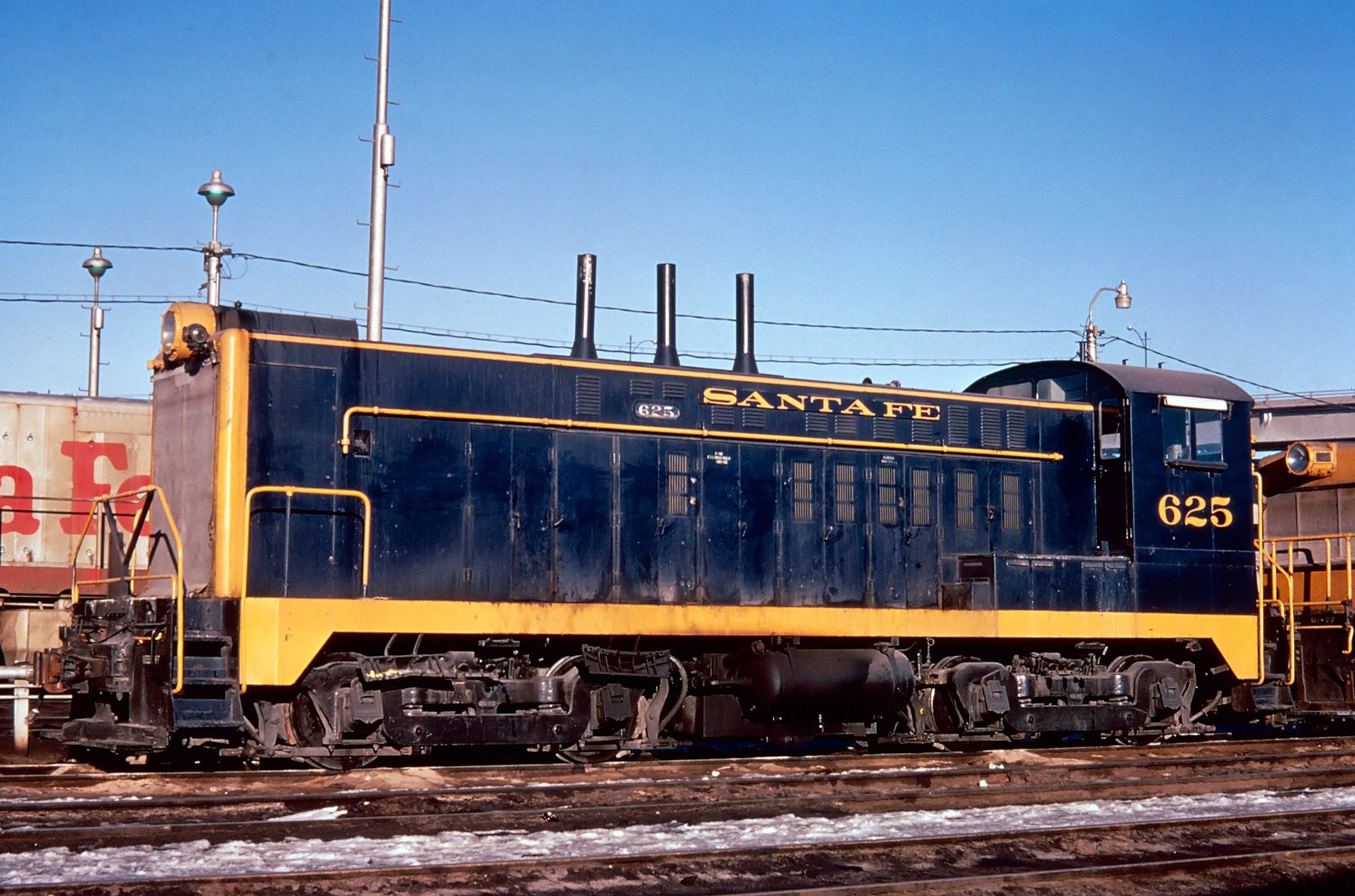 Santa Fe DS-4-4-750 #625 at Argentine Yard in Argentine, Kansas, circa 1965. American-Rails.com collection.
The DS-4-4-750 began production in the summer of 1949 using the builder's latest 606NA model prime mover. Producing 750 horsepower, the DS-4-4-750 was a mid-grade switcher as Baldwin also produced a 660 horsepower and 1,000 horsepower model.
Using a B-B truck arrangement the model found a diversity of buyers from Class I railroads like the Pennsylvania, Erie, and Santa Fe to industrial companies like American Cynamid, Youngstown Sheet & Tube, and American Steel & Wire.
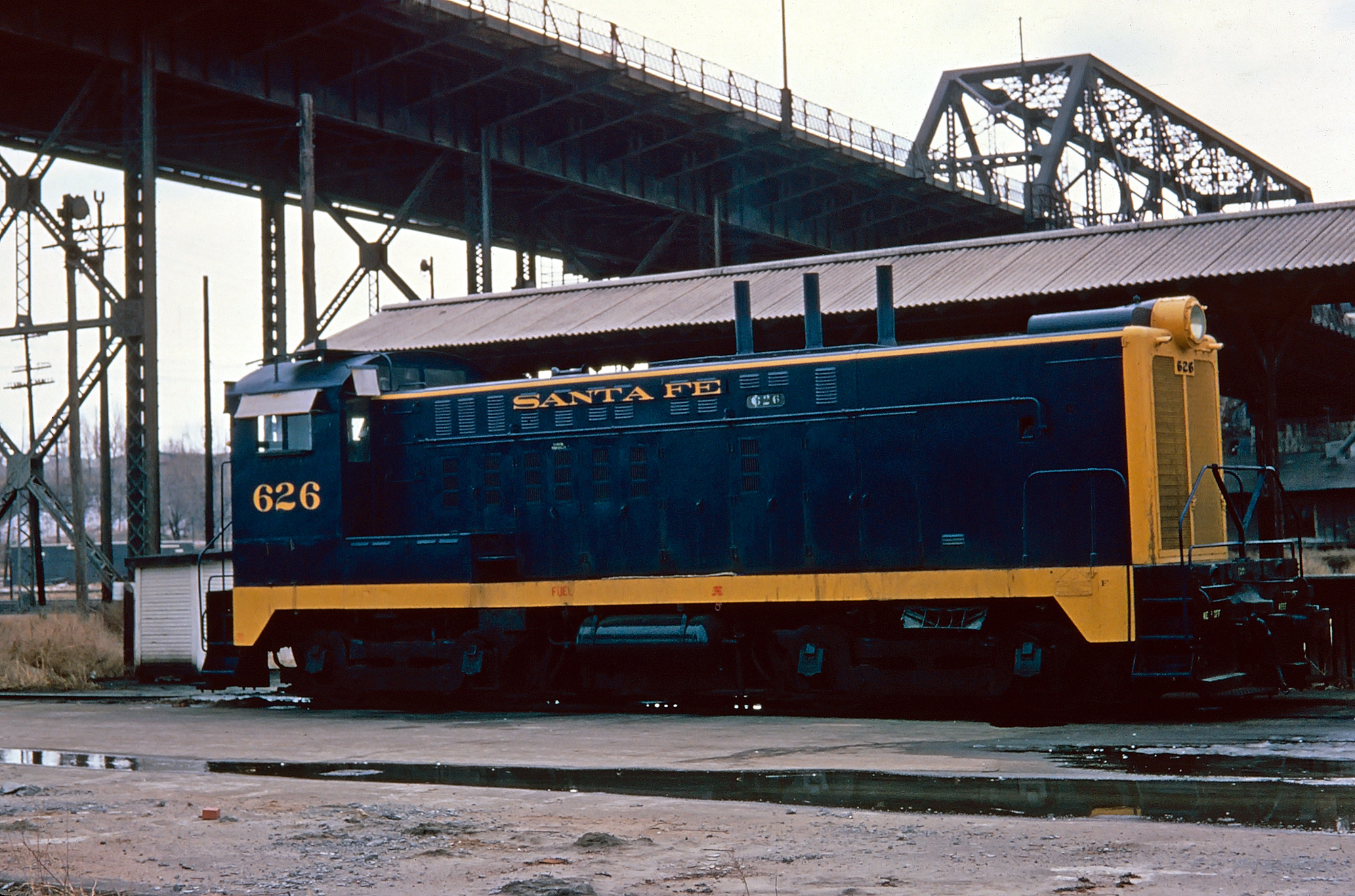


As with the American Locomotive, Baldwin at the time still held a loyal following by some railroads that had worked with it for years during the reign of steam. The PRR, for instance, purchased examples of nearly every Baldwin diesel it ever produced.
Data Sheet and Specifications
| Entered Production | 7/15/1949 (Santa Fe #525) |
| Years Produced | 7/15/1946-2/23/1951 |
| Baldwin Class | DS-4-4-750 |
| Engine | 606NA, 6-Cylinder In-Line |
| Engine Builder | De La Vergne |
| Horsepower | 750 |
| RPM | 625 |
| Carbody Styling | Baldwin |
| Length (Between Coupler Pulling Faces) | 48' |
| Weight | 200,000 Lbs |
| Height (Top Of Rail To Top Of Cab) | 14' |
| Width | 10' |
| Trucks | B-B |
| Truck Type | GSC Rigid Bolster, Drop-Side Equalizer |
| Truck Wheelbase | 8' |
| Wheel Size | 40" |
| Traction Motors | 362D (4), Westinghouse |
| Traction Generator | 480F, Westinghouse |
| Auxiliary Generator | YG42A, Westinghouse |
| Gear Ratio | 16:76 |
| Tractive Effort Rating | 33,600 Lbs at 8.3 MPH. |
| Top Speed | 45 MPH |
Production Roster
Total Built = 53
| Owner | Road Number | Baldwin Serial Number | Construction Number | Completion Date |
|---|---|---|---|---|
| Atchison, Topeka & Santa Fe | 525 | 1 | 74394 | 7/15/1949 |
| Atchison, Topeka & Santa Fe | 526 | 2 | 74395 | 7/27/1949 |
| Atchison, Topeka & Santa Fe | 527 | 3 | 74396 | 7/14/1949 |
| Atchison, Topeka & Santa Fe | 528 | 4 | 74397 | 7/14/1949 |
| Atchison, Topeka & Santa Fe | 529 | 5 | 74398 | 7/16/1949 |
| Atchison, Topeka & Santa Fe | 530 | 6 | 74399 | 7/15/1949 |
| Atchison, Topeka & Santa Fe | 531 | 7 | 74400 | 7/23/1949 |
| Atchison, Topeka & Santa Fe | 532 | 8 | 74401 | 7/23/1949 |
| Atchison, Topeka & Santa Fe | 533 | 9 | 74402 | 7/19/1949 |
| Youngstown Sheet & Tube | 608 | 10 | 74405 | 8/8/1949 |
| Youngstown Sheet & Tube | 609 | 11 | 74406 | 8/8/1949 |
| Youngstown Sheet & Tube | 610 | 12 | 74407 | 8/8/1949 |
| California Western | 51 | 13 | 74408 | 8/19/1949 |
| California Western | 52 | 14 | 74409 | 8/19/1949 |
| Erie Railroad | 386 | 15 | 74430 | 8/5/1949 |
| Erie Railroad | 387 | 16 | 74431 | 8/5/1949 |
| Erie Railroad | 388 | 17 | 74432 | 8/5/1949 |
| Erie Railroad | 389 | 18 | 74433 | 8/5/1949 |
| Texas-Mexican Railway | 509 | 19 | 74594 | 7/16/1949 |
| Texas-Mexican Railway | 510 | 20 | 74595 | 7/18/1949 |
| American Steel & Wire | 20 | 21 | 74674 | 8/16/1949 |
| Pennsylvania | 5595 | 22 | 74720 | 5/17/1950 |
| Pennsylvania | 5596 | 23 | 74721 | 5/29/1950 |
| Pennsylvania | 5597 | 24 | 74722 | 5/24/1950 |
| Pennsylvania | 5598 | 25 | 74723 | 5/29/1950 |
| Pennsylvania | 5599 | 26 | 74724 | 6/12/1950 |
| Pennsylvania | 5600 | 27 | 74725 | 6/12/1950 |
| Pennsylvania | 5601 | 28 | 74726 | 6/14/1950 |
| Pennsylvania | 5602 | 29 | 74727 | 6/13/1950 |
| Pennsylvania | 5603 | 30 | 74728 | 6/14/1950 |
| Pennsylvania | 5604 | 31 | 74729 | 6/15/1950 |
| Pennsylvania | 5605 | 32 | 74730 | 6/19/1950 |
| Pennsylvania | 5606 | 33 | 74731 | 6/19/1950 |
| Pennsylvania | 5607 | 34 | 74732 | 6/20/1950 |
| Pennsylvania | 5608 | 35 | 74733 | 6/20/1950 |
| Pennsylvania | 5609 | 36 | 74734 | 6/21/1950 |
| Pennsylvania | 5610 | 37 | 74735 | 6/22/1950 |
| Pennsylvania | 5611 | 38 | 74736 | 6/23/1950 |
| Pennsylvania | 5612 | 39 | 74737 | 6/26/1950 |
| Pennsylvania | 5613 | 40 | 74738 | 6/26/1950 |
| Pennsylvania | 5614 | 41 | 74739 | 6/27/1950 |
| Pennsylvania | 5615 | 42 | 74740 | 6/28/1950 |
| Pennsylvania | 5616 | 43 | 74741 | 6/28/1950 |
| Pennsylvania | 5617 | 44 | 74742 | 6/29/1950 |
| Pennsylvania | 5618 | 45 | 74743 | 6/30/1950 |
| American Cyanamid Company | 14 | 46 | 74784 | 3/24/1950 |
| Warner Company | 14 | 47 | 74785 | 4/4/1950 |
| Baldwin | 301* | 48 | 74813 | 7/19/1950 |
| Baldwin | 750 (Became Weyerhaeuser Timber Company #101) | 49 | 74814 | 6/1950 |
| Baldwin | 751 (Became Weyerhaeuser Timber Company #102) | 50 | 74815 | 6/1950 |
| Weyerhaeuser Timber Company | 101 | 49 | 74814 | Acquired 10/28/1950 |
| Weyerhaeuser Timber Company | 102 | 50 | 74815 | Acquired 11/15/1950 |
| Youngstown Sheet & Tube | 700 | 51 | 73657 | 2/21/1950 |
| Youngstown Sheet & Tube | 701 | 52 | 73658 | 2/22/1950 |
| Youngstown Sheet & Tube | 702 | 53 | 73659 | 2/23/1950 |
* Originally Baldwin's plant switcher, #300. It became Weyerhaeuser Timber #301 on January 29, 1956.
Sources
- Foster, Gerald. A Field Guide To Trains. New York: Houghton Mifflin, 1996.
- Kirkland, John F. Diesel Builders, The: Volume Three, Baldwin Locomotive Works. Pasadena: Interurban Press, 1994.
- Pinkepank, Jerry A. Diesel Spotter's Guide. Milwaukee: Kalmbach Publishing Company, 1967.
- Solomon, Brian. Baldwin Locomotives. Minneapolis: Voyageur Press, 2009.
After less than two years in production, Baldwin removed the DS-4-4-750 from its catalog, replacing it with the S-8 (the offered just slightly more horsepower) and the more powerful S-12.
The DS-4-4-750, and later DS-4-4-1000, also ended the company's use of its confusing classification system, which could be traced back to the steam era and "Whyte Notation."
In 1950, after it released upgraded prime movers (the model 606 and 608) it likewise used a simpler system of model type and horsepower (for instance, the S-12 meant Switcher, 1,200 horsepower).
SteamLocomotive.com
Wes Barris's SteamLocomotive.com is simply the best web resource on the study of steam locomotives.
It is difficult to truly articulate just how much material can be found at this website.
It is quite staggering and a must visit!