EMD MP15 Switcher Locomotives

Last revised: January 22, 2024
By: Adam Burns
The MP15 series was Electro-Motive's immediate follow-up to the earlier SW1500 line, manufactured between 1966 - 1974. This was the first switcher EMD offered as essentially a potential road-switcher with its 1,500 horsepower and operational Blomberg trucks.
This continued with the MP15 where Blombergs became standard and was even equipped with larger fuel tank for main line freight service. EMD also lengthened the frame and the model also featured the same electrical components as the builder's "Dash 2" line of road-switchers.
When EMD released alternating current technology in 1975; this changed the designation of the original model to MP15DC and the new variant as the MP15AC.
In addition, the MP15T was later offered in 1984 sporting a turbocharged eight-cylinder prime mover for improved fuel economy. Overall, the series sold relatively well and many MP15's remain in service on both large and small railroads.
Photos
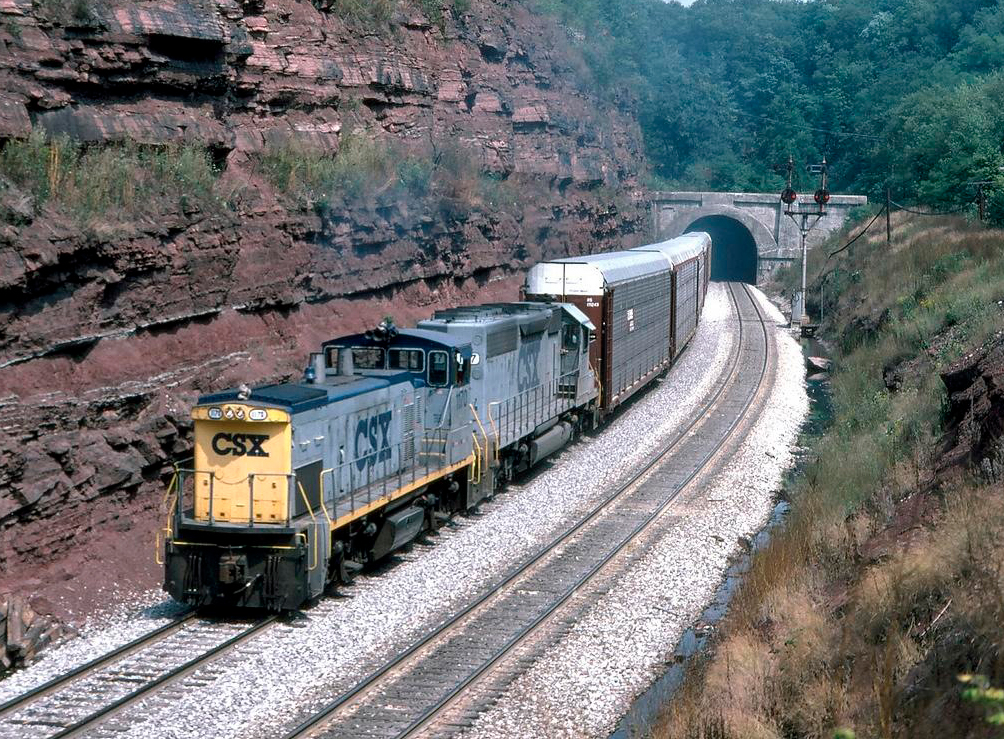 CSX MP15AC #1170 leads westbound autorack train Q219 over Sand Patch on August 28, 1993. Wade Massie photo.
History and Background
Throughout the history of Electro-Motive's switcher line the builder saw successful sales, more than could be said for its road-switchers after the 1980s.
From the earliest SC and NW models to the final series presented here, the manufacturer produced thousands of switchers, many of which remain on Class I rosters for light-duty service.
The MP15 (later redesignated as the MP15DC) was the first in the series and interestingly, was meant to not only for yard, industrial, and light branch duties but also as a general road switcher. It replaced the earlier SW1500, featuring a larger fuel tank (1,400 gallons) and Blomberg trucks as standard for general road service.
Interestingly, EMD actually considered the MP15 a true road-switcher rather than a switcher. While it carried the look of the latter, internally it was indeed a small road switcher, essentially a GP7.
With the introduction of the MP15AC in August, 1975, EMD made a number of updates to the locomotive. As Bob Hayden notes in his book, "Diesel Locomotives: Cyclopedia, Volume 2," it was 18 inches longer than the MP15DC which allowed for a larger fuel tank (1,600 gallons).
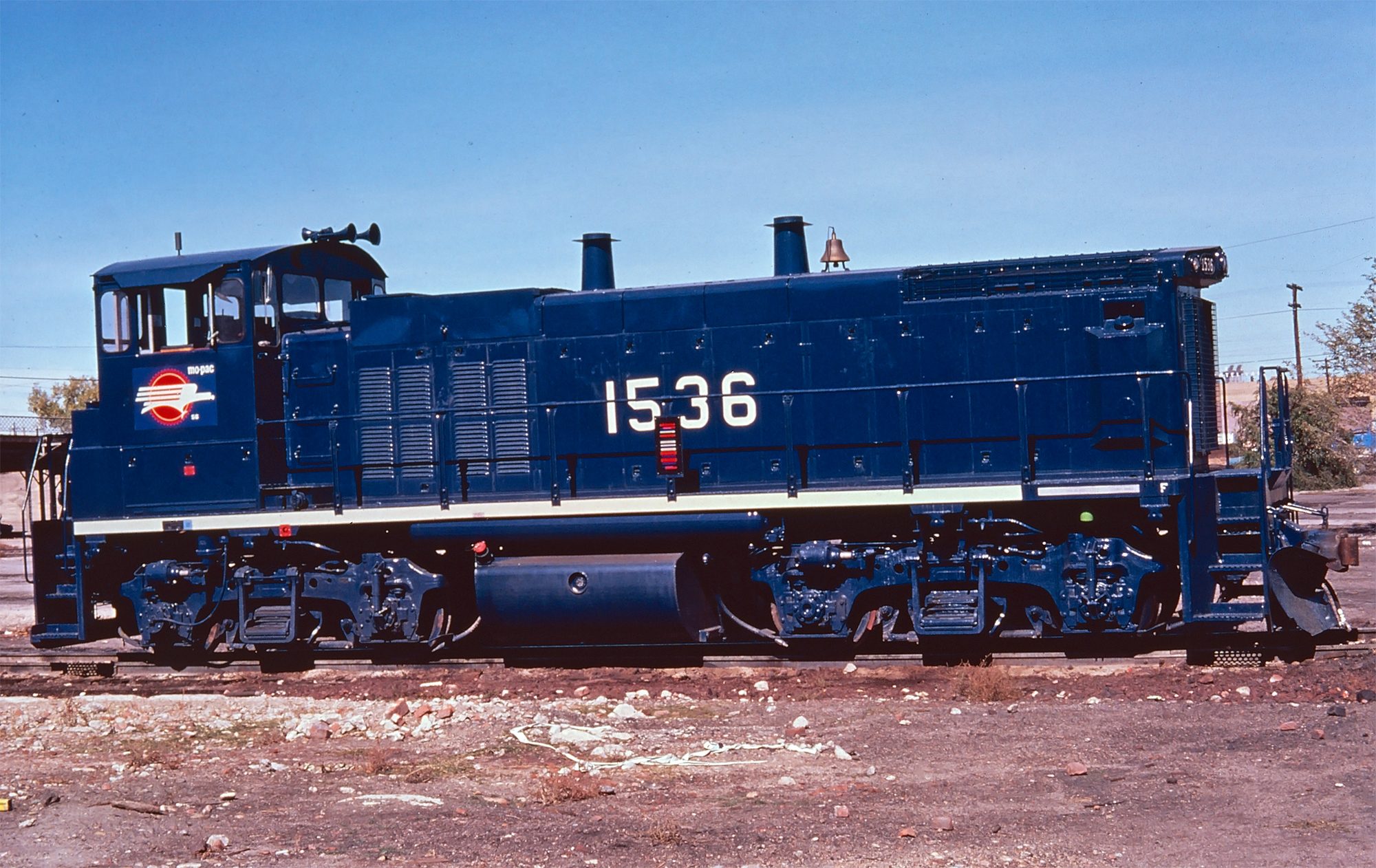 A recently delivered Missouri Pacific MP15DC, #1536, in the fall of 1974. American-Rails.com collection.
In addition, EMD moved the radiator air-intakes to the lower side of the hood on the locomotive's pilot end. As Louis Marre points out in his book, "The Contemporary Diesel Spotters Guide: A Comprehensive Reference Manual To Locomotives Since 1972," this design was actually based from EMD's successful SD40T-2 and SD45T-2, the so-called "Tunnel Motors."
These powerful road-switchers were almost entirely purchased by Southern Pacific (along with the Rio Grande) and featured air intakes low on the frame to grab fresh air as through the many tunnels and snowsheds on Donner Pass.
Marre goes on to note the MP15 series was marketed to railroads as a combination switcher/light road-switcher to replace aging GP7s and GP9s. Interestingly, its lack of a toilet ultimately hindered sales as some state laws required this feature on locomotives used as either lead units or in MU sets outside of yard work.
In addition, the MP15AC was more expensive than its earlier counterpart (MP15DC), further hurting sales. Nevertheless, it did sell relatively well. The MP15AC accomplished its use of "AC" power by using an alternator, which then converted the power back to DC, through the use of a silicon rectifier.
Data Sheet and Specifications
| Entered Production | 2/1974 (Missouri Pacific #1530) |
| Years Produced (MP15DC) | 2/1974 - 1/1983 |
| Years Produced (MP15AC) | 8/1975 - 12/1983 |
| Years Produced (MP15T) | 10/1984 - 5/1987 |
| EMD Class | MP15DC, MP15AC, MP15T |
| Engine (MP15DC, MP15AC) | 645E (12 Cylinder) |
| Engine (MP15T) | 645E (8 Cylinder, Turbocharged) |
| Engine Builder | EMD/GM |
| Horsepower | 1500 |
| RPM | 800 |
| Length (MP15DC) | 47' 8" |
| Length (MP15AC) | 49' 2" |
| Length (MP15T) | 50' 2" |
| Height (Top Of Rail To Top Of Cab) | 15' 0" |
| Width | 10' 3" |
| Weight | 250,000 Lbs |
| Fuel Capacity (MP15DC) | 1400 Gallons |
| Fuel Capacity (MP15AC, MP15T) | 1600 Gallons |
| Air Compressor | WXO (Gardner-Denver) |
| Air Brake Schedule | 24L (Westinghouse) |
| Trucks | B-B |
| Truck Type | Blomberg |
| Truck Wheelbase | 9' 0" |
| Wheel Size | 40" |
| Traction Motors (MP15DC) | D77 (4), EMD/GM |
| Traction Motors (MP15AC, MP15T) | D79AR10 (4), EMD/GM |
| Traction Generator (MP15DC) | D15C, EMD/GM |
| Traction Alternator (MP15AC, MP15T) | D14, EMD/GM |
| Auxiliary Generator | EMD/GM |
| MU (Multiple-Unit) | Optional |
| Dynamic Brakes | No |
| Gear Ratio | 62:15 |
| Tractive Effort/Starting | 62,000 Lbs |
| Tractive Effort/Continuous | 48,800 Lbs at 9.3 mph |
| Top Speed | 65 mph |
Production Rosters
MP15DC
Total Built = 339
| Owner | Road Number | Order Number/Serial Number | Completion Date |
|---|---|---|---|
| Southern Pacific | 2690-2696 | 73625-1 thru 73625-7 | 12/1974 |
| Union Railroad | 10-14 | 73645-1 thru 73645-5 | 7/1974 |
| Missouri Pacific | 1530-1534 | 73749-1 thru 73749-5 | 2/1974 |
| Missouri Pacific | 1535-1539 | 73678-1 thru 73678-5 | 9/1974 |
| Missouri Pacific | 1540-1544 | 73778-1 thru 73778-5 | 9/1974 |
| Pittsburgh & Lake Erie | 1574-1583 | 73694-1 thru 73694-10 | 6/1974 - 7/1974 |
| Cities Service Corporation | 109 | 74618-1 | 7/1974 |
| Rockdale, Sandow & Southern | 13-15 | 74620-1 thru 74620-3 | 11/1974 |
| Bauxite & Northern | 15-16 | 74621-1 and 74621-2 | 11/1974 |
| Point Comfort & Northern | 11-13 | 74622-1 thru 74622-3 | 11/1974 |
| Reading | 2771-2780 | 74641-1 thru 74641-10 | 12/1974 |
| St Marys Railroad | 504 | 74645-1 | 10/1974 |
| Chicago & North Western | 1307-1316 | 74662-1 thru 74662-10 | 3/1975 |
| Chicago & North Western | 1302-1306 | 74762-1 thru 74762-5 | 2/1975 |
| Union Railroad | 15-21 | 74667-1 thru 74667-7 | 6/1975 - 7/1975 |
| Pittsburgh & Lake Erie | 1584-1598 | 74668-1 thru 74668-15 | 5/1975 |
| Louisville & Nashville | 5030-5039 | 74778-1 thru 74778-10 | 1/1975 |
| Belt Railway of Chicago | 533-534 | 74683-1 and 74683-2 | 6/1975 |
| Missouri Pacific | 1545-1554 | 74791-1 thru 74791-10 | 2/1975 |
| Kansas City Southern | 4363-4366 | 74692-1 thru 74692-4 | 8/1975 |
| St Louis-San Francisco Railway (Frisco) | 361-365 | 74694-1 thru 74694-5 | 3/1975 |
| Southern Pacific | 2697-2701 | 74697-1 thru 74697-5 | 1/1975 - 2/1975 |
| Manufacturers Railway (St. Louis) | 251-252 | 75611-1 and 75611-2 | 8/1975 |
| W.R. Grace & Company | 121-122 | 75612-1 and 75612-2 | 8/1975 |
| North Louisiana & Gulf | 42-45 | 75619-1 thru 75619-4 | 11/1975 |
| Cambria & Indiana Railroad | 19-20 | 75627-1 and 75627-2 | 8/1975 |
| Tennessee Eastman | 2 | 756060-1 | 11/1975 |
| Union Railroad | 22-24 | 756070-1 thru 756070-3 | 3/1976 |
| Texas & Northern | 998-999 | 756085-1 and 756085-2 | 12/1975 |
| U.S. Steel-Fairfield Works | 170 | 756100-1 | 5/1976 |
| U.S. Steel-Minntac Works | 955-965 | 756119-1 thru 756119-11 | 5/1976 |
| Brewster Phosphates | 18 | 756127-1 | 1/1976 |
| Lake Erie, Franklin & Clarion | 25 | 756146-1 | 8/1976 |
| Arizona Public Service | 2 | 756149-1 | 6/1977 |
| Terminal Railway-Alabama State Docks | 761 | 756150-1 | 8/1976 |
| St. Marys Railroad | 505 | 756156-1 | 6/1976 |
| Swift & Company | 1976 | 756158-1 | 12/1976 |
| U.S. Steel-Minntac Works | 966-968 | 766000-1 thru 760000-3 | 8/1976 |
| Kelly's Creek & Northwestern | 1 | 766006-1 | 12/1976 |
| Union Railroad | 25-26 | 766013-1 and 766013-2 | 12/1976 |
| Birmingham Southern | 260-261 | 766014-1 and 766014-2 | 8/1976 |
| Southern | 2348-2373 | 767051-1 thru 767051-26 | 6/1977 - 7/1977 |
| Union Railroad | 27-33 | 766057-1 thru 766057-7 | 2/1977 |
| Terminal Railway-Alabama State Docks | 771-772 | 776002-1 and 776002-2 | 10/1977 |
| Lake Erie, Franklin & Clarion | 26 | 776021-1 | 10/1977 |
| Lake Erie, Franklin & Clarion | 27 | 786122-1 | 12/1978 |
| Georgetown Railroad | 1011 | 786144-1 | 12/1978 |
| Southern | 2374-2383 | 787185-1 thru 787185-10 | 9/1979- 10/1979 |
| Lake Erie, Franklin & Clarion | 28 | 786234-1 | 11/1979 |
| Gulf Oil Company | 101 | 786235-1 | 9/1979 |
| Houston Belt & Terminal | 60-64 | 786236-1 thru 786236-5 | 10/1979 |
| Southern | 2384-2393 | 787244-1 thru 787244-10 | 11/1979 |
| Alcoa Terminal | 7 | 786247-1 | 2/1980 |
| Terminal Railway-Alabama State Docks | 801-802 | 796300-1 and 796300-2 | 10/1980 |
| Belt Railway of Chicago | 535-536 | 796302-1 and 796302-2 | 2/1980 |
| Genesee & Wyoming | 45-46 | 796350-1 and 796350-2 | 10/1980 - 11/1980 |
| Kelly's Creek & Northwestern | 2 | 796358-1 | 10/1980 |
| Brewster Phosphates | 19 | 796371-1 | 11/1980 |
| Alton & Southern | 1522 | 796374-1 | 11/1980 |
| W.R. Grace & Company | 131-132 | 796376-1 and 796376-2 | 10/1980 - 11/1980 |
| Graysonia, Nashville & Ashdown | 80 | 796377-1 | 10/1980 |
| Point Comfort & Northern | 14-15 | 796384-1 and 796384-2 | 11/1980 |
| Georgetown Railroad | 1012 | 806028-1 | 11/1980 |
| Southern | 2404-2435 | 817015-1 thru 817015-32 | 4/1982 - 5/1982 |
| Missouri Pacific | 1356-1375 | 817019-1 thru 817019-20 | 1/1982 |
| Metro Sanitary District of Greater Chicago | 4 | 816030-1 | 1/1983 |
| Terminal Railway-Alabama State Docks | 821-822 | 816033-1 and 816033-2 | 6/1982 |
| Southern | 2394-2403 | 817037-1 and 817037-10 | 5/1982 - 6/1982 |
| Missouri Pacific | 1376-1392 | 827018-1 thru 827018-17 | 11/1982 - 12/1982 |
| Manufacturers Railway | 254 | 826025-1 | 1/1983 |
| Texas City Terminal | 35-37 | 827028-1 thru 827028-3 | 11/1982 |
MP15AC
Total Built = 217
| Owner | Road Number | Order Number/Serial Number | Completion Date |
|---|---|---|---|
| Milwaukee Road | 466-497 | 75625-1 thru 75625-32 | 10/1975 - 11/1975 |
| Milwaukee Road | 434-465 | 75629-1 thru 75629-32 | 1/1976 - 2/1976 |
| Southern Pacific | 2732-2735 | 756053-1 thru 756053-4 | 10/1975 |
| Southern Pacific | 2702-2731, 2736-2759 | 756064-1 thru 756064-54 | 8/1975 - 9/1975 |
| Electro-Motive (Demonstrator) | 115 (became Georgetown Railroad 1013) | 757129-1 | 10/1975 |
| Kennecott Copper Corporation | 906 | 756152-1 | 12/1976 |
| Long Island Rail Road | 150-172 | 766043-1 thru 766043-23 | 3/1977 - 4/1977 |
| Seaboard Coast Line | 4000-4019 | 777024-1 thru 777024-20 | 10/1977 |
| Seaboard Coast Line | 4200-4224 | 777032-1 thru 777032-25 | 2/1978 |
| Louisville & Nashville | 4225-4234 | 777038-1 thru 777038-10 | 3/1978 |
| Kennecott Copper Corporation | 701,704 | 776117-1 and 776117-2 | 12/1978 |
| Kennecott Copper Corporation | 120-122 | 776128-1 thru 776128-3 | 12/1978 |
| Electro-Motive (Demonstrator) | 116 | 787150-1 | 7/1978 |
| Weyerhaeuser (Golden Triangle) | G1 | 796389-1 | 10/1980 |
| Terminal Railway-Alabama State Docks | 803 | 806003-1 | 10/1980 |
| Missouri-Kansas-Texas (Katy) | 56-59 | 806026-1 thru 806026-4 | 10/1980 |
| Eastman Kodak | 10 | 806035-1 | 4/1981 |
| Rockwell-Hanford | 3728 | 816059-1 | 9/1982 |
| Rockwell-Hanford | 3727 | 836053-1 | 12/1983 |
MP15T
Total Built = 43
| Owner | Road Number | Order Number/Serial Number | Completion Date |
|---|---|---|---|
| Seaboard System | 1200-1214 | 837079-1 thru 837079-15 | 10/1984 - 11/1984 |
| Seaboard System | 1215-1222 | 847037-1 thru 847037-8 | 3/1985 |
| Seaboard System | 1223-1241 | 857074-1 thru 857074-19 | 11/1985 - 12/1985 |
| Dow Chemical | 957 | 866139-1 | 5/1987 |
Export Production Roster
MP15DC
Total Built = 12
| Owner | Road Number | Serial Number | Order Number | Completion Date |
|---|---|---|---|---|
| BC Hydro & Power Authority | 151-153 | 75626-1 thru 75626-3 | C377 (General Motors Diesel) | 11/1975 |
| Altos Hornos de México (Mexico) | 146-148 | 756093-1 thru 756093-3 | - | 01/76 |
| Quebec Iron & Titanium (Romaine River Railway) | 9 | 768030-1 | C402 (General Motors Diesel) | 3/1977 |
| Mexico Minerals (Mexico) | No Number | 788018-1 | - | 10/1979 |
| Altos Hornos de México (Mexico) | 159 | 788061-1 | - | 12/1978 |
| Quebec Iron & Titanium (Romaine River Railway) | 10 | 808008-1 | C433 (General Motors Diesel) | 10/1980 |
| Altos Hornos de México (Mexico) | 166 | 808010-1 11/80 | - | 11/80 |
| Mexico Minerals (Mexico) | No Number | 808050-1 | - | 1/1982 |
MP15AC
Total Built = 25
| Owner | Road Number | Serial Number | Completion Date |
|---|---|---|---|
| Ferrocarril Nacional de México | 9801-9825 | 818040-1 thru 818040-25 | 6/1983 - 7/1983 |
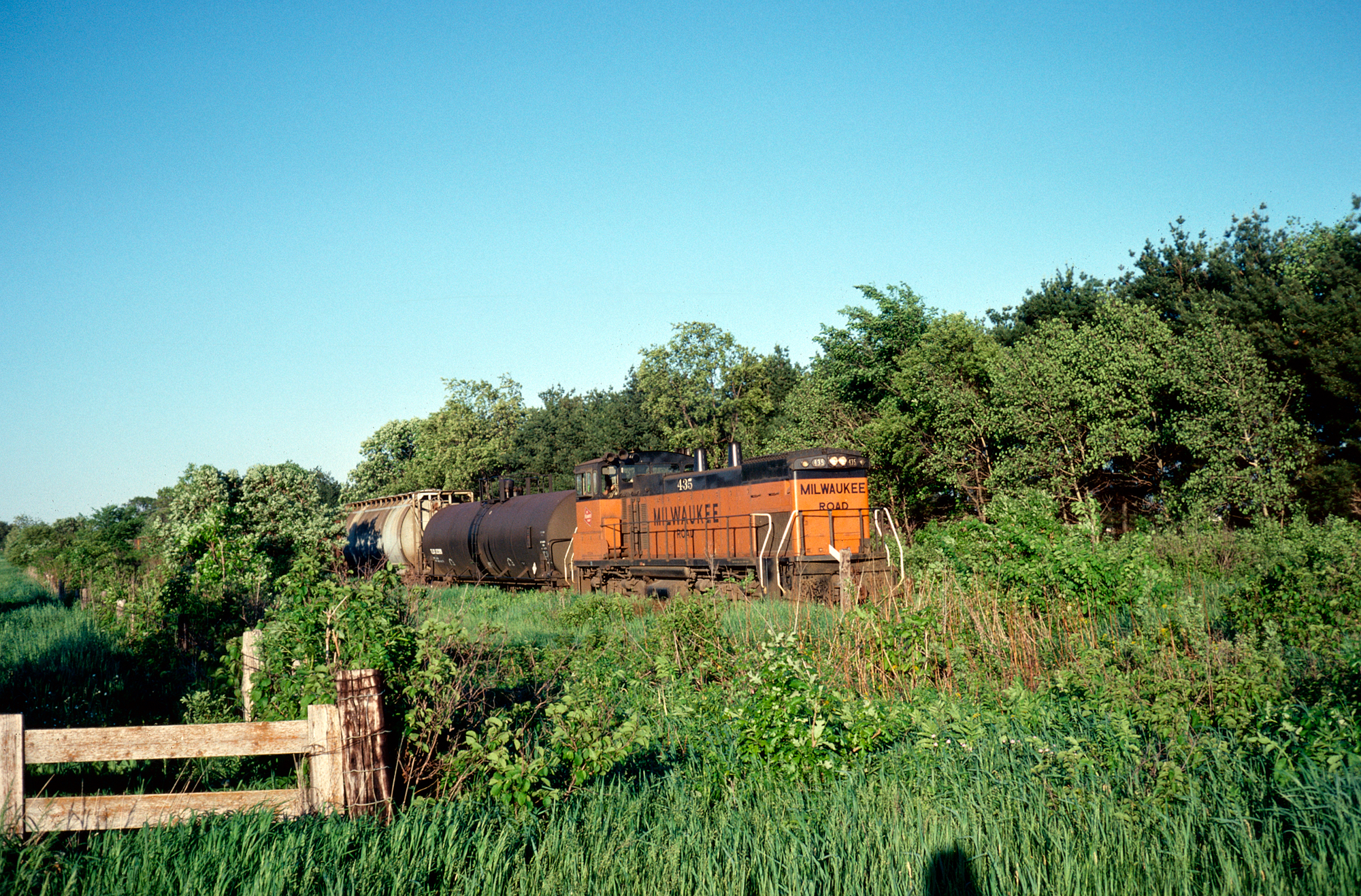 Milwaukee Road MP15AC #435 leads a short freight eastbound near Brodhead, Wisconsin on May 31, 1978. Richard Kundert photo. American-Rails.com collection.
The MP15T was essentially a variant of the MP15AC in that it featured a turbocharged prime mover, which was meant to be more fuel efficient (it was also slightly longer than the MP15AC at 50' 2") using only an eight-cylinder version of EMD's 645E prime mover.
The model was built between October, 1984 and November, 1987. Few MP15Ts were ever built, as all but one were manufactured for the Seaboard System, which purchased 42 units.
Sources
- Foster, Gerald. A Field Guide To Trains. New York: Houghton Mifflin, 1996.
- Hayden, Bob. Diesel Locomotives: Cyclopedia, Volume 2 (Model Railroader). Milwaukee: Kalmbach Publishing Company, 1980.
- McDonnell, Greg. Locomotives: The Modern Diesel & Electric Reference, 2nd Edition. Buffalo: Boston Mills Press/Firefly Books, 2015.
- Marre, Louis A. and Pinkepank, Jerry A. Contemporary Diesel Spotter's Guide, The: A Comprehensive Reference Manual To Locomotives Since 1972. Milwaukee: Kalmbach Publishing Company, 1989.
- Solomon, Brian. EMD Locomotives. Minneapolis: MBI Publishing Company, 2006.
Contents
SteamLocomotive.com
Wes Barris's SteamLocomotive.com is simply the best web resource on the study of steam locomotives.
It is difficult to truly articulate just how much material can be found at this website.
It is quite staggering and a must visit!