FM's "H20-44": Its Most Powerful Switcher Model

Last revised: January 28, 2024
By: Adam Burns
The H20-44 was the most powerful switcher Fairbanks-Morse cataloged. It was also powerful true switcher ever built at 2,000 horsepower.
In fact, the locomotive was so powerful that John Kirkland notes in his book, "The Diesel Builders: Fairbanks-Morse And Lima Hamilton," all of its 2,000 horses could not be used in a true switching capacity.
The only way to do so was by using the locomotive in a transfer or road-switcher capacity were it was operating in main line service.
While the H20-44 sold better than other FM models, overall its sale were only lukewarm. Few Fairbanks-Morse diesel locomotives were ever preserved but thankfully, three H20-44's were saved and are on display at various museums around the country.
Photos
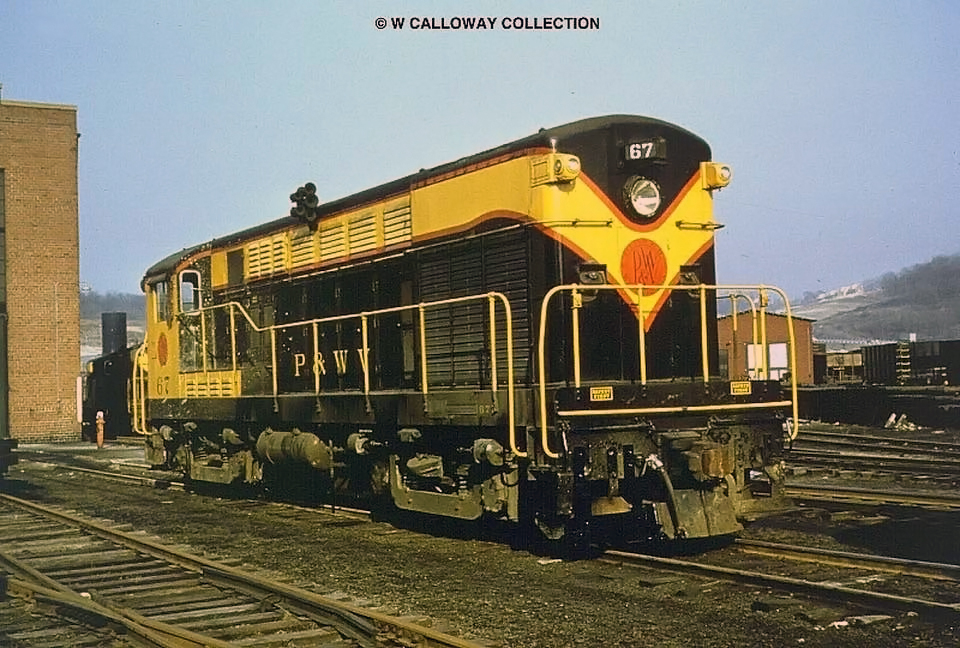 Pittsburgh & West Virginia H20-44 #67 is seen here at Rook Yard (Pennsylvania) during the 1950s. Warren Calloway collection.
%20during%20the%201950s.%20%20Warren%20Calloway%20collection.)
Overview
The H20-44 debuted in August, 1947 when it was featured at the AAR Convention in Atlantic City, New Jersey alongside H15-44 #1500 and a pair of Erie-Built 'A' units.
FM was in such a rush to finish the H20-44 demonstrator, #2000, that paint crews had to finish the job on site!
The locomotive used the builder's standard 2-cycle 38D8 1/8 O-P prime mover (10 cylinders).
Additionally, it featured swing bolster, drop-side equalizer trucks with all internal electrical components outsourced from Westinghouse.
Aside from the high horsepower rating, the H20-44 featured a tractive effort rating of 42,800 pounds (at 14.7 mph) with 63:15 gearing. No other gearing was optional on this unit.
At 51 feet in length it was somewhat shorter than either of FM's lightweight road-switcher models, the H15-44 and H16-44.
As was the case with most of FM's diesel locomotive models the company hired famed industrial designer Raymond Loewy to give the H20-44 fine lines and exterior features.
Finding such design features somewhat frivolous and doing little to boost sales, FM scrapped Loewy's recommendations in the model's latter years of production to save on construction costs.
In any event, Fairbanks-Morse apparently learned from the unsuccessful nature of the H20-44 and offered no future switcher-type models that included such a high horsepower rating.
Instead, in 1950 it released the H12-44 switcher that went on to become its most successful such design.
In regards to the model's classification system, it was more or less similar to what Baldwin used in its early diesel designs but was not quite as complicated in understanding.
For example, the H20-44's designation was as follows:
- "H" stood for Hood unit
- "20" was the horsepower rating
- Each 4 meant four axles and four traction motors
Reception
When production had ended in March, 1954 the H20-44 had sold just 96 units to a handful of railroads. The Pennsylvania wound up with the most, 38 examples.
While FM locomotives were not the unreliable machines that is often portrayed in historical texts, the H20-44 was not an especially great design.
It was too powerful as as switcher and is why the H12-44 (at 1,200 horsepower) was much more suited for this role. Interestingly, as a road or transfer switcher the H20-44 proved much more successful.
The small Akron, Canton & Youngstown of northern Ohio and nearby Pittsburgh & West Virginia, for instance, employed theirs in daily road assignments for many years.
Data Sheet and Specifications
| Entered Production | 8/1947 (Demonstrator #2000) |
| Years Produced | 8/1947 - 3/1954 |
| Fairbanks-Morse Class | H20-44 |
| Engine | 38D8 1/8, 10-cylinder Opposed-Piston |
| Engine Builder | Fairbanks-Morse |
| Horsepower | 2000 |
| RPM | 850 |
| Carbody Styling | Raymond Loewy |
| Length (Inside Couplers) | 51' |
| Height (Top Of Rail To Top Of Cab) | 14' 6" |
| Width | 10' 6" |
| Weight | 250,000 Lbs |
| Trucks | B-B |
| Truck Type | GSC Swing Bolster, Drop-Side Equalizer |
| Truck Wheelbase | 9' 6" |
| Wheel Size | 40" |
| Traction Motors | 370F (4), Westinghouse |
| Traction Generator | 474A, Westinghouse |
| Auxiliary Generator | YG45A, Westinghouse |
| MU (Multiple-Unit) | Yes |
| Gear Ratio | 63:15 |
| Tractive Effort | 42,800 Lbs at 14.7 mph |
| Top Speed | 65 mph |
Production Roster
Total Built = 96
| Owner | Road Number | Construction Number | Contract Number | Completion Date | Quantity |
|---|---|---|---|---|---|
| Fairbanks Morse (Demo) | 2000* | L1032 | LD43 | 8/1947 | 1 |
| Union Pacific | DS1365 | L1031 | LD43 | 10/1947 | 1 |
| Union Pacific | DS1360-DS1364 | L1033-L1037 | LD39 | 8/1947 | 5 |
| Pittsburgh & West Virginia | 50-51 | L1038-L1039 | LD40 | 10/1947 | 2 |
| Union Pacific | DS1367 | L1040 | LD43 | 11/1947 | 1 |
| Union Pacific | DS1368-DS1370 | L1041-L1043 | LD43 | 12/1947 | 3 |
| Akron, Canton & Youngstown | 500-502 | L1044-L1046 | LD42 | 1/1948 | 3 |
| Akron, Canton & Youngstown | 503 | L1047 | LD42 | 2/1948 | 1 |
| Indiana Harbor Belt (New York Central) | 7110-7114 | 20L18-20L22 | LD55 | 7/1948 | 5 |
| Indiana Harbor Belt (New York Central) | 7100-7102 | 20L23-20L25 | LD44 | 7/1948 | 3 |
| Indiana Harbor Belt (New York Central) | 7103-7104 | 20L26-20L27 | LD44 | 8/1948 | 2 |
| Indiana Harbor Belt (New York Central) | 7105 | 20L28 | LD44 | 9/1948 | 1 |
| Indiana Harbor Belt (New York Central) | 7106-7109 | 20L29-20L32 | LD44 | 10/1948 | 4 |
| Pittsburgh & West Virginia | 52-53 | 20L33-20L34 | LD58 | 10/1948 | 2 |
| Indiana Harbor Belt (New York Central) | 7115-7116 | 20L35-20L36 | LD61 | 9/1948 | 2 |
| Pennsylvania | 9305-9307 | 20L37-20L39 | LD65 | 12/1948 | 3 |
| Pennsylvania | 9308-9309 | 20L40-20L41 | LD65 | 1/1949 | 2 |
| Pennsylvania | 9300-9301 | 20L42-20L43 | LD65 | 1/1949 | 2 |
| Pennsylvania | 9302-9304 | 20L44-20L46 | LD65 | 2/1949 | 3 |
| Pennsylvania | 9310 | 20L47 | LD65 | 2/1949 | 1 |
| Pennsylvania | 9311 | 20L48 | LD65 | 3/1949 | 1 |
| Indiana Harbor Belt (New York Central) | 7117 | 20L49 | LD78 | 4/1948 | 1 |
| Indiana Harbor Belt (New York Central) | 7118 | 20L50 | LD78 | 5/1948 | 1 |
| Pittsburgh & West Virginia | 54-55 | 20L51-20L52 | LD98 | 1/1951 | 2 |
| Pittsburgh & West Virginia | 56-58 | 20L53-20L55 | LD102 | 1/1951 | 3 |
| Pittsburgh & West Virginia | 59 | 20L56 | LD98 | 2/1951 | 1 |
| Akron, Canton & Youngstown | 504 | 21L309 | LD101 | 2/1951 | 1 |
| Pennsylvania | 8917-8924 | 21L453-21L460 | LD105 | 5/1951 | 8 |
| Pennsylvania | 8925-8931 | 21L461-21L467 | LD105 | 6/1951 | 7 |
| Pennsylvania | 8932-8933 | 21L468-21L469 | LD105 | 4/1951 | 2 |
| Pennsylvania | 8934-8936 | 21L470-21L472 | LD105 | 5/1951 | 3 |
| Pennsylvania | 8937-8942 | 21L473-21L478 | LD105 | 4/1951 | 6 |
| Pittsburgh & West Virginia | 60-65 | 21L630-21L635 | LD105 | 5/1952 | 6 |
| Pittsburgh & West Virginia | 66-71 | 21L713-21L718 | LD139 | 2/1953 | 6 |
| Akron, Canton & Youngstown | 505 | 21L832 | LD162 | 3/1954 | 1 |
* Fairbanks-Morse demonstrator #2000 became Union Pacific #DS1366. It was originally built for the AAR Convention held in Atlantic City, New Jersey in August, 1947.
When production had ended on the FM H20-44 in March 1954 it had sold to five different railroads:
- Akron, Canton & Youngstown (6)
- New York Central (19)
- Pennsylvania (38)
- Pittsburgh & West Virginia (22)
- Union Pacific (10)
UP also went on to purchase FM's two pair of demonstrators, both of which were designated #2000 giving the railroad a total of 12 units.
Today, at least three FM H20-44s are preserved;
- Union Pacific #DS-1366 at the San Diego Railway Museum
- Union Pacific #DS-1369 at the Illinois Railway Museum
- Akron, Canton & Youngstown #505 at the Center for Transportation & Commerce in Galveston, Texas (painted as UP #410)
Lastly, for more information about the FM H20-44 please refer to the above chart for a complete production roster.
Sources
- Kirkland, John F. Diesel Builders, The: Fairbanks-Morse And Lima-Hamilton. Glendale: Interurban Press, 1985.
- Pinkepank, Jerry A. Diesel Spotter's Guide. Milwaukee: Kalmbach Publishing Company, 1967.
- Schafer, Mike. Vintage Diesel Locomotives. Osceola: MBI Publishing, 1998.
SteamLocomotive.com
Wes Barris's SteamLocomotive.com is simply the best web resource on the study of steam locomotives.
It is difficult to truly articulate just how much material can be found at this website.
It is quite staggering and a must visit!