EMD "GP50" Locomotives

Last revised: January 5, 2024
By: Adam Burns
The GP50 was EMD's continuation of its four-axle series, incorporating all of the improvements of its predecessor in addition to greater horsepower and continued refinements.
Unfortunately, sales proved lackluster. By the time the model was introduced in May, 1980 the industry had fully moved away from four-axle road power, minus a few holdouts.
In addition, as Louise Marre and Jerry Pinkepank note in their book, "The Contemporary Diesel Spotter's Guide: A Comprehensive Reference Manual To Locomotives Built After 1972," there was hesitation among some railroads to acquire such a high horsepower, four-axle model due to its increased maintenance demands.
Ironically, the earlier GP40-2 actually remained in EMD's catalog a year longer than its successor when Florida East Coast took delivery of #433-434 in December, 1986.
Photos
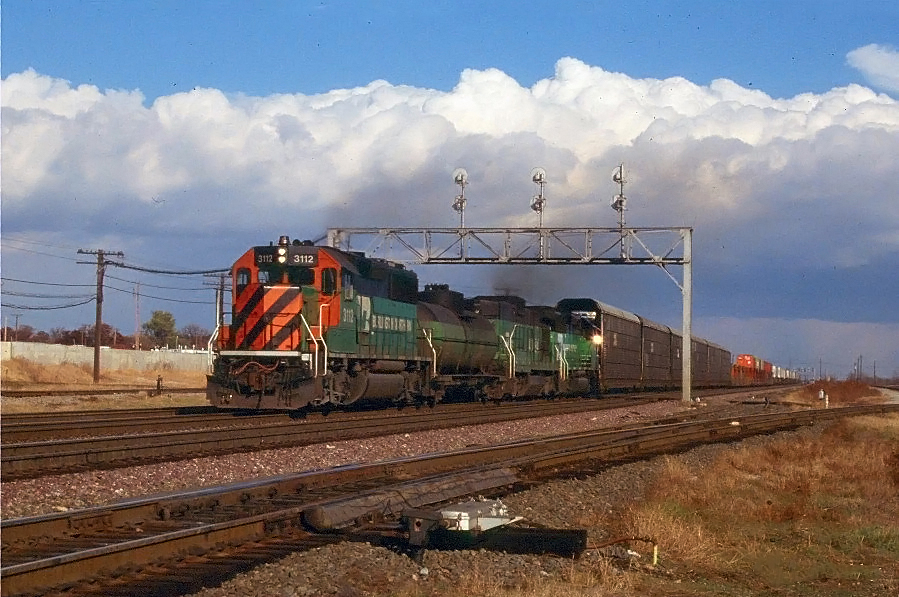 Burlington Northern GP50 #3112, a few helpers, and a fuel tender move intermodal containers and autoracks through Eola, Illinois on October 16, 1987. Brian Rackley photo.
Overview
The GP50 was EMD's final Geep to carry its model 645 prime mover. The later GP60, produced between 1985-1991 and the last in the series, was equipped with the builder's updated 710G3A engine.
In his book, "Locomotives: The Modern Diesel & Electric Reference," author Greg McDonnell the GP50 was born out of extensive testing carried out in the late 1970s.
Dubbed the GP40X, this testbed variant produced 23 locomotives, which featured a number of experimental features such as a 16-cylinder 645F3 prime mover, high-adhesion HT-B trucks, and a wheel-slip detection system. Interestingly, what ultimately became the GP50 included almost none of these features.
Specifications
The GP50, and its 645F3B engine, offered the greatest output yet of a four-axle model, capable of producing an impressive 3,500 horsepower. The model was designed for fast freight service.
Ultimately, most railroads shied away from the design with only the Southern, Chicago & North Western, Santa Fe, Missouri Pacific, and Burlington Northern purchasing examples. Interestingly, Southern wound up with the largest fleet, 90, which were all equipped with its traditional high, short hoods.
Spotting Features
The GP50 sported a common frame with its predecessors - the GP38 and GP40 series - with an overall length of 59 feet, 2 inches. In addition, the carbodies featured a slightly longer nose and an anticlimber on the front deck.
Despite their many similarities, the '50 is easily distinguishable by its larger rear radiator grilles, which are 8 inches taller. Interestingly, EMD elected not to incorporate the flared radiator grilles utilized on the experimental GP40X, and a feature which defined the big six-axle SD45.
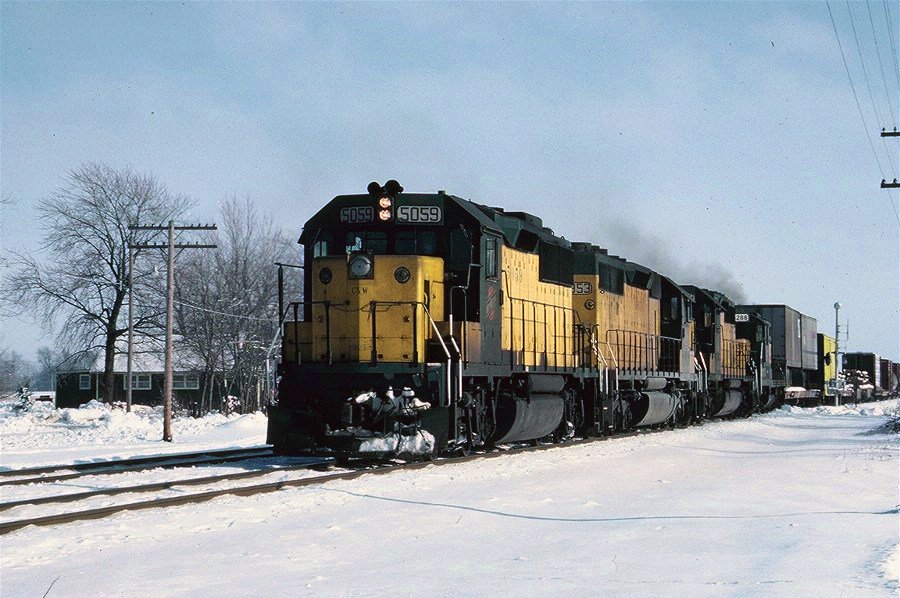 Chicago & North Western GP50 #5059 leads a general merchandise freight westbound at Creston, Illinois on December 18, 1987. Brian Rackley photo.
Reception
The four-axle road-switcher market had cooled considerably by the 1980s. There was no longer demand for such a locomotive in main line service as the industry switched to six-axle models for such assignments. By comparison EMD's bigger SD40/SD40-2 series sold more than 5,000 examples.
The GP50 also suffered from teething issues with its 3,500 horsepower 645F3 prime mover, which further hurt sales. Mr. McDonnell notes this problem was ultimately never corrected.
Data Sheet
| Entered Production | 5/1980 (Chicago & North Western #5050) |
| Years Produced | 5/1980 - 11/1985 |
| Engine | 645F3B |
| Engine Builder | GM |
| Horsepower | 3500 |
| RPM | 900 |
| Cylinders | 16 |
| Length | 59' 2" |
| Height (Top Of Rail To Top Of Cab) | 15' 7" |
| Width | 10' 4" |
| Weight | 260,000-277,000 Lbs |
| Fuel Capacity | 2600 Gallons |
| Air Compressor | Gardner-Denver |
| Air Compressor Model | WBO |
| Air Brake Manufacturer | Westinghouse |
| Air Brake Schedule | 26L |
| Trucks | B-B |
| Truck Type | Blomberg |
| Truck Wheelbase | 9' |
| Wheel Size | 40" |
| Traction Motors | D87 (4), GM |
| Primary Alternator | AR15-D18, GM |
| MU (Multiple-Unit) | Yes |
| Dynamic Brakes | Yes |
| Gear Ratio | 62:15 |
| Tractive Effort (Starting) | 65,000 Lbs at 25% |
| Tractive Effort (Continuous) | 62,400 Lbs at 9.8 mph |
| Top Speed | 65 mph |
Production Roster
GP50
Total Built = 278
| Owner | Road Number(s) | Serial Number(s) | Completion Date |
|---|---|---|---|
| Southern | 7017-7063 | 786251-1 thru 786251-47 | 8/1980-11/1980 |
| Chicago & North Western | 5050-5099 | 786257-1 thru 786257-50 | 5/1980-9/1980 |
| Santa Fe | 3824-3839 | 796317-1 thru 796317-16 | 3/1981-4/1981 |
| Southern | 7003-7016 | 796321-1 thru 796321-14 | 9/1980-11/1980 |
| Missouri Pacific | 3500-3509 | 797322-1 thru 797322-10 | 11/1980-12/1980 |
| Burlington Northern | 3100-3109 | 796331-1 thru 796331-10 | 12/1980 |
| Santa Fe | 3810-3822 (Evens) | 806005-1 thru 806005-7 | 1/1981-2/1981 |
| Santa Fe | 3811-3823 (Odds) | 806006-1 thru 806006-7 | 2/1981-3/1981 |
| Southern | 7064-7070 | 807008-1 thru 807008-7 | 11/1980-12/1980 |
| Missouri Pacific | 3510-3525 | 807023-1 thru 807023-16 | 1/1981 |
| Southern | 7073-7092 | 807054-1 thru 807054-20 | 4/1981-6/1981 |
| Southern | 7071-7072 | 807057-1, 807057-2 | 12/1980 |
| Missouri Pacific | 3526-3529 | 807058-1 thru 807058-4 | 1/1981 |
| Santa Fe | 3840-3854 | 847057-1 thru 847057-15 | 4/1985 |
| Burlington Northern | 3110-3157 | 847065-1 thru 847065-48 | 6/1985-11/1985 |
| Burlington Northern | 3158-3162 | 847073-1 thru 847073-5 | 11/1985 |
Most buyers predominanetly used them as intended, in fast freight service, such as the Southern and Chicago & North Western. Of note was the ten ordered by the St. Louis-San Francisco (Frisco) in December, 1980.
By then the railroad was working towards a merger with Burlington Northern and its fleet - except for #3100, which bore full Frisco colors - was delivered in Cascade Green paint.
One final interesting group of BN units carried their on unique trademark; #3158-3162 were equipped with an experimental, oversized "crew cab" designed to house all of the crew at the head-end.
It was not unlike a similar testbed concept built by General Electric, the BQ23-7. This variant of the B23-7 was produced for Seaboard Coast Line in 1978-1979. These also sported an enlarged cab albeit EMD's design enjoyed a more seamless appearance within the overall carbody.
The crewcab never caught on as the caboose was abolished and crew numbers were reduced, making the entire concept redundant. In addition to being the only examples produced they were also the final GP50s outshopped, completed in November, 1985.
Sources
- Foster, Gerald. A Field Guide To Trains. New York: Houghton Mifflin, 1996.
- Marre, Louis A. and Pinkepank, Jerry A. Contemporary Diesel Spotter's Guide, The: A Comprehensive Reference Manual To Locomotives Since 1972. Milwaukee: Kalmbach Publishing Company, 1989.
- McDonnell, Greg. Locomotives: The Modern Diesel & Electric Reference, 2nd Edition. Buffalo: Boston Mills Press/Firefly Books, 2015.
- Solomon, Brian. EMD Locomotives. Minneapolis: MBI Publishing Company, 2006.
- Solomon, Brian. GE and EMD Locomotives: The Illustrated History. Minneapolis: Voyageur Press, 2014.
Contents
SteamLocomotive.com
Wes Barris's SteamLocomotive.com is simply the best web resource on the study of steam locomotives.
It is difficult to truly articulate just how much material can be found at this website.
It is quite staggering and a must visit!