GE "C44-9W" Locomotives

Last revised: November 25, 2023
By: Adam Burns
The C44-9W solidified General Electric as the top locomotive builder. When production had ended the model had sold some 2,387 examples domestically and in Australia.
In addition, Canadian National and British Columbia Railway acquired 27 examples of the C44-9WL, equipped with a slight variation of the North American Safety Cab sporting four windshields.
Much of this model's massive success hinged on one railroad, BNSF, which acquired well over 1,500 examples. Dating back to the Santa Fe era, the railroad continuing purchasing C44-9W's from February, 1994 until August, 2005.
There were several factors for its blockbuster sales, ranging from the new HiAd trucks to the latest in microprocessor controls. Generally, it was well-liked for its reliability, efficiency, and simplicity.
From the 1990s until the mid-2000s, nearly every other locomotive on a Class I roster was seemingly a Dash 9. That changed with the Evolution Series' introduction in 2005.
Since then, thousands of these locomotives have been manufactured and now operate on all Class I railroads, in addition to a handful of smaller lines.
Photos
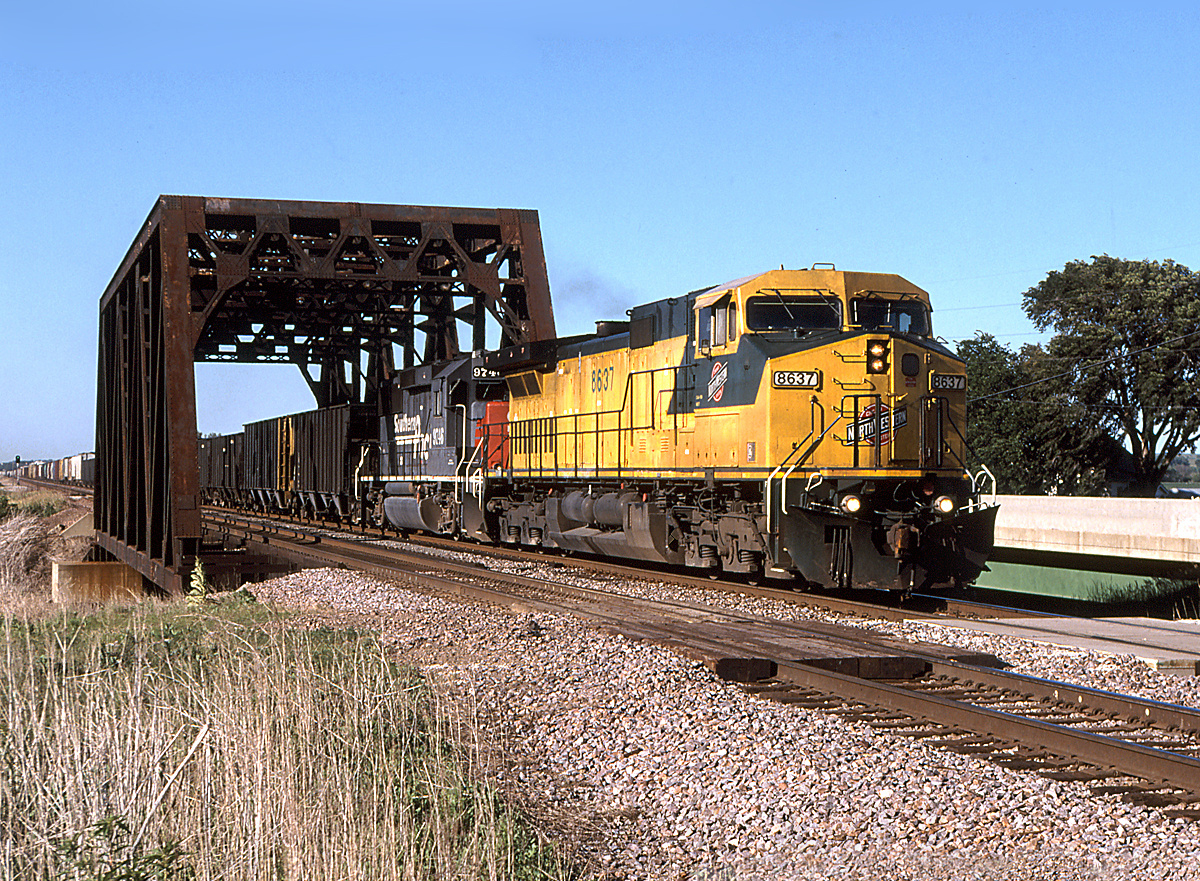 A former Chicago & North Western C44-9W, #8637, crosses the Boyer River near Dunlap, Iowa with a southbound/westbound Union Pacific freight on June 18, 2000. Wade Massie photo.
Overview
The C44-9W, which began production in 1993, was one of the last with General Electric's 7FDL prime mover. This engine had started it all for the company.
However, more stringent environmental regulations required a new prime mover to meet the Environmental Protection Agency's Tier 2 emissions regulations. GE delivered with its new GEVO power plant, unveiled in 2005.
The C44-9W was also the most powerful offered in the Dash 9 series, boasting 4,400 horsepower (listed at only 4,390 horsepower).
The first units to roll out Erie included a group of 65 completed for the Chicago & North Western between November, 1993 and January, 1994.
Interestingly, these units sat on the shop floor next to late era C40-8W's still in production for Conrail and the LMS lease fleet (painted in Conrail colors). This batch was not completed until November, 1994.
In addition, 53 examples of the uprated C44-8W, built for CSX, were not completed until March, 1994. Needless to say, it was a busy time at Erie as GE struggled to keep up with demand.
Enhancements
Brian Solomon notes in his book, "GE Locomotives," the Dash 9 line was more of a marketing tool rather a complete redesign. It largely continued refinements that began with the Dash 8 series. The notable improvements in the Dash 9s included:
- Electronic Fuel Injection (Also known as EFI, this system both reduces fuel use and emissions. Both were big selling points in the 1990s, in part due to stricter government regulations.)
- Split Cooling (This describes a system that uses two water circuits to more quickly cool engine intercoolers, which decreases air-intake temperatures and helps further reduce emissions. It also reduces fuel costs and extends engine life.)
- HiAd Truck (The HiAd, or high adhesion, truck first appeared in the Dash 9 series. It is a bolsterless design which allows the wheels to freely pivot and reduces weight transfer. In doing so there is less wear to the wheels and track, thus reducing maintenance costs. It also allows for greater adhesion, as noted in the title.)
- Reduction From 3 To 2 Blowers (GE redesigned the blowers to have a single large blower serve the traction motors instead of two, which reduced maintenance costs.)
Other upgrades included the latest microprocessors that monitored all aspects of locomotive operation for optimum performance. The use of computers was a game-changer in operational efficiency as their ability to reduce costs was unmatched.
The Dash 9 series continued the model designations from the earlier Dash 7 and Dash 8 lines. In regards to the C44-9W:
- "C" referred to a six-axle (C-C) locomotive.
- "44" designated the horsepower rating (in this case, 4,390).
- "9" indicated that the "Dash 9" line was introduced in 1993.
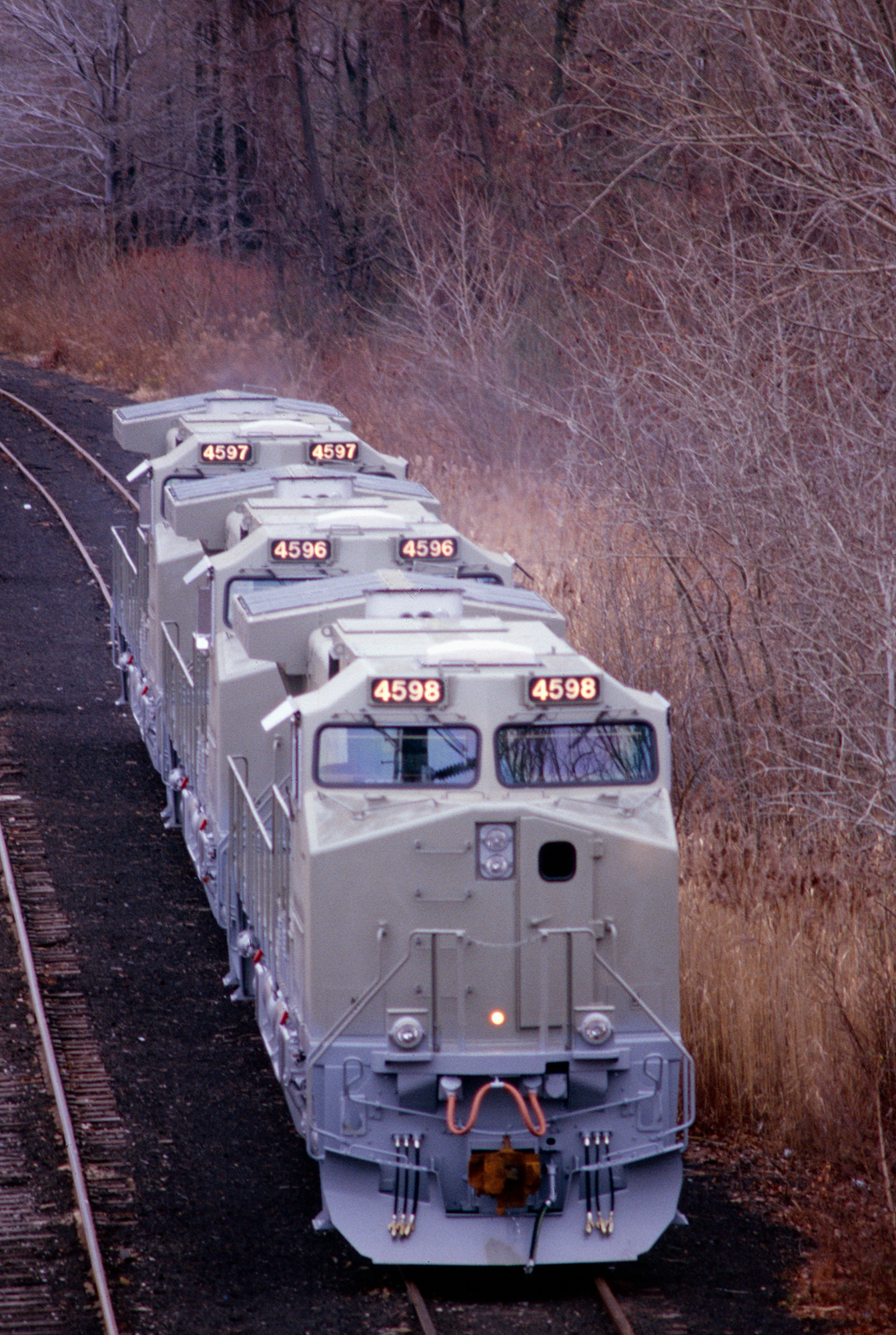 Three new Burlington Northern Santa Fe C44-9W's (#4596-4598), still in their primer, at GE's Erie, Pennsylvania facility; December, 1999. American-Rails.com collection.
%2C%20still%20in%20their%20primer%2C%20at%20GE's%20Erie%2C%20Pennsylvania%20facility%3B%20December%2C%201999.%20%20American-Rails.com%20collection.)
General Electric sold 2,366 units to every major Class I at the time except CSX Transportation and Kansas City Southern.
In additional, Norfolk Southern had purchased the C40-9 and C40-9W variant. These were virtually identical to the their uprated counterparts but sported only 4,000 horsepower, a rating NS felt sufficient to handle its tonnage needs.
In all, NS acquired 1,215 examples of this model; one of the largest single orders by an individual railroad up until that time.
Data Sheet
| Entered Production | 11/1993 (Chicago & North Western #8601) |
| Years Produced | 11/1993 - 11/2005 |
| GE Class | C44-9W |
| Engine | 7FDL16 (16 cylinder) |
| Engine Builder | General Electric |
| Horsepower | 4400 |
| RPM | 1050 |
| Length | 73' 2" |
| Height (Top Of Rail To Top Of Cab) | 15' 4 1/2" |
| Width | 9' 11" |
| Weight (C44-9W) | 390,000 - 434,000 Lbs |
| Weight (C44-9WL) | 385,000 |
| Fuel Capacity | 5,300 Gallons |
| Air Compressor | 3CDC (Westinghouse) |
| Air Brake Schedule | 26L (Westinghouse) |
| Trucks | C-C |
| Truck Type | Hi-Ad Bolsterless |
| Truck Wheelbase | 13' 4" |
| Wheel Size | 40" or 42" |
| Traction Motors | 752AH (6), GE |
| Traction Alternator | GMG197, GE |
| Auxiliary Generator | GYA30A, GE |
| MU (Multiple-Unit) | Yes |
| Dynamic Brakes | Yes |
| Gear Ratio | 83:20 |
| Tractive Effort/Starting | 140,000 Lbs* |
| Tractive Effort/Continuous | 108,600 Lbs at 18.3 mph* |
| Top Speed | 70 mph |
* These tractive effort ratings denote a C44-9W with standard options. BNSF's fleet, for instance, weighed 415,000 pounds and featured 42-inch wheels enabling the locomotives to produce 105,640 pounds of continuous effort at 12.9 mph.
Production Rosters
C44-9W
(Total Built = 2,366)
| Owner | Road Number | Serial Number | Order Number | Completion Date | Quantity |
|---|---|---|---|---|---|
| Chicago & North Western | 8601-8609 | 47495-47503 | 1816 | 11/1993-12/1993 | 9 |
| Chicago & North Western | 8633-8635 | 47504-47506 | 1816 | 1/1994 | 3 |
| Chicago & North Western | 8610-8632 | 47507-47529 | 1816 | 12/1993 | 23 |
| Chicago & North Western | 8636-8665 | 47644-47673 | 1816 | 1/1994 | 30 |
| Santa Fe | 600-649 | 47674-47723 | 1818 | 2/1994-3/1994 | 50 |
| Chicago & North Western | 8666-8685 | 47724-47743 | 1825 | 4/1994 | 20 |
| Hamersley Iron (Australia) | 7065-7093 | 47744-47772 | 1824 | 10/1994-11/1994 | 29 |
| Chicago & North Western | 8686-8715 | 47780-47809 | 1825 | 4/1994-5/1994 | 30 |
| Union Pacific | 9700-9739 | 47846-47885 | 1826 | 7/1994-8/1994 | 40 |
| Southern Pacific | 8100-8200 | 47930-48030 | 1823 | 5/1994-12/1994 | 101 |
| Santa Fe | 651-699 (Odds) | 48058-48082 | 1829 | 8/1994-9/1994 | 25 |
| Chicago & North Western | 8716-8730 | 48083-48097 | 1825 | 5/1994 | 15 |
| Santa Fe | 650-698 (Evens) | 48144-48168 | 1829 | 9/1994 | 25 |
| Burlington Northern Santa Fe | 960-1123 | 49350-49513 | 1872 | 8/1996-1/1997 | 164 |
| Burlington Northern Santa Fe | 700-799 | 49983-50082 | 1879 | 6/1997-9/1997 | 100 |
| Burlington Northern Santa Fe | 4700-4705 | 50083-50088 | 1879 | 10/1997 | 6 |
| Burlington Northern Santa Fe | 4706-4770 | 50201-50265 | 1879 | 10/1997-5/1998 | 65 |
| Canadian National | 2523-2602 | 50302-50381 | 1877 | 2/1997-2/1998 | 80 |
| Burlington Northern Santa Fe | 4771 | 50519 | 1879 | 5/1998 | 1 |
| Burlington Northern Santa Fe | 4772-4971 | 50626-50825 | 1893 | 6/1998-12/1998 | 200 |
| Quebec North Shore & Labrador Railway | 404-414 | 51014-51024 | 1885 | 6/1998-8/1998 | 11 |
| Burlington Northern Santa Fe | 4972-4988 | 51607-51623 | 1893 | 12/1998 | 17 |
| Burlington Northern Santa Fe | 4989-4999 | 51624-51634 | 1910 | 12/1998-1/1999 | 11 |
| Burlington Northern Santa Fe | 4300-4598 | 51635-51933 | 1910 | 1/1999-12/1999 | 299 |
| Burlington Northern Santa Fe | 4599-4606 | 51988-51995 | 1910 | 12/1999 | 7 |
| Burlington Northern Santa Fe | 4607-4699 | 52131-52223 | 1917 | 12/1999-4/2000 | 93 |
| Burlington Northern Santa Fe | 5420-5499 | 52303-52224 (Reversed) | 1917 | 9/2000-4/2000 | 80 |
| British Columbia Railway | 4645-4654 | 52602-52611 | 1927 | 8/2000-9/2000 | 10 |
| Canadian National | 2603-2642 | 52612-52651 | 1894 | 1/2001 | 40 |
| Burlington Northern Santa Fe | 5370-5419 | 52702-52653 (Reversed) | 1917 | 12/2000-8/2000 | 50 |
| Burlington Northern Santa Fe | 5270-5369 | 53336-53237 (Reversed) | 1938 | 8/2001-4/2001 | 100 |
| Hamersley Iron (Australia) | 7094-7096 | 52841-52843 | 1925 | 8/2000 | 3 |
| Pilbara Rail (Australia) | 9401-9403* | 53455-53457 | 1970 | 10/2001 | 3 |
| Burlington Northern Santa Fe | 5223-5269 | 53793-53747 (Reversed) | 1948 | 5/2002-3/2002 | 47 |
| Burlington Northern Santa Fe | 4147-4199 | 53846-53794 (Reversed) | 1948 | 9/2002-6/2002 | 53 |
| Canadian National | 2643-2672 | 53847-53876 | 1950 | 8/2002-9/2002 | 30 |
| Burlington Northern Santa Fe | 4097-4146 | 53929-53880 (Reversed) | 1953 | 11/2002-10/2002 | 50 |
| Pilbara Rail (Australia) | 9404-9409 | 54154-54159 | 1970 | 4/2003 | 6 |
| Pilbara Rail (Australia) | 7097-7098 | 54160-54161 | 1958 | 4/2003 | 2 |
| Pilbara Rail (Australia) | 9428-9430 | 54187-54189 | 1958 | 8/2003 | 3 |
| Pilbara Rail (Australia) | 9431-9432 | 54241-54242 | 1958 | 7/2003 | 2 |
| Pilbara Rail (Australia) | 7063-7064 | 54243-54244 | 1943 | 8/2003 | 2 |
| Burlington Northern Santa Fe | 5170-5222 | 54399-54347 (Reversed) | 1960 | 11/2003-9/2003 | 53 |
| Burlington Northern Santa Fe | 4000-4096 | 54346-54250 (Reversed) | 1960 | 9/2003-6/2003 | 97 |
| Canadian National | 2673-2696 | 54682-54705 | 1967 | 1/2004-2/2004 | 24 |
| Canadian National | 2200-2202 | 54706-54708 | 1967 | 1/2004 | 3 |
| Canadian National | 2203-2205 | 54709-54711 | 1967 | 2/2004 | 3 |
| Pilbara Rail (Australia) | 9433-9434 | 54766-54767 | 1974 | 5/2004 | 2 |
| Pilbara Iron (Australia) | 7061-7062 | 54768-54769 | 1974 | 5/2004-6/2004 | 2 |
| Burlington Northern Santa Fe | 5000-5169 | 54939-54770 (Reversed) | 1973 | 8/2004-3/2004 | 170 |
| Burlington Northern Santa Fe | 5500-5529 | 54969-54940 (Reversed) | 1973 | 8/2004 | 30 |
| Burlington Northern Santa Fe | 5530-5532 | 55114-55116 | 1973 | 3/2004 | 3 |
| Canadian National | 2697-2726 | 55117-55146 | 1978 | 6/2004-9/2004 | 30 |
| Pilbara Iron (Australia) | 7055-7060 | 55880-55885 | 1974 | 4/2005 | 6 |
| Pilbara Iron (Australia) | 7053-7054 | 56154-56155 | 1999 | 11/2005 | 2 |
| General Electric (Demo) | 905 | 56241 | 2103 | 5/2005 | 1 |
| Pilbara Iron (Australia) | 7043-7050 | 57094-57101 | 10 | 8/2006 | 8 |
* Renumbered 9470-9472.
C44-9WL
(Total Built = 27)
| Owner | Road Number | Serial Number | Order Number | Completion Date | Quantity |
|---|---|---|---|---|---|
| Canadian National Railway | 2500-2522 | 48349-48371 | 1827 | 12/1994 | 23 |
| British Columbia Railway | 4641-4644 | 48469-48472 | 1832 | 3/1995 | 4 |
C44-9WM
(Total Built = 148)
| Owner | Road Number | Serial Number | Order Number | Completion Date | Quantity |
|---|---|---|---|---|---|
| Estrada de Ferro Carajás (Brazil) | 801-802 | 49939-49940 | 1876 | 9/1997 | 2 |
| Estrada de Ferro Carajás (Brazil) | 803-805 | 50198-50200 | 1876 | 10/1997 | 3 |
| Ferronorte (Brazil) | 9001-9050 | 51934-51983 | 1904 | 12/1998-11/1999 | 50 |
| Estrada de Ferro Carajás (Brazil) | 806-809 | 51984-51987 | 1936 | 2/1999 | 4 |
| Estrada de Ferro Carajás (Brazil) | 810-813 | 53092-53095 | 1936 | 1/2001-2/2001 | 4 |
| Estrada de Ferro Carajás (Brazil) | 814 | 53483 | 1936 | 1/2002 | 1 |
| Estrada de Ferro Carajás (Brazil) | 803 (2nd) | 53484 | 1936 | 1/2002 | 1 |
| Estrada de Ferro Carajás (Brazil) | 815-819 | 55459-55463 | 1984 | 1/2005-2/2005 | 5 |
| Estrada de Ferro Carajás (Brazil) | 820-825 | 55886-55891 | 1984 | 8/2005-9/2005 | 6 |
| Estrada de Ferro Carajás (Brazil) | 826-833 | 55948-55955 | 1984 | 10/2005-11/2005 | 8 |
| Estrada de Ferro Carajás (Brazil) | 834-856 | 58906-58928 | 1936 | 1/2008-2/2008 | 23 |
| Estrada de Ferro Carajás (Brazil) | 857-867 | 59123-59133 | 1932 | 5/2008-6/2008 | 11 |
BB40-9WM
(Total Built = 251)
| Owner | Road Number | Serial Number | Order Number | Completion Date | Quantity |
|---|---|---|---|---|---|
| Vitória-Minas Railway (Brazil) | 1113-1122 | 49941-49950 | 1875 | 1/1997 | 10 |
| Vitória-Minas Railway (Brazil) | 1123-1137 | 52587-52601 | 1926 | 4/2000 | 15 |
| Vitória-Minas Railway (Brazil) | 1138-1145 | 53077-53084 | 1930 | 1/2001-2/2001 | 8 |
| Vitória-Minas Railway (Brazil) | 1146-1157 | 53485-53496 | 1947 | 6/2002 | 12 |
| Vitória-Minas Railway (Brazil) | 1158-1179 | 54559-54580 | 1969 | 1/2004-2/2004 | 22 |
| Vitória-Minas Railway (Brazil) | 1180-1181 | 54712-54713 | 1969 | 2/2004 | 2 |
| Vitória-Minas Railway (Brazil) | 1182-1184 | 55111-55113 | 1969 | 7/2004 | 3 |
| Vitória-Minas Railway (Brazil) | 1185-1195 | 55464-55474 | 1983 | 1/2005 | 11 |
| Vitória-Minas Railway (Brazil) | 1196-1251 | 55892-55947 | 1983 | 2/2005-1/2006 | 56 |
| Vitória-Minas Railway (Brazil) | 1252-1253 | 56362-56363 | 1983 | 2/2006 | 2 |
| Vitória-Minas Railway (Brazil) | 1254-1276 | 59395-59417 | 1941 | 10/2008-11/2008 | 23 |
| Vitória-Minas Railway (Brazil) | 1277-1309 | 60276-60308 | 2256 | 1/2011-6/2011 | 33 |
| Vale Logistica Integrada (Brazil) | 6020-6034 | 60785-60799 | 2266 | 2/2012-3/2012 | 15 |
| America Latina Logistica (Brazil) | 8300-8306 | 60989-60995 | 5921* | 1/2012-2/2012 | 7 |
| Vale Logistica Integrada (Brazil) | 6035-6054 | 61380-61399 | 2276 | 8/2012-11/2012 | 20 |
| Corredor Logístico Integrado do Norte (Brazil) | 1850-1861 | 62974-62985 | 2289 | 1/1997 | 12 |
* GE kits assembled in Brazil.
C44MEi
(Total Built = 18)
| Owner | Road Number | Serial Number | Order Number | Completion Date | Quantity |
|---|---|---|---|---|---|
| MRS Logística (Brazil) | 3956-3973 | 58886-58903 | 1934 | 3/2008-5/2008 | 18 |
Sources
- Foster, Gerald. A Field Guide To Trains. New York: Houghton Mifflin, 1996.
- McDonnell, Greg. Locomotives: The Modern Diesel & Electric Reference, 2nd Edition. Buffalo: Boston Mills Press/Firefly Books, 2015.
- Solomon, Brian. American Diesel Locomotive, The. Osceola: MBI Publishing, 2000.
- Solomon, Brian. GE and EMD Locomotives: The Illustrated History. Minneapolis: Voyageur Press, 2014.
- Solomon, Brian. GE Locomotives: 110 Years Of General Electric Motive Power. St. Paul: MBI Publishing, 2003.
Interestingly, the Dash 9 series was not GE's only big seller during the 1990s and early 2000s. Some Class Is were also quite fond of its alternating current variant, the AC4400CW (and more powerful AC6000CW) cataloged at the same
time.
This locomotive was purchase by far several railroads and sold even better than the C44-9W. Its success lay in its AC traction motors that were much more efficient offering superior tractive effort, making them ideal for drag service.
Today, most C44-9W's remain in revenue service in their original configuration or have been overhauled, such as the upgrades being carried out at Norfolk Southern with its AC44C6M program.
Contents
SteamLocomotive.com
Wes Barris's SteamLocomotive.com is simply the best web resource on the study of steam locomotives.
It is difficult to truly articulate just how much material can be found at this website.
It is quite staggering and a must visit!