EMD "GP20" Locomotives

Last revised: September 9, 2023
By: Adam Burns
Electro-Motive's GP20 was the builder's first turbocharged model in the General Purpose series. Interestingly, it was inspired by Union Pacific's efforts to turbocharge the 567 prime mover.
It was also the first road-switcher offered with a standard low nose/hood, designed to provide crews greater forward visibility. EMD would later refine its look on the GP30.
The builder eventually came up with the Spartan Cab on the GP35 that employed these concepts while sporting a pointed, low nose.
When production had ended on the GP20 a little more than a half-dozen domestic railroads purchased more than 200 examples. Today, this resilient little road-switcher can still be found in operation on numerous short lines are the country.
Additionally, at least two are known to be officially preserved; Southern Pacific #7207 used by the Blue Ridge Scenic Railway and Western Pacific #2001 at the Western Pacific Railroad Museum.
Photos
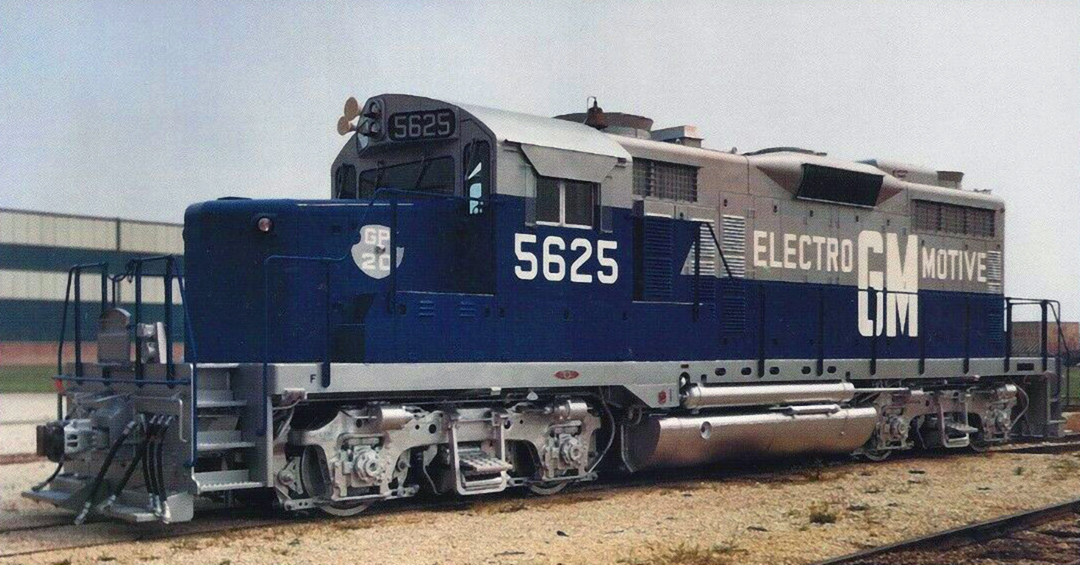 An Electro-Motive photo featuring GP20 demonstrator #5625 in August, 1960. This locomotive, along with demonstrators #5626-5628, were all sold to Southern Pacific (#7234-7237).
.)
Overview
In essence, the GP20 was merely a turbocharged GP18. In his book, "Diesel Locomotives: The First 50 Years," author Louis Marre notes the model's genesis began with Union Pacific's belief that the 567C powerplant could be turbocharged.
In September, 1955 UP added 9 AiResearch and 10 Elliott turbochargers to its own GP9s, boosting their horsepower output to 2,000, in an effort to prove such technology could be effectively applied to the 567.
These locomotives were dubbed Omaha GP20s. After the experiment proved successful, the railroad reverted 15 back to normally aspirated GP9s while 4 others were reengined with newly turbocharged EMD prime movers.
Electro-Motive held considerable reservations to UP's turbocharging efforts as it feared doing so would lead to higher maintenance costs. However, western railroads were pushing for higher horsepower variants, especially Union Pacific. Following UP's successful tests the builder decided to catalog a new, standalone turbocharged model.
Prior to this EMD had rebuilt nine other Union Pacific GP9s with turbocharged 567D2 engines between March and June, 1959. These included numbers 300, 301, 305, 311, 313, 320, 300B, 301B, and 308B.
In addition, EMD rebuild 47 others, which retained their 567Cs, with turbochargers. Also dubbed as Omaha GP20s these locomotives were completed between June, 1959 and October, 1965.
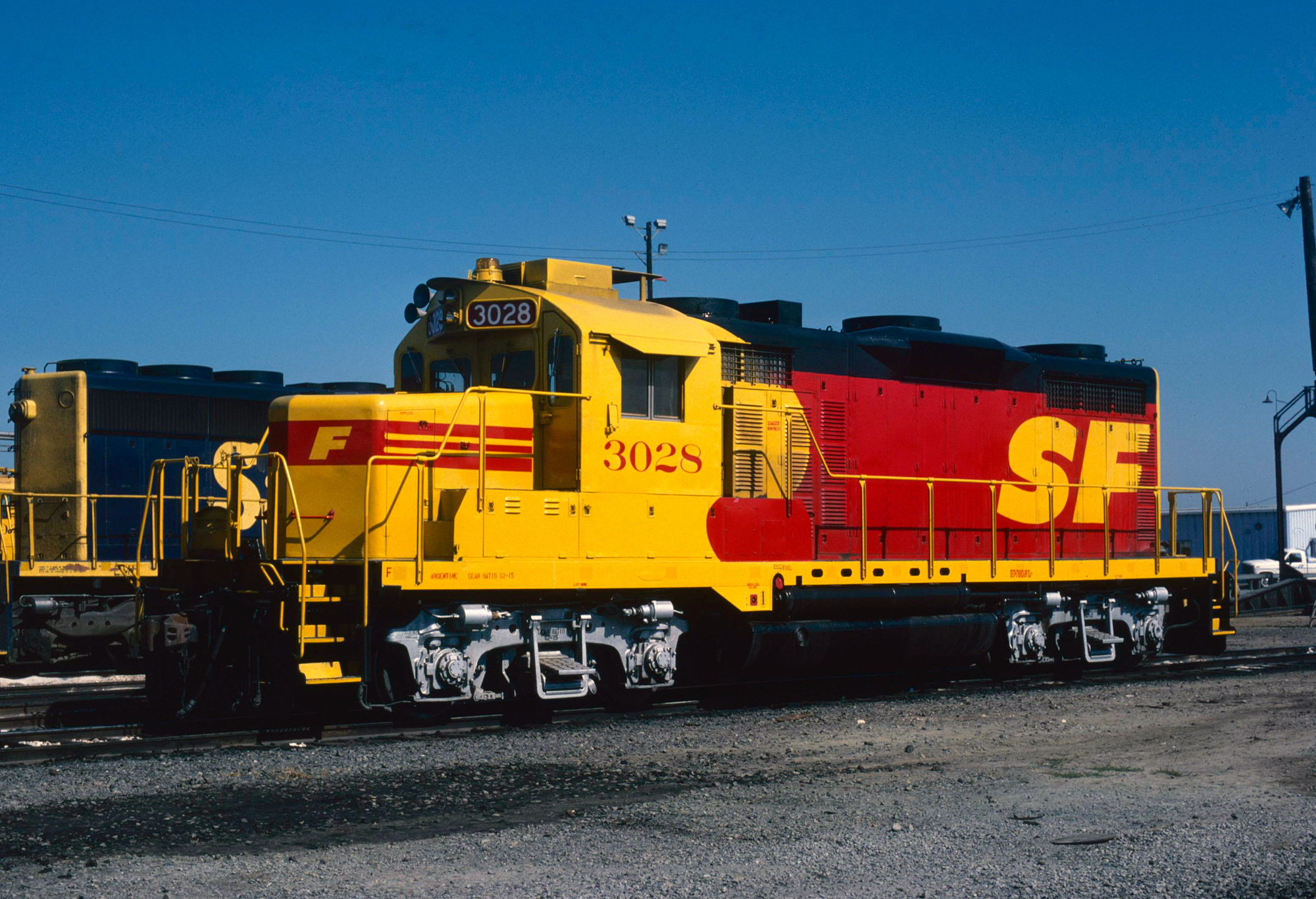 Santa Fe GP20 #3028 in the "Kodachrome" livery; summer, 1986. Location not listed. Author's collection.
Specifications
The GP20 came equipped with dynamic brakes as a standard option (a system for temporarily employing traction motors as generators and using the resulting electromotive force to slow the train) and offered oil-bath filters to keep out dust, dirt, and other particles from reaching internal components, a relatively new concept for its time.
Spotting Features
In his book, "Diesel Locomotives: Cyclopedia, Volume 2," author Bob Hayden notes that only the first ten GP20s built for Western Pacific (#2001-2010), as well as thirty six others for Great Northern (built to operate long hood forward), featured EMD's classic high, short hood.
The remainder sported the new low, short hood with a slight downward slope for greater forward visibility. Aside from this trademark, the only distinguishing feature from the earlier GP7 through GP18 was the addition of a short, rectangular turbocharger exhaust stack located just behind the first exhaust fan near the cab.
While not unique solely to the GP20, one cosmetic feature found on few other EMD designs was a solid front windshield.
It was first applied to the four-axle GP18, and could also be found on early Special Duty models like the SD18 and SD24. By the GP30's release in 1961 the builder had changed the styling to a split version.
Data Sheet
| Entered Production | 11/1959 (Western Pacific #2001-2006) |
| Years Produced | 11/1959-4/1962 |
| Engine | 567D2 |
| Engine Builder | GM |
| Horsepower | 2000 |
| RPM | 800 |
| Cylinders | 16 |
| Length | 56' 2" |
| Height (Top Of Rail To Top Of Cab) | 14' 6" |
| Width | 10' 0" |
| Weight | 240,000 Lbs |
| Fuel Capacity | 900 Gallons |
| Air Compressor | Gardner-Denver |
| Air Compressor Model | WBO |
| Air Brake Manufacturer | Westinghouse |
| Air Brake Schedule | 24RL |
| Trucks | B-B |
| Truck Type | Blomberg |
| Truck Wheelbase | 9' |
| Wheel Size | 40" |
| Traction Motors | D47 (4), GM |
| Primary Generator | D22, GM |
| Auxiliary Generator | Delco (64-72) |
| Alternator | D14 |
| MU (Multiple-Unit) | Yes |
| Dynamic Brakes | Yes |
| Gear Ratio | 62:15 |
| Tractive Effort (Starting) | 64,000 Lbs at 25% |
| Tractive Effort (Continuous) | 45,000 Lbs at 9.3 mph |
| Top Speed | 65 mph |
Production Roster
Total Built = 260
| Owner | Road Number(s) | Serial Number(s) | Order Number | Completion Date |
|---|---|---|---|---|
| Great Northern | 2000-2011 | 25561-25572 | 7583 | 4/1960 |
| Santa Fe | 1100-1124 | 25573-25597 | 7584 | 5/1960-7/1960 |
| Western Pacific | 2001-2006 | 25623-25628 | 5607 | 11/1959 |
| Great Northern | 2012-2017 | 25700-25705 | 7583 | 4/1960 |
| Western Pacific | 2007-2010 | 26041-26044 | 7592 | 7/1960 |
| Union Pacific | 700-729 | 26045-26074 | 5624 | 7/1960-8/1960 |
| Electro-Motive (Demonstrator) | 5625-5628 (became Southern Pacific #7234-7237) | 26107-26110 | 5625 | 8/1960 |
| Great Northern | 2018-2024, 2035, 2025-2034 | 26286-26303 | 7594 | 11/1960-12/1960 |
| St. Louis Southwestern Railway (Cotton Belt) | 800-809 | 26304-26313 | 7595 | 12/1960-1/1961 |
| Chicago, Burlington & Quincy | 900-901 | 26571-26572 | 7598 | 2/1961 |
| Chicago, Burlington & Quincy | 902-935 | 26573-26606 | 7597 | 2/1961-4/1961 |
| New York Central | 6100-6103 | 26815-26818 | 7606 | 7/1961 |
| New York Central | 6104-6114 | 26819-26829 | 7607 | 7/1961-8/1961 |
| Santa Fe | 1125-1174 | 26831-26880 | 7609 | 8/1961-12/1961 |
| St. Louis Southwestern Railway (Cotton Belt) | 810-819 | 26943-26952 | 7611 | 12/1961-1/1962 |
| Southern Pacific | 7200-7223 | 27087-27110 | 5634 | 1/1962-3/1962 |
| Southern Pacific | 7224-7233 | 27345-27354 | 5634 | 3/1962-4/1962 |
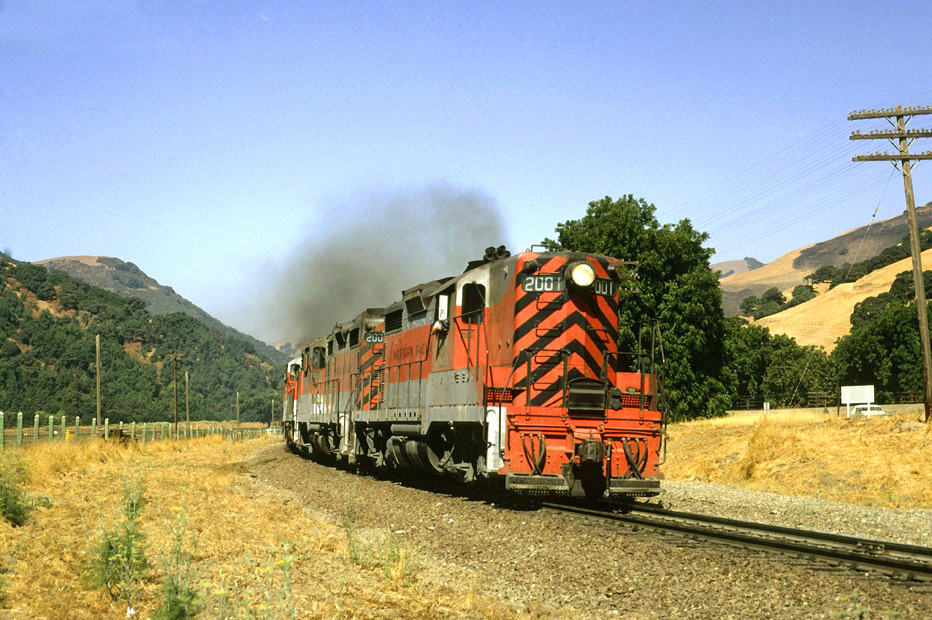 Western Pacific GP20, #2001, and a number of other Geeps pull a freight through the Niles Canyon near Sunol, California during August of 1969. Drew Jacksich photo.
Interestingly, of all the GP20s produced, only New York Central's 15 examples were built without dynamic brakes. The railroad felt the feature was unnecessary along its Water Level Route main line which contained few notable grades.
Buyers of the locomotive included the Santa Fe (75), Burlington (36), Great Northern (36 high hoods), New York Central (15), Southern Pacific (38, which included demonstrators 5625-5628), Cotton Belt (20), Union Pacific (30, purchased new), and Western Pacific (10 high hoods).
Sources
- Foster, Gerald. A Field Guide To Trains. New York: Houghton Mifflin, 1996.
- Hayden, Bob. Diesel Locomotives: Cyclopedia, Volume 2 (Model Railroader). Milwaukee: Kalmbach Publishing Company, 1980.
- Marre, Louis A. Diesel Locomotives: The First 50 Years, A Guide To Diesels Built Before 1972. Milwaukee: Kalmbach Publishing Company, 1995.
- Pinkepank, Jerry A. Diesel Spotter's Guide. Milwaukee: Kalmbach Publishing Company, 1967.
- Solomon, Brian. EMD Locomotives. Minneapolis: MBI Publishing Company, 2006.
- Solomon, Brian. GE and EMD Locomotives: The Illustrated History. Minneapolis: Voyageur Press, 2014.
SteamLocomotive.com
Wes Barris's SteamLocomotive.com is simply the best web resource on the study of steam locomotives.
It is difficult to truly articulate just how much material can be found at this website.
It is quite staggering and a must visit!