EMD's "GP40" and "GP40-2" Locomotive Series

Last revised: January 2, 2024
By: Adam Burns
The GP40 series was EMD's last, truly successful four-axle line. A turocharged, and more powerful, variant of the GP38 it was manufactured for more than two decades (1965-1986), ironically remaining in the catalog longer than its successor, the GP50.
During its production run the model was offered in several variants, including for both freight and passenger assignments. It also enjoyed modest sales in Canada and beyond, especially at Canadian National which had many built to its "Comfort Cab" specifications.
Their ruggedness and reliability - especially the GP40-2 - has allowed the series to remain in regular use throughout the country, nearly four decades after the final examples rolled out of La Grange.
Photos
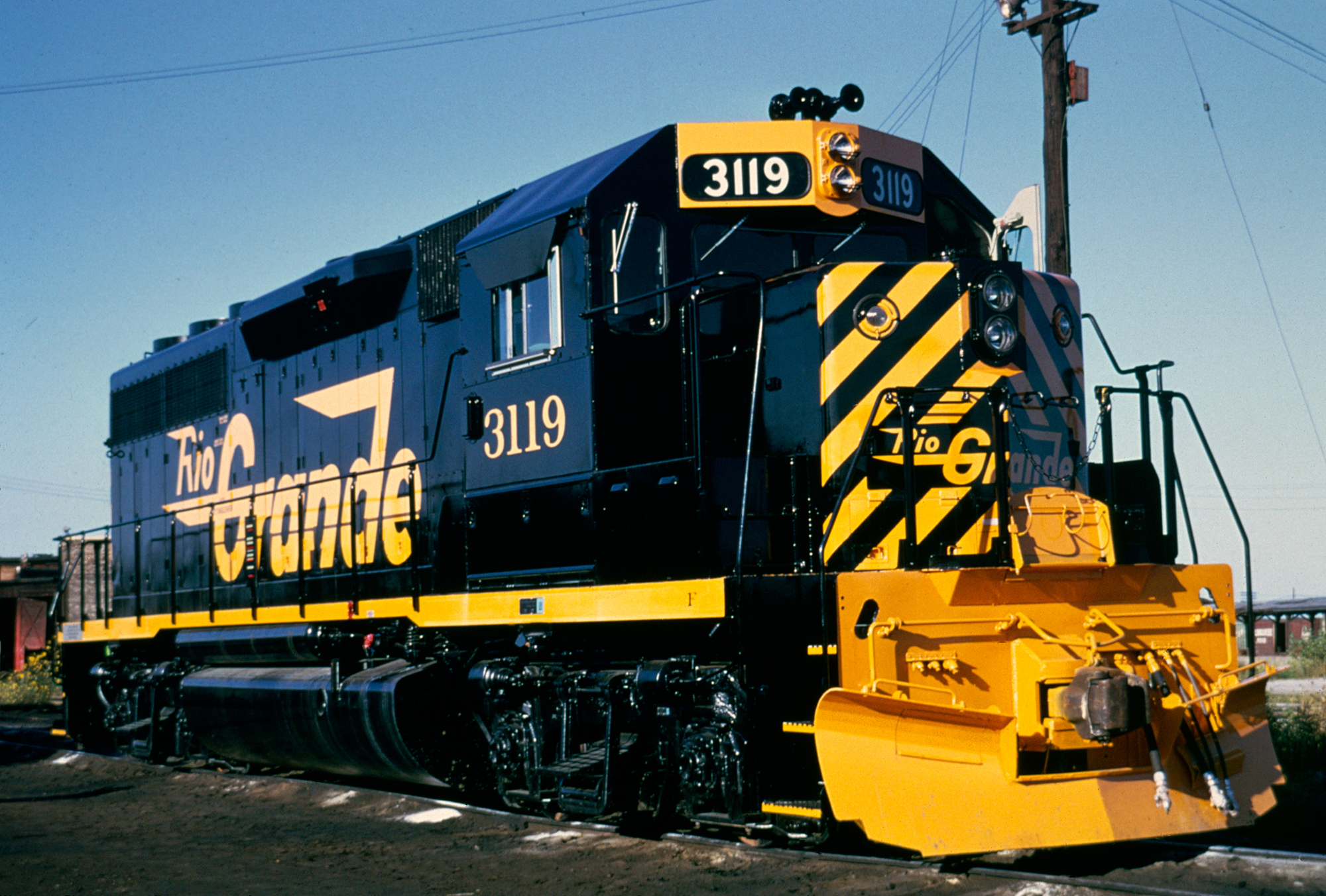 Recently completed Rio Grande GP40-2 #3119 awaits pickup and delivery to its new owner at Blue Island, Illinois in September of 1974. American-Rails.com collection.
Overview
After dominating the first-generation market for more than two decades - and reaching the 567's zenith in horsepower capability - Electro-Motive unveiled a new prime mover in 1965, the model 645.
As trains became longer and heavier, the new engine was designed to meet these demands while simultaneously allowing EMD to remain the industrial leader. In his book, "EMD Locomotives," author Brian Solomon notes the 645 was essentially a refinement of its predecessor.
However, the larger engine block forced the manufacturer to move away from its cornerstone belief that parts and components must remain compatible between models.
The 645 continued to feature a welded, "Vee" cylinder block which sported two rows of cylinders divided by 45 degrees. The pistons were driven by a crankshaft, which powered both rows of cylinders.
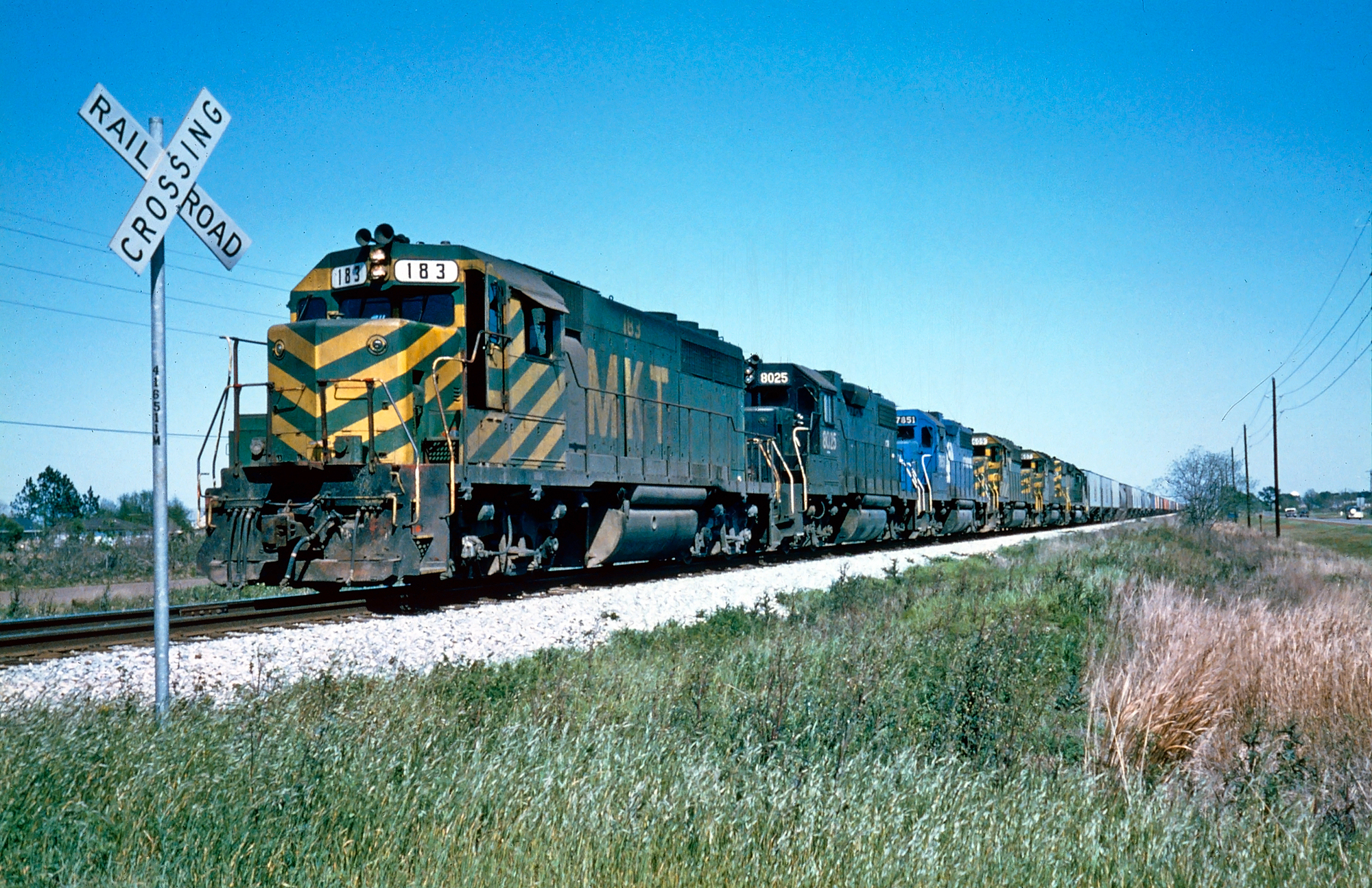 Katy GP40 #183, Conrail GP38-2 #8025 and GP38 #7851, and three other MKT units lead a general manifest between Taylor and Temple, Texas, circa 1983. Mike Bledsoe photo. American-Rails.com collection.
Specifications
The 645's most prominent difference was simply its size; the larger cylinder bore, 9 ½ inches, increased the individual cylinder displacement by a total of 78 cubic inches, from 567 to 645 cubic inches. The new engine could also be aspirated by either a Roots Blower or turocharger.
In late 1965 EMD advertised nine new models equipped with this new engine, offered in a variety of horsepower ratings, sizes, and wheel arrangements. Although, not every railroad at that time needed - or could handle - the big SD38s, SD40s, and SD45s.
As a result, there remained a strong demand for smaller, modestly powered models capable of multiple assignments. In the GP40's case, it was the turbocharged variant of its GP38 counterpart, increasing output from 2,000 to 3,000 horsepower.
EMD intended for it to be used in either fast freight or long-haul intermodal service. Interestingly, New York Central - the first to order a 645-powered model - acquired fifty GP40s in late 1965 for just such assignments leading its Super Van (Flexi-Van) service. The NYC would eventually purchase a total of 105 GP40s.
The locomotive also included features already now common on earlier models such as dynamic braking, and an airtight hood that kept out dust, dirt and other particles from reaching vital internal components.
Spotting Features
EMD's 645 line was the first to feature a generally common carbody design, making it more difficult differentiating model types. In the case of the GP40 it is most easily identified by its turbocharger stack and three, large radiator fans.
However, singling out the GP40-2 from its standard counterpart can be far trickier. The most obvious differences include the water-level sight gauge cut into the right-side hood door as well bolted, instead of hinged, battery boxes.
In addition, later GP40-2s were equipped with quieter "Q"-type radiator fans which were taller than standard designs. Finally, the rare GP40P and GP40X featured their own unique traits; most noticeably flared radiator air intakes, elevated walkways (GP40x), and a conspicuous 3 ½ foot extension behind the rear radiator air intakes on the GP40P (which housed either a steam generator or HEP equipment)
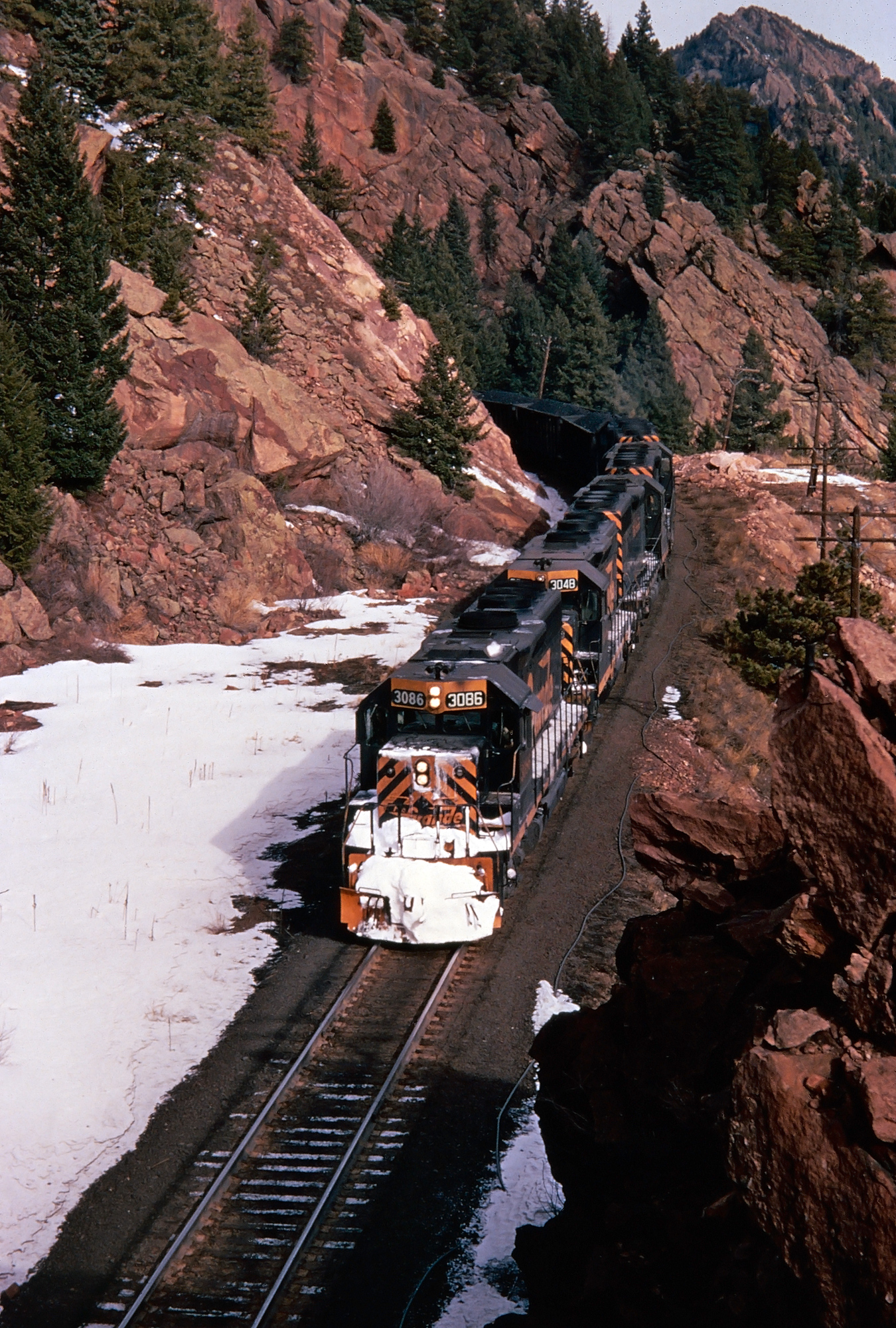 Rio Grande GP40 #3086, GP35 #3048, and three other units exit tunnel #8 near Plainview, Colorado with an eastbound coal drag as the train descends the Front Range into Denver, circa 1972. American-Rails.com collection.
GP40-2
There is almost no outward distinction between the GP40-2 and GP40. In his book, "Locomotives: The Modern Diesel & Electric Reference," author Greg McDonnell notes that EMD's 1972 release of its "Dash 2" line listed 40 refinements, although nearly all of these were internal aimed at improving locomotive efficiency and operation.
The GP40 had greatly advanced electrical systems from the earlier GP35 which contained complex relay circuitry with many switches and shunting contactors that often led to wheel slip issues.
The transition circuit could not keep up with demand and sometimes became "locked up," resulting in the locomotive remaining unloaded with no electrical power being sent to the traction motors.
EMD largely solved this problem with its latest AR10 alternator; its rectifier - with four banks of solid state silicon diodes - could quickly convert AC to DC for the traction motors. It also predominanely eliminated flashovers, a typical issue with DC generators.
Not only was the AR10 more efficient but also required fewer overall components, which also decreased maintenance. With less circuitry the GP40 did not experience nearly the same amount of wheel slip issues.
However, it was the GP40-2 that further improved the concept. It no longer featured the labyrinth of relays, switches, and interlocks which had commonly been found on all previous models. Instead, it utilized transistors, printed circuit boards, and solid-state modular components.
This new control system enabled the Dash 2 to virtually eliminate wheel slip issues, allowing the model to provide near constant adhesion. While the GP40-2 did not enjoy its predecessor's sales numbers - largely due to railroads transitioning to six-axle variants by that time - it nevertheless was a solid locomotive that saw strong demand and eliminated most customer complaints.
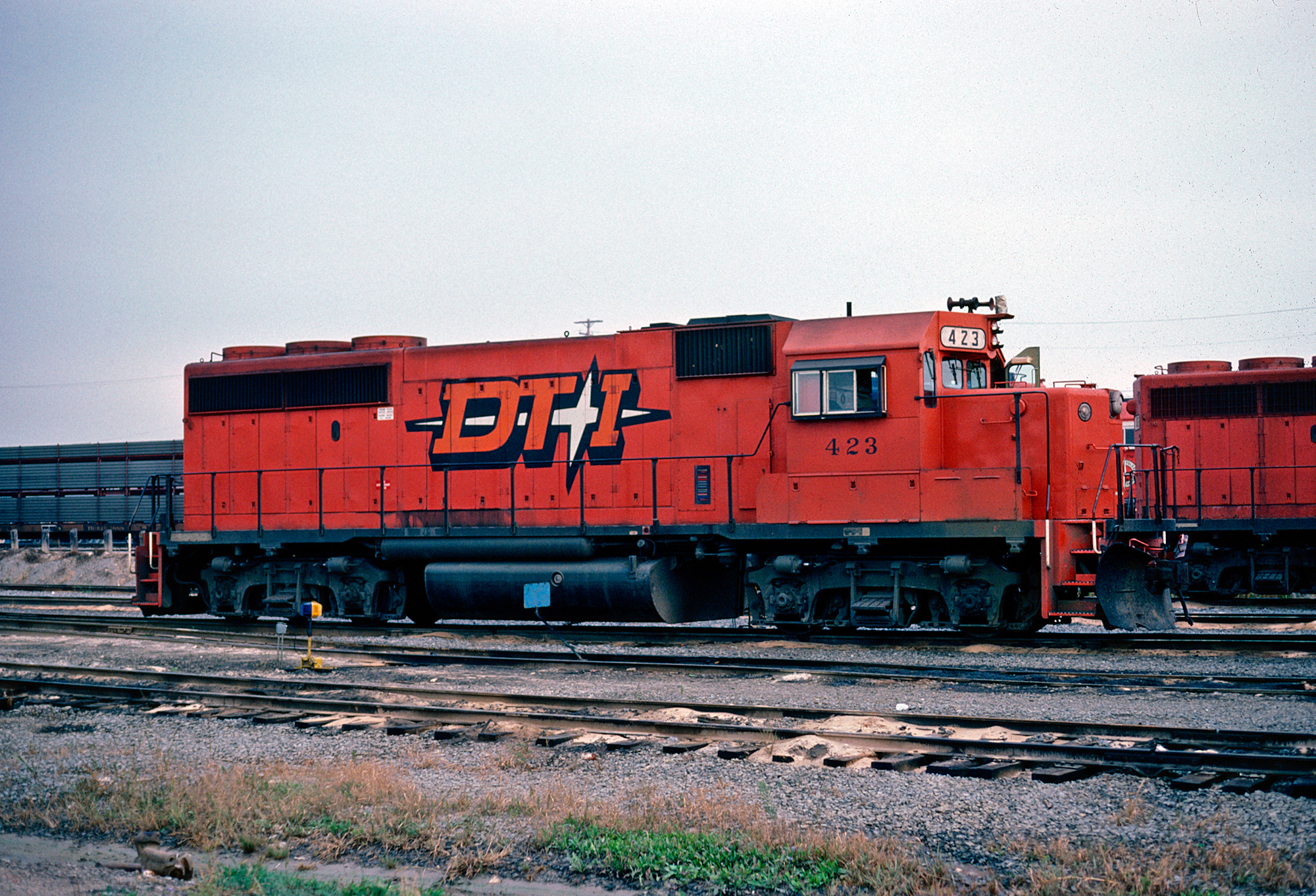 Detroit, Toledo & Ironton GP40-2 #423 at Flat Rock, Michigan; September 1982. American-Rails.com collection.
GP40-2L
There were a number of spinoffs in the GP40 line; perhaps most notable was Canadian National's GP40-2L (or GP40-2LW). Featuring CN's own custom-designed comfort, or safety cab, the model sported a wide cab design which would later become standard on EMD models as the "North American cab" first applied to Union Pacific's SD60Ms of 1989.
The cab was not only designed to increase crew safety but also featured such comforts as refrigerators, hot plates, and coffee pots. Interestingly, the "L" designation was not related to the cab but denoted its lightweight frame, which enabled increased fuel and sand capacity without exceeding CN's gross weight and axle loading standards.
Lastly, the GP40-2Ls were equipped with another custom CN design, a wheel-slip control system known as Positive Traction Control. Of note, not all of the railroad's GP40-2s were of the lightweight variety; #9633-9667 were standard variants with the wide cab (GP40-2W).
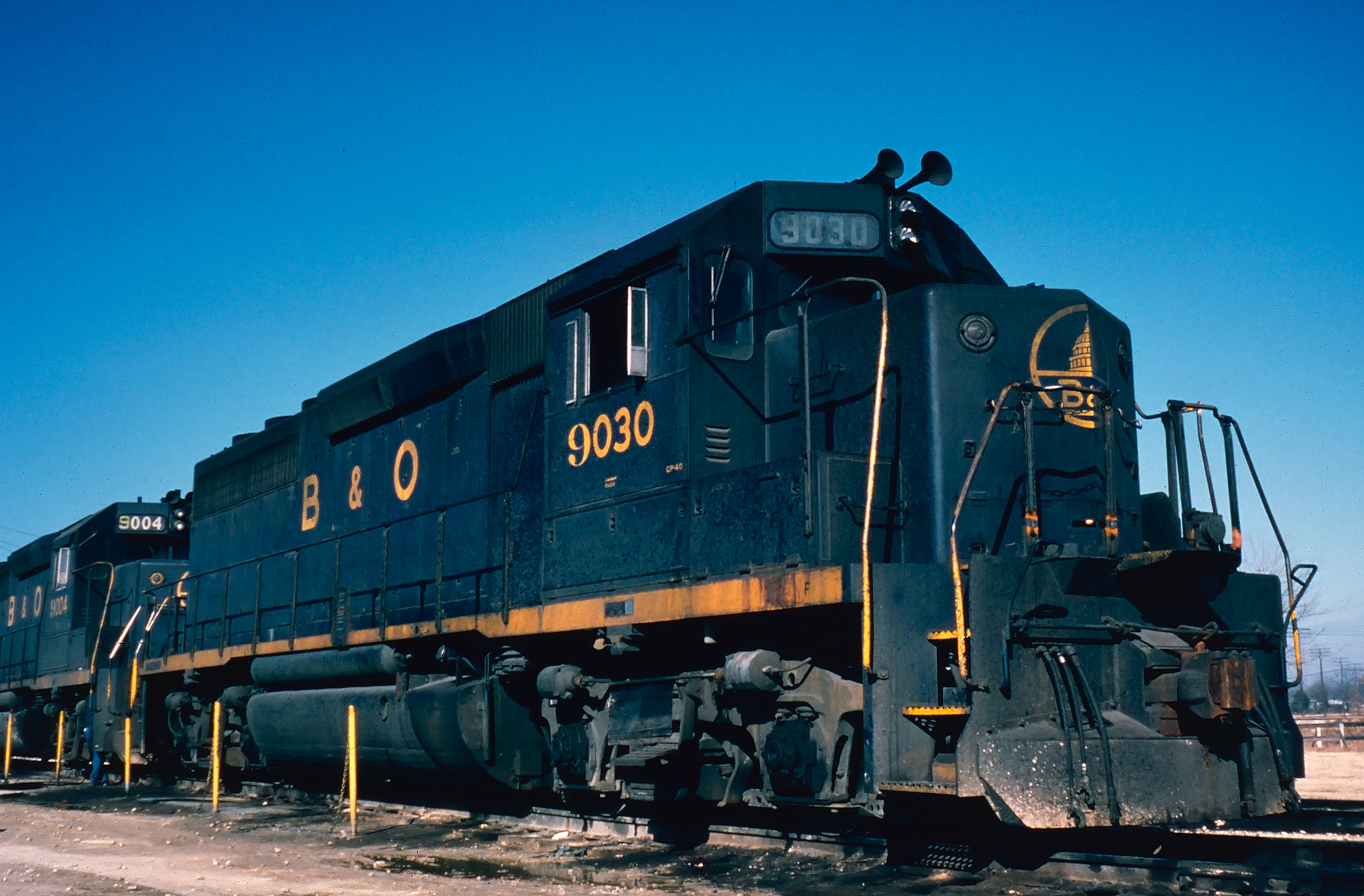 A pair of Baltimore & Ohio GP40's leased to the Santa Fe, circa 1979. Mike Bledsoe photo. American-Rails.com collection.
GP40X
The GP40X utilized EMD's latest version of its 645 engine, the 645FE, and, as Louise Marre and Jerry Pinkepank note in their book, "The Contemporary Diesel Spotter's Guide: A Comprehensive Reference Manual To Locomotives Built After 1972," the model was essentially a GP50 prototype.
Its most notable features included an extra 500 horsepower, experimental HT-B trucks, and an innovative wheel-slip detection and control system known as the Super Series.
It was built only between 1977-1978 with four railroads purchasing 23 examples; Santa Fe (3800-3809), Southern Pacific (7200-7201, 7230-7231), Southern (7000-7002), and Union Pacific (9000-9005).
The "X" denoted its experimental nature; the AT&SF and Southern had theirs equipped with standard Blomberg Ms while the Southern Pacific and Union Pacific tested theirs with the HT-B.
Finally, SP's sported "L" shaped windshields and an experimental elephant ear shroud over the radiators, designed as an alternative to the Tunnel Motor concept. The idea was not repeated. When the GP50 officially debuted in May, 1980 it did not included any of the above noted features.
GP40P/GP40P-2
This variant included a group of thirteen units purchased by the New Jersey Department of Transportation in 1968 for commuter service on the Central Railroad of New Jersey (then bankrupt).
Their lengthed frames included space not only for larger fuel tanks but also an additonal 3 ½ feet at the rear for a steam generator and electric equipment to supply heating, lighting, and air-conditioning. This was later repalced by HEP. The model also featured the flared rear radiator found on the GP40X.
Finally, Southern Pacific purchased three examples of the Dash 2 variant (GP40P-2) in 1974, also for commuter service. It similarly sported the same flared rear radiator but lacked the larger fuel tank and increased water supply. In addition, it included extended-range dynamic brakes and cab air-conditioning.
GP40TC
Another passenger model was produced at EMD's Canadian subsidiary, General Motors Diesel, for GO Transit of Toronto between November and December, 1966.
The GP40TC used an SD40 frame and wide cab design, featuring HEP equipment (a GM 12V-149 engine powered a 500 kw alternator) for passenger service. A total of eight were constructed (numbered 600-607) and Amtrak wound up purchasing these units from GO Transit in 1990.
Data Sheet
| Entered Production (GP40) | 11/1965 (New York Central #3036) |
| Entered Production (GP40X) | 5/1965 (Demonstrator #433-A) |
| Entered Production (GP40P) | 10/1968 (Jersey Central #3671) |
| Entered Production (GP40-2) | 4/1972 (Seaboard Coast Line #1636) |
| Entered Production (GP40P-2) | 11/1974 (Southern Pacific #3197) |
| Years Produced (GP40) | 11/1965 - 12/1971 |
| Years Produced (GP40X) | 5/1965 |
| Years Produced (GP40P) | 10/1968 |
| Years Produced (GP40-2) | 4/1972 - 12/1986 |
| Years Produced (GP40P-2) | 11/1974 |
| Engine (GP40, GP40P, GP40X) | 645E |
| Engine (GP40-2, GP40P-2) | 645E3C |
| Engine Builder | GM |
| Horsepower (GP40, GP40X, GP40P, GP40-2) | 3000 |
| Horsepower (GP40P-2) | 3200 |
| RPM | 800 |
| Cylinders | 16 |
| Length (GP40, GP40X, GP40-2) | 59' 2" |
| Length (GP40P, GP40P-2) | 62' 8" |
| Length (GP40TC) | 65' 8" |
| Height (Top Of Rail To Top Of Cab) | 15' 5" |
| Width (GP40) | 10' 2 ½" |
| Width (GP40P, GP40X, GP40-2, GP40P-2) | 10' 4" |
| Weight (GP40) | 245,000 Lbs |
| Weight (GP40P, GP40P-2) | 281,000 Lbs |
| Weight (GP40X) | 260,000 Lbs |
| Weight (GP40-2) | 257,000-282,000 Lbs |
| Weight (GP40-2L) | 262,000-263,000 Lbs |
| Fuel Capacity (GP40) | 1700 - 3600 Gallons |
| Fuel Capacity (GP40P) | 1800 Gallons |
| Fuel Capacity (GP40X, GP40P-2) | 3200 Gallons |
| Fuel Capacity (GP40-2) | 1700 Gallons |
| Air Compressor | Gardner-Denver |
| Air Compressor Model | WBO |
| Air Brake Manufacturer | Westinghouse |
| Air Brake Schedule | 26L |
| Trucks | B-B |
| Truck Type | Blomberg |
| Truck Wheelbase | 9' |
| Wheel Size | 40" |
| Traction Motors (GP40, GP40P, GP40-2, GP40P-2, GP40-2L) | D77B (4), GM |
| Traction Motors (GP40X) | D87X (4), GM |
| Steam Generator (GP40P, GP40P-2) | Vapor Clarkson (800 Lbs/Hr) |
| Primary Alternator (GP40, GP40P, GP40-2, GP40P-2) | AR10A6-D14, GM |
| Primary Alternator (GP40X) | AR10X2-D14, GM |
| Primary Alternator (GP40-2L) | AR10, GM |
| MU (Multiple-Unit) | Yes |
| Dynamic Brakes | Yes |
| Gear Ratio (GP40, GP40X, GP40P-2) | 62:15 |
| Gear Ratio (GP40P) | 61:16 |
| Tractive Effort (Starting) | 62,500 Lbs at 25% (GP40) |
| Tractive Effort (Starting) | 72,000 Lbs at 25% (GP40P) |
| Tractive Effort (Starting) | 64,000 Lbs at 25% (GP40X, GP40P-2) |
| Tractive Effort (Starting) | 61,000 Lbs at 25% (GP40-2) |
| Tractive Effort (Continuous) | 54,700 Lbs at 11.1 mph (GP40, GP40P, GP40-2, GP40P-2) |
| Tractive Effort (Continuous) | 54,200 Lbs at 11.1 mph (GP40X) |
| Top Speed (GP40, GP40X, GP40-2, GP40P-2) | 65 mph |
| Top Speed (GP40P) | 77 mph |
Production Rosters
GP40
Total Built = 1,221
| Owner | Road Number(s) | Serial Number(s) | Order Number | Completion Date |
|---|---|---|---|---|
| New York Central | 3000-3035 | 30937-30972 | 7831 | 12/1965 |
| New York Central | 3036-3049 | 30973-30986 | 7851 | 11/1965-12/1965 |
| Denver & Rio Grande Western | 3051-3062 | 30995-31006 | 7842 | 1/1966 |
| Denver & Rio Grande Western | 3063 | 31440 | 7842 | 1/1966 |
| Illinois Central | 3039-3000 (reversed) | 31441-31480 | 5697 | 2/1966-1/1966 (reversed) |
| St. Louis-Southwestern Railway (Cotton Belt) | 7600-7607 | 31483-31490 | 7860 | 1/1966-3/1966 |
| Milwaukee Road | 180-185 | 31610-31615 | 7876 | 3/1966 |
| Western Pacific | 3501-3510 | 31662-31671 | 7878 | 5/1966 |
| Milwaukee Road | 186-191 | 31672-31677 | 7876 | 3/1966 |
| Seaboard Air Line | 600-614 | 31767-31781 | 7885 | 5/1966 |
| Seaboard Air Line | 615 | 31784 | 7896 | 5/1966 |
| Seaboard Air Line | 616-629 | 31785-31798 | 7897 | 5/1966-8/1966 |
| De Queen & Eastern | D7 | 31855 | 5704 | 8/1966 |
| Norfolk & Western | 1329-1358 | 31869-31898 | 7901 | 4/1966-5/1966 |
| Missouri-Kansas-Texas (Katy) | 170-173 | 32122-32125 | 7918 | 6/1966 |
| Missouri-Kansas-Texas (Katy) | 174-181 | 32126-32133 | 5713 | 8/1966 |
| Richmond, Fredericksburg & Potomac | 121-125 | 32149-32153 | 7911 | 11/1966 |
| Richmond, Fredericksburg & Potomac | 126-127 | 32154-32155 | 7948 | 3/1967-4/1967 |
| Denver & Rio Grande Western | 3064-3068 | 32170-32174 | 7921 | 9/1966 |
| Rock Island | 340-359 | 32232-32251 | 7926 | 9/1966-10/1966 |
| Rock Island | 360-361 | 32292-32293 | 7923 | 9/1966 |
| Milwaukee Road | 174-179, 192-199 | 32294-32307 | 7924 | 10/1966 |
| Atlantic Coast Line | 915-928 | 32350-32363 | 7929 | 11/1966-12/1966 |
| Atlantic Coast Line | 929 | 32364 | 5717 | 12/1966 |
| Louisville & Nashville | 3000-3009 | 32443-32452 | 5718 | 10/1966-11/1966 |
| Milwaukee Road | 153-173 | 32470-32490 | 7936 | 1/1967 |
| Chicago, Burlington & Quincy | 170-189 | 32566-32585 | 7940 | 12/1966 |
| Rock Island | 362-381 | 32588-32607 | 7942 | 12/1966-1/1967 |
| Seaboard Air Line | 630-644 | 32609-32623 | 7944 | 1/1967 |
| Baltimore & Ohio | 3684-3699 | 32644-32659 | 7943 | 11/1966 |
| Illinois Central | 3040-3048 | 32860-32868 | 5723 | 2/1967 |
| Illinois Central | 3049-3051 | 32869-32871 | 7959 | 2/1967 |
| Illinois Central | 3052-3055 | 32872-32875 | 7960 | 2/1967 |
| Illinois Central | 3056-3059 | 32876-32879 | 7961 | 3/1967 |
| Denver & Rio Grande Western | 3069-3080 | 32880-32891 | 7956 | 2/1967 |
| Soo Line | 732-735 | 32954-32957 | 7957 | 3/1967 |
| Seaboard Air Line | 645-650 | 32958-32963 | 7944 | 2/1967 |
| Western Pacific | 3511-3516 | 33056-33061 | 7981 | 3/1967 |
| Georgia Railroad | 752 | 33097 | 7990 | 5/1967 |
| Western Railway of Alabama | 701 | 33098 | 7990 | 5/1967 |
| Atlanta & West Point | 726 | 33099 | 7990 | 5/1967 |
| Georgia Railroad | 751 | 33100 | 5728 | 5/1967 |
| New York Central | 3050-3079 | 33214-33243 | 7987 | 7/1967-8/1967 |
| Norfolk & Western | 1359-1383 | 33250-33279 | 7054 | 8/1967-9/1967 |
| Norfolk & Western | 1384-1388 | 33275-33279 | 5733 | 9/1967 |
| Louisville & Nashville | 3010-3029 | 33449-33468 | 7075 | 8/1967-9/1967 |
| Missouri-Kansas-Texas | 182-193 | 33474-33485 | 7056 | 9/1967-10/1967 |
| New York Central | 3080-3104 | 33491-33515 | 7064 | 10/1967-11/1967 |
| Milwaukee Road | 2047-2056 | 33531-33540 | 7058 | 1/1968 |
| Chicago, Burlington & Quincy | 620-634 | 33741-33755 | 7057 | 2/1968 |
| Chicago, Burlington & Quincy | 635-639 | 33869-33873 | 7057 | 2/1968 |
| Western Railway of Alabama (West Point Route) | 702 | 33881 | 7093 | 7/1968 |
| Atlanta & West Point (West Point Route) | 727 | 33882 | 7093 | 7/1968 |
| Georgia Railroad | 753-754 | 33883-33884 | 7093 | 7/1968 |
| Detroit, Toledo & Ironton | 400-404 | 33910-33914 | 7099 | 6/1968 |
| Detroit, Toledo & Ironton | 405 | 33956 | 7099 | 6/1968 |
| Missouri-Kansas-Texas (Katy) | 194-209 | 34077-34092 | 7102 | 8/1968 |
| Milwaukee Road | 2061-2067 | 34138-34144 | 7120 | 12/1968 |
| Milwaukee Road | 2057-2060 | 34145-34148 | 7132 | 12/1968 |
| Missouri-Kansas-Texas (Katy) | 210 | 34271 | 7102 | 10/1968 |
| Penn Central | 3105-3169 | 34282-34346 | 7127 | 8/1968-9/1968 |
| Penn Central | 3170-3223 | 34611-34664 | 7145 | 10/1968-11/1968 |
| Penn Central | 3224-3259 | 34688-34723 | 7145 | 11/1968-12/1968 |
| Western Railway of Alabama (West Point Route) | 703-704 | 34748-34749 | 7153 | 1/1969 |
| Atlanta & West Point (West Point Route) | 728-729 | 34750-34751 | 7153 | 1/1969 |
| Rock Island | 382-393 | 34763-34774 | 7156 | 1/1969 |
| Baltimore & Ohio | 3700-3739 | 34823-34862 | 7158 | 2/1969-4/1969 |
| Rock Island | 394-396 | 34868-34870 | 7156 | 1/1969 |
| Illinois Central | 3060-3069 | 34957-34966 | 7171 | 8/1969 |
| Electro-Motive (Demonstrators) | 11-20 (became Penn Central #3260-3269) | 35044-35053 | 7179 | 5/1969 |
| Electro-Motive (Demonstrator) | 21 (became Toledo, Peoria & Western #1000) | 35054 | 7179 | 5/1969 |
| Electro-Motive (Demonstrators) | 22-26 (became Penn Central #3270-3274) | 35055-35059 | 7179 | 5/1969 |
| Electro-Motive (Demonstrators) | 2068-2071 (became Milwaukee Road #2068-2071) | 35060-35063 | 7180 | 5/1969 |
| Seaboard Coast Line | 1566-1595 | 35079-35108 | 7183 | 12/1969-1/1970 |
| Missouri-Kansas-Texas (Katy) | 211-230 | 35454-35473 | 7192 | 11/1969 |
| Denver & Rio Grande Western | 3081-3085 | 35577-35581 | 7201 | 10/1969 |
| Seaboard Coast Line | 1596-1632 | 35897-35933 | 7229 | 5/1970-6/1970 |
| Illinois Central | 3070-3074 | 36166-36170 | 5759 | 2/1970 |
| Atlanta & West Point (West Point Route) | 730-732 | 36171-36173 | 7250 | 5/1970 |
| Western Railway of Alabama (West Point Route) | 705 | 36174 | 7250 | 5/1970 |
| Rock Island | 4700-4719 | 36386-36405 | 7263 | 3/1970-4/1970 |
| Western Railway of Alabama (West Point Route) | 706-707 | 36654-36655 | 7250 | 5/1970 |
| Baltimore & Ohio | 3740-3764 | 36721-36745 | 7275 | 12/1970-1/1971 |
| Florida East Coast | 401-410 | 36773-36782 | 7278 | 1/1971-3/1971 |
| Western Pacific | 3522-3526 | 36783-36787 | 7272 | 8/1970 |
| Western Pacific | 3517-3521 | 36824-36828 | 7272 | 8/1970 |
| De Queen & Eastern | D12 | 36879 | 5765 | 3/1971 |
| Baltimore & Ohio | 3765-3777 | 37189-37201 | 7301 | 2/1971-3/1971 |
| Baltimore & Ohio | 3778-3779 | 37202-37203 | 7317 | 3/1971 |
| Western Pacific | 3527-3544 | 37838-37855 | 7332 | 8/1971-9/1971 |
| Western Maryland | 3795-3799 | 37886-37890 | 5791 | 8/1971 |
| Texas, Oklahoma & Eastern | D13 | 38243 | 5786 | 9/1971 |
| Baltimore & Ohio | 4000-4054 | 38480-38544 | 7340 | 8/1971-10/1971 |
| Baltimore & Ohio | 4055-4064 | 38535-38544 | 7356 | 10/1971-11/1971 |
| Chesapeake & Ohio | 4065-4089 | 38545-38569 | 7340 | 5/1971-8/1971 |
| Texas, Oklahoma & Eastern | D14 | 38570 | 5786 | 9/1971 |
| Denver & Rio Grande Western | 3086-3093 | 38571-38578 | 7357 | 11/1971 |
| Chesapeake & Ohio | 4090 | 39236 | 7340 | 12/1971 |
| Chesapeake & Ohio | 4091-4099, 3780-3794 | 39237-39260 | 5811 | 12/1971 |
| Seaboard Coast Line | 1633-1635 | 5793-1 thru 5793-3 | 5793 | 9/1971 |
GP40X
| Owner | Road Number | Serial Number | Order Number | Completion Date |
|---|---|---|---|---|
| Electro-Motive (Demonstrator) | 433A (became Illinois Central #3075)* | 29877 | 5674 | 5/1965 |
| Southern Pacific | 7200-7201, 7230-7231 | 766016-1 thru 766016-4 | 766016 | 2/1978 |
| Santa Fe | 3802-3809 | 766054-1 thru 766054-8 | 766054 | 4/1978-5/1978 |
| Southern | 7000-7002 | 766066-1 thru 766066-3 | 766066 | 6/1978 |
| Union Pacific | 9000-9005 | 766068-1 thru 766068-6 | 766068 | 12/1977-3/1978 |
| Santa Fe | 3800 | 776008-1 | 776008 | 6/1978 |
| Santa Fe | 3801 | 776009-1 | 776009 | 6/1978 |
* Completed in May, 1965 this unit was EMD's prototype GP40.
GP40P
| Owner | Road Numbers | Serial Numbers | Order Number | Completion Date |
|---|---|---|---|---|
| Central of New Jersey Railroad | 3671-3683 | 34248-34260 | 7130 | 10/1968 |
GP40-2
| Owner | Road Number(s) | Serial Numbers(s) | Completion Date |
|---|---|---|---|
| Florida East Coast | 411-415 | 5813-1 thru 5813-5 | 11/1972 |
| Georgia Railroad | 755-756 | 5814-1, 5814-2 | 12/1972 |
| Detroit, Toledo & Ironton | 406-413 | 7359-1 thru 7359-8 | 10/1972 |
| Denver & Rio Grande Western | 3094-3105 | 7360-1 thru 7360-12 | 4/1972-5/1972 |
| Seaboard Coast Line | 1636-1656 | 7361-1 thru 7361-21 | 4/1972 |
| Baltimore & Ohio | 4100-4162, 1977, GM50 | 7365-1 thru 7365-65 | 8/1972-11/1972 |
| Chesapeake & Ohio | 4165-4184 | 7394-1 thru 7394-20 | 11/1972 |
| Richmond, Fredericksburg & Potomac | 141-147 | 72702-1 thru 72702-7 | 9/1972 |
| Denver & Rio Grande Western | 3106-3115 | 72715-1 thru 72715-10 | 12/1972 |
| Texas, Oklahoma & Eastern | D15 | 72654-1 | 1/1973 |
| Detroit, Toledo & Ironton | 414-421 | 73611-1 thru 73611-8 | 10/1973 |
| Texas, Oklahoma & Eastern | D16 | 73619-1 | 11/1973 |
| Reading | 3671-3674 | 73624-1 thru 73624-4 | 12/1973 |
| Reading | 3675 | 73724-1 | 12/1973 |
| Denver & Rio Grande Western | 3116-3127 | 74635-1 thru 74635-12 | 9/1974 |
| Denver & Rio Grande Western | 3128 | 73735-1 | 11/1974 |
| Atlanta & West Point | 733 | 73681-1 | 11/1974 |
| Western Railway of Alabama (West Point Route | 708 | 73681-2 | 11/1974 |
| Texas, Oklahoma & Eastern | D20 | 74604-1 | 9/1974 |
| Florida East Coast | 416-418 | 74650-1 thru 74650-3 | 10/1974 |
| Alaska Railroad | 3000-3005 | 74759-1 thru 74759-6 | 4/1975-5/1975 |
| Baltimore & Ohio | 4185-4246 | 74695-1 thru 74695-62 | 4/1975-7/1975 |
| Alaska Railroad | 3007-3011 | 757143-1 thru 757143-5 | 5/1976 |
| Baltimore & Ohio | 4247-4256 | 767034-1 thru 767034-10 | 2/1977 |
| Western Maryland | 4257-4261 | 767049-1 thru 767049-5 | 2/1977 |
| Conrail | 3280-3312 | 766069-1 thru 766069-33 | 4/1977-6/1977 |
| Boston & Maine | 300-317 | 776025-1 thru 776025-18 | 12/1977 |
| Baltimore & Ohio | 4308-4311 | 777051-1 thru 777051-4 | 3/1978 |
| Southern Pacific | 7608-7627 | 776071-1 thru 776071-20 | 2/1978-4/1978 |
| Chesapeake & Ohio | 4262-4281 | 776085-1 thru 776085-20 | 1/1978 |
| Baltimore & Ohio | 4287-4307 | 776091-1 thru 776091-21 | 01/1978-2/1978 |
| Alaska Railroad | 3012-3015 | 777093-1 thru 777093-4 | 9/1978 |
| Chesapeake & Ohio | 4282-4286 | 777094-1 thru 777094-5 | 2/1978-3/1978 |
| Conrail | 3313-3345 | 776127-1 thru 776127-33 | 5/1978-6/1978 |
| Department of Transportation (Pueblo, Colorado) | 003 | 786143-1 | 12/1978 |
| Western Maryland | 4312-4321 | 786158-1 thru 786157-10 | 11/1978 |
| Florida East Coast | 419-423 | 786169-1 thru 786169-5 | 10/1979 |
| Western Maryland | 4352-4371 | 787172-1 thru 787172-20 | 1/1979-3/1979 |
| St. Louis Southwestern Railway (Cotton Belt) | 7628-7657 | 786179-1 thru 786179-30 | 1/1979-2/1979 |
| St. Louis-San Francisco Railway (Frisco) | 750-774 | 786186-1 thru 786186-25 | 4/1979-6/1979 |
| Conrail | 3346-3385 | 786191-1 thru 786191-40 | 3/1979-6/1979 |
| Detroit, Toledo & Ironton | 422-425 | 786215-1 thru 786215-4 | 11/1979 |
| Western Pacific | 3545-3549 | 786220-1 thru 786220-5 | 7/1979 |
| Baltimore & Ohio | 4322-4351 | 787227-1 thru 787227-30 | 2/1979-3/1979 |
| Kansas City Southern | 798-799 | 786232-1 thru 786232-2 | 8/1979 |
| Southern Pacific | 7658-7677 | 786266-1 thru 786266-20 | 3/1980 |
| Louisville & Nashville (Family Lines) | 6600-6616 | 786267-1 thru 786267-17 | 3/1980-4/1980 |
| Western Pacific | 3550-3559 | 786277-1 thru 786227-10 | 4/1980 |
| Chesapeake & Ohio | 4372-4391 | 786288-1 thru 786288-20 | 1/1980 |
| Chesapeake & Ohio | 4392-4421 | 787289-1 thru 787289-30 | 2/1980-3/1980 |
| Florida East Coast | 424 | 797320-1 | 1/1980 |
| Florida East Coast | 425-429 | 796325-1 thru 796325-5 | 8/1980-9/1980 |
| Conrail | 3386-3403 | 796339-1 thru 796339-18 | 1/1980-2/1980 |
| Southern Pacific | 7940-7959 | 796354-1 thru 796354-10 | 4/1980-6/1980 |
| Seaboard Coast Line (Family Lines) | 6617-6621 | 797382-1 thru 797382-5 | 6/1980 |
| Baltimore & Ohio | 4422-4447 | 807014-1 thru 807014-26 | 5/1981-6/1981 |
| Kansas City Southern | 796-797 | 806040-1, 806040-2 | 3/1981 |
| Denver & Rio Grande Western | 3129-3130 | 827038-1, 827038-2 | 3/1983 |
| Southern Pacific | 7240-7247 | 847009-1 thru 847009-8 | 11/1984 |
| Florida East Coast | 430-431 | 847012-1, 847012-2 | 12/1984 |
| St. Louis Southwestern Railway (Cotton Belt) | 7248-7273 | 847046-1 thru 847046-26 | 10/1984-11/1984 |
| Florida East Coast | 432 | 857078-1 | 12/1985 |
| Florida East Coast | 433-434 | 857127-1, 857127-2 | 12/1986 |
GP40P-2
| Owner | Road Numbers | Serial Numbers | Completion Date |
|---|---|---|---|
| Southern Pacific | 3197-3199 | 74619-1 thru 74619-3 | 11/1974 |
Export
GP40
| Owner | Road Numbers | Serial Numbers | Order Numbers | Completion Date |
|---|---|---|---|---|
| Ferrocarril Nacional de México | 8400-8409 | 32253-32262 | 710690-710699 | 6/1967 |
| Ferrocarril Chihuahua al Pacífico (Mexico) | 1000-1003 | 36874-36877 | 711772-711775 | 6/1971 |
| Ferrocarril Chihuahua al Pacífico (Mexico) | 1004-1007 | 37613-37616 | 711966-711969 | 6/1971 |
GP40-2
| Owner | Road Number(s) | Serial Number(s) | Completion Date |
|---|---|---|---|
| Sonora-Baja California Railroad (Mexico) | 2104-2105 | 712421-712422 | 12/1972 |
| Sonora-Baja California Railroad (Mexico) | 2106 | 712438 | 12/1972 |
| Sonora-Baja California Railroad (Mexico) | 2107-2109 | 712954-712956 | 12/1973 |
| Ferrocarril Chihuahua al Pacífico< (Mexico) | 1008-1016 | 75624-1 thru 75624-9 | 6/1975-7/1975 |
| Ferrocarril Chihuahua al Pacífico (Mexico) | 1019-1022 | 75634-1 thru 75634-4 | 1/1976 |
| Ferrocarril Chihuahua al Pacífico (Mexico) | 1017-1018 | 758014-1, 758014-2 | 1/1976 |
| Sonora-Baja California Railroad (Mexico) | 2110-2112 | 758039-1 thru 758039-3 | 8/1976 |
| Sonora-Baja California Railroad (Mexico) | 2309-2310 | 788029-1, 788029-2 | 12/1979 |
| Sonora-Baja California Railroad (Mexico) | 2311 | 808018-1 | 12/1980 |
| Sonora-Baja California Railroad (Mexico) | 2312 | 808030-1 | 7/1981 |
| Ferrocarril Chihuahua al Pacífico (Mexico) | 1023-1029 | 808041-1 thru 808041-7 | 7/1981 |
| Ferrocarril Chihuahua al Pacífico (Mexico) | 1030-1036 | 818021-1 thru 818021-7 | 3/1982-4/1982 |
| Sonora-Baja California Railroad (Mexico) | 2313-2314 | 818036-1, 818036-2 | 7/1982 |
General Motors Diesel Division (GMDD)
GP40-2W
| Owner | Road Numbers | Serial Numbers | Order Number | Completion Date |
|---|---|---|---|---|
| Government of Ontario Transit (GO Transit) | 9808-9811 | A2938-A2941 | C361 | 12/1973 |
| Government of Ontario Transit | 9812-9814 | A3163-A3165 | C375 | 11/1974 |
| Government of Ontario Transit | 707-710 | A3306-A3309 | C380 | 9/1975-10/1975 |
| Canadian National | 9633-9667 | A3428-A3462 | C396 | 3/1976-5/1976 |
GP40-2LW
| Owner | Road Numbers | Serial Numbers | Order Number | Completion Date |
|---|---|---|---|---|
| Canadian National | 9400-9490 | A2978-A3068 | C365 | 3/1974-9/1974 |
| Canadian National | 9491-9530 | A3069-A3108 | C372 | 9/1974-11/1974 |
| Canadian National | 9531-9632 | A3166-A3267 | C376 | 2/1975-9/1975 |
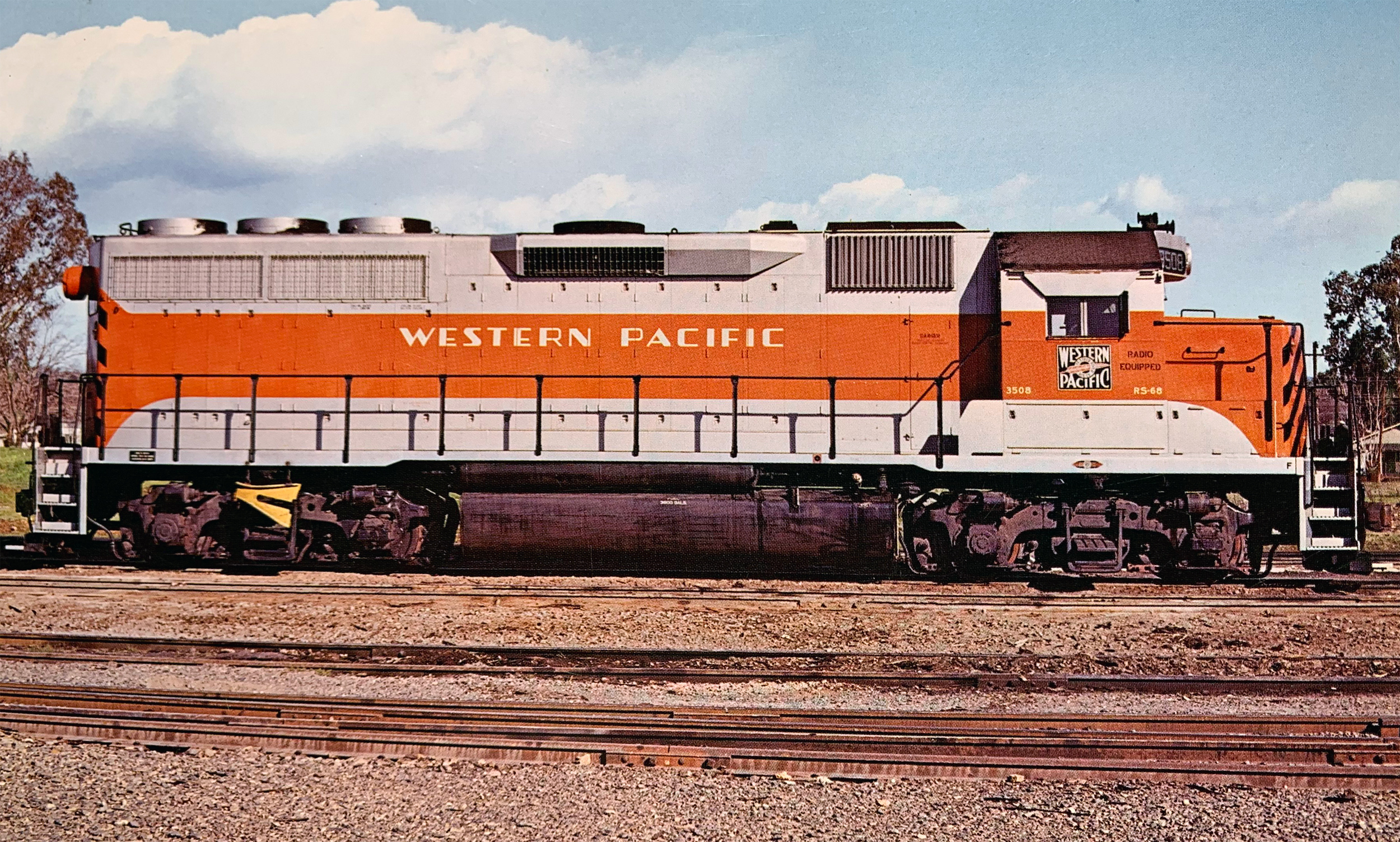 In this Western Pacific photo, GP40 #3508 rests at the road's engine terminal in Oroville, California during May of 1966. Author's collection.
The GP40 and GP40-2, along with the non-turbocharged GP38 and GP38-2, were EMD’s most successful second-generation Geeps. As with earlier models they fit exactly what railroads were looking for while also featuring the manufacturers’ excellence in quality and reliability.
The GP40's rugged and reliable nature has enabled it to remain as common as railroad spikes, even nearly 40 years since Florida East Coast #434 rolled out of La Grange in December, 1986 - ironically, one year after the final GP50 had been completed.
As a result, the model can still regularly be found in service throughout the country today, although many Class 1 variants have been heavily modified or rebuilt over the years.
Sources
- Foster, Gerald. A Field Guide To Trains. New York: Houghton Mifflin, 1996.
- Marre, Louis A. and Pinkepank, Jerry A. Contemporary Diesel Spotter's Guide, The: A Comprehensive Reference Manual To Locomotives Since 1972. Milwaukee: Kalmbach Publishing Company, 1989.
- McDonnell, Greg. Locomotives: The Modern Diesel & Electric Reference, 2nd Edition. Buffalo: Boston Mills Press/Firefly Books, 2015.
- Solomon, Brian. EMD Locomotives. Minneapolis: MBI Publishing Company, 2006.
- Solomon, Brian. GE and EMD Locomotives: The Illustrated History. Minneapolis: Voyageur Press, 2014.
SteamLocomotive.com
Wes Barris's SteamLocomotive.com is simply the best web resource on the study of steam locomotives.
It is difficult to truly articulate just how much material can be found at this website.
It is quite staggering and a must visit!