Los Angeles Union Station: Photos, History, Current Use
Last revised: December 20, 2024
By: Adam Burns
Union Station Los Angeles (LAUS), better known as its original name, Los Angeles
Union Passenger Terminal (LAUPT) is one of the best-recognized such facilities in the western United States.
When built LAUPT was served by the Union Pacific, Southern Pacific, and Santa Fe hosting some of the West’s most prominent passenger trains.
Unfortunately, it was completed during the waning days of rail travel as the public abandoned trains for other modes of transportation.
The station's high water mark occurred only during its first decade of operation. After World War II its importance dwindled but its fate proved far brighter than several others across the country.
Despite its late construction LAUPT has been in continual use since it opened and is ready to handle the resurgence of passenger rail in the 21st century.
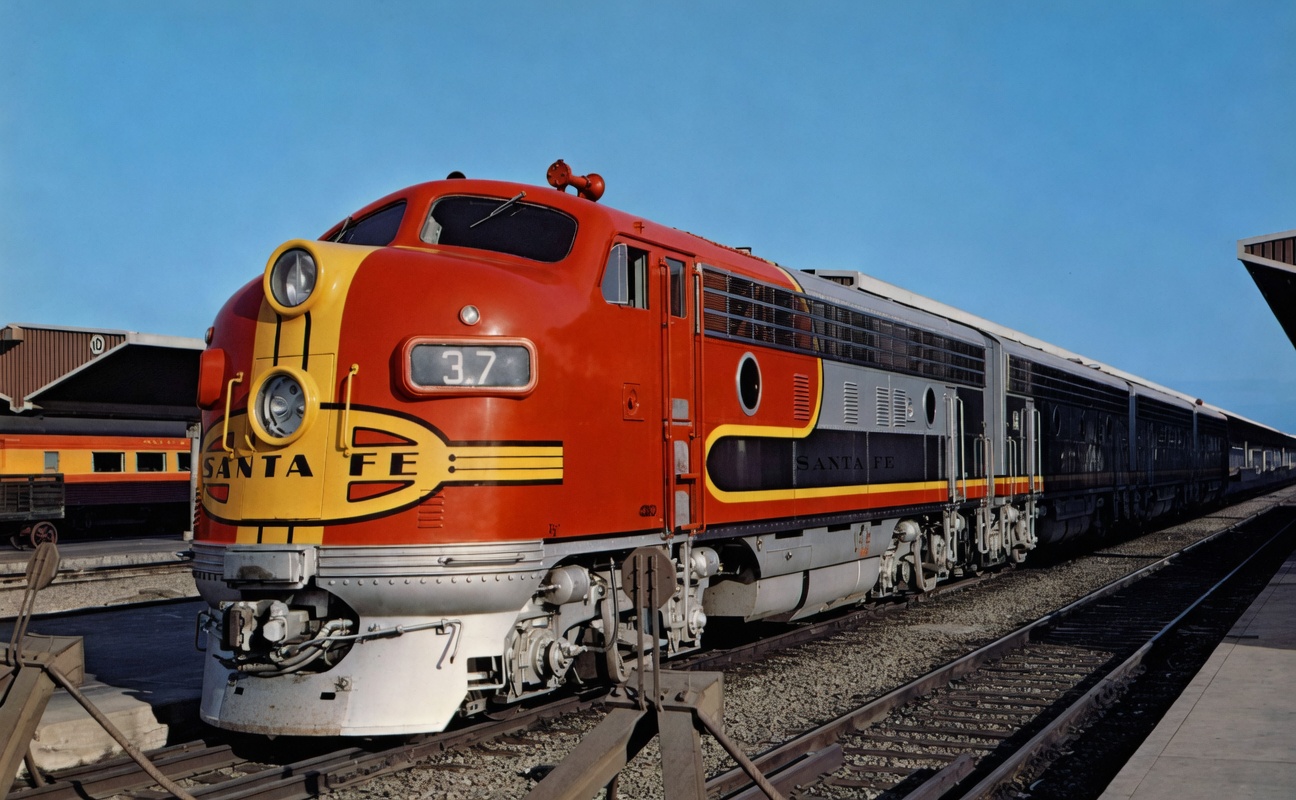 This stunning Santa Fe publicity photo features a matching A-B-B-A set of F7s, led by #37-L, at Los Angeles Union Passenger Terminal awaiting to lead the "Super Chief", circa 1950. Note the Southern Pacific train at left.
History
Los Angeles owes its growth to the railroad. California's first was the small Sacramento Valley, which opened a 22-mile line connecting Sacramento with Folsom in early 1856.
However, the city wouldn't receive its first train until the Los Angeles & San Pedro opened a 21-mile route between San Pedro Bay and Los Angeles on October 26, 1869.
At the time the small community numbered only around 5,000 residents but would explode over the next three decades to more than 100,000. During this time the West's three principal railroads would reach Los Angeles.
Union Station At The Oscars
In 2021, Union Station added another historical notch in its belt by playing host to the 93rd Oscars on April 25th. The station has made numerous cameos in movies and commercials over the years.
One of the most recent was scenes in the 2012 movie "The Dark Knight Rises" in which the facility played host to Bane's faux courtroom.
The first was the Southern Pacific, which conquered the Tehachapi's (via the grand Tehachapi Loop still in service today) and completed a link to Los Angeles via San Francisco on September 5, 1876.
The second was the the Atchison, Topeka & Santa Fe (Santa Fe), incorporating a subsidiary known as the San Bernardino & Los Angeles Railway on November 20, 1886. This little system linked its namesake cities less than a year later on May 31, 1887.
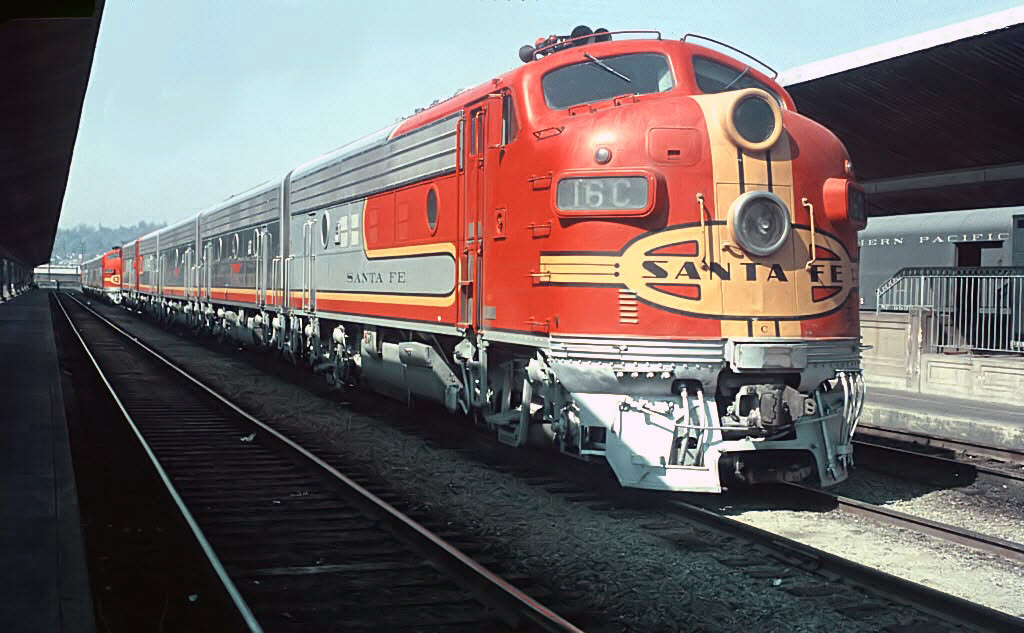 A classic set of Santa Fe "Warbonnets", with F3A #16C closest to the photographer, at Los Angeles Union Passenger Terminal in August, 1964. Rick Burn photo.
Finally, there was the Union Pacific, the last to arrive. It opened service to the City of Angels in 1905 with the completion of subsidiary Los Angeles & Salt Lake.
All three railroads served different passenger terminals at this time. According to the KCETLink article, "Lost Train Depots of Los Angeles," by Nathan Masters the city's first depot was built by Southern Pacific predecessor Los Angeles & San Pedro, which opened a very small facility at the southwest corner of Commercial and Alameda Streets on October 26, 1869.
In the following half-century SP would construct a handful of different terminals, each a bit more architecturally impressive than the previous. The first was River Station which opened in 1876 at the current site of the Los Angeles State Historic Park.
Unfortunately, the public never cared much for this terminal, located within the railroad's bustling freight yards and very far from the downtown area.
Just over a decade later it was replaced by Arcade Station in 1888. A wooden structure built in the Victorian style it was located at Fourth Avenue and Alameda Street.
A far improvement from earlier terminals, Arcade was elegant both inside and out situated in a much better location but as the city continued to grow SP realized yet another facility would be needed.
In 1912 it announced plans for this new terminal called Central Station.
According to Holly Kane's thesis entitled, "Arriving in Los Angeles: Railroad Depots As Gateways To The California Dream," it was built by the firm Parkinson & Bergstrom, which based its design from Washington Union Station (D.C.) in the Beaux-Arts style. It opened in 1914 and remained in regular use over the next two decades.
The Santa Fe's station was arguably the most handsome. Named the La Grande Station and located at the corner of Santa Fe Avenue and Second Street it was the work of company employee Frank Levet.
The brick terminal was a lavish facility featuring an intricate roofline of towers and domes, culminating in the great Moorish Dome above the building.
While it was damaged in the 1933 Long Beach Earthquake (resulting in the removal of its great dome) it remained Santa Fe's primary station until Los Angeles Union Passenger Terminal was built.
Lastly was Union Pacific's simple but elegant two-story Victorian station completed by predecessor Los Angeles & Salt Lake (LA&SL) in 1891.
Appearing as a classic "Gingerbread" style structure with ornate trim and brackets the wooden building sat across the Los Angeles River from La Grande Station.
In early 1915 the LA&SL began plans for a new terminal, even hiring architects Sumner Hunt and Silas Burns.
However, it was ultimately never built and after catching fire on March 11, 1924 Union Pacific elected to share Southern Pacific's Central Station.
The idea for what later became today's union station began as early as 1911 when the Los Angeles City Council first studied the project.
Then, it gained significant traction with the California Railroad Commission’s report released in 1920 detailing that the facility would cost nearly $11 million (a figure which proved to be almost exactly correct).
However, delays ensued, the most pressing of which was the railroads' reluctance to build a centralized terminal. The ensuing battle would eventually reach all the way to the U.S. Supreme Court. The nation's top court ultimately sided with the Railroad Commission, issuing its decision on May 31, 1931.
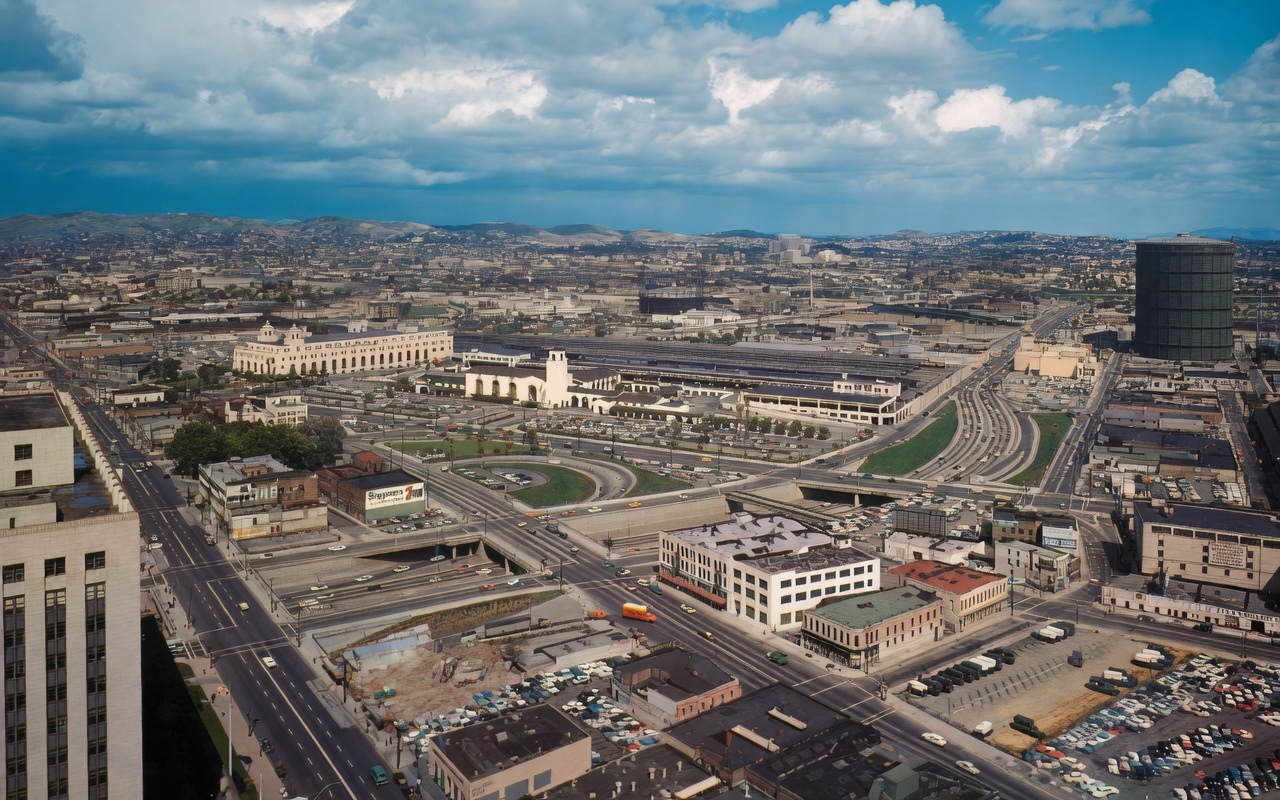 An aerial view of Los Angeles Union Passenger Terminal circa 1950s.
The railroads' hesitation was not without merit. The Great Depression hit the country hard and passenger traffic dropped precipitously, remaining low throughout the 1930s.
They simply felt there was no need to build a costly terminal, which would never meet capacity. However, having lost their court fight the trio begrudgingly submitted proposals and the commission selected a stub-ended design in early 1932.
Yet, for another year the three railroads continued to fight the terminal's construction but finally announced on June 16, 1933 they would suspend these efforts.
What became known as Los Angeles Union Passenger Terminal (LAUPT) was located within Los Angeles' original Chinatown along what is today North Alameda Street and East Cesar E. Chavez Avenue.
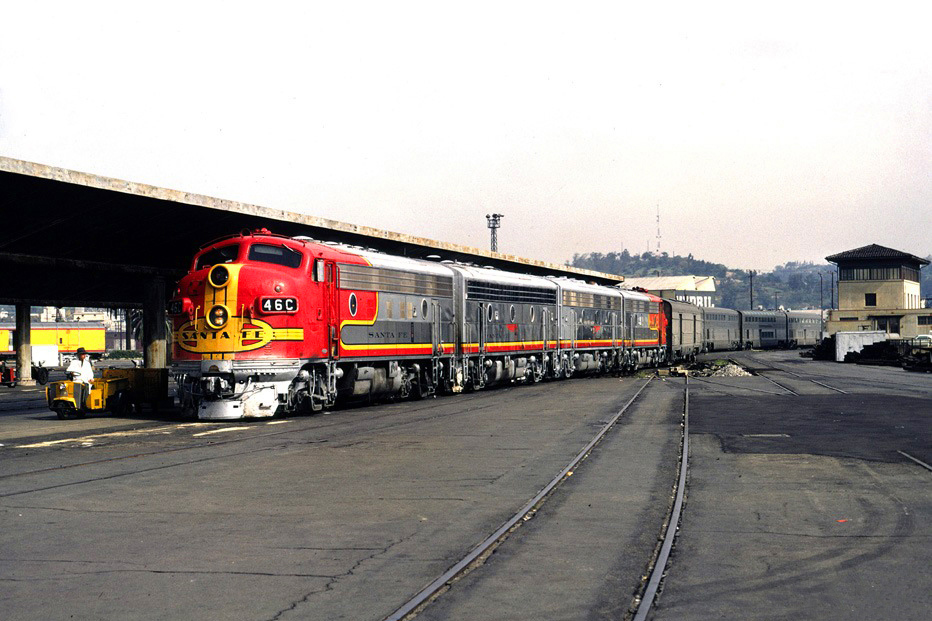 Santa Fe's combined "Super Chief"/"El Capitan", led by F7A #46C, arrives at Los Angeles Union Passenger Terminal in March, 1971. Drew Jacksich photo.
Construction
As Brian Solomon notes in his book, "Railway Depots, Stations & Terminals," Union Station Los Angeles is often credited as being the last great passenger terminal built in this country.
Its architecture was a mix of California’s traditional mission-style with Art Deco touches. The facility, utilizing 25.5 acres, was completed at a cost of $11 million in 1939 financed by the Union Pacific, Santa Fe, and Southern Pacific.
The history of what would become LAUPT dates back to 1926 when the city gave residents the option of voting for a new train station or build an "El", also known as an elevated railroad.
They would narrowly pass the measure and despite some the previously mentioned controversy the new station greatly improved traffic flow by allowing both trains and passengers to meet at a centralized location.
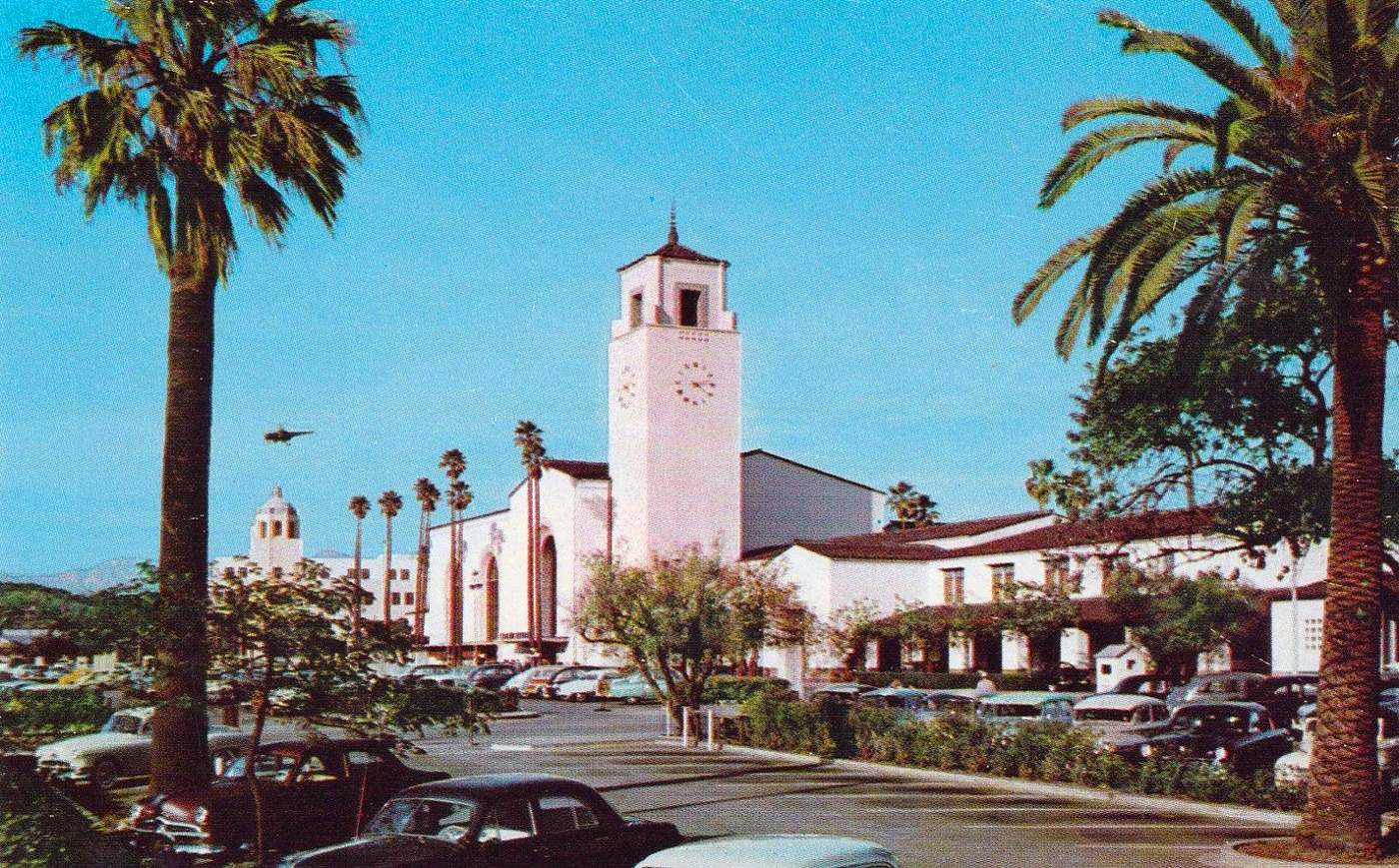
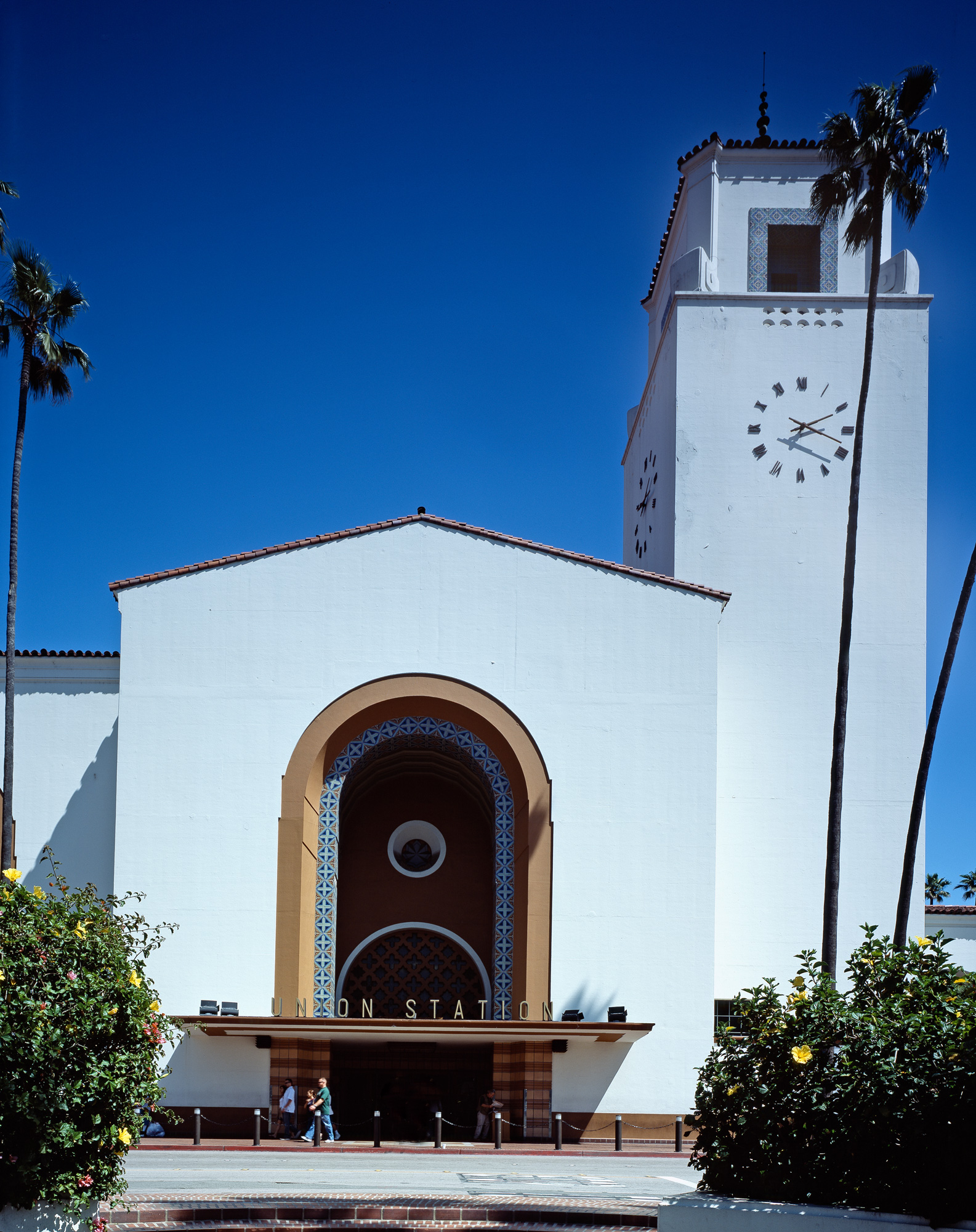 The clock tower at front entrance at Los Angeles Union Station as seen in 2005. Carol Highsmith photo.
Los Angeles Union Passenger Terminal was designed by John Parkinson and Donald Parkinson, a father and son architect team, and its overall finished appearance fit in very well with the region in which it was located.
In addition to their work each railroad hired their own architects including H. L. Gilman for the Santa Fe, J.H. Christie for Southern Pacific and R. J. Wirth for Union Pacific.
While the building's design carried an overall Spanish Mission theme it also employed elements of the Dutch Colonial Revival and Streamline Moderne styles.
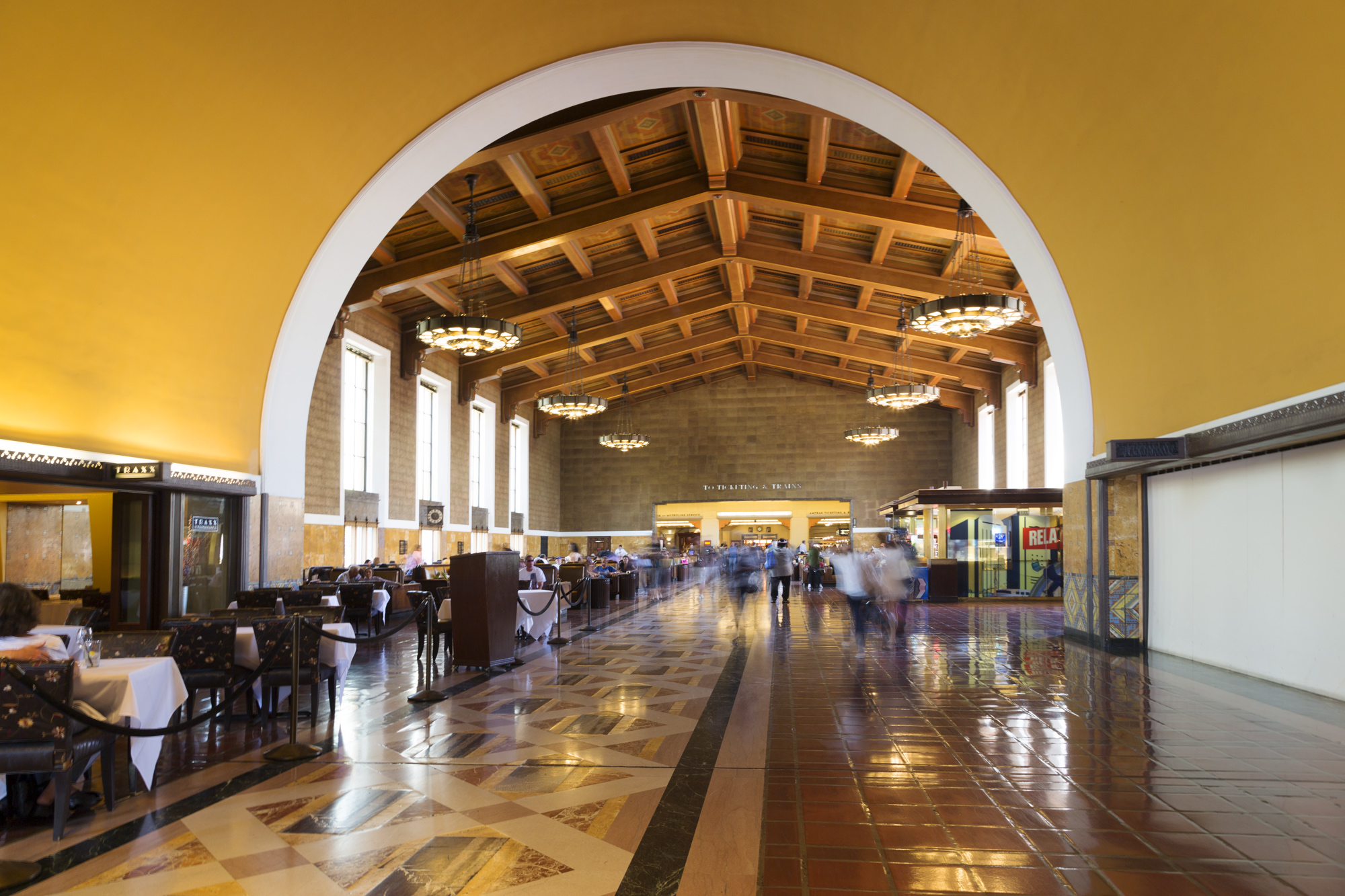
For instance, inside Union Station Los Angeles one could find terra cotta tiles and Travertine marble used to create beautiful floor designs while interior garden patios gave the terminal a unique feel that most simply did not have.
Considering the late era in which it was constructed, LAUPT was a beautiful building that evoked earlier masterpieces such as Grand Central Terminal, King Street Station, St. Louis Union Station, and others.
Unfortunately, John Parkinson would not live to see LAUPT completed, passing away during its planning stages on December 9, 1935.
When Los Angeles Union Passenger Terminal opened in 1939 a fabulous railroad gala was held mirroring the "Pageant of the Iron Horse" which had taken place in Baltimore during 1927.
Bill Bradley notes in his book, "The Last Of The Great Stations," that LAUPT attracted a half-million visitors for its grand opening. The first scheduled train to arrive was Southern Pacific's Imperial, a secondary transcontinental service to Chicago.
Unfortunately, the terminal had long since missed the "Golden Age," which peaked during the first few decades of the 20th century but did witness throngs of travelers during World War II.
At this time the facility witnessed over 7,000 folks and 100 trains daily. The station also saw its three builders’ most prominent passenger trains with names like the Santa Fe's Super Chief and El Capitan, Southern Pacific's Sunset Limited and Daylight, and the Union Pacific's City of Los Angeles.
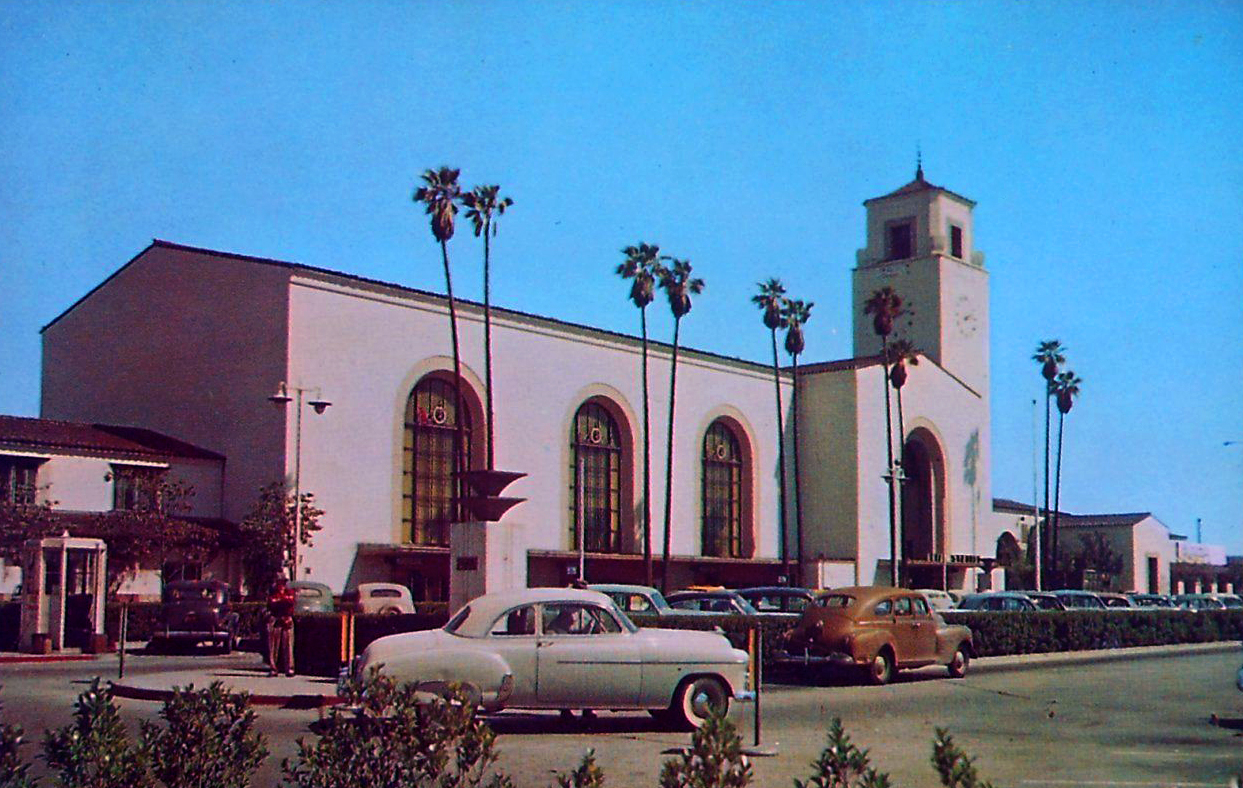
Modern Era
According to architect Paul Hunter in Tom Zoellner's book "Train" Union Station Los Angeles provided a grand entrance into the city and Southern California:
"Certainly I know of no other city in which arriving passengers leave the station through an open patio, filled with bright flowers, shady pepper trees, and flanked with tall palms.
This scheme undoubtedly originated with publicity men, but they have certainly hit upon the ideal introduction to Southern California."
Rail travel slowly died away after the war as folks found automobiles much more convenient and airlines a faster means of traveling from city to city.
As the public abandoned trains the famous consists had largely stopped calling to LAUPT by 1970 and were gone altogether by 1971 when Amtrak took over most of the nation's intercity passenger services.
Thankfully for both architecture’s sake and that of our transportation infrastructure LAUPT (renamed Union Station Los Angeles, LAUS for short, by one-time owner Catellus Development) found new life beginning in the 1990s.
Prior to this the facility had limped along under Amtrak serving a few of the carrier’s long-distance trains. In 1992 the station was completely restored and, its future continues to look bright:
"The most visible change is the Gateway Center, a bus terminal and park & ride facility which provides better connections between buses and trains.
The Gateway, which opened in October 1995, also includes shops, restaurants and offices, all located on the Union Station property.
In the 21st century, Union Station Los Angeles will also be a major destination in the proposed high-speed rail system for California."
(The previous was courtesy of Los Angeles Rail Transit.)
Today, Los Angeles Union Station is owned by the city after it was purchased in the spring of 2011 following approval of the Metro Board.
In 1980 it was placed on the National Register of Historic Places and is one of the city's true landmarks. Amtrak still calls five of its intercity passenger trains to the terminal (Coast Starlight, Pacific Surfliner, Southwest Chief, Sunset Limited, and Texas Eagle) while commuter service Metrolink makes six station stops to the terminal via all of its different lines.
Additionally, the terminal continues to use all of its original 14 staging tracks although the stub-ended design is increasingly becoming a considerable liability as service continues to increase.
Due to this bottleneck there are plans to convert several of the staging tracks as run-through corridors, which should greatly help efficiency. To read more about Union Station Los Angeles's history please click here.
Recent Articles


-
Erie Steam Locomotives: History, Roster & Photos
Sep 20, 26 11:55 AM
 Erie Railroad steam—Camelback 2-8-0s, 155 N-1 Mikados, 105 Berkshires, K-class Pacifics, Triplexes. Post-1900 roster after Drury. Last steam March 17, 1954.
 -
Erie Railroad Diesel Roster: All-Time
Sep 20, 26 11:47 AM
 Erie Railroad diesel—boxcabs 1926, FTs 1944, F3/F7, FA/PA, GP7/GP9, Baldwins, Limas. All-time roster with serials, orders, classes. Last steam March 17 1954. EL October 17 1960.
 -
Erie Railroad: Map, Passenger Trains, Logo, History
Sep 20, 26 11:44 AM
 Erie Railroad—New York & Erie 1832, Piermont–Dunkirk May 14 1851, six-foot then standard June 1880, Chicago 1883. High-and-wide fourth way. Erie Lackawanna October 17 1960.
 -
Colebrookdale Railroad Dining (2026): Secret Valley Dinner Train
Sep 20, 26 11:36 AM
 2026 Colebrookdale Railroad dinner in Boyertown—Secret Valley Dining Class, about 2 hours. Saturday evenings. Confirm on colebrookdalerailroad.com.
 -
Boone & Scenic Valley Wolf Dinner Train (2026)
Sep 19, 26 08:15 PM
 2026 Boone & Scenic Valley Wolf Dinner Train—Des Moines River valley, Bass Point Creek High Bridge, Union Pacific dining cars. Confirm on bsvrr.com.
 -
C&NW 4-6-2s 1617 & 1620: Minnesota 400 Yellow Jackets
Sep 19, 26 11:28 AM
 C&NW Class E Pacifics 1617 and 1620—Alco Schenectady 1917, yellow-and-green E-4-style shrouds 1941 for the Minnesota 400. Crews called them Yellow Jackets. Renumbered 617/620. Scrapped 1956.
 -
Erie Lackawanna Diesel Roster: All-Time
Sep 19, 26 10:13 AM
 Erie Lackawanna diesel—Erie and DL&W inheritance, GP35s, U25Bs, SD45/SDP45/SD45-2, U34CH. All-time roster with serials and orders. Conrail April 1 1976.
 -
Erie Lackawanna Railway: Map, History, Logo
Sep 19, 26 10:06 AM
 Erie Lackawanna Railway—Erie and DL&W, October 17 1960–March 31 1976. Von Willer, White revival, Dereco, Agnes, Conrail. High-and-wide Chicago main. Map, logo, what remains.
 -
"Empire State Express" (1941 Train): Timetables, Route, Consist
Sep 18, 26 10:59 PM
 NYC Empire State Express—George Daniels 1891 day train, 999’s 112.5 mph claim, Budd stainless streamliner December 7 1941, Cleveland and Detroit sections, diesels, 1967 name drop. Timetables, consist…
 -
New York Central 4-6-4s 5426 & 5429: Empire State Express Hudsons
Sep 18, 26 10:32 PM
 NYC J-3a Hudsons 5426 and 5429—Alco 1937, Budd stainless shrouds 1941 for the Empire State Express. Pearl Harbor inaugural. Shrouds off by 1950. Neither preserved.
 -
"Stourbridge Lion" Locomotive: Facts, History, Photos
Sep 18, 26 10:27 PM
 Stourbridge Lion—Foster, Rastrick 0-4-0, first steam locomotive in the United States. Horatio Allen, Honesdale, August 8, 1829. Too heavy for D&H gravity track. Boiler in Baltimore; Colonie replic…
 -
Delaware & Hudson Steam Roster (Post 1900)
Sep 18, 26 10:01 PM
 Delaware & Hudson steam—Camelback 2-8-0s, Loree high-pressure compounds, Class K 4-8-4s, forty Challengers. Post-1900 class roster after Drury. Last steam July 21, 1953.
 -
Boston & Maine Steam Roster (Post 1900)
Sep 18, 26 02:57 PM
 Boston & Maine steam—B-15 Moguls, K-8 Consolidations, P-4 Lima Pacifics, T-1 Limas, R-1 Mountains. Post-1900 class roster after Drury. Last steam July 23, 1956.
 -
Boston & Maine Diesel Roster (All-Time)
Sep 18, 26 01:25 PM
 Boston & Maine diesel—boxcab 1100 1935, Flying Yankee 6000, FTs, E7s, BL2s, GP7/GP9, GP38-2s and GP40-2s. All-time roster. Last steam July 23, 1956.
 -
Mid-Continent Railway Museum Dining (2026)
Sep 18, 26 01:21 PM
 2026 Mid-Continent dining in North Freedom—select-date seated meals in luxury cars, reservations required. Pizza Limited June 28. Confirm on midcontinent.org.
 -
Bessemer & Lake Erie Steam Roster (Post 1900)
Sep 18, 26 12:11 PM
 Bessemer & Lake Erie steam—C3A 150–151, D1A/D2A Santa Fes, 47 H1 Texas types after Burlington. Post-1900 class roster after Drury. Last steam 2-8-0 156, May 14, 1953.
 -
Bessemer & Lake Erie Diesel Roster (All Time)
Sep 18, 26 12:09 PM
 Bessemer & Lake Erie diesel—Westinghouse 281 1936, Baldwin DRS-6-6-1500s, F7s 1950–53, SD7/SD9/SD18/SD38 family, RSD-15s. All-time roster. Last steam 2-8-0 156, May 14, 1953.
 -
Bangor & Aroostook Steam Roster (Post 1900)
Sep 18, 26 11:21 AM
 Bangor & Aroostook steam—Manchester Ten-Wheelers, Alco Mountains 100–109, G-2 Consolidations, Pacifics 250–254. Post-1900 class roster after Drury. Last steam Pacific 251, July 22, 1951.
 -
Bangor & Aroostook Diesel Roster (All Time)
Sep 18, 26 11:09 AM
 Bangor & Aroostook diesel—F3s 1947, eight BL2s, E7s, GP7s leased to the PRR, GP9s, GP38s. All-time roster. Last regular steam July 22, 1951.
 -
B&O Steam Locomotive Roster (Post 1900)
Sep 18, 26 10:33 AM
 Baltimore & Ohio steam—Old Maude, E-27 Consolidations, Q Mikados, Big Sixes, EM-1 Yellowstones, President Pacifics. Post-1900 class roster after Drury. Last public steam May 17, 1958.
 -
Baltimore & Ohio (B&O): Diesel Roster (All-Time)
Sep 18, 26 10:28 AM
 Baltimore & Ohio diesel—boxcab 1925, EMC 50 1935, EA 1937, FTs, F3s, F7s, FA-2s, sharks, GP7/GP9, GP30s after C&O 1963, SD50s 8576–8595 1984. All-time roster. Last steam 1958.
 -
Detroit & Toledo Shore Line Railroad: Map, Roster, History
Sep 18, 26 12:32 AM
 Detroit & Toledo Shore Line—Pleasant Bay 1898, named 1899, Detroit–Toledo freight bridge, GTW and Clover Leaf/NKP/N&W. Merged into Grand Trunk Western June 26, 1981.
 -
Lackawanna Steam Locomotives: History, Roster & Photos
Sep 18, 26 12:17 AM
 Delaware, Lackawanna & Western steam—Camelback 2-8-0s, Mikados, freight Pacifics, Poconos 4-8-4s, Hudsons. Post-1900 roster after Drury. Last steam July 13, 1953.
 -
Lackawanna (DL&W) Diesel Roster: All Time
Sep 18, 26 12:11 AM
Delaware, Lackawanna & Western diesel—boxcabs 1926, EMC SC 425–426 1935, FTs 1945, F3/F7/E8, GP7s, RS-3s, FM Train Masters. All-time roster. Last steam 1953. -
Lackawanna Railroad: Map, History, Viaducts, Rosters
Sep 18, 26 12:04 AM
 TDelaware, Lackawanna & Western—Liggett’s Gap 1832, named March 11 1853, Hoboken–Buffalo, anthracite, Phoebe Snow, Cutoff and Tunkhannock. It merged with the Erie to form Erie Lackawanna on Octobe…
 -
Rail News, The Latest
Sep 17, 26 11:56 PM
This page provides a portal to the latest in rail news, from preservation and restortation subjects to other notable topics. -
Union Pacific Big Boy 4014 Sets First Holiday Tour for Make-A-Wish
Sep 17, 26 11:54 PM
 Union Pacific Big Boy 4014’s first holiday tour: Cheyenne–Denver tickets, Nov. 21 Denver-area display, Make-A-Wish. Museum patrons Oct. 16; public Oct. 19.
 -
Conrail Diesel Roster (All Time)
Sep 17, 26 10:27 PM
Conrail diesel—~5,000 inherited 1976, Big Blue, GP15-1s, SD40-2s, SD50s, Dash-8s, SD60/60M/60I, SD80MACs. All-time CR-number roster. -
Chessie System (Railroad): The C&O, B&O, And WM
Sep 17, 26 09:38 PM
 Chessie System, Inc.—C&O, B&O, and Western Maryland. Kitten-C paint 1972, holding company February 26 1973, CSX November 1 1980, C&O into CSXT August 31 1987.
 -
Chesapeake & Ohio (C&O) Diesel Roster: All-Time
Sep 17, 26 06:01 PM
Chesapeake & Ohio diesel—late steam, no Fairbanks-Morse, E7s 1946, GP7/GP9 flood, F7s, GP40-2s, B30-7s, SD50s 1984–85. All-time roster. Steam ended 1956. -
Chesapeake & Ohio (C&O) Steam Roster: Post-1900
Sep 17, 26 03:18 PM
 Chesapeake & Ohio steam—H-8 Alleghenies, K-4 Kanawhas, T-1 Texas, Greenbriers, H-6 1949 Mallets. Post-1900 class roster including Pere Marquette and Hocking Valley. Last steam 1956.
 -
Chesapeake and Ohio Railway: Map, Logo, History
Sep 17, 26 02:36 PM
 Chesapeake & Ohio Railway—Louisa Railroad 1836, named August 31 1868, Ohio River 1873. Coal, Chessie the kitten, Pere Marquette 1947, B&O control 1963, into CSX August 31 1987. Complete corporate…
 -
TVRM Valentine Train Ride (2026)
Sep 17, 26 02:31 PM
 2026 TVRM Valentine Train Ride in Chattanooga—Feb. 6–15, plated dinner, Grand Junction Depot. Confirm on tvrail.com.
 -
River Fox Train Dining (2026)
Sep 17, 26 02:29 PM
 2026 River Fox Train in West Sacramento—Brunch Train and Murder Mystery dinner. 18095 County Road 117. Confirm on riverfoxtrain.com.
 -
Weehawken Terminal, Serving The West Shore Railroad
Sep 17, 26 01:38 PM
 Weehawken Terminal—West Shore / New York Central Hudson waterfront station, opened 1884. Five ferry slips, sixteen tracks, Weehawken Tunnel 4,014 feet. Last ferry March 25, 1959. Port Imperial and HBL…
 -
West Shore Railroad: Map, History, Timetables
Sep 17, 26 01:32 PM
 West Shore Railroad—New York, West Shore & Buffalo 1880–83, Weehawken to Buffalo. PRR-backed rival to the Central. Morgan settlement, 475-year NYC lease January 1 1886. CSX River Sub today.
 -
Jersey Central Diesel Locomotives: History, Roster & Photos
Sep 17, 26 01:20 PM
 Central Railroad of New Jersey diesel—boxcab 1000, Baldwin double-enders, F3s, Train Masters, SD35s, GP40Ps. All-time roster. Steam ended July 1, 1954.
 -
Jersey Central Steam Locomotives: History, Roster & Photos
Sep 17, 26 01:17 PM
 Central Railroad of New Jersey steam—Camelback Ten-Wheelers, USRA Mikados, G-class Pacifics, suburban tanks. Post-1900 class roster after Drury. Dieselized July 1, 1954.
 -
Jersey Central Railroad (CNJ): Map, Rosters, History
Sep 17, 26 01:14 PM
 Central Railroad of New Jersey—Elizabethtown & Somerville 1831, named April 23 1849. Communipaw, anthracite, Blue Comet, Reading/B&O control. Conrail April 1 1976. Complete corporate history.
 -
Central Vermont Diesel Locomotives: History, Roster & Photos
Sep 17, 26 11:35 AM
 Central Vermont diesel—Alco S-2s 1942, RS-3s, RS-11s from DW&P, EMD GP9s 1956–57, GP38ACs 1971. All-time roster. Last steam April 4, 1957.
 -
Central Vermont Steam Locomotives: History, Roster & Photos
Sep 17, 26 11:19 AM
 Central Vermont steam—ten Alco 2-10-4s of 1928, four U-1-a Mountains, Consolidations. Post-1900 class roster after Drury. Last steam April 4, 1957.
 -
Central Vermont Railway: Map, Logo, Rosters
Sep 17, 26 11:03 AM
 Central Vermont Railway—Vermont Central charter October 1843, Bethel–White River Junction June 26, 1848. Grand Trunk 1898, CN 1923, RailTex/NECR 1995. Complete corporate history.
 -
Fitchburg Railroad: Map, History, Timetables
Sep 17, 26 10:40 AM
 Fitchburg Railroad—chartered March 3, 1842, Boston–Fitchburg March 5, 1845. Alvah Crocker, Hoosac west door, Vermont & Massachusetts, Cheshire. B&M 99-year lease July 1, 1900. Complete corpora…
 -
Steam Railroading Institute Dining (2026)
Sep 17, 26 10:30 AM
 2026 SRI Owosso dining—vintage dining cars, select evenings. 2026 dinner calendar not posted; 2025 Up In Smoke is the recent example. Confirm on michigansteamtrain.com.
 -
Canadian Pacific Railway: Map, History, Logo, Photos
Sep 17, 26 12:06 AM
 Canadian Pacific Railway—incorporated February 16, 1881. Last spike Craigellachie November 7, 1885. Soo, Milwaukee, D&H, DM&E. CPKC April 14, 2023. Complete corporate history.
 -
Canadian Pacific Diesel Locomotives: History, Roster & Photos
Sep 17, 26 12:03 AM
 Canadian Pacific diesel—E8A 1800 in 1949, FP7/FP9, FA-2, C424, SD40-2, SD40-2F Red Barns, AC4400CW, ES44AC, SD30C-ECO, SD70ACu heritage. All-time roster. Last steam November 6, 1960.
 -
Canadian Pacific Steam Locomotives: History, Roster & Photos
Sep 16, 26 11:35 PM
 Canadian Pacific steam—3,257 engines 1881–1949. D10 Ten-Wheelers, G3 Pacifics, Royal Hudsons, Selkirk 2-10-4s. Post-1900 class roster after Drury. Last steam November 6, 1960.
 -
Woodstown Central Dining in Motion (2026)
Sep 16, 26 11:31 PM
 2026 Woodstown Central Dining in Motion—Salem County table car, 50–60 minutes, private table of four from $190. Confirm on woodstowncentral.com.
 -
NCTM Wine & Dine on the Rails (2026)
Sep 16, 26 11:28 PM
 2026 NCTM Wine & Dine on the Rails in Spencer—Feb. 13–15, three-course dinner, 21+, $145/$140. Sold out. Confirm next season on nctransportationmuseum.org.
 -
Southern Railway 4-6-2 1380: The Streamlined Ps-4
Sep 16, 26 10:34 PM
 Southern Railway Ps-4 4-6-2 1380—Alco 1923, serial 64857. Otto Kuhler streamlining at Spencer 1940–41 for the Tennessean. Only streamlined steam locomotive on the Southern. Scrapped Baltimore 1953.