Baldwin "AS-16" Locomotives

Last revised: February 29, 2024
By: Adam Burns
The AS16 began a new series and designation system for Baldwin's diesel line, one which was much simpler and easier to
grasp than the complicated hyphens and numbers used before.
Interestingly, this new series also found Baldwin becoming a bit more successful in the locomotive market, although it remained well behind the American Locomotive (Alco) and Electro-Motive.
Overview
Interestingly, this improvement was likely not a coincidence. With the unveiling of its Standard Line in 1950 the company released an updated prime mover with the goal of becoming a more dominant player in the market once more.
While the Baldwin's latest designs were still not of the quality cataloged by Electro-Motive they were certainly a step in the right direction and an improvement over earlier designs.
Unfortunately, with its purchase by the Westinghouse Electric Company, Baldwin's direction was steered away from locomotive manufacturing thus ending any ideas of remaining a major competitor.
Photos
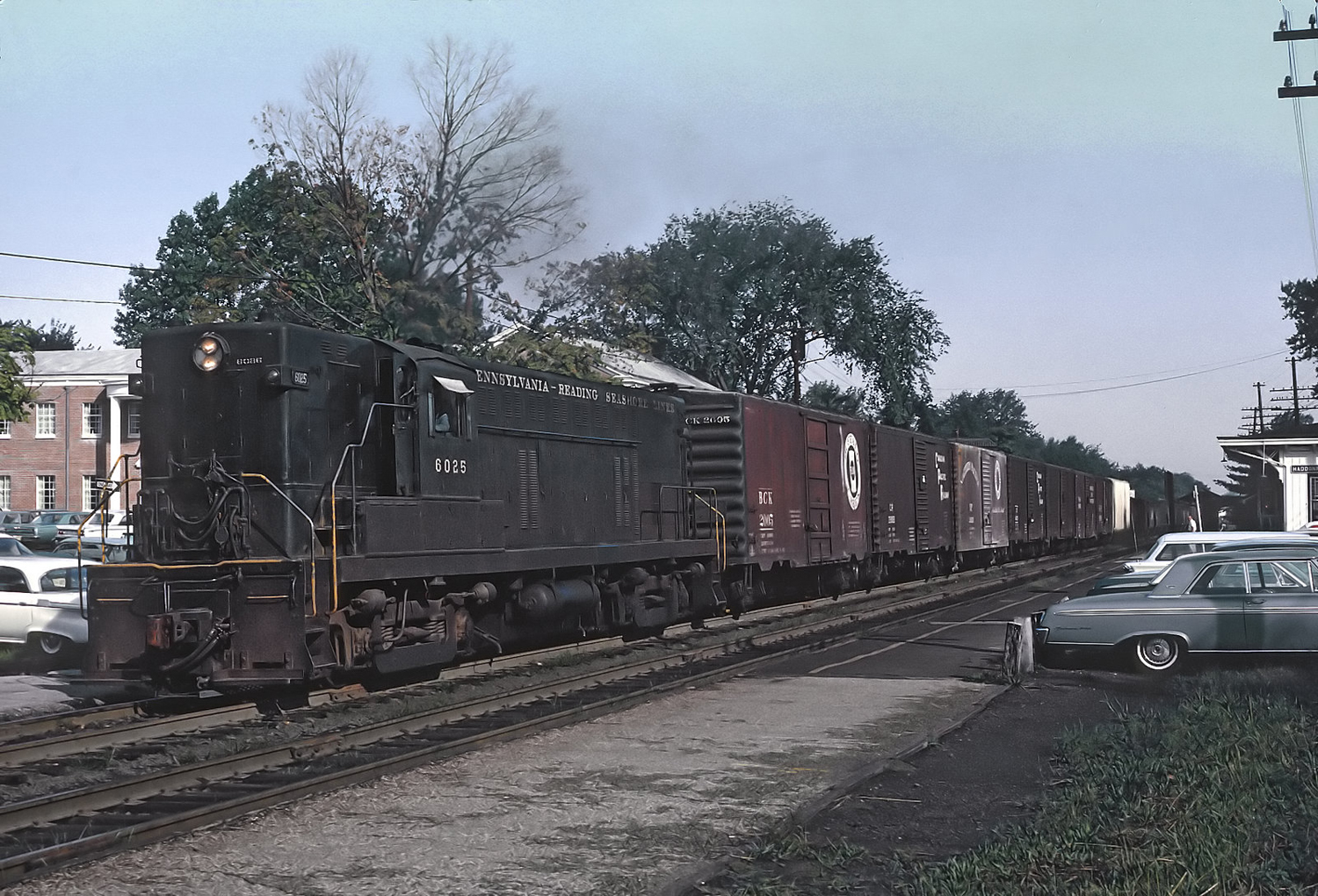 Pennsylvania-Reading Seashore Lines AS16 #6025 works freight service as it passes the station at Haddonfield, New Jersey on September 2, 1965. Roger Puta photo.
The AS16 began production in 1950 and it introduced the manufacturer's new Standard Line of diesels. "Standard" most definitely is an understatement as the new designations were easier to understand and far simpler than previous descriptions.
Taking direction from Alco and EMD, Baldwin used a plain one or two letter designation for each model followed by two or three numbers.
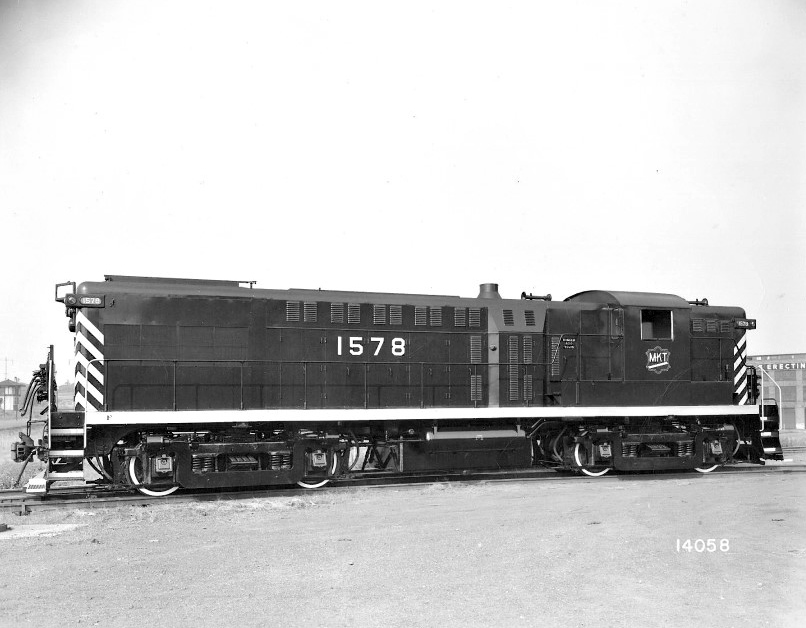 A Baldwin company photo of new Missouri-Kansas-Texas Railroad (Katy) AS16 #1578 taken in the early 1950s.
%20AS16%20%231578%20taken%20in%20the%20early%201950s.)
In part, this was due to its discontinuance of manufacturing steam locomotives after 1949, realizing the motive power could no longer compete in the market. Its new designations were as follows:
- AS for All Service
- RS for Road Switcher
- RF for Road Freight
- RT for Road Transfer
The system included the number of powered axles and horsepower, although the AS16 was the only Standard Line road switcher not to include the former in its designation.
For instance, the AS416 meant All Service road switcher that featured 4 powered axles and 1,600 horsepower. Utilizing Baldwin's updated 608A prime mover, the AS16 sold relatively well at least when considering the builder's diesel line as a whole.
Reception
In terms of its road switchers the AS16 was the second highest seller with 127 sold to several Class I railroads including:
- Baltimore & Ohio
- Erie Railroad
- Missouri-Kansas-Texas (Katy)
- St. Louis Brownsville & Mexico (Missouri Pacific)
- International-Great Northern (Missouri Pacific)
- Nickel Plate Road
- Pennsylvania-Reading Seashore Lines (PRSL)
- Soo Line
- Reading
- Western Maryland
The AS16 was produced between 1950 and 1955, after which time the Baldwin-Lima-Hamilton Corporation (a formation of the Baldwin Locomotive Works and Lima-Hamilton Corporation) called it quits. As usual, all internal components were supplied by Westinghouse and once again, BLH failed to offer the AS16 with dynamic braking.
Data Sheet and Specifications
| Entered Production | 9/28/1950 (Missouri-Kansas-Texas #1571) |
| Years Produced | 9/28/1950 - 2/29/1956 |
| Baldwin Class | DRS-4-4-1600/1 SC |
| Engine | 608A |
| Engine Builder | De La Vergne |
| Horsepower | 1600 |
| Carbody Styling | Baldwin |
| Length (Between Coupler Pulling Faces) | 58' |
| Weight | 236,000 Lbs (Optional ballasting to 250,000 Lbs.) |
| Height (Top Of Rail To Top Of Cab) | 14' |
| Width | 10' 2" |
| Trucks | B-B |
| Truck Type | Swing Bolster-Drop Side Equalizers |
| Truck Wheelbase | 9' 10" |
| Wheel Size | 42" |
| Traction Motors | 370DL (4)*, Westinghouse |
| Traction Generator | 471B**, Westinghouse |
| Auxiliary Generator | YG42B, Westinghouse |
| Gear Ratio | 15:63 |
| Tractive Effort Rating | 42,800 Lbs at 10.5 MPH (15:63) |
| Top Speed | 70 MPH |
* Later upgraded to model 370DE and then 370DEZ.
** Later upgraded to model 471BZ.
The Erie Railroad and Pennsylvania-Reading Seashore Lines acquired a group of AS16's with freight gearing (15:68). In addition, PRSL purchased a secondary allotment with passenger gearing (17:62). They are as follows:
- Erie Railroad #1106-1116 = 15:68 Gearing
- Pennsylvania-Reading Seashore Lines #6022-6023 = 15:68 Gearing
- Pennsylvania-Reading Seashore Lines #6007-6016 = 17:62 Gearing
The 15:68 freight gearing offered 52,500 pounds of continuous tractive effort at 9.2 mph. Maximum speed was listed at 65 mph.
The 17:62 passenger gearing offered 42,400 pounds of continuous tractive effort at 11.4 mph. Maximum speed was listed at 80 mph.
Production Roster
Total Built = 127
| Owner | Road Number | Baldwin Serial Number | Construction Number | Completion Date |
|---|---|---|---|---|
| Missouri-Kansas-Texas (Katy) | 1571 | 1 | 74891 | 9/28/1950 |
| Missouri-Kansas-Texas (Katy) | 1572 | 2 | 74892 | 9/28/1950 |
| Missouri-Kansas-Texas (Katy) | 1573 | 3 | 74893 | 9/29/1950 |
| Missouri-Kansas-Texas (Katy) | 1574 | 4 | 74894 | 10/3/1950 |
| Missouri-Kansas-Texas (Katy) | 1575 | 5 | 74895 | 9/29/1950 |
| Missouri-Kansas-Texas (Katy) | 1576 | 6 | 74896 | 10/3/1950 |
| Missouri-Kansas-Texas (Katy) | 1577 | 7 | 74897 | 10/4/1950 |
| Missouri-Kansas-Texas (Katy) | 1578 | 8 | 74898 | 10/4/1950 |
| Western Maryland | 173 | 9 | 74899 | 5/31/1951 |
| Western Maryland | 174 | 10 | 74900 | 5/31/1951 |
| Western Maryland | 175 | 11 | 74901 | 6/22/1951 |
| Western Maryland | 176 | 12 | 74902 | 6/22/1951 |
| Erie Railroad | 1106 | 13 | 74903 | 5/3/1951 |
| Erie Railroad | 1107 | 14 | 74904 | 5/3/1951 |
| Erie Railroad | 1108 | 15 | 74905 | 5/3/1951 |
| Erie Railroad | 1109 | 16 | 74981 | 7/10/1951 |
| Erie Railroad | 1110 | 17 | 74982 | 7/30/1951 |
| Erie Railroad | 1140 | 18 | 74983 | 7/31/1951 |
| Minneapolis, St. Paul & Sault Ste. Marie (Soo Line) | 379 | 19 | 74984 | 8/27/1951 |
| Minneapolis, St. Paul & Sault Ste. Marie (Soo Line) | 380 | 20 | 74985 | 8/27/1951 |
| Erie Railroad | 1111 | 21 | 74986 | 11/30/1951 |
| Erie Railroad | 1112 | 22 | 74987 | 11/30/1951 |
| Missouri-Kansas-Texas | 1585 | 23 | 75341 | 11/14/1953 |
| Reading Railroad | 530 | 25 | 75151 | 7/24/1951 |
| Reading Railroad | 531 | 26 | 75152 | 8/1/1952 |
| Reading Railroad | 532 | 27 | 75153 | 8/28/1951 |
| Reading Railroad | 533 | 28 | 75154 | 8/31/1951 |
| Reading Railroad | 534 | 29 | 75155 | 9/1/1951 |
| Reading Railroad | 535 | 30 | 75156 | 9/2/1951 |
| Reading Railroad | 560 | 31 | 75157 | 9/24/1951 |
| Reading Railroad | 561 | 32 | 75158 | 9/25/1951 |
| Reading Railroad | 562 | 33 | 75159 | 9/27/1951 |
| Reading Railroad | 563 | 34 | 75160 | 8/30/1951 |
| International-Great Northern (Missouri Pacific) | 4195 | 35 | 75161 | 11/29/1951 |
| International-Great Northern (Missouri Pacific) | 4196 | 36 | 75162 | 11/29/1951 |
| Missouri-Kansas-Texas (Katy) | 1586 | 37 | 75342 | 1/14/1953 |
| Reading Railroad | 536 | 38 | 75317 | 9/5/1951 |
| Reading Railroad | 537 | 39 | 75318 | 9/30/1951 |
| Reading Railroad | 538 | 40 | 75319 | 10/30/1951 |
| Reading Railroad | 539 | 41 | 75320 | 10/31/1951 |
| Reading Railroad | 540 | 42 | 75321 | 11/1/1951 |
| Reading Railroad | 541 | 43 | 75322 | 11/7/1951 |
| Reading Railroad | 542 | 44 | 75323 | 11/9/1951 |
| Reading Railroad | 543 | 45 | 75324 | 11/12/1951 |
| Reading Railroad | 544 | 46 | 75325 | 11/14/1951 |
| Reading Railroad | 545 | 47 | 75326 | 11/14/1951 |
| Reading Railroad | 546 | 48 | 75327 | 11/15/1951 |
| Reading Railroad | 547 | 49 | 75328 | 11/16/1951 |
| Reading Railroad | 548 | 50 | 75329 | 11/20/1951 |
| Reading Railroad | 549 | 51 | 75330 | 11/21/1951 |
| Reading Railroad | 550 | 52 | 75331 | 11/23/1951 |
| Missouri-Kansas-Texas (Katy) | 1787 | 53 | 75694 | 1/20/1953 |
| Missouri-Kansas-Texas (Katy) | 1579 | 54 | 75431 | 10/23/1951 |
| Missouri-Kansas-Texas (Katy) | 1580 | 55 | 75432 | 10/23/1951 |
| Missouri-Kansas-Texas (Katy) | 1581 | 56 | 75433 | 10/25/1951 |
| Missouri-Kansas-Texas (Katy) | 1582 | 56 | 75433 | 10/25/1951 |
| Missouri-Kansas-Texas (Katy) | 1583 | 57 | 75434 | 10/25/1951 |
| Missouri-Kansas-Texas (Katy) | 1584 | 58 | 75435 | 10/27/1951 |
| Missouri-Kansas-Texas (Katy) | 1585 | 59 | 75436 | 10/26/1951 |
| Baltimore & Ohio | 900 | 60 | 75498 | 5/27/1952 |
| Baltimore & Ohio | 901 | 61 | 75499 | 5/27/1952 |
| Baltimore & Ohio | 902 | 62 | 75500 | 5/29/1952 |
| Baltimore & Ohio | 903 | 63 | 75501 | 5/29/1952 |
| Baltimore & Ohio | 904 | 64 | 75502 | 6/3/1952 |
| Erie Railroad | 1113 | 65 | 75516 | 3/25/1952 |
| Erie Railroad | 1114 | 66 | 75517 | 3/27/1952 |
| Erie Railroad | 1115 | 67 | 75518 | 3/25/1952 |
| Erie Railroad | 1116 | 68 | 75519 | 3/27/1952 |
| Erie Railroad | 1117 | 69 | 75538 | 1/29/1952 |
| Erie Railroad | 1118 | 70 | 75539 | 1/29/1952 |
| Erie Railroad | 1119 | 71 | 75540 | 1/31/1952 |
| Erie Railroad | 1120 | 72 | 75541 | 1/31/1952 |
| Reading Railroad | 576 | 73 | 75591 | 6/21/1952 |
| Reading Railroad | 577 | 74 | 75592 | 6/21/1952 |
| Reading Railroad | 578 | 75 | 75593 | 6/25/1952 |
| Reading Railroad | 579 | 76 | 75594 | 6/25/1952 |
| Reading Railroad | 580 | 77 | 75595 | 6/30/1952 |
| Reading Railroad | 581 | 78 | 75596 | 6/30/1952 |
| Reading Railroad | 582 | 79 | 75597 | 7/11/1952 |
| Reading Railroad | 583 | 80 | 75598 | 7/11/1952 |
| Reading Railroad | 584 | 81 | 75599 | 7/18/1952 |
| Reading Railroad | 585 | 82 | 75600 | 7/17/1952 |
| Reading Railroad | 586 | 83 | 75715 | 7/18/1952 |
| Reading Railroad | 587 | 84 | 75716 | 7/24/1952 |
| Reading Railroad | 588 | 85 | 75717 | 7/22/1952 |
| Reading Railroad | 589 | 86 | 75718 | 7/24/1952 |
| Missouri-Kansas-Texas (Katy) | 1788 | 87 | 75695 | 1/21/1953 |
| Pennsylvania-Reading Seashore Lines | 6007 | 88 | 75804 | 3/19/1953 |
| Pennsylvania-Reading Seashore Lines | 6708 | 89 | 75805 | 3/19/1953 |
| Pennsylvania-Reading Seashore Lines | 6709 | 90 | 75806 | 3/23/1953 |
| Pennsylvania-Reading Seashore Lines | 6710 | 91 | 75807 | 3/26/1953 |
| Baltimore & Ohio | 905 | 92 | 75420 | 3/27/1953 |
| Pennsylvania-Reading Seashore Lines | 6011 | 93 | 75850 | 3/31/1953 |
| Pennsylvania-Reading Seashore Lines | 6012 | 94 | 75851 | 3/31/1953 |
| Pennsylvania-Reading Seashore Lines | 6013 | 95 | 75852 | 4/16/1953 |
| Pennsylvania-Reading Seashore Lines | 6014 | 96 | 75853 | 4/23/1953 |
| Pennsylvania-Reading Seashore Lines | 6015 | 97 | 75854 | 4/16/1953 |
| Pennsylvania-Reading Seashore Lines | 6016 | 98 | 75855 | 4/23/1953 |
| Reading Railroad | 551 | 99 | 75926 | 10/5/1954 |
| Reading Railroad | 552 | 100 | 75927 | 10/8/1953 |
| Reading Railroad | 553 | 101 | 75928 | 10/26/1953 |
| Reading Railroad | 554 | 102 | 75929 | 11/3/1953 |
| New York, Chicago & St. Louis (Nickel Plate) | 320 | 103 | 75943 | 11/4/1953 |
| New York, Chicago & St. Louis (Nickel Plate) | 321 | 104 | 75944 | 11/4/1953 |
| Baltimore & Ohio | 899 | 105 | 75966 | 2/25/1954 |
| Pennsylvania-Reading Seashore Lines | 6024 | 106 | 75975 | 2/16/1956 |
| Pennsylvania-Reading Seashore Lines | 6025 | 107 | 75976 | 2/16/1956 |
| Pennsylvania-Reading Seashore Lines | 6026 | 108 | 75977 | 2/29/1956 |
| Pennsylvania-Reading Seashore Lines | 6027 | 109 | 75978 | 2/29/1956 |
| Pennsylvania-Reading Seashore Lines | 6022 | 110 | 75979 | 12/30/1955 |
| Pennsylvania-Reading Seashore Lines | 6023 | 111 | 75980 | 12/30/1955 |
| St. Louis, Brownsville & Mexico (Missouri Pacific) | 4326 | 112 | 76004 | 6/30/1954 |
| St. Louis, Brownsville & Mexico (Missouri Pacific) | 4327 | 113 | 76005 | 6/30/1954 |
| St. Louis, Brownsville & Mexico (Missouri Pacific) | 4328 | 114 | 76006 | 7/15/1954 |
| St. Louis, Brownsville & Mexico (Missouri Pacific) | 4329 | 115 | 76007 | 7/15/1954 |
| St. Louis, Brownsville & Mexico (Missouri Pacific) | 4330 | 116 | 76008 | 7/23/1954 |
| St. Louis, Brownsville & Mexico (Missouri Pacific) | 4331 | 117 | 76009 | 7/23/1954 |
| New York, Chicago & St. Louis (Nickel Plate) | 322 | 118 | 76028 | 6/15/1954 |
| New York, Chicago & St. Louis (Nickel Plate) | 323 | 119 | 76029 | 6/18/1954 |
| Baltimore & Ohio | 890 | 120 | 76096 | 5/6/1955 |
| Baltimore & Ohio | 891 | 121 | 76097 | 5/23/1955 |
| Baltimore & Ohio | 892 | 122 | 76098 | 5/24/1955 |
| Baltimore & Ohio | 893 | 123 | 76099 | 5/25/1955 |
| Baltimore & Ohio | 894 | 124 | 76100 | 5/27/1955 |
| Baltimore & Ohio | 895 | 125 | 76101 | 6/16/1955 |
| Baltimore & Ohio | 896 | 126 | 76102 | 6/22/1955 |
| Baltimore & Ohio | 897 | 127 | 76103 | 6/27/1955 |
| Baltimore & Ohio | 898 | 128 | 76104 | 6/30/1955 |
Serial number 24 remained vacant.
Sources
- Foster, Gerald. A Field Guide To Trains. New York: Houghton Mifflin, 1996.
- Kirkland, John F. Diesel Builders, The: Volume Three, Baldwin Locomotive Works. Pasadena: Interurban Press, 1994.
- Pinkepank, Jerry A. Diesel Spotter's Guide. Milwaukee: Kalmbach Publishing Company, 1967.
- Solomon, Brian. Baldwin Locomotives. Minneapolis: Voyageur Press, 2009.
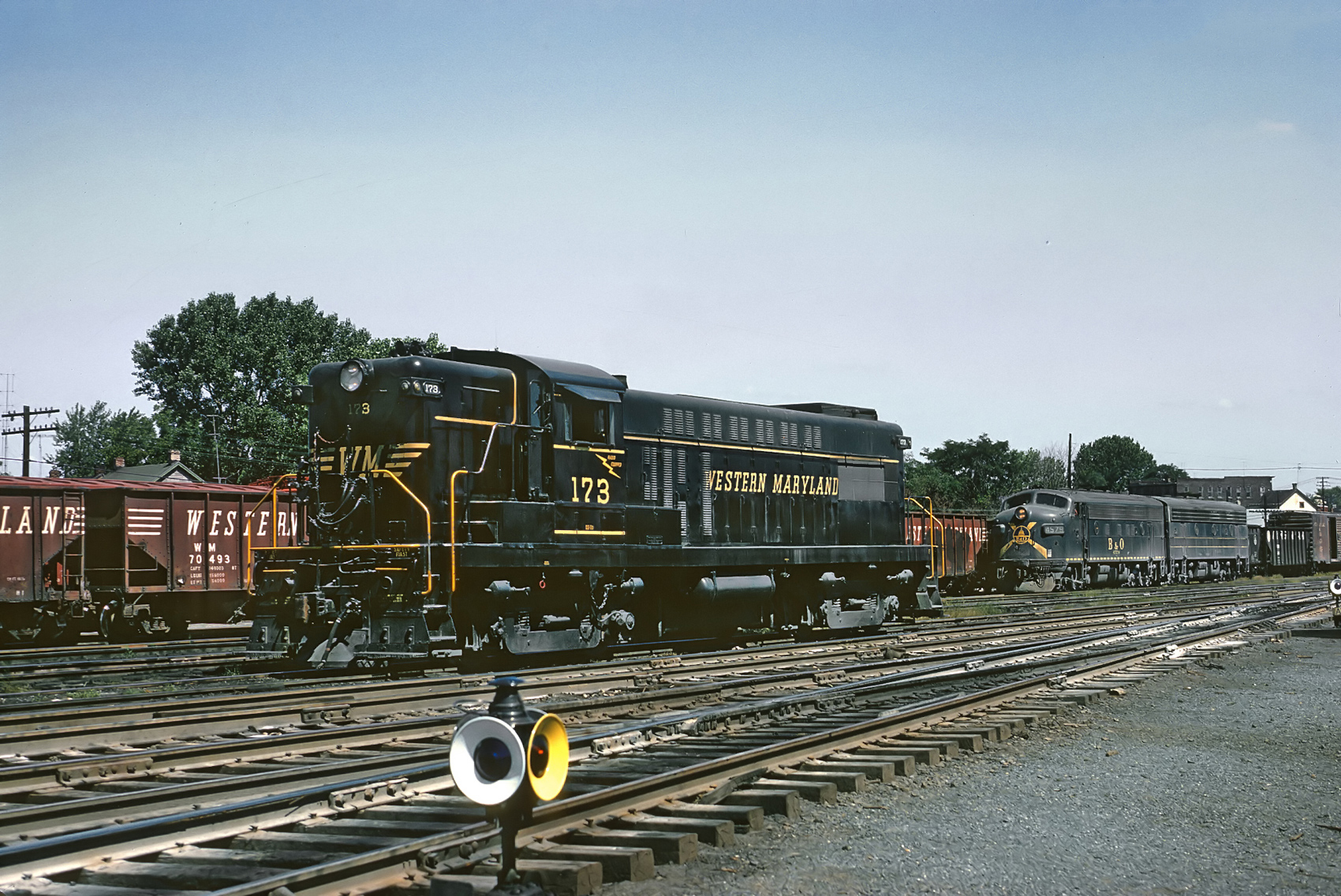 Western Maryland AS-16 #173 was captured here by Roger Puta in the Hagerstown Yard during September of 1964. Note the Baltimore & Ohio F7's in the background.
Why the company elected to preclude this option has always remained a mystery considering the benefits it offered, particularly in heavy freight/drag service on stiff grades, and the fact that both the RS3 and GP7 offered the feature. Unfortunately, none of the AS16s manufactured are known to be preserved or in operation.
SteamLocomotive.com
Wes Barris's SteamLocomotive.com is simply the best web resource on the study of steam locomotives.
It is difficult to truly articulate just how much material can be found at this website.
It is quite staggering and a must visit!