Baldwin's "VO-660": A De La Vergne, 660 HP Switcher

Last revised: June 23, 2023
By: Adam Burns
The VO660 was Baldwin's first diesel switcher model, debuting in 1939 along with its more powerful cousin, the VO-1000. It somewhat resembled models then in production by the American Locomotive and Electro-Motive Corporation.
The Baldwin Locomotive Works was slow to embrace the diesel-electric concept as a main line locomotive.
However, as John Kirkland points out in his book, "The Diesel Builders: Volume Three (Baldwin Locomotive Works," Baldwin was quite familiar with electric and diesel-electric technology dating back to the early 20th century.
Between 1910-1926, Baldwin constructed more than 1,230 gasoline-engine switchers and in 1925 built its first diesel-powered locomotive.
Today, a few examples of the VO-660 remain preserved; Wyandotte Terminal #103 is located at the Illinois Railway Museum while Standard Steel #6712 is currently being put back into operation by short line SMS Lines (which loves Baldwins and rosters several in active service).
Photos
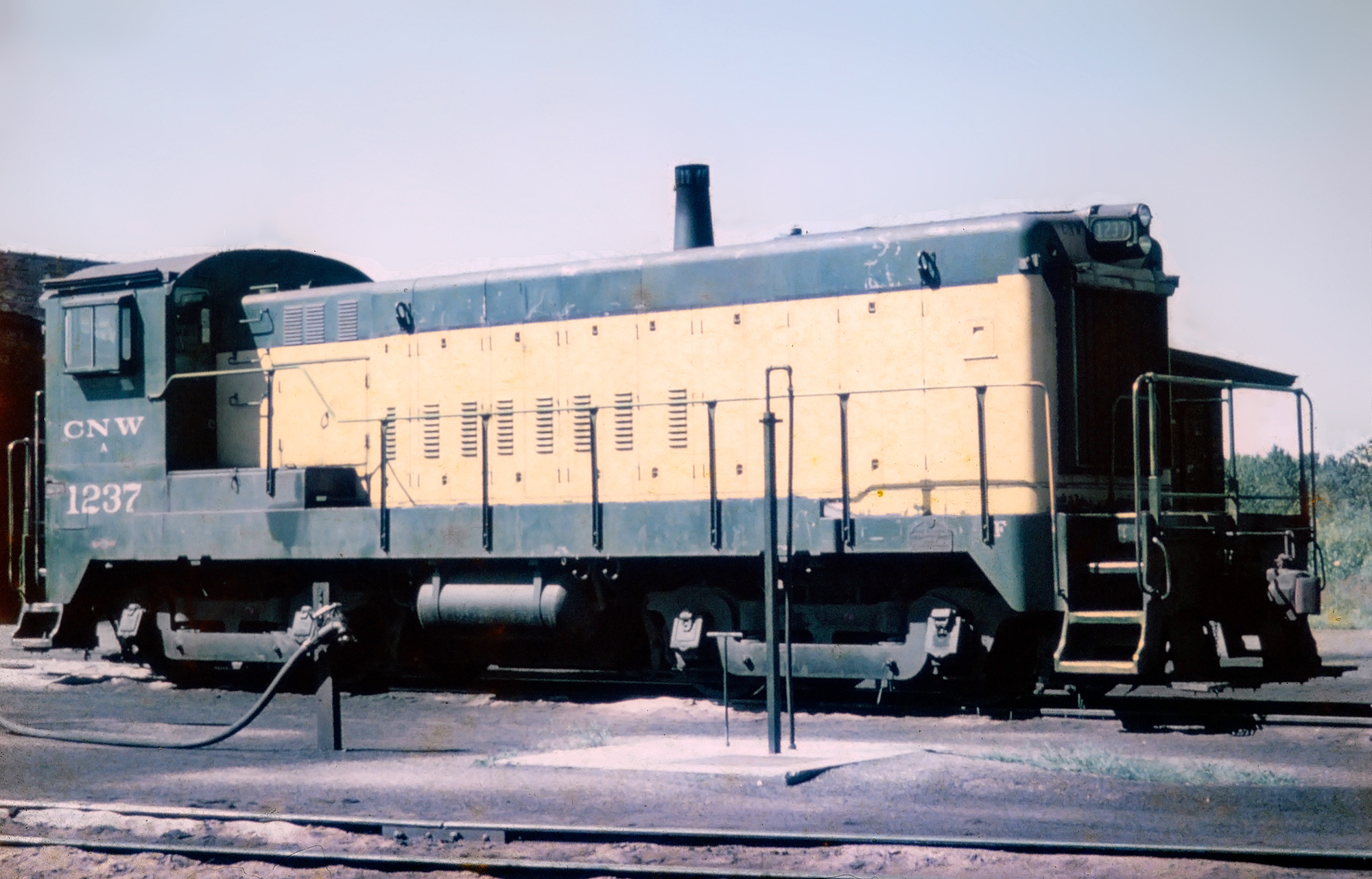 Chicago & North Western VO-660m #1237, circa 1965. This unit was outshopped by Baldwin on April 28, 1945. It was sent to Electro-Motive in the late 1950s and rebuilt with a 567C power plant. American-Rails.com collection.
Overview
The VO660 began production in April, 1939 as the company's first true diesel model. The company was able to produce its own line of diesels only after it had acquired the I.P. Morris & De La Vergne company, which specialized in the design and construction of diesel engines.
Interestingly, Baldwin's purchase of the company was more to diversify its holdings in offering switcher and light duty diesels, as it saw no need to develop a main line freight or passenger locomotive. This can also be seen in its 1929 purchase of the Whitcomb Locomotive Works, which dated back to the late 19th century.
Whitcomb began specializing in electric/diesel-electric locomotives as early as 1914 and after Baldwin's purchase continued to release small, industrial size switchers that actually sold relatively well.
Despite Baldwin's later issues of remaining competitive in the diesel market it actually found sustained business in small switchers.
The "VO" was the designation De La Vergne gave to the prime mover used in the locomotive and the "660" simply regarded the horsepower.
The company kept this setup through the VO1000 but soon after changed its classification system to a complex set of numbers and letters.
While Baldwin only sold a little over 100 VO660s railroads tended to favor the design, as could be seen in later models that sold several hundred units.
Class I railroads like the Denver & Rio Grande Western, Chicago & North Western, New York Central, Northern Pacific, Western Maryland, Reading, Wabash and others all purchased at least a few examples of the VO660.
The relatively good reliability of the small switcher and its rugged pulling power made it a real favorite among crews and railroads.
Data Sheet and Specifications
Baldwin's early "VO" model switchers are somewhat difficult to differentiate in that the builder was slowly phasing production over to diesel technology. As a result, its early variants were offered in a variety of horsepower ratings and constructed at the same time.
The information presented here will break down the switchers built to the 660 horsepower rating, and the various differences to which each was constructed until Baldwin settled on a standardized design.
Baldwin technically never classified the model as the "VO-660." As Brian Solomon notes in his book, "Baldwin Locomotives," this was another railfan designation to classify these early switchers.
In truth, Baldwin never gave its first production switcher line any name at all, only listing them by their horsepower rating.
The first built to 660 horsepower (and Baldwin's third diesel-electric it ever produced) was demonstrator #62000; despite changes here and there this locomotive essentially kicked off the 660 horsepower line.
Demonstrator #62000
| Date Built | 10/1936 |
| Baldwin Class | 8-OE-660/1 E-1* |
| Engine | VO, 6-Cylinder In-Line |
| Engine Builder | De La Vergne |
| Horsepower | 660 |
| RPM | 600 |
| Carbody Styling | Baldwin |
| Length (Between Coupler Pulling Faces) | 39' 6" |
| Weight | 212,000 Lbs. |
| Trucks | B-B |
| Truck Type | Rigid Bolster, Drop-Side Equalizer |
| Truck Wheelbase | 8' |
| Wheel Size | 40" |
| Traction Motors | Allis-Chalmers Manufacturing Company |
| Traction Generator | Allis-Chalmers Manufacturing Company |
| Auxiliary Generator | Allis-Chalmers Manufacturing Company |
| Gear Ratio | 16:76 |
| Tractive Effort Rating | 29,900 Lbs at 5.7 MPH. |
| Top Speed | 45 MPH |
* Baldwin's classification system:
- 8 = Total number of wheels
- OE = Oil engine-Electric transmission
- 660/1 = One 660 HP engine
- E = 4 pairs of driving wheels
- 1 = First locomotive of this class
From Baldwin's view, #62000 was its first production diesel locomotive, completed as a demonstrator in October, 1936. Following demonstrations on June 28, 1937 it was sold to the Santa Fe as #2200. The locomotive primarily handled switching chores at AT&SF's Dearborn Station (Chicago).
In 1940 Baldwin offered to replace the locomotive with a 1,000 horsepower variant (Class 0-4-4-0 1000/1 DE29), which featured Westinghouse equipment, a trait by then shared with all Baldwin-produced diesels.
The Santa Fe accepted #2206 on May 29, 1941; #2200 was returned to Baldwin and became Eddystone plant switcher #1. It was eventually sold to Boston Metals Company in the 1960's and scrapped in 1966.
Reading #36
| Completion Date | 6/22/1939 |
| Baldwin Class | 8-DE-660/1 E-1* |
| Engine | VO, 6-Cylinder In-Line |
| Engine Builder | De La Vergne |
| Horsepower | 660 |
| RPM | 600 |
| Carbody Styling | Baldwin |
| Length (Between Coupler Pulling Faces) | 43' 8" |
| Weight | 194,000 Lbs. |
| Trucks | B-B |
| Truck Type | Batz |
| Truck Wheelbase | 8' 4" |
| Wheel Size | 40" |
| Traction Motors | 362 (4), Westinghouse |
| Traction Generator | 485D2, Westinghouse |
| Auxiliary Generator | YG30B, Westinghouse |
| Gear Ratio | 16:76 |
| Tractive Effort Rating | 28,000 Lbs at 6.5 MPH. |
| Top Speed | 45 MPH |
* Baldwin's updated classification system:
- 8 = Total number of wheels
- DE = Diesel-Electric
- 660/1 = One 660 HP engine
- E = 4 pairs of driving wheels
- 1 = First locomotive of this class
Reading #36 (later renumbered 60 within a year of its delivery) was a one-off design that featured 'I' beams between the engine compartment running the length of the carbody.
This resulted in an extended pilot "porch" and unconventional elevated walkway along the long hood. No other VO-660's were built like this particular unit.
Early Variants
| Completion Date | 12/5/1939 (Demonstrator #299*) |
| Years Produced | 12/5/1939-2/1940 |
| Baldwin Class | 8-DE-660/1 E |
| Engine | VO, 6-Cylinder In-Line |
| Engine Builder | De La Vergne |
| Horsepower | 660 |
| RPM | 600 |
| Carbody Styling | Baldwin |
| Length (Between Coupler Pulling Faces) | 45' |
| Weight | 198,500 Lbs. |
| Height (Top Of Rail To Top Of Cab) | 14' 6" |
| Width | 10' |
| Trucks | B-B |
| Truck Type | Batz |
| Truck Wheelbase | 8' |
| Wheel Size | 40" |
| Traction Motors | 362 (4), Westinghouse |
| Traction Generator | 485H2, Westinghouse |
| Auxiliary Generator | YG30C, Westinghouse |
| Gear Ratio | 16:76 |
| Tractive Effort Rating | 28,000 Lbs at 6.5 MPH. |
| Top Speed | 45 MPH |
* Baldwin demonstrator #299, completed on December 5, 1939, was the first VO-660 to carry the now classic-lines of its switcher series.
Later Variants
| Completion Date | 5/20/1940 (Northern Pacific #128) |
| Years Produced | 5/20/1940-6/15/1946 |
| Baldwin Class | 8-DE-660/1 E |
| Engine | VO, 6-Cylinder In-Line |
| Engine Builder | De La Vergne |
| Horsepower | 660 |
| RPM | 600 |
| Carbody Styling | Baldwin |
| Length (Between Coupler Pulling Faces) | 45' |
| Weight | 198,500 Lbs. |
| Height (Top Of Rail To Top Of Cab) | 14' 6" |
| Width | 10' |
| Trucks | B-B |
| Truck Type | Rigid Bolster, Drop-Side Equalizer* |
| Truck Wheelbase | 8' |
| Wheel Size | 40" |
| Traction Motors | 362B (4), Westinghouse |
| Traction Generator | 485H2, Westinghouse |
| Auxiliary Generator | YG30C, Westinghouse |
| Gear Ratio | 16:76 |
| Tractive Effort Rating | 28,000 Lbs at 6.5 MPH. |
| Top Speed | 45 MPH |
* As John Kirkland notes in his book, "The Diesel Builders: Volume Two," General Steel Casting Corporation never gave their trucks model identifications, such as AAR Type A or AAR Type B.
While the types were adopted by American Association of Railroads (AAR) as standard designs, their specific designations were actually coined by railfans, not the industry.
Production Roster
Total Built = 141
Later Variants
| Owner | Road Number | Baldwin Serial Number | Construction Number | Completion Date |
|---|---|---|---|---|
| Northern Pacific | 128 (Renumbered 650) | 6 | 62392 | 5/20/1940 |
| Chicago, Milwaukee, St. Paul & Pacific (Milwaukee Road) | 1635 | 7 | 62393 | 5/19/1940 |
| Minneapolis, Northfield & Southern | 600 | 8 | 62394 | 6/9/1940 |
| Terminal Railroad Association Of St. Louis | 531 | 9 | 62395 | 7/23/1940 |
| Terminal Railroad Association Of St. Louis | 532 | 10 | 62396 | 7/24/1940 |
| Missouri Pacific | 9009 | 11 | 62397 | 9/3/1940 |
| Missouri Pacific | 9010 | 12 | 62398 | 9/12/1940 |
| Reading | 61 | 13 | 62399 | 9/26/1940 |
| Reading | 62 | 14 | 62400 | 10/4/1940 |
| Reading | 63 | 15 | 62401 | 10/16/1940 |
| Elgin, Joliet & Eastern | 271 | 16 | 62488 | 3/19/1941 |
| Elgin, Joliet & Eastern | 272 | 17 | 62489 | 3/19/1941 |
| Seaboard Air Line | 1202 | 18 | 62490 | 2/10/1941 |
| American Steel & Wire | 1 | 19 | 62491 | 4/17/1941 |
| Southern Pacific | 1021 | 20 | 62492 | 4/15/1941 |
| Southern Pacific | 1022 | 21 | 62493 | 4/15/1941 |
| New York Central | 501 | 22 | 62494 | 5/7/1941 |
| Iowa Ordnance Depot | 2-100 | 23 | 62495 | 5/29/1941 |
| Denver & Rio Grande Western | 66 | 24 | 62496 | 5/31/1941 |
| Wabash Railway | 200 | 25 | 62497 | 7/28/1941 |
| Missouri Pacific | 9206 | 26 | 62498 | 6/26/1941 |
| Upper Merion & Plymouth | 51 | 27 | 62499 | 7/21/1941 |
| Missouri Pacific | 9012 | 28 | 62500 | 7/25/1941 |
| Denver & Rio Grande Western | 67 | 29 | 62501 | 7/20/1941 |
| Denver & Rio Grande Western | 68 | 30 | 62502 | 7/17/1941 |
| Denver & Rio Grande Western | 69 | 31 | 64183 | 8/4/1941 |
| Denver & Rio Grande Western | 70 | 32 | 64184 | 8/8/1941 |
| Denver & Rio Grande Western | 71 | 33 | 64185 | 8/18/1941 |
| Denver & Rio Grande Western | 72 | 34 | 64186 | 8/19/1941 |
| Denver & Rio Grande Western | 73 | 35 | 64187 | 9/5/1941 |
| Denver & Rio Grande Western | 74 | 36 | 64188 | 8/30/1941 |
| Patapsco & Back Rivers | 63 | 37 | 64189 | 8/21/1941 |
| Reading | 64 | 38 | 64190 | 9/4/1941 |
| Western Maryland | 1201 | 39 | 64191 | 10/6/1941 |
| Reading | 65 | 40 | 64192 | 9/11/1941 |
| Reading | 66 | 41 | 64193 | 9/26/1941 |
| Reading | 67 | 42 | 64194 | 10/8/1941 |
| Southern Railway | DS-2005 | 43 | 64195 | 10/10/1941 |
| New Orleans Public Belt | 41 | 44 | 64196 | 10/24/1941 |
| Nashville, Chattanooga & St. Louis | 40 | 45 | 64197 | 11/5/1941 |
| Louisville & Nashville | 20 | 46 | 64230 | 11/26/1941 |
| Louisville & Nashville | 21 | 47 | 64231 | 12/7/1941 |
| Louisville & Nashville | 22 | 48 | 64232 | 12/18/1941 |
| Louisville & Nashville | 23 | 49 | 64233 | 12/3/1941 |
| New York Central | 502 | 50 | 64234 | 1/16/1942 |
| Central Railroad Of New Jersey | 1040 | 51 | 64235 | 1/22/1942 |
| Central Railroad Of New Jersey | 1041 | 52 | 64236 | 1/22/1942 |
| Central Railroad Of New Jersey | 1042 | 53 | 64237 | 1/26/1942 |
| Central Railroad Of New Jersey | 1043 | 54 | 64238 | 1/27/1942 |
| Terminal Railroad Association Of St. Louis | 533 | 55 | 64239 | 2/22/1942 |
| Terminal Railroad Association Of St. Louis | 534 | 56 | 64240 | 3/1/1942 |
| New Orleans Public Belt | 42 | 57 | 64241 | 3/11/1942 |
| New Orleans Public Belt | 43 | 58 | 64242 | 3/12/1942 |
| Upper Merion & Plymouth | 52 | 59 | 64243 | 2/28/1942 |
| Akron & Barberton Belt | 25 | 60 | 64244 | 3/18/1942 |
| Northern Pacific | 129 | 61 | 64245 | 4/10/1942 |
| Northern Pacific | 130 | 62 | 64246 | 4/7/1942 |
| Pennsylvania | 5907 | 63 | 64247 | 3/26/1942 |
| Upper Terminal Of Memphis | 9090 | 64 | 64248 | 4/16/1942 |
| Upper Terminal Of Memphis | 9091 | 65 | 64249 | 4/5/1942 |
| Basic Magnesium, Inc. | 1000 | 66 | 64250 | 4/19/1942 |
| Patapsco & Back Rivers | 64 | 67 | 64251 | 4/11/1942 |
| Patapsco & Back Rivers | 65 | 68 | 64252 | 4/1/1942 |
| St. Louis-San Francisco | 600 | 69 | 64253 | 5/3/1942 |
| St. Louis-San Francisco | 601 | 70 | 64254 | 5/7/1942 |
| American Steel & Wire | 23-1 | 71 | 64387 | 7/2/1942 |
| Western Maryland | 103 | 72 | 64388 | 7/18/1942 |
| Western Maryland | 104 | 73 | 64389 | 7/13/1942 |
| Reading | 68 | 74 | 64390 | 7/22/1942 |
| Reading | 69 | 75 | 64391 | 7/23/1942 |
| Chicago & Eastern Illinois | 110 | 76 | 64392 | 8/28/1942 |
| Pennsylvania | 5908 | 77 | 64393 | 9/1/1942 |
| Minneapolis, Northfield & Southern | 1 | 78 | 64394 | 9/24/1942 |
| Pennsylvania | 5809 | 79 | 64395 | 9/1/1942 |
| New York Central | 752 | 80 | 64396 | 10/22/1942 |
| New York Central | 753 | 81 | 64397 | 11/2/1942 |
| New York Central | 754 | 82 | 64398 | 11/2/1942 |
| Reading | 70 | 82 | 64399 | 9/11/1942 |
| Western Maryland | 105 | 84 | 64400 | 9/15/1942 |
| Pennsylvania | 5932 | 85 | 64401 | 9/11/1942 |
| Pennsylvania | 5933 | 86 | 64402 | 9/23/1942 |
| Pennsylvania | 5934 | 87 | 64403 | 9/23/1942 |
| Pennsylvania | 5935 | 88 | 64404 | 10/4/1942 |
| Pennsylvania | 5936 | 89 | 64405 | 10/4/1942 |
| Pennsylvania | 5937 | 90 | 64406 | 10/6/1942 |
| Westinghouse Electric & Manufacturing Company | 10 | 92 | 64757 | 6/9/1942 |
| U.S. Navy | 15 | 93 | 70324 | 12/30/1944 |
| U.S. Navy | 16 | 94 | 70325 | 12/29/1944 |
| U.S. Navy | 18 | 95 | 70326 | 12/28/1944 |
| New York Central | 755 | 96 | 70327 | 1/2/1945 |
| New York Central | 756 | 97 | 70328 | 1/2/1945 |
| New York Central | 757 | 98 | 70329 | 1/5/1945 |
| New York Central | 758 | 99 | 70330 | 1/6/1945 |
| New York Central | 759 | 100 | 70331 | 1/10/1945 |
| New York Central | 760 | 101 | 70332 | 1/10/1945 |
| New York Central | 761 | 102 | 70333 | 1/10/1945 |
| Youngstown Sheet & Tube | 600 | 103 | 71759 | 2/15/1945 |
| Youngstown Sheet & Tube | 601 | 104 | 71760 | 3/19/1945 |
| U.S. Navy | 10 | 105 | 72002 | 4/26/1945 |
| U.S. Navy | 11 | 106 | 72003 | 4/26/1945 |
| U.S. Navy | 31 | 107 | 72004 | 5/16/1945 |
| Youngstown Sheet & Tube | 602 | 108 | 71512 | 4/25/1945 |
| Youngstown Sheet & Tube | 603 | 109 | 71513 | 4/24/1945 |
| Chicago & North Western | 1237 | 110 | 71514 | 4/28/1945 |
| Chicago & North Western | 1238 | 111 | 71515 | 4/28/1945 |
| Chicago & North Western | 1239 | 112 | 71516 | 5/11/1945 |
| Youngstown Sheet & Tube | 604 | 113 | 71517 | 5/30/1945 |
| Youngstown Sheet & Tube | 605 | 114 | 71518 | 5/30/1945 |
| Chicago & North Western | 1240 | 115 | 71519 | 6/7/1945 |
| Chicago & North Western | 1241 | 116 | 71520 | 6/7/1945 |
| Chicago & North Western | 1242 | 117 | 71521 | 6/8/1945 |
| Chicago & North Western | 1243 | 118 | 71569 | 6/14/1945 |
| Chicago & North Western | 1244 | 119 | 71570 | 6/16/1945 |
| Chicago & North Western | 1245 | 120 | 71571 | 6/18/1945 |
| Chicago, St. Paul, Minneapolis & Omaha (C&NW) | 58 | 121 | 71572 | 6/25/1945 |
| Chicago, St. Paul, Minneapolis & Omaha (C&NW) | 59 | 122 | 71573 | 6/28/1945 |
| Chicago, St. Paul, Minneapolis & Omaha (C&NW) | 68 | 123 | 71574 | 6/28/1945 |
| Chicago & North Western | 1246 | 124 | 71575 | 8/13/1945 |
| Youngstown Sheet & Tube | 606 | 125 | 71576 | 8/20/1945 |
| Youngstown Sheet & Tube | 607 | 126 | 71577 | 9/17/1945 |
| Long Island Rail Road | 403 | 127 | 71578 | 10/2/1945 |
| American Smelting & Refining | 1950 | 128 | 72813 | 11/2/1945 |
| American Smelting & Refining | 1951 | 129 | 72814 | 10/29/1945 |
| American Smelting & Refining | 1952 | 130 | 72815 | 11/4/1945 |
| American Smelting & Refining | 1953 | 131 | 72816 | 11/5/1945 |
| Warner Company | 11 | 132 | 72817 | 11/30/1945 |
| Francisco Sugar Company | 45 | 133 | 72818 | 6/15/1946 |
| Proctor & Gamble Company | 125 | 134 | 72819 | 12/26/1945 |
| American Steel & Wire | 11 | 135 | 72820 | 1/9/1946 |
| Pennsylvania | 5941 | 136 | 72821 | 10/13/1945 |
| Pennsylvania | 5942 | 137 | 72822 | 10/13/1945 |
| Wyandotte Terminal Railroad | 101 | 138 | 72823 | 10/30/1945 |
| Singer Manufacturing Company | 2 | 139 | 72824 | 11/24/1945 |
| Wyandotte Terminal Railroad | 102 | 140 | 72825 | 11/28/1945 |
| Wyandotte Terminal Railroad | 103 | 141 | 72826 | 11/28/1945 |
| Pennsylvania | 5943 | 142 | 72827 | 11/3/1945 |
| LaSalle & Bureau County | 6 | 143 | 72828 | 1/24/1946 |
| Kansas City Southern | 1150 | 144 | 72829 | 5/8/1946 |
Beginning with Baldwin's "B Lot" of VO-660's, the first of which was serial number 16 (Elgin, Joliet & Eastern #271), the cab roof was lowered from 14' 6" to 14'.
This was made to improve clearance restrictions under bridges, within tunnels, and among other potential obstacles. In total, the VO-660 was built in Lots A through K; changes after Lot B were minor.
Early Variants
| Owner | Road Number | Baldwin Serial Number | Construction Number | Completion Date |
|---|---|---|---|---|
| Baldwin Demonstrator | 62000 (Became Santa Fe #2200) | 1 | 62000 | 10/1936 |
| Santa Fe | 2200 (Traded to Baldwin on 5/29/1941; became plant switcher #1.) | 1 | 62000 | 10/1936 |
| Reading | 36 (Renumbered 60) | 1 | 62300 | 6/22/1939 |
| Baldwin Demonstrator | 299 (Plant switcher) | 2 | 62299 | 12/5/1939 |
| Baldwin Demonstrator | 335 (Sold to Standard Steel Works [#12] on 2/24/1940, later renumbered 6712.) | 3 | 62335 | 1/31/1940 |
| Baldwin Demonstrator | 336 (Sold to Elgin, Joliet & Eastern [#270] on 5/7/1940.) | 4 | 62336 | 3/1940 |
| Baldwin Demonstrator | 337 (Sold to Central of Georgia [#5]) | 5 | 62337 | 2/1940 |
Of important note is the first five VO-660's constructed, Baldwin serial numbers 1-5; these locomotives were built to the specifications noted above.
Beginning with Baldwin serial #6 (Northern Pacific #128), part of "Lot A" (Baldwin's way of designating minor differences/improvements to a model type), some changes were made which is reflected in the below data sheet.
Sources
- Foster, Gerald. A Field Guide To Trains. New York: Houghton Mifflin, 1996.
- Kirkland, John F. Diesel Builders, The: Volume Three, Baldwin Locomotive Works. Pasadena: Interurban Press, 1994.
- Pinkepank, Jerry A. Diesel Spotter's Guide. Milwaukee: Kalmbach Publishing Company, 1967.
- Solomon, Brian. Baldwin Locomotives. Minneapolis: Voyageur Press, 2009.
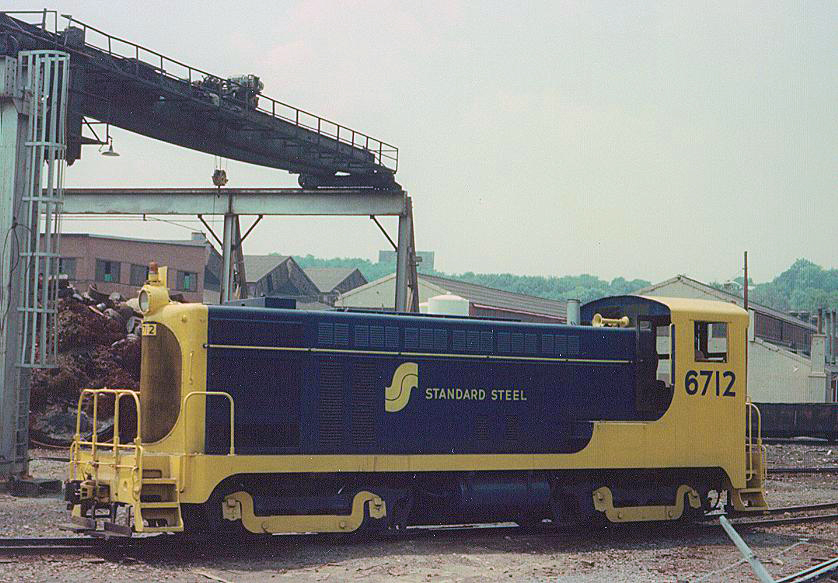 Standard Steel VO-660 #6712 is seen here at the company's plant in Burnham, Pennsylvania on July 20, 1976. Purchased new by the manufacturer in 1940 she is the oldest preserved Baldwin, currently owned by SMS Rail. Doug Kroll photo.
Reception
The VO660 also found an interest with industrial settings as companies like the Iowa Ordnance Plant, American Smelting and Refining Company, American Steel & Wire Company and even the US Navy and Westinghouse itself purchased the VO660.
For Baldwin its real successes with switcher designs came later with models like the VO-1000, S12, and DS-4-4-1000. These locomotives offered much greater horsepower and tractive effort, which made them more marketable (as railroads could employ them in a number of different applications, not just switching and shuffling cars).
Contents
SteamLocomotive.com
Wes Barris's SteamLocomotive.com is simply the best web resource on the study of steam locomotives.
It is difficult to truly articulate just how much material can be found at this website.
It is quite staggering and a must visit!