The Cincinnatian

Last revised: December 20, 2023
By: Adam Burns
One of the Baltimore & Ohio’s most exotic passenger trains was a regional luxury dayliner, the Cincinnatian. The train was known for its distinctive blue and white livery and panoramic views of the Appalachian Mountains and foothills.
This original version featured 4-6-2s and equipment shrouded by the company's own shop forces in Mount Clare while serving an unsustainable market between Washington, D.C. - Cincinnati, Ohio.
It is rather interesting B&O officials chose this initial routing. Despite serving the railroad's important St. Louis main line, there simply was not enough business between the terminating cities; the largest markets at the time included Cumberland, Grafton, Clarksburg, Parkersburg, and Athens.
Nevertheless, the railroad spent a great deal of money, resources, and effort publicizing the train. Unfortunately, and not surprisingly, it proved unsuccessful. As a result, the train was soon switched to the more populated Cincinnati-Detroit market. While never terribly profitable, the Cincinnatian remained on the timetable for nearly 25 years and survived until the start of Amtrak.
Photos
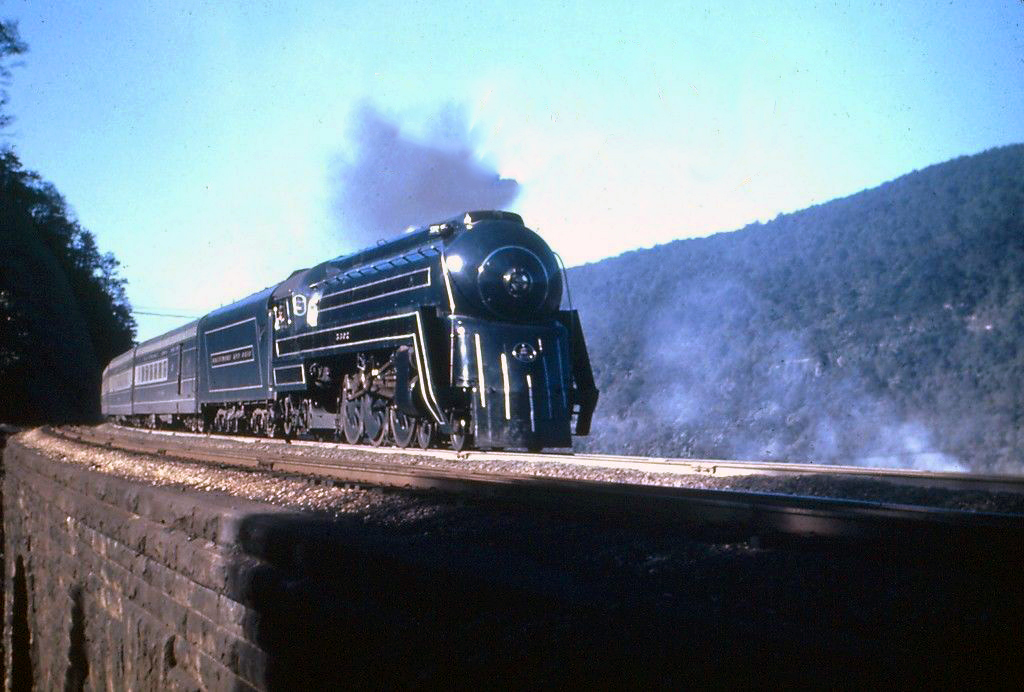 One of Baltimore & Ohio's beautifully streamlined P-7d's (4-6-2) has train #76, the eastbound "Cincinnatian," crossing Tray Run Viaduct, in the summer of 1947. Charles H. Kerrigan photo.
History
Recognizing the public's growing fascination with rapid travel and the inherent glamour connected to it, the B&O launched the Cincinnatian to embody the pinnacle of rail travel of its time.
The train was essentially a truncated, coach-only version of the B&O's premier National Limited, which linked New York City via Jersey Central's Communipaw Terminal at Jersey City, New Jersey) and St. Louis.
The B&O was renowned for extraordinary customer service. A journey onboard the Cincinnatian guaranteed impeccable service from the staff, making travel not just an activity, but an entrancing experience.
Within the pecking order of service along this route, it could be described as sitting in third behind the Diplomat, which complemented the National Limited. The luxury-ladened Cincinnatian entered service on January 19, 1947, initially inaugurated between Baltimore and Cincinnati.
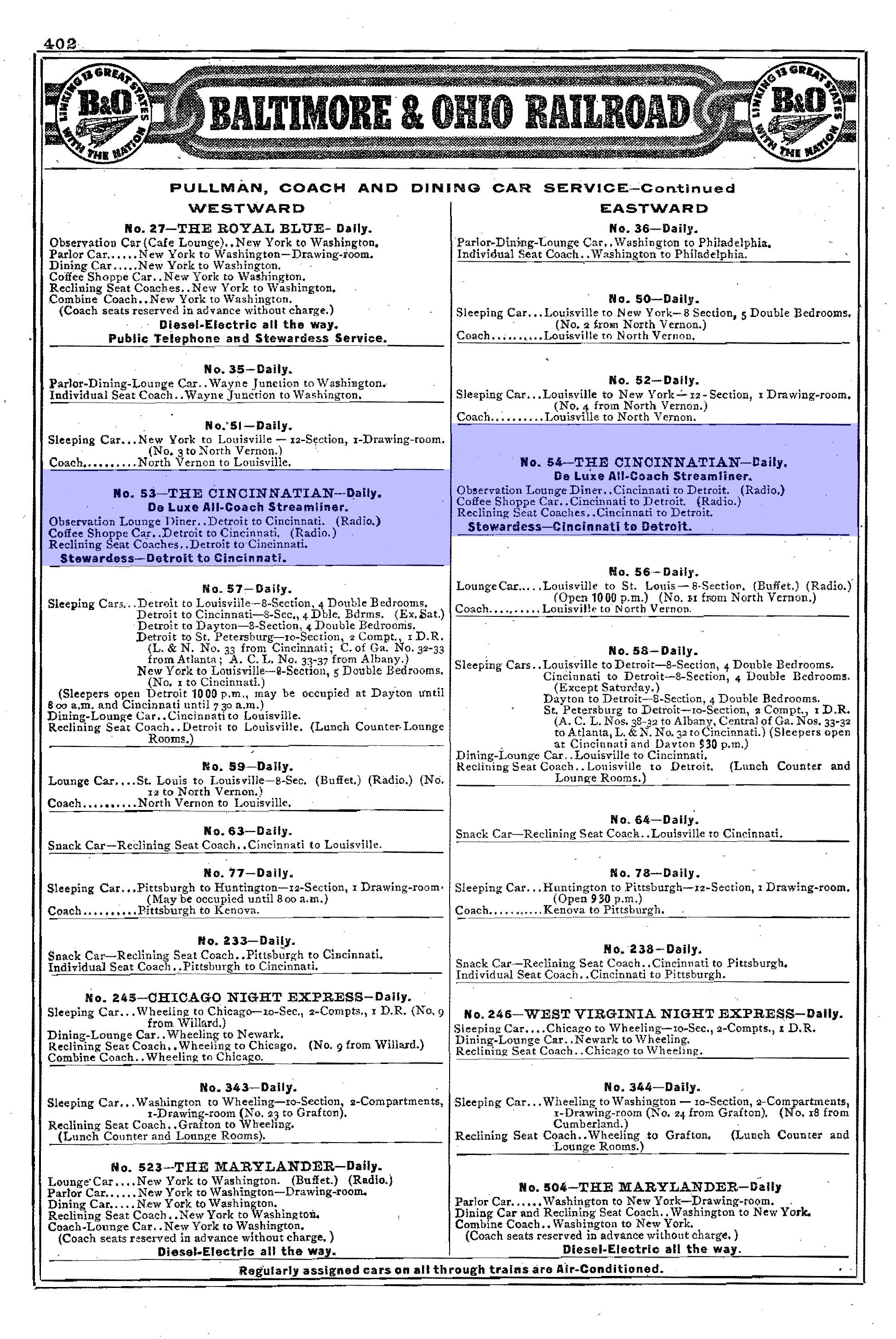
Consist, 1948 (Washington - Cincinnati)

Perhaps B&O officials were caught up in streamliner mania sweeping the nation but the Baltimore/Washington-Cincinnati market was an odd choice to launch a dedicated service.
The cities along the route included small communities like Martinsburg, Clarksburg, and Parkersburg, West Virginia and Athens and Chillicothe in Ohio. Aside from Cumberland, the largest city on the run was Parkersburg, with a population at the time of just under 50,000 residents.
Timetable: April, 1948 (Washington - Cincinnati)
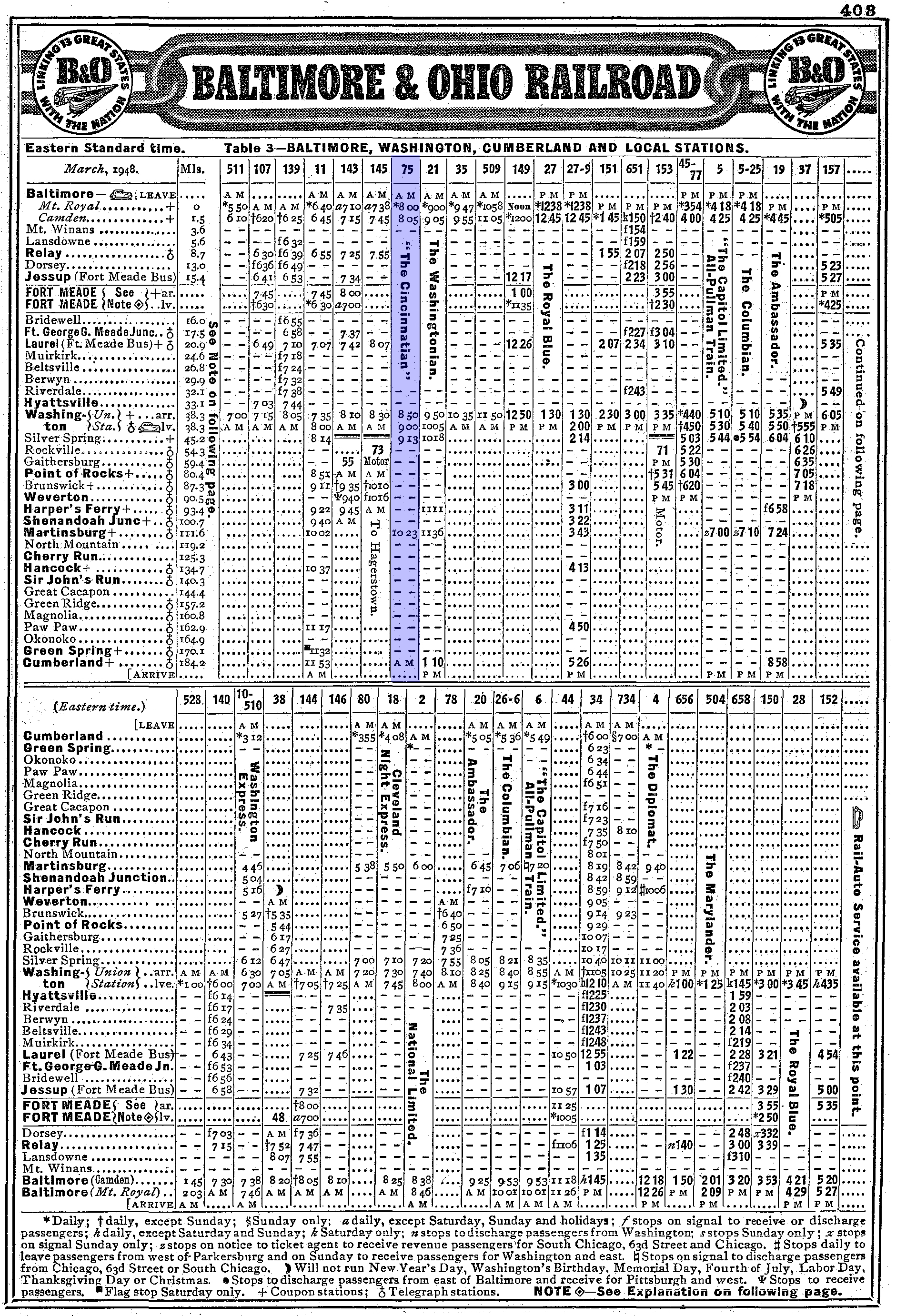
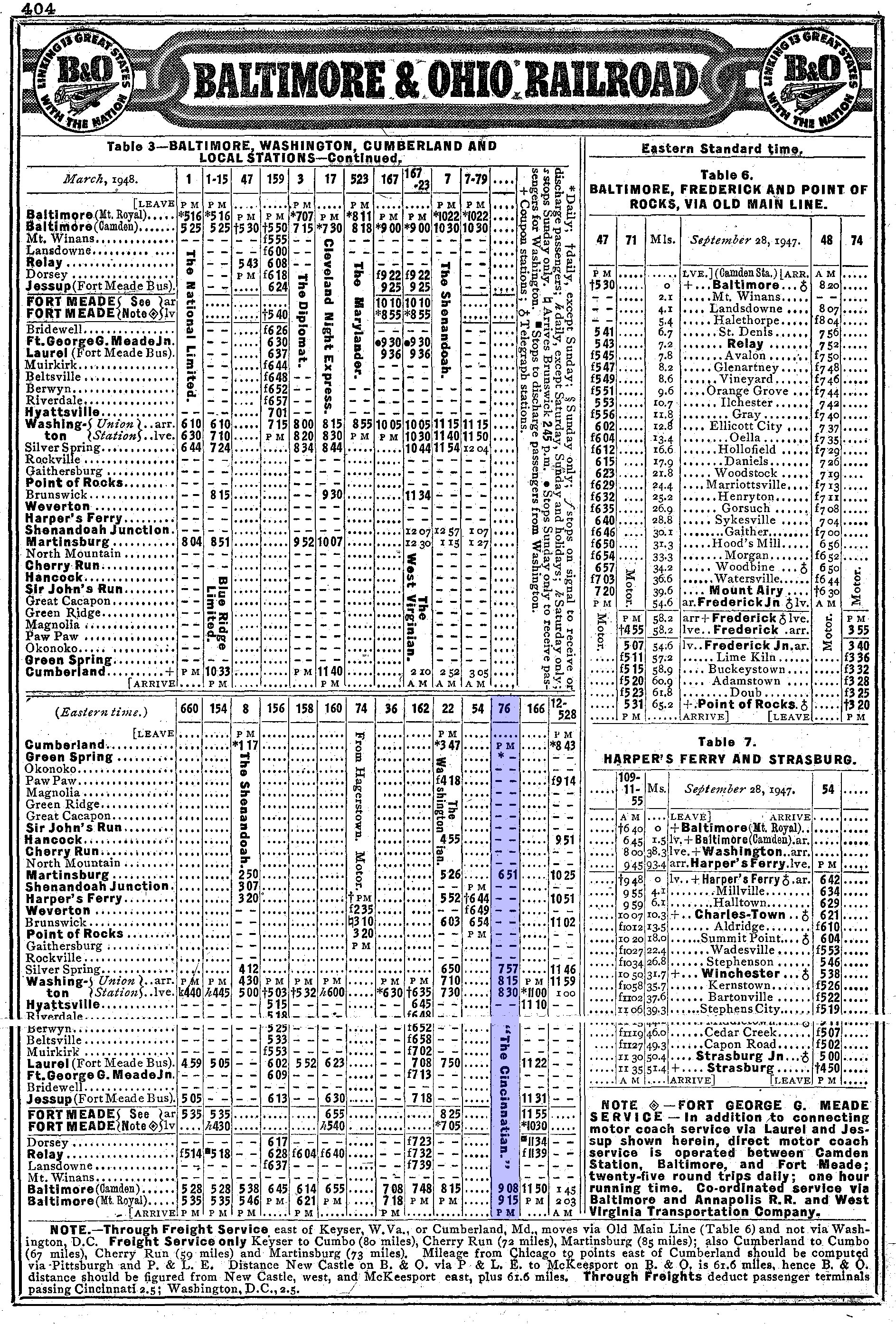
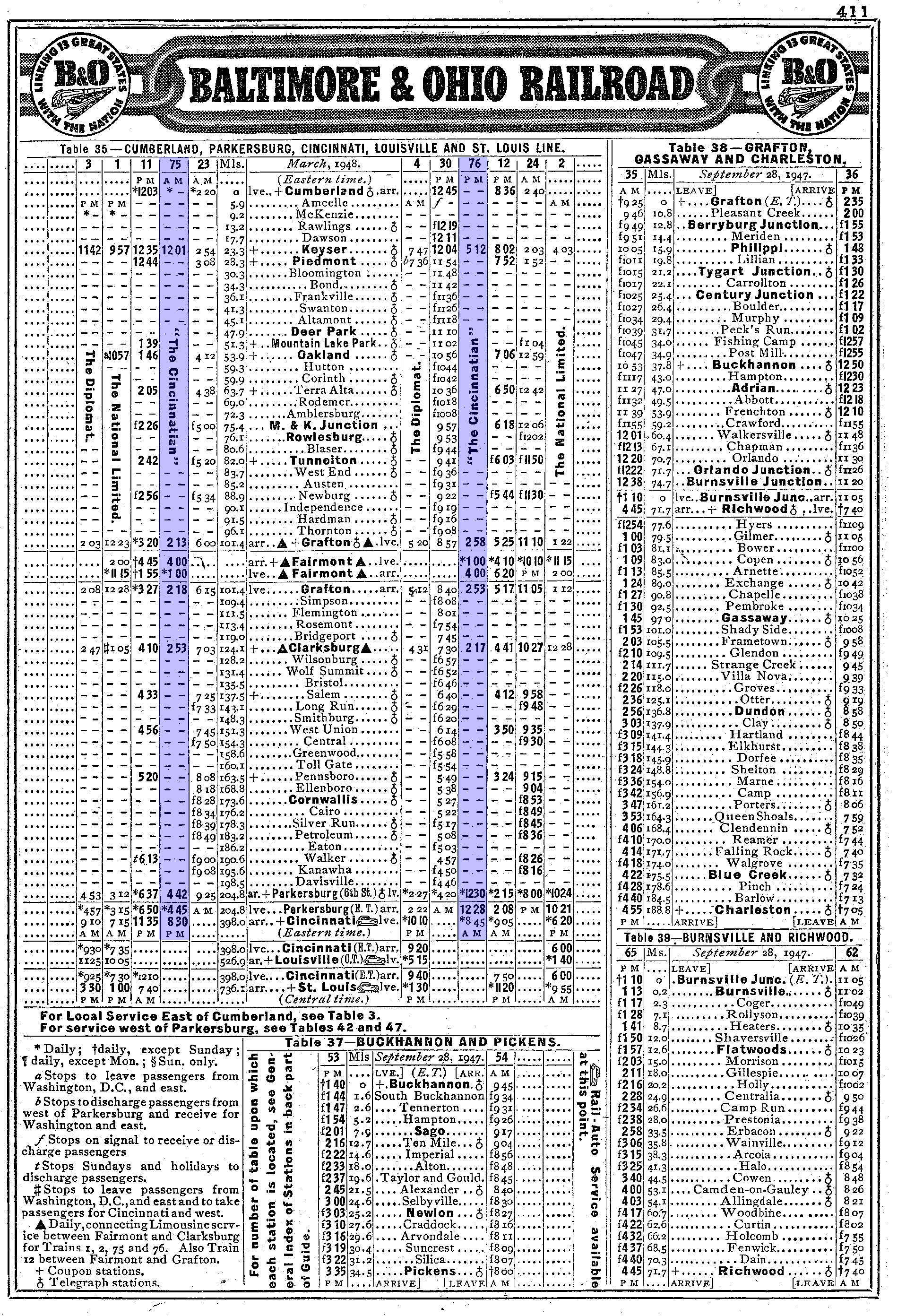
Onboard, passengers could indulge in top-tier services like fine dining and a comfortable observation lounge. These amenities significantly contributed to the overall allure of the streamlined train, positioning it as an unforgettable experience of its era.
The Cincinnatian incorporated sleek passenger cars and an elaborately assembled consist, all engineered by B&O's Mount Clare shops from older heavyweight equipment. However, average passenger would has never known this; the consist was as finely crafted as anything constructed by Budd, Pullman-Standard, or American Car & Foundry.
The typical Cincinnatian included immaculate reclining coaches, a standard lounge, a complete diner, the famous Coffee Shoppe Car, and a sleek round-ended lounge-observation.
Reflecting unmatched artistry, the Cincinnatian's livery boasted a royal blue hue with silver trimmings, establishing a distinctive, recognizable aesthetic that enhanced its grandeur and harked back to a regally sophisticated age of travel. The livery was a version of the railroad's standard blue and grey passenger scheme.
The Cincinnatian's streamlining was the work of the B&O's own Olive Dennis, a female engineer. Even the lead locomotives were bedecked in matching paint with similar graceful shrouding; they certainly could not be missed!
The train was initially pulled by the streamlined President-Class Pacific locomotives, a testament to the B&O's investment in state-of-the-art steam technology, underlining its commitment to melding speed with style.
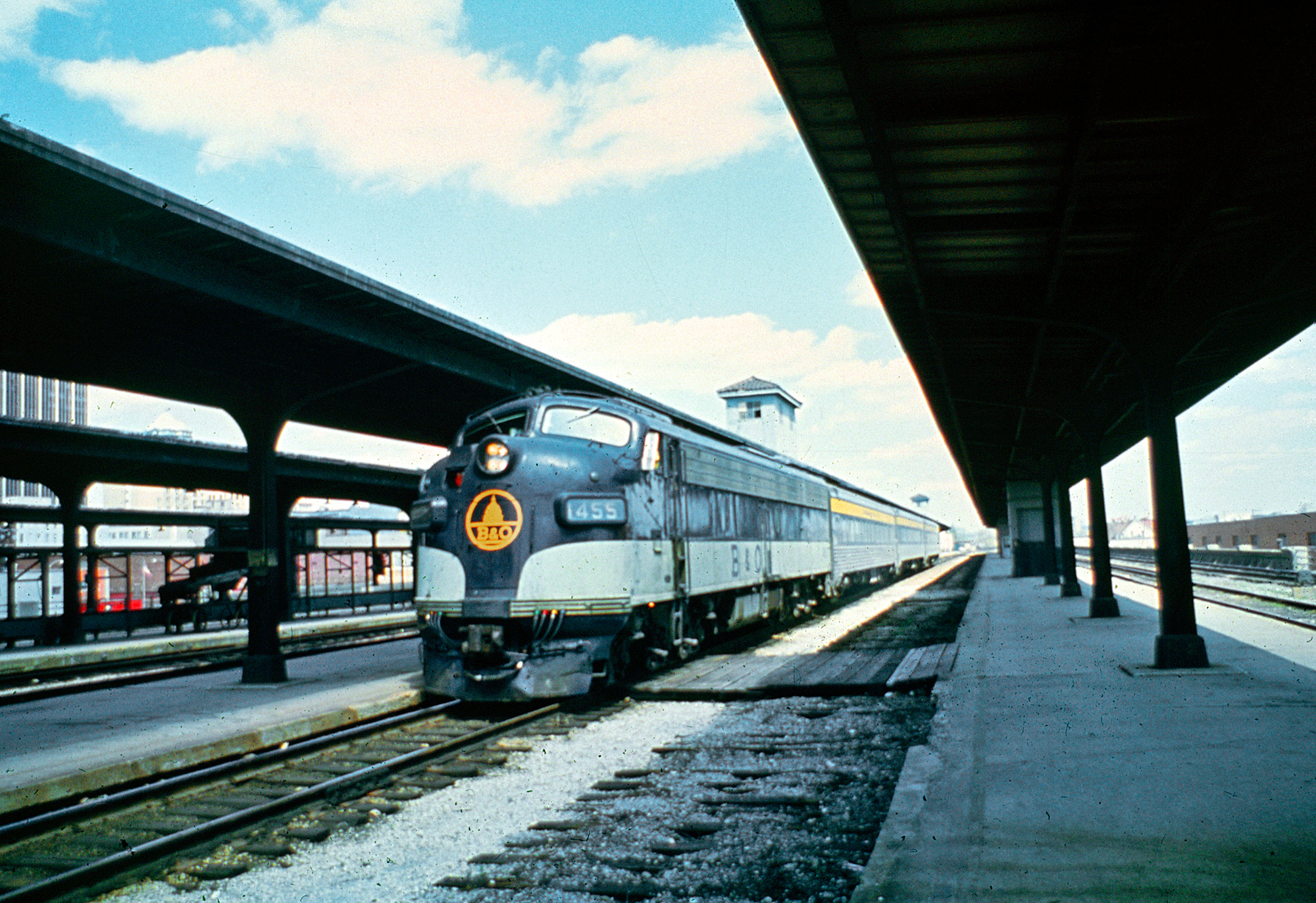 Baltimore & Ohio E9A #1455 has train #53, the southbound "Cincinnatian," stopped at Dayton Union Station in 1971. American-Rails.com collection.
It wasn't long before the railroad recognized a patronage problem. After just three years, in an effort to improve profitability the B&O redirected the train to a Cincinnati-Detroit routing with the first run occurring on June 25, 1950.
The train initially journeyed a distance of 398 miles between Baltimore and Cincinnati. Post its rerouting, travel distance between Cincinnati and Detroit was 282 miles, embodying vast terrains across a multitude of states.
Along its journey, the Cincinnatian provided passengers with breathtaking views of the natural landscape, passing through the picturesque spectacles of Maryland, West Virginia, and Ohio, immersing riders in the mesmerizing beauty of America’s heartland.
Consist, 1952 (Cincinnati - Detroit)
%20has%20train%20%2376%2C%20the%20eastbound%20%22Cincinnatian%2C%22%20crossing%20Tray%20Run%20Viaduct%2C%20in%20the%20summer%20of%201947.%20%20Charles%20H.%20Kerrigan%20photo.)


Final Years
The steamers were part of the B&O's handsome Class P-7d's and four, in all, #5301-5304 received the custom streamlining.
To complete the train's look it was given silver pinstriping with "The Cincinnatian" flanking the rear observation car. On the Cincinnati – Detroit run, the train was renumbered as #53 southbound and #54 northbound.
Right up until the end the Cincinnatian continued providing beverage and food service between Cincinnati and Lima, Ohio along with reclining-seat coaches.
Timetable, 1969 (Cincinnati - Detroit)
| Time/Leave (Train #53) | Milepost | Location | Time/Arrive (Train #54) |
|---|---|---|---|
| 11:00 AM | 0 | 5:40 PM | |
| 11:35 AM | 25 | 4:54 PM | |
| 12:55 PM (Ar) 1:05 PM (Dp) | 82 | 3:45 PM (Dp) 3:30 (Ar) | |
| 1:47 PM (Ar) 2:05 PM (Dp) | 119 | 2:30 PM (Dp) 2:10 (Ar) | |
| 2:58 PM | 153 | 1:16 PM | |
| 3:16 PM | 166 | 12:59 PM | |
| 3:45 PM | 186 | 12:39 PM | |
| 3:58 PM | 196 | 12:18 PM | |
| 4:10 PM | 204 | 12:07 PM | |
| 4:37 PM (Ar) 4:47 PM (Dp) | 224 | 11:40 AM (Dp) 11:25 (Ar) | |
| 5:11 PM | 246 | 11:02 AM | |
| 5:29 PM | 258 | 10:47 AM | |
| 6:20 PM | 282 | 10:00 AM |
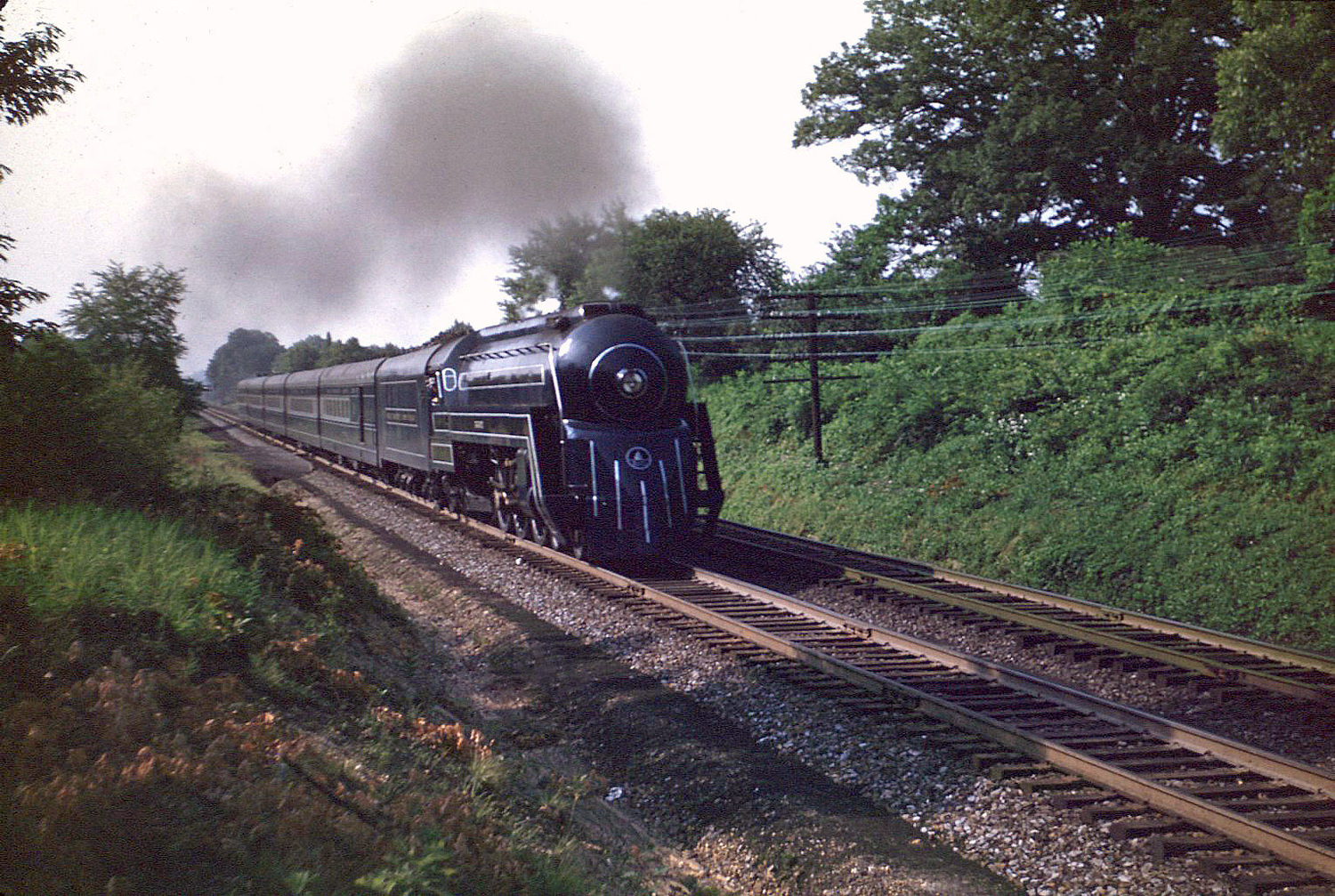 The Baltimore & Ohio's original "Cincinnatian" (Baltimore - Cincinnati), is seen here at an unknown location led by one of the road's handsome P-7d Pacific's (#5301-5304), circa 1947. The train's accommodations included a Coffee Shoppe Car, reclining seat coaches, and diner-lounge-observation. Poor ridership along the lightly-populated route resulted in the "Cincy" switching to a Cincinnati - Detroit schedule in June of 1950. Charles H. Kerrigan photo.
%2C%20is%20seen%20here%20at%20an%20unknown%20location%20led%20by%20one%20of%20the%20road's%20handsome%20P-7d%20Pacific's%20(%235301-5304)%2C%20circa%201947.%20The%20train's%20accommodations%20included%20a%20Coffee%20Shoppe%20Car%2C%20reclining%20seat%20coaches%2C%20and%20diner-lounge-observation.%20Poor%20ridership%20along%20the%20lightly-populated%20route%20resulted%20in%20the%20%22Cincy%22%20switching%20to%20a%20Cincinnati%20-%20Detroit%20schedule%20in%20June%20of%201950.%20Charles%20H.%20Kerrigan%20photo.)
Legacy
The Cincinnatian's impressive legacy is rooted in its commitment to speed, luxury, and unparalleled service. Even though it ceased operations in 1971, its spirit lives on in the hearts of locomotive enthusiasts, standing as a testament to the golden age of American rail travel.
Much like its contemporary, the "National Limited," the Cincinnatian served as a flagship for the Baltimore and Ohio railroad, symbolizing wealth, luxury, and an incredible testament to the advancement of the locomotive industry during the time.
Beyond the glamour and extravagance, the Cincinnatian embodied the spirit of American progress, mirroring the economic advancement and the rise of middle-class travel during the mid-20th century.
Innovative engineering techniques and practical design strategies were employed to ensure a smooth journey for every passenger onboard. The Cincinnatian's mechanics, from engine functionality to passenger convenience, were a marvel to both engineers and riders.
The introduction of the Cincinnatian also reinforced the B&O's role as a vital industrial player in the American economy, promoting travel and commerce, simultaneously fueling economic growth and leisure travel.
The Cincinnatian was not only a symbol of refined travel but also an embodiment of the B&O's pioneering spirit and its contributions to expanding America's railway infrastructure.
B&O's commitment to passenger comfort and safety was evident in every aspect of Cincinnatian operation, from its streamlined design to its careful routing.
The B&O's strategic decision to redirect its route to Detroit-Cincinnati highlighted the railway's ability to adapt efficiently to shifts in market trends and passenger demand, thus ensuring its relevance and profitability in a changing landscape.
Despite changing times and shifts in the transport industry, the Cincinnatian’s legacy remains a significant part of American railway history, serving as an enduring testament to the golden era of streamlined luxury travel.
In the grand scheme of American rail history, the Cincinnatian along with the National Limited, stands as a monument of the Baltimore and Ohio railway's legacy, the company's commitment to passenger comfort, and their role in shaping America's railway infrastructure.
Contents
Consist, 1948 (Washington - Cincinnati)
Timetable: April, 1948 (Washington - Cincinnati)
Consist, 1952 (Cincinnati - Detroit)
SteamLocomotive.com
Wes Barris's SteamLocomotive.com is simply the best web resource on the study of steam locomotives.
It is difficult to truly articulate just how much material can be found at this website.
It is quite staggering and a must visit!