- Home ›
- Fallen Flags ›
- Conrail
Conrail (Railroad): Map, Logo, Roster, History
Last revised: September 17, 2026
By: Adam Burns
The Consolidated Rail Corporation—Conrail, mark CR—was the federal answer to the Northeastern freight collapse of the 1970s. Pennsylvania incorporated the company on February 10, 1976. Operations began at 12:01 a.m. on April 1, 1976, with about 19,000 route-miles taken from Penn Central, Erie Lackawanna, the Reading, the Lehigh Valley, the Central Railroad of New Jersey, the Lehigh & Hudson River, and related bits. It lost money like Penn Central at first. L. Stanley Crane took the helm on January 1, 1981. The railroad was in the black by year-end. The government sold its stake on March 26, 1987. CSX and Norfolk Southern split the Class I on June 1, 1999. Diesels that wore CR numbers are the Conrail diesel roster. This page is the company.
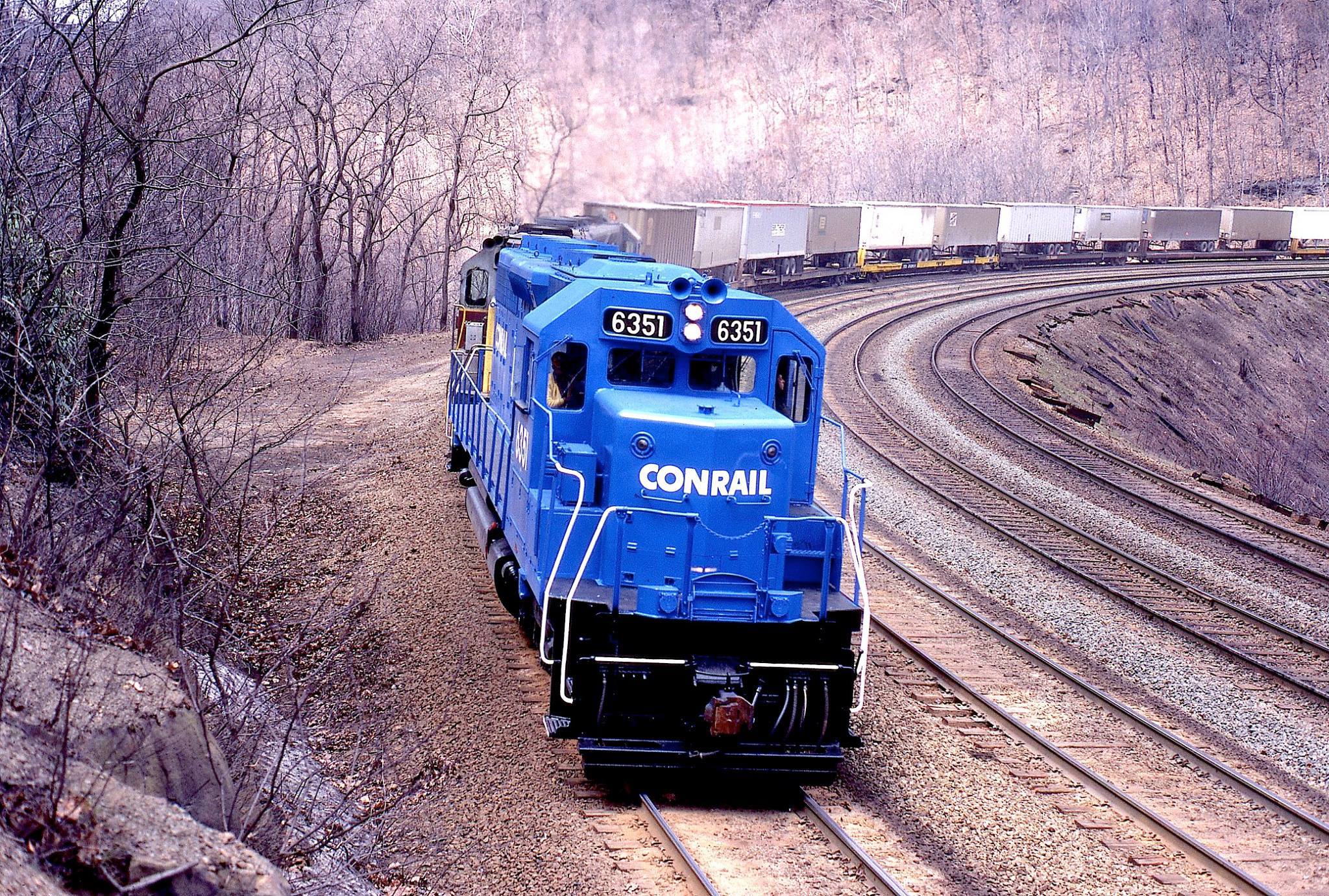
Recently repainted Conrail SD40 #6351 (built as Pennsylvania #6098) grinds upgrade with westbound vans on Horseshoe Curve. All four tracks were still in service. Warren Calloway photo.
On this page: At a glance · Penn Central and the cascade · 3R Act and the Railway Association · Erie Lackawanna in · April 1, 1976 · Big Blue · GG1s and the wire · Commuter and NERSA · Crane, Staggers, 1981 · March 26, 1987 · CSX, Norfolk Southern, June 1, 1999 · What remains
At a glance
The Conrail logo. Author’s work. Tony Palladino at Siegel & Gale; steel wheels on steel rails, nicknamed the can-opener. Unveiled May 30, 1976.
| Item | Detail |
|---|---|
| What it was | Consolidated Rail Corporation. Federal freight railroad assembled from Northeastern bankruptcies. Mark CR |
| Headquarters | Six Penn Center Plaza, Philadelphia (conveyance). Later 2001 Market Street |
| Incorporated | Pennsylvania February 10, 1976 |
| Operations | April 1, 1976, 12:01 a.m.–June 1, 1999 |
| 3R Act | Regional Rail Reorganization Act, signed January 2, 1974. Created the United States Railway Association |
| 4R Act | Railroad Revitalization and Regulatory Reform Act, signed February 5, 1976. Approved the Final System Plan |
| Route-miles | About 19,000 (1976). 10,826 (1998) |
| States / provinces | Massachusetts, Rhode Island, Connecticut, New York, New Jersey, Pennsylvania, Maryland, Delaware, Virginia, West Virginia, Ohio, Kentucky (Louisville), Michigan, Indiana, Illinois, Missouri (St. Louis); Ontario and Quebec |
| Gauge | 4 ft 8½ in |
| Paint | Conrail blue, white lettering and can-opener. First locomotive, GP40 3091, Collinwood, May 20, 1976 |
| First profit | Year-end 1981, under L. Stanley Crane (from January 1) |
| IPO | March 26, 1987. Government stake about $1.65 billion; about $1.9 billion with cash to the Treasury |
| End of the Class I | CSX and Norfolk Southern split, June 1, 1999. Conrail Shared Assets remains as a switching company |
| Roster | Conrail diesel roster |
Dates align with the 1970s decade page and the Staggers page. 19,000 miles is the Official Guide-era start plant. Information compiled September 17, 2026.
Penn Central and the cascade
Penn Central had been created on February 1, 1968, from the Pennsylvania and the New York Central. The New Haven came in January 1, 1969. The computers did not talk. Classification clerks lost cars. Slow orders multiplied. Cash ran out at more than a million dollars a day. The board voted to file under Section 77 on June 21, 1970. That filing is the Penn Central encyclopedia. What this page owns is what the filing did to everyone else.
Boston & Maine had already filed, on March 12, 1970. Lehigh Valley followed. The Reading filed November 23, 1971. Jersey Central was already in its last bankruptcy, from March 22, 1967. Lehigh & Hudson River went in. Hurricane Agnes in June 1972 put Erie Lackawanna into court on June 26. By 1973 more than half the Northeastern rail network was in receivership. The decade frame is the 1970s.
Judge John P. Fullam sat on Penn Central. Trustees headed by Jervis Langdon, Jr.—once president of the Baltimore & Ohio—first thought a traditional reorganization might work. They hired William H. Moore from the Southern. He did not last. Langdon took the presidency himself in January 1973 and told Fullam the estate could not be reorganized without federal help. The ICC would not let the railroad abandon branches that handled a handful of cars a year, or raise rates on traffic that lost money. Amtrak took the intercity trains on May 1, 1971. Commuter trains stayed. Crew consist stayed at five men. Unions walked out briefly on February 7, 1973. Congress said it would act.
3R Act and the Railway Association
The Regional Rail Reorganization Act—the 3R Act—was signed by President Nixon on January 2, 1974. It created the United States Railway Association (not the 1918 USRA) inside the Department of Transportation to draw a Final System Plan, and a Rail Services Planning Office to watch the Association. The railroad itself would be Conrail. Jim McClellan, who had helped stand up Amtrak, was among the planners. The first Preliminary System Plan took Penn Central, Reading, Lehigh & Hudson River, Jersey Central, Lehigh Valley, and the Ann Arbor. Erie Lackawanna was left out on purpose: a solvent EL would have been competition into Chicago.
The Poughkeepsie Bridge burned on May 8, 1974. Maybrook died. New England gateway traffic that had used EL was gone. EL’s trustees first said they could reorganize, then asked for inclusion on January 9, 1975.
Erie Lackawanna in
EL’s request threw the plan. One idea was MARC, a Mid-Atlantic Railroad from CNJ, Reading, Lehigh Valley, and L&HR, working with EL against Conrail. Washington lost interest in the cost. Another was Three Systems East: Norfolk & Western would take EL, Chessie System the Reading and Jersey Central to the Port of New York. N&W backed away. Chessie, under Hays T. Watkins, was offered EL in July 1975—Two Systems East. Chessie and EL’s unions could not agree. EL went into Conrail. The double-track Chicago main west of Ohio was mothballed in favor of the old Pennsylvania and Central. The Friendly Service Route in the Midwest is gone.
April 1, 1976
The Railroad Revitalization and Regulatory Reform Act—the 4R Act—was signed by President Ford on February 5, 1976. It approved the Final System Plan, created Conrail as the operating company, and began to loosen ICC rate control. Pennsylvania papers were filed February 10. Conveyance was 12:01 a.m. on April 1. Edward G. Jordan of the USRA was the first chairman. Richard D. Spence, from Southern Pacific, was president.
Penn Central had been about 20,500 miles. CNJ about 700, Reading about 1,300, Lehigh Valley about 1,250, L&HR 86, EL about 3,000. Combined, more than 26,800. McClellan had argued that more than 15,575 miles needed cutting at once, EL aside. Langdon had said nearly half of Penn Central should go; 11,000 miles made 80 percent of the freight. At start Conrail kept about 19,000, including light-density lines states would try to save. The Delaware & Hudson stayed out as a competitor, with directed equipment from Lehigh Valley and Reading. Pittsburgh & Lake Erie stayed independent. Ann Arbor went to Michigan. Miles kept coming off through the 1990s. By 1998 the plant was 10,826.
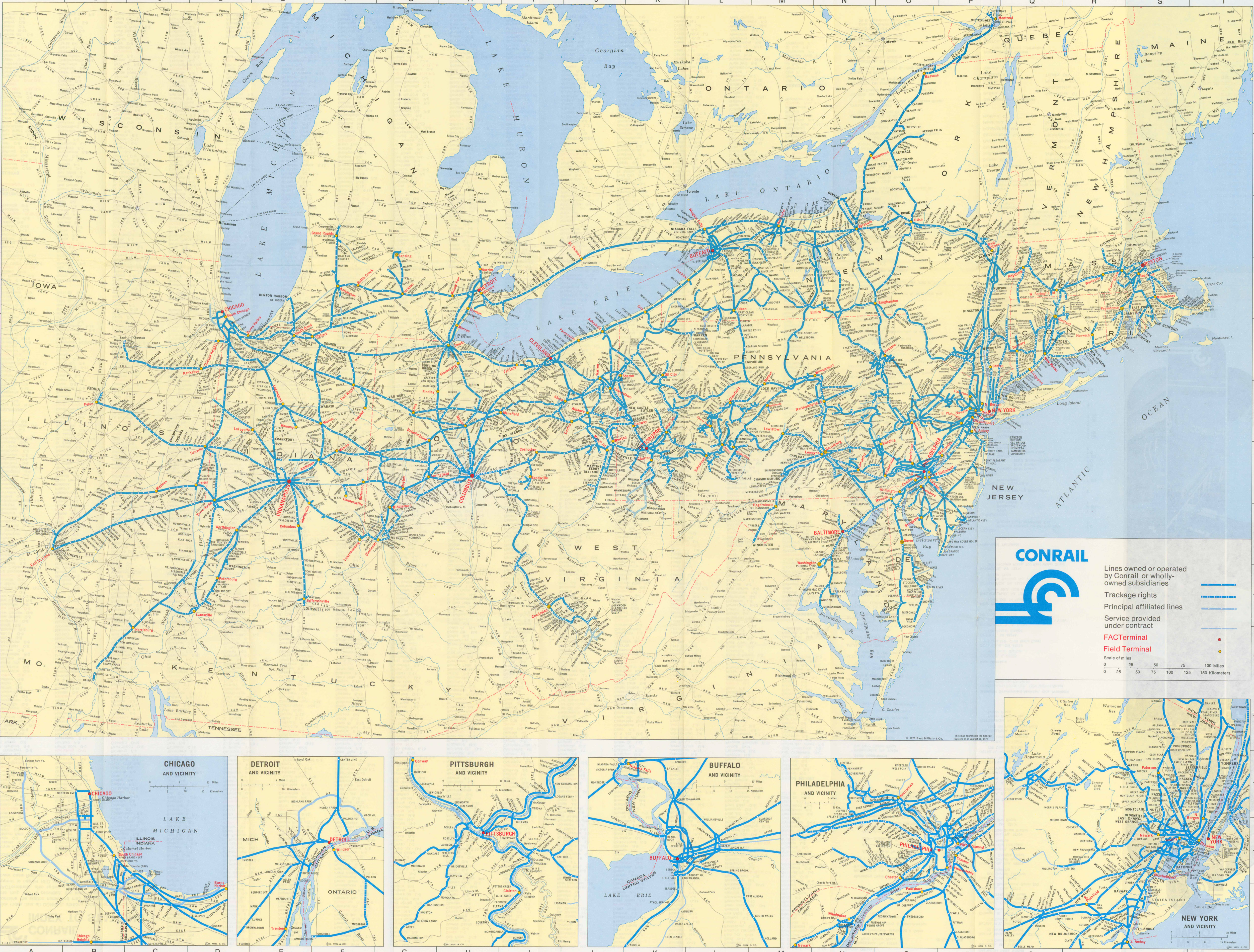
An official 1978 Conrail system map.
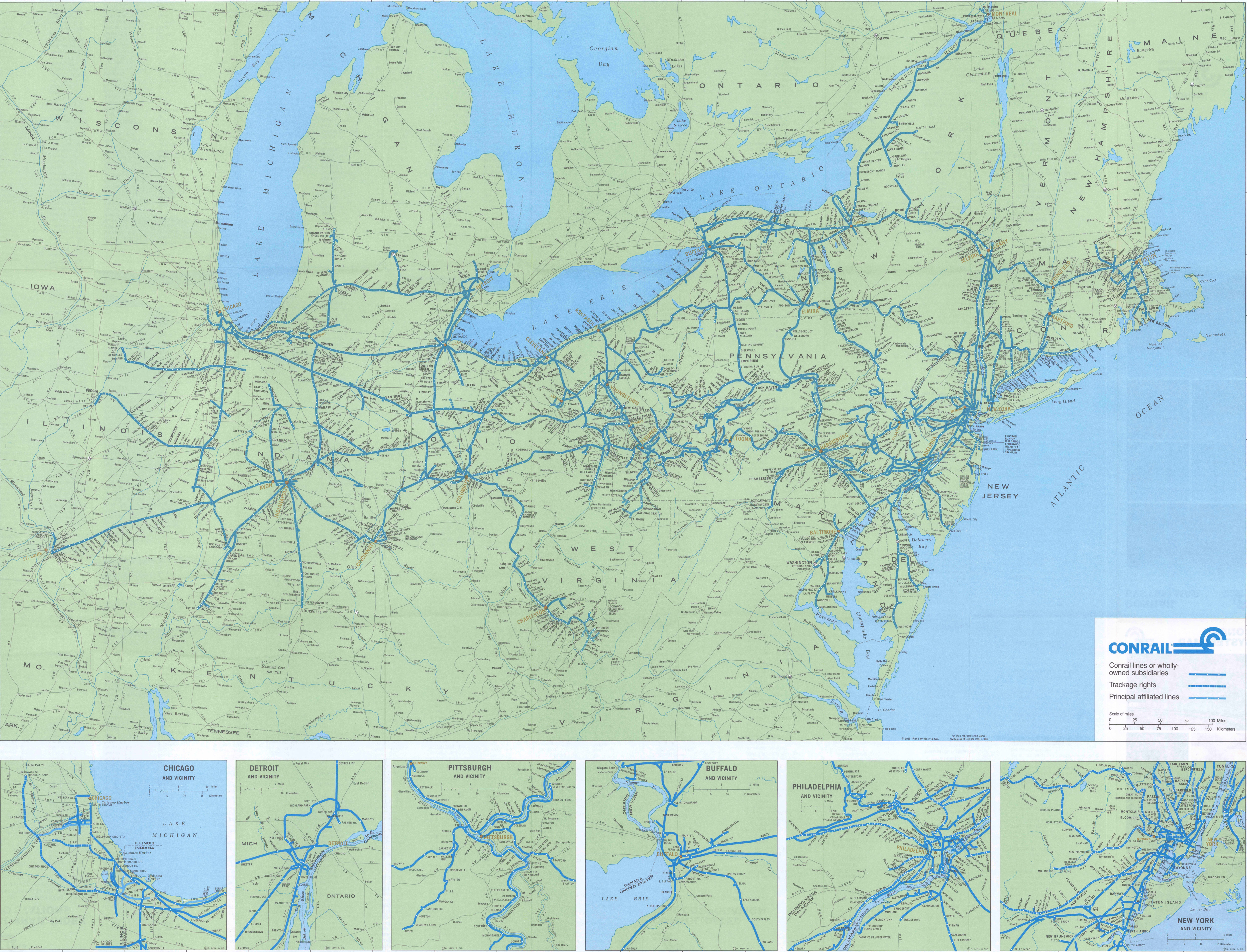
An official 1986 Conrail system map by Rand McNally & Company.
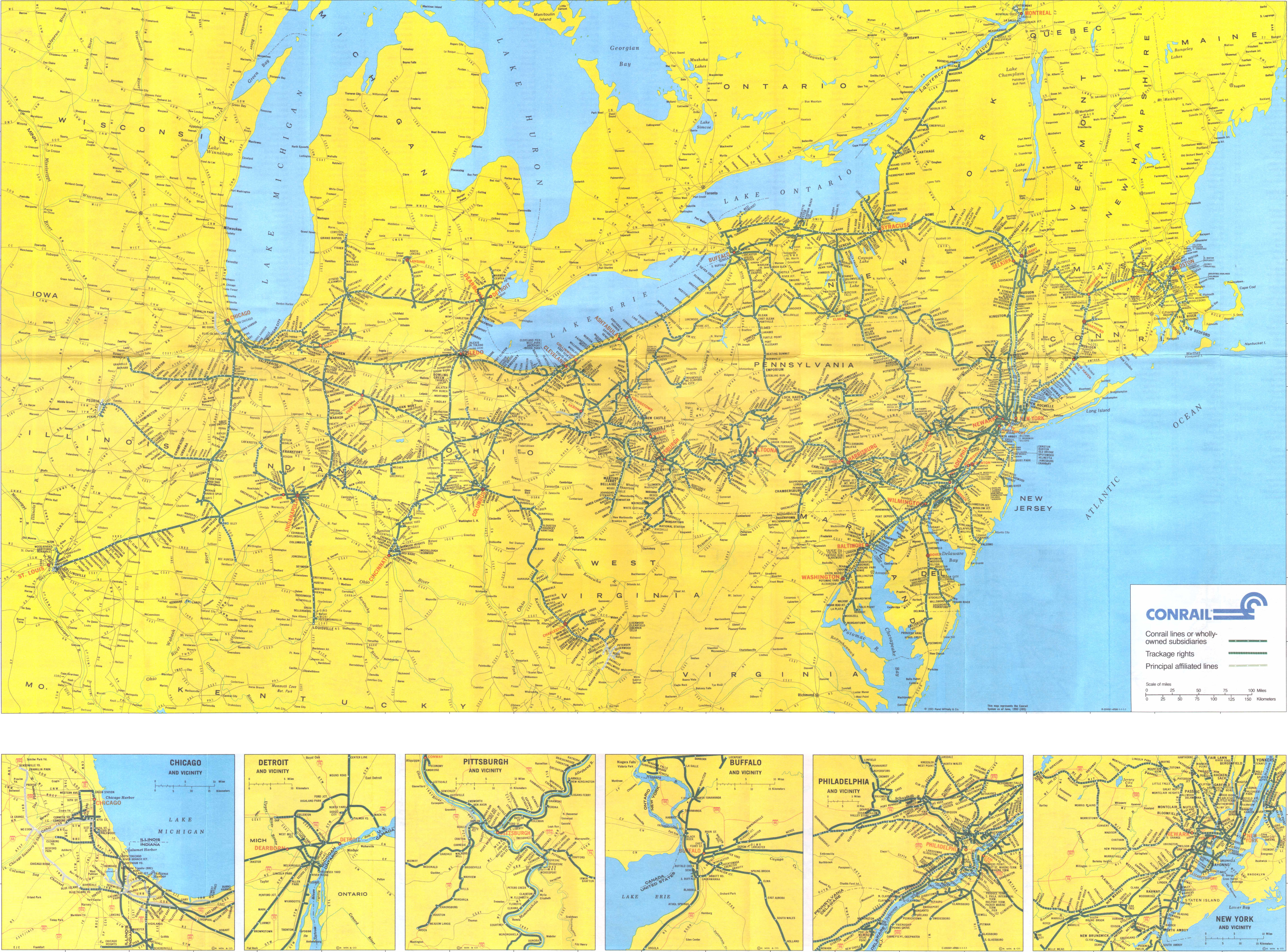
An official 1993 Conrail system map.
Big Blue
Nothing magical happened on April 1. The railroad still lost about a million dollars a day. Locomotives ran in Penn Central black, Erie maroon, Reading green, Jersey Central red, Lehigh Valley yellow, and whatever stencil the shops had time for. Siegel & Gale got the identity. Tony Palladino drew wheels on rails—the can-opener. Final art April 28, 1976; rolling stock unveiled May 30. Conrail blue, white lettering. Boxcars red oxide; covered hoppers gray. The first locomotive in dress blues was GP40 3091, still carrying its New York Central number, out of Collinwood on May 20. Trains ran John C. Benson’s photograph that August. The railroad hoped to have 170 of some 5,000 locomotives in blue by year-end. Big Blue is what stuck.
GG1s and the wire
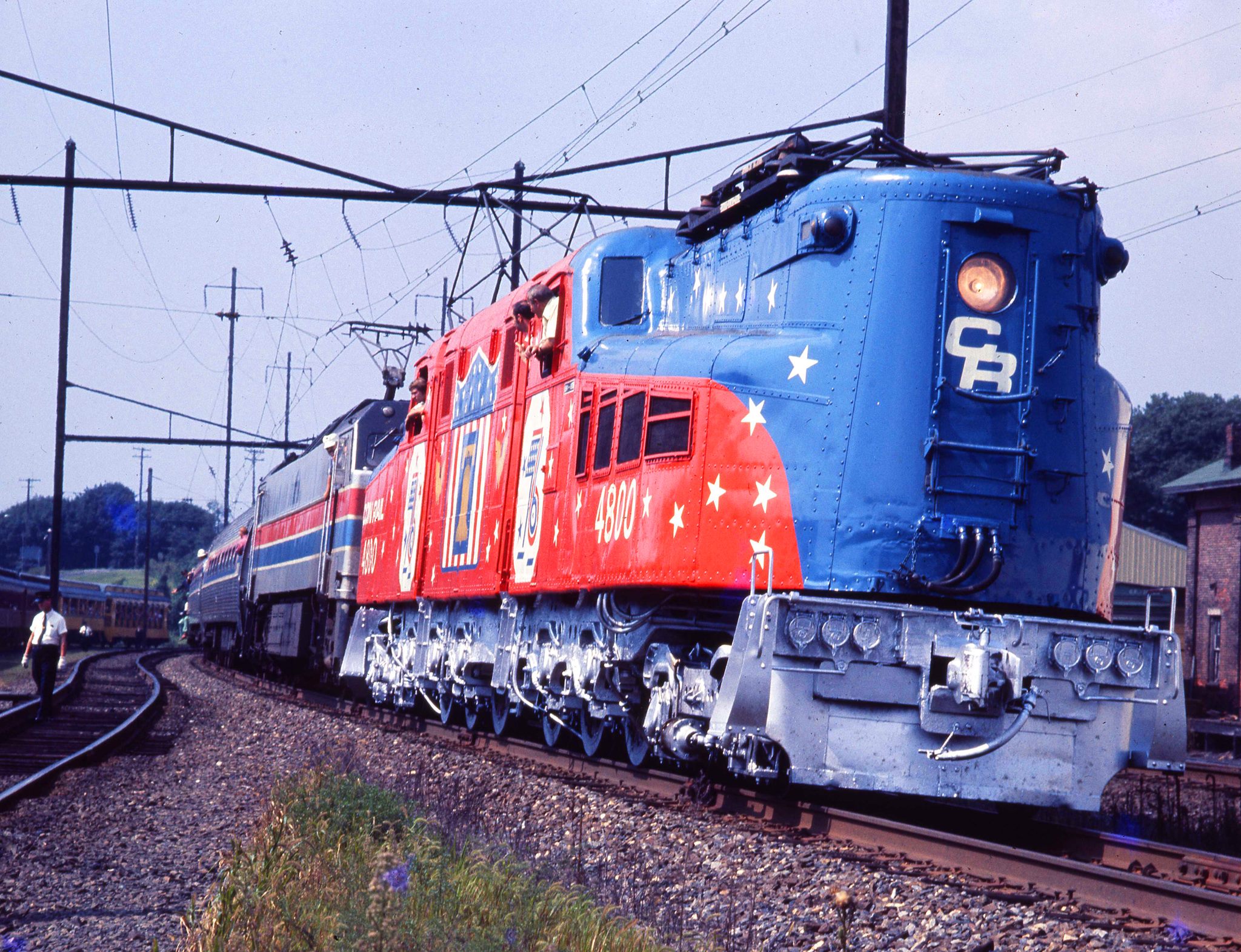
Conrail GG-1 #4800—Old Rivets, the original GG-1—in Bicentennial paint at Leaman Place, Pennsylvania, interchange with the Strasburg, ahead of an Amtrak special, summer 1976. Jerry Custer photo.
Penn Central left Conrail the Pennsylvania electrification: New York–Washington and the freight wires to Harrisburg. GG1s still handled passenger and some freight. 4800 wore red, white, and blue in 1976, then Conrail blue. Amtrak took corridor passenger motors; Conrail kept freight electrics, including former Virginian/New Haven E-33s, into the late 1970s. NJ Transit bought thirteen GG1s on July 1, 1980. The last revenue GG1 was NJ Transit 4879, train 3323 out of Penn Station, October 28, 1983. That story is the GG1 page. Diesels that ran under the wire, including New Haven FL9s on Metro-North, are on the diesel roster.

Conrail GG-1 #4800, Old Rivets, in Bicentennial livery at the former Pennsylvania shops, Wilmington, Delaware, 1976. Photographer unknown.

A freshly repainted Conrail E-33, #4608, at Harrisburg, Pennsylvania, May 29, 1977. Built as Virginian EL-C #139, then Norfolk & Western #239, New Haven #308, Penn Central #4608. Mark Saxon photo.
Commuter and NERSA
Conrail inherited the commuter trains Penn Central, EL, Reading, and CNJ had not been able to drop. MBTA took Massachusetts in March 1977. Cleveland–Youngstown EL service ended in 1977. The Valparaiso Local out of Chicago Union Station went to Amtrak in 1979. New York and Philadelphia stayed longest. The Northeast Rail Service Act, signed August 13, 1981, let Conrail shed commuter operations to state agencies. NJ Transit, SEPTA, Metro-North, and the rest took the trains. Freight was the point.

Conrail GP9 #7508 and GP7 #5959 lead the Valparaiso Local out of Chicago Union Station, July 3, 1978. Marty Bernard photo. Amtrak took the train in 1979.
Crane, Staggers, 1981
USRA planners had expected red ink into 1990. John Kneiling said so in Trains, September 1975. By 1980 there was still no bottom. The Staggers Rail Act, signed October 14, 1980, gave the industry contract rates and a way to abandon. Conrail still had too many miles and too many people. L. Stanley Crane retired from the Southern and took Conrail on January 1, 1981. He cut another 4,400 miles in two years and lost about 1 percent of the traffic. CTC went in. He showed the unions the books. They gave back wage increases and layoff pay worth about $200 million. When profits came, some officers wanted to keep the money. Crane ordered it returned. Year-end 1981 was the first profit since the early Penn Central months of 1968.

The office-car special wore Brunswick green and gold, powered by E8As. Pittsburgh, March 19, 1997. Wade Massie photo.
March 26, 1987
Norfolk Southern tried to buy Conrail from the government in the mid-1980s and withdrew in August 1986. The Conrail Privatization Act that October authorized a public offering. On March 26, 1987, the government sold its 85 percent at $28 a share. The stake brought about $1.65 billion; with Conrail cash to the Treasury, about $1.9 billion. It was then the largest U.S. initial public offering. The railroad was a private Class I again, ticker CRR, still headquartered in Philadelphia, still blue.
CSX, Norfolk Southern, June 1, 1999
Two mains New York–Chicago made Conrail the Eastern intermodal conveyor. Traffic and the stock attracted the neighbors a second time. CSX announced a purchase in 1996. Norfolk Southern fought it. The two settled: CSX about 42 percent, mostly former New York Central; Norfolk Southern about 58 percent, mostly former Pennsylvania. The Surface Transportation Board approved the split. Conveyance was June 1, 1999. The Class I ended. CSX and NS encyclopedias stay on their pages.
What remains
Conrail Shared Assets Operations is the switching company CSX and Norfolk Southern still own jointly: North Jersey, South Jersey/Philadelphia, and Detroit. The can-opener is on museum locomotives and on Norfolk Southern heritage unit 8098. The Pennsylvania and Central spines are CSX and NS. The holding company of February 10, 1976, is not a Class I.
Related reading on American-Rails.com
- Penn Central · Pennsylvania Railroad · New York Central · New Haven
- Erie Lackawanna · Jersey Central · Reading · Lehigh Valley · Lehigh & Hudson River
- Conrail diesel roster · Penn Central diesels · GG1 · FL9
- The 1970s · Staggers Act · Amtrak
- CSX · Norfolk Southern · Chessie System
Sources
- Loving, Rush, Jr. The Men Who Loved Trains: The Story of Men Who Battled Greed to Save an Ailing Industry. Bloomington: Indiana University Press, 2006. PC trustees; Crane; labor; IPO politics
- Grant, H. Roger. Erie Lackawanna: Death Of An American Railroad, 1938–1992. Stanford: Stanford University Press, 1994. EL inclusion January 9, 1975
- Consolidated Rail Corporation. Company history. Incorporated February 10, 1976; operations April 1, 1976; Staggers; IPO
- Trains Magazine, August 1976. First Conrail blue locomotive, GP40 3091, Collinwood May 20, 1976
- Kneiling, John. “Kneiling vs. USRA.” Trains, September 1975. Negative cash flow into 1990
- Goldman Sachs. Historic Conrail IPO, March 26, 1987. $28 per share; about $1.65 billion
- Logopedia / Siegel & Gale identity notes. Tony Palladino can-opener; unveiled May 30, 1976
- American-Rails.com: 1970s decade (3R January 2, 1974; 4R February 5, 1976; Conrail April 1, 1976); Staggers; Penn Central; GG1
Recent Articles


-
Louisiana Scenic Train Rides (2026): A Complete Guide
Oct 01, 26 02:52 PM
 Louisiana has no regular full-size tourist railroad in 2026. New Orleans Polar Express returns December 11–31. Museums at Long Leaf, DeQuincy, and Jackson.
 -
Kentucky Scenic Train Rides (2026): A Complete Guide
Oct 01, 26 02:45 PM
 Kentucky tourist trains in 2026—Big South Fork Scenic Railway, Bluegrass Scenic Railroad, Kentucky Railway Museum, and My Old Kentucky Dinner Train.
 -
Georgia Scenic Train Rides (2026): A Complete Guide
Oct 01, 26 02:27 PM
 Georgia tourist trains in 2026—Blue Ridge Scenic Railway, SAM Shortline, Azalea Sprinter, Savannah shop rides, and what to confirm at Stone Mountain.
 -
Arkansas Scenic Train Rides (2026): A Complete Guide
Oct 01, 26 01:02 PM
 Arkansas tourist trains in 2026—Arkansas & Missouri through the Boston Mountains, and the Eureka Springs & North Arkansas dinner and excursion trains.
 -
Alabama Scenic Train Rides (2026): A Complete Guide
Oct 01, 26 12:59 PM
 Alabama tourist trains in 2026—Heart of Dixie Railroad Museum at Calera, North Alabama Railroad Museum at Chase, and the Wales West Light Railway at Silverhill.
 -
The Circus Train: How Such Attractions Reached Distant Cities
Oct 01, 26 12:22 PM
 How circuses moved by rail: Coup's 1872 flats, the Ringling train's sections and car counts, the 1918 Hammond wreck, and the last show on May 21, 2017.
 -
West Virginia Halloween Train Rides (2026)
Oct 01, 26 12:19 PM
 2026 West Virginia Halloween train. Cass Scenic Halloween Train, October 30 and 31, steam, 5:00 p.m. from Cass Depot. Adult $75. About two hours to Whittaker. Family ride.
 -
Wisconsin Halloween Train Rides (2026)
Oct 01, 26 12:11 PM
2026 Wisconsin Halloween trains. Mid-Continent Pumpkin Special October 24–25, adult $24, pumpkins extra. Halloween Flyer October 24 at 4:30 p.m., adult $30. Osceola Pumpkin Express boards in Osceola… -
Utah Halloween Train Rides (2026)
Oct 01, 26 12:00 PM
 2026 Utah Halloween trains at Heber Valley Railroad. Pumpkin Train, about 40 minutes, with a cookie and a pumpkin. Halloween Express, about 90 minutes to Grim Hollow, Monday, Thursday, and Friday even…
 -
Texas Halloween Train Rides (2026)
Oct 01, 26 11:28 AM
 2026 Texas Halloween train. Texas State Railroad Spooky Special, adult-only, October 24. Boards Palestine at 5:00 p.m. About five hours to Rusk and back. Dinner on the grounds. Not steam. No fare on t…
 -
Tennessee Halloween Train Rides (2026)
Oct 01, 26 12:15 AM
 2026 Tennessee Halloween trains. Tennessee Valley Railroad Museum Rails, Wizards & Spells, selected days September 18 through October 25, from $35, about 2.5 hours. Spells & Potions tea from $60. The…
 -
Frisco's "Firefly" (Train): Consist, Route, Timetable
Sep 30, 26 11:37 PM
 Frisco Firefly—daylight streamliner, Kansas City to Tulsa and Oklahoma City. Trains 117 and 118. Pacifics 1018, 1026, and 1031. Last run May 22, 1960.
 -
South Carolina Halloween Train Rides (2026)
Sep 30, 26 11:29 PM
 2026 South Carolina Halloween train. South Carolina Railroad Museum Pumpkin Patch Express, the two Saturdays before Halloween. About three miles to the Greenbriar pavilion. Pumpkin for children 12 and…
 -
Oregon Halloween Train Rides (2026)
Sep 30, 26 08:10 PM
2026 Oregon Halloween train. Sumpter Valley Railroad Halloween Express at the Sumpter Depot, calendar window October 31 at 11:00 a.m. through November 1 at 12:30 p.m. Fare and the individual clocks ar… -
Oklahoma Halloween Train Rides (2026)
Sep 30, 26 03:45 PM
2026 Oklahoma Halloween train. Oklahoma Railway Museum, October 30 and 31, from Oakwood Station in Oklahoma City. Adults $15, children 3–12 $8. A candy bag with the ride. -
McCloud River Railroad: Serving The Timber Industry (1897-2009)
Sep 30, 26 03:37 PM
 McCloud River Railroad—Mount Shasta City to McCloud, Hambone, and Burney. Opened August 1, 1897. Alco No. 25 and EMD SD38s. Dinner train through January 2010. Railbikes in 2026; a dinner train is stil…
 -
Nevada Halloween Train Rides (2026)
Sep 30, 26 03:30 PM
2026 Nevada Halloween trains in Ely. Nevada Northern Pumpkin Patch Caper and Haunted Ghost Train. Adult tickets start at $45. Dates are on the railroad’s ticket calendar. Boulder City stays off until… -
Missouri Halloween Train Rides (2026)
Sep 30, 26 11:12 AM
 2026 Missouri Halloween trains. St. Louis Iron Mountain & Southern Pumpkin Patch Train on October 3, 4, 10, and 11, and Halloween Express on October 31 at 1:00 p.m. Jackson depot. No fare on the sched…
 -
Minnesota Halloween Train Rides (2026)
Sep 30, 26 11:06 AM
 2026 Minnesota Halloween trains. North Shore Scenic Great Pumpkin Train in Duluth, October 15–18. Everyone gets a pumpkin. Terror Train is October 30, an adult costume party, about three hours. Fares…
 -
Maryland Halloween Train Rides (2026)
Sep 30, 26 10:42 AM
 2026 Maryland Halloween trains. Western Maryland Scenic Pumpkin Patch Limited, October 17, 18, 24, and 25, $14. Colesville Trolleyween October 24, 25, and 31.
 -
West Side Lumber Company Railroad: Roster, History, Lines
Sep 30, 26 09:45 AM
 West Side Lumber at Tuolumne, California. Three-foot Shay and Heisler logging railroad. Lima shop numbers, builder specs, and where the engines are in 2026.
 -
Kansas Halloween Train Rides (2026)
Sep 30, 26 09:41 AM
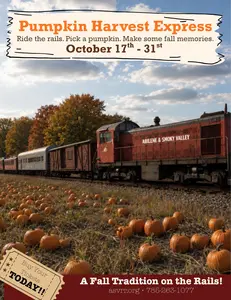
 2026 Kansas Halloween train. Abilene & Smoky Valley Pumpkin Harvest Express, October 17 through 31. About one hour. Shop prices $35.56 to $41.02. Everyone picks a pumpkin.
 -
Iowa Halloween Train Rides (2026)
Sep 29, 26 11:58 PM
 2026 Iowa Halloween train. Boone & Scenic Valley Pumpkin Express, October 10, 10:00 a.m. from 225 10th Street. About 1 hour 15 minutes. Children pick a pumpkin.
 -
Arizona Halloween Train Rides (2026)
Sep 29, 26 11:43 PM
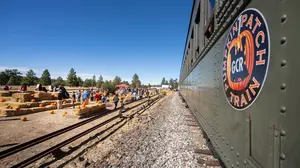
 2026 Arizona Halloween train. Grand Canyon Railway Pumpkin Patch Train from Williams, $39 with a pumpkin included. Select October dates on the ticket calendar. Haunted train cars are optional.
 -
Nevada Northern Halloween Trains (2026)
Sep 29, 26 06:18 PM
Nevada Northern 2026 Halloween trains in Ely. Pumpkin Patch Caper to Keystone Gulch and the Haunted Ghost Train. Adult tickets start at $45. Dates are on the railroad’s calendar. Confirm on nnry.com. -
Grand Canyon Railway Pumpkin Patch Train (2026)
Sep 29, 26 02:42 PM
 Grand Canyon Railway Pumpkin Patch Train—select October 2026 dates from Williams, $39 with a pumpkin included. Haunted train cars are optional. Days are on the ticket calendar. Confirm on thetrain.com…
 -
Cass Scenic Railroad Halloween Trains (2026)
Sep 29, 26 02:37 PM
 Cass Scenic Halloween Trains—October 30 and 31, 2026, steam, 5:00 p.m. from Cass Depot. About two hours to Whittaker. Adult $75. Candy for every child. Confirm on mountainrailwv.com.
 -
Halloween Train Rides (2026): Pumpkin Patch, Haunted & Spooky Trips
Sep 29, 26 11:26 AM
 2026 Halloween train rides in nine checked states. Conway Scenic Halloween Express October 24–25. Strasburg’s three fall tickets. Great Smoky Mountains Railroad’s October trains are the gorge and rive…
 -
Maine Halloween Train Rides (2026)
Sep 29, 26 11:08 AM
 2026 Maine Halloween trains. Seashore Pumpkin Patch Trolley through October 18, adult $17. Happy Trolleyween October 23–25 at $15. WW&F Pumpkin Pickin’ October 3, 12, 17, and 24. Downeast’s booking it…
 -
Kentucky Halloween Train Rides (2026)
Sep 29, 26 10:58 AM
 2026 Kentucky Halloween trains. Kentucky Railway Museum Trick and Track Express, October 24 and 31, from $17. Bluegrass Scenic pumpkin trains in Versailles. Confirm on the ticket shop.
 -
Connecticut Halloween Train Rides (2026)
Sep 29, 26 10:26 AM
 2026 Connecticut Halloween trains. East Windsor Pumpkin Patch Fridays through Sundays, October 2–31. Naugatuck coach $20. Shore Line Pumpkin Patch on nine October days. Confirm on each site.
 -
Pennsylvania Halloween Train Rides (2026)
Sep 29, 26 09:45 AM
 2026 Pennsylvania Halloween trains—Everett October 3, 4, 10, and 17, Strasburg’s three fall shows, Oil Creek on October 24, plus Kutztown, Kempton, Honesdale, Middletown, and West Chester.
 -
New York Halloween Train Rides (2026)
Sep 29, 26 12:08 AM
2026 New York Halloween trains—Catskill Pumpkin Express October 17–18 and 24–25, Adirondack pumpkin and family trains, Arcade & Attica haunt, Cooperstown patch and trick-or-treat, Tupper Lake triv… -
North Carolina Halloween Train Rides (2026)
Sep 28, 26 11:56 PM
 2026 North Carolina Halloween trains—New Hope Valley Track or Treat on October 10, 17, 23, and 24, and Tweetsie Ghost Train Friday and Saturday nights through October 31. GSMR’s October menu is the go…
 -
Tweetsie Railroad Ghost Train Halloween Festival (2026)
Sep 28, 26 11:44 PM
Tweetsie Ghost Train—Friday and Saturday nights September 25–October 31, 2026, in Blowing Rock. Adult $65, child $45. One reserved steam ride plus the park. Ages 8 and up for the haunt. -
Milwaukee Road Class A 4-4-2: Specs, Roster, History
Sep 28, 26 11:20 PM
 Milwaukee Road Class A Atlantics 1–4, Alco 1935–1937, for the Hiawatha. Order S-1740, 84-inch drivers, 19x28, 300 psi, 30,685 lb. Full builder specs, roster, and the May 15, 1935 run at 112.5 mph. All…
 -
Strasburg Rail Road Halloween Trains (2026)
Sep 28, 26 11:00 PM
 Strasburg’s 2026 Halloween tickets—Pumpkins in Paradise on October 3, The Haunting of Pumpkin Junction, and The Brakeman’s Curse through October 25. Three fares. Legacy of Sleepy Hollow is an earlier…
 -
GSMR Peanuts Pumpkin Train (2026): Not on This Year’s Ticket Menu
Sep 28, 26 10:50 PM
Great Smoky Mountains Railroad’s September 28, 2026 ticket menu lists Nantahala and Tuckasegee excursions. A Peanuts Great Pumpkin train is not on that menu. Polar Express is on the November calendar. -
New Jersey Halloween Train Rides (2026)
Sep 28, 26 06:45 PM
2026 New Jersey Halloween trains—Black River & Western to Everitt Farms through October 25, Delaware River Great Pumpkin through November 1, Whippany October 4, 10, and 11, Pine Creek night trains. -
New Hampshire Halloween Train Rides (2026)
Sep 28, 26 05:17 PM
2026 New Hampshire Halloween train—Conway Scenic Halloween Express, October 24 and 25, about 1 hour from North Conway. Coach adult $30. Confirm on conwayscenic.com. -
Conway Scenic Pumpkin Patch Express (2026): Dates, Tickets & Tips
Sep 28, 26 05:09 PM
 Conway Scenic Halloween Express—October 24 and 25, 2026, about 1 hour from North Conway. Coach adult $30. A pumpkin after the ride while supplies last. Confirm on conwayscenic.com.
 -
Black River & Western Pumpkin Trains (2026): Dates, Tickets & Tips
Sep 28, 26 02:20 PM
 Suggested meta description: Black River & Western Pumpkin Train—Flemington to Everitt Farms, weekends September 26–October 25, 2026. Pumpkin patch, maze, and wagon rides. Confirm on blackriverrail…
 -
Scenic Dinner Train Rides (2026): A Complete Guide
Sep 28, 26 01:30 PM
 2026 scenic dinner trains by state—a seated meal on the train. Branson through October 30, Cincinnati Saturdays, Potomac Eagle, and the full state list. Confirm on the railroad.
 -
West Virginia Dinner Train Rides (2026): A Complete Guide
Sep 28, 26 11:58 AM
 2026 Potomac Eagle dining from Romney—about 3 hours in the Trough. Premium three courses $124. Superior four courses $159, ages 17 and older. Confirm on potomaceagle.com.
 -
Washington Dinner Train Rides (2026): A Complete Guide
Sep 28, 26 11:51 AM
 2026 Chehalis-Centralia dinner trains have run. The July 18 Roaring 20s dinner was $89. The planning calendar lists no later dinner. Confirm on steamtrainride.com.
 -
Texas Dinner Train Rides (2026): A Complete Guide
Sep 28, 26 11:27 AM
 2026 Texas has no plated dinner aboard the train. Grapevine sells snacks. The Texas State Railroad Dogwood lunch was served at the Rusk depot. Confirm on the railroad.
 -
Ohio Dinner Train Rides (2026): A Complete Guide
Sep 28, 26 10:15 AM
2026 Ohio dinner trains—Cincinnati Saturdays, $140, about 3 hours, ages 12 and up. Hocking Valley Elegant Dinner Train October 17 and November 7, from $95. -
Missouri Dinner Train Rides (2026): A Complete Guide
Sep 28, 26 10:09 AM
 2026 Branson Scenic Railway dinner train—three courses, about 2 hours, Fridays and Saturdays through October 30. Dome $123.50 plus tax. Confirm on bransontrain.com.
 -
Minnesota Dinner Train Rides (2026): A Complete Guide
Sep 28, 26 09:40 AM
 2026 North Shore Scenic Northwoods Dinner Train in Duluth—four courses in the SkyView dome, 2½ hours, $90, through September 26. Confirm on duluthtrains.com.
 -
Maine Dinner Train Rides (2026): A Complete Guide
Sep 28, 26 09:29 AM
 2026 Maine has no dining-car dinner. WW&F Pig Roast at SeaLyon Farm was June 13 and has run, $54.95. Sunset Express was a drink and ended September 5.