
EMD "F9" Locomotives: Specs, Roster, History
Last revised: December 18, 2024
By: Adam Burns
The F9 was Electro-Motive's most powerful and advanced in the traditional F series, or those designs sporting the classic "bull dog" nose carbody.
Unfortunately, a multitude of factors resulted in far fewer sales compared to the highly successful F3 and F7. When introduced in 1954, EMD had already cataloged its GP7 for nearly five years.
The builder's General Purpose series was designed specifically for all types of freight service - main line, switching, and even yard work. As a result, the industry soon realized the need for streamlined diesels in freight assignments simply no longer made sense.
While they looked handsome at the head end, Fs offered poor sight lines in yard and switching work; engineers had difficulty clearly seeing other crewmen/brakemen and objects outside the locomotive, particularly to the rear.
With the GP's versatility and clear sight lines from the cab, railroads had less of a desire to continue purchasing cab designs best suited for main line services.
Nevertheless, the F9 was the most advanced, rugged, and reliable in the series sporting EMD's latest prime mover and other improved internal components. Interestingly, F9Bs sold better than their "A" unit counterparts, even with Canadian roads. Today, several remain either preserved or in operation.
Photos
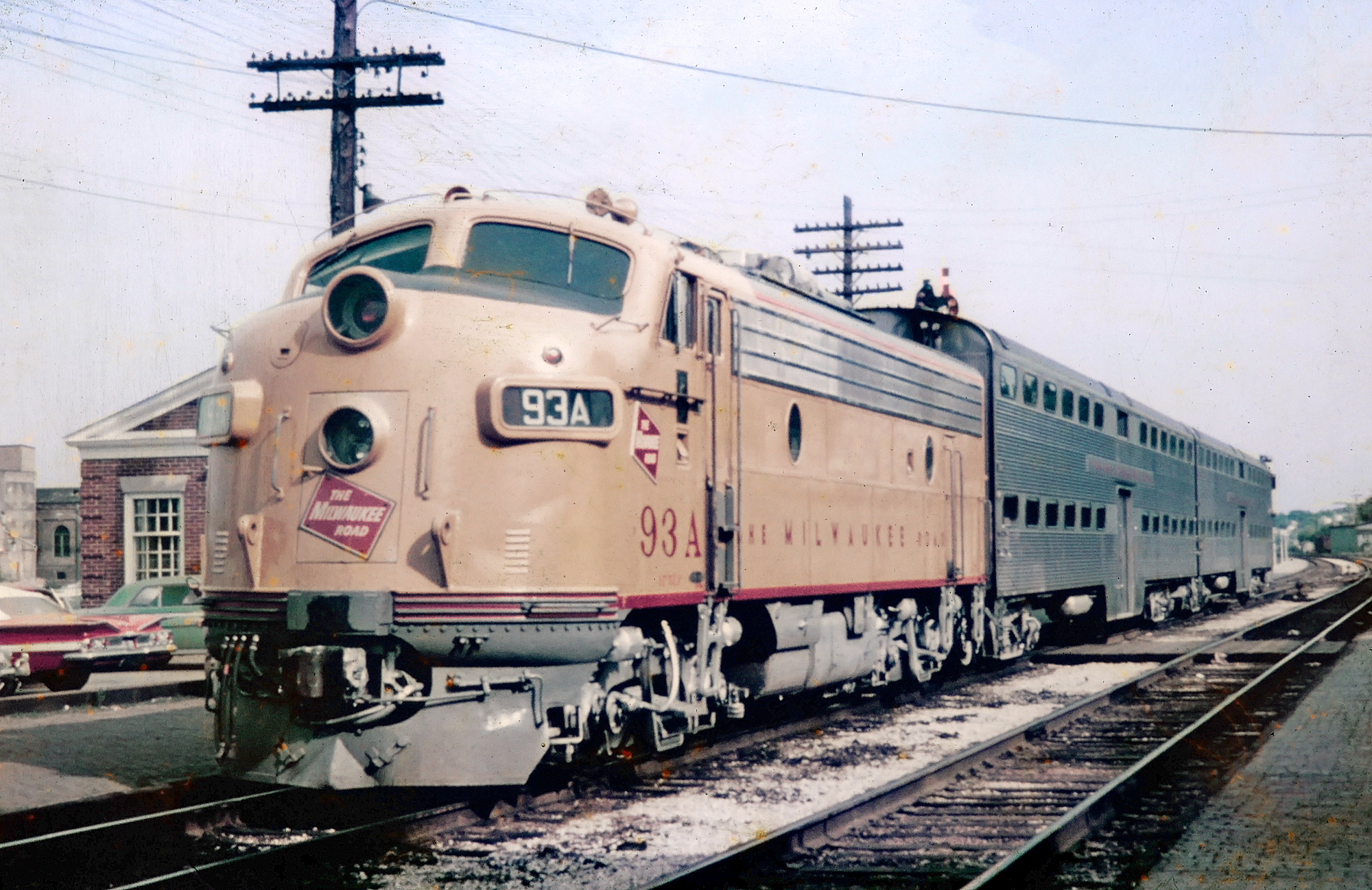 Milwaukee Road F9A #93-A (built as #81-C) works suburban service at Franklin Park, Illinois in September, 1965. American-Rails.com collection.
Overview
The F9 was part of Electro-Motive's so-called "9 Line" which included the F9, SD9, GP9, and E9 which all debuted in 1954.
Among the F9's most notable improvements was its use of EMD's latest 567 power plant, the 567C. This engine, as Brian Solomon notes in his book, "Electro-Motive: E Units and F Units," was the most advanced in the series.
Its upgrades included a redesign of the engine crankcase to withstand a greater beating in daily service, replacement of water seals susceptible to leaking on older model 567s, and an improved cooling circuit.
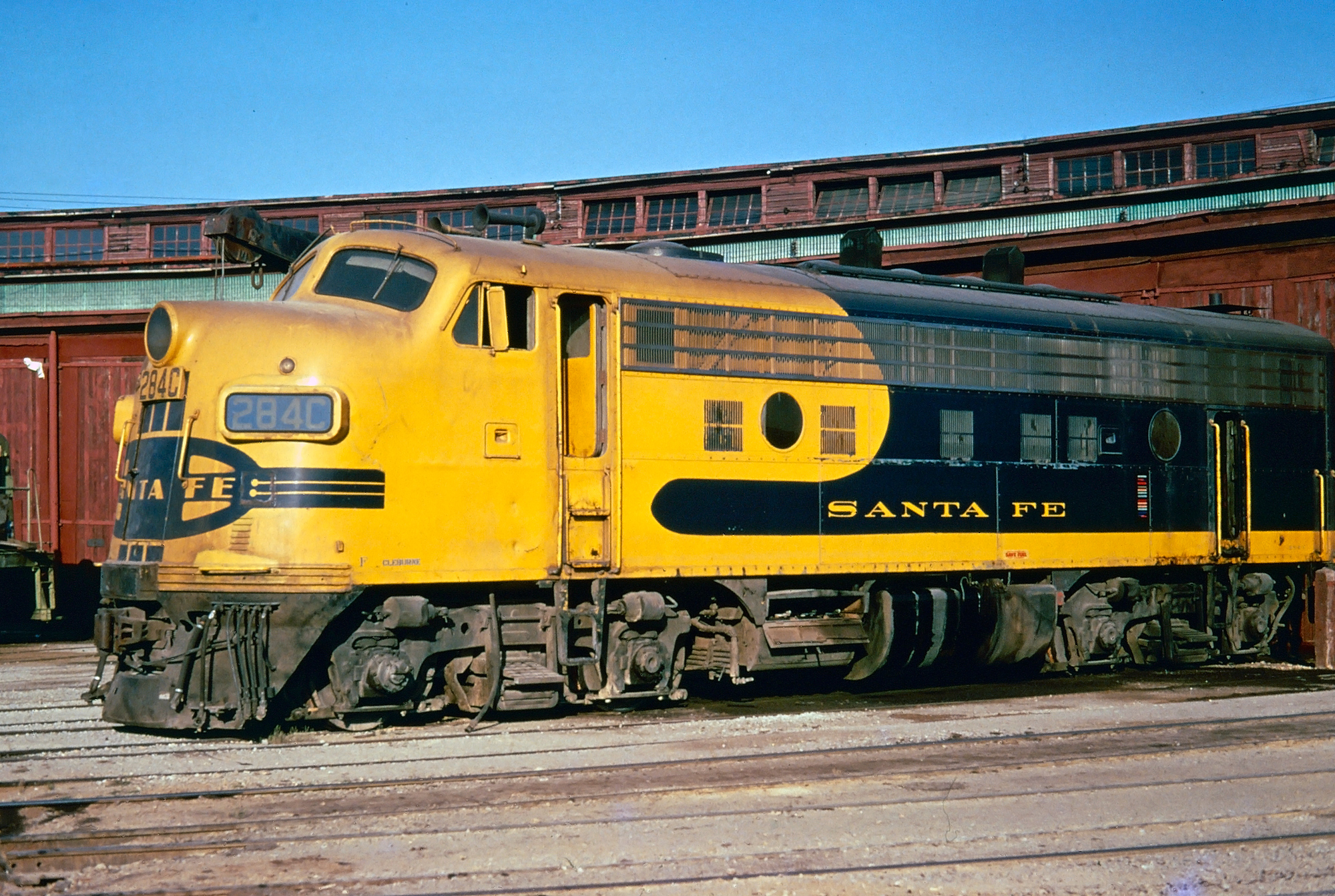
%20works%20suburban%20service%20at%20Franklin%20Park%2C%20Illinois%20in%20September%2C%201965.%20American-Rails.com%20collection.)

To add an extra 250 horsepower, engineers increased rotational speed from 800 to 835 rpm as the engine's bore and stroke remained the same. As a result, a complete A-B-B-A set could produce 7,000 horsepower; 1,000 horsepower more than an F7 set.
Another upgrade was EMD's latest D37 traction motor; this variant featured an improved molded coil that essentially sealed out all moisture. It also sported greater tractive effort. Finally, its Teflon insulation, which replaced mica, decreased friction and, in doing so, decreased maintenance.
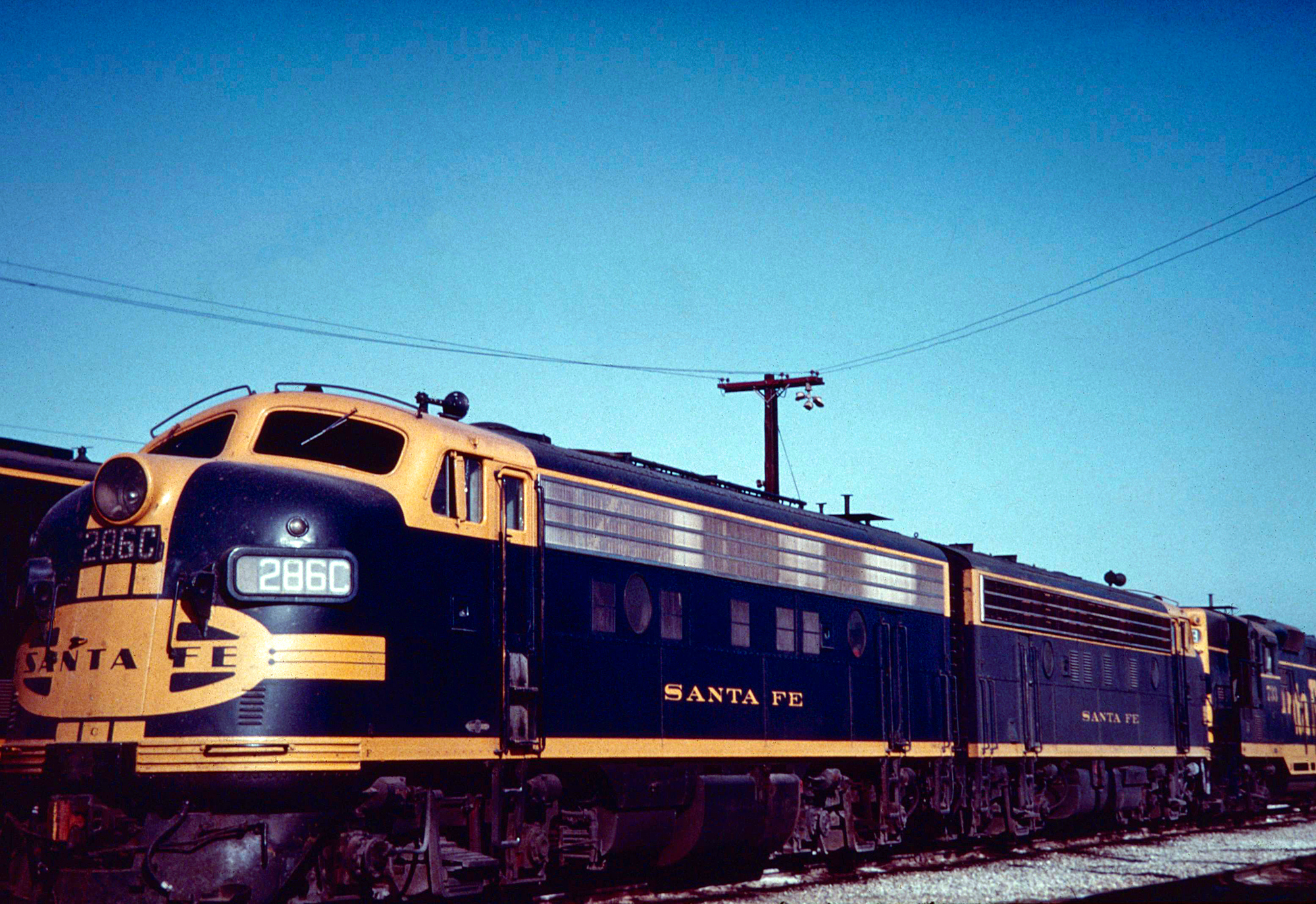 Santa Fe F9A #286-C and other power layover in San Diego, California during the early 1960s. Fred Worsfold photo. American-Rails.com collection.
Spotting Features
Visually, the F9 was very similar to the F7; the locomotive was 50 feet, 8 inches in length and featured two portholes with the filter grille still located along the top of the carbody. However, as Louis A. Marre notes in his book, "Diesel Locomotives: The First 50 Years," there were a few differences.
Perhaps most noticeable was the grille; the F9 featured a stamped, stainless steel design (the Farr-Air grille), which replaced the previously fabricated version commonly found on F7s, and late model F3s.
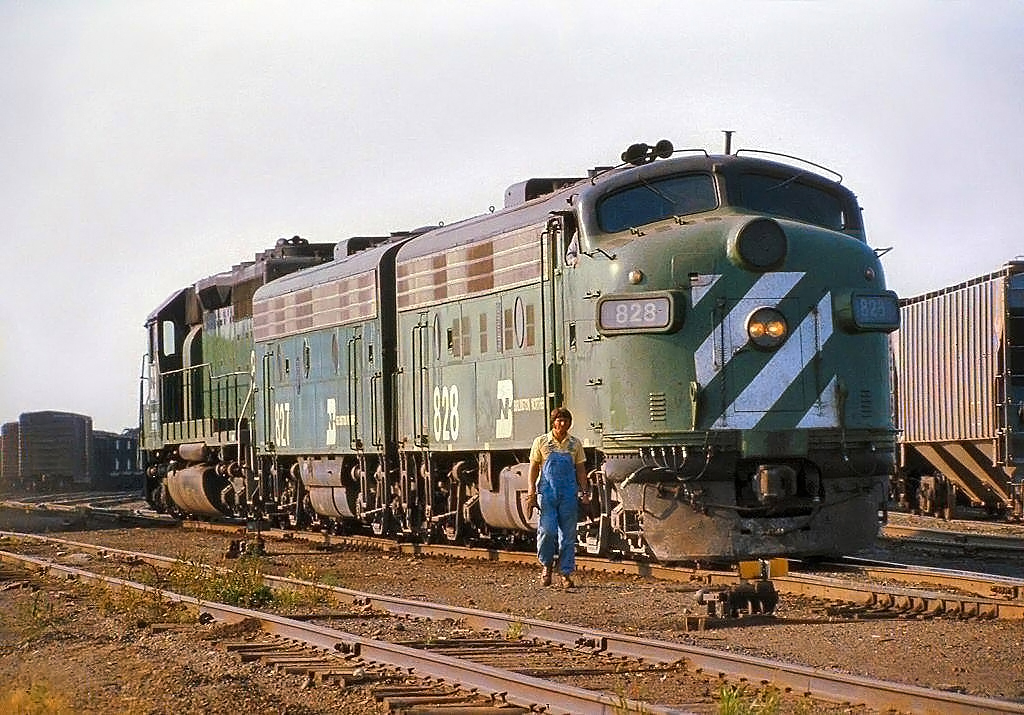 An A-B set of Burlington Northern F9's, along with a Geep, have cut away from their train at the Belknap Street Yard in Superior, Wisconsin and are heading for the roundhouse during August of 1976. Photo by Rob Kitchen.
Another distinguishable feature was the headlight glass; on the F9 it is flush with the outside rim of the headlight casing. On F7s the headlight is recessed. Next, the classic horizontal louvers commonly found on F3s and F7s was replaced with square, vertical-slotted openings.
There were five situated on the F9; one ahead of the porthole, nearest the cab, and four others between the first and second porthole. Finally, the F9 sported a stainless-steel model nameplate directly under the cab window, near the cab door, upon customer request.
Reception
Between EMD's McCook, Illinois plant and its London, Ontario affiliate (General Motors Diesel), just 100 F9As and 158 F9Bs were constructed by the time production had ended in the spring of 1960. By then, the industry was acquiring increasing numbers of GP7s, GP9s, and early Special Duty variants.
Data Sheet and Specifications
| Entered Production | 2/1953 (Demonstrator #975) |
| Years Produced | 2/1953 - 5/1960 |
| Engine | 567C |
| Engine Builder | GM |
| Horsepower | 1750 |
| RPM | 835 |
| Cylinders | 16 |
| Length (F9A) | 50' 8" |
| Length (F9B) | 50' 0" |
| Height (Top Of Rail To Top Of Cab) | 15' 0" |
| Width | 10' 8" |
| Weight | 230,000 Lbs (A Units): 228,000 Lbs (B Units) |
| Fuel Capacity | 1,200 Gallons |
| Air Compressor | Gardner-Denver |
| Air Compressor Model | WBO |
| Air Brake Manufacturer | Westinghouse |
| Air Brake Schedule | 24RL |
| Trucks | B-B |
| Truck Type | Blomberg |
| Truck Wheelbase | 9' |
| Wheel Size | 40" |
| Traction Motors | D37 (4), GM |
| Primary Generator | D12D, GM |
| Auxiliary Generator | Delco (A8102) |
| Alternator | D14 |
| MU (Multiple-Unit) | Yes |
| Dynamic Brakes | Yes (A Units) |
| Tractive Effort (Starting) | 56,500 Lbs at 25% |
| Tractive Effort (Continuous/Average) | 40,000 Lbs at 9.3 mph |
| Gear Ratios | 65:12, 62:15, 61:16, 60:17, 59:18, 58:19, 57:20, 56:21 |
| Top Speeds | 55 mph, 65 mph, 71 mph, 77 mph, 83 mph, 95 mph, 102 mph |
* Steam generators were optional in the F9. They were produced by Vapor Clarkson; model OK4625 (1,200 Lbs/Hr) for "A" units and model OK4616 (1,200 Lbs/Hr) for "B" units.
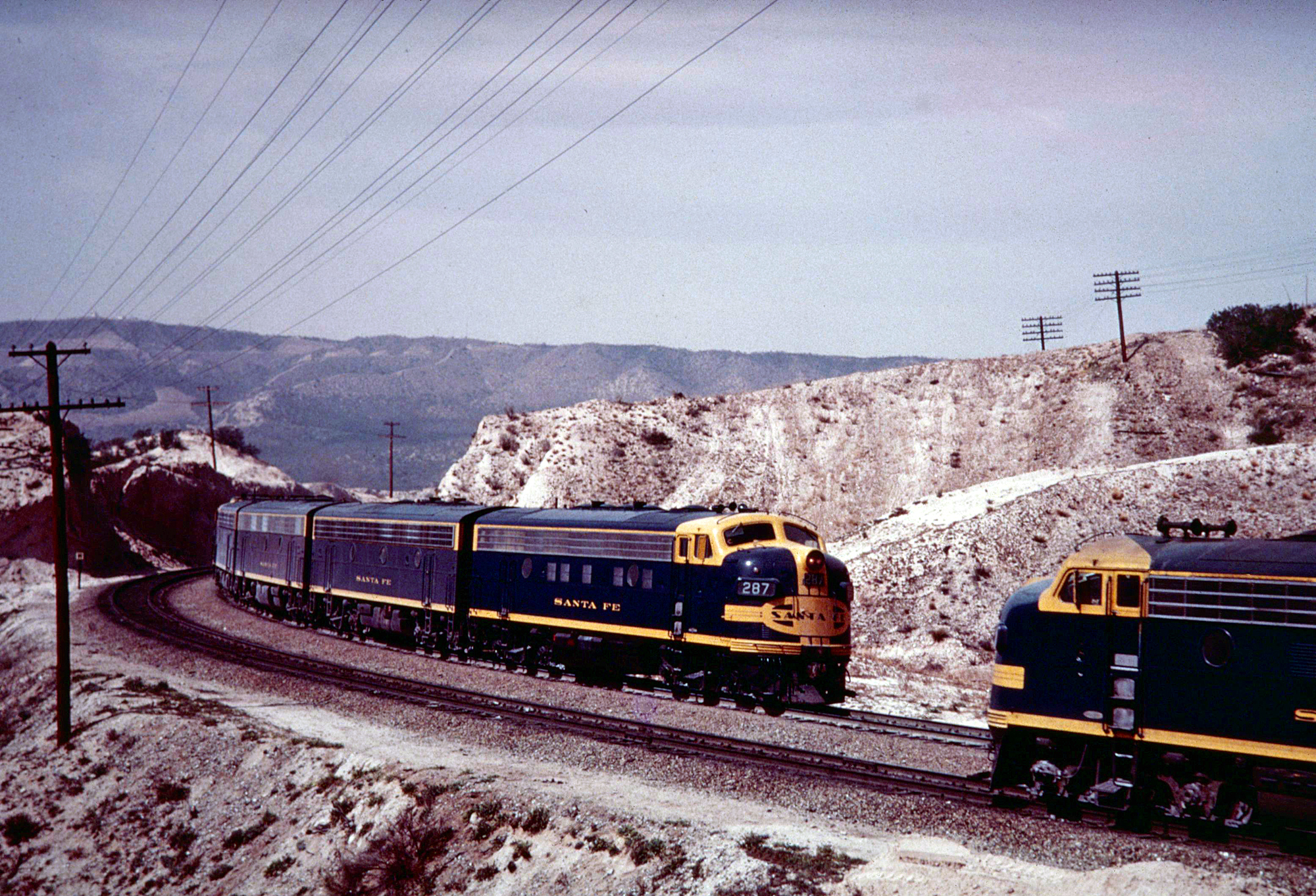 Santa Fe covered wagons meet at the Summit of Cajon Pass (California) during the early 1960s. Pictured is F9A #287-A leading an eastbound train. Fred Worsfold photo. American-Rails.com collection.
%20during%20the%20early%201960s.%20Pictured%20is%20F9A%20%23287-A%20leading%20an%20eastbound%20train.%20Fred%20Worsfold%20photo.%20American-Rails.com%20collection.)
Production Roster
F9A
Total Built = 84
| Owner | Road Number(s) | Serial Number(s) | Order Number | Completion Date |
|---|---|---|---|---|
| Electro-Motive (Demonstrator) | 975 (became Northern Pacific #7050A) | 18129 | 3186 | 2/1953 |
| Electro-Motive (Demonstrator) | 462 (rebuilt from Chicago & North Western F7A #6501A) | 26158 | E1188R | 5/1960 |
| Milwaukee Road | 81C-86C | 18752-18757 | 3172 | 1/1954 |
| Northern Pacific | 7000A, 7000D-7001A, 7000D | 19048-19051 | 3176 | 1/1954 |
| Northern Pacific | 6700A, 6700C | 19056-19057 | 3175 | 2/1954 |
| Northern Pacific | 7002A, 7002D-7006A, 7006D | 19738-19747 | 3179 | 8/1954-10/1954 |
| Northern Pacific | 7008A, 7008D-7009A, 7009D | 20297-20300 | 3180 | 7/1955-8/1955 |
| Northern Pacific | 7007A, 7007D | 20324-20325 | 3181 | 2/1955 |
| Denver & Rio Grande Western | 5771, 5774 | 20527-20528 | 3184 | 9/1955 |
| Erie Mining Company | 100-102 | 20830-20832 | 3187 | 5/1956 |
| Erie Mining Company | 103-104 | 21048-21049 | 3187 | 5/1956, 8/1956 |
| Northern Pacific | 7010A, 7010D-7014A, 7014D | 21104-21113 | 3189 | 3/1956 |
| Northern Pacific | 6701A, 6701C | 21124-21125 | 3190 | 8/1956 |
| Santa Fe | 281, 281C-288, 288C | 21127-21142 | 3191 | 6/1956-7/1956 |
| Santa Fe | 289, 289C | 21423-21424 | 3191 | 7/1956 |
| Louisville & Nashville | 919-926 | 22508-22515 | 3194 | 11/1956-12/1956 |
| Northern Pacific | 6702A-6704A | 22765-22767 | 3195 | 12/1956 |
| Atlantic Coast Line | 317, 417 | 23465-23466 | 8044 | 5/1957 |
| Louisville & Nashville | 811 | 24571 | 8050 | 4/1958 |
| Colorado & Southern | 700D | 25098 | 8057 | 3/1959 |
| Fort Worth & Denver | 750A | 25099 | 8058 | 3/1959 |
| Wabash | 1141A | 25163 | 8059 | 3/1959 |
F9A Reused Serials
Total Built = 6
| Owner | Road Number | Serial Number | Order Number | Completion Date | Heritage |
|---|---|---|---|---|---|
| Denver & Rio Grande Western | 5571 | 5866 | 8032 | 2/1954 | F7A #557 (1st unit in A-B-B-A set) |
| Denver & Rio Grande Western | 5531 | 3546 | 7516 | 2/1954 | F3A #553 (1st unit in A-B-B-A set) |
| Kansas City Southern (Louisiana & Arkansas) | 32A | 8600 | 8035 | 11/1955 | F7A #32A |
| Kansas City Southern | 74D | 9164 | 8037 | 3/1956 | F7A #74D |
| Kansas City Southern | 58D | 4931 | 8037 | 3/1956 | F3A #58D |
| Northern Pacific | 6500C | 8731 | 8038 | 3/1956 | F7A #6500C |
F9B
Total Built = 98
| Owner | Road Number(s) | Serial Number(s) | Order Number | Completion Date |
|---|---|---|---|---|
| Northern Pacific | 7000B, 7000C-7001B, 7001C | 19052-19055 | 3176 | 1/1954 |
| Northern Pacific | 6700B | 19058 | 3175 | 2/1954 |
| St Louis-San Francisco Railway (Frisco) | 5140-5144 | 19059-19063 | 3174 | 1/1954 |
| Great Northern | 470B, 470C-474B, 474C (Evens) | 19334-19339 | 3170 | 2/1954 |
| Northern Pacific | 7002B, 7002C-7006B, 7006C | 19748-19757 | 3179 | 8/1954-10/1954 |
| Northern Pacific | 7008B, 7008C-7009B, 7009C | 20301-20304 | 3180 | 8/1955 |
| Northern Pacific | 7007B, 7007C | 20326-20327 | 3181 | 2/1955 |
| Missouri-Kansas-Texas Railroad (Katy) | 226B-229B | 20350-20353 | 3182 | 3/1955 |
| Clinchfield | 864-868 | 20357-20361 | 3183 | 4/1955 |
| Denver & Rio Grande Western | 5772-5773, 5753, 5763 | 20529-20532 | 3184 | 9/1955 |
| Milwaukee Road | 81D-86D | 20610-20615 | 3185 | 11/1955 |
| Erie Mining Company | 200-205 | 21050-21055 | 3187 | 7/1956-8/1956 |
| Northern Pacific | 7010B, 7010C-7014B, 7014C | 21114-21123 | 3189 | 3/1956 |
| Northern Pacific | 6701B | 21126 | 3190 | 8/1956 |
| Santa Fe | 281A, 281B-288A, 288B | 21143-21158 | 3191 | 6/1956-7/1956 |
| Santa Fe | 289A, 289B | 21425-21426 | 3191 | 7/1956 |
| Louisville & Nashville | 717-720 | 22516-22519 | 3194 | 11/1956-12/1956 |
| St Louis-San Francisco Railway (Frisco) | 5145-5152 | 23177-23184 | 3197 | 4/1957 |
F9B Reused Serials
Total Built = 4
| Owner | Road Number | Serial Number | Order Number | Completion Date | Heritage |
|---|---|---|---|---|---|
| Chicago & North Western | 4051B-4054B | 3119-3122 | 7522 | 7/1955, 9/1955, 12/1955 | FTB's 5400B, 5400C-5401B, 5401C |
General Motors Diesel (GMD)
F9B
Total Built = 46
| Owner | Road Number(s) | Serial Number(s) | Order Number | Completion Date |
|---|---|---|---|---|
| Canadian Pacific | 1900-1907 | A600-A607 | C176 | 1/1954-4/1954 |
| Canadian National | 6600-6612 | A617-A629 | C182 | 9/1954-1/1955 |
| Canadian National | 6613 | A763 | C182 | 2/1955 |
| Canadian National | 6614-6620 | A1053-A1059 | C218 | 1/1957-3/1957 |
| Canadian National | 6621-6630 | A1205-A1214 | C231 | 3/1957-5/1957 |
| Canadian National | 6631-6637 | A1403-A1409 | C243 | 5/1958-7/1958 |
Export
F9A
Total Built = 10
| Owner | Road Numbers | Serial Numbers | Order Number | Completion Date |
|---|---|---|---|---|
| Ferrocarriles Nacionales de México | 7000A-7005A | 19314-19319 | 7029 | 2/1954-3/1954 |
| Ferrocarriles Nacionales de México | 7006A-7009A | 19326-19329 | 7030 | 10/1954-11/1954 |
F9B
Total Built = 10
| Owner | Road Numbers | Serial Numbers | Order Number | Completion Date |
|---|---|---|---|---|
| Ferrocarriles Nacionales de México | 7000B-7005B | 19320-19325 | 7029 | 2/1954-3/1954 |
| Ferrocarriles Nacionales de México | 7006B-7009B | 19330-19333 | 7030 | 10/1954-11/1954 |
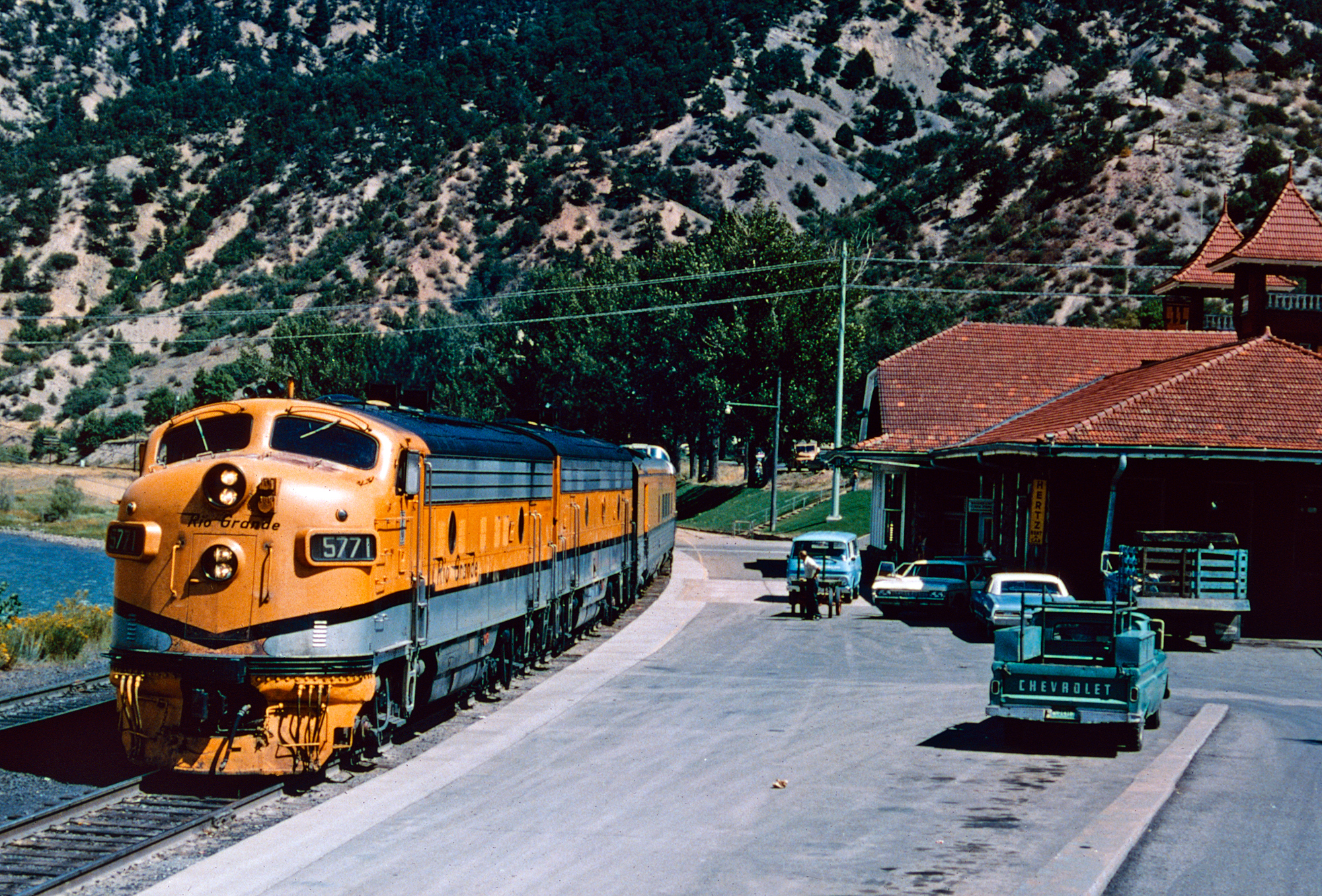 Rio Grande F9A #5771 has arrived at Glenwood Springs, Colorado with the westbound "Rio Grande Zephyr" on September 2, 1972. The Colorado River is visible at left. Ed Fulcomer photo. American-Rails.com collection.
For the Canadian lines only the two large carries, Canadian National and Canadian Pacific purchased the F9, in this case F9Bs (38 for CN and 8 for CP). For U.S. lines, Northern Pacific acquired the most, purchasing 70 A and B units (38 "As" and 32 "Bs").
Interestingly, private industry Erie Mining Company became famous in the railfan community for its roster of five F9As and six F9Bs, which handled taconite for decades.
In 1989, LTV Steel acquired Erie Mining and continued utilizing the locomotive fleet until 2002, when the operation was again sold to Cleveland Cliffs. The railroad was subsequently renamed as Cliffs Erie Railroad and continued to run cleanup trains until 2008.
Sources
- Foster, Gerald. A Field Guide To Trains. New York: Houghton Mifflin, 1996.
- Hayden, Bob. Diesel Locomotives: Cyclopedia, Volume 2 (Model Railroader). Milwaukee: Kalmbach Publishing Company, 1980.
- Marre, Louis A. Diesel Locomotives: The First 50 Years, A Guide To Diesels Built Before 1972. Milwaukee: Kalmbach Publishing Company, 1995.
- Pinkepank, Jerry A. Diesel Spotter's Guide. Milwaukee: Kalmbach Publishing Company, 1967.
- Solomon, Brian. EMD Locomotives. Minneapolis: MBI Publishing Company, 2006.
- Solomon, Brian. Electro-Motive E-Units and F-Units: The Illustrated History of North America's Favorite Locomotives. Minneapolis: Voyageur Press, 2011.