
EMD "SDP40F" Locomotives: Specs, Roster, Derailment Issue
Last revised: February 26, 2025
By: Adam Burns
The SDP40F was Amtrak's first new road power, acquired by the carrier between the summers of 1973 and '74. Outwardly, it rode on the stretched frame of the earlier FP45 but internally was essentially an SD40-2 wrapped in a semi-streamlined, "cowl" carbody.
When Amtrak launched on May 1, 1971 it had no new equipment of its own, relying solely on mostly worn out, rundown equipment it had received from joining railroads.
From an operational standpoint the SDP40F was a reliable, rugged, and efficient locomotive, inherent of EMD's designs from that era. However, it nevertheless suffered from a mysterious derailment issue soon after entering service.
While the exact cause was eventually determined, and EMD devised a solution, Amtrak had lost confidence in the model. After only a few years of service, the carrier began trading in part of the fleet on new F40PHs in 1977.
During the mid-1980s, Santa Fe acquired 18 units that had not been traded in and converted them into freight locomotives, redesignated as SDF40-2s. Today, just one is preserved, former Amtrak #644 located in Boulder City, Nevada at the Nevada Southern Railroad Museum.
This SDF40-2 carries a Burlington Northern Santa Fe number (6976) and wears the remains of a "Maersk Sealand" light blue livery from its time pulling freight nearly two decades ago. It is currently operational
Photos
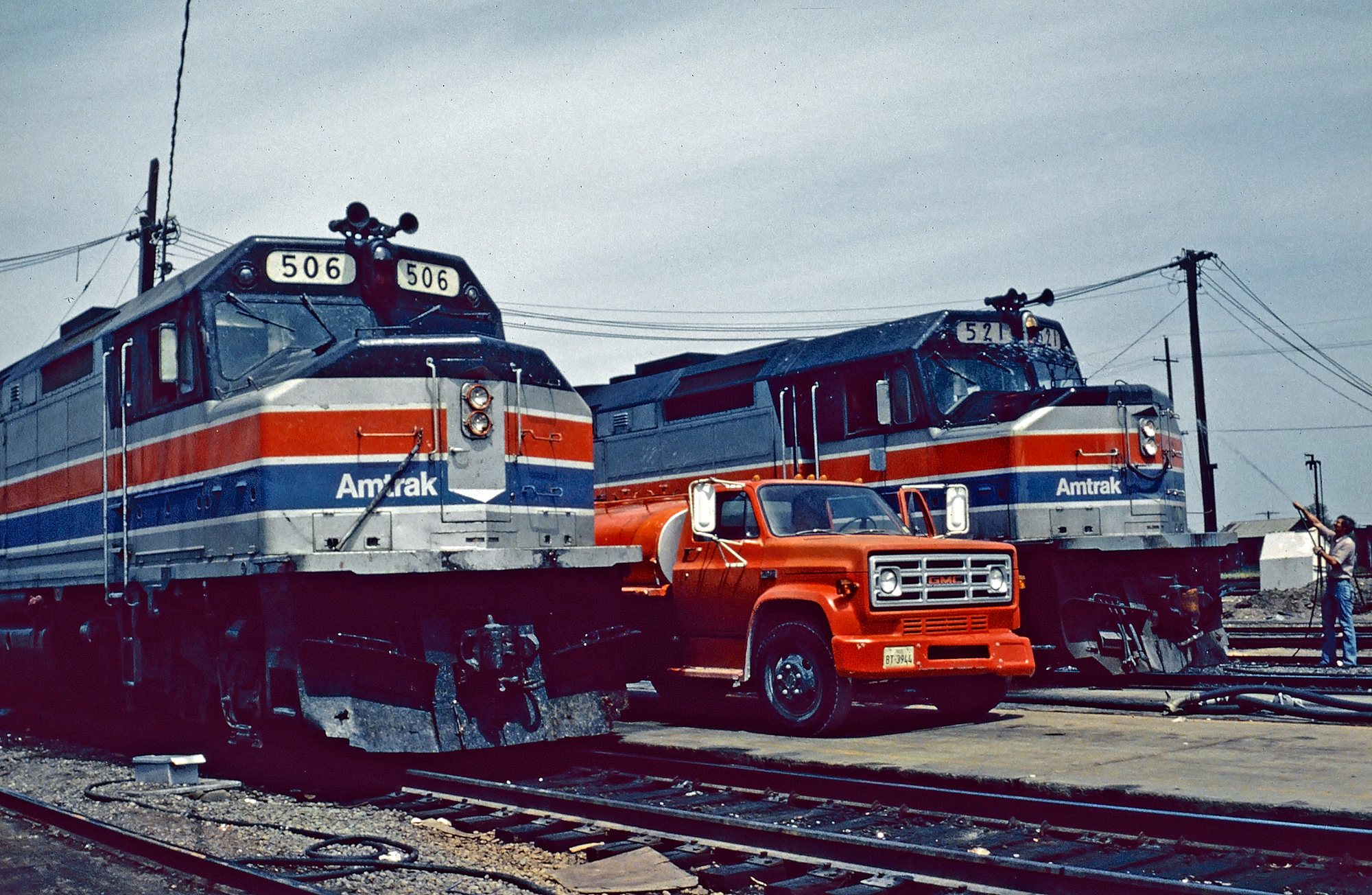 Amtrak SDP40Fs #506 and #521 layover at Fort Worth, Texas, circa 1979; it appears #521 is receiving a quick bath. Mike Bledsoe photo. American-Rails.com collection.
Overview
Amtrak had high hopes for the SDP40F; the carrier desperately needed new power to replace aging E8s, E9s, FP7s and other F units, which the joining railroads were happy to dispose of. These classic workhorses had racked up millions of miles in service; most either needed significant overhauls or simply parked and retired.
As Greg McDonnell notes in his book, "Locomotives: The Modern Diesel & Electric Reference (2nd Edition)," internally, the model was equipped with all of the components and electronics of a standard SD40-2.
However, outwardly it resembled EMD's earlier FP45 of 1967/1968. In his book, "The Contemporary Diesel Spotters Guide," author Louis Marre notes this model was the first to feature the "Cowl" carbody. This new configuration utilized a standard road-switcher frame, which supported a cowl.
This design reduced air resistance and allowed for troubleshooting and minor maintenance while the locomotive was in operation. The classic Es and Fs had been engineered much differently as the carbody was essentially part of the entire structural frame.
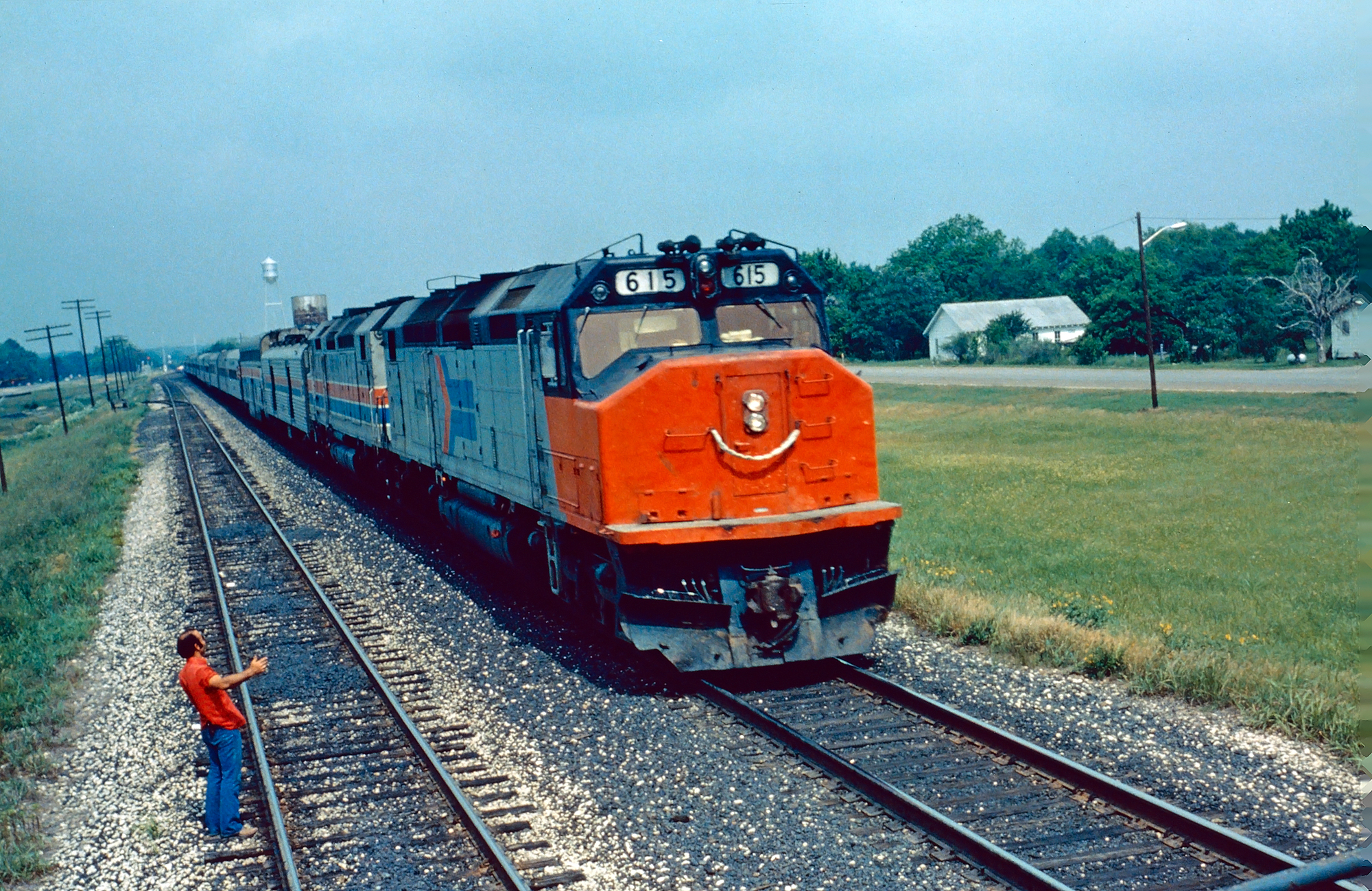 A pair of Amtrak SDP40F's, led by #615, have train #2, the eastbound "Sunset Limited," at Waelder, Texas in the summer of 1979. Mike Bledsoe photo. American-Rails.com collection.
Design
While employing simpler construction methods and greater operational efficiency, the cowl was a far less elegant styling. It featured a tapered, rectangular nose, hard lines, notched windshields, and overall boxy appearance in place of smooth curves, a rounded nose, and curved windshields found on the Es and Fs.
The SDP40F's stretched frame was four feet longer than a traditional SD40-2 (72' 4") to house the steam generator and necessary water supply for passenger service. It utilized EMD's latest prime mover, the 16-cylinder, model 645E3, that could produce 3,000 horsepower.
Amtrak placed a very large order for the new locomotives, which totaled 150 units; the fleet was delivered in three separate batches between June, 1973 and August, 1974 numbered 500-649.
Almost immediately the SDP40Fs began experiencing derailments, and had eventually been involved in more than a dozen by 1977.
The first occurred along the Burlington Northern on December 16, 1976 at Ralston, Nebraska. The BN subsequently banned the SDP40F on its network, although the locomotives later returned following Federal Railroad Administration (FRA) speed restrictions of 40 mph (later lifted on Class 5 track).
Thirty days after the Ralston incident a similar accident occurred on the Louisville & Nashville at Newcastle, Alabama.
The FRA, Amtrak, Association of American Railroads (AAR), and Electro-Motive discovered most derailments had occurred when a train entered a curve of around 2 degrees at 40 to 60 mph.
Significant testing at the time could never determine the cause although some type of harmonic motion involving either the hollow-bolster HT-C trucks or yawing action of the locomotive and/or accompanying baggage car was suspected.
It was finally determined the sloshing of water in the on-board water supply created just enough lateral motion to cause the locomotives to derail.
EMD found a solution to the issue but Amtrak had lost trust in the model and elected to move on. In 1977, at barely three years of age, the carrier traded in 40 to EMD on new F40PHs. To reduce costs these locomotives utilized engines, alternators, traction motors, and some other components from the traded in SDP40Fs.
By 1979 more than half of the fleet had been traded in and by 1988 only eighteen remained. In addition, EMD had retained four trade-ins for test bed units. In September, 1984 Amtrak had traded eighteen others to the Santa Fe for twenty five of the AT&SF's CF7 locomotives, as well as 18 other SSB1200s.
Data Sheet and Specifications
| Entered Production | 6/1973 (Amtrak #500) |
| Years Produced | 6/1973 - 8/1974 |
| Engine | 645E3 |
| Engine Builder | GM |
| Horsepower | 3000 |
| RPM | 800 |
| Cylinders | 16 |
| Length | 72' 4" |
| Height (Top Of Rail To Top Of Cab) | 15' 7 ½" |
| Width | 10' 4" |
| Weight | 396,000 - 400,000 Lbs |
| Fuel Capacity | 3,200 Gallons |
| Air Compressor | Gardner-Denver |
| Air Compressor Model | WBO |
| Air Brake Manufacturer | Westinghouse |
| Air Brake Schedule | 26L |
| Trucks | C-C |
| Truck Type | HT-C Hollow Bolster |
| Truck Wheelbase | 13' 7" |
| Wheel Size | 40" |
| Traction Motors | D77/D78 (6), GM |
| Primary Generator | AR10, GM |
| Auxiliary Generator | GM |
| Alternator | GMD14 |
| Steam Generator (Optional) | AR4125 (Vapor-Clarkson) |
| MU (Multiple-Unit) | Yes |
| Dynamic Brakes | Yes |
| Gear Ratio | 59:15 |
| Tractive Effort (Starting) | 65,000 Lbs at 25% |
| Tractive Effort (Continuous) | 38,240 Lbs at 16.1 mph |
| Top Speed | 95 mph |
Production Roster
Total Built = 150
| Owner | Road Numbers | Serial Numbers | Date Built |
|---|---|---|---|
| Amtrak | 500-539 | 72694-1 thru 72694-40 | 6/1973-7/1973 |
| Amtrak | 540-579 | 73683-1 thru 73683-40 | 3/1974-5/1974 |
| Amtrak | 580-649 | 74611-1 thru 74611-70 | 5/1974-8/1974 |
SDF40-2 (ATSF)
| BNSF Number | ATSF Number | Amtrak Number | EMD Serial Number | Completion Date | Rebuild Date (SDF40-2) | Retirement | Disposition |
|---|---|---|---|---|---|---|---|
| 6960 | 5250 | 643 | 74611-64 | 11/1974 | 1/1985 | 5/2002 | Scrapped |
| 6961 | 5251 | 511 | 72694-12 | 3/1973 | 4/1985 | 5/2002 | Scrapped |
| 6962 | 5252 | 615 | 74611-36 | 1/1974 | 2/1985 | 5/2002 | Scrapped |
| 6963 | 5253 | 630 | 74611-51 | 6/1974 | 2/1985 | 5/2002 | Scrapped |
| 6964 | 5254 | 635 | 74611-56 | 7/1974 | 3/1985 | 5/2002 | Scrapped |
| 6965 | 5255 | 526 | 74694-27 | 6/1973 | 2/1985 | 5/2002 | Scrapped |
| 6966 | 5256 | 640 | 74611-61 | 6/1974 | 3/1985 | 5/2002 | Scrapped |
| 6967 | 5257 | 622 | 74611-43 | 1/1974 | 3/1985 | 5/2002 | Scrapped |
| 6968 | 5258 | 628 | 74611-49 | 3/1974 | 3/1985 | 5/2002 | Scrapped |
| 6969 | 5259 | 633 | 74611-54 | 7/1974 | 3/1985 | 5/2002 | |
| 6970 | 5260 | 638 | 74611-59 | 6/1974 | 3/1985 | 5/2002 | Scrapped |
| 6971 | 5261 | 634 | 74611-55 | 4/1974 | 4/1985 | 5/2002 | Scrapped |
| 6972 | 5262 | 629 | 74611-50 | 3/1974 | 4/1985 | 5/2002 | Scrapped |
| 6973 | 5263 | 639 | 74611-60 | 5/1974 | 4/1985 | 4/1999 | Wrecked at Barstow, California on 11/13/1998; scrapped. |
| 6974 | 5264 | 632 | 74611-53 | 4/1974 | 4/1985 | 5/2002 | Scrapped |
| 6975 | 5265 | 649 | 74611-70 | 9/1974 | 4/1985 | 5/2002 | Scrapped |
| 6976 | 5266 | 644 | 74611-65 | 8/1974 | 5/1985 | 5/2002 | Acquired by the Northwest Railway Museum (Portland, Oregon) for preservation in 11/2003. Later acquired by Dynamic Rail Preservation, Inc. Relocated to Ogden, Utah, then Boulder City, Nevada at the Nevada Southern Railroad Museum. |
| 6977 | 5267 | 645 | 74611-66 | 8/1974 | 5/1985 | 5/2002 | Scrapped |
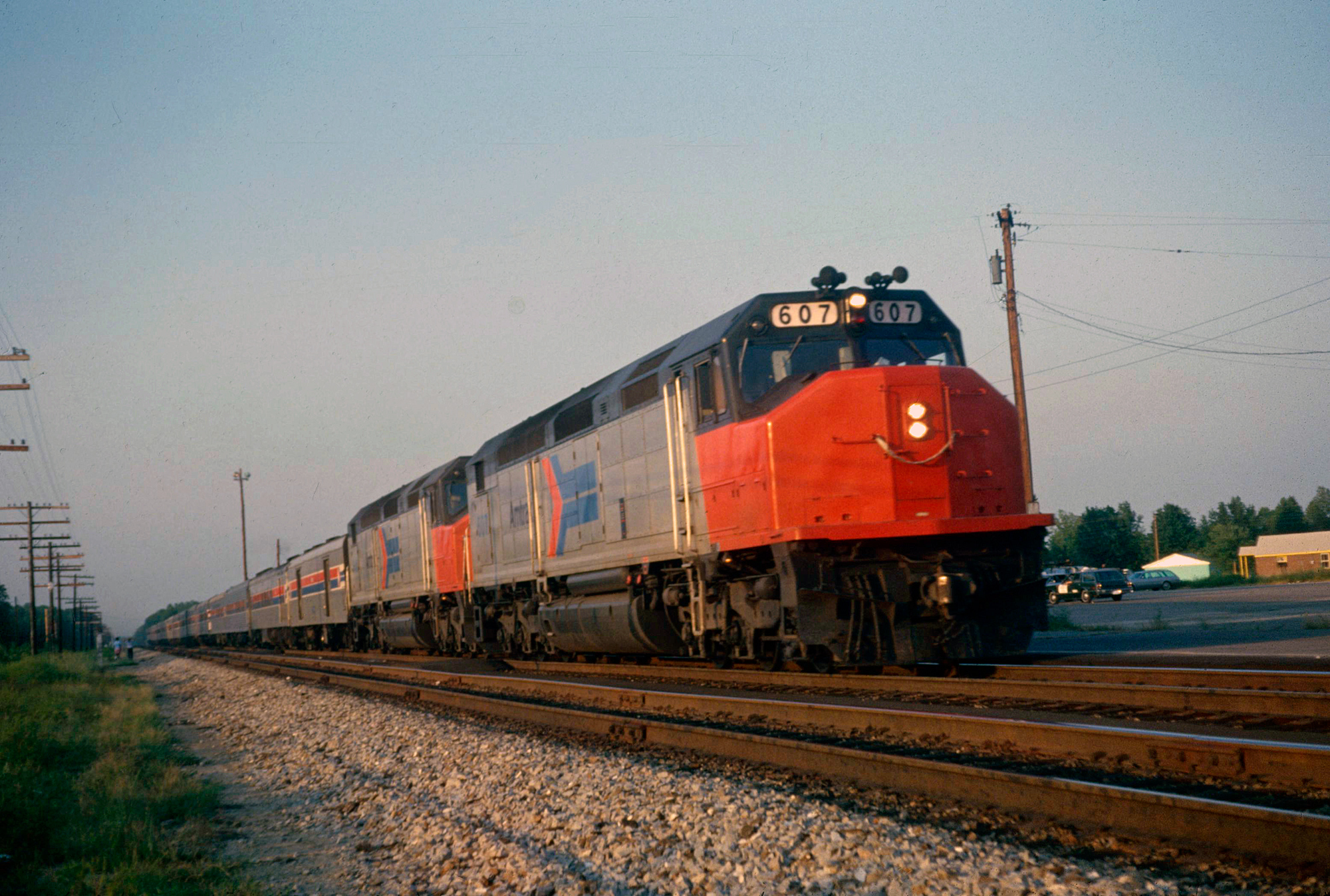 A pair of Amtrak SDP40F's are stopped at Petersburg, Virginia with the southbound "Silver Star" on a September evening in 1977. Author's collection.
The Santa Fe had theirs stripped of steam generators, and the accompanying water tanks, installed front steps and platforms, and redesignated the units as SDF40-2s for freight service. Interestingly, the railroad never experience any problems with these locomotives.
In his book, "A Field Guide To Trains," author Gerald Foster notes that during their second trip to the shops the units also had their noses notched for easier boarding.
The following F40PH model, a variant of EMD's successful GP40-2, became the face of Amtrak for more than 20 years. Interestingly, they were originally intended for commuter and short haul service. However, the SDP40F's failure as a long haul road locomotive, resulted in EMD modifying the smaller F40PH for such assignments.
Sources
- Foster, Gerald. A Field Guide To Trains. New York: Houghton Mifflin, 1996.
- Marre, Louis A. and Pinkepank, Jerry A. Contemporary Diesel Spotter's Guide, The: A Comprehensive Reference Manual To Locomotives Since 1972. Milwaukee: Kalmbach Publishing Company, 1989.
- Marre, Louis A. Contemporary Diesel Spotter's Guide, The: A Comprehensive Reference Manual To Locomotives Since 1972, Including Rebuilding, Upgrading, And Leasing Programs (2nd Edition). Milwaukee: Kalmbach Publishing Company, 1995.
- McDonnell, Greg. Locomotives: The Modern Diesel & Electric Reference, 2nd Edition. Buffalo: Boston Mills Press/Firefly Books, 2015.
- Solomon, Brian. Amtrak. St. Paul: MBI Publishing Company, 2004.
- Solomon, Brian. EMD Locomotives. Minneapolis: MBI Publishing Company, 2006.
- Tyre, Peg (Editorial Director). Amtrak: An American Story. Washington: National Railroad Passenger Corporation, 2011.
Recent Articles


-
New York Murder Mystery Dinner Train Rided On The A&A!
Dec 03, 25 09:52 AM
 While its regular excursions are popular with families, railfans, and casual travelers alike, the railroad’s themed experiences—especially its Murder Mystery Dinner Train—have made it a standout desti…
 -
Pennsylvania Murder Mystery Dinner Train Rides On The M&H
Dec 03, 25 09:40 AM
 Among their special events, the railroad’s murder mystery dinner train experiences are perennial crowd-pleasers—part theater, part culinary outing, and entirely memorable.
 -
New Mexico Christmas Train Rides In Santa Fe!
Dec 03, 25 09:26 AM
Among the Sky Railway's most popular offerings is a family-friendly Christmas outing, Pablo’s Holiday Express, which turns the historic Lamy Depot into a winter wonderland each holiday season.


