GE "C39-8" Locomotives

Last revised: February 14, 2024
By: Adam Burns
The C39-8 began as a testbed unit in 1984 and was part of General Electric's new "Dash 8" line. This series included a total of four prototype models manufactured in a variety of horsepower ratings and axle settings.
Norfolk Southern was selected to receive the C39-8 and operated #8550-8551 that year. The railroad was so pleased with the locomotive it not only acquired the two prototypes but also a large fleet consisting of more than 100 units.
The C39-8 was actually a spinoff of GE's very first six-motored "Dash 8" design, C36-8 #607 completed in March, 1983. This initial unit could produce 3,600 horsepower while its successor was uprated to 3,900 horsepower.
GE would go on to offer a 4,000 horsepower variant, the C40-8 series, that sold thousands from the late 1980s through the early 1990s.
These six-motored road-switchers would not only propel General Electric into first place but also keep the company ahead of Electro-Motive permanently. In addition, future models like the C40-9W, C44-9W, and AC4400CW also saw thousands roll out of Erie.
The C39-8 spent more than 20 years operating on Norfolk Southern before the Class I retired its fleet in 2008. Today, you can still find the locomotive in service on smaller roads although most of the original fleet is now operating in South America.
Photos
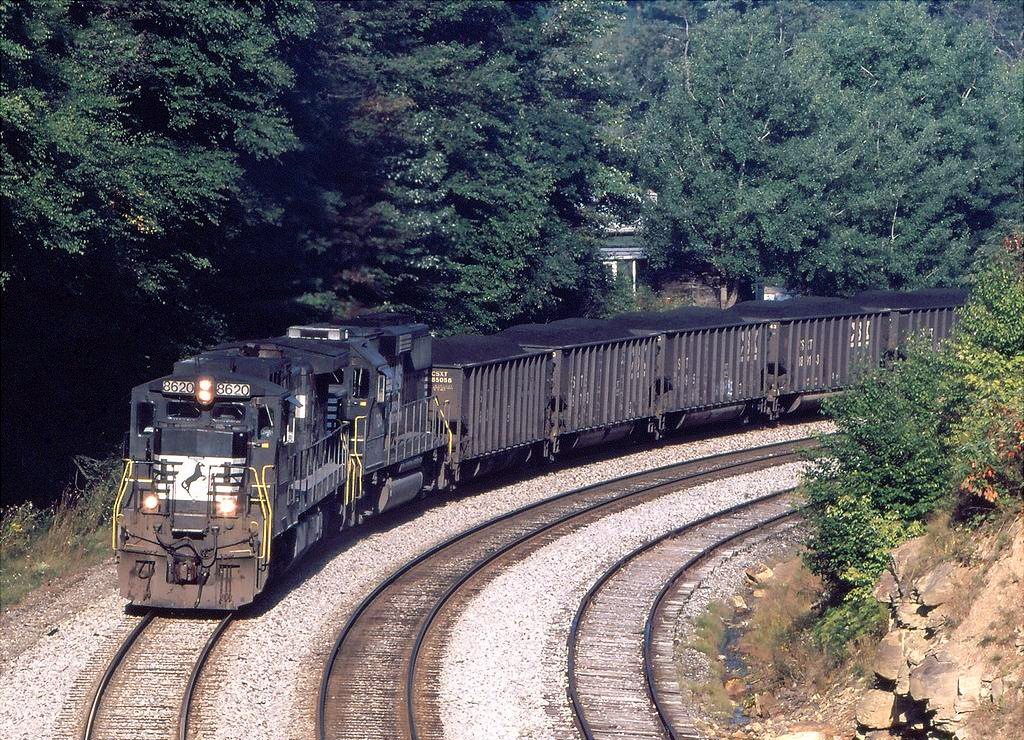 Norfolk Southern C39-8 #8620 and an EMD unit grind upgrade with a CSX coal train near Altamont, Maryland on September 1, 2004. Wade Massie photo.
Overview
The C39-8 was the six-motored equivalent to the four-axle, B39-8. The latter was another testbed prototype that saw three units operate on the Santa Fe, #7400-7402.
Eventually, GE offered a cataloged version of this locomotive that saw 40 examples sold to Southern Pacific (#8000-8039) and another 102 completed for General Electric Leasing known as the B39-8E.
Norfolk Southern had been purchasing GE products since its inception and both predecessors, Norfolk & Western and Southern Railway, had also experimented with the builder's earlier models.
Since testing the C39-8, NS became a loyal GE customer and this loyalty continues today under GE-successor Wabtec Freight.
Norfolk Southern not only acquired more than 100 examples of the C39-8 but in the following years also purchased thousands of Dash 8s, Dash 9s, and the Evolution Series that debuted in 2005.
North American Safety Cab
Interestingly, while the "North American Safety Cab" of the late 1980s became standard on all future GE products, NS was a holdout for the Standard Cab through the early Dash 9 series.
As Brian Solomon notes in his book, "GE Locomotives," the railroad did not wish to spend the added cost of this new feature.
However, that changed in the mid-1990s when the wide cab became standard. As a result, it was then more expensive to equip locomotives with a Standard Cab.
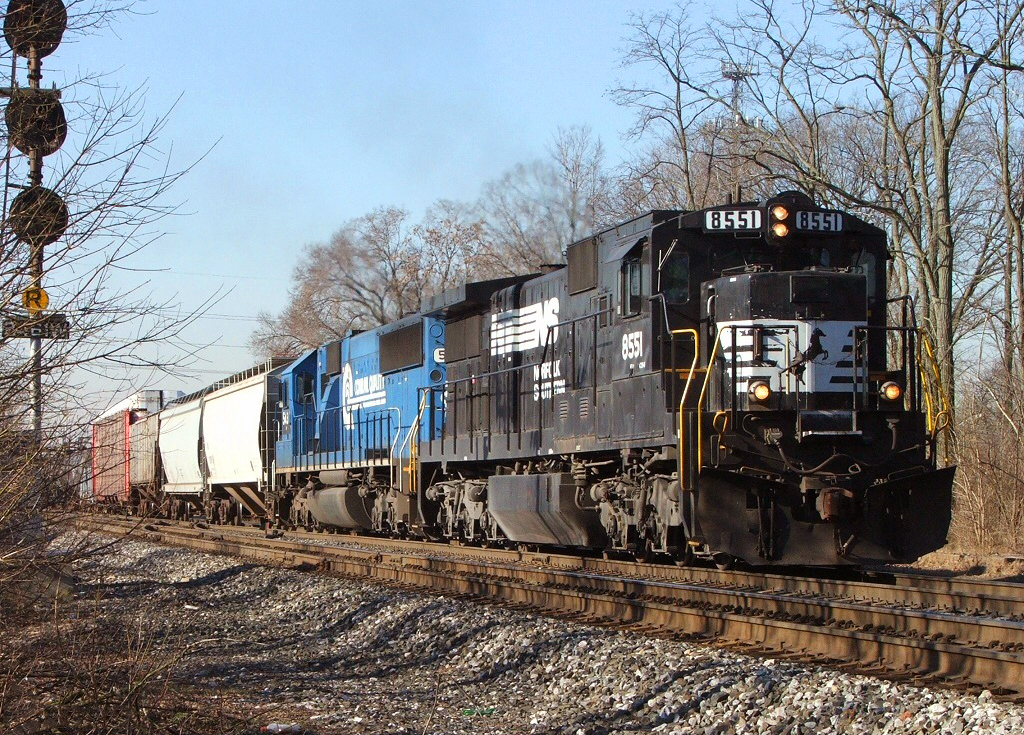 A northbound Norfolk Southern train, led by C39-8 #8551, departs Sharonville Yard in Cincinnati, Ohio on March 14, 2005. Rob Kitchen photo.
The Dash 8 series continued the model designations from the earlier Dash 7 line. In regards to the C39-8/E:
- "C" referred to a six-axle (C-C) locomotive.
- "39" designated the horsepower rating of 3,900.
- "8" indicated that the "Dash 8" line was introduced in 1982.
- "E" designated "Enhanced."
The "Enhanced" moniker was used to differentiate the pre-production Dash 8s (which it dubbed "Classics") from the cataloged variants. The latter featured both internal and external improvements following the exhaustive road tests of the prototypes.
Interestingly, many of the production C39-8s carried the appearance of their prototype counterparts, in contrast to the other Dash 8 models that already featured these improvements.
Data Sheet
| Entered Production | 1/1984 (Norfolk Southern/GE #8550-8551) |
| Years Produced | 1/1984 - 6/1987 |
| GE Class | C39-8, C39-8E |
| Engine | 7FDL16 (16 cylinder) |
| Engine Builder | General Electric |
| Horsepower | 3900 |
| RPM | 1050 |
| Length | 70' 8" |
| Height (Top Of Rail To Top Of Cab) | 15' 4 1/2" |
| Width | 8' 10" |
| Weight | 389,000 - 420,000 Lbs |
| Fuel Capacity | 4,600 Gallons |
| Air Compressor | 3CDC (Westinghouse) |
| Air Brake Schedule | 26L (Westinghouse) |
| Trucks | C-C |
| Truck Type | FB3 |
| Truck Wheelbase | 13' 7" |
| Wheel Size | 40" |
| Traction Motors | 752 (6), GE |
| Traction Alternator | GMG187, GE |
| Auxiliary Generator | GY27, GE |
| MU (Multiple-Unit) | Yes |
| Dynamic Brakes | Yes |
| Gear Ratio | 83:20 |
| Tractive Effort/Starting | 106,790 Lbs |
| Tractive Effort/Continuous | 92,750 Lbs at 10.9 mph |
| Top Speed | 70 mph |
Production Rosters
C39-8
| Owner | Road Number | Serial Number | Order Number | Completion Date | Quantity |
|---|---|---|---|---|---|
| Conrail | 6000-6021 | 45327-45348 | 1366 | 6/1986-8/1986 | 22 |
| Norfolk Southern | 8550-8551 | 43149-43150 | 1311-1312 | 1/1984 | 2 |
| Norfolk Southern | 8552-8563 | 44481-44492 | 1319 | 10/1984-11/1984 | 12 |
| Norfolk Southern | 8564-8588 | 44884-44908 | 1861 | 4/1985-8/1985 | 25 |
| Norfolk Southern | 8589-8613 | 44909-44933 | 1862 | 4/1985-8/1985 | 25 |
| Norfolk Southern | 8614-8638 | 45302-45326 | 1863 | 5/1986-6/1986 | 25 |
| Norfolk Southern | 8639-8663 | 45349-45373 | 1864 | 8/1986-10/1986 | 25 |
C39-8E
| Owner | Road Number | Serial Number | Order Number | Completion Date | Quantity |
|---|---|---|---|---|---|
| Norfolk Southern | 8664-8688 | 45384-45408 | 1870 | 3/1987-6/1987 | 25 |
Sources
- Foster, Gerald. A Field Guide To Trains. New York: Houghton Mifflin, 1996.
- Marre, Louis A. and Pinkepank, Jerry A. Contemporary Diesel Spotter's Guide, The: A Comprehensive Reference Manual To Locomotives Since 1972. Milwaukee: Kalmbach Publishing Company, 1989.
- McDonnell, Greg. Locomotives: The Modern Diesel & Electric Reference, 2nd Edition. Buffalo: Boston Mills Press/Firefly Books, 2015.
- Solomon, Brian. American Diesel Locomotive, The. Osceola: MBI Publishing, 2000.
- Solomon, Brian. GE and EMD Locomotives: The Illustrated History. Minneapolis: Voyageur Press, 2014.
- Solomon, Brian. GE Locomotives: 110 Years Of General Electric Motive Power. St. Paul: MBI Publishing, 2003.
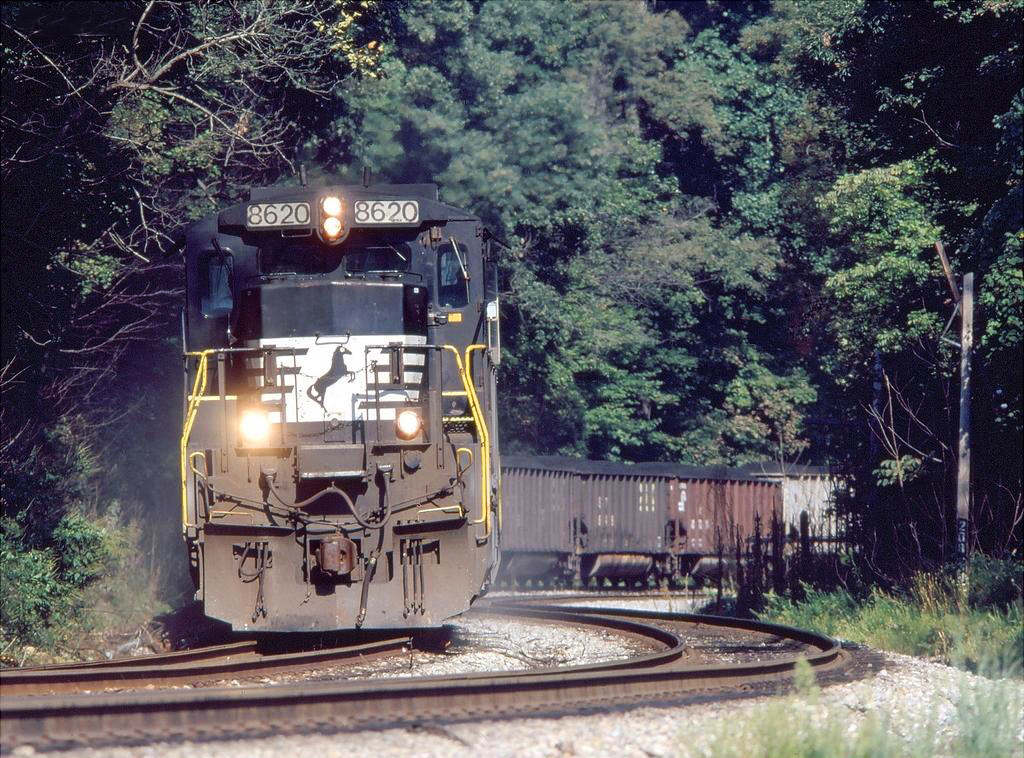 With assistance, NS C39-8 #8620 powers a CSX coal drag up the B&O's former Seventeen Mile Grade at Bloomington, Maryland on September 1, 2004. Wade Massie photo.
It was only when Norfolk Southern #8664-8688 rolled out of Erie in 1987 where the "Enhanced" features present.
The original C39-8s sported a "bulge" behind the cab (housing dynamic brakes and the equipment blower), Dash 7-style winged rear radiator with flush vents, and a rounded cab that sat slightly lower than the roofline.
Their C39-8E counterparts, however, sported a much more symmetrical appearance with pleasing lines including a cab flush with the roofline, lower nose, equipment blower and dynamic brakes that seamlessly melded into the carbody, and angled radiator vents.
In addition to NS, Conrail also acquired 22 examples of the C39-8 in the "Classic" carbody. These units, numbered 6000-6021, were completed during the summer of 1986.
SteamLocomotive.com
Wes Barris's SteamLocomotive.com is simply the best web resource on the study of steam locomotives.
It is difficult to truly articulate just how much material can be found at this website.
It is quite staggering and a must visit!