GE "C40-8" and "C40-8W" Locomotives

Last revised: January 22, 2024
By: Adam Burns
The C40-8 model and its variants (C40-8W, C40-8M, and C44-8W/C41-8W) began General Electric's dominance in locomotive manufacturing. This reign lasted from the 1990s until GE sold its transportation division to Wabtec Freight in February, 2019.
The C40-8 series was the pinnacle of the "Dash 8" line that had been launched in 1984 when a group of prototypes began testing on four different railroads.
These early locomotives were offered in a variety of horsepower ratings and axle settings, largely ranging from 3,200 to 3,900 horsepower.
With the C40-8 series, GE uprated all of its road-switchers to an even 4,000 horsepower. As the company continued pushing the envelope on its 7FDL prime mover, late era C40-8's were uprated to over 4,100 horsepower, and finally 4,400 horsepower.
The latter became a highly popular rating that witnessed more than 2,300 examples sold in the C44-9W model, a locomotive that remained in GE's catalog from 1993 through 2005.
The success of the C40-8 series, which itself saw some 1,677 examples produced between 1989-1994, was a forebearer of GE's massive success during the 1990s.
Today, you can still find examples operating on CSX Transportation, Canadian National, and Union Pacific. However, now at 30+ years of age their numbers are dwindling quickly.
Photos
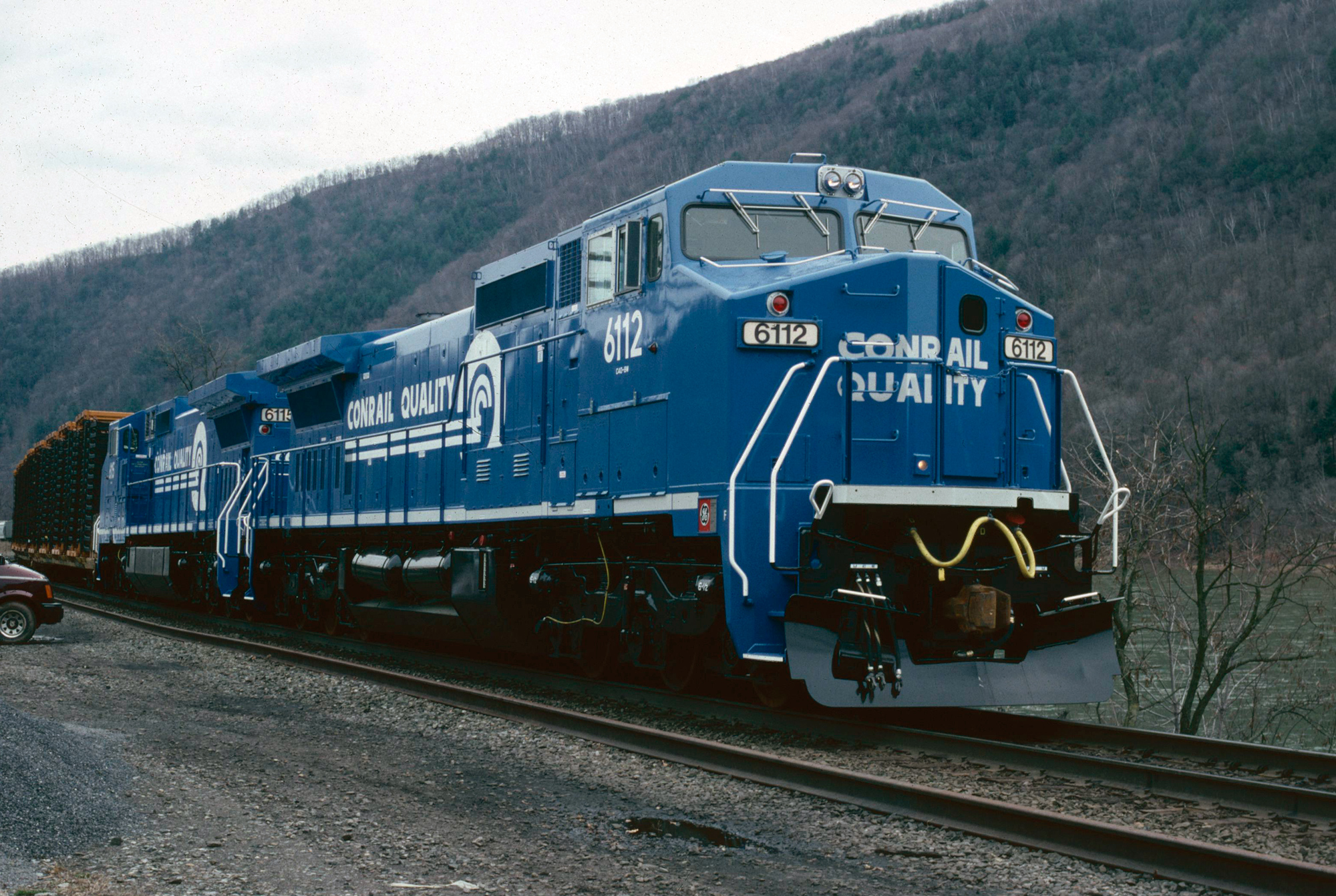 A pair of sharp new Conrail C40-8W's, #6112 and #6115, have a westbound/northbound freight at Renovo, Pennsylvania on March 29, 1991. Photographer unknown. American-Rails.com collection.
Overview
The C40-8 began production in December, 1987 as an uprated version of the earlier C39-8. The original variant sported GE's classic Standard Cab. However, that would change with the North American Safety Cab.
This wide cab had first appeared in December, 1989 when a group of 50 units built for Union Pacific (#9356-9405) rolled out of Erie. The new design changed the model's rating to C40-8W with "W" simply referring to "Wide."
As Greg McDonnell notes in his book, "Locomotives, The Modern Diesel & Electric Reference: 2nd Edition," the model featured the latest in software upgrades and carbody improvements (redesigns to the cooling system, dynamic brakes, and radiators for a more streamlined appearance), a process that began with late C39-8 variants.
Orders for the C40-8 took off quickly in late 1987 with five Class Is ordering the Standard Cab design including:
- Chicago & North Western (77)
- Union Pacific (256)
- CSX Transportation (147)
- Conrail (25)
- Norfolk Southern (50)
Additionally, Estrada de Ferro Carajás of Brazil acquired three units. Interestingly, as Brian Solomon notes in his book, "GE Locomotives," Norfolk Southern did not wish to spend the additional cost of the new wide cab design.
As a result, the company not only purchased 50 examples of the C40-8 but also another 125 examples of the later C40-9, receiving its final Standard Cab units in 1995. Through September, 1991, when the last C&NW units were delivered, GE had sold some 585 examples of the C40-8.
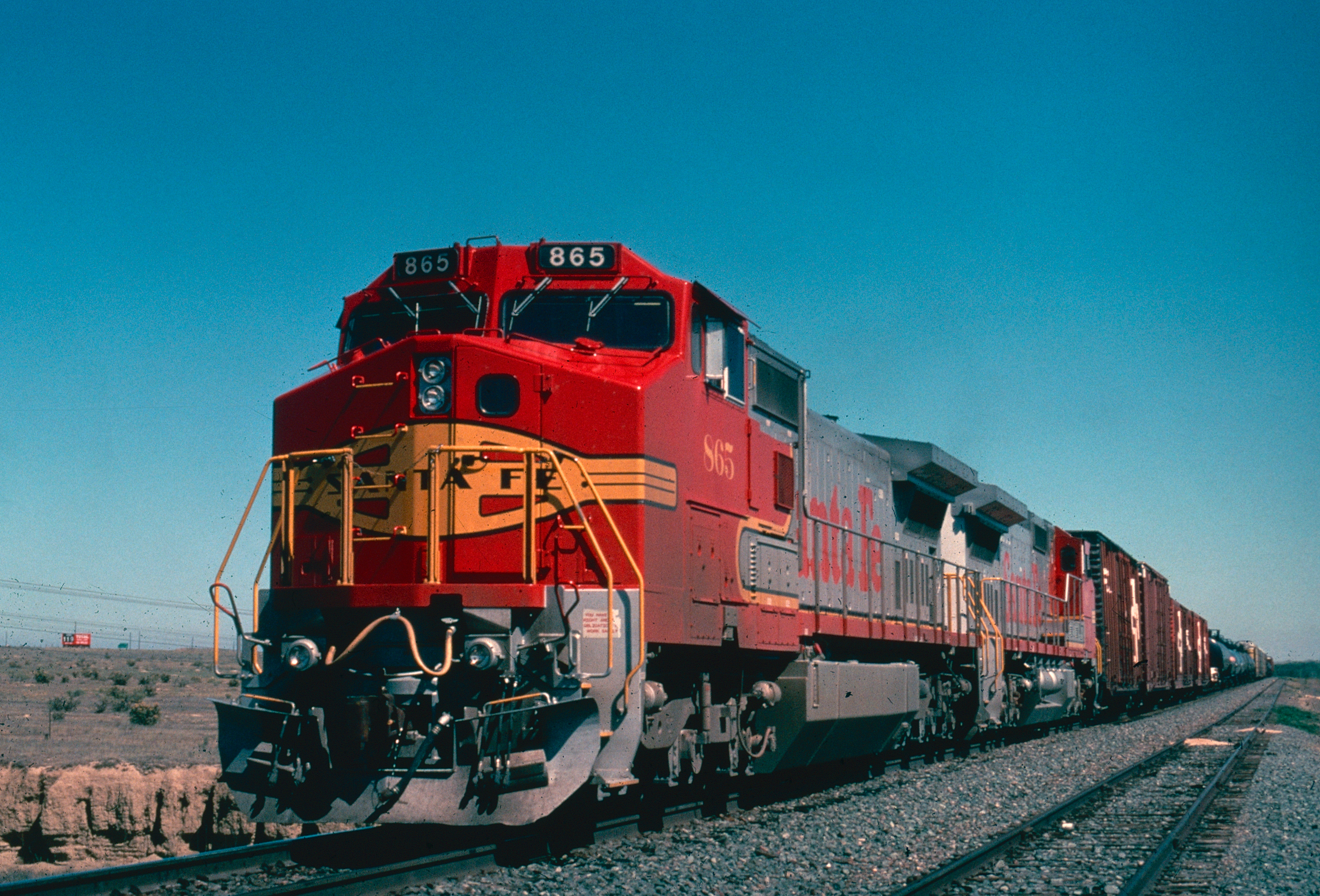 A pair of Santa Fe C40-8W's, about a year old, have a long freight south of Bragdon, Colorado on September 14, 1993. American-Rails.com collection.
The wide cab, at least from an outward appearance, has changed little on new GE products since the C40-8W. It features a sloped and beveled front nose, thin rectangular windshields, and a front access door leading to the pilot and front steps.
When production had ended in November, 1994 the C40-8W had sold nearly twice as many examples as its predecessor (847).
In addition to the original variants, GE built three others:
- C40-8M (Identical to the original save for its full width cowl cab and carbody. It was purchased only in Canada by British Columbia Railway, Canadian National, and Quebec North Shore & Labrador.)
- C41-8W (Equipped with an additional 100 horsepower; acquired by Santa Fe and Union Pacific.)
- C44-8W (Boasting with an additional 400 horsepower, CSX purchased 53 examples.)
Data Sheets
C40-8, C40-8W, C40-8M, C44-8W
| Entered Production | 12/1987 (Union Pacific #9100) |
| Years Produced | 12/1987 - 3/1994 |
| GE Class | C40-8, C40-8W, C40-8M, C44-8W |
| Engine | 7FDL16 (16 cylinder) |
| Engine Builder | General Electric |
| Horsepower | 4000-4400 |
| RPM | 1050 |
| Length (C40-8, C40-8W, C44-8W) | 70' 8" |
| Length (C40-8M) | 71' 8" |
| Height (Top Of Rail To Top Of Cab) | 15' 4 1/2" |
| Width | 8' 10" |
| Weight (C40-8) | 391,000-420,000 Lbs |
| Weight (C40-8M) | 388,000-395,000 Lbs |
| Weight (C40-8W) | 394,000-400,000 Lbs |
| Weight (C44-8W) | 412,000 Lbs |
| Fuel Capacity | 4,600 Gallons |
| Air Compressor | 3CDC (Westinghouse) |
| Air Brake Schedule | 26L (Westinghouse) |
| Trucks | C-C |
| Truck Type | FB3 |
| Truck Wheelbase | 13' 7" |
| Wheel Size | 40" |
| Traction Motors (C40-8) | 752AG (6) or 752AH (6), GE |
| Traction Motors (C40-8W, C40-8M, C44-8W) | 752AH (6), GE |
| Traction Alternator (C40-8, C40-8W, C40-8M) | GMG194, GE |
| Traction Alternator (C44-8W) | GMG197, GE |
| Auxiliary Generator | GY27, GE |
| MU (Multiple-Unit) | Yes |
| Dynamic Brakes | Yes |
| Gear Ratio | 83:20 |
| Tractive Effort/Starting | 106,790 Lbs |
| Tractive Effort/Continuous | 92,750 Lbs at 10.9 mph |
| Top Speed | 70 mph |
Production Rosters
C40-8
(Total Built = 584)
| Owner | Road Number | Serial Number | Order Number | Completion Date | Quantity |
|---|---|---|---|---|---|
| Union Pacific | 9100-9174 | 45549-45623 | 1872 | 11/1987-2/1988 | 75 |
| Union Pacific | 9175-9184 | 45724-45733 | 1874 | 7/1988-12/1988 | 10 |
| Union Pacific | 9186-9284 | 45735-45833 | 1874 | 7/1988-12/1989 | 99 |
| Union Pacific | 9350-9355 | 45834-45839 | 1875 | 12/1988 | 6 |
| Union Pacific | 9285-9349 | 45840-45904 | 1875 | 12/1988-2/1989 | 65 |
| Union Pacific | 9185 (2nd) | 45905 | 1875 | 11/1988 | 1 |
| Conrail | 6025-6049 | 45906-45930 | 1877 | 3/1989 | 25 |
| CSX Transportation | 7500-7539 | 45991-46030 | 1878 | 5/1989-6/1989 | 40 |
| CSX Transportation | 7540-7589 | 46031-46080 | 1878 | 8/1989-9/1989 | 50 |
| CSX Transportation | 7590-7593 | 46081-46084 | 1878 | 12/1989 | 4 |
| Chicago & North Western | 8501-8530 | 46085-46114 | 1880 | 6/1989-8/1989 | 30 |
| CSX Transportation | 7594-7646 | 46318-46370 | 1892 | 6/1990-8/1990 | 53 |
| Estrada de Ferro Carajás (Brazil) | 501-504* | 46242-46245 | 1886 | 9/1989 | 4 |
| Norfolk Southern | 8710-8713 | 46631-46634 | 1897 | 3/1991 | 4 |
| Chicago & North Western | 8531-8542 | 46371-46382 | 1887 | 8/1990 | 12 |
| Norfolk Southern | 8689-8709 | 46383-46403 | 1897 | 12/1990 | 21 |
| Chicago & North Western | 8543-8574** | 46771-46802 | 1898 | 7/1991-9/1991 | 32 |
| Chicago & North Western | 8575-8577*** | 46803-46805 | 1898 | 9/1991 | 3 |
| Norfolk Southern | 8714-8763 | 47076-47125 | 1805 | 12/1990 | 50 |
* Built to 5'-3" broad gauge.
** Uprated to 4,150 horsepower in the spring of 1992.
*** Out-shopped from Erie with 4,135 horsepower.
C40-8W
(Total Built = 796)
| Owner | Road Number | Serial Number | Order Number | Completion Date | Quantity |
|---|---|---|---|---|---|
| Union Pacific | 9356-9405 | 46192-46241 | 1881 | 12/1989-3/1990 | 50 |
| Conrail | 6050-6099 | 46246-46295 | 1882 | 5/1990-6/1990 | 50 |
| Union Pacific | 9406-9455 | 46531-46580 | 1895 | 11/1990-1/1991 | 50 |
| Conrail | 6100-6149 | 46635-46684 | 1896 | 3/1991-4/1991 | 50 |
| CSX Transportation | 7650-7735 | 46685-46770 | 1899 | 4/1991-8/1991 | 86 |
| Union Pacific | 9456-9480 | 46811-46835 | 1802 | 10/1991 | 25 |
| CSX Transportation | 7736-7758 | 46856-46878 | 1899 | 11/1991 | 23 |
| Santa Fe | 800-866 | 46929-46995 | 1803 | 4/1992-5/1992 | 67 |
| CSX Transportation | 7759-7817 | 46996-47054 | 1804 | 6/1992-8/1992 | 59 |
| CSX Transportation | 7818-7845 | 47152-47179 | 1804 | 11/1992-12/1992 | 28 |
| Conrail | 6150-6179 | 47184-47213 | 1808 | 2/1993 | 30 |
| CSX Transportation | 7846-7876 | 47214-47244 | 1809 | 1/1993-2/1993 | 31 |
| CSX Transportation | 7877-7899 | 47245-47267 | 1809 | 4/1993 | 23 |
| CSX Transportation | 7900-7917 | 47314-47331 | 1809 | 4/1993-5/1993 | 18 |
| Santa Fe | 867-926 | 47335-47394 | 1811 | 3/1993-7/1993 | 60 |
| Conrail | 6180-6229 | 47395-47444 | 1813 | 6/1993 | 50 |
| Conrail | 6230-6265 | 47810-47845 | 1822 | 6/1994 | 36 |
| LMS (Conrail) | 700-739 | 48104-48143 | 1828 | 8/1994-10/1994 | 40 |
| LMS (Conrail) | 740-759 | 48204-48223 | 1831 | 10/1994-11/1994 | 20 |
C41-8W
(Total Built = 108)
| Owner | Road Number | Serial Number | Order Number | Completion Date | Quantity |
|---|---|---|---|---|---|
| Union Pacific | 9481-9530 | 47445-47494 | 1814 | 8/1993-10/1993 | 50 |
| Santa Fe | 927-951 | 47531-47555 | 1811 | 9/1993-10/1993 | 25 |
| Union Pacific | 9531-9555 | 47556-47580 | 1802 | 10/1993 | 29 |
| Union Pacific | 9556-9559 | 47640-47643 | 1814 | 12/1993 | 4 |
C40-8M
(Total Built = 84)
| Owner | Road Number | Serial Number | Order Number | Completion Date | Quantity |
|---|---|---|---|---|---|
| Canadian National Railway | 2400-2429 | 46162-46191 | 1878 | 3/1990 | 30 |
| British Columbia Railway | 4601-4622 | 46296-46317 | 1883 | 4/1990 | 22 |
| Canadian National Railway | 2430-2454 | 47127-47151 | 1806 | 11/1992-12/1992 | 25 |
| British Columbia Railway | 4623-4626 | 47180-47183 | 1807 | 2/1993 | 4 |
| Quebec North Shore & Labrador Railway | 401-403 | 47637-47639 | 1849 | 3/1994 | 3 |
C44-8W
(Total Built = 53)
| Owner | Road Number | Serial Number | Order Number | Completion Date | Quantity |
|---|---|---|---|---|---|
| CSX Transportation | 9000-9002 | 47332-47334 | 1820 | 7/1993 | 3 |
| CSX Transportation | 9003-9052 | 47584-47633 | 1817 | 2/1994-3/1994 | 50 |
Sources
- Foster, Gerald. A Field Guide To Trains. New York: Houghton Mifflin, 1996.
- Marre, Louis A. and Pinkepank, Jerry A. Contemporary Diesel Spotter's Guide, The: A Comprehensive Reference Manual To Locomotives Since 1972. Milwaukee: Kalmbach Publishing Company, 1989.
- McDonnell, Greg. Locomotives: The Modern Diesel & Electric Reference, 2nd Edition. Buffalo: Boston Mills Press/Firefly Books, 2015.
- Solomon, Brian. American Diesel Locomotive, The. Osceola: MBI Publishing, 2000.
- Solomon, Brian. GE and EMD Locomotives: The Illustrated History. Minneapolis: Voyageur Press, 2014.
- Solomon, Brian. GE Locomotives: 110 Years Of General Electric Motive Power. St. Paul: MBI Publishing, 2003.
Interestingly, the first "Dash 9s" were rolling out of Erie as GE completed the final C40-8W orders, which included the LMS lease fleet painted in Conrail colors.
It is interesting to note that while present-day General Electric locomotives are known for reliability, they have not held up as long as some Electro-Motive models.
For instance, SD40 series locomotives have been, and continue to be, extensively rebuilt by Class Is such as at Norfolk Southern. Here, examples (now more than 40 years old) remain on the active rosters having been extensively rebuilt with the latest electronics and microprocessors.
SteamLocomotive.com
Wes Barris's SteamLocomotive.com is simply the best web resource on the study of steam locomotives.
It is difficult to truly articulate just how much material can be found at this website.
It is quite staggering and a must visit!