
New York, Ontario & Western Railway: Map, Roster, History
Last revised: August 23, 2024
By: Adam Burns
The New York, Ontario and Western Railway is a sometimes
forgotten fallen flag because it exited the business even prior to the mega merger movement.
The NYO&W suffered a rather unsuccessful and sad existence throughout most of the 20th century as it attempted to stay solvent.
Because of its financial struggles the Ontario & Western was given several unflattering nicknames, such as the "Old & Weary," although it did its best to survive after its main source of traffic, anthracite coal, dried up.
The railroad was conceived just after the Civil War and eventually opened a rugged route from New York City to Lake Ontario with a principal branch to Scranton, Pennsylvania.
Following its loss of coal the company attempted to market itself as a merchandise, bridge carrier but continued to struggle in the postwar years. Alas, following two decades mired in bankruptcy, from which it never emerged, the O&W was ordered to liquidate in the late 1950s.
Photos
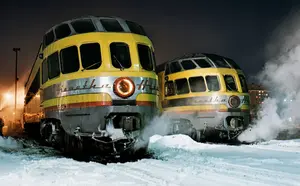
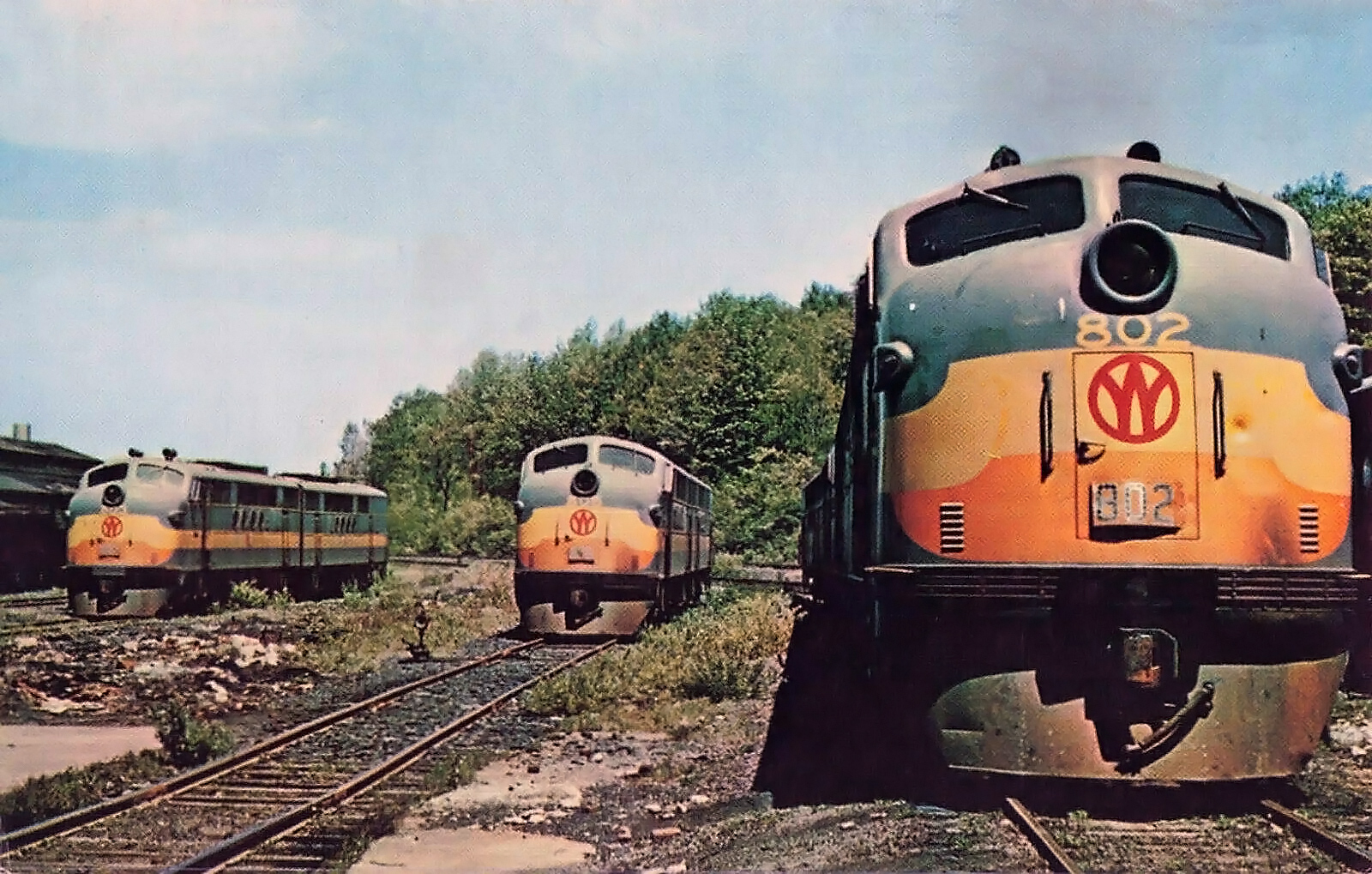 New York, Ontario & Western FT's await their fate at the yard in Middletown, New York during May, 1957. Doug Wornom photo.
History
There have been many writings over the years concerning the history of the New York, Ontario & Western and most have not been particularly flattering. Even during the company's existence it was mocked in financial circles, regarded as the "Old Woman."
It was viewed as a worn down property with an unlikely future. Perhaps a Wall Street investor stated it best in an article by A.V. Neusser and C.E. Pearce entitled, "The NYO&W," from the August 1942 issue of Trains Magazine:
"I must confess I cannot understand why some railroads were built...We will take, for example, the New York, Ontario & Western.
At A Glance
Weehawken, New Jersey - Cornwall, New York (trackage rights, West Shore Railroad) Cornwall - Campbell Hall - Oneida - Oswego, New York Summitville - Kingstown Cadosia, New York - Scranton, Pennsylvania (Scranton Division) Summitville - Port Jervis - Monticello Sidney - Edmeston, New York (New Berlin Branch) Randallsville - Utica (Utica Division) Clinton - Rome, New York | |
This road really starts nowhere, goes nowhere, avoids all large industrial centers, and ends nowhere. When its anthracite mines folded up, the earnings of the road fell off so rapidly that serious financial difficulties soon developed..."
Despite its many issues, operationally the railroad was a fascinating system serving local customers within bucolic settings that defines the industry's classic era.
The NYO&W began life as the New York & Oswego Midland Railroad, envisioned by Dewitt C. Littlejohn to open the state's northerly interior by tapping its natural and agricultural resources.
 An A-B set of New York, Ontario & Western FT's and F3's head east through Campbell Hall, New York, circa 1953. Marvin Cohen photo. American-Rails.com collection.
At the time this area offered little rail service and no carrier here provided a direct link to New York City. The NY&OM was incorporated in 1868 and began construction westward from Middletown, New York.
For whatever reason, instead of following river valleys and easier grades, Littlejohn felt his line should be constructed across a series of mountain ranges and valleys, which bisected at right angles to the direction of the railroad.
This required numerous fills, bridges, and tunnels. After the road was completed, many described it as the "Colorado Midland" of the east.
The CM, which eventually became part of the Rio Grande, was built during the 1880s and opened a rugged route across the Colorado Rockies from Colorado Springs and Leadville to Glenwood Springs and Grand Junction via Hagerman Pass.
The great expense incurred on the NY&OM's construction resulted in its bankruptcy and it was reorganized in 1880 as the New York, Ontario and Western Railway. By this time it had completed a main line from Middletown to Oswego along the banks of Lake Ontario where port services were established.
Logo
Expansion
In addition, the O&W inherited branches to Delhi, New Berlin and Ellenville, New York. Its most important segment was located east of Middletown through association with the New York, West Shore & Buffalo Railway.
The NYWS&B maintained a route between Cornwall and Weehawken, New Jersey (just north of Jersey City), extending north to Albany, then turning west all of the way to Buffalo. The project was largely spearheaded by the same folks overseeing the O&W and enabled it to reach Weehawken, via 52 miles of NYWS&B trackage rights.
The West Shore had completed a connection from its main line at Cornwall to the O&W at Middletown in 1883, permitting the latter to achieve a more direct routing to the New York City region. The New York Central & Hudson River eventually acquired control of the NYWS&B in 1885, renaming it as the West Shore Railroad.
The Central continued allowing the O&W access to Weehawken, in which it paid a fixed sum per mile. The so-called "Middletown Branch" of the former NYWS&B was sold to the O&W and in 1886 a new agreement was reached with the West Shore for trackage rights lasting 200 years.
System Map (1940)
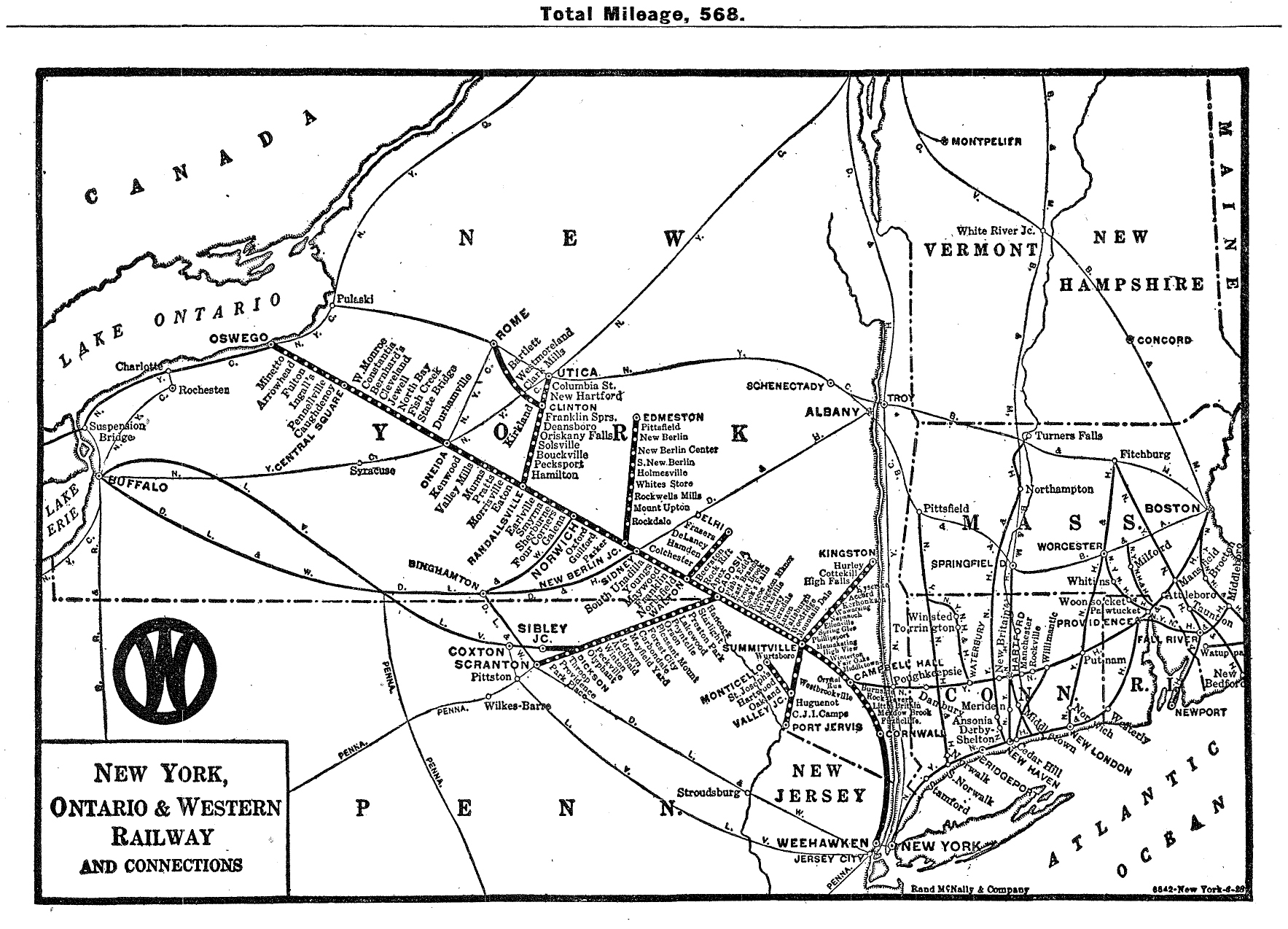
As part of this deal, the O&W was also granted use of the West Shore's terminal facilities in Weehawken. Its entire main line, including trackage rights, stretched 326 miles between New York and Oswego while the road's primary shops were situated in Middletown.
There were four divisions; the Southern Division ran from Weehawken/Cornwall to Sidney, a distance of 201 miles (Comprised within this territory is trackage of the ex-Port Jervis, Monticello & Summitville Railroad running from the main line at Summitville to Port Jervis, 22 miles, and a branch from Valley Junction to Monticello extending 16 miles.
In addition:
- A 35-branch to the north of Summitville connected with the Ulster & Delaware/NYC at Kingston.)
- The 125-mile Northern Division continued north to Oswego (This corridor also included the New Berlin Branch running 29 miles to Edmeston until it was sold to the Unadilla Valley Railway.)
- The Utica Division branched from the main line at Randallsville and ran 31 miles to Utica where connections were made with the NYC and Lackawanna (there was also a 13-mile branch to Rome from a location known as Rome Branch Junction).
- Finally the Scranton Division. This corridor proved of vital importance as it would generate all of the O&W's lucrative anthracite coal traffic.
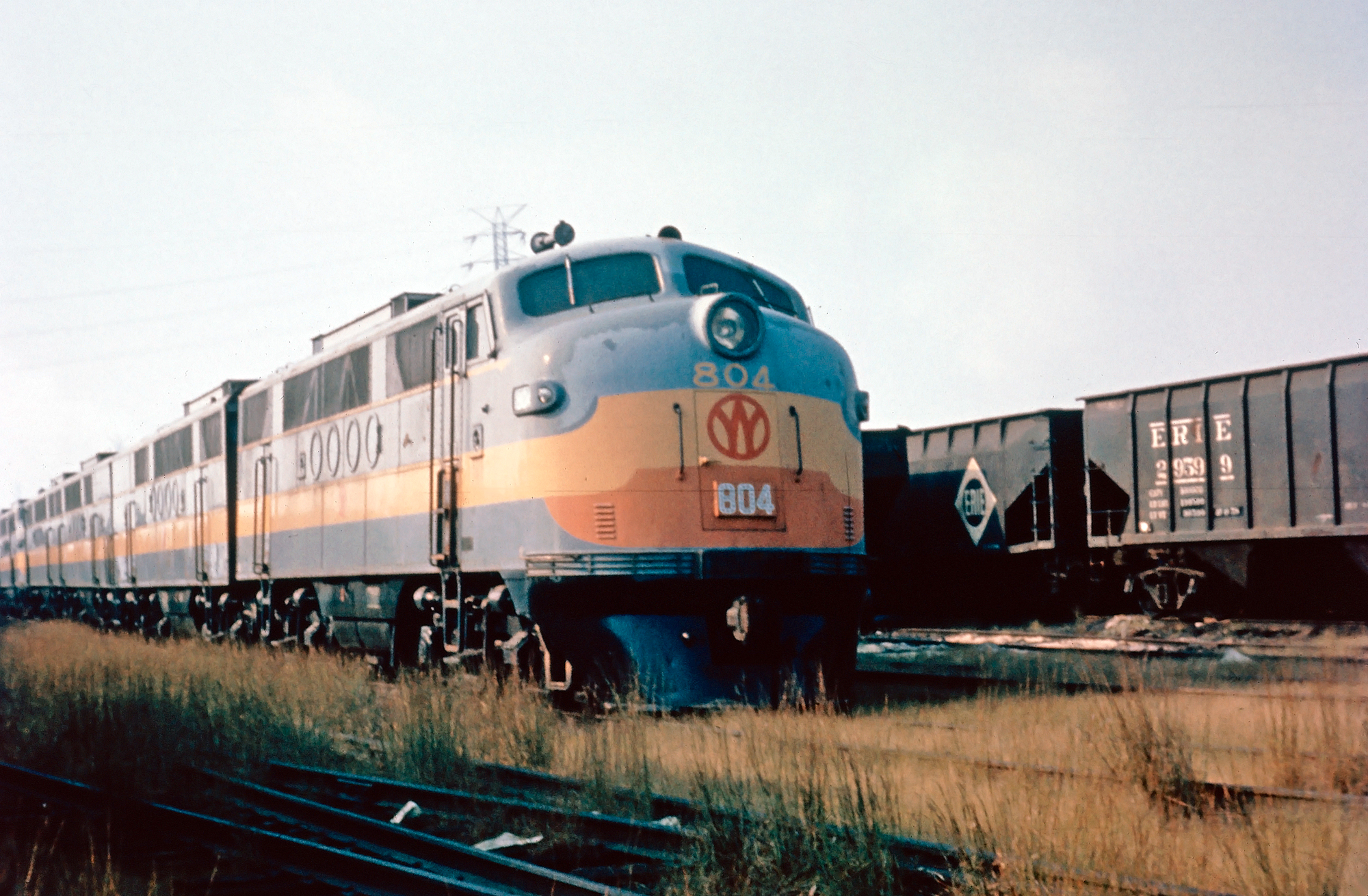 A rare color photo of New York, Ontario & Western FT's in storage on the Erie Railroad during the summer of 1957. Following the shutdown, the FTs remained here until 1967 when most were acquired by the New York Central as trade-in units on new GP40s. In addition, four other units, an A-B-B-A set, were sold to the B&O (#806-807, 806B-807B). Meyer Pearlman photo. American-Rails.com collection.
The line was completed in 1890 during the presidency of Thomas P. Fowler, who had arrived from the New York Central. The corridor ran 54 miles from the main line at Cadosia to Scranton and a connection with the Central Railroad of New Jersey, Lackawanna, and Lehigh Valley.
The O&W became a modestly successful operation with its transportation of milk and dairy products along with very popular seasonal trains to resorts and hotels situated within the lower Catskill Mountains. However, no other railroad depended on the movement of anthracite quite as much as the Ontario & Western.
Prior to wide-scale use of petroleum products, anthracite was a popular and important source of heating fuel for residential and commercial sectors since it burned very cleanly.
At the turn of the 20th century the profitable 568-mile O&W even had the means of double-tracking its Southern Division from East Branch to Cornwall, as well as the entirety of the Scranton Division.
Timetables (1940)
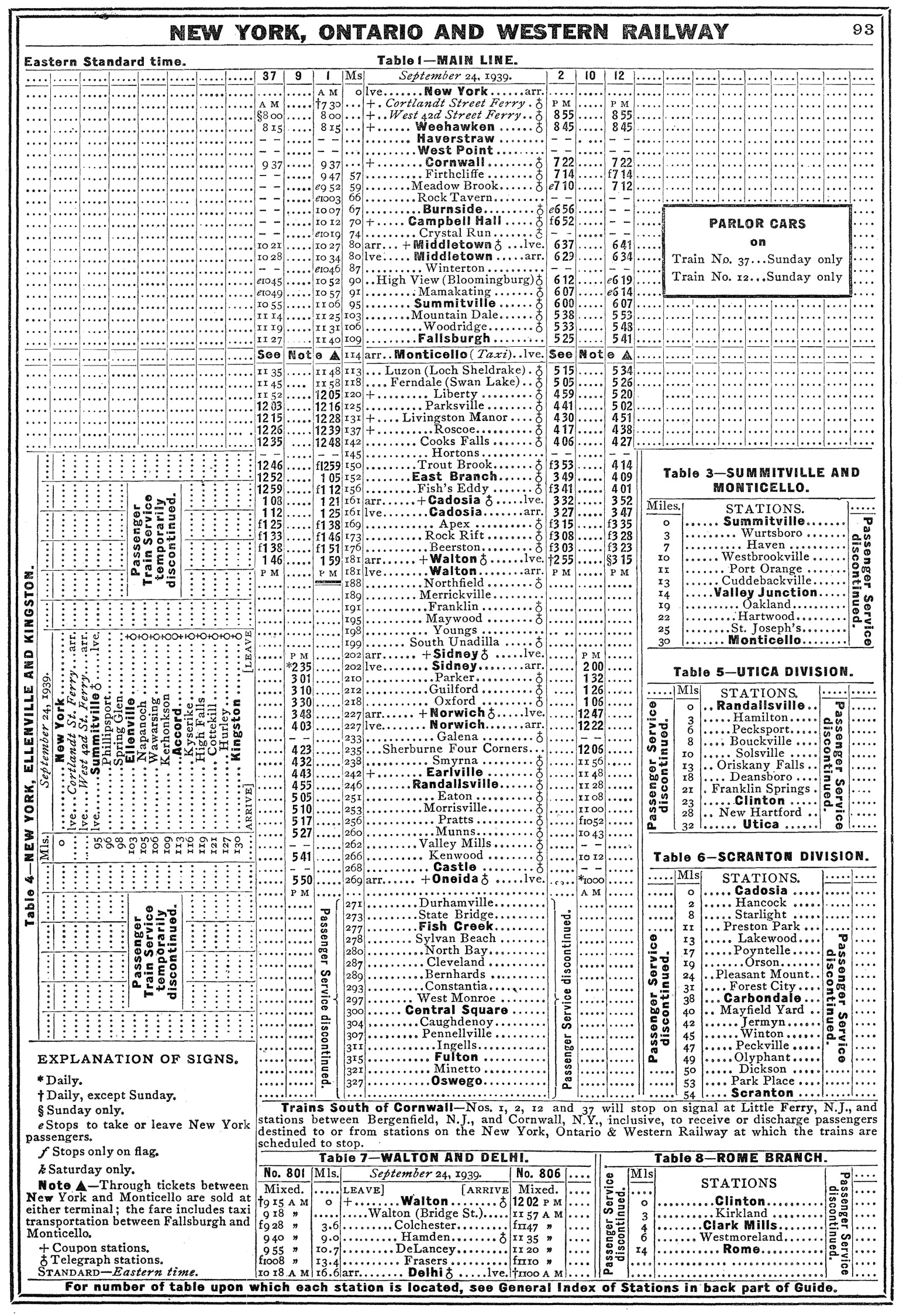
It even upgraded the latter corridor with block signals and had centralized traffic control (CTC) installed from East Branch to Cadosio (8 miles).
Unfortunately, the first wave of bad luck hit in October of 1904 when it came under the control of the New York, New Haven & Hartford, then led by banker and industrialist J.P. Morgan.
A new president was brought in, Charles Mellen, who attempted to use the O&W as a bartering chip with the New York Central to leverage the New Haven's interests elsewhere.
This endeavor proved unsuccessful for the New Haven but resulted in the railroad being neglected and poorly maintained. The next setback was the onset of better roads and highways constructed into upstate New York.
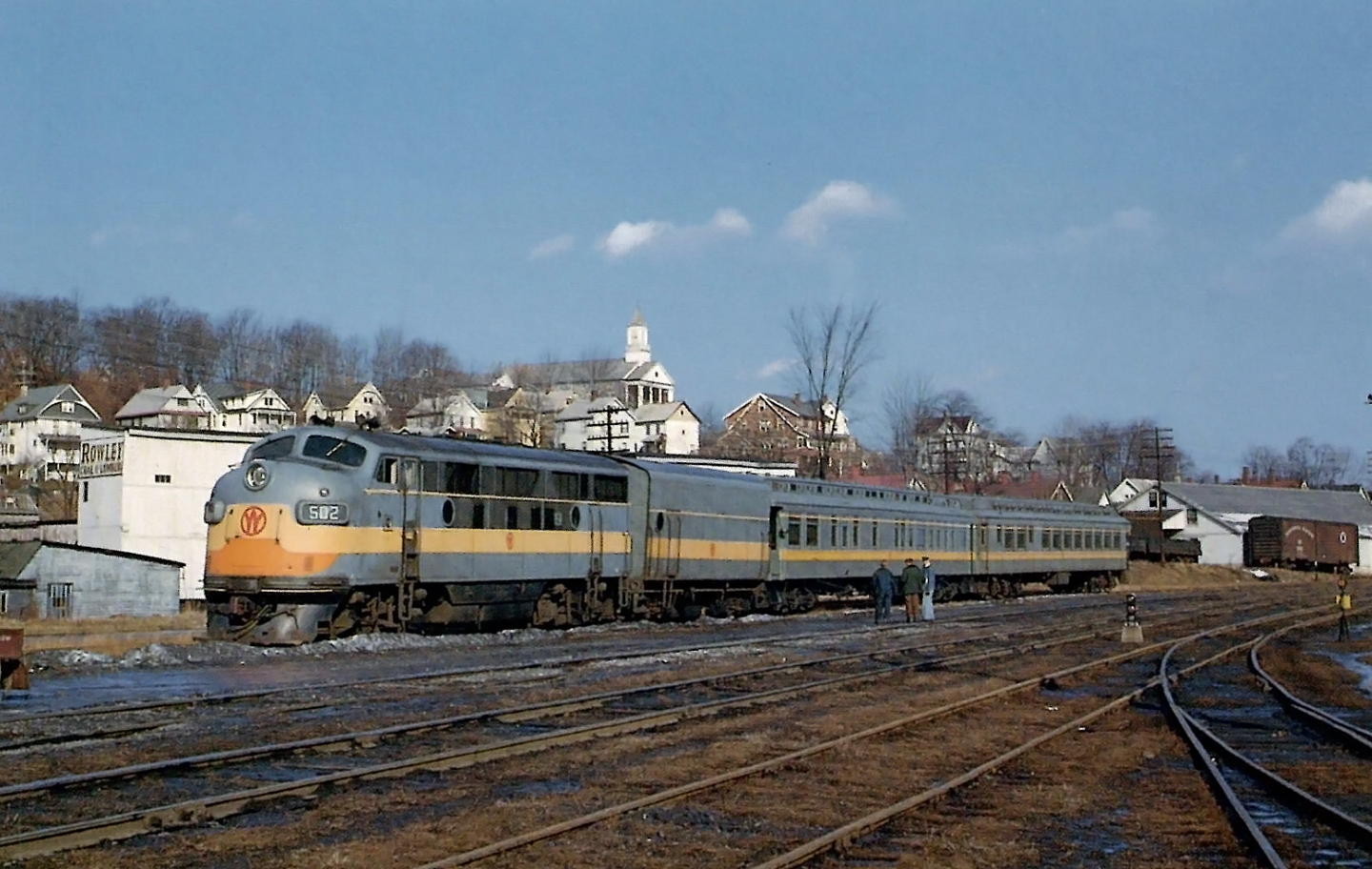 A pair of Ontario & Western observation cars, a steam generator car, and F3A #502 have an inspection train at Middletown, New York in March, 1957. Marvin Cohen photo. American-Rails.com collection.
These infrastructure improvements allowed folks much more freedom to reach the mountains on their own accord; over time the automobile severely eroding the O&W's once-lucrative passenger traffic. Finally, as the 1920s dawned anthracite coal began losing its appeal as a primary heating source.
While it still remained in demand for another few decades the natural resource was simply no longer profitable by the postwar years.
The new highways also hammered its lucrative milk traffic and the economic downturn of the 1930s, brought about by the stock market crash in October of 1929, painted a bleak picture for the road's future.
"Mountaineer Limited" (Streamliner)
It is surprising that of all the railroads to dabble in streamlining, the financially strapped Ontario & Western was one to do so.
Surprisingly, some larger railroads did not even bother with the concept, believing it a gimmick, while others, like the very profitable Southern Railway, only spent conservatively on the styling.
The O&W embarked on such a program in 1938 to update its Mountaineer Limited, a train which traversed 137 miles from Weehawken to Roscoe, New York.
The railroad hired noted industrial designer Otto Kuhler to overhaul two steel parlor-observation cars and a handful of coaches with updated interior decors and matching styling inside and out.
In addition, 4-8-2 #405, a 1923 product of Alco's Schenectady Works (classed Y-1), was dressed in a light streamlining (or "speedlined") with a livery of maroon, orange, and black carrying elements of chrome.
According to the article by A.V. Neusser and C.E. Pearce it appears the road cut short further streamlining efforts although perhaps this was for the best as passenger earnings continued to slump regardless.
The result of these setbacks resulted in the O&W's traffic slashed in half by 1932 from its peak three years earlier according to Robert Malinoski's article, "NYO&W Scranton Division: March 17, 1933," published in the March, 1987 issue of Trains Magazine.
During February of 1937 the New York, Ontario & Western entered voluntary bankruptcy from which it would never emerge.
The company, however, did not give up easily. Its loyal and hardworking employees tried a myriad of things to pull the railroad out of its financial crisis. One of its first tactics was the aforementioned streamlining concept on the Mountaineer to bring back passenger traffic.
It then touted itself as a bridge line the railroad began launching merchandise freights from Mayfield Yard in Scranton to the New Haven at Maybrook Yard.
These symbol-freights included eastbound OB-2 and LB-4 while their westbound counterparts were BO-1 and BL-1. The O&W also operated similar trains between Scranton and Norwich/Utica including SU-1 and US-2.
The company also tried to prop up its port at Oswego to lure Canadian National and Canadian Pacific to initiate carferry services across the lake.
It spent around $300,000, an incredible amount of money for a struggling road of its size, to improve its port facilities. Alas, neither of the Canadian roads expressed much interest in the joint service.
Steam Roster
| Class | Road Numbers | Wheel Arrangement | Builder | Completion Date | Engine Totals |
|---|---|---|---|---|---|
| E | 225-228 | 4-6-0 | Alco (Brooks) | 1911 | 4 |
| I | 42 | 2-6-0 | Baldwin | 1907 | 1 |
| I-1* | 33, 35 | 4-6-0 | Alco (Cooke) | 1904 | 2 |
| L | 50-52 | 0-6-0 | Alco (Cooke) | 1910 | 3 |
| L | 53-56 | 0-6-0 | Alco (Cooke) | 1911 | 4 |
| P | 201-204 | 2-8-0 | Cooke | 1900 | 4 |
| P | 205 | 2-8-0 | Cooke | 1901 | 1 |
| P | 207-211 | 2-8-0 | Cooke | 1901 | 5 |
| P | 213-214 | 2-8-0 | Cooke | 1901 | 2 |
| P | 215, 217 | 2-8-0 | Alco (Cooke) | 1902 | 2 |
| P | 218-220 | 2-8-0 | Alco (Cooke) | 1903 | 3 |
| U | 254-255 | 2-6-0 | Alco (Cooke) | 1907 | 2 |
| U-1** | 244-246 | 4-6-0 | Alco (Cooke) | 1904 | 3 |
| U-1** | 250 | 4-6-0 | Alco (Cooke) | 1905 | 1 |
| U-1** | 251, 253, 256 | 4-6-0 | Alco (Cooke) | 1907 | 3 |
| V | 271-275 | 2-6-0 | Alco (Cooke) | 1908 | 5 |
| V | 277-280 | 2-6-0 | Alco (Cooke) | 1908 | 4 |
| V | 281-282, 284 | 2-6-0 | Alco (Cooke) | 1909 | 3 |
| W | 301-314 | 2-8-0 | Alco (Cooke) | 1910 | 14 |
| W | 315-326 | 2-8-0 | Alco (Cooke) | 1911 | 12 |
| X | 351-356 | 2-10-2 | Alco | 1915 | 6 |
| X | 358-362 | 2-10-2 | Alco | 1915 | 5 |
| Y | 401, 403-410 | 4-8-2 | Alco | 1922-1923 | 9 |
| Y-1*** | 402 | 4-8-2 | Alco | 1922 | 1 |
| Y-2**** | 451-460 | 4-8-2 | Alco | 1929 | 10 |
* Built as 2-6-0s, later converted to 4-6-0's in 1919-1920.
** Built as 2-6-0s, later upgraded to 4-6-0's between 1916 - 1924.
*** Upgraded with booster; tractive effort increased from 50,300 to 60,600 pounds. In addition, weight increased from 158 to 162.5 tons.
**** Additional tractive effort improvements to 71,850 pounds; weight was also increased from 158 to 179.5 tons.
"C" - Designates a "Camelback" design.
All of the above information concerning the O&W's steam locomotive roster is courtesy of the A.V. Neusser and C.E. Pearce article entitled, "The NYO&W," from the August 1942 issue of Trains Magazine.
Diesel Roster
Electro-Motive Division
| Model Type | Road Number | Date Built | Quantity |
|---|---|---|---|
| NW2 | 111-131 | 1948 | 21 |
| F3A | 501-503, 821-822 | 1948 | 5 |
| FTA | 601, 801-808 | 1945 | 9 |
| FTB | 601B, 801B-808B | 1945 | 9 |
| F3B | 821B-822B | 1948 | 2 |
General Electric
| Model Type | Road Number | Date Built | Quantity |
|---|---|---|---|
| 44-Tonner | 101-105 | 1942 | 5 |
 Ontario & Western FTs, led by #807, sit under the coaling tower at Middletown, New York in the late fall of 1947. Marvin Cohen photo. American-Rails.com collection.
Final Years
Finally, it traded in aging steam locomotives for new Electro-Motive FT's and F3's between 1945 and 1948, aided here by Reconstruction Finance Corporation (RFC) loans.
According to the article, "Obituary Of An Old Woman," by authors Jim Shaughnessy and Rod Craib from the July, 1957 issue of Trains, in a last ditch effort the company eliminated most of its double-tracking with automatic block signals and tried any means necessary to acquire new customers.
It discontinued seasonal passenger service in 1948 and ended all passenger trains after September 10, 1953. Alas, the 1950s simply proved an impossible decade. In 1936 it was still handling 6 million tons of anthracite but this number had declined to only 307,521 tons by 1955.
As the trustees realized the company's future appeared doomed they made one last attempt to keep segments operating by having interested parties purchase various routes. Unfortunately, the talks dragged out and creditors grew increasingly impatient to sell off the assets and recover their losses.
Realizing the unrest, the bankruptcy court ordered the O&W
liquidated and its assets sold on March 29, 1957. It was the largest liquidation of its day until the Rock Island met a similar fate in 1980.
Recent Articles


-
Canadian National Railway: Map, Logo, History, Photos
Sep 16, 26 08:55 AM
 Canadian National—name Dec 20 1918, incorporated June 6 1919, Grand Trunk Jan 20 1923. Crown corporation, IPO Nov 17 1995. IC, Wisconsin Central, BC Rail, EJ&E. Class I, mark CN.
 -
Buffalo, Rochester and Pittsburgh Railway: "Safety and Service"
Sep 16, 26 12:12 AM
 Buffalo, Rochester & Pittsburgh—Rochester & State Line 1869, BR&P March 12 1887. Pennsylvania coal to Buffalo and Rochester. B&O January 1 1932. All-time steam roster, LL 2-6-6-2s, XX…
 -
Buffalo Creek & Gauley Railroad: Map, Roster, Logo, Photos
Sep 15, 26 11:55 PM
 Buffalo Creek & Gauley—Elk River Coal & Lumber, April 1 1904, Dundon–Widen. Last all-steam WV coal road, February 27 1965. All-time steam roster, #4 Baldwin 59472, Majestic and Elk River diesels…
 -
Buffalo and Susquehanna Railroad: Map & History
Sep 15, 26 11:42 PM
 Buffalo & Susquehanna—Goodyear hemlock railroad, Sinnemahoning Valley December 14 1885, 1893 merger, coal to Sagamore, Buffalo extension, bankruptcy May 6 1910, B&O 1932, WAG 1956.
 -
WMSR Allegheny Mountain Dinner Train (2026): Dates & Tickets
Sep 15, 26 11:36 PM
 2026 Western Maryland Scenic Allegheny Mountain Dinner Train—Cumberland, 3 hours, 21+, Saturday 7 p.m. Confirm on wmsr.com.
 -
Boston and Albany Railroad: Map & History
Sep 15, 26 11:28 PM
 Boston & Albany Railroad—Boston & Worcester June 23 1831, Western Railroad across the Berkshires, merger 1867–70. NYC 99-year lease July 1 1900. Berkshires, New England States, CSX and MBTA today.
 -
Grand Bellevue Dinner Train (2026): Portsmouth, Rhode Island
Sep 15, 26 11:14 PM
 2026 Grand Bellevue Rail Dining in Portsmouth, RI—2.5-hour seated dinner on Narragansett Bay. Fall/winter TBA after Aug. 29. Confirm on thegrandbell.com.
 -
The "John Bull": The C&A's First Locomotive (1831)
Sep 15, 26 11:01 PM
 John Bull locomotive—Stephenson Planet-type 0-4-0, 1831. Dripps assembly, 4-2-0 rebuild, cowcatcher. Specs, Camden & Amboy career, Smithsonian 1884, 1981 steam-up, 1939 replica.
 -
Napa Valley Wine Train Dining (2026): Lunch, Dinner & Vista Dome
Sep 15, 26 10:56 PM
 2026 Napa Valley Wine Train dining—downtown Napa, 36-mile round trip, gourmet lunch and dinner, Vista Dome. Confirm packages on winetrain.com.
 -
My Old Kentucky Dinner Train (2026): Dates, Tickets & What to Expect
Sep 15, 26 10:50 PM
 2026 My Old Kentucky Dinner Train in Bardstown—2.5 hours, 35-mile round trip, four-course dinner from $116. Confirm on kydinnertrain.com.
 -
LaSalle Street Station: One Of Chicago's Great Terminals
Sep 15, 26 10:42 PM
 LaSalle Street Station—Rock Island October 10, 1852. Frost & Granger July 1, 1903. 20th Century Limited, Rockets, Golden State. Headhouse razed 1981. Metra Rock Island District today.
 -
Charlie Russell Chew Choo (2026): Montana Dinner Train from Lewistown
Sep 15, 26 10:39 PM
 2026 Charlie Russell Chew Choo dinner train—Hanover/Lewistown, 4.5 hours, 56-mile round trip, prime rib. Adult $151. Remaining listed dates sold out. Confirm on montanadinnertrain.com.
 -
Central Pacific Railroad: Map, History, Facts, Logo
Sep 15, 26 10:30 PM
 Central Pacific—Judah, Big Four, June 28 1861. Sierra, Chinese labor, Donner Summit Tunnel. Ten-mile day April 28 1869. Promontory May 10. Southern Pacific lease April 1 1885. Dissolved June 30 1959…
 -
Bessemer & Lake Erie Railroad: "The Bessemer Road"
Sep 15, 26 05:20 PM
 Bessemer & Lake Erie—Bear Creek 1865, Carnegie 1897, U.S. Steel 1901. Ore south from Conneaut, coal north. 2-10-4s, Missabe sister road. CN May 10, 2004. Complete corporate history.
 -
Bangor and Aroostook Railroad: "Serving Northern Maine"
Sep 15, 26 05:05 PM
 Bangor & Aroostook—chartered February 13, 1891, first trains January 1, 1894. Potatoes, paper, Searsport, State of Maine reefers. MM&A 2003, Lac-Mégantic 2013, CP 2020, CPKC today. Complete co…
 -
Baltimore & Ohio Chicago Terminal Railroad: Map and History
Sep 15, 26 03:11 PM
 B&OCT—formed January 6, 1910 to buy Chicago Terminal Transfer. Grand Central, Barr Yard, 78 route-miles. Assigned B&O steam. Complete diesel roster. CSX paper subsidiary, mark BOCT.
 -
The "Alphabet Route" (Railroad): Photos and History
Sep 15, 26 02:53 PM
 Alphabet Route—eight railroads, not one company. P&WV to Connellsville February 11, 1931. Alpha Jets Chicago/St. Louis–New York/Boston. NKP, W&LE, P&WV, WM, Reading, CNJ, L&HR, New Hav…
 -
Milwaukee Road Livestock Operations: Cattle, Dakotas & Montana
Sep 15, 26 02:36 PM
 Milwaukee Road livestock traffic—Dakota and Montana cattle, Iowa hogs, Chicago markets, 28-hour law, head-end stock cars. By 1974 mostly Montana. Rick Burn’s Helena speech. Operations history, not the…
 -
Spirit of Jasper Ride & Dine (2026): Season Pause
Sep 15, 26 02:29 PM
 Spirit of Jasper Ride & Dine in Jasper, Indiana—seated meal on board. Operator: not running public trains for 2026. Depot remains open as a rental. Confirm on spiritofjaspertrain.com.
 -
South Carolina Canal & Rail Road Company: Map and History
Sep 15, 26 01:59 PM
 South Carolina Canal & Rail Road—chartered December 19, 1827. Best Friend of Charleston, 136 miles Charleston–Hamburg October 1833, Aiken inclined plane. South Carolina Railroad 1844, Southern 189…
 -
The Practice of Double-Heading: The Steam Era
Sep 15, 26 01:43 PM
 Doubleheading—two locomotives on the point, each with its own steam crew. Not a rear helper, not diesel MU. How it worked, PRR 1877, mountain grades, and what MU ended.
 -
Mohawk and Hudson Railroad: Map, Pictures, Locomotives
Sep 15, 26 01:20 PM
 Mohawk & Hudson Railroad—New York’s first railroad, chartered April 17, 1826. DeWitt Clinton, inclined planes, Albany & Schenectady 1847, first New York Central May 17, 1853. Complete corporat…
 -
Essex Clipper Dinner Train (2026): Dates, Tickets & What to Expect
Sep 15, 26 01:09 PM
 2026 Essex Clipper Dinner Train in Essex, CT—2.5 hours, four-course meal $129.99, 18+. Fall dates through Oct. 25. Confirm on essexsteamtrain.com.
 -
Camden & Amboy Railroad: Map, History, Photos
Sep 15, 26 12:53 PM
 Camden & Amboy Railroad—chartered February 4, 1830. Joint Companies monopoly with the Delaware & Raritan Canal, John Bull, T-rail. United New Jersey 1872, PRR 999-year lease 1871. Complete corpora…
 -
Cafe Lafayette Dinner Train (2026): Dates, Tickets & What to Expect
Sep 15, 26 12:47 PM
2026 Cafe Lafayette Dinner Train in North Woodstock, NH—2 hours, 20 miles, five-course meal from $125. May–October. Confirm on nhdinnertrain.com. -
Christmas Train Ride Locations (2026): A Complete Guide
Sep 15, 26 10:47 AM
 2026 Christmas train rides by state—Santa, North Pole Express, and holiday trains. Not Polar Express. State guides and product pages. Confirm dates on each railroad.
 -
Baltimore & Ohio Railroad: Linking 13 Great States With The Nation
Sep 15, 26 10:22 AM
 Baltimore & Ohio Railroad—first U.S. common carrier, chartered February 28, 1827. Wheeling 1853, Chicago 1874, C&O control 1963, Chessie 1973, into CSX April 30, 1987. Complete corporate history.
 -
Delaware & Hudson Railway: The Bridge Line
Sep 15, 26 09:59 AM
 Delaware & Hudson Railway—Wurts brothers canal 1823, gravity railroad 1829, Stourbridge Lion, Bridge Line to Montreal. Guilford 1984, CP 1991, NS south line 2015, CPKC north.
 -
Delaware & Hudson Diesel Roster (All-Time)
Sep 15, 26 12:17 AM
 All-time Delaware & Hudson diesel roster—Alco S-2s through C-628s and PA-4s, GE U-boats, Baldwin RF-16s, EMD SD45s and GP38-2/GP39-2s. Serials, dates, dispositions.
 -
Granite Railway, Our Country's First Railroad
Sep 14, 26 11:28 PM
 Granite Railway of Quincy, Massachusetts—chartered March 4, 1826, opened October 7, 1826. Gridley Bryant, 5-foot gauge, horses, Bunker Hill Monument stone. First commercial U.S. railroad.
 -
Milwaukee Road Skytop Lounges: History, Specs & Floor Plans
Sep 14, 26 11:09 PM
 Milwaukee Road Skytop observation cars—Brooks Stevens, 1948. Four Rapids parlor-lounges from Milwaukee Shops, six Creek sleeper-lounges from Pullman-Standard. Floor plans, roster, preservation.
 -
West Virginia Christmas Train Rides (2026): A Complete Guide
Sep 14, 26 11:02 PM
2026 West Virginia Christmas trains—Potomac Eagle North Pole Express in Romney and Christmas at Cass. Not Polar Express. Elkins Polar is not listed for 2026. -
Railroads Of Today: Class I Map, PSR & the 2026 Industry
Sep 14, 26 10:30 PM
 U.S. freight rail in 2026—six Class I railroads on a nearly 140,000-mile network. PSR as everyday practice, how the STB works, traffic mix, short lines and regionals.
 -
Railroad History (USA): Timeline, Facts & How the Network Was Built
Sep 14, 26 10:03 PM
 Full U.S. railroad history hub—origins and inventors, Golden Age peak mileage, Civil War and transcontinental, streamliners, ICC regulation, Penn Central and Conrail, Staggers Act, PSR, and today’s Cl…
 -
Railroads In The 2020s: CPKC, East Palestine & the UP–NS Case
Sep 14, 26 09:51 PM
 U.S. railroads 2020–2026—Class I mileage 91,773 in 2020. COVID traffic drop, CPKC April 14 2023, East Palestine Feb. 3 2023, UP–NS $85 billion case still before the STB.
 -
Railroads In The 2010s: PSR, Coal’s Decline & Positive Train Control
Sep 14, 26 03:51 PM
 U.S. railroads 2010–2020—Class I mileage 95,573 to 91,773. Buffett closed BNSF Feb. 12 2010, Harrison at CP June 29 2012 and CSX 2017, PTC deadline Dec. 31 2018.
 -
Virginia Christmas Train Rides (2026): A Complete Guide
Sep 14, 26 03:46 PM
 2026 Virginia Christmas trains—Virginia Scenic Railway Santa Express from Staunton, about 60 minutes. Confirm dates. Not Polar Express.
 -
MARC Train: Maryland Commuter Rail History, Lines & Roster
Sep 14, 26 01:16 PM
 MARC Train history—Maryland Rail Commuter 1984, B&O and PRR corridors, Penn/Camden/Brunswick lines, Silver Spring 1996, all-time locomotive roster.
 -
Railroads In The 2000s: Merger Freeze, Wisconsin Central & Buffett
Sep 13, 26 07:57 AM
 U.S. railroads 2000–2010—Class I mileage 99,250 to 95,573. STB merger freeze March 17 2000, CN–WC Oct. 9 2001, BNSF Railway Jan. 24 2005, Buffett Nov. 3 2009.
 -
Railroads In The 1990s: Mega-Mergers, Conrail’s Split & the STB
Sep 13, 26 12:13 AM
 U.S. railroads 1990–2000—Class I mileage 119,758 to 99,250. BNSF Sept. 22 1995, UP–SP Sept. 11 1996, Conrail split June 1 1999, ICC Termination Dec. 29 1995.
 -
Railroads In The 1980s: Staggers, Mega-Mergers & Conrail’s IPO
Sep 12, 26 11:12 PM
 U.S. railroads 1980–1990—Class I mileage 164,822 to 119,758. Staggers Oct. 14 1980, CSX and Norfolk Southern, UP–Missouri Pacific–Western Pacific, Conrail IPO March 26 1987.
 -
Wabash Class O-1 4-8-4s: History, Roster & Specifications
Sep 12, 26 11:01 PM
 Wabash Class O-1 4-8-4s—Baldwin 1930–31, twenty-five engines 2900–2924. Fast freight, complete roster, specifications. None preserved.
 -
Staggers Rail Act of 1980: Statute, Contract Rates & the ICC
Sep 10, 26 11:23 PM
 Staggers Rail Act, Pub. L. 96-448, signed October 14, 1980. Harley Staggers, S.1946, contract rates, 180% variable-cost test, abandonments, short lines.
 -
Rock Island E8A 652: Bicentennial Independence Paint & History
Sep 10, 26 10:42 PM
 Rock Island E8A 652—EMD March 1952, serial 15199. 20th Century Railroad Club Independence bicentennial scheme, Peoria and Quad Cities Rockets, Midland Railway, Manly Junction Museum.
 -
Vermont Christmas Train Rides (2026): A Complete Guide
Sep 10, 26 10:37 PM
2026 Vermont Christmas trains—Okemo Valley Holiday Express from Chester Depot Dec. 19–20. Polar is Burlington Dec. 5–6 only. -
Railroads In The 1970s: Penn Central, Amtrak & Conrail
Sep 10, 26 10:18 AM
 U.S. railroads 1970–1980—196,479 miles at the decade’s start. Penn Central bankruptcy June 21 1970, Amtrak May 1 1971, 3R/4R Acts, Conrail April 1 1976, Rock Island 1975, Milwaukee 1977.
 -
Railroads In The 1960s: Mergers, Passenger Collapse & Penn Central
Sep 10, 26 10:03 AM
U.S. railroads 1960–1970—207,334 to 196,479 miles. Erie Lackawanna 1960, C&O–B&O 1963, N&W–Nickel Plate 1964, SCL 1967, Penn Central Feb. 1 1968. -
South Carolina Christmas Train Rides (2026): A Complete Guide
Sep 10, 26 08:36 AM
 2026 South Carolina Christmas trains—South Carolina Railroad Museum Santa Train in Winnsboro. Confirm December dates. Not Polar Express. Drop light-festival padding.
 -
Steam Locomotive Feedwater Heaters: Elesco, Coffin & Worthington
Sep 10, 26 08:29 AM
 Steam locomotive feedwater heaters—open Worthington vs closed Elesco and Coffin. How they work, how to identify them on a smokebox, and why not every engine had one.
 -
Oregon Christmas Train Rides (2026): A Complete Guide
Sep 10, 26 08:22 AM
2026 Oregon Christmas trains—Portland Holiday Express, Garibaldi Candy Cane Express, Sumpter Valley Christmas Trains Dec. 11–13. Polar is Mount Hood.



.%20%20Meyer%20Pearlman%20photo.%20%20American-Rails.com%20collection.)

