Railroad Bridges (USA): History, Types, Trusses & Famous Spans
Last revised: August 13, 2026
By: Adam Burns
Without bridges, American railroading stops at the first creek. From the industry’s earliest decades, companies had to span streams, rivers, tidal channels, and entire valleys—first with stone and wood, then with iron and steel, and later with reinforced concrete. Some early wooden trestles looked as if they might not hold a person, let alone a locomotive; many did the job for a season or a war, then burned, rotted, or washed out. The best masonry viaducts of the 1830s–1900s still carry freights and Amtrak today.
This page is a full overview of that story: how bridge language works (bridge vs. trestle vs. viaduct; deck vs. through), how materials and truss patents evolved, what types you still see on Class I mains, and which landmark spans define the map. For individual famous structures, see also the landmarks hub.
On this page: At a glance · Terms · Stone viaducts · Wood & trestles · Iron & steel trusses · Common types · Movable spans · Concrete giants · Famous examples · Today’s inventory · Related reading
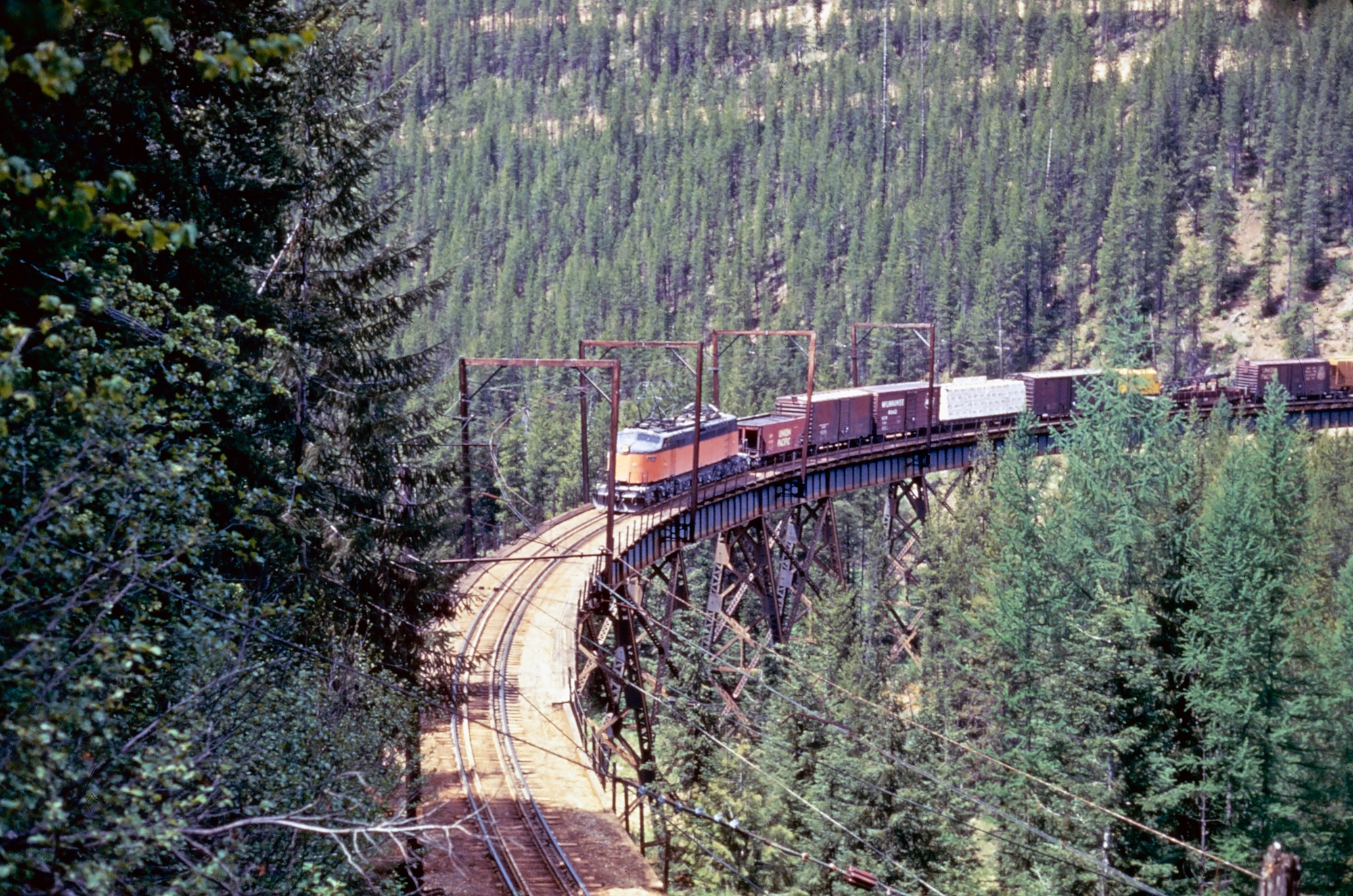
Milwaukee Road “Little Joe” E-70 crosses Dominion Creek Trestle just east of St. Paul Pass, Montana, with an eastbound, circa 1973. American-Rails.com collection.
At a Glance
| Topic | Notes |
|---|---|
| Why bridges matter | Every railroad is a chain of grade, track, and openings; bridges and culverts are the openings that cannot be filled |
| Material sequence (broad) | Stone & wood (1830s–) → iron trusses (mid-1800s) → steel (late 1800s–) → concrete (early 1900s–) → modern steel/concrete composites |
| Pioneer masonry icon | B&O Thomas Viaduct (Elkridge, Md., 1835)—curved multi-arch stone; still in service |
| Key early truss patents | Howe (1840), Pratt (1844), Warren (1848 era); earlier Burr arch (1817) and Town lattice (1820) for covered/road and early rail practice |
| Most common modern short span | Plate girder (deck or through) over creeks, roads, and cuts |
| Long-span showpieces | Through trusses, cantilevers, steel arches (e.g., Hell Gate), multi-span concrete arches (e.g., Tunkhannock) |
| Movable types | Swing, bascule, vertical lift—where navigation rights forced the railroad to yield the channel |
| Longevity fact | Well-built stone and heavy steel often outlast the companies that ordered them; axle loads and fatigue still force rebuilds |
Bridge, Trestle, Viaduct—and Deck vs. Through
Railroad people use everyday words with technical edges:
- Bridge — general term for a structure carrying track over a void (water, road, another railroad, canyon).
- Trestle — typically a multi-span structure of bents or towers (wood pile/frame or later steel tower bents) marching across a wide, often shallow obstacle. Classic western timber trestles and fill-and-trestle combinations made mountain construction possible before long fills were finished.
- Viaduct — a long multi-span bridge, often high, often of masonry or concrete arches (Thomas, Starrucca, Tunkhannock, Rockville). In popular use it signals grandeur as much as length.
- Deck bridge — the roadway (track) rides on top of the main structural members. Deck trusses and deck girders are common.
- Through bridge — the track passes through the structure; main trusses or girders rise beside (and often above) the train. Through trusses and through girders define countless mainline river crossings.
- Pony truss / half-through — intermediate forms where sides do not fully enclose the clearance envelope.
Clearance matters as much as strength. A bridge must carry locomotive impact, heavy axle loads, and continuous vibration while leaving room for equipment height, double-stacks, and (on some lines) overhead wire. Many rebuilds of the late twentieth and early twenty-first centuries were driven as much by clearance and load rating as by pure structural failure.
Stone: Beauty, Cost & Structures That Outlived Companies
Stone-arch railroad bridges are among the most admired works in American civil engineering. They are also expensive. Where railroads had capital, skilled masons, and a permanent main-line ambition, they sometimes chose stone for spans that would not need constant replacement. Where they did not, wood and later iron won the bid.
One of the first major railroad bridges in the United States is the Baltimore & Ohio’s Thomas Viaduct at Elkridge, Maryland, over the Patapsco River. Completed in 1835 and named for B&O’s first president, Philip E. Thomas, it was at the time a world-class masonry structure—often cited as the longest multi-arch railroad masonry bridge of its day and notable as a curved alignment. It remains in freight and passenger service nearly two centuries later, a direct rebuke to anyone who thinks early American engineering was temporary.
Other famed stone and masonry multi-arch works include the Erie’s Starrucca Viaduct in northeastern Pennsylvania and, on a different scale of ambition, the Pennsylvania Railroad’s Rockville Bridge near Harrisburg. Rockville, opened in 1902, stretches about 3,820 feet across the Susquehanna with 48 arches and still carries Norfolk Southern freights and Amtrak. These are not museum pieces behind fences; they are working plant.
Stone’s drawbacks explain why it did not dominate every crossing: quarrying, transport, skilled labor, and slow construction raised costs far above timber trestles. Railroads reserved masonry for showpiece mains, difficult permanent sites, and locations where fire or flood made wood a liability. Many of the best survivors are listed as National Historic Landmarks or National Register properties—and still host trains.
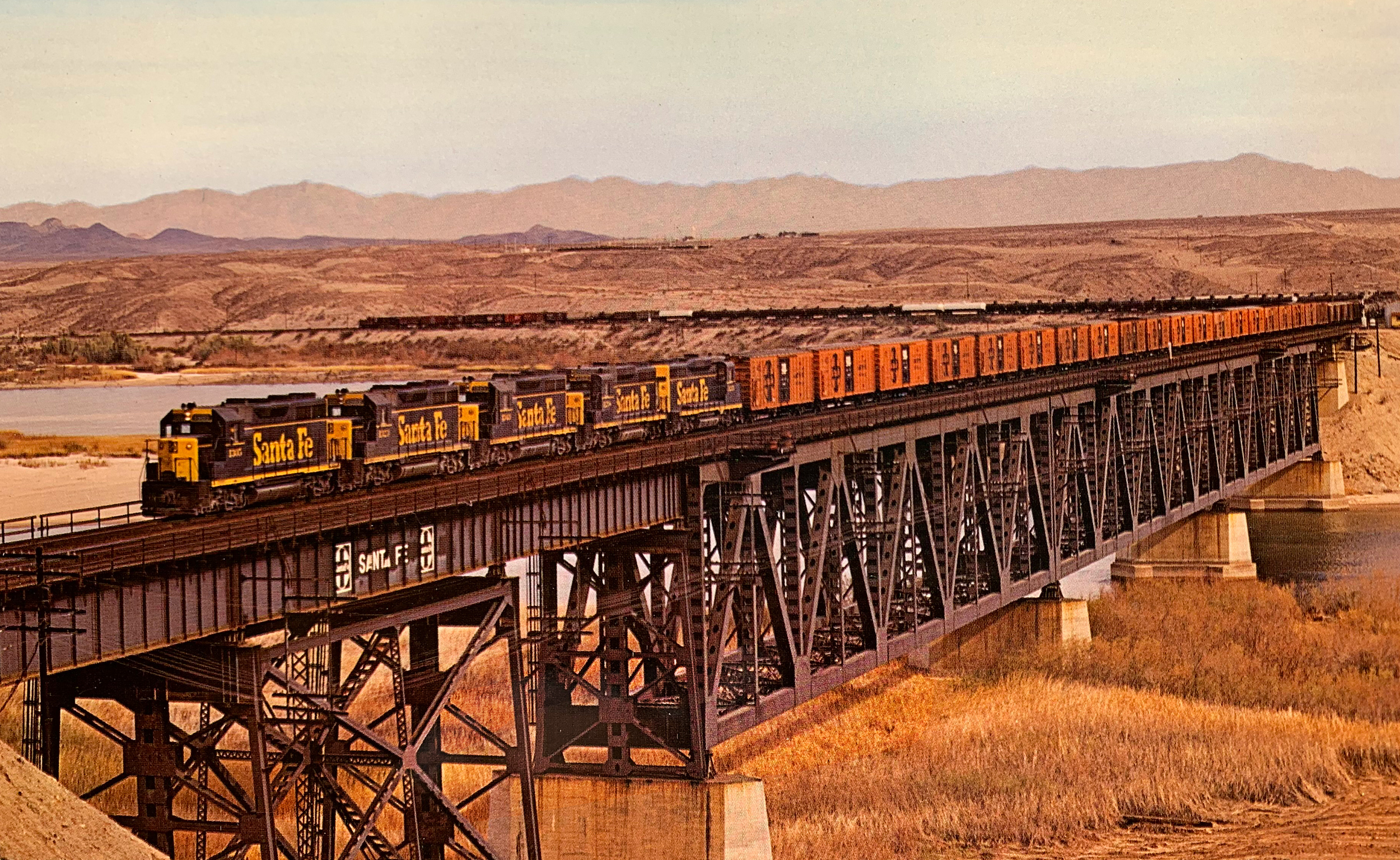
Santa Fe publicity view: GP35s #1305, #1323, and #1343 with GP30s head west over the 1,506-foot deck-girder bridge spanning the Colorado River near Topock, Arizona, circa 1964. Author’s collection.
Wood: Speed, War & the Disposable Crossing
Where stone was too slow or costly, railroads built in wood. Pile trestles, frame trestles, and covered truss spans carried the network west and filled temporary gaps during construction. Wood could be cut near the job, erected by large labor gangs, and replaced when it burned or rotted—an operating strategy as much as an engineering one.
Civil War photography made the wooden military bridge famous. The United States Military Railroad threw up long pile structures that look terrifying to modern eyes but could be completed quickly after a raid or flood. A classic view shows the 4-4-0 General Haupt posed on a large wood pile bridge on the Richmond, Fredericksburg & Potomac about 1863—cheap, fast, and expendable by design.
Even into the diesel era, small wood pile bridges survived on branch lines. A November 1956 view of Union Pacific 2-8-0 #355 on the Crow Valley Branch near Greeley, Colorado, shows how ordinary such spans once were. They were never the most durable answer; they were the answer that got trains across until traffic or capital justified steel.
Covered wooden trusses—using patterns such as the Burr arch (Theodore Burr, patent era 1817) and Town lattice (Ithiel Town, 1820)—also appear in early American bridge practice. Railroads used and adapted road-bridge ideas, then specialized them for locomotive loads. Fire was the eternal enemy: sparks from wood-burning and early coal locomotives made open wooden decks a constant risk, which is one reason iron and steel were welcomed so eagerly when prices fell.
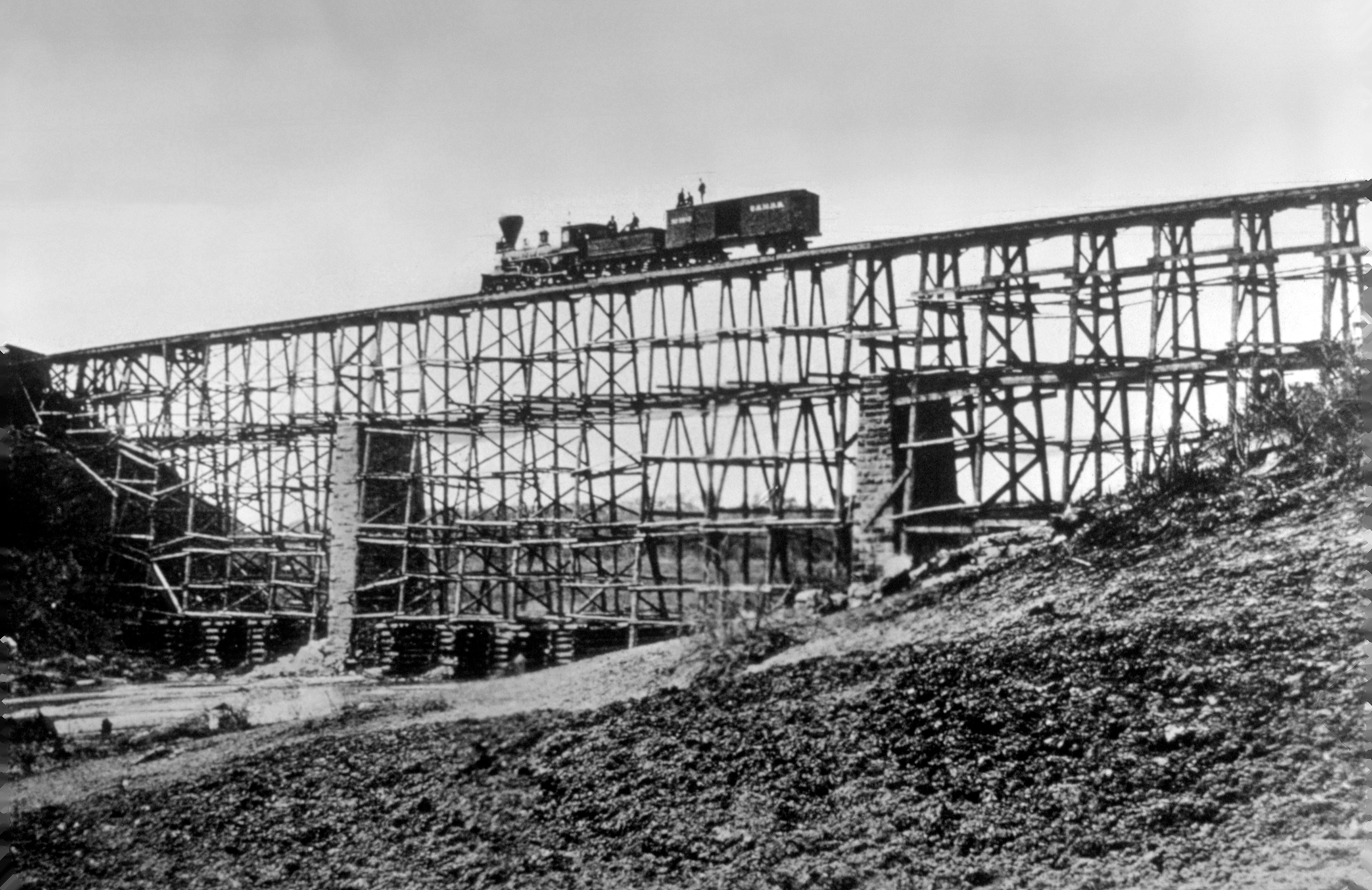
A large wood pile bridge built by the United States Military Railroad on the Richmond, Fredericksburg & Potomac, circa 1863, with 4-4-0 General Haupt posed on the structure. American-Rails.com collection.
From Timber Trusses to Iron and Steel
The nineteenth century was the great age of the truss—a framework of triangles that turns spans into systems of tension and compression members. American inventors and builders patented configurations that still name the bridges railfans photograph today.
| Type / patent era | Who / when | What to notice |
|---|---|---|
| Burr arch truss | Theodore Burr, ~1817 | Arch combined with truss; common in covered-bridge tradition |
| Town lattice | Ithiel Town, 1820 | Lattice web of planks; economical timber pattern |
| Howe truss | William Howe, 1840 | Wood compression diagonals with iron vertical rods; dominant long-span timber railroad form of mid-century |
| Pratt truss | Thomas & Caleb Pratt, 1844 | Diagonals in tension (sloping down toward center in classic form); became extraordinarily common in iron and steel |
| Warren truss | James Warren (and others), 1848-era practice | Series of equilateral/isosceles triangles; later steel Warrens (with or without verticals) remain ubiquitous |
| Whipple and others | Squire Whipple and peers, 1840s+ | Scientific iron-truss design; bowstring and long-span experiments |
Howe vs. Pratt is the distinction modelers and bridge hunters still argue about trackside. In broad terms, the Howe favored wood diagonals that take compression and iron rods that take tension—ideal when good timber was cheap and wrought iron rods were the premium product. The Pratt reversed the logic for metal: diagonals that work primarily in tension can be lighter steel members. Once iron and then steel became affordable after the Civil War, Pratt and Warren patterns (and their double-intersection cousins) crowded the map.
As steel production matured in the late 1800s, railroads built larger versions of known patterns rather than inventing entirely new geometries every decade. Cantilever trusses and great through arches handled channels that simple fixed spans could not. The New York, New Haven & Hartford’s Hell Gate Bridge—a steel arch completed in September 1916 on the East River approaches between Queens and the Bronx (via the Hell Gate alignment)—remains a defining railroad arch and a critical Amtrak (and freight) artery into New York.
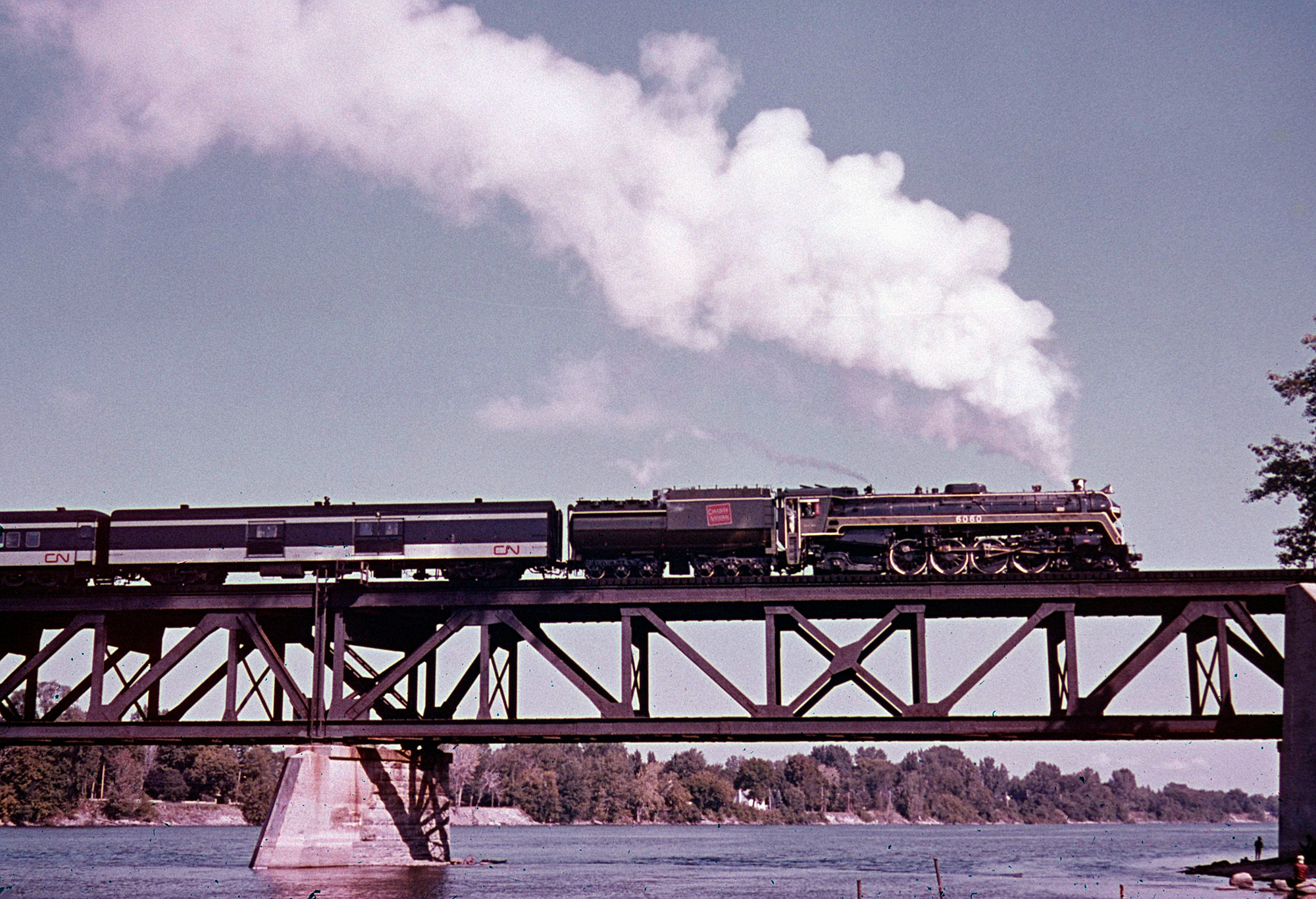
Canadian National 4-8-2 #6060 leads an excursion eastbound over a historic Pratt deck truss spanning the Richelieu River at Beloeil, Quebec, September 15, 1973. Carl Sturner photo. American-Rails.com collection.
Common Railroad Bridge Types (What You Still See)
Walk any main line and you will mostly meet workhorse types, not Hell Gates.
Plate girder bridges
The most common railroad bridges in modern North America are variations of the plate girder—built-up steel girders (historically riveted plates and angles; later welded) carrying one or more tracks over a road, creek, or cut. They are relatively cheap, quick to erect, and easy to design in standard spans. Longer crossings may string many girder spans end to end, or mix girders with a truss main span. Deck girders put the track on top; through girders put the webs beside the train.
Even monumental river crossings sometimes use girder approaches. The Santa Fe’s roughly 1,506-foot deck-girder structure over the Colorado River near Topock, Arizona—shown in a mid-1960s publicity view with a GP30/GP35 lashup—is a reminder that “girder” does not always mean “short and humble.”
Truss bridges (through and deck)
Where spans grow and navigation or flood openings demand fewer piers, trusses still appear. Through Pratt and Warren trusses frame countless photographs of freights “inside” the bridge. Deck trusses put the triangles under the track, useful where overhead clearance for a through structure is awkward. Older pin-connected trusses and later riveted or bolted designs both survive; railroads rate them carefully as loads rise.
Beam and short spans
Simple steel or concrete beams handle the shortest openings. Culverts and concrete boxes increasingly replace the tiniest bridges, but beams remain the default for modest openings on secondary lines.
Trestles and tower structures
Multi-bent trestles—wood historically, steel towers later—cross wide valleys where a single long span was uneconomical. Western construction history is full of temporary timber trestles later buried in fill or replaced with steel. Electrified mountain lines produced dramatic steel trestles; Milwaukee Road’s electrified Rocky Mountain Division left images such as Dominion Creek near St. Paul Pass that still define “trestle” for many railfans.
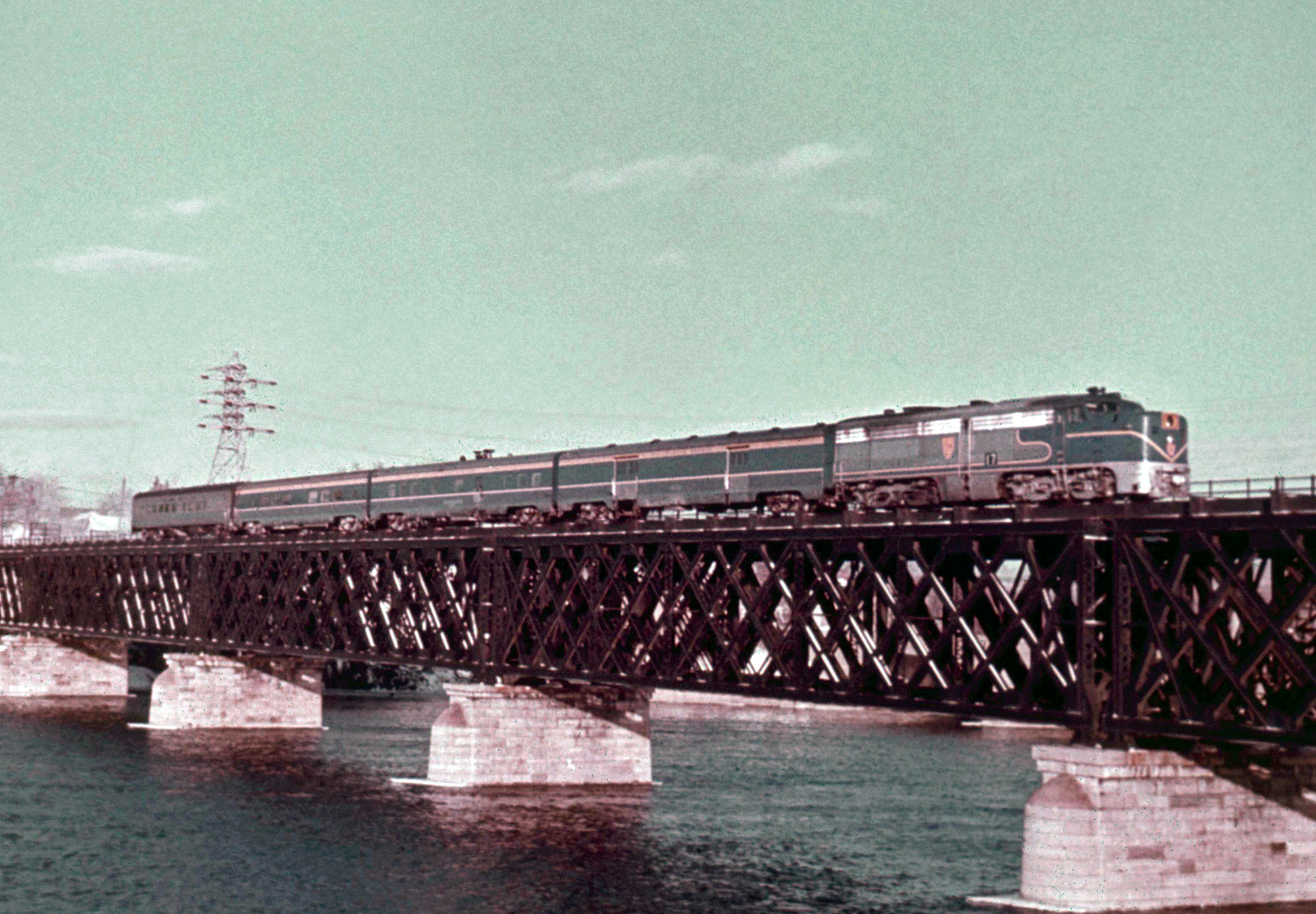
Delaware & Hudson PA-1 #17 leads the southbound Laurentian over the Mohawk River at Cohoes, New York, February 1968. Jim Shaughnessy photo. American-Rails.com collection.
Movable Spans: When Boats Have the Right-of-Way
At navigable rivers and harbors, railroads often could not build a fixed high bridge. Movable bridges let vessels pass:
- Swing bridges rotate on a center (or rim-bearing) pier to open a channel.
- Bascule bridges lift like a drawbridge leaf (single or double leaf), with counterweights.
- Vertical-lift bridges raise a span between towers while keeping it level—favored for wide channels and heavy rail loads in the twentieth century.
Movable spans add machinery, operators or remote control, and delay risk to every timetable. Many harbor cities still run them daily; others were replaced by high fixed spans when highway and rail funding allowed. For operations people, a stuck drawbridge is as real a problem as a broken rail.
Reinforced Concrete: Arches Without Quarry Dust
Early twentieth-century railroads adopted reinforced concrete for viaducts that combined stone’s mass with industrial production. The Delaware, Lackawanna & Western’s Tunkhannock Viaduct (Nicholson, Pennsylvania) is the textbook example: roughly 2,375 feet long and about 240 feet above the valley floor, a multi-arch concrete giant that still startles first-time viewers—especially with the old Lackawanna lettering spirit associated with the structure in popular memory. It is not stone, but it belongs in the same conversation as Starrucca and Thomas: permanent, monumental, and built to outlast corporate names.
Concrete also appears in countless smaller trestle replacements, pier jackets, and deck slabs. Modern bridge programs often use prestressed concrete beams for highway underpasses and short rail spans, while long river crossings remain steel’s domain.
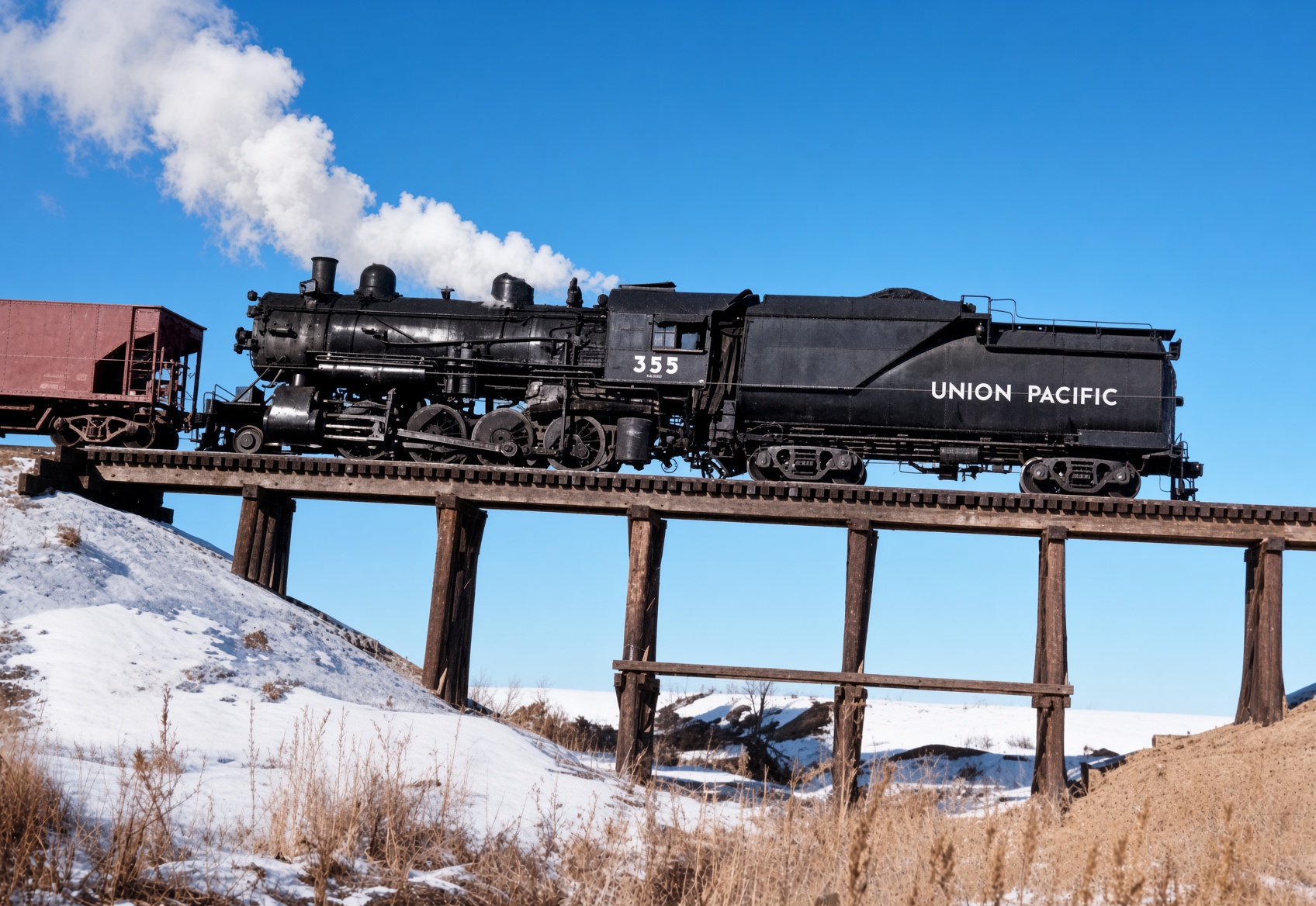
Union Pacific 2-8-0 #355 works local service on the Crow Valley Branch near Greeley, Colorado, crossing a small wood pile bridge in November 1956. American-Rails.com collection.
Famous Examples (Gateway to Deeper Profiles)
American-Rails.com covers many landmark spans and related engineering sites individually. A short map of names worth knowing:
| Structure | Why it matters | Profile |
|---|---|---|
| Thomas Viaduct | 1835 B&O curved stone multi-arch; still working | Thomas Viaduct |
| Starrucca Viaduct | Erie-era stone arches; ASCE landmark conversation | Starrucca |
| Rockville Bridge | PRR Susquehanna stone giant (1902); NS + Amtrak | Rockville |
| Tunkhannock Viaduct | Lackawanna concrete multi-arch; height and length icons | Tunkhannock |
| Hell Gate Bridge | 1916 steel arch into New York; Amtrak artery | Hell Gate |
| Kinzua Viaduct | Iron/steel tower viaduct history; partial survival after storm | Kinzua |
| Poughkeepsie Bridge | Hudson crossing drama; now walkway reuse story | Poughkeepsie |
| Key West Extension | Bridges over open water; Flagler overseas railroad | Key West Extension |
More bridge and viaduct entries live under the landmarks directory (Keystone, Salisbury, Tulip, Newark Bay, and others). Use that hub when you are hunting by type rather than by railroad.
Today: Heavy Loads, Old Steel & Why Replacement Matters
Railroad bridges remain critical infrastructure. Intermodal stacks, heavy bulk unit trains, and higher axle loads stress structures designed for lighter steam-era freights. Many spans are safe under current ratings; others need strengthening, speed restrictions, or full replacement. A bridge failure is rare relative to train-miles, but the consequence is severe—so inspection, load rating, and capital programs sit at the center of modern maintenance-of-way work.
Replacement is expensive. Multi-million-dollar price tags for even mid-size structures are normal; major river crossings cost far more. When public funding assists private railroad bridge projects, the economic argument is usually about national freight flow, grade-crossing elimination packages, passenger reliability, or navigation—not aesthetics. Still, the best historic spans prove that quality first construction can serve for a century or more. Thomas Viaduct’s ongoing service is the extreme case; countless anonymous girders from the 1910s–1950s quietly do the same job every hour of every day.
For modelers and photographers, bridges are the punctuation of the railroad landscape. For operating companies, they are balance-sheet line items and safety-critical assets. For historians, they are a readable timeline of materials science: stone pride, wooden expedience, iron ingenuity, steel capacity, concrete monumentality.
Related Reading on American-Rails.com
- Railroad landmarks (bridges, tunnels, passes, grades)
- Rail infrastructure · Railroad history
- Individual spans: Thomas · Starrucca · Rockville · Tunkhannock · Hell Gate · Kinzua
- St. Paul Pass (trestle country context) · Home
External engineering overview often recommended for visual type-spotting: Pittsburgh-area bridge basics references (e.g., pghbridges.com educational pages) for truss identification diagrams.
Sources
- Historic American railroad engineering practice: stone multi-arch viaducts (B&O Thomas Viaduct, 1835; PRR Rockville Bridge, 1902); Erie Starrucca tradition
- Truss patent and adoption history: Howe (1840), Pratt (1844), Warren (1848-era), Burr (1817), Town lattice (1820); Whipple iron-truss tradition
- Material transition literature: timber to iron to steel; plate-girder standardization for short and medium spans
- Movable-bridge practice: swing, bascule, and vertical-lift types on navigable waters
- Concrete viaduct era: Lackawanna Tunkhannock Viaduct dimensions and significance
- Hell Gate Bridge (NYNH&H / East River arch, completed 1916) operating role for modern passenger and freight approaches
- American-Rails.com landmark profile pages and photo collection captions linked throughout
- NCHRP / historic bridge type context studies used industry-wide for identification of common truss forms
Original American-Rails.com bridges overview (first drafted circa 2008; revised September 4, 2024) substantially rewritten and expanded August 13, 2026 for research depth while retaining core examples: Thomas Viaduct, Starrucca, Rockville, Tunkhannock, Hell Gate, Pratt/Warren/Howe lineage, plate-girder ubiquity, wooden military and branch trestles, and the modern need for bridge capital investment.
Recent Articles


-
Railway Express Agency (REA): Signs, Trucks, Logo & History
Sep 24, 26 09:40 AM
 Railway Express Agency—railroad-owned express company. Incorporated December 7, 1928. Operations March 1, 1929. Red diamond, green trucks. Last regular express November 7, 1975.
 -
Michigan Dinner Train Rides (2026): A Complete Guide
Sep 24, 26 09:28 AM
 2026 Steam Railroading Institute dining in Owosso—select evenings, no public dinner dates posted. Confirm on michigansteamtrain.com.
 -
Pittsburgh and West Virginia Railway: Map, Rosters, History
Sep 24, 26 12:24 AM
 Pittsburgh & West Virginia—the Hi-Line. Wabash-Pittsburgh Terminal 1904. Railway January 29, 1917. Connellsville February 11, 1931. N&W lease October 16, 1964. Wheeling & Lake Erie from May 17, 1990.
 -
Indiana Dinner Train Rides (2026): A Complete Guide
Sep 24, 26 12:13 AM
 2026 Spirit of Jasper Ride & Dine is paused. No public trains. Depot at 201 Mill Street stays open as a rental. Confirm on spiritofjaspertrain.com.
 -
New Jersey Dinner Train Rides (2026): A Complete Guide
Sep 24, 26 12:01 AM
2026 Woodstown Central Dining in Motion—private table of four from $190, about an hour, Salem County. Confirm on woodstowncentral.com. -
Maryland Dinner Train Rides (2026): A Complete Guide
Sep 23, 26 05:19 PM
 2026 Western Maryland Scenic Allegheny Mountain Dinner Train—Cumberland, 3 hours, 21+, Saturday 7 p.m. Confirm on wmsr.com.
 -
Pittsburgh and Lake Erie Railroad: Map, Rosters, Photos
Sep 23, 26 03:28 PM
 Pittsburgh & Lake Erie—the Little Giant. Chartered 1875, Pittsburgh to Youngstown February 10, 1879. New York Central from 1883. Independent May 15, 1979. Last day September 11, 1992.
 -
Kansas Dinner Train Rides (2026): A Complete Guide
Sep 23, 26 01:11 PM
 2026 Abilene & Smoky Valley Smoky Valley Limited—two hours from the Rock Island Depot, about $72–$110, dates into December 31. Confirm on asvrr.org.
 -
The Belpaire Firebox: Simplicity and Greater Power
Sep 23, 26 01:03 PM
 Belpaire firebox—Alfred Belpaire, 1864. Square crown, straight staybolts at right angles. Pennsylvania standard after the 1880s. Great Northern was the other big user.
 -
Pennsylvania Railroad (PRR) Electric Roster: All Classes
Sep 23, 26 12:57 PM
Pennsylvania Railroad electrics—DD1s into Penn Station, P5s, 139 GG1s, B1 switchers, and 66 E44s. Class roster, 1905–1963. No unit-by-unit GG1 list. -
Penn Central Diesel Roster: All-Time
Sep 23, 26 12:46 PM
 Penn Central diesel roster—PRR classes on NYC, PRR, and New Haven power. New orders carry serials. GP38-2s are 7940-8162. Conrail April 1, 1976.
 -
Penn Central Railroad: Map, History, Logo
Sep 23, 26 12:32 PM
 Penn Central—Pennsylvania and New York Central merged February 1, 1968. New Haven January 1, 1969. Section 77 bankruptcy June 21, 1970. Conrail April 1, 1976.
 -
Iowa Dinner Train Rides (2026): A Complete Guide
Sep 23, 26 11:42 AM
 2026 Boone & Scenic Valley Wolf Dinner Train—Saturdays May–October, Union Pacific dining cars, Bass Point Creek High Bridge. Confirm on bsvrr.com.
 -
Pennsylvania-Reading Seashore Lines: Map, Roster, History
Sep 23, 26 12:32 AM
 Pennsylvania-Reading Seashore Lines—Atlantic City Railroad renamed July 15, 1933. Pennsylvania two-thirds, Reading one-third. Camden to Atlantic City, Cape May, and Millville. Conrail April 1, 1976.
 -
Wisconsin Dinner Train Rides (2026): A Complete Guide
Sep 23, 26 12:28 AM
2026 Wisconsin Great Northern dinner train in Trego—$105, Namekagon River, January 8–31 and May 5–December 17. Mid-Continent’s remaining 2026 calendar is snack and scenic. Confirm on the railroad. -
New Hampshire Dinner Train Rides (2026): A Complete Guide
Sep 23, 26 12:21 AM
2026 Cafe Lafayette Dinner Train in North Woodstock—five courses, 2 hours, from $125. Children under 6 not allowed. Confirm on nhdinnertrain.com. -
PRR "GG-1" Locomotives: Roster, Photos, Specs
Sep 23, 26 12:13 AM
 PRR GG1 electric: 139 locomotives, 4800–4938, built 1934–1943. Specs, Loewy shell, Amtrak numbers, and the last revenue trip on October 28, 1983.
 -
Montana Dinner Train Rides (2026): A Complete Guide
Sep 23, 26 12:04 AM
2026 Charlie Russell Chew Choo from Hanover, near Lewistown—4.5 hours, prime rib, adult $151. Remaining listed dates sold out. Confirm on montanadinnertrain.com. -
Kentucky Dinner Train Rides (2026): A Complete Guide
Sep 22, 26 11:52 PM
2026 My Old Kentucky Dinner Train in Bardstown—four courses, 2.5 hours, adult $116. Confirm on kydinnertrain.com. -
Tennessee Dinner Train Rides (2026): A Complete Guide
Sep 22, 26 11:45 PM
2026 TVRM Chattanooga Dinner Train—Grand Junction, select Fri/Sat March 6–October 24, 6 p.m., from $110. Confirm on tvrail.com. -
The Trainphone: PRR's Wireless Radio System
Sep 22, 26 11:17 PM
 Pennsylvania Trainphone—Union Switch & Signal inductive telephone. Bel-Del trial 1941, Frenchtown November 29, 1943. Carriers at 88 kHz and 144 kHz. Out of service April 30, 1967.
 -
Pennsylvania (PRR) Steam Roster: Post 1906
Sep 22, 26 11:13 PM
 ennsylvania steam after 1906—H8, H9, and H10 Consolidations, 574 L1s Mikados, 598 I1s Decapods, 425 K4s Pacifics, 301 M1 Mountains. Drury’s grid. Last steam November 30, 1957.
 -
Pennsylvania Railroad (PRR) Diesel Roster: All-Time List
Sep 22, 26 10:59 PM
 Pennsylvania diesel roster—SW 3908 in June 1937, then Alco, Baldwin, EMD, Fairbanks-Morse, GE, and Lima. Serials and Alco order numbers. Penn Central February 1, 1968.
 -
Pennsylvania Railroad: Map, Logo, History, Rosters
Sep 22, 26 10:02 PM
 Pennsylvania Railroad—chartered April 13, 1846, Harrisburg–Pittsburgh, Horseshoe Curve 1854, Penn Station 1910. Standard Railroad of the World. Penn Central February 1, 1968.
 -
Pennsylvania Dinner Train Rides (2026): A Complete Guide
Sep 22, 26 04:48 PM
 2026 Pennsylvania dinner trains—Colebrookdale Dining Class in Boyertown and Strasburg Dinner on the Rails. Confirm on each railroad.
 -
New York, Ontario & Western Steam Locomotives: History & Roster
Sep 22, 26 04:40 PM
 NYO&W steam—camelback 2-8-0s and 2-6-0s, Class X Bull Moose 2-10-2s, Class Y and Y-2 Mountains. All-time class roster. Steam finished in the summer of 1948. None saved.
 -
New York, Ontario & Western Diesel Roster: All-Time
Sep 22, 26 04:36 PM
 NYO&W diesel—five GE 44-tonners 101-105, eighteen FTs, seven F3s, twenty-one NW2s. Serials and the NW2 order E824. Railroad liquidated March 29 1957.
 -
New York, Ontario & Western Railway: Map, Roster, History
Sep 22, 26 04:26 PM
 New York, Ontario & Western—New York & Oswego Midland chartered January 11 1866, O&W January 21 1880. Scranton coal, West Shore rights. Last train March 29 1957.
 -
Massachusetts Dinner Train Rides (2026): A Complete Guide
Sep 22, 26 04:16 PM
 2026 Cape Cod Dinner Train—Hyannis, Buzzards Bay, and North Falmouth. Four-course, 3–3½ hours, from $99.99. Confirm on capetrain.com.
 -
Colorado Dinner Train Rides (2026): A Complete Guide
Sep 22, 26 03:51 PM
 2026 Royal Gorge Route First Class Dinner and Lunch from Cañon City. About 2 hours, 12+, from $199+. Confirm on royalgorgeroute.com.
 -
New York and Long Branch Railroad: A PRR & CNJ Subsidiary
Sep 22, 26 03:11 PM
 New York & Long Branch—chartered April 8 1868, Perth Amboy–Long Branch July 1 1875, Bay Head Junction 1881. Jersey Central and Pennsylvania trains. Conrail April 1 1976. NJ Transit North Jersey Co…
 -
Monongahela Railway Steam Locomotives: History & Roster
Sep 22, 26 01:34 PM
 Monongahela steam—H-5 Consolidations, USRA light Mikados 170–179, Baldwin L-2s, ex-P&LE L-3s. All-time roster. Last steam May 26, 1954.
 -
Monongahela Railway Diesel Roster: All-Time
Sep 22, 26 01:16 PM
 Monongahela diesel—27 Baldwin S-12s, NYC RF-16 sharks, P&LE GP7s, GP38s 2000–2004, Super 7s 2300–2310. Serials and orders. Last steam May 26, 1954.
 -
Monongahela Railway: Map, Rosters, History
Sep 22, 26 01:14 PM
 Monongahela Railway—incorporated December 31 1900, Railway July 1 1915. Brownsville–Fairmont coal road. Last steam May 26 1954. Conrail May 1 1993.
 -
Virginia Scenic Railway Dining (2026)
Sep 22, 26 01:09 PM
 2026 Virginia Scenic Railway—Blue Ridge Flyer Dining Class from Staunton, about 3 hours, plated meal. Sunday Brunch from Louisa, about $132. Confirm on virginiascenicrailway.com.
 -
Virginia Dinner Train Rides (2026): A Complete Guide
Sep 22, 26 01:03 PM
 2026 Virginia Scenic Railway—Blue Ridge Flyer Dining Class from Staunton, Alleghany Special Dining Class, Sunday Brunch from Louisa. Confirm on virginiascenicrailway.com.
 -
Oregon Dinner Train Rides (2026): A Complete Guide
Sep 22, 26 12:51 PM
 2026 Oregon has no plated dinner train on the calendar. Mount Hood is scenic with snacks. Oregon Coast Scenic’s evening ride is the 21+ Moonlight with sandwiches.
 -
Maine Central Steam Locomotives: History & Roster
Sep 22, 26 12:33 PM
Maine Central steam—Ten-Wheelers, W-class Consolidations, S-class Mikados, C-class Pacifics, Hudsons 701 and 702. Post-1900 roster after Drury. Last steam June 13, 1954. -
Maine Central Diesel Roster: All-Time
Sep 22, 26 12:04 PM
 Maine Central diesel—railcar 901, HH660s, GP7s, E7s, F3s, GP38s, U18Bs, ex-Rock Island U25Bs. All-time roster with serials and orders. Last steam June 13, 1954.
 -
Maine Central Railroad: Map, Logo, Rosters, History
Sep 22, 26 11:36 AM
 Maine Central—Androscoggin & Kennebec and Penobscot & Kennebec, October 28 1862. Pine Tree Route. Mountain Division, Portland–Bangor–Vanceboro. Last steam June 13 1954. Guilford June 1981.
 -
Maryland and Pennsylvania Railroad: Map, Roster, Logo
Sep 22, 26 12:14 AM
 Ma & Pa—Peach Bottom 1868, Maryland & Pennsylvania February 12 1901, Baltimore to York. Last steam November 29 1956. York Railway December 1 1999.
 -
New York Dinner Train Rides (2026): A Complete Guide
Sep 21, 26 11:59 PM
2026 New York dinner train—Adirondack Dinner Train from Utica, 6 p.m., about 3 hours, First Class from $139. Arcade & Attica mystery dinner is served at Curriers. Confirm on the railroad. -
California Dinner Train Rides (2026): A Complete Guide
Sep 21, 26 11:49 PM
 2026 California dinner trains—Napa Valley Wine Train plated meals, River Fox brunch and mystery dinner, Roaring Camp barbecue at camp. Confirm on each railroad.
 -
Roaring Camp Starlight Dinner Party (2026)
Sep 21, 26 11:33 PM
 2026 Roaring Camp Starlight Dinner Party—Beach Train from the Santa Cruz Boardwalk, barbecue at Felton, ride back after dark. Confirm on roaringcamp.com.
 -
Long Island Rail Road Steam Locomotives: History, Roster & Photos
Sep 21, 26 11:29 PM
 Long Island steam—G5s 20–50, H10s 101–119, last steam at Hicksville October 8, 1955. Post-1898 class roster.
 -
Long Island Rail Road Diesel Roster: All-Time
Sep 21, 26 11:24 PM
 Long Island diesel—boxcab 401 in 1925, FM C-Liners, RS-3s, C-420s, GP38-2s, DE30AC and DM30AC. All-time roster with serials and orders.
 -
Long Island Rail Road: Map, History, Pictures, Logo
Sep 21, 26 08:27 PM
 Long Island Rail Road—Brooklyn & Jamaica 1836, Greenport 1844, Pennsylvania control 1900, Penn Station 1910. MTA since 1968. Steam and diesel rosters.
 -
Oregon Coast Scenic Railroad (2026): Sunset Dinner and Moonlight
Sep 21, 26 02:40 PM
 2026 Oregon Coast Scenic does not post the old four-course Sunset Dinner. The evening ride is the 21+ Moonlight Excursion from Garibaldi, with pre-ordered sandwiches. Confirm on oregoncoastscenic.org.
 -
Adirondack Dinner Train (2026): Dates, Tickets & What to Expect
Sep 21, 26 01:38 PM
 2026 Adirondack Dinner Train—Utica Union Station, 6 p.m., about 3 hours to Remsen. First Class from $139. Chef Patrick O’Connor. Confirm on adirondackrr.com.
 -
Lehigh Valley Steam Locomotives: History, Roster & Photos
Sep 21, 26 01:31 PM
 Lehigh Valley steam—Camelback Consolidations, 2-10-2s, K-class Pacifics, six Mountains, Wyoming 4-8-4s. Post-1900 roster after Drury. Last steam September 14, 1951.