Civil War Railroads: North vs South, USMRR, Maps & Facts
Last revised: September 2, 2026
By: Adam Burns
The American Civil War was the first large-scale railroad war. Armies moved by train. They ate by train. They lived or died by whether a bridge over a Virginia creek could be stood up in nine days. In 1860 the United States had about 30,600 miles of railroad. Roughly two-thirds of it, and almost all of the shops, rail mills, and locomotive works, sat in states that stayed in the Union. The Confederacy had about 9,000 miles, much of it new, much of it 5-foot gauge, and almost none of it run as one system. That imbalance did not win the war by itself. How each side used the iron did.
The war itself is First Manassas, the Baltimore & Ohio under Jackson, the United States Military Railroad, Herman Haupt’s beanpole bridge over Potomac Creek, Gettysburg supplied from the rear, Longstreet’s ride to Chickamauga and the Union answer that was larger, Andrews’s raid at Big Shanty, Sherman on the Western & Atlantic, and Grant’s railhead at City Point.
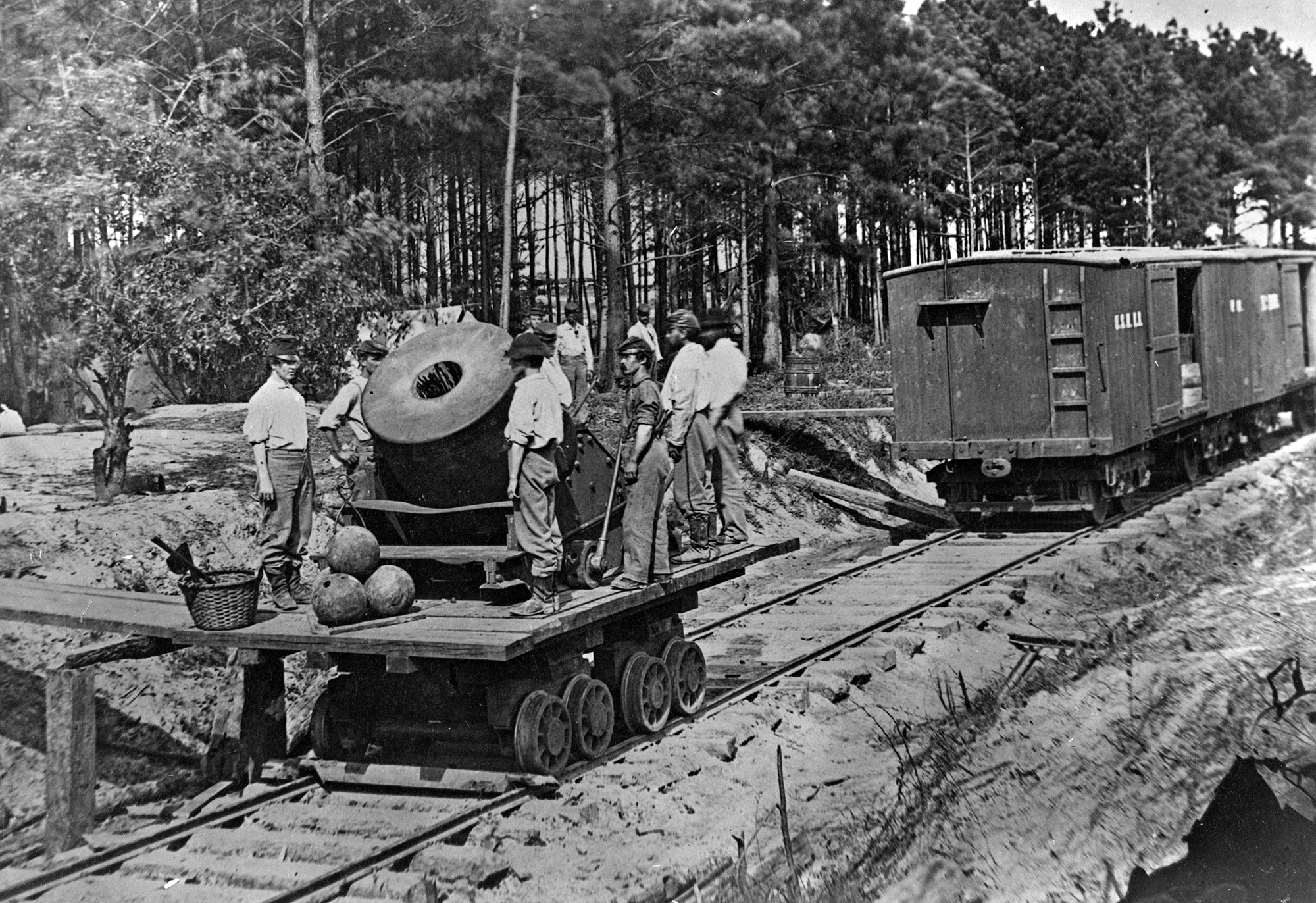
The Dictator, a 13-inch seacoast mortar on a railroad car, near Petersburg, Virginia, 1864. Mortars were not new. Putting one on a flatcar was. American-Rails.com collection.
On this page: At a glance · Two networks · Philippi and First Manassas · The B&O as a battlefield · USMRR, McCallum, Haupt · Gettysburg · Chickamauga both ways · Andrews Raid · Sherman and City Point · Why the Confederacy could not run a railroad war · Maps · What the war made possible
At a glance
| Item | Detail |
|---|---|
| U.S. railroad mileage, 1860 | About 30,600 miles operated (Poor’s / period tables print 30,635). Roughly 21,000–22,000 in Union territory, about 9,000 in the Confederacy. |
| What the numbers hide | The North had the shops, the rail mills, a connected network, and standard gauge on most of it. The South had new mileage (William G. Thomas: a large share built in the 1850s), 5-foot gauge on much of it, and roads that often did not connect even in the same city |
| Law | Act of January 31, 1862 authorized the president to take possession of railroads and telegraphs when required. The United States Military Railroad (USMRR) followed |
| USMRR at war’s end | About 2,105 miles under control; 419 locomotives; 6,330 cars; some 642 miles of track laid or relaid and 26 miles of bridges built or rebuilt; cost on the order of $30 million (NARA / McCallum report tradition) |
| Who ran it | Daniel C. McCallum, military director and superintendent (ex–Erie). Herman Haupt, construction and transportation in Virginia (ex–Pennsylvania Railroad). Haupt was a commissioned colonel, later offered brigadier of volunteers; he would not be bound by the star and left in September 1863 |
| First large troop movement by rail to a battle | Joseph E. Johnston, Manassas Gap Railroad, to First Manassas / First Bull Run, July 1861 |
| Largest rail movements of the war | Longstreet Virginia to Georgia, September 1863 (~12,000–15,000 men, ~900 miles, ~9–12 days). Union XI and XII Corps to Chattanooga immediately after (~20,000–25,000 men, ~1,200 miles, about 11–12 days) |
Figures above are the conventional McCallum / census / campaign numbers. Mileage splits depend on how Kentucky, Missouri, Maryland, and western Virginia are counted. Information compiled September 2, 2026.
Two networks, not one country’s railroad
By 1860 the railroad was no longer a toy. Heavier rail, better bridges, and the need for a true right-of-way were already understood. Poor’s tables put about 30,635 miles in operation. The 1850s had been the building decade everywhere. Thomas’s The Iron Way notes that a large share of Southern mileage when the war broke out, roughly 75%, was completed during the 1850s. New track did not mean a network. Southern roads had been built from plantation districts to ports. They used different gauges. They often failed to connect in the same town. Richmond was served by several companies that did not interchange as a single machine.
The North had something the Confederacy never built: a railroad system. New England and the Midwest were webbed. Shops in Philadelphia, Paterson, and the Massachusetts mill towns could replace what wore out. Prewar annual rail-making capacity is usually given as on the order of 200,000 tons in the North against a small fraction of that in the South. By contrast the Confederacy produced very few rails and locomotives; only Tredegar and a few shops kept busy. They could not replace a war. The North kept rolling mills going. That, more than the raw mile count, is why a wrecked Orange & Alexandria could be put back and a wrecked Western & Atlantic often could not.
Gauge was a weapon the Confederacy used on itself. Five-foot track was common in the Deep South. Standard gauge (4 ft 8½ in) dominated the North and much of Virginia. Longstreet’s men in 1863 would unload and reload because of it. The Southern 5-foot network was not converted to standard until May 1886, a generation later. During the war there was no time, no iron, and no central authority to make it one railroad.
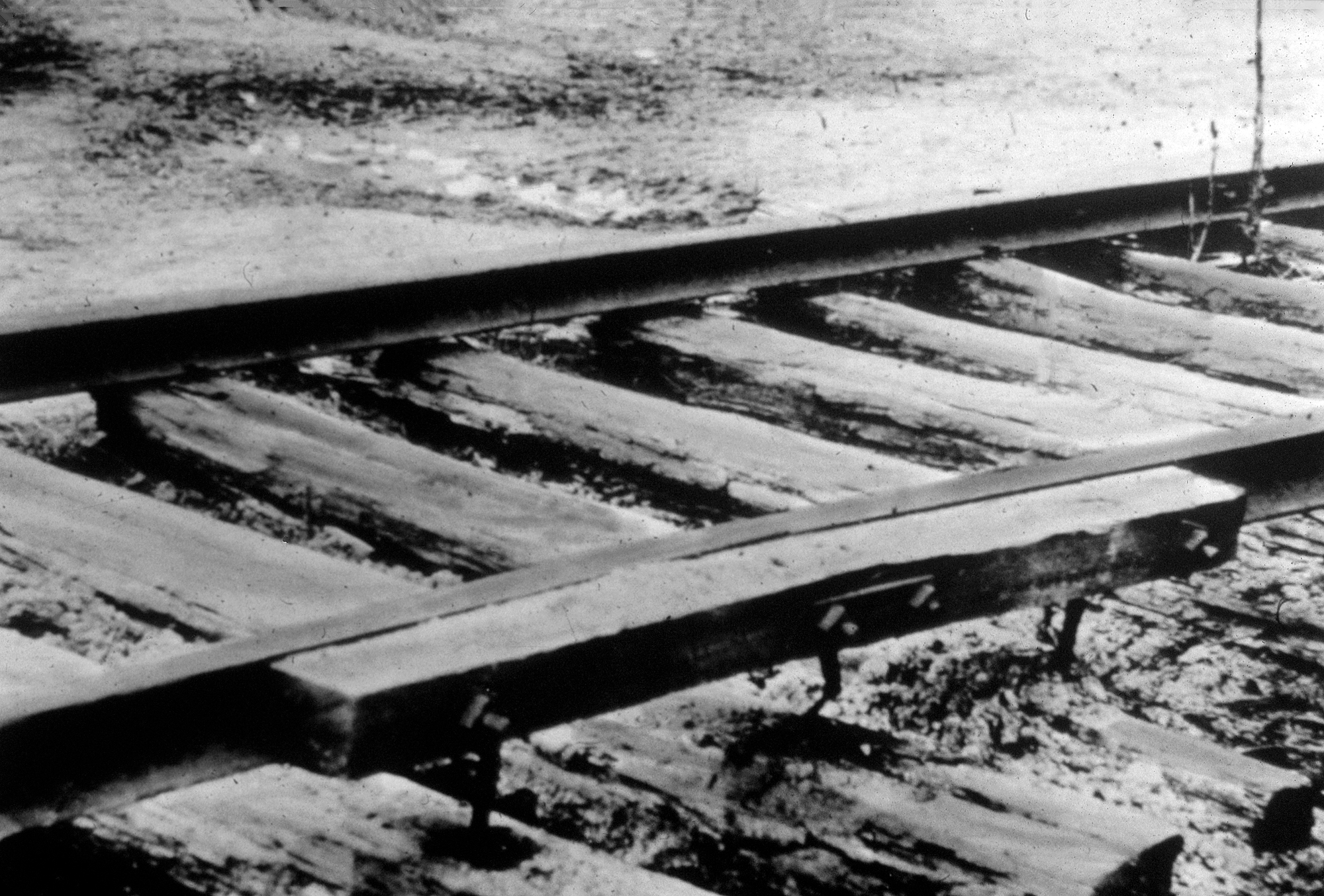
A long timber, roughly 4×4, bolted to adjacent ties and set hard against the outside of a damaged rail. It kept a flange in line until a real rail could be spiked. American-Rails.com collection.
Philippi, then Manassas: the railroad arrives as a weapon
On the night of June 2–3, 1861, Union troops used the Baltimore & Ohio out of Grafton to close on Philippi in western Virginia. The fight on the morning of June 3 was small. The method was not. A railroad had put infantry on a battlefield faster than a road march.
Six weeks later the Confederacy did it at scale. Facing a Union offensive at Manassas Junction, P.G.T. Beauregard needed Joseph E. Johnston from the Shenandoah. Johnston marched to Piedmont Station (today’s Delaplane) on the Manassas Gap Railroad and rode east to the field. It is the first time in history a railroad moved a large force to a battle in time to change it. First Manassas / First Bull Run, July 21, 1861, went Confederate. The meat and flour that later rode that same road earned it the nickname “Meat Line of the Confederacy.” The lesson both sides took home was the same: whoever held the junction held the campaign.
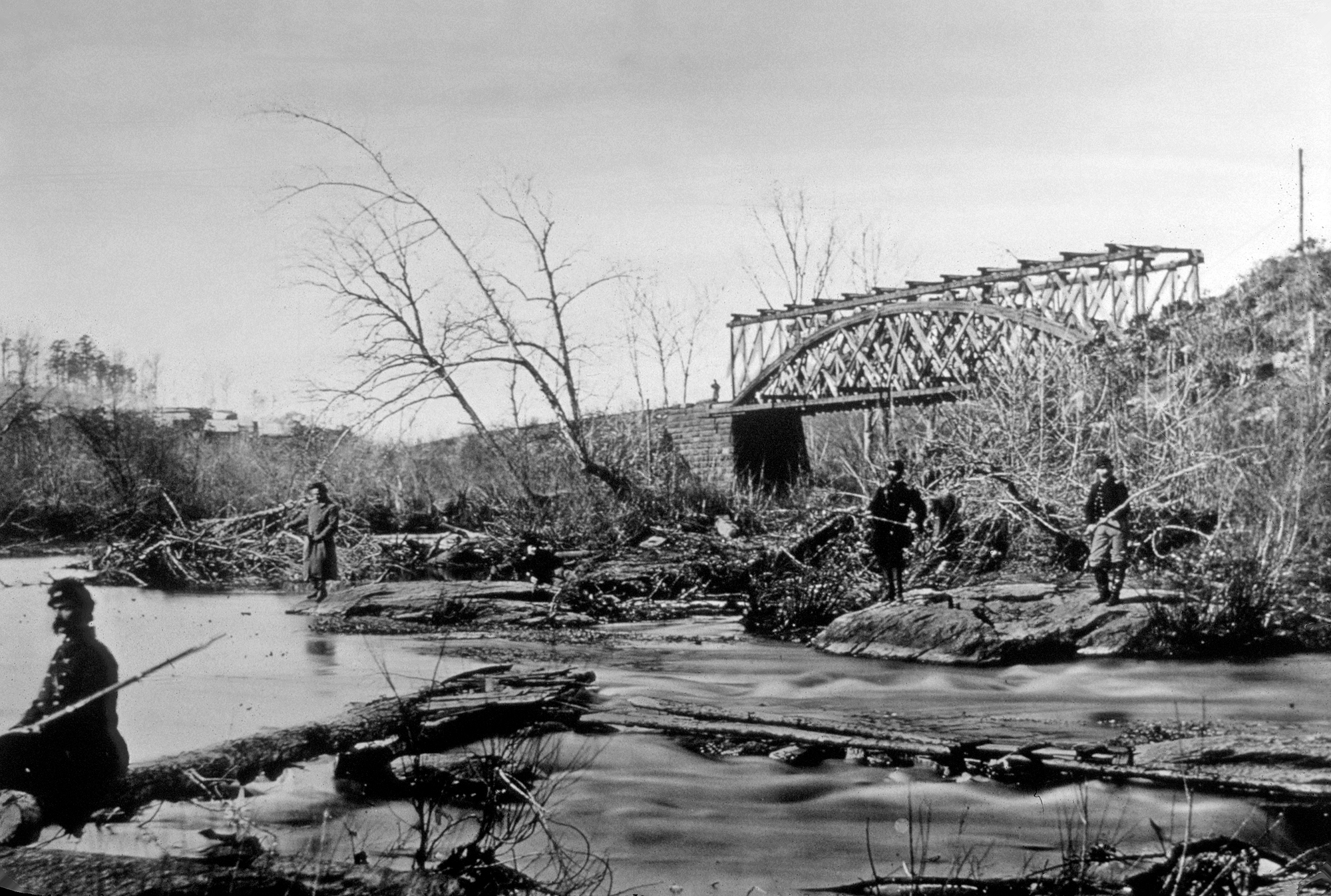
Orange & Alexandria bridge over Bull Run, Virginia, circa 1863. A Haupt truss, posed with Union infantry in the foreground. American-Rails.com collection.
The B&O was a Union railroad in a slave state
The B&O was a Maryland corporation in a slave state that stayed in the Union and became invaluable to the Northern cause. Although it was not a Confederate road its network nevertheless straddled territory with considerable Southern sympathizers. President John W. Garrett’s line was, from the first weeks, the Union’s east–west stem between Washington, Baltimore, and the Ohio River. Confederate cavalry and then Thomas J. Jackson treated it as such. In May–June 1861 Jackson’s men wrecked shops and lifted locomotives at Martinsburg. Later raids kept ripping up the main line in the lower Shenandoah and along the Potomac. Stover’s atlas figure of more than $2.5 million in damage (period dollars) is the usual round number; ten months of repair is the usual recovery. The B&O answered with armored cars—period writers sometimes called a railroad battery a “dry-land Merrimack.” That nickname is period color, not a claim that the car was a copy of CSS Virginia.
The United States Military Railroad
Northern civilian railroads stayed in private hands. They were leaned on, not nationalized the way the United States Railroad Administration would nationalize them in 1917–20. What the Union created in 1862 was a separate War Department agency to run captured lines and to keep the armies in Virginia and the West fed.
Congress on January 31, 1862, authorized Lincoln to take railroads and telegraphs when the safety of the country required it. On February 11, Secretary of War Edwin Stanton named Daniel C. McCallum—architect, engineer, former general superintendent of the Erie—military director and superintendent. McCallum started with about seven miles of the Washington & Alexandria. By Appomattox the USMRR was a 2,000-mile railroad: 419 locomotives, 6,330 cars, hundreds of miles of new or relaid track, 26 miles of bridges, on the order of $30 million spent. McCallum bought and built 312 locomotives and captured 106; he bought 5,111 cars, built 55, and captured 409 (Journal of the American Military History Foundation, 1938, from the official report).
Herman Haupt was the field man in Virginia. Stanton pulled him off the Hoosac Tunnel in April 1862. He was a West Point graduate (1835, age 18) and former chief engineer of the Pennsylvania Railroad. Commissioned colonel and aide to Irvin McDowell, he rebuilt the line toward Fredericksburg in rain with whoever he could find. The signature job was the trestle over Potomac Creek on the Richmond, Fredericksburg & Potomac: about 400 feet long and nearly 80–100 feet high, stood up in nine days (May 6–15, 1862) after Confederates had dropped the 1842 bridge. Lincoln came to look on May 23 and said there was nothing in it but beanpoles and cornstalks. Nevertheless, loaded trains were already crossing the rebuilt structure.
Haupt’s other fight was with Union generals who treated trains like wagons. He got written orders that the railroad was under his control and that no military officer had a right to interfere. A cabinet meeting in September 1862 offered him brigadier general of volunteers. He would not accept pay that tied him to the army; he wanted to keep the Hoosac and his civilian freedom. McCallum stayed the superintendent. Haupt ran Virginia until September 14, 1863, then went home. The Construction Corps he had shaped kept working.
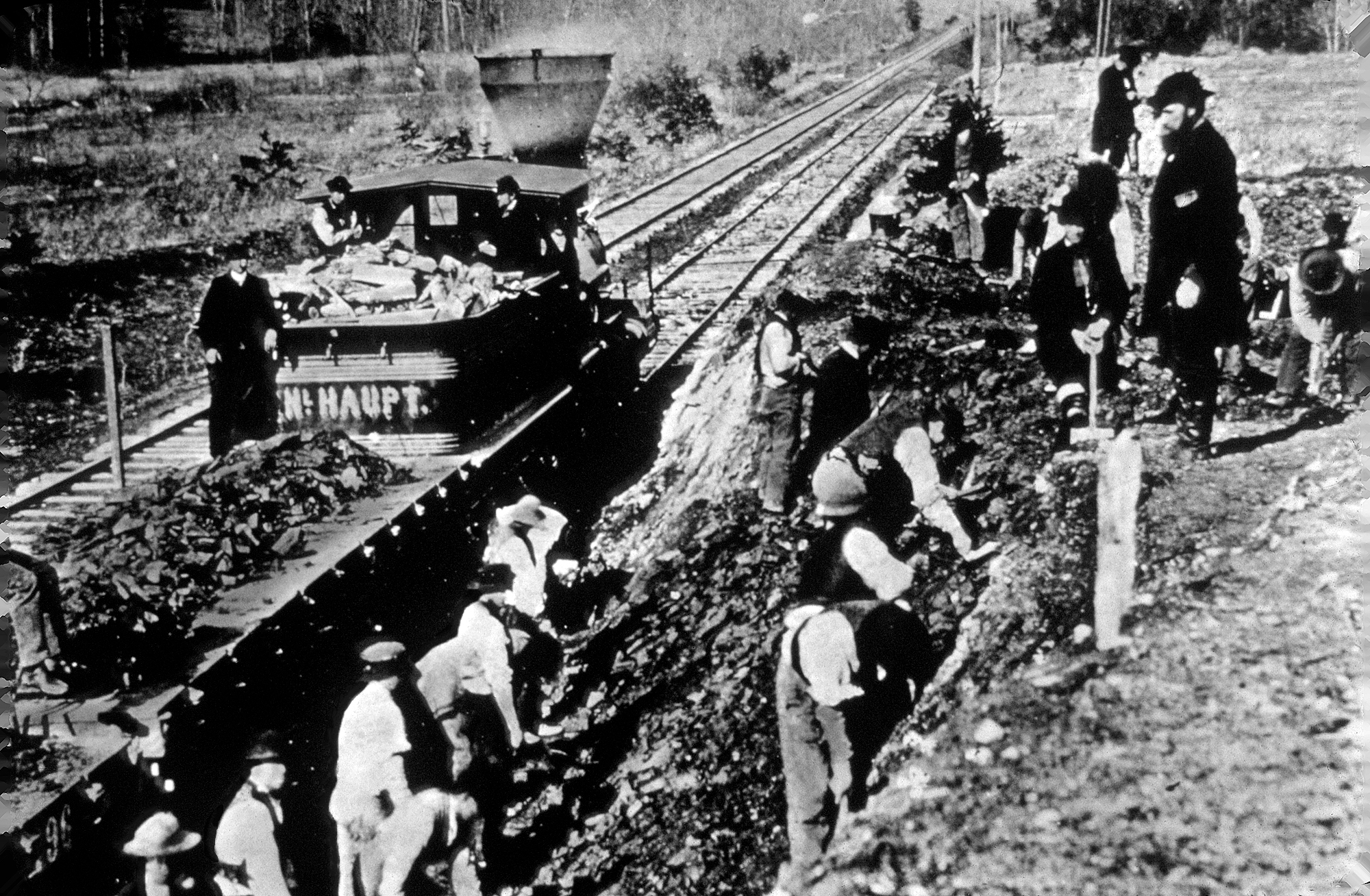
United States Military Railroad forces repairing the Orange & Alexandria near Aquia Creek, outside Fredericksburg, Virginia, 1863. American-Rails.com collection.
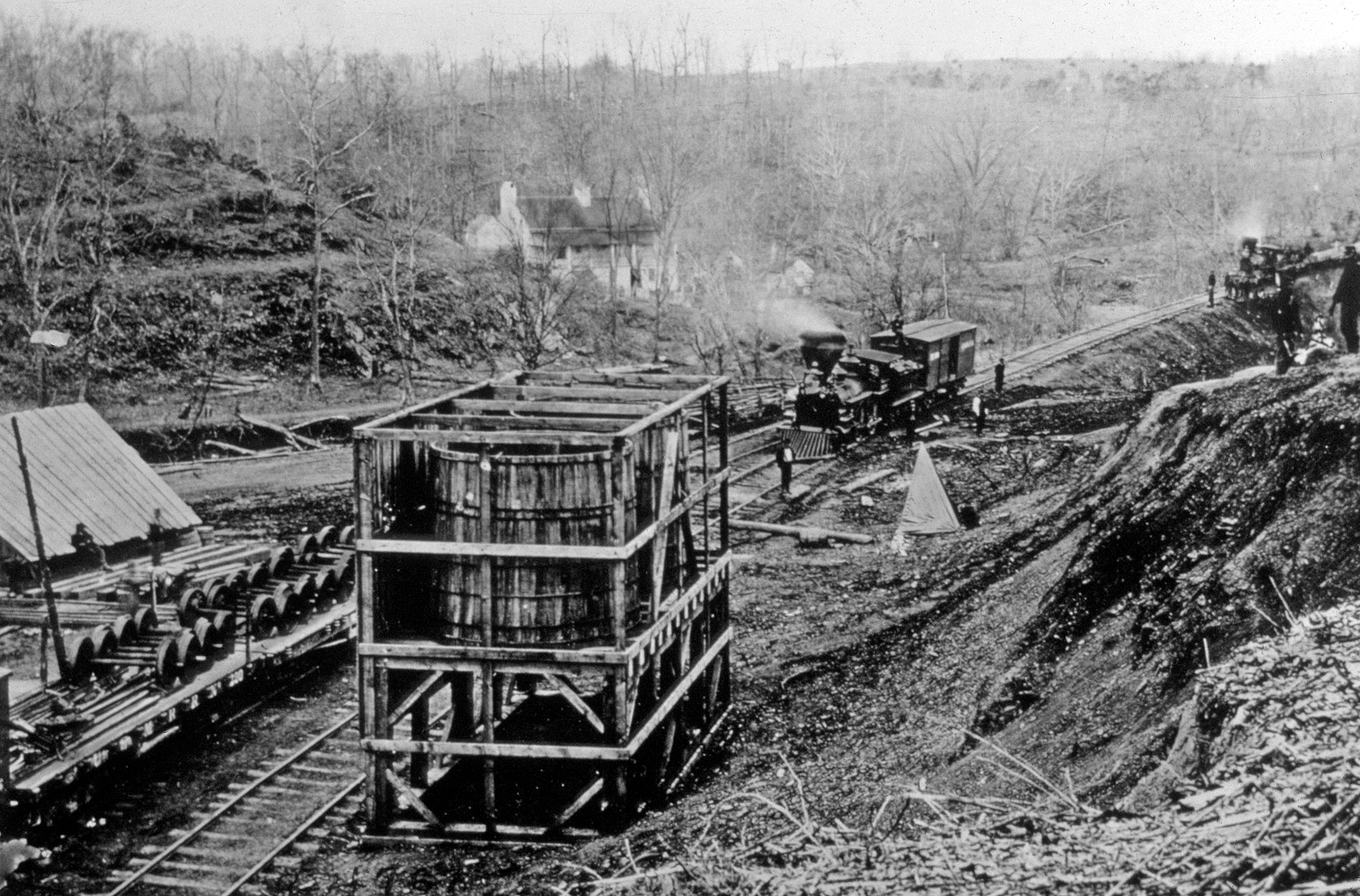
USMRR picking up the pieces after John Pope’s retreat from Second Bull Run, Clifton, Virginia, fall 1862. Two locomotives stand near Union Mills Station. American-Rails.com collection.
Gettysburg was a railroad battle in the rear
Gettysburg was a railroad battle in the rear as much as a fight on Cemetery Ridge. In late June and early July 1863 Haupt shoved supplies toward Meade on the Western Maryland and the connecting laterals, rebuilt what cavalry had torn up, and kept the Army of the Potomac from starving on its own victory. Westminster and the stub lines into Pennsylvania mattered. The Hanover Junction views of November 1863 are a later scene on that same lattice of roads. A man in a top hat in the background has been called Lincoln on the way to the Gettysburg Address. It has never been proved, and most writers now leave it alone. The station is still there.
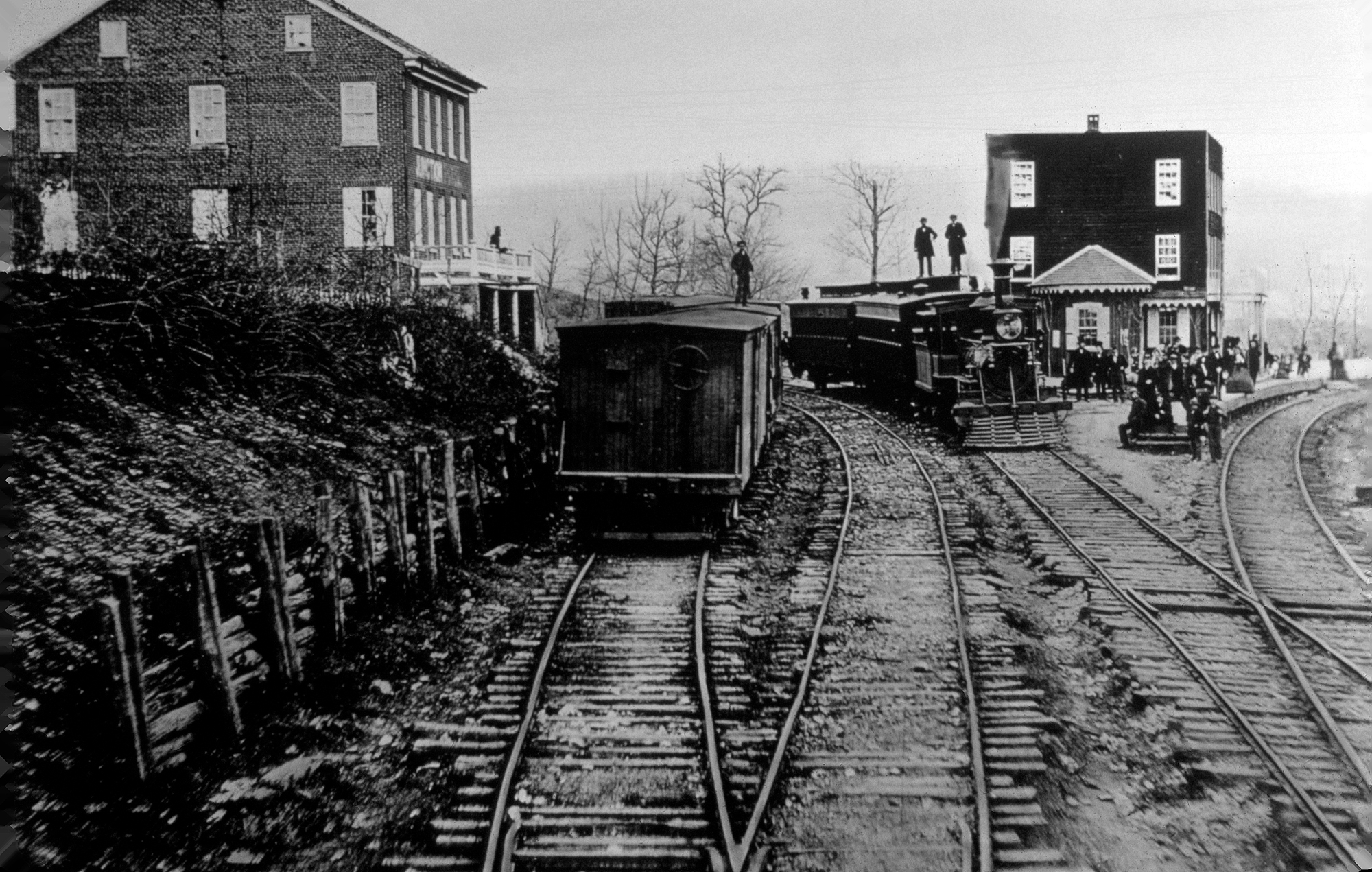
Hanover Junction, Pennsylvania, November 1863. A figure in a top hat has been called Lincoln on the way to Gettysburg. It has never been proved. The station and tracks are still in use. American-Rails.com collection.
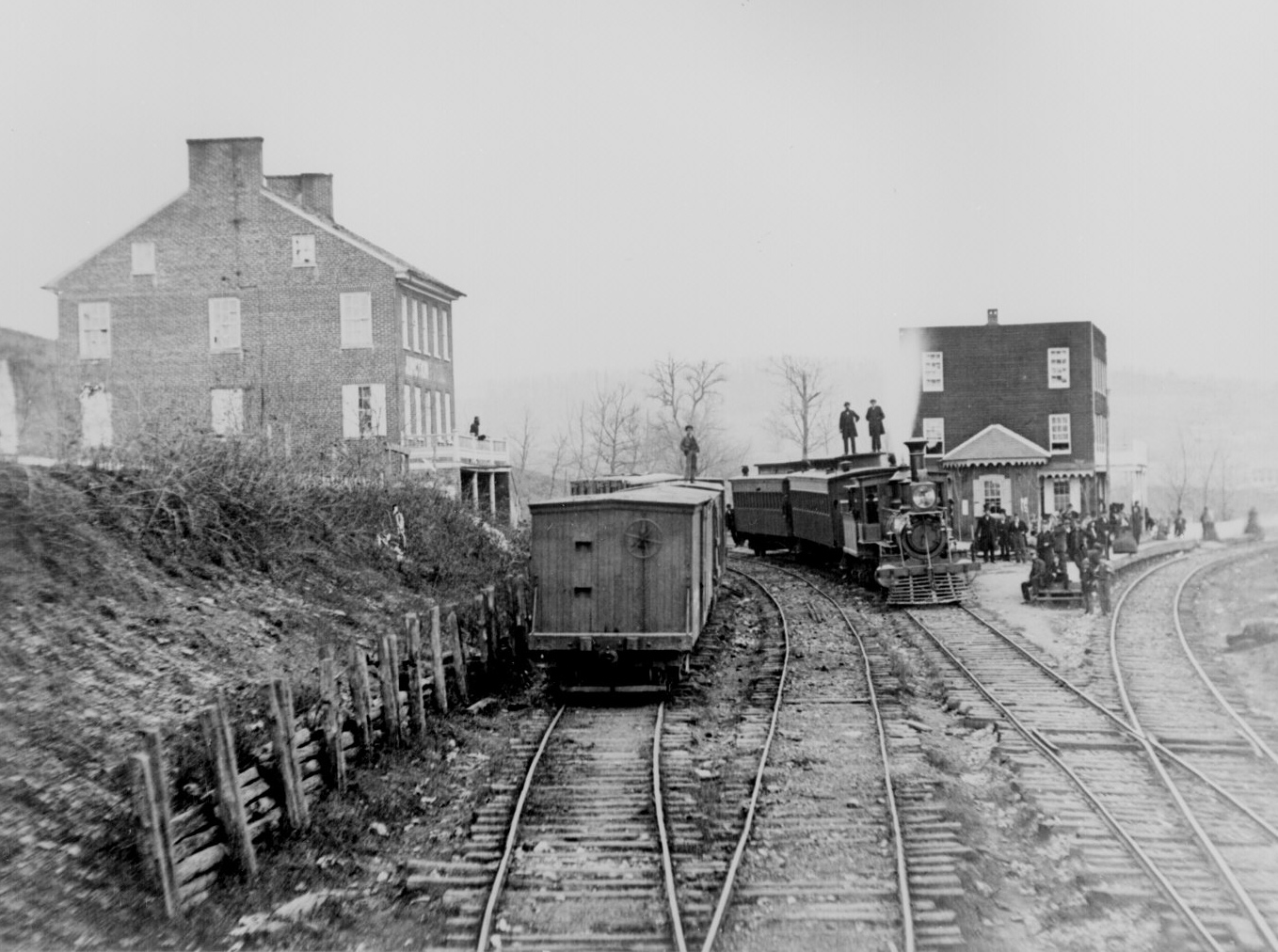
Another view at Hanover Junction, November 1863.
Chickamauga: the Confederacy’s great move, and the Union’s larger answer
In September 1863 James Longstreet took two divisions of the First Corps off the Rapidan and sent them to Braxton Bragg. Union occupation of Knoxville killed the short Virginia–Tennessee route. The detour ran Virginia–Carolinas–Georgia: on the order of 900 miles, sixteen railroad companies, two gauges, and men unloading at every break. Advance brigades left about September 9 and were with Bragg about nine days later. Fair estimates of the force are 12,000 to 15,000. Only part of the infantry, and none of the artillery, made the Battle of Chickamauga. Longstreet himself missed the first day. Five brigades (about 9,000) were on the field September 20 when the Union line broke. The main battle is September 19–20, with contact on the 18th—not a three-day set-piece.
The Union answer was bigger. After Rosecrans fell back into Chattanooga, Stanton asked McCallum how fast two corps of the Army of the Potomac could go west. McCallum said days, not weeks. The XI and XII Corps—on the order of 20,000 to 25,000 men—rode about 1,200 miles via Indianapolis and Louisville. Last units were in the Chattanooga theater in about eleven or twelve days. It was, at the time, the largest military rail movement in history, North or South. Railroad interior lines worked for both sides. The side with shops and a superintendent could do it twice.
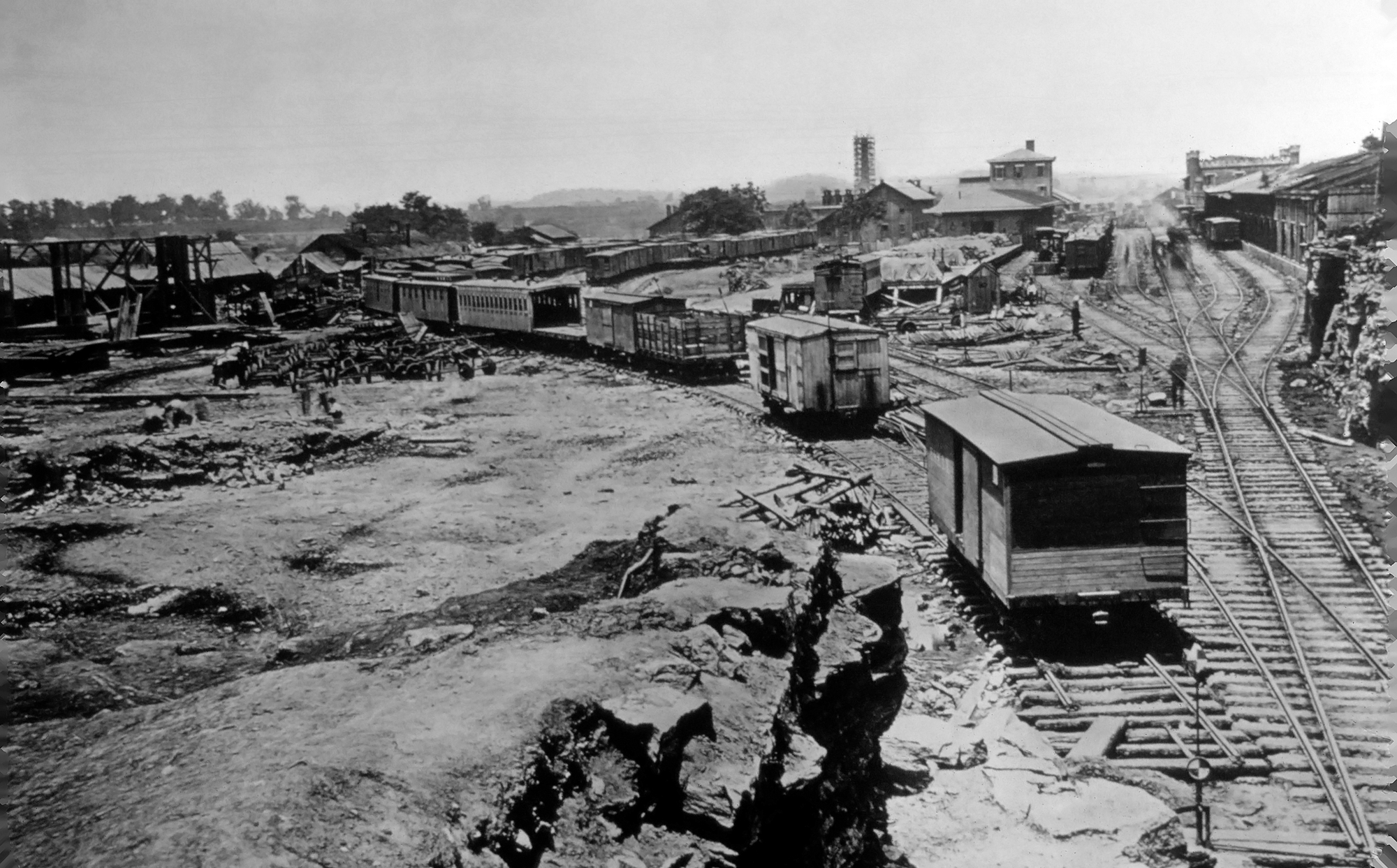
Nashville & Chattanooga Railroad yard and station, Nashville, Tennessee, March 1864. After Chickamauga this was Union supply country. American-Rails.com collection.
The General - Stolen at Big Shanty
The most famous railroad day of the war is still April 12, 1862. James J. Andrews, a civilian scout, and volunteers from Ohio regiments (twenty-four men in the party, two of them civilians) rode a northbound Western & Atlantic train from Marietta to the breakfast stop at Big Shanty (today’s Kennesaw), which had no telegraph. They uncoupled the passenger cars and took the 4-4-0 General, a tender, and three empty boxcars north, cutting wire and trying to burn bridges toward Chattanooga. Conductor William Fuller ran after them on foot, then a pole car, then the locomotives Yonah, William R. Smith, and finally Texas running in reverse. About seven hours and nearly ninety miles later the General died north of Ringgold.
All the raiders were taken. Andrews and seven others were hanged as spies. The soldiers among the survivors became the first men awarded the Medal of Honor (Jacob Parrott first, March 25, 1863). Andrews and William Campbell, civilians, were not eligible. Twenty-one of twenty-four participants eventually received the medal, two of them as late as 2024. Militarily the raid failed. Chattanooga did not fall in 1862. The Western & Atlantic was running again in days.
Sherman, wrecking, and City Point
By 1864 the Union was using railroads as both a supply line and a weapon against the Confederate landscape. William T. Sherman’s Atlanta campaign lived on the Western & Atlantic as it had been rebuilt behind him. When he left Atlanta for the sea, his men made Sherman’s neckties: rails heated and twisted around trees so they could not be spiked again. John Hankey’s point in Trains still holds: almost every major campaign sat on a junction.
Grant’s Petersburg siege sat on one too. City Point, where the James meets the Appomattox, became a USMRR port and railhead in 1864–65. McCallum’s people turned the east end of the South Side Railroad into an intermodal yard for an army. The 4-4-0 President in the photograph below is that place. The Dictator, the 13-inch mortar on a flatcar, is the same siege.
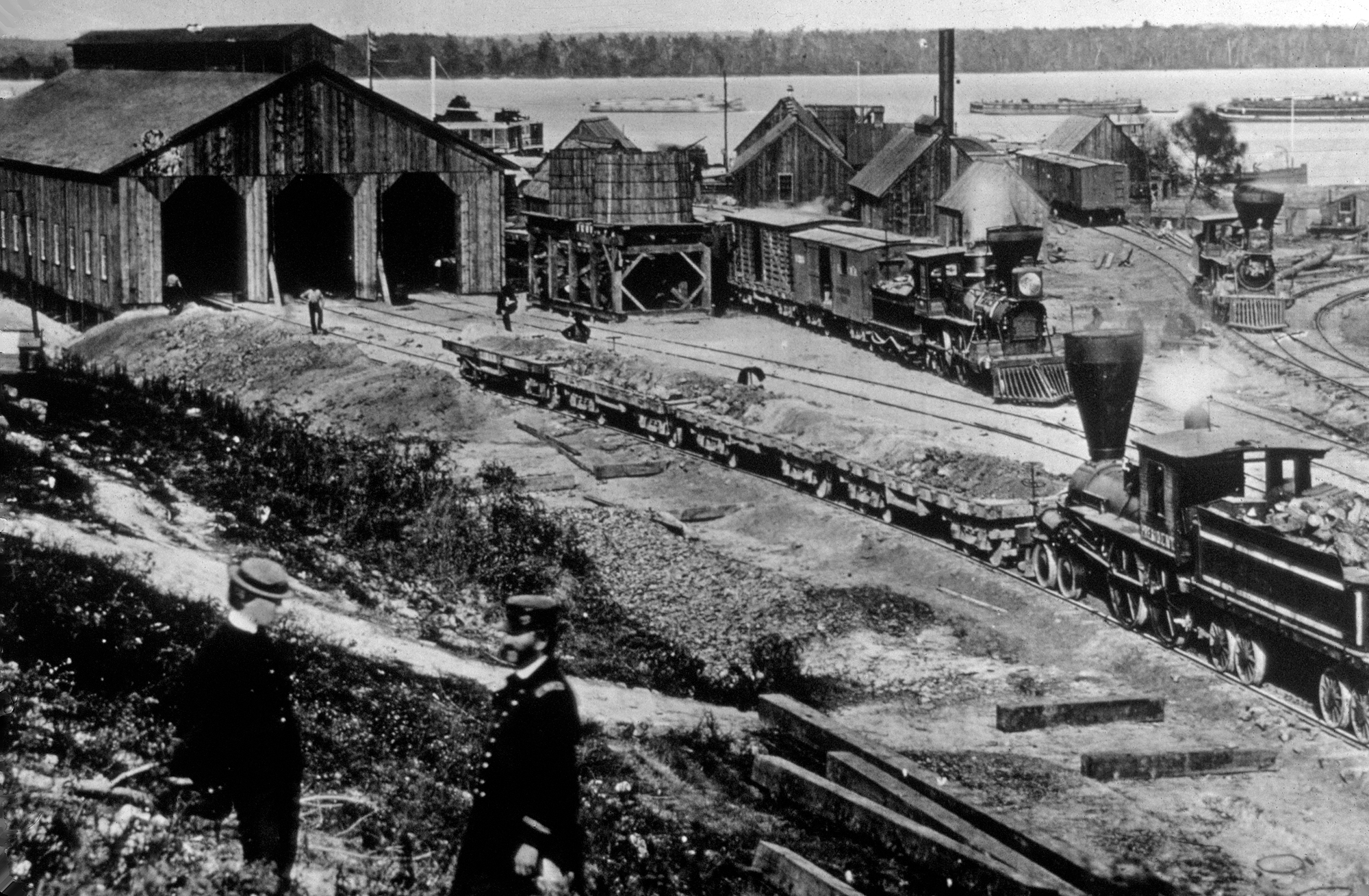
USMRR yard and engine house at City Point, Virginia, 1864–65, during the Petersburg campaign. The 4-4-0 in the foreground is President. American-Rails.com collection.
Why the Confederacy could not run a railroad war
Southern soldiers used trains well when a general seized a road for a week. Johnston at Manassas, Longstreet to Georgia, the defense of Atlanta all prove it. What the Confederacy never built was a McCallum. States’ rights meant companies, gauges, and governors. Civilian traffic kept priority longer than it should have. There was no equivalent of the USMRR Construction Corps with a rail mill behind it. Iron went to Tredegar for guns. Worn 50- and 60-pound rail stayed in the track. Period writers remembered a pair of new iron wheels at about $15 in 1861 and $500 in 1865; the exact invoices vary, but inflation plus scarcity is the point. By 1865 many Confederate railroads were militarily useless—not because Southerners never understood trains, but because they understood them too late, and because Union cavalry and construction gangs had already been over the same miles.
The Louisville & Nashville was fought over as often as any road in Kentucky and Tennessee. It was not uniquely the “most destroyed railroad of the war”; the Orange & Alexandria, the Virginia Central, and the Western & Atlantic could file the same claim. Drop the superlative. Keep the fact that a border railroad in the western theater was a prize, not a spectator.
Hankey’s counterfactual—that the Union might have lost the war by losing one campaign—is a magazine close, not a railroad fact. Lincoln’s determination and Grant’s arrival matter. So does a 2,000-mile military railroad that could put a bridge over Potomac Creek in nine days.
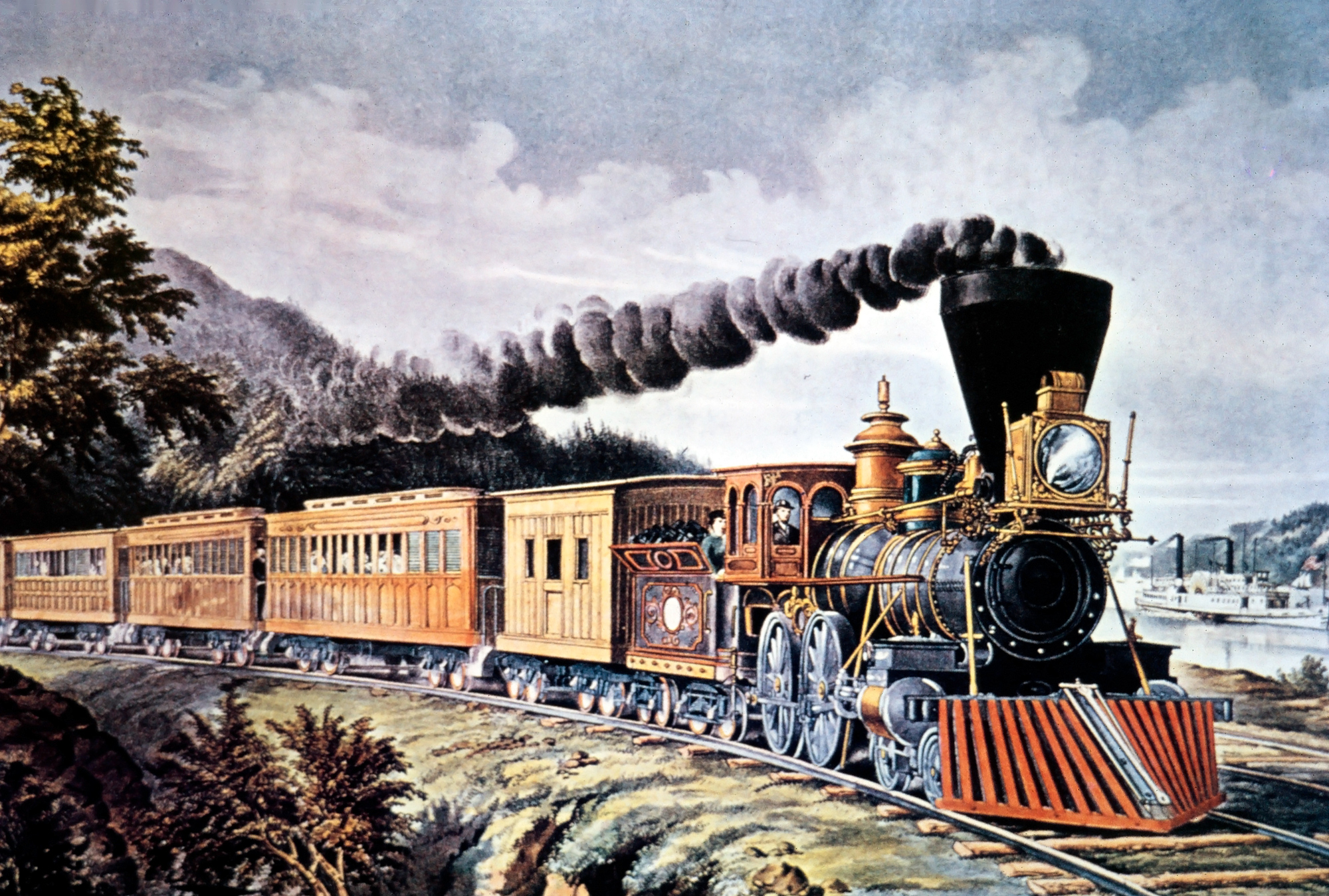
“American Express Train,” Currier & Ives, 1864. Later used on the jacket of Railroads in the Days of Steam (1960). American-Rails.com collection.
Maps
The three maps already on this page feature the nation's rail newtork during the war. James T. Lloyd’s 1861 sheet is the railroad United States at the outbreak. Julius Bien’s 1866 sheet is the USMRR as McCallum wanted it remembered—his name is on it. The 1869 Official Guide plate is the country four years after Appomattox, with the first transcontinental in and the war’s wreckage not yet all spiked back. They are Library of Congress / period items. Click through; they are large.
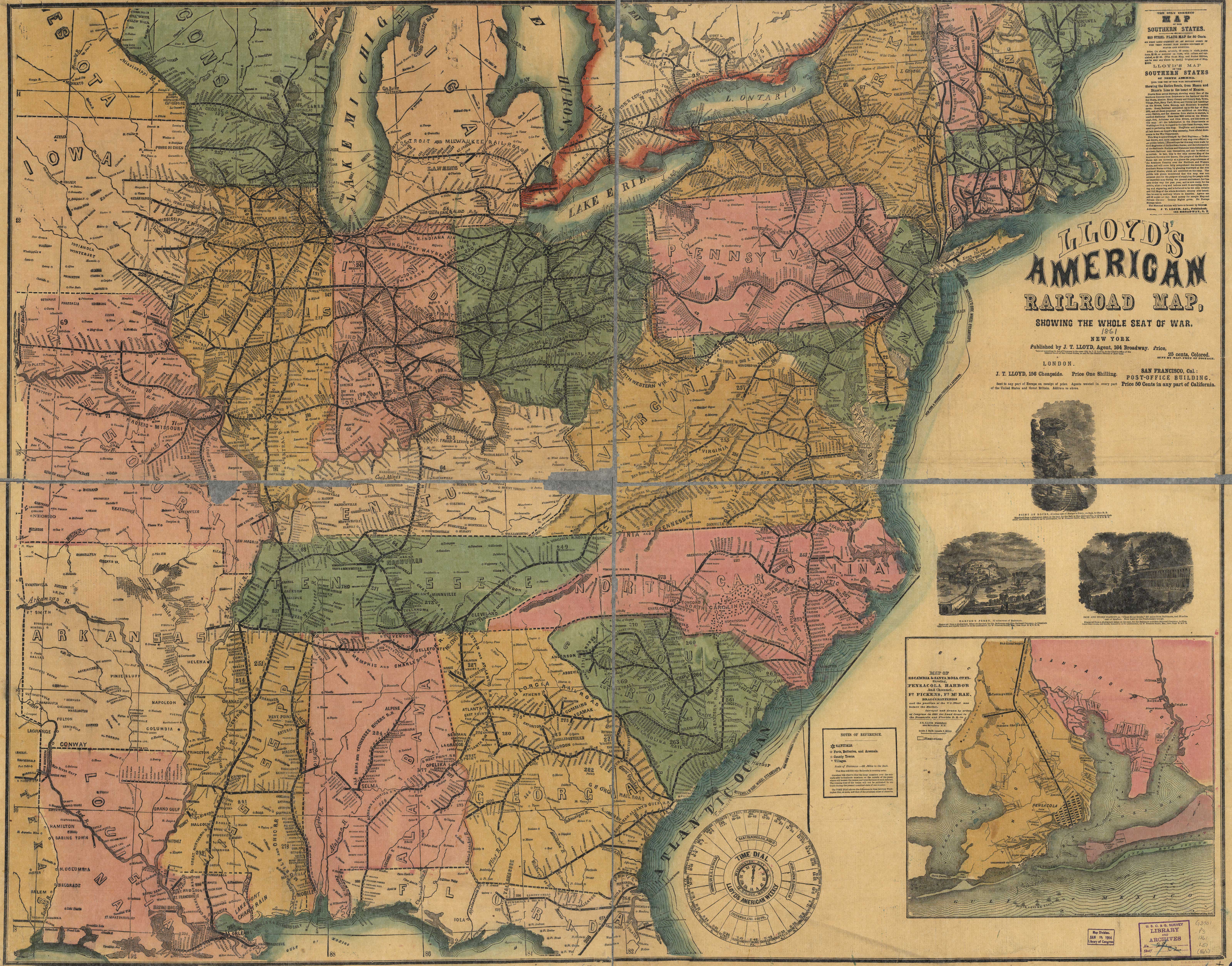
Railroads of the United States, 1861. James T. Lloyd. Library of Congress.
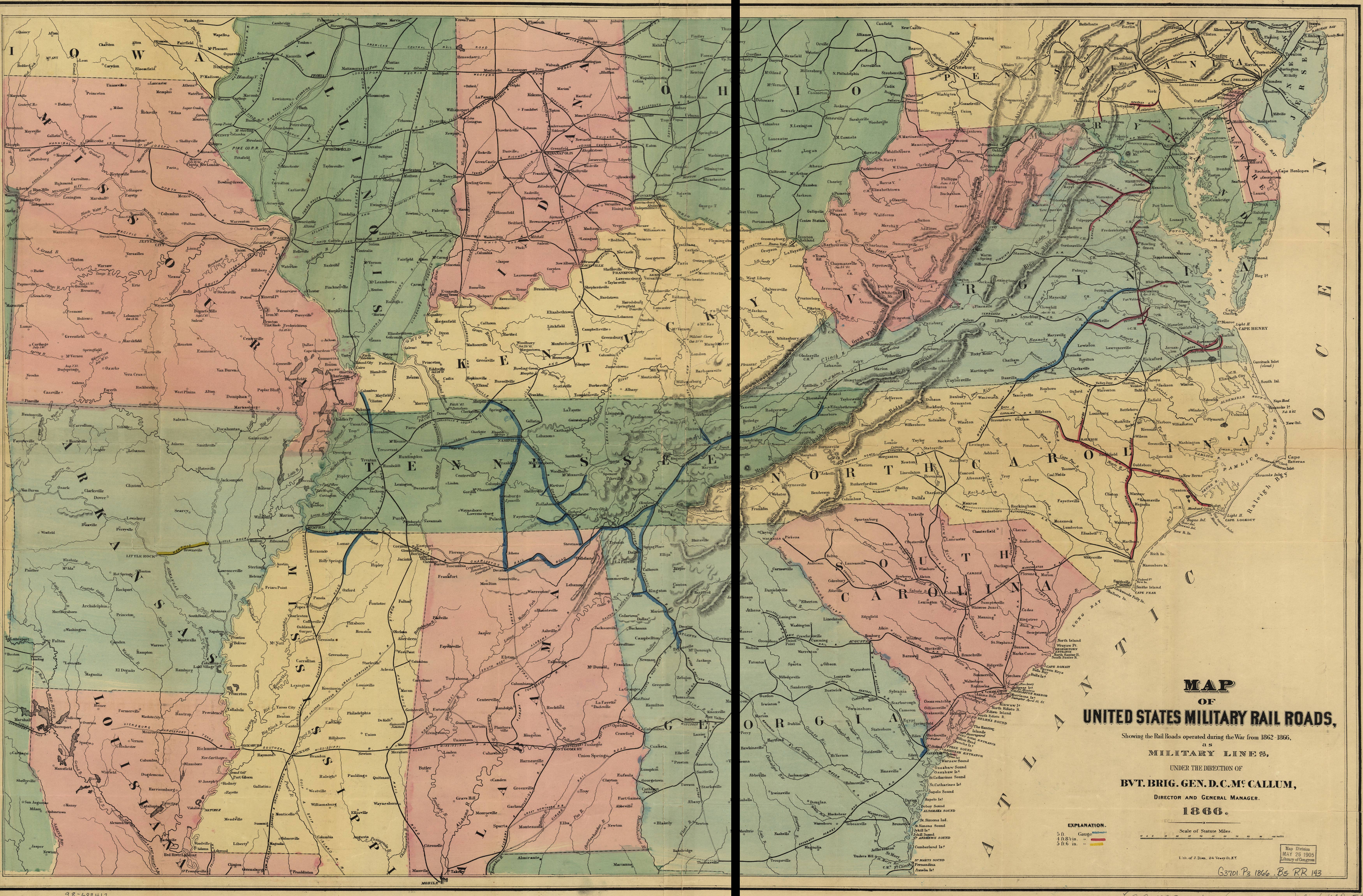
United States Military Railroads, 1866. Julius Bien. McCallum’s name is on the sheet. Library of Congress.
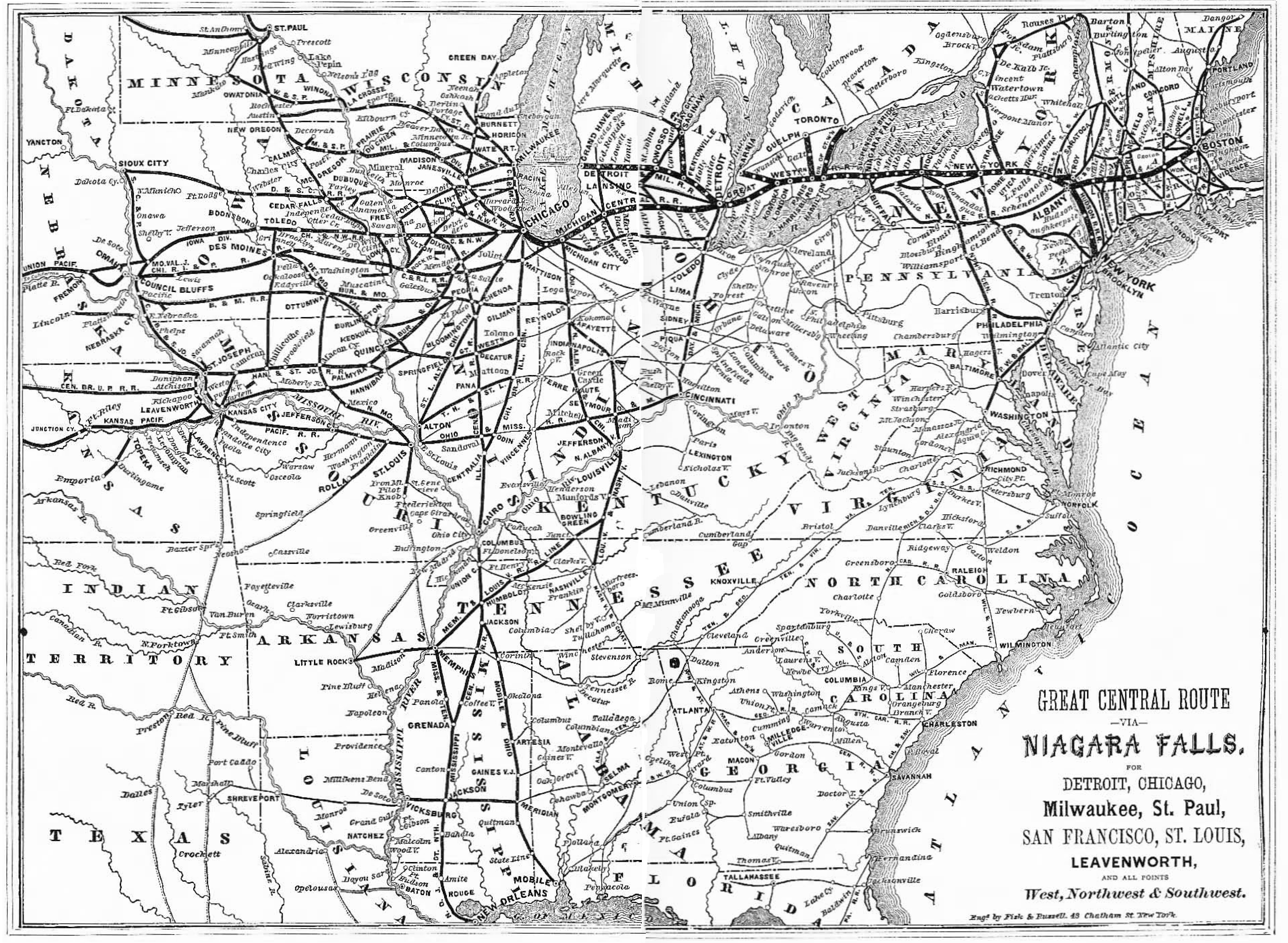
United States railroads, circa 1869, from the 1870 Official Guide of the Railways. American-Rails.com collection.
What the war made possible
Secession took Southern votes out of Congress. The Pacific Railway Act of July 1, 1862, could pass on a central route from the Missouri at Omaha / Council Bluffs toward San Francisco—the surveys Jefferson Davis had run as secretary of war in 1853–55 no longer had to satisfy a slaveholding caucus. Ground was broken during the war; the golden spike at Promontory was May 10, 1869. A second act on July 2, 1864, chartered the Northern Pacific. That road was not finished until 1883.
What the war itself taught American railroading was organization: a superintendent who could tell a major general no, a construction corps that owned a schedule, and the idea that a military railroad was a system, not a pile of cars. John Hankey has argued that the USMRR at Appomattox already looked like a 1920s Class I. That is the line from Potomac Creek to the twentieth century.
Related Reading on American-Rails.com
Sources
- Daniel C. McCallum, official USMRR report (end-of-war mileage, power, and cost; NARA summary in Prologue, Summer 2011)
- John P. Hankey, “The Railroad War: How the Iron Road Changed the American Civil War,” Trains, March 2011; and “A New Look at Civil War Railroading,” Trains, May 2025 (Potomac Creek, USMRR as a Class I, City Point)
- William G. Thomas, The Iron Way: Railroads, the Civil War, and the Making of Modern America (Yale, 2011)
- George Edgar Turner, Victory Rode the Rails (Bobbs-Merrill, 1953)
- Thomas Weber, The Northern Railroads in the Civil War, 1861–1865 (Columbia, 1952)
- Robert C. Black III, The Railroads of the Confederacy (UNC Press, 1952)
- John F. Stover, The Routledge Historical Atlas of the American Railroads (1999)
- “United States Military Railroads, 1862–1865,” Journal of the American Military History Foundation 2 (1938): locomotives purchased 312 / captured 106; cars 5,111 / 55 / 409
- National Park Service, Chickamauga & Chattanooga historical handbook: Longstreet’s move, ~15,000, sixteen roads, gauges
- American Battlefield Trust / U.S. Army Medal of Honor accounts: Andrews Raid, Big Shanty, Yonah / William R. Smith / Texas, first Medals of Honor
- Poor’s / period mileage tables: 30,635 miles operated, 1860
- Mike Schafer, Classic American Railroads (MBI, 1996)
- Rosemary Entringer, “The Great Locomotive Chase,” Trains, May 1956
Maps on this page are period Library of Congress / Official Guide items. City Point, Hanover Junction, and the Dictator photographs are wartime views.
Recent Articles


-
Pennsylvania Railroad Museums (2026): A Complete Guide
Oct 06, 26 12:09 AM
 Pennsylvania railroad museums—Strasburg, Steamtown, the Horseshoe Curve, the East Broad Top, and the depots and towers in between. Confirm hours on each site.
 -
Maryland Railroad Museums (2026): A Complete Guide
Oct 05, 26 11:53 PM
 Maryland railroad museums—the Baltimore roundhouse, Ellicott City station, Bowie, Gaithersburg’s Buffalo Creek & Gauley 14, and the Western Maryland collections.
 -
Ohio Railroad Museums (2026): A Complete Guide
Oct 05, 26 05:51 PM
 Ohio railroad museums—the Age of Steam Roundhouse, Bellevue, Worthington, Conneaut’s Nickel Plate 755, and the Dennison depot. Confirm hours on each site.
 -
Delaware Railroad Museums (2026): A Complete Guide
Oct 05, 26 02:43 PM
 Delaware railroad museums—Wilmington & Western at Greenbank, the Harrington tower and N5 caboose, Felton's 1868 depot, and the Selbyville station museum.
 -
C&O's M-1 Steam Turbine Locomotives: Specs, Roster, History
Oct 05, 26 12:13 PM
 Chesapeake & Ohio Class M-1 steam-turbine-electrics. Three Baldwin-Westinghouse locomotives, 500–502, built 1947–48 for The Chessie. Specs, the 2-C1+2-C1-B arrangement, and a roster. All scrapped…
 -
N&W 2-6-6-2 Locomotives (Class Z): Specs, Roster, History
Oct 05, 26 11:44 AM
 Norfolk & Western Class Z 2-6-6-2s. One hundred ninety compound Mallets, 1300–1489, from Richmond, Baldwin, and Schenectady, 1912–1918. Diagram specs, the Z-1b rebuilds, Z-2 1399, and a roster. No…
 -
Scenic Train Rides (USA 2026): State Guide to Tourist Railroads
Oct 04, 26 12:17 AM
 Scenic and tourist train rides in all 50 states for 2026. Colorado narrow gauge, Pennsylvania steam, Alaska’s White Pass, and the states with no full-size ride this month. Confirm on the railroad.
 -
Wyoming Scenic Train Rides (2026): A Complete Guide
Oct 03, 26 12:07 AM
 Wyoming has no full-size tourist railroad on the calendar in October 2026. Cheyenne Depot Museum and Douglas Railroad Museum are static. Union Pacific 4014’s posted public trip is a November run to De…
 -
Washington Scenic Train Rides (2026): A Complete Guide
Oct 02, 26 11:53 PM
 Washington tourist trains in 2026—Mount Rainier Scenic at Elbe, the Northwest Railway Museum, and Chehalis-Centralia. Lake Whatcom has no 2026 date on its ticket page.
 -
Wisconsin Scenic Train Rides (2026): A Complete Guide
Oct 02, 26 11:48 PM
 Wisconsin tourist trains in 2026—Wisconsin Great Northern, Osceola & St. Croix Valley, Mid-Continent, East Troy, and the National Railroad Museum.
 -
Pennsylvania Railroad Class Q2 4-4-6-4: Specs, Roster, History
Oct 02, 26 11:28 PM
 Pennsylvania Railroad Class Q2 4-4-6-4 duplexes. Twenty-six engines, 6131 and 6175–6199, Altoona 1944–45. Form 109-J specs, the 7,987 hp test of 6175, and a roster. All scrapped.
 -
Utah Scenic Train Rides (2026): A Complete Guide
Oct 02, 26 11:18 PM
 Utah tourist trains in 2026—Heber Valley Railroad from Heber City. Golden Spike at Promontory is a locomotive demonstration, not a line-haul ride.
 -
South Dakota Scenic Train Rides (2026): A Complete Guide
Oct 02, 26 11:06 PM
 South Dakota’s 2026 scenic train is the Black Hills Central 1880 Train, Hill City to Keystone. Steam is the summer assignment. Confirm the engine.
 -
Oregon Scenic Train Rides (2026): A Complete Guide
Oct 02, 26 11:04 PM
 Oregon tourist trains in 2026—Oregon Coast Scenic from Rockaway Beach, Mount Hood at Hood River, Eagle Cap from Elgin, and the Oregon Rail Heritage Center in Portland.
 -
Oklahoma Scenic Train Rides (2026): A Complete Guide
Oct 02, 26 10:36 PM
 Oklahoma has no full-size scenic railroad on an October 2026 calendar. Oklahoma Railway Museum Halloween and Polar trains, the El Reno trolley, and the Heartland Flyer.
 -
North Dakota Scenic Train Rides (2026): A Complete Guide
Oct 02, 26 01:14 PM
North Dakota has no tourist railroad on a 2026 calendar. Ride Amtrak’s daily Empire Builder. The Fort Lincoln Trolley in Mandan is not a current ticket. -
Nebraska Scenic Train Rides (2026): A Complete Guide
Oct 02, 26 10:11 AM
 Nebraska has no full-size scenic railroad in 2026. The Omaha Zoo Railroad runs weekends through October 4. Ride Amtrak’s California Zephyr across the state.
 -
Missouri Scenic Train Rides (2026): A Complete Guide
Oct 02, 26 09:56 AM
 Missouri tourist trains in 2026—Branson Scenic Railway and the St. Louis, Iron Mountain & Southern at Jackson. Belton has no 2026 schedule posted.
 -
Minnesota Scenic Train Rides (2026): A Complete Guide
Oct 02, 26 09:52 AM
 Minnesota tourist trains in 2026—North Shore Scenic Railroad in Duluth, the Duluth River Train, and the Como-Harriet streetcar.
 -
Kansas Scenic Train Rides (2026): A Complete Guide
Oct 02, 26 09:32 AM
 Kansas tourist trains in 2026—the Abilene & Smoky Valley Railroad. Santa Fe 3415 is in overhaul. Midland Railway at Baldwin City is closed.
 -
Iowa Scenic Train Rides (2026): A Complete Guide
Oct 02, 26 08:41 AM
 Iowa tourist trains in 2026—Boone & Scenic Valley across the Bass Point Creek High Bridge, and Midwest Central’s December North Pole trains
 -
Indiana Scenic Train Rides (2026): A Complete Guide
Oct 02, 26 08:35 AM
 Indiana tourist trains in 2026—French Lick Scenic Railway, Nickel Plate Express, Hoosier Valley, and Hesston. Whitewater Valley is suspended.
 -
Illinois Scenic Train Rides (2026): A Complete Guide
Oct 02, 26 12:28 AM
 Illinois tourist trains in 2026—Illinois Railway Museum, Monticello Railway Museum, Fox River Trolley, and Silver Creek & Stephenson.
 -
Texas Scenic Train Rides (2026): A Complete Guide
Oct 02, 26 12:14 AM
 Texas tourist trains in 2026—Texas State Railroad, Grapevine Vintage Railroad, Austin Steam Train's Hill Country Flyer, and the Galveston Railroad Museum.
 -
Tennessee Scenic Train Rides (2026): A Complete Guide
Oct 02, 26 12:03 AM
Tennessee tourist trains in 2026—Tennessee Valley Railroad Museum, Dollywood Express, Three Rivers Rambler Christmas trains, and the Tennessee Central Railway Museum. -
South Carolina Scenic Train Rides (2026): A Complete Guide
Oct 01, 26 11:52 PM
 South Carolina's tourist train is the South Carolina Railroad Museum in Winnsboro—Blue Granite Express, pumpkin trains, and Santa trains on the old Rockton & Rion.
 -
Mississippi Scenic Train Rides (2026): A Complete Guide
Oct 01, 26 11:38 PM
 Mississippi has no regular tourist railroad in 2026. Ride Amtrak through the state, or book the excursion lines in Alabama, Tennessee, Louisiana, or Arkansas.
 -
Louisiana Scenic Train Rides (2026): A Complete Guide
Oct 01, 26 02:52 PM
 Louisiana has no regular full-size tourist railroad in 2026. New Orleans Polar Express returns December 11–31. Museums at Long Leaf, DeQuincy, and Jackson.
 -
Kentucky Scenic Train Rides (2026): A Complete Guide
Oct 01, 26 02:45 PM
 Kentucky tourist trains in 2026—Big South Fork Scenic Railway, Bluegrass Scenic Railroad, Kentucky Railway Museum, and My Old Kentucky Dinner Train.
 -
Georgia Scenic Train Rides (2026): A Complete Guide
Oct 01, 26 02:27 PM
 Georgia tourist trains in 2026—Blue Ridge Scenic Railway, SAM Shortline, Azalea Sprinter, Savannah shop rides, and what to confirm at Stone Mountain.
 -
Arkansas Scenic Train Rides (2026): A Complete Guide
Oct 01, 26 01:02 PM
 Arkansas tourist trains in 2026—Arkansas & Missouri through the Boston Mountains, and the Eureka Springs & North Arkansas dinner and excursion trains.
 -
Alabama Scenic Train Rides (2026): A Complete Guide
Oct 01, 26 12:59 PM
Alabama tourist trains in 2026—Heart of Dixie Railroad Museum at Calera, North Alabama Railroad Museum at Chase, and the Wales West Light Railway at Silverhill. -
The Circus Train: How Such Attractions Reached Distant Cities
Oct 01, 26 12:22 PM
 How circuses moved by rail: Coup's 1872 flats, the Ringling train's sections and car counts, the 1918 Hammond wreck, and the last show on May 21, 2017.
 -
West Virginia Halloween Train Rides (2026)
Oct 01, 26 12:19 PM
 2026 West Virginia Halloween train. Cass Scenic Halloween Train, October 30 and 31, steam, 5:00 p.m. from Cass Depot. Adult $75. About two hours to Whittaker. Family ride.
 -
Wisconsin Halloween Train Rides (2026)
Oct 01, 26 12:11 PM
2026 Wisconsin Halloween trains. Mid-Continent Pumpkin Special October 24–25, adult $24, pumpkins extra. Halloween Flyer October 24 at 4:30 p.m., adult $30. Osceola Pumpkin Express boards in Osceola… -
Utah Halloween Train Rides (2026)
Oct 01, 26 12:00 PM
 2026 Utah Halloween trains at Heber Valley Railroad. Pumpkin Train, about 40 minutes, with a cookie and a pumpkin. Halloween Express, about 90 minutes to Grim Hollow, Monday, Thursday, and Friday even…
 -
Texas Halloween Train Rides (2026)
Oct 01, 26 11:28 AM
 2026 Texas Halloween train. Texas State Railroad Spooky Special, adult-only, October 24. Boards Palestine at 5:00 p.m. About five hours to Rusk and back. Dinner on the grounds. Not steam. No fare on t…
 -
Tennessee Halloween Train Rides (2026)
Oct 01, 26 12:15 AM
 2026 Tennessee Halloween trains. Tennessee Valley Railroad Museum Rails, Wizards & Spells, selected days September 18 through October 25, from $35, about 2.5 hours. Spells & Potions tea from $60. The…
 -
Frisco's "Firefly" (Train): Consist, Route, Timetable
Sep 30, 26 11:37 PM
 Frisco Firefly—daylight streamliner, Kansas City to Tulsa and Oklahoma City. Trains 117 and 118. Pacifics 1018, 1026, and 1031. Last run May 22, 1960.
 -
South Carolina Halloween Train Rides (2026)
Sep 30, 26 11:29 PM
 2026 South Carolina Halloween train. South Carolina Railroad Museum Pumpkin Patch Express, the two Saturdays before Halloween. About three miles to the Greenbriar pavilion. Pumpkin for children 12 and…
 -
Oregon Halloween Train Rides (2026)
Sep 30, 26 08:10 PM
2026 Oregon Halloween train. Sumpter Valley Railroad Halloween Express at the Sumpter Depot, calendar window October 31 at 11:00 a.m. through November 1 at 12:30 p.m. Fare and the individual clocks ar… -
Oklahoma Halloween Train Rides (2026)
Sep 30, 26 03:45 PM
2026 Oklahoma Halloween train. Oklahoma Railway Museum, October 30 and 31, from Oakwood Station in Oklahoma City. Adults $15, children 3–12 $8. A candy bag with the ride. -
McCloud River Railroad: Serving The Timber Industry (1897-2009)
Sep 30, 26 03:37 PM
 McCloud River Railroad—Mount Shasta City to McCloud, Hambone, and Burney. Opened August 1, 1897. Alco No. 25 and EMD SD38s. Dinner train through January 2010. Railbikes in 2026; a dinner train is stil…
 -
Nevada Halloween Train Rides (2026)
Sep 30, 26 03:30 PM
2026 Nevada Halloween trains in Ely. Nevada Northern Pumpkin Patch Caper and Haunted Ghost Train. Adult tickets start at $45. Dates are on the railroad’s ticket calendar. Boulder City stays off until… -
Missouri Halloween Train Rides (2026)
Sep 30, 26 11:12 AM
 2026 Missouri Halloween trains. St. Louis Iron Mountain & Southern Pumpkin Patch Train on October 3, 4, 10, and 11, and Halloween Express on October 31 at 1:00 p.m. Jackson depot. No fare on the sched…
 -
Minnesota Halloween Train Rides (2026)
Sep 30, 26 11:06 AM
 2026 Minnesota Halloween trains. North Shore Scenic Great Pumpkin Train in Duluth, October 15–18. Everyone gets a pumpkin. Terror Train is October 30, an adult costume party, about three hours. Fares…
 -
Maryland Halloween Train Rides (2026)
Sep 30, 26 10:42 AM
 2026 Maryland Halloween trains. Western Maryland Scenic Pumpkin Patch Limited, October 17, 18, 24, and 25, $14. Colesville Trolleyween October 24, 25, and 31.
 -
West Side Lumber Company Railroad: Roster, History, Lines
Sep 30, 26 09:45 AM
 West Side Lumber at Tuolumne, California. Three-foot Shay and Heisler logging railroad. Lima shop numbers, builder specs, and where the engines are in 2026.
 -
Kansas Halloween Train Rides (2026)
Sep 30, 26 09:41 AM
 2026 Kansas Halloween train. Abilene & Smoky Valley Pumpkin Harvest Express, October 17 through 31. About one hour. Shop prices $35.56 to $41.02. Everyone picks a pumpkin.
 -
Iowa Halloween Train Rides (2026)
Sep 29, 26 11:58 PM
2026 Iowa Halloween train. Boone & Scenic Valley Pumpkin Express, October 10, 10:00 a.m. from 225 10th Street. About 1 hour 15 minutes. Children pick a pumpkin.