EMD "SD70ACe" Locomotives: Specs, Horsepower, Roster
Last revised: December 16, 2024
By: Adam Burns
Electro-Motive Diesel’s SD70ACe debuted in 2005 and was the
main competition to General Electric’s Evolution Series™ of
road-switchers.
Although the SD70 series, which was first cataloged by the company in 1992, has never been able to regain EMD's dominance as the number one locomotive builder it was nevertheless a very successful design with a few thousand different versions of the model operating around the country today.
EMD's latest locomotive model is the SD70ACe-T4, which looks to carry on the success of its variants such as the original SD70ACe, SD70MAC, and SD70M (which sold more than 2,700 examples combined).
Price
Today, the original SD70ACe can be found in operation on every Class I except Canadian National (which rosters the variant design, SD70M-2). Additionally, even regional Montana Rail Link has purchased sixteen of the locomotives. The price of these locomotives ranged from $1.5 million for DC traction motors, to nearly $2.5 million for AC traction motors.
Photos
 A pair of Union Pacific SD70ACe's, led by #8464, roll west past historic Union Station in Kansas City with a string of autoracks in September, 2010. American-Rails.com collection.
Development
The SD70ACe, as with General Electric's Evolution models, was born out of a requirement by the EPA that new locomotives meet the agency's then-"Tier II" standards for diesel admissions.
In the case of GE, its new GEVOs utilized a 12-cylinder prime mover that also captures diesel exhaust and captures it as energy in storable batteries to reuse later.
While EMD had not yet achieved such technological advances with its locomotives the SD70ACe held its own and is a fine design.
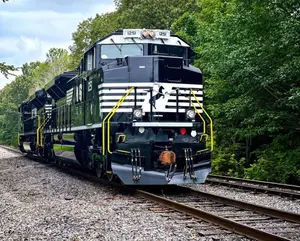
Rated at 4,300 hp, the SD70ACe was essentially a more environmentally friendly version of the builder’s SD70 series featuring EMD’s 16-cylinder model 710G3C-T2 engine, along with upgraded computer systems, electronics, and the builder’s famous self-steering trucks (the HTCR-II).
The HCTR-II has aided significantly in EMD's ability to continue strong sales despite continuing to lag behind GE in research and development.
The HTCR-II was created during the 1990s and first equipped on the original SD70 designs. It used computer software to steer itself into oncoming curves which greatly reduces the wear on both truck, axles, and the track itself.
While as successful as GE’s Evolution Series™ sales nonetheless were strong for the SD70ACe. Total sales for the model by the end of 2014 concluded at 1,034 units in North America.
While the SD70ACe featured the same basic carbody of the SD70 series part of its design was inspired by Conrail's SD80MAC of 1995.
Although the '80MAC (also known as the "Conrail Cadillac" because it was the only railroad to purchase the locomotive) did not sell particularly well EMD rearranged some of its features on the longer frame.
Not only was it the first model to feature the flared rear radiator (common on GE models since the 1970s) but EMD also moved its dynamic brakes from directly behind the cab to the very rear of the locomotive. This new design feature was used on the later SD90MAC and kept with the SD70ACe.
EMD also offered one notable variant of the locomotive for North American lines, the SD70M-2. This locomotive was essentially the DC version employing General Motors' model AR20AB generator instead of the TA17/CA7A alternator.
Ultimately, it sold to only three railroads; the Canadian National (#8000-8024, #8800-8964), Norfolk Southern (numbered #2649-2778), and Florida East Coast (#100-107).
Additionally, EMD's three demonstrators of this variant went to CIT Financial as leasing units. Dimensionally, the SD70ACe is 74 feet, 3 inches length or about six feet shorter than the SD80MAC and SD90MAC.
Data Sheet and Specifications
Total Built (All Variants): 2,286
| Entered Production (SD70ACe) | 4/2003 (Demonstrator GM70) |
| Years Produced (SD70ACe) | 4/2003 - 5/2015 |
| Years Produced (SD70ACe-P4) | 7/2013 - 5/2014 |
| Years Produced (SD70ACe-P4-T4) | 7/2016 |
| Years Produced (SD70ACe TRC) | 2/2016 - 1/2020 |
| Years Produced (SD70ACe-T4) | 9/2015 - 1/2020 |
| Engine | 710G3C-T2 |
| Engine Builder | GM |
| Horsepower | 4300 |
| RPM | 904 |
| Cylinders | 16 |
| Length | 74' 3" |
| Height (Top Of Rail To Top Of Cab) | 15' 11" |
| Width | 10' 3" |
| Weight | 408,000 Lbs |
| Fuel Capacity | 4900 Gallons |
| Air Compressor | Gardner-Denver |
| Air Compressor Model | WLASC |
| Air Brake Manufacturer | Westinghouse |
| Air Brake Schedule | 26L |
| Trucks | C-C |
| Truck Type | HTCR-II |
| Truck Wheelbase | 13' 7" |
| Wheel Size | 40" |
| Traction Motors | A3432 (6), GM |
| Primary Generator | TA17, GM |
| Auxiliary Generator | GM (A8589) |
| Alternator | CA7A |
| MU (Multiple-Unit) | Yes |
| Dynamic Brakes | Yes |
| Gear Ratio | 70:17 |
| Tractive Effort (Starting) | 191,000 Lbs at 35% |
| Tractive Effort (Continuous) | 157,000 Lbs at 12 mph |
| Top Speed | 70 mph |
Production Rosters
SD70ACe
Total Built = 1,946
| Owner | Road Number(s) | Quantity | Order Number | Serial Number(s) | Date Built |
|---|---|---|---|---|---|
| EMDX (Demonstrator) | GM70-GM73* | 4 | 20026404 | 20026404-1 thru 20026404-4 | 4/2003 - 5/2003 |
| CSX | 4831-4850 | 20 | 20036520 | 20036520-1 thru 20036520-20 | 4/2004 - 9/2004 |
| Union Pacific | 8309-8423 | 115 | 20046610 | 20046610-1 thru 20046610-115 | 1/2005 - 7/2005 |
| Kansas City Southern | 4000-4029 | 30 | 20046620 | 20046620-1 thru 20046620-30 | 11/2005 - 1/2006 |
| Montana Rail Link | 4300-4315 | 16 | 20046621 | 20046621-1 thru 20046621-16 | 5/2005 - 7/2005 |
| Union Pacific | 8424-8523** | 100 | 20046621 | 20046621-1 thru 20046621-16 | 5/2005 - 7/2005 |
| BNSF Railway | 9370-9399 | 30 | 20056729 | 20056729-1 thru 20056729-30 | 2/2006 - 4/2006 |
| Union Pacific | 8521-8523 (2nd), 8524-8620 | 100 | 20056753 | 20056753-1 thru 20056753-100 | 2/2007 - 7/2007 |
| BNSF Railway | 9330-9369 | 100 | 20056766 | 20056766-1 thru 20056766-40 | 8/2006 - 10/2006 |
| Kansas City Southern | 4030-4059 | 30 | 20066856 | 20066856-1 thru 20066856-30 | 8/2007 - 9/2007 |
| BNSF Railway | 9130-9264*** | 135 | 20066862 | 20066862-1 thru 20066862-135 | 11/2007 - 9/2008 |
| BNSF Railway | 9265-9304 | 40 | 20066862 | 20066862-146 thru 20066862-175 | 4/2008 - 9/2008 |
| Kansas City Southern | 4100-4129 | 30 | 20066887 | 20066887-1 thru 20066887-30 | 1/2008 - 4/2008 |
| Union Pacific | 8621-8670 | 50 | 20066888 | 20066888-1 thru 20066888-50 | 5/2008 - 8/2008 |
| BNSF Railway | 9305-9329, 9166-9167, 9184-9191 | 35 | 20086021 | 20086021-1 thru 20086021-35 | 1/2009 - 3/2009 |
| Quebec, North Shore & Labrador | 501-507 | 7 | 20086094 | 20086094-1 thru 20086094-7 | 12/2009 |
| Quebec, North Shore & Labrador | 508-513 | 6 | 20106364 | 20106364-1 thru 20106364-6 | 7/2011 - 8/2011 |
| Union Pacific | 8671-8710 | 40 | 20106374 | 20106374-1 thru 20106374-40 | 7/2011 - 9/2011 |
| Norfolk Southern | 1000-1024 | 25 | 20106377 | 20106377-1 thru 20106377-25 | 2/2011 - 5/2011 |
| Ferromex | 4015-4058 | 44 | 20106395 | 20106395-1 thru 20106395-44 | 4/2011 - 6/2011 |
| Ferromex | 4059-4096 | 38 | 20116402 | 20116402-1 thru 20116402-38 | 9/2011 - 12/2011 |
| EMDX (Demonstrator) | 2012 | 1 | 20106455 | 20106455-1 | 8/2011 |
| Norfolk Southern | 1025-1064 | 40 | 20116512 | 20116512-1 thru 20116512-40 | 10/2011 |
| EMDX (Demonstrator) | 4223 | 1 | 20116529 | 20116529-1 | 1/2012 |
| Union Pacific | 8711-8773 | 73 | 20116557 | 20116557-1 thru 20116557-73 | 1/2012 - 6/2012 |
| ArcelorMittal Canada | 9001-9005 | 5 | 20116598 | 20116598-1 thru 20116598-5 | 10/2012 |
| EMDX (Demonstrators) | 1205, 1201-1204**** | 5 | 20116604A | 20116604A-1 thru 20116604A-5 | 5/2012 |
| Kansas City Southern | 4130-4139 | 10 | 20116604B | 20116604B-1 thru 20116604B-10 | 8/2012 |
| EMDX (Demonstrators) | 1206-1210***** | 5 | 20116676 | 20116676-1 thru 20116676-5 | 7/2012 |
| BNSF Railway | 9050-9129 | 70 | 20116683 | 20116683-1 thru 20116683-70 | 7/2012 - 12/2012 |
| Quebec, North Shore & Labrador | 514-523 | 10 | 20116688- | 20116688-1 thru 20116688-10 | 12/2012 |
| Union Pacific | 8784-8823 | 40 | 20126745 | 20126745-1 thru 20126745-40 | 1/2013 - 3/2013 |
| Norfolk Southern | 1075-1099 | 25 | 20126746 | 20126746-1 thru 20126746-25 | 4/2013 |
| Union Pacific | 8824-8896 | 73 | 20126837 | 20126837-1 thru 20126837-73 | 1/2014 - 7/2014 |
| Norfolk Southern | 1100-1124 | 25 | 20126838 | 20126838-1 thru 20126838-25 | 2/2014 |
| BNSF Railway | 8750-8799, 9000-9049 | 100 | 20126869 | 20126869-1 thru 20126869-100 | 5/2013 - 12/2013 |
| Montana Rail Link | 4400-4408 | 9 | 20136895 | 20136895-1 thru 20136895-9 | |
| Kansas City Southern | 4140-4164 | 25 | 20136932 | 20136932-1 thru 20136932-25 | 12/2013 |
| BNSF Railway | 8520-8599, 8400-8499, 8990-8999 | 190 | 20136925 | 20136925-1 thru 20136925-190 | 4/2014 - 12/2014 |
| Kansas City Southern | 4175-4199 | 25 | 20136954 | 20136954-1 thru 20136954-25 | 9/2014 - 11/2014 |
| Ferromex | 4100-4118 | 19 | 20136960 | 20136960-1 thru 20136960-19 | 1/2015 - 4/2015 |
| Ferromex | 4119-4133 | 15 | 20136983 | 20136983-1 thru 20136983-15 | 4/2015 - 5/2015 |
| Norfolk Southern | 1125-1174 | 50 | 20136988 | 20136988-1 thru 20136988-50 | 11/2014 |
| Union Pacific | 8897-8996 | 100 | 20136990 | 20136990-1 thru 20136990-100 | 10/2014 - 12/2014 |
| Kansas City Southern | 4165-4174 | 10 | 20146999 | 20146999-1 thru 20146999-10 | 3/2014 - 4/2014 |
| Kansas City Southern de Mexico | 4200-4224 | 25 | 20146029 | 20146029-1 thru 20146029-25 | 2/2015 - 4/2015 |
* Became Kansas City Southern #3997-3999.
** Union Pacific #8521-8523 became heritage units #1989 (Rio Grande), #1995 (Chicago & North Western), and #1996 (Southern Pacific).
*** BNSF #9166, #9167, and #9184-9191 were canceled and resold to BHP (Australia) as #4324-4333.
**** #1201-1203 became Arkansas & Missouri #70-72. #1204-1204 became Texas Utilities Mining Company #5308-5309.
***** #1206 and #1208-1210 became Canadian National #8100-8103.
SD70ACe-P4
Total Built = 22
| Owner | Road Number(s) | Quantity | Order Number | Serial Number(s) | Date Built |
|---|---|---|---|---|---|
| EMDX (Demonstrators) | 1211-1212* | 2 | 20126780 | 20126780-1 thru 20126780-2 | 7/2013 |
| BNSF Railway | 8500-8519 | 20 | 20116581 | 20116581-1 thru 20116581-20 | 4/2014 - 5/2014 |
* Became Tacoma Municipal Belt Line #7001-7002.
SD70ACeP4-T4
Total Built = 2
| Owner | Road Number(s) | Quantity | Order Number | Serial Number(s) | Date Built |
|---|---|---|---|---|---|
| EMDX (Demonstrators) | 1603-1604 | 2 | 20156267 | 20156267-1 thru 20156267-2 | 7/2016 |
SD70ACe (T4C)
Total Built = 168
| Owner | Road Number(s) | Quantity | Order Number | Serial Number(s) | Date Built |
|---|---|---|---|---|---|
| Union Pacific | 8997-9096 | 100 | 20146115 | 20146115-1 thru 20146115-100 | 2/2016 - 6/2017 |
| Union Pacific | 9097-9104 | 8 | 20146115 | 20146115-101 thru 20146115-108 | 12/2018 |
| Norfolk Southern | 1175-1224 | 50 | 20176662 | 20176662-1 thru 20176662-50 | 11/2018 - 11/2019 |
| EMDX (Demonstrators) | 2115-2124* | 10 | 20186647 | 20186647-1 thru 20186647-10 | 12/2019 - 1/2020 |
* Became Norfolk Southern #1225-1244.
SD70ACe-T4
Total Built = 148
| Owner | Road Number(s) | Quantity | Order Number | Serial Number(s) | Date Built |
|---|---|---|---|---|---|
| EMDX (Demonstrators) | 1501-1505* | 5 | 20146006 | 20146006-1 thru 20146006-5 | 9/2015 |
| EMDX (Demonstrators) | 1601-1602 | 2 | 20156205 | 20156205-1 thru 20156205-2 | 12/2016 |
| EMDX (Demonstrators) | 1605-1606 | 2 | 20156206 | 20156206-1 thru 20156206-2 | 12/2016 |
| EMDX (Demonstrators) | 1607-1608 | 2 | 20156207 | 20156207-1 thru 20156207-2 | 6/2016 |
| EMDX (Demonstrators) | 1609-1610 | 2 | 20156208 | 20156208-1 thru 20156208-2 | 6/2016 |
| Union Pacific | 3012-3099** | 88 | 20146140 | 20146140-1 thru 20146140-35, 20146140-79 thru 20146140-88, 20146140-36 thru 20146140-78 | 10/2016 - 10/2018 |
| CSX | 8900-8909 | 10 | 20176590 | 20176590-1 thru 20176590-10 | 5/2019 - 6/2019 |
| EMDX (Demonstrators) | 7201-7227 | 27 | 20186680 | 20186680-1 thru 20186680-10 | 11/2019 - 1/2020 |
| EMDX (Demonstrators) | 7233-7242 | 10 | 20186663 | 20186663-1 thru 20186663-10 | 11/2019 - 1/2020 |
* #1502-1505 became Union Pacific #3000-3003.
** Union Pacific #3091, #3097-3099, and #3013 were returned to EMD, becoming demonstrators #7228-7232.
Tractive Effort
Its tractive effort ratings are very comparable to the GEVOs; 191,000 pounds starting (slightly more) and 157,000 pounds continuous (slightly less).
There are also a few international variants of the model known as the SD70ACe/Ic and the SD70ACS. The former was purchased by BHP Billiton of Australia with a lower height profile to clear low hanging obstacles.
The latter design was developed for arid desert environments and has been purchased by Saudi Railway, Mauritania's Société Nationale Industrielle et Minière, and the Etihad Railway. Alas, it seems foreign buyers will be the only customers for EMD's SD70 series moving forward.
SD70ACe-T4
As the EPA increased its regulations on ever-cleaner diesel emissions it seemed the SD70ACe and its 710 prime mover were safe as the engine met later Tier III standards.
However, when Tier IV standards went into effect on January 1, 2015 Caterpillar/Progressive Rail was unable to make the prime mover compliant and there is no way to do so according to Bill Badurksi, a former EMD employee in his article "Closing A Chapter In History," from the January, 2015 issue of Trains Magazine.
While EMD sat in the shadows as General Electric unveiled its all new, Tier IV-compliant model in August of 2012 the company continued working towards releasing its own design, especially after it became apparent the 710 prime mover would have to be retired for domestic sales.
At the Railway Interchange trade show in Minneapolis on October 4, 2015 the company, amid much secrecy, finally unveiled its own Tier IV locomotive, the SD70ACe-T4.
While the model's name seems to indicate it is a variant of the original SD70ACe series, EMD states this is a brand new locomotive manufactured from the ground up.
In place of the old 710 prime mover is the new 12-cylinder, 4,600 horsepower model 1010 diesel engine that was designed by Electro-Motive, Progressive Rail Services, and parent Caterpillar.
During an interview with Trains Magazine at the show an EMD representative gave a confident and convincing interview of the SD70ACe-T4's capabilities.
While they would not go into the specifics regarding how the engine can produce 4,600 horsepower and remain Tier IV compliant the representative did state they utilize technology similar to General Electric in that diesel exhaust is captured as energy and reused within the system.
Aside from the new engine several other design features went into the model using considerable feedback from railroads and employees.
- Riding on a new frame the SD70ACe-T4 is three inches shorter than the original SD70ACe to meet railroads' requests.
- A larger interior cabin has been achieved by lowering the floor with a concave ceiling (high enough to offer plenty of clearance for hard hats).
- An escape door on the conductor's side in the event of a rollover, and a return of EMD's classic notched windshield for better crew visibility.
In addition to these features Electro-Motive debuted an all-new radial (self-steering) truck with independently controlled axles that is said to be much easier to maintain.
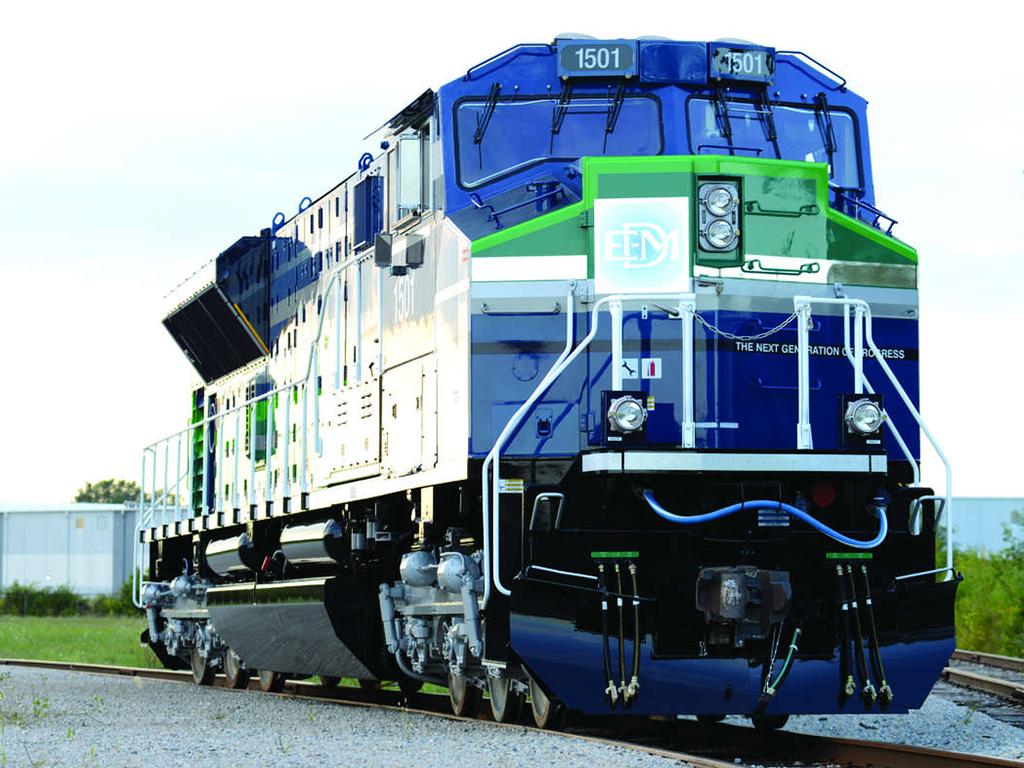
The first demonstrator built was #1501, manufactured at Progress Rail’s Muncie, Indiana facility and EMD states there will be a total of five demonstrators in production draped in various paint schemes.
The company goes on to state that SD70ACe-T4 will enter production in 2016. Caterpillar and EMD have much riding on this locomotive. If it proves troublesome and unsuccessful it appears the builder will never again compete against General Electric's now decades-long dominance in the locomotive marketplace.
However, for the industry's sake having two competitive manufacturers offering high quality locomotives, one of which is the long-recognized name of diesel technology which almost single-handedly retired steam from main line service, would certainly be a good thing. In any event, in the coming months and years we will find out what kind of product the SD70ACe-T4 is and how it performs.
Sources
- McDonnell, Greg. Locomotives: The Modern Diesel & Electric Reference, 2nd Edition. Buffalo: Boston Mills Press/Firefly Books, 2015.
- Solomon, Brian. GE and EMD Locomotives: The Illustrated History. Minneapolis: Voyageur Press, 2014.
Recent Articles


-
North Carolina Dinner Train Rides At Spencer
Mar 13, 26 10:01 AM
 Tucked into the Piedmont town of Spencer, the North Carolina Transportation Museum is the kind of place that feels less like a typical museum and more like a living rail yard that never quite stopped…
 -
Tennessee Dinner Train Rides At TVRM
Mar 13, 26 09:56 AM
 Tucked into East Chattanooga, the Tennessee Valley Railroad Museum (TVRM) is less a “museum you walk through” and more a railroad you step aboard.
 -
New York Dinner Train Rides In The Adirondacks
Mar 13, 26 09:36 AM
 Operating over a restored segment of the former New York Central’s Adirondack Division, the Adirondack Railroad has steadily rebuilt both track and public interest in passenger rail across the region.
 -
Pennsylvania Dinner Train Rides At Boyertown
Mar 13, 26 09:33 AM
 With beautifully restored vintage equipment, carefully curated menus, and theatrical storytelling woven into each trip, the Colebrookdale Railroad offers far more than a simple meal on rails.
 -
Wisconsin BBQ Tasting Train Rides
Mar 12, 26 10:57 PM
 The Wisconsin Great Northern Railroad will once again welcome passengers aboard its popular Spring BBQ Dinner Train in 2026.
 -
Connecticut DOT Awards $20 Million In Railroad Grants
Mar 12, 26 01:19 PM
 The Connecticut Department of Transportation (CTDOT) has announced a new round of funding aimed at improving the safety, reliability, and capacity of the state’s freight rail network.
 -
California's Beer Tasting Train Rides
Mar 12, 26 12:59 PM
 While the Niles Canyon Railway is known for family-friendly weekend excursions and seasonal classics, one of its most popular grown-up offerings is Beer on the Rails.
 -
Reading & Northern Unveils Semiquincentennial 1776
Mar 12, 26 12:48 PM
In November 2025, the Reading, Blue Mountain & Northern Railroad (RBMN)—commonly known as the Reading & Northern—announced the debut of a striking patriotic locomotive commemorating the upcoming 250th… -
New Jersey's Beer Tasting Train Rides
Mar 12, 26 11:35 AM
 On select dates, the Woodstown Central Railroad pairs its scenery with one of South Jersey’s most enjoyable grown-up itineraries: the Brew to Brew Train.
 -
Florida BBQ Tasting Train Rides
Mar 12, 26 11:28 AM
 While Florida does not currently offer any BBQ train rides the Florida Railroad Museum does host a similar event, a campfire experience!
 -
Texas "Murder Mystery" Dinner Train Rides
Mar 12, 26 10:40 AM
 Here’s a comprehensive look into the world of murder mystery dinner trains in Texas.
 -
Connecticut's Murder Mystery Dinner Train Rides
Mar 12, 26 10:36 AM
 All aboard the intrigue express! One location in Connecticut typically offers a unique and thrilling experience for both locals and visitors alike, murder mystery trains.
 -
Missouri's Wine Tasting Train Rides
Mar 12, 26 10:33 AM
 The fusion of scenic vistas, historical charm, and exquisite wines is beautifully encapsulated in Missouri's wine tasting train experiences.
 -
Minnesota's Wine Tasting Train Rides
Mar 12, 26 10:28 AM
 This article takes you on a journey through Minnesota's wine tasting trains, offering a unique perspective on this novel adventure.
 -
Charlotte Approves $37.9M For "Red Line" To Lake Norman
Mar 11, 26 02:18 PM
 The Charlotte City Council has approved $37.9 million in funding for the next phase of design work on the long-planned Red Line commuter rail project.
 -
NS, Progress Rail Announce SD70ICC Modernization
Mar 11, 26 12:15 PM
 Norfolk Southern Railway has announced a significant locomotive modernization initiative in partnership with Progress Rail Services Corporation that will rebuild 96 existing road locomotives into a ne…
 -
Colorado Seeks Input On Proposed Front Range Passenger Train Name
Mar 11, 26 11:55 AM
 Colorado officials are inviting the public to help name a proposed passenger train that could one day connect major cities along the state’s heavily traveled Interstate 25 corridor.
 -
Virginia Whiskey Train Rides
Mar 11, 26 11:22 AM
 Among the Virginia Scenic Railway's most popular specialty excursions is the “Bourbon & BBQ” tasting train, an adults-oriented rail journey that pairs scenic views of the Shenandoah Valley with guided…
 -
Minnesota's Beer Tasting Train Rides
Mar 11, 26 10:32 AM
 Among the North Shore Scenic Railroad's special events, one consistently rises to the top for adults looking for a lively night out: the Beer Tasting Train.
 -
New Mexico's Beer Tasting Train Rides
Mar 11, 26 10:23 AM
 Sky Railway's New Mexico Ale Trail Train is the headliner: a 21+ excursion that pairs local brewery pours with a relaxed ride on the historic Santa Fe–Lamy line.
 -
Indiana's Murder Mystery Dinner Train Rides
Mar 11, 26 10:19 AM
 This piece explores the allure of murder mystery trains and why they are becoming a must-try experience for enthusiasts and casual travelers alike.
 -
Ohio's Murder Mystery Dinner Train Rides
Mar 11, 26 10:02 AM
 The murder mystery dinner train rides in Ohio provide an immersive experience that combines fine dining, an engaging narrative, and the beauty of Ohio's landscapes.
 -
Kentucky Easter Train Rides
Mar 10, 26 11:39 AM
 The Bluegrass State is home to beautiful rolling farms and the western Appalachian Mountain chain, which comes alive each spring. A few railroad museums host Easter-themed events during this time.
 -
California Easter Train Rides
Mar 10, 26 10:26 AM
 California is home to many tourist railroads and museums; several offer Easter-themed train rides for the entire family.
 -
NS Faces Multiple Derailments Near Historic Horseshoe Curve
Mar 10, 26 10:15 AM
One of America’s most famous railroad landmarks, the legendary Horseshoe Curve west of Altoona, Pennsylvania, has recently been the site of multiple freight-train derailments involving Norfolk Souther… -
Oregon's Beer Tasting Train Rides
Mar 10, 26 10:11 AM
 If your idea of a perfect night out involves craft beer, scenery, and the gentle rhythm of jointed rail, Santiam Excursion Trains delivers a refreshingly different kind of “brew tour.”
 -
Arizona's Beer Tasting Train Rides
Mar 10, 26 09:57 AM
 Verde Canyon Railroad’s signature fall celebration—Ales On Rails—adds an Oktoberfest-style craft beer festival at the depot before you ever step aboard.
 -
Connecticut's Wine Tasting Train Rides
Mar 10, 26 09:54 AM
 If you’re looking for a signature “special occasion” experience, the Essex Steam Train's Wine & Chocolate Dinner Train stands out as a decadent, social, and distinctly memorable take on dinner on…
 -
Massachusetts Wine Tasting Train Rides
Mar 10, 26 09:37 AM
 This article dives into some of the alluring aspects of wine by rail in Massachusetts, currently offered by the Cape Cod Central Railroad.
 -
Union Pacific Restores Rail Bridge Service in Lincoln
Mar 09, 26 11:34 PM
Union Pacific crews have successfully restored freight rail service across a key bridge in Lincoln, Nebraska, completing a rapid reconstruction effort in just a few weeks. -
TVRM To Assist In Gas-Powered Locomotive's Restoration
Mar 09, 26 11:15 PM
The Tennessee Valley Railroad Museum has announced it is assisting in the eventual cosmetic restoration of a former gas powered locomotive used in the logging industry. -
Michigan's Easter Train Rides
Mar 09, 26 10:37 AM
 Spring sometimes comes late to Michigan but this doesn't stop a handful of the state's heritage railroads from hosting Easter-themed rides.
 -
Pennsylvania's Easter Train Rides
Mar 09, 26 10:05 AM
Pennsylvania is home to many tourist trains and several host Easter-themed train rides. Learn more about these special events here. -
Tennessee's Whiskey Tasting Train Rides
Mar 09, 26 09:33 AM
 Here’s what to know, who to watch, and how to plan an unforgettable rail-and-whiskey experience in the Volunteer State.
 -
Michigan's Whiskey Tasting Train Rides
Mar 09, 26 09:07 AM
 There's a unique thrill in combining the romance of train travel with the rich, warming flavors of expertly crafted whiskeys.
 -
Massachusetts Wine Tasting Train Rides
Mar 09, 26 08:56 AM
This article dives into some of the alluring aspects of wine by rail in Massachusetts, currently offered by the Cape Cod Central Railroad. -
Maryland Wine Tasting Train Rides
Mar 09, 26 08:37 AM
 This article delves into the enchanting world of wine tasting train experiences in Maryland, providing a detailed exploration of their offerings, history, and allure.
 -
New York's Whiskey Tasting Train Rides
Mar 08, 26 10:16 AM
 For those keen on embarking on such an adventure, the Arcade & Attica offers a unique whiskey tasting train at the end of each summer!
 -
Florida's Whiskey Tasting Train Rides
Mar 08, 26 10:15 AM
 If you’re dreaming of a whiskey-forward journey by rail in the Sunshine State, here’s what’s available now, what to watch for next, and how to craft a memorable experience of your own.
 -
Colorado Wine Tasting Train Rides
Mar 08, 26 10:14 AM
 To truly savor these local flavors while soaking in the scenic beauty of Colorado, the concept of wine tasting trains has emerged, offering both locals and tourists a luxurious and immersive indulgenc…
 -
Iowa Wine Tasting Train Rides
Mar 08, 26 10:13 AM
 The state not only boasts a burgeoning wine industry but also offers unique experiences such as wine by rail aboard the Boone & Scenic Valley Railroad.
 -
Northern Pacific 4-6-0 1356 Receives Cosmetic Restoration
Mar 07, 26 02:19 PM
 A significant preservation effort is underway in Missoula, Montana, where volunteers and local preservationists have begun a cosmetic restoration of Northern Pacific Railway steam locomotive No. 1356.
 -
New York's Beer Tasting Train Rides
Mar 07, 26 02:08 PM
 Among the Adirondack Railroad's most popular special outings is the Beer & Wine Train Series, an adult-oriented excursion built around the simple pleasures of rail travel.
 -
Kentucky's Whiskey Tasting Train Rides
Mar 07, 26 10:17 AM
Whether you’re a curious sipper planning your first bourbon getaway or a seasoned enthusiast seeking a fresh angle on the Kentucky Bourbon Trail, a train excursion offers a slow, scenic, and flavor-fo… -
Ohio's Whiskey Tasting Train Rides
Mar 07, 26 10:15 AM
 LM&M's Bourbon Train stands out as one of the most distinctive ways to enjoy a relaxing evening out in southwest Ohio: a scenic heritage train ride paired with curated bourbon samples and onboard refr…
 -
Georgia 'Wine Tasting' Train Rides In Cordele
Mar 07, 26 10:13 AM
 While the railroad offers a range of themed trips throughout the year, one of its most crowd-pleasing special events is the Wine & Cheese Train—a short, scenic round trip designed to feel…
 -
Arizona Wine Tasting Train Rides
Mar 07, 26 10:12 AM
 For those who want to experience the charm of Arizona's wine scene while embracing the romance of rail travel, wine tasting train rides offer a memorable journey through the state's picturesque landsc…
 -
Massachusetts's Beer Tasting Train Rides
Mar 06, 26 09:00 AM
 Among Cape Cod Central's lineup of specialty trips, the railroad’s Rails & Ales Beer Tasting Train stands out as a “best of both worlds” event.
 -
Pennsylvania's Beer Tasting Train Rides
Mar 06, 26 08:57 AM
 Today, EBT’s rebirth has introduced a growing lineup of experiences, and one of the most enticing for adult visitors is the Broad Top Brews Train.
 -
Indiana's Whiskey Tasting Train Rides
Mar 06, 26 08:55 AM
 Among IRE’s most talked-about offerings is the Wine & Whiskey Train—an adults-only, evening-style trip that leans into the best parts of classic rail travel: atmosphere, comfort, and a little cele…