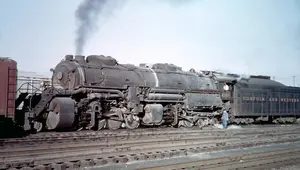
Western Maryland Railway: Map, Rosters, Logo, History
Last revised: September 26, 2026
By: Adam Burns
The Western Maryland Railway was the Fast Freight Line, and the men who worked it called it the Wild Mary. On something over 800 miles a shipper could find a time freight, a coal drag, a branch local, and a Shay on a grade that ordinary rod engines would not take. The main line crossed the Appalachians on tunnels and high bridges. Black Fork Grade, down the Blackwater Canyon, was the operating problem everyone remembered. The photography was the compensation.
The company that became the railway was chartered as the Baltimore, Carroll & Frederick Rail Road on May 27, 1852, and renamed the Western Maryland Rail Road on March 21, 1853. The first trains ran on August 11, 1859. The last day as the Western Maryland was April 30, 1983. On May 1 the property went into the Baltimore & Ohio.

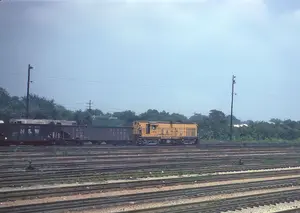
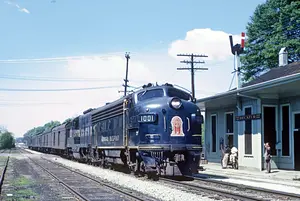
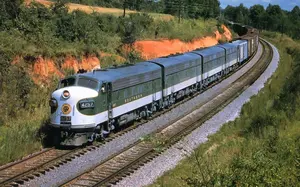
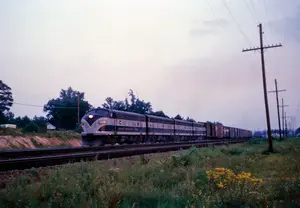
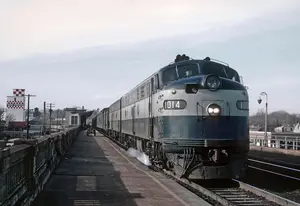
A new Western Maryland F7A and more covered wagons on a long freight at Hagerstown, Maryland, about 1955. Aubrey Bodine photo.
On this page: At a glance · Out of Baltimore · John Mifflin Hood · George Gould · Connellsville Extension · The Alphabet Route · Passenger trains · Elkins and the branches · Fireball, speed lettering, Circus · Chessie and the end · What is left
At a glance
| Item | Detail |
|---|---|
| Railroad | Western Maryland Railway. The Wild Mary. Mark WM |
| Headquarters | Baltimore, the Standard Oil Building |
| Charter | Baltimore, Carroll & Frederick Rail Road, May 27, 1852. Western Maryland Rail Road, March 21, 1853. Railway, from the 1909 reorganization, January 1, 1910 |
| Operated | August 11, 1859 – April 30, 1983. Into the Baltimore & Ohio May 1, 1983 |
| States | Maryland, Pennsylvania, West Virginia |
| Miles | 720.5 route miles in 1952. The operating network, branches included, was described at about 835 miles |
| Main lines | Baltimore–Hagerstown–Cumberland. Cumberland–Connellsville, the 1912 extension. Cumberland–Elkins, the old West Virginia Central. Dutch Line to York. Elkins branches to Durbin, Webster Springs, and Belington |
| Slogan | The Fast Freight Line |
| Last passenger | Durbin Branch mixed train, April 10, 1959 |
| Last steam | Helpers and branch Consolidations into 1954. The class grid is the steam roster |
| Diesels | Alco S1 102 in 1941 through Chessie-ordered GP40-2s in 1977–79. Serials are the diesel roster |
| Successor | Baltimore & Ohio, then CSX |
A second railroad out of Baltimore
Maryland chartered the Baltimore & Ohio in February 1827 so the city would not lose its port to the canals aimed at Philadelphia and New York. By the time the General Assembly chartered the Baltimore, Carroll & Frederick, on May 27, 1852, the B&O was finishing the line to Wheeling. Roger Cook and Karl Zimmermann, in The Western Maryland Railway: Fireballs and Black Diamonds, put the new company’s first aim at the Monocacy, on what was then Virginia’s northeastern border. Farm freight, stone, and ore were the traffic. A through mountain railroad was not yet the plan.
The name changed on March 21, 1853, to the Western Maryland Rail Road. Construction left Baltimore on July 11, 1857, using a piece of the old Baltimore & Susquehanna branch between Relay House and Owings Mills, bought that year. Service opened August 11, 1859. By October 1873 the company had its own entrance to downtown Baltimore at Fulton Station. Rails reached Reisterstown before the money stopped, then Union Bridge in November 1862, and then stopped again for the Civil War. The line opened to Hagerstown in August 1872. In the fall of 1873 Williamsport gave it the Chesapeake & Ohio Canal. In 1884 better interchanges there reached the B&O and the Shenandoah Valley Railroad, later a Norfolk & Western line.
John Mifflin Hood
John Mifflin Hood became president in 1874 and made a local railroad into a regional one. In October 1881 the company leased 33.6 miles of the Baltimore & Cumberland Valley Rail Road, Edgemont to Shippensburg by way of Waynesboro and Chambersburg. A short branch at Shippensburg later met the Harrisburg & Potomac, a future Reading line, and that junction became a piece of the Alphabet Route. Late in 1886 the Baltimore & Hanover and the Gettysburg railroads came in. They were consolidated that year as the Baltimore & Harrisburg Railway. Highfield, Maryland, was reached in June 1889, and York, Pennsylvania, in 1893, with the Pennsylvania Railroad and the Maryland & Pennsylvania at York. Railroaders called the Hanover Subdivision the Dutch Line.
The Fireball. It went on twelve new 4-6-6-4s in 1940 and became the mark of the Fast Freight Line. Author’s work.
The second Alphabet link was built in the 1890s. In 1892 the 14-mile Potomac Valley Rail Road opened from Williamsport to Big Pool, crossed the Potomac, and met the B&O main line at Cherry Run, West Virginia. With the Philadelphia & Reading, the Western Maryland then built the Washington & Franklin Railway, a straighter road from Hagerstown to Shippensburg, finished in March 1899. Midwest freight could leave the B&O and go northeast on the Reading. Hood left the presidency in February 1902. Baltimore had been paying for a great deal of the expansion and had not been paid back. Cook and Zimmermann put the city’s claim near $9 million.
George Gould, Port Covington, and the West Virginia Central
On May 7, 1902, the Fuller Syndicate bought the railroad. George Gould wanted it in the coast-to-coast system he was trying to finish from his father’s properties: Western Pacific, Rio Grande, Missouri Pacific, Wabash, Wheeling & Lake Erie, and the Wabash-Pittsburgh Terminal. The new owners started with a deep-water terminal at Port Covington, southeast of Baltimore on the Patapsco, with freight piers, coal piers, and car-float ramps. That was the tidewater outlet.
Cumberland was next. Construction began August 1, 1903. Freight trains ran on March 15, 1906, and passenger trains on June 17. At Cumberland the line met another Gould road, the West Virginia Central & Pittsburg, which Gould had bought in January 1902 and turned over to the Western Maryland on November 1, 1905. Henry G. Davis had chartered that property in 1866 as the Potomac & Piedmont Coal & Railroad and renamed it in 1881. Its main line from Cumberland to Elkins was finished in 1889. Coal and lumber branches ran west and south of Elkins, with the B&O at Belington and, in time, the Chesapeake & Ohio at Durbin. The grades were mountain grades. Some of those branches were still in service in the 1980s.
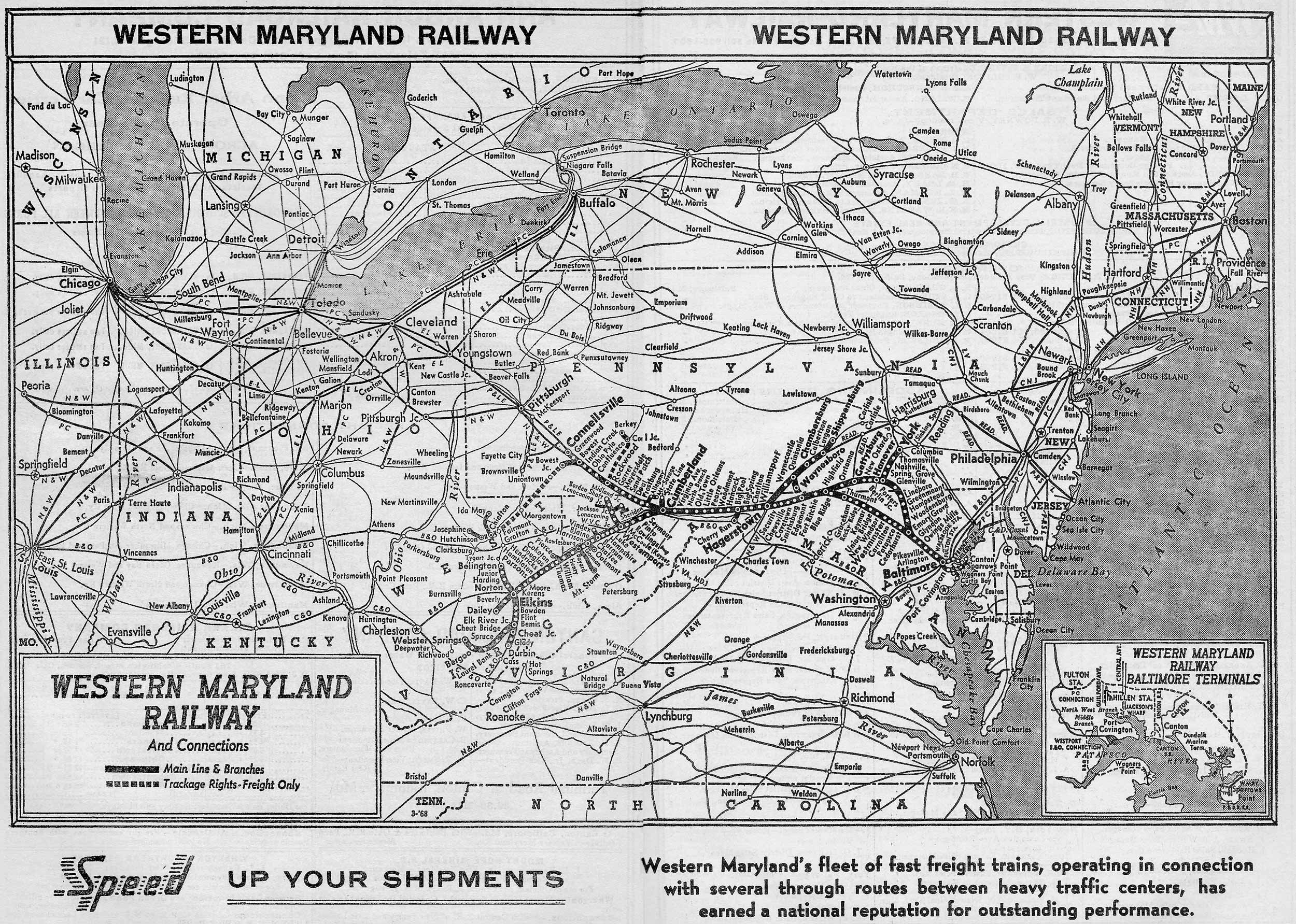
The Western Maryland in 1969, still a through freight railroad from Baltimore to Connellsville and a coal railroad from Cumberland into West Virginia. Author’s collection.
Gould’s last addition in this stretch was the Georges Creek & Cumberland, taken in January 1907. It ran west from Cumberland through the Narrows to mines around Midland and to the Pennsylvania Railroad at Ellerslie, just over the state line. The through line he wanted, on to Connellsville, was not finished when the empire broke. The Western Maryland Rail Road went into bankruptcy on March 6, 1908, was reorganized as the Western Maryland Railway on December 1, 1909, and left receivership on January 1, 1910. John D. Rockefeller’s interests held the reorganized company. The Baltimore & Ohio bought that control in 1927. The Interstate Commerce Commission left the Western Maryland operating as its own railroad.
The Connellsville Extension
The receivers kept the Connellsville plan, and the Georges Creek & Cumberland had already given them the Narrows. Construction west of Cumberland resumed in April 1910. The extension was built like a main line that might someday be double-tracked. It never was. Eighty-six miles, four tunnels — Big Savage, Borden, Brush, and Pinkerton — and two long viaducts, the Salisbury Viaduct at 1,908 feet and the Keystone Viaduct. West of Cumberland the line climbed toward Deal on 1.75 percent for about 23 miles, then descended toward Connellsville on 0.60 to 0.80 percent.
Helmstetter’s Curve is about seven railroad miles west of Cumberland, outside Corriganville, where the engineers had to get across Cash Valley. They built a hairpin, first on a trestle and then buried in fill, on the edge of the Helmstetter farm. The extension opened August 1, 1912, and connected with the Pittsburgh & Lake Erie. The connection that made the Alphabet Route was later. The Pittsburgh & West Virginia finished its own line into Connellsville in the spring of 1931.
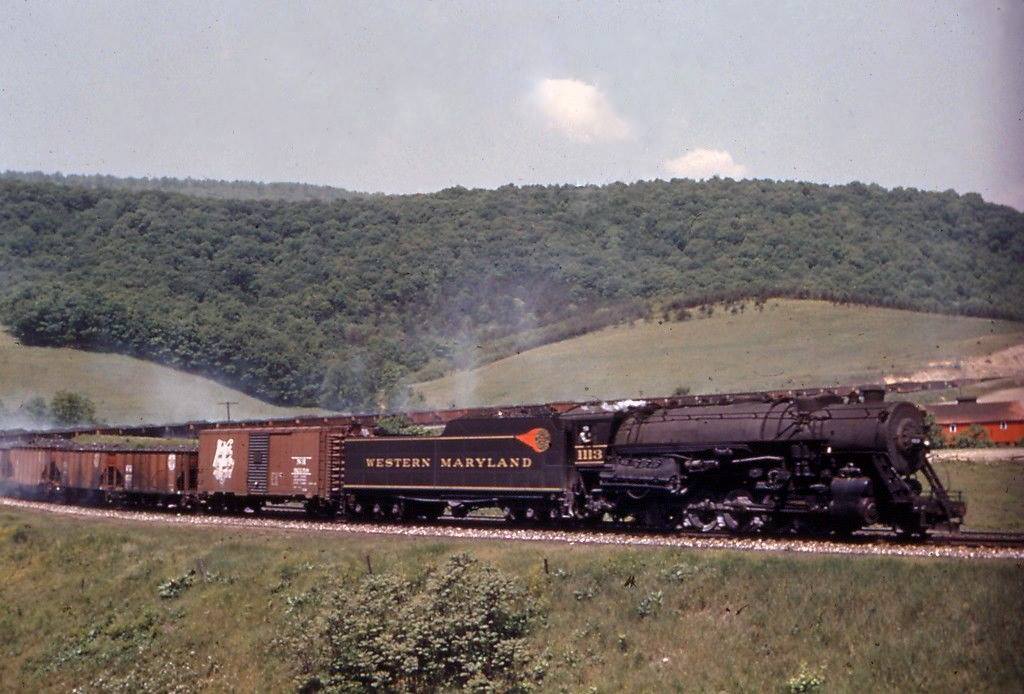
Decapod 1113, class I-2, eases a coal train down Helmstetter’s Curve near Corriganville, Maryland, in the 1950s. The brake shoes are smoking. Bill Price photo.
Eight railroads, one freight route
The Alphabet Route was a freight consortium, not a merged railroad. Nickel Plate, Wheeling & Lake Erie, Pittsburgh & West Virginia, Western Maryland, Reading, Jersey Central, Lehigh & Hudson River, and the New Haven handed cars to one another between the Chicago gateway and Baltimore, Philadelphia, New York, and Boston. The point was a path that was not the B&O, the New York Central, or the Pennsylvania. It worked for years. The mergers of the 1970s made the handoff unnecessary.
East of the mountain, the through freights used the Connellsville–Shippensburg line. Coal, coke, and lumber moved on the Elkins–Baltimore line and went to tidewater at Port Covington. A few coal branches were not even connected to the rest of the railroad. The Fairmont Helen’s Run Railway, bought in September 1916, ran a little over six miles from Chiefton to Ida May. The Fairmont Bingamon, added in December 1917, ran between Hutchinson and Josephine. Both sat near Fairmont, and the Western Maryland reached them on B&O trackage rights out of Bowest Yard, near Connellsville. The Somerset Coal Railway, from 1915, was about four miles from Coal Junction to Gray and two Consolidation Coal mines, reached by rights over the B&O from Rockwood. The mine at Ida May belonged to Bethlehem Steel. In the 1950s it produced about 4,000 carloads a month, more traffic than all of the Western Maryland south of Cumberland.
A modest passenger railroad
The Western Maryland never fielded a streamliner. For a few years after the Connellsville Extension it did run a first-class train. In 1913 a Pullman contract put sleepers on the westbound Chicago Limited, train 3, and the eastbound Baltimore Limited, train 2, in and out of Hillen Station, the Baltimore terminal since 1876. Parlor cars, diners, and club cars ran with them. The Western Express and Eastern Express, trains 7 and 8, were the plainer pair. Pittsburgh & Lake Erie, Erie, and New York Central carried the cars on from Connellsville toward Chicago. The limiteds made Baltimore–Chicago in 21½ to 22½ hours and were gone by 1917. After that the Western Maryland’s own trains were coaches.
Ten Baldwin K-1 Pacifics, 151–160, came in 1909, and nine heavier K-2s, 201–209, in 1912. They handled the passenger trains for years. In the 1930s an H-7b or an H-8 Consolidation more often drew the Durbin mixed. That mixed train was the last passenger service on the railroad. It came off on April 10, 1959. For a short time at the end, four Alco RS3s with steam generators did the work: 192, 193, 194, and 197, bought between May 1953 and September 1954. The steam generator and the dynamic brake sat in a high short hood. Crews called them hammerheads.
The public timetable had also carried the Baltimore–Elkins Day Express, the Hagerstown expresses, the Pittsburgh expresses, and the resort trains to Pen-Mar and Blue Mountain. After 1959 the railroad still hosted fan trips. Nickel Plate 2-8-4 759 and Reading 4-8-4 2102 ran on Western Maryland rails in the Chessie years, with the company’s own F7s, FA-2s, and Geeps.
Elkins, Black Fork, and the logging railroads
Davis’s West Virginia Central started west from Bloomington, now West Virginia Junction, in April 1880. The hard part was the drop down Blackwater Canyon. Black Fork Grade leaves Thomas on grades past 3 percent and levels at Hendricks. The yard those trains were built in is Elkins. South of Parsons the line climbs again, past 2 percent, to Haddix, and reaches Elkins — then Leadsville — in 1889. A branch continued to Dailey and Huttonsville in 1899. The Belington branch, 16 miles, opened in 1891 and was standard-gauged in 1892 after a start as a three-foot line. Belington & Beaver Creek pushed a coal branch on to Weaver in 1899.
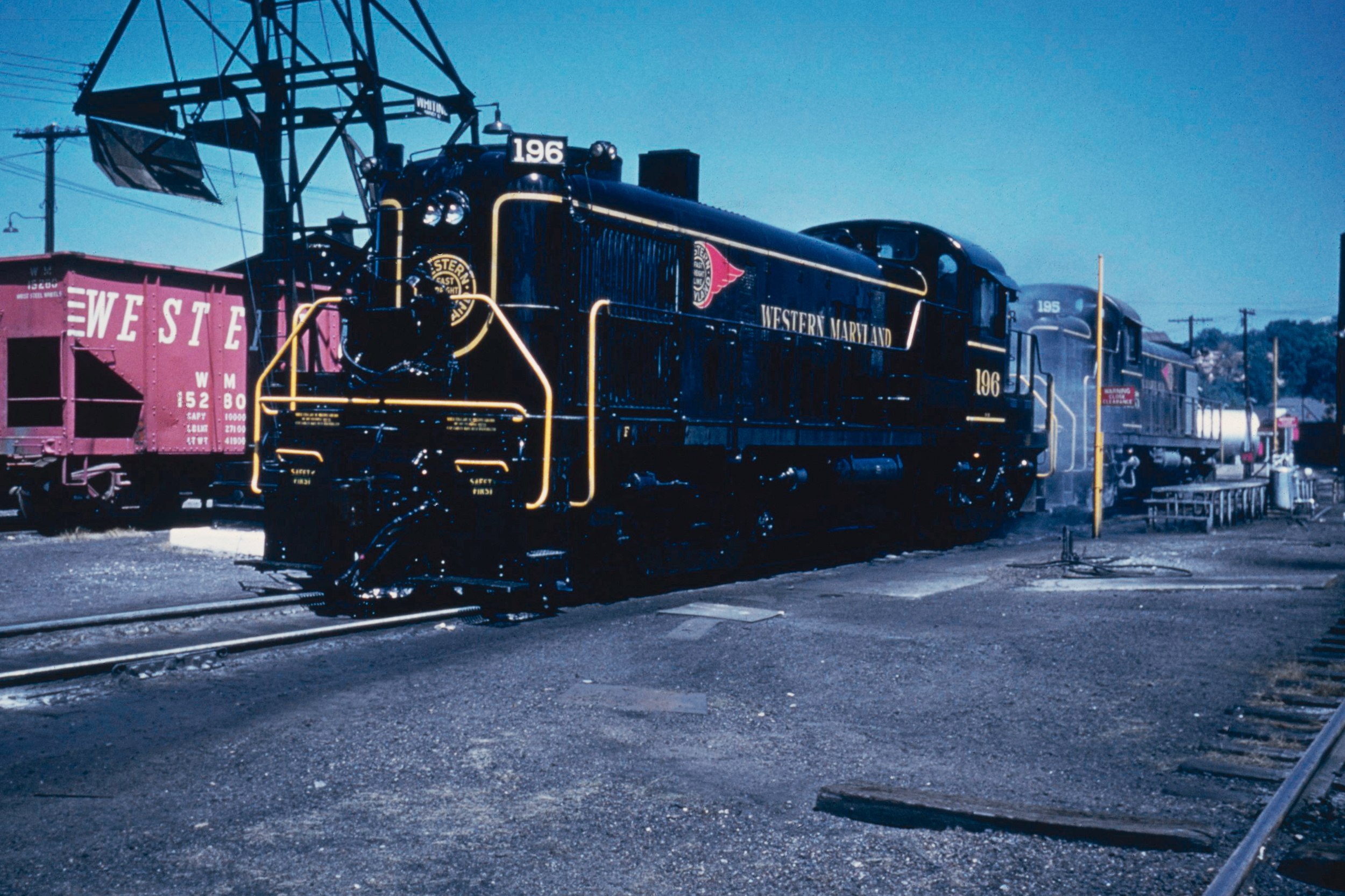
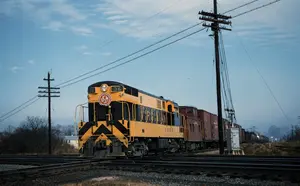
A pair of RS3s at the wash rack in Elkins, West Virginia, August 27, 1958. The Elkins Division was the coal and lumber end of the railroad. David R. Sweetland photo. Author’s collection.
The Coal & Iron Railway, chartered December 14, 1899, as a West Virginia Central subsidiary, built the line south from Elkins to a Chesapeake & Ohio connection. The two companies settled on Durbin. Tunnel No. 1 went under Cheat Mountain south of Canfield. Tunnel No. 2 went under Shavers Mountain near Glady. Service reached Bemis in late 1902 and Durbin on July 27, 1903. William McNeel, in The Durbin Route, gives the length from Elkins as 46.9 miles. On the Western Maryland it was the Durbin Branch. Grades passed 2 percent.
The Greenbrier, Cheat & Elk began as a logging railroad of West Virginia Pulp & Paper. William Warden, in West Virginia Logging Railroads, traces it to 173,000 acres bought near Cass, and to a charter that could not move logs until the C&O’s Greenbrier Branch reached Durbin in December 1903. The eight miles from Cass to Spruce were a Shay railroad. Spruce had a pulp mill, a store, and a yard. In 1910 the logging road became the Greenbrier, Cheat & Elk and grew to about 175 miles, the longest logging railroad in the country, from Cheat Junction to Bergoo. The Western Maryland bought the lines north and west of Spruce in 1927 and ran them as the Elk River Branch, for coal more than for logs. Heavier rail and a few eased curves did not make it a main line. The worst curves kept Maney guard rails, the sort of hardware an interurban used. Summit Cut, near Spruce, stands at 4,066.6 feet, the highest main-line summit in the East.
In 1929 the company also bought the West Virginia Midland, a former narrow-gauge logging road that had been the Holly River & Addison. The only piece kept was the 1925 line from Webster Springs to Bergoo, about 12 miles, which isolated the Webster Springs branch from the rest of the railroad except through that connection. The Chaffee Railroad, bought the same year, ran from Chaffee, West Virginia, to a mine at Vindex, Maryland. Grades passed 9 percent. Curves reached 23.5 degrees. Shays worked it. No. 6, outshopped by Lima in May 1945, was a 162-ton three-truck engine and the last Shay Lima built. The branch played out in 1950. The engine was stored, then moved under its own power to the B&O Railroad Museum in 1953, and went to Cass in 1980. It still runs there. The Cumberland & Pennsylvania, bought from Consolidated Coal in May 1944, was the last addition, between Westernport and Borden Shaft, and it preserved a way into the Georges Creek mines after most of the old Georges Creek & Cumberland had been given up.
Black engines, a Fireball, and then yellow
George H. Drury’s post-1900 class grid is the steam roster. The assignment, as Cook and Zimmermann had it around 1947, was simple enough to remember. Consolidations fought Black Fork and the branches south of Elkins. Decapods helped. The big 2-8-8-2s took the Blue Ridge grades. Twelve Baldwin 4-6-6-4s, 1201–1212, built in 1940 and 1941, were meant for the fast freight between Hagerstown and Connellsville. They were hard on the rail and they slipped. They were moved east of Cumberland and retired in 1953. Twelve 4-8-4s, the Potomacs, 1401–1412, came from Baldwin in 1947 and worked east of Cumberland until diesels replaced them in 1954. They were the only 4-8-4s the Western Maryland owned, and the company was the last road to buy the type for the first time. Later 4-8-4s were reorders. The Norfolk & Western’s last J came in 1950.
The engines were painted glossy black and kept clean, with red-and-gold Fireball heralds. The Fireball went on those twelve 4-6-6-4s in 1940. Speed lettering replaced it on freight cars in 1952 and on diesels in 1954. In June 1969 new SD40s arrived in red and white, the Circus scheme, still with the speed lettering.
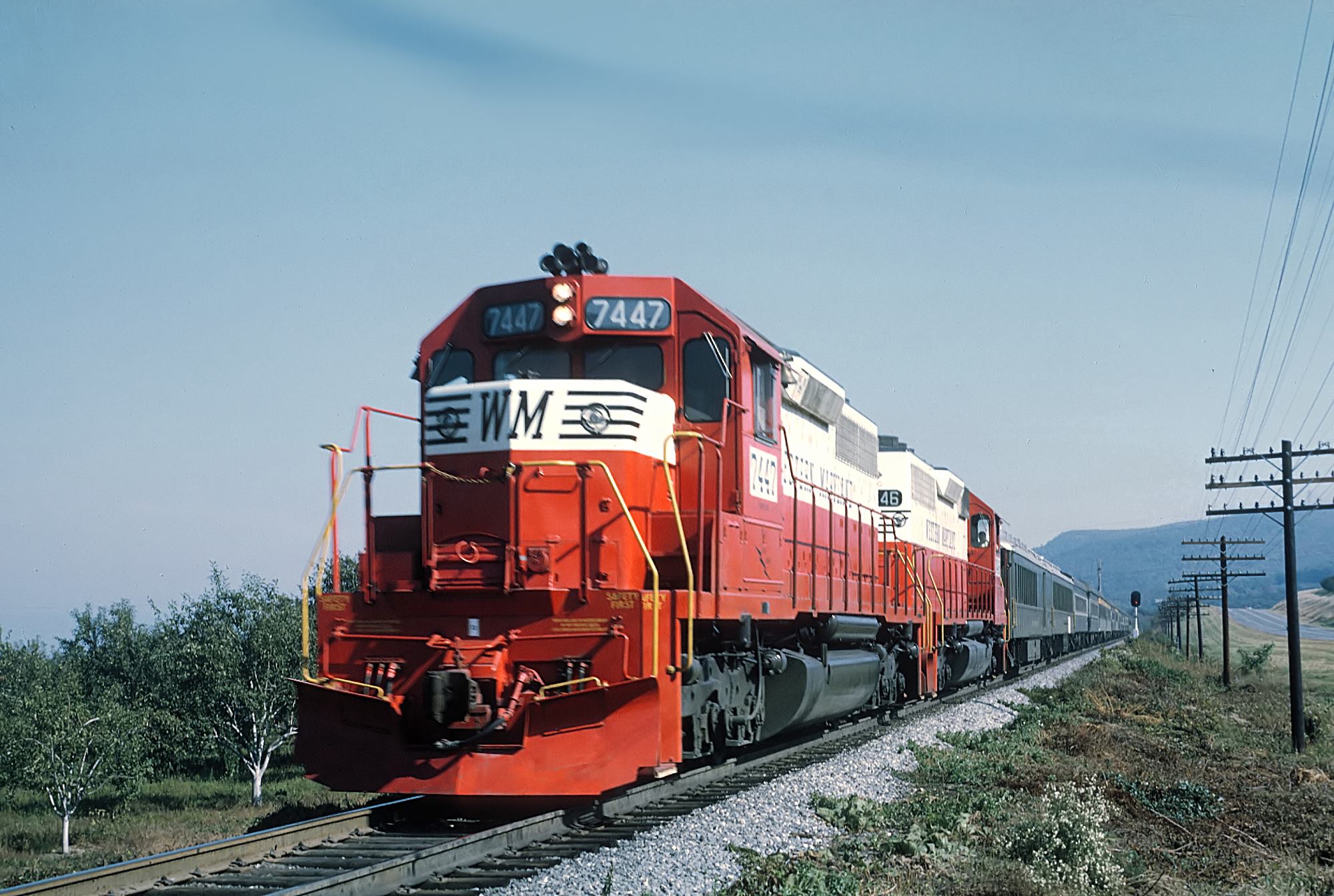
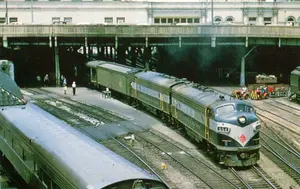
New SD40s in Circus paint on an NRHS fan trip near Smithsburg, Maryland, October 11, 1969. Roger Puta photo.
Diesels were tried from every builder that would sell one: an Alco S1 in 1941, Baldwin switchers and road-switchers, two General Electric 44-tonners for the Baltimore docks, and then Electro-Motive covered wagons, BL2s, and Geeps. The second-generation road engines were all EMD. The serial list is the diesel roster.
Control, Chessie, and a fast abandonment
The Western Maryland stayed profitable, and it stayed a separate operating company, long after the B&O held the stock. The Interstate Commerce Commission’s control case, brought by the Chesapeake & Ohio and the B&O, closed on February 4, 1963. That was control, not a merger. The stock purchase was completed in 1967. Chessie System, Inc., the holding company for the C&O, the B&O, and the Western Maryland, was incorporated on February 26, 1973. Yellow, blue, and vermillion, and the Chessie kitten, covered the speed lettering and the Circus paint. A small “WM” under the cab was what remained of the name on a locomotive.
On June 11, 1973, the company asked the Commission for permission to abandon 125 miles of the main line between Hancock and Connellsville, keeping Cumberland to Frostburg. The authority came in early 1975. Most of the Connellsville Extension went out of service on April 7, 1976. Hurricane Agnes had already broken the line between Westminster and Cedarhurst in June 1972. It was put back, then lost again in another storm three years later. Chessie did not rebuild it. Port Covington closed in 1973, and the export coal went to the B&O’s Curtis Bay piers. The St. Lawrence Seaway, opened in 1959, had already taken export grain away from every eastern pier railroad, Port Covington included. By the end of the 1970s the railroad east and west of Cumberland was mostly gone. What remained was the Thomas Subdivision and the West Virginia branches.
Floods in the fall of 1985 closed parts of the Thomas Subdivision. CSX, formed as an operating company on July 1, 1986, did not repair them. The Durbin Branch had lost its reason in 1979, when the C&O abandoned the Greenbrier Subdivision. The Western Maryland itself disappeared first among the Chessie roads. It merged into the Baltimore & Ohio on May 1, 1983.
What is left
The Western Maryland Scenic Railroad runs the old Connellsville Extension between Cumberland and Frostburg, through the Narrows, Brush Tunnel, and Helmstetter’s Curve. Its steam star is Chesapeake & Ohio 2-6-6-2 1309. Consolidation 734 is a Lake Superior & Ishpeming engine lettered as a Western Maryland H-7. The original 734 was an Alco H-7a and was scrapped. West of Frostburg the extension is the Great Allegheny Passage.
The West Virginia Central operates former Western Maryland and B&O track in the Elkins country, from Tygart Junction through Belington and Elkins and south toward Spruce. CSX still uses short pieces of the old railroad in Maryland. The rail to Webster Springs and Bergoo was still in place after the trains stopped in the early CSX years. Shay 6 is at Cass. The class-by-class steam list, and the diesel list with serials, are the two roster pages.
Related reading on American-Rails.com
- Western Maryland steam roster · Western Maryland diesel roster
- Dutch Line · Durbin Branch · Black Fork Grade · Elkins · Greenbrier, Cheat & Elk
- Western Maryland Scenic Railroad · Helmstetter’s Curve
- Chessie System · Baltimore & Ohio · Chesapeake & Ohio
- Pittsburgh & West Virginia · Wheeling & Lake Erie · West Virginia railroads
Sources
- Cook, Roger, and Karl Zimmermann. The Western Maryland Railway: Fireballs and Black Diamonds. San Diego: Howell-North, 1981. Corporate story, Connellsville Extension, Alphabet Route, branch traffic, 1947 steam assignments
- Drury, George H. Guide to North American Steam Locomotives. Revised edition. Milwaukee: Kalmbach, pp. 326–328. Post-1900 class grid. Potomacs are Baldwin 1947. M-2s are the 4-6-6-4s
- Thompson, E. L. “Fast Freight Line.” Trains, May 1941. Steam assignment and the 1940s roster
- Price, William P. Western Maryland Steam Album. Potomac Chapter, National Railway Historical Society, 1985
- Grenard, Ross, and John Krause. Steam in the Alleghenies: Western Maryland. Carstens
- McNeel, William. The Durbin Route. Durbin Branch, July 27, 1903, 46.9 miles
- Warden, William. West Virginia Logging Railroads
- Chessie chronology used on the Chessie System page: ICC control case closed February 4, 1963; Western Maryland into the Baltimore & Ohio May 1, 1983
Recent Articles


-
Virginian Railway's 2-6-6-6 Locomotives (Class AG)
Oct 18, 26 01:38 PM
 Virginian Railway class AG. Eight Lima 2-6-6-6s, Nos. 900-907, built in 1945 for the east end. Billed at 753,000 pounds. Scrapped in 1960.
 -
Pennsylvania (PRR) Steam Roster: Post 1906
Oct 18, 26 01:05 PM
 ennsylvania steam after 1906—H8, H9, and H10 Consolidations, 574 L1s Mikados, 598 I1s Decapods, 425 K4s Pacifics, 301 M1 Mountains. Drury’s grid. Last steam November 30, 1957.
 -
Chicago, Aurora and Elgin Railroad: The "Roarin' Elgin"
Oct 18, 26 10:54 AM
 The Chicago, Aurora & Elgin, the Roarin' Elgin, ran 600-volt third-rail trains from Chicago to Aurora, Batavia, and Elgin. Passenger service ended at noon on July 3, 1957. Freight ended June 11, 1959.
 -
Algoma Central Railway: Map, Logo, Rosters
Oct 17, 26 10:49 PM
 Algoma Central Railway, Sault Ste. Marie to Hearst. Wisconsin Central on February 1, 1995. Fifty-nine steam locomotives and forty-two diesels.
 -
Akron, Canton and Youngstown Railroad: Map, History, Rosters
Oct 17, 26 05:49 PM
 Akron, Canton and Youngstown Railroad, Mogadore to Delphos. The rails never reached Canton or Youngstown. Norfolk & Western control on October 16, 1964. Twenty-six diesels and the historical society's…
 -
Georgia Railroad: Map, History, Logo, Rosters
Oct 17, 26 12:59 PM
 Georgia Railroad, the Georgia Railroad and Banking Company, Augusta to Atlanta, with the Athens branch and the Macon Road. Mark GA. The railroad properties were sold on November 4, 1982.
 -
West Point Route (Railroad): Map, History, Logo
Oct 16, 26 11:26 PM
 The West Point Route was a trademarked name comprising the Atlanta & West Point and Western Railway of Alabama, which were controlled by the Georgia Railroad.
 -
Virginian Railway Diesel Roster (All-Time)
Oct 16, 26 11:11 PM
 All-time diesel roster of the Virginian Railway. 40 Fairbanks-Morse H16-44s, 25 H24-66 Train Masters, and one GE 44-tonner. Serials included.
 -
Virginian Railway Steam Roster (Post 1900)
Oct 16, 26 10:55 PM
 Virginian Railway steam locomotives built since 1900. Mikados, 2-8-8-2s, the Triplex, class AE 2-10-10-2s, and the 1945 2-6-6-6s.
 -
Virginian Railway: Map, Rosters, History, Electrification
Oct 16, 26 10:51 PM
 Virginian Railway, Deepwater to Norfolk. Combined in 1907 and completed in 1909. Electrified from Roanoke to Elmore. Absorbed by the Norfolk & Western on December 1, 1959.
 -
Baldwin "Centipede" Locomotives: Specs, Roster, Photos
Oct 16, 26 03:58 PM
 Baldwin DR-12-8-1500/2 Centipede—2-D+D-2, two 608SC engines, 3,000 hp. SAL 4500 from the 1943 test bed. 54 on the serial list, 52 sold. PRR BP60 then BH50. None preserved.
 -
Louisville & Nashville Class M-1 2-8-4s: The Big Emmas
Oct 16, 26 03:52 PM
Louisville & Nashville class M-1, 42 Big Emma 2-8-4s. Baldwin in 1942 and 1944, Lima in 1949. Coal trains from Neon to DeCoursey. No locomotive survives. -
Tennessee, Alabama and Georgia Railway: Map, History, Rosters
Oct 16, 26 03:21 PM
 Tennessee, Alabama and Georgia Railway, Chattanooga to Gadsden. The May 1929 card is 91.7 miles. Southern stock control closed on a January 1, 1971 schedule. Five diesels and Prince's steam list.
 -
Railroad Museums In The USA (2026): State Guides & Collections
Oct 16, 26 02:29 PM
 U.S. railroad museums—what they are vs tourist railroads, preservation history (R&LHS, NRHS, IRM, Steamtown), state guides, and destination collections. Confirm hours on each museum’s site.
 -
Wyoming Railroad Museums (2026): A Complete Guide
Oct 16, 26 02:26 PM
 Wyoming railroad museums—the Cheyenne Depot, Burlington 5633 at Douglas, Big Boy 4004, and the Laramie depot. Confirm hours and which locomotive is on the property.
 -
West Virginia Railroad Museums (2026): A Complete Guide
Oct 16, 26 12:52 PM
 West Virginia railroad museums—Cass Scenic’s geared steam, the Hinton C&O collection, and the Martinsburg B&O roundhouse. Confirm hours and which locomotive is assigned.
 -
Washington Railroad Museums (2026): A Complete Guide
Oct 16, 26 12:46 PM
 Washington railroad museums—Snoqualmie, Elbe, Chehalis, Reardan, and the Northern Pacific depot at Toppenish. Confirm hours and which locomotive is assigned.
 -
Vermont Railroad Museums (2026): A Complete Guide
Oct 16, 26 12:42 PM
 Vermont railroad museums—the Shelburne Museum’s 1890 station, Central Vermont No. 220, and the private car Grand Isle. Confirm hours on the site.
 -
Tennessee Central Railway: Map, Logo, Rosters, History
Oct 16, 26 11:32 AM
 Tennessee Central Railway, Harriman to Hopkinsville. Reorganized January 26, 1922. Last day August 31, 1968. Thirty-one diesels and the railroad's steam roster.
 -
Southern Railway Steam Roster (Post 1900)
Oct 16, 26 09:40 AM
Southern Railway steam locomotives built since 1900. Ps-4 Pacifics, Ts Mountains, USRA Santa Fes, and the subsidiary grids for the CNO&TP, Alabama Great Southern, and New Orleans and Northeastern. -
Southern Railway (USA): Map, Locomotives, Logo, History
Oct 16, 26 09:28 AM
 The Southern Railway, formed July 1, 1894 from the Richmond and Danville and the East Tennessee, Virginia and Georgia. Washington. Norfolk Southern Railway on December 31, 1990.
 -
Seaboard Coast Line Diesel Roster (All-Time)
Oct 15, 26 04:21 PM
 All-time diesel roster of the Seaboard Coast Line. Inherited Coast Line and Seaboard locomotives, then 623 new locomotives in the printed orders, plus 28 acquired from other railroads.
 -
Seaboard Coast Line Railroad: Map, History, Photos
Oct 15, 26 04:17 PM
 The Seaboard Coast Line, formed July 1, 1967 from the Atlantic Coast Line and the Seaboard Air Line. Jacksonville. Family Lines, then the Seaboard System on December 29, 1982.
 -
South Carolina Railroad Museums (2026): A Complete Guide
Oct 15, 26 02:54 PM
 South Carolina railroad museums—Winnsboro’s Rockton & Rion line, Spartanburg’s Hub City depot, Greenwood’s Baldwin No. 19, and the Best Friend replica. Confirm hours on each site.
 -
South Dakota Railroad Museums (2026): A Complete Guide
Oct 15, 26 10:55 AM
 South Dakota railroad museums—the Hill City museum beside the 1880 Train, and Prairie Village at Madison. Confirm hours, and confirm whether Hill City is still open.
 -
Seaboard Air Line Diesel Roster (All-Time)
Oct 15, 26 10:46 AM
 All-time diesel roster of the Seaboard Air Line. 734 locomotives: E4s in 1938, Centipedes, Alco road switchers, and GP40s through February 1967. Serials included.
 -
Seaboard Air Line Steam Roster (Post 1900)
Oct 15, 26 10:39 AM
 Seaboard Air Line steam locomotives built since 1900. Mikados, Russian Decapods, 2-10-2s, and the 2-6-6-4s sold to the Baltimore and Ohio in 1947. Drury's class grid.
 -
Seaboard Air Line Railroad: Map, Rosters, History
Oct 15, 26 10:34 AM
 The Seaboard Air Line, chartered in the Portsmouth and Roanoke of 1832 and formed July 1, 1900. Inland route to Florida. Merged into the Seaboard Coast Line on July 1, 1967.
 -
Utah Railroad Museums (2026): A Complete Guide
Oct 15, 26 12:04 AM
 Utah railroad museums—Ogden Union Station, Golden Spike at Promontory, the Helper mining museum, and the Heber Valley Railroad. Confirm hours on each site.
 -
Escanaba & Lake Superior Diesel Roster (All-Time)
Oct 14, 26 10:44 PM
All-time diesel roster of the Escanaba & Lake Superior. 30 locomotives: Baldwin switchers and RS-12s, two RF16s, three GP38s, three SD40-2s, and the Reserve Mining units. Serials and order numbers. -
Escanaba & Lake Superior Railroad: In Service Since 1898
Oct 14, 26 09:04 PM
 Escanaba & Lake Superior Railroad, chartered November 17, 1898, and still operating from Wells, Michigan. Logging line to Channing, the Milwaukee Road lines, and the diesel roster.
 -
Richmond, Fredericksburg & Potomac Diesel Roster (All-Time)
Oct 14, 26 08:49 PM
 All-time diesel roster of the Richmond, Fredericksburg and Potomac. 107 locomotives: 22 Alco S2s, one SW1, and an Electro-Motive road fleet from E8s to GP40-2s. Serials and order numbers.
 -
Richmond, Fredericksburg & Potomac Steam Roster (Since 1900)
Oct 14, 26 08:46 PM
 Richmond, Fredericksburg and Potomac steam locomotives built since 1900. Pacifics, Mountains, Berkshire-type 2-8-4s, and the named 4-8-4s. Last revenue run December 17, 1954.
 -
Richmond, Fredericksburg and Potomac Railroad: Map, Rosters, Logo
Oct 14, 26 08:36 PM
 The Richmond, Fredericksburg and Potomac, chartered February 25, 1834. A 113-mile Richmond–Washington bridge line. Named 4-8-4s, Potomac Yard, and the CSX sale of October 10, 1991.
 -
North Dakota Railroad Museums (2026): A Complete Guide
Oct 14, 26 08:29 PM
North Dakota railroad museums—Mandan’s state museum, the Railroad Museum of Minot, and Bonanzaville’s Northern Pacific 684. Confirm hours on each site. -
Oklahoma Railroad Museums (2026): A Complete Guide
Oct 14, 26 08:02 PM
Oklahoma railroad museums—the Oklahoma Railway Museum, Enid’s Frisco 1519, Waynoka’s Harvey House, and El Reno’s Rock Island depot. Confirm hours on each site. -
Oneida & Western Railroad: Map, History, Timetable
Oct 14, 26 06:47 PM
Oneida & Western Railroad, a Tennessee short line from Oneida to Jamestown. Chartered in 1912, opened to East Jamestown in 1921, and to Jamestown on December 10, 1930. Last revenue train March 4, 1954… -
Oneida and Western Railroad (Shamrock Coal Company)
Oct 14, 26 03:20 PM
 Shamrock Coal's mint-green coal trains, 1979–1987. Eight EMD SD40-2s, OWTX 9950–9957, order 786246. Two 72-car gondola sets. Louisville & Nashville, then CSX. Sold to BC Rail.
 -
Rhode Island Railroad Museums (2026): A Complete Guide
Oct 14, 26 03:03 PM
 Rhode Island railroad museums—the Friends’ museum in the 1875 Kingston depot, on the old New York, Providence and Boston. Confirm what is on view.
 -
Original Norfolk Southern Diesel Roster (All-Time)
Oct 14, 26 12:40 PM
 All-time diesel roster of the original Norfolk Southern Railway. 59 locomotives: Baldwin switchers and AS-416s, three GE 70-tonners, 17 GP18s, and seven GP38s. Serials and order numbers.
 -
Original Norfolk Southern Railway: Map, Rosters, History
Oct 14, 26 10:09 AM
 The original Norfolk Southern Railway, chartered in 1870 as the Elizabeth City & Norfolk. Norfolk to Charlotte. Merged into the Southern Railway on January 1, 1974. Baldwin diesels and the GP18s and G…
 -
Nebraska Railroad Museums (2026): A Complete Guide
Oct 14, 26 10:00 AM
 Nebraska railroad museums—the Durham Museum, Kenefick Park, Cody Park, and the Golden Spike Tower over Bailey Yard. Confirm hours on each site.
 -
Nevada Railroad Museums (2026): A Complete Guide
Oct 14, 26 09:51 AM
 Nevada railroad museums—Carson City, Boulder City, the Nevada Northern at East Ely, and the Virginia City depot. Confirm hours on each site.
 -
Montana Railroad Museums (2026): A Complete Guide
Oct 14, 26 12:17 AM
 Montana railroad museums—the Livingston depot, Fort Missoula’s Willamette, the Harlowton Milwaukee depot, and the Whitefish station. Confirm hours on each site.
 -
"Jawn Henry" Locomotive: Specs, Diagram, Photos
Oct 14, 26 12:03 AM
 Norfolk & Western No. 2300, class TE-1, the steam turbine-electric Jawn Henry. Baldwin-Lima-Hamilton, Westinghouse, and Babcock & Wilcox, May 1954. Specifications, the road tests, and the Dece…
 -
Atlantic and Danville Railway: Serving Southern VA
Oct 13, 26 04:32 PM
 Atlantic and Danville Railway, chartered in 1882, incorporated September 1883. Three-foot line to Claremont, then Norfolk to Danville. Southern lease from September 1, 1899, to July 1, 1949. Alco RS2s…
 -
Norfolk, Franklin and Danville Railroad: Map, Roster, History
Oct 13, 26 04:26 PM
 Norfolk, Franklin and Danville Railway, chartered October 2, 1962, and operating from November 1, 1962. Norfolk to Danville, 210.8 miles. Two Alco RS36s and four RS11s. Merged into the N&W on December…
 -
Norfolk & Western Diesel Roster (All-Time)
Oct 12, 26 11:59 PM
 Norfolk & Western diesel roster, all-time. 1,464 locomotives built new for the railroad, from the 1955 GP9s and RS-3s through the C36-7s, plus the merger fleets.
 -
Norfolk & Western Steam Roster (Post 1900)
Oct 12, 26 11:52 PM
 Norfolk & Western steam since 1898. The Roanoke grid: 1,266 locomotives, the J, the A, and the Y, and the last road steam on May 7, 1960.
 -
Norfolk & Western Railway: Map, Logo, Rosters, History
Oct 12, 26 11:45 PM
 The Norfolk & Western, from the City Point Railroad of 1838 to Norfolk Southern. Pocahontas coal, Roanoke steam, and the 1964 expansion.