
Alco "RSD5" Locomotives: Data Sheet, Roster, Specs
Last revised: December 16, 2024
By: Adam Burns
The RSD5 was an extension of the RSD4 and cataloged to replace a flaw in the earlier design. After fixing the
issue, which had to do with inadequate spacing, the RSD5 sold nearly six
times as many units as its predecessor.
The model was meant to compete with the Electro-Motive Division's SD7 design, the six-axle cousin of the GP7. Interestingly, despite railroads' disinterest in C-C locomotives at the time, Alco actually outsold its competitor by a few units.
The RSD5 was, of course, nearly identical to the RSD4 although Alco did bump its horsepower rating just slightly, which actually made it a touch more powerful than the SD7.
Photos
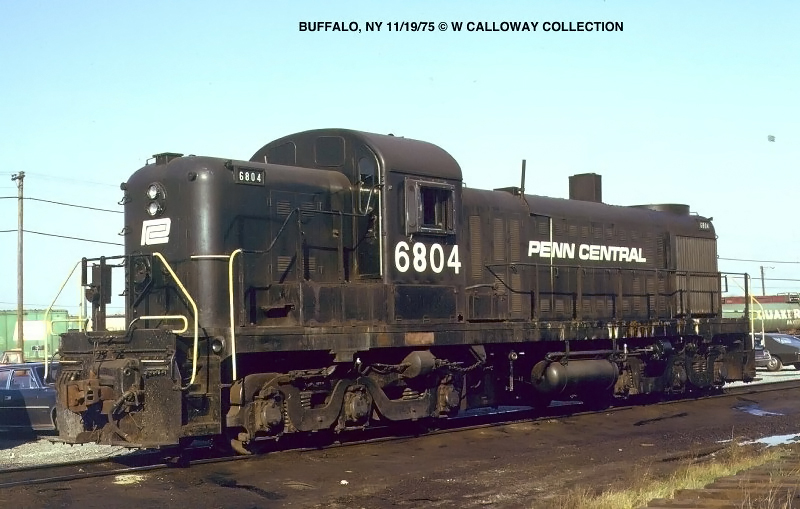 Penn Central RSD5 #6804 is seen here at Buffalo, New York in November, 1975. Warren Calloway collection.
Overview
The RSD5 was rushed into production as a replacement for the earlier RSD4, whose frame was not long enough to support the main generator. As such, at nearly 56 feet, 7 inches the later RSD5 was nearly eight inches longer than its predecessor.
Internally, the model was identical to the RSD4 and both were essentially the same as the four-axle RS3. From a strength standpoint, the RSD5 was slightly better; it offered 1,000 pounds more starting tractive effort (90,000 pounds) and an additional 100 horsepower (1,600 hp). Interestingly, despite the RSD4's issues most railroads that purchased it returned to buy the RSD5.
The RSD5 entered production in 1952 directly after the unsuccessful RSD4 and remained in the company's catalog until 1955. The new model used the same Alco 244 prime mover.
Designation
As with all other "D" designated models, the RSD5 used a C-C truck arrangement with all six axles powered. The six axle models were meant to provide a sizable increase in traction and be used on light branch/secondary lines allowing the locomotive's weight to be distributed more evenly over additional axles.
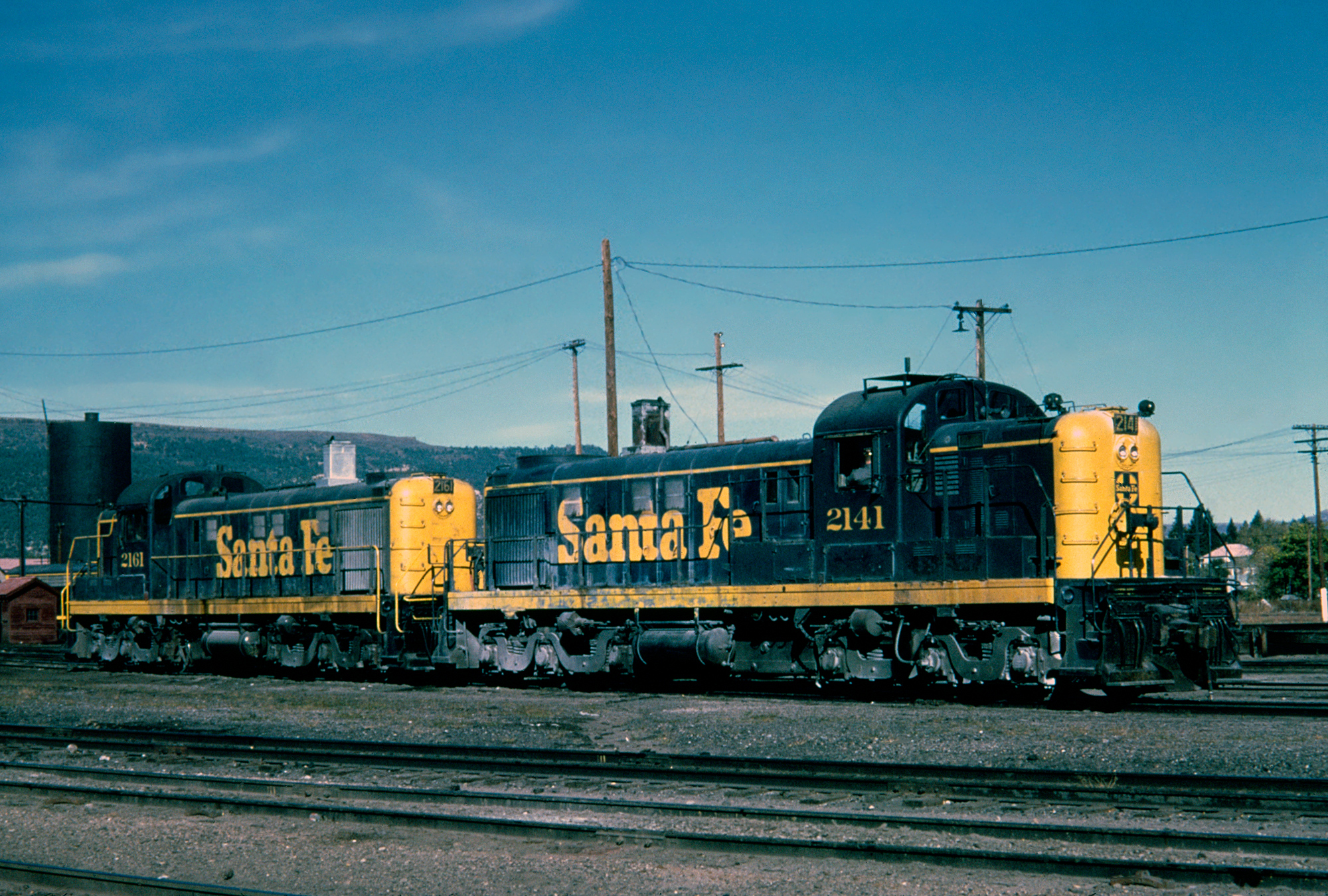
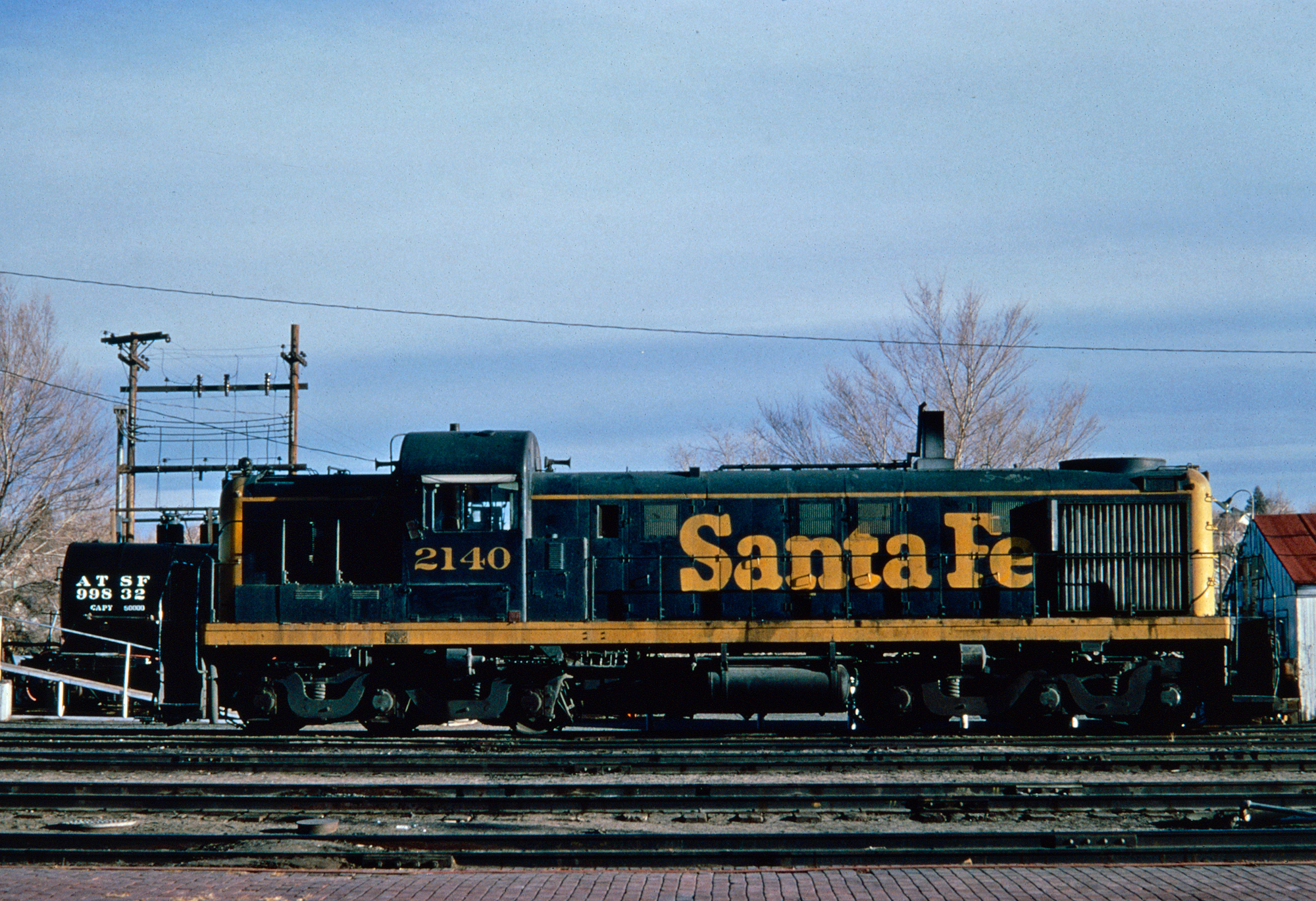 Santa Fe RSD5 #2140 lays over in Colorado Springs, Colorado circa 1965. American-Rails.com collection.
In an attempt to probably ease railroads fears over the problematic RSD4, Alco even built an RSD5 demonstrator to prove that the model no longer suffered from its previous issues.
Apparently, the
Atchison, Topeka & Santa was quite impressed as they
purchased more than 50 units of the design after only picking up ten
examples of the RSD4. Additionally, lines like the Chesapeake &
Ohio and Southern Pacific, both of which had not even purchased the RSD4
bought nearly 90 of RSD5s between them.
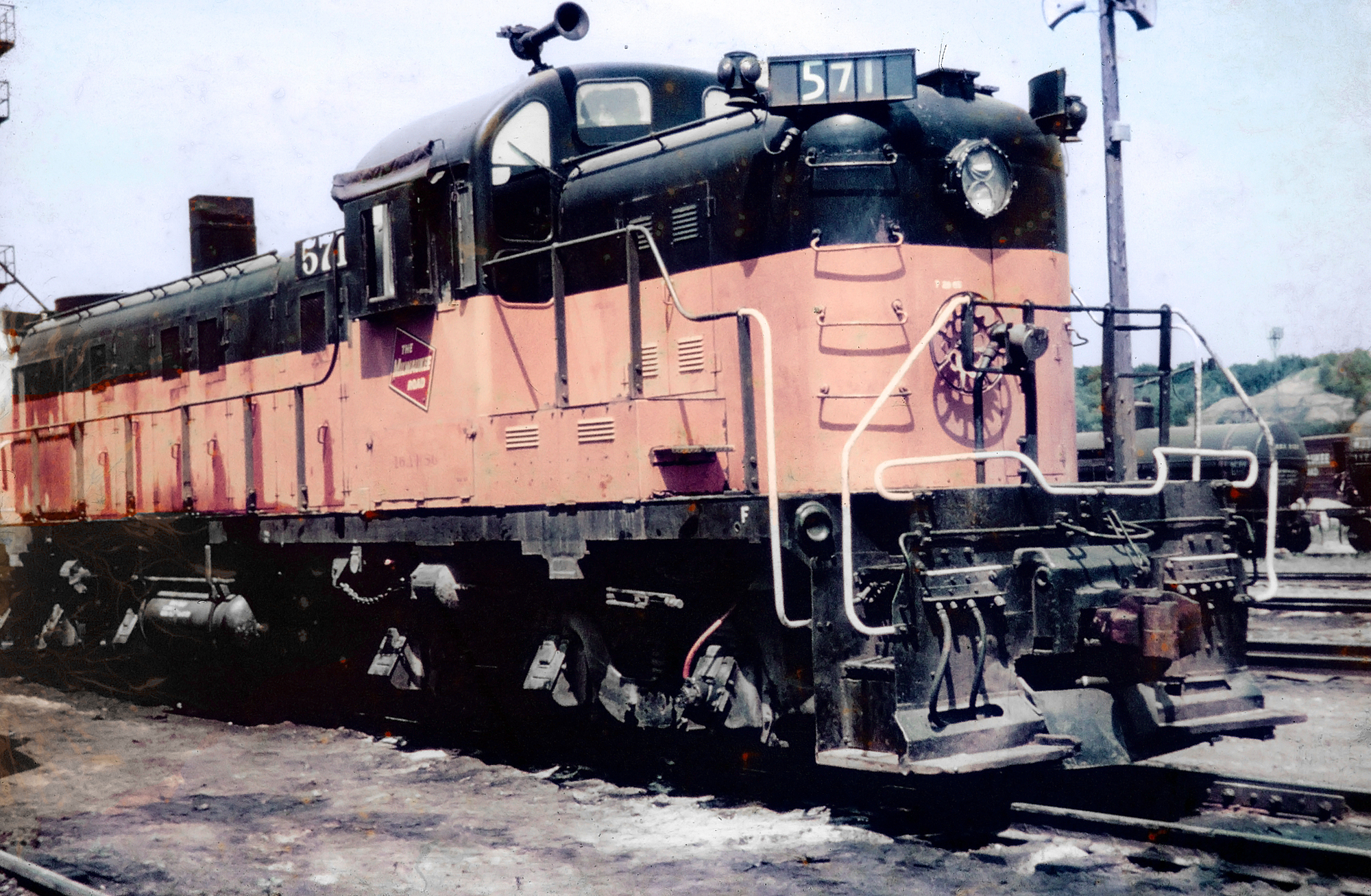 Milwaukee Road RSD5 #571 (built as #2151) at Pigs Eye Yard in St. Paul, Minnesota; August, 1965. Fred Byerly photo. American-Rails.com collection.
Data Sheet and Specifications
| Alco Class | 606-DL-360 |
| Entered Production | 3/1952 (Chesapeake & Ohio #5570) |
| Years Produced | 3/1952-3/1956 |
| Model Specification | E1664/A/B |
| Engine | 244, V-12 |
| Horsepower | 1,600 |
| RPM | 1,000 |
| Carbody Styling | Alco |
| Length (Between Coupler Pulling Faces) | 56' 5.75" |
| Weight | 360,000 Lbs. |
| Dynamic Brakes | Optional |
| Trucks | C-C |
| Truck Type | Trimount |
| Truck Wheelbase | 12' 6" |
| Wheel Size | 40" |
| Traction Motors | GE 752 (6) |
| Traction Generator | GT566 |
| Steam Generator | - |
| Gear Ratio | 74:18 |
| Tractive Effort Rating | 78,750 Lbs. at 5.5 MPH |
| Top Speed | 60 MPH |
Production Roster
Alco
Total Built = 167
| Owner | Road Number(s) | Serial Number(s) | Date Built |
|---|---|---|---|
| Alco (Demonstrator) | 1606 (became Santa Fe #2157) | 80195 | 8/1952 |
| Santa Fe | 2110 - 2119 | 80196-80205 | 8/1952 - 10/1952 |
| Santa Fe | 2120, 2121 | 80287, 80288 | 4/1953 |
| Santa Fe | 2122 - 2129 | 80407-80414 | 4/1953 |
| Santa Fe | 2130 - 2137 | 80599-80606 | 6/1953 - 7/1953 |
| Santa Fe | 2138, 2139 | 80770, 80771 | 8/1953 |
| Santa Fe | 2140 - 2151 | 80587-80598 | 6/1953 |
| Santa Fe | 2152 - 2156 | 80772-80776 | 8/1953 |
| Santa Fe | 2158 - 2162 | 80805-80809 | 10/1953 - 11/1953 |
| Birmingham Southern | 160 | 80855 | 12/1953 |
| Chesapeake & Ohio | 5570 - 5574 | 79427-79431 | 3/1952 - 4/1952 |
| Chesapeake & Ohio | 5575 - 5579 | 79702-79706 | 4/1952 |
| Chesapeake & Ohio | 5580 - 5589 | 79945-79954 | 5/1952 - 6/1952 |
| Chesapeake & Ohio | 5590 - 5595 | 80189-80194 | 6/1952 - 7/1952 |
| Central Railroad of New Jersey | 1615 | 80286 | 4/1953 |
| Chicago & North Western | 1665 - 1667 | 80780-80782 | 9/1953 |
| Chicago & North Western | 1684, 1685 | 80859, 80860 | 3/1954 |
| Chicago & North Western | 1686 - 1688 | 80863-80865 | 4/1954 |
| Chicago & North Western | 1689, 1690 | 80861, 80862 | 4/1954 |
| Milwaukee Road | 2150, 2151 | 80777, 80778 | 8/1953 |
| Milwaukee Road | 2152 | 80779 | 9/1953 |
| Milwaukee Road | 2153 - 2155 | 80802-80804 | 10/1953 |
| Pennsylvania | 8446, 8447 | 80206, 80207 | 10/1952 |
| Pennsylvania | 8448 - 8451 | 80208-80211 | 3/1953 |
| St. Louis-Southwestern Railway (Cotton Belt) | 270 - 272 | 80415-80417 | 4/1953 |
| Southern Pacific | 5294, 5295 | 80212, 80418 | 3/1953, 4/1953 |
| Southern Pacific | 5296 - 5302 | 80427-80433 | 5/1953 |
| Southern Pacific | 5303 | 80582 | 5/1953 |
| Southern Pacific | 5304 - 5307 | 80583-80586 | 7/1953 |
| Southern Pacific | 5336 - 5339 | 80787-80790 | 9/1953 |
| Southern Pacific | 5445 - 5448 | 80880-80883 | 4/1955 |
| Southern Pacific | 5494 - 5502 | 80886-80894 | 11/1955 - 12/1955 |
| Southern Pacific | 5503 - 5507 | 81765-81769 | 1/1956 |
| Texas & New Orleans (SP) | 155 - 158 | 80783-80786 | 9/1953 |
| Texas & New Orleans (SP) | 159 - 169 | 80791-80801 | 10/1953 |
| Texas & New Orleans (SP) | 170 | 80213 | 4/1953 |
| Texas & New Orleans (SP) | 171 - 176 | 80419-80424 | 4/1953 - 5/1953 |
| Texas & New Orleans (SP) | 185, 186 | 80425, 80426 | 5/1953 |
| Utah Railway | 306 | 81696 | 11/1955 |
Export
Total Built = 37
| Owner | Road Number(s) | Serial Number(s) | Date Built |
|---|---|---|---|
| Ferrocarril del Pacifico (Mexico) | 801 - 810 | 80810-80819 | 11/1953 - 12/1953 |
| Ferrocarril del Pacifico (Mexico) | 811 - 813 | 80856-80858 | 12/1953 |
| Ferrocarril del Pacifico (Mexico) | 814 - 827 | 80866-80879 | 8/1953-1/1954 |
| Ferrocarril del Pacifico (Mexico) | 828 - 832 | 81770-81774 | 1/1956 - 2/1956 |
| Ferrocarril del Pacifico (Mexico) | 833 - 835 | 81880-81882 | 2/1956 |
| Ferrocarriles Nacionales de México (Mexico) | 6900, 6901 | 80884, 80885 | 11/1955 |
Sources
- Foster, Gerald. A Field Guide To Trains. New York: Houghton Mifflin, 1996.
- Kirkland, John F. Diesel Builders, The: Volume Two, American Locomotive Company And Montreal Locomotive Works. Glendale: Interurban Press, 1989.
- Pinkepank, Jerry A. Diesel Spotter's Guide. Milwaukee: Kalmbach Publishing Company, 1967.
- Solomon, Brian. Alco Locomotives. Minneapolis: Voyageur Press, 2009.
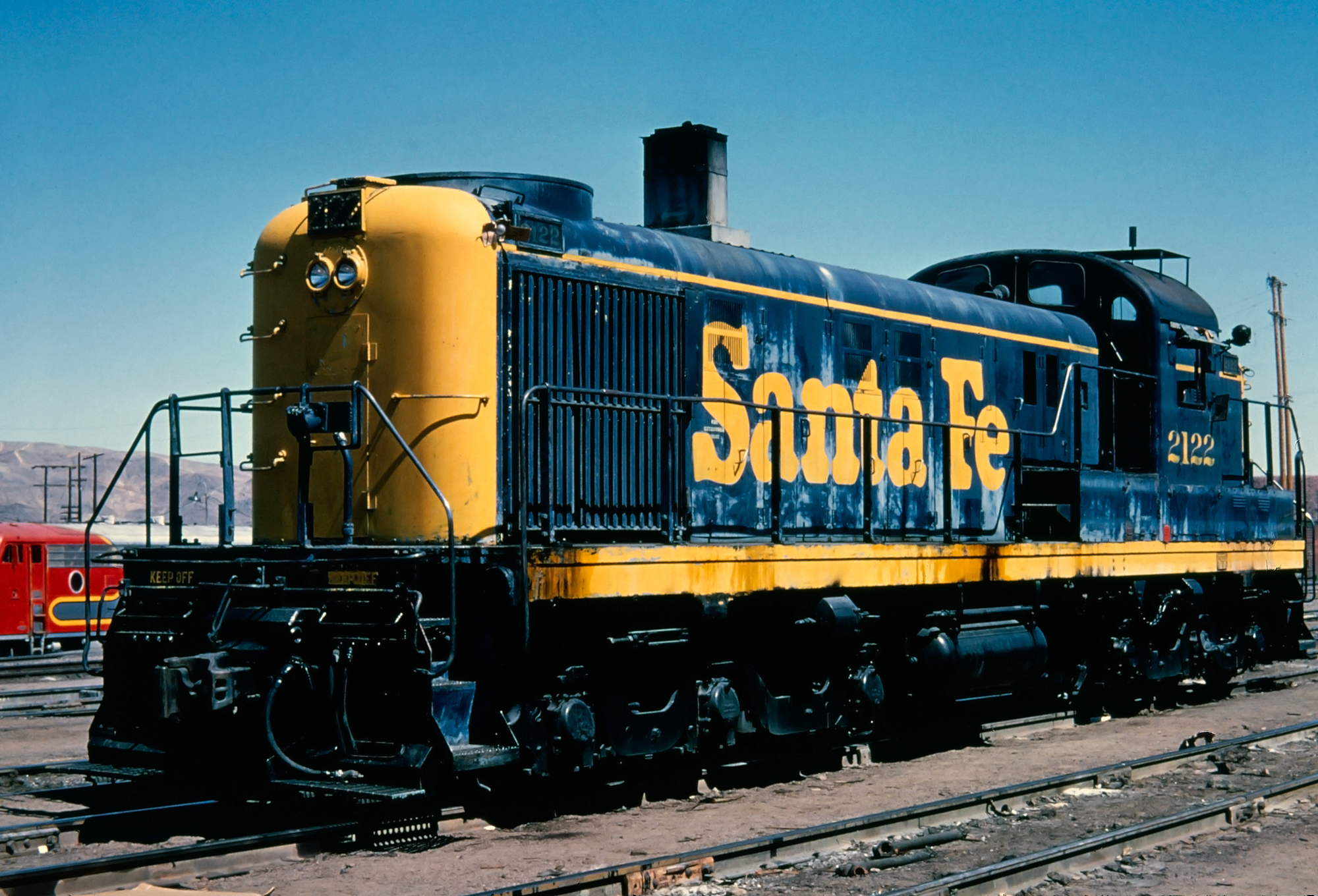 Santa Fe RSD5 #2122 is between assignments in Barstow, California during the late 1960s. Note the Warbonnet F unit in the background. American-Rails.com collection.
Many of the railroads that purchased the RSD5 employed them in heavy freight service such as the Utah Railway, Milwaukee Road, Chicago & North Western, Southern Pacific. The latter three roads particularly loved six axle diesels, practically since they were first manufactured by Alco and EMD.
In any event, for a six-axle model the Alco RSD5 sold relatively well at 204 units for a number of Class I railroads such as the Milwaukee Road, Southern Pacific, Chesapeake & Ohio, and Santa Fe (this also includes the 37 purchased by Mexican lines, Ferrocarril del Pacífico and Ferrocarriles Nacionales de México).
Preservation
Today, at least two of these units have been preserved, former Utah Railway #306 (as Nickel Plate #324) and Chicago & North Western #1689.
After the latter was retired in March, 1981 she went through a number of owners, and even once wore Western Maryland colors leading excursions on the Western Maryland Scenic Railroad. Today, she has been returned to her C&NW colors thanks to the efforts of the Illinois Railway, which has lovingly restored the locomotive.
Contents
Recent Articles


-
An Oregon Christmas Train Ride In Portland!
Nov 07, 25 12:18 AM
 The ORHF's Holiday Express is more than a nostalgic train ride. It’s a fundraiser that directly supports the preservation work you see inside the enginehouse.
 -
An Hawaii Christmas Train Ride On Oahu!
Nov 06, 25 11:55 PM
 When the Christmas season arrives, the Hawaiian Railway Society transforms their excursion experience into the Holiday Express—an illuminated, family-friendly ride that blends vintage railroading with…
 -
An Ohio Christmas Train Ride In Nelsonville!
Nov 06, 25 02:57 PM
Among the Hocking Valley Scenic Railway's most popular offerings is the Santa Train, a Christmastime tradition that sells out year after year and has become a cornerstone of the region’s holiday festi…


%20at%20Pigs%20Eye%20Yard%20in%20St.%20Paul%2C%20Minnesota%3B%20August%2C%201965.%20Fred%20Byerly%20photo.%20%20American-Rails.com%20collection.)

