Baldwin "RF16" Locomotives: Preserved, Specs, Roster
Last revised: December 28, 2024
By: Adam Burns
The RF16 epitomized Baldwin's "Sharknose" design. It was featured exclusively on the model
during its four year production run before the builder ended domestic production of diesel locomotives.
Meant for use in freight service, and in competition against Electro-Motive's F series and the American Locomotive Company's (Alco) FA, it was the best selling cab unit Baldwin built with more than 150 units outshopped.
The RF16 was also the only cab design cataloged as part of Baldwin's new Standard Line released in 1950.
The only difference between the earlier DR-4-4-1500, and latest RF16, was the latter's use of an Elliott model H704 turbocharger, which added an extra 100 horsepower.
This subsequently reclassified the prime mover as 608A. Baldwin also cataloged one variant, the RF-615E, purchased by the Argentine State Railway.
Photos
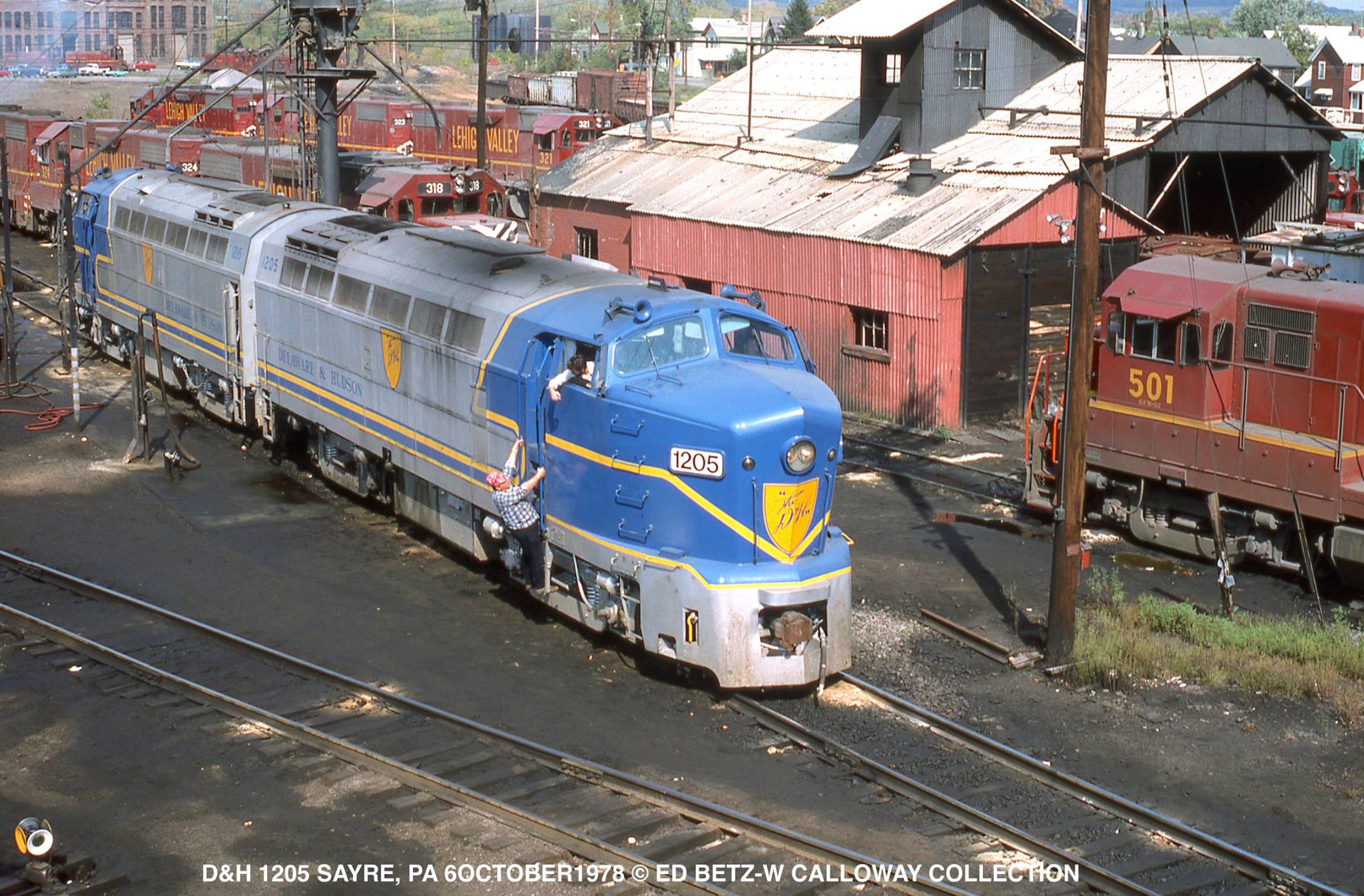 Delaware & Hudson's only pair of RF16 cab units, products of Baldwin Locomotive, are on the service tracks at Lehigh Valley's primary terminal and shops in Sayre, Pennsylvania during the mid-1970's. Ed Betz photo/Warren Calloway collection.
Overview
Baldwin is often criticized as a failed builder that was unable to keep pace with either Electro-Motive or American Locomotive.
In truth, parent Westinghouse pulled the plug on the industry's most recognized manufacturer just as it began selling more diesel locomotives during the 1950's.
Historical texts often never mention that between the spring of 1945 and the end of production (1956), Baldwin sold more than 4,000 locomotives. These included late era steam, numerous electrics, and of course its early diesel line.
As John Kirkland points out in his book, "The Diesel Builders: Volume Three (Baldwin Locomotive Works," orders had ramped up to such an extent that by the late 1940's Baldwin had reached production capacity.
Today, two RF16s survive, stored away at short line Escanaba & Lake Superior in Michigan. The railroad's owner states they will eventually be donated to a museum.
The RF16 began production in November of 1950 featuring the company's latest 608A prime mover capable of producing 1,600 horsepower.
Its introduction followed that of the late-era DR-4-4-1500 model sporting the famed "Shark Nose" carbody.
With calls to replace the original and unpopular "Baby Face" carbody, Baldwin contracted with Hadley, Ryder & Pedersen for a complete redesign. The company came up with the classic "Shark Nose" concept, which gave Baldwin's late-era cab models an entirely unique look.
Hadley, Ryder & Pedersen was also tasked with arranging the interior equipment, stress analysis of the carbody, and working with Baldwin in the final overall design.
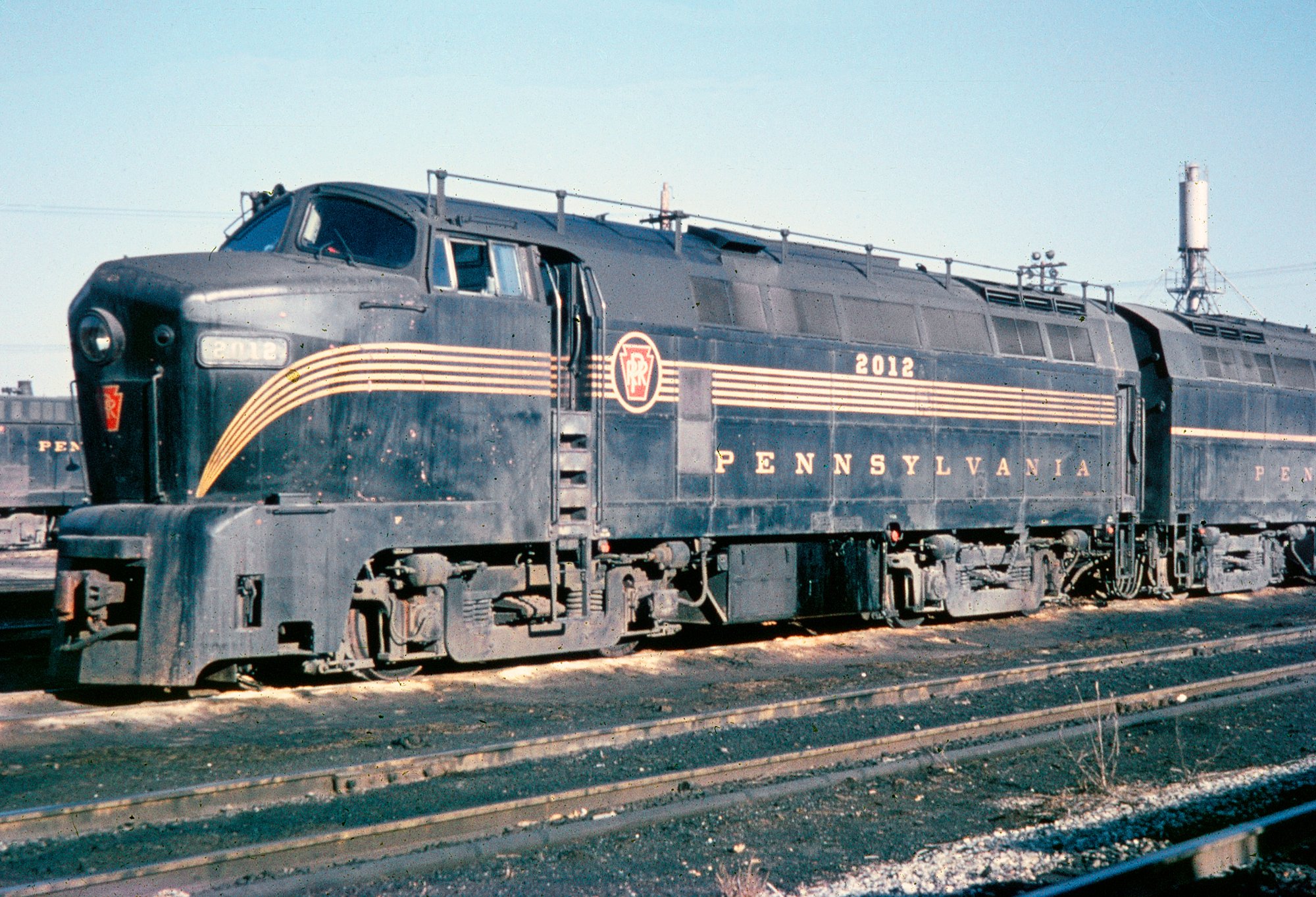 Pennsylvania RF16 #2012 in Toledo, Ohio, circa 1955. Fred Byerly photo. American-Rails.com collection.
Contrary to popular railfan belief, the "Shark Nose" was not a Raymond Loewy design. As John Kirkland points out this idea likely derived from the carbody's similarity to Pennsylvania Railroad's streamlined 4-4-4-4 "Duplex Drive" T-1's.
The angular nose of these famous steam locomotives, which was a Lowey inspiration, bore a striking resemblance to the "Shark Nose."
With a continuous tractive effort rating ranging from 42,200 - 52,500 pounds (depending upon the gearing chosen), the RF16 provided more than either EMD's F7 or Alco's FA-2 models.
For these reasons, the model became well-liked for its ability to pull heavy loads at slow speeds, a trademark of Westinghouse traction motors.
The model's internal components were outsourced to Westinghouse, which provided equipment for all of Baldwin's diesels.
The classification system for the RF16 was very straightforward, particularly compared to the earlier system:
- "RF" referred to Road Freight
- "16" designated the horsepower rating of 1,600
Overall the RF16 sold fairly well although only three Class I railroads ultimately purchased it:
- Baltimore & Ohio
- New York Central
- Pennsylvania Railroad (Baldwin's ever-loyal customer)
Among the group they bought 109 'A' units and 51 'B' units by the time production had ended in 1954. Additionally, the aforementioned Argentine State Railway purchased 51 units of a C-C design known as the RF-615E.
Data Sheet and Specifications
| Entered Production | 11/7/1950 (Baltimore & Ohio #851 and #851A) |
| Years Produced | 11/7/1950 - 5/21/1953 |
| Baldwin Class | DR-4-4-1600/1 SC |
| Engine | 608A |
| Turbocharger | H704 (Elliott) |
| Engine Builder | De La Vergne |
| Horsepower | 1600 |
| RPM | 625 |
| Carbody Styling | Baldwin |
| Length (Between Coupler Pulling Faces) | 54' 8" (A units), 53' 22" (B units) |
| Weight | 250,000 Lbs |
| Trucks | B-B |
| Truck Type | GSC Swing Bolster, Drop-Side Equalizers |
| Truck Wheelbase | 9' 10" |
| Wheel Size | 42" |
| Traction Motors | 370G (4), Westinghouse |
| Traction Generator | 471A, Westinghouse |
| Auxiliary Generator | YG42A, Westinghouse |
| Gear Ratio | 15:68, 15:63, 17:62 |
| Tractive Effort Rating | 52,500 Lbs at 9.2 MPH (15:68), 48,600 Lbs at 9.9 MPH (15:63), or 42,200 Lbs at 11.4 MPH (17:62)* |
| Top Speed | 65 MPH (15:68), 70 MPH (15:63), 80 MPH (17:62) |
* No orders were received with 17:62 gearing.
During the course of production, Baldwin made the following equipment updates:
- 471A main generator was first replaced with the model 471B, and then later the 471BZ.
- YG42A auxiliary upgraded to model YG42B.
- 370G traction motors upgraded first to model 370DL, then 370DE, and finally 370DEZ.
Production Roster
Total Built = 160
| Owner | Road Number | Baldwin Serial Number (A Unit) | Baldwin Serial Number (B Unit) | Construction Number | Completion Date |
|---|---|---|---|---|---|
| Baltimore & Ohio | 851 | 1 | 74801 | 11/7/1950 | |
| Baltimore & Ohio | 851A | 2 | 74802 | 11/7/1950 | |
| Baltimore & Ohio | 853 | 3 | 74803 | 11/10/1950 | |
| Baltimore & Ohio | 853A | 4 | 74804 | 11/10/1950 | |
| Baltimore & Ohio | 855 | 5 | 74805 | 11/15/1950 | |
| Baltimore & Ohio | 855A | 6 | 74806 | 11/15/1950 | |
| Baltimore & Ohio | 857 | 7 | 74807 | 11/17/1950 | |
| Baltimore & Ohio | 857A | 8 | 74808 | 11/17/1950 | |
| Baltimore & Ohio | 859 | 9 | 74809 | 11/28/1950 | |
| Baltimore & Ohio | 859A | 10 | 74810 | 11/28/1950 | |
| Baltimore & Ohio | 861 | 11 | 74811 | 11/30/1950 | |
| Baltimore & Ohio | 861A | 12 | 74816 | 11/30/1950 | |
| Baltimore & Ohio | 863 | 13 | 74817 | 12/6/1950 | |
| Baltimore & Ohio | 863A | 14 | 74818 | 12/6/1950 | |
| Pennsylvania | 9708 | 15 | 74819 | 12/21/1950 | |
| Pennsylvania | 9708B | 1 | 74831 | 12/21/1950 | |
| Pennsylvania | 9709 | 16 | 74820 | 12/21/1950 | |
| Pennsylvania | 9710 | 17 | 74821 | 1/10/1951 | |
| Pennsylvania | 9710B | 2 | 74832 | 1/10/1950 | |
| Pennsylvania | 9711 | 18 | 74822 | 1/10/1951 | |
| Pennsylvania | 9712 | 19 | 74823 | 1/17/1951 | |
| Pennsylvania | 9712B | 3 | 74833 | 1/17/1950 | |
| Pennsylvania | 9713 | 20 | 74824 | 1/17/1951 | |
| Pennsylvania | 9714 | 21 | 74825 | 1/29/1951 | |
| Pennsylvania | 9714B | 4 | 74834 | 1/20/1951 | |
| Pennsylvania | 9715 | 22 | 74826 | 1/29/1951 | |
| Pennsylvania | 9740 | 23 | 74827 | 2/6/1951 | |
| Pennsylvania | 9740B | 5 | 74835 | 2/6/1951 | |
| Pennsylvania | 9741 | 24 | 74838 | 2/6/1951 | |
| Pennsylvania | 9742 | 25 | 74829 | 2/13/1951 | |
| Pennsylvania | 9742B | 6 | 74836 | 2/13/1951 | |
| Pennsylvania | 9743 | 26 | 74830 | 2/13/1951 | |
| Pennsylvania | 9744 | 27 | 74889 | 2/15/1951 | |
| Pennsylvania | 9744B | 7 | 74837 | 2/15/1951 | |
| Pennsylvania | 9745 | 28 | 74990 | 2/15/1951 | |
| Pennsylvania | 9728 | 29 | 74991 | 2/21/1951 | |
| Pennsylvania | 9728B | 8 | 74838 | 2/21/1951 | |
| Pennsylvania | 9729 | 30 | 74992 | 2/21/1951 | |
| Pennsylvania | 9730 | 31 | 74993 | 2/27/1951 | |
| Pennsylvania | 9730B | 9 | 74839 | 2/27/1951 | |
| Pennsylvania | 9731 | 32 | 74994 | 2/27/1951 | |
| Pennsylvania | 9716 | 33 | 74995 | 3/6/1951 | |
| Pennsylvania | 9717 | 34 | 74996 | 3/6/1951 | |
| Pennsylvania | 9718 | 35 | 74997 | 3/12/1951 | |
| Pennsylvania | 9719 | 36 | 74998 | 3/12/1951 | |
| Pennsylvania | 9720 | 37 | 74999 | 3/14/1951 | |
| Pennsylvania | 9721 | 38 | 75000 | 3/14/1951 | |
| Pennsylvania | 9722 | 39 | 75001 | 3/21/1951 | |
| Pennsylvania | 9723 | 40 | 75002 | 3/21/1951 | |
| Pennsylvania | 9724 | 41 | 75003 | 3/27/1951 | |
| Pennsylvania | 9725 | 42 | 75004 | 3/27/1951 | |
| Pennsylvania | 9726 | 43 | 75005 | 3/29/1951 | |
| Pennsylvania | 9727 | 44 | 75006 | 3/29/1951 | |
| Pennsylvania | 9732 | 45 | 74847 | 4/4/1951 | |
| Pennsylvania | 9732B | 10 | 74840 | 4/4/1951 | |
| Pennsylvania | 9733 | 46 | 74848 | 4/4/1951 | |
| Pennsylvania | 9794 | 47 | 74849 | 4/13/1951 | |
| Pennsylvania | 9594B | 11 | 74841 | 4/13/1951 | |
| Pennsylvania | 9595 | 48 | 74850 | 4/13/1951 | |
| Pennsylvania | 9596 | 49 | 74851 | 4/20/1951 | |
| Pennsylvania | 9596B | 12 | 74842 | 4/20/1951 | |
| Pennsylvania | 9597 | 50 | 74852 | 4/20/1951 | |
| Pennsylvania | 9598 | 51 | 74853 | 4/30/1951 | |
| Pennsylvania | 9598B | 13 | 74843 | 4/30/1951 | |
| Pennsylvania | 9599 | 52 | 74854 | 4/30/1951 | |
| Pennsylvania | 9734 | 53 | 74855 | 5/4/1951 | |
| Pennsylvania | 9734B | 14 | 74844 | 5/9/1951 | |
| Pennsylvania | 9735 | 54 | 74856 | 5/4/1951 | |
| Pennsylvania | 9736 | 55 | 75112 | 5/15/1951 | |
| Pennsylvania | 9736B | 15 | 74845 | 5/15/1951 | |
| Pennsylvania | 9737 | 56 | 75113 | 5/15/1951 | |
| Pennsylvania | 9738 | 57 | 75114 | 5/31/1951 | |
| Pennsylvania | 9738B | 16 | 74846 | 5/31/1951 | |
| Pennsylvania | 9739 | 58 | 75115 | 5/31/1951 | |
| Pennsylvania | 2000 | 61 | 75197 | 6/27/1951 | |
| Pennsylvania | 2000B | 18 | 75215 | 6/27/1951 | |
| Pennsylvania | 2001 | 62 | 75198 | 6/27/1951 | |
| Pennsylvania | 2002 | 63 | 75199 | 6/28/1951 | |
| Pennsylvania | 2002B | 19 | 75216 | 6/28/1951 | |
| Pennsylvania | 2003 | 64 | 75200 | 6/28/1951 | |
| Pennsylvania | 2004 | 65 | 75201 | 7/28/1951 | |
| Pennsylvania | 2004B | 20 | 75217 | 7/28/1951 | |
| Pennsylvania | 2005 | 66 | 75202 | 7/28/1951 | |
| Pennsylvania | 2006 | 67 | 75203 | 9/21/1951 | |
| Pennsylvania | 2006B | 21 | 75218 | 9/21/1951 | |
| Pennsylvania | 2007 | 68 | 75204 | 9/21/1951 | |
| Pennsylvania | 2008 | 69 | 75205 | 10/5/1951 | |
| Pennsylvania | 2008B | 22 | 75219 | 10/5/1951 | |
| Pennsylvania | 2009 | 70 | 75206 | 10/5/1951 | |
| Pennsylvania | 2010 | 71 | 75207 | 2/21/1952 | |
| Pennsylvania | 2010B | 23 | 75220 | 2/2/1952 | |
| Pennsylvania | 2011 | 72 | 75208 | 2/21/1952 | |
| Pennsylvania | 2012 | 73 | 75209 | 2/26/1952 | |
| Pennsylvania | 2012B | 24 | 75221 | 2/26/1952 | |
| Pennsylvania | 2013 | 74 | 75210 | 2/26/1952 | |
| Pennsylvania | 2014 | 75 | 75211 | 2/29/1952 | |
| Pennsylvania | 2014B | 25 | 75222 | 2/29/1952 | |
| Pennsylvania | 2015 | 76 | 75212 | 2/29/1952 | |
| Pennsylvania | 2016 | 77 | 75213 | 3/12/1952 | |
| Pennsylvania | 2016B | 26 | 75223 | 3/12/1952 | |
| Pennsylvania | 2017 | 78 | 75214 | 3/12/1952 | |
| Pennsylvania | 2018 | 79 | 75358 | 3/24/1952 | |
| Pennsylvania | 2018B | 27 | 75400 | 3/24/1952 | |
| Pennsylvania | 2019 | 80 | 75359 | 3/24/1952 | |
| New York Central | 3804 | 81 | 75360 | 12/7/1951 | |
| New York Central | 3702 | 28 | 75401 | 12/7/1951 | |
| New York Central | 3805 | 82 | 75361 | 12/7/1951 | |
| New York Central | 3806 | 83 | 75362 | 12/17/1951 | |
| New York Central | 3703 | 29 | 75402 | 12/17/1951 | |
| New York Central | 3807 | 84 | 75363 | 12/17/1951 | |
| New York Central | 3808 | 85 | 75364 | 12/27/1951 | |
| New York Central | 3704 | 30 | 75403 | 12/27/1951 | |
| New York Central | 3809 | 86 | 75365 | 12/27/1951 | |
| New York Central | 3810 | 87 | 75366 | 12/29/1951 | |
| New York Central | 3705 | 31 | 75404 | 12/29/1951 | |
| New York Central | 3811 | 88 | 75367 | 12/29/1951 | |
| New York Central | 3812 | 89 | 75368 | 1/11/1952 | |
| New York Central | 3706 | 32 | 75405 | 1/11/1952 | |
| New York Central | 3813 | 90 | 75369 | 1/11/1952 | |
| New York Central | 3814 | 91 | 75370 | 1/17/1952 | |
| New York Central | 3707 | 33 | 75406 | 1/17/1952 | |
| New York Central | 3815 | 92 | 75371 | 1/17/1952 | |
| New York Central | 3816 | 93 | 75372 | 1/25/1952 | |
| New York Central | 3708 | 34 | 75407 | 1/24/1952 | |
| New York Central | 3817 | 94 | 75373 | 1/24/1952 | |
| New York Central | 3818 | 95 | 75374 | 1/31/1952 | |
| New York Central | 3709 | 35 | 75408 | 1/31/1952 | |
| New York Central | 3819 | 96 | 75375 | 1/31/1952 | |
| New York Central | 3820 | 97 | 75376 | 2/8/1952 | |
| New York Central | 3821 | 98 | 75377 | 2/8/1952 | |
| Pennsylvania | 2020 | 99 | 75378 | 3/28/1952 | |
| Pennsylvania | 2020B | 36 | 75409 | 3/28/1952 | |
| Pennsylvania | 2021 | 100 | 75379 | 3/28/1952 | |
| Pennsylvania | 2022 | 101 | 75380 | 4/3/1952 | |
| Pennsylvania | 2022B | 37 | 75410 | 4/3/1952 | |
| Pennsylvania | 2023 | 102 | 75381 | 4/3/1952 | |
| Pennsylvania | 2024 | 103 | 75382 | 4/21/1952 | |
| Pennsylvania | 2024B | 38 | 75411 | 4/21/1952 | |
| Pennsylvania | 2025 | 104 | 75383 | 4/21/1952 | |
| Pennsylvania | 2026 | 105 | 75384 | 4/30/1952 | |
| Pennsylvania | 2026B | 39 | 75412 | 4/30/1952 | |
| Pennsylvania | 2027 | 106 | 75385 | 4/30/1952 | |
| Baltimore & Ohio | 865 | 107 | 75386 | 5/24/1952 | |
| Baltimore & Ohio | 865X | 40 | 75413 | 5/15/1952 | |
| Baltimore & Ohio | 865A | 108 | 75387 | 5/28/1952 | |
| Baltimore & Ohio | 867 | 109 | 75388 | 3/27/1953 | |
| Baltimore & Ohio | 851X | 41 | 75414 | 5/15/1952 | |
| Baltimore & Ohio | 869 | 110 | 75389 | 4/30/1953 | |
| Baltimore & Ohio | 871 | 111 | 75390 | 5/21/1953 | |
| Baltimore & Ohio | 853X | 42 | 75415 | 5/24/1952 | |
| Baltimore & Ohio | 855X | 43 | 75416 | 5/24/1952 | |
| Baltimore & Ohio | 857X | 44 | 75417 | 5/28/1952 | |
| Baltimore & Ohio | 859X | 45 | 75418 | 5/28/1952 | |
| Baltimore & Ohio | 861X | 46 | 75419 | 5/29/1952 | |
| Baltimore & Ohio | 867X | 47 | 75808 | 3/27/1953 | |
| Baltimore & Ohio | 867AX | 48 | 75809 | 3/27/1953 | |
| Baltimore & Ohio | 869X | 49 | 75810 | 4/30/1953 | |
| Baltimore & Ohio | 869AX | 50 | 75811 | 4/30/1953 | |
| Baltimore & Ohio | 871X | 51 | 75812 | 5/21/1953 | |
| Baltimore & Ohio | 871AX | 52 | 75813 | 5/21/1953 |
Serial numbers 59-60 for 'A' units and 17 for 'B' units remained vacant.
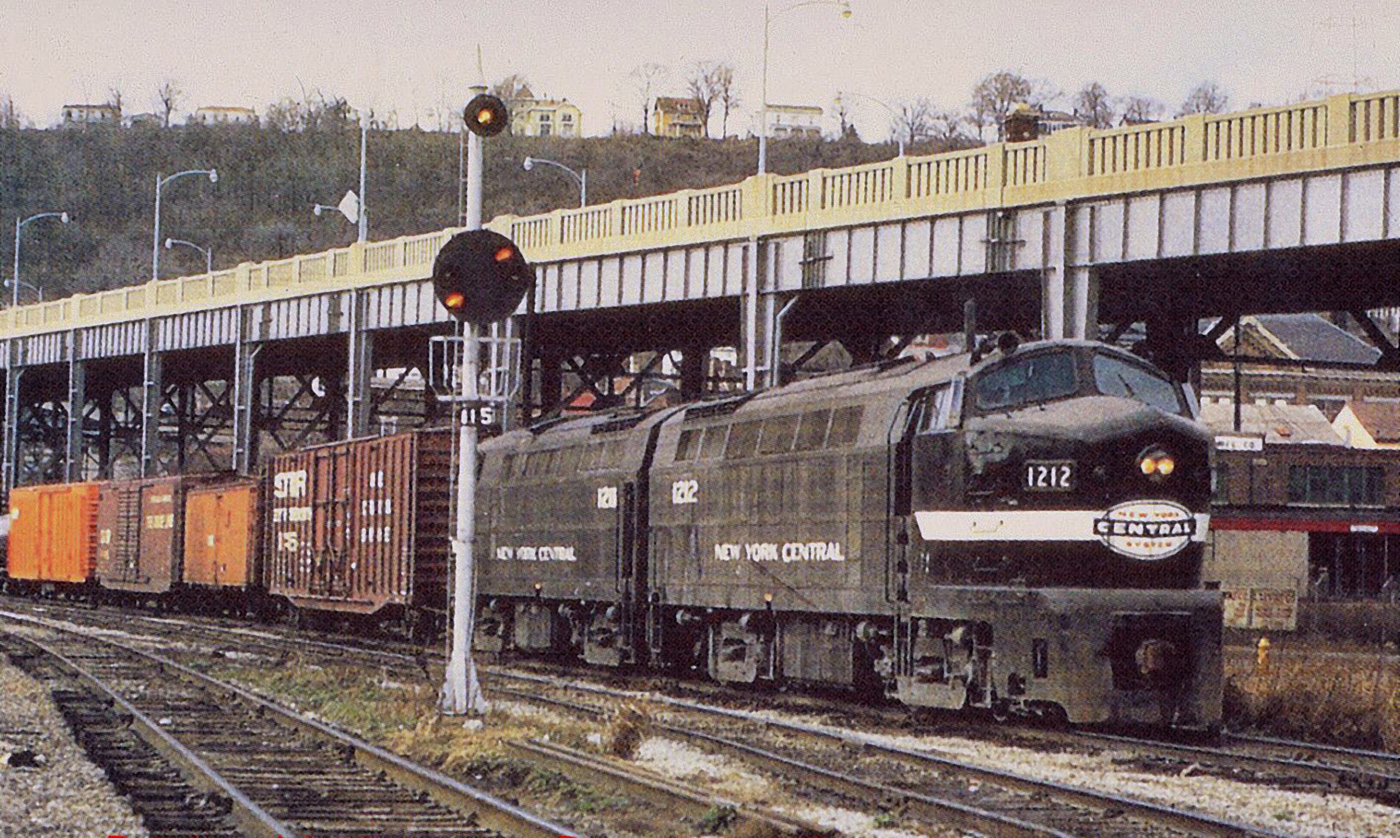 New York Central RF16's #1212 and #1211 are eastbound along the Ohio River to the west of downtown Cincinnati, Ohio with a mixed freight train on December 8, 1966. The U.S. Route 50/River Road viaduct can be seen adjacent to the train. It has since been replaced.
Preservation
In 1962, the B&O began striking their RF16's from the roster; likely in response to Baldwin exiting the locomotive market.
In 1966, just a few years prior to the Penn Central merger the PRR sold or scrapped all of its RF16s while a year later the remaining units still serviceable on the NYC were sold to the Monongahela Railway for use in coal drag service.
In 1974 the Delaware & Hudson picked up Monongahela's two remaining RF16s from a scrap dealer and used them in freight service until 1978.
By the early 1980s they came under the ownership of the Escanaba & Lake Superior Railroad of Michigan and for many years now have been locked in a storage, away from public view. The owner states they will be donated to a preservation group at some point in the future.
Sources
- Kirkland, John F. Diesel Builders, The: Volume Three, Baldwin Locomotive Works. Pasadena: Interurban Press, 1994.
- Pinkepank, Jerry A. Diesel Spotter's Guide. Milwaukee: Kalmbach Publishing Company, 1967.
- Solomon, Brian. Baldwin Locomotives. Minneapolis: Voyageur Press, 2009.
Recent Articles


-
Pennsylvania Father's Day Train Rides: A Complete Guide
May 11, 25 11:14 PM
 This state offers a unique way to celebrate Father's Day with unforgettable train rides that combine history, stunning landscapes, and a dash of nostalgia.
 -
New York Father's Day Train Rides: A Complete Guide
May 11, 25 03:57 PM
 If you’re looking to make this day memorable, consider taking a scenic train ride with your dad through the beautiful landscapes of New York State.
 -
Missouri Father's Day Train Rides: A Complete Guide
May 11, 25 02:57 PM
 If you're looking for a unique way to honor your dad this year, why not consider a scenic and historical train ride?