Jersey Central Railroad (CNJ): Map, Rosters, History
Last revised: September 17, 2026
By: Adam Burns
The Central Railroad of New Jersey called itself The Big Little Railroad. Reporting mark CNJ. The company that wore that slogan was never large on the map—about 700 route-miles at the peak, two-thirds of them in New Jersey—but it was dense. Four to six tracks between Jersey City and Raritan handled 300 commuter trains a day and 35,000 riders, plus the drills, the anthracite, and, east of Bound Brook, the Baltimore & Ohio and the Reading into New York Harbor. Jersey City to Scranton is only 191 miles. The plant behind those miles ran to some 1,900 miles of track.
New Jersey chartered the ancestor, the Elizabethtown & Somerville, on February 9, 1831. The first trains ran August 13, 1836. The Central Railroad Company of New Jersey took the name on April 23, 1849. The Reading bought control in 1901; the B&O bought the Reading the same year. The company entered its last bankruptcy on March 22, 1967. It remained insolvent until the launch of Conrail on April 1, 1976, which acquired remaining freight operations.
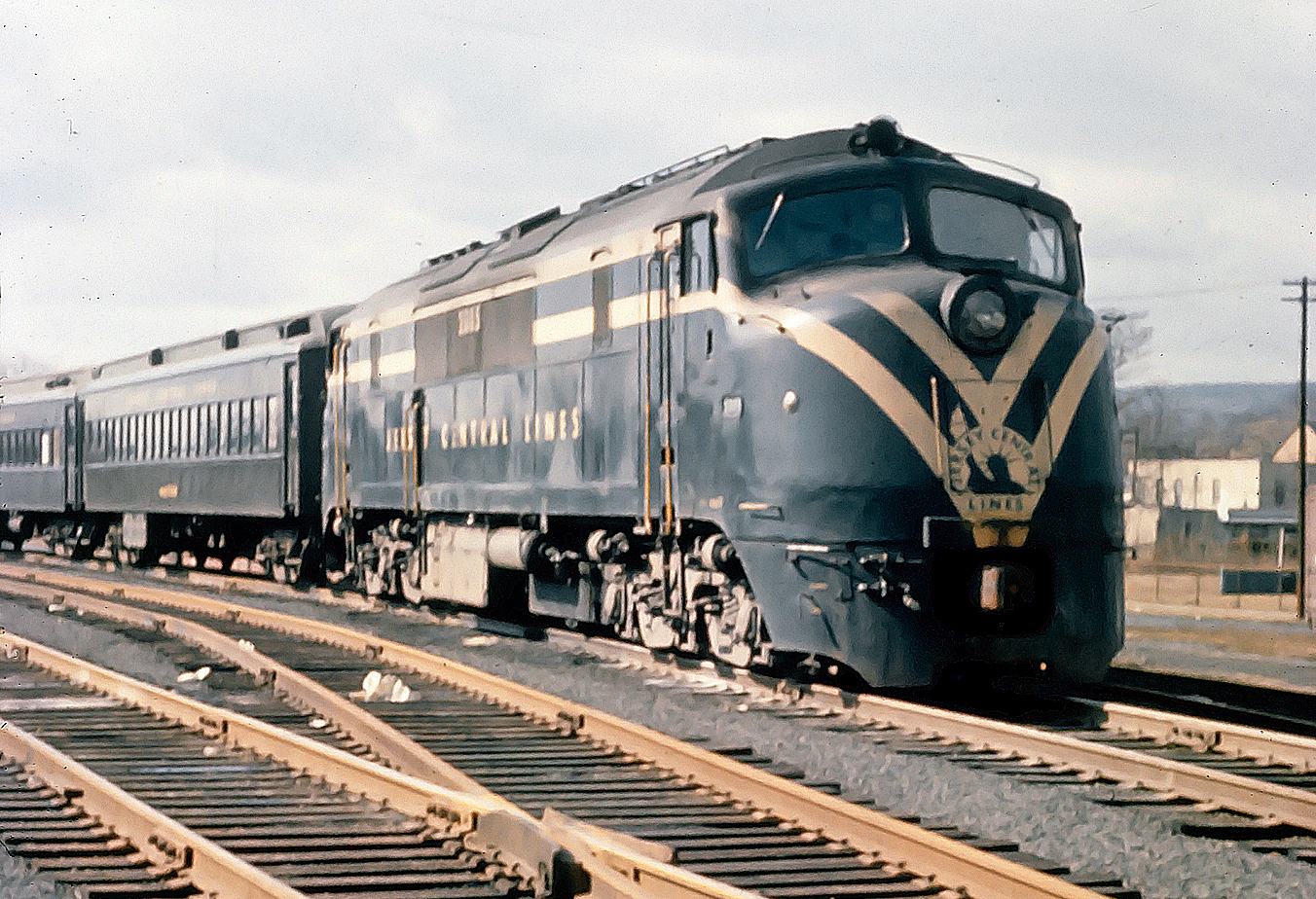
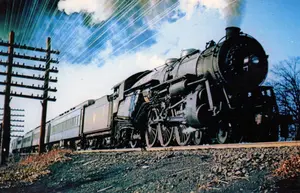
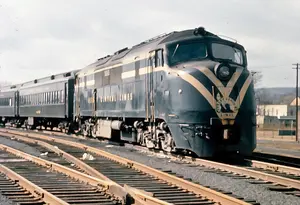
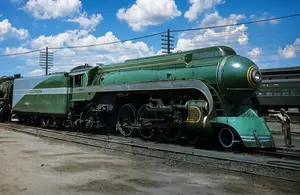
One of the Jersey Central’s double-ended DRX-6-4-2000s, #2005, tied down at Plainfield, New Jersey, circa 1955. The six Baldwins were bought so commuter engines would not have to turn at Communipaw Terminal on the Hudson. Meyer Pearlman photo. American-Rails.com collection.
On this page: At a glance · Elizabethtown & Somerville · April 23, 1849 · Communipaw and the Central Division · Southern Division · New York & Long Branch · Lehigh & Susquehanna · System map, 1969 · Reading and the B&O · Blue Comet and the varnish · Steam and diesel · 1939, taxes, and the Statue of Liberty · Aldene, 1967 · Pennsylvania out, Conrail · What remains
At a glance
The Central Railroad of New Jersey logo. Author’s work. The Statue of Liberty mark arrived in 1944 with the Jersey Central Lines name.
| Item | Detail |
|---|---|
| Headquarters | New York City (143 Liberty Street) |
| Charter | Elizabethtown & Somerville, New Jersey, February 9, 1831 |
| First trains | Elizabethport–Elizabeth, August 13, 1836 (horses). Steam from 1839 |
| Company name | Central Railroad Company of New Jersey, April 23, 1849 |
| Dates of operation | August 13, 1836–March 31, 1976 |
| States served | New Jersey and Pennsylvania. A Bronx carfloat terminal in New York |
| Route-miles | About 700 (peak / 1950). Some 1,900 miles of track |
| Principal lines | Jersey City–Elizabeth–Phillipsburg, N.J.; Easton–Bethlehem–Allentown–Wilkes-Barre/Scranton, Pa.; High Bridge–Hopatcong Junction–Rockaway, N.J.; Elizabethport–Perth Amboy and the New York & Long Branch; Red Bank–Bridgeton/Bayside (Southern Division) |
| Gauge | 4 ft 8½ in (a 4 ft 10 in ancestor converted in 1847) |
| Slogan / mark | The Big Little Railroad / CNJ. Jersey Central Lines from 1944 |
| Reading control | Majority stock, 1901. Earlier Reading lease 1883–87. B&O control of the Reading, 1901 |
| Bankruptcies | 1939 (emerged 1949). Final petition March 22, 1967 |
| Successor | Conrail freight, April 1, 1976. Commuter mains to New Jersey DOT, later NJ Transit |
| Rosters | Steam (built since 1900) · All-time diesel |
700 route-miles and 1,900 track-miles are the Classic Trains / Official Guide-era plant. Headquarters is the Liberty Street office. Information compiled September 17, 2026.
Elizabethtown & Somerville, 1831
The Elizabethtown & Somerville Railroad was incorporated on February 9, 1831, to run west from Elizabethport on Newark Bay—ferry to New York—through Elizabeth and Plainfield to Somerville. Construction lagged. The first segment opened August 13, 1836: about two miles, Elizabeth to Elizabethport, with a horse-drawn coach. Steam arrived in 1839 as the rails reached Plainfield. Somerville opened on January 2, 1842, which completed the original charter.
Until 1864 the railroad’s New York connection was the ferry from Elizabethport. That was enough for a local company. It was not enough for anthracite.
Somerville & Easton, and April 23, 1849
The Somerville & Easton Railroad was incorporated in 1847 to carry the idea west to the Delaware. Service opened Somerville to White House on September 25, 1848. The Somerville & Easton bought the Elizabethtown & Somerville in February 1849. On April 23 the combined company took a name that fit both charters: Central Railroad Company of New Jersey. Hagley dates the Somerville & Easton corporation itself to February 26, 1847, renamed on that April date.
Rails reached Phillipsburg, on the east bank of the Delaware, in 1852. Hagley puts the Elizabethport–Easton completion on July 2. Phillipsburg became a five-railroad town: the CNJ, the Lehigh Valley, the Lehigh & Hudson River, the Delaware, Lackawanna & Western, and the Pennsylvania’s Belvidere Division. On September 8, 1855, the Lehigh Valley’s Easton Bridge put LV coal trains onto CNJ iron for the run to Elizabethport. For a few years the Jersey Central was the tidewater outlet for three anthracite roads.
The Lackawanna connected at Hampton in 1857. CNJ laid a third rail east to the Elizabethport piers for DL&W’s six-foot-gauge cars and bought nine broad-gauge locomotives to handle them. The Lackawanna later built its own Hudson terminal; the Lehigh Valley did the same after 1871. The CNJ kept going west on its own account.
Communipaw, Newark Bay, and the Central Division
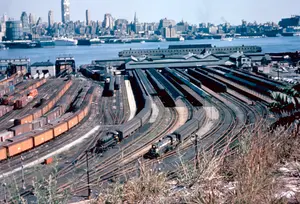
The Hudson waterfront was the point of the railroad. In 1864 CNJ opened a passenger terminal in the Communipaw section of Jersey City and, to reach it, a mile-long drawbridge over Newark Bay from Elizabethport to Bayonne. The ferry to Manhattan shifted from Elizabethport to the new slip. The first station was too small. Architects Peabody & Stearns of Boston designed a larger one, opened in 1889, with a centered bell tower looking at the Lower Manhattan skyline. That building is the Communipaw Terminal still standing in Liberty State Park. It was CNJ’s New York station, and for decades it was also the Reading’s and the B&O’s.
Jersey City to Phillipsburg became the Central Division. The busiest piece was the 35 miles Jersey City to Raritan: four to six tracks, 300 commuter trains, 35,000 daily riders, and the local freights the railroad called drills. Classic Trains, in “Jersey Central: Coal, Commuters, and a Comet,” is the article for that density. The four-track Newark Bay drawbridge of 1926—1.4 miles, two lift spans—replaced the 1864 structure. Elizabethport held the main shops (rebuilt in concrete in 1901, rated for 430 locomotives and 20,000 freight cars a year) and, in the 1930s, one of the more modern traffic-control towers in the country, where the Central Division met the Newark and Perth Amboy branches.
America’s first automatic, motor-operated semaphore went in on the CNJ at Black Dan’s Cut, east of Phillipsburg, in 1893. Twin McMyler car dumpers at Pier 18, Jersey City, in 1919 made that pier the railroad’s foremost coal destination into the 1960s.
Southern Division: Pine Barrens to Delaware Bay
The Southern Division ran into the sparsely settled middle of New Jersey, the Pine Barrens, from Red Bank to Bridgeton, Bowentown, and Bayside. Produce, sand, gravel, oysters, glassware, and eggs paid the bills that anthracite and cement paid farther north. Vacationers used it for Atlantic City, Long Branch, and Tuckerton.
The largest ancestor was the Raritan & Delaware Bay Railroad, chartered in 1854 as one end of a New York–Norfolk scheme: rail across New Jersey, steamship across Delaware Bay, rail down the Delmarva. The Norfolk piece never materialized. The R&DB opened in 1860 between Port Monmouth and Bergen Iron Works (Lakewood) via Red Bank, reached a Camden & Atlantic connection at Winslow in 1862, and took the name New Jersey Southern Railroad in 1870 (New Jersey Southern Railway after the 1880 reorganization). It leased the Vineland Railway in 1872; that line had opened to Bayside in 1871. Jay Gould briefly controlled both in a Delmarva play aimed at Baltimore and the B&O. A rate war between B&O and the Pennsylvania ended that interest in 1874. A trustee ran the New Jersey Southern until it was leased to the New York & Long Branch, a CNJ proxy, in 1879.
CNJ influence once crossed Delaware Bay as the Baltimore & Delaware Bay Railroad, Bombay Hook, Delaware, to Chestertown, Maryland. That line went into the Pennsylvania family in 1901. The Southern Division that remained was New Jersey iron: the main to Bayside, later branches to Tuckerton/Barnegat, Deerfield, and Bivalve, and a carferry from Bayside toward Woodland Beach, Delaware.
New York & Long Branch
The New York & Long Branch tied the Central Division to the Southern Division and to the shore. Chartered April 8, 1868, it was never an independent operating company and never rostered its own engines. CNJ held control by 1873 and exclusive operating rights from that year. Perth Amboy to Long Branch opened in 1875; the line reached Bay Head Junction in 1882. The Pennsylvania threatened a parallel railroad. An agreement in January 1882 (the later operating compromise is often dated 1888) put both companies on the NY&LB, CNJ handling the freight. New Jersey Southern trains used it between Red Bank and the Perth Amboy Branch. Today the corridor is NJ Transit’s North Jersey Coast Line.
Lehigh & Susquehanna: the Pennsylvania Division
West of Easton the railroad was an anthracite hauler. The trackage was built by the Lehigh Coal & Navigation Company as the Lehigh & Susquehanna Railroad, opened in 1843 from the Lehigh Canal at White Haven to the North Branch Canal at Wilkes-Barre. The notable civil-engineering leftover was the Ashley Planes: a cable-worked incline, maximum grade 14.65 percent, that hoisted eastbound coal until after World War II. A 12½-mile “Back Track” between Ashley and Solomon’s Gap, opened 1867, took passengers and westbound freight around the planes.
LC&N was authorized in 1863 to extend the L&S from White Haven to Mauch Chunk (Jim Thorpe) after floods wrecked the canal, and in 1864 to build on to Easton against the parallel Lehigh Valley. Service to Mauch Chunk began in 1867; Phillipsburg in 1868. CNJ took a 999-year lease of the L&S in 1871. Branches followed to the mines: Lehigh, Lee, Nanticoke, Audenried. The last notable extension was the Wilkes-Barre & Scranton, Pittston to Scranton, opened 1888, leased by the L&S and assigned to the CNJ.
Mauch Chunk was the early Pennsylvania operating base. Narrow-gauge “lokies” worked the Wanamie Colliery on the Nanticoke Branch until 1967; CNJ hauled the coal to Ashley’s Huber Breaker. Easton, Bethlehem, Allentown, Wilkes-Barre, Scranton, and Phillipsburg were manufacturing towns, Bethlehem a steel town. The territory was crowded: Lehigh Valley, Erie, Lackawanna, Lehigh & Hudson River, Lehigh & New England, Reading, Delaware & Hudson, Ontario & Western, and the Pennsylvania all ran there. In 1892 the Central States Dispatch—a fast-freight route on B&O, Western Maryland, Reading, CNJ, Lehigh & Hudson River, and New Haven—began using Allentown Yard. That geography later sat inside the Alphabet Route.
The Commodities Clause of the Esch–Cummins Act (Transportation Act of 1920) forbade railroads to haul freight they had an interest in. CNJ coal mines acquired in 1872–73 came off the books under antitrust pressure in 1923. Anthracite itself was already past its best years.
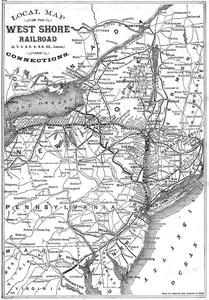
System map, 1969
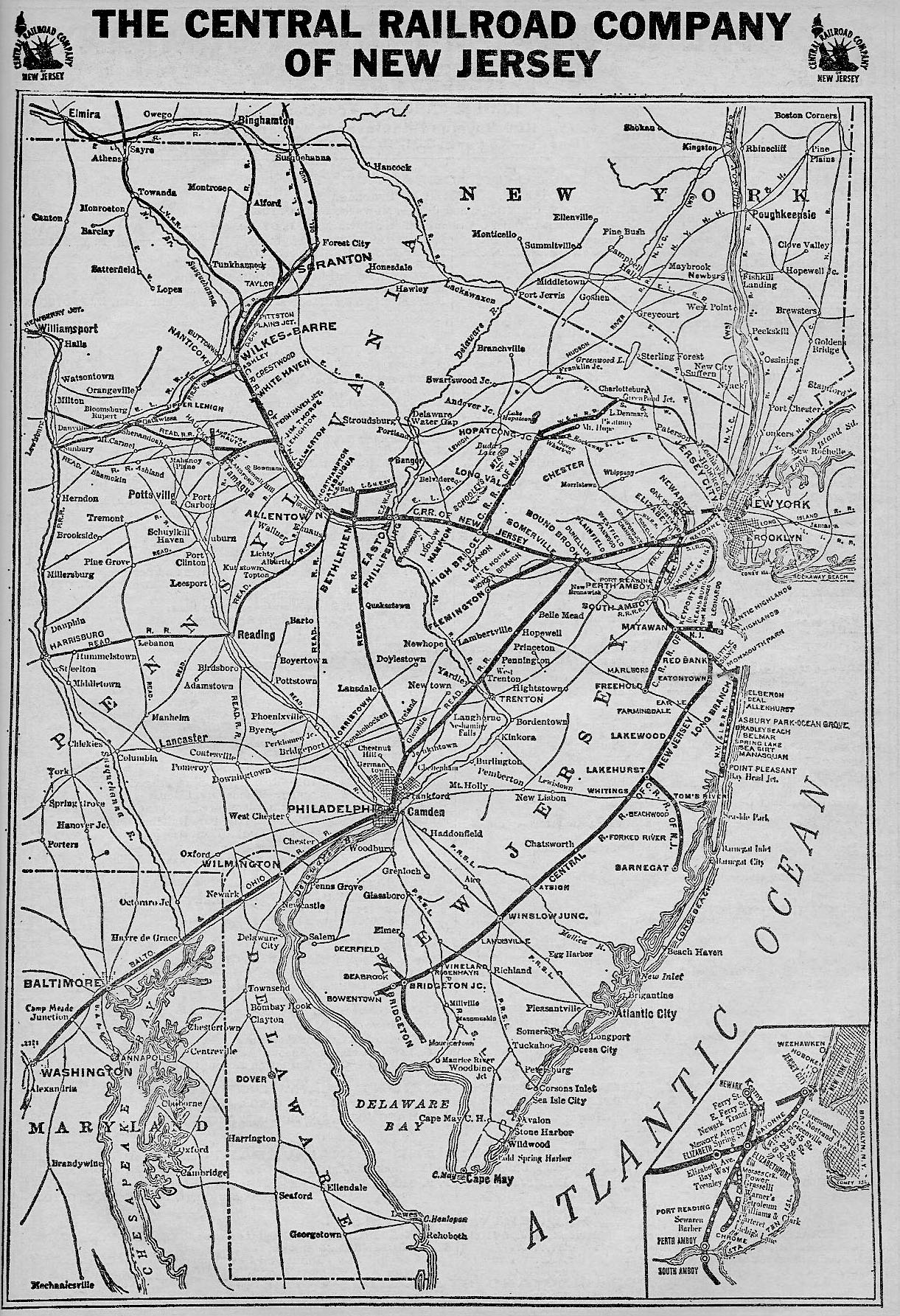
An official 1969 system map of the Central Railroad of New Jersey. Author’s collection. Jersey City at the right, the Pennsylvania anthracite lines at the left, the Southern Division down the state.
Reading lease, Reading stock, B&O New York
The Philadelphia & Reading leased and operated the CNJ from 1883 to 1887, forming a New York–Philadelphia route, and again in 1892. CNJ resumed its own management after the 1887 reorganization. In 1901 the Reading Company, successor to the Philadelphia & Reading, bought a majority of CNJ stock. At about the same time the Baltimore & Ohio bought control of the Reading. George H. Drury, in Guide to North American Steam Locomotives, puts both purchases in that year. From then until Conrail, CNJ was a Reading property and the last miles of the B&O’s New York run.
B&O passenger trains used the Reading to Bound Brook and the CNJ to Jersey City, then the ferry to Manhattan. Passengers never rode a B&O locomotive into New York. That patchwork was the Royal Blue Line; the train itself is the Royal Blue. B&O symbol freights kept using the route into the 1970s. The B&O gave up the New York passenger market in April 1958.
The High Bridge & Longwood Valley opened High Bridge to Rockaway in 1876 and, within two years, became the High Bridge Branch as CNJ absorbed small iron-ore roads in northern New Jersey—Dover & Rockaway, Ogden Mine—to feed regional mills. In 1930 the company took the Wharton & Northern and a stake in the Mount Hope Mineral Railroad. In 1929 it bought 30 percent of the Raritan River Railroad, South Amboy to New Brunswick.
Blue Comet, Bullet, and the Reading varnish
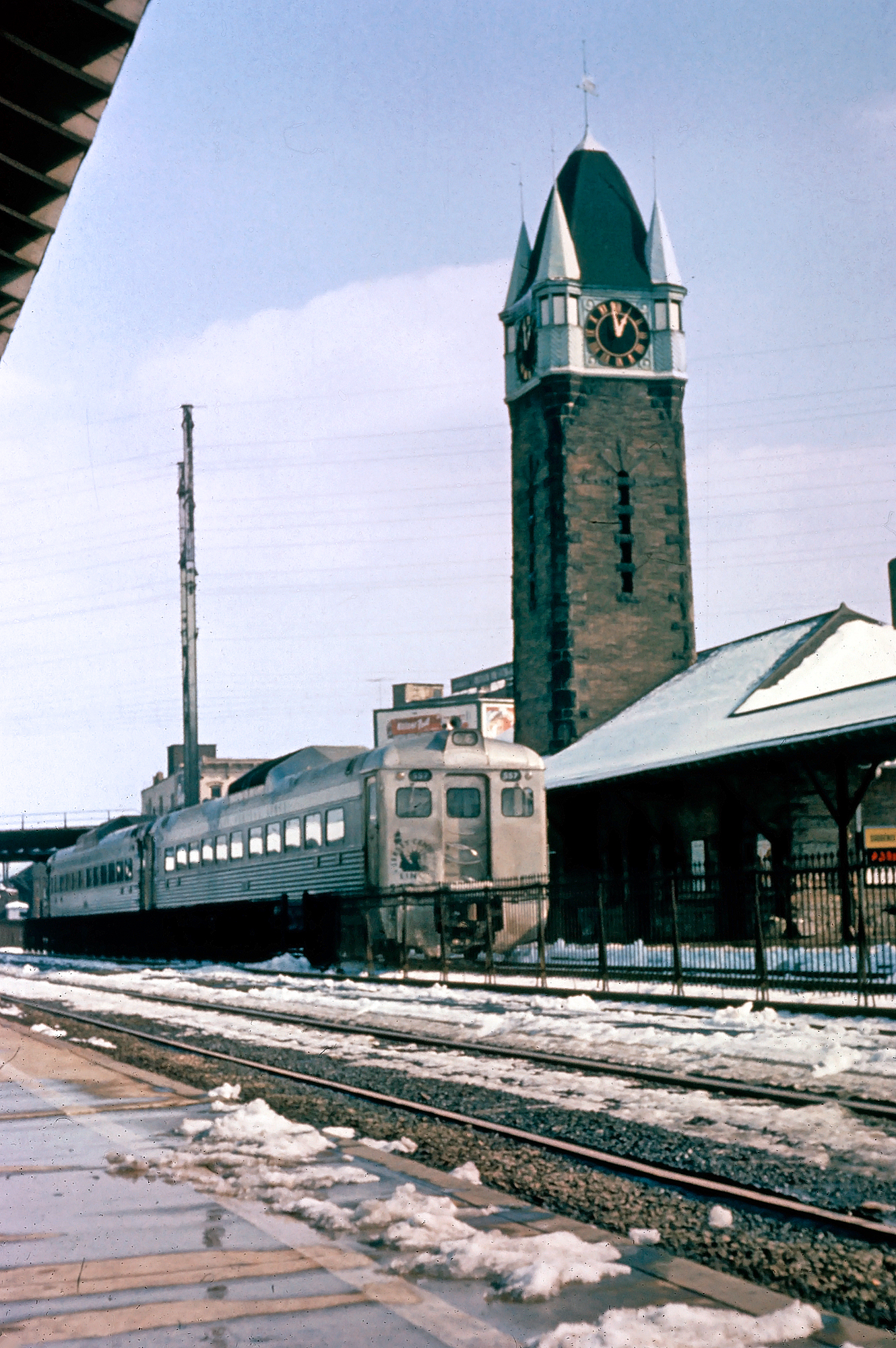
Jersey Central RDC-1s on the four-track main at Elizabeth, New Jersey, circa 1960. The Pennsylvania Railroad’s Northeast Corridor sits in the background. Meyer Pearlman photo. American-Rails.com collection. Little of this corridor remains.
The train the photographs remember is the Blue Comet. It started on February 21, 1929: twice-daily luxury coaches, Jersey City to Atlantic City, Packard blue with gold lettering and a Jersey-cream window band, no extra fare. Three G-3 Pacifics were painted to match. R. B. White was president. Automobile competition killed it in 1941. Later in 1929 the Bullet tried the same idea Jersey City–Wilkes-Barre, dark olive with gold and chromium on the Pacifics. The Bullet lasted two years.
Through varnish with the Reading used Communipaw as the New York station: the Crusader to Philadelphia, the Queen of the Valley to Harrisburg, the Wall Street, the Interstate Express (with the Lackawanna). B&O’s Capitol Limited and National Limited came the same way until 1958. A March 1940 Official Guide listing is the CNJ timetable page. After World War II the remaining passengers were almost all commuters—great amounts of equipment for two peaks, five days a week.
Camelbacks, then diesels from every builder
CNJ was an anthracite carrier, and culm was cheap fuel, which meant Camelbacks with Wootten fireboxes. The first modern non-Camelback power arrived in 1918: Pacifics, USRA Mikados, and six-wheel switchers. George H. Drury’s post-1900 class table, and the 111 Ten-Wheelers that did every leftover job into the mid-1950s, are the steam roster. Ten-Wheeler 774 made a ceremonial last run; on July 1, 1954, the company announced it was totally dieselized. 0-6-0 113, sold to a coal company, last steamed in January 1960 and runs today at Minersville, Pennsylvania.
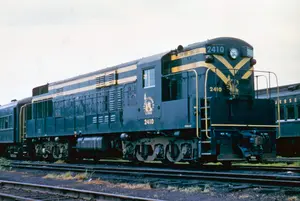
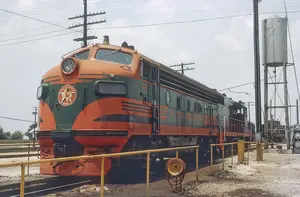
The diesel story starts earlier than most Class Is. In 1924–25 Alco, General Electric, and Ingersoll-Rand built five 60-ton, 300-horsepower boxcab switchers. CNJ bought the first of them, #1000, for the Bronx carfloat terminal. Drury calls it the first commercially successful diesel locomotive. It spent about 27 years there and is preserved at the B&O Railroad Museum. Cab diesels from Baldwin and Electro-Motive replaced steam on most mainline freights in 1947. Six double-end Baldwin passenger units, the only ones in North America, arrived at the same time—the engine in the photograph at the top of this page. Fairbanks-Morse Train Masters owned the NY&LB commuter pool until the GP40Ps of 1968. Unit-by-unit is the diesel roster.
1939, New Jersey taxes, and Jersey Central Lines
Freight traffic, in millions of net ton-miles, ran 2,513 in 1925, 1,511 in 1933, 3,735 in 1944, 1,948 in 1960, and 1,455 in 1970 (ICC annual reports). Passenger-miles were 480 million in 1925, 337 in 1933, 480 in 1944, 175 in 1960, and 124 in 1970. Three-fourths of the freight terminated on line. The railroad was a terminal carrier, which meant little profit, and New Jersey taxes ate a large share of what profit there was. Anthracite was already in decline before the Depression.
CNJ entered a ten-year bankruptcy in 1939 while the Reading, itself under B&O, still held the stock. It emerged in 1949. During World War II, German submarines pushed eastbound oil off tankers and onto tank cars; CNJ delivered up to 1,000 loads a day, about half the New York area’s requirement, until the pipelines opened. In 1944 the company became Jersey Central Lines and took the Statue of Liberty as its emblem.
In 1946 the Pennsylvania lines were organized as the Central Railroad of Pennsylvania, a paper attempt to put those assets beyond New Jersey tax collectors. CNJ resumed operating the Pennsylvania lines at the end of 1952. CRP survived as owner of the Easton & Western, four miles in Easton. The Pennsylvania, or Penn, Division dated from January 1, 1953.
When the Lehigh & New England quit in 1961, CNJ bought about 40 miles of its Pennsylvania trackage—Tadmor Yard at Bath, the Bethlehem Branch, the Martins Creek Branch, trackage around Catasauqua, and the former Panther Creek Railroad to Tamaqua—for $10 million, effective October 31, 1961. Walter Kraus, in the Allentown Morning Call of August 24, 1989, is the citation. In November 1965 CNJ, the Lehigh Valley, and the Reading coordinated the parallel Lehigh River lines: LV and Reading folded small yards into CNJ’s expanded Allentown Yard; new connections at South Bethlehem and Lehighton let the LV run Bethlehem–Lehighton on CNJ iron.
A proposed C&O–N&W merger in 1965, meant as a counter to Penn Central, would have taken the CNJ with it. Penn Central’s bankruptcy killed that prospect. Mail-contract cancellations in 1965 dropped 18 passenger trains systemwide.
Aldene Plan, April 30, 1967
The company filed its last bankruptcy on March 22, 1967. That year it dropped the last non-commuter passenger trains, Allentown–Jersey City. New Jersey had begun subsidizing commuters in 1964. The Aldene Plan, built to cut the passenger deficit, opened at the end of April. A new ramp at Aldene, in Roselle Park, connected the CNJ main to the Lehigh Valley. On April 30, 1967, the last ferry ran between Communipaw and Manhattan, and the terminal closed. The next day CNJ trains originated and terminated at Pennsylvania Station in Newark, where riders changed to the Pennsylvania or to PATH. The ferry, the Jersey City concourse, and the local trains east of Cranford were the savings, about $1.5 million a year. A Budd RDC “Bayonne Scoot” kept a remnant Cranford–Bayonne service until August 6, 1978. Push-pull trains with cab cars converted from 1920s coaches were an Aldene operating requirement.
The Newark Bay drawbridge outlived its passenger trains and was demolished by the Coast Guard in 1980.
Out of Pennsylvania, into Conrail
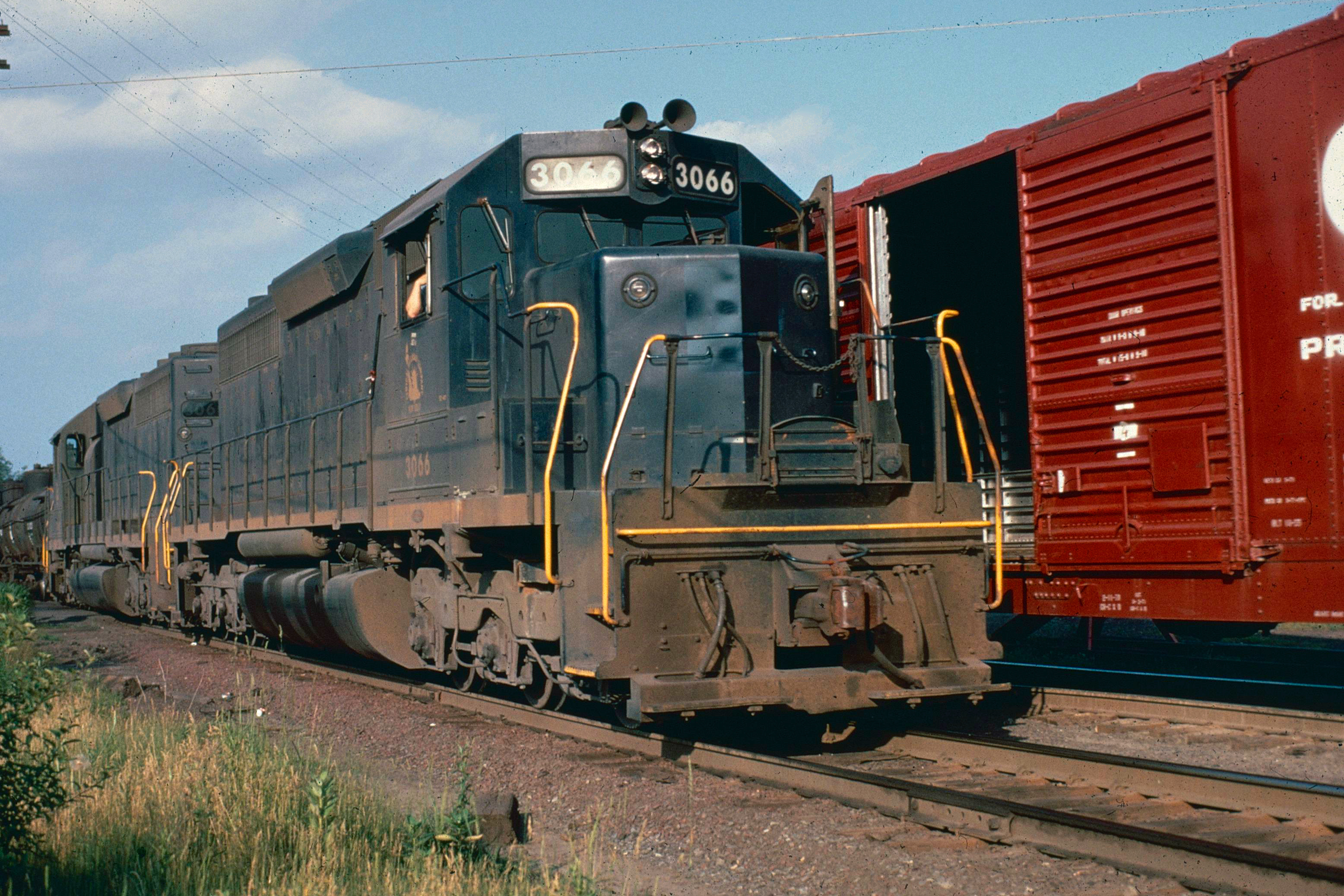
Jersey Central SD40 #3066 (ex-B&O #7487) and #3069 (ex-B&O #7490) lead a westbound through Ashley, Pennsylvania, along Main Street on June 27, 1971. Author’s collection. Two years from the end of CNJ operations in Pennsylvania.
The 1971 “Blue Print for Survival” included getting out of Pennsylvania. CNJ embargoed those lines, except the ex-L&NE pieces, on March 31, 1972. The Lehigh Valley took over, expecting to keep the Erie Lackawanna through business; CNJ instead started trains ES99/SE98 with the EL between Elizabethport and Scranton via a new connection on the High Bridge Branch. LV and Reading took the ex-L&NE lines in January 1975.
A federal court in 1974 held that CNJ, the Lehigh Valley, the Reading, and Penn Central could not reorganize. Conrail took the freight on April 1, 1976. Commuter routes went to the New Jersey Department of Transportation and, from 1979, to NJ Transit: today’s Raritan Valley Line and North Jersey Coast Line. The corporate shell emerged from bankruptcy as Central Jersey Industries on September 14, 1979, later CJI Industries, and in 1986 merged into Triangle Industries.
What remains
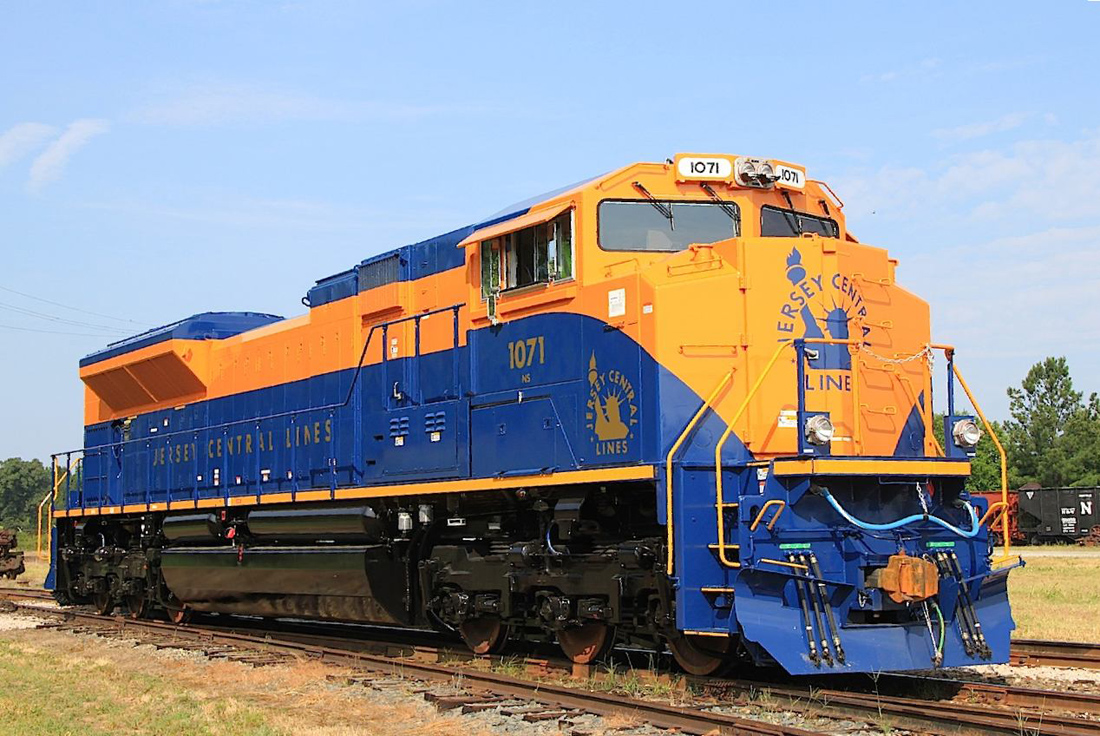
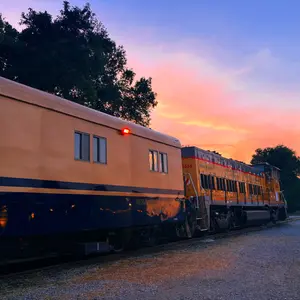
Norfolk Southern heritage unit SD70ACe #1071 in the Jersey Central’s early orange and blue, North Carolina Transportation Museum, July 3, 2012. Warren Calloway photo. NS painted the locomotive for its 30th anniversary.
NJ Transit still runs the Raritan Valley Line on the old main, Aldene to High Bridge, and the North Jersey Coast Line on the NY&LB, Perth Amboy to Bay Head. Hudson-Bergen Light Rail uses pieces of the Jersey City–Bayonne waterfront. Conrail Shared Assets keeps freight on Elizabethport–Aldene, Elizabethport–Perth Amboy, and Red Bank–Lakehurst. Morristown & Erie runs the Dover & Rockaway and part of the High Bridge Branch. In Pennsylvania, Reading & Northern has the White Haven–Laurel Run remnant of the joint CNJ/LV operation after 1965, and the passenger program at Jim Thorpe. Southern Division fragments survive under Cape May Seashore Lines, Southern Railroad of New Jersey, and Winchester & Western.
The four-track speedway Jersey City to Raritan is gone as a railroad plant; the Elizabeth station is preserved beside an empty right-of-way. Communipaw Terminal is a museum in Liberty State Park. It has not seen a scheduled train since April 30, 1967. Norfolk Southern’s 1071 and NJ Transit’s GP40PH-2 4109 still wear Jersey Central paint. The paper company of 1849 is not.
Related reading on American-Rails.com
- CNJ steam roster · CNJ diesel roster · Camelbacks
- Blue Comet · Communipaw Terminal · New York & Long Branch · March 1940 timetable
- Reading · Baltimore & Ohio · Lehigh Valley · Lehigh & New England · Lehigh & Hudson River
- Royal Blue · Crusader · Alphabet Route
- Conrail · NJ Transit · NJ Transit 4109 · Reading & Northern · Raritan River
Sources
- Drury, George H. Guide to North American Steam Locomotives, revised edition, pp. 100–102. Routes, Reading/B&O 1901, Camelbacks, #1000, dieselization July 1, 1954
- Drury, George H. The Historical Guide to North American Railroads. Kalmbach, 1994, pp. 56–59. Corporate skeleton, CRP, L&NE, Aldene, Conrail
- “Jersey Central: Coal, Commuters, and a Comet.” Classic Trains, Winter 2011. 700/1,900 miles; 300 trains / 35,000 riders; semaphore 1893; Newark Bay 1926; Blue Comet and Bullet; 1944 Liberty mark; Aldene; PA exit March 31, 1972
- Kraus, Walter. “Real Demise Of Rail Line Trailed Coal’s Decline.” The Morning Call (Allentown), August 24, 1989. L&NE sale October 31, 1961, $10 million
- Hagley Museum and Library. Central Railroad Company of New Jersey records. April 23, 1849 name; July 2, 1852 Easton; March 22, 1967 bankruptcy; Central Jersey Industries September 14, 1979
- ICC annual reports. Ton-miles and passenger-miles, 1925–1970
- American-Rails.com: Communipaw Terminal; New York & Long Branch; Blue Comet; Reading; Baltimore & Ohio; Lehigh Valley; Lehigh & New England; Conrail; NJ Transit 4109
Recent Articles


-
Boston & Maine Steam Roster (Post 1900)
Sep 18, 26 02:57 PM
 Boston & Maine steam—B-15 Moguls, K-8 Consolidations, P-4 Lima Pacifics, T-1 Limas, R-1 Mountains. Post-1900 class roster after Drury. Last steam July 23, 1956.
 -
Boston & Maine Diesel Roster (All-Time)
Sep 18, 26 01:25 PM
 Boston & Maine diesel—boxcab 1100 1935, Flying Yankee 6000, FTs, E7s, BL2s, GP7/GP9, GP38-2s and GP40-2s. All-time roster. Last steam July 23, 1956.
 -
Mid-Continent Railway Museum Dining (2026)
Sep 18, 26 01:21 PM
 2026 Mid-Continent dining in North Freedom—select-date seated meals in luxury cars, reservations required. Pizza Limited June 28. Confirm on midcontinent.org.
 -
Bessemer & Lake Erie Steam Roster (Post 1900)
Sep 18, 26 12:11 PM
 Bessemer & Lake Erie steam—C3A 150–151, D1A/D2A Santa Fes, 47 H1 Texas types after Burlington. Post-1900 class roster after Drury. Last steam 2-8-0 156, May 14, 1953.
 -
Bessemer & Lake Erie Diesel Roster (All Time)
Sep 18, 26 12:09 PM
 Bessemer & Lake Erie diesel—Westinghouse 281 1936, Baldwin DRS-6-6-1500s, F7s 1950–53, SD7/SD9/SD18/SD38 family, RSD-15s. All-time roster. Last steam 2-8-0 156, May 14, 1953.
 -
Bangor & Aroostook Steam Roster (Post 1900)
Sep 18, 26 11:21 AM
 Bangor & Aroostook steam—Manchester Ten-Wheelers, Alco Mountains 100–109, G-2 Consolidations, Pacifics 250–254. Post-1900 class roster after Drury. Last steam Pacific 251, July 22, 1951.
 -
Bangor & Aroostook Diesel Roster (All Time)
Sep 18, 26 11:09 AM
 Bangor & Aroostook diesel—F3s 1947, eight BL2s, E7s, GP7s leased to the PRR, GP9s, GP38s. All-time roster. Last regular steam July 22, 1951.
 -
B&O Steam Locomotive Roster (Post 1900)
Sep 18, 26 10:33 AM
 Baltimore & Ohio steam—Old Maude, E-27 Consolidations, Q Mikados, Big Sixes, EM-1 Yellowstones, President Pacifics. Post-1900 class roster after Drury. Last public steam May 17, 1958.
 -
Baltimore & Ohio (B&O): Diesel Roster (All-Time)
Sep 18, 26 10:28 AM
 Baltimore & Ohio diesel—boxcab 1925, EMC 50 1935, EA 1937, FTs, F3s, F7s, FA-2s, sharks, GP7/GP9, GP30s after C&O 1963, SD50s 8576–8595 1984. All-time roster. Last steam 1958.
 -
Detroit & Toledo Shore Line Railroad: Map, Roster, History
Sep 18, 26 12:32 AM
 Detroit & Toledo Shore Line—Pleasant Bay 1898, named 1899, Detroit–Toledo freight bridge, GTW and Clover Leaf/NKP/N&W. Merged into Grand Trunk Western June 26, 1981.
 -
Lackawanna Steam Locomotives: History, Roster & Photos
Sep 18, 26 12:17 AM
 Delaware, Lackawanna & Western steam—Camelback 2-8-0s, Mikados, freight Pacifics, Poconos 4-8-4s, Hudsons. Post-1900 roster after Drury. Last steam July 13, 1953.
 -
Lackawanna (DL&W) Diesel Roster: All Time
Sep 18, 26 12:11 AM
 Delaware, Lackawanna & Western diesel—boxcabs 1926, EMC SC 425–426 1935, FTs 1945, F3/F7/E8, GP7s, RS-3s, FM Train Masters. All-time roster. Last steam 1953.
 -
Lackawanna Railroad: Map, History, Viaducts, Rosters
Sep 18, 26 12:04 AM
 TDelaware, Lackawanna & Western—Liggett’s Gap 1832, named March 11 1853, Hoboken–Buffalo, anthracite, Phoebe Snow, Cutoff and Tunkhannock. It merged with the Erie to form Erie Lackawanna on Octobe…
 -
Rail News, The Latest
Sep 17, 26 11:56 PM
This page provides a portal to the latest in rail news, from preservation and restortation subjects to other notable topics. -
Union Pacific Big Boy 4014 Sets First Holiday Tour for Make-A-Wish
Sep 17, 26 11:54 PM
 Union Pacific Big Boy 4014’s first holiday tour: Cheyenne–Denver tickets, Nov. 21 Denver-area display, Make-A-Wish. Museum patrons Oct. 16; public Oct. 19.
 -
Conrail Diesel Roster (All Time)
Sep 17, 26 10:27 PM
 Conrail diesel—~5,000 inherited 1976, Big Blue, GP15-1s, SD40-2s, SD50s, Dash-8s, SD60/60M/60I, SD80MACs. All-time CR-number roster.
 -
Chessie System (Railroad): The C&O, B&O, And WM
Sep 17, 26 09:38 PM
 Chessie System, Inc.—C&O, B&O, and Western Maryland. Kitten-C paint 1972, holding company February 26 1973, CSX November 1 1980, C&O into CSXT August 31 1987.
 -
Chesapeake & Ohio (C&O) Diesel Roster: All-Time
Sep 17, 26 06:01 PM
 Chesapeake & Ohio diesel—late steam, no Fairbanks-Morse, E7s 1946, GP7/GP9 flood, F7s, GP40-2s, B30-7s, SD50s 1984–85. All-time roster. Steam ended 1956.
 -
Chesapeake & Ohio (C&O) Steam Roster: Post-1900
Sep 17, 26 03:18 PM
 Chesapeake & Ohio steam—H-8 Alleghenies, K-4 Kanawhas, T-1 Texas, Greenbriers, H-6 1949 Mallets. Post-1900 class roster including Pere Marquette and Hocking Valley. Last steam 1956.
 -
Chesapeake and Ohio Railway: Map, Logo, History
Sep 17, 26 02:36 PM
 Chesapeake & Ohio Railway—Louisa Railroad 1836, named August 31 1868, Ohio River 1873. Coal, Chessie the kitten, Pere Marquette 1947, B&O control 1963, into CSX August 31 1987. Complete corporate…
 -
TVRM Valentine Train Ride (2026)
Sep 17, 26 02:31 PM
 2026 TVRM Valentine Train Ride in Chattanooga—Feb. 6–15, plated dinner, Grand Junction Depot. Confirm on tvrail.com.
 -
River Fox Train Dining (2026)
Sep 17, 26 02:29 PM
 2026 River Fox Train in West Sacramento—Brunch Train and Murder Mystery dinner. 18095 County Road 117. Confirm on riverfoxtrain.com.
 -
Weehawken Terminal, Serving The West Shore Railroad
Sep 17, 26 01:38 PM
 Weehawken Terminal—West Shore / New York Central Hudson waterfront station, opened 1884. Five ferry slips, sixteen tracks, Weehawken Tunnel 4,014 feet. Last ferry March 25, 1959. Port Imperial and HBL…
 -
West Shore Railroad: Map, History, Timetables
Sep 17, 26 01:32 PM
 West Shore Railroad—New York, West Shore & Buffalo 1880–83, Weehawken to Buffalo. PRR-backed rival to the Central. Morgan settlement, 475-year NYC lease January 1 1886. CSX River Sub today.
 -
Jersey Central Diesel Locomotives: History, Roster & Photos
Sep 17, 26 01:20 PM
 Central Railroad of New Jersey diesel—boxcab 1000, Baldwin double-enders, F3s, Train Masters, SD35s, GP40Ps. All-time roster. Steam ended July 1, 1954.
 -
Jersey Central Steam Locomotives: History, Roster & Photos
Sep 17, 26 01:17 PM
 Central Railroad of New Jersey steam—Camelback Ten-Wheelers, USRA Mikados, G-class Pacifics, suburban tanks. Post-1900 class roster after Drury. Dieselized July 1, 1954.
 -
Jersey Central Railroad (CNJ): Map, Rosters, History
Sep 17, 26 01:14 PM
 Central Railroad of New Jersey—Elizabethtown & Somerville 1831, named April 23 1849. Communipaw, anthracite, Blue Comet, Reading/B&O control. Conrail April 1 1976. Complete corporate history.
 -
Central Vermont Diesel Locomotives: History, Roster & Photos
Sep 17, 26 11:35 AM
 Central Vermont diesel—Alco S-2s 1942, RS-3s, RS-11s from DW&P, EMD GP9s 1956–57, GP38ACs 1971. All-time roster. Last steam April 4, 1957.
 -
Central Vermont Steam Locomotives: History, Roster & Photos
Sep 17, 26 11:19 AM
 Central Vermont steam—ten Alco 2-10-4s of 1928, four U-1-a Mountains, Consolidations. Post-1900 class roster after Drury. Last steam April 4, 1957.
 -
Central Vermont Railway: Map, Logo, Rosters
Sep 17, 26 11:03 AM
 Central Vermont Railway—Vermont Central charter October 1843, Bethel–White River Junction June 26, 1848. Grand Trunk 1898, CN 1923, RailTex/NECR 1995. Complete corporate history.
 -
Fitchburg Railroad: Map, History, Timetables
Sep 17, 26 10:40 AM
 Fitchburg Railroad—chartered March 3, 1842, Boston–Fitchburg March 5, 1845. Alvah Crocker, Hoosac west door, Vermont & Massachusetts, Cheshire. B&M 99-year lease July 1, 1900. Complete corpora…
 -
Steam Railroading Institute Dining (2026)
Sep 17, 26 10:30 AM
 2026 SRI Owosso dining—vintage dining cars, select evenings. 2026 dinner calendar not posted; 2025 Up In Smoke is the recent example. Confirm on michigansteamtrain.com.
 -
Canadian Pacific Railway: Map, History, Logo, Photos
Sep 17, 26 12:06 AM
 Canadian Pacific Railway—incorporated February 16, 1881. Last spike Craigellachie November 7, 1885. Soo, Milwaukee, D&H, DM&E. CPKC April 14, 2023. Complete corporate history.
 -
Canadian Pacific Diesel Locomotives: History, Roster & Photos
Sep 17, 26 12:03 AM
 Canadian Pacific diesel—E8A 1800 in 1949, FP7/FP9, FA-2, C424, SD40-2, SD40-2F Red Barns, AC4400CW, ES44AC, SD30C-ECO, SD70ACu heritage. All-time roster. Last steam November 6, 1960.
 -
Canadian Pacific Steam Locomotives: History, Roster & Photos
Sep 16, 26 11:35 PM
 Canadian Pacific steam—3,257 engines 1881–1949. D10 Ten-Wheelers, G3 Pacifics, Royal Hudsons, Selkirk 2-10-4s. Post-1900 class roster after Drury. Last steam November 6, 1960.
 -
Woodstown Central Dining in Motion (2026)
Sep 16, 26 11:31 PM
 2026 Woodstown Central Dining in Motion—Salem County table car, 50–60 minutes, private table of four from $190. Confirm on woodstowncentral.com.
 -
NCTM Wine & Dine on the Rails (2026)
Sep 16, 26 11:28 PM
 2026 NCTM Wine & Dine on the Rails in Spencer—Feb. 13–15, three-course dinner, 21+, $145/$140. Sold out. Confirm next season on nctransportationmuseum.org.
 -
Southern Railway 4-6-2 1380: The Streamlined Ps-4
Sep 16, 26 10:34 PM
 Southern Railway Ps-4 4-6-2 1380—Alco 1923, serial 64857. Otto Kuhler streamlining at Spencer 1940–41 for the Tennessean. Only streamlined steam locomotive on the Southern. Scrapped Baltimore 1953.
 -
Texas Mexican Railway: Serving The Border Since The 1880s
Sep 16, 26 09:58 PM
 Texas Mexican Railway—Corpus Christi, San Diego & Rio Grande March 1875, 3-foot. Tex-Mex June 1881, Laredo Sept 1881, Rio Grande bridge 1883. Standard gauge July 17 1902. Mexican government 1900–1…
 -
Mount Hood Railroad Dining (2026): No Plated Dinner Train This Season
Sep 16, 26 09:53 PM
 2026 Mount Hood Railroad in Hood River is scenic Fruit Loop trains with snacks and sandwiches—not a plated dinner train. Confirm on mthoodrr.com.
 -
Peoria and Eastern Railway: Map, Timetables, History
Sep 16, 26 09:39 PM
 Peoria & Eastern—Danville, Urbana, Bloomington & Pekin 1866, IB&W 1869, OI&W 1887. Incorporated Feb 21 1890, Big Four next day. NYC 1930, Conrail 1976. GP7s 5612–5625. Complete corporate history.
 -
Boston and Maine Railroad: "Route Of The Minute Man"
Sep 16, 26 11:30 AM
 Boston & Maine—Andover & Wilmington 1833, NH charter June 27 1835. Eastern, Boston & Lowell, Fitchburg/Hoosac, Concord & Montreal. Section 77 March 12 1970. Guilford June 30 1983. CSX June 1 2…
 -
Smoky Valley Limited Dinner Train (2026)
Sep 16, 26 11:24 AM
 2026 Abilene & Smoky Valley Smoky Valley Limited—two-hour dinner from the 1887 Rock Island Depot. Kansas catering, ~$72–$110. Confirm on asvrr.org.
 -
Canadian National Diesel Locomotives: History, Roster & Photos
Sep 16, 26 11:14 AM
 Canadian National diesel—CLC boxcabs 1929, GMD FP9 and GP9, MLW FPA-4 and RS-18, GMD1, wide-cab SD40-2W, Dash-9s, ES44AC and ET44AC. All-time roster.
 -
Canadian National Steam Locomotives: History, Roster & Photos
Sep 16, 26 10:07 AM
Canadian National steam—CGR, Canadian Northern, Grand Trunk, GTP. 4-8-4 Confederations, U-1 Mountains, J and K Pacifics. Post-1900 class roster. Last scheduled steam April 25, 1960. -
Canadian National Railway: Map, Logo, History, Photos
Sep 16, 26 08:55 AM
 Canadian National—name Dec 20 1918, incorporated June 6 1919, Grand Trunk Jan 20 1923. Crown corporation, IPO Nov 17 1995. IC, Wisconsin Central, BC Rail, EJ&E. Class I, mark CN.
 -
Buffalo, Rochester and Pittsburgh Railway: "Safety and Service"
Sep 16, 26 12:12 AM
 Buffalo, Rochester & Pittsburgh—Rochester & State Line 1869, BR&P March 12 1887. Pennsylvania coal to Buffalo and Rochester. B&O January 1 1932. All-time steam roster, LL 2-6-6-2s, XX…
 -
Buffalo Creek & Gauley Railroad: Map, Roster, Logo, Photos
Sep 15, 26 11:55 PM
 Buffalo Creek & Gauley—Elk River Coal & Lumber, April 1 1904, Dundon–Widen. Last all-steam WV coal road, February 27 1965. All-time steam roster, #4 Baldwin 59472, Majestic and Elk River diesels…
 -
Buffalo and Susquehanna Railroad: Map & History
Sep 15, 26 11:42 PM
 Buffalo & Susquehanna—Goodyear hemlock railroad, Sinnemahoning Valley December 14 1885, 1893 merger, coal to Sagamore, Buffalo extension, bankruptcy May 6 1910, B&O 1932, WAG 1956.
 -
WMSR Allegheny Mountain Dinner Train (2026): Dates & Tickets
Sep 15, 26 11:36 PM
 2026 Western Maryland Scenic Allegheny Mountain Dinner Train—Cumberland, 3 hours, 21+, Saturday 7 p.m. Confirm on wmsr.com.