"City of San Francisco" (Train): Consist, Timetable, Route
Last revised: August 25, 2024
By: Adam Burns
The City of San Francisco was just one train in the Union Pacific’s premier fleet of passenger trains. The City of S.F.
was one of the first in the fleet and became acclaimed for its
impeccable service.
Overall, the Union Pacific hosted an entire array of other plush City trains including the City of Portland, City of Denver, City of Salina, City of St. Louis, City of Los Angeles, and City of Las Vegas.
The City of S.F. began in the mid-1930s as a semi-articulated trainset and operated a fast schedule between the port city and Chicago even though it took three different railroads to complete the streamliner's transcontinental journey.
Unfortunately, with the startup of Amtrak none of the City trains were retained.
Today, the City fleet can still be witnessed, in a manner of speaking, as the UP’s official business train is not only decorated in the Cities’ classic livery but also includes the original equipment from them, right down to the two E9As and E9Bs that power it!
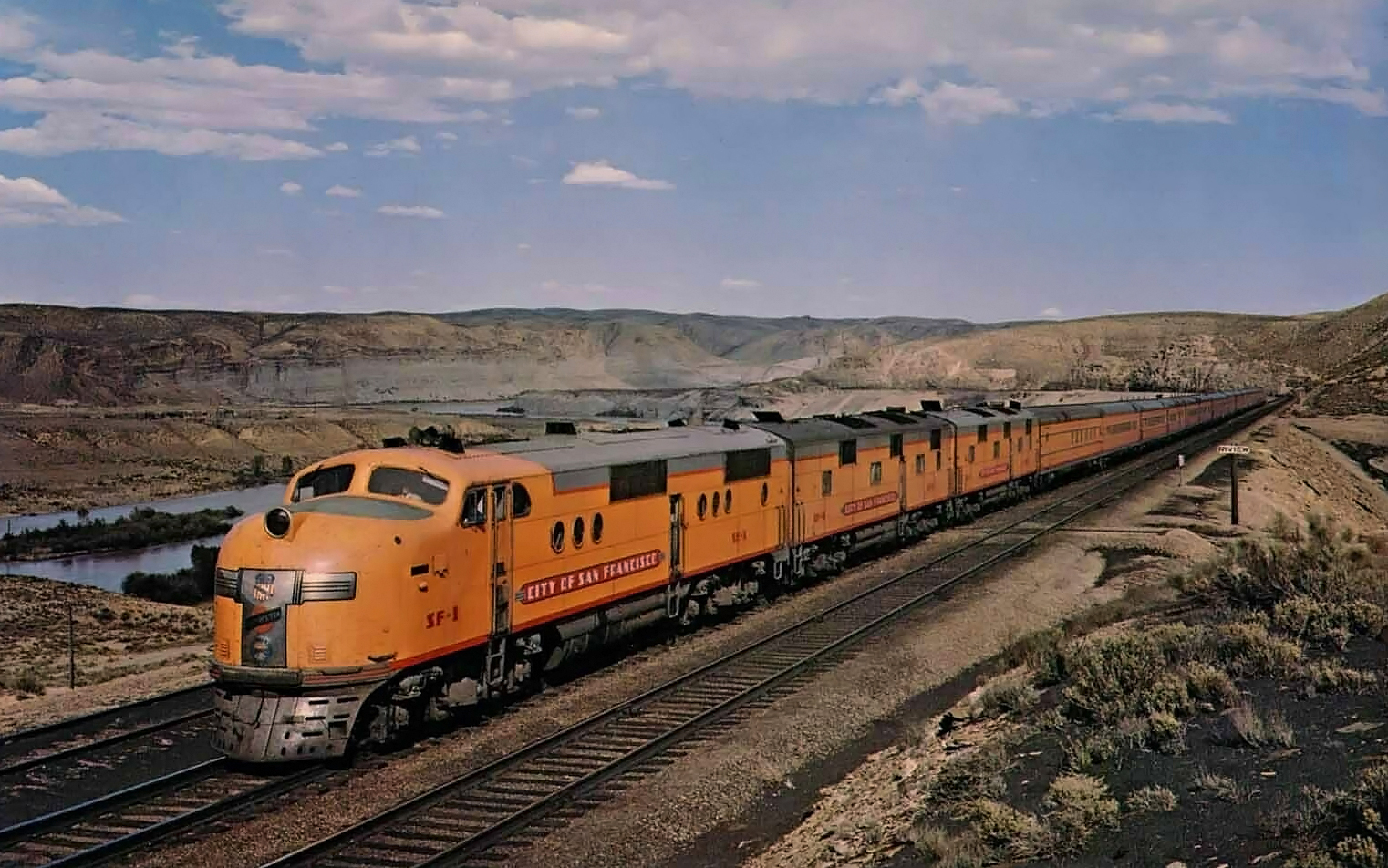 In this Union Pacific publicity photo the rare E2 model leads the westbound "City of San Francisco" which is seen here at Riview, Wyoming, circa 1940. The bulbous-nose E2 was a hybrid in Electro-Motive's transition from the slant-nose EA/E1 to the later "Bulldog" look on the E7's, E8's, and E9's. SF-1, in the lead, later became Southern Pacific #6017, nicknamed the "Queen Mary." The SP would go on to rebuild her at the shops in Los Angeles to E7 specifications, equipped with a pair of 567A prime movers, capable of producing a combined 2,000 horsepower.
History
Union Pacific, the largest and one of the most powerful railroads in the country, has been with us since 1862. The company is far older than any other American Class I railroad today with the Kansas City Southern in a nearby second.
In that time UP has become not only one of the most highly respected institutions in the nation but also has seen nearly every major railroading event in our country’s history, and accordingly has a very long and storied history.
The City of San Francisco was actually quite similar to its sister, the City of Los Angeles, operating almost virtually identical routes save for the two’s different terminating cities in California.
For the first twenty years or so of the train’s existence it was operated in conjunction with the Chicago & North Western Railway which ferried the San Francisco from Omaha, eastward to Chicago.
This setup lasted until 1955 when the UP, dissatisfied with the services C&NW was providing handed the train over to rival Milwaukee Road, a partnership that would last until the train’s end. Similarly, west of Ogden, Utah the Southern Pacific handled the City of S.F. to its final destination.
In total, the train was operated by three different railroads to stretch from the Midwest to West Coast. The City of San Francisco debuted on June 14, 1936 as a semi-articulated trainset known by the Union Pacific as the M-10004 (the railroad owned a total of seven of these trainsets).
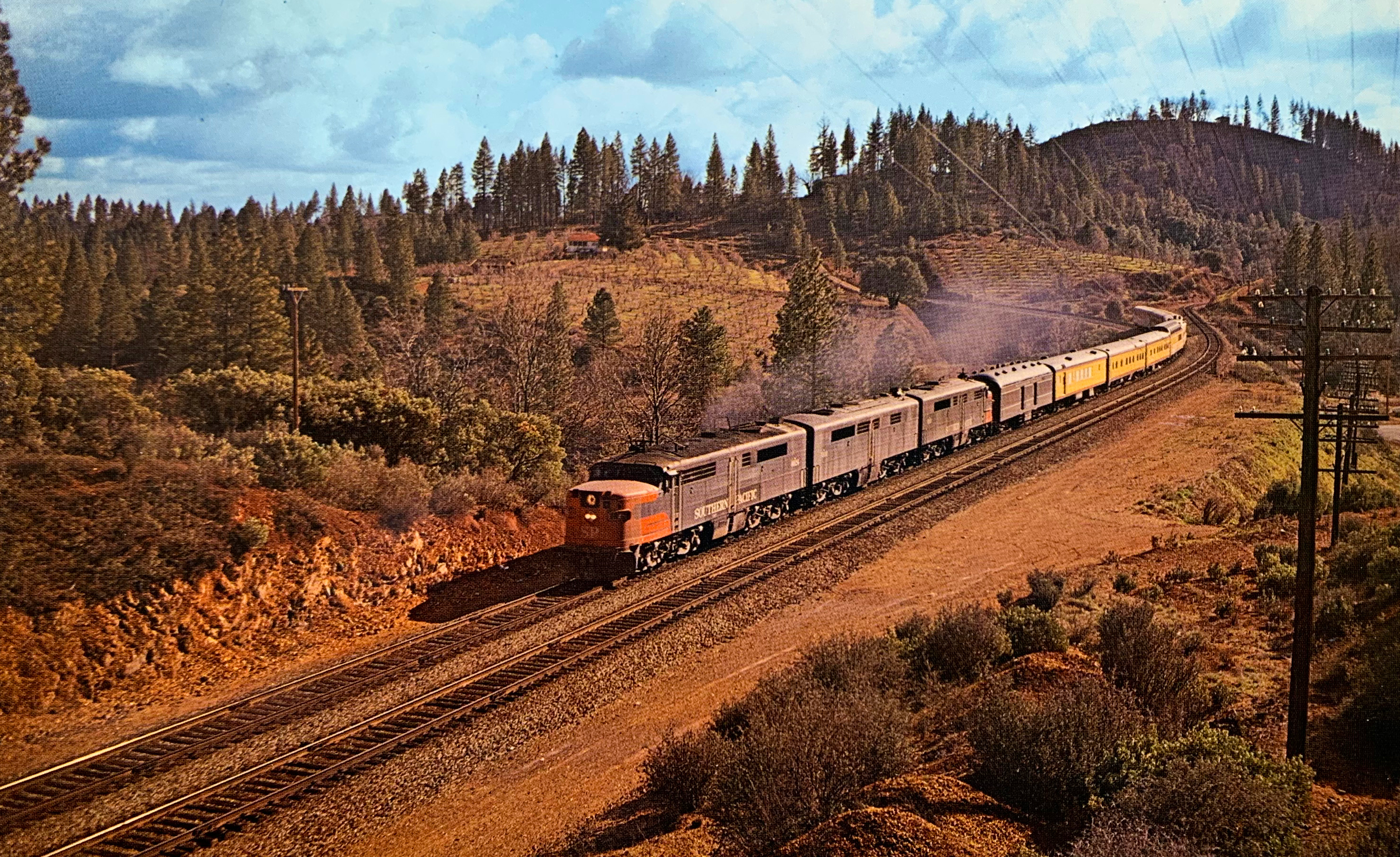 Southern Pacific PA-2 #6024 leads train #28, the eastbound "San Francisco Overland," over Donner Pass, two miles west of Colfax, California in the spring of 1960. A few months later the train was combined with the "City of San Francisco." Richard Steinheimer photo. Author's collection.
Because the train was one of the very first transcontinental streamliners to hit the rails the traveling public was awestruck. The original nine-car trainset was so successful that just a year later Union Pacific upgraded the train, doing away with the semi-articulated design (the M-10004 was reassigned to another run).
Timetable (June, 1957)
| Read Down Time/Leave (Train #101/Milwaukee Road) | Milepost | Location | Read Up Time/Arrive (Train #102/Milwaukee Road) |
|---|---|---|---|
| 6:30 PM (Dp) | 0.0 | 11:15 AM (Ar) | |
| 8:38 PM (Ar) | 138 | 8:47 AM (Dp) | |
| 8:44 PM (Dp) | 138 | 8:40 AM (Ar) | |
| 10:10 PM | 227 | 7:19 AM | |
| 12:05 AM (Ar) | 362 | 5:11 AM (Dp) | |
| 12:10 AM (Dp) | 362 | 5:06 AM (Ar) | |
| 2:45 AM (Ar) | 487 | 3:00 AM (Dp) | |
| Time/Leave (Train #101/Union Pacific) | Milepost | Location | Time/Arrive (Train #102/Union Pacific) |
| 2:55 AM (Dp) | 487 | 2:50 AM (Ar) | |
| F | 525 | F | |
| F | 570 | F | |
| 4:54 AM (Ar) | 632 | 12:40 AM (Dp) | |
| 4:55 AM (Dp) | 632 | 12:39 AM (Ar) | |
| F | 674 | F | |
| 6:40 AM (Ar) | 769 | 10:48 PM (Dp) | |
| 5:45 AM (Dp) | 769 | 9:43 PM (Ar) | |
| 7:28 AM (Ar) | 893 | 8:02 PM (Dp) | |
| 7:29 AM (Dp) | 893 | 8:01 PM (Ar) | |
| 9:15 AM (Ar) | 995 | 6:40 PM (Dp) | |
| 9:25 AM (Dp) | 995 | 6:30 PM (Ar) | |
| 10:45 AM (Ar) | 1051 | 5:12 PM (Dp) | |
| 10:46 AM (Dp) | 1051 | 5:11 PM (Ar) | |
| 12:40 PM (Ar) | 1168 | 3:25 PM (Dp) | |
| 12:41 PM (Dp) | 1168 | 3:24 PM (Ar) | |
| 3:00 PM (Ar) | 1302 | 1:05 PM (Dp) | |
| 3:10 PM (Dp) | 1302 | 12:55 PM (Ar) | |
| 4:51 PM | 1402 | 11:14 AM | |
| 6:30 PM (Ar) | 1478 | 9:40 AM (Dp) | |
| Time/Leave (Train #101/Southern Pacific) | Milepost | Location | Time/Arrive (Train #102/Southern Pacific) |
| 6:50 PM (Dp) | 1478 | 9:20 AM (Ar) | |
| F 9:44 PM | 1705 | F 4:13 AM | |
| 10:13 PM | 1727 | 3:51 AM | |
| F 11:52 PM | 1844 | F 2:04 AM | |
| F 12:54 AM | 1917 | F 1:03 AM | |
| 2:50 AM | 2018 | 11:14 PM | |
| F 3:40 AM | 2053 | F 10:08 PM | |
| F 5:51 AM | 2118 | F 7:56 PM | |
| 7:30 AM (Ar) | 2171 | 6:43 PM (Dp) | |
| 7:40 AM (Dp) | 2171 | 6:34 PM (Ar) | |
| F 8:19 AM | 2211 | F 5:44 PM | |
| 9:21 AM | 2254 | 4:48 PM | |
| 9:32 PM | 2258 | 4:40 PM | |
| 9:45 PM (Ar) | 2260 | 4:33 PM (Dp) | |
| 10:00 PM (Dp) | 2260 | 4:20 PM (Ar) | |
| 10:20 PM (Ar) | 2263 | 4:00 PM (Dp) |
The new City of S.F. featured EMC's new E2A/B streamlined diesel locomotive model, E2A #SF-1 and E2B's #SF-2 and #SF-3. Overall the train featured 14 cars (minus the power) built by Pullman-Standard and American Car & Foundry.
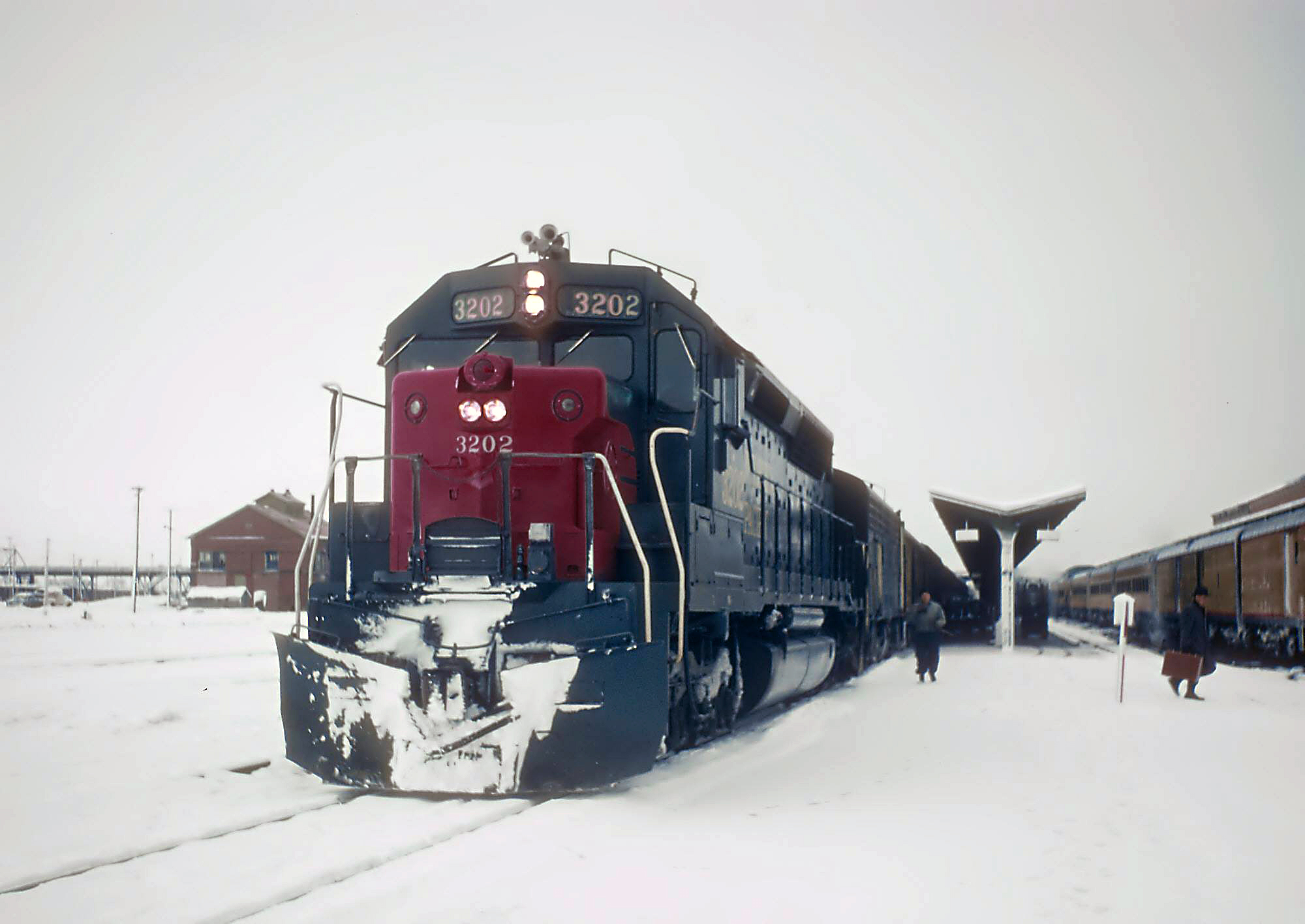 Southern Pacific SDP45 #3202 is ahead of train #102, the "City of San Francisco," at Ogden Union Station on a snowy day in January, 1970. Rick Burn photo.
The consist included a single coach, the famed semi-articulated diner/kitchen, club car, and several sleepers/sections/roomettes. It was with this new equipment that Union Pacific began the practice of naming its cars after the city name.
For instance, in the case of the City of San Francisco the consist included names like "Golden State Park", "Portsmouth Square", "Twin Peaks", and "Chinatown".
Consist (1952)
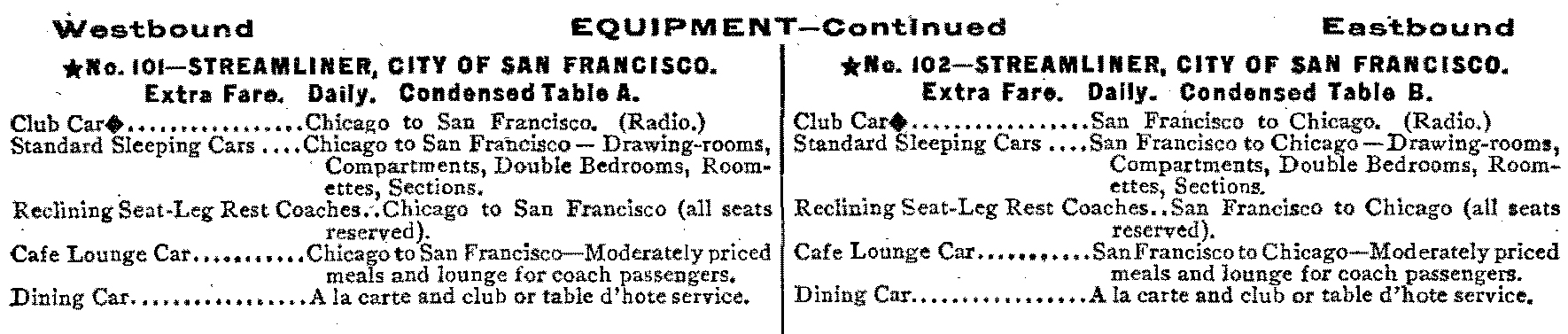
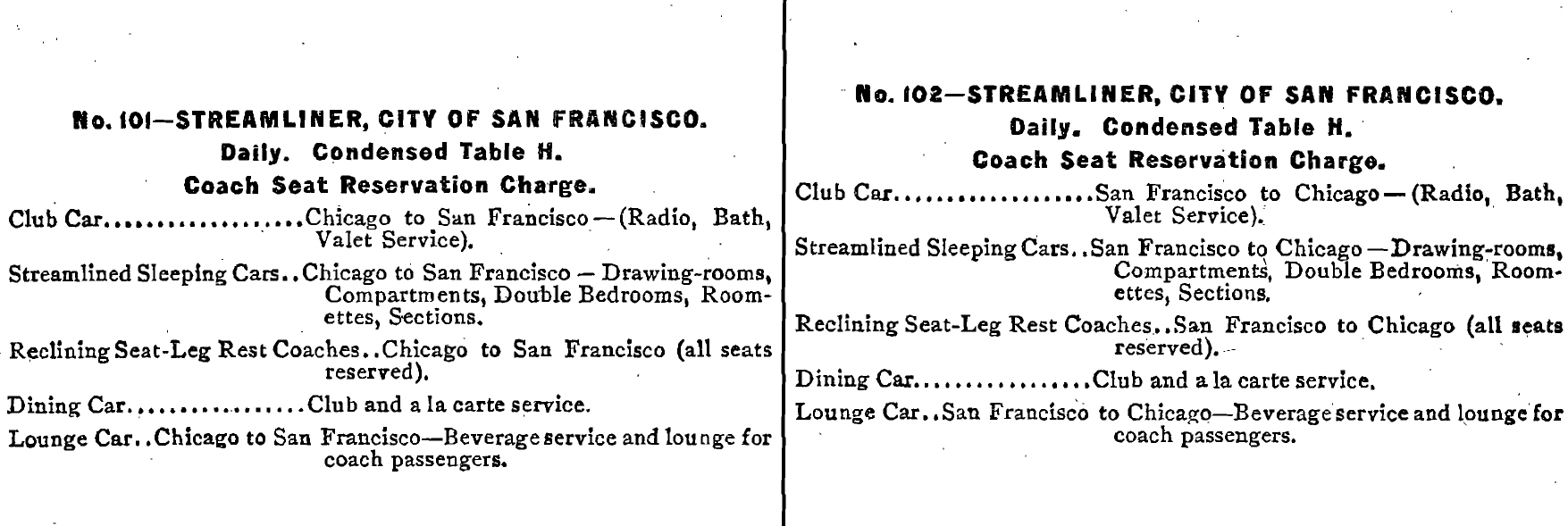
Just before World War II UP further upgraded the train with new streamlined diesel from EMC, E6A #SF-4 and E6Bs #SF-5 and #SF-6 (this latest design featured a much more slanted nose than the earlier, more-bulbous E2).
Following the war the City fleet received even more upgrades, including lightweight equipment and what UP termed “Domeliners,” which were dome cars set up as diners, coaches, and even lounges.
Timetable (May, 1969)
| Read Down Time/Leave (Train #103/Milwaukee Road) | Milepost | Location | Read Up Time/Arrive (Train #104/Milwaukee Road) |
|---|---|---|---|
| 6:00 PM (Dp) | 0.0 | 11:59 AM (Ar) | |
| 6:45 PM | 37 | 11:00 AM | |
| 7:21 PM | 80 | 10:22 AM | |
| 8:21 PM (Ar) | 138 | 9:27 AM (Dp) | |
| 8:28 PM (Dp) | 138 | 9:20 AM (Ar) | |
| 10:01 PM | 227 | 7:54 AM | |
| 11:57 PM (Ar) | 362 | 5:48 AM (Dp) | |
| 12:02 AM (Dp) | 362 | 5:38 AM (Ar) | |
| 2:30 AM (Ar) | 487 | 3:30 AM (Dp) | |
| Time/Leave (Train #103/Union Pacific) | Milepost | Location | Time/Arrive (Train #104/Union Pacific) |
| 2:55 AM (Dp) | 487 | 3:10 AM (Ar) | |
| F | 525 | F | |
| F | 570 | F | |
| 5:04 AM (Ar) | 632 | 12:55 AM (Dp) | |
| 5:05 AM (Dp) | 632 | 12:54 AM (Ar) | |
| F | 674 | F | |
| 7:10 AM (Ar) | 769 | 11:00 PM (Dp) | |
| 6:15 AM (Dp) | 769 | 9:55 PM (Ar) | |
| 7:58 AM (Ar) | 893 | 8:05 PM (Dp) | |
| 7:59 AM (Dp) | 893 | 8:04 PM (Ar) | |
| 9:45 AM (Ar) | 995 | 6:35 PM (Dp) | |
| 10:45 AM (Dp) | 995 | 6:00 PM (Ar) | |
| 12:07 PM (Ar) | 1051 | 4:41 PM (Dp) | |
| 12:08 PM (Dp) | 1051 | 4:40 PM (Ar) | |
| 1:54 PM (Ar) | 1168 | 2:57 PM (Dp) | |
| 1:55 PM (Dp) | 1168 | 2:56 PM (Ar) | |
| 3:42 PM | 1287 | 1:10 PM | |
| 4:15 PM (Ar) | 1302 | 12:50 PM (Dp) | |
| 4:25 PM (Dp) | 1302 | 12:45 PM (Ar) | |
| 6:09 PM (Ar) | 1402 | 11:05 AM (Dp) | |
| 6:10 PM (Dp) | 1402 | 11:04 AM (Ar) | |
| 8:00 PM (Ar) | 1478 | 9:35 AM (Dp) | |
| Time/Leave (Train #101/Southern Pacific) | Milepost | Location | Time/Arrive (Train #102/Southern Pacific) |
| 8:30 PM (Dp) | 1478 | 9:05 AM (Ar) | |
| 10:40 PM | 1654 | 4:46 AM | |
| 11:30 PM | 1705 | 3:50 AM | |
| 12:11 AM | 1727 | 3:20 AM | |
| F 1:06 AM | 1785 | F 2:03 AM | |
| 2:01 AM | 1844 | 1:13 AM | |
| F 2:31 AM | 1844 | F 12:41 AM | |
| 3:11 AM | 1917 | 11:59 PM | |
| F 4:01 AM | 1973 | F 11:10 PM | |
| 5:15 AM | 2015 | 10:25 PM | |
| 5:30 AM | 2018 | 9:52 PM | |
| 6:25 AM | 2053 | 8:50 PM | |
| F 8:38 AM | 2118 | F 6:30 PM | |
| F 9:17 AM | 2136 | F 6:07 PM | |
| 9:50 AM | 2154 | 5:43 PM | |
| 10:30 AM (Ar) | 2171 | 5:10 PM (Dp) | |
| 10:45 AM (Dp) | 2171 | 5:00 PM (Ar) | |
| 2185 | F 4:35 PM | ||
| 11:39 AM | 2211 | 4:08 PM | |
| 12:05 PM | 2229 | 3:47 PM | |
| 12:15 PM | 2234 | 3:33 PM | |
| 12:40 PM | 2248 | 3:12 PM | |
| 12:57 PM | 2254 | 3:00 PM | |
| 1:15 PM (Ar) | 2258 | 2:50 PM (Dp) |
The new
equipment, totaling more than 140 new cars,
were again adorned in a striking livery of Armour Yellow and light gray
with red trim, a paint scheme still in use today on the Union Pacific.
At this time the City of S.F. was also upgraded with new power from EMD including E7s and later E8s and E9s. To keep the equipment and train in matching paint the new equipment used by both the C&NW and Southern Pacific was also clad in Armour Yellow and light gray. This new equipment stretched the train to eighteen cars (including power).
While the City of S.F. could never be termed as the City of Los Angeles since it did not operate with quite such stately services as the latter (for instance, the train never received domes, at least by Union Pacific, although the Southern Pacific did offer dome service on its leg of the San Francisco), the train was a finely run through the end.
After 1960 the train did receive dome service after the railroad combined it with the City of Los Angeles. During the City of San Francisco heyday the train could make the jaunt between Chicago and San Francisco in just over 40 hours although in later years this increased to about 45 hours.
Final Years
Listed as Trains #103 (westbound) and #104 (eastbound) in Union Pacific's official timetable the City of S.F. would leave Chicago in the late evening and arrive at Omaha very early the next morning.
The Union Pacific would then carry the train as far west as Ogden, arriving there about 8 pm the same day and handing the train off to the Southern Pacific.
The SP would then carry it into San Francisco, arriving there early in the afternoon of the following day. Overall the train carried a respectable train speed of nearly 50 mph and successfully competed with the California Zephyr.
By the late 1960s the UP had combined all of its City trains east of Wyoming and unfortunately, while service remained high through the end with the train neither it nor the rest of the fleet was retained under Amtrak (which has its beginnings dating back to the spring of 1971).
Recent Articles


-
Conrail Diesel Roster (All Time)
Sep 17, 26 10:27 PM
 Conrail diesel—~5,000 inherited 1976, Big Blue, GP15-1s, SD40-2s, SD50s, Dash-8s, SD60/60M/60I, SD80MACs. All-time CR-number roster.
 -
Chessie System (Railroad): The C&O, B&O, And WM
Sep 17, 26 09:38 PM
 Chessie System, Inc.—C&O, B&O, and Western Maryland. Kitten-C paint 1972, holding company February 26 1973, CSX November 1 1980, C&O into CSXT August 31 1987.
 -
Chesapeake & Ohio (C&O) Diesel Roster: All-Time
Sep 17, 26 06:01 PM
 Chesapeake & Ohio diesel—late steam, no Fairbanks-Morse, E7s 1946, GP7/GP9 flood, F7s, GP40-2s, B30-7s, SD50s 1984–85. All-time roster. Steam ended 1956.
 -
Chesapeake & Ohio (C&O) Steam Roster: Post-1900
Sep 17, 26 03:18 PM
 Chesapeake & Ohio steam—H-8 Alleghenies, K-4 Kanawhas, T-1 Texas, Greenbriers, H-6 1949 Mallets. Post-1900 class roster including Pere Marquette and Hocking Valley. Last steam 1956.
 -
Chesapeake and Ohio Railway: Map, Logo, History
Sep 17, 26 02:36 PM
 Chesapeake & Ohio Railway—Louisa Railroad 1836, named August 31 1868, Ohio River 1873. Coal, Chessie the kitten, Pere Marquette 1947, B&O control 1963, into CSX August 31 1987. Complete corporate…
 -
TVRM Valentine Train Ride (2026)
Sep 17, 26 02:31 PM
 2026 TVRM Valentine Train Ride in Chattanooga—Feb. 6–15, plated dinner, Grand Junction Depot. Confirm on tvrail.com.
 -
River Fox Train Dining (2026)
Sep 17, 26 02:29 PM
 2026 River Fox Train in West Sacramento—Brunch Train and Murder Mystery dinner. 18095 County Road 117. Confirm on riverfoxtrain.com.
 -
Weehawken Terminal, Serving The West Shore Railroad
Sep 17, 26 01:38 PM
 Weehawken Terminal—West Shore / New York Central Hudson waterfront station, opened 1884. Five ferry slips, sixteen tracks, Weehawken Tunnel 4,014 feet. Last ferry March 25, 1959. Port Imperial and HBL…
 -
West Shore Railroad: Map, History, Timetables
Sep 17, 26 01:32 PM
 West Shore Railroad—New York, West Shore & Buffalo 1880–83, Weehawken to Buffalo. PRR-backed rival to the Central. Morgan settlement, 475-year NYC lease January 1 1886. CSX River Sub today.
 -
Jersey Central Diesel Locomotives: History, Roster & Photos
Sep 17, 26 01:20 PM
 Central Railroad of New Jersey diesel—boxcab 1000, Baldwin double-enders, F3s, Train Masters, SD35s, GP40Ps. All-time roster. Steam ended July 1, 1954.
 -
Jersey Central Steam Locomotives: History, Roster & Photos
Sep 17, 26 01:17 PM
 Central Railroad of New Jersey steam—Camelback Ten-Wheelers, USRA Mikados, G-class Pacifics, suburban tanks. Post-1900 class roster after Drury. Dieselized July 1, 1954.
 -
Jersey Central Railroad (CNJ): Map, Rosters, History
Sep 17, 26 01:14 PM
 Central Railroad of New Jersey—Elizabethtown & Somerville 1831, named April 23 1849. Communipaw, anthracite, Blue Comet, Reading/B&O control. Conrail April 1 1976. Complete corporate history.
 -
Central Vermont Diesel Locomotives: History, Roster & Photos
Sep 17, 26 11:35 AM
 Central Vermont diesel—Alco S-2s 1942, RS-3s, RS-11s from DW&P, EMD GP9s 1956–57, GP38ACs 1971. All-time roster. Last steam April 4, 1957.
 -
Central Vermont Steam Locomotives: History, Roster & Photos
Sep 17, 26 11:19 AM
 Central Vermont steam—ten Alco 2-10-4s of 1928, four U-1-a Mountains, Consolidations. Post-1900 class roster after Drury. Last steam April 4, 1957.
 -
Central Vermont Railway: Map, Logo, Rosters
Sep 17, 26 11:03 AM
 Central Vermont Railway—Vermont Central charter October 1843, Bethel–White River Junction June 26, 1848. Grand Trunk 1898, CN 1923, RailTex/NECR 1995. Complete corporate history.
 -
Fitchburg Railroad: Map, History, Timetables
Sep 17, 26 10:40 AM
 Fitchburg Railroad—chartered March 3, 1842, Boston–Fitchburg March 5, 1845. Alvah Crocker, Hoosac west door, Vermont & Massachusetts, Cheshire. B&M 99-year lease July 1, 1900. Complete corpora…
 -
Steam Railroading Institute Dining (2026)
Sep 17, 26 10:30 AM
 2026 SRI Owosso dining—vintage dining cars, select evenings. 2026 dinner calendar not posted; 2025 Up In Smoke is the recent example. Confirm on michigansteamtrain.com.
 -
Canadian Pacific Railway: Map, History, Logo, Photos
Sep 17, 26 12:06 AM
 Canadian Pacific Railway—incorporated February 16, 1881. Last spike Craigellachie November 7, 1885. Soo, Milwaukee, D&H, DM&E. CPKC April 14, 2023. Complete corporate history.
 -
Canadian Pacific Diesel Locomotives: History, Roster & Photos
Sep 17, 26 12:03 AM
 Canadian Pacific diesel—E8A 1800 in 1949, FP7/FP9, FA-2, C424, SD40-2, SD40-2F Red Barns, AC4400CW, ES44AC, SD30C-ECO, SD70ACu heritage. All-time roster. Last steam November 6, 1960.
 -
Canadian Pacific Steam Locomotives: History, Roster & Photos
Sep 16, 26 11:35 PM
 Canadian Pacific steam—3,257 engines 1881–1949. D10 Ten-Wheelers, G3 Pacifics, Royal Hudsons, Selkirk 2-10-4s. Post-1900 class roster after Drury. Last steam November 6, 1960.
 -
Woodstown Central Dining in Motion (2026)
Sep 16, 26 11:31 PM
 2026 Woodstown Central Dining in Motion—Salem County table car, 50–60 minutes, private table of four from $190. Confirm on woodstowncentral.com.
 -
NCTM Wine & Dine on the Rails (2026)
Sep 16, 26 11:28 PM
 2026 NCTM Wine & Dine on the Rails in Spencer—Feb. 13–15, three-course dinner, 21+, $145/$140. Sold out. Confirm next season on nctransportationmuseum.org.
 -
Southern Railway 4-6-2 1380: The Streamlined Ps-4
Sep 16, 26 10:34 PM
 Southern Railway Ps-4 4-6-2 1380—Alco 1923, serial 64857. Otto Kuhler streamlining at Spencer 1940–41 for the Tennessean. Only streamlined steam locomotive on the Southern. Scrapped Baltimore 1953.
 -
Texas Mexican Railway: Serving The Border Since The 1880s
Sep 16, 26 09:58 PM
 Texas Mexican Railway—Corpus Christi, San Diego & Rio Grande March 1875, 3-foot. Tex-Mex June 1881, Laredo Sept 1881, Rio Grande bridge 1883. Standard gauge July 17 1902. Mexican government 1900–1…
 -
Mount Hood Railroad Dining (2026): No Plated Dinner Train This Season
Sep 16, 26 09:53 PM
 2026 Mount Hood Railroad in Hood River is scenic Fruit Loop trains with snacks and sandwiches—not a plated dinner train. Confirm on mthoodrr.com.
 -
Peoria and Eastern Railway: Map, Timetables, History
Sep 16, 26 09:39 PM
 Peoria & Eastern—Danville, Urbana, Bloomington & Pekin 1866, IB&W 1869, OI&W 1887. Incorporated Feb 21 1890, Big Four next day. NYC 1930, Conrail 1976. GP7s 5612–5625. Complete corporate history.
 -
Boston and Maine Railroad: "Route Of The Minute Man"
Sep 16, 26 11:30 AM
 Boston & Maine—Andover & Wilmington 1833, NH charter June 27 1835. Eastern, Boston & Lowell, Fitchburg/Hoosac, Concord & Montreal. Section 77 March 12 1970. Guilford June 30 1983. CSX June 1 2…
 -
Smoky Valley Limited Dinner Train (2026)
Sep 16, 26 11:24 AM
 2026 Abilene & Smoky Valley Smoky Valley Limited—two-hour dinner from the 1887 Rock Island Depot. Kansas catering, ~$72–$110. Confirm on asvrr.org.
 -
Canadian National Diesel Locomotives: History, Roster & Photos
Sep 16, 26 11:14 AM
 Canadian National diesel—CLC boxcabs 1929, GMD FP9 and GP9, MLW FPA-4 and RS-18, GMD1, wide-cab SD40-2W, Dash-9s, ES44AC and ET44AC. All-time roster.
 -
Canadian National Steam Locomotives: History, Roster & Photos
Sep 16, 26 10:07 AM
 Canadian National steam—CGR, Canadian Northern, Grand Trunk, GTP. 4-8-4 Confederations, U-1 Mountains, J and K Pacifics. Post-1900 class roster. Last scheduled steam April 25, 1960.
 -
Canadian National Railway: Map, Logo, History, Photos
Sep 16, 26 08:55 AM
 Canadian National—name Dec 20 1918, incorporated June 6 1919, Grand Trunk Jan 20 1923. Crown corporation, IPO Nov 17 1995. IC, Wisconsin Central, BC Rail, EJ&E. Class I, mark CN.
 -
Buffalo, Rochester and Pittsburgh Railway: "Safety and Service"
Sep 16, 26 12:12 AM
 Buffalo, Rochester & Pittsburgh—Rochester & State Line 1869, BR&P March 12 1887. Pennsylvania coal to Buffalo and Rochester. B&O January 1 1932. All-time steam roster, LL 2-6-6-2s, XX…
 -
Buffalo Creek & Gauley Railroad: Map, Roster, Logo, Photos
Sep 15, 26 11:55 PM
 Buffalo Creek & Gauley—Elk River Coal & Lumber, April 1 1904, Dundon–Widen. Last all-steam WV coal road, February 27 1965. All-time steam roster, #4 Baldwin 59472, Majestic and Elk River diesels…
 -
Buffalo and Susquehanna Railroad: Map & History
Sep 15, 26 11:42 PM
 Buffalo & Susquehanna—Goodyear hemlock railroad, Sinnemahoning Valley December 14 1885, 1893 merger, coal to Sagamore, Buffalo extension, bankruptcy May 6 1910, B&O 1932, WAG 1956.
 -
WMSR Allegheny Mountain Dinner Train (2026): Dates & Tickets
Sep 15, 26 11:36 PM
 2026 Western Maryland Scenic Allegheny Mountain Dinner Train—Cumberland, 3 hours, 21+, Saturday 7 p.m. Confirm on wmsr.com.
 -
Boston and Albany Railroad: Map & History
Sep 15, 26 11:28 PM
 Boston & Albany Railroad—Boston & Worcester June 23 1831, Western Railroad across the Berkshires, merger 1867–70. NYC 99-year lease July 1 1900. Berkshires, New England States, CSX and MBTA today.
 -
Grand Bellevue Dinner Train (2026): Portsmouth, Rhode Island
Sep 15, 26 11:14 PM
 2026 Grand Bellevue Rail Dining in Portsmouth, RI—2.5-hour seated dinner on Narragansett Bay. Fall/winter TBA after Aug. 29. Confirm on thegrandbell.com.
 -
The "John Bull": The C&A's First Locomotive (1831)
Sep 15, 26 11:01 PM
 John Bull locomotive—Stephenson Planet-type 0-4-0, 1831. Dripps assembly, 4-2-0 rebuild, cowcatcher. Specs, Camden & Amboy career, Smithsonian 1884, 1981 steam-up, 1939 replica.
 -
Napa Valley Wine Train Dining (2026): Lunch, Dinner & Vista Dome
Sep 15, 26 10:56 PM
 2026 Napa Valley Wine Train dining—downtown Napa, 36-mile round trip, gourmet lunch and dinner, Vista Dome. Confirm packages on winetrain.com.
 -
My Old Kentucky Dinner Train (2026): Dates, Tickets & What to Expect
Sep 15, 26 10:50 PM
 2026 My Old Kentucky Dinner Train in Bardstown—2.5 hours, 35-mile round trip, four-course dinner from $116. Confirm on kydinnertrain.com.
 -
LaSalle Street Station: One Of Chicago's Great Terminals
Sep 15, 26 10:42 PM
 LaSalle Street Station—Rock Island October 10, 1852. Frost & Granger July 1, 1903. 20th Century Limited, Rockets, Golden State. Headhouse razed 1981. Metra Rock Island District today.
 -
Charlie Russell Chew Choo (2026): Montana Dinner Train from Lewistown
Sep 15, 26 10:39 PM
 2026 Charlie Russell Chew Choo dinner train—Hanover/Lewistown, 4.5 hours, 56-mile round trip, prime rib. Adult $151. Remaining listed dates sold out. Confirm on montanadinnertrain.com.
 -
Central Pacific Railroad: Map, History, Facts, Logo
Sep 15, 26 10:30 PM
 Central Pacific—Judah, Big Four, June 28 1861. Sierra, Chinese labor, Donner Summit Tunnel. Ten-mile day April 28 1869. Promontory May 10. Southern Pacific lease April 1 1885. Dissolved June 30 1959…
 -
Bessemer & Lake Erie Railroad: "The Bessemer Road"
Sep 15, 26 05:20 PM
 Bessemer & Lake Erie—Bear Creek 1865, Carnegie 1897, U.S. Steel 1901. Ore south from Conneaut, coal north. 2-10-4s, Missabe sister road. CN May 10, 2004. Complete corporate history.
 -
Bangor and Aroostook Railroad: "Serving Northern Maine"
Sep 15, 26 05:05 PM
 Bangor & Aroostook—chartered February 13, 1891, first trains January 1, 1894. Potatoes, paper, Searsport, State of Maine reefers. MM&A 2003, Lac-Mégantic 2013, CP 2020, CPKC today. Complete co…
 -
Baltimore & Ohio Chicago Terminal Railroad: Map and History
Sep 15, 26 03:11 PM
 B&OCT—formed January 6, 1910 to buy Chicago Terminal Transfer. Grand Central, Barr Yard, 78 route-miles. Assigned B&O steam. Complete diesel roster. CSX paper subsidiary, mark BOCT.
 -
The "Alphabet Route" (Railroad): Photos and History
Sep 15, 26 02:53 PM
 Alphabet Route—eight railroads, not one company. P&WV to Connellsville February 11, 1931. Alpha Jets Chicago/St. Louis–New York/Boston. NKP, W&LE, P&WV, WM, Reading, CNJ, L&HR, New Hav…
 -
Milwaukee Road Livestock Operations: Cattle, Dakotas & Montana
Sep 15, 26 02:36 PM
 Milwaukee Road livestock traffic—Dakota and Montana cattle, Iowa hogs, Chicago markets, 28-hour law, head-end stock cars. By 1974 mostly Montana. Rick Burn’s Helena speech. Operations history, not the…
 -
Spirit of Jasper Ride & Dine (2026): Season Pause
Sep 15, 26 02:29 PM
 Spirit of Jasper Ride & Dine in Jasper, Indiana—seated meal on board. Operator: not running public trains for 2026. Depot remains open as a rental. Confirm on spiritofjaspertrain.com.
 -
South Carolina Canal & Rail Road Company: Map and History
Sep 15, 26 01:59 PM
 South Carolina Canal & Rail Road—chartered December 19, 1827. Best Friend of Charleston, 136 miles Charleston–Hamburg October 1833, Aiken inclined plane. South Carolina Railroad 1844, Southern 189…