EMD "GP30" Locomotives: Data Sheet, Specs, Roster
Last revised: February 20, 2025
By: Adam Burns
The now-classic GP30 was unmistakable. It featured an interesting semi-streamlined design for a road-switcher, sporting a bulbous appendage on the roof, which ran from just above the cab to the dynamic brake blister.
The unique carbody was never repeated by EMD although its flush nose and uniform cab, featuring a two-piece windshield, became a standard design for the next thirty years.
The locomotive was essentially an improved GP20, featuring an upgraded prime mover, greater horsepower, and new advances to keep the engine compartment cleaner.
The GP30 was Electro-Motive's answer to General Electric's recently introduced U25B, the company's entry into the road-switcher market in the spring of 1959.
EMD again found big success with its latest model, selling nearly 1,000 examples to dozens of railroads. While the model was equipped with the low, short hood as a standard option some roads continued to purchase high hood variants and Union Pacific even acquired cabless examples.
Today, the GP30 is well preserved with numerous examples at museums or in operation on tourist lines. Additionally, others remain in service at short lines.
Photos
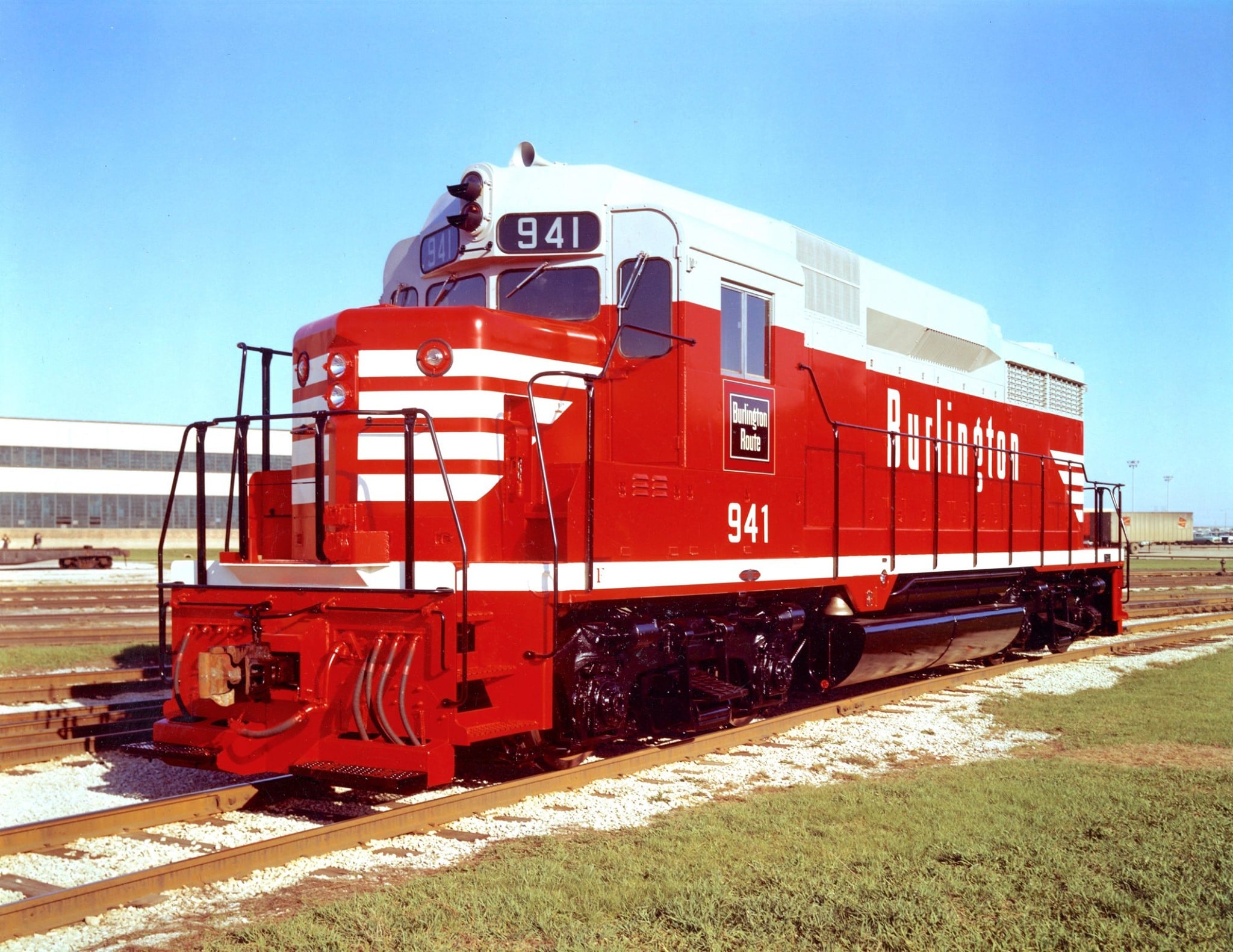 An Electro-Motive photo featuring new Chicago, Burlington & Quincy GP30 #941 in Chinese Red in April, 1962. Warren Calloway collection.
Overview
In his book, "EMD Locomotives," author Brian Solomon notes the GP30 was one of the builder's final four-axle road-switchers sporting the 567 prime mover. The model featured the turbocharged 567D3 engine, which could produce 2,250 horsepower.
The GP30 was EMD's first to feature the now-common pointed, low, short hood. This design became EMD's standard until the FRA mandated the wide "safety" cab on every new locomotive in the 1990s.
Interestingly, the GP30 abandoned EMD's brief attempt at attributing horsepower rating to the model name. Apparently, there was no specific reasoning for the use of "30" other than perhaps, as Gerald Foster notes in "A Field Guide To Trains," "GP30" sounded better than "U25B."
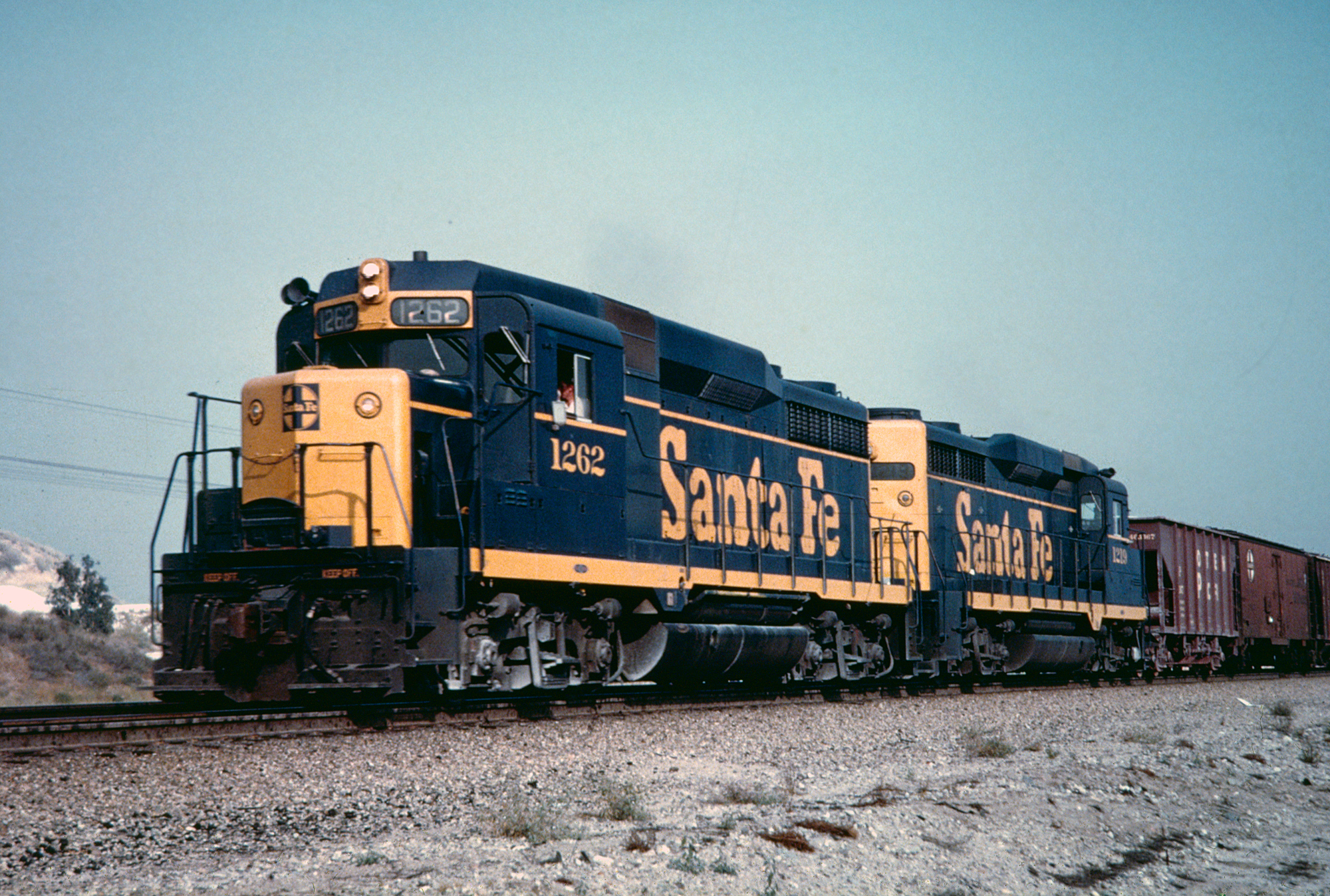 A sharp pair of new Santa Fe GP30's, #1262 and #1219, head west through Los Angeles on May 5, 1963. American-Rails.com collection.
Specifications
Much improved over early models like the GP7 and GP9, the GP30 boasted:
- 2,250 horsepower (250 more horsepower than the GP20, which is said to have been achieved through the use of a different turbocharger, since the bore, stroke, compression ratios and RPMs of the two engines were identical).
- Was equipped with dynamic brakes (while not new, the system temporarily employed traction motors as generators and used the resulting electromotive force to slow the train).
- Featured an airtight hood that kept out dust, dirt and other particles from reaching internal components (to cool these critical components the GP30 featured a single air intake for electrical cooling, with a pressurized cooling system).
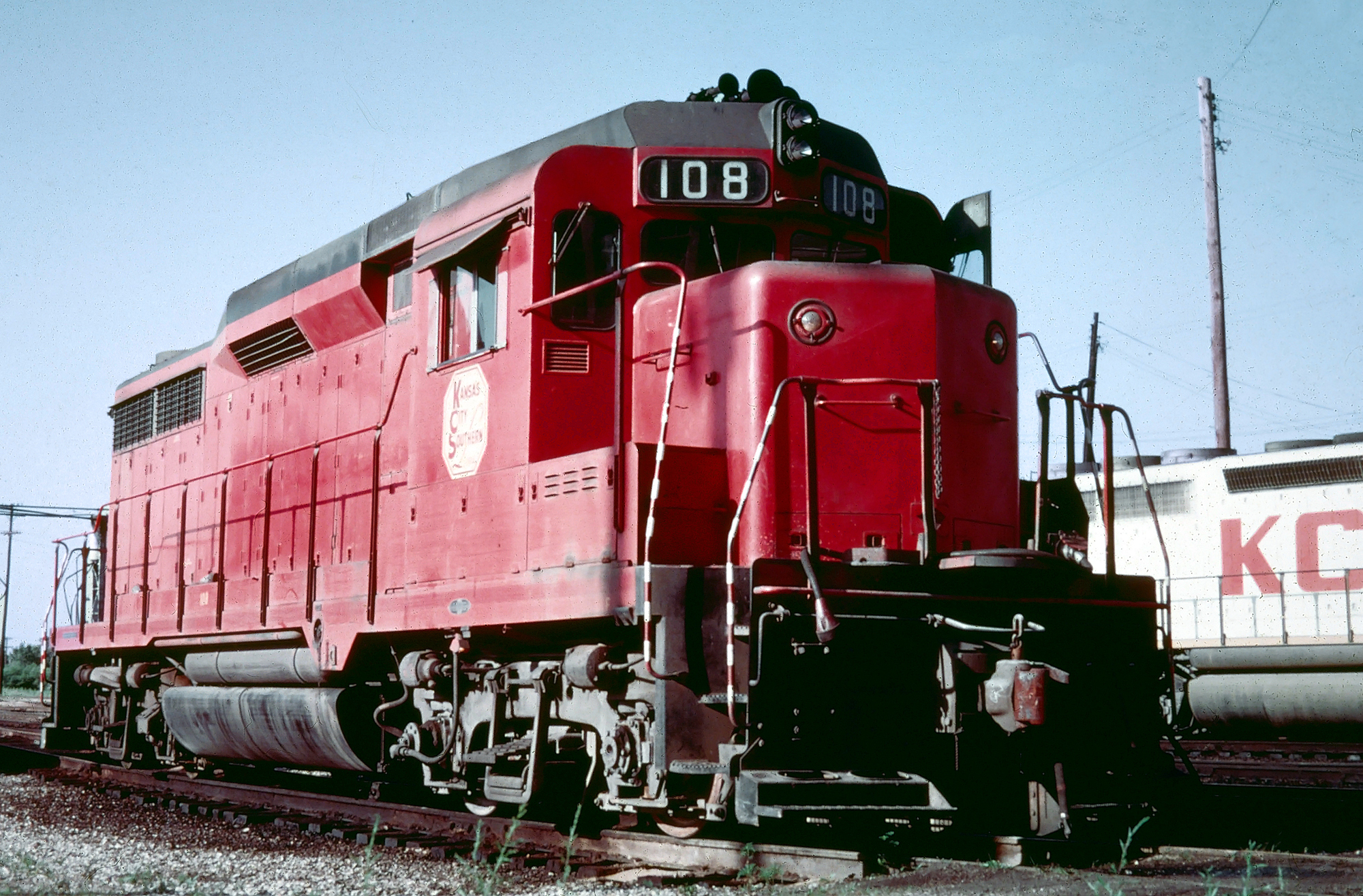 Kansas City Southern GP30 #108 at the road's shops in Pittsburg, Kansas, circa 1969. American-Rails.com collection.
Obviously, the model's most recognizable aspect was the carbody featuring a semi-streamlined "bulge" along the roofline between the cab and dynamic brake blister.
In his book, "Diesel Locomotives: Cyclopedia, Volume 2," author Bob Hayden points out the space ahead of the blister actually had a purpose. It housed an electrical cabinet, turbocharger, and central air intake/filter system.
To improve the carbody's appearance, EMD continued this flaring around the blister giving the GP30 a somewhat streamlined appearance. Interestingly, this cosmetic touch was applied to all GP30s, whether they were ordered with dynamics or not.
Spotting Features
While the GP30's roofline bulge was its trademark feature, making it unmistakable from any other EMD design, it also featured some other, less noticeable improvements.
The carbody's walkway was elevated a few inches, which provided space for pipes and electric conduit on the left side and a traction motor cooling air duct on the right.
In addition, Louis Marre notes in his book, "Diesel Locomotives: The First 50 Years," the GP30 was the first to feature all of its radiators at the rear of the long hood; previous variants had included these both ahead, and behind, the exhaust stacks.
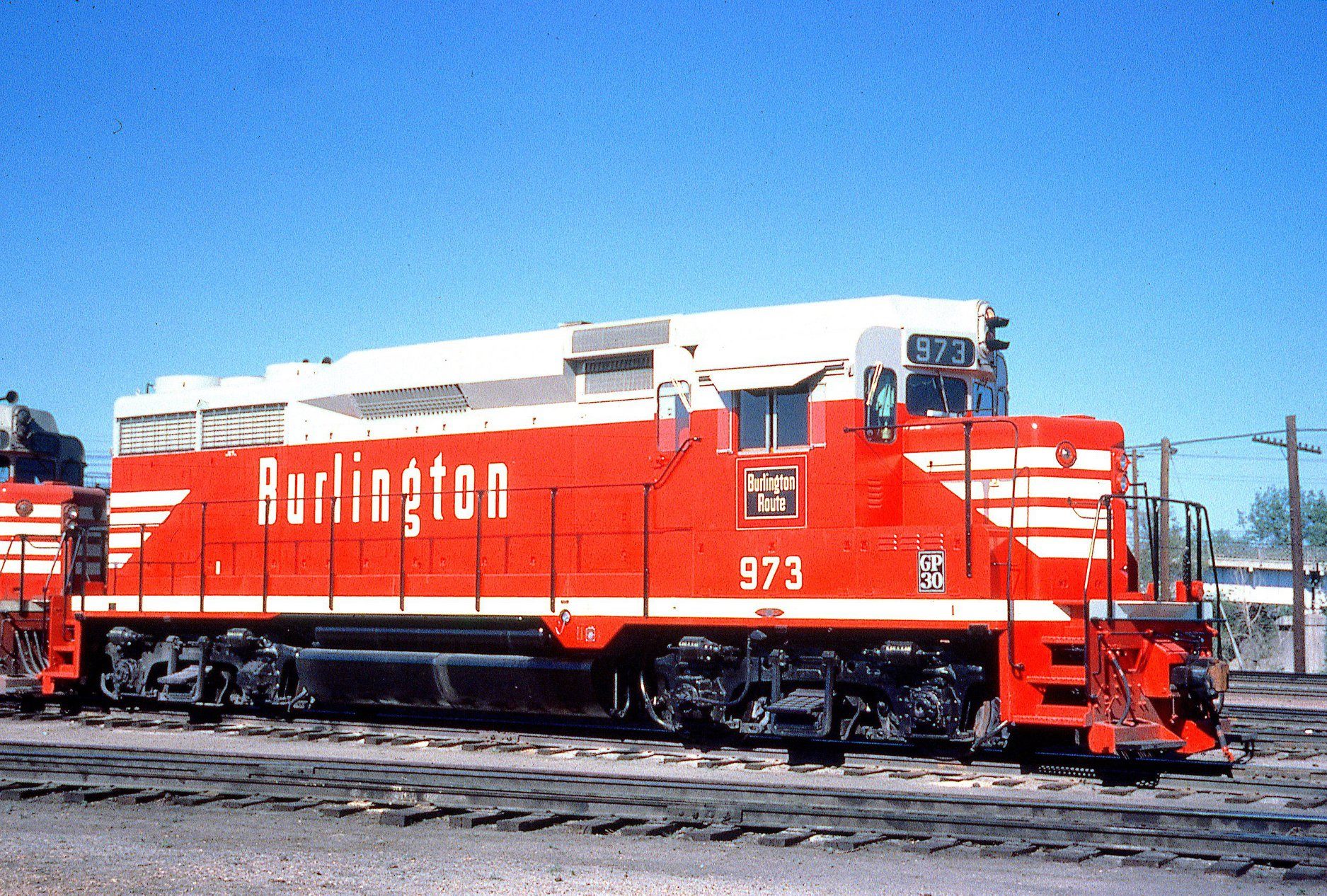 A set of new Chicago, Burlington & Quincy GP30s (led by #973), resplendent in their 'Chinese Red' livery, are seen here in Denver, Colorado in May, 1963. Warren Calloway collection.
Variants
Once again, Canadian lines took no orders on the GP30; the largest orders came from Union Pacific (111), Southern (120), and the Santa Fe (85).
Most buyers stuck with EMD's then-standard low nose. However, some continued to operate high hood road-switchers and ordered theirs with this feature, notably Southern Railway and Norfolk & Western.
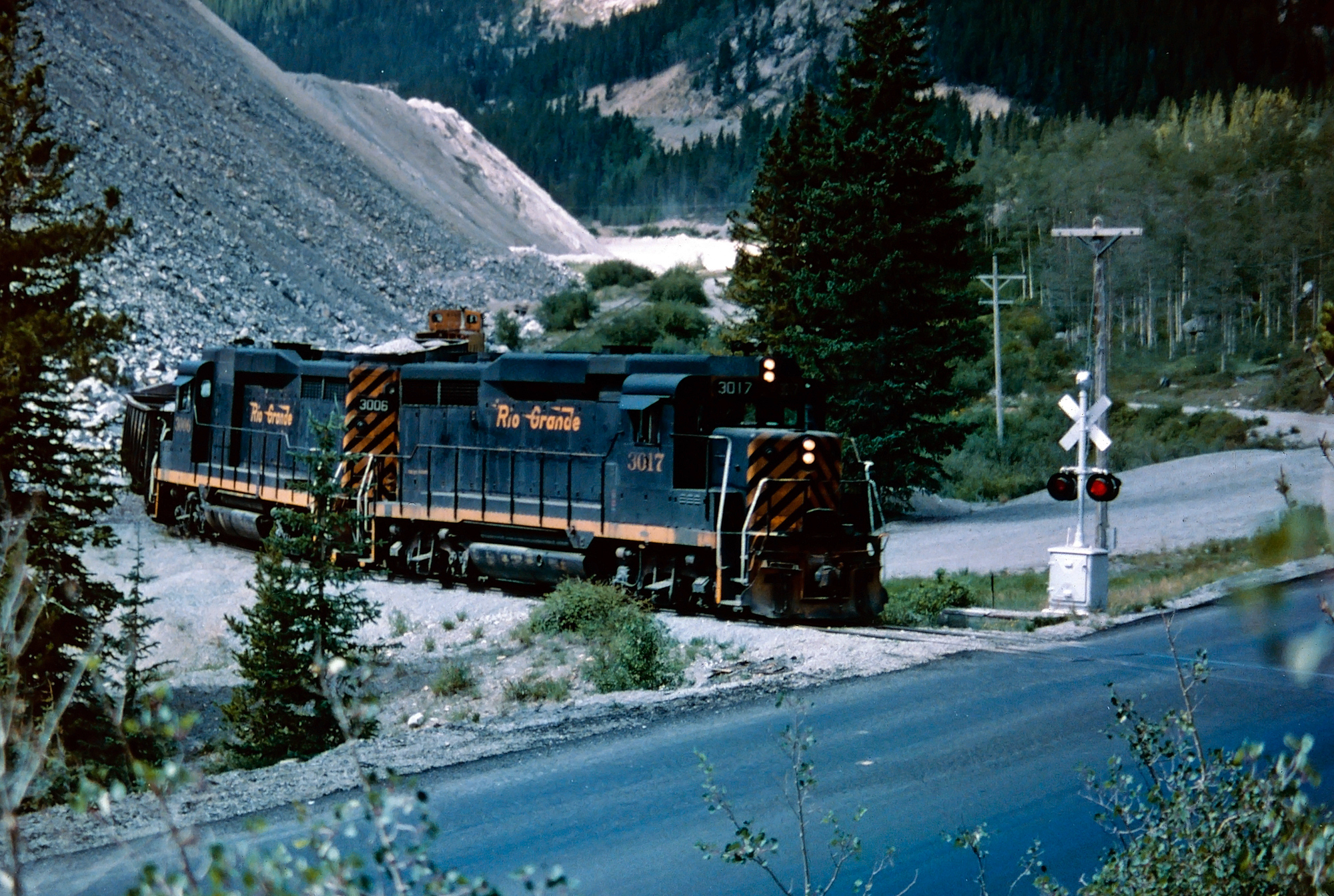 Rio Grande GP30's #3017 and #3006 bring a load of limestone down the stiff grades of the Monarch Branch near Monarch, Colorado on August 24, 1979. Robert Harmen photo. American-Rails.com collection.
In addition, others like the Milwaukee Road, Soo Line, and Gulf, Mobile & Ohio traded-in older Alcos on new GP30s to reduce costs and utilize GE's rugged 752 traction motors. These variants looked interesting sporting AAR Type B trucks in place of the standard Blombergs.
Union Pacific was the only buyer to acquire cabless variants, forty in all numbered 700B-739B. Interestingly, eight of these (#727B-734B) were ordered with steam generators for passenger service, the only GP30s so equipped.
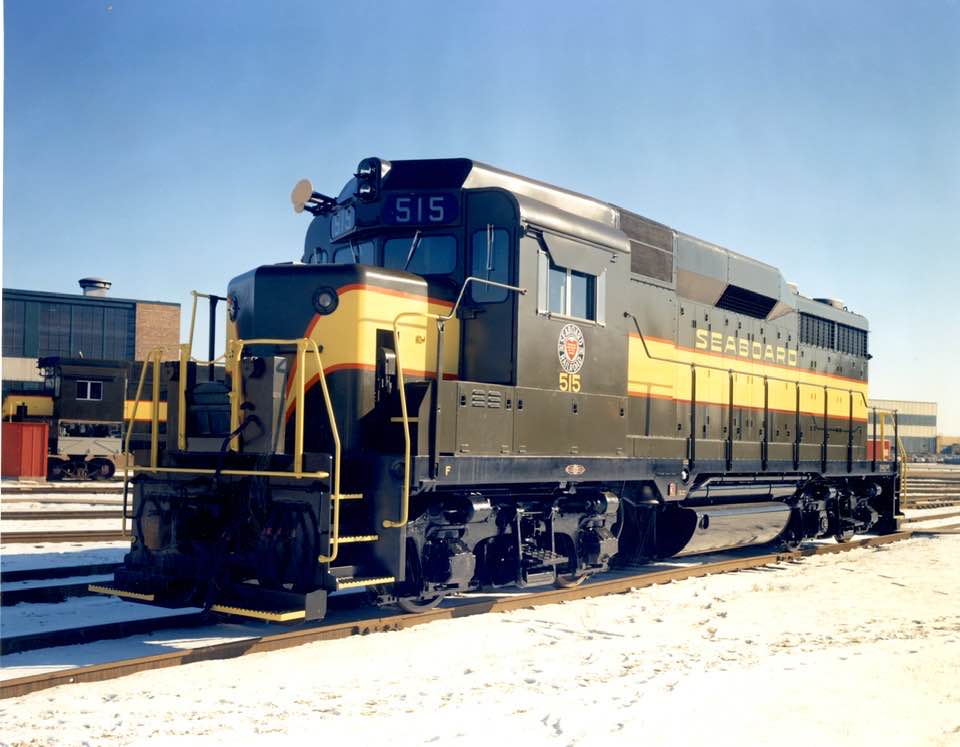 An EMD photo featuring new Seaboard Air Line GP30 #515 in December, 1962. Warren Calloway photo.
Data Sheet
| Entered Production | 7/1961 (Demonstrator #5629/#1962) |
| Years Produced | 7/1961 - 11/1963 (7/1963 for GP30B) |
| Engine | 567D3 |
| Engine Builder | GM |
| Horsepower | 2250 |
| RPM | 900 |
| Cylinders | 16 |
| Length | 56' 2" |
| Height (Top Of Rail To Top Of Cab) | 15' 0" |
| Width | 10' 2 ½" |
| Weight | 260,000 Lbs |
| Fuel Capacity | 1700 Gallons |
| Air Compressor | Gardner-Denver |
| Air Compressor Model | WBO |
| Air Brake Manufacturer | Westinghouse |
| Air Brake Schedule | 24L |
| Trucks | B-B |
| Truck Type | Blomberg |
| Truck Wheelbase | 9' |
| Wheel Size | 40" |
| Traction Motors | D57 (4), GM |
| Primary Generator | D22, GM |
| Auxiliary Generator | Delco (64-72) |
| Alternator | D14 |
| MU (Multiple-Unit) | Yes |
| Dynamic Brakes | Yes |
| Gear Ratio | 62:15 |
| Tractive Effort (Starting) | 60,500 Lbs at 25% |
| Tractive Effort (Continuous) | 50,000 Lbs at 9.3 mph |
| Top Speed | 65 mph |
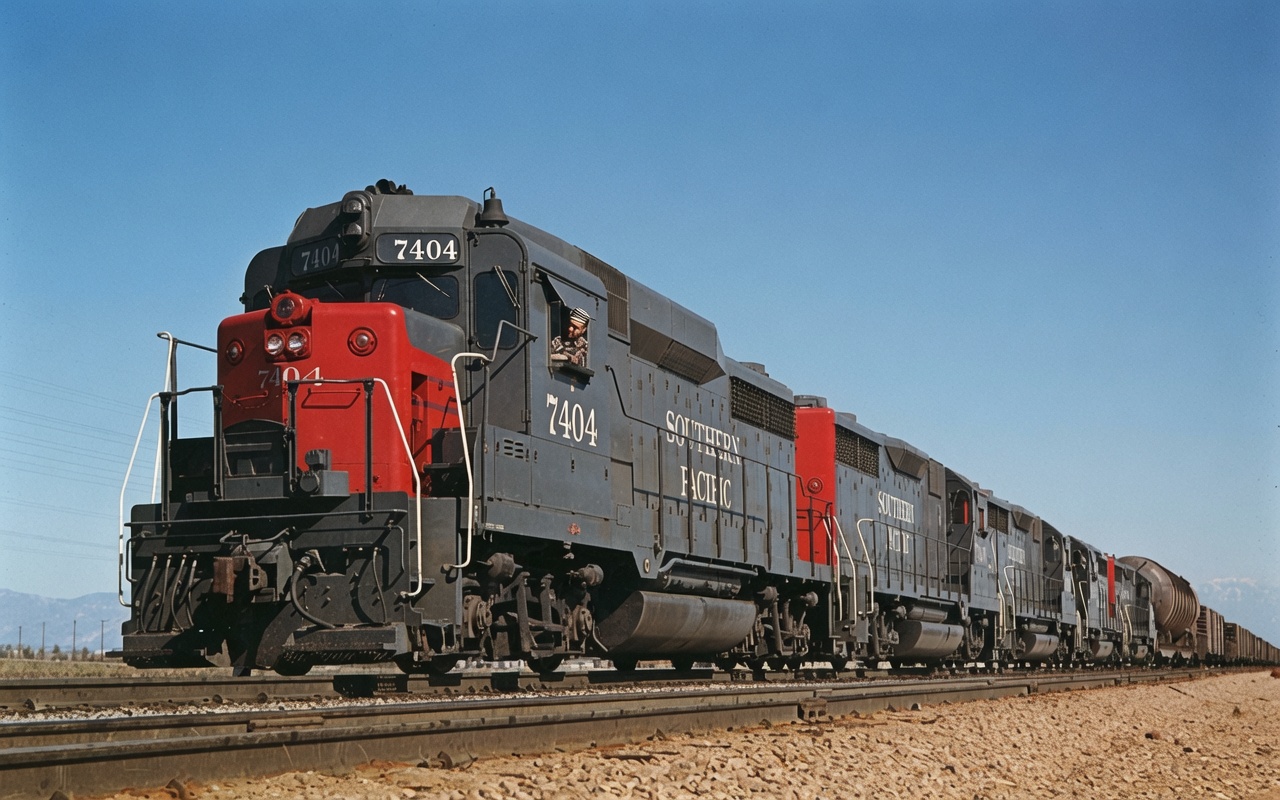 In this Southern Pacific publicity photo several Geeps, led by GP30 #7404 with a quartet of GP35's trailing, are ahead of a westbound freight near Los Angeles in 1963.
Production Roster
Total Built = 948
| Owner | Road Number(s) | Serial Number(s) | Order Number | Completion Date |
|---|---|---|---|---|
| Electro-Motive (Demonstrator) | 5629 (became Union Pacific #875) | 26613 | 5629 | 7/1961 |
| Reading | 5513-5514, 5520, 5503, 5507, 5505, 5508, 5506, 5501-5502, 5509-5510, 5519, 5504, 5515-5516, 5511-5512, 5517-5518 | 27114-27133 | 7617 | 3/1962-7/1962 |
| Denver & Rio Grande Western | 3001-3010 | 27135-27144 | 7619 | 4/1962-5/1962 |
| Chicago, Burlington & Quincy | 940-969 | 27151-27180 | 7621 | 4/1962-6/1962 |
| Santa Fe | 1200-1234 | 27187-27221 | 7622 | 4/1962-6/1962 |
| Denver & Rio Grande Western | 3011-3013 | 27222-27224 | 7619 | 5/1962 |
| Southern | 2525-2556 | 27313-27344 | 5636 | 8/1962-9/1962 |
| Norfolk & Western | 522-558 | 27355-27391 | 5637 | 6/1962-8/1962 |
| Norfolk & Western | 560-565 | 27393-27398 | 5637 | 8/1962-9/1962 |
| Louisville & Nashville | 1000-1028 | 27399-27427 | 7626 | 7/1962-12/1962 |
| Southern | 2557-2584 | 27428-27455 | 5636 | 9/1961-11/1962 |
| Electro-Motive (Demonstrator) | 5639 (became Seaboard Air Line #534) | 27462 | 5639 | 3/1962 |
| Phelps Dodge Corporation | 24 (New Cornelia Branch Mine) | 27466 | 5641 | 9/1962 |
| Union Pacific | 800-874 | 27509-27583 | 5643 | 7/1962-10/1962 |
| Chesapeake & Ohio | 3002-3015 | 27584-27597 | 7627 | 12/1962-1/1963 |
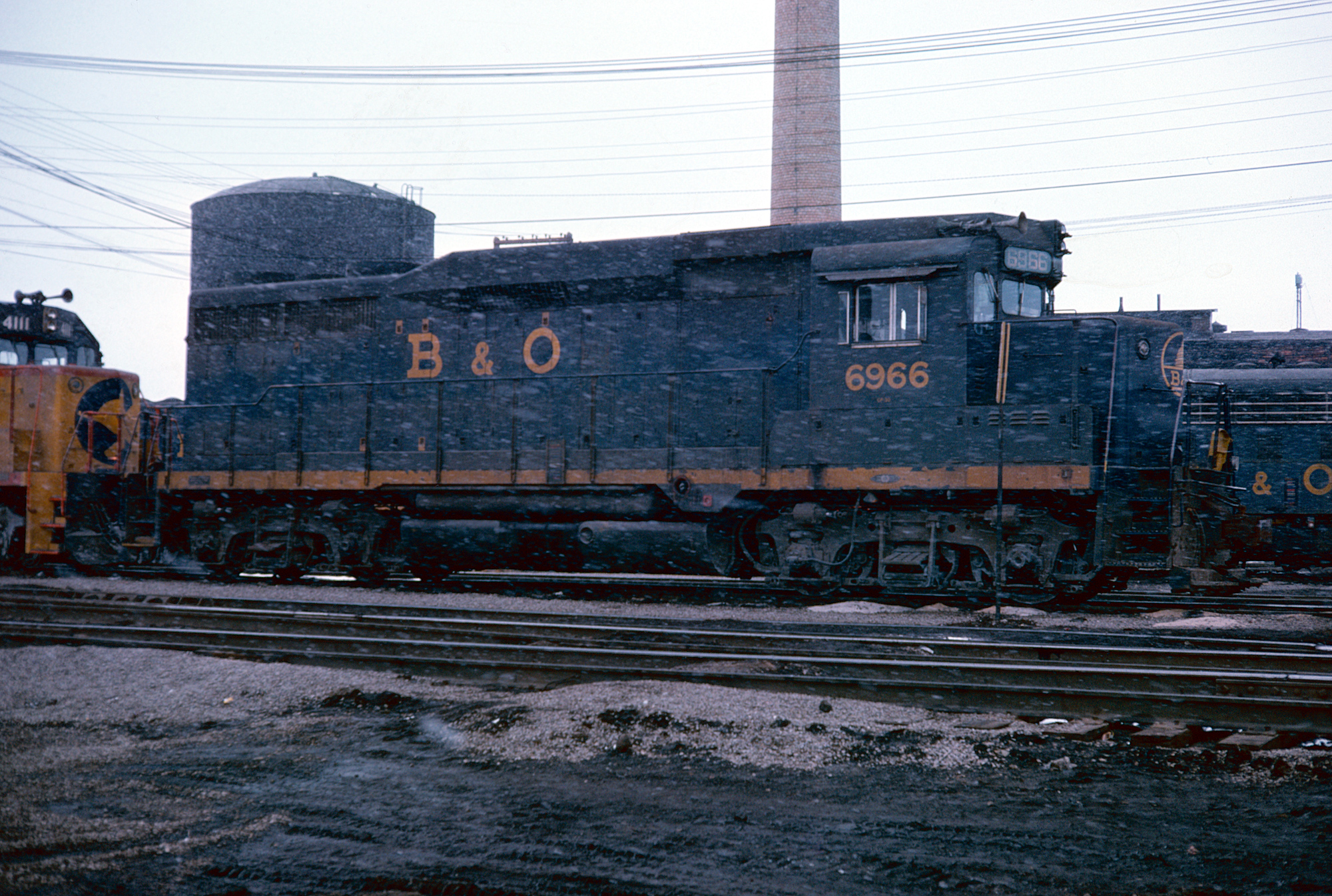
| Baltimore & Ohio | 6900-6927 | 27617-27644 | 7628 | 10/1962-11/1962 |
| Baltimore & Ohio | 6928-6976 | 27645-27693 | 7631 | 11/1962-1/1963 |
| Phelps Dodge Corp | 25-32 (New Cornelia Branch Mine) | 27728-27735 | 5654 | 6/1963 |
| Milwaukee Road | 340-355 | 27736-27751 | 7656 | 5/1963, 7/1963 |
| Louisville & Nashville | 1029-1048 | 27752-27771 | 7657 | 5/1963-9/1963 |
| Kansas City Southern | 100-109 | 27788-27797 | 5635 | 5/1962 |
| Chesapeake & Ohio | 3000-3001 | 27798-27799 | 7632 | 8/1962, 10/1962 |
| New York, Chicago & St Louis (Nickel Plate Road) | 900-909 | 27894-27903 | 5647 | 11/1962 |
| Gulf, Mobile & Ohio | 500-516 | 27904-27920 | 7635 | 12/1962-4/1963 |
| Gulf, Mobile & Ohio | 517-519 | 27925-27927 | 7635 | 5/1963 |
| Seaboard Air Line | 500-509 | 27928-27937 | 5648 | 11/1962 |
| Seaboard Air Line | 510-533 | 27938-27961 | 7636 | 12/1962-1/1963 |
| Norfolk & Western | 559 | 27978 | 5637 | 8/1962 |
| New York Central | 6115-6124 | 27979-27988 | 7624 | 8/1962 |
| Atlantic Coast Line | 900-907 | 27989-27996 | 7637 | 1/1963 |
| Atlantic Coast Line | 908 | 27997 | 7647 | 1/1963 |
| Denver & Rio Grande Western | 3014-3028 | 28043-28057 | 7640 | 1/1963-2/1963 |
| Santa Fe | 1235-1284 | 28058-28107 | 7642 | 1/1963-6/1963 |
| Pennsylvania | 2200-2251 | 28108-28159 | 7643 | 2/1963-5/1963 |
| Union Pacific | 700-709 | 28160-28169 | 7648 | 2/1963 |
| Alaska Railroad | 2000 | 28171 | 7645 | 3/1963 |
| St. Louis Southwestern Railway (Cotton Belt) | 750-759 | 28172-28181 | 5650 | 2/1963 |
| Southern Pacific | 7400-7407 | 28182-28189 | 7646 | 3/1963 |
| Union Pacific | 710-734 | 28190-28214 | 7648 | 2/1963-3/1963 |
| Great Northern | 3000-3016 | 28261-28277 | 7650 | 4/1963-5/1963 |
| Chicago, Burlington & Quincy | 970-977 | 28292-28299 | 7652 | 4/1963-9/1963 |
| Chicago & North Western | 810-823 | 28304-28317 | 7653 | 4/1963 |
| Soo Line | 701-721 | 28321-28341 | 7654 | 3/1963-6/1963 |
| Soo Line | 700 | 28342 | 7655 | 3/1963 |
| Chicago & Eastern Illinois | 239-241 | 28345-28347 | 7658 | 6/1963 |
| Union Pacific | 735 | 28351 | 7648 | 6/1963 |
| Kansas City Southern | 110-119 | 28388-28397 | 7661 | 7/1963 |
| Chesapeake & Ohio | 3016-3017 | 28410-28411 | 7663 | 8/1963 |
| Gulf, Mobile & Ohio | 520-530 | 28422-28432 | 7666 | 8/1963-9/1963 |
| Chesapeake & Ohio | 3018-3043 | 28494-28519 | 7663 | 8/1963-10/1963 |
| Chesapeake & Ohio | 3044-3045 | 28520-28521 | 7682 | 10/1963 |
| Chesapeake & Ohio | 3046-3047 | 28522-28523 | 7683 | 10/1963 |
| Chicago Great Western | 201-208 | 28526-28533 | 7679 | 8/1963-9/1963 |
| Toledo, Peoria & Western | 700 | 28534 | 7680 | 9/1963 |
| Southern | 2585-2614, 2635-2639, 2630-2634, 2640-2644, 2615-2629 | 28555-28614 | 7669 | 9/1963-11/1963 |
| Louisville & Nashville | 1049-1057 | 28645-28653 | 7687 | 10/1963-11/1963 |
GP30B
| Owner | Road Number(s) | Serial Number(s) | Order Number | Completion Date |
|---|---|---|---|---|
| Union Pacific | 700B-726B | 28215-28241 | 7651 | 4/1963-6/1963 |
| Union Pacific | 727B-739B | 28242-28254 | 7649 | 6/1963-7/1963 |
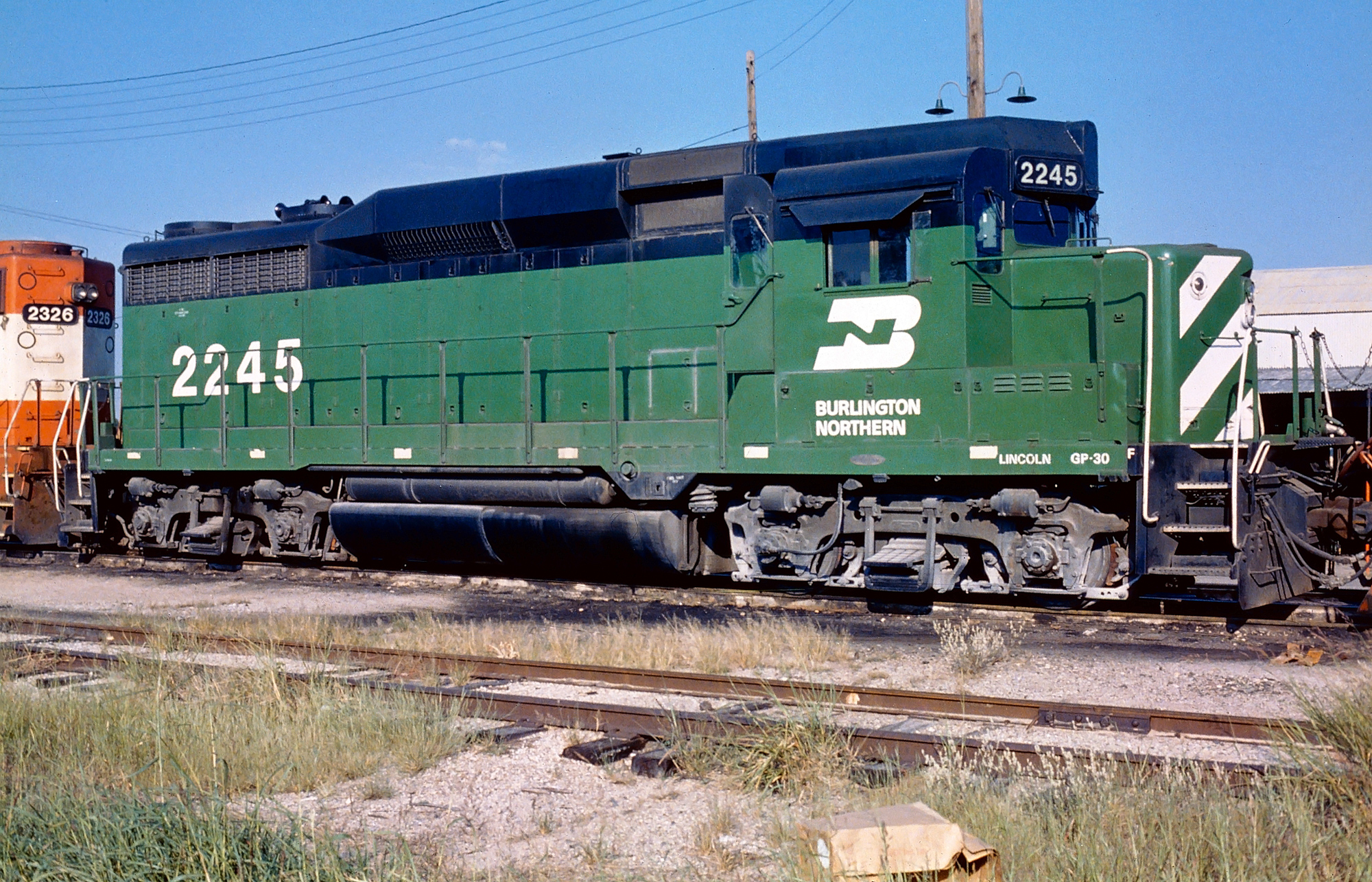 Burlington Northern GP30 #2245, circa 1983. This unit was built as Chicago, Burlington & Quincy #968 in July, 1962. She was later retired in June, 1986. Mike Bledsoe photo. American-Rails.com collection.
In all, a total of 948 were built during a three-year production run that lasted from 1961-1963. In July, 1963 EMD released the more powerful GP35, a 2,500 horsepower road-switcher which offered the same output as GE's U25B.
This locomotive, which dropped the roofline bulge, was the last four-axle design to sport the 567 prime mover and carried the now-classic second-generation appearance of EMD road-switchers for the next 30 years, including the Spartan Cab.
It was even more successful than its predecessor, selling more than 1,300 examples and easily outpacing similar cataloged models offered from GE and Alco.
Sources
- Pinkepank, Jerry A. Diesel Spotter's Guide. Milwaukee: Kalmbach Publishing Company, 1967.
- Foster, Gerald. A Field Guide To Trains. New York: Houghton Mifflin, 1996.
- Marre, Louis A. Diesel Locomotives: The First 50 Years, A Guide To Diesels Built Before 1972. Milwaukee: Kalmbach Publishing Company, 1995.
- Schafer, Mike. Vintage Diesel Locomotives. Osceola: MBI Publishing, 1998.
- Solomon, Brian. EMD Locomotives. Minneapolis: MBI Publishing Company, 2006.
- Solomon, Brian. GE and EMD Locomotives: The Illustrated History. Minneapolis: Voyageur Press, 2014.
Recent Articles


-
Detroit & Toledo Shore Line Railroad: Map, Roster, History
Sep 18, 26 12:32 AM
 Detroit & Toledo Shore Line—Pleasant Bay 1898, named 1899, Detroit–Toledo freight bridge, GTW and Clover Leaf/NKP/N&W. Merged into Grand Trunk Western June 26, 1981.
 -
Lackawanna Steam Locomotives: History, Roster & Photos
Sep 18, 26 12:17 AM
 Delaware, Lackawanna & Western steam—Camelback 2-8-0s, Mikados, freight Pacifics, Poconos 4-8-4s, Hudsons. Post-1900 roster after Drury. Last steam July 13, 1953.
 -
Lackawanna (DL&W) Diesel Roster: All Time
Sep 18, 26 12:11 AM
 Delaware, Lackawanna & Western diesel—boxcabs 1926, EMC SC 425–426 1935, FTs 1945, F3/F7/E8, GP7s, RS-3s, FM Train Masters. All-time roster. Last steam 1953.
 -
Lackawanna Railroad: Map, History, Viaducts, Rosters
Sep 18, 26 12:04 AM
 TDelaware, Lackawanna & Western—Liggett’s Gap 1832, named March 11 1853, Hoboken–Buffalo, anthracite, Phoebe Snow, Cutoff and Tunkhannock. It merged with the Erie to form Erie Lackawanna on Octobe…
 -
Rail News, The Latest
Sep 17, 26 11:56 PM
This page provides a portal to the latest in rail news, from preservation and restortation subjects to other notable topics. -
Union Pacific Big Boy 4014 Sets First Holiday Tour for Make-A-Wish
Sep 17, 26 11:54 PM
 Union Pacific Big Boy 4014’s first holiday tour: Cheyenne–Denver tickets, Nov. 21 Denver-area display, Make-A-Wish. Museum patrons Oct. 16; public Oct. 19.
 -
Conrail Diesel Roster (All Time)
Sep 17, 26 10:27 PM
 Conrail diesel—~5,000 inherited 1976, Big Blue, GP15-1s, SD40-2s, SD50s, Dash-8s, SD60/60M/60I, SD80MACs. All-time CR-number roster.
 -
Chessie System (Railroad): The C&O, B&O, And WM
Sep 17, 26 09:38 PM
 Chessie System, Inc.—C&O, B&O, and Western Maryland. Kitten-C paint 1972, holding company February 26 1973, CSX November 1 1980, C&O into CSXT August 31 1987.
 -
Chesapeake & Ohio (C&O) Diesel Roster: All-Time
Sep 17, 26 06:01 PM
 Chesapeake & Ohio diesel—late steam, no Fairbanks-Morse, E7s 1946, GP7/GP9 flood, F7s, GP40-2s, B30-7s, SD50s 1984–85. All-time roster. Steam ended 1956.
 -
Chesapeake & Ohio (C&O) Steam Roster: Post-1900
Sep 17, 26 03:18 PM
 Chesapeake & Ohio steam—H-8 Alleghenies, K-4 Kanawhas, T-1 Texas, Greenbriers, H-6 1949 Mallets. Post-1900 class roster including Pere Marquette and Hocking Valley. Last steam 1956.
 -
Chesapeake and Ohio Railway: Map, Logo, History
Sep 17, 26 02:36 PM
 Chesapeake & Ohio Railway—Louisa Railroad 1836, named August 31 1868, Ohio River 1873. Coal, Chessie the kitten, Pere Marquette 1947, B&O control 1963, into CSX August 31 1987. Complete corporate…
 -
TVRM Valentine Train Ride (2026)
Sep 17, 26 02:31 PM
 2026 TVRM Valentine Train Ride in Chattanooga—Feb. 6–15, plated dinner, Grand Junction Depot. Confirm on tvrail.com.
 -
River Fox Train Dining (2026)
Sep 17, 26 02:29 PM
 2026 River Fox Train in West Sacramento—Brunch Train and Murder Mystery dinner. 18095 County Road 117. Confirm on riverfoxtrain.com.
 -
Weehawken Terminal, Serving The West Shore Railroad
Sep 17, 26 01:38 PM
 Weehawken Terminal—West Shore / New York Central Hudson waterfront station, opened 1884. Five ferry slips, sixteen tracks, Weehawken Tunnel 4,014 feet. Last ferry March 25, 1959. Port Imperial and HBL…
 -
West Shore Railroad: Map, History, Timetables
Sep 17, 26 01:32 PM
 West Shore Railroad—New York, West Shore & Buffalo 1880–83, Weehawken to Buffalo. PRR-backed rival to the Central. Morgan settlement, 475-year NYC lease January 1 1886. CSX River Sub today.
 -
Jersey Central Diesel Locomotives: History, Roster & Photos
Sep 17, 26 01:20 PM
 Central Railroad of New Jersey diesel—boxcab 1000, Baldwin double-enders, F3s, Train Masters, SD35s, GP40Ps. All-time roster. Steam ended July 1, 1954.
 -
Jersey Central Steam Locomotives: History, Roster & Photos
Sep 17, 26 01:17 PM
 Central Railroad of New Jersey steam—Camelback Ten-Wheelers, USRA Mikados, G-class Pacifics, suburban tanks. Post-1900 class roster after Drury. Dieselized July 1, 1954.
 -
Jersey Central Railroad (CNJ): Map, Rosters, History
Sep 17, 26 01:14 PM
 Central Railroad of New Jersey—Elizabethtown & Somerville 1831, named April 23 1849. Communipaw, anthracite, Blue Comet, Reading/B&O control. Conrail April 1 1976. Complete corporate history.
 -
Central Vermont Diesel Locomotives: History, Roster & Photos
Sep 17, 26 11:35 AM
 Central Vermont diesel—Alco S-2s 1942, RS-3s, RS-11s from DW&P, EMD GP9s 1956–57, GP38ACs 1971. All-time roster. Last steam April 4, 1957.
 -
Central Vermont Steam Locomotives: History, Roster & Photos
Sep 17, 26 11:19 AM
 Central Vermont steam—ten Alco 2-10-4s of 1928, four U-1-a Mountains, Consolidations. Post-1900 class roster after Drury. Last steam April 4, 1957.
 -
Central Vermont Railway: Map, Logo, Rosters
Sep 17, 26 11:03 AM
 Central Vermont Railway—Vermont Central charter October 1843, Bethel–White River Junction June 26, 1848. Grand Trunk 1898, CN 1923, RailTex/NECR 1995. Complete corporate history.
 -
Fitchburg Railroad: Map, History, Timetables
Sep 17, 26 10:40 AM
 Fitchburg Railroad—chartered March 3, 1842, Boston–Fitchburg March 5, 1845. Alvah Crocker, Hoosac west door, Vermont & Massachusetts, Cheshire. B&M 99-year lease July 1, 1900. Complete corpora…
 -
Steam Railroading Institute Dining (2026)
Sep 17, 26 10:30 AM
 2026 SRI Owosso dining—vintage dining cars, select evenings. 2026 dinner calendar not posted; 2025 Up In Smoke is the recent example. Confirm on michigansteamtrain.com.
 -
Canadian Pacific Railway: Map, History, Logo, Photos
Sep 17, 26 12:06 AM
 Canadian Pacific Railway—incorporated February 16, 1881. Last spike Craigellachie November 7, 1885. Soo, Milwaukee, D&H, DM&E. CPKC April 14, 2023. Complete corporate history.
 -
Canadian Pacific Diesel Locomotives: History, Roster & Photos
Sep 17, 26 12:03 AM
 Canadian Pacific diesel—E8A 1800 in 1949, FP7/FP9, FA-2, C424, SD40-2, SD40-2F Red Barns, AC4400CW, ES44AC, SD30C-ECO, SD70ACu heritage. All-time roster. Last steam November 6, 1960.
 -
Canadian Pacific Steam Locomotives: History, Roster & Photos
Sep 16, 26 11:35 PM
 Canadian Pacific steam—3,257 engines 1881–1949. D10 Ten-Wheelers, G3 Pacifics, Royal Hudsons, Selkirk 2-10-4s. Post-1900 class roster after Drury. Last steam November 6, 1960.
 -
Woodstown Central Dining in Motion (2026)
Sep 16, 26 11:31 PM
 2026 Woodstown Central Dining in Motion—Salem County table car, 50–60 minutes, private table of four from $190. Confirm on woodstowncentral.com.
 -
NCTM Wine & Dine on the Rails (2026)
Sep 16, 26 11:28 PM
 2026 NCTM Wine & Dine on the Rails in Spencer—Feb. 13–15, three-course dinner, 21+, $145/$140. Sold out. Confirm next season on nctransportationmuseum.org.
 -
Southern Railway 4-6-2 1380: The Streamlined Ps-4
Sep 16, 26 10:34 PM
 Southern Railway Ps-4 4-6-2 1380—Alco 1923, serial 64857. Otto Kuhler streamlining at Spencer 1940–41 for the Tennessean. Only streamlined steam locomotive on the Southern. Scrapped Baltimore 1953.
 -
Texas Mexican Railway: Serving The Border Since The 1880s
Sep 16, 26 09:58 PM
 Texas Mexican Railway—Corpus Christi, San Diego & Rio Grande March 1875, 3-foot. Tex-Mex June 1881, Laredo Sept 1881, Rio Grande bridge 1883. Standard gauge July 17 1902. Mexican government 1900–1…
 -
Mount Hood Railroad Dining (2026): No Plated Dinner Train This Season
Sep 16, 26 09:53 PM
 2026 Mount Hood Railroad in Hood River is scenic Fruit Loop trains with snacks and sandwiches—not a plated dinner train. Confirm on mthoodrr.com.
 -
Peoria and Eastern Railway: Map, Timetables, History
Sep 16, 26 09:39 PM
 Peoria & Eastern—Danville, Urbana, Bloomington & Pekin 1866, IB&W 1869, OI&W 1887. Incorporated Feb 21 1890, Big Four next day. NYC 1930, Conrail 1976. GP7s 5612–5625. Complete corporate history.
 -
Boston and Maine Railroad: "Route Of The Minute Man"
Sep 16, 26 11:30 AM
 Boston & Maine—Andover & Wilmington 1833, NH charter June 27 1835. Eastern, Boston & Lowell, Fitchburg/Hoosac, Concord & Montreal. Section 77 March 12 1970. Guilford June 30 1983. CSX June 1 2…
 -
Smoky Valley Limited Dinner Train (2026)
Sep 16, 26 11:24 AM
 2026 Abilene & Smoky Valley Smoky Valley Limited—two-hour dinner from the 1887 Rock Island Depot. Kansas catering, ~$72–$110. Confirm on asvrr.org.
 -
Canadian National Diesel Locomotives: History, Roster & Photos
Sep 16, 26 11:14 AM
 Canadian National diesel—CLC boxcabs 1929, GMD FP9 and GP9, MLW FPA-4 and RS-18, GMD1, wide-cab SD40-2W, Dash-9s, ES44AC and ET44AC. All-time roster.
 -
Canadian National Steam Locomotives: History, Roster & Photos
Sep 16, 26 10:07 AM
 Canadian National steam—CGR, Canadian Northern, Grand Trunk, GTP. 4-8-4 Confederations, U-1 Mountains, J and K Pacifics. Post-1900 class roster. Last scheduled steam April 25, 1960.
 -
Canadian National Railway: Map, Logo, History, Photos
Sep 16, 26 08:55 AM
 Canadian National—name Dec 20 1918, incorporated June 6 1919, Grand Trunk Jan 20 1923. Crown corporation, IPO Nov 17 1995. IC, Wisconsin Central, BC Rail, EJ&E. Class I, mark CN.
 -
Buffalo, Rochester and Pittsburgh Railway: "Safety and Service"
Sep 16, 26 12:12 AM
 Buffalo, Rochester & Pittsburgh—Rochester & State Line 1869, BR&P March 12 1887. Pennsylvania coal to Buffalo and Rochester. B&O January 1 1932. All-time steam roster, LL 2-6-6-2s, XX…
 -
Buffalo Creek & Gauley Railroad: Map, Roster, Logo, Photos
Sep 15, 26 11:55 PM
 Buffalo Creek & Gauley—Elk River Coal & Lumber, April 1 1904, Dundon–Widen. Last all-steam WV coal road, February 27 1965. All-time steam roster, #4 Baldwin 59472, Majestic and Elk River diesels…
 -
Buffalo and Susquehanna Railroad: Map & History
Sep 15, 26 11:42 PM
 Buffalo & Susquehanna—Goodyear hemlock railroad, Sinnemahoning Valley December 14 1885, 1893 merger, coal to Sagamore, Buffalo extension, bankruptcy May 6 1910, B&O 1932, WAG 1956.
 -
WMSR Allegheny Mountain Dinner Train (2026): Dates & Tickets
Sep 15, 26 11:36 PM
 2026 Western Maryland Scenic Allegheny Mountain Dinner Train—Cumberland, 3 hours, 21+, Saturday 7 p.m. Confirm on wmsr.com.
 -
Boston and Albany Railroad: Map & History
Sep 15, 26 11:28 PM
 Boston & Albany Railroad—Boston & Worcester June 23 1831, Western Railroad across the Berkshires, merger 1867–70. NYC 99-year lease July 1 1900. Berkshires, New England States, CSX and MBTA today.
 -
Grand Bellevue Dinner Train (2026): Portsmouth, Rhode Island
Sep 15, 26 11:14 PM
2026 Grand Bellevue Rail Dining in Portsmouth, RI—2.5-hour seated dinner on Narragansett Bay. Fall/winter TBA after Aug. 29. Confirm on thegrandbell.com. -
The "John Bull": The C&A's First Locomotive (1831)
Sep 15, 26 11:01 PM
 John Bull locomotive—Stephenson Planet-type 0-4-0, 1831. Dripps assembly, 4-2-0 rebuild, cowcatcher. Specs, Camden & Amboy career, Smithsonian 1884, 1981 steam-up, 1939 replica.
 -
Napa Valley Wine Train Dining (2026): Lunch, Dinner & Vista Dome
Sep 15, 26 10:56 PM
 2026 Napa Valley Wine Train dining—downtown Napa, 36-mile round trip, gourmet lunch and dinner, Vista Dome. Confirm packages on winetrain.com.
 -
My Old Kentucky Dinner Train (2026): Dates, Tickets & What to Expect
Sep 15, 26 10:50 PM
 2026 My Old Kentucky Dinner Train in Bardstown—2.5 hours, 35-mile round trip, four-course dinner from $116. Confirm on kydinnertrain.com.
 -
LaSalle Street Station: One Of Chicago's Great Terminals
Sep 15, 26 10:42 PM
 LaSalle Street Station—Rock Island October 10, 1852. Frost & Granger July 1, 1903. 20th Century Limited, Rockets, Golden State. Headhouse razed 1981. Metra Rock Island District today.
 -
Charlie Russell Chew Choo (2026): Montana Dinner Train from Lewistown
Sep 15, 26 10:39 PM
 2026 Charlie Russell Chew Choo dinner train—Hanover/Lewistown, 4.5 hours, 56-mile round trip, prime rib. Adult $151. Remaining listed dates sold out. Confirm on montanadinnertrain.com.
 -
Central Pacific Railroad: Map, History, Facts, Logo
Sep 15, 26 10:30 PM
 Central Pacific—Judah, Big Four, June 28 1861. Sierra, Chinese labor, Donner Summit Tunnel. Ten-mile day April 28 1869. Promontory May 10. Southern Pacific lease April 1 1885. Dissolved June 30 1959…
 -
Bessemer & Lake Erie Railroad: "The Bessemer Road"
Sep 15, 26 05:20 PM
 Bessemer & Lake Erie—Bear Creek 1865, Carnegie 1897, U.S. Steel 1901. Ore south from Conneaut, coal north. 2-10-4s, Missabe sister road. CN May 10, 2004. Complete corporate history.