Minneapolis, Northfield and Southern Railway: Map, History, Rosters
Last revised: July 25, 2024
By: Adam Burns
The Minneapolis, Northfield and Southern Railway was the brainchild of successful livestock feed and mail/order businessman, Colonel Marion Wills Savage.
He envisioned an electrified interurban connecting the Twin Cities and Dubuque, Iowa with through service into Chicago and other Midwestern points.
Like so many traction schemes this one fell far short of its intended goal. What was originally known as the Minneapolis, St. Paul, Rochester & Dubuque Electric Company only made it about 40 miles out of Minneapolis before funding ran out.
Soon afterwards, Savage and his famous race horse, Dan Patch, passed away. The property subsequently failed and was renamed the Minneapolis, Northfield & Southern. New ownership realized its only chance for success was by transitioning into a belt line.
Throughout the 1920's freight continued to grow and was soon earning more than $1 million annually. The MN&S went quietly about its business for the next six decades until the merger movement finally brought change.
During the early 1980's it was acquired by the Soo Line as part of that road's attempt to expand across the Midwest. After this endeavor fell through the former MN&S lines were sold to new short line startups.
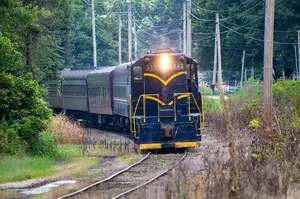
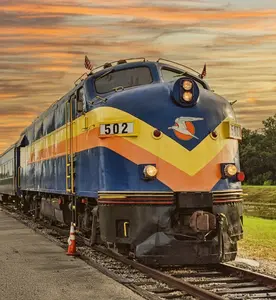
Today, most of its original network remains in operation under the Twin Cities & Western and Progressive Rail (this company continues sporting the MN&S's historic livery and logo).
Photos
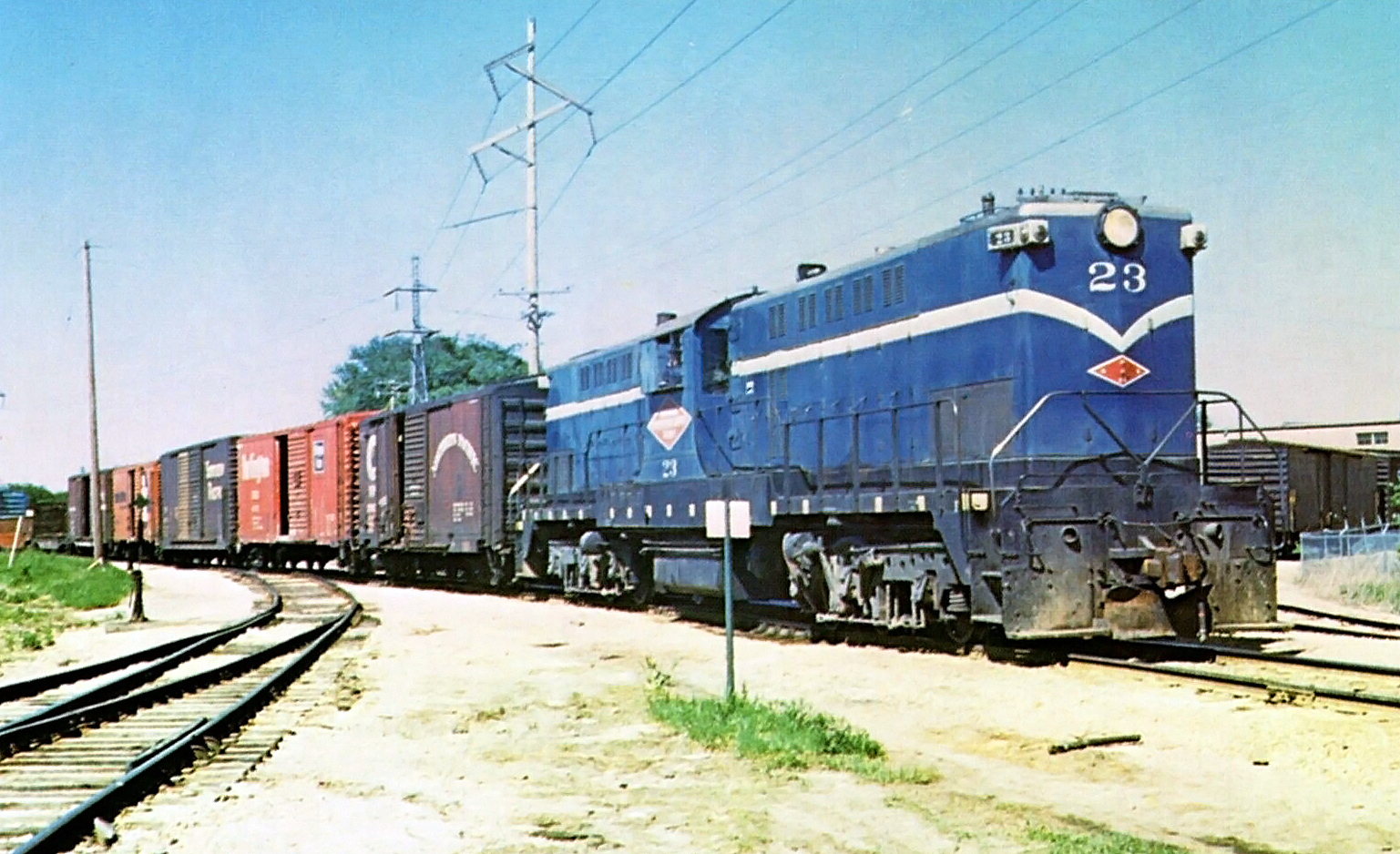 Minneapolis, Northfield & Southern DT-6-6-2000 #23 is seen here in service in Minneapolis on May 20, 1971. Bob Johnson photo.
History
In their excellent book, "The Electric Interurban Railways In America," authors and historians Dr. George Hilton and John Due point out how there were three great eras of interurban growth in the United States.
It all began during the 1890's and reached a fever pitch between 1901 and 1904 when more than 5,000 miles were laid down.
The Panic of 1903 briefly ended further expansion but construction reignited between 1905 and 1908 when another 4,000 miles were built. It was during this latter period that Marion Savage dreamed of his own electrified railroad.
At A Glance
Minneapolis - Gluek, Minnesota Minneapolis - Auto Club - Randolph St. Paul - Auto Club Northfield - Mankato | |
In an era just before Henry Ford's revolutionary Model T, the interurban was viewed as the future in transportation with reliable, efficient, and high-speed service between cities of all sizes.
The traction concept faced a daunting task even before the automobile as it tried to compete against the long-established steam railroads.
For some strange reason, many further handicapped themselves by connecting tiny countryside hamlets like Middlebourne, West Virginia and Montrose, Pennsylvania where such little development offered only a marginal chance for success.
In addition, few bothered developing carload freight traffic. As a result, many were abandoned during the 1920's.
Minnesota, Rochester & Dubuque Traction Company
The Dan Patch Line's origins begin just prior to Marion Savage's involvement when promoter W.P. Mason incorporated the Minnesota, Rochester & Dubuque Traction Company (MR&DT) on November 27, 1906.
His plan was to improve transportation within communities located south of the Twin Cities but here, again, no effort was made to garner any freight business.
A route was laid out to the Mississippi River heading in a southeasterly direction while passing through a predominantly rural region. It even missed Rochester, the largest city below Minneapolis/St. Paul, after the two parties failed to secure a franchise agreement through city streets.
Minneapolis, St. Paul, Rochester & Dubuque Electric Traction Company
Like Savage, Mason had ambitions for electrification and a right-of-way built to the highest standards. Unfortunately, he was unable to secure the needed financing. That changed during mid-April of 1907 when Savage became involved and reincorporated the MR&DT as the Minneapolis, St. Paul, Rochester & Dubuque Electric Traction Company (MStPR&DECT).
Never failing to advertise or market an opportunity, Savage immediately gave it the nickname "Dan Patch Air Line" (later shortened to "Dan Patch Line") after his celebrity racehorse which had never lost a race and carried multiple world racing records.
Logo
Savage's plans were similar to Mason's although the MStPR&DECT carried a slightly different route. Despite the enthusiasm, the idea was facing strong competition from the region's major steam railroads.
The Milwaukee Road, Chicago Great Western, and Chicago, Burlington & Quincy all served the same territory directly while the Rock Island was not far away. In addition, Chicago & North Western and Soo Line held a presence. Nevertheless, Marion pressed forward.
With an advertising prowess like a slick car salesmen, he regularly exaggerated his interurban's exploits, often overselling its success, completion date, and projected route. The first sign of trouble occurred with surveying as towns either squabbled over wanting service or refusing entry (Faribault).
Operation
Grading finally began in 1908 and according to the book, "The Minneapolis, Northfield & Southern Railway" by authors John Luecke and Paul Spyhalski, the first 12.38 miles from 54th Street (Minneapolis) to the community of Savage (named after the owner it featured his 750-acre stock farm) opened for regular service on July 5, 1910.
Since the MStPR&DECT was designed or passenger service it needed a direct entry into downtown Minneapolis if it hoped to procure the expected business. This was also a problem since its would-be connection, the Twin Cities Rapid Transit Company (TCRT), had no desire to work with the interurban.
To make matters worse, Minneapolis initially refused a franchise (later remedied). In the meantime, the Dan Patch Line continued southward and commenced regular service to Northfield (37 miles) on December 13, 1910.
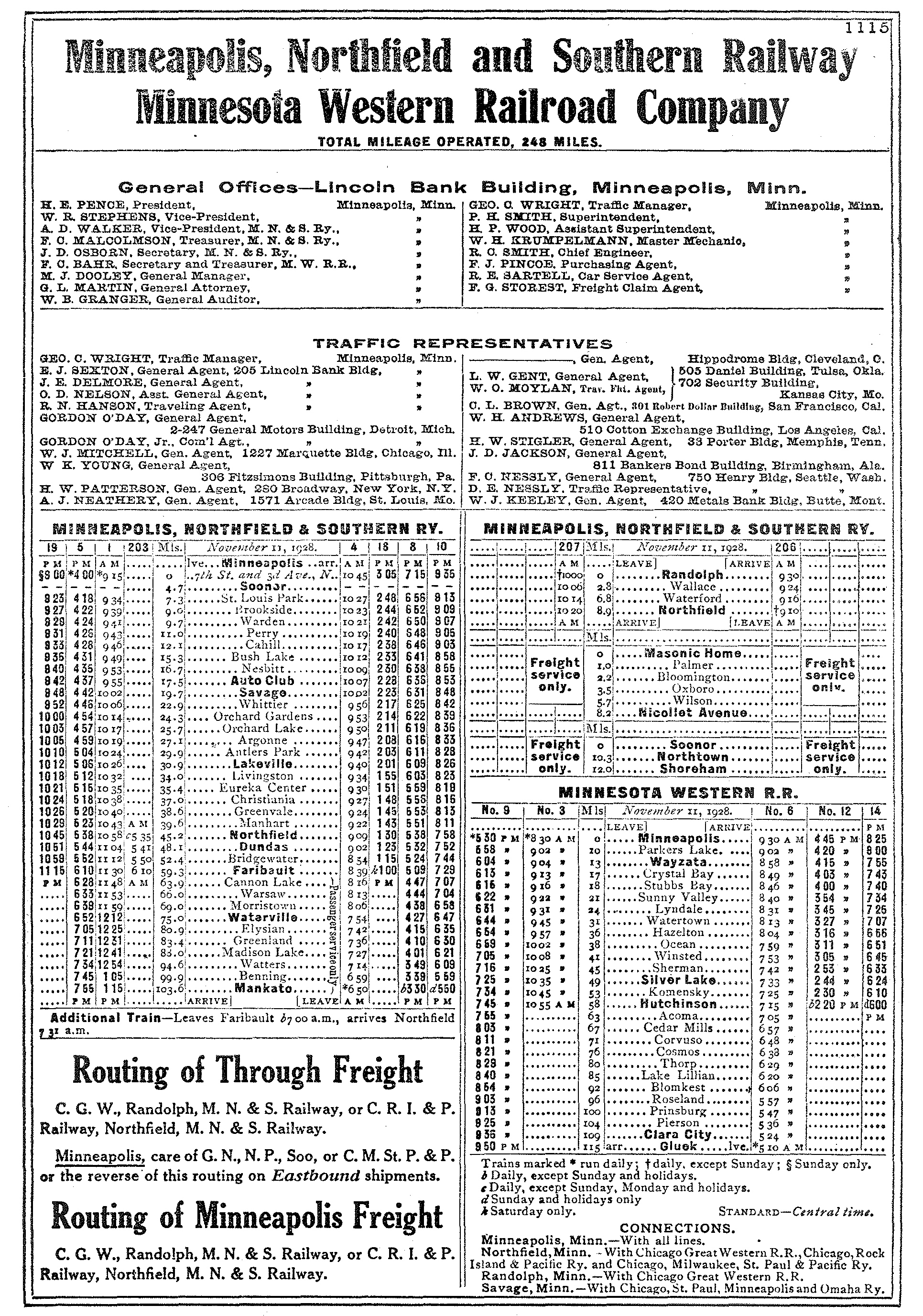
Timetables (1929)
Another issue was the matter of electrification; Savage had continually promised the road would be energized, even perusing potential sites for a small power plant. Ultimately, the idea was abandoned and the company settled on gas-electric rail cars manufactured by General Electric. While the MStPR&DECT encountered numerous early setbacks, operations did eventually improve.
An agreement was reached with the TCRT and, following construction of a small depot at 54th Street, through service was inaugurated to that point on March 1, 1911. A year later the Dan Patch discontinued its southern construction efforts entirely when work ceased on an extension to Faribault.
Instead, the road leased Chicago Great Western's Mankato Branch. This line was never particularly profitable but the CGW connection it offered at Northfield/Randolph proved very important as the carload freight business grew.
The "Dan Patch Line"
In an effort to increase ticket sales the Dan Patch followed in the footsteps of many other interurbans by building amusement parks and resorts. The most popular was Antlers Park situated along Lake Marion, not far from Savage.
It featured a beach, club house, dancing pavilion, aerial swing, and even a miniature railway all of which drew huge summer crowds. The road's first involvement with freight occurred on August 25, 1911 when it shipped 400 gallons of milk from the Crescent Creamery located in Northfield to Minneapolis.
This was followed a few years later by the purchase of a freight locomotive, delivered in July of 1913. It was the first gas-electric design ever built, a product of General Electric that featured a boxcab carbody with a massive center headlight.
The machine was about 40 feet in length utilizing a pair of engines producing (combined) 640 horsepower with a top-speed of 38 mph (reports state it was operated as high as 51 mph).
As historian Bill Middleton notes in his article, "The Strange, Successful Story Of The Railroad That Was Once Named For A Race Horse" from the June, 1959 issue of Trains Magazine, the employment of this new locomotive gave the Dan Patch Line claim as the very first railroad or interurban to operate exclusively with internal combustion power.
As the freight business took off, Savage further sought a downtown Minneapolis connection for improved interchange with the major Class I's.
System Map (1929)
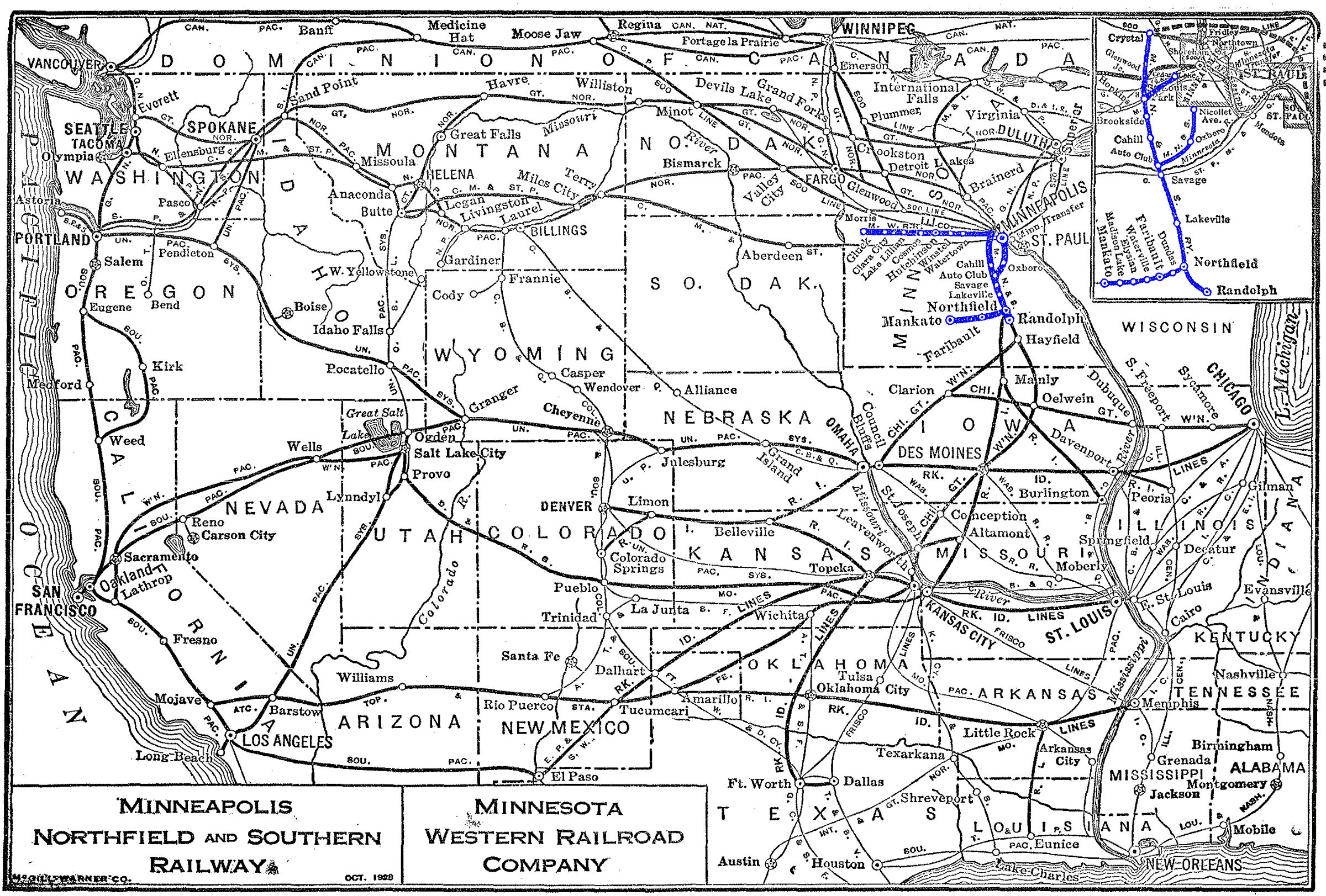
He was finally able to achieve this in 1914 when the Dan Patch Line opened a new terminal at 7th Street North, operated in junction with the 3-mile Electric Short Line Terminal Company (ESL for short, this system was formally merged into the Minneapolis, Northfield & Southern in 1956.).
It was all made possible by a connector built from Auto Club Junction (near Savage) to ESL's Luce Line Junction. In addition, a freight terminal was situated nearby (When the MStPR&DECT entered receivership it stopped using this facility, as well as the Chicago Great Western's Mankato Branch for a few years. After the M&NS's startup, service resumed to each.).
Unfortunately, the lack of a strong freight base, coupled with the expensive infrastructure projects, led the MStPR&DECT into receivership on July 20, 1916. This occurred just two weeks after a strange series of events resulted in the passing of both Marion Savage and his fabled race horse, Dan Patch, which died unexpectedly on July 11th.
 Minneapolis, Northfield & Southern H10-44s, led by #11, work freight service into Northfield, Minnesota on October 29, 1964. Rick Burn photo.
Minneapolis, Northfield & Southern Railway
After hearing the news, his owner passed just a day later. What followed was a brief but dramatic reorganization period when parties, particularly creditors, wanted the railroad liquidated to reclaim monetary losses. This effort was thwarted, in the end, which led to the property's reorganization as the Minneapolis, Northfield & Southern Railway in June of 1918.
Recognizing the only chance for long-term profitably lay in freight, new ownership wasted no time developing this business. In 1919 such carloads earned $79,000 while just a year later had jumped to $116,000. These numbers continued to climb while at the same time passenger service was cutback.
It gained true belt line status when a 6-mile extension opened in 1927 from Soonor, on the western outskirts of Minneapolis, to a connection with the Soo Line at Crystal. This included an additional 7 miles of Soo Line trackage rights to reach Shoreham Yard and an interchange with Northern Pacific's Northtown Yard.
With this half-million dollar project completed the MN&S now had seven interchanges opened with the primary carriers serving the Twin Cities region (Chicago & North Western, Rock Island, Chicago Great Western, Milwaukee Road, and Great Northern along with those previously-mentioned).
There was also an interchange with the Minnesota Western Railway, a small road with its own. It began as the Electric Short Line Railroad (ESLR) incorporated in August of 1908.
By 1927 it had opened just over 115 miles from Minneapolis to rural Gluek, Minnesota with intentions of pushing as far west as Brookings or Watertown, South Dakota (never completed). The lightly patronized ESLR was managed by the MN&S until its 1956 when it was sold to the Minneapolis & St. Louis and later abandoned.
In 1929 the Minneapolis, Northfield & Southern grossed over $1 million in revenue for the first time in its history and continued acquiring new locomotives (including steam) to meet growing demand. The onset of the Great Depression did witness traffic declines although the company withstood this period relatively well.
Some retrenchment took place as the depression settled in, notably dropping its lease of CGW's Mankato Branch on January 18, 1931.
This trackage had originally been built under the Rock Island (as the Wisconsin, Minnesota & Pacific) to extend its reach across the Upper Midwest, and perhaps even reach the Pacific coast, although that idea eventually fizzled.
For awhile it was leased by the Minneapolis & St. Louis as its "Cannon Valley Division" before finally behind sold to the CGW in 1899. The stub-end branch never saw much business and was later abandoned. The MN&S continued to thrive during, and after, World War II reaching a net operating revenue of $4.77 million by 1957.
During the diesel era it maintained an interesting fleet, owning a few Fairbanks-Morse models and even Baldwin's odd DT-6-6-2000 center-cab transfer switcher.
Minneapolis, St. Paul, Rochester & Dubuque Electric Traction Rosters
Railcars
| Road Number(s)/Name | Builder | Date Built/Notes |
|---|---|---|
| 1 (Ogerita) | Strang/Brill | 1906 |
| 2 (Irene) | Strang/Brill | 1908 (Strang Demonstrator) |
| 3 (Rosamond) | Strang/Brill | 1908 (Ex-Missouri & Kansas Interurban, Acquired 1911) |
| 4-7 | General Electric | 5/1911 - 7/1911 |
| 8-10 | General Electric | 3/1912 - 5/1912 |
| 11-12 | General Electric | 8/1913 |
| 13-14 | General Electric | 7/1915 - 8/1915 |
Steam Roster
| Road Numbers | Wheel Arrangement | Builder | Date Built/Notes |
|---|---|---|---|
| 200-202 | 2-6-0 | H.K. Porter | 1915 (New) |
Gas-Electric Locomotive Roster
| Road Numbers | Builder | Horsepower/Arrangement | Date Built |
|---|---|---|---|
| 100 | General Electric | 350 HP/B-B | 1913 |
| 101-103 | General Electric | 350 HP/B-B | 1915 |
 Minneapolis, Northfield & Southern's only H10-44, #11, already boarded up and awaiting its fate at the engine house in Glenwood Junction, Minnesota on July 5, 1975. Karl Miller photo.
Minneapolis, Northfield & Southern Rosters
Steam
| Road Numbers | Wheel Arrangement | Builder | Date Built/Notes |
|---|---|---|---|
| 1 | 2-6-0 | Baldwin | 1889 (Acquired 1918) |
| 100-101 | 2-6-0 | H.K. Porter | 1920 (New) |
| 143, 146 | 2-6-0 | Alco | 1907 (Ex-Soo, Acquired 1927) |
| 300-302 | 2-6-2 | Alco | 1906 (Ex-Northern Pacific, Acquired 1925) |
| 400-405 | 2-8-0 | Alco/Pittsburgh | 1905-1907 (Ex-Duluth, Missabe & Northern: Acquired 1927) |
| 500-506 | 2-10-0 | Alco/Brooks | 1917 (Ex-Detroit, Toledo & Ironton: Acquired 1932-1935) |
| 506 (2nd) | 2-10-0 | Baldwin | 1944 |
| 507 | 2-10-0 | Alco/Brooks | 1918 (Ex-Erie, Acquired 1945) |
Railcars
| Road Number | Builder | Date Built/Notes |
|---|---|---|
| 12 | General Electric | 1/1916 (Ex-Florida East Coast #200, Acquired 1921) |
| 13 | General Electric | 7/1915 (Ex-MStPR&DECT) |
| 14 | General Electric | 8/1915 (Ex-MStPR&DECT) |
| 15 | Strang/Brill | 7/1915 (Ex-MStPR&DECT, Irene) |
| 55 | Wason | 6/1912 (Ex-MStPR&DECT) |
| 59 | Wason | 4/1913 (Ex-MStPR&DECT) |
| A-1 (Railbus) | MStPR&DECT | 1918 (MStPR&DECT Shops) |
 Minneapolis, Northfield & Southern DT-6-6-2000 #23 in freight service near Northfield, Minnesota on August 31, 1962. Rick Burn photo.
Diesel
| Road Number | Manufacturer | Model Type | Date Built | Other Notes |
|---|---|---|---|---|
| 10 | Fairbanks-Morse | H12-44 | 1/51 | Preserved as C&NW #10. |
| 11 | Fairbanks-Morse | H10-44 | 9/46 | Scrapped. |
| 12 | Baldwin | VO-1000 | 9/44 | Scrapped. |
| 15 | Baldwin-Lima-Hamilton | DRS6-6-1500 | 3/50 | Scrapped. |
| 20-24 | Baldwin | DT-6-6-2000 | 12/48-1/49 | All scrapped except #21, donated to IRM. |
| 25 | Baldwin-Lima-Hamilton | RT-624 | 7/53 | Scrapped. |
| 30-35 | EMD | SW1200 | 9/62-5/65 | All in use. |
| 36-37 | EMD | SW1500 | 1/66 | Both in use. |
| 40-41 | EMD | SD39 | 10/68 | Both in use. |
| 60-61 | Baldwin | VO660 | 6/40-9/42 | Scrapped. |
Soo Line Merger
The Midwestern merger movement began with C&NW's acquisition of Minneapolis & St. Louis in 1960, followed by the Chicago Great Western in 1968. As the number of railroads shrank the MN&S realized its future was in doubt since over 70% of its 82,000 carloads in 1957, for instance, came via overhead/through business (interchange).
It did well until the CGW merger caused its car-loadings with that carrier to drop by half. As marriages (and bankruptcies) continued through the 1980's, Soo Line saw the MN&S as an important Twin Cities gateway to coincide with its larger plan of purchasing the former Rock Island's "Spine Line" between St. Paul and Kansas City. The Soo formally took control on June 2, 1982.
The company and its employees had always taken a great deal of pride in the property with spotless locomotives, well maintained rights-of-way, and very well-kept shops at Glenwood Junction. The Soo quickly razed this facility and removed the connecting yard.
Ironically, the MN&S ultimately became a useless appendage when the "Spine Line" sale fell through after rival C&NW was awarded the corridor in 1985.
No longer of any use the property was sold; in April of 1996 Twin Cities & Western took over the northern section above Savage while Progressive Rail purchased the segment south of Lakeville (the Savage - Lakeville section remains owned by Soo parent Canadian Pacific).
There is also talk of turning the route into a commuter rail line given the population growth of towns and suburbs within the greater Twin Cities region. How interesting to think that the entire corridor could come full circle and again carry passengers/commuters just as it did a century ago.
Recent Articles


-
West Side Lumber Company Railroad: Roster, History, Lines
Sep 30, 26 09:45 AM
 West Side Lumber at Tuolumne, California. Three-foot Shay and Heisler logging railroad. Lima shop numbers, builder specs, and where the engines are in 2026.
 -
Kansas Halloween Train Rides (2026)
Sep 30, 26 09:41 AM
 2026 Kansas Halloween train. Abilene & Smoky Valley Pumpkin Harvest Express, October 17 through 31. About one hour. Shop prices $35.56 to $41.02. Everyone picks a pumpkin.
 -
Iowa Halloween Train Rides (2026)
Sep 29, 26 11:58 PM
 2026 Iowa Halloween train. Boone & Scenic Valley Pumpkin Express, October 10, 10:00 a.m. from 225 10th Street. About 1 hour 15 minutes. Children pick a pumpkin.
 -
Arizona Halloween Train Rides (2026)
Sep 29, 26 11:43 PM
 2026 Arizona Halloween train. Grand Canyon Railway Pumpkin Patch Train from Williams, $39 with a pumpkin included. Select October dates on the ticket calendar. Haunted train cars are optional.
 -
Nevada Northern Halloween Trains (2026)
Sep 29, 26 06:18 PM
 Nevada Northern 2026 Halloween trains in Ely. Pumpkin Patch Caper to Keystone Gulch and the Haunted Ghost Train. Adult tickets start at $45. Dates are on the railroad’s calendar. Confirm on nnry.com.
 -
Grand Canyon Railway Pumpkin Patch Train (2026)
Sep 29, 26 02:42 PM
 Grand Canyon Railway Pumpkin Patch Train—select October 2026 dates from Williams, $39 with a pumpkin included. Haunted train cars are optional. Days are on the ticket calendar. Confirm on thetrain.com…
 -
Cass Scenic Railroad Halloween Trains (2026)
Sep 29, 26 02:37 PM
 Cass Scenic Halloween Trains—October 30 and 31, 2026, steam, 5:00 p.m. from Cass Depot. About two hours to Whittaker. Adult $75. Candy for every child. Confirm on mountainrailwv.com.
 -
Halloween Train Rides (2026): Pumpkin Patch, Haunted & Spooky Trips
Sep 29, 26 11:26 AM
 2026 Halloween train rides in nine checked states. Conway Scenic Halloween Express October 24–25. Strasburg’s three fall tickets. Great Smoky Mountains Railroad’s October trains are the gorge and rive…
 -
Maine Halloween Train Rides (2026)
Sep 29, 26 11:08 AM
 2026 Maine Halloween trains. Seashore Pumpkin Patch Trolley through October 18, adult $17. Happy Trolleyween October 23–25 at $15. WW&F Pumpkin Pickin’ October 3, 12, 17, and 24. Downeast’s booking it…
 -
Kentucky Halloween Train Rides (2026)
Sep 29, 26 10:58 AM
 2026 Kentucky Halloween trains. Kentucky Railway Museum Trick and Track Express, October 24 and 31, from $17. Bluegrass Scenic pumpkin trains in Versailles. Confirm on the ticket shop.
 -
Connecticut Halloween Train Rides (2026)
Sep 29, 26 10:26 AM
 2026 Connecticut Halloween trains. East Windsor Pumpkin Patch Fridays through Sundays, October 2–31. Naugatuck coach $20. Shore Line Pumpkin Patch on nine October days. Confirm on each site.
 -
Pennsylvania Halloween Train Rides (2026)
Sep 29, 26 09:45 AM
 2026 Pennsylvania Halloween trains—Everett October 3, 4, 10, and 17, Strasburg’s three fall shows, Oil Creek on October 24, plus Kutztown, Kempton, Honesdale, Middletown, and West Chester.
 -
New York Halloween Train Rides (2026)
Sep 29, 26 12:08 AM
2026 New York Halloween trains—Catskill Pumpkin Express October 17–18 and 24–25, Adirondack pumpkin and family trains, Arcade & Attica haunt, Cooperstown patch and trick-or-treat, Tupper Lake triv… -
North Carolina Halloween Train Rides (2026)
Sep 28, 26 11:56 PM
 2026 North Carolina Halloween trains—New Hope Valley Track or Treat on October 10, 17, 23, and 24, and Tweetsie Ghost Train Friday and Saturday nights through October 31. GSMR’s October menu is the go…
 -
Tweetsie Railroad Ghost Train Halloween Festival (2026)
Sep 28, 26 11:44 PM
 Tweetsie Ghost Train—Friday and Saturday nights September 25–October 31, 2026, in Blowing Rock. Adult $65, child $45. One reserved steam ride plus the park. Ages 8 and up for the haunt.
 -
Milwaukee Road Class A 4-4-2: Specs, Roster, History
Sep 28, 26 11:20 PM
 Milwaukee Road Class A Atlantics 1–4, Alco 1935–1937, for the Hiawatha. Order S-1740, 84-inch drivers, 19x28, 300 psi, 30,685 lb. Full builder specs, roster, and the May 15, 1935 run at 112.5 mph. All…
 -
Strasburg Rail Road Halloween Trains (2026)
Sep 28, 26 11:00 PM
 Strasburg’s 2026 Halloween tickets—Pumpkins in Paradise on October 3, The Haunting of Pumpkin Junction, and The Brakeman’s Curse through October 25. Three fares. Legacy of Sleepy Hollow is an earlier…
 -
GSMR Peanuts Pumpkin Train (2026): Not on This Year’s Ticket Menu
Sep 28, 26 10:50 PM
Great Smoky Mountains Railroad’s September 28, 2026 ticket menu lists Nantahala and Tuckasegee excursions. A Peanuts Great Pumpkin train is not on that menu. Polar Express is on the November calendar. -
New Jersey Halloween Train Rides (2026)
Sep 28, 26 06:45 PM
2026 New Jersey Halloween trains—Black River & Western to Everitt Farms through October 25, Delaware River Great Pumpkin through November 1, Whippany October 4, 10, and 11, Pine Creek night trains. -
New Hampshire Halloween Train Rides (2026)
Sep 28, 26 05:17 PM
 2026 New Hampshire Halloween train—Conway Scenic Halloween Express, October 24 and 25, about 1 hour from North Conway. Coach adult $30. Confirm on conwayscenic.com.
 -
Conway Scenic Pumpkin Patch Express (2026): Dates, Tickets & Tips
Sep 28, 26 05:09 PM
 Conway Scenic Halloween Express—October 24 and 25, 2026, about 1 hour from North Conway. Coach adult $30. A pumpkin after the ride while supplies last. Confirm on conwayscenic.com.
 -
Black River & Western Pumpkin Trains (2026): Dates, Tickets & Tips
Sep 28, 26 02:20 PM
 Suggested meta description: Black River & Western Pumpkin Train—Flemington to Everitt Farms, weekends September 26–October 25, 2026. Pumpkin patch, maze, and wagon rides. Confirm on blackriverrail…
 -
Scenic Dinner Train Rides (2026): A Complete Guide
Sep 28, 26 01:30 PM
 2026 scenic dinner trains by state—a seated meal on the train. Branson through October 30, Cincinnati Saturdays, Potomac Eagle, and the full state list. Confirm on the railroad.
 -
West Virginia Dinner Train Rides (2026): A Complete Guide
Sep 28, 26 11:58 AM
 2026 Potomac Eagle dining from Romney—about 3 hours in the Trough. Premium three courses $124. Superior four courses $159, ages 17 and older. Confirm on potomaceagle.com.
 -
Washington Dinner Train Rides (2026): A Complete Guide
Sep 28, 26 11:51 AM
 2026 Chehalis-Centralia dinner trains have run. The July 18 Roaring 20s dinner was $89. The planning calendar lists no later dinner. Confirm on steamtrainride.com.
 -
Texas Dinner Train Rides (2026): A Complete Guide
Sep 28, 26 11:27 AM
 2026 Texas has no plated dinner aboard the train. Grapevine sells snacks. The Texas State Railroad Dogwood lunch was served at the Rusk depot. Confirm on the railroad.
 -
Ohio Dinner Train Rides (2026): A Complete Guide
Sep 28, 26 10:15 AM
2026 Ohio dinner trains—Cincinnati Saturdays, $140, about 3 hours, ages 12 and up. Hocking Valley Elegant Dinner Train October 17 and November 7, from $95. -
Missouri Dinner Train Rides (2026): A Complete Guide
Sep 28, 26 10:09 AM
 2026 Branson Scenic Railway dinner train—three courses, about 2 hours, Fridays and Saturdays through October 30. Dome $123.50 plus tax. Confirm on bransontrain.com.
 -
Minnesota Dinner Train Rides (2026): A Complete Guide
Sep 28, 26 09:40 AM
 2026 North Shore Scenic Northwoods Dinner Train in Duluth—four courses in the SkyView dome, 2½ hours, $90, through September 26. Confirm on duluthtrains.com.
 -
Maine Dinner Train Rides (2026): A Complete Guide
Sep 28, 26 09:29 AM
 2026 Maine has no dining-car dinner. WW&F Pig Roast at SeaLyon Farm was June 13 and has run, $54.95. Sunset Express was a drink and ended September 5.
 -
Greenbrier, Cheat & Elk Railroad: Western Maryland's Logging Line
Sep 26, 26 11:59 PM
 Greenbrier, Cheat and Elk—the logging railroad the Western Maryland bought in 1927. Cass to Spruce, Summit Cut at 4,066.6 feet, Elk River Branch, Laurel Bank.
 -
Elkins (Western Maryland): Yard, History, Operations
Sep 26, 26 11:56 PM
 Western Maryland at Elkins—the Elkins Division yard, roundhouse, and wash rack. Belington, Durbin, Black Fork, and the Elk River branches met here.
 -
B&O's "Cincinnatian" (Train): Route, Consist, Timetable
Sep 26, 26 11:51 PM
 B&O Cincinnatian—Mount Clare five-car streamliner, January 19, 1947, trains 75 and 76. P-7d Pacifics 5301–5304. Detroit–Cincinnati from June 25, 1950, trains 53 and 54. Last run April 30, 1971.
 -
The Semaphore: Railroading's Classic Signal
Sep 26, 26 11:51 AM
 Railroad semaphore signals: blade and spectacle, lower quadrant and upper quadrant, US&S Style B and GRS Model 2A, Robinson’s track circuit, and the last blades on the Raton Subdivision.
 -
Black Fork Grade (Western Maryland): History and Operations
Sep 26, 26 11:47 AM
 Black Fork Grade—the Western Maryland climb through Blackwater Canyon. Thomas to Hendricks, past 3 percent, an H-9 and ten loads, helpers off at Fairfax.
 -
Western Maryland Steam Locomotives: History & Roster
Sep 26, 26 11:39 AM
 Western Maryland steam—H-9 Consolidations, I-2 Decapods, Lima 2-8-8-2s, Baldwin Challengers, and twelve Baldwin Potomac 4-8-4s. Post-1900 roster.
 -
Western Maryland Diesel Roster: All-Time
Sep 26, 26 11:32 AM
 Western Maryland diesels—S1 102 in 1941, fourteen F7 boosters, BL2s, hammerhead RS3s, Circus SD40s, and Chessie GP40-2s. Serials and order numbers.
 -
The Dutch Line (Western Maryland): History, Map, Operations
Sep 25, 26 09:38 PM
 Western Maryland Dutch Line—the Hanover Subdivision. Emory Grove to Highfield via Hanover and Gettysburg, York branch 1893, stone trains, and the route CSX still runs.
 -
The Durbin Branch (Western Maryland): History, Map, Operations
Sep 25, 26 09:13 PM
 Western Maryland Durbin Branch—the Coal & Iron Railway, 46.9 miles Elkins to Durbin, opened July 27, 1903. Mixed train until April 10, 1959. H-7B Consolidations.
 -
Western Maryland Railway: Map, Rosters, Logo, History
Sep 25, 26 10:24 AM
 Western Maryland Railway—the Fast Freight Line. Baltimore, Carroll & Frederick, May 27, 1852. Connellsville Extension 1912. Chessie, then into the B&O May 1, 1983.
 -
Illinois Dinner Train Rides (2026): A Complete Guide
Sep 25, 26 09:52 AM
2026 Monticello Railway Museum Murder Mystery Dinner Train—June 13, July 11, August 1, and September 5 have run. Three courses, about 2 hours, $112. Confirm on mrym.org. -
Georgia Dinner Train Rides (2026): A Complete Guide
Sep 25, 26 12:29 AM
 2026 Azalea Sprinter dinner train from Nashville and Willacoochee, Georgia—2½ hours. Club Car adult $147, Executive adult $177. Confirm on azaleasprinter.com.
 -
Baldwin "Centipede" Locomotives: Specs, Roster, Photos
Sep 25, 26 12:02 AM
 Baldwin DR-12-8-1500/2 Centipede—2-D+D-2, two 608SC engines, 3,000 hp. SAL 4500 from the 1943 test bed. 54 on the serial list, 52 sold. PRR BP60 then BH50. None preserved.
 -
Florida Dinner Train Rides (2026): A Complete Guide
Sep 24, 26 11:56 PM
 2026 Seminole Gulf Murder Mystery Dinner Train in Fort Myers—five courses cooked onboard, 3½ hours, $129 or $135 Saturday, plus tax and gratuity. Confirm on semgulf.com.
 -
West Virginia Northern Railroad: Map, Photos, History
Sep 24, 26 11:27 PM
 West Virginia Northern—Kingwood to Tunnelton, 11 miles of Preston County coal. Narrow gauge 1888, standard gauge 1895. Last freight February 19, 1991. Consolidations 8 and 9 survive.
 -
Rutland Railroad: Map, Rosters, History, Logo
Sep 24, 26 01:18 PM
Rutland Railroad—Follett’s Champlain & Connecticut River, November 1, 1843. Bellows Falls–Burlington December 18, 1849. Green Mountain Gateway. Last train September 25, 1961. Vermont Railway Janua… -
Arkansas Dinner Train Rides (2026): A Complete Guide
Sep 24, 26 01:12 PM
 2026 Eureka Springs & North Arkansas Dinner Train—Eurekan dining car, about 2 hours, $53.62 tax included, opens May 9, Tuesday, Wednesday, Friday, and Saturday. Confirm on esnarailway.com.
 -
Arizona Dinner Train Rides (2026): A Complete Guide
Sep 24, 26 01:01 PM
2026 Arizona has no plated dinner train. Grand Canyon Railway sells snacks in the cars and meals in Williams or at the rim. Verde Canyon includes a charcuterie tray. -
Rail News, The Latest
Sep 24, 26 12:36 PM
This page provides a portal to the latest in rail news, from preservation and restortation subjects to other notable topics. -
Cotton Belt 819 Moved Outside at Pine Bluff for Evaluation
Sep 24, 26 12:35 PM
Cotton Belt 819 left the Pine Bluff shop on September 22, 2026, first time outside in about 30 years. RDG Steam Services is evaluating the engine. No donation link posted.