Penn Central Railroad: Map, History, Logo
Last revised: September 23, 2026
By: Adam Burns
Penn Central was the railroad produced on February 1, 1968, when the Pennsylvania absorbed the New York Central. The New Haven was added at the end of that year. For twenty-nine months the combination was the largest privately owned railroad in the world. At 5:35 p.m. on June 21, 1970, the Penn Central Transportation Company filed for reorganization under Section 77 of the Bankruptcy Act, the largest corporate bankruptcy in American history up to that time. The trains kept running. Amtrak took the intercity passenger trains on May 1, 1971. Conrail took the freight railroad at 12:01 a.m. on April 1, 1976. For more about the company's locomotives, please visit the Penn Central diesel roster. This page detail's the PC and its collapse.
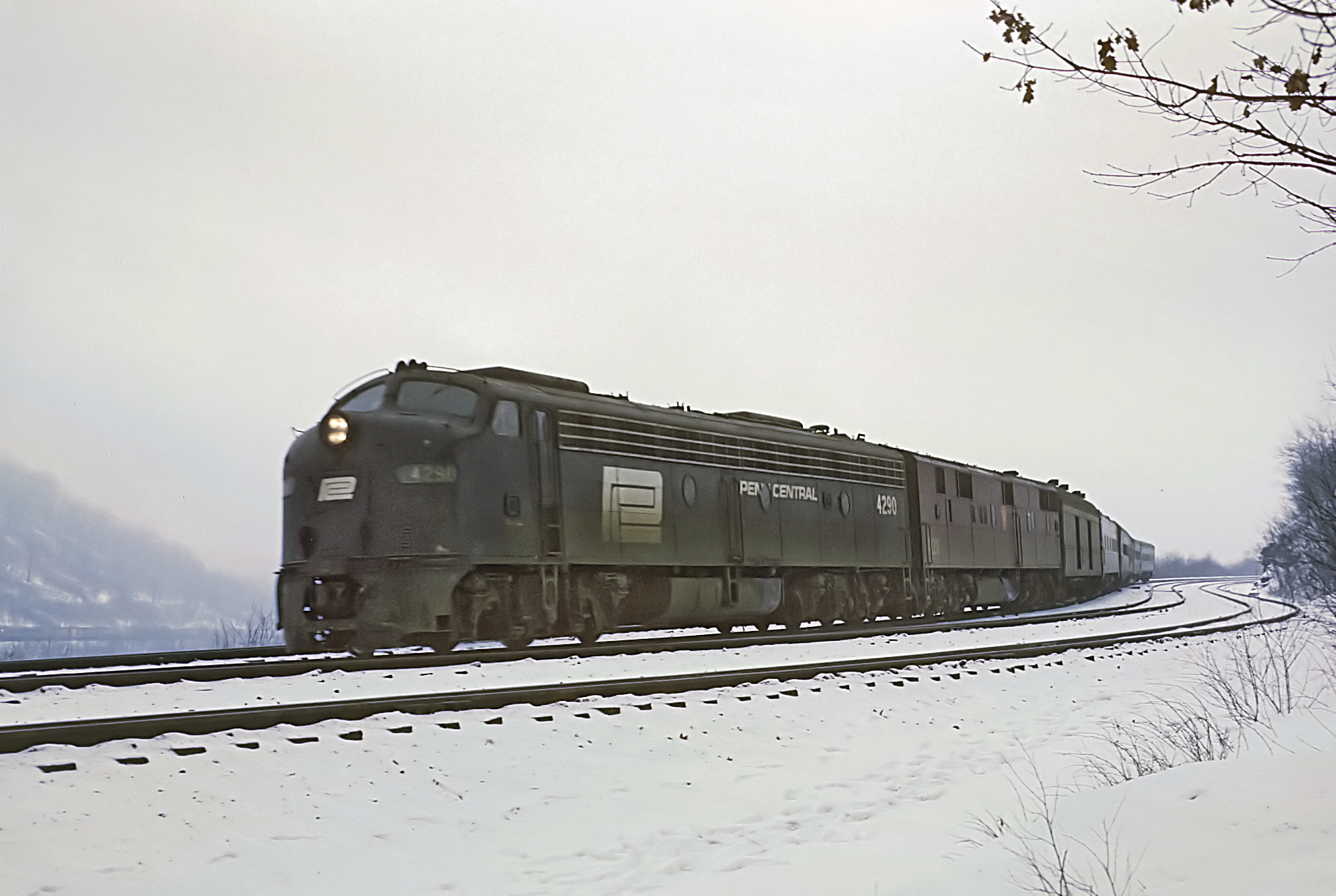
Penn Central E8A #4290 has train #54, the "Pennsylvania Limited," on Horseshoe Curve on a snowy February 23, 1969. Roger Puta photo.
On this page: At a glance · Why the rivals merged · February 1, 1968 · The New Haven · Service comes apart · Holding company and the cash · June 21, 1970 · Trustees · Amtrak and Conrail · Photographs · Sources
At a glance
The Penn Central mark. Author’s work.
The same mark in jade green. Author’s work.
| Item | Detail |
|---|---|
| Railroad | Penn Central Transportation Company, from October 2, 1969. On merger day the surviving corporation was still the Pennsylvania, renamed the Pennsylvania New York Central Transportation Company. Mark PC |
| Parent | Penn Central Company, the holding company, from October 2, 1969. The diversified businesses sat there. The railroad did not |
| Headquarters | 6 Penn Center Plaza, Philadelphia. Alfred E. Perlman kept an office in New York |
| Merger | February 1, 1968, 12:01 a.m. Pennsylvania absorbs the New York Central. Application filed March 9, 1962. ICC approval April 6, 1966. Supreme Court, January 15, 1968 |
| New Haven | Conveyed at 11:59:59 p.m., December 31, 1968. Operated as part of the system from January 1, 1969. 1,502 route-miles |
| Merger-day plant | 19,286 route-miles. 4,202 diesel and electric locomotives. 194,656 freight cars. 4,937 passenger cars. Assets over $4.2 billion. The New Haven is not in these counts |
| Officers | Stuart T. Saunders, chairman. Alfred E. Perlman, president, until December 1, 1969. Paul A. Gorman, president from that day, chairman from June 9, 1970. David C. Bevan, finance |
| Bankruptcy | Section 77 petition, June 21, 1970, 5:35 p.m. Judge John P. Fullam designated June 23 |
| Passenger trains | Intercity service to Amtrak, May 1, 1971. Commuter trains stayed |
| Freight railroad ends | Conveyed to Conrail, April 1, 1976, 12:01 a.m. The corporate estate continued |
| Roster | Penn Central diesel roster. Electrics, including the GG1, are the GG1 class page |
Merger-day counts are the Hagley chronology of the Pennsylvania Railroad. Cash figures in the narrative are labeled as cash or as reported net loss, because those are different numbers. Information compiled September 23, 2026.
When I was in college, a few professors got as far as Penn Central and had to move on. The lecture was the right subject and the wrong length. Rush Loving, Jr.’s The Men Who Loved Trains had not been published yet. That book is the politics, at book length. The collapse itself has a shorter shape. It is a merger the Interstate Commerce Commission approved in 1966, a railroad that never became one railroad, a holding company that kept paying dividends out of borrowed cash, and a petition filed on a Sunday evening in 1970.
Why the rivals merged
The Pennsylvania lost money in 1946, the first annual loss in a history that had paid a dividend every year since 1848, and then went back to buying passenger cars. The New York Central was never as rich. Its board brought in Alfred E. Perlman in 1954. He finished dieselization, built yards, put younger men in the offices, and sold Flexi-Van, a container-on-flatcar service the Central called the Super Van. The Central’s public face was still the 20th Century Limited. The balance sheet was a different story.
Informal talks between the two companies started in September 1957. Perlman did not want the Pennsylvania. In 1959 he courted the Chesapeake & Ohio and the Baltimore & Ohio instead: coal from the C&O, markets from the B&O, and the Norfolk & Western, which the Pennsylvania controlled, left as the counterweight. The three presidents could not agree on who would run the combined company, and the talks died. Perlman came back to the Pennsylvania in October 1961.
They filed with the Commission on March 9, 1962. Stockholders of both companies voted for it that May. The ICC approved the merger on April 6, 1966. Approval was conditioned on taking the New Haven, passenger trains and all, and on the Pennsylvania giving up the Norfolk & Western. Rival roads sued. A three-judge court and then the Supreme Court made the Commission wait until the weaker roads—Erie Lackawanna, Delaware & Hudson, and Boston & Maine—had a path into the Norfolk & Western. The Commission issued a modified order on June 9, 1967. On January 15, 1968, in the Penn-Central Merger Cases, the Supreme Court affirmed. Justice Abe Fortas wrote the opinion. Two weeks later the railroads merged.
David P. Morgan had asked the uncomfortable question a decade early. In the January 1958 Trains, "NYC + PRR, What Does It Mean?," he looked at two heavily indebted railroads in a growing national economy and argued that regulation written for an older era had left them unable to meet competition the public was already subsidizing on the highway, the river, and in the air. He was describing the industry. He was not publishing the merger-day census.
February 1, 1968
At 12:01 a.m. on Thursday, February 1, 1968, the Pennsylvania Railroad Company absorbed the New York Central Railroad Company and became the Pennsylvania New York Central Transportation Company. At 12:04 a.m. the name Penn Central went up on Perlman’s business car, parked in Suburban Station in Philadelphia. Saunders was chairman. Perlman was president. The Pennsylvania named 14 directors and the Central 11. The first combined movement that day was a Pennsylvania locomotive taking a cut of Central auto-rack cars out of Detroit.
The plant, before the New Haven, was 19,286 route-miles, more than the Canadian Pacific’s 16,638, which made it the largest privately owned railroad in the world. Assets were over $4.2 billion. Annual revenues were over $1 billion. The locomotive fleet was 4,202 diesel and electric units, with 194,656 freight cars and 4,937 passenger cars. Headquarters was 6 Penn Center Plaza. Perlman preferred the old Central offices in New York, and the two men rarely shared a hallway.

Three weeks in. Former New York Central E8As, led by #4051, bring an eastbound train into Albany Union Station at Tower B on February 22, 1968. Norton Clark photo.
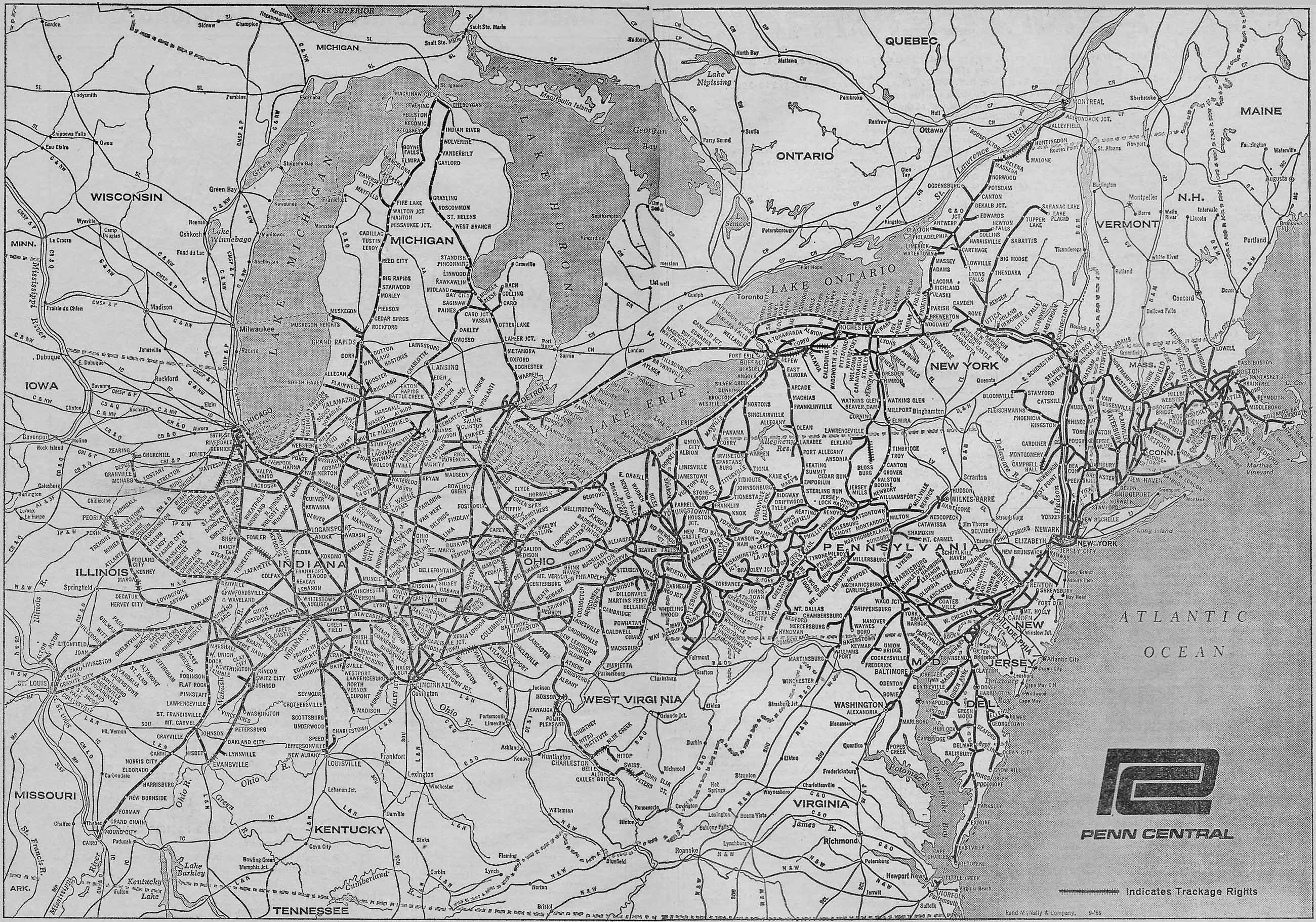
An official system map of the Penn Central Transportation Company, September 1969. The New Haven is already in. Author’s collection.
The New Haven
The New York, New Haven & Hartford had been in bankruptcy since 1961. Its trustees asked, in June 1962, to be included. The Commission’s approval of the big merger was conditioned on taking the whole New Haven, freight and passenger. On November 25, 1968 the ICC ordered the inclusion and set a price of about $145.6 million, most of it in securities rather than cash. Bondholders thought the property was worth more and sued. Judge Robert P. Anderson, who had the New Haven’s reorganization, had already warned that if inclusion was not ordered by January 1, 1969, he would entertain a motion to dismiss the case and stop the trains.
Penn Central took the New Haven’s rail assets at 11:59:59 p.m. on December 31, 1968. The operating date everyone used was January 1, 1969. The addition was 1,502 route-miles, 325 locomotives, 3,959 freight cars, and 660 passenger cars, plus about 23,000 daily commuters at New York and 5,000 at Boston. Tom Nelligan, writing in Trains a year later, made the point that still governs the story: the New Haven’s freight, not only its passenger trains, failed to pay its way. The price fight went on to the Supreme Court as the New Haven Inclusion Cases. The railroad was already inside Penn Central while the lawyers argued about what it had been worth.
Service comes apart
A merger is supposed to save money by closing duplicate yards, pulling up duplicate track, and reducing duplicate jobs. The Commission had taken more than six years, counting the court stays. Saunders and Perlman could not spend a pre-merger fortune on joint yards and a joint car-tracing system while the marriage might still be enjoined. They combined the operating departments on day one and hoped the clerks would catch up.
They did not. Pennsylvania men and Central men—red hats and green hats, in the nickname the crews used—did not share a rulebook, a routing code, or a map. Loving’s account has classification clerks facing thousands of new routing combinations and cars draining into the wrong yards. He records a car billed to Harrisburg that Central clerks, who had never worked a Pennsylvania terminal, forwarded toward Pittsburgh. The story is an illustration, not a car-tracing report. The result was not illustrative. Shippers could not find their freight.
In 1969 the failure piled up at Selkirk Yard, east of Albany, which was the Central’s modern hump and the gate to New England. Maine potatoes off the Bangor & Aroostook sat there long enough to lose a season. Farms that had shipped by rail stopped. The Bangor & Aroostook was pushed to the edge. It did not lose every other commodity forever, and it did not disappear that year. It lost the movement that had kept the railroad in the potato business.
Saunders had come from the Norfolk & Western as a lawyer and a negotiator, not as a dispatcher. The protective arrangements he accepted, on top of the Commission’s labor conditions, kept people on the payroll after the traffic that had justified the jobs was gone. On September 23, 1969 he told a Senate subcommittee that, over the previous two years, the Broadway Limited had averaged about 60 passengers a trip against a crew of more than 70. Perlman kept trying to run a railroad from New York. On August 26 Saunders told him he was finished as president. The board elected Paul A. Gorman, the head of Western Electric, on August 27. Gorman’s contract kept him at Western Electric for 90 days, so he took the chair on December 1, 1969. Perlman became vice chairman, with his New York office and his business car, and without the railroad.
Holding company and the cash
The operating breakdown is only half of the bankruptcy. On January 22, 1969 the board approved a holding company so the enterprise could, in Saunders’s words, diversify into a wide range of growth businesses. The next day Bevan was handed a cash forecast that ran from a $46 million positive balance in December 1968 to a $104 million deficit by the end of 1969. They built the box anyway. On October 1, 1969 the railroad was dropped into a subsidiary. On October 2 the old Penn Central Company was renamed the Penn Central Transportation Company, and the holding company was renamed the Penn Central Company. Real estate, Great Southwest, Arvida, and the rest sat with the parent. The losses sat with the railroad. The railroad’s stake in Executive Jet Aviation produced a separate fight at the Civil Aeronautics Board: a railroad was not supposed to control an airline.
Dividends continued. On August 27, 1969 the board approved the September dividend after Bevan had already reported a cash drain for the year of $295 million. On November 26, 1969 the board passed the fourth-quarter dividend. That ended the Pennsylvania’s dividend, paid every year since 1848. Passing it did not refill the treasury. The railroad was paying its bills with short-term debt, above all commercial paper sold through Goldman, Sachs & Co. Outstanding commercial paper reached about $200 million.
On May 27, 1970 Bevan told the finance committee what the cash had been doing. The cash loss for 1968 was $140 million. For 1969 it was $220 million. The first quarter of 1970 was another $100 million. Since merger day the company had borrowed $993 million and repaid $240 million. He said it still needed $263 million to get through the year. The reported net loss for the quarter ended March 31, the figure in the petition coverage, was $62.7 million. A cash loss and a reported net loss are not the same number. Both said the same thing about the direction. The SEC staff report later found that accounting entries had softened what the public statements showed, and that many of those entries produced no cash. Between the merger and the petition the cash drain was on the order of half a billion dollars.
June 21, 1970
Saunders had gone to Washington. On May 26 he told Attorney General John Mitchell, Treasury Secretary David Kennedy, Defense Secretary Melvin Laird, and White House aide Peter Flanigan that about $200 million of commercial paper had matured or was about to, that it could not be rolled, and that the railroad would have to file in early June. On June 8 the board relieved Saunders, Bevan, and Perlman. Gorman, who had been president for six months, became chairman and chief executive on June 9. He told reporters he would try to hold the commuter trains and the Metroliners and to get rid of the long-distance passenger trains. He would not say what he was doing about the cash.
On June 10, Deputy Defense Secretary David Packard said the Defense Department would support a guarantee of up to $200 million in bank loans under the Defense Production Act, through October 31, while Congress considered a larger railroad-loan program on the order of $750 million. The administration then decided not to give the guarantee. The board met on Sunday, June 21, 1970, and the Penn Central Transportation Company filed under Section 77 at 5:35 p.m. It was the largest corporate bankruptcy in the country up to that time. About $82 million of the commercial paper was still outstanding, held by 72 buyers who had treated the paper as short-term and safe. The SEC later estimated that, in the 30 days after the filing, the commercial-paper market ran off by about $3 billion, and that the Federal Reserve’s opening of the discount window kept that runoff from spreading further.
The war in Vietnam took the front pages. The question asked about the railroad was whether the passenger trains would still run. They did. Judge John P. Fullam of the Eastern District of Pennsylvania was designated to preside on June 23. In July he appointed four trustees: George P. Baker, Richard C. Bond, Jervis Langdon, Jr., and W. Willard Wirtz. Langdon was the railroader in the group, a former president of the Baltimore & Ohio. On June 29 Fullam authorized $50 million in trustees’ certificates so the payroll could be met.
Trustees
Section 77 is a reorganization statute, not a liquidation. Railroads were not allowed the ordinary corporate burial. The court stayed creditors, and the trustees stopped paying debt service, leased-line rents, and taxes. That was still not enough cash. Congress passed the Emergency Rail Services Act of 1970 on January 8, 1971. It let the Secretary of Transportation guarantee trustees’ certificates when essential service was about to stop and the certificates could not be sold without the guarantee. On January 15, 1971 Fullam authorized $100 million of those certificates.
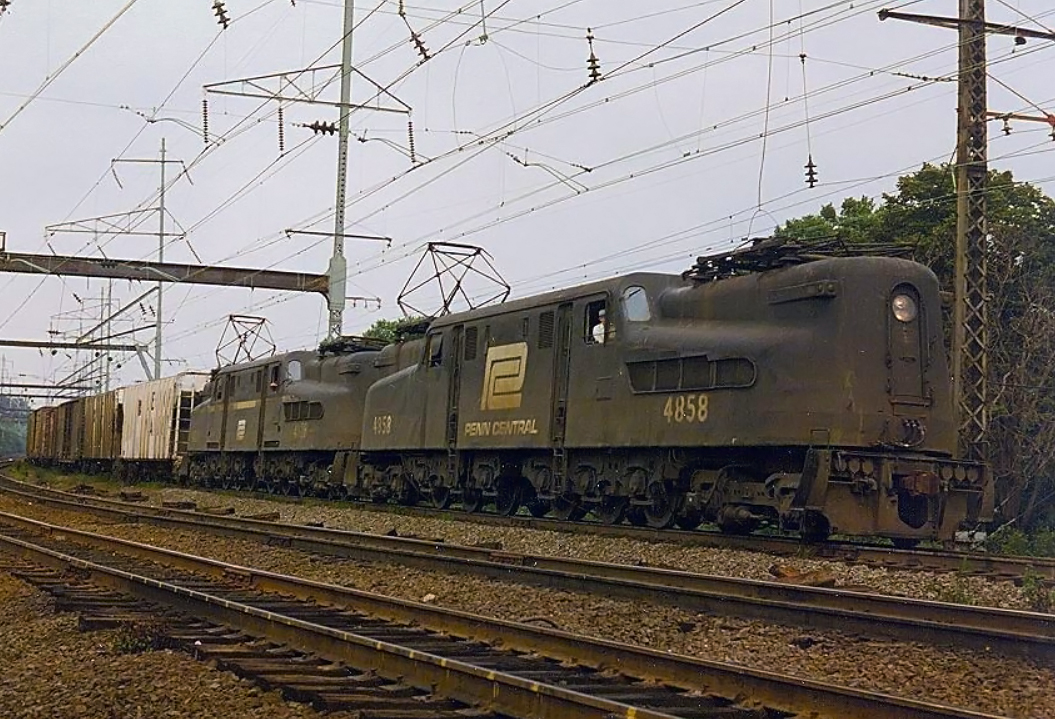
Penn Central GG1s have a freight in tow through Zoo Junction in Philadelphia on August 7, 1974. The wire was still working. The company had been in court for four years. Doug Kroll photo.
The physical plant came apart behind the financial one. Deferred maintenance put large parts of the freight railroad under slow orders. Locomotives queued outside the shops because the shops could not keep up. In March 1973 Fullam gave the trustees until July 2 to file either a practicable plan of reorganization or a proposal to liquidate. He said it was highly doubtful the railroad could be allowed to continue, on the basis then in front of him, past October 1. The trustees told him they needed $600 million to $800 million of help over three years. Their report was that a conventional reorganization could not be made to work. Langdon, the operating trustee, later served as president. The federal freight solution is the Conrail page, which picks up the story when the filing had pulled the rest of the Northeast into court.
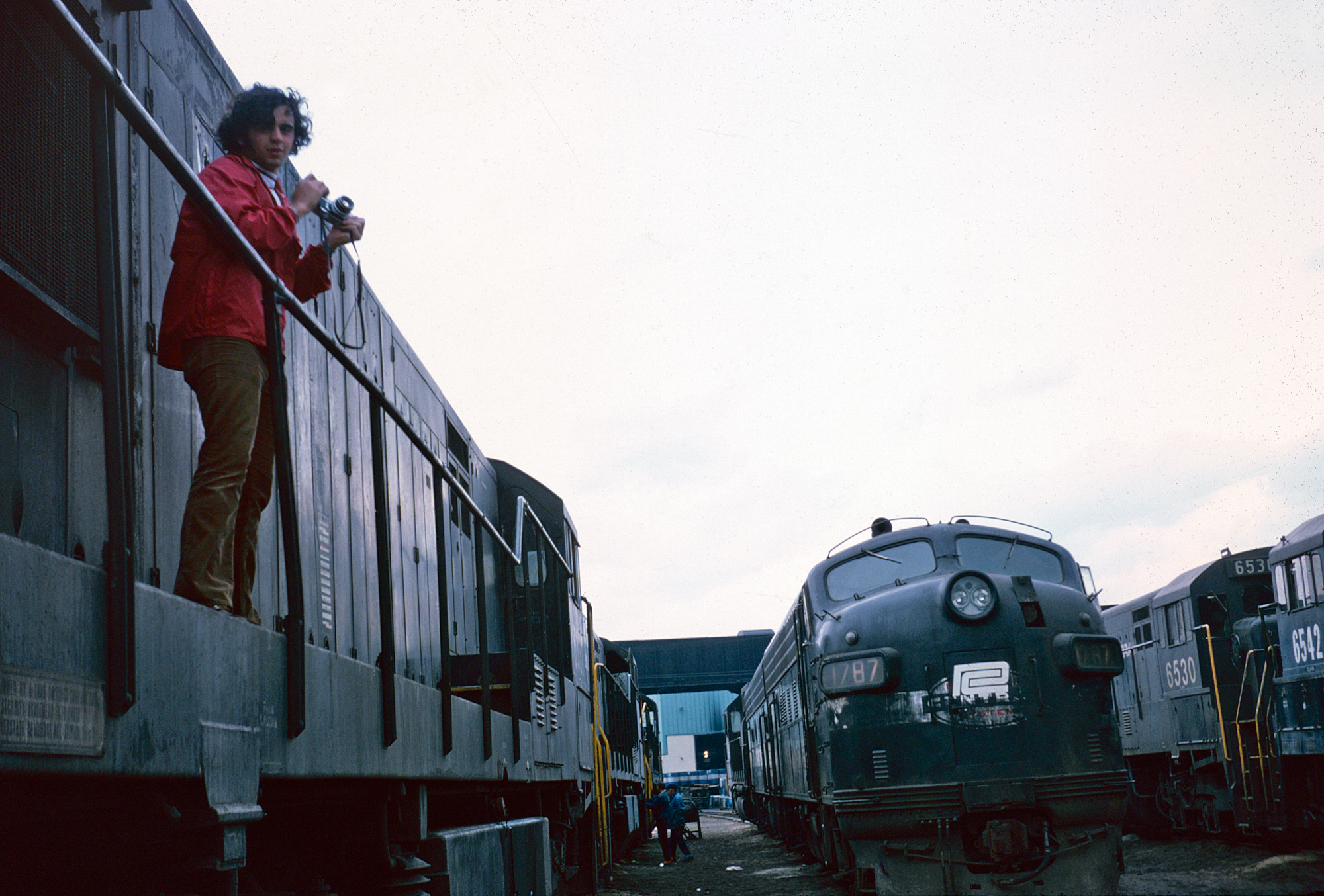
Locomotives wait outside the shops at Selkirk, New York, in April 1975. The estate was a year away from conveyance. American-Rails.com collection.
Amtrak and Conrail
The Rail Passenger Service Act became law on October 30, 1970. Amtrak, the National Railroad Passenger Corporation, started May 1, 1971, and took Penn Central’s intercity trains. Commuter trains stayed on the railroad, and on the creditors. The Northeast Corridor electrics stayed in Penn Central paint until Conrail and Amtrak divided the work. The GG1 story from that handoff is the GG1 page.
Penn Central’s filing did not stay inside one company. Boston & Maine was already in court, from March 12, 1970. The Central Railroad of New Jersey had been in its last bankruptcy since March 22, 1967. The Reading filed on November 23, 1971. Hurricane Agnes in June 1972 put Erie Lackawanna in on June 26. Lehigh Valley and the Lehigh & Hudson River followed the same path. By 1973 more than half the Northeastern network was in receivership. The frame for that decade is the 1970s.
The Regional Rail Reorganization Act, the 3R Act, was signed on January 2, 1974. The Railroad Revitalization and Regulatory Reform Act, the 4R Act, was signed on February 5, 1976. Conveyance to Conrail was 12:01 a.m. on April 1, 1976. What moved was the freight railroad. The Penn Central Transportation Company remained a corporate estate, with the retained real estate and the claims, and spent years in Fullam’s court arguing what the conveyed property had been worth. Deregulation of rates is a later statute, the Staggers Rail Act of 1980, on the Staggers page. Conrail’s first profitable year, 1981, and the sale of the government’s shares in 1987, belong on the Conrail page.
The routes did not vanish with the lettering. The Northeast Corridor is Amtrak’s. The freight mains west of the seaboard are CSX and Norfolk Southern, divided on June 1, 1999. Branches went to short lines. The black locomotives with the interlocking "PC" lasted, in dwindling numbers, well into the Conrail years.
Photographs
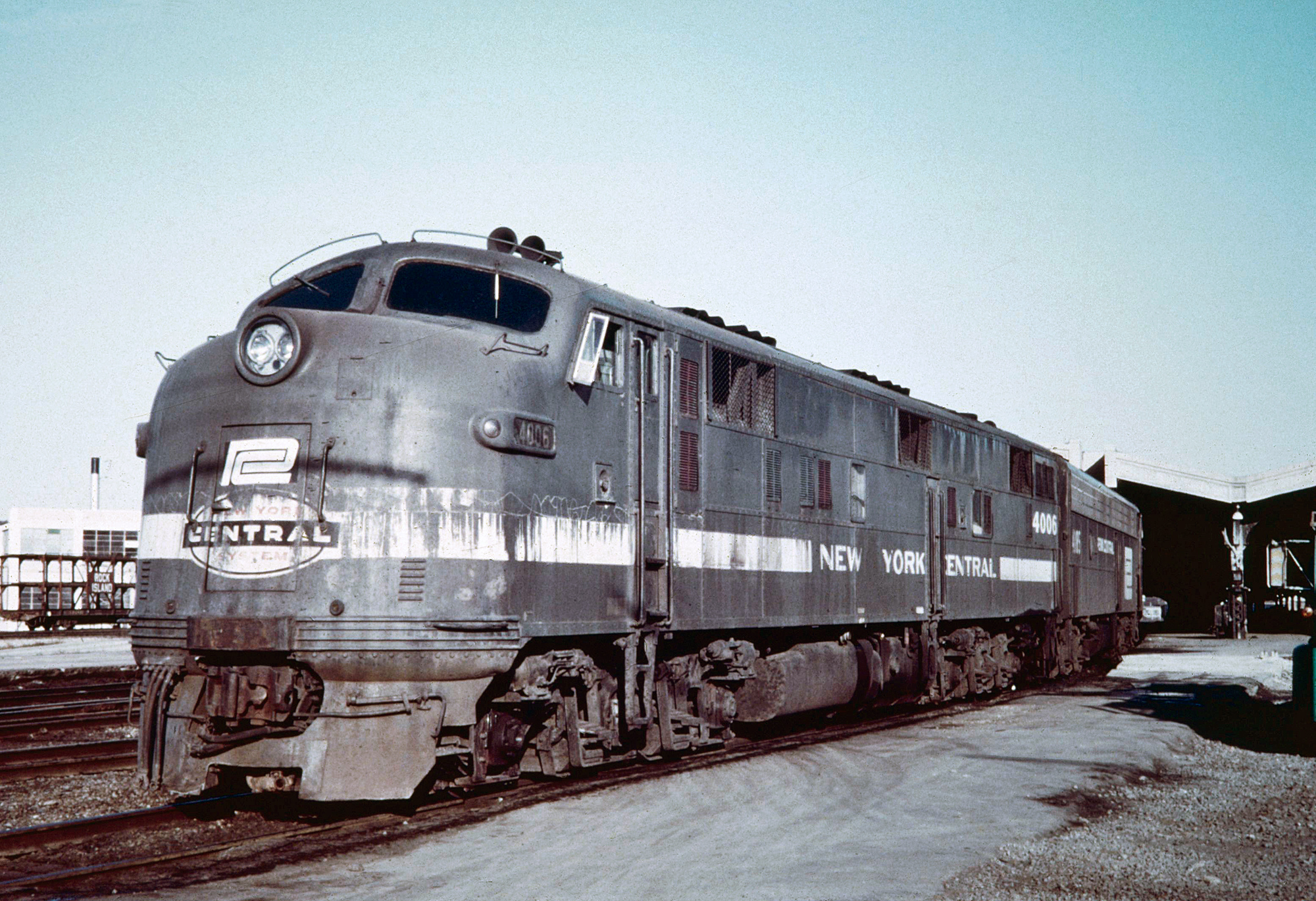
Penn Central E7A #4006 and other power at Michigan Central Station, about 1969. American-Rails.com collection.
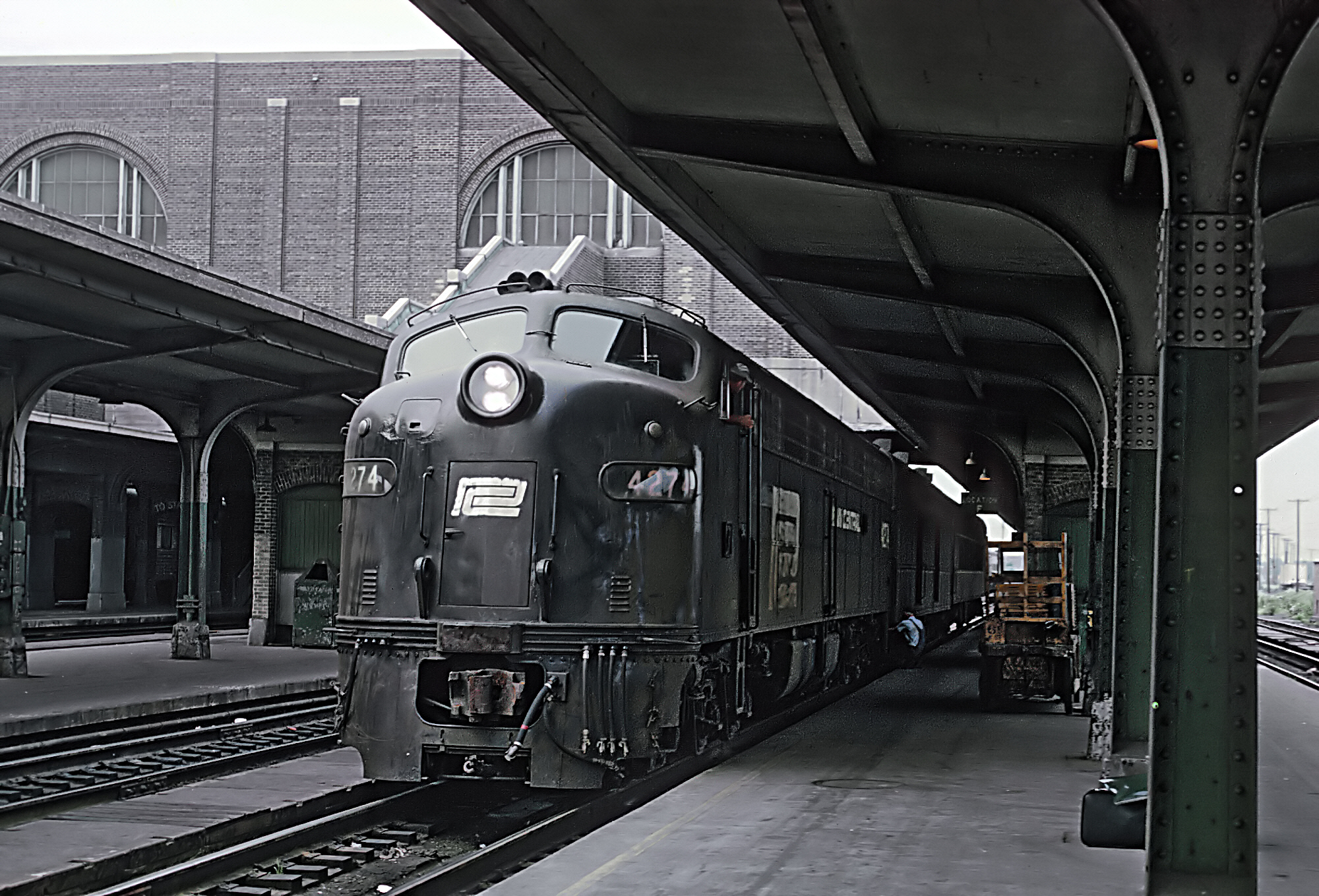
Penn Central E8A #4274 awaits departure from Central Terminal in Buffalo, New York, with train #575, the "Buffalo Day Express," on July 20, 1969. Roger Puta photo.
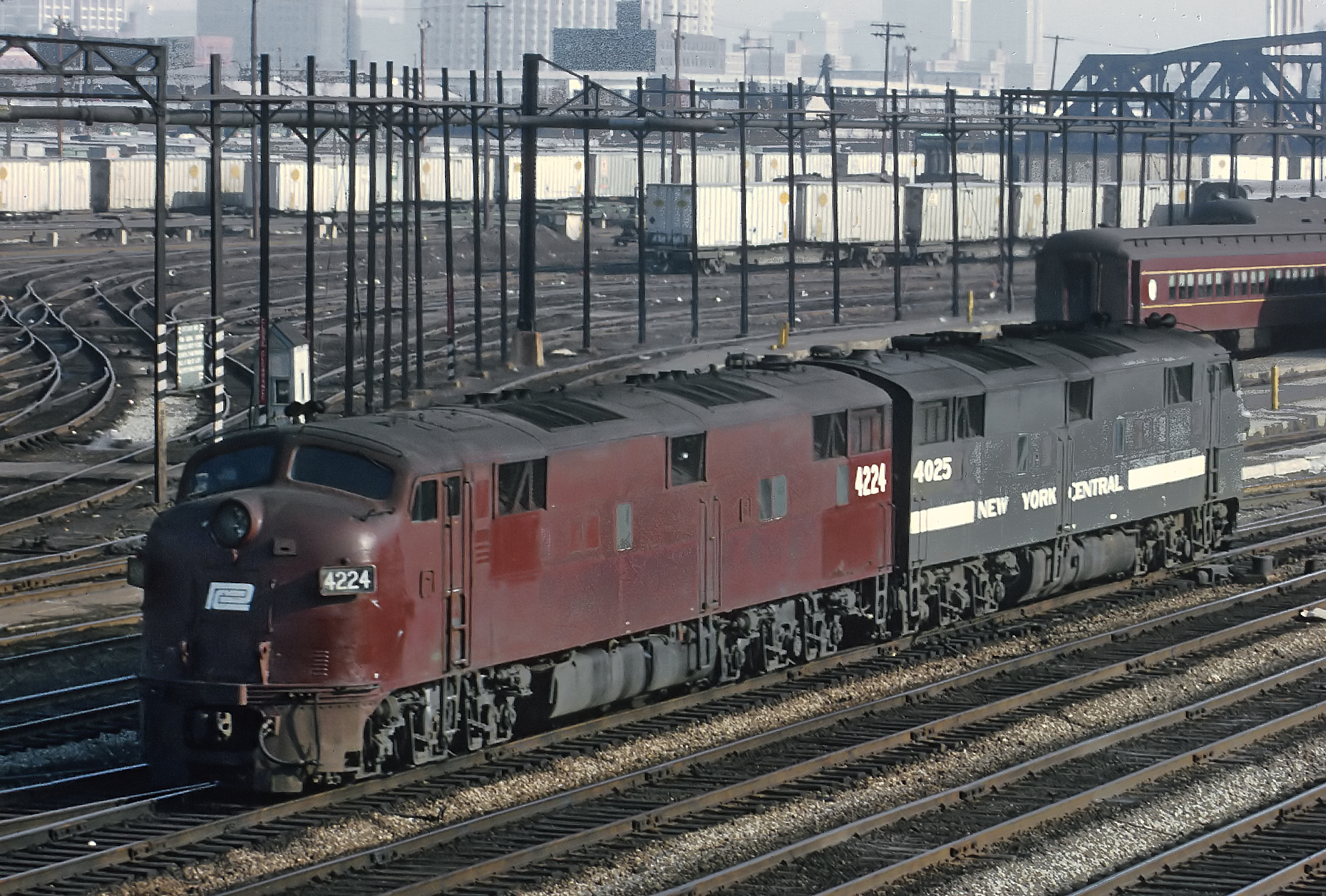
Penn Central #4224 (ex-Pennsylvania E7A) and #4025 (ex-New York Central E7A) run light at 12th Street in Chicago on March 30, 1971. Former Pennsylvania coach yards are in the background. A month later, Amtrak took the intercity trains. Marty Bernard photo.

Worn Penn Central E8As and E7As, with E8A #4257 closest to the camera, at the 14th Street Coach Yard in Chicago on June 24, 1973. Marty Bernard photo.
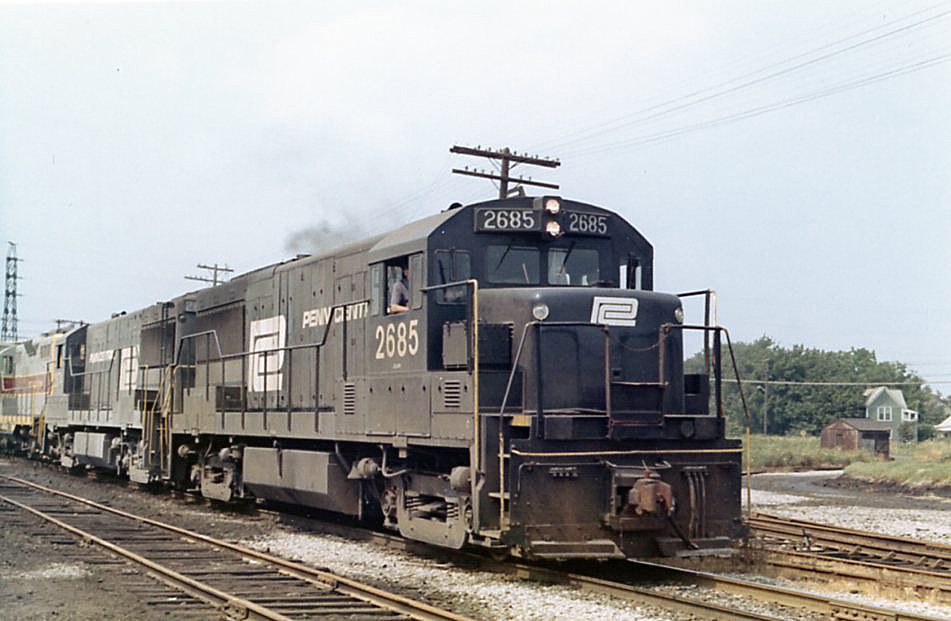
Penn Central U25Bs #2685 and #2674 lead a southbound Erie Lackawanna freight through North Tonawanda, New York, on August 5, 1973. Doug Kroll photo.
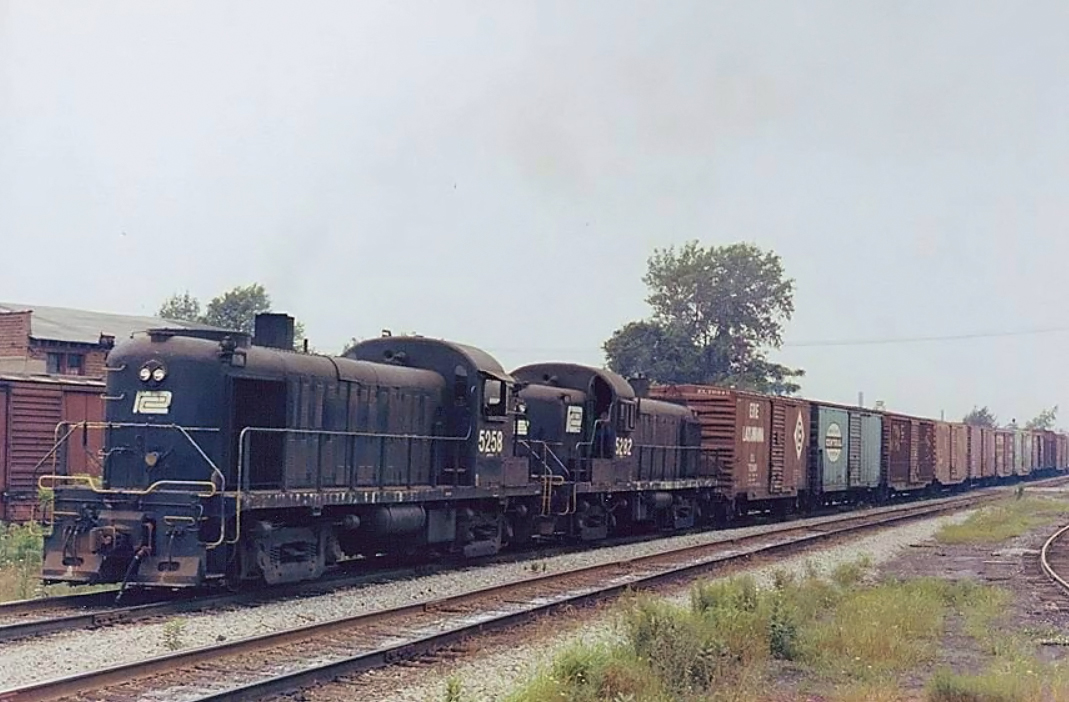
Penn Central RS3s #5258 and #5282 are southbound with a Niagara Falls–Frontier Yard freight at North Tonawanda, New York, on August 14, 1973. Doug Kroll photo.
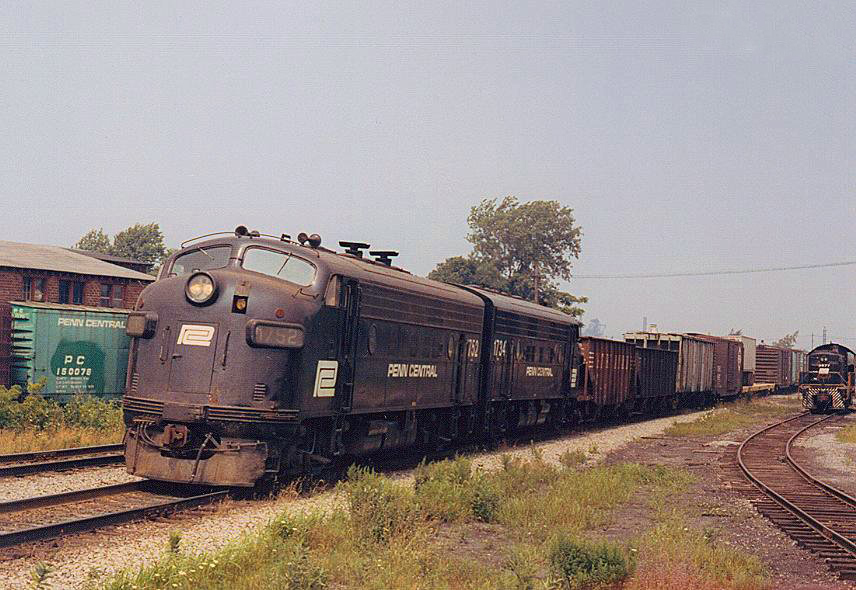
A pair of tired Penn Central F7As southbound at North Tonawanda, New York, on August 8, 1973. The railroad was in its third year of trusteeship. Doug Kroll photo.
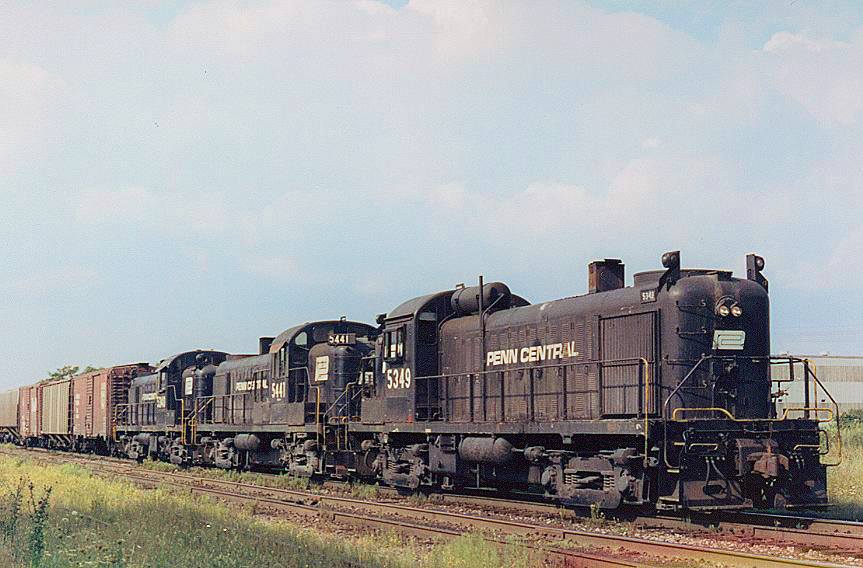
Penn Central RS3s #5349, #5441, and #5340 head south on the Belt Line behind Central Terminal in Buffalo on August 12, 1973. Doug Kroll photo.
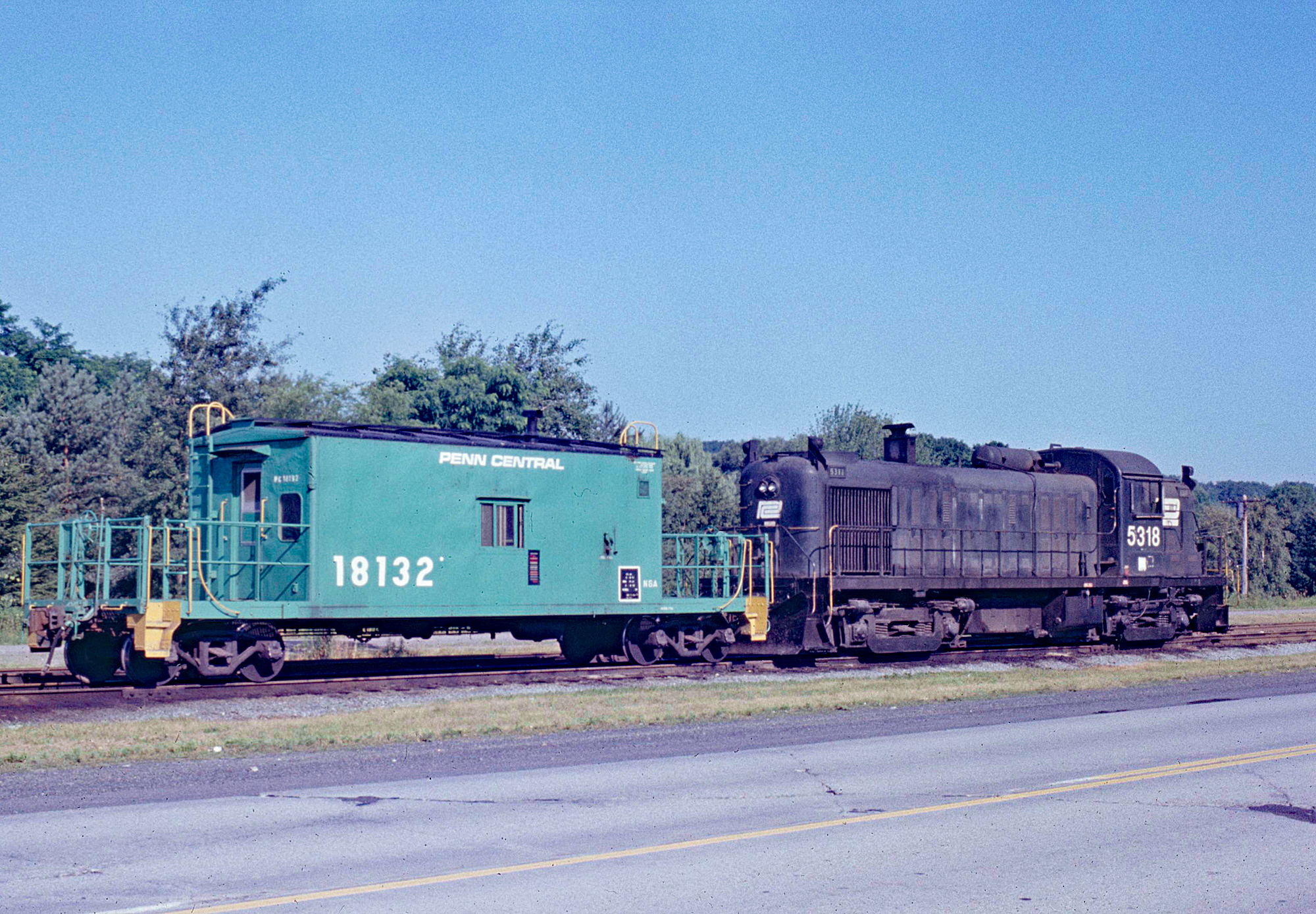
Penn Central RS3 #5318 (ex-New York Central #8318) with a transfer caboose along a highway the original note does not name, July 1973. American-Rails.com collection.

Penn Central F7s, led by #1749 (ex-New York Central), with a coal train through Cleveland, Ohio, in September 1975. Photographer unknown.
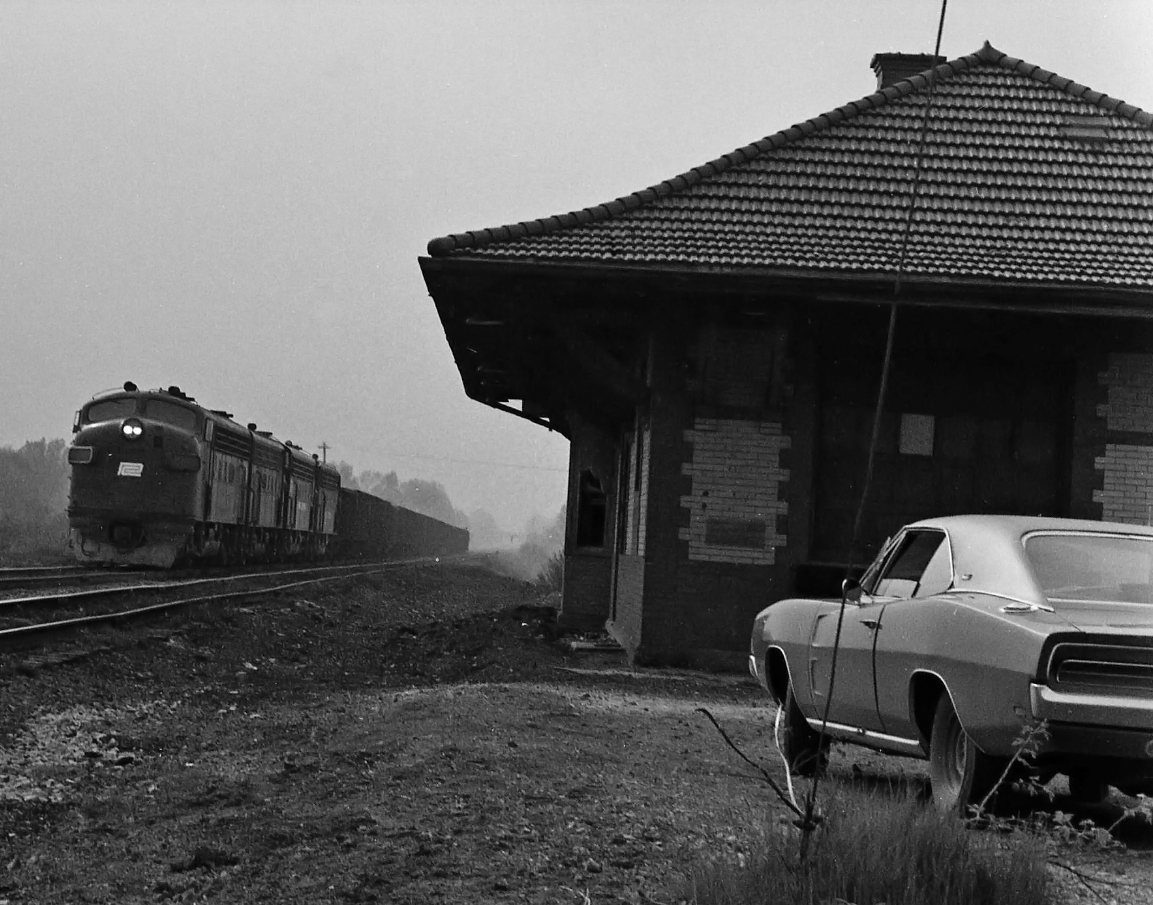
Four Penn Central F7s pass the former Pennsylvania depot in Ravenna, Ohio, with hoppers in the early 1970s. A 1969 Dodge Charger is in the foreground. Jerry Custer photo.
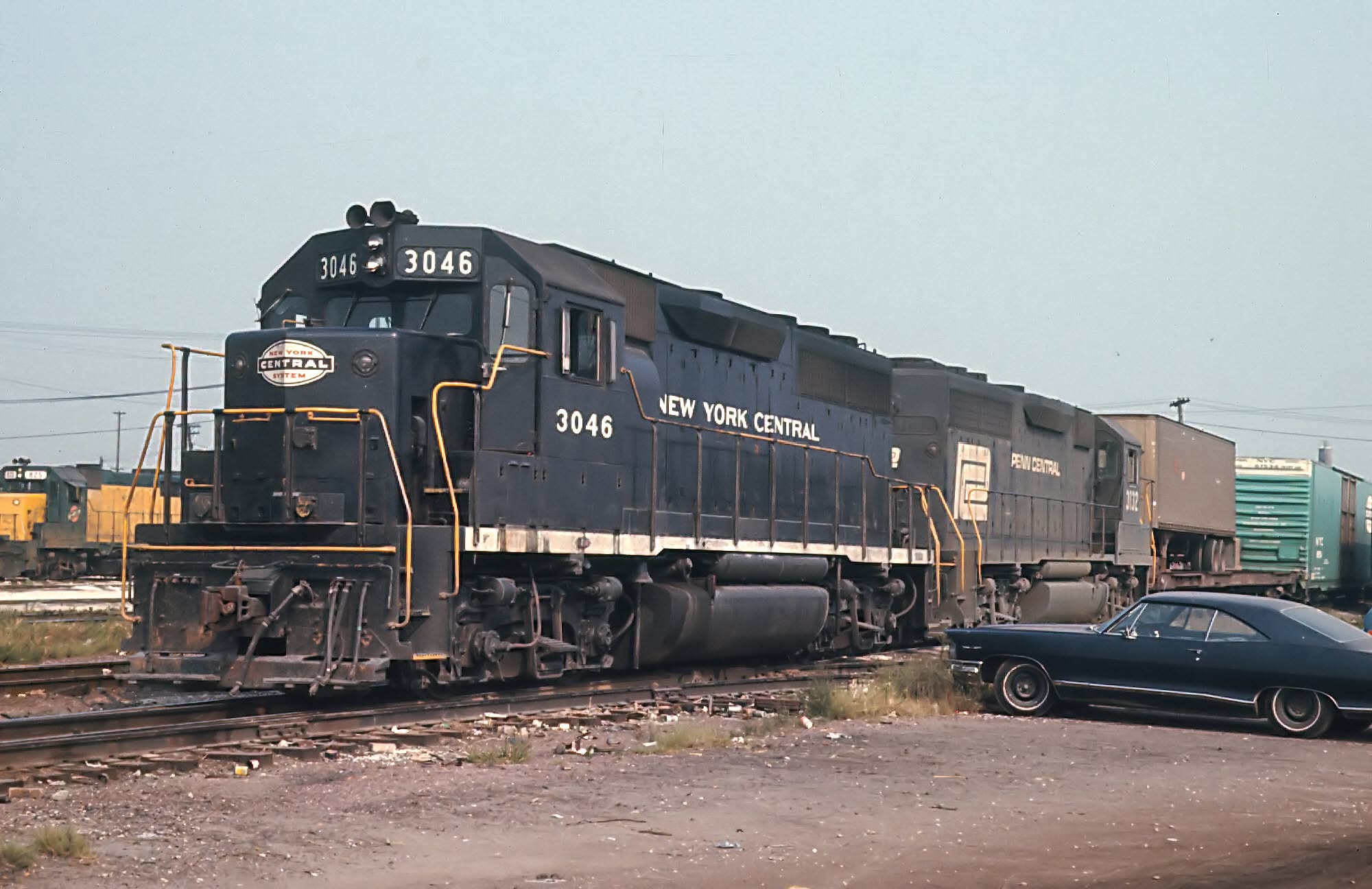
Former New York Central GP40 #3046 and Penn Central GP40 #3132 at Proviso, Illinois, on August 28, 1969. A 1965–66 Chevrolet Impala Sport Coupe is beside the tracks. Marty Bernard photo.
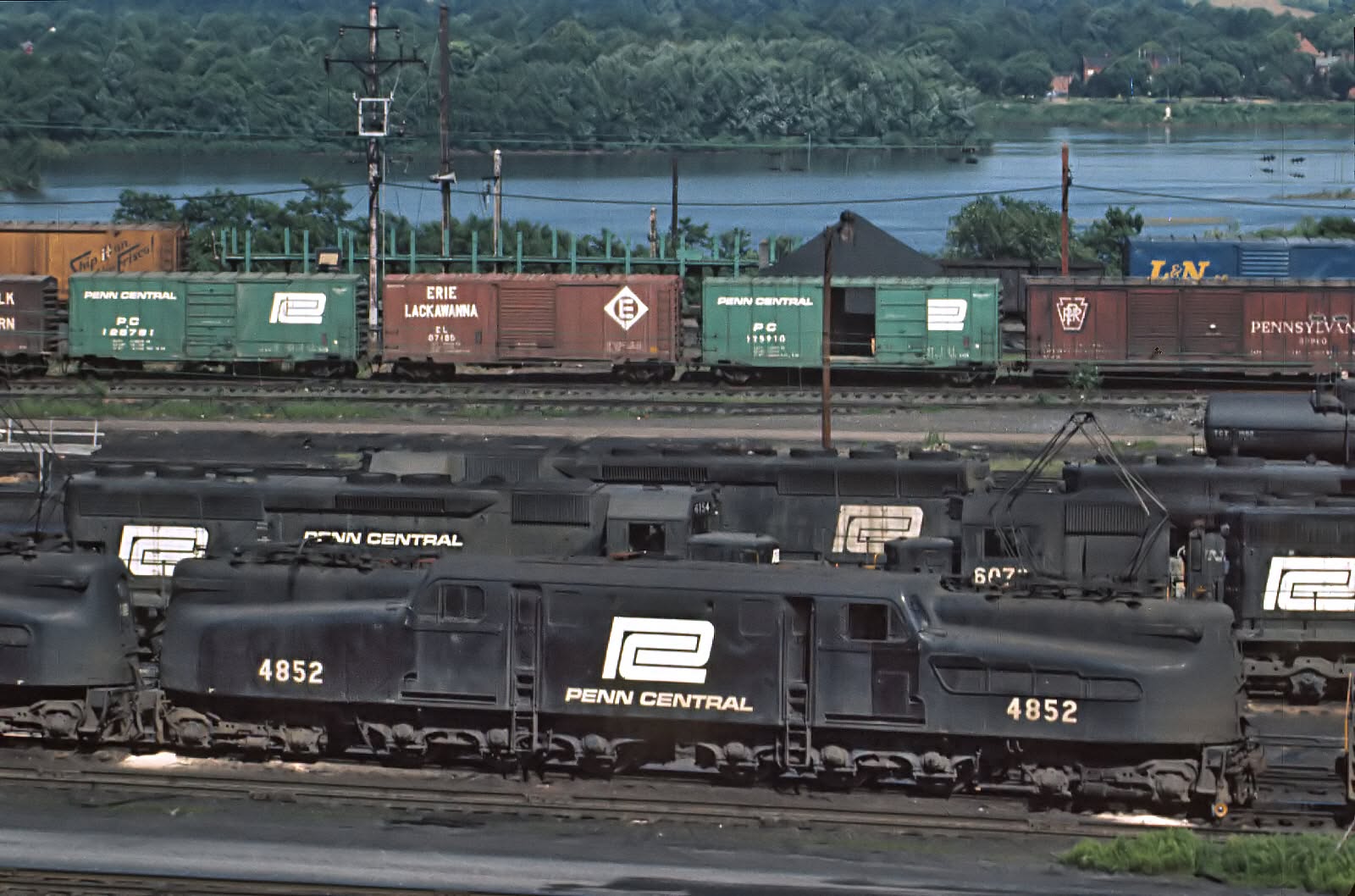
Penn Central GG1 #4852 and other power at Enola, Pennsylvania, on June 11, 1972. Marty Bernard photo.
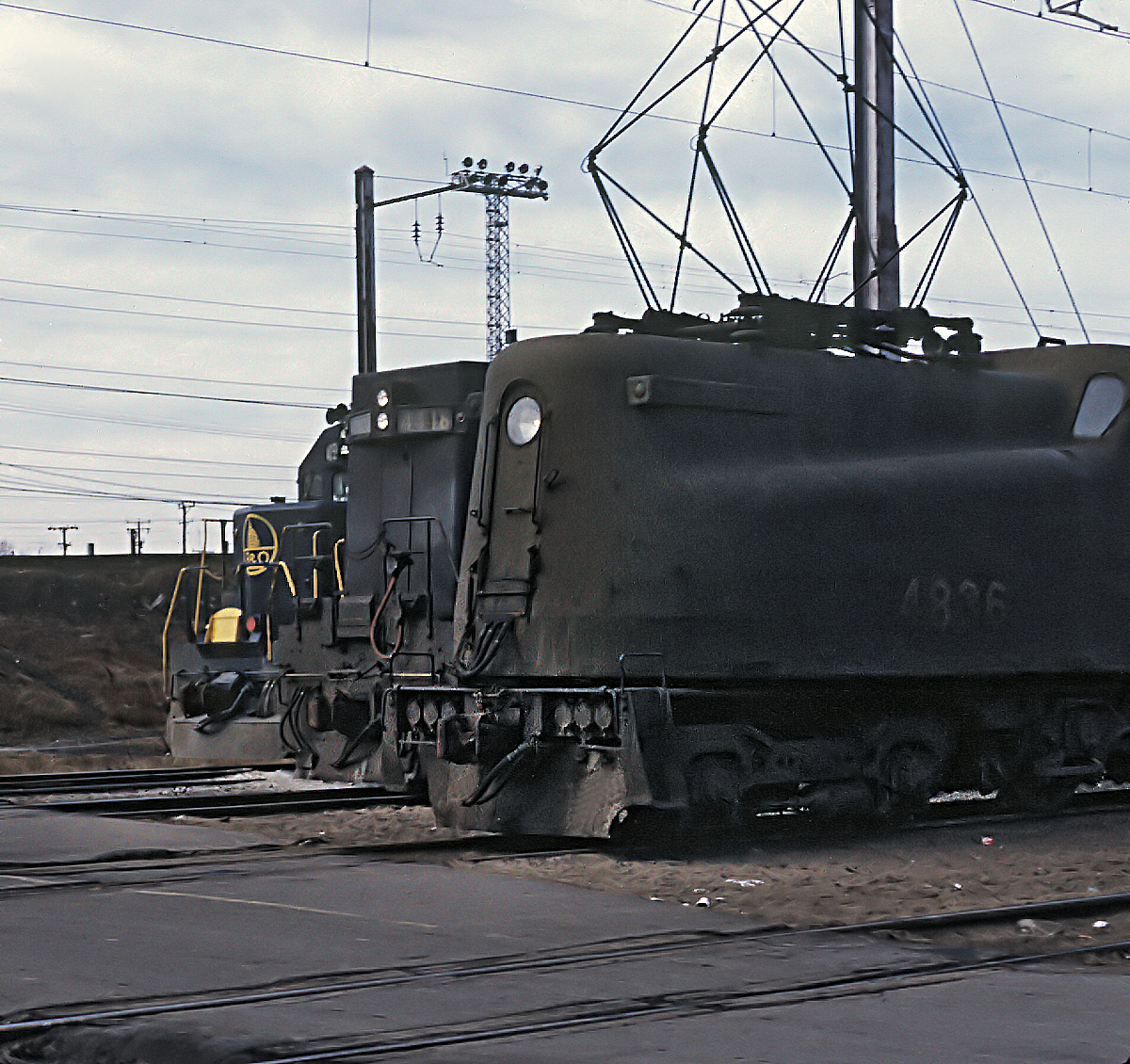
Penn Central GG1 #4836, E44 #4416, and Baltimore & Ohio GP40 #4051 at Potomac Yard in Alexandria, Virginia, on January 14, 1972. Marty Bernard photo.
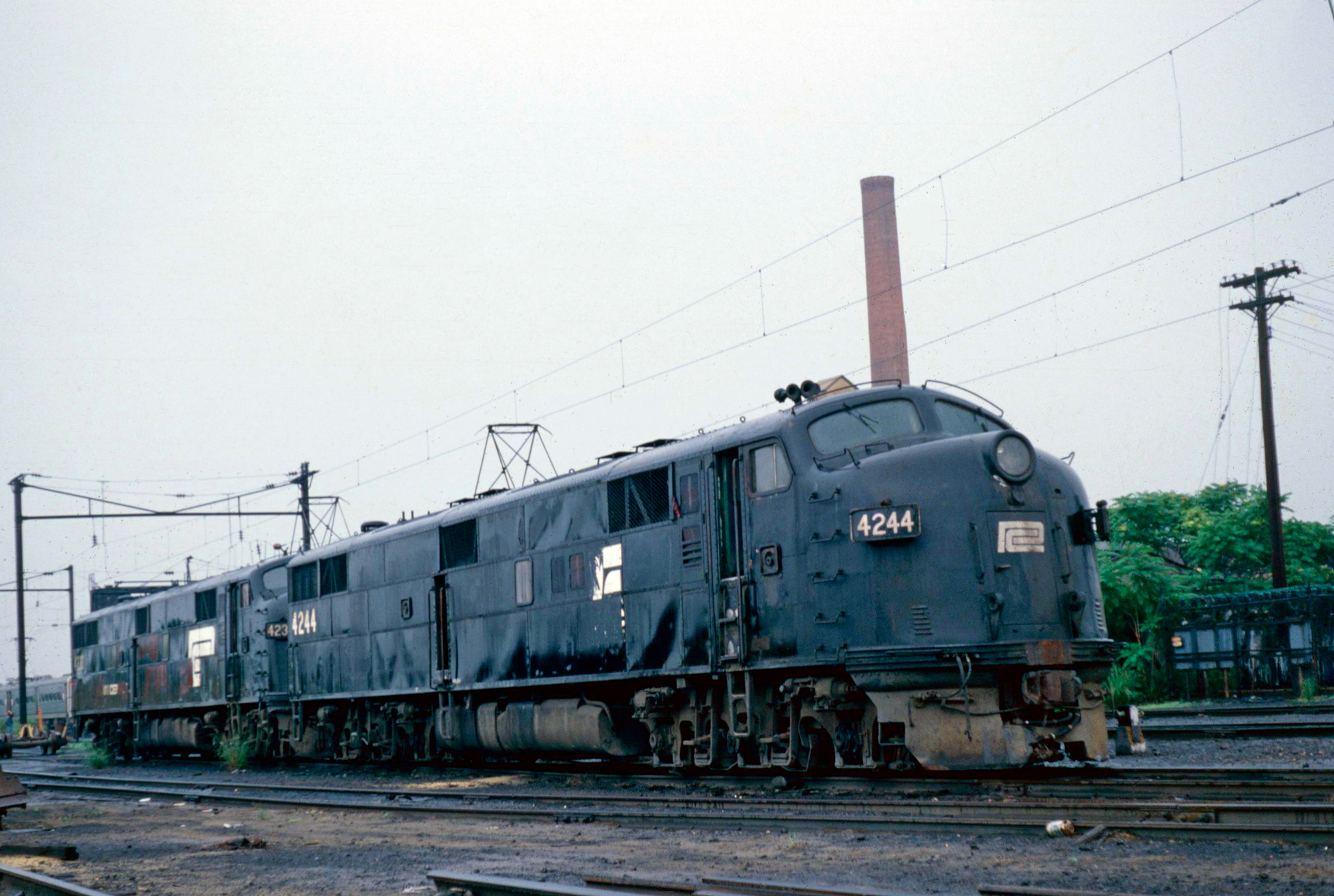
A pair of former Penn Central E7As, ex-Pennsylvania, at South Amboy, New Jersey, in July 1978. The freight railroad had belonged to Conrail since April 1, 1976. The units were still in Penn Central black. American-Rails.com collection.
Sources
- Penn-Central Merger and N & W Inclusion Cases, 389 U.S. 486 (January 15, 1968). Application filed March 9, 1962. ICC approval April 6, 1966. Modified order June 9, 1967.
- New Haven Inclusion Cases, 399 U.S. 392 (1970). Inclusion was a condition of the merger. Conveyance December 31, 1968. The price litigation outlived the conveyance.
- Christopher T. Baer, Pennsylvania Railroad technical chronology, Hagley Museum and Library, for 1968, 1969, and 1970. Merger-day plant and corporate names. Bevan’s May 27, 1970 cash figures, drawn there from the SEC record. Filing at 5:35 p.m. on June 21, 1970. Fullam designated June 23.
- Securities and Exchange Commission staff report, The Financial Collapse of the Penn Central Company, to the House Special Subcommittee on Investigations (1972). Commercial paper, Goldman, Sachs, the half-billion cash drain, and the runoff after the filing.
- The New York Times, June 22, 1970 (the petition, the withdrawn $200 million guarantee, the $62.7 million quarterly net loss) and March 7, 1973 (Fullam’s deadline and the trustees’ $600–$800 million estimate).
- Emergency Rail Services Act of 1970, Public Law 91-663, January 8, 1971. Fullam’s order of January 15, 1971, authorizing $100 million in guaranteed trustees’ certificates.
- David P. Morgan, "NYC + PRR, What Does It Mean?," Trains, January 1958. A warning, not a census.
- Tom Nelligan, "How PC + NH = PC," Trains, January 1970. The 1,502-mile addition, which the Hagley chronology also carries.
- Rush Loving, Jr., The Men Who Loved Trains (Indiana University Press, 2006). The operating-culture account, including the Harrisburg routing story. Paraphrased here.
Related reading
- Pennsylvania Railroad · New York Central · New York, New Haven & Hartford
- Penn Central diesel roster · GG1
- Conrail · Amtrak · The 1970s · Staggers Rail Act
Recent Articles


-
New York Halloween Train Rides (2026)
Sep 29, 26 12:08 AM
 2026 New York Halloween trains—Catskill Pumpkin Express October 17–18 and 24–25, Adirondack pumpkin and family trains, Arcade & Attica haunt, Cooperstown patch and trick-or-treat, Tupper Lake triv…
 -
North Carolina Halloween Train Rides (2026)
Sep 28, 26 11:56 PM
 2026 North Carolina Halloween trains—New Hope Valley Track or Treat on October 10, 17, 23, and 24, and Tweetsie Ghost Train Friday and Saturday nights through October 31. GSMR’s October menu is the go…
 -
Tweetsie Railroad Ghost Train Halloween Festival (2026)
Sep 28, 26 11:44 PM
 Tweetsie Ghost Train—Friday and Saturday nights September 25–October 31, 2026, in Blowing Rock. Adult $65, child $45. One reserved steam ride plus the park. Ages 8 and up for the haunt.
 -
Milwaukee Road Class A 4-4-2: Specs, Roster, History
Sep 28, 26 11:20 PM
 Milwaukee Road Class A Atlantics 1–4, Alco 1935–1937, for the Hiawatha. Order S-1740, 84-inch drivers, 19x28, 300 psi, 30,685 lb. Full builder specs, roster, and the May 15, 1935 run at 112.5 mph. All…
 -
Strasburg Rail Road Halloween Trains (2026)
Sep 28, 26 11:00 PM
 Strasburg’s 2026 Halloween tickets—Pumpkins in Paradise on October 3, The Haunting of Pumpkin Junction, and The Brakeman’s Curse through October 25. Three fares. Legacy of Sleepy Hollow is an earlier…
 -
GSMR Peanuts Pumpkin Train (2026): Not on This Year’s Ticket Menu
Sep 28, 26 10:50 PM
Great Smoky Mountains Railroad’s September 28, 2026 ticket menu lists Nantahala and Tuckasegee excursions. A Peanuts Great Pumpkin train is not on that menu. Polar Express is on the November calendar. -
New Jersey Halloween Train Rides (2026)
Sep 28, 26 06:45 PM
2026 New Jersey Halloween trains—Black River & Western to Everitt Farms through October 25, Delaware River Great Pumpkin through November 1, Whippany October 4, 10, and 11, Pine Creek night trains. -
New Hampshire Halloween Train Rides (2026)
Sep 28, 26 05:17 PM
 2026 New Hampshire Halloween train—Conway Scenic Halloween Express, October 24 and 25, about 1 hour from North Conway. Coach adult $30. Confirm on conwayscenic.com.
 -
Conway Scenic Pumpkin Patch Express (2026): Dates, Tickets & Tips
Sep 28, 26 05:09 PM
 Conway Scenic Halloween Express—October 24 and 25, 2026, about 1 hour from North Conway. Coach adult $30. A pumpkin after the ride while supplies last. Confirm on conwayscenic.com.
 -
Black River & Western Pumpkin Trains (2026): Dates, Tickets & Tips
Sep 28, 26 02:20 PM
 Suggested meta description: Black River & Western Pumpkin Train—Flemington to Everitt Farms, weekends September 26–October 25, 2026. Pumpkin patch, maze, and wagon rides. Confirm on blackriverrail…
 -
Scenic Dinner Train Rides (2026): A Complete Guide
Sep 28, 26 01:30 PM
 2026 scenic dinner trains by state—a seated meal on the train. Branson through October 30, Cincinnati Saturdays, Potomac Eagle, and the full state list. Confirm on the railroad.
 -
West Virginia Dinner Train Rides (2026): A Complete Guide
Sep 28, 26 11:58 AM
 2026 Potomac Eagle dining from Romney—about 3 hours in the Trough. Premium three courses $124. Superior four courses $159, ages 17 and older. Confirm on potomaceagle.com.
 -
Washington Dinner Train Rides (2026): A Complete Guide
Sep 28, 26 11:51 AM
 2026 Chehalis-Centralia dinner trains have run. The July 18 Roaring 20s dinner was $89. The planning calendar lists no later dinner. Confirm on steamtrainride.com.
 -
Texas Dinner Train Rides (2026): A Complete Guide
Sep 28, 26 11:27 AM
 2026 Texas has no plated dinner aboard the train. Grapevine sells snacks. The Texas State Railroad Dogwood lunch was served at the Rusk depot. Confirm on the railroad.
 -
Ohio Dinner Train Rides (2026): A Complete Guide
Sep 28, 26 10:15 AM
2026 Ohio dinner trains—Cincinnati Saturdays, $140, about 3 hours, ages 12 and up. Hocking Valley Elegant Dinner Train October 17 and November 7, from $95. -
Missouri Dinner Train Rides (2026): A Complete Guide
Sep 28, 26 10:09 AM
 2026 Branson Scenic Railway dinner train—three courses, about 2 hours, Fridays and Saturdays through October 30. Dome $123.50 plus tax. Confirm on bransontrain.com.
 -
Minnesota Dinner Train Rides (2026): A Complete Guide
Sep 28, 26 09:40 AM
 2026 North Shore Scenic Northwoods Dinner Train in Duluth—four courses in the SkyView dome, 2½ hours, $90, through September 26. Confirm on duluthtrains.com.
 -
Maine Dinner Train Rides (2026): A Complete Guide
Sep 28, 26 09:29 AM
 2026 Maine has no dining-car dinner. WW&F Pig Roast at SeaLyon Farm was June 13 and has run, $54.95. Sunset Express was a drink and ended September 5.
 -
Greenbrier, Cheat & Elk Railroad: Western Maryland's Logging Line
Sep 26, 26 11:59 PM
 Greenbrier, Cheat and Elk—the logging railroad the Western Maryland bought in 1927. Cass to Spruce, Summit Cut at 4,066.6 feet, Elk River Branch, Laurel Bank.
 -
Elkins (Western Maryland): Yard, History, Operations
Sep 26, 26 11:56 PM
 Western Maryland at Elkins—the Elkins Division yard, roundhouse, and wash rack. Belington, Durbin, Black Fork, and the Elk River branches met here.
 -
B&O's "Cincinnatian" (Train): Route, Consist, Timetable
Sep 26, 26 11:51 PM
 B&O Cincinnatian—Mount Clare five-car streamliner, January 19, 1947, trains 75 and 76. P-7d Pacifics 5301–5304. Detroit–Cincinnati from June 25, 1950, trains 53 and 54. Last run April 30, 1971.
 -
The Semaphore: Railroading's Classic Signal
Sep 26, 26 11:51 AM
 Railroad semaphore signals: blade and spectacle, lower quadrant and upper quadrant, US&S Style B and GRS Model 2A, Robinson’s track circuit, and the last blades on the Raton Subdivision.
 -
Black Fork Grade (Western Maryland): History and Operations
Sep 26, 26 11:47 AM
 Black Fork Grade—the Western Maryland climb through Blackwater Canyon. Thomas to Hendricks, past 3 percent, an H-9 and ten loads, helpers off at Fairfax.
 -
Western Maryland Steam Locomotives: History & Roster
Sep 26, 26 11:39 AM
 Western Maryland steam—H-9 Consolidations, I-2 Decapods, Lima 2-8-8-2s, Baldwin Challengers, and twelve Baldwin Potomac 4-8-4s. Post-1900 roster.
 -
Western Maryland Diesel Roster: All-Time
Sep 26, 26 11:32 AM
 Western Maryland diesels—S1 102 in 1941, fourteen F7 boosters, BL2s, hammerhead RS3s, Circus SD40s, and Chessie GP40-2s. Serials and order numbers.
 -
The Dutch Line (Western Maryland): History, Map, Operations
Sep 25, 26 09:38 PM
 Western Maryland Dutch Line—the Hanover Subdivision. Emory Grove to Highfield via Hanover and Gettysburg, York branch 1893, stone trains, and the route CSX still runs.
 -
The Durbin Branch (Western Maryland): History, Map, Operations
Sep 25, 26 09:13 PM
 Western Maryland Durbin Branch—the Coal & Iron Railway, 46.9 miles Elkins to Durbin, opened July 27, 1903. Mixed train until April 10, 1959. H-7B Consolidations.
 -
Western Maryland Railway: Map, Rosters, Logo, History
Sep 25, 26 10:24 AM
 Western Maryland Railway—the Fast Freight Line. Baltimore, Carroll & Frederick, May 27, 1852. Connellsville Extension 1912. Chessie, then into the B&O May 1, 1983.
 -
Illinois Dinner Train Rides (2026): A Complete Guide
Sep 25, 26 09:52 AM
2026 Monticello Railway Museum Murder Mystery Dinner Train—June 13, July 11, August 1, and September 5 have run. Three courses, about 2 hours, $112. Confirm on mrym.org. -
Georgia Dinner Train Rides (2026): A Complete Guide
Sep 25, 26 12:29 AM
 2026 Azalea Sprinter dinner train from Nashville and Willacoochee, Georgia—2½ hours. Club Car adult $147, Executive adult $177. Confirm on azaleasprinter.com.
 -
Baldwin "Centipede" Locomotives: Specs, Roster, Photos
Sep 25, 26 12:02 AM
 Baldwin DR-12-8-1500/2 Centipede—2-D+D-2, two 608SC engines, 3,000 hp. SAL 4500 from the 1943 test bed. 54 on the serial list, 52 sold. PRR BP60 then BH50. None preserved.
 -
Florida Dinner Train Rides (2026): A Complete Guide
Sep 24, 26 11:56 PM
 2026 Seminole Gulf Murder Mystery Dinner Train in Fort Myers—five courses cooked onboard, 3½ hours, $129 or $135 Saturday, plus tax and gratuity. Confirm on semgulf.com.
 -
West Virginia Northern Railroad: Map, Photos, History
Sep 24, 26 11:27 PM
 West Virginia Northern—Kingwood to Tunnelton, 11 miles of Preston County coal. Narrow gauge 1888, standard gauge 1895. Last freight February 19, 1991. Consolidations 8 and 9 survive.
 -
Rutland Railroad: Map, Rosters, History, Logo
Sep 24, 26 01:18 PM
 Rutland Railroad—Follett’s Champlain & Connecticut River, November 1, 1843. Bellows Falls–Burlington December 18, 1849. Green Mountain Gateway. Last train September 25, 1961. Vermont Railway Janua…
 -
Arkansas Dinner Train Rides (2026): A Complete Guide
Sep 24, 26 01:12 PM
 2026 Eureka Springs & North Arkansas Dinner Train—Eurekan dining car, about 2 hours, $53.62 tax included, opens May 9, Tuesday, Wednesday, Friday, and Saturday. Confirm on esnarailway.com.
 -
Arizona Dinner Train Rides (2026): A Complete Guide
Sep 24, 26 01:01 PM
 2026 Arizona has no plated dinner train. Grand Canyon Railway sells snacks in the cars and meals in Williams or at the rim. Verde Canyon includes a charcuterie tray.
 -
Rail News, The Latest
Sep 24, 26 12:36 PM
This page provides a portal to the latest in rail news, from preservation and restortation subjects to other notable topics. -
Cotton Belt 819 Moved Outside at Pine Bluff for Evaluation
Sep 24, 26 12:35 PM
Cotton Belt 819 left the Pine Bluff shop on September 22, 2026, first time outside in about 30 years. RDG Steam Services is evaluating the engine. No donation link posted. -
Reading Steam Locomotives: History, Roster & Photos
Sep 24, 26 12:14 PM
 Reading steam—Wootten fireboxes, Camelback Consolidations, Mallets, K-1 Santa Fes, G-3 Pacifics, T-1 4-8-4s. Post-1900 roster after Drury. Rambles ended October 17, 1964.
 -
Reading Diesel Roster: All-Time
Sep 24, 26 12:10 PM
 Reading diesel roster—AGEIR boxcabs, FTs, FA-1s, RS-3s, Train Masters, GP30s through GP39-2s. Serials and order numbers. Conrail April 1, 1976.
 -
Reading Railroad: Map, Logo, History, Rosters
Sep 24, 26 12:08 PM
 Reading Company—Philadelphia & Reading, 1833. Anthracite, Port Richmond, Reading Terminal. Operating company January 1, 1924. Conrail April 1, 1976.
 -
Nevada Dinner Train Rides (2026): A Complete Guide
Sep 24, 26 12:02 PM
 2026 Nevada Northern Taste of Italy—adults-only gala from East Ely. The September 19 date has run. Confirm any later night on nnry.com.
 -
North Carolina Dinner Train Rides (2026): A Complete Guide
Sep 24, 26 11:24 AM
 2026 North Carolina dinner trains—NCTM Wine & Dine in Spencer sold out February 13–15. GSMR First Class is the plated meal on the Nantahala Gorge excursion. Confirm on the railroad.
 -
Railway Express Agency (REA): Signs, Trucks, Logo & History
Sep 24, 26 09:40 AM
 Railway Express Agency—railroad-owned express company. Incorporated December 7, 1928. Operations March 1, 1929. Red diamond, green trucks. Last regular express November 7, 1975.
 -
Michigan Dinner Train Rides (2026): A Complete Guide
Sep 24, 26 09:28 AM
 2026 Steam Railroading Institute dining in Owosso—select evenings, no public dinner dates posted. Confirm on michigansteamtrain.com.
 -
Pittsburgh and West Virginia Railway: Map, Rosters, History
Sep 24, 26 12:24 AM
 Pittsburgh & West Virginia—the Hi-Line. Wabash-Pittsburgh Terminal 1904. Railway January 29, 1917. Connellsville February 11, 1931. N&W lease October 16, 1964. Wheeling & Lake Erie from May 17, 1990.
 -
Indiana Dinner Train Rides (2026): A Complete Guide
Sep 24, 26 12:13 AM
2026 Spirit of Jasper Ride & Dine is paused. No public trains. Depot at 201 Mill Street stays open as a rental. Confirm on spiritofjaspertrain.com. -
New Jersey Dinner Train Rides (2026): A Complete Guide
Sep 24, 26 12:01 AM
2026 Woodstown Central Dining in Motion—private table of four from $190, about an hour, Salem County. Confirm on woodstowncentral.com. -
Maryland Dinner Train Rides (2026): A Complete Guide
Sep 23, 26 05:19 PM
 2026 Western Maryland Scenic Allegheny Mountain Dinner Train—Cumberland, 3 hours, 21+, Saturday 7 p.m. Confirm on wmsr.com.
 -
Pittsburgh and Lake Erie Railroad: Map, Rosters, Photos
Sep 23, 26 03:28 PM
 Pittsburgh & Lake Erie—the Little Giant. Chartered 1875, Pittsburgh to Youngstown February 10, 1879. New York Central from 1883. Independent May 15, 1979. Last day September 11, 1992.