
EMD "SD7" Locomotives: Data Sheet, Specs, Roster
Last revised: December 17, 2024
By: Adam Burns
When Electro-Motive quietly unveiled the six-axle SD7 in 1952, company officials could have never imagined the new "Special Duty" line would one day witness unprecedented success.
Prior to its introduction, EMD had no interest in a specialized locomotive and instead remained focused on mass produced four-axle variants. At the time this included the streamlined "F" series although the builder had recently (1949) launched its own road-switcher line, the GP7.
The SD7 was the Geep's larger cousin, sporting a C-C truck arrangement that offered greater tractive effort on a longer frame but was otherwise identical. At the time, there was little interest in such a design; comparable models sold by Alco and Baldwin also found little interest.
A total of 188 SD7s were produced during a very short production run from April, 1952 to November, 1953. Interestingly, in a nod to the quality of EMD products, the model's largest buyer - Southern Pacific - rebuilt its entire fleet, which remained in service through the 1990s.
Photos
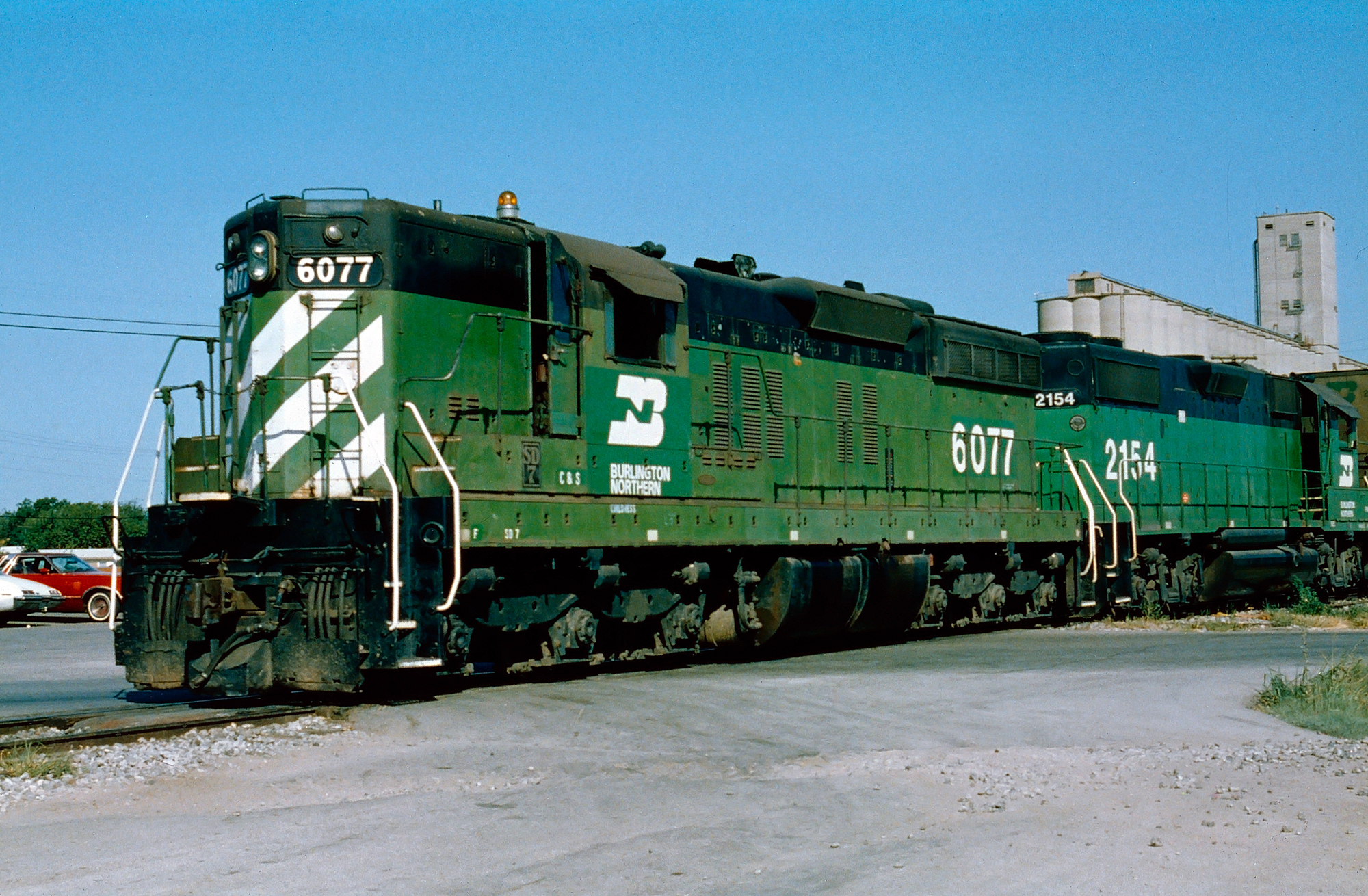 Burlington Northern (Colorado & Southern) SD7 #6077 (built as #817) and GP38-2 #2154 at North Yard in Saginaw, Texas, circa 1983. Mike Bledsoe photo. American-Rails.com collection.
History
The six-motored locomotive concept was not new when EMD introduced the SD7. As Brian Solomon points out in his book, "EMD Locomotives," General Electric had offered a straight-electric in this configuration as early as 1930 when it produced 42 Class R-2 locomotives for New York Central for its West Side freight operations in New York City (Manhattan).
In addition, Alco had first offered a six-motored RS1 in 1942 for the U.S. Army while Baldwin first cataloged its own six-axle version as early as 1946, the A1A-A1A trucked DRS-6-4-1500. Two years later it unveiled the six-motored DRS-6-6-1500.
Internally, the SD7 was identical to its four-axle counterpart, equipped with a 1,500 horsepower, 16-cylinder model 567B prime mover.
However, it was also unique via a custom designed frame; by contrast, Alco and Baldwin had utilized the same basic frame in developing both their four, and six-axle models. While internally the same, the SD7 was outwardly unmistakable from the GP7.
At a length of 60 feet, 8 ½ inches over couplers, the model was more than five feet longer than its four-axle counterpart. A single locomotive could haul a 5,500-ton train on level track, climb grades as high as 5%, and negotiate curves of 23 degrees.
The SD7 also featured another unique trait, EMD's own Flexicoil truck. This lightweight, high adhesion design offered a surprisingly comfortable ride and was easy to maintain. It provided mechanics straightforward access to the center-axle, which was difficult to reach in Alco's early six-axle truck.
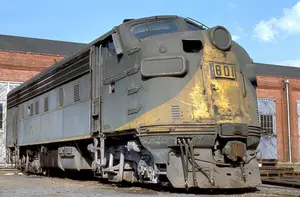
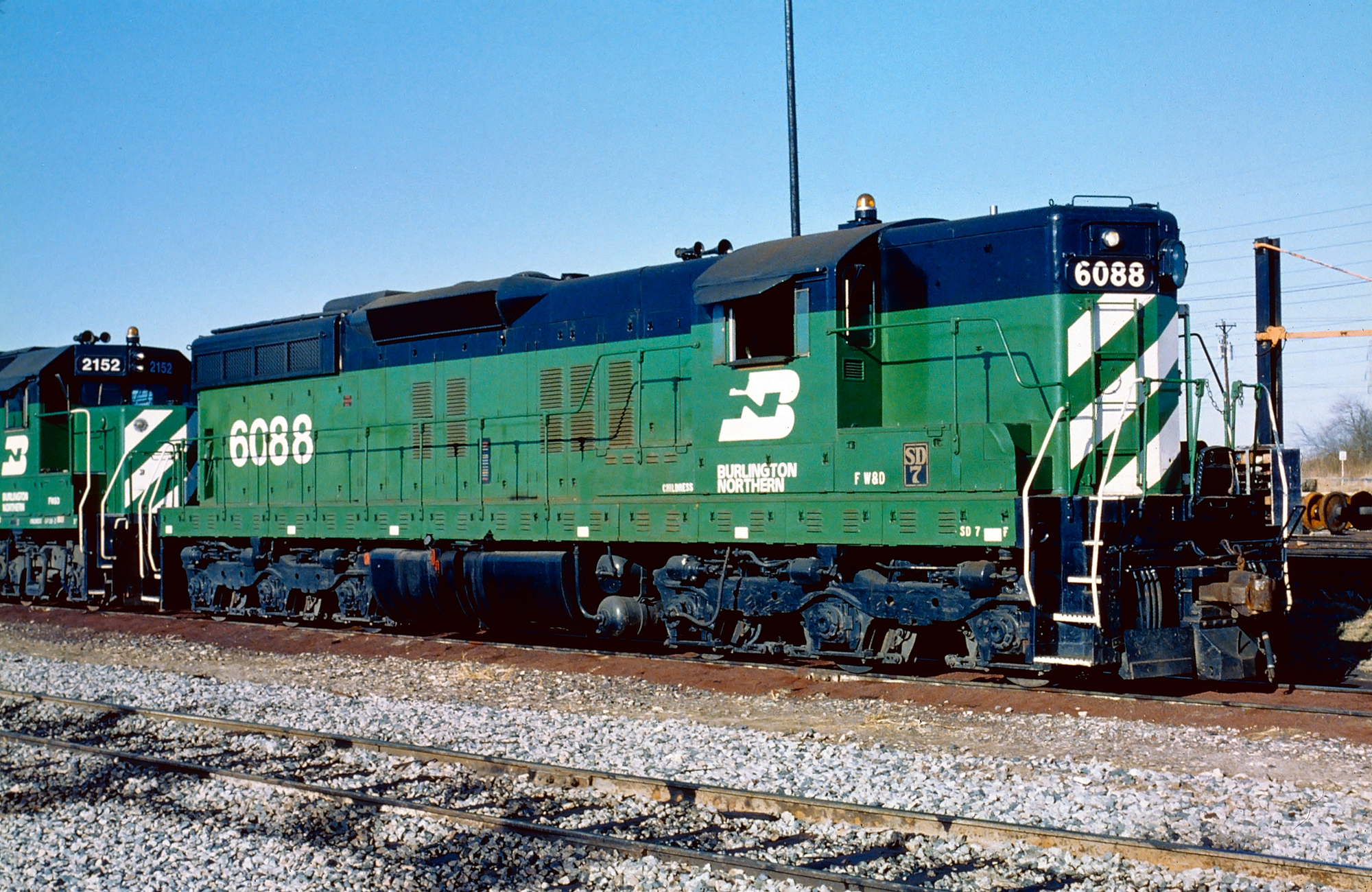 Burlington Northern SD7 #6088, sub-lettered for the Fort Worth & Denver, is seen here in Fort Worth, Texas, circa 1983. Mike Bledsoe photo. American-Rails.com collection.
Reception
In the early 1950s, railroads still preferred four-axle locomotives in main line freight service. As a result, reception to EMD's early six-axle variants was cool.
Nevertheless, there was some interest, especially by Southern Pacific, which tested out the builder's bright red demonstrator, #990, and ultimately purchased this unit. In fact, SP wound up with the largest fleet, 43 of the 188 examples produced.
Data Sheet and Specifications
| Entered Production | 4/1952 (Milwaukee Road #2200) |
| Years Produced | 4/1952 - 11/1953 |
| Engine | 567B |
| Engine Builder | GM |
| Horsepower | 1500 |
| RPM | 800 |
| Cylinders | 16 |
| Length | 60' 8 ½" |
| Height (Top Of Rail To Top Of Cab) | 15' 0" |
| Width | 10' 8" |
| Weight | 300,000-360,000 Lbs |
| Fuel Capacity | 1200 Gallons |
| Air Compressor | Gardner-Denver |
| Air Compressor Model | WBO |
| Air Brake Manufacturer | Westinghouse |
| Air Brake Schedule | 6BL |
| Trucks | C-C |
| Truck Type | Flexicoil |
| Truck Wheelbase | 13' 7" |
| Wheel Size | 40" |
| Traction Motors | D27C (6), GM |
| Primary Generator | D12B, GM |
| Auxiliary Generator | Delco |
| Alternator | D14 |
| MU (Multiple-Unit) | Yes |
| Dynamic Brakes | Yes |
| Gear Ratio | 65:12, 62:15, 61:16, 60:17, 59:18, 58:19 |
| Tractive Effort (Starting) | 90,800 Lbs at 25% |
| Tractive Effort (Continuous) | 75,000 Lbs at 9.3 mph |
| Top Speed | 55 mph (65:12), 65 mph (62:15), 71 mph (61:16), 77 mph (60:17), 83 mph (59:18), 89 mph (58:19) |
Production Roster
Total Built = 188
| Owner | Road Number(s) | Serial Number(s) | Order Number | Completion Date |
|---|---|---|---|---|
| Milwaukee Road | 2200-2208 | 15612-15620 | 5139 | 4/1952-6/1952 |
| Milwaukee Road | 2209-2211 | 15621-15623 | 5201 | 6/1952, 8/1952 |
| Electro-Motive (Demonstrator) | 990 (became Southern Pacific #5308) | 15624 | 7512 | 10/1952 |
| Great Northern | 550-564 | 16099-16113 | 5146 | 5/1952-10/1952 |
| Nevada Northern | 401 | 16824 | 6397 | 8/1952 |
| Milwaukee Road | 2212-2214 | 16941-16943 | 5144 | 6/1952 |
| Fort Worth & Denver City (Burlington) | 850-857 | 17121-17128 | 6468 | 3/1953 |
| Colorado & Southern (Burlington) | 810-817 | 17129-17136 | 6274 | 1/1953-2/1953 |
| Bessemer & Lake Erie | 801-803 | 17138-17140 | 6436 | 10/1952 |
| Southern Pacific | 5279-5293 | 17144-17156 | 5157 | 11/1952-1/1953 |
| Colorado & Southern (Burlington) | 818-819 | 17260-17261 | 6274 | 2/1953 |
| Chicago, Burlington & Quincy | 400-411 | 17396-17407 | 5140 | 11/1952-12/1952 |
| Minneapolis & St Louis | 852, 952 | 17408-17409 | 5181 | 12/1952 |
| Electro-Motive (Demonstrator) | 991 (became Baltimore & Ohio #760) | 17410 | 6457 | 3/1952 |
| Kennecott Copper Corporation | 903 | 17411 | 6456 | 12/1952 |
| Great Northern | 565-572 | 17896-17903 | 5182 | 3/1953-4/1953 |
| Bessemer & Lake Erie | 451-455 | 17904-17908 | 5212 | 4/1953 |
| Fort Worth & Denver City (Burlington) | 858-860 | 17921-17923 | 5249 | 10/1953 |
| Denver & Rio Grande Western | 5300-5304 | 18124-18128 | 5232 | 5/1953 |
| Chicago & North Western | 1661-1664 | 18223-18227 | 5185 | 5/1953 |
| Chicago & North Western | 1660 | 18227 | 5276 | 6/1953 |
| Union Pacific | 775-781 | 18284-18290 | 5244 | 6/1953 |
| Union Pacific | 783-784 | 18291-18292 | 5277 | 6/1953 |
| Union Pacific | 782 | 18293 | 5278 | 6/1953 |
| Milwaukee Road | 2215-2219 | 18301-18305 | 5274 | 10/1953 |
| Milwaukee Road | 2220-2223 | 18306-18309 | 6516 | 10/1953 |
| Central of Georgia | 201 | 18310 | 6512 | 5/1953 |
| Chicago, Burlington & Quincy | 300-324 | 18320-18344 | 5242 | 5/1953-10/1953 |
| Southern Pacific | 5316-5335 | 18381-18400 | 5188 | 8/1953-9/1953 |
| Southern Pacific | 5309-5313 | 18401-18405 | 5282 | 7/1953 |
| Southern Pacific | 5314 | 18406 | 5283 | 7/1953 |
| Southern Pacific | 5315 | 18407 | 5286 | 7/1953 |
| Pennsylvania | 8588-8589 | 18669-18670 | 5300 | 10/1953 |
| Baltimore & Ohio | 761-764 | 18683-18686 | 5303 | 11/1953 |
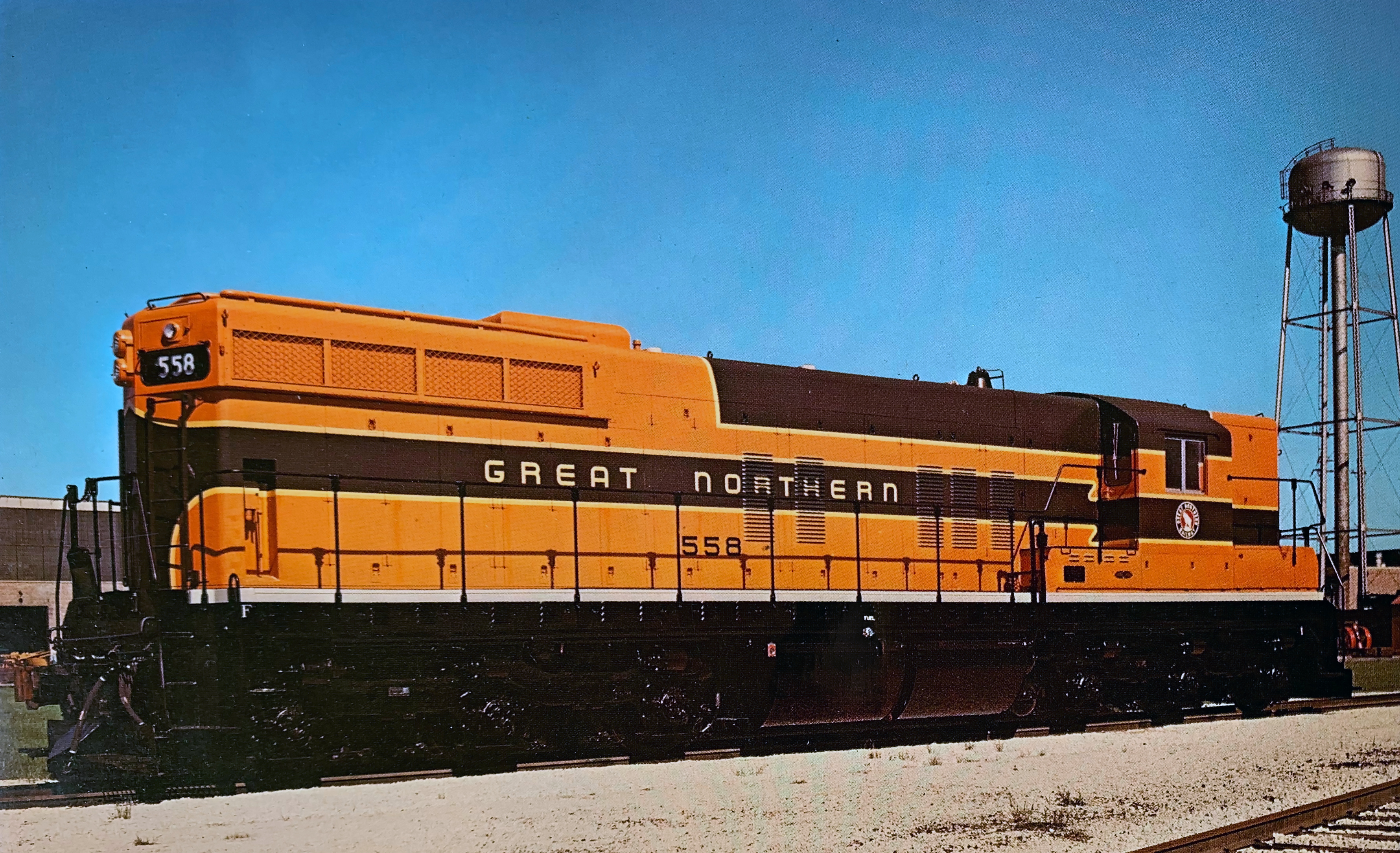 An Electro-Motive photo showcasing new Great Northern SD7 #558 in the summer of 1952. American-Rails.com collection.
Demonstrators
In designing the SD7, EMD intended it to be used in light branch service. The truck itself was lightweight and its additional axle could more evenly distribute the locomotive's weight over a greater distance, a handy trait in territory where rail was generally light.
Interestingly, the Flexicoil proved so successful it remained EMD's standard through the early 645 series which included the SD38, SD40, and SD45. It was finally replaced with the "Dash 2" line, which carried the new HT-C truck.
EMD's second demonstrator, #991, was purchased by the Baltimore & Ohio, which went on to roster five examples, #760-765. Other buyers included the Milwaukee Road, Great Northern, Nevada Northern, Burlington (and subsidiaries), Bessemer & Lake Erie, Minneapolis & St Louis, Kennecott Copper Corporation, Rio Grande, Chicago & North Western, Union Pacific, Central of Georgia, and Pennsylvania.
Interestingly, SP kept their SD7s in service - following an extensive rebuild program into SD7Rs, through the end when the railroad merged with Union Pacific in 1996.
Sources
- Foster, Gerald. A Field Guide To Trains. New York: Houghton Mifflin, 1996.
- Hayden, Bob. Diesel Locomotives: Cyclopedia, Volume 2 (Model Railroader). Milwaukee: Kalmbach Publishing Company, 1980.
- Marre, Louis A. Diesel Locomotives: The First 50 Years, A Guide To Diesels Built Before 1972. Milwaukee: Kalmbach Publishing Company, 1995.
- Pinkepank, Jerry A. Diesel Spotter's Guide. Milwaukee: Kalmbach Publishing Company, 1967.
- Schafer, Mike. Vintage Diesel Locomotives. Osceola: MBI Publishing, 1998.
- Solomon, Brian. EMD Locomotives. Minneapolis: MBI Publishing Company, 2006.
Recent Articles


-
Milwaukee Road X3800: Deer Lodge’s Shop Goat
Oct 08, 26 04:28 PM
 Milwaukee Road X3800, the a home-built shop goat that served the Deer Lodge, MT yard. It was a 220-volt DC switcher, powered through an extension cord that moved electrics into a roundhouse where the…
 -
Key West Extension (Overseas Railroad): History, Construction, Decline
Oct 08, 26 03:59 PM
 Henry Flagler's Overseas Railroad, Miami to Key West, 1905–1935. The Seven Mile Bridge, the 1935 Labor Day Hurricane, and the road that became U.S. 1.
 -
Florida East Coast Steam Roster (Post 1900)
Oct 08, 26 02:34 PM
 Florida East Coast steam since 1897. Seventeen Ten-Wheelers, twenty Atlantics, eighty-seven Pacifics, ninety Mountains, fifteen Mikados, and the switchers.
 -
Florida East Coast Diesel Roster (All-Time)
Oct 08, 26 02:12 PM
 Florida East Coast diesel roster, all-time. E units from 1939, F3s, BL2s, GP7s and GP9s, the GP40-2 orders, 22 SD40-2s, and 24 ES44C4s. Serials and EMD order numbers.
 -
Florida East Coast Railway: Map, History, Rosters
Oct 08, 26 01:46 PM
 Florida East Coast Railway, Henry Flagler's line from Jacksonville to Miami and Key West. Receivership in 1931, the 1963 strike, Grupo México in 2017, and Brightline on the same track.
 -
Minnesota Railroad Museums (2026): A Complete Guide
Oct 08, 26 10:32 AM
 Minnesota railroad museums—the Lake Superior Railroad Museum, Two Harbors, Jackson Street, Willmar’s Great Northern 2523, and Currie. Confirm hours on each site.
 -
Maine Railroad Museums (2026): A Complete Guide
Oct 08, 26 09:24 AM
 Maine railroad museums—Seashore Trolley, the two-foot lines at Portland, Alna, and Phillips, Boothbay, and the Bangor & Aroostook depots. Confirm hours on each site.
 -
Massachusetts Railroad Museums (2026): A Complete Guide
Oct 08, 26 12:08 AM
 Massachusetts railroad museums—Berkshire Scenic at Lenox, Shelburne Falls trolley No. 10, Edaville, Chatham’s 1887 depot, and Lowell. Confirm hours on each site.
 -
Clinchfield Steam Roster (Post 1900)
Oct 07, 26 12:09 PM
 Clinchfield steam since 1900. Fifteen H-4 Consolidations, K-1 Mikados, M-2 and M-3 Mallets, L-class 2-8-8-2s, eighteen Challengers. Class grid after Drury. Last steam April 16, 1954.
 -
Clinchfield Diesel Roster (All-Time)
Oct 07, 26 12:05 PM
 Clinchfield diesel roster, all-time. F3A 800, FP7 200, the F7s, GP7s, 25 SD40s, 18 SD45-2s, seven U36Cs, and the Family Lines hoods. Serials and EMD order numbers.
 -
Clinchfield Railroad: Map, Steam Locomotives, Roster, Logo
Oct 07, 26 12:02 PM
 Clinchfield Railroad, Elkhorn City to Spartanburg. George L. Carter, the Carolina, Clinchfield & Ohio, the 1924 lease, coal, the loops, and CSX. Steam and diesel rosters are companion pages.
 -
Kentucky Railroad Museums (2026): A Complete Guide
Oct 07, 26 11:39 AM
 Kentucky railroad museums—the Kentucky Railway Museum, Bowling Green’s L&N depot, Paducah, Versailles, and Covington. Confirm hours on each site.
 -
Kansas Railroad Museums (2026): A Complete Guide
Oct 07, 26 11:26 AM
 Kansas railroad museums—Santa Fe 3768 at Wichita, Santa Fe 132 in Topeka, the Great Overland Station, and Abilene. Confirm hours on each site.
 -
Cincinnati, New Orleans and Texas Pacific Diesel Roster (All-Time)
Oct 07, 26 10:38 AM
 All-time diesel roster of Southern locomotives lettered for the Cincinnati, New Orleans and Texas Pacific. Serials, order numbers, and builder dates.
 -
Cincinnati, New Orleans and Texas Pacific Railway
Oct 07, 26 10:31 AM
 Cincinnati, New Orleans and Texas Pacific Railway, incorporated September 8, 1881, to lease Cincinnati’s railroad to Chattanooga. Queen and Crescent route, Rathole, and the 2024 sale to Norfolk Southe…
 -
Indiana Railroad Museums (2026): A Complete Guide
Oct 07, 26 12:26 AM
 Indiana railroad museums—Nickel Plate 765, Elkhart’s New York Central collection, French Lick, Linden’s junction depot, and Haley Tower. Confirm hours on each site.
 -
"Triplex" Steam Locomotive: Specs, History, Photos
Oct 06, 26 11:52 PM
 Erie class P-1 Triplex 2-8-8-8-2s. Three Baldwin compounds, 2603–2605, later 5014–5016, built 1914 and 1916. Matt H. Shay, the 1930 class card, and Virginian XA 700.
 -
Illinois Railroad Museums (2026): A Complete Guide
Oct 06, 26 11:47 PM
 Illinois railroad museums—the Illinois Railway Museum, Monticello, the Pioneer Zephyr, Galesburg’s Burlington 3006, and the depots. Confirm hours on each site.
 -
Iowa Railroad Museums (2026): A Complete Guide
Oct 06, 26 11:41 PM
 Iowa railroad museums—the Union Pacific Railroad Museum, RailsWest, Sioux City, Boone, and the National Hobo Museum in Britt. Confirm hours on each site.
 -
Charleston and Western Carolina Diesel Roster (All-Time)
Oct 06, 26 11:29 PM
 Charleston and Western Carolina diesel roster. Twenty-one GP7s, two SW7s, two SW9s, and six F7As, all built 1950–1952. Serials, order numbers, and ACL and SCL numbers.
 -
Charleston and Western Carolina Railway: Map, History, Timetables
Oct 06, 26 11:18 PM
 Charleston and Western Carolina Railway, incorporated September 16, 1896. Port Royal to Spartanburg, with branches to Anderson and Greenville. Merged into the Atlantic Coast Line on December 31, 1959.
 -
Central of Georgia Steam Roster (Post 1900)
Oct 06, 26 04:00 PM
 Central of Georgia steam since 1900. Cooke Consolidations, Harriman Mikados, 32 Mountains, and eight Lima 4-8-4s. Class grid after Drury. Last steam May 1953.
 -
Central of Georgia Diesel Roster (All-Time)
Oct 06, 26 03:44 PM
 Central of Georgia diesel roster. SW1 No. 1 in 1939, E7s and E8s, nine F3As, 39 RS3s, GP7s through SD35s. Serials and order numbers.
 -
Central of Georgia Railway: Map, Logo, History, Rosters
Oct 06, 26 03:42 PM
 Central of Georgia Railway, from the 1833 Savannah charter to Southern control on June 17, 1963. Map, logos, Nancy Hanks II, and links to the steam and diesel rosters.
 -
Georgia Railroad Museums (2026): A Complete Guide
Oct 06, 26 03:33 PM
Georgia railroad museums—Savannah’s Central shops, Duluth, the General at Kennesaw, the Texas in Atlanta, Tifton, Waycross, and Albany. Confirm hours on each site. -
Florida Railroad Museums (2026): A Complete Guide
Oct 06, 26 03:18 PM
 Florida railroad museums—Boca Raton, Winter Garden, Whitehall, the Gold Coast, Parrish, Fort Myers, Milton, and Plant City. Confirm hours on each site.
 -
Connecticut Railroad Museums (2026): A Complete Guide
Oct 06, 26 01:05 PM
 Connecticut railroad museums—the Shore Line Trolley, East Windsor, the Naugatuck Railroad, Danbury Union Station, Willimantic, and the SoNo tower. Confirm hours on each site.
 -
Colorado Railroad Museums (2026): A Complete Guide
Oct 06, 26 12:47 PM
 Colorado railroad museums—Golden, the Forney’s Big Boy 4005, Pueblo’s Santa Fe 2912, and the depots at Castle Rock, Limon, and Ridgway. Confirm hours on each site.
 -
Atlantic Coast Line Steam Roster (Post 1900)
Oct 06, 26 12:44 PM
 Atlantic Coast Line steam since 1900. Copper Head Ten-Wheelers, 235 P-5 Pacifics, Q-1 Santa Fes, twelve R-1 4-8-4s. Class grid after Drury. Last steam June 30, 1955.
 -
Atlantic Coast Line Diesel Roster (All-Time)
Oct 06, 26 11:57 AM
 Atlantic Coast Line diesel roster. HH660 1900 in 1939, E3s for the Champion, FTs and F2s, GP7s 100–279, GP30s, U25Cs, and the 1967 SCL numbers. Serials and orders.
 -
Atlantic Coast Line Railroad: "Standard Railroad of the South"
Oct 06, 26 11:53 AM
 Atlantic Coast Line, the Standard Railroad of the South. April 21, 1900 to July 1, 1967. Plant System, L&N, Clinchfield, the Champion, and the Seaboard Coast Line merger.
 -
California Railroad Museums (2026): A Complete Guide
Oct 06, 26 09:50 AM
California railroad museums—the California State Railroad Museum, Perris, Portola, Railtown 1897, and the depots that still stand. Confirm hours on each site. -
Arizona Railroad Museums (2026): A Complete Guide
Oct 06, 26 09:46 AM
Arizona railroad museums—the Arizona Railway Museum in Chandler, Southern Pacific 1673 at Tucson, and the McCormick-Stillman park in Scottsdale. -
Arkansas Railroad Museums (2026): A Complete Guide
Oct 06, 26 09:07 AM
 Arkansas railroad museums—Cotton Belt 819 at Pine Bluff, the Fort Smith trolley, the Mammoth Spring depot, and the Eureka Springs railway.
 -
Alabama Railroad Museums (2026): A Complete Guide
Oct 06, 26 09:03 AM
Alabama railroad museums—Heart of Dixie at Calera, the North Alabama museum at Chase, Huntsville’s 1860 depot, and Fort Payne. Confirm hours on each site. -
Pennsylvania Railroad Museums (2026): A Complete Guide
Oct 06, 26 12:09 AM
 Pennsylvania railroad museums—Strasburg, Steamtown, the Horseshoe Curve, the East Broad Top, and the depots and towers in between. Confirm hours on each site.
 -
Maryland Railroad Museums (2026): A Complete Guide
Oct 05, 26 11:53 PM
 Maryland railroad museums—the Baltimore roundhouse, Ellicott City station, Bowie, Gaithersburg’s Buffalo Creek & Gauley 14, and the Western Maryland collections.
 -
Ohio Railroad Museums (2026): A Complete Guide
Oct 05, 26 05:51 PM
 Ohio railroad museums—the Age of Steam Roundhouse, Bellevue, Worthington, Conneaut’s Nickel Plate 755, and the Dennison depot. Confirm hours on each site.
 -
Delaware Railroad Museums (2026): A Complete Guide
Oct 05, 26 02:43 PM
 Delaware railroad museums—Wilmington & Western at Greenbank, the Harrington tower and N5 caboose, Felton's 1868 depot, and the Selbyville station museum.
 -
C&O's M-1 Steam Turbine Locomotives: Specs, Roster, History
Oct 05, 26 12:13 PM
 Chesapeake & Ohio Class M-1 steam-turbine-electrics. Three Baldwin-Westinghouse locomotives, 500–502, built 1947–48 for The Chessie. Specs, the 2-C1+2-C1-B arrangement, and a roster. All scrapped…
 -
N&W 2-6-6-2 Locomotives (Class Z): Specs, Roster, History
Oct 05, 26 11:44 AM
 Norfolk & Western Class Z 2-6-6-2s. One hundred ninety compound Mallets, 1300–1489, from Richmond, Baldwin, and Schenectady, 1912–1918. Diagram specs, the Z-1b rebuilds, Z-2 1399, and a roster. No…
 -
Scenic Train Rides (USA 2026): State Guide to Tourist Railroads
Oct 04, 26 12:17 AM
 Scenic and tourist train rides in all 50 states for 2026. Colorado narrow gauge, Pennsylvania steam, Alaska’s White Pass, and the states with no full-size ride this month. Confirm on the railroad.
 -
Wyoming Scenic Train Rides (2026): A Complete Guide
Oct 03, 26 12:07 AM
Wyoming has no full-size tourist railroad on the calendar in October 2026. Cheyenne Depot Museum and Douglas Railroad Museum are static. Union Pacific 4014’s posted public trip is a November run to De… -
Washington Scenic Train Rides (2026): A Complete Guide
Oct 02, 26 11:53 PM
 Washington tourist trains in 2026—Mount Rainier Scenic at Elbe, the Northwest Railway Museum, and Chehalis-Centralia. Lake Whatcom has no 2026 date on its ticket page.
 -
Wisconsin Scenic Train Rides (2026): A Complete Guide
Oct 02, 26 11:48 PM
 Wisconsin tourist trains in 2026—Wisconsin Great Northern, Osceola & St. Croix Valley, Mid-Continent, East Troy, and the National Railroad Museum.
 -
Pennsylvania Railroad Class Q2 4-4-6-4: Specs, Roster, History
Oct 02, 26 11:28 PM
Pennsylvania Railroad Class Q2 4-4-6-4 duplexes. Twenty-six engines, 6131 and 6175–6199, Altoona 1944–45. Form 109-J specs, the 7,987 hp test of 6175, and a roster. All scrapped. -
Utah Scenic Train Rides (2026): A Complete Guide
Oct 02, 26 11:18 PM
 Utah tourist trains in 2026—Heber Valley Railroad from Heber City. Golden Spike at Promontory is a locomotive demonstration, not a line-haul ride.
 -
South Dakota Scenic Train Rides (2026): A Complete Guide
Oct 02, 26 11:06 PM
 South Dakota’s 2026 scenic train is the Black Hills Central 1880 Train, Hill City to Keystone. Steam is the summer assignment. Confirm the engine.
 -
Oregon Scenic Train Rides (2026): A Complete Guide
Oct 02, 26 11:04 PM
 Oregon tourist trains in 2026—Oregon Coast Scenic from Rockaway Beach, Mount Hood at Hood River, Eagle Cap from Elgin, and the Oregon Rail Heritage Center in Portland.
 -
Oklahoma Scenic Train Rides (2026): A Complete Guide
Oct 02, 26 10:36 PM
Oklahoma has no full-size scenic railroad on an October 2026 calendar. Oklahoma Railway Museum Halloween and Polar trains, the El Reno trolley, and the Heartland Flyer.


%20SD7%20%236077%20(built%20as%20%23817)%20and%20GP38-2%20%232154%20at%20North%20Yard%20in%20Saginaw%2C%20Texas%2C%20circa%201983.%20%20Mike%20Bledsoe%20photo.%20%20American-Rails.com%20collection.)

