EMD "SD90MAC" Locomotives: Data Sheet, Specs, Roster
Last revised: December 16, 2024
By: Adam Burns
The SD90MAC was Electro-Motive's most powerful locomotive on a single frame. The model
was developed after the company's successful SD70 line and cataloged by the builder at the same time as the less powerful SD80MAC
(rated at 5,000 horsepower).
The mid-1990s were the era of the high horsepower race between EMD and General Electric, as each had been dueling for bragging rights dating back to the 1970s when GE finally came into its own as a locomotive builder.
Unfortunately, as their pace quickened proper development was allowed to slip to the point that neither the SD90MAC nor the AC6000CW were highly reliable locomotives. EMD's model.
In particular, it was plagued with reliability issues; so much so that the company abandoned the use of the H engine and reequipped with the locomotive with a more reliable prime mover.
Today, most of the original SD90MACs have either been retired, traded in, or rebuilt while SD9043MACs remain in regular use with various companies, particularly Union Pacific which continues to utilize some of the units.
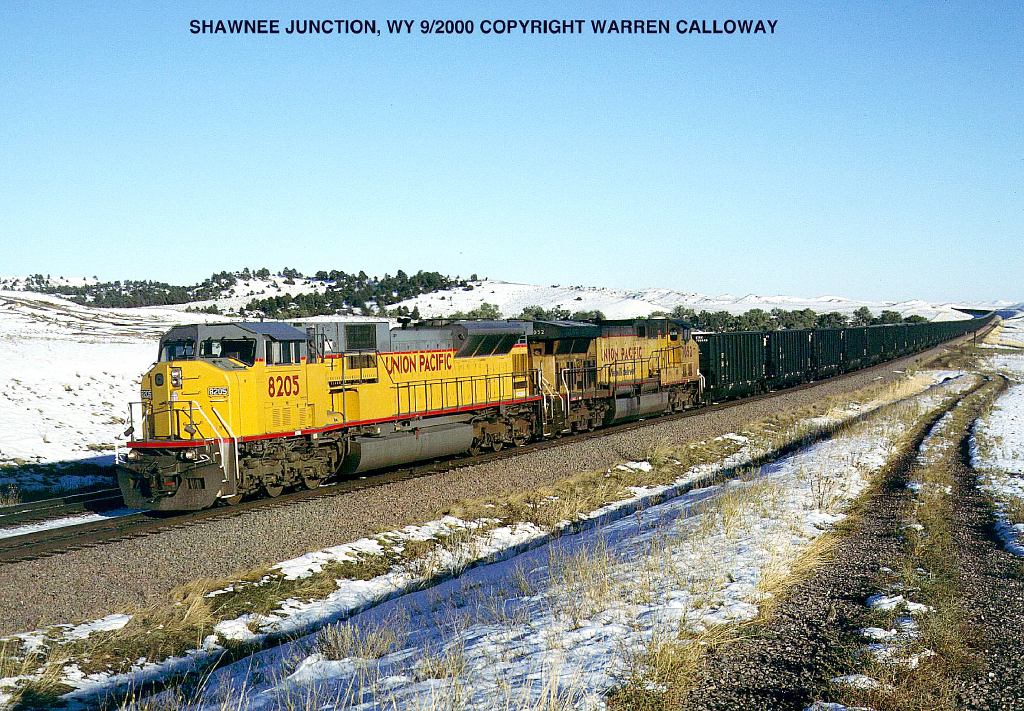 Union Pacific SD90MAC-H #8205 leads empty hoppers at Shawnee Junction, Wyoming in September, 2000. Warren Calloway photo.
Horsepower
The SD90MAC and it’s related models are, to date, the most powerful locomotive produced by EMD. The model hit the catalog in 1995 and EMD opted not to use its 16-cylinder 710G3B engine but the newly designed 16-cylinder H-engine (sometimes giving the model the name of SD90MAC-H), which allowed for the locomotive’s very powerful 6,000 horsepower.
Aside from the prime mover the SD90MAC was essentially the same as the SD70 series and SD80MAC (it was also the same length as the SD80MAC at just over 80 feet).
The '90MAC was so new when EMD first cataloged it that the 16-cylinder 265H engine it was designed to use was not even ready for production.
As such, the builder was forced to use the above mentioned 710G3B for a short time if railroads wanted or needed their orders in a hurry. These units were reclassified as the SD90-43MAC.
Reception
While the SD90-43MAC sold fairly well with Union Pacific, which purchased over 300 of them (it began receiving the locomotives in October, 1995), the original SD90MAC did very poorly mainly because the engine was not properly tested and was prone to constant mechanical trouble.
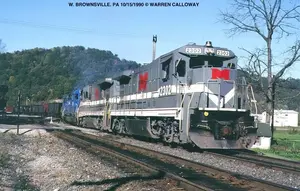
The original was also purchased by UP, along with Canadian Pacific and their total production ended at just 40 units. While over 400 units of the series have been produced (almost all of which are SD90-43MACs) the SD90MACs themselves were not well received by railroads because their lack of reliability and constant mechanical troubles (for instance, recently a set of SD90MACs went to work on the Appalachian & Ohio Railroad in central West Virginia only to be taken off the railroad due to mechanical problems).
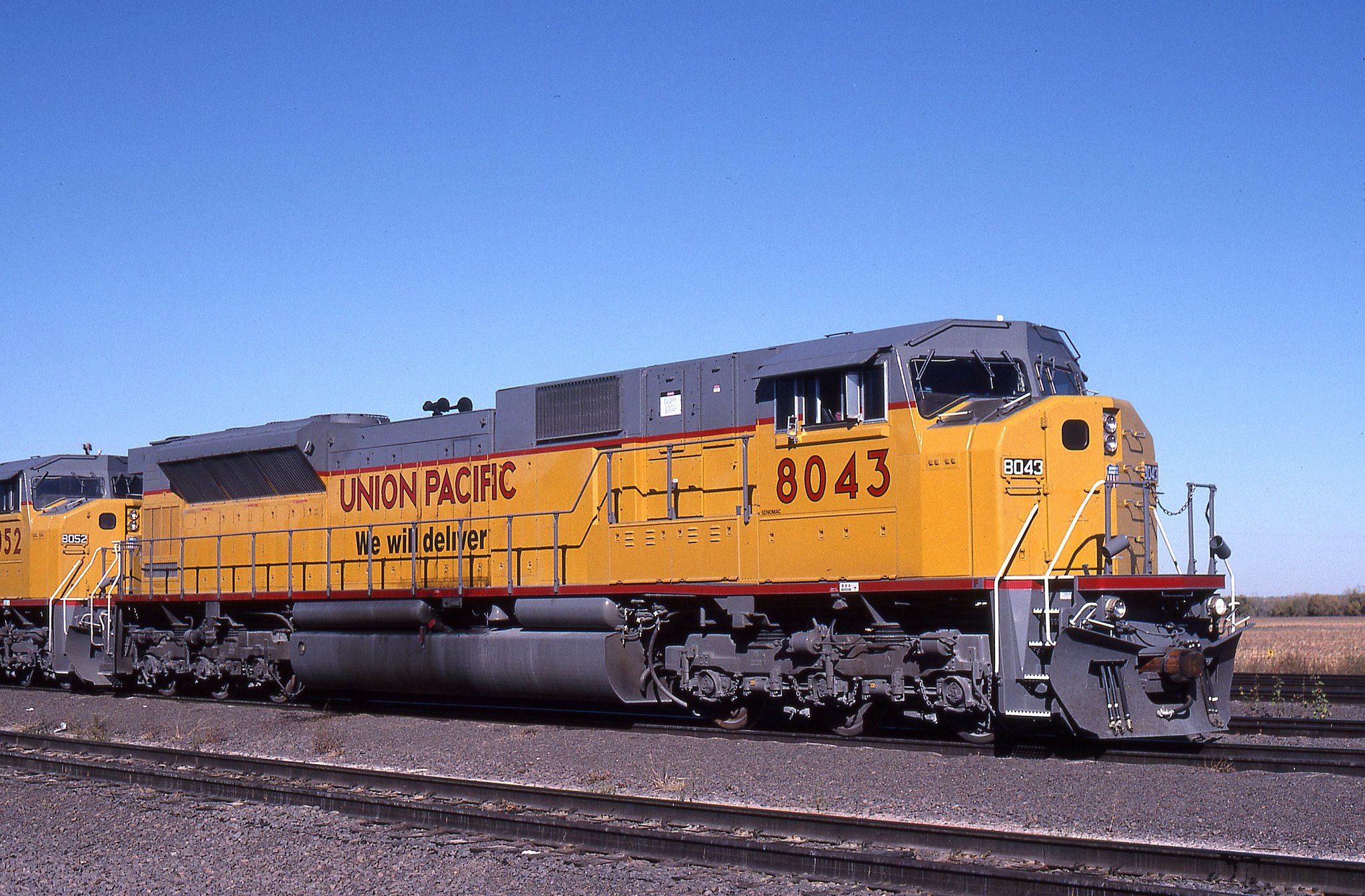 A pair of Union Pacific's recently delivered SD9043MACs, #8043 and #8052, equipped with the more reliable 710G3B-ES engine, have empties near Morrill, Nebraska on October 6, 1996. Warren Calloway photo.
Perhaps the only bright spot of the SD90MAC was that it featured EMD's highly successful HTCR-II truck (high-traction, six-axle, radial), which could steer itself into oncoming curves instead of just following the rail which greatly reduced wear to both rail and truck/axle components.
For Union Pacific it completed its order of SD90-43MACs in January 1999 with a total of 309 units numbered 8000-8308. Additionally, Canadian Pacific purchased another 61, numbered 9100-9160 and CIT Leasing bought 40 numbered 100-139.
These locomotives were all built November, 1999 and February, 2000. These is a slight variation with the original SD90MACs in that early versions featured a Phase I safety cab while later models were equipped with the Phase II design that allowed for better visibility, which located the train crew higher off the ground.
The SD90MAC's also offered the highest tractive efforts of EMD model aside from the experimental "DD" series; 200,000 pounds starting effort and 137,000 pounds continuous.
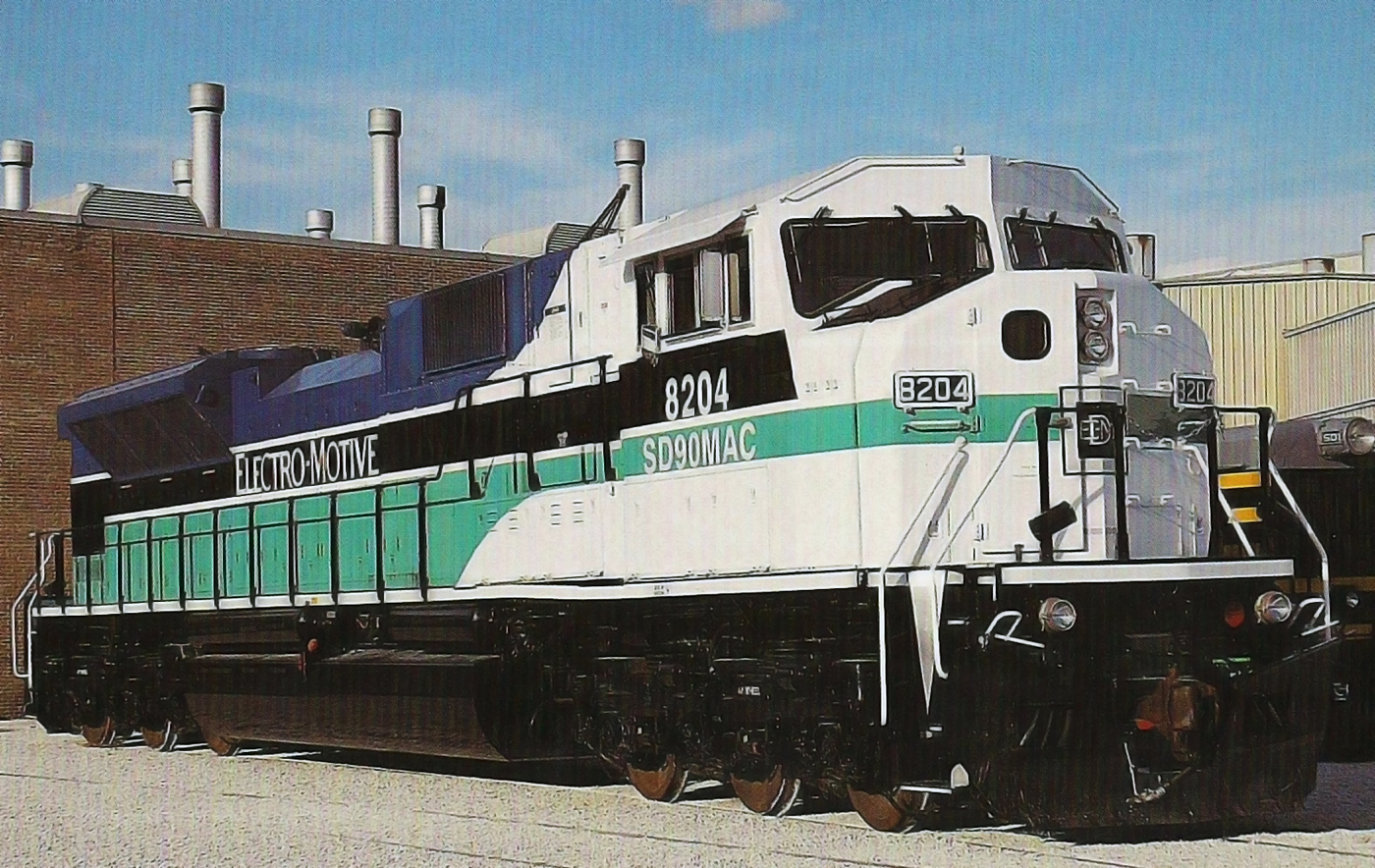 An Electro-Motive photo of brand new SD90MAC-H #8204 featured at the company's La Grange, Illinois facility during its Open House celebrating 75 years on September 21, 1997. Joe Suo photo.
Data Sheet and Specifications
| Entered Production (SD9043MAC) | 10/1995 (Union Pacific #8000) |
| Entered Production (SD90MAC-H and SD90MAC-H II) | 8/1996 (Union Pacific #8160) |
| Years Produced (SD9043MAC) | 10/1995 - 2/2000 |
| Years Produced (SD90MAC-H and SD90MAC-H II) | 8/1996 - 12/1999 |
| Engine (SD943MAC) | 710G3B-ES |
| Engine (SD90MAC-H and SD90MAC-H II) | 265H |
| Engine Builder | GM |
| Horsepower (SD9043MAC) | 4300 |
| Horsepower (SD90MAC-H and SD90MAC-H II) | 6000 |
| RPM (SD9043MAC) | 950 |
| RPM (SD90MAC-H and SD90MAC-H II) | 1000 |
| Cylinders | 16 |
| Length | 80' 2" |
| Height (Top Of Rail To Top Of Cab) | 15' 7 ½" |
| Width | 10' 3" |
| Weight (SD9043MAC) | 415,000 Lbs |
| Weight (SD90MAC-H) | 420,000 Lbs |
| Weight (SD90MAC-H II) | 425,000 Lbs |
| Fuel Capacity | 5000 Gallons |
| Air Compressor | Gardner-Denver |
| Air Compressor Model | WLASC |
| Air Brake Manufacturer | Westinghouse |
| Air Brake Schedule | 26L |
| Trucks | C-C |
| Truck Type | HTCR-II |
| Truck Wheelbase | 13' 7" |
| Wheel Size | 40" |
| Wheel Slip Control System | EM2000es (EMD) |
| Traction Motors | 1TB2830 (6), GM |
| Primary Generator | TA22/CA88, GM |
| Auxiliary Generator | GM (A8589) |
| Alternator | CA7A |
| MU (Multiple-Unit) | Yes |
| Dynamic Brakes | Yes |
| Gear Ratio | 70:17 |
| Tractive Effort (Starting) | 185,000 Lbs at 33% (SD9043MAC) |
| Tractive Effort (Starting) | 200,000 Lbs at 33% (SD90MAC-H) |
| Tractive Effort (Starting) | 205,000 Lbs at 33% (SD90MAC-H II) |
| Tractive Effort (Continuous) | 137,000 Lbs at 12 mph |
| Top Speed | 70 mph |
Production Roster
SD90MAC-H
| Owner | Road Number(s) | Quantity | Order Number | Serial Number(s) | Date Built |
|---|---|---|---|---|---|
| Union Pacific | 8160, 8201 | 2 | 956626 | 956626-1 thru 956626-2 | 8/1996 - 10/1996 |
| Union Pacific | 8202-8203, 8204 (EMDX), 8205, 8506-8507 | 6 | 956649 | 956649-1 thru 956649-4 | 2/1997 - 10/1997 |
| Union Pacific | 8508-8521 | 14 | 966715 | 966715-1 thru 966715-14 | 4/1998 - 1/1999 |
SD90MAC-H II
| Owner | Road Number(s) | Quantity | Order Number | Serial Number(s) | Date Built |
|---|---|---|---|---|---|
| Demonstrators | GM90-GM91 | 2 | 976804 | 976804-1 thru 976804-2 | 6/1998 |
| Canadian Pacific | 9300-9303 | 4 | 986903 | 986903-1 thru 986903-4 | 12/1999 |
| Union Pacific | 8522-8561 | 40 | 976833 | 976833-1 thru 976833-16 | 4/1999 - 11/1999 |
SD9043MAC
| Owner | Road Number(s) | Quantity | Order Number | Serial Number(s) | Date Built |
|---|---|---|---|---|---|
| Union Pacific | 8000-8024 | 25 | 936449 | 936449-1 thru 936449-25 | 10/1995 - 3/1996 |
| Union Pacific | 8025-8074 | 50 | 956613 | 956613-1 thru 956613-50 | 6/1996 - 10/1996 |
| Union Pacific | 8075-8178 | 104 | 966714 | 966714-1 thru 966714-104 | 1/1997 - 9/1997 |
| Union Pacific | 8179-8308 | 8 | 976800 | 976800-1 thru 976800-130 | 1/1998 - 1/1999 |
| Canadian Pacific | 9100-9111 | 12 | 976841 | 976841-1 thru 976841-12 | 10/1998 - 1/1999 |
| Canadian Pacific | 9112-9160 | 49 | 976842 | 976842-13 thru 976842-61 | 11/1998 - 12/1999 |
| CITX | 100-125 | 26 | 986927 | 986927-1 thru 986927-26 | 11/1999 - 12/1999 |
| CITX | 126-139 | 14 | 986927 | 986927-27 thru 986927-40 | 12/1999 - 2/2000 |
SD89MAC
| Owner | Road Number(s) | Quantity | Order Number | Serial Number(s) | Date Built |
|---|---|---|---|---|---|
| Demonstrator* | GM92 | 1 | 996135 | 996135-1 | 6/2000 |
* This testbed model featured a 265H engine, de-rated to 12 cylinders and boasted 4,300 horsepower. It was ultimately never sold.
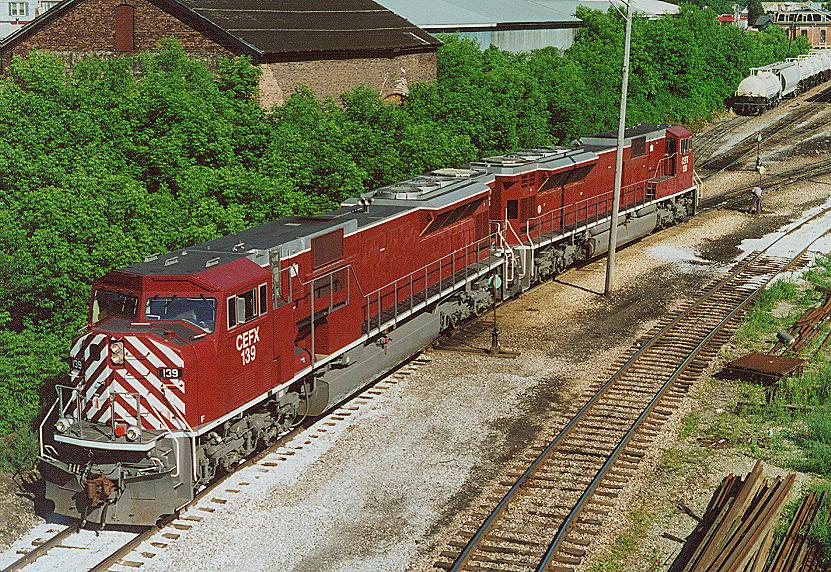 CIT Group SD9043MACs #139 and #138 are seen here on lease to the Vermont Railway at Rutland, Vermont on July 1, 2000. The regional leased these two units to test EMD's steerable trucks on the curvy and stiff Green Mountain line between Rutland and Bellows Falls. Doug Kroll photo.
While GE's version, the AC6000CW also had reliability issues, its problems where not nearly as magnified as the SD90MAC.
The designation of the SD90's "MAC" is as follows; the "M" was EMD's designation for the wide, safety cab the locomotive featured while the "AC" regarded the alternator that it featured allowing for increased tractive effort, the model TA22CA8.
For railroads, the horsepower race between GE and EMD was a learning lesson that highly powerful, single locomotives is not always a good thing even if they are reliable due to the fact that if a unit goes down so does most of your train's power supply. As such, today the generally accepted horsepower rating for locomotives is between 4,000 to 4,500.
Sources
- Foster, Gerald. A Field Guide To Trains. New York: Houghton Mifflin, 1996.
- McDonnell, Greg. Locomotives: The Modern Diesel & Electric Reference, 2nd Edition. Buffalo: Boston Mills Press/Firefly Books, 2015.
- Solomon, Brian. American Diesel Locomotive, The. Osceola: MBI Publishing, 2000.
- Solomon, Brian. EMD Locomotives. Minneapolis: MBI Publishing Company, 2006.
- Solomon, Brian. GE and EMD Locomotives: The Illustrated History. Minneapolis: Voyageur Press, 2014.
Recent Articles


-
Maryland Dinner Train Rides (2026): A Complete Guide
Sep 23, 26 05:19 PM
 2026 Western Maryland Scenic Allegheny Mountain Dinner Train—Cumberland, 3 hours, 21+, Saturday 7 p.m. Confirm on wmsr.com.
 -
Pittsburgh and Lake Erie Railroad: Map, Rosters, Photos
Sep 23, 26 03:28 PM
 Pittsburgh & Lake Erie—the Little Giant. Chartered 1875, Pittsburgh to Youngstown February 10, 1879. New York Central from 1883. Independent May 15, 1979. Last day September 11, 1992.
 -
Kansas Dinner Train Rides (2026): A Complete Guide
Sep 23, 26 01:11 PM
 2026 Abilene & Smoky Valley Smoky Valley Limited—two hours from the Rock Island Depot, about $72–$110, dates into December 31. Confirm on asvrr.org.
 -
The Belpaire Firebox: Simplicity and Greater Power
Sep 23, 26 01:03 PM
 Belpaire firebox—Alfred Belpaire, 1864. Square crown, straight staybolts at right angles. Pennsylvania standard after the 1880s. Great Northern was the other big user.
 -
Pennsylvania Railroad (PRR) Electric Roster: All Classes
Sep 23, 26 12:57 PM
 Pennsylvania Railroad electrics—DD1s into Penn Station, P5s, 139 GG1s, B1 switchers, and 66 E44s. Class roster, 1905–1963. No unit-by-unit GG1 list.
 -
Penn Central Diesel Roster: All-Time
Sep 23, 26 12:46 PM
 Penn Central diesel roster—PRR classes on NYC, PRR, and New Haven power. New orders carry serials. GP38-2s are 7940-8162. Conrail April 1, 1976.
 -
Penn Central Railroad: Map, History, Logo
Sep 23, 26 12:32 PM
 Penn Central—Pennsylvania and New York Central merged February 1, 1968. New Haven January 1, 1969. Section 77 bankruptcy June 21, 1970. Conrail April 1, 1976.
 -
Iowa Dinner Train Rides (2026): A Complete Guide
Sep 23, 26 11:42 AM
 2026 Boone & Scenic Valley Wolf Dinner Train—Saturdays May–October, Union Pacific dining cars, Bass Point Creek High Bridge. Confirm on bsvrr.com.
 -
Pennsylvania-Reading Seashore Lines: Map, Roster, History
Sep 23, 26 12:32 AM
 Pennsylvania-Reading Seashore Lines—Atlantic City Railroad renamed July 15, 1933. Pennsylvania two-thirds, Reading one-third. Camden to Atlantic City, Cape May, and Millville. Conrail April 1, 1976.
 -
Wisconsin Dinner Train Rides (2026): A Complete Guide
Sep 23, 26 12:28 AM
 2026 Wisconsin Great Northern dinner train in Trego—$105, Namekagon River, January 8–31 and May 5–December 17. Mid-Continent’s remaining 2026 calendar is snack and scenic. Confirm on the railroad.
 -
New Hampshire Dinner Train Rides (2026): A Complete Guide
Sep 23, 26 12:21 AM
2026 Cafe Lafayette Dinner Train in North Woodstock—five courses, 2 hours, from $125. Children under 6 not allowed. Confirm on nhdinnertrain.com. -
PRR "GG-1" Locomotives: Roster, Photos, Specs
Sep 23, 26 12:13 AM
 PRR GG1 electric: 139 locomotives, 4800–4938, built 1934–1943. Specs, Loewy shell, Amtrak numbers, and the last revenue trip on October 28, 1983.
 -
Montana Dinner Train Rides (2026): A Complete Guide
Sep 23, 26 12:04 AM
2026 Charlie Russell Chew Choo from Hanover, near Lewistown—4.5 hours, prime rib, adult $151. Remaining listed dates sold out. Confirm on montanadinnertrain.com. -
Kentucky Dinner Train Rides (2026): A Complete Guide
Sep 22, 26 11:52 PM
2026 My Old Kentucky Dinner Train in Bardstown—four courses, 2.5 hours, adult $116. Confirm on kydinnertrain.com. -
Tennessee Dinner Train Rides (2026): A Complete Guide
Sep 22, 26 11:45 PM
2026 TVRM Chattanooga Dinner Train—Grand Junction, select Fri/Sat March 6–October 24, 6 p.m., from $110. Confirm on tvrail.com. -
The Trainphone: PRR's Wireless Radio System
Sep 22, 26 11:17 PM
 Pennsylvania Trainphone—Union Switch & Signal inductive telephone. Bel-Del trial 1941, Frenchtown November 29, 1943. Carriers at 88 kHz and 144 kHz. Out of service April 30, 1967.
 -
Pennsylvania (PRR) Steam Roster: Post 1906
Sep 22, 26 11:13 PM
 ennsylvania steam after 1906—H8, H9, and H10 Consolidations, 574 L1s Mikados, 598 I1s Decapods, 425 K4s Pacifics, 301 M1 Mountains. Drury’s grid. Last steam November 30, 1957.
 -
Pennsylvania Railroad (PRR) Diesel Roster: All-Time List
Sep 22, 26 10:59 PM
 Pennsylvania diesel roster—SW 3908 in June 1937, then Alco, Baldwin, EMD, Fairbanks-Morse, GE, and Lima. Serials and Alco order numbers. Penn Central February 1, 1968.
 -
Pennsylvania Railroad: Map, Logo, History, Rosters
Sep 22, 26 10:02 PM
 Pennsylvania Railroad—chartered April 13, 1846, Harrisburg–Pittsburgh, Horseshoe Curve 1854, Penn Station 1910. Standard Railroad of the World. Penn Central February 1, 1968.
 -
Pennsylvania Dinner Train Rides (2026): A Complete Guide
Sep 22, 26 04:48 PM
 2026 Pennsylvania dinner trains—Colebrookdale Dining Class in Boyertown and Strasburg Dinner on the Rails. Confirm on each railroad.
 -
New York, Ontario & Western Steam Locomotives: History & Roster
Sep 22, 26 04:40 PM
 NYO&W steam—camelback 2-8-0s and 2-6-0s, Class X Bull Moose 2-10-2s, Class Y and Y-2 Mountains. All-time class roster. Steam finished in the summer of 1948. None saved.
 -
New York, Ontario & Western Diesel Roster: All-Time
Sep 22, 26 04:36 PM
 NYO&W diesel—five GE 44-tonners 101-105, eighteen FTs, seven F3s, twenty-one NW2s. Serials and the NW2 order E824. Railroad liquidated March 29 1957.
 -
New York, Ontario & Western Railway: Map, Roster, History
Sep 22, 26 04:26 PM
 New York, Ontario & Western—New York & Oswego Midland chartered January 11 1866, O&W January 21 1880. Scranton coal, West Shore rights. Last train March 29 1957.
 -
Massachusetts Dinner Train Rides (2026): A Complete Guide
Sep 22, 26 04:16 PM
 2026 Cape Cod Dinner Train—Hyannis, Buzzards Bay, and North Falmouth. Four-course, 3–3½ hours, from $99.99. Confirm on capetrain.com.
 -
Colorado Dinner Train Rides (2026): A Complete Guide
Sep 22, 26 03:51 PM
 2026 Royal Gorge Route First Class Dinner and Lunch from Cañon City. About 2 hours, 12+, from $199+. Confirm on royalgorgeroute.com.
 -
New York and Long Branch Railroad: A PRR & CNJ Subsidiary
Sep 22, 26 03:11 PM
 New York & Long Branch—chartered April 8 1868, Perth Amboy–Long Branch July 1 1875, Bay Head Junction 1881. Jersey Central and Pennsylvania trains. Conrail April 1 1976. NJ Transit North Jersey Co…
 -
Monongahela Railway Steam Locomotives: History & Roster
Sep 22, 26 01:34 PM
 Monongahela steam—H-5 Consolidations, USRA light Mikados 170–179, Baldwin L-2s, ex-P&LE L-3s. All-time roster. Last steam May 26, 1954.
 -
Monongahela Railway Diesel Roster: All-Time
Sep 22, 26 01:16 PM
 Monongahela diesel—27 Baldwin S-12s, NYC RF-16 sharks, P&LE GP7s, GP38s 2000–2004, Super 7s 2300–2310. Serials and orders. Last steam May 26, 1954.
 -
Monongahela Railway: Map, Rosters, History
Sep 22, 26 01:14 PM
 Monongahela Railway—incorporated December 31 1900, Railway July 1 1915. Brownsville–Fairmont coal road. Last steam May 26 1954. Conrail May 1 1993.
 -
Virginia Scenic Railway Dining (2026)
Sep 22, 26 01:09 PM
 2026 Virginia Scenic Railway—Blue Ridge Flyer Dining Class from Staunton, about 3 hours, plated meal. Sunday Brunch from Louisa, about $132. Confirm on virginiascenicrailway.com.
 -
Virginia Dinner Train Rides (2026): A Complete Guide
Sep 22, 26 01:03 PM
 2026 Virginia Scenic Railway—Blue Ridge Flyer Dining Class from Staunton, Alleghany Special Dining Class, Sunday Brunch from Louisa. Confirm on virginiascenicrailway.com.
 -
Oregon Dinner Train Rides (2026): A Complete Guide
Sep 22, 26 12:51 PM
 2026 Oregon has no plated dinner train on the calendar. Mount Hood is scenic with snacks. Oregon Coast Scenic’s evening ride is the 21+ Moonlight with sandwiches.
 -
Maine Central Steam Locomotives: History & Roster
Sep 22, 26 12:33 PM
Maine Central steam—Ten-Wheelers, W-class Consolidations, S-class Mikados, C-class Pacifics, Hudsons 701 and 702. Post-1900 roster after Drury. Last steam June 13, 1954. -
Maine Central Diesel Roster: All-Time
Sep 22, 26 12:04 PM
 Maine Central diesel—railcar 901, HH660s, GP7s, E7s, F3s, GP38s, U18Bs, ex-Rock Island U25Bs. All-time roster with serials and orders. Last steam June 13, 1954.
 -
Maine Central Railroad: Map, Logo, Rosters, History
Sep 22, 26 11:36 AM
 Maine Central—Androscoggin & Kennebec and Penobscot & Kennebec, October 28 1862. Pine Tree Route. Mountain Division, Portland–Bangor–Vanceboro. Last steam June 13 1954. Guilford June 1981.
 -
Maryland and Pennsylvania Railroad: Map, Roster, Logo
Sep 22, 26 12:14 AM
 Ma & Pa—Peach Bottom 1868, Maryland & Pennsylvania February 12 1901, Baltimore to York. Last steam November 29 1956. York Railway December 1 1999.
 -
New York Dinner Train Rides (2026): A Complete Guide
Sep 21, 26 11:59 PM
2026 New York dinner train—Adirondack Dinner Train from Utica, 6 p.m., about 3 hours, First Class from $139. Arcade & Attica mystery dinner is served at Curriers. Confirm on the railroad. -
California Dinner Train Rides (2026): A Complete Guide
Sep 21, 26 11:49 PM
 2026 California dinner trains—Napa Valley Wine Train plated meals, River Fox brunch and mystery dinner, Roaring Camp barbecue at camp. Confirm on each railroad.
 -
Roaring Camp Starlight Dinner Party (2026)
Sep 21, 26 11:33 PM
 2026 Roaring Camp Starlight Dinner Party—Beach Train from the Santa Cruz Boardwalk, barbecue at Felton, ride back after dark. Confirm on roaringcamp.com.
 -
Long Island Rail Road Steam Locomotives: History, Roster & Photos
Sep 21, 26 11:29 PM
 Long Island steam—G5s 20–50, H10s 101–119, last steam at Hicksville October 8, 1955. Post-1898 class roster.
 -
Long Island Rail Road Diesel Roster: All-Time
Sep 21, 26 11:24 PM
 Long Island diesel—boxcab 401 in 1925, FM C-Liners, RS-3s, C-420s, GP38-2s, DE30AC and DM30AC. All-time roster with serials and orders.
 -
Long Island Rail Road: Map, History, Pictures, Logo
Sep 21, 26 08:27 PM
 Long Island Rail Road—Brooklyn & Jamaica 1836, Greenport 1844, Pennsylvania control 1900, Penn Station 1910. MTA since 1968. Steam and diesel rosters.
 -
Oregon Coast Scenic Railroad (2026): Sunset Dinner and Moonlight
Sep 21, 26 02:40 PM
 2026 Oregon Coast Scenic does not post the old four-course Sunset Dinner. The evening ride is the 21+ Moonlight Excursion from Garibaldi, with pre-ordered sandwiches. Confirm on oregoncoastscenic.org.
 -
Adirondack Dinner Train (2026): Dates, Tickets & What to Expect
Sep 21, 26 01:38 PM
 2026 Adirondack Dinner Train—Utica Union Station, 6 p.m., about 3 hours to Remsen. First Class from $139. Chef Patrick O’Connor. Confirm on adirondackrr.com.
 -
Lehigh Valley Steam Locomotives: History, Roster & Photos
Sep 21, 26 01:31 PM
 Lehigh Valley steam—Camelback Consolidations, 2-10-2s, K-class Pacifics, six Mountains, Wyoming 4-8-4s. Post-1900 roster after Drury. Last steam September 14, 1951.
 -
Lehigh Valley Diesel Roster: All-Time
Sep 21, 26 01:23 PM
 Lehigh Valley diesel—boxcabs 1926, FTs 1945, F3/F7, FA/PA, C628 Snowbirds, GP38-2s, U23Bs. All-time roster with serials and orders. Last steam September 14, 1951.
 -
Lehigh Valley Railroad: Map, Roster, Logo, History
Sep 21, 26 01:09 PM
 Lehigh Valley—DLS&S 1847, named January 7 1853, Mauch Chunk–Easton September 12 1855. Route of the Black Diamond. Jersey City–Buffalo. Conrail April 1 1976.
 -
Wisconsin Great Northern Dinner Train (2026)
Sep 21, 26 12:47 PM
2026 Wisconsin Great Northern dinner train—Trego, $105, Namekagon River. January 8–31 and May 5–December 17. Confirm on spoonertrainride.com. -
Lehigh and New England Railroad: Map, Rosters, History
Sep 21, 26 12:33 AM
 Lehigh & New England—South Mountain & Boston 1873, named April 2 1895. Anthracite, cement, Maybrook. Last Camelbacks, Alco FAs. Voluntary shutdown October 31 1961.
 -
TVRM Chattanooga Dinner Train (2026): Dates, Tickets & What to Expect
Sep 21, 26 12:20 AM
 2026 TVRM Chattanooga Dinner Train Experience—Grand Junction, select Fri/Sat March 6–October 24, three-course, 2–3 hours, from $110. Confirm on tvrail.com.