
- Home ›
- Fallen Flags ›
- Frisco
St. Louis-San Francisco Railway (Frisco): Map, Rosters, History
Last revised: October 12, 2024
By: Adam Burns
The St. Louis-San Francisco Railway, commonly known as the
"Frisco," has a storied history of two halves. During its first 60 years the company struggled mightily with a tumultuous history of name changes and bankruptcies.
It tried many times to create a transcontinental corridor but failed in every attempt. The much larger Atchison, Topeka & Santa Fe was predominantly responsible for this setback as it sought its own route to the coast.
History
After settling into a regional role serving parts of Kansas, Missouri, Texas, Oklahoma, Arkansas, Mississippi, Tennessee, and Alabama the Frisco blossomed into a successful railroad. Its status was further enhanced by reaching the Gulf Coast (Florida) during the 1920s where the lucrative petrochemical industry later developed.
Following one last bankruptcy, brought about by the depression, it spent the last 30 years as a healthy carrier. Throughout its corporate history the Frisco was not your typical Midwestern "granger" system as it carried a culture all its own, right down to a self-designed coonskin logo.
Both its own prosperity and the merger movement were growing during the 1970s, which led to its acquisition by western giant Burlington Northern in 1981.
 An Electro-Motive company photo of recently out-shopped St. Louis-San Francisco (Frisco) E8A #2015, named for thoroughbred "Twenty Grand," during February of 1950. The horse nearly won the Triple Crown in 1931, finishing second to 'Mate' in the Preakness that year.
The St. Louis-San Francisco Railway's story begins in Mach of 1849 when the Pacific Railroad (PR) was chartered by the State of Missouri for the purpose of linking St. Louis with the Pacific coast.
The transcontinental concept was an aspiring but daunting one given that no railroad had yet accomplished such a feat (and ultimately would not for another two decades). Nevertheless, the project pressed forward and by July of 1853 the first 38 miles to Franklin, Missouri (now known as Pacific) was finished.
Alas, like so many grand schemes it became extremely difficult maintaining the needed cashflow and before long the PR ran out of money.
In his book, "Classic American Railroads: Volume III," author and historian Mike Schafer notes that to procure further funding and interest the Southwest Branch of the Pacific Railroad was incorporated for the purpose of opening a southwestern corridor from Franklin to Rolla.
It is here where the Frisco's story begins. Construction was launched on July 19, 1853 but required upwards of seven years before the line was finally completed in 1860.
Before further work could be undertaken the country was plunged into the Civil War. Damage sustained during the conflict, coupled with further financial difficulties, placed the entire PR system under Missouri state control in February of 1866.
At A Glance
St. Louis - Springfield - Tulsa - Dallas/Fort Worth Tulsa - Oklahoma City - Quanah, Texas Tulsa - Avard, Oklahoma Beaumont, Kansas - Enid, Oklahoma - Vernon, Texas Springfield - Clinton, Missouri - Kansas City Kansas City - Fort Scott, Kansas - Springfield - Memphis, Tennessee - Birmingham, Alabama Fort Scott - Parsons - Ellsworth, Kansas Monnett, Missouri - Cherryvale, Kansas Monnett - Fort Smith, Arkansas - Paris, Texas Fayetteville, Arkansas - Henrietta, Oklahoma Ardmore - Hugo, Oklahoma - Hope, Arkansas St. Louis - Memphis Cape Girardeau, Missouri - Hoxie, Arkansas Amory, Mississippi - Pensacola, Florida | |
Freight: 286 Passenger: 23 Switchers: 102 | |
Freight Cars: 17,889 Passenger Cars: 230 | |
A few months later, in June of 1866, the original Pacific Railroad between St. Louis and Kansas City was sold while the Southwest Branch fell into the hands of General John Fremont.
Over the years he had been involved with numerous projects and renamed his latest investment as the Southwest Pacific Railroad with continued aspirations of reaching San Francisco. The general's grand ambitions lacked any strong financial backing, however, and he was never able to build beyond Rolla.
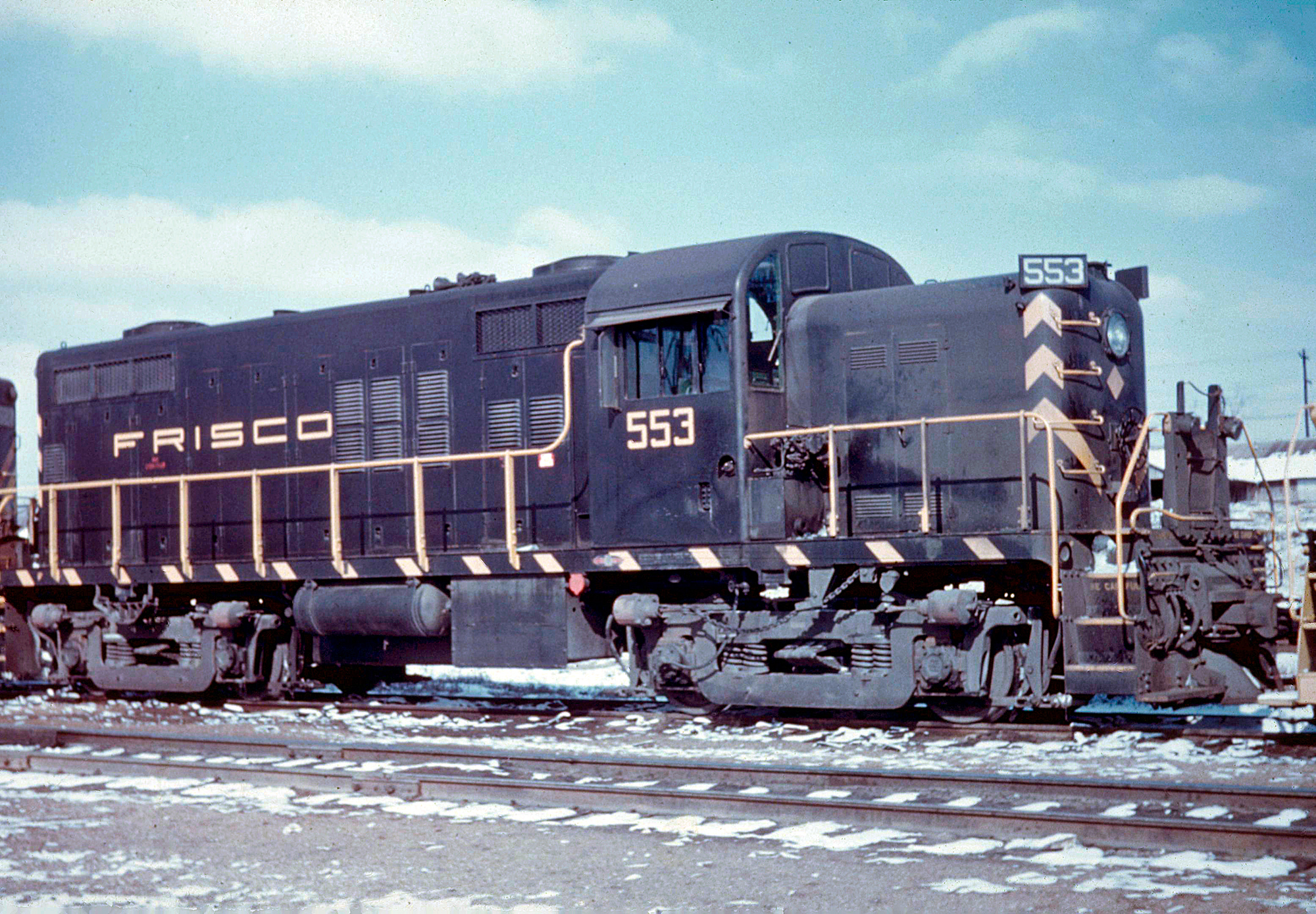 Frisco RS2m #553, retrofitted with an EMD power plant which required a Geep hood, is seen here in Springfield, Missouri, circa 1970. American-Rails.com collection.
The property was subsequently reacquired by the state in June of 1867 whereupon it became the South Pacific Railroad in May of 1868. Under this latest incarnation the system maintained transcontinental intentions as rails were extended from Rolla to Springfield with grading completed as far as Seneca.
Before further work could be undertaken monetary shortfalls led to yet another name change in 1870 as the Atlantic & Pacific Railway. The A&P remained focused on the west coast although, despite its grandiose name, was primarily interested in a western route from Springfield only.
The Coonskin Logo
Arguably the Frisco's most identifiable feature was its unique logo. The railroad remained true to its Ozark Mountain heritage and paid homage to such through its iconic emblem.
In Mr. Collias's book he relates the story, handed down through the company, which led to its creation:
"As related by the company, the station agent at Neosho, Missouri, in 1900 augmented his income by trapping and skinning raccoons and selling the pelts. His practice was to tack hides up to dry on the west end of the depot building.
One day, after an obviously successful evening of hunting, the private car of Vice-President G.H. Nettleton rolled into the station in full view of the coonskins tacked up to dry.
When Mr. Nettleton inquired about the use of company property for hide tanning, the station agent replied that it was very hard to support a family on his salary of $1.25 for a ten-hour work day and his supplemental income was a must.
Then Nettleton asked, somewhat accusingly, 'Don't you know railroading comes first?', and then grinned and said, 'Well, a hobby is different, how much for one of those coonskins?' Following an exchange of two dollars, Mt. Nettleton re-boarded his private car with the coonskin, leaving a puzzled station agent behind.
Shortly thereafter a drawing indicative of a tightly stretched coonskin with the word FRISCO enclosed within its boundaries appeared in the corporate office and the Frisco trademark was born."
 From the fireman's side of the cab of Frisco's train #808, the northbound "Sunnyland," eases to a stop at the small community of St. Marys, Missouri on April 16, 1963. Roger Puta photo.
Despite Fremont's lack of success he was able to secure roughly one million acres in federal land grants, which greatly aided the A&P's efforts. By 1870 the railroad was operating a continuous, 300-mile corridor from Pacific, Missouri to Vinita, Indian Territory (later Oklahoma).
It had began efforts on a disconnected western segment between Isleta, New Mexico and Needles, California before financial struggles arose and the company slipped into bankruptcy once again on October 30, 1875. What followed was a complicated corporate shakeup.
At that time the A&P controlled not only the previously mentioned trackage but also the original Pacific Railroad (reorganized as the Missouri Pacific Railway in 1872) main line between St. Louis and Kansas City.
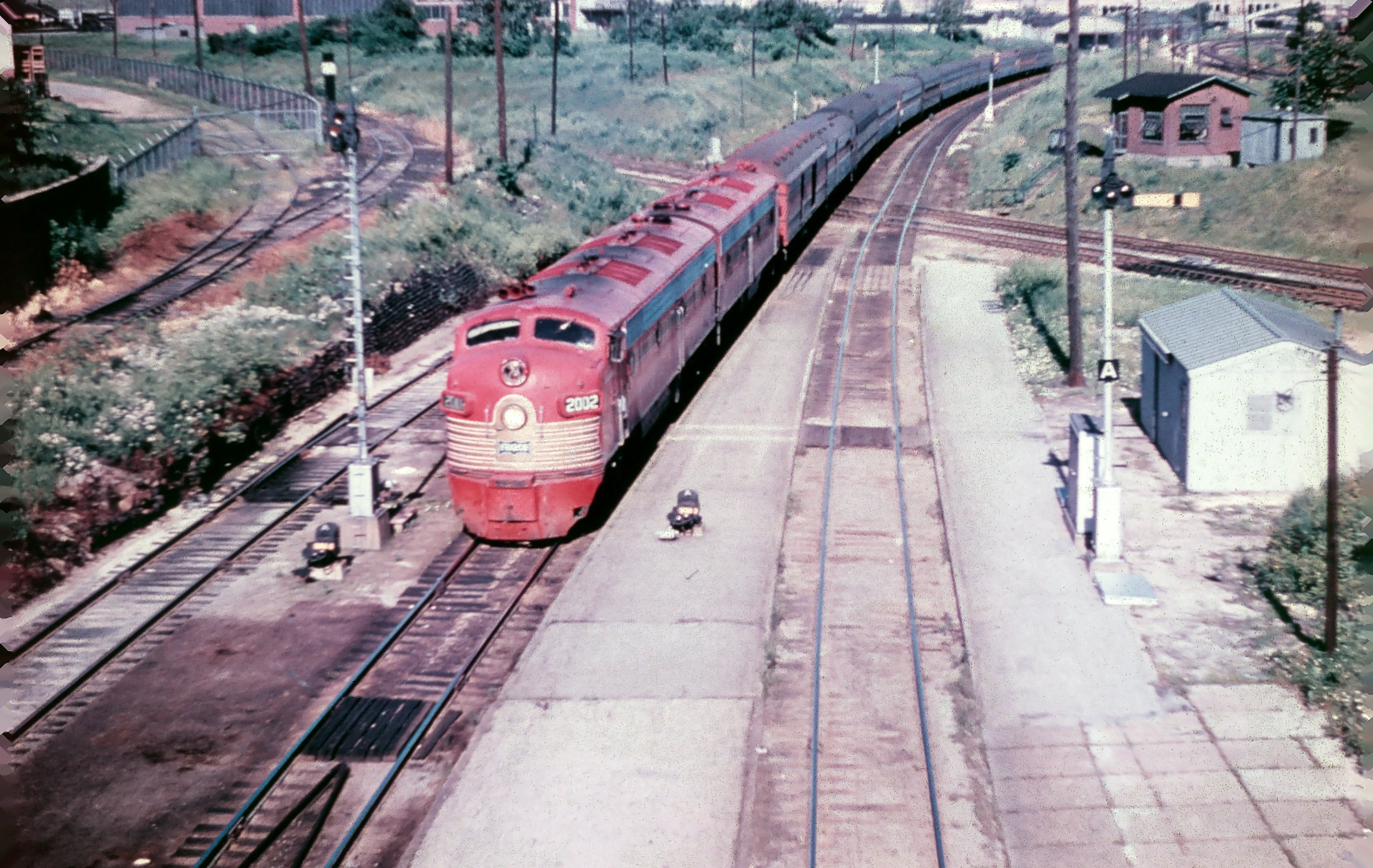 A pair of Frisco E8A's, led by #2002, rattle across the Missouri Pacific diamonds with train #10, the eastbound "Meteor," at Tower Grove, Missouri on June 23, 1957. American-Rails.com collection.
Expansion
On September 11, 1876 the St. Louis & San Francisco Railway was incorporated for the purpose of acquiring the A&P's assets between Pacific-Vinita while the newly formed Missouri Pacific would pick up the St. Louis-Kansas City corridor.
With now entirely separate managements, the StL&SF no longer had a direct entry into St. Louis. For some time it utilized MP trackage rights but the high rental charges of this affair led to the opening of its own line in 1883.
Passenger Trains
Black Gold: (Tulsa - Fort Worth)
The Firefly: (Tulsa - Oklahoma City)
Kansas City-Florida Special: (Kansas City - Jacksonville)
Memphian: (St. Louis - Memphis)
Meteor: (St. Louis - Oklahoma City/Fort Smith)
Oklahoman: Originally connected Kansas City and Tulsa and later served St. Louis and Oklahoma City.
Southland: (Kansas City - Birmingham)
Sunnyland: (Kansas City/St. Louis - Atlanta/Pensacola)
Texas Special: (St. Louis - Dallas/Fort Worth - San Antonio)
Will Rogers: (St. Louis - Oklahoma City/Wichita)
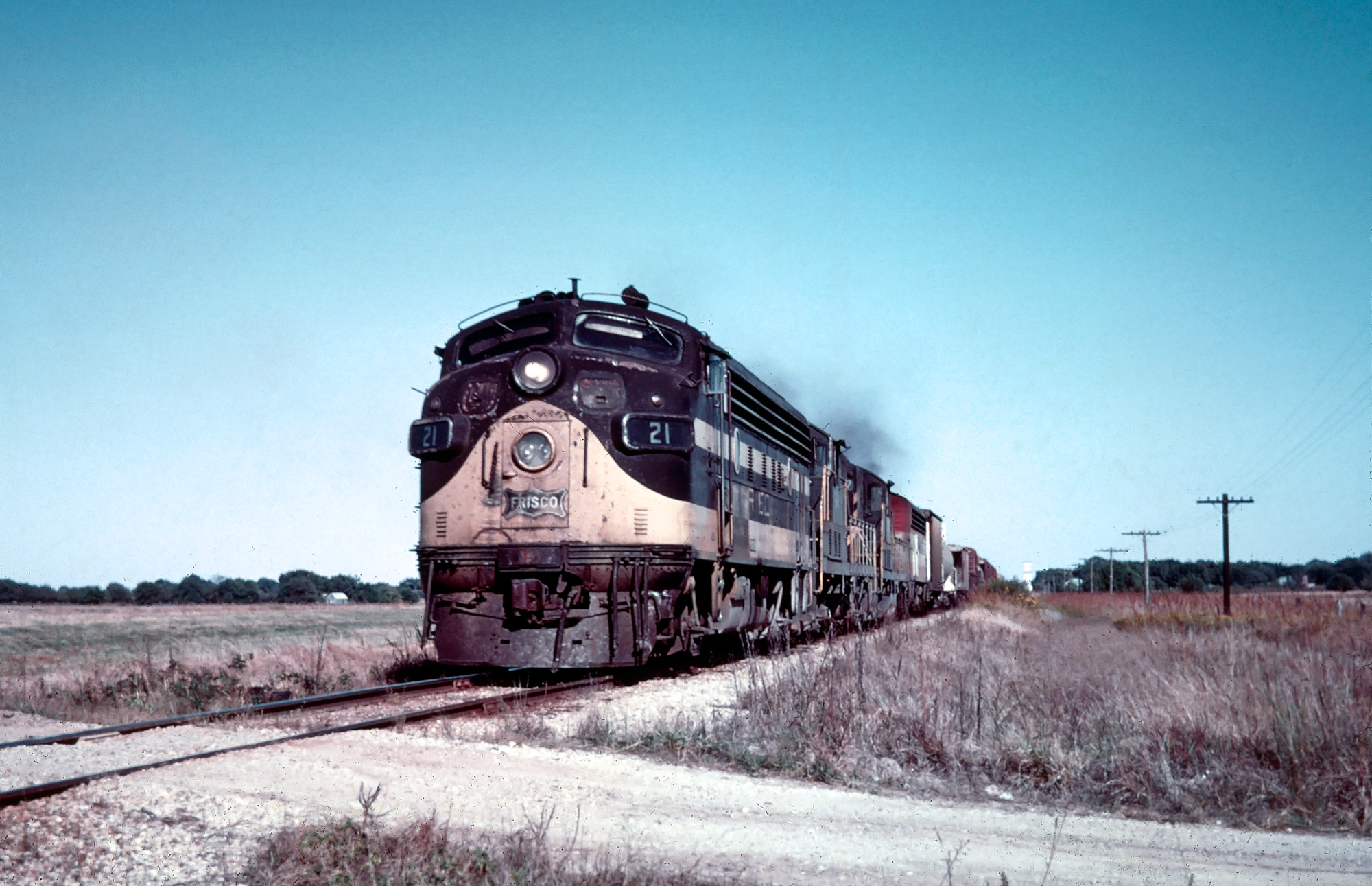 Frisco F7A #21 leads a general manifest westbound over a rural grade crossing near Altamont, Kansas, circa 1966. Mac Owen photo. American-Rails.com collection.
During the 1880's StL&SF established routes throughout the southern Midwest as it continued to work on a California extension. This new trackage included:
- Pierce City, Missouri - Wichita, Kansas; originally finished in 1880 it was pushed west to Ellsworth in 1888 for a connection with Union Pacific.
- An extension of the main line to Sapulpa, via Tulsa, by 1886.
- Finally, a branch from Monett, Missouri - Paris, Texas, completed in 1887, opened an interchange with the Gulf, Colorado & Santa Fe, a Santa Fe subsidiary.
By 1890 it boasted a network of 1,800 miles. Unfortunately, hopes of reaching the west coast were eventually dashed. According to Keith Bryant, Jr.'s book, "History of the Atchison, Topeka, and Santa Fe Railway," the new Frisco intended to establish a California corridor by working in conjunction with the Santa Fe.
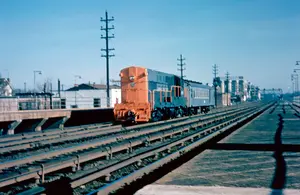
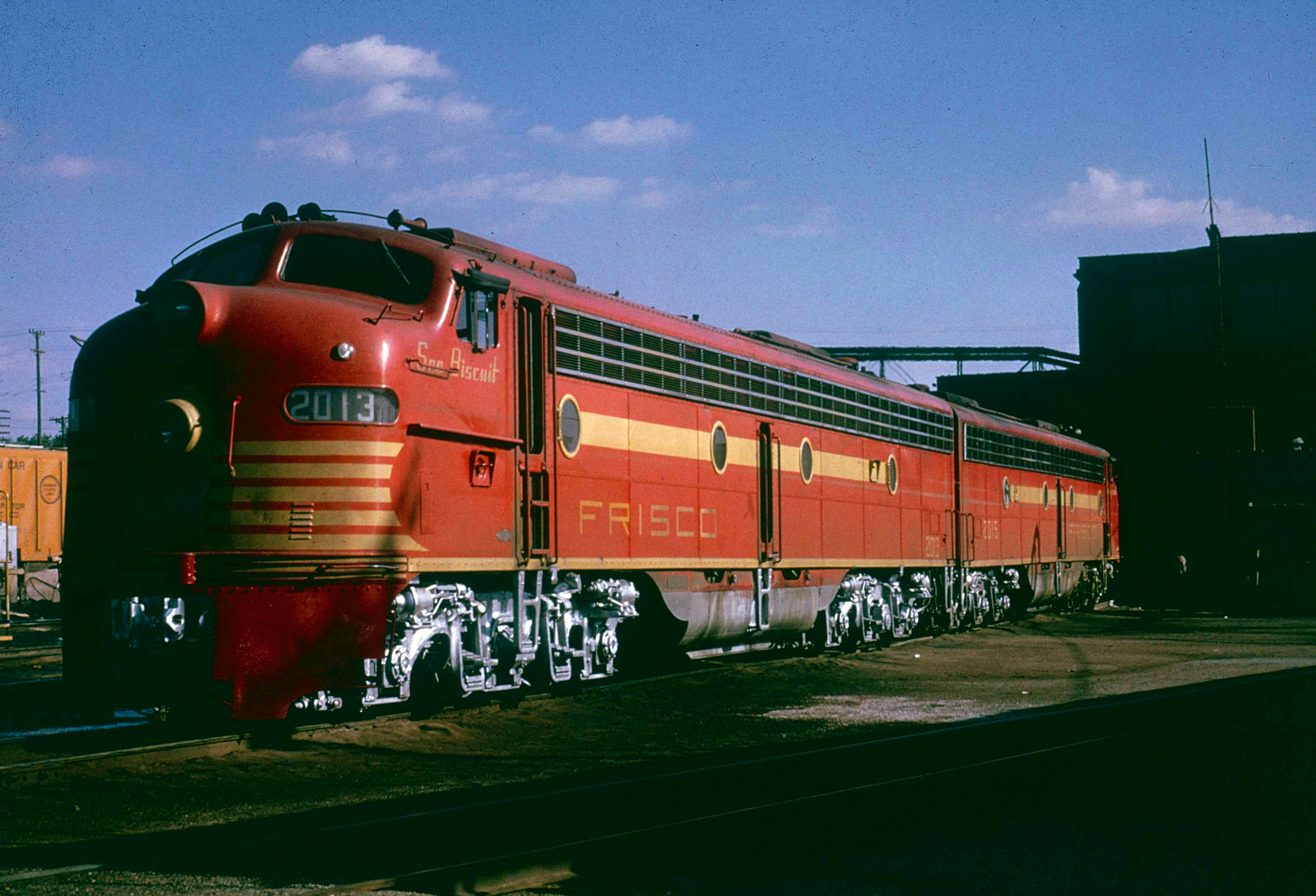 Frisco E8A's, #2013 ("Sea Biscuit") and #2015 ("Twenty Grand") layover at Lindenwood Yard in St. Louis during the early 1960s. American-Rails.com collection.
The much larger railroad would be used from a connection at Wichita to Albuquerque where the StL&SF would then use its new line as far west as Needles and a Southern Pacific interchange. The AT&SF realized the potential danger of this new threat and worked out a comprise with Frisco officials.
What was known as the Tripartite Agreement was signed by both parties on November 14, 1879 which essentially gave Santa Fe total control of the railroad and A&P charter into California.
Things remained this way until the financial Panic of 1893 forced the Frisco back into receivership. It emerged in June of 1896 as the St. Louis-San Francisco Railroad and free of Santa Fe's influence.
System Map (1933)
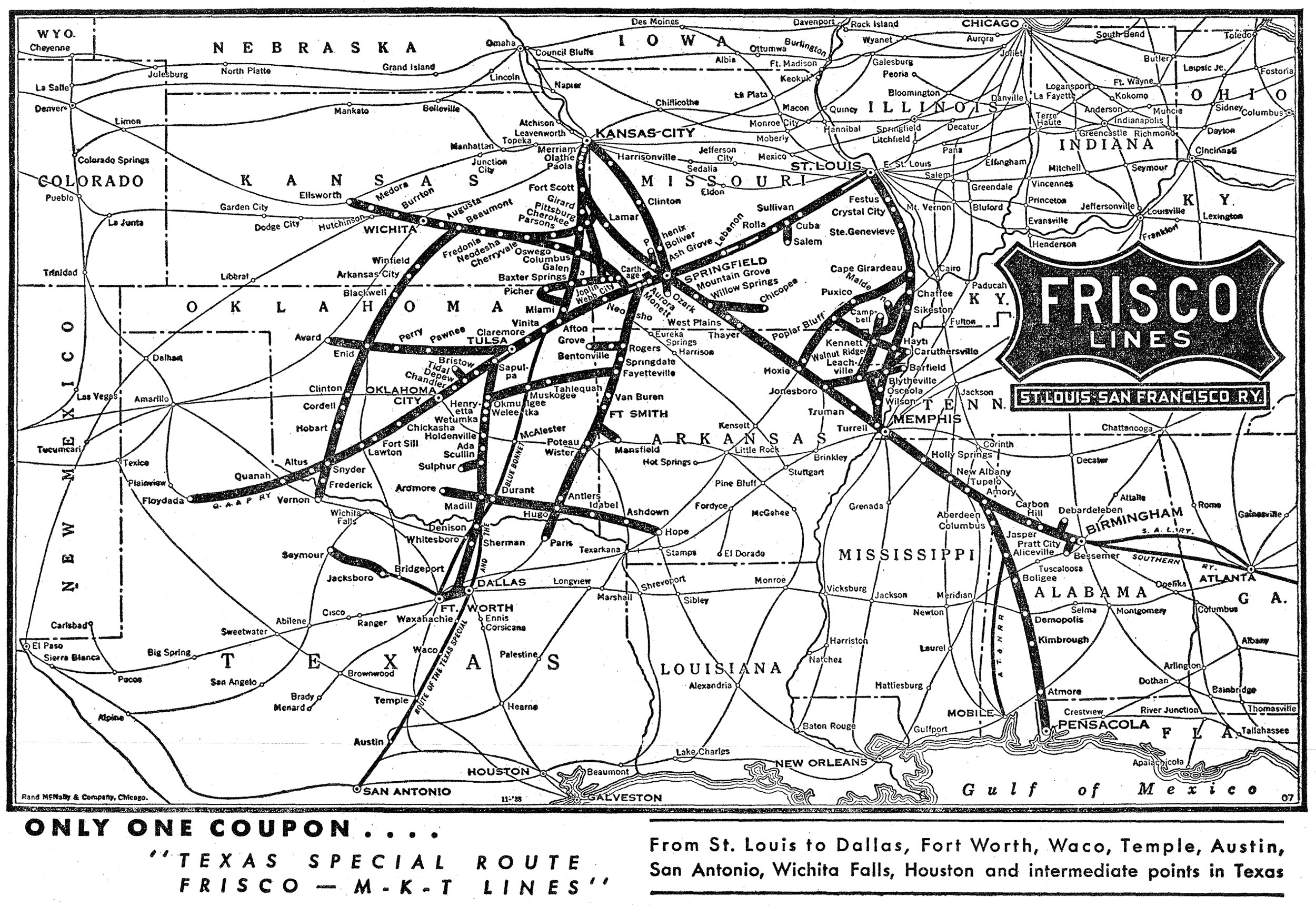
Once independent the railroad began another round of rapid expansion as it centered on a Midwestern network only:
- Its main line was extended west of Sapulpa to Oklahoma City in 1898 and finally Altus, Oklahoma in 1903.
- In 1909 it gained control of the Quanah, Acme & Pacific which extended this western terminus to Floydada, Texas. For many years the location was an important interchange with the Santa Fe.
- South of Sapulpa service opened to Denison, Texas in 1901.
- It gained access to Carrolton by purchasing the small Red River, Texas & Southern Railway while trackage rights over the St. Louis Southwestern and Chicago, Rock Island & Pacific (Rock Island) provided access into Dallas/Fort Worth.
- In 1898 it first reached Kansas City on a new corridor built as the Kansas City, Osceola & Southern (later nicknamed the "High Line") from Springfield, Missouri via Clinton and Osceola.
- It completed an east-west branch between Ardmore, Oklahoma and Hope, Arkansas in 1903 (built as the St. Louis, San Francisco & New Orleans).
- Lastly, four years later a new branch opened between Beaumont, Kansas and Vernon, Texas which linked Wichita with its Altus line.
Its largest single acquisition was the 1901 lease of the Kansas City, Fort Scott & Memphis Railway (KCFtS&M) which joined Kansas City with Baxter Springs, Kansas (a connection later opened between Baxter Springs and Frisco's main line at Afton, Oklahoma).
 One of the Frisco's passenger-model GP7's, #617 was photographed here at Baxter Springs, Kansas, circa 1970. Mac Owen photo. American-Rails.com collection.
In turn, the KCFtS&M also controlled the Kansas City, Springfield & Memphis (Springfield-Memphis, Tennessee) as well as the Kansas City, Memphis & Birmingham (Memphis-Birmingham, Alabama).
Another interesting subsidiary was the Kansas City, Clinton & Springfield which roughly paralleled the "High Line" between Springfield and Kansas City albeit over a less noteworthy route.
It was notoriously referred to as the "Leaky Roof" and before its abandonment offered the Frisco one of three different options into Kansas City (the other running between Springfield and Fort Scott).
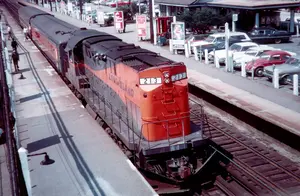
 Frisco E8A #2019, named for the thoroughbred "Cavalcade," is seen here moving through the terminal tracks at the railroad's depot in Springfield, Missouri, circa 1966. The facility saw its final passenger train on December 9, 1967 and was demolished on March 5, 1977. Mac Owen photo. American-Rails.com collection.
Expansion also took place in the east where a north-south bridge line opened between St. Louis-Memphis while purchase of the Gulf Coast Lines (GSL) provided access into that region. The former was built as the St. Louis, Memphis & Southeastern, opening in 1904 as far as Marion, Arkansas (along the Memphis - Springfield main line).
By acquiring the GSL the Frisco gained a route between New Orleans and Brownsville via Houston. This late-era growth was all thanks to the Reid-Moore Syndicate which took control of the Frisco in 1903.
The speculators also acquired the Rock Island, Chicago & Eastern Illinois, and Fort Worth & Rio Grande (It was added in 1901, running between Fort Worth and Brady, Texas. The system was later sold to the Santa Fe in 1937.) in a grand attempt to establish a powerful transcontinental railroad.
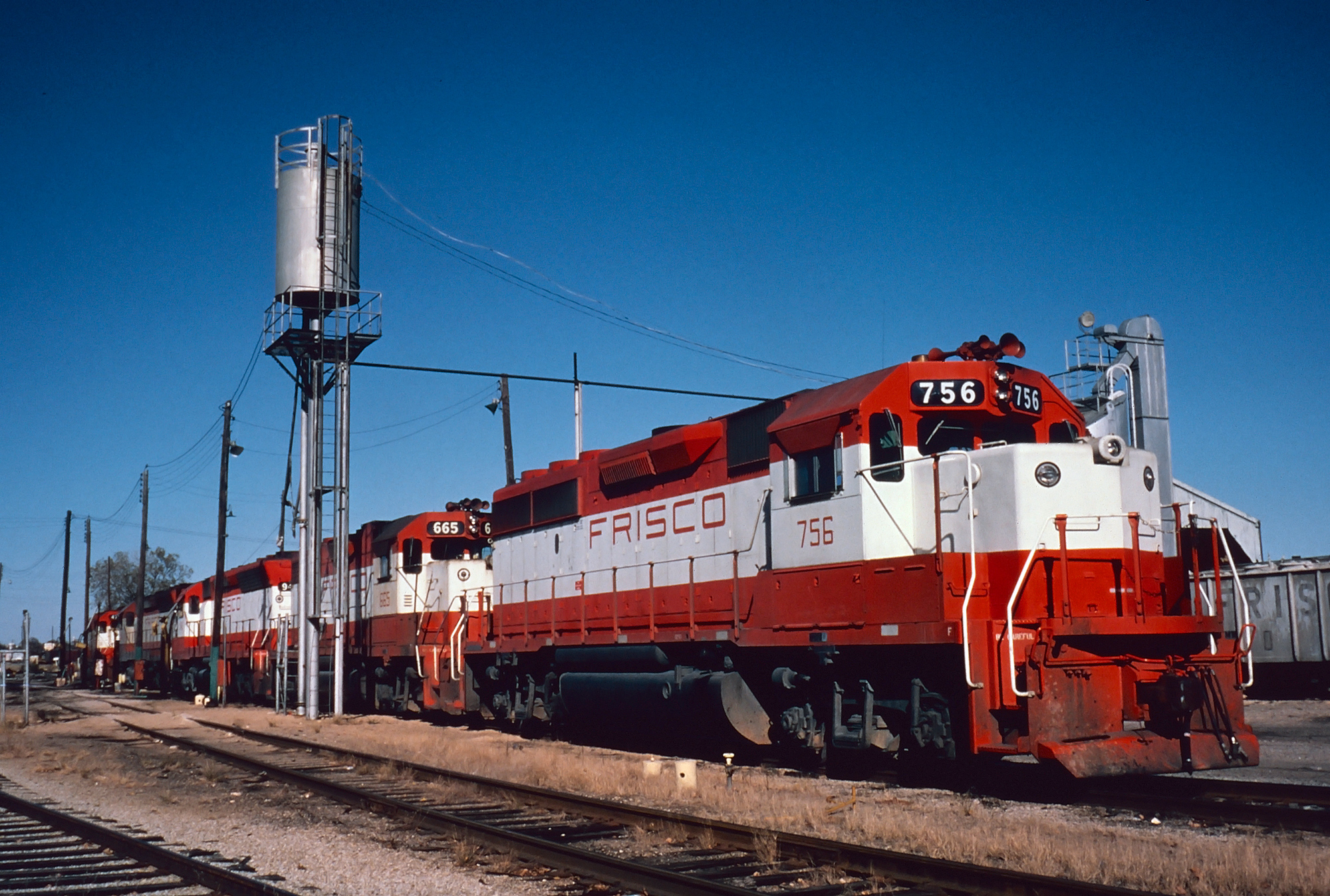 St. Louis-San Francisco Railway power lays over at Birmingham, Alabama, circa 1980. The group includes GP40-2 #756, GP38-2 #665, a pair of SD45's, and another GP38-2. Mike Bledsoe photo. American-Rails.com collection.
Their efforts ballooned Frisco's network to 5,260 miles but it came at great cost as the syndicate overextended their finances. The incredibly complex and expensive boondoggle ultimately failed, resulting in the Frisco bankruptcy in 1913.
It emerged on June 19, 1916 as the St. Louis-San Francisco Railway but was separated from both the C&EI and GSL (the C&EI became independent once more while the Gulf Coast Lines were later picked up by Missouri Pacific).
Better days were in store as Frisco began upgrading infrastructure to position itself as a strong regional carrier. Its final noteworthy expansion took place in July of 1925 by acquiring the 142-mile Muscle Shoals, Birmingham & Pensacola running between Kimbrough, Alabama and Pensacola, Florida.
The move reestablished service to the Gulf Coast and the railroad hurriedly completed a 152-mile link from Kimbrough to Aberdeen, Mississippi (opened on June 27, 1928). Two decades later it gained another Gulf Coast route by purchasing the Alabama, Tennessee & Northern (operating between Reform and Mobile, Alabama) on December 28, 1948.
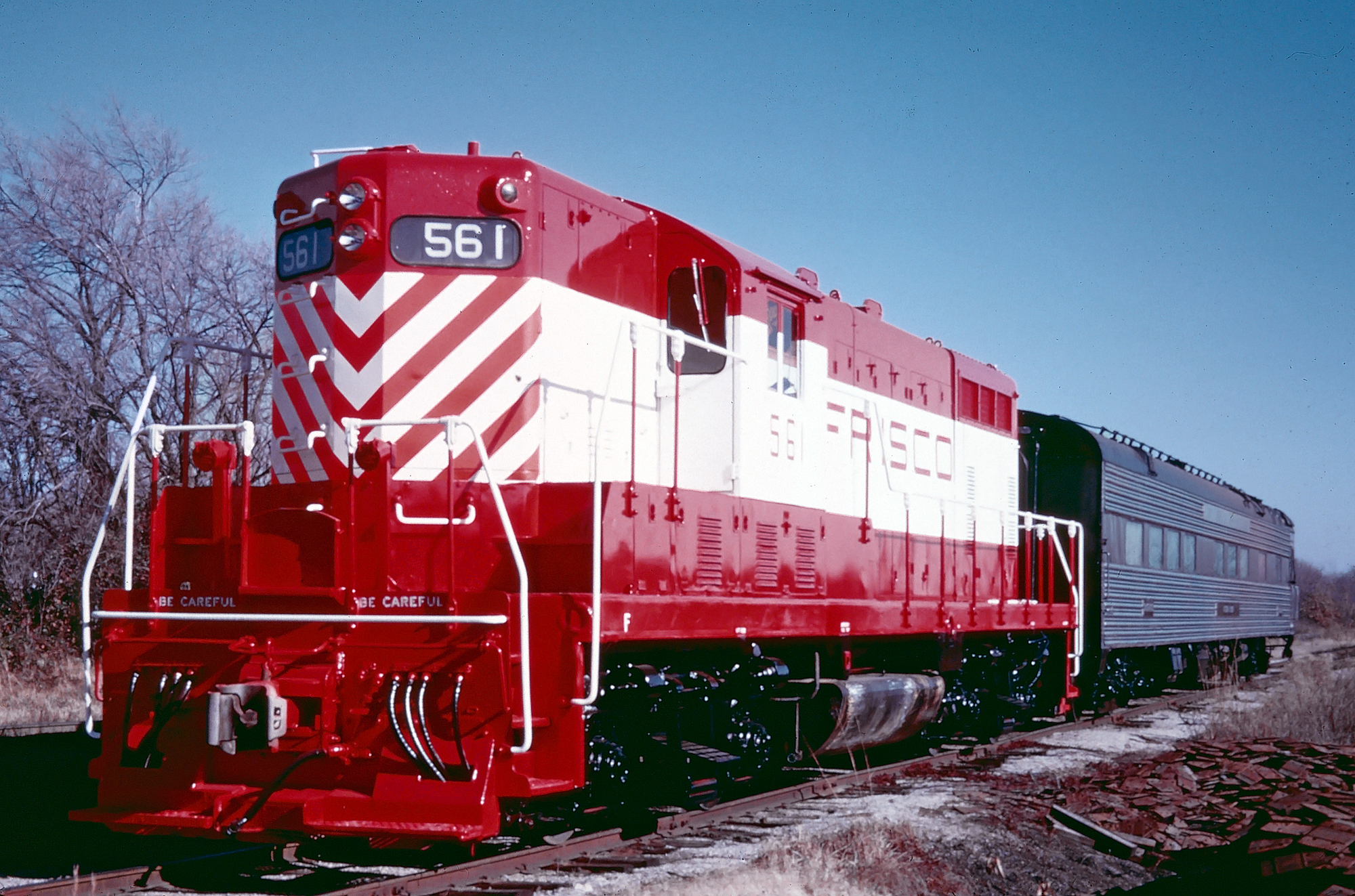 Freshly repainted Frisco GP7 #561 at Altamont, Kansas in December, 1969. Mac Owen photo. American-Rails.com collection.
The 1920s were generally good with a strengthening freight business and further property upgrades through the installation of centralized traffic control and fleet of high quality/rebuilt locomotives (thanks to its West Springfield Shops).
Attention to its physical plant would pay off when the Great Depression brought about bankruptcy on November 1, 1932. As traffic and the economy slowly recovered the Frisco's well-maintained property was ready for the onslaught of business during World War II.
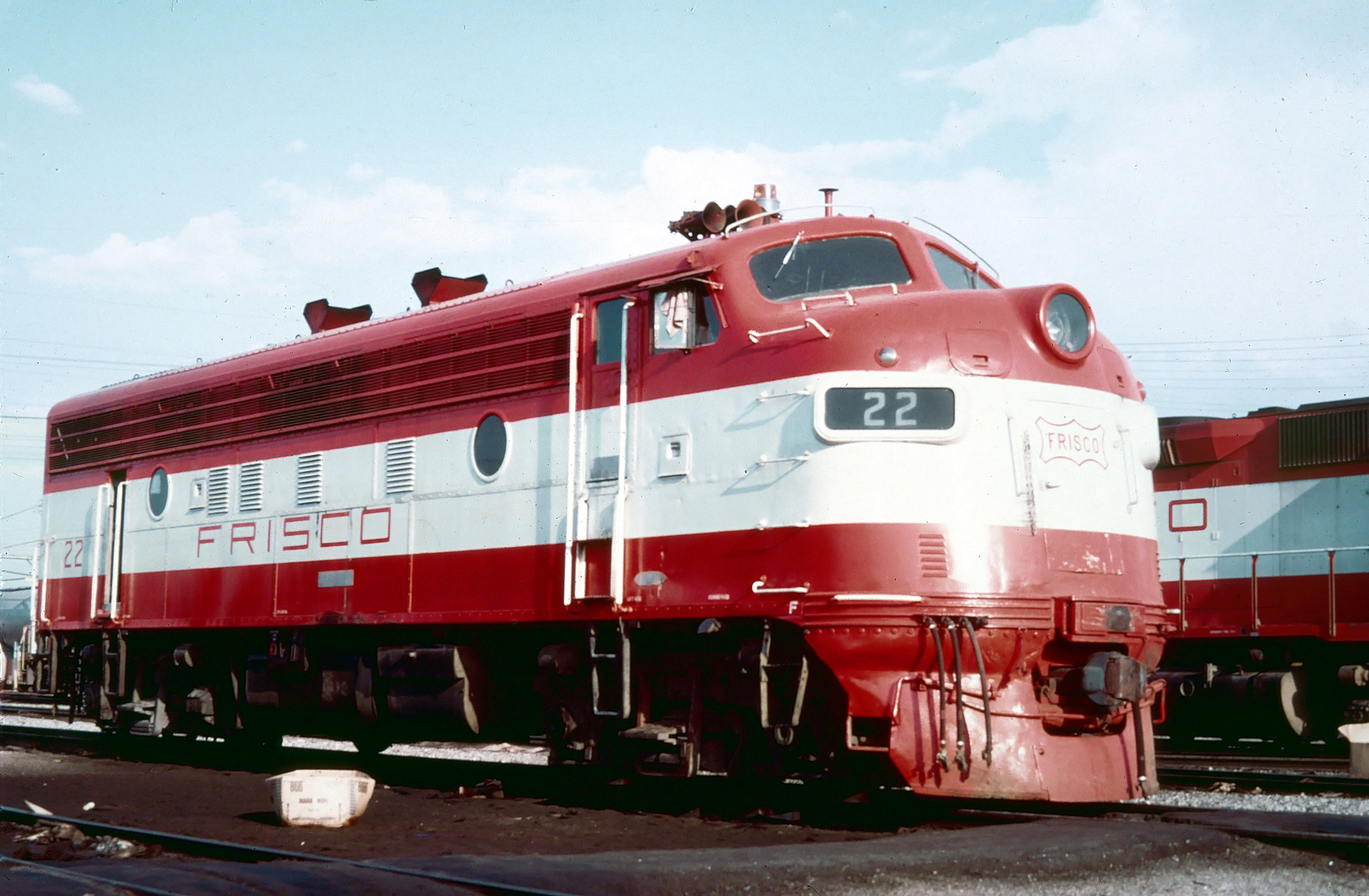 St. Louis-San Francisco Railway ("Frisco") F7A #22 at Springfield, Missouri, circa 1968. Mac Owen photo. American-Rails.com collection.
It handled a record 9.4 billion ton-miles in 1944 and the brisk traffic brought an end to receivership in January of 1947. The company's final thirty years were its best thanks to a growing petrochemical industry along the Gulf Coast.
It also diversified into other traffic such as zinc, paper, automobile components, and general merchandise. The Frisco became well-known at this time for providing reliable, high-speed service over its 5,100-mile network.
As upgrades continued during its latter years key portions of its main arteries were double-tracked while CTC-protected territory was extended.
 Frisco E7A #2005, named "Winchester," at Springfield, Missouri after being rebuilt to resemble an E8A sporting a full-length grille and four portholes on October 28, 1961. Richard Wallin photo.
Diesel Roster
The American Locomotive Company
| Model Type | Road Number | Date Built |
|---|---|---|
| RS1 | 101-111 | 1944-1947 |
| S2 | 290-294 | 1948-1949 |
| RS2 | 550-554 | 1949 |
| FA-1 | 5200-5231 | 1948-1949 |
| FB-1 | 5300-5315 | 1948-1949 |
The Baldwin Locomotive Works
| Model Type | Road Number | Date Built |
|---|---|---|
| VO-1000 | 200-237 | 1942-1946 |
| DS-4-4-1000 | 238-241 | 1948 |
| VO-660 | 60-61 | 1942 |
Davenport
| Model Type | Road Number | Date Built |
|---|---|---|
| 44-Tonner | 1-2 | 1942 |
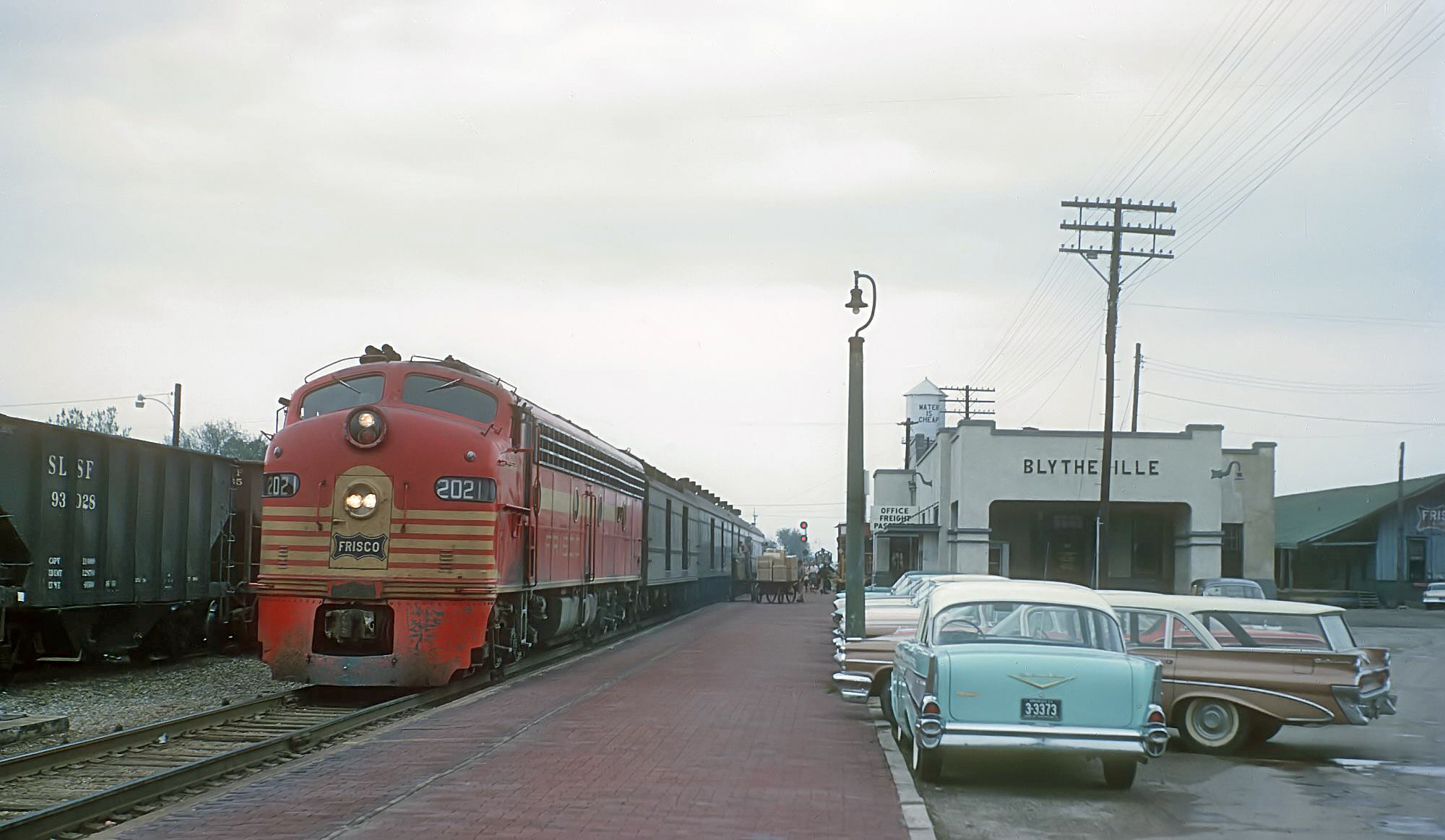 Frisco's train #808, the "Sunnyland," stopped at Blytheville, Arkansas; April, 1963. Rick Burn photo.
Electro-Motive Division
| Model Type | Road Number | Date Built |
|---|---|---|
| GP15-1 | 100-124 | 1977 |
| NW2 | 250-265 | 1948-1949 |
| SD38-2 | 296-299 | 1979 |
| SW7 | 300-304 | 1951 |
| SW9 | 305-314 | 1952 |
| SW1500 | 315-360 | 1968-1973 |
| MP15DC | 361-365 | 1975 |
| GP38-2 | 400-478, 663-699 | 1972-1976 |
| GP7 | 500-549, 555-632 | 1950-1953 |
| GP38AC | 633-662 | 1971 |
| GP35 | 700-732 | 1964-1965 |
| GP40-2 | 750-774 | 1979 |
| SD45 | 900-948 | 1967-1969 |
| SD40-2 | 950-957 | 1978 |
| E7A | 2000-2005 | 1947 |
| E8A | 2006-2022 | 1950 |
| F3A | 5000-5017 | 1948 |
| F3B | 5100-5117 | 1948 |
| F7A | 5018-5039 | 1949-1950 |
| F7B | 5118-5139 | 1949-1953 |
| FP7 | 5040-5051 | 1950-1951 |
| F9B | 5140-5152 | 1954-1957 |
Fairbanks Morse
| Model Type | Road Number | Date Built |
|---|---|---|
| H10-44 | 270-281 | 1948-1949 |
| H12-44 | 282-285 | 1950 |
General Electric
| Model Type | Road Number | Date Built |
|---|---|---|
| 44-Tonner | 4-8 | 1943 |
| 45-Tonner | 11 | 1941 |
| U25B | 800-831* | 1961-1966 |
| U30B | 832-862 | 1968-1975 |
| B30-7 | 863-870 | 1977 |
* #812-815 were ex-demonstrators #51-54.
Whitcomb
| Model Type | Road Number | Date Built |
|---|---|---|
| 44DE-18 | 3 | 1943 |
Steam Roster (All-Time)
|
Number(s) 1-60 (2nd) 26-35, 38, 40, 43 (1st) 44 (1st) 45-50 (1st) 51-52 (1st) 53-54 (1st), 56-60 (1st) 62-65, 67-70 72 (2nd), 73 72-73 (1st), 74 (1st) 75 (1st) 74-75 (2nd) 76-77 (1st), 78 76-77 (2nd) 91-93 94-95 96-103 104 105-107 108-113 114-115 130-135 136-137 138-143 144-145 146-147 148-151 152-154 155-157 158-159 160-162 182-183 184-187 188-189 190-195 200-204 205-219 220-229 300-303 304-353 354-358 359-362 363-364 365-366 367-368 389-397 398-399 400-409 410-415 416-427 428-447, 467, 479-484 448-466 487-515 516-548 549-557 558-567 568-572 573-584 585-599 600-609 610-628 629-633 634-668 669-693 695-699 700-704 705-724 727-741 742-799 801-818 819-828 829-833 834-835 850-851 860-861 870-871 950-951 956-965 970-989 1000-1009 1010-1014 1015-1039 1040-1059 1060-1069 1060-1069 1100-1111 1200-1280 1281-1292 1293-1305 1306-1345 1400-1409 1500-1529 1613-1623 1624, 1626 1625 1627-1632 2001-2007 2232-2237 2238 2241 2252 2253 2260 2263 2264 2265-2266 2267 2274-2275 2650-2652 2653-2658 2659-2666 2667-2668 2669 2670-2675 2676-2691 2692-2695 2698 2699 2700-2715 2716-2719 2720-2723 2724-2730 2731-2733 2734-2737 3540-3548 3600-3601 3602-3610 3611-3629, 3631 3632-3639 3641-3642 3643-3646 3647 3648-3657 3660-3661 3662-3663 3664-3667 3668-3669 3670 3671-3675 3676-3695 3698 3700-3712 3713-3722 3730 3731-3752 3800-3806 4000, 4001, 4004, 4006-4032 4002, 4003, 4005 4100-4164 4200-4219 4300-4310 4400-4422 4500-4524 |
Wheel Arrangement 2-10-2 4-4-0 4-4-0 4-4-0 4-4-0 4-4-0 4-4-0 2-6-0 4-4-0 4-4-0 4-6-0 4-4-0 2-8-0 4-4-0 4-4-0 4-4-0 4-4-0 4-4-0 4-4-0 4-4-0 4-4-0 4-4-0 4-4-0 4-4-0 4-4-0 4-4-0 4-4-0 4-4-0 4-4-0 4-4-0 4-4-0 4-4-0 4-4-0 4-4-0 4-4-0 4-4-0 4-4-0 2-6-0 2-6-0 2-6-0 2-6-0 2-6-0 2-6-0 2-6-0 2-6-0 2-6-0 4-6-0 4-6-0 4-6-0 4-6-0 4-6-0 4-6-0 4-6-0 4-6-0 4-6-0 4-6-0 4-6-0 4-6-0 4-6-0 4-6-0 4-6-0 4-6-0 4-6-0 4-6-0 4-6-0 4-6-0 4-6-0 4-6-0 2-8-0 2-8-0 2-8-0 2-8-0 2-8-0 2-8-0 2-8-0 2-8-0 2-8-0 2-8-0 4-6-2 4-6-2 4-6-2 4-6-2 4-6-2 4-6-4 4-6-0 2-8-0 2-8-0 2-8-0 2-8-0 4-6-0 4-8-2 2-10-0 2-10-0 2-10-0 2-10-0 2-8-8-2 4-4-0 4-4-0 4-4-0 4-4-0 4-4-0 4-4-0 4-4-0 4-4-0 4-4-0 4-4-0 4-4-0 4-6-0 4-6-0 4-6-0 4-6-0 4-6-0 4-6-0 4-6-0 4-6-0 4-6-0 4-6-0 2-8-0 2-8-0 2-8-0 2-8-0 2-8-0 2-8-0 0-6-0 0-6-0 0-6-0 0-6-0 0-6-0 0-6-0 0-6-0 0-6-0 0-6-0 0-6-0 0-6-0 0-6-0 0-6-0 0-6-0 0-6-0 0-6-0 0-4-0 0-6-0 0-6-0 0-6-0 0-6-0 0-6-0 2-8-2 2-8-2 2-8-2 2-8-2 4-8-2 4-8-2 4-8-4 |
Builder Baldwin Hinkley Pittsburgh Rogers Cooke Manchester Manchester Baldwin Manchester Manchester Baldwin Manchester Baldwin Hinkley Cooke Manchester Baldwin Pittsburgh Baldwin Pittsburgh Rogers Cooke Baldwin Rhode Island NY Locomotive Works Rogers Baldwin Cooke Union Pacific Schenectady Alco/Pittsburgh Pittsburgh Alco/Pittsburgh Alco/Dickson Alco/Pittsburgh Alco/Dickson Rhode Island Rogers Baldwin Rhode Island Baldwin Brooks Alco Alco/Brooks Dickson Cooke Baldwin Rogers Cooke Baldwin Rogers Pittsburgh Baldwin Alco/Pittsburgh Alco/Cooke Baldwin Alco/Pittsburgh Alco/Dickson Alco/Richmond Baldwin Alco Baldwin Alco/Dickson Alco/Brooks Alco/Dickson Alco/Brooks Alco Baldwin Dickson Alco/Pittsburgh Alco/Richmond Alco/Brooks Alco/Brooks Brooks Pittsburgh Pittsburgh Alco/Dickson Baldwin Alco/Brooks Baldwin Baldwin Alco Baldwin Frisco Alco Baldwin Alco/Brooks Baldwin Alco Baldwin Baldwin Alco/Richmond Alco/Brooks Alco Baldwin Alco Manchester Rhode Island Cooke Portland Baldwin Taunton Rogers Schenectady Altoona (PRR) Manchester Baldwin Rogers Baldwin Manchester Rogers Baldwin Rogers Rhode Island Pittsburgh Brooks Baldwin Baldwin Rogers Cooke Baldwin Rogers Altoona (PRR) Frisco Manchester Hinkley Baldwin Pittsburgh Baldwin Rogers Cooke Baldwin Manchester Cooke Baldwin Hinkley Alco/Pittsburgh Baldwin Baldwin Pittsburgh Alco/Dickson Baldwin Alco Baldwin Alco Lima Alco Baldwin Baldwin Frisco Frisco Baldwin |
Date Built/Notes 1916-1917 1878-1881 1885 1880 1886 1883-1884 1883-1884 1913 1884 1882 1916 1882 1925 1869 1893, 1888 1880-1881 1893 1885 1885-1887 1890 1883 1884 1888 1889 1888 1886 1886 1884-1889 1890 1889 1902 1899-1900 1901 1907 1902 1902-1903 1903 1886 1886-1892 1891 1897-1899 1893 1909 1910 1882 1882 1879 1880 1884 1887-1893 1887-1888 1890-1893 1898-1903 1901 1902 1902-1903 1902 1903 1902 1903-1904 1905 1904 1903 1906 1903 1906 1905 1903 1900 1902 1902 1903 1905 1900 1897, 1899 1900 1902 1906-1907 1904 1904* 1910* 1912* 1917 (Rebuilt into 4-6-4's) 1937-1941 (Ex-4-6-2's) 1907 1907-1909 1910 1910 1912 1907 1923-1926 1917-1918 1918 1918 1918 1910 1870 1881 1888 1882 1898 Unknown Unknown 1883 Unknown Unknown 1886 1882 1870-1873 1883-1884 1882 1870 1885 1888-1889 1886 1899 1871 1881 1881 1884 1886 1884 1876-1877 `1923 1883 1882-1885 1886-1888 1893-1901 1881-1882 1882 1892 1906 1883 1885 1893 1882 1902 1904 1905-1906 1889 1906-1907 1907 1907 1910 1919 1919 1919 1923-1926 1930 1936-1937** 1939-1942** 1942-1943 |
* Many of these Pacifics were rebuilt by Frisco's West Springfield Shops between 1936 and 1943.
** Rebuilt by the West Springfield Shops from former 2-10-2's.
Thanks to author Joe Collias's book "Frisco Power: Locomotives And Trains Of The St. Louis-San Francisco Railway, 1903-1953," for help with much of the above roster information.
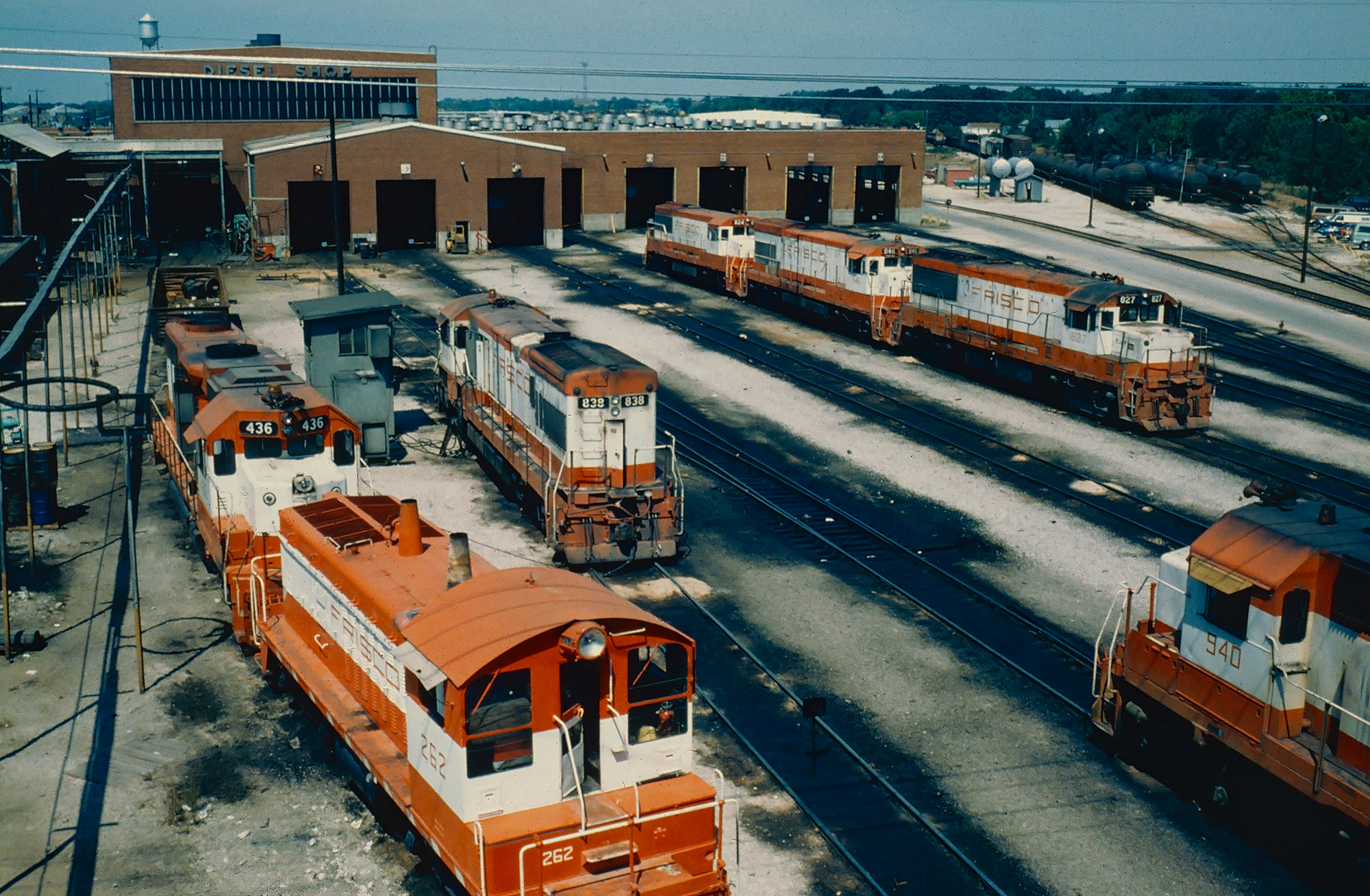 A view of the St. Louis-San Francisco ("Frisco") shops in Springfield, Missouri, circa 1979. Mike Bledsoe photo. American-Rails.com collection.
Final Years
It opened a high tech “hump” yard in Memphis (whereby an inclined track and computer-controlled switches guided cars into their correct staging track), streamlined/consolidated operations wherever possible, initiated run-through freights with other carriers ("pooling), and was successful in petitioning the Interstate Commerce Commission to eliminate remaining passenger services entirely on December 8, 1967 with the Southland's termination.
This process had been launched nearly a decade earlier when on January 5, 1959 the Texas Special was discontinued.
The once-glamorous streamliner was a joint service with the Missouri-Kansas-Texas Railroad but the Katy's declining physical plant and shoddy equipment irritated Frisco management, leading to the train's cancellation.
In 1965 it attempted to discontinue remaining services but was initially denied by the ICC. With $7 million in losses annually, however, it persisted until winning approval two years later, making it the largest freight-only railroad up to that time.
By the 1970's the St. Louis-San Francisco Railway had transformed itself into a very attractive property and caught the eye of the much larger Burlington Northern, which formally acquired the road on June 8, 1981.
Photos
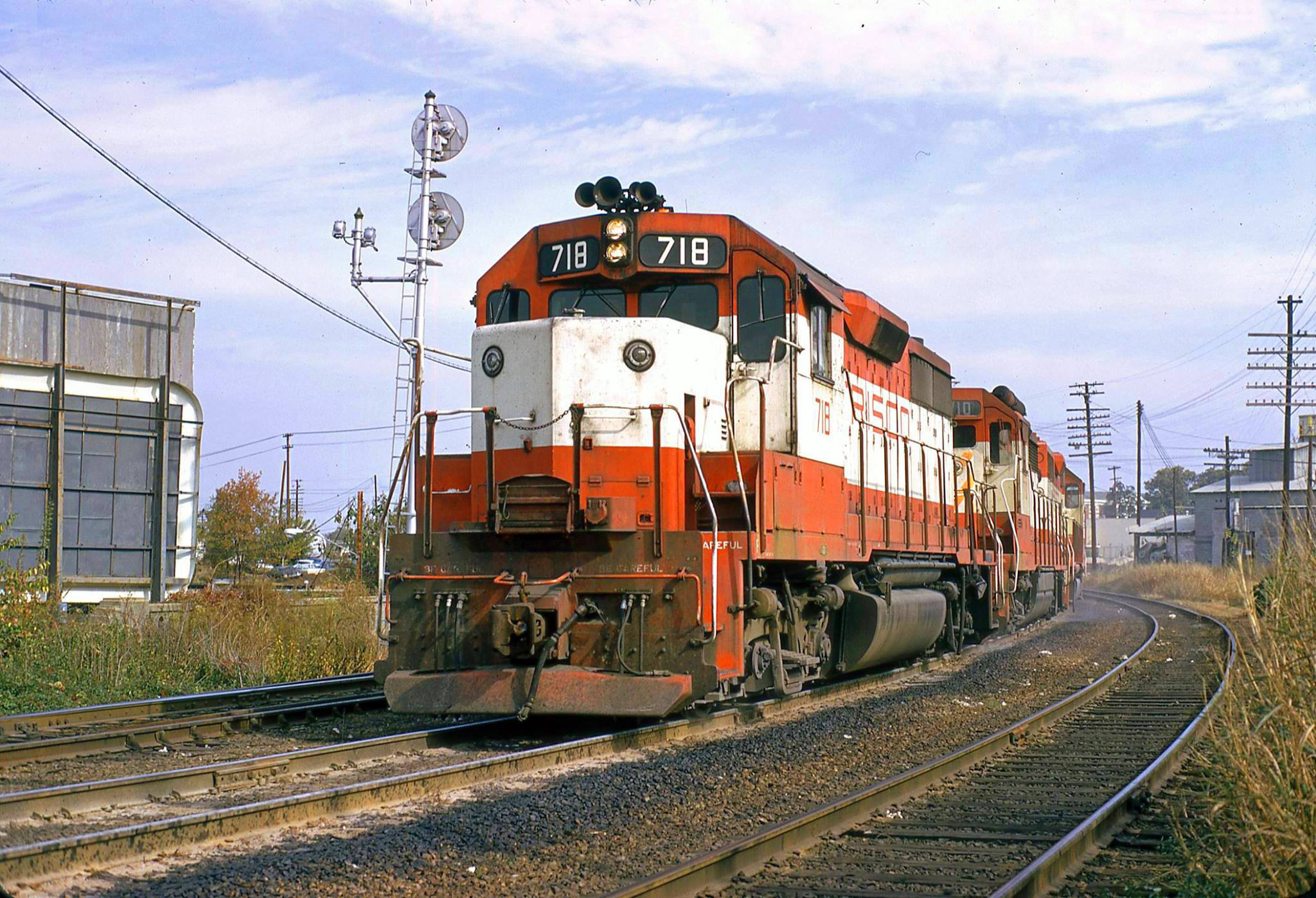 Frisco (St. Louis–San Francisco Railway) power, led by GP35 #718, running on the Seaboard Coast Line at Raleigh, North Carolina in May of 1974. Warren Calloway photo.
 Marty Bernard caught Frisco GP7 #557 hustling an eastbound freight over Long Branch Creek Treslte just east of Morrison, Oklahoma on September 10, 1966. That is Marty's vehicle beneath the trestle.
 St. Louis-San Francisco E8A #2012, "Flying Ebony" (named for the thoroughbred which won the 1925 Kentucky Derby), is seen here in Springfield, Missouri during January of 1965. Richard Wallin photo.
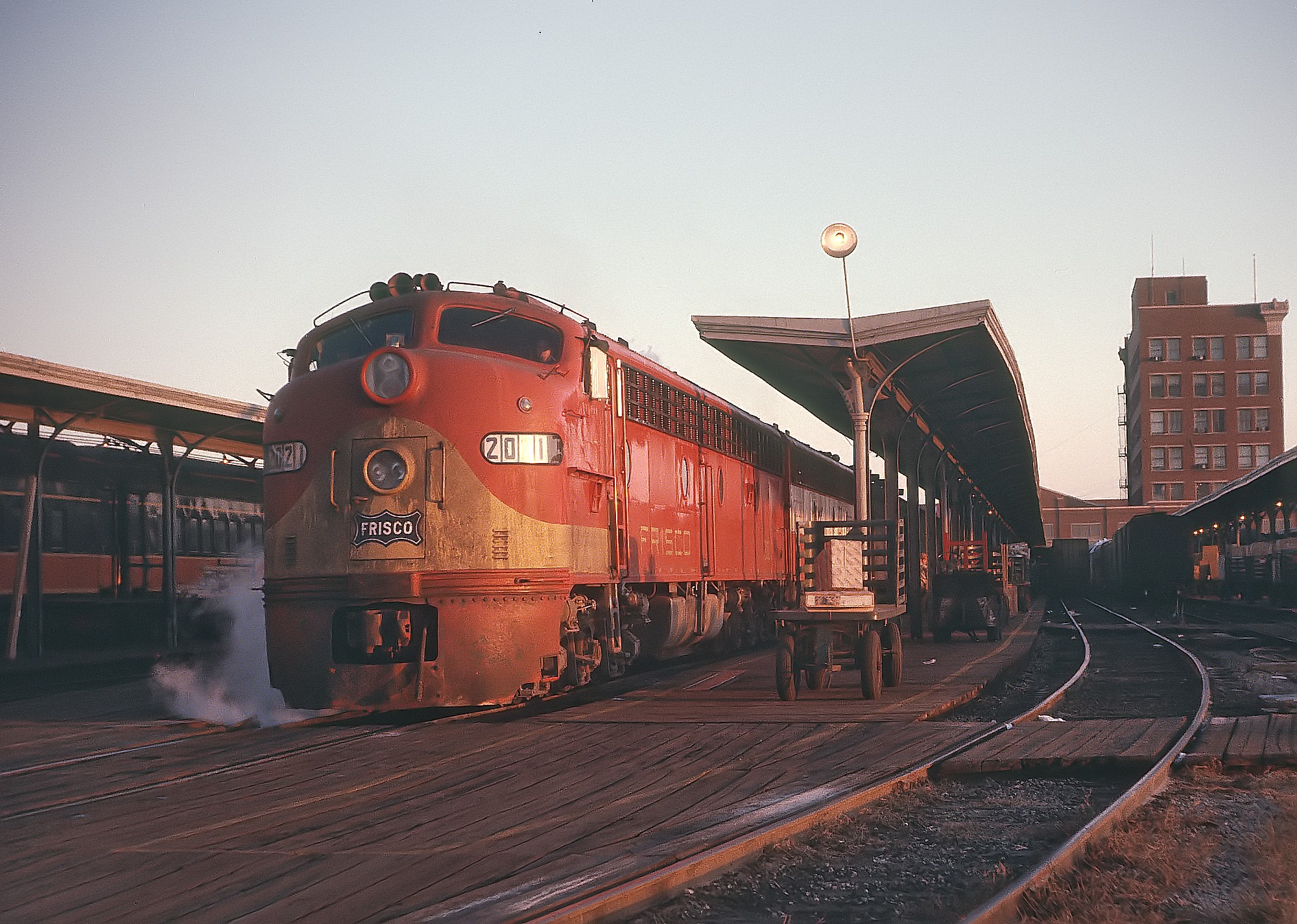 Frisco E8A #2021 is ahead of train 102, the 'Southland' at Memphis Central Station in October, 1967. Tom Hoffmann photo, Rick Burn collection.
Recent Articles


-
Pittsburgh and West Virginia Railway: Map, Rosters, History
Sep 24, 26 12:24 AM
 Pittsburgh & West Virginia—the Hi-Line. Wabash-Pittsburgh Terminal 1904. Railway January 29, 1917. Connellsville February 11, 1931. N&W lease October 16, 1964. Wheeling & Lake Erie from May 17, 1990.
 -
Indiana Dinner Train Rides (2026): A Complete Guide
Sep 24, 26 12:13 AM
 2026 Spirit of Jasper Ride & Dine is paused. No public trains. Depot at 201 Mill Street stays open as a rental. Confirm on spiritofjaspertrain.com.
 -
New Jersey Dinner Train Rides (2026): A Complete Guide
Sep 24, 26 12:01 AM
2026 Woodstown Central Dining in Motion—private table of four from $190, about an hour, Salem County. Confirm on woodstowncentral.com. -
Maryland Dinner Train Rides (2026): A Complete Guide
Sep 23, 26 05:19 PM
 2026 Western Maryland Scenic Allegheny Mountain Dinner Train—Cumberland, 3 hours, 21+, Saturday 7 p.m. Confirm on wmsr.com.
 -
Pittsburgh and Lake Erie Railroad: Map, Rosters, Photos
Sep 23, 26 03:28 PM
 Pittsburgh & Lake Erie—the Little Giant. Chartered 1875, Pittsburgh to Youngstown February 10, 1879. New York Central from 1883. Independent May 15, 1979. Last day September 11, 1992.
 -
Kansas Dinner Train Rides (2026): A Complete Guide
Sep 23, 26 01:11 PM
 2026 Abilene & Smoky Valley Smoky Valley Limited—two hours from the Rock Island Depot, about $72–$110, dates into December 31. Confirm on asvrr.org.
 -
The Belpaire Firebox: Simplicity and Greater Power
Sep 23, 26 01:03 PM
 Belpaire firebox—Alfred Belpaire, 1864. Square crown, straight staybolts at right angles. Pennsylvania standard after the 1880s. Great Northern was the other big user.
 -
Pennsylvania Railroad (PRR) Electric Roster: All Classes
Sep 23, 26 12:57 PM
 Pennsylvania Railroad electrics—DD1s into Penn Station, P5s, 139 GG1s, B1 switchers, and 66 E44s. Class roster, 1905–1963. No unit-by-unit GG1 list.
 -
Penn Central Diesel Roster: All-Time
Sep 23, 26 12:46 PM
 Penn Central diesel roster—PRR classes on NYC, PRR, and New Haven power. New orders carry serials. GP38-2s are 7940-8162. Conrail April 1, 1976.
 -
Penn Central Railroad: Map, History, Logo
Sep 23, 26 12:32 PM
 Penn Central—Pennsylvania and New York Central merged February 1, 1968. New Haven January 1, 1969. Section 77 bankruptcy June 21, 1970. Conrail April 1, 1976.
 -
Iowa Dinner Train Rides (2026): A Complete Guide
Sep 23, 26 11:42 AM
 2026 Boone & Scenic Valley Wolf Dinner Train—Saturdays May–October, Union Pacific dining cars, Bass Point Creek High Bridge. Confirm on bsvrr.com.
 -
Pennsylvania-Reading Seashore Lines: Map, Roster, History
Sep 23, 26 12:32 AM
 Pennsylvania-Reading Seashore Lines—Atlantic City Railroad renamed July 15, 1933. Pennsylvania two-thirds, Reading one-third. Camden to Atlantic City, Cape May, and Millville. Conrail April 1, 1976.
 -
Wisconsin Dinner Train Rides (2026): A Complete Guide
Sep 23, 26 12:28 AM
2026 Wisconsin Great Northern dinner train in Trego—$105, Namekagon River, January 8–31 and May 5–December 17. Mid-Continent’s remaining 2026 calendar is snack and scenic. Confirm on the railroad. -
New Hampshire Dinner Train Rides (2026): A Complete Guide
Sep 23, 26 12:21 AM
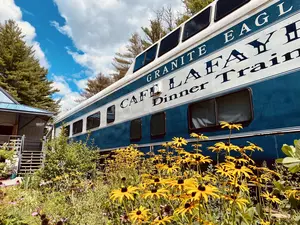
2026 Cafe Lafayette Dinner Train in North Woodstock—five courses, 2 hours, from $125. Children under 6 not allowed. Confirm on nhdinnertrain.com. -
PRR "GG-1" Locomotives: Roster, Photos, Specs
Sep 23, 26 12:13 AM
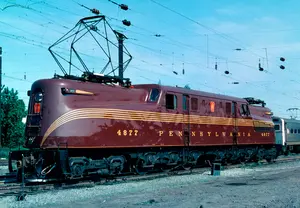
 PRR GG1 electric: 139 locomotives, 4800–4938, built 1934–1943. Specs, Loewy shell, Amtrak numbers, and the last revenue trip on October 28, 1983.
 -
Montana Dinner Train Rides (2026): A Complete Guide
Sep 23, 26 12:04 AM
2026 Charlie Russell Chew Choo from Hanover, near Lewistown—4.5 hours, prime rib, adult $151. Remaining listed dates sold out. Confirm on montanadinnertrain.com. -
Kentucky Dinner Train Rides (2026): A Complete Guide
Sep 22, 26 11:52 PM
2026 My Old Kentucky Dinner Train in Bardstown—four courses, 2.5 hours, adult $116. Confirm on kydinnertrain.com. -
Tennessee Dinner Train Rides (2026): A Complete Guide
Sep 22, 26 11:45 PM
2026 TVRM Chattanooga Dinner Train—Grand Junction, select Fri/Sat March 6–October 24, 6 p.m., from $110. Confirm on tvrail.com. -
The Trainphone: PRR's Wireless Radio System
Sep 22, 26 11:17 PM
 Pennsylvania Trainphone—Union Switch & Signal inductive telephone. Bel-Del trial 1941, Frenchtown November 29, 1943. Carriers at 88 kHz and 144 kHz. Out of service April 30, 1967.
 -
Pennsylvania (PRR) Steam Roster: Post 1906
Sep 22, 26 11:13 PM
 ennsylvania steam after 1906—H8, H9, and H10 Consolidations, 574 L1s Mikados, 598 I1s Decapods, 425 K4s Pacifics, 301 M1 Mountains. Drury’s grid. Last steam November 30, 1957.
 -
Pennsylvania Railroad (PRR) Diesel Roster: All-Time List
Sep 22, 26 10:59 PM
 Pennsylvania diesel roster—SW 3908 in June 1937, then Alco, Baldwin, EMD, Fairbanks-Morse, GE, and Lima. Serials and Alco order numbers. Penn Central February 1, 1968.
 -
Pennsylvania Railroad: Map, Logo, History, Rosters
Sep 22, 26 10:02 PM
 Pennsylvania Railroad—chartered April 13, 1846, Harrisburg–Pittsburgh, Horseshoe Curve 1854, Penn Station 1910. Standard Railroad of the World. Penn Central February 1, 1968.
 -
Pennsylvania Dinner Train Rides (2026): A Complete Guide
Sep 22, 26 04:48 PM
 2026 Pennsylvania dinner trains—Colebrookdale Dining Class in Boyertown and Strasburg Dinner on the Rails. Confirm on each railroad.
 -
New York, Ontario & Western Steam Locomotives: History & Roster
Sep 22, 26 04:40 PM
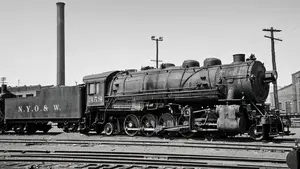
 NYO&W steam—camelback 2-8-0s and 2-6-0s, Class X Bull Moose 2-10-2s, Class Y and Y-2 Mountains. All-time class roster. Steam finished in the summer of 1948. None saved.
 -
New York, Ontario & Western Diesel Roster: All-Time
Sep 22, 26 04:36 PM
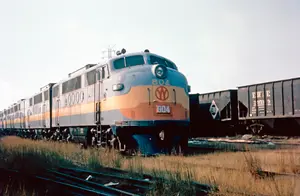
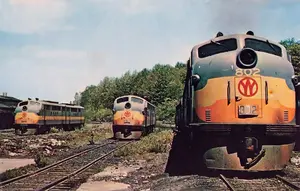
 NYO&W diesel—five GE 44-tonners 101-105, eighteen FTs, seven F3s, twenty-one NW2s. Serials and the NW2 order E824. Railroad liquidated March 29 1957.
 -
New York, Ontario & Western Railway: Map, Roster, History
Sep 22, 26 04:26 PM
 New York, Ontario & Western—New York & Oswego Midland chartered January 11 1866, O&W January 21 1880. Scranton coal, West Shore rights. Last train March 29 1957.
 -
Massachusetts Dinner Train Rides (2026): A Complete Guide
Sep 22, 26 04:16 PM
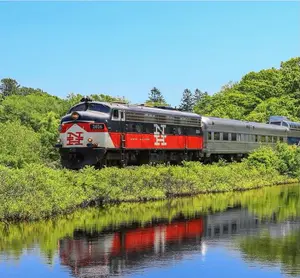
 2026 Cape Cod Dinner Train—Hyannis, Buzzards Bay, and North Falmouth. Four-course, 3–3½ hours, from $99.99. Confirm on capetrain.com.
 -
Colorado Dinner Train Rides (2026): A Complete Guide
Sep 22, 26 03:51 PM
 2026 Royal Gorge Route First Class Dinner and Lunch from Cañon City. About 2 hours, 12+, from $199+. Confirm on royalgorgeroute.com.
 -
New York and Long Branch Railroad: A PRR & CNJ Subsidiary
Sep 22, 26 03:11 PM
 New York & Long Branch—chartered April 8 1868, Perth Amboy–Long Branch July 1 1875, Bay Head Junction 1881. Jersey Central and Pennsylvania trains. Conrail April 1 1976. NJ Transit North Jersey Co…
 -
Monongahela Railway Steam Locomotives: History & Roster
Sep 22, 26 01:34 PM
 Monongahela steam—H-5 Consolidations, USRA light Mikados 170–179, Baldwin L-2s, ex-P&LE L-3s. All-time roster. Last steam May 26, 1954.
 -
Monongahela Railway Diesel Roster: All-Time
Sep 22, 26 01:16 PM
 Monongahela diesel—27 Baldwin S-12s, NYC RF-16 sharks, P&LE GP7s, GP38s 2000–2004, Super 7s 2300–2310. Serials and orders. Last steam May 26, 1954.
 -
Monongahela Railway: Map, Rosters, History
Sep 22, 26 01:14 PM
 Monongahela Railway—incorporated December 31 1900, Railway July 1 1915. Brownsville–Fairmont coal road. Last steam May 26 1954. Conrail May 1 1993.
 -
Virginia Scenic Railway Dining (2026)
Sep 22, 26 01:09 PM
 2026 Virginia Scenic Railway—Blue Ridge Flyer Dining Class from Staunton, about 3 hours, plated meal. Sunday Brunch from Louisa, about $132. Confirm on virginiascenicrailway.com.
 -
Virginia Dinner Train Rides (2026): A Complete Guide
Sep 22, 26 01:03 PM
 2026 Virginia Scenic Railway—Blue Ridge Flyer Dining Class from Staunton, Alleghany Special Dining Class, Sunday Brunch from Louisa. Confirm on virginiascenicrailway.com.
 -
Oregon Dinner Train Rides (2026): A Complete Guide
Sep 22, 26 12:51 PM
 2026 Oregon has no plated dinner train on the calendar. Mount Hood is scenic with snacks. Oregon Coast Scenic’s evening ride is the 21+ Moonlight with sandwiches.
 -
Maine Central Steam Locomotives: History & Roster
Sep 22, 26 12:33 PM
Maine Central steam—Ten-Wheelers, W-class Consolidations, S-class Mikados, C-class Pacifics, Hudsons 701 and 702. Post-1900 roster after Drury. Last steam June 13, 1954. -
Maine Central Diesel Roster: All-Time
Sep 22, 26 12:04 PM
 Maine Central diesel—railcar 901, HH660s, GP7s, E7s, F3s, GP38s, U18Bs, ex-Rock Island U25Bs. All-time roster with serials and orders. Last steam June 13, 1954.
 -
Maine Central Railroad: Map, Logo, Rosters, History
Sep 22, 26 11:36 AM
 Maine Central—Androscoggin & Kennebec and Penobscot & Kennebec, October 28 1862. Pine Tree Route. Mountain Division, Portland–Bangor–Vanceboro. Last steam June 13 1954. Guilford June 1981.
 -
Maryland and Pennsylvania Railroad: Map, Roster, Logo
Sep 22, 26 12:14 AM
 Ma & Pa—Peach Bottom 1868, Maryland & Pennsylvania February 12 1901, Baltimore to York. Last steam November 29 1956. York Railway December 1 1999.
 -
New York Dinner Train Rides (2026): A Complete Guide
Sep 21, 26 11:59 PM
2026 New York dinner train—Adirondack Dinner Train from Utica, 6 p.m., about 3 hours, First Class from $139. Arcade & Attica mystery dinner is served at Curriers. Confirm on the railroad. -
California Dinner Train Rides (2026): A Complete Guide
Sep 21, 26 11:49 PM
 2026 California dinner trains—Napa Valley Wine Train plated meals, River Fox brunch and mystery dinner, Roaring Camp barbecue at camp. Confirm on each railroad.
 -
Roaring Camp Starlight Dinner Party (2026)
Sep 21, 26 11:33 PM
 2026 Roaring Camp Starlight Dinner Party—Beach Train from the Santa Cruz Boardwalk, barbecue at Felton, ride back after dark. Confirm on roaringcamp.com.
 -
Long Island Rail Road Steam Locomotives: History, Roster & Photos
Sep 21, 26 11:29 PM
 Long Island steam—G5s 20–50, H10s 101–119, last steam at Hicksville October 8, 1955. Post-1898 class roster.
 -
Long Island Rail Road Diesel Roster: All-Time
Sep 21, 26 11:24 PM
 Long Island diesel—boxcab 401 in 1925, FM C-Liners, RS-3s, C-420s, GP38-2s, DE30AC and DM30AC. All-time roster with serials and orders.
 -
Long Island Rail Road: Map, History, Pictures, Logo
Sep 21, 26 08:27 PM
 Long Island Rail Road—Brooklyn & Jamaica 1836, Greenport 1844, Pennsylvania control 1900, Penn Station 1910. MTA since 1968. Steam and diesel rosters.
 -
Oregon Coast Scenic Railroad (2026): Sunset Dinner and Moonlight
Sep 21, 26 02:40 PM
 2026 Oregon Coast Scenic does not post the old four-course Sunset Dinner. The evening ride is the 21+ Moonlight Excursion from Garibaldi, with pre-ordered sandwiches. Confirm on oregoncoastscenic.org.
 -
Adirondack Dinner Train (2026): Dates, Tickets & What to Expect
Sep 21, 26 01:38 PM
 2026 Adirondack Dinner Train—Utica Union Station, 6 p.m., about 3 hours to Remsen. First Class from $139. Chef Patrick O’Connor. Confirm on adirondackrr.com.
 -
Lehigh Valley Steam Locomotives: History, Roster & Photos
Sep 21, 26 01:31 PM
 Lehigh Valley steam—Camelback Consolidations, 2-10-2s, K-class Pacifics, six Mountains, Wyoming 4-8-4s. Post-1900 roster after Drury. Last steam September 14, 1951.
 -
Lehigh Valley Diesel Roster: All-Time
Sep 21, 26 01:23 PM
 Lehigh Valley diesel—boxcabs 1926, FTs 1945, F3/F7, FA/PA, C628 Snowbirds, GP38-2s, U23Bs. All-time roster with serials and orders. Last steam September 14, 1951.
 -
Lehigh Valley Railroad: Map, Roster, Logo, History
Sep 21, 26 01:09 PM
 Lehigh Valley—DLS&S 1847, named January 7 1853, Mauch Chunk–Easton September 12 1855. Route of the Black Diamond. Jersey City–Buffalo. Conrail April 1 1976.


%20and%20%232015%20(%22Twenty%20Grand%22)%20layover%20at%20Lindenwood%20Yard%20in%20St.%20Louis%20during%20the%20early%201960s.%20American-Rails.com%20collection.)
.%20Author's%20collection.)


%20F7A%20%2322%20at%20Springfield%2C%20Missouri%2C%20circa%201968.%20%20Mac%20Owen%20photo.%20%20American-Rails.com%20collection.)
%20shops%20in%20Springfield%2C%20Missouri%2C%20circa%201979.%20%20Mike%20Bledsoe%20photo.%20%20American-Rails.com%20collection.)