
Missouri-Kansas-Texas Railroad (Katy): Map, History, Rosters
Last revised: November 19, 2024
By: Adam Burns
The Missouri-Kansas-Texas Railroad, better known as The Katy, was a large granger that maintained an unconventional north-south network within a region dominated by the Santa Fe, Missouri Pacific, and Southern Pacific/St. Louis Southwestern (Cotton Belt).
It was also forced to compete against the Rock Island and St. Louis-San Francisco (Frisco). In spite of this, the company suffered only one true bankruptcy as a result of financial hardship.
As its name implies, the MKT linked its namesake states with key connections to St. Louis, Kansas City, Dallas/Fort Worth, Waco, San Antonio, and Galveston/Houston. Much of its growth across Texas occurred during the Jay Gould era, one of the industry's most notorious tycoons.
After escaping his grasp the Katy spent the 20th century as a well-managed, if not highly profitable, railroad. Due to its regional nature and many competitors it did not enjoy the success of its larger neighbors but was nonetheless a respected carrier.
During the late 1960's, legendary railroader John Barriger III took the reins and guided the Katy through a brief bout of prominence. He had always envisioned it joining a stronger system, which came true in 1988 when it was acquired by Union Pacific.
Photos
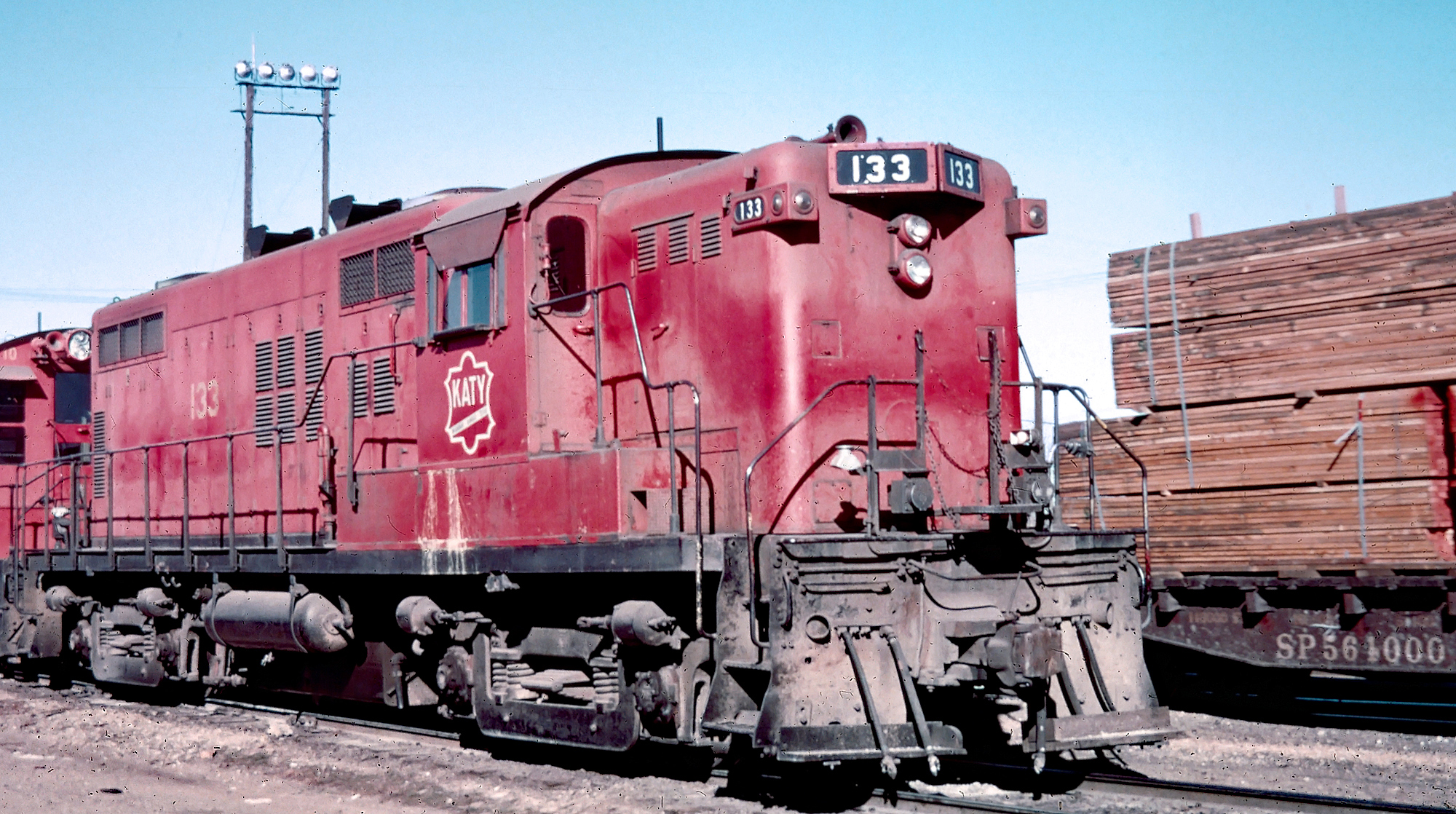 Katy AS16M #133 lays over at Parsons, Kansas, circa 1967. This unit was built as AS16 #1578 (October, 1950); during the late 1950s it was sent to EMD and upgraded with a 567C (replacing the original Baldwin 608A power plant), requiring a Geep hood to house the engine block. Mac Owen photo. American-Rails.com collection.
History
The Katy's story begins during the railroad's earliest days west of the Mississippi River. These vast lands remained relatively uninhabited during the mid-19th century and the federal government looked to change this by aiding in a route's construction to the Pacific Ocean.
The concept was first launched in the 1850s when then-U.S. Secretary of War Jefferson Davis (who later became president of the Confederate States of America) led surveying efforts for this purpose. Three primary corridors were chosen; one to the north, a central route, and finally a southern passage.
For years, Congress could not agree upon which due to philosophical differences over slavery. However, following the Civil War's outbreak, a unified Northern delegation decided upon the central option.
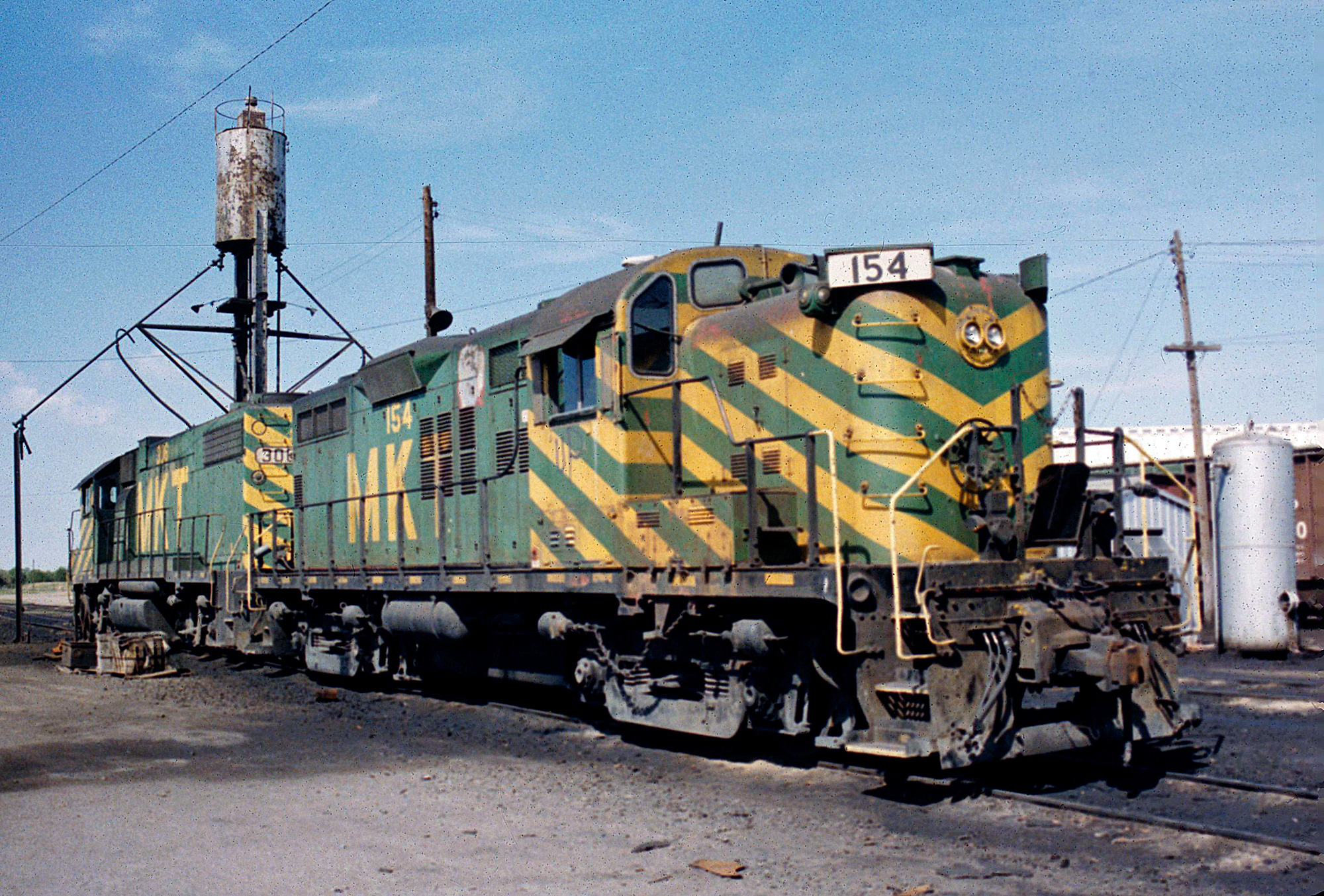 One of Katy's RS3m rebuilds, #154, along with GP38 #301 layover at the engine facility at North Enid Yard in Enid, Oklahoma just after the Union Pacific acquisition, circa 1988. American-Rails.com collection.
Hostilities also brought a much more urgent reason to build west, curbing Confederate influence within these regions. The Pacific Railroad Act of 1862, signed into law by President Abraham Lincoln on July 1st, is the most famous piece of legislation passed for this purpose.
It established the Union Pacific Railroad to build from Omaha, Nebraska, which would meet the Central Pacific heading east from Sacramento. Following six years of construction the two met at Promontory Summit, Utah during a formal ceremony held on May 10, 1869.
At A Glance
St. Louis - Parsons, Kansas Sedalia, Missouri - Kansas City Parsons - Junction City, Kansas Parsons - Oklahoma City Chase - Osage, Oklahoma Parsons - Denison, Texas Denison - Fort Worth - Waco Denison - Dallas - Waco Denison - Wichita Falls - Keyes, Oklahoma Altus, Oklahoma - Wellington, Texas Waco - Rotan, Texas Waco - Austin - San Antonio Waco - Houston - Galveston Smithville - San Marcos, Texas | |
With the driving of the Golden Spike that day, the Transcontinental Railroad was completed. While this event may be the best remembered, a number of similar projects were also undertaken at around the same time.
The Northern Pacific was later established to build from the 49th parallel while the Texas Pacific Railroad (predecessor of the Texas & Pacific Railway) was tasked to run via the 32nd parallel (never completed).
In addition, other upstarts like the Atchison, Topeka & Santa Fe; Atlantic & Pacific/St. Louis & San Francisco (whose charter was acquired by the AT&SF); and Kansas Pacific (Union Pacific) were awarded land grants to open the West.
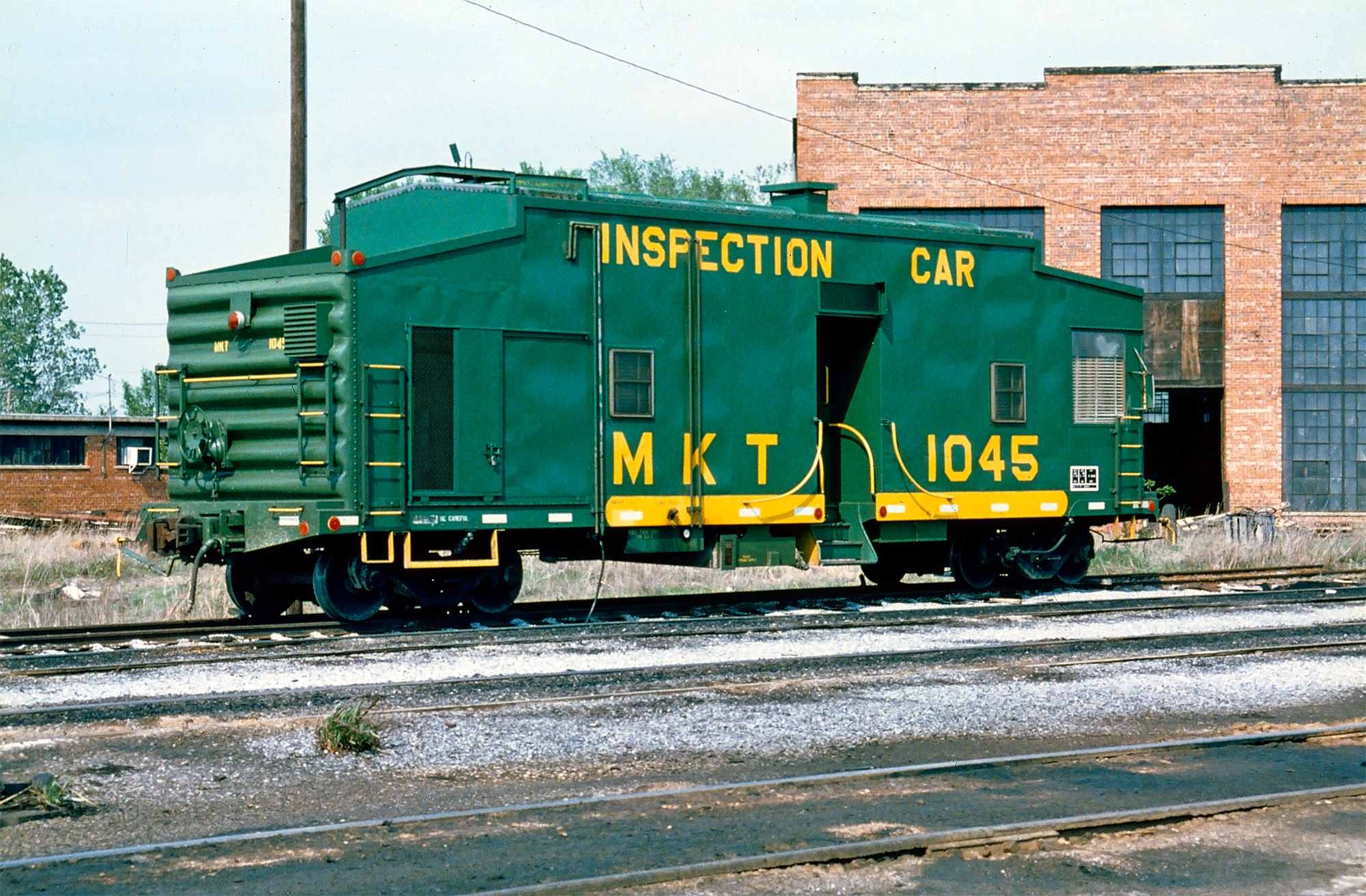 Katy inspection car #1045 tied down in Denison, Texas, circa 1983. The car was built by the Denison Shops in 1973 from a 40-foot Pullman boxcar and remained in use until the 1988 takeover by Union Pacific. Today, it's preserved at the Oklahoma Railway Museum. Mike Bledsoe photo. American-Rails.com collection.
Interestingly, the Katy's immediate predecessor also enjoyed such land grants although much of its network was ultimately pieced together through either new construction or acquisition. It all began when President Lincoln signed an amended Pacific Railroad Act into law on March 3, 1863.
This legislation, according to the booklet, "The Opening Of The Great Southwest: A Brief History Of The Origin And Development Of The Missouri-Kansas-Texas Railroad" (released by MKT's publicity department in 1970), stated the government would "grant alternate sections of land along the route to aid in construction of a line down the Neosho Valley to the southern boundary of Kansas."
These would be ten sections in width along each side of the track. The book, "Katy Power: Locomotives And Trains Of The Missouri-Kansas Texas Railroad, 1912-1985" by authors Joe Collias and Raymond George, Jr., notes the government had another motive behind this plan; to provide U.S. Army forts with improved transportation as a national defense measure against the Confederacy.
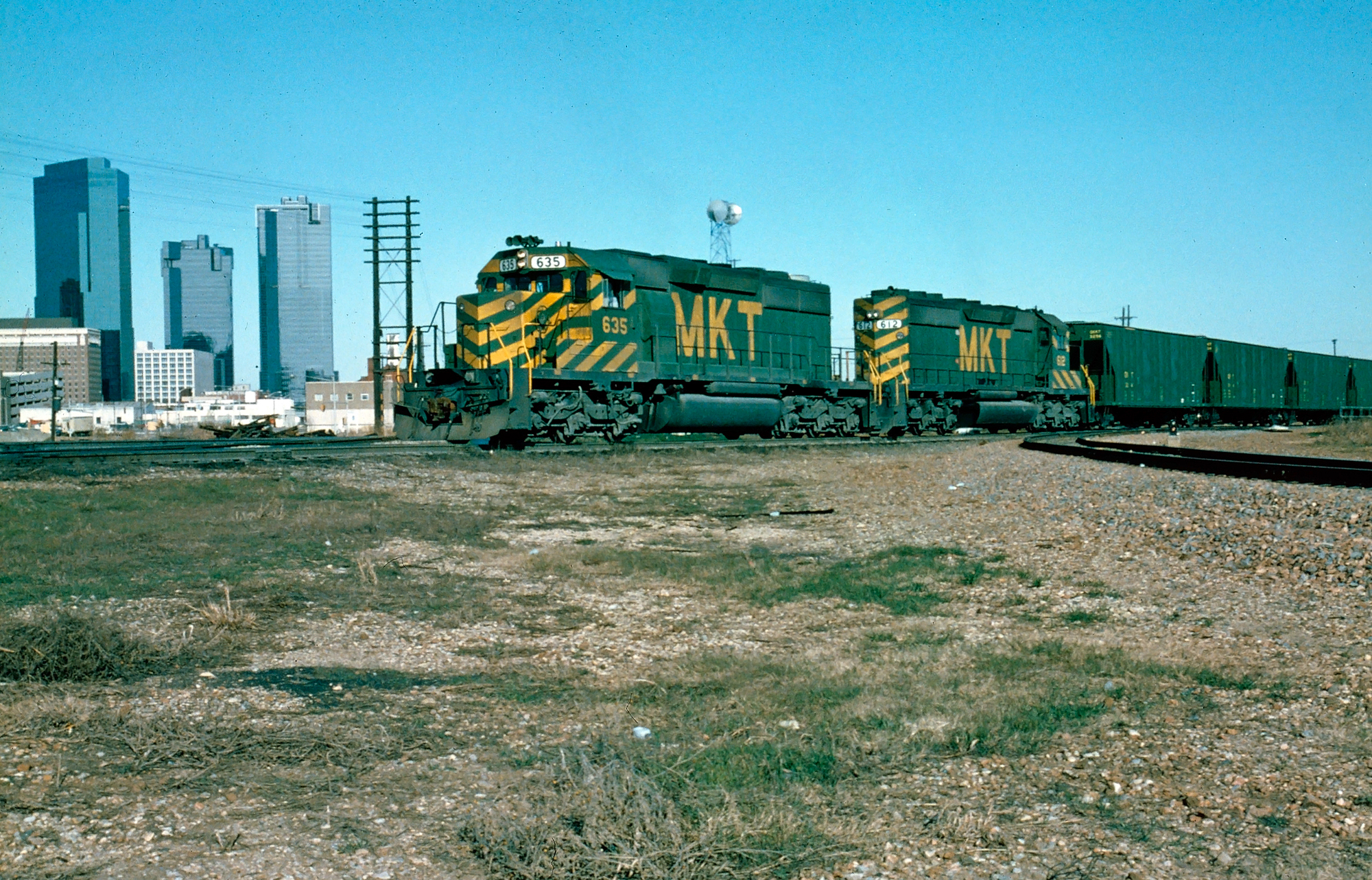
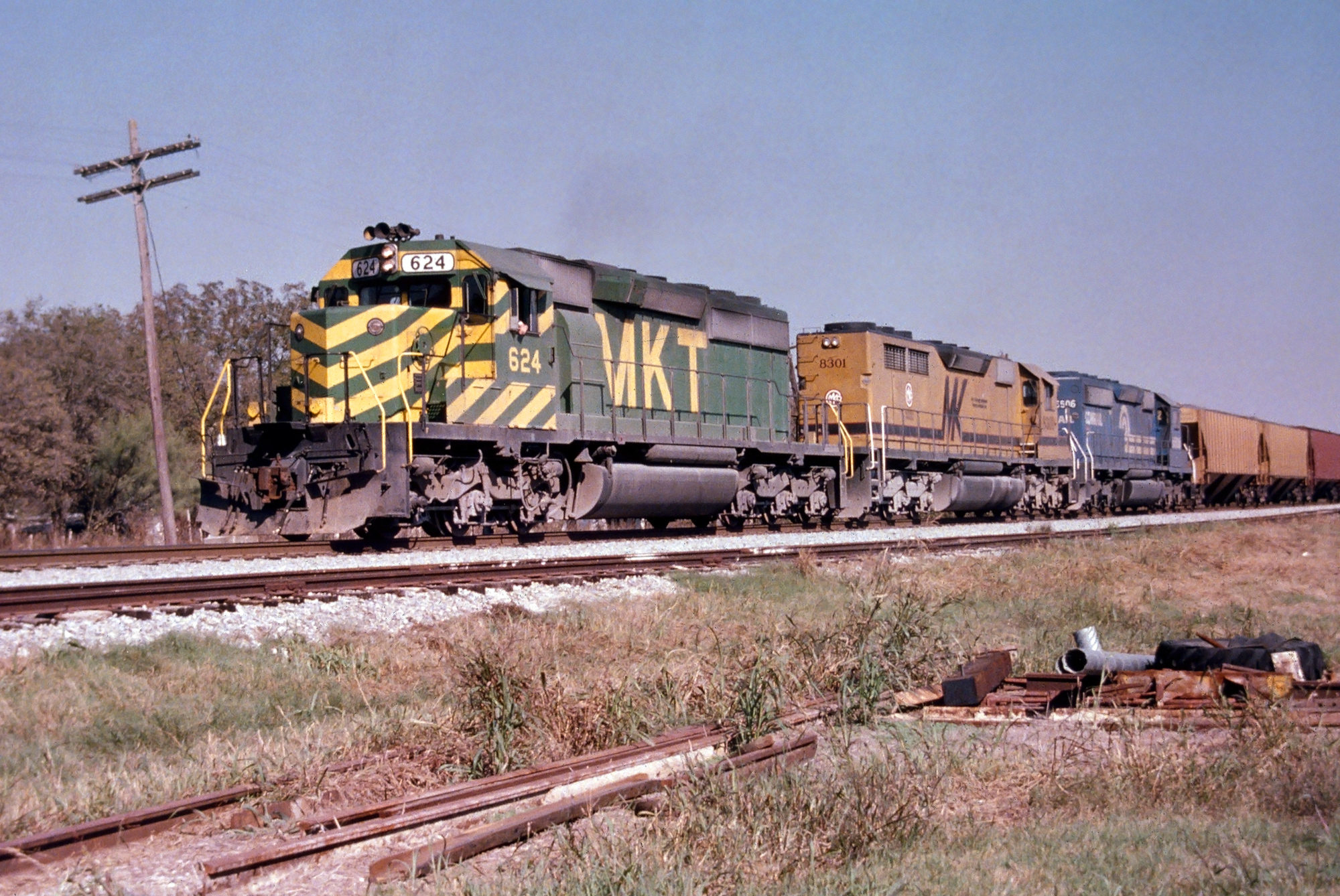 Katy SD40-2 #624, Morrison-Knudsen SD40M-2 #8301, and Conrail SD40-2 #6506 have what appear to be grain hoppers on the move near Bartlett, Texas, circa 1982. Mike Bledsoe photo. American-Rails.com collection.
More specifically, it was hoped that Fort Riley, Fort Leavenworth, and Fort Gibson could be directly connected by rail.
There were three railroads incorporated for this purpose; the Kansas & Neosho Valley Railroad (K&NV); Leavenworth, Lawrence & Fort Gibson Railroad (LL&FtG); and finally the Union Pacific Railway, Southern Branch (UPRSB).
The latter, formed during February of 1865, is the Katy's genesis, envisioned to link all three forts as well as Fort Smith in Arkansas (never accomplished). The first to complete the task and reach Indian Territory (the state of Oklahoma after November 16, 1907) would be declared the winner.
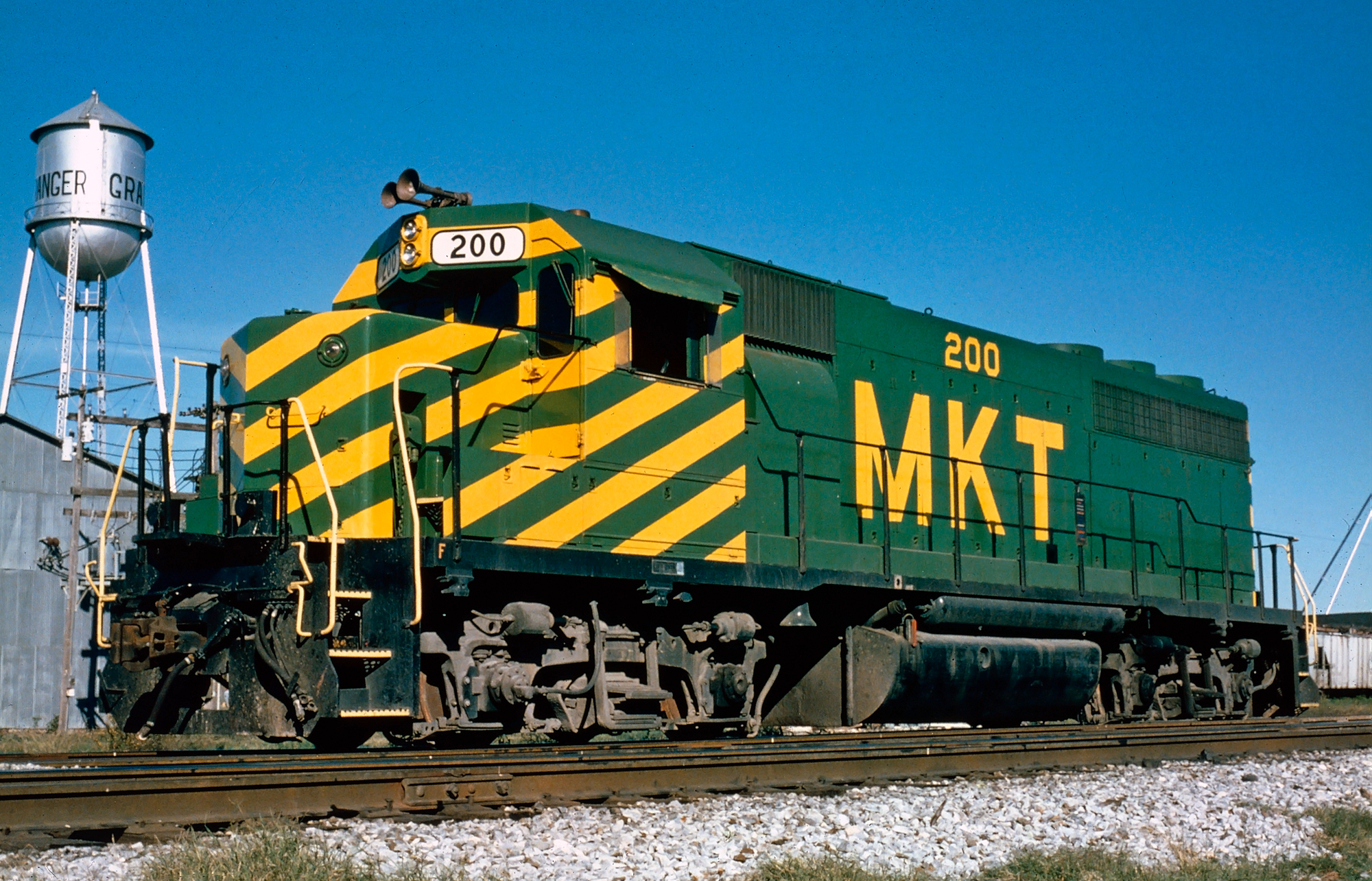
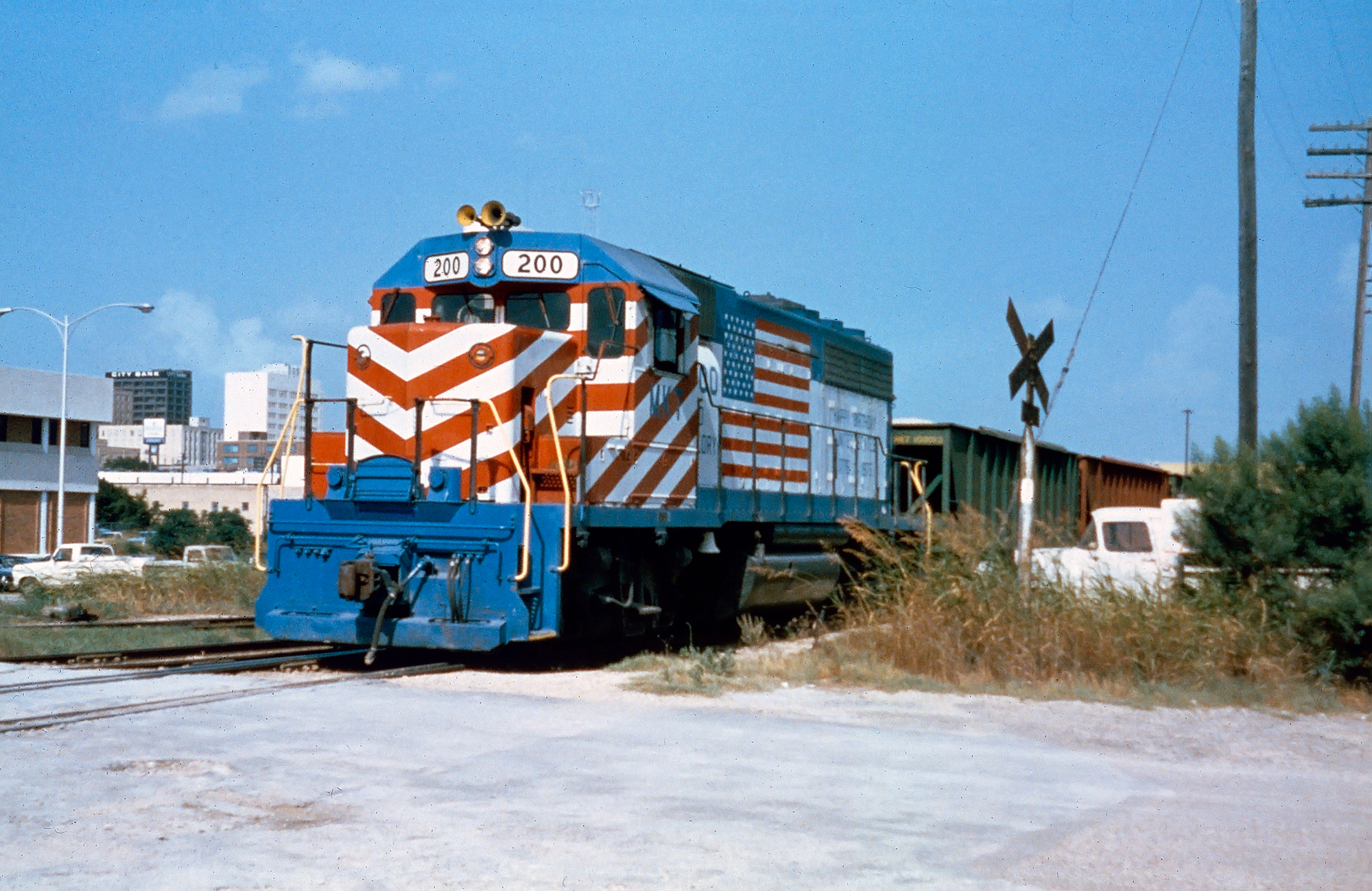 Missouri-Kansas-Texas (Katy) GP40 #200, still in bicentennial colors at Austin, Texas in the summer of 1979. Mike Bledsoe photo. American-Rails.com collection.
It wasn't long before promoters of the LL&FtG had given up, which left only the K&NV (later reorganized as the Missouri River, Fort Scott & Gulf) and UPRSB. The former began construction directly south out of Kansas City while the latter commenced from Fort Riley, Kansas (Junction City) in a southeasterly direction.
Both companies were soon underway and the UPRSB had reached Burlington, Kansas by February of 1870. Just three months later, on May 23rd, it was renamed as the Missouri, Kansas & Texas Railway (MK&T).
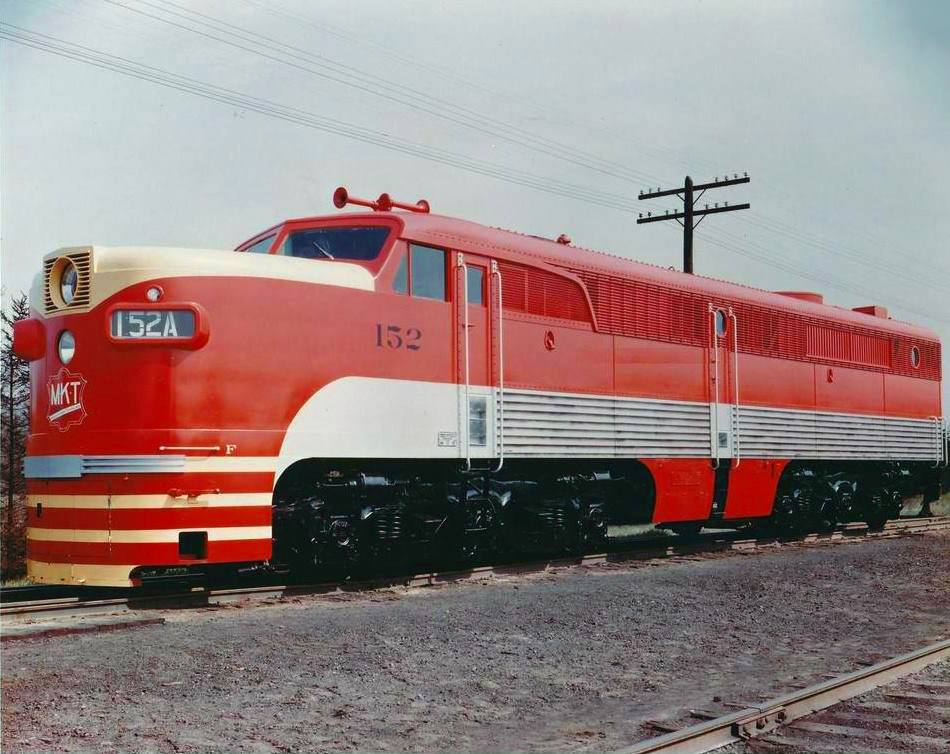 An American Locomotive Company builder's photo featuring new Missouri-Kansas-Texas Railroad ("The Katy"), PA-1 #152-A, circa 1949.
Shortly thereafter, track-layers arrived in Chetopa, Kansas (182 miles from Junction City) and the first train officially entered Indian Territory on June 6, 1870.
There was great dismay when it was learned the MRFtS&G had actually arrived there first, completing a line down the eastern edge of Kansas, connecting Fort Scott, Girard, Columbus, and Baxter Springs along the way.
However, by doing so it had entered Quapaw Indian Territory, which was not stipulated in the federal act which specifically stated a railroad was to enter the Neosho River Valley within the Cherokee's lands. As a result, the MK&T was awarded the grant.
Logo
With more capital now available officials immediately sought further construction and opened a new, 160-mile corridor from southeastern Kansas to Sedalia on February 3, 1871.
It split off the original main line at the new town of Parsons (named for MK&T president Judge Levi Parsons, the location later became the modern Katy's primary engine and maintenance terminal).
After opening to Sedalia, construction crews worked their way south, crossed the Red River, and reached Denison, Texas on December 24, 1872. Many of the railroads building west (which included the powerful Santa Fe) were funded by eastern capitalists based in either Boston, New York, or Philadelphia.
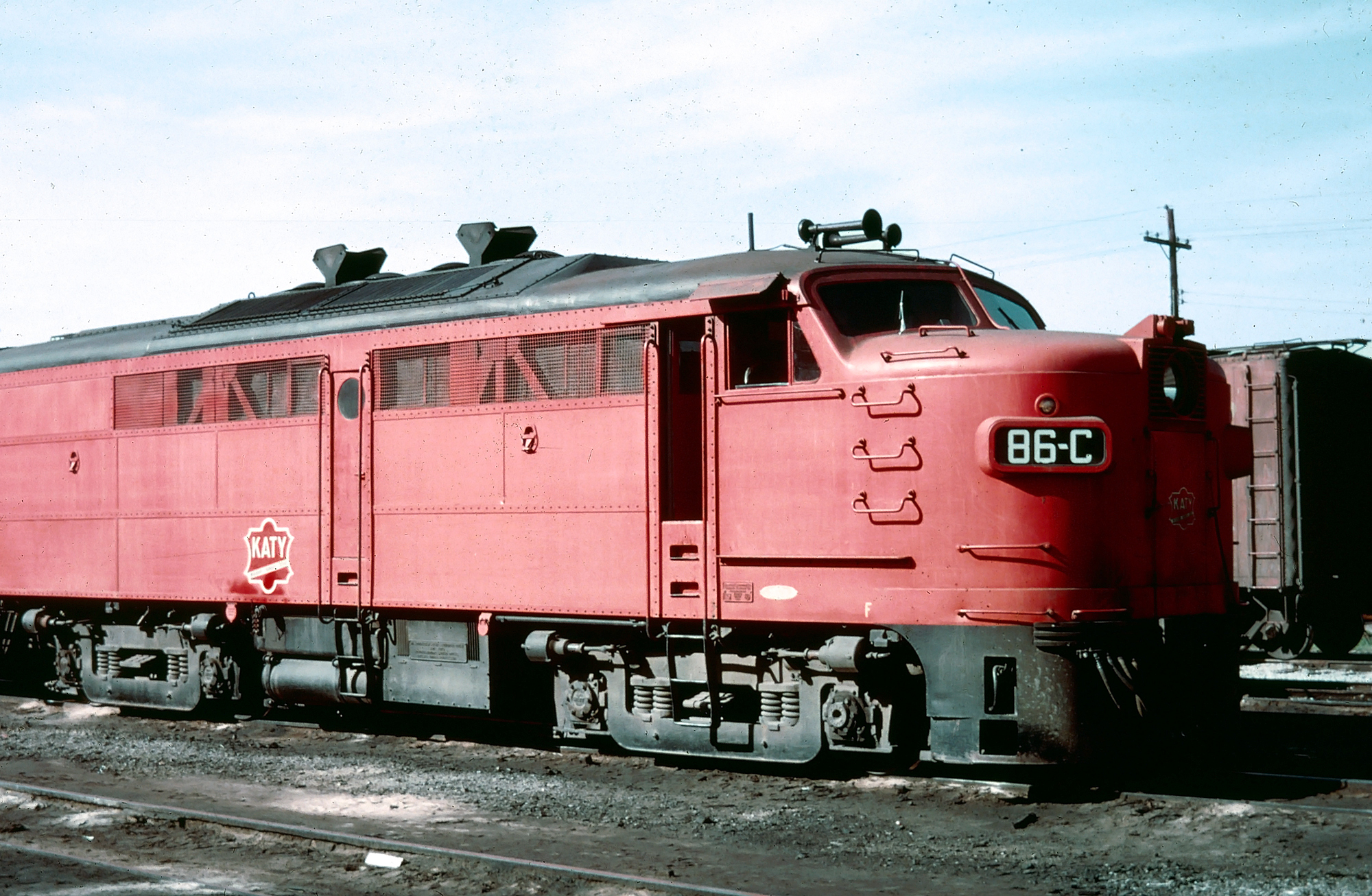 One of Katy's FA-1s rebuilt with an EMD 567C at Parsons, Kansas, circa 1968. Mac Owen photo. American-Rails.com collection.
The Katy was no different and relied heavily on their monetary support. Early on, it struggled to procure a steady traffic base due to the region's sparse population. It subsisted chiefly on the Chisholm Trail's cattle business (which helped fuel the Santa Fe's rapid growth) along with available agricultural traffic.
In an effort to remedy this issue, it opened a through extension from Sedalia to Moberly, Missouri on January 10, 1874 following completion of a bridge over the mighty Missouri River.
The new line provided a connection with the St. Louis, Kansas City & Northern (a Wabash predecessor), which offered through service into the growing hub of Chicago.
System Map
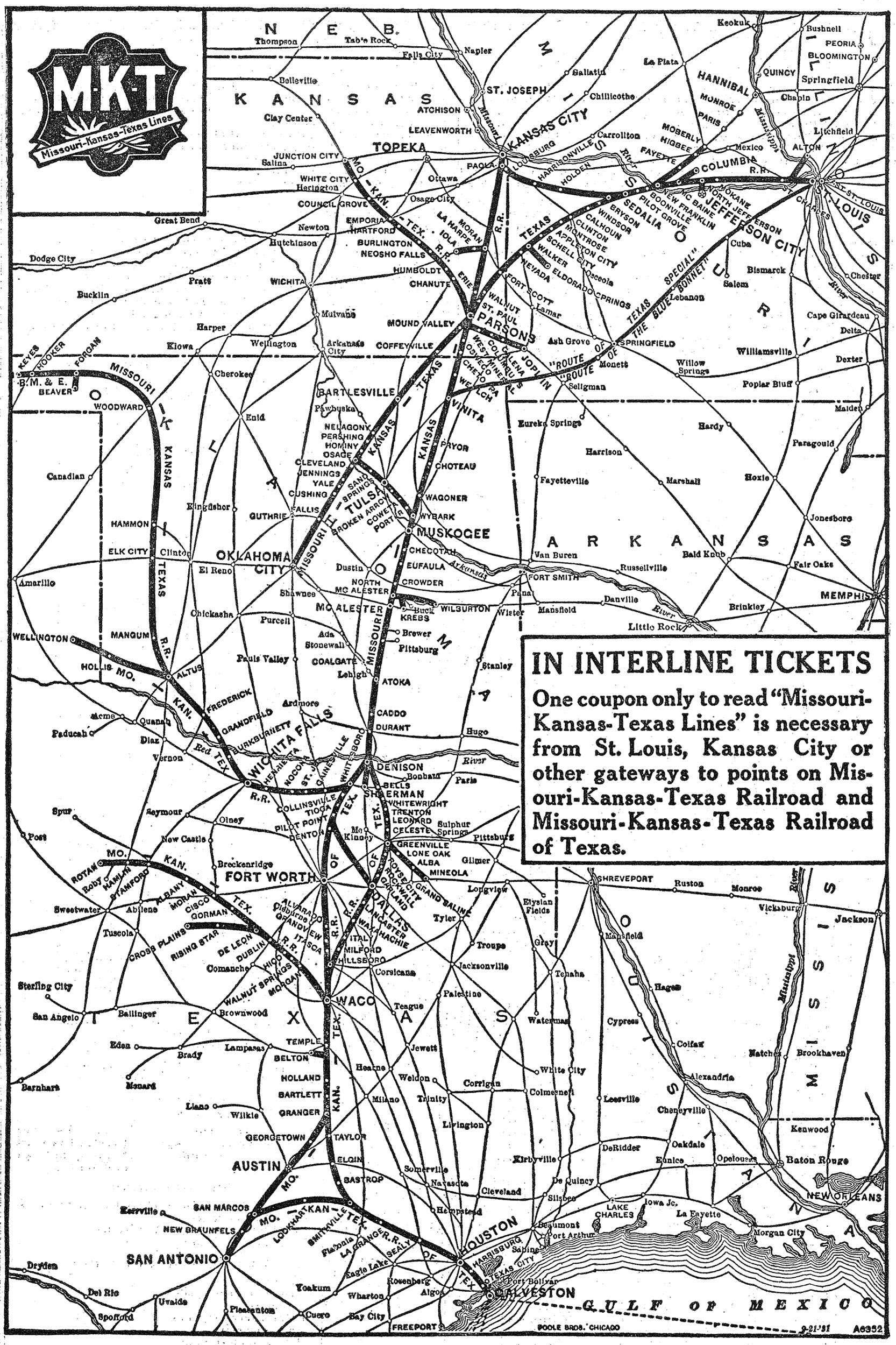
Following the financial Panic of 1873 the MK&T did its best to remain solvent but eventually entered bankruptcy on December 31, 1874. It exited receivership on March 1, 1876 carrying the same name but with new leadership.
A confidant of Jay Gould, William Bond, was named general manager which led to the tycoon, himself, later achieving the presidency on January 26, 1880. He implemented his typical policies of deferred maintenance and pay cuts to provide shareholders with the highest possible earnings.
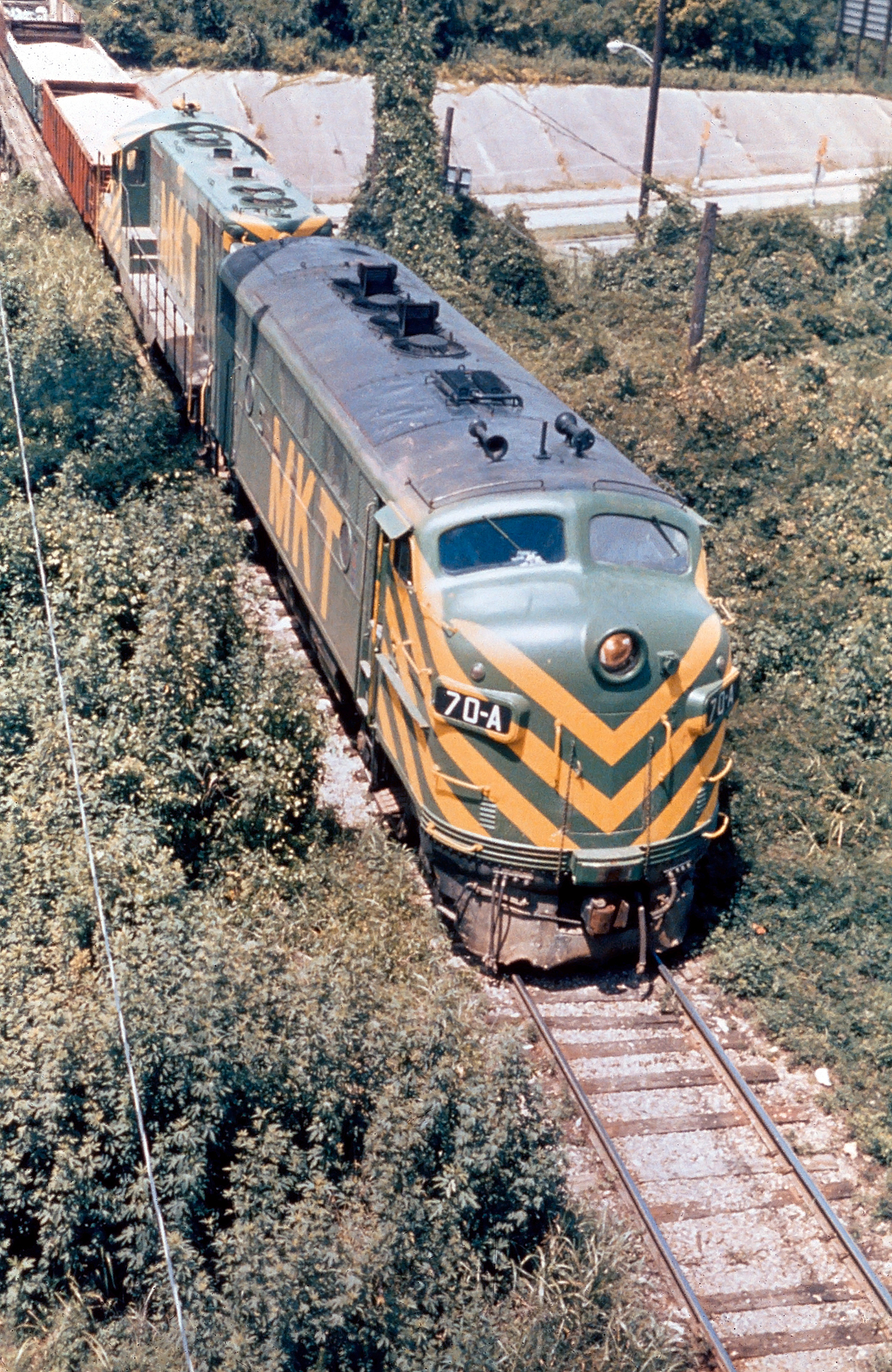 Katy F3A #70-A and a Geep are seen here in service at Austin, Texas, circa 1978. Mike Bledsoe photo. American-Rails.com collection.
Expansion
Despite his poor reputation, Gould is credited with much of the Katy's expansion. Growth was a key step in his larger plan to establish a true, coast-to-coast transcontinental railroad and explains why most railroads under his control rapidly expanded in the late 19th century.
In the Katy's case, its development was somewhat different as Gould used the carrier to further propagate his influence across Texas. By the end of that year he enjoyed a virtual monopoly in the Lonestar State thanks to a portfolio that included the Missouri Pacific, Texas & Pacific, and International & Great Northern.
By acquiring the MP, Gould made a corporate change with the Missouri, Kansas & Texas; henceforth it would be the MK&T Division of that system. This was abbreviated to "K&T Division" in printed timetables which led to the nickname "KT" or "Katy."
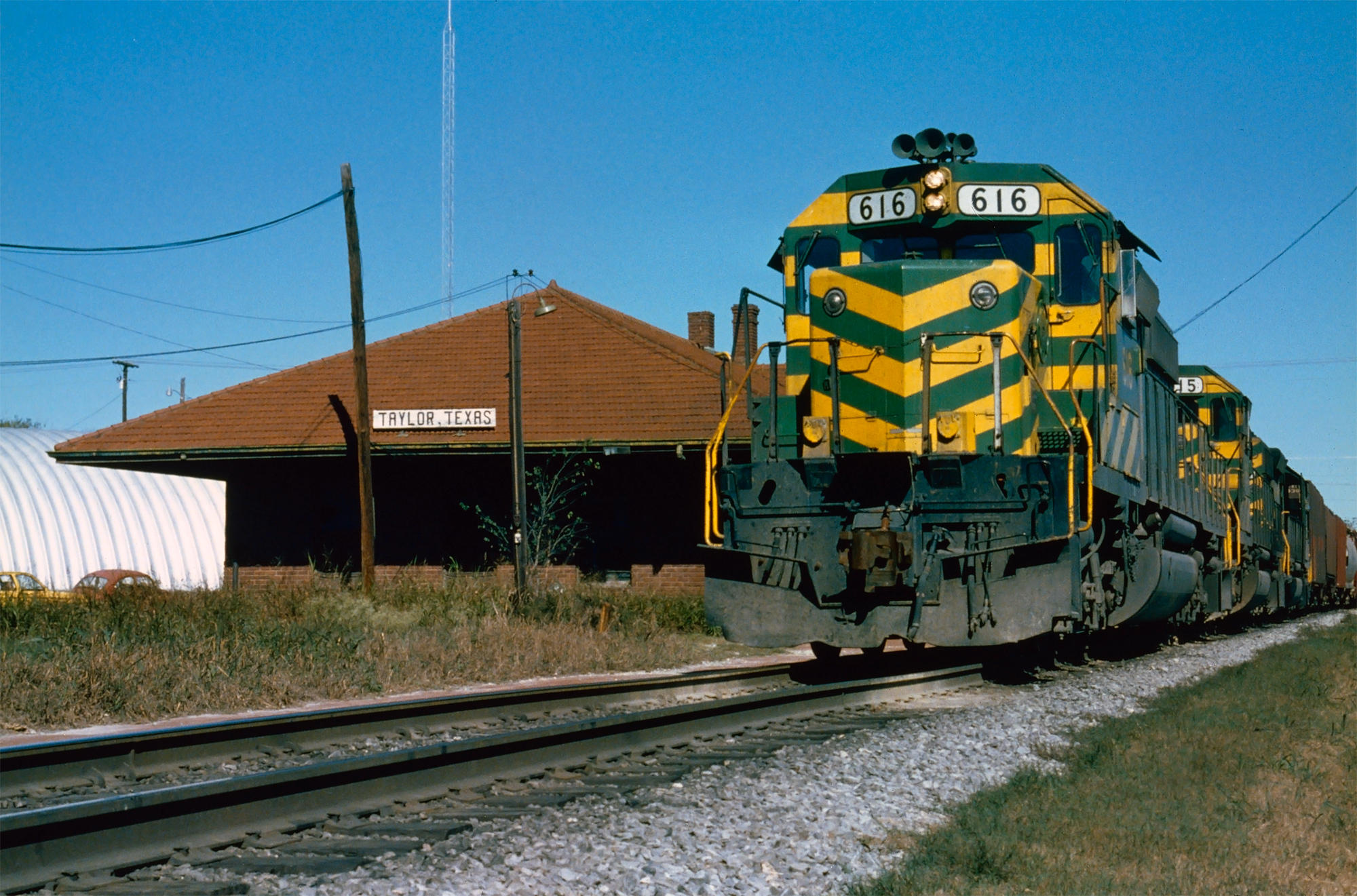 Katy SD40-2 #616 leads a southbound past the depot at Taylor, Texas, circa 1983. Mike Bledsoe photo. American-Rails.com collection.
Afterwards, he quickly pushed it deeper into Texas; in early 1881 Gould purchased two small short lines running south and west of Denison; one reached Greenville while the other terminated at Gainesville. Then, trackage rights were secured over the T&P on April 1st providing access into Fort Worth from Whitesboro.
The 1880's were a banner decade for growth:
- From Greenville the line was extended to Mineola on June 25, 1881.
- Service into Dallas also began that year by controlling the Dallas & Wichita.
- Beyond Fort Worth rails reached Taylor on June 9, 1882.
- Another small short line, the Dallas & Greenville Railway, was picked up in 1886, providing direct service between those two points.
- In 1890 subsidiary Dallas & Waco reached Hillsboro, which opened through service from Dallas to Waco, Taylor, and points further south.
- In 1887 an extension reached Henrietta along a corridor that eventually became a very long agricultural branch into western Oklahoma.
- Houston was accessed in 1893 and the MK&T entered Galveston by jointly owning the Galveston, Houston & Henderson in conjunction with the Intentional & Great Northern.
- Lastly, it first arrived at San Antonio from the east in 1901, then opened a direct north-south connection from Granger to Austin in 1904 (beyond San Marcos trackage rights were secured over the I&GN into San Antonio).
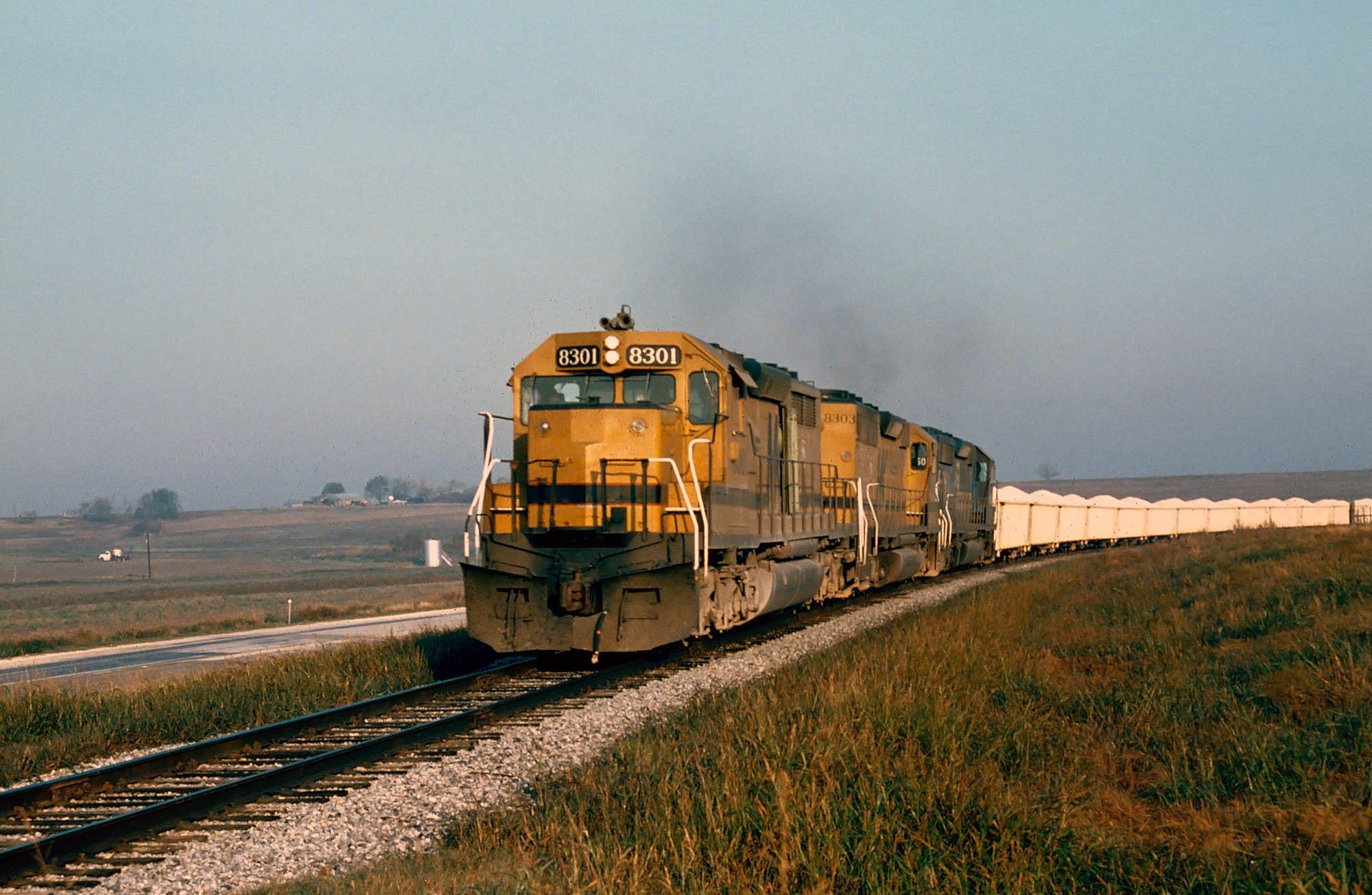 Morrison Knudsen SD40M-2 #8301 (built as Electro-Motive SD45X demonstrator #4203) and SD40R #8303 (built as Southern Pacific SD40 #8402), along with a Conrail unit, lead this Katy freight between Taylor and Elgin, Texas, circa 1984. At the time the MKT was leasing a great deal of locomotives to fulfill a power shortage. Mike Bledsoe photo. American-Rails.com collection.
The company wrapped up its expansion in Texas by acquiring the Texas Central Railway in June of 1910. This 268-mile system provided service into De Leon, Cross Plains, and Rotan via Waco.
While Gould never focused on further growth across Indian Territory he did establish a direct route into Kansas City; much of this was accomplished in 1887 when a new line opened from Parsons to Paola.
From there, 43 miles of trackage rights were secured over the Kansas City, Fort Scott & Memphis Railway (Frisco) on July 8, 1889. Before Gould could carry out further efforts a court order forced him to divest control of the MK&T; it took effect on November 1, 1888 at which time the Katy was permanently separated from the Missouri Pacific.
It was placed into a voluntary receivership and reorganized as an independent Missouri, Kansas & Texas Railway on July 1, 1891. Following this corporate shakeup the MK&T continued to expand:
- It reached St. Louis in the spring of 1894 by completing a line from New Franklin to Manchens (162 miles) then gained trackage rights over the Chicago, Burlington & Quincy from that point into the Gateway City.
- Just a year later, in 1895, it opened an 86-mile cutoff from Bryson to Paola, providing a direct, east-west corridor between St. Louis and Kansas City.
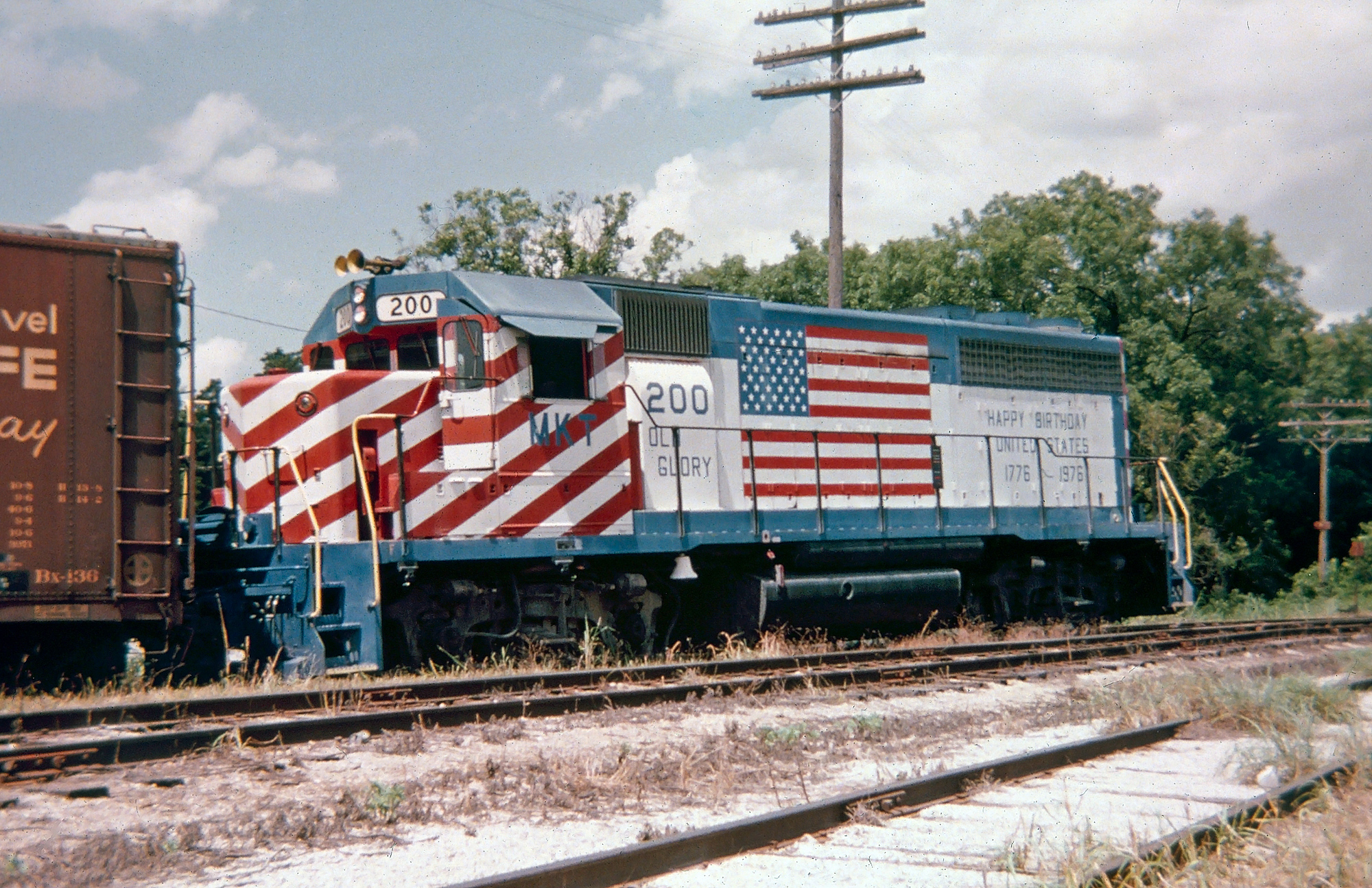 Katy GP40 #200, wearing the railroad's bicentennial livery, at Austin, Texas in the summer of 1979. Mike Bledsoe photo. American-Rails.com collection.
The Katy's final additions included a route to Oklahoma City and the extensive, previously mentioned agricultural branch across western Oklahoma. The former was attained over a long, 169-mile branch running southwestward from Coffeyville, completed in February of 1904.
- Of note was a sort of cutoff established between this branch and the Kansas City/St. Louis-Dallas/Fort Worth main line when a 79-mile connector opened from Osage to Wybark in August of 1903. -
The latter was carried out through a series of leases and new construction; first, the MK&T leased the Wichita Falls Railway in 1895 to access Wichita Falls, Texas from what was then the end-of-track at Henrietta.
In July of 1911 it acquired the Wichita Falls & Northwestern Railway, which was already in the process of opening rail service throughout western Oklahoma; it reached Forgan on November 1, 1912, which had followed completion of a branch from Altus to Wellington, Texas on November 10, 1910.
Altogether, this trackage totaled 363 miles. In 1931 the line was further extended from Forgan to Keyes by acquiring the 105-mile Beaver, Meade & Englewood Railroad.
The Katy's entire interest in this trackage was to improve its wheat and cotton tonnage. However, as the years passed the branch became increasingly unprofitable and was abandoned north of Altus on January 31, 1973.
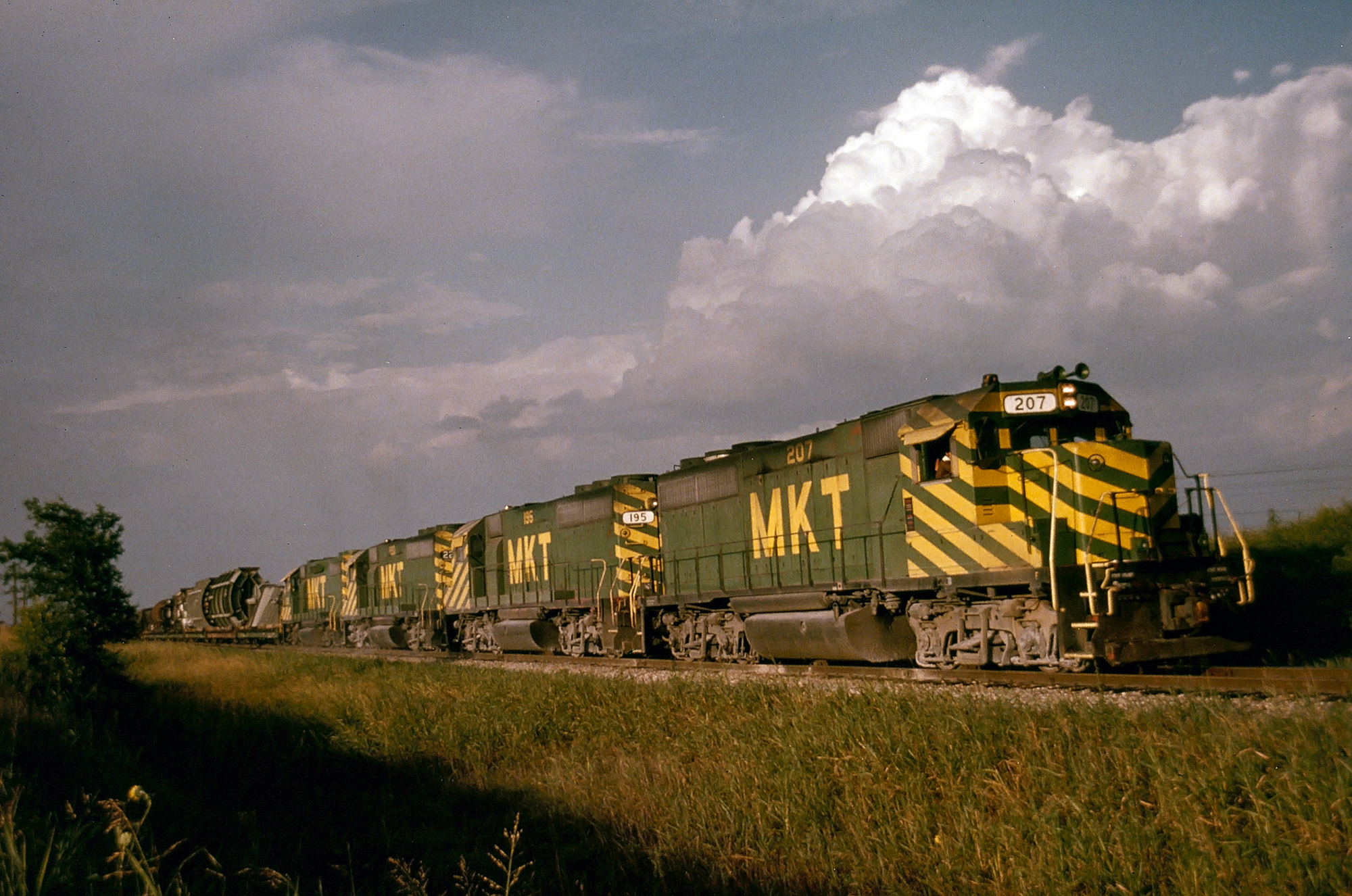 A quartet of Katy GP40's, led by #207, are between Troy and Eddy, Texas in the summer of 1978. According to Steve Bledsoe: This photo "..was in the 1983 Katy Railroad calendar. Our father always said that is was the best picture he ever took. We were heading to Colorado for a family vacation and someone yelled, 'There’s a headlight!' So our dad pulled off the side of the road and ran through a patch of weeds and just barely got the picture. The Katy president at that time contacted our father to create a large picture on canvas. The original picture seen here hung the the company offices in Dallas for years. We did have an artist enhance our framed canvas picture of this image and for our business we sold posters of the enhanced version of this image. The big canvas picture that was in the Katy offices is now part of the Red River Museum in the old Katy depot in Denison, Texas." Mike Bledsoe photo. American-Rails.com collection.
There were many other components of the contemporary Katy not mentioned here; many were short segments either abandoned or sold over the years. One of the most notable was the narrow-gauge East Line & Red River Railroad (EL&RR), acquired on November 28, 1881.
According to Dr. George Hilton's book, "American Narrow Gauge Railroads," the system was originally chartered on March 22, 1871 and over the next decade opened 124 miles from Greenville to Jefferson, Texas. Following MK&T's takeover it was extended westward from Greenville to McKinney in May of 1882.
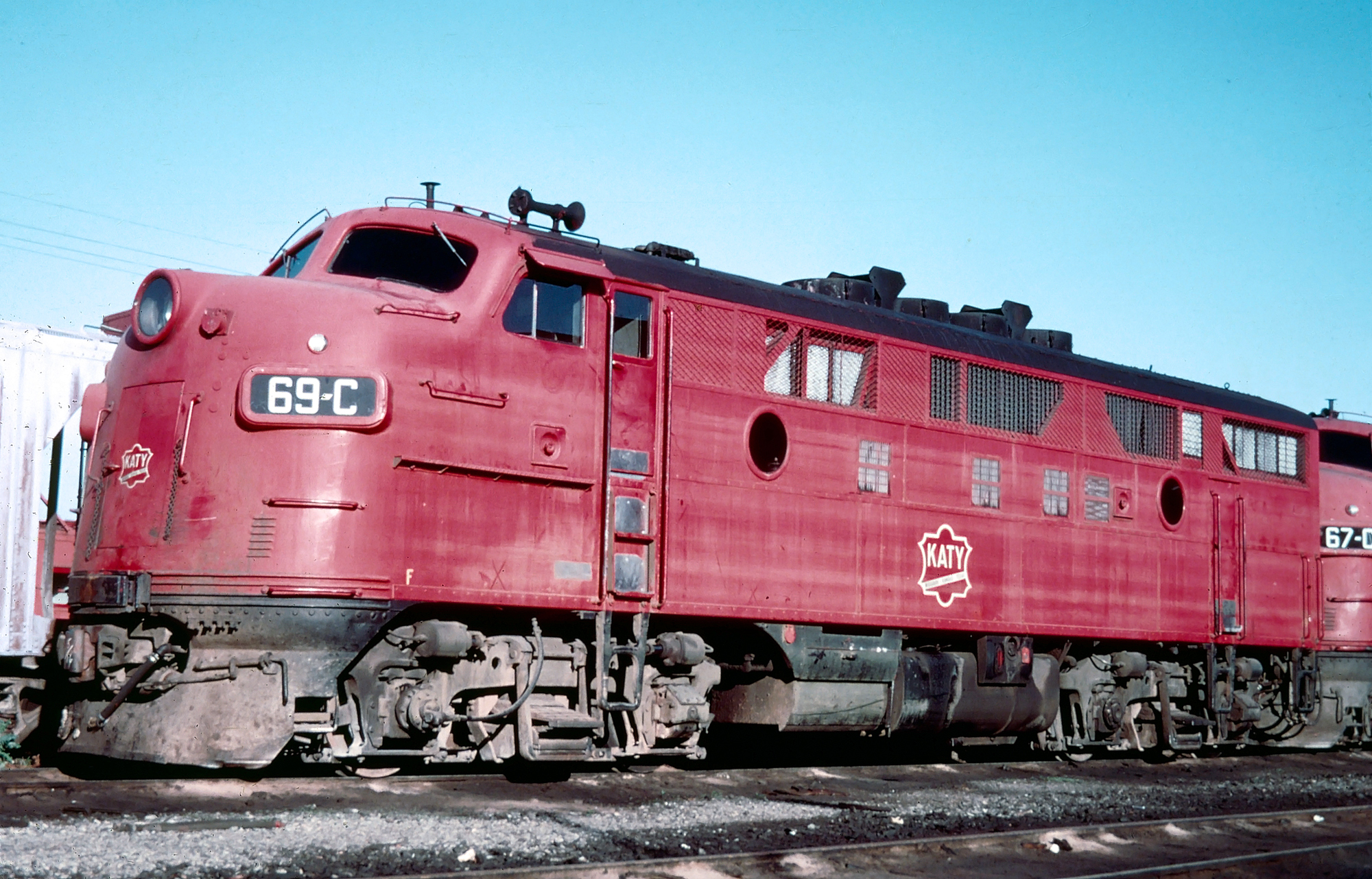 Missouri-Kansas-Texas Railroad ("Katy") F3A #69-C at Parsons, Kansas, circa 1968. Mac Owen photo. American-Rails.com collection.
Due to a dispute with the Texas attorney general, the EL&RR was ordered separated from the MK&T on April 12, 1891 although it remained under Katy control.
The process of converting the property to standard gauge began in 1887 when the newer McKinney-Greenville section was widened. The remainder was finished during a single day (122 miles) on September 13, 1892.
It was then pushed eastward to Waskom, Texas while 20 miles of trackage rights were secured over the Vicksburg, Shreveport & Pacific (future component of the Illinois Central) in 1900 to reach Shreveport, Louisiana. It only remained in the MK&T network for two decades.
On September 26, 1915 the Katy was placed in receivership. When it was reorganized on April 1, 1923 as the Missouri-Kansas-Texas Railroad the EL&RR trackage was not retained and became part of the Louisiana Railway & Navigation Company (a Kansas City Southern predecessor).
Throughout the 20th century, the 2,787-mile Katy enjoyed strong leadership although stiff competition hampered profits. It managed to evade bankruptcy during the Great Depression, thanks in part to a nearly $3 million Reconstruction Finance Loan received in 1938.
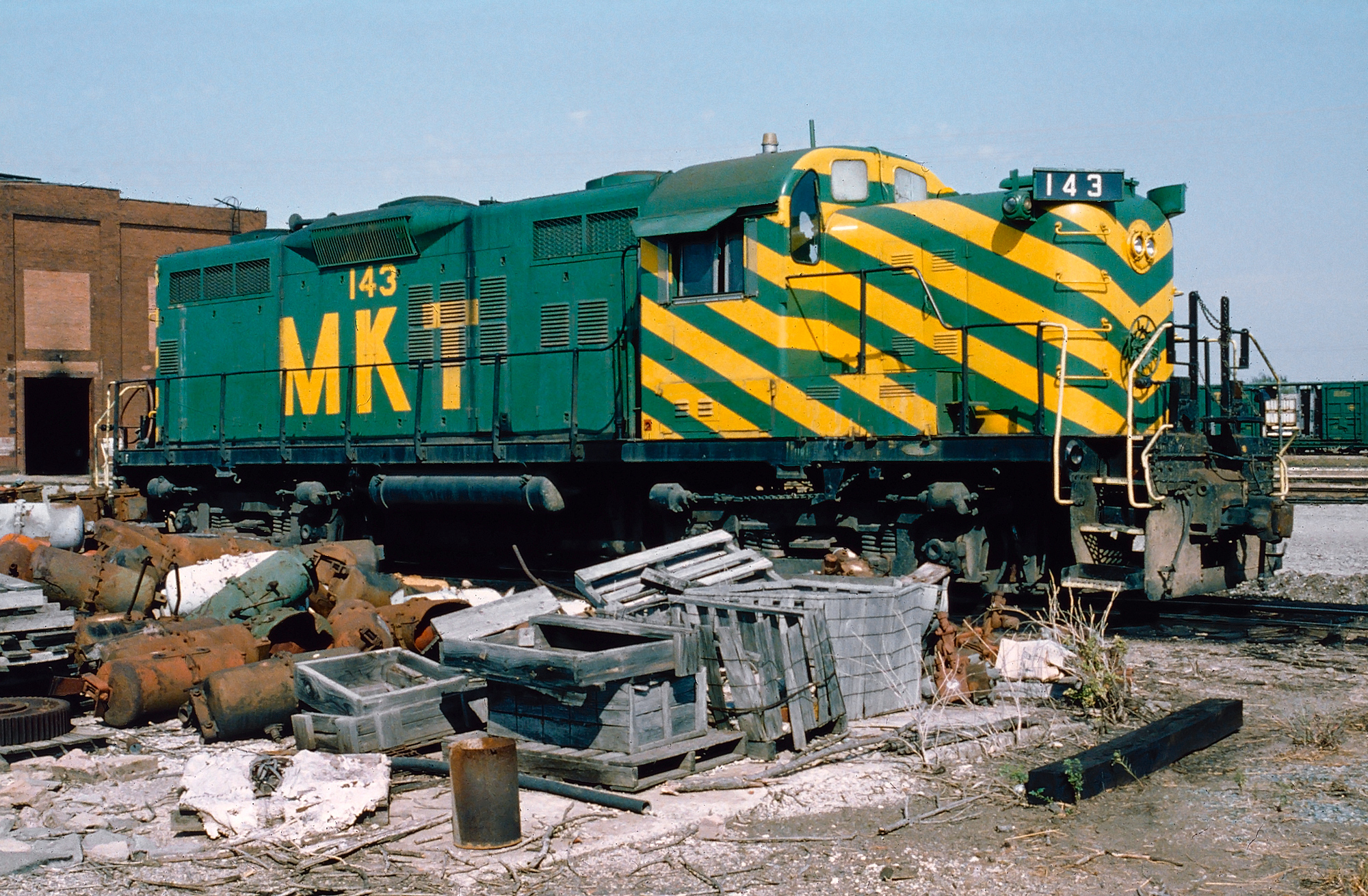 Katy RS3m #143 lays over at the shops in Parsons, Kansas, circa 1983. This was one of units rebuilt by Electro-Motive with a 567C in 1959, which required a Geep hood to house the engine block. Mike Bledsoe photo. American-Rails.com collection.
Mr. Collias and Mr. George, Jr. argue that had the MKT elected to enter receivership during these lean times it may have decreased or eliminated outstanding debt, improved its system, and enjoyed greater success. As it were, lack of money precluded heavier infrastructure and equipment investments.
Much of its network was laid with relatively light rail (90 pounds or less) which prevented more powerful wheel arrangements (such as 2-8-4's, 4-8-4's, or articulateds) from being utilized. Without these, it could not handle longer freights, which would have generated greater revenue.
In May of 1948 the Katy did unveil a beautiful streamliner, the Texas Special, in conjunction with the St. Louis-San Francisco between St. Louis and Fort Worth/Dallas/San Antonio. Unfortunately, MKT's deteriorating track conditions and equipment greatly vexed the Frisco, which canceled its leg in 1959.
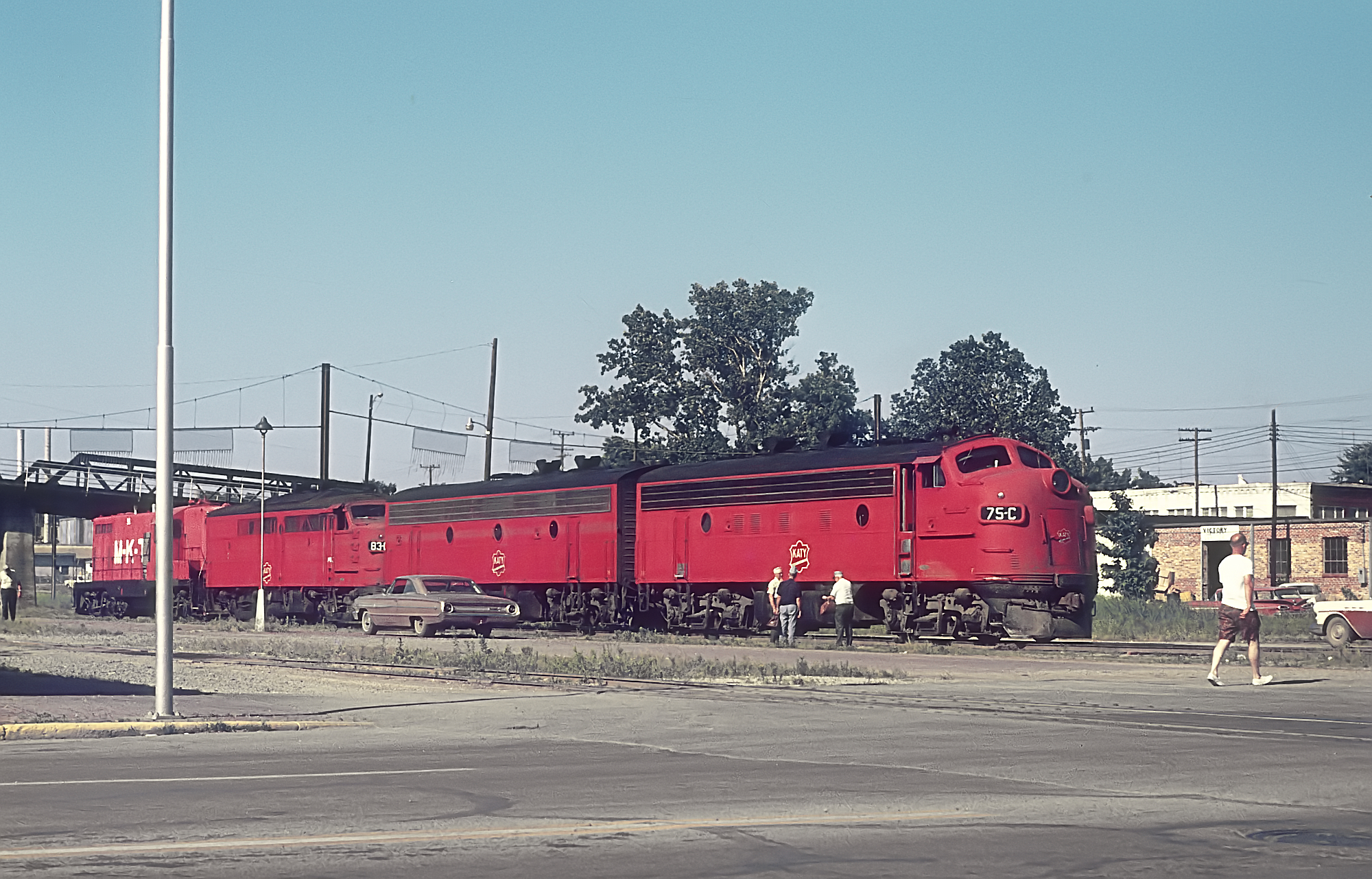 Katy F7A #75C, F9B #75B, FA-1 #83C, and a Geep were photographed here by Marty Bernard at Muskogee, Oklahoma on June 13, 1968.
Passenger Trains
Texas Special: (St. Louis - Dallas/Fort Worth - San Antonio)
Diesel Roster
American Locomotive Company
| Model Type | Road Number (Original) | Road Number (Post-1960) | Date Built | Quantity |
|---|---|---|---|---|
| PA-1 | 151A-153A, 151C-153C | 57A-59A, 57C-59C | 4/1949-11/1949 | 6 |
| PA-2 | 154A-157A, 154C-157C | 60A-63A, 60C-63C | 11/1950-3/1951 | 8 |
| FA-1 | 326A-334A, 326C-334C | 82A-90A, 82C-90C | 11/1948-3/1949 | 18 |
| FA-2 | 331A (2nd) | 87A (2nd) | 12/1950 | 1 |
| RS3 | 1551-1563, 1701-1702 | 144-156, 142-143 | 9/1950-9/1951 | 15 |
Baldwin Locomotive Works
| Model Type | Road Number (Original) | Road Number (Post-1960) | Date Built | Quantity |
|---|---|---|---|---|
| DS-4-4-1000 | 1000-1010 | 22-32 | 8/14/1946-3/10/1947 | 11 |
| S12 | 1201-1215 | 33-47 | 9/29/1951-6/16/1952 | 15 |
| AS16 | 1571-1586, 1787-1788 | 126-133, 124-125 | 9/28/1950-11/14/1953 | 18 |
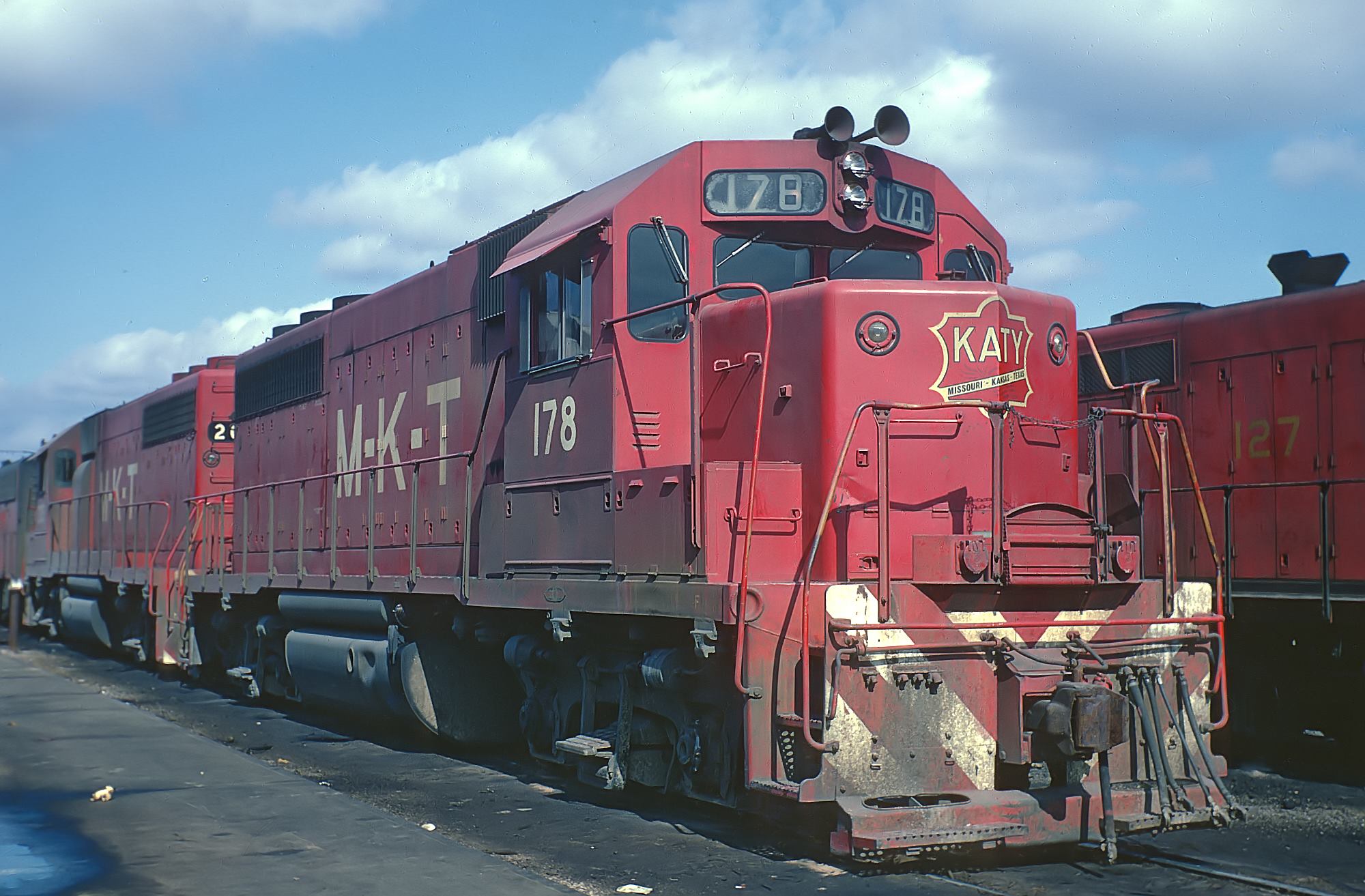 Missouri-Kansas-Texas GP40 #178 and other power layover at Parsons, Kansas in November, 1969. At the date of this photo the Katy's Geeps were a few years old. Rick Burn photo.
Electro-Motive Division
| Model Type | Road Number (Original) | Road Number (Post-1960) | Date Built | Quantity |
|---|---|---|---|---|
| SW1200 | 1-6 | 1-6 | 12/1957 | 6 |
| SW1500 | - | 50-55 | 11/1967-9/1968 | 6 |
| MP15AC | - | 56-59 | 10/1980 | 4 |
| E7A | 101A, 101C | 51A, 51C | 3/1947 | 2 |
| E8A | 106A-107A, 106C-107C | 52A-53A, 52C-53C | 3/1950 | 4 |
| E8A | 131, 133, 135 | 54A-56A | 5/1951 | 3 |
| E8A | 132, 134 | 54C-55C | 5/1951 | 2 |
| FP7 | 121A-124A, 124A-124C | 78A-81A, 78C-81C | 1/1952-2/1952 | 8 |
| GP40 | - | 170-248 | 6/1966-10/1968 | 79 |
| F3A | 201A-207A, 201C-207C | 64A-70A, 64C-70C | 6/1947 | 14 |
| F3B | 201B-207B | 64B, 64D-64H, 65B | 6/1947 | 7 |
| F7A | 208A-211A | 71A-74A | 6/1949 | 4 |
| F7A | 226A-229A | 75A, 76A, 65H, 77A | 6/1949 | 4 |
| F7A | 208C-211C | 71C-74C | 6/1949 | 4 |
| F7A | 226C-229C | 75C, 76C, 70C, 77C | 6/1949 | 4 |
| F7B | 121B-124B | 78B, 78D-78F | 1/1952-2/1952 | 4 |
| F7B | 208B-211B | 65D-65G | 6/1949 | 4 |
| F9B | 226B-229B | 75B, 75D-75F | 3/1955 | 4 |
| GP38 | - | 300-303 | 12/1969 | 4 |
| GP38-2 | - | 304-321 | 12/1972-6/1976 | 18 |
| GP39-2 | - | 360-379 | 3/1984-6/1984 | 20 |
| GP39-2 | - | 380-388 | 1/1977 | 9 (Ex-Kennecott Copper) |
| SD40-2 | - | 600-636 | 8/1978-9/1981 | 37 |
| SD40-2 | - | 637 | 9/1979 | 1 (Rebuilt from #316) |
| NW2 | 1026-1030 | 7-11 | 1/1947 | 5 |
| SW9 | 1226-1235 | 12-21 | 2/1952-4/1952 | 10 |
| GP7 | 1501-1529, 1761-1764 | 91-119, 120-123 | 3/1950-12/1952 | 34 |
Fairbanks-Morse
| Model Type | Road Number (Original) | Road Number (Post-1960) | Date Built | Quantity |
|---|---|---|---|---|
| H16-44 | 1591 | 157 | 9/1950 | 1 |
| H16-44 | 1731-1734 | 158-161 | 9/1951-10/1951 | 4 |
General Electric
| Model Type | Road Number (Original) | Road Number (Post-1960) | Date Built | Quantity |
|---|---|---|---|---|
| U23B | - | 350-352 | 5/1973 | 3 |
| 25-Tonner | 400 | 94 | 1950 | 1 |
| 70-Tonner | 1651-1654 | - | 1950 | 4 |
Whitcomb Locomotive Works
| Model Type | Road Number (Original) | Road Number (Post-1960) | Date Built | Quantity |
|---|---|---|---|---|
| 12-Tonner | 1655 | 92 | 1949 | 1 |
| 25-Tonner | 1656 | 93 | 1949 | 1 |
Motorcar/"Doodlebug" Roster
| Road Number(s) | Wheel Arrangement/Type | Horsepower/Engine Manufacturer | Builder | Completion Date |
|---|---|---|---|---|
| M-1 (Grasshopper) | B-B | 175 | J.G. Brill | 1925* |
| T-1 | Trailer (Accompanied M-1) | - | J.G. Brill | 1925* |
| M-10 | B-B | 200/Winton | St. Louis | 1926 |
| M-11 | B-B | 400/Winton Model 148 | St. Louis | 1932 |
| M-12 | B-B | 415/Brill-Westinghouse | St. Louis | 1932 |
| 20 | B-B/RDC-3 | 275 (2 engines)/General Motors | Budd Company | 1956 |
* Sold to Chicago & Alton in 1934.
Steam Roster (Post 1912)
| Road Number(s) | Class | Wheel Arrangement | Builder | Completion Date |
|---|---|---|---|---|
| 3 | - | 0-6-0T | Grant | 1871 |
| 4 | - | 0-6-0 | Baldwin | 1880 |
| 5-13 | B-1 | 0-6-0 | Baldwin | 1911 |
| 14-23 | B-2 | 0-6-0 | Alco | 1904 |
| 24-28 | B-2 | 0-6-0 | Baldwin | 1906 |
| 29-38 | B-2 | 0-6-0 | Alco | 1910 |
| 39-58 | C-1-a | 0-8-0 | Lima | 1920 |
| 59-68 | C-1-b | 0-8-0 | Alco | 1923 |
| 101-110* | C-2-a | 0-8-0 | Lima | 1925 |
| 102-163** | D-4 | 2-6-0 | Baldwin | 1889-1892 |
| 173-182 | D-5 | 2-6-0 | Baldwin | 1895 |
| 183-192 | D-6 | 2-6-0 | Richmond | 1899 |
| 193-195 | K | 2-6-0 | Baldwin | 1895 |
| 196-200 | D-6 | 2-6-0 | Pittsburgh | 1898 |
| 201-207 | E | 4-4-2 | Baldwin | 1895 |
| 208-220 | F | 4-6-0 | Baldwin | 1893-1899 |
| 221-230 | G-5-a | 4-6-0 | Alco | 1904 |
| 231-238 | G-5-b | 4-6-0 | Baldwin | 1905 |
| 239-245 | G-5-c | 4-6-0 | Alco | 1907 |
| 246-247 | G-6 | 4-6-0 | Baldwin | 1905 |
| 248-257 | G-7 | 4-6-0 | Baldwin | 1902 |
| 258-267 | G-8-a | 4-6-0 | Baldwin | 1906 |
| 268-288 | F | 4-6-0 | Alco | 1909 |
| 289 | G-9 | 4-6-0 | Baldwin | 1903 |
| 291-293 | F | 4-6-0 | Baldwin | 1891-1893 |
| 294 | F | 4-6-0 | Brooks | 1887 |
| 295-297 | F | 4-6-0 | Alco | 1909 |
| 301-302 | E-2 | 4-4-0 | MKT Shops | 1902 |
| 304-305 | B | 4-4-0 | Baldwin | 1876 |
| 306-317*** | E-3 | 4-4-0 | Baldwin | 1890-1892 |
| 318-319 | E-3 | 4-4-0 | Pittsburgh | 1870 |
| 320 | E-3 | 4-4-0 | Chicago & Alton | 1880 |
| 321 | E-3 | 4-4-0 | Grant | 1871 |
| 322 | E-3 | 4-4-0 | Baldwin | 1876 |
| 329-330, 332 | D | 4-4-0 | Baldwin | 1876 |
| 331 | D | 4-4-0 | Mason | 1873 |
| 334-336, 338 (1st) | B | 4-4-0 | Baldwin | 1876 |
| 337 | B | 4-4-0 | Cooke | 1879 |
| 338 (2nd) | B | 4-4-0 | Cooke | 1879 |
| 339 | C | 4-4-0 | UP | 1886 |
| 340 | B | 4-4-0 | Baldwin | 1876 |
| 357-366 | H-1 | 4-6-2 | Alco | 1910 |
| 350-356 | H-2-a | 4-6-2 | Alco | 1911 |
| 367-376 | H-2-b | 4-6-2 | Alco | 1912 |
| 377-388 | H-3-a | 4-6-2 | Alco | 1915-1916 |
| 389-398 | H-3-b | 4-6-2 | Alco | 1917 |
| 399-408 | H-3-c | 4-6-2 | Lima | 1920 |
| 409-413 | H-3-d | 4-6-2 | Lima | 1923 |
| 414-426, 452-475 | D-7 | 2-6-0 | Baldwin | 1900-1901 |
| 1001-1005, 1204-1211 | D-7 | 2-6-0 | Baldwin | 1900-1901 |
| 476-485 | J-5 | 2-6-0 | Alco | 1902 |
| 486-495 | J-5 | 2-6-0 | Baldwin | 1902 |
| 496-515 | J-5 | 2-6-0 | Alco | 1903 |
| 516-550 | J-5 | 2-6-0 | Baldwin | 1903-1904 |
| 551-560 | J-5 | 2-6-0 | Alco | 1904 |
| 561-600 | J-5 | 2-6-0 | Baldwin | 1906 |
| 93-94 | E | 2-6-0 | Alco | 1908 |
| 99-101 | E | 2-6-0 | Baldwin | 1909 |
| 601-607 | K-3 | 2-8-0 | Baldwin | 1892-1893 |
| 608-612 | K-6-a | 2-8-0 | Baldwin | 1901 |
| 613-615 | K-6-b | 2-8-0 | Baldwin | 1895-1901 |
| 656-667 | K-6-c | 2-8-0 | Baldwin | 1894-1895 |
| 671-675 | K-7 | 2-8-0 | Alco | 1901 |
| 668-669 | K-8 | 2-8-0 | Alco | 1902 |
| 670 | K-8 | 2-8-0 | Baldwin | 1902 |
| 616-655 | K-10 | 2-8-0 | Alco | 1910 |
| 676-681 | G | 2-8-0 | Baldwin | 1892-1901 |
| 682-693 | G | 2-8-0 | Alco | 1906-1907 |
| 701-760 | L-1-a | 2-8-2 | Alco | 1913-1914 |
| 761-770 | L-1-b | 2-8-2 | Alco | 1914 |
| 784 | - | 0-6-0T | MKT Shops | 1914 |
| 787 | - | 0-6-0T | MKT Shops | 1913 |
| 801-835 | L-2-a | 2-8-2 | Alco | 1915 |
| 836-860 | L-2-b | 2-8-2 | Alco | 1918 |
| 861-880 | L-2-c | 2-8-2 | Lima | 1920 |
| 881-920 | L-2-d | 2-8-2 | Lima | 1923 |
| 1301-1304**** | C | 4-4-0 | Baldwin | 1910-1911 |
* Renumbered 70-79 in 1947.
** All retired by 1925.
*** Numbers 306, 309, 311, 312, 314, and 315 became #1301-1306 in August of 1949.
**** Retired in 1932.
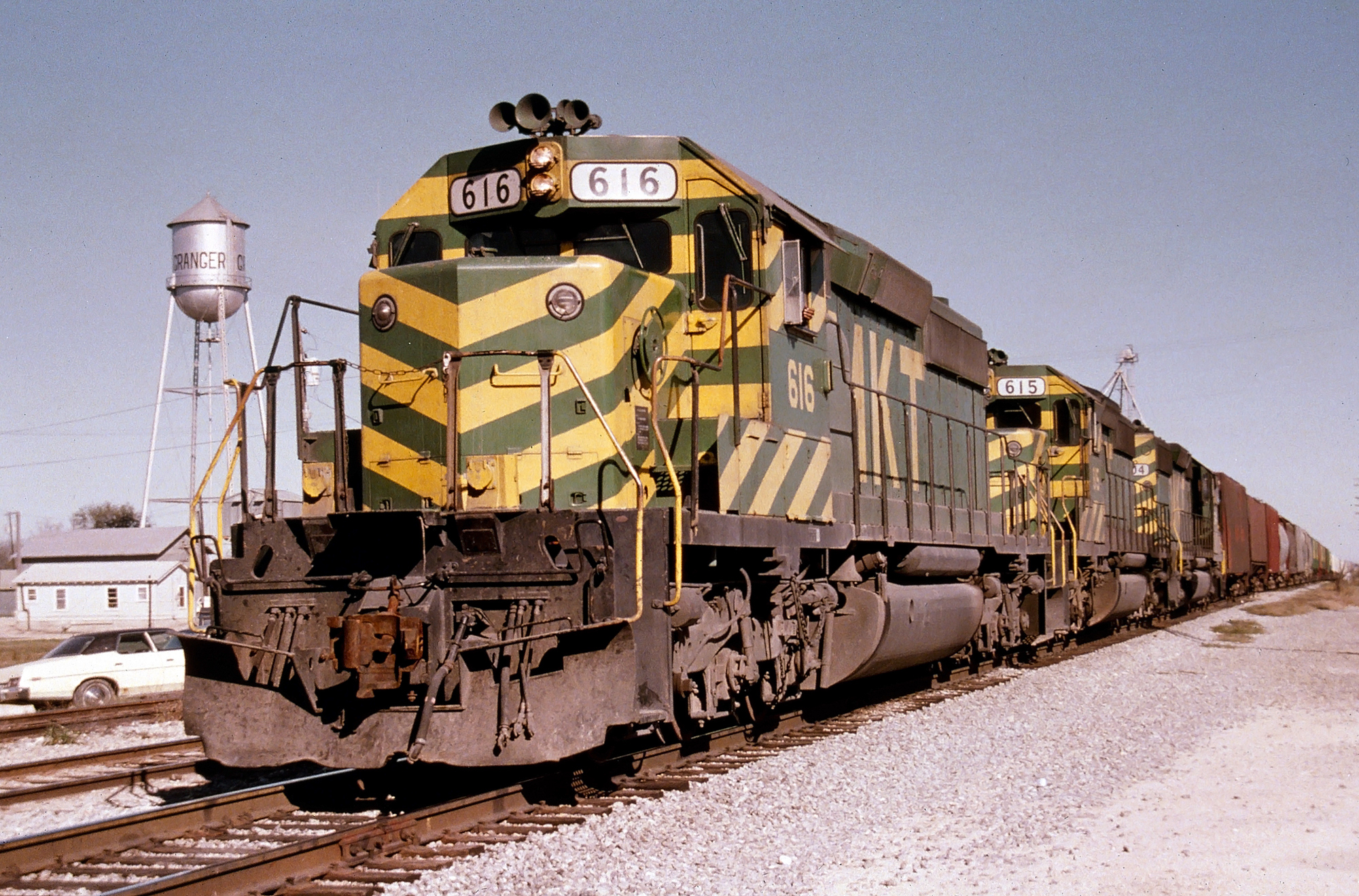 Katy SD40-2s #616, #615, and #604 have a southbound freight at Granger, Texas, circa 1982. Mike Bledsoe photo. American-Rails.com collection.
Final Years
When John Barriger III was elected president in May of 1965 he improved the MKT as best he could and was able to increase gross revenue from $56 million in 1964 to $68 million by 1968.
He worked similar magic at other moribund railroads and realized the Katy's greatest chance for long-term survival was merger with a stronger system.
Under new president, Reginald Whitman, unprofitable branches were abandoned or sold and in 1980 gross revenues jumped further to $220 million although management knew by that time the railroad must join.
By that the 1980's most of Katy's important interchange connects were gone as it found itself surrounded by the transcontinental Santa Fe, Burlington Northern, Southern Pacific, and Union Pacific. After brief negotiations, MKT officially became a division of Union Pacific in 1988.
While much of the original network has since been either abandoned or railbanked some of its lines persevere under Union Pacific today.
The country's largest railroad has even paid tribute to this predecessor by painting an SD70ACe locomotive into an MKT-inspired livery, which was unveiled in September of 2005. Its number recognizes Missouri-Texas-Kansas’s final year of independence, 1988.
Photo Gallery
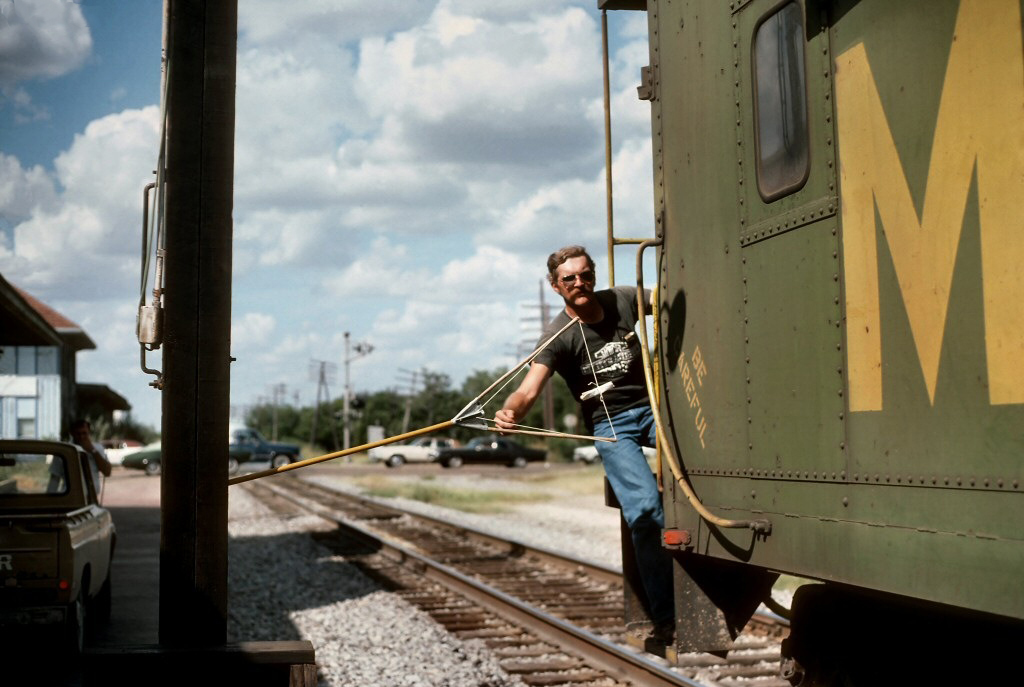 The old practice of grabbing train orders is demonstrated here by a crewman aboard a Missouri-Kansas-Texas freight rolling through Temple, Texas during September of 1981. Gary Morris photo.
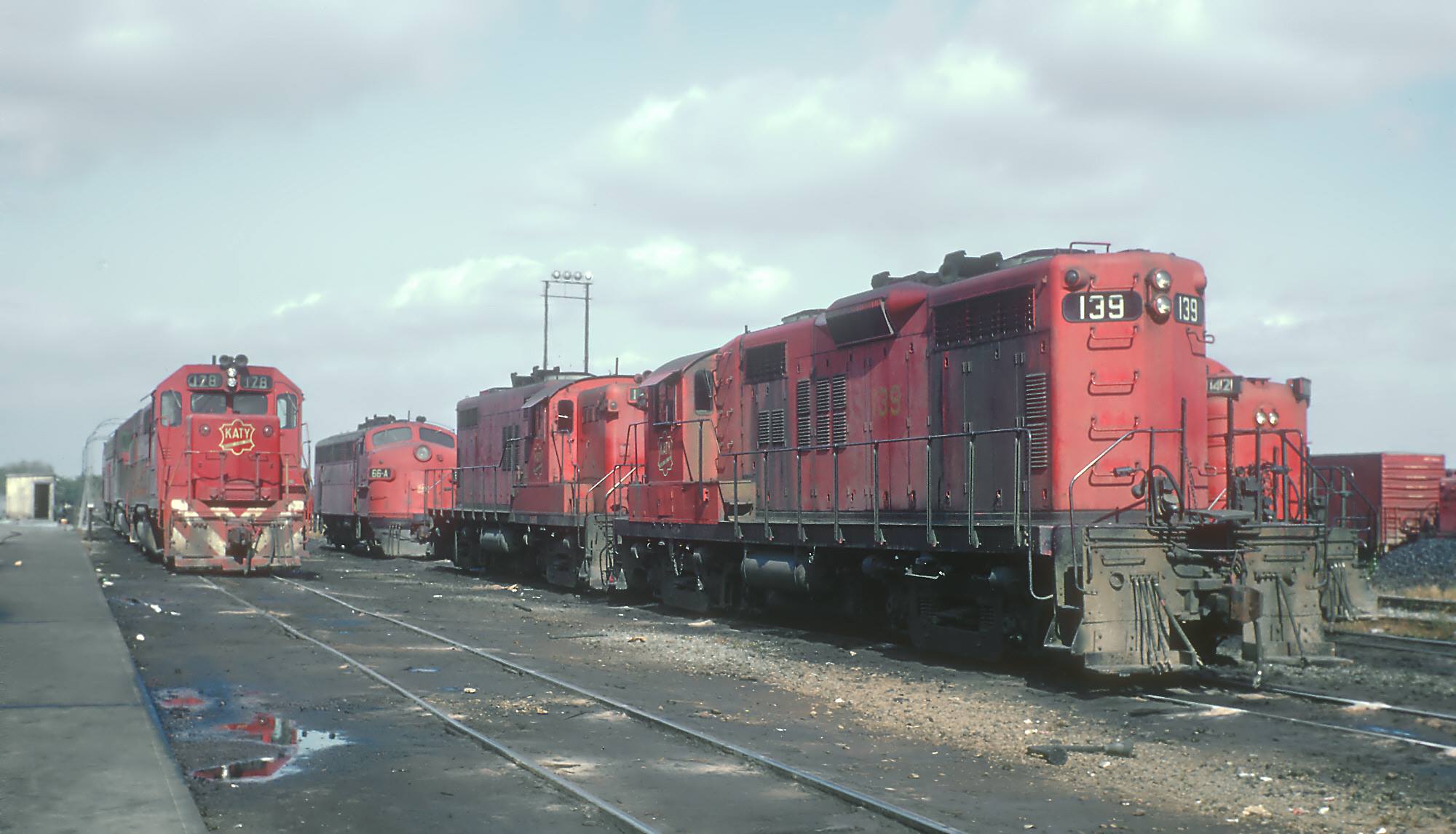 A variety of power at Katy's terminal in Parsons, Kansas November, 1969. Notable units include GP7 #139 and GP40 #178. Also note one of the railroad's interesting AS16M Baldwin rebuilds (sporting EMD 567C prime movers). Rick Burn photo.
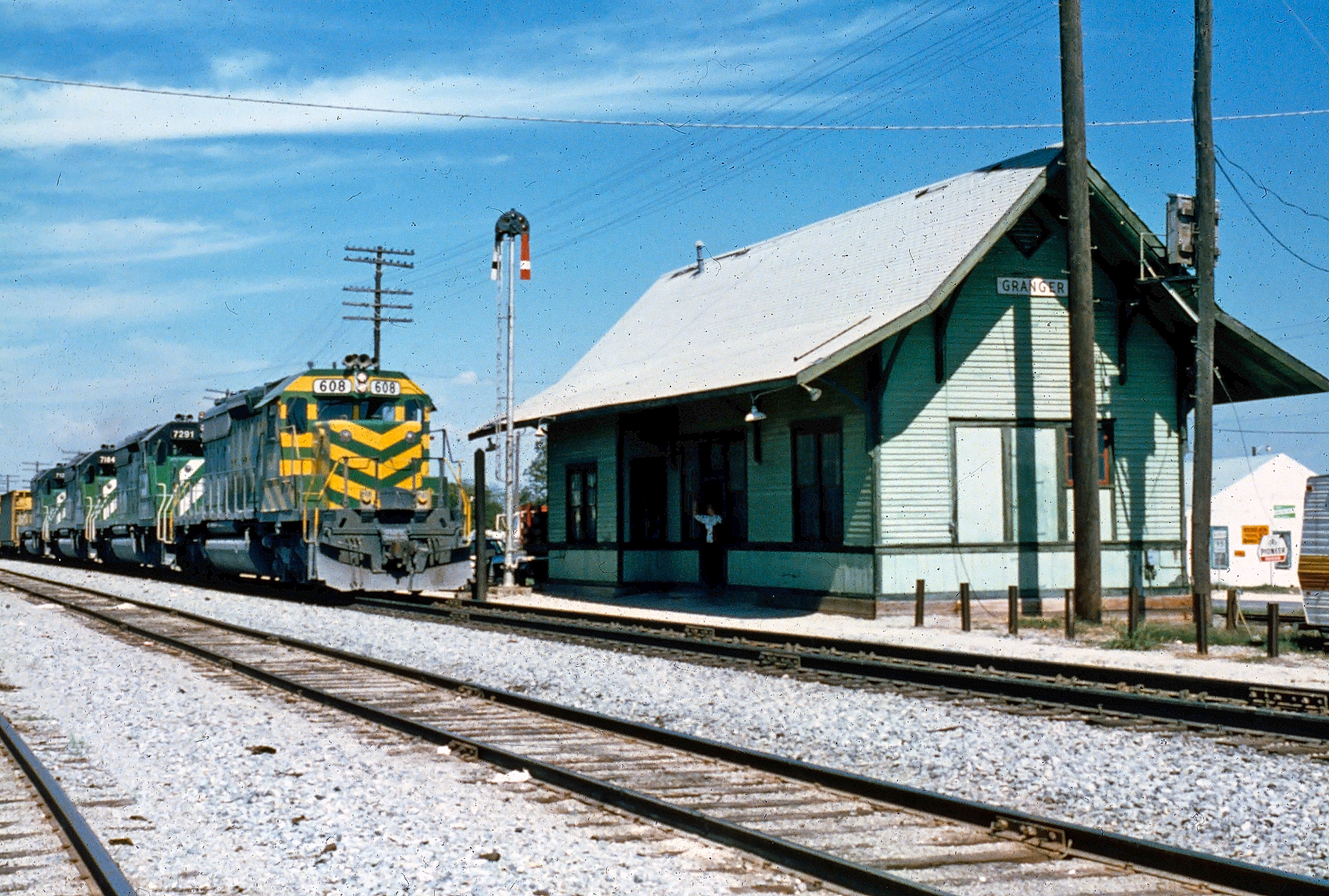 Katy SD40-2 #608 leads a unit coal train southbound past the small depot in Granger, Texas, circa 1984. Mike Bledsoe photo. American-Rails.com collection.
Recent Articles


-
Scenic Train Rides (USA 2026): State Guide to Tourist Railroads
Oct 04, 26 12:17 AM
 Scenic and tourist train rides in all 50 states for 2026. Colorado narrow gauge, Pennsylvania steam, Alaska’s White Pass, and the states with no full-size ride this month. Confirm on the railroad.
 -
Wyoming Scenic Train Rides (2026): A Complete Guide
Oct 03, 26 12:07 AM
 Wyoming has no full-size tourist railroad on the calendar in October 2026. Cheyenne Depot Museum and Douglas Railroad Museum are static. Union Pacific 4014’s posted public trip is a November run to De…
 -
Washington Scenic Train Rides (2026): A Complete Guide
Oct 02, 26 11:53 PM
 Washington tourist trains in 2026—Mount Rainier Scenic at Elbe, the Northwest Railway Museum, and Chehalis-Centralia. Lake Whatcom has no 2026 date on its ticket page.
 -
Wisconsin Scenic Train Rides (2026): A Complete Guide
Oct 02, 26 11:48 PM
 Wisconsin tourist trains in 2026—Wisconsin Great Northern, Osceola & St. Croix Valley, Mid-Continent, East Troy, and the National Railroad Museum.
 -
Pennsylvania Railroad Class Q2 4-4-6-4: Specs, Roster, History
Oct 02, 26 11:28 PM
 Pennsylvania Railroad Class Q2 4-4-6-4 duplexes. Twenty-six engines, 6131 and 6175–6199, Altoona 1944–45. Form 109-J specs, the 7,987 hp test of 6175, and a roster. All scrapped.
 -
Utah Scenic Train Rides (2026): A Complete Guide
Oct 02, 26 11:18 PM
 Utah tourist trains in 2026—Heber Valley Railroad from Heber City. Golden Spike at Promontory is a locomotive demonstration, not a line-haul ride.
 -
South Dakota Scenic Train Rides (2026): A Complete Guide
Oct 02, 26 11:06 PM
 South Dakota’s 2026 scenic train is the Black Hills Central 1880 Train, Hill City to Keystone. Steam is the summer assignment. Confirm the engine.
 -
Oregon Scenic Train Rides (2026): A Complete Guide
Oct 02, 26 11:04 PM
 Oregon tourist trains in 2026—Oregon Coast Scenic from Rockaway Beach, Mount Hood at Hood River, Eagle Cap from Elgin, and the Oregon Rail Heritage Center in Portland.
 -
Oklahoma Scenic Train Rides (2026): A Complete Guide
Oct 02, 26 10:36 PM
 Oklahoma has no full-size scenic railroad on an October 2026 calendar. Oklahoma Railway Museum Halloween and Polar trains, the El Reno trolley, and the Heartland Flyer.
 -
North Dakota Scenic Train Rides (2026): A Complete Guide
Oct 02, 26 01:14 PM
North Dakota has no tourist railroad on a 2026 calendar. Ride Amtrak’s daily Empire Builder. The Fort Lincoln Trolley in Mandan is not a current ticket. -
Nebraska Scenic Train Rides (2026): A Complete Guide
Oct 02, 26 10:11 AM
 Nebraska has no full-size scenic railroad in 2026. The Omaha Zoo Railroad runs weekends through October 4. Ride Amtrak’s California Zephyr across the state.
 -
Missouri Scenic Train Rides (2026): A Complete Guide
Oct 02, 26 09:56 AM
 Missouri tourist trains in 2026—Branson Scenic Railway and the St. Louis, Iron Mountain & Southern at Jackson. Belton has no 2026 schedule posted.
 -
Minnesota Scenic Train Rides (2026): A Complete Guide
Oct 02, 26 09:52 AM
 Minnesota tourist trains in 2026—North Shore Scenic Railroad in Duluth, the Duluth River Train, and the Como-Harriet streetcar.
 -
Kansas Scenic Train Rides (2026): A Complete Guide
Oct 02, 26 09:32 AM
 Kansas tourist trains in 2026—the Abilene & Smoky Valley Railroad. Santa Fe 3415 is in overhaul. Midland Railway at Baldwin City is closed.
 -
Iowa Scenic Train Rides (2026): A Complete Guide
Oct 02, 26 08:41 AM
 Iowa tourist trains in 2026—Boone & Scenic Valley across the Bass Point Creek High Bridge, and Midwest Central’s December North Pole trains
 -
Indiana Scenic Train Rides (2026): A Complete Guide
Oct 02, 26 08:35 AM
 Indiana tourist trains in 2026—French Lick Scenic Railway, Nickel Plate Express, Hoosier Valley, and Hesston. Whitewater Valley is suspended.
 -
Illinois Scenic Train Rides (2026): A Complete Guide
Oct 02, 26 12:28 AM
 Illinois tourist trains in 2026—Illinois Railway Museum, Monticello Railway Museum, Fox River Trolley, and Silver Creek & Stephenson.
 -
Texas Scenic Train Rides (2026): A Complete Guide
Oct 02, 26 12:14 AM
 Texas tourist trains in 2026—Texas State Railroad, Grapevine Vintage Railroad, Austin Steam Train's Hill Country Flyer, and the Galveston Railroad Museum.
 -
Tennessee Scenic Train Rides (2026): A Complete Guide
Oct 02, 26 12:03 AM
Tennessee tourist trains in 2026—Tennessee Valley Railroad Museum, Dollywood Express, Three Rivers Rambler Christmas trains, and the Tennessee Central Railway Museum. -
South Carolina Scenic Train Rides (2026): A Complete Guide
Oct 01, 26 11:52 PM
 South Carolina's tourist train is the South Carolina Railroad Museum in Winnsboro—Blue Granite Express, pumpkin trains, and Santa trains on the old Rockton & Rion.
 -
Mississippi Scenic Train Rides (2026): A Complete Guide
Oct 01, 26 11:38 PM
 Mississippi has no regular tourist railroad in 2026. Ride Amtrak through the state, or book the excursion lines in Alabama, Tennessee, Louisiana, or Arkansas.
 -
Louisiana Scenic Train Rides (2026): A Complete Guide
Oct 01, 26 02:52 PM
 Louisiana has no regular full-size tourist railroad in 2026. New Orleans Polar Express returns December 11–31. Museums at Long Leaf, DeQuincy, and Jackson.
 -
Kentucky Scenic Train Rides (2026): A Complete Guide
Oct 01, 26 02:45 PM
 Kentucky tourist trains in 2026—Big South Fork Scenic Railway, Bluegrass Scenic Railroad, Kentucky Railway Museum, and My Old Kentucky Dinner Train.
 -
Georgia Scenic Train Rides (2026): A Complete Guide
Oct 01, 26 02:27 PM
 Georgia tourist trains in 2026—Blue Ridge Scenic Railway, SAM Shortline, Azalea Sprinter, Savannah shop rides, and what to confirm at Stone Mountain.
 -
Arkansas Scenic Train Rides (2026): A Complete Guide
Oct 01, 26 01:02 PM
 Arkansas tourist trains in 2026—Arkansas & Missouri through the Boston Mountains, and the Eureka Springs & North Arkansas dinner and excursion trains.
 -
Alabama Scenic Train Rides (2026): A Complete Guide
Oct 01, 26 12:59 PM
Alabama tourist trains in 2026—Heart of Dixie Railroad Museum at Calera, North Alabama Railroad Museum at Chase, and the Wales West Light Railway at Silverhill. -
The Circus Train: How Such Attractions Reached Distant Cities
Oct 01, 26 12:22 PM
 How circuses moved by rail: Coup's 1872 flats, the Ringling train's sections and car counts, the 1918 Hammond wreck, and the last show on May 21, 2017.
 -
West Virginia Halloween Train Rides (2026)
Oct 01, 26 12:19 PM
 2026 West Virginia Halloween train. Cass Scenic Halloween Train, October 30 and 31, steam, 5:00 p.m. from Cass Depot. Adult $75. About two hours to Whittaker. Family ride.
 -
Wisconsin Halloween Train Rides (2026)
Oct 01, 26 12:11 PM
2026 Wisconsin Halloween trains. Mid-Continent Pumpkin Special October 24–25, adult $24, pumpkins extra. Halloween Flyer October 24 at 4:30 p.m., adult $30. Osceola Pumpkin Express boards in Osceola… -
Utah Halloween Train Rides (2026)
Oct 01, 26 12:00 PM
 2026 Utah Halloween trains at Heber Valley Railroad. Pumpkin Train, about 40 minutes, with a cookie and a pumpkin. Halloween Express, about 90 minutes to Grim Hollow, Monday, Thursday, and Friday even…
 -
Texas Halloween Train Rides (2026)
Oct 01, 26 11:28 AM
 2026 Texas Halloween train. Texas State Railroad Spooky Special, adult-only, October 24. Boards Palestine at 5:00 p.m. About five hours to Rusk and back. Dinner on the grounds. Not steam. No fare on t…
 -
Tennessee Halloween Train Rides (2026)
Oct 01, 26 12:15 AM
 2026 Tennessee Halloween trains. Tennessee Valley Railroad Museum Rails, Wizards & Spells, selected days September 18 through October 25, from $35, about 2.5 hours. Spells & Potions tea from $60. The…
 -
Frisco's "Firefly" (Train): Consist, Route, Timetable
Sep 30, 26 11:37 PM
 Frisco Firefly—daylight streamliner, Kansas City to Tulsa and Oklahoma City. Trains 117 and 118. Pacifics 1018, 1026, and 1031. Last run May 22, 1960.
 -
South Carolina Halloween Train Rides (2026)
Sep 30, 26 11:29 PM
 2026 South Carolina Halloween train. South Carolina Railroad Museum Pumpkin Patch Express, the two Saturdays before Halloween. About three miles to the Greenbriar pavilion. Pumpkin for children 12 and…
 -
Oregon Halloween Train Rides (2026)
Sep 30, 26 08:10 PM
2026 Oregon Halloween train. Sumpter Valley Railroad Halloween Express at the Sumpter Depot, calendar window October 31 at 11:00 a.m. through November 1 at 12:30 p.m. Fare and the individual clocks ar… -
Oklahoma Halloween Train Rides (2026)
Sep 30, 26 03:45 PM
2026 Oklahoma Halloween train. Oklahoma Railway Museum, October 30 and 31, from Oakwood Station in Oklahoma City. Adults $15, children 3–12 $8. A candy bag with the ride. -
McCloud River Railroad: Serving The Timber Industry (1897-2009)
Sep 30, 26 03:37 PM
 McCloud River Railroad—Mount Shasta City to McCloud, Hambone, and Burney. Opened August 1, 1897. Alco No. 25 and EMD SD38s. Dinner train through January 2010. Railbikes in 2026; a dinner train is stil…
 -
Nevada Halloween Train Rides (2026)
Sep 30, 26 03:30 PM
2026 Nevada Halloween trains in Ely. Nevada Northern Pumpkin Patch Caper and Haunted Ghost Train. Adult tickets start at $45. Dates are on the railroad’s ticket calendar. Boulder City stays off until… -
Missouri Halloween Train Rides (2026)
Sep 30, 26 11:12 AM
 2026 Missouri Halloween trains. St. Louis Iron Mountain & Southern Pumpkin Patch Train on October 3, 4, 10, and 11, and Halloween Express on October 31 at 1:00 p.m. Jackson depot. No fare on the sched…
 -
Minnesota Halloween Train Rides (2026)
Sep 30, 26 11:06 AM
 2026 Minnesota Halloween trains. North Shore Scenic Great Pumpkin Train in Duluth, October 15–18. Everyone gets a pumpkin. Terror Train is October 30, an adult costume party, about three hours. Fares…
 -
Maryland Halloween Train Rides (2026)
Sep 30, 26 10:42 AM
 2026 Maryland Halloween trains. Western Maryland Scenic Pumpkin Patch Limited, October 17, 18, 24, and 25, $14. Colesville Trolleyween October 24, 25, and 31.
 -
West Side Lumber Company Railroad: Roster, History, Lines
Sep 30, 26 09:45 AM
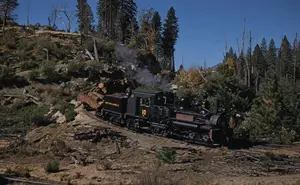
 West Side Lumber at Tuolumne, California. Three-foot Shay and Heisler logging railroad. Lima shop numbers, builder specs, and where the engines are in 2026.
 -
Kansas Halloween Train Rides (2026)
Sep 30, 26 09:41 AM
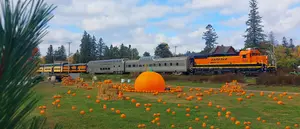
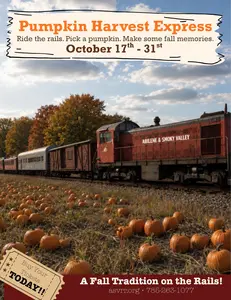
 2026 Kansas Halloween train. Abilene & Smoky Valley Pumpkin Harvest Express, October 17 through 31. About one hour. Shop prices $35.56 to $41.02. Everyone picks a pumpkin.
 -
Iowa Halloween Train Rides (2026)
Sep 29, 26 11:58 PM
2026 Iowa Halloween train. Boone & Scenic Valley Pumpkin Express, October 10, 10:00 a.m. from 225 10th Street. About 1 hour 15 minutes. Children pick a pumpkin. -
Arizona Halloween Train Rides (2026)
Sep 29, 26 11:43 PM
 2026 Arizona Halloween train. Grand Canyon Railway Pumpkin Patch Train from Williams, $39 with a pumpkin included. Select October dates on the ticket calendar. Haunted train cars are optional.
 -
Nevada Northern Halloween Trains (2026)
Sep 29, 26 06:18 PM
Nevada Northern 2026 Halloween trains in Ely. Pumpkin Patch Caper to Keystone Gulch and the Haunted Ghost Train. Adult tickets start at $45. Dates are on the railroad’s calendar. Confirm on nnry.com. -
Grand Canyon Railway Pumpkin Patch Train (2026)
Sep 29, 26 02:42 PM
Grand Canyon Railway Pumpkin Patch Train—select October 2026 dates from Williams, $39 with a pumpkin included. Haunted train cars are optional. Days are on the ticket calendar. Confirm on thetrain.com… -
Cass Scenic Railroad Halloween Trains (2026)
Sep 29, 26 02:37 PM
 Cass Scenic Halloween Trains—October 30 and 31, 2026, steam, 5:00 p.m. from Cass Depot. About two hours to Whittaker. Adult $75. Candy for every child. Confirm on mountainrailwv.com.
 -
Halloween Train Rides (2026): Pumpkin Patch, Haunted & Spooky Trips
Sep 29, 26 11:26 AM
 2026 Halloween train rides in nine checked states. Conway Scenic Halloween Express October 24–25. Strasburg’s three fall tickets. Great Smoky Mountains Railroad’s October trains are the gorge and rive…
 -
Maine Halloween Train Rides (2026)
Sep 29, 26 11:08 AM
 2026 Maine Halloween trains. Seashore Pumpkin Patch Trolley through October 18, adult $17. Happy Trolleyween October 23–25 at $15. WW&F Pumpkin Pickin’ October 3, 12, 17, and 24. Downeast’s booking it…



%3B%20during%20the%20late%201950s%20it%20was%20sent%20to%20EMD%20and%20upgraded%20with%20a%20567C%20(replacing%20the%20original%20Baldwin%20608A%20power%20plant)%2C%20requiring%20a%20Geep%20hood%20to%20house%20the%20engine%20block.%20Mac%20Owen%20photo.%20American-Rails.com%20collection.)


%2C%20PA-1%20%23152-A%2C%20circa%201949.)


.%20Author's%20collection.)


%20and%20SD40R%20%238303%20(built%20as%20Southern%20Pacific%20SD40%20%238402)%2C%20along%20with%20a%20Conrail%20unit%2C%20lead%20this%20Katy%20freight%20between%20Taylor%20and%20Elgin%2C%20Texas%2C%20circa%201984.%20%20At%20the%20time%20the%20MKT%20was%20leasing%20a%20great%20deal%20of%20power.%20%20Mike%20Bledsoe%20photo.%20%20American-Rails.com%20collection.)


%20F3A%20%2369-C%20at%20Parsons%2C%20Kansas%2C%20circa%201968.%20%20Mac%20Owen%20photo.%20%20American-Rails.com%20collection.)


