
Railroad Water Towers (USA): Photos, History, Purpose
Last revised: September 9, 2024
By: Adam Burns
The water tower was once a common sight along both important railroad main lines as well as secondary/branch lines all across the country.
These structures were originally built out of wood and then later designed from steel and/or concrete.
However, wooden devices stood the test of time and were still being used well into the 20th century, some of which continue to survive today as either preserved relics or still functioning as originally intended.
Whatever their construction material, water towers for a vital piece of infrastructure holding thousands of gallons of water for locomotives at strategic locations; some railroads had just one while others maintained thousands.
Covered here is a brief history of these devices and the role they played for more than a century before steam was retired in favor of the diesel.
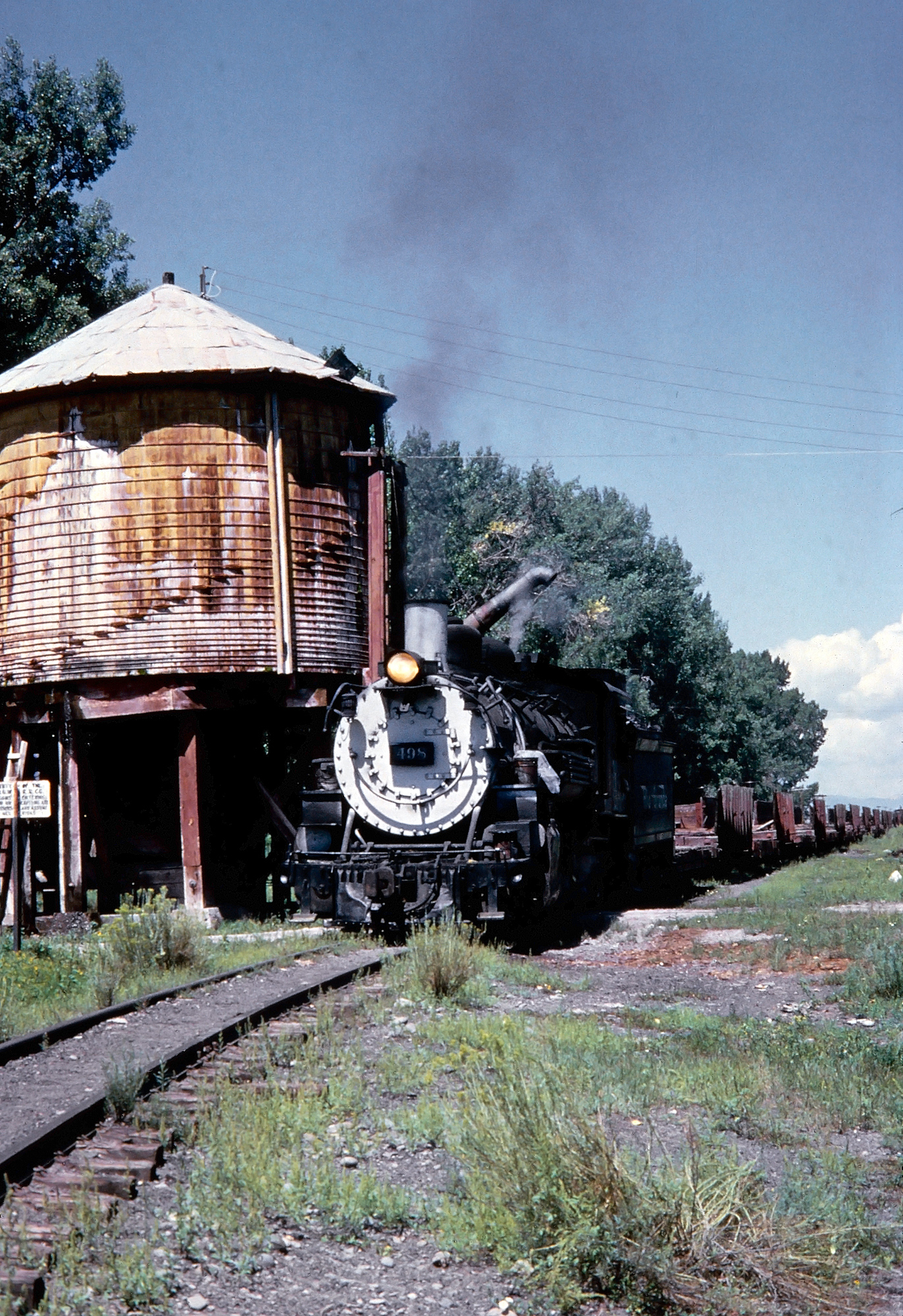 Rio Grande 2-8-2 #498 (K-37) stops for a drink at the water tank at Pagosa Junction (Gato), Colorado with an eastbound string of empties in the summer of 1968. American-Rails.com collection.
History
The device which stored water for locomotives had a handful of designations over the years such as tower, column, station, and stop.
Whatever the name its purpose was the same, a place where locomotives could replenish their greatly needed water supply, which was typically exhausted in 100 miles or less during main line service.
The history of steam power has been widely covered on this site and you can read much more about it here. The first locomotive operated in the United States was the English-built Stourbridge Lion, carrying out its first test over the Delaware & Hudson Canal Company on August 8, 1829, piloted by Horatio Allen.
The first American-built design was Peter Cooper's 2-2-0 "Tom Thumb," which famously lost in a horse race while testing on the fledgling Baltimore & Ohio on August 28, 1830.
As technologies improved and it became widely evident railroads were the future in transportation, thanks to their speed, efficiency, and ability to operate in all types of weather (unlike canals and stagecoach lines) ever larger and more powerful locomotives were designed throughout the 19th century.
The first widely used wheel arrangement (officially known as the “Whyte notation”) was the 4-4-0 "American."
The type offered a larger boiler for increased power, front pilot truck to "steer" into curves, a covered cab for crewmen, and a sizable tender to store coal/wood and water.
While the American was not the first of its kind to feature these improvements it was the first built on such a large scale. The tender was of particular importance.
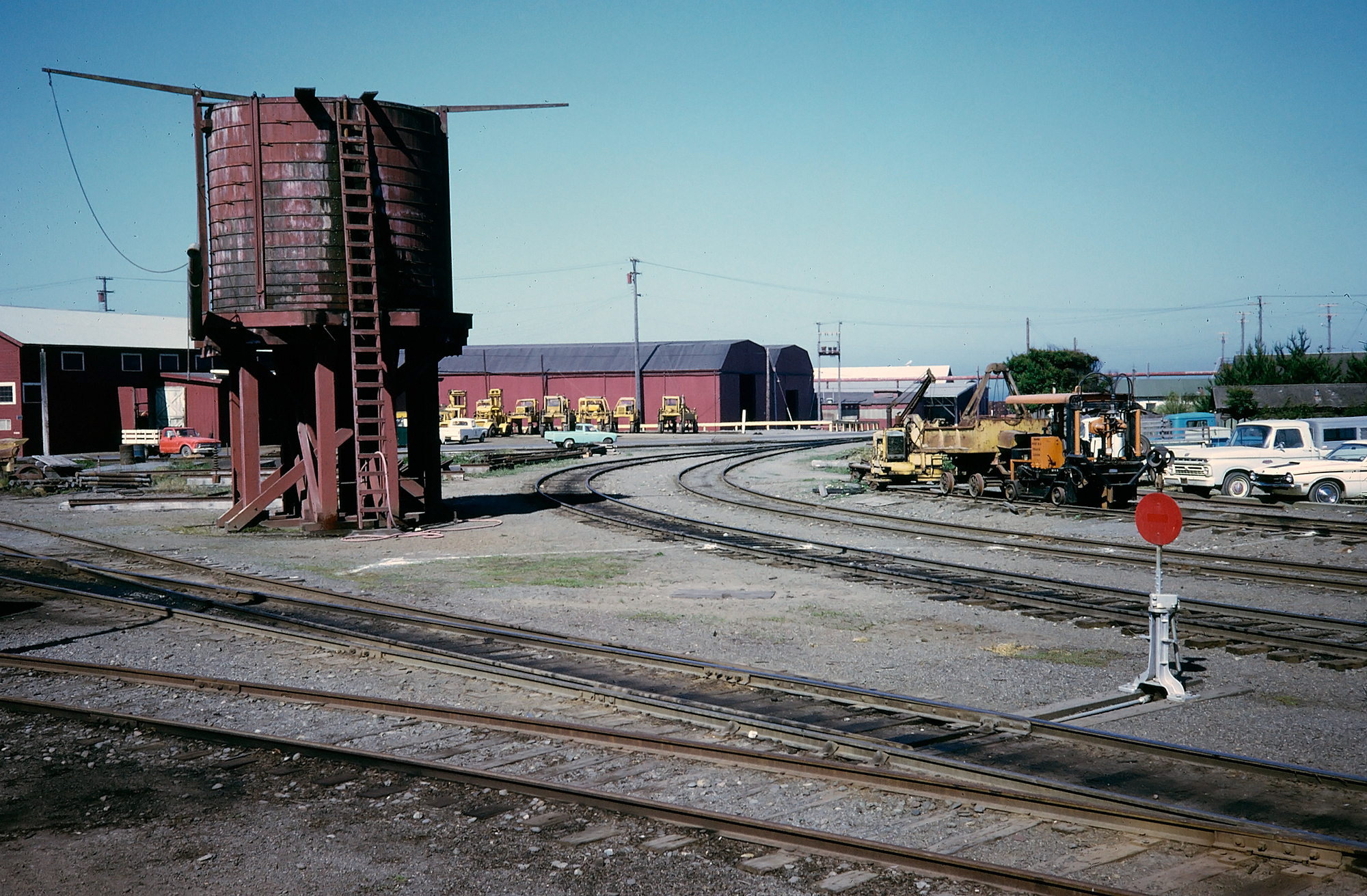 The California Western Railroad's water tower at Fort Bragg, California as it appeared in April, 1973. American-Rails.com collection.
Purpose
Without one, or any type of water storage device a locomotive's range was limited, usually 10 miles or less since water was consumed at a far higher rate than heating fuel (early on this consisted of coal/wood and then later oil was used).
In addition to producing steam, the ultimate source of a locomotive's power, water was extremely important to the boiler's well-being.
It must remain high enough to cover the firebox or the resulting heat could cause a failure of the entire system and explode.
Despite their romance steam locomotives, and any type of equipment employing a boiler, are dangerous machines.
Water levels must be constantly monitored (in the old days engineers relied on a sight glass in the cab) and the shell must be strong enough to support the required steam pressure.
According to one expert a general rule of thumb pertaining to a steam locomotive's water consumption is as follows (again, these numbers are general as obtaining correct figures is specific for each individual steam locomotive requiring precise equations relating to BTU's per minute divided by the fuel being used [among other calculations, as the locomotive's drawbar horsepower is also needed to achieve correct figures):
During light working conditions, 18,000 pounds of water are available per every ton of coal consumed.
In moderate working conditions, 13,000 pounds of water are available for every ton of coal burned.
Finally, with heavy working conditions, 11,000 pounds of water are available for every ton of coal consumed.
These numbers were derived using post-20th century, modern locomotive designs. What began as such a simple device became a highly advanced machine by the 1940s.
The tender could greatly extend a locomotive's range and by the late steam era (1930s-1940s) a locomotive used in main line service could run anywhere between 75 to 150 miles before needing to refuel, which typically coincided with a train crew's district/territory.
This distance was also how far most railroads placed maintenance terminals/facilities since steamers needed constant care whether it be lubrication, fuel, sand, or some other requirement.
Of course, liquid H2O was always the most precious commodity; railroads typically placed at least one water tower, plug (similar to a tower but without a storage device and only tall enough to fit over the tender with a discharge chute which pumped water), or "tank pond" (located near the tracks they were fabricated by damming nearby creeks or streams) half-way between terminals as a safety precaution.
In The Modern Era
The water tower became a bucolic object during the romantic era of railroading when trains were the only way to travel and steam locomotives were commonplace.
It could be found in the smallest of towns, awaiting its next tenant, while in some cases stops were placed miles from the nearest home.
Alas, with the invention of the diesel locomotive water towers disappeared in the post World War II era; diesels, which required far less fuel and maintenance, enabled railroads to push districts and maintenance facilities much further apart.
Additionally, there was no need for watering stops since there was no need for water. Today, these relics from the past can still be found decaying along a few rights-of-way while others have been restored.
In some cases, original examples are still used as they were intended, such as on the Cass Scenic Railroad and Durango & Silverton Narrow-Gauge.
Recent Articles


-
New Jersey's Beer Tasting Train Rides
Mar 12, 26 11:35 AM
 On select dates, the Woodstown Central Railroad pairs its scenery with one of South Jersey’s most enjoyable grown-up itineraries: the Brew to Brew Train.
 -
Florida BBQ Tasting Train Rides
Mar 12, 26 11:28 AM
 While Florida does not currently offer any BBQ train rides the Florida Railroad Museum does host a similar event, a campfire experience!
 -
Texas "Murder Mystery" Dinner Train Rides
Mar 12, 26 10:40 AM
 Here’s a comprehensive look into the world of murder mystery dinner trains in Texas.
 -
Connecticut's Murder Mystery Dinner Train Rides
Mar 12, 26 10:36 AM
 All aboard the intrigue express! One location in Connecticut typically offers a unique and thrilling experience for both locals and visitors alike, murder mystery trains.
 -
Missouri's Wine Tasting Train Rides
Mar 12, 26 10:33 AM
 The fusion of scenic vistas, historical charm, and exquisite wines is beautifully encapsulated in Missouri's wine tasting train experiences.
 -
Minnesota's Wine Tasting Train Rides
Mar 12, 26 10:28 AM
 This article takes you on a journey through Minnesota's wine tasting trains, offering a unique perspective on this novel adventure.
 -
Charlotte Approves $37.9M For "Red Line" To Lake Norman
Mar 11, 26 02:18 PM
 The Charlotte City Council has approved $37.9 million in funding for the next phase of design work on the long-planned Red Line commuter rail project.
 -
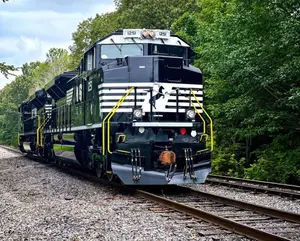
NS, Progress Rail Announce SD70ICC Modernization
Mar 11, 26 12:15 PM
 Norfolk Southern Railway has announced a significant locomotive modernization initiative in partnership with Progress Rail Services Corporation that will rebuild 96 existing road locomotives into a ne…
 -
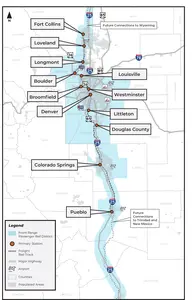
Colorado Seeks Input On Proposed Front Range Passenger Train Name
Mar 11, 26 11:55 AM
 Colorado officials are inviting the public to help name a proposed passenger train that could one day connect major cities along the state’s heavily traveled Interstate 25 corridor.
 -
Virginia Whiskey Train Rides
Mar 11, 26 11:22 AM
 Among the Virginia Scenic Railway's most popular specialty excursions is the “Bourbon & BBQ” tasting train, an adults-oriented rail journey that pairs scenic views of the Shenandoah Valley with guided…
 -
Minnesota's Beer Tasting Train Rides
Mar 11, 26 10:32 AM
 Among the North Shore Scenic Railroad's special events, one consistently rises to the top for adults looking for a lively night out: the Beer Tasting Train.
 -
New Mexico's Beer Tasting Train Rides
Mar 11, 26 10:23 AM
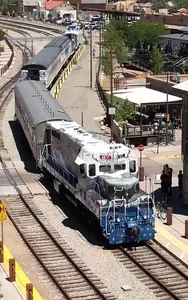
 Sky Railway's New Mexico Ale Trail Train is the headliner: a 21+ excursion that pairs local brewery pours with a relaxed ride on the historic Santa Fe–Lamy line.
 -
Indiana's Murder Mystery Dinner Train Rides
Mar 11, 26 10:19 AM
 This piece explores the allure of murder mystery trains and why they are becoming a must-try experience for enthusiasts and casual travelers alike.
 -
Ohio's Murder Mystery Dinner Train Rides
Mar 11, 26 10:02 AM
 The murder mystery dinner train rides in Ohio provide an immersive experience that combines fine dining, an engaging narrative, and the beauty of Ohio's landscapes.
 -
Kentucky Easter Train Rides
Mar 10, 26 11:39 AM
 The Bluegrass State is home to beautiful rolling farms and the western Appalachian Mountain chain, which comes alive each spring. A few railroad museums host Easter-themed events during this time.
 -
California Easter Train Rides
Mar 10, 26 10:26 AM
 California is home to many tourist railroads and museums; several offer Easter-themed train rides for the entire family.
 -
NS Faces Multiple Derailments Near Historic Horseshoe Curve
Mar 10, 26 10:15 AM
One of America’s most famous railroad landmarks, the legendary Horseshoe Curve west of Altoona, Pennsylvania, has recently been the site of multiple freight-train derailments involving Norfolk Souther… -
Oregon's Beer Tasting Train Rides
Mar 10, 26 10:11 AM
 If your idea of a perfect night out involves craft beer, scenery, and the gentle rhythm of jointed rail, Santiam Excursion Trains delivers a refreshingly different kind of “brew tour.”
 -
Arizona's Beer Tasting Train Rides
Mar 10, 26 09:57 AM
 Verde Canyon Railroad’s signature fall celebration—Ales On Rails—adds an Oktoberfest-style craft beer festival at the depot before you ever step aboard.
 -
Connecticut's Wine Tasting Train Rides
Mar 10, 26 09:54 AM
 If you’re looking for a signature “special occasion” experience, the Essex Steam Train's Wine & Chocolate Dinner Train stands out as a decadent, social, and distinctly memorable take on dinner on…
 -
Massachusetts Wine Tasting Train Rides
Mar 10, 26 09:37 AM
 This article dives into some of the alluring aspects of wine by rail in Massachusetts, currently offered by the Cape Cod Central Railroad.
 -
Union Pacific Restores Rail Bridge Service in Lincoln
Mar 09, 26 11:34 PM
Union Pacific crews have successfully restored freight rail service across a key bridge in Lincoln, Nebraska, completing a rapid reconstruction effort in just a few weeks. -
TVRM To Assist In Gas-Powered Locomotive's Restoration
Mar 09, 26 11:15 PM
The Tennessee Valley Railroad Museum has announced it is assisting in the eventual cosmetic restoration of a former gas powered locomotive used in the logging industry. -
Michigan's Easter Train Rides
Mar 09, 26 10:37 AM
 Spring sometimes comes late to Michigan but this doesn't stop a handful of the state's heritage railroads from hosting Easter-themed rides.
 -
Pennsylvania's Easter Train Rides
Mar 09, 26 10:05 AM
Pennsylvania is home to many tourist trains and several host Easter-themed train rides. Learn more about these special events here. -
Tennessee's Whiskey Tasting Train Rides
Mar 09, 26 09:33 AM
 Here’s what to know, who to watch, and how to plan an unforgettable rail-and-whiskey experience in the Volunteer State.
 -
Michigan's Whiskey Tasting Train Rides
Mar 09, 26 09:07 AM
 There's a unique thrill in combining the romance of train travel with the rich, warming flavors of expertly crafted whiskeys.
 -
Massachusetts Wine Tasting Train Rides
Mar 09, 26 08:56 AM
This article dives into some of the alluring aspects of wine by rail in Massachusetts, currently offered by the Cape Cod Central Railroad. -
Maryland Wine Tasting Train Rides
Mar 09, 26 08:37 AM
 This article delves into the enchanting world of wine tasting train experiences in Maryland, providing a detailed exploration of their offerings, history, and allure.
 -
New York's Whiskey Tasting Train Rides
Mar 08, 26 10:16 AM
 For those keen on embarking on such an adventure, the Arcade & Attica offers a unique whiskey tasting train at the end of each summer!
 -
Florida's Whiskey Tasting Train Rides
Mar 08, 26 10:15 AM
 If you’re dreaming of a whiskey-forward journey by rail in the Sunshine State, here’s what’s available now, what to watch for next, and how to craft a memorable experience of your own.
 -
Colorado Wine Tasting Train Rides
Mar 08, 26 10:14 AM
 To truly savor these local flavors while soaking in the scenic beauty of Colorado, the concept of wine tasting trains has emerged, offering both locals and tourists a luxurious and immersive indulgenc…
 -
Iowa Wine Tasting Train Rides
Mar 08, 26 10:13 AM
 The state not only boasts a burgeoning wine industry but also offers unique experiences such as wine by rail aboard the Boone & Scenic Valley Railroad.
 -
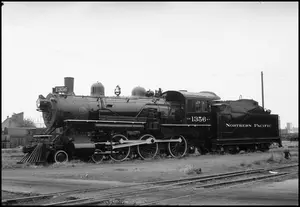
Northern Pacific 4-6-0 1356 Receives Cosmetic Restoration
Mar 07, 26 02:19 PM
 A significant preservation effort is underway in Missoula, Montana, where volunteers and local preservationists have begun a cosmetic restoration of Northern Pacific Railway steam locomotive No. 1356.
 -
New York's Beer Tasting Train Rides
Mar 07, 26 02:08 PM
 Among the Adirondack Railroad's most popular special outings is the Beer & Wine Train Series, an adult-oriented excursion built around the simple pleasures of rail travel.
 -
Kentucky's Whiskey Tasting Train Rides
Mar 07, 26 10:17 AM
Whether you’re a curious sipper planning your first bourbon getaway or a seasoned enthusiast seeking a fresh angle on the Kentucky Bourbon Trail, a train excursion offers a slow, scenic, and flavor-fo… -
Ohio's Whiskey Tasting Train Rides
Mar 07, 26 10:15 AM
 LM&M's Bourbon Train stands out as one of the most distinctive ways to enjoy a relaxing evening out in southwest Ohio: a scenic heritage train ride paired with curated bourbon samples and onboard refr…
 -
Georgia 'Wine Tasting' Train Rides In Cordele
Mar 07, 26 10:13 AM
 While the railroad offers a range of themed trips throughout the year, one of its most crowd-pleasing special events is the Wine & Cheese Train—a short, scenic round trip designed to feel…
 -
Arizona Wine Tasting Train Rides
Mar 07, 26 10:12 AM
 For those who want to experience the charm of Arizona's wine scene while embracing the romance of rail travel, wine tasting train rides offer a memorable journey through the state's picturesque landsc…
 -
Massachusetts's Beer Tasting Train Rides
Mar 06, 26 09:00 AM
 Among Cape Cod Central's lineup of specialty trips, the railroad’s Rails & Ales Beer Tasting Train stands out as a “best of both worlds” event.
 -
Pennsylvania's Beer Tasting Train Rides
Mar 06, 26 08:57 AM
 Today, EBT’s rebirth has introduced a growing lineup of experiences, and one of the most enticing for adult visitors is the Broad Top Brews Train.
 -
Indiana's Whiskey Tasting Train Rides
Mar 06, 26 08:55 AM
 Among IRE’s most talked-about offerings is the Wine & Whiskey Train—an adults-only, evening-style trip that leans into the best parts of classic rail travel: atmosphere, comfort, and a little cele…
 -
North Carolina's Whiskey Tasting Train Rides
Mar 06, 26 08:53 AM
 One of the GSMR's most distinctive special events is Spirits on the Rail, a bourbon-focused dining experience built around curated drinks and a chef-prepared multi-course meal.
 -
Arkansas Wine Tasting Train Rides
Mar 06, 26 08:50 AM
 This article takes you through the experience of wine tasting train rides in Arkansas, highlighting their offerings, routes, and the delightful blend of history, scenery, and flavor that makes them so…
 -
California Wine Tasting Train Rides
Mar 06, 26 08:49 AM
 This article explores the charm, routes, and offerings of these unique wine tasting trains that traverse California’s picturesque landscapes.
 -
Construction Continues On Railroad Museum Of Pennsylvania Roundhouse
Mar 05, 26 01:52 PM
 Construction is underway on a long-anticipated roundhouse exhibit building at the Railroad Museum of Pennsylvania in Strasburg, a project designed to preserve several of the most historically signific…
 -
Wisconsin Wine Tasting Train Rides
Mar 05, 26 09:53 AM
 Wisconsin might not be the first state that comes to mind when one thinks of wine, but this scenic region is increasingly gaining recognition for its unique offerings in viticulture.
 -
Alabama Wine Tasting Train Rides
Mar 05, 26 09:50 AM
 While the state might not be the first to come to mind when one thinks of wine or train travel, the unique concept of wine tasting trains adds a refreshing twist to the Alabama tourism scene.
 -
California's Dinner Train Rides In Sacramento
Mar 05, 26 09:49 AM
 Just minutes from downtown Sacramento, the River Fox Train has carved out a niche that’s equal parts scenic railroad, social outing, and “pick-your-own-adventure” evening on the rails.
 -
New Jersey's Dinner Train Rides In Woodstown
Mar 05, 26 09:48 AM
 For visitors who love experiences (not just attractions), Woodstown Central’s dinner-and-dining style trains have become a signature offering—especially for couples’ nights out, small friend groups, a…


%20stops%20for%20a%20drink%20at%20the%20water%20tank%20at%20Pagosa%20Junction%20(Gato)%2C%20Colorado%20with%20an%20eastbound%20string%20of%20empties%20in%20the%20summer%20of%201968.%20%20American-Rails.com%20collection.)
