
West Point Route (Railroad): Map, History, Logo
Last revised: August 23, 2024
By: Adam Burns
The West Point Route was a fondly remembered southern system which connected Atlanta with Montgomery, Alabama.
The name itself was actually a marketing term only used by the Atlanta & West Point (A&WP) and Western
Railway of Alabama (WRoA).
The two companies met at West Point, Georgia and for many years were under the Georgia Railroad & Banking Company's control, which connected Atlanta with Augusta and Macon.
All three got their start handling agricultural-related traffic, transitioned to manufacturing and merchandise, and then spent later years as successful bridge lines.
From an early period they were jointly owned by the Louisville & Nashville and Atlantic Coast Line, remaining subsidiaries until the 1980's.
History
During a flurry of mergers beginning in the 1960's their identity slowly disappeared. First, the Seaboard Coast Line was created and then all railroads under SCL's control fell under the marketing name, "Family Lines System."
Finally, they vanished into the Seaboard System and CSX Transportation. Today, the West Point Route continues to play an important role under CSX.
Photos
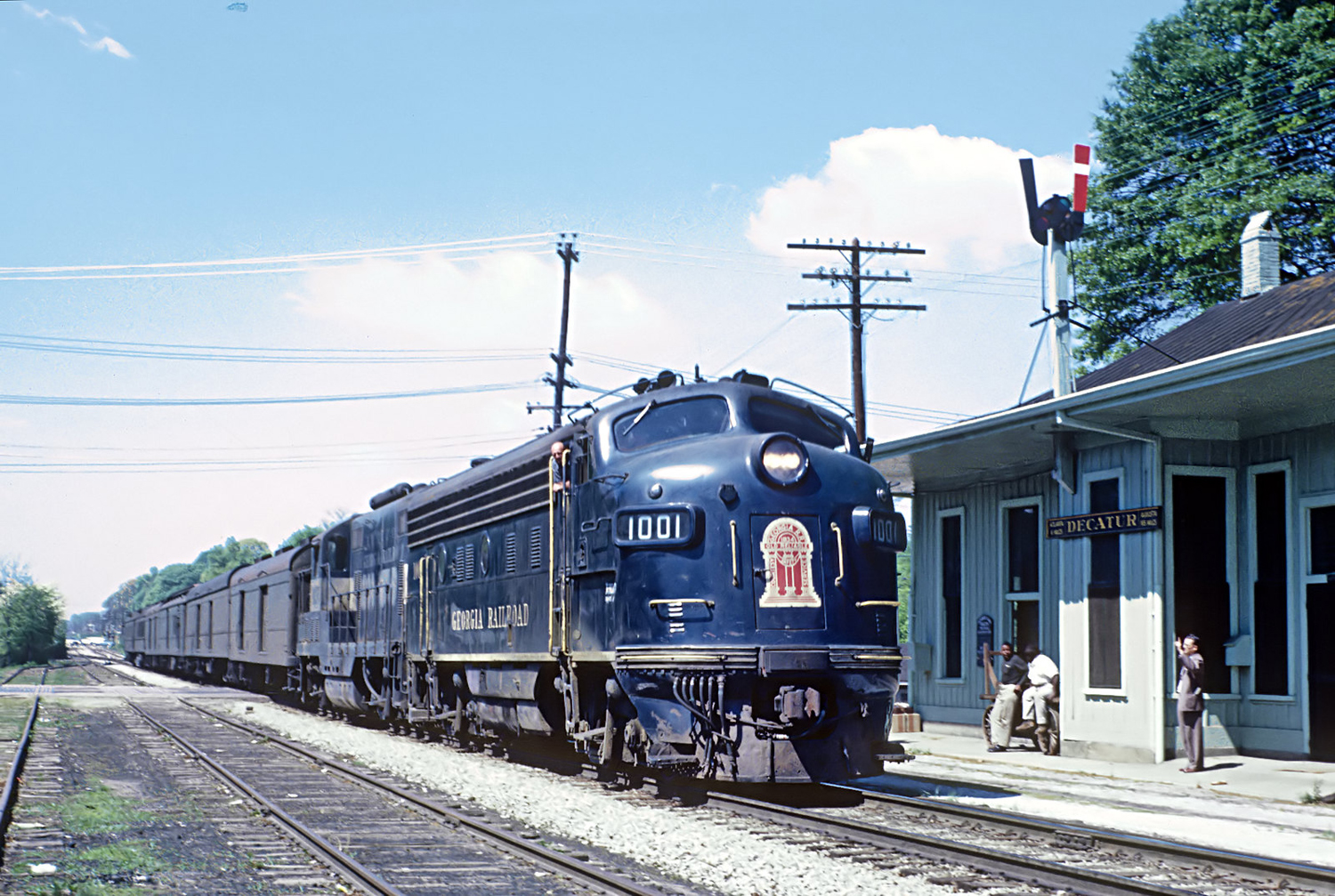 Georgia Railroad F3A #1001 wears a new paint scheme as it arrives in Decatur, Georgia with train #2 on April 13, 1963. Roger Puta photo.
Georgia Railroad
The history of the West Point Route is one of struggle, perseverance, and eventual success. The Georgia Railroad was technically not part of the West Point Route although as the long-time owner a brief history will be provided here.
Its ancestry begins on December 21, 1833 when the Georgia Railroad Company was chartered to build a new line from Augusta to Athens. Only a day earlier the Central Rail Road & Canal Company had been born through Savannah interests to construct their own line westward towards Augusta.
In time this future rival became the Central of Georgia Railway and blossomed into a profitable 1,500+ mile network connecting Savannah, Atlanta, Athens, Chattanooga, Montgomery, Birmingham, and other points.
At Augusta, construction of the Georgia Railroad began in 1835 and only a year later the corporate name was changed to the Georgia Rail Road & Banking Company. During December of 1841 the original route to Athens opened, built to the South's standard 5-foot broad gauge.
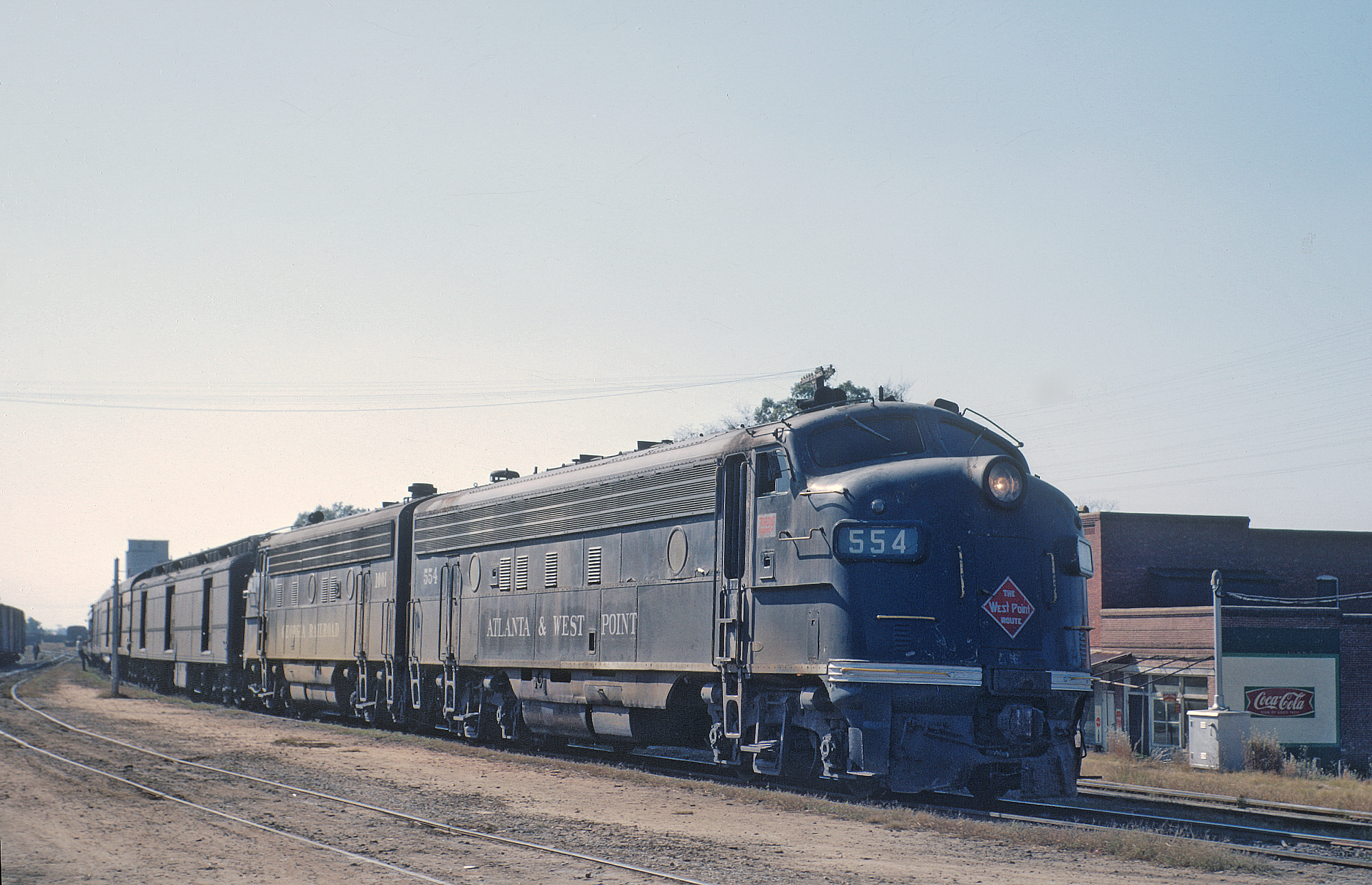 Atlanta & West Point FP7 #554 has Georgia Railroad's eastbound train 2 (Atlanta - Augusta) at Camak, Georgia in October, 1967. Roger Puta photo.
Expansion
It was not long before a westward extension towards Atlanta was eyed. This new city literally grew from nothing. It all began with the Western & Atlantic's chartering in late 1836 to connect Decatur with Chattanooga, Tennessee.
Surprisingly, the former town did not want a railroad and so the W&A's southern terminus was moved a few miles to the southwest at a location known simply as "Terminus."
It became Marthasville in 1843 (according to Dain Schult's book, "Nashville, Chattanooga & St. Louis: A History Of 'The Dixie Line'," the town was named after former Georgia governor Wilson Lumpkin's daughter, Martha) and then Atlanta in 1847.
In 1845 the Georgia Railroad opened its own line to the town, followed by the Macon & Western (Central of Georgia) on September 4, 1846. In short order the railroad was a financial success and one of the South's better systems entering the Civil War.
It suffered considerable damage by Union forces during the conflict's latter years, particularly during General Sherman's "March To The Sea." Afterwards the line was quickly rebuilt and before long was again expanding. In 1867 it leased the Macon & Augusta which was attempting to complete a connection with the Georgia at Warrenton.
The 78-mile branch was finished in 1873 and established through service from Camak, along the Georgia's main line, to Macon. This was largely the extent of the Georgia's system. Further growth came through acquisition.
As Richard Prince's book, "Central of Georgia Railway And Connecting Lines" notes, in 1875 the Georgia Rail Road & Banking Company, in conjunction with the Central Rail Road & Banking Company Of Georgia, jointly leased the Western Rail Road of Alabama.
This system offered through service to Montgomery and Selma, Alabama via West Point where interchange was carried out with the Atlanta & West Point (the A&WP was already a Georgia Railroad subsidiary). It was then reorganized as the Western Railway of Alabama and remained a partnership venture for nearly twenty years.
In 1881 half the Georgia and its subsidiaries were leased to the Louisville & Nashville while the Central Rail Road & Banking Company Of Georgia picked up the other half.
During the Panic of 1893 the Central failed, which allowed the L&N to acquire its half-interest. In 1902 the Atlantic Coast Line took control of the L&N and from that point forward the Georgia remained a subsidiary of much larger railroads.
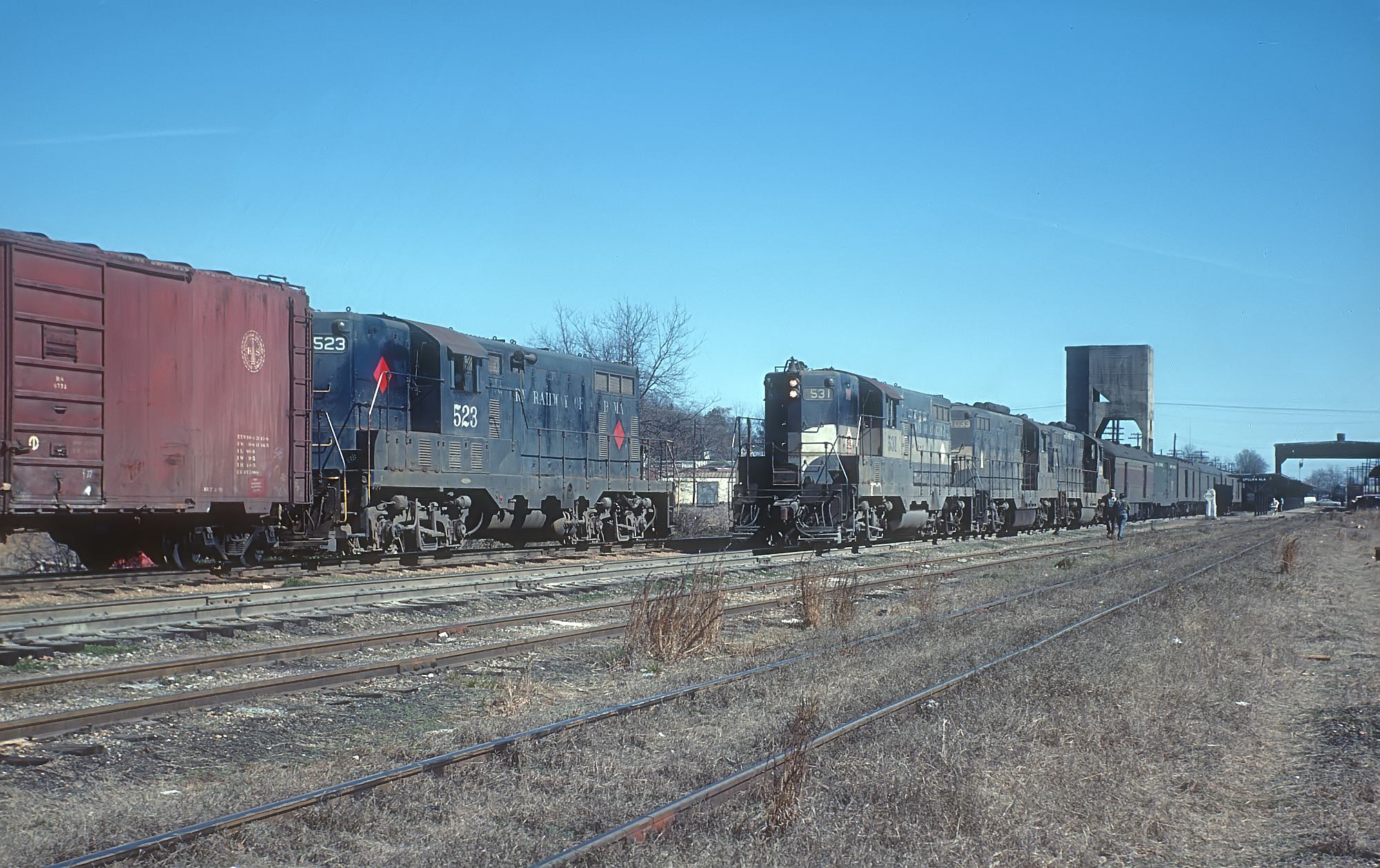 Western Railway of Alabama GP7 #523 works freight service at Opelika, Alabama as GP9 #531 leads train #37, the "Crescent," in February, 1968. Rick Burn photo.
Western Railway Of Alabama
The Western Railway of Alabama (WRoA) traces its heritage back to the Montgomery Rail Road Company chartered on January 15, 1834.
Robert Hanson's book, "The West Point Route," points out that it was envisioned to construct a new line from Montgomery to just across the Georgia state line at West Point along the Chattahoochee River.
During 1835 and into 1836 the line's survey work was completed while actual construction commenced on March 1, 1836. In June of 1840 the first 32-mile section opened from Montgomery to Franklin.
Almost immediately the railroad ran into trouble as it struggled to earn sufficient revenue to cover expenses. It was subsequently sold at foreclosure on July 9, 1842 and a new company chartered on February 13, 1843.
Known as the Montgomery & West Point Rail Road (M&WP), at first it too experienced difficulties as it attempted to corral funding for the line's completion.
Eventually, these efforts paid off with rails opening to Opelika in 1848 and finally West Point on April 28, 1851. The latter town became the interchange point with the Atlanta & LaGrange, predecessor to the Atlanta & West Point, when it reached there in 1854.
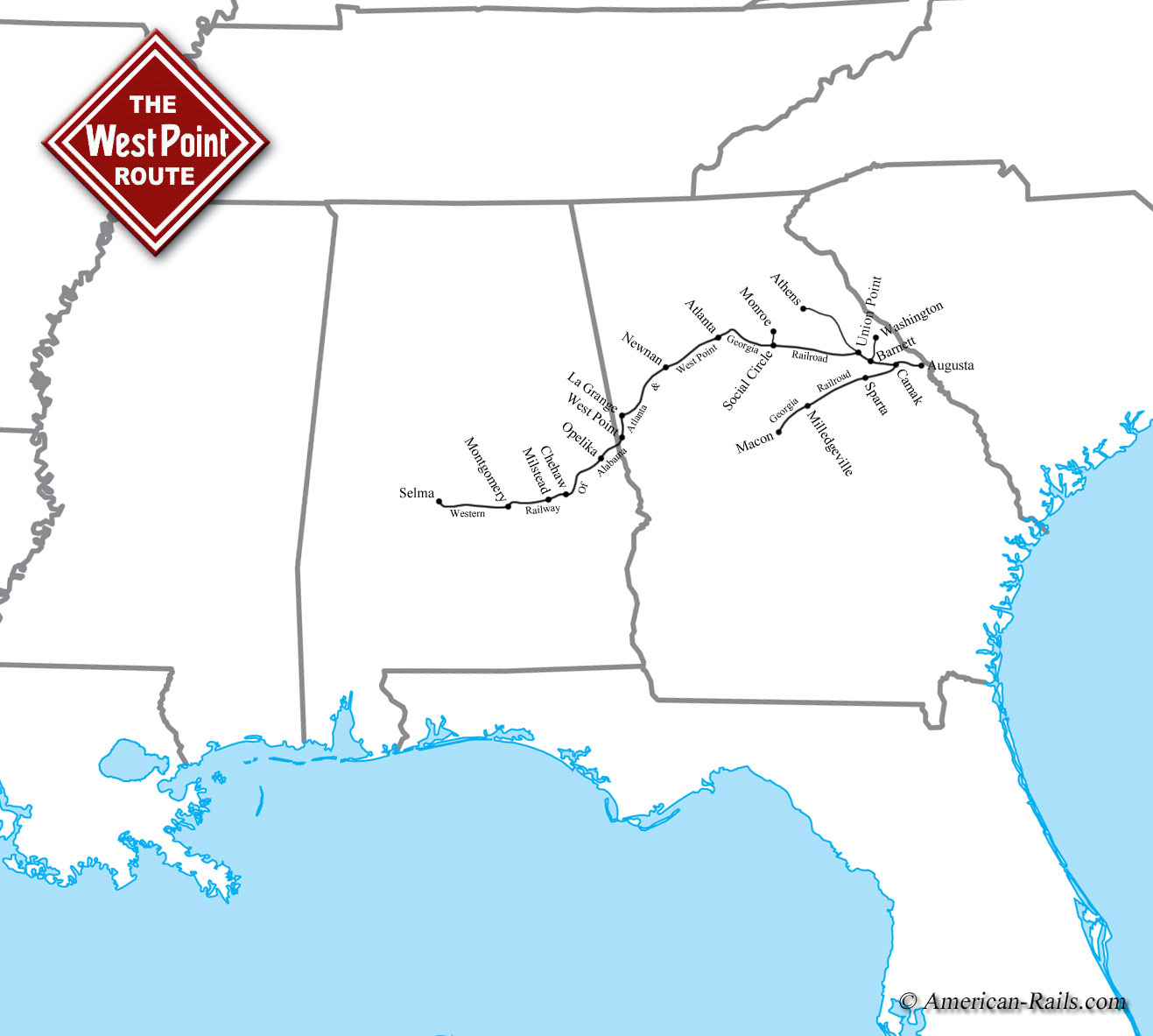
Little additional growth occurred although it did add one notable branch, a 29-mile extension from Opelika to Columbus, Georgia which opened in 1855.
The railroad was spared the worst of the Civil War until July of 1864 when it was damaged by Union forces between Opelika and Chehaw as well as along its Columbus Branch.
More extensive destruction was carried out in April of 1865. After the war M&WP forces worked quickly on repairs and finally had the entire railroad back in service by August 29th that year.
They also re-gauged the property from 4 feet, 8 1/2 inches to 5 feet. On September 1, 1870 the M&WP merged with the Western Rail Road to form the Western Rail Road Company of Alabama.
Just a few months later, in December, rails were pushed westward from Montgomery to Selma. Financial trouble found the road following the Panic of 1873 and it failed on April 1, 1874. A year later, on June 1, 1875, it was taken over in a joint agreement between the Central Rail Road & Banking Company Of Georgia and Georgia Railroad & Banking Company.
In corporate maneuverings carried out by the new owners the Columbus Branch was acquired by the Central Rail Road and the Western Railway of Alabama was chartered on March 15, 1883 to operate the assets of the Western Rail Road Company Of Alabama.
The use of broad gauge throughout the South lost its luster by century's end as railroad after railroad switched to the standard width of 4 feet 8 1/2 inches. The WRoA at first changed to 4 feet, 9 inches in the spring of 1886 and then soon afterwards reduced this by a half-inch more.
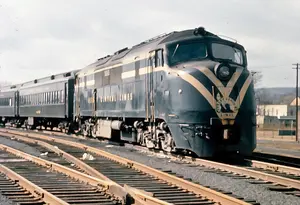
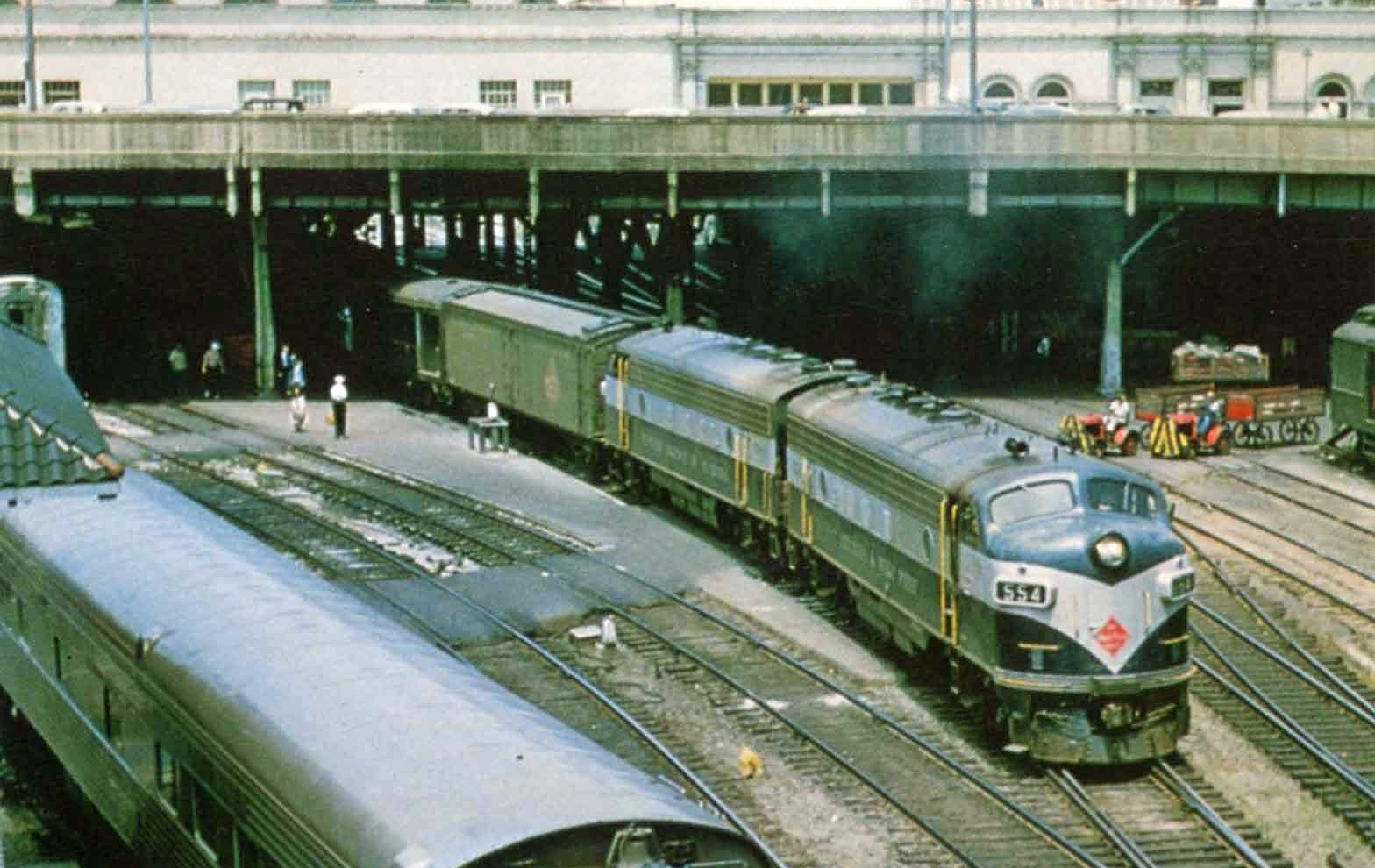 Atlanta & West Point (West Point Route) FP7 #554 departs Atlanta Terminal Station with Southern's "Crescent Limited" (New York-Washington-Atlanta-Montgomery-New Orleans) in 1957. Howard Robins photo.
Atlanta & West Point Railroad
The eastern component of the West Point Route was the Atlanta & West Point (A&WP). Its history begins on December 27, 1847 with the chartering of the Atlanta & LaGrange Rail Road.
The state stipulated it was to connect with the Macon & Western "somewhere near Atlanta" and run westward to the state line at LaGrange.
Built to 5-foot, broad gauge construction began during the fall of 1849 from the M&W connection at East Point and by March of 1851 had opened 18 miles to Palmetto.
By September, rails reached Newnan and just over a year later, in February of 1853, trains were rolling into LaGrange. The project had been largely funded by the Georgia Railroad & Banking Company and as a result it did not suffer from the financial shortfalls experienced by its western counterpart.
With an amendment to the charter it completed a final extension to West Point (80 miles in all) which provided a partial interchange with the Montgomery & West Point.
However, through service could not be established due to the gauge differences at that time. On December 22, 1857 a name change took place and the corporation became the Atlanta & West Point Rail Road.
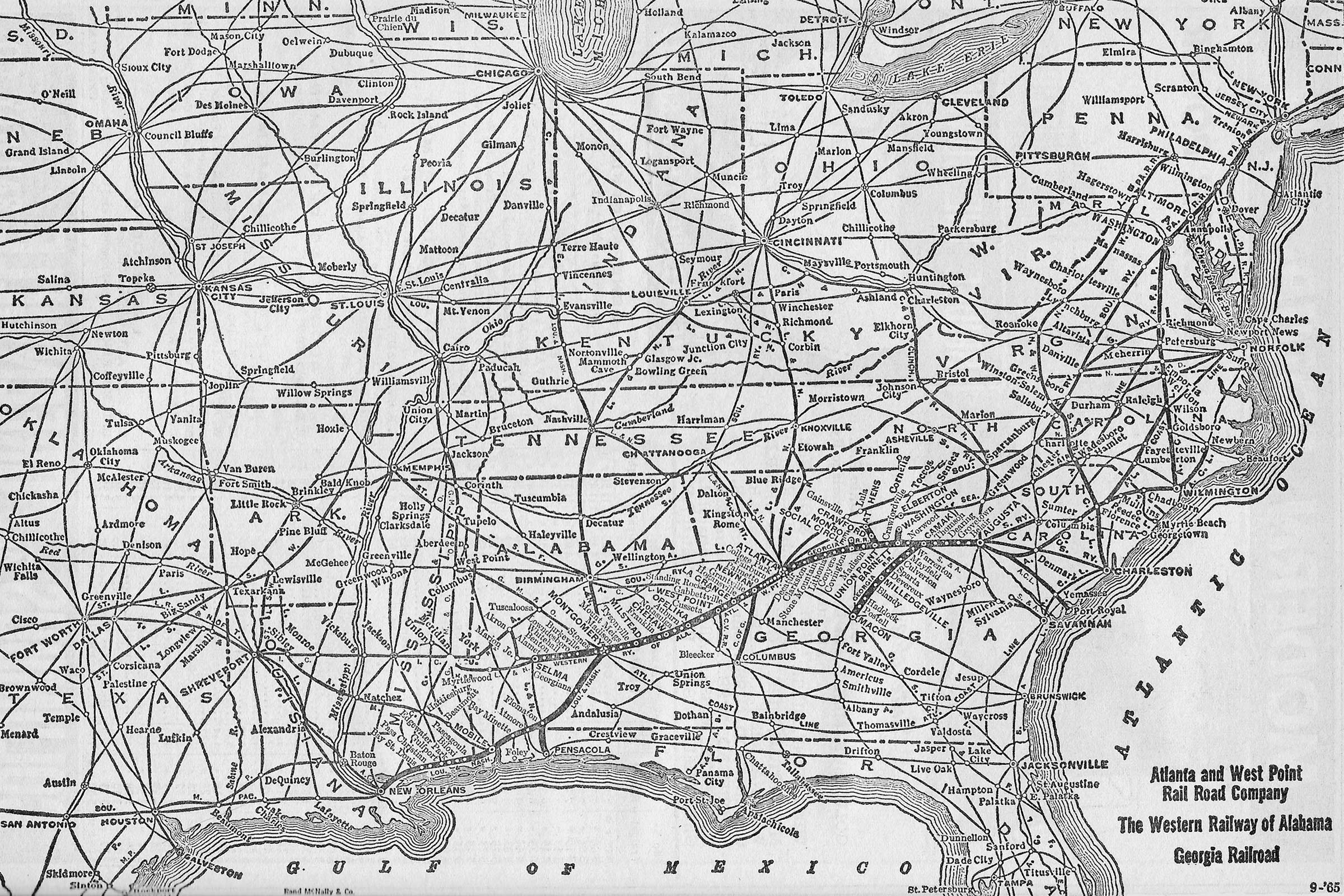
System Map (1965)
Like the Montgomery & West Point the A&WP mostly avoided Union incursions until 1864 when General Sherman's advancing forces caused extensive damage to its network with losses totaling more than $1.6 million. Within short order, however, it too got back onto its feet and was reporting net earnings by 1866.
As mentioned above things remained unchanged from a corporate standpoint until the 1881 agreement whereby the Georgia and its subsidiaries were leased to the Louisville & Nashville and Central Rail Road & Banking Company Of Georgia.
With the Central's financial collapse following the Panic of 1893 the L&N acquired its half-interest. In 1902 the Atlantic Coast Line took control of the L&N. There remained a series of additional corporate changes to take place before the final, modern version of the West Point Route was born.
The first had occurred in March of 1883 when the WRoA and A&WP came under common management. For many years the two roads had used the marketing slogan "Atlanta and New Orleans Short Line" in an appeal to draw in potential new business. In 1896 they introduced the moniker within a diamond logo.
Another slight change took place in 1902 when it was changed to "The West Point Route." Just as the WRoA had done, the A&WP's gauge was changed from 5-foot broad gauge to 4 feet, 9 inches in the spring of 1886 and then soon afterwards reduced to 4 feet, 8 1/2 inches.
Logo
The West Point Route
Into the 20th century the 225-mile West Point Route (A&WP and WRoA) fared relatively well. Throughout the years passenger business played an important role although not necessarily always a profitable one. On May 14, 1905 the beautiful Atlanta Terminal Station opened, replacing an earlier facility that was cramped and outdated.
Prior to construction the project was originally owned by the Southern Railway and Central of Georgia through new subsidiary Atlanta Terminal Company created in early 1903. Before long, the Atlanta & West Point had also acquired a one-third interest and the three maintained joint-ownership until the facility was razed in the early 1970's.
At A Glance
317 (Georgia Railroad) 225 (Atlanta & West Point and Western Railway of Alabama) | |
Atlanta - Augusta, Georgia Augusta - Macon, Georgia Augusta - Athens, Georgia | |
The station was designed by P. Thornton Marye featuring two grand spires bracketing the headhouse. Over the years it also saw use by the Seaboard Air Line and Atlanta, Birmingham & Atlantic.
During the facility's peak years it witnessed more than eighty trains per day including such names as the Crescent, Man O'War, Ponce de Leon, and Nancy Hanks.
Into the 1920's the railroads acquired new locomotives and completed the installation of automatic block signals (1922), a project that helped improve freight business. Following the Great Depression and through the early 1930's the A&WP and WRoA struggled to remain solvent.
Prior to the market's collapse they netted a combined profit of more than a half-million dollars and then recorded losses of the same by 1932. Within a few years the roads had turned a corner and were showing a profit once more by 1936, having avoided bankruptcy.
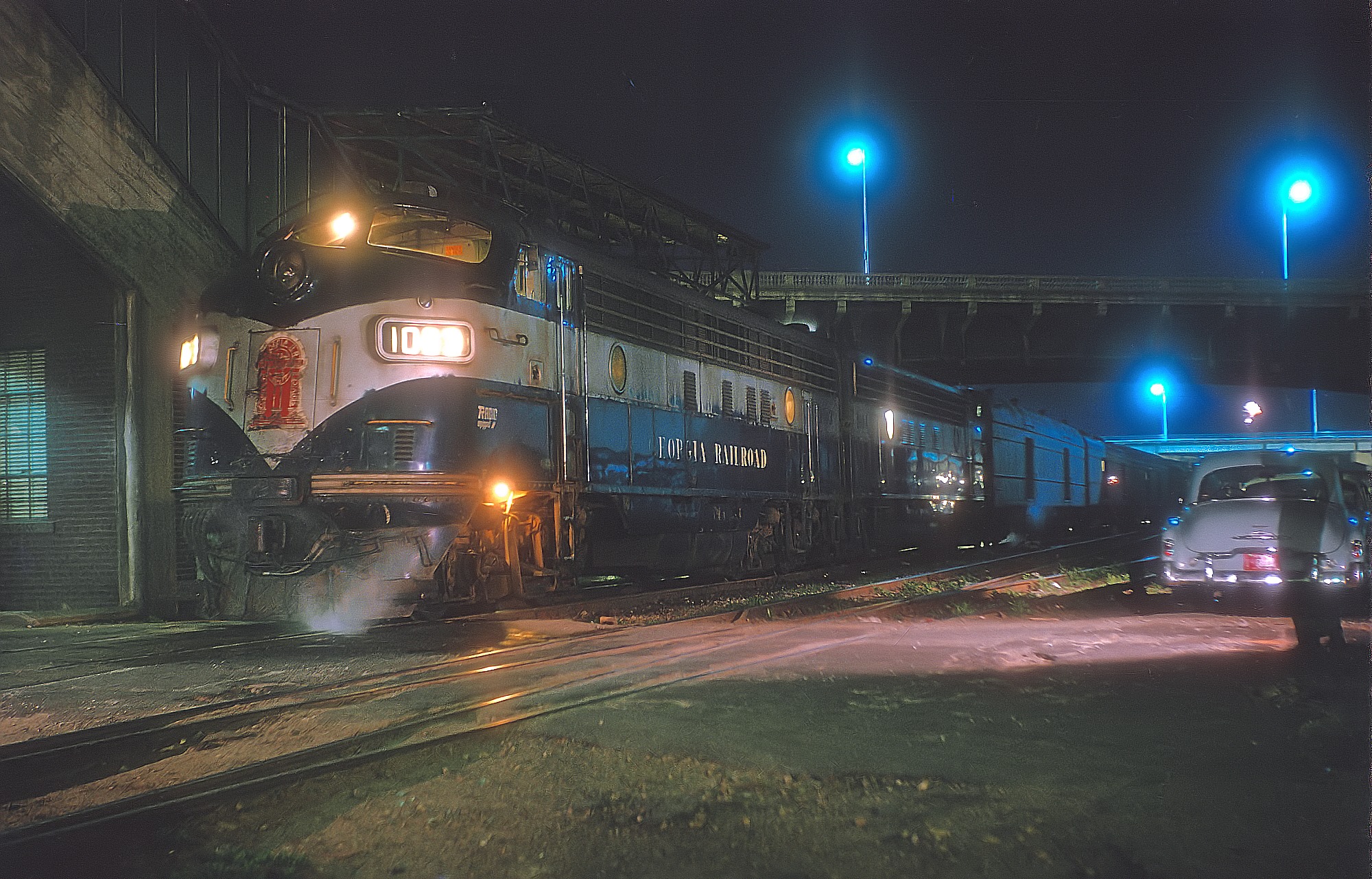 Georgia Railroad FP7 #1003 has Train #4 (Atlanta-Augusta) at Atlanta Terminal Station in April, 1963. Rick Burn photo.
By World War II business of all types was soaring which necessitated purchasing additional locomotives. In 1945 the roads reported a profit of more than $700,000.
As Joseph Sadler notes in his article, "West Point Route" from the June, 1943 issue of Trains Magazine freight business by this time was 90% through traffic with just 10% originating online. Diesels also arrived in the postwar years beginning in May of 1948 when F3A #501 was delivered to the WRoA.
New units continued to roll in until steam had been retired completely by July 1, 1954. Most power was from Electro-Motive but all three roads did purchase a few Baldwin switchers. The locomotives were clad in a striking livery of deep blue and silver with the "West Point Route" and Georgia Railroad logos adorning respective units.
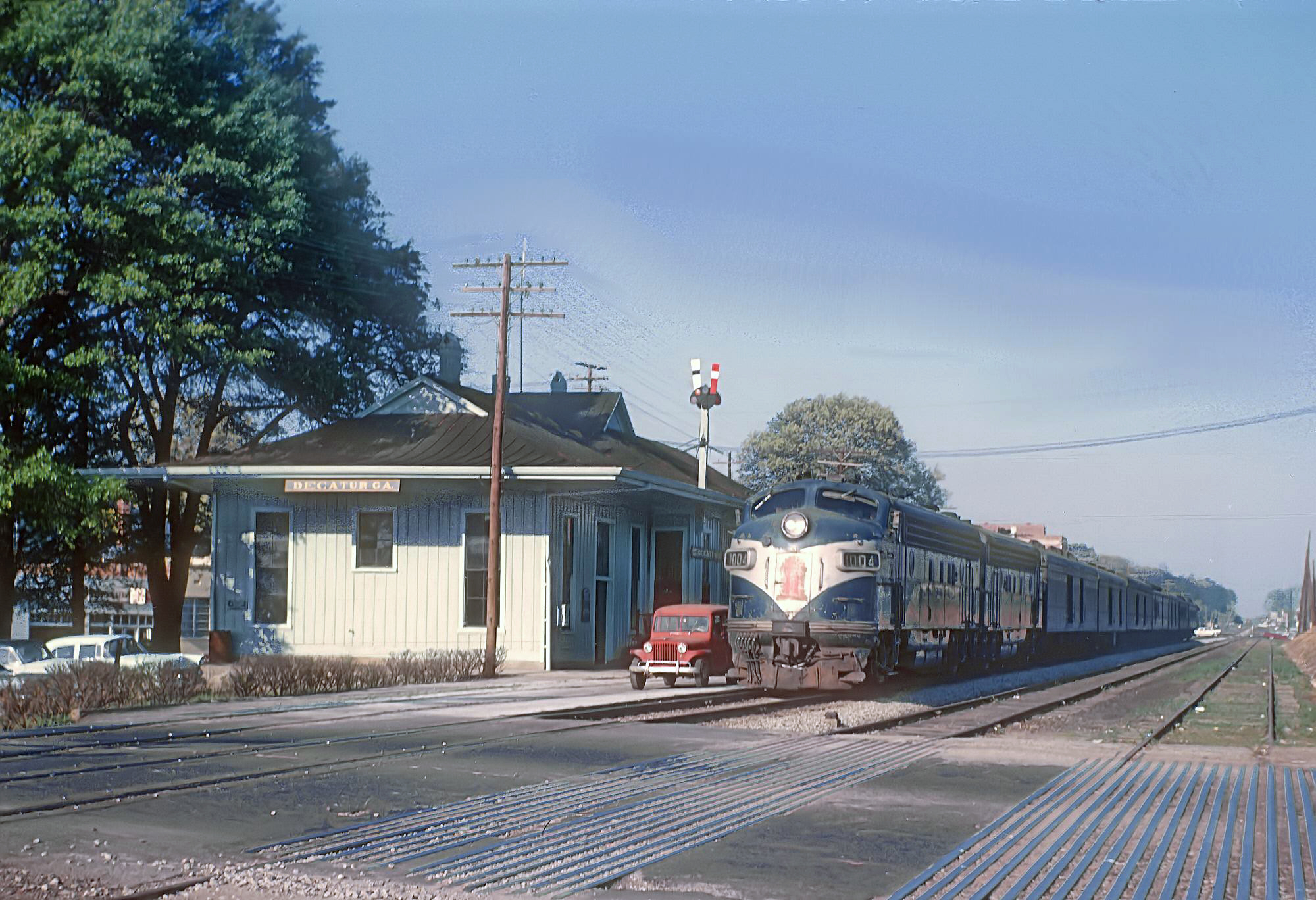 Georgia Railroad FP7 #1004 is ahead of train #1 (Augusta-Atlanta) at Decatur, Georgia in April, 1963. Rick Burn photo.
Diesel Rosters
Atlanta & West Point
| Road Number(s) | Builder | Model | Amount | Date Built |
|---|---|---|---|---|
| 551-554 | EMD | FP7 | 4 | 1949-1951 |
| 1005 | EMD | FP7 | 1 | 1949 (Ex-WRoA #502) |
| 571-576 | EMD | GP7 | 6 | 1950-1952 |
| 675 | Baldwin | DS-4-4-1000 | 1 | 1949 (Ex-Georgia #921) |
| 676-677 | Baldwin | DS-4-4-1000 | 2 | 1949 |
| 678 | Baldwin | S-12 | 1 | 1951 |
| 726-732 | EMD | GP40 | 7 | 1967-1970 |
| 733 | EMD | GP40-2 | 1 | 1974 |
| 4976 | EMD | GP16 | 1 | 1950 (Ex-A&WP GP7 #576) |
| 4978 | EMD | GP16 | 1 | 1951 (Ex-ACL GP7 #246) |
| 6007-6008 | EMD | GP38-2 | 2 | 1979 |
Western Railway of Alabama
| Road Number(s) | Builder | Model | Amount | Date Built |
|---|---|---|---|---|
| 501 | EMD | F3A | 1 | 1948 |
| 502-503 | EMD | FP7 | 2 | 1949 |
| 520 | EMD | GP7 | 1 | 1950 (Ex-SAL #1734) |
| 521-526 | EMD | GP7 | 6 | 1950-1953 |
| 530-531 | EMD | GP9 | 1 | 1954 |
| 621-624 (1-4) | Baldwin | VO-1000 | 4 | 1944 |
| 630 | Baldwin | DS-4-4-1000 | 1 | 1948 |
| 701-707 | EMD | GP40 | 7 | 1967-1970 |
| 708 | EMD | GP40-2 | 1 | 1974 |
| 4977, 4979 | EMD | GP16 | 2 | 1951-1952 (Ex-WRoA #524, Ex-ACL GP7 #141) |
| 6045-6046 | EMD | GP38-2 | 2 | 1979 |
Georgia Railroad
| Road Number(s) | Builder | Model | Amount | Date Built |
|---|---|---|---|---|
| 751-754 | EMD | GP40 | 4 | 1967-1968 |
| 755-756 | EMD | GP40-2 | 2 | 1972 |
| 901-905 | EMD | NW2 | 5 | 1948-1949 |
| 906-907 | EMD | SW9 | 2 | 1951 |
| 921 | Baldwin | DS-4-4-1000 | 1 | 1949 |
| 1001 | EMD | F3A | 1 | 1948 |
| 1002-1004 | EMD | FP7 | 3 | 1949-1950 |
| 1005 | EMD | FP7 | 1 | 1949 (Ex-A&WP #551) |
| 1019-1020 | EMD | GP7 | 2 | 1950 (Ex-A&WP #571-572) |
| 1021-1036 | EMD | GP7 | 16 | 1950-1953 |
| 1040-1042 | EMD | GP9 | 3 | 1954 |
| 4975 | EMD | GP16 | 1 | 1954 (Ex-Georgia #1042) |
| 6009-6010 | EMD | GP38-2 | 2 | 1979 |
| 6051-6052 | EMD | GP38-2 | 2 | 1980 (Ex-SCL #6051-6052) |
Steam Rosters
Western Railway Of Alabama (As of 1943)
| Class | Road Number | Wheel Arrangement | Builder | Date Built |
|---|---|---|---|---|
| E | 100-104 | 0-6-0 | Rogers | 1907-1908 |
| E | 105 | 0-6-0 | Alco | 1910 |
| G | 115, 127 | 0-8-0 | Alco | 1918 |
| A | 128-130 | 4-6-0 | Rogers | 1904 |
| A | 131, 161 | 4-6-0 | Alco | 1911 |
| A | 175 | 4-6-0 | Rogers | 1903, Rebuilt in 1924. |
| P | 180, 190 | 4-6-2 | Lima | 1926 |
| M | 181, 185, 186 | 4-8-2 | Alco | 1924 |
| M | 187, 375-377 | 4-8-2 | Alco | 1924 |
| F | 378 | 2-8-2 | Lima | 1923 |
Atlanta & West Point (As of 1943)
| Class | Road Number | Wheel Arrangement | Builder | Date Built |
|---|---|---|---|---|
| E | 200-202 | 0-6-0 | Alco | 1912 |
| G | 215, 225-226 | 0-8-0 | Alco | 1918 |
| G | 228-229 | 0-8-0 | Alco | 1918 |
| A | 230 | 4-6-0 | Rogers | 1903-1907 |
| A | 261 | 4-6-0 | Rogers | 1906, Rebuilt 1924. |
| A | 273 | 4-6-0 | Rogers | 1899, Rebuilt 1924. |
| A | 275 | 4-6-0 | Rogers | 1900, Rebuilt 1924. |
| P | 290 | 4-6-2 | Lima | 1926 |
| P | 280-281 | 4-6-2 | Alco | 1913 |
| P | 350-351 | 4-6-2 | Alco | 1913 |
| F | 425-427 | 2-8-2 | Lima | 1923 |
| F | 400-401 | 2-8-2 | Lima | 1918 |
The above steam locomotive roster information is courtesy of Joseph Sadler's article, "West Point Route" from the June, 1943 issue of Trains Magazine.
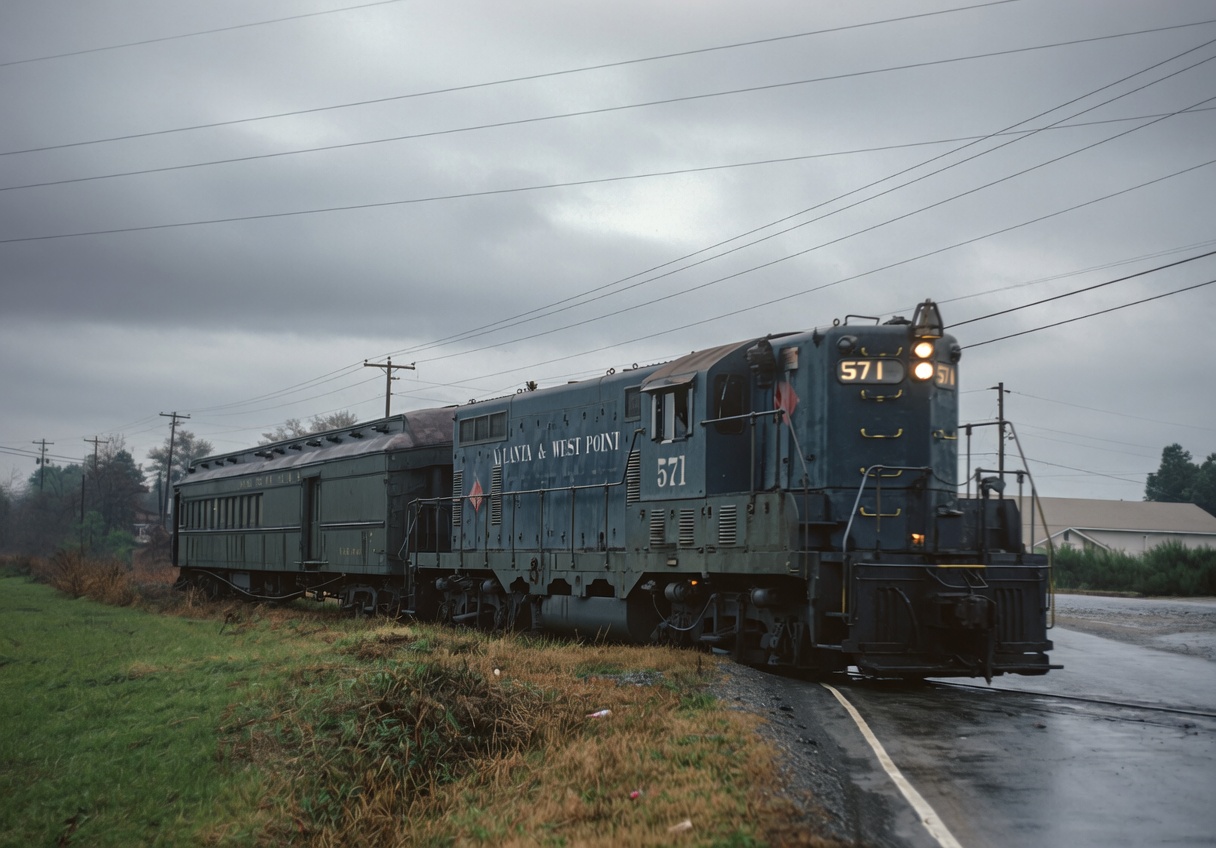 Atlanta & West Point GP7 #571 leads a Georgia Railroad mixed train toting a single combine near Athens, Georgia on November 24, 1967. Roger Puta photo.
The roads also received a series of sleek, stainless-steel lightweight cars for Southern's Crescent including an RPO-Baggage-Express, coaches, a diner, pair of sleepers, and a sleeper-observation.
Into the 1960's the West Point Route canceled as many passenger trains as it could due to the declining nature of this business.
It was further hurt by the U.S. Post Office discontinuing mail contracts, which made their final runs on October 18, 1966. By 1968 only the Crescent remained and its final remnants were dropped entirely after January 7, 1970.
Second-generation road power began arriving at this time and new GP models continued arriving throughout the 1970's carrying a simplified solid black livery with only the company logos and names on the carbody.
Family Lines and CSX Transportation
That decade also witnessed each railroad's identity disappearing into the Family Lines System. In 1974 the West Point lost its separate traffic and accounting departments which were folded into the owning railroads.
As the Seaboard Coast Line, Louisville & Nashville, and other Family Lines properties continued consolidating operations corporate identities largely disappeared except for their respective names.
In 1980 the Family Lines completed a merger with Chessie System, which formed CSX Corporation on November 1st, a holding company.
On December 29, 1982 the group was formally merged into Seaboard System and the West Point Route officially disappeared a few days later on January 1, 1983.
Recent Articles


-
Lehigh and New England Railroad: Map, Rosters, History
Sep 21, 26 12:33 AM
 Lehigh & New England—South Mountain & Boston 1873, named April 2 1895. Anthracite, cement, Maybrook. Last Camelbacks, Alco FAs. Voluntary shutdown October 31 1961.
 -
TVRM Chattanooga Dinner Train (2026): Dates, Tickets & What to Expect
Sep 21, 26 12:20 AM
 2026 TVRM Chattanooga Dinner Train Experience—Grand Junction, select Fri/Sat March 6–October 24, three-course, 2–3 hours, from $110. Confirm on tvrail.com.
 -
Lehigh and Hudson River Railroad: Map, Rosters, History
Sep 20, 26 11:55 PM
 Lehigh & Hudson River—Warwick Valley 1860, Railway April 1 1882. Easton–Maybrook bridge road, Alphabet Route, Alco RS-3s and C420s. Conrail April 1 1976.
 -
Royal Gorge First Class Dinner Train (2026)
Sep 20, 26 11:47 PM
 2026 Royal Gorge Route First Class Lunch & Dinner—Cañon City, about 2 hours, from $199+, 12+. Confirm on royalgorgeroute.com.
 -
GE "44-Tonner" Locomotives: Roster, Specs, History
Sep 20, 26 11:09 PM
 GE 44-ton switcher—90,000-pound rule, Caterpillar D17000 center-cab, Sept 4 1940 CB&Q 9103 through Oct 1956 Dansville & Mount Morris 1. Phases, serial roster, PRR 46.
 -
Strasburg Rail Road Dining (2026): Dinner on the Rails & Elegant Expre
Sep 20, 26 11:00 PM
 2026 Strasburg Rail Road seated meals—Dinner on the Rails, Elegant Express, Valentine dinner. Lee E. Brenner diner. Confirm on strasburgrailroad.com.
 -
International-Great Northern Railroad: Map, History, Timetables
Sep 20, 26 10:43 PM
 International–Great Northern—Houston & Great Northern 1866, International Railroad 1870, merged Sept 30 1873. Palestine, Longview–Laredo, Gould, Missouri Pacific March 1 1956.
 -
Nevada Northern Taste of Italy Dinner Train (2026)
Sep 20, 26 03:25 PM
 2026 Nevada Northern Taste of Italy—adults-only multi-course Italian dinner, steam when healthy, East Ely. Sep. 19 gala listed. Confirm on nnry.com.
 -
Cape Cod Dinner Train (2026): Dates, Tickets & What to Expect
Sep 20, 26 02:53 PM
 Cape Cod Central Dinner Train—Hyannis, Buzzards Bay, and Falmouth. Four-course, 3–3½ hours, from $99.99. Confirm on capetrain.com.
 -
Erie Steam Locomotives: History, Roster & Photos
Sep 20, 26 11:55 AM
 Erie Railroad steam—Camelback 2-8-0s, 155 N-1 Mikados, 105 Berkshires, K-class Pacifics, Triplexes. Post-1900 roster after Drury. Last steam March 17, 1954.
 -
Erie Railroad Diesel Roster: All-Time
Sep 20, 26 11:47 AM
 Erie Railroad diesel—boxcabs 1926, FTs 1944, F3/F7, FA/PA, GP7/GP9, Baldwins, Limas. All-time roster with serials, orders, classes. Last steam March 17 1954. EL October 17 1960.
 -
Erie Railroad: Map, Passenger Trains, Logo, History
Sep 20, 26 11:44 AM
 Erie Railroad—New York & Erie 1832, Piermont–Dunkirk May 14 1851, six-foot then standard June 1880, Chicago 1883. High-and-wide fourth way. Erie Lackawanna October 17 1960.
 -
Colebrookdale Railroad Dining (2026): Secret Valley Dinner Train
Sep 20, 26 11:36 AM
 2026 Colebrookdale Railroad dinner in Boyertown—Secret Valley Dining Class, about 2 hours. Saturday evenings. Confirm on colebrookdalerailroad.com.
 -
Boone & Scenic Valley Wolf Dinner Train (2026)
Sep 19, 26 08:15 PM
 2026 Boone & Scenic Valley Wolf Dinner Train—Des Moines River valley, Bass Point Creek High Bridge, Union Pacific dining cars. Confirm on bsvrr.com.
 -
C&NW 4-6-2s 1617 & 1620: Minnesota 400 Yellow Jackets
Sep 19, 26 11:28 AM
 C&NW Class E Pacifics 1617 and 1620—Alco Schenectady 1917, yellow-and-green E-4-style shrouds 1941 for the Minnesota 400. Crews called them Yellow Jackets. Renumbered 617/620. Scrapped 1956.
 -
Erie Lackawanna Diesel Roster: All-Time
Sep 19, 26 10:13 AM
 Erie Lackawanna diesel—Erie and DL&W inheritance, GP35s, U25Bs, SD45/SDP45/SD45-2, U34CH. All-time roster with serials and orders. Conrail April 1 1976.
 -
Erie Lackawanna Railway: Map, History, Logo
Sep 19, 26 10:06 AM
 Erie Lackawanna Railway—Erie and DL&W, October 17 1960–March 31 1976. Von Willer, White revival, Dereco, Agnes, Conrail. High-and-wide Chicago main. Map, logo, what remains.
 -
"Empire State Express" (1941 Train): Timetables, Route, Consist
Sep 18, 26 10:59 PM
 NYC Empire State Express—George Daniels 1891 day train, 999’s 112.5 mph claim, Budd stainless streamliner December 7 1941, Cleveland and Detroit sections, diesels, 1967 name drop. Timetables, consist…
 -
New York Central 4-6-4s 5426 & 5429: Empire State Express Hudsons
Sep 18, 26 10:32 PM
 NYC J-3a Hudsons 5426 and 5429—Alco 1937, Budd stainless shrouds 1941 for the Empire State Express. Pearl Harbor inaugural. Shrouds off by 1950. Neither preserved.
 -
"Stourbridge Lion" Locomotive: Facts, History, Photos
Sep 18, 26 10:27 PM
 Stourbridge Lion—Foster, Rastrick 0-4-0, first steam locomotive in the United States. Horatio Allen, Honesdale, August 8, 1829. Too heavy for D&H gravity track. Boiler in Baltimore; Colonie replic…
 -
Delaware & Hudson Steam Roster (Post 1900)
Sep 18, 26 10:01 PM
 Delaware & Hudson steam—Camelback 2-8-0s, Loree high-pressure compounds, Class K 4-8-4s, forty Challengers. Post-1900 class roster after Drury. Last steam July 21, 1953.
 -
Boston & Maine Steam Roster (Post 1900)
Sep 18, 26 02:57 PM
 Boston & Maine steam—B-15 Moguls, K-8 Consolidations, P-4 Lima Pacifics, T-1 Limas, R-1 Mountains. Post-1900 class roster after Drury. Last steam July 23, 1956.
 -
Boston & Maine Diesel Roster (All-Time)
Sep 18, 26 01:25 PM
 Boston & Maine diesel—boxcab 1100 1935, Flying Yankee 6000, FTs, E7s, BL2s, GP7/GP9, GP38-2s and GP40-2s. All-time roster. Last steam July 23, 1956.
 -
Mid-Continent Railway Museum Dining (2026)
Sep 18, 26 01:21 PM
 2026 Mid-Continent dining in North Freedom—select-date seated meals in luxury cars, reservations required. Pizza Limited June 28. Confirm on midcontinent.org.
 -
Bessemer & Lake Erie Steam Roster (Post 1900)
Sep 18, 26 12:11 PM
Bessemer & Lake Erie steam—C3A 150–151, D1A/D2A Santa Fes, 47 H1 Texas types after Burlington. Post-1900 class roster after Drury. Last steam 2-8-0 156, May 14, 1953. -
Bessemer & Lake Erie Diesel Roster (All Time)
Sep 18, 26 12:09 PM
 Bessemer & Lake Erie diesel—Westinghouse 281 1936, Baldwin DRS-6-6-1500s, F7s 1950–53, SD7/SD9/SD18/SD38 family, RSD-15s. All-time roster. Last steam 2-8-0 156, May 14, 1953.
 -
Bangor & Aroostook Steam Roster (Post 1900)
Sep 18, 26 11:21 AM
 Bangor & Aroostook steam—Manchester Ten-Wheelers, Alco Mountains 100–109, G-2 Consolidations, Pacifics 250–254. Post-1900 class roster after Drury. Last steam Pacific 251, July 22, 1951.
 -
Bangor & Aroostook Diesel Roster (All Time)
Sep 18, 26 11:09 AM
 Bangor & Aroostook diesel—F3s 1947, eight BL2s, E7s, GP7s leased to the PRR, GP9s, GP38s. All-time roster. Last regular steam July 22, 1951.
 -
B&O Steam Locomotive Roster (Post 1900)
Sep 18, 26 10:33 AM
 Baltimore & Ohio steam—Old Maude, E-27 Consolidations, Q Mikados, Big Sixes, EM-1 Yellowstones, President Pacifics. Post-1900 class roster after Drury. Last public steam May 17, 1958.
 -
Baltimore & Ohio (B&O): Diesel Roster (All-Time)
Sep 18, 26 10:28 AM
 Baltimore & Ohio diesel—boxcab 1925, EMC 50 1935, EA 1937, FTs, F3s, F7s, FA-2s, sharks, GP7/GP9, GP30s after C&O 1963, SD50s 8576–8595 1984. All-time roster. Last steam 1958.
 -
Detroit & Toledo Shore Line Railroad: Map, Roster, History
Sep 18, 26 12:32 AM
 Detroit & Toledo Shore Line—Pleasant Bay 1898, named 1899, Detroit–Toledo freight bridge, GTW and Clover Leaf/NKP/N&W. Merged into Grand Trunk Western June 26, 1981.
 -
Lackawanna Steam Locomotives: History, Roster & Photos
Sep 18, 26 12:17 AM
 Delaware, Lackawanna & Western steam—Camelback 2-8-0s, Mikados, freight Pacifics, Poconos 4-8-4s, Hudsons. Post-1900 roster after Drury. Last steam July 13, 1953.
 -
Lackawanna (DL&W) Diesel Roster: All Time
Sep 18, 26 12:11 AM
Delaware, Lackawanna & Western diesel—boxcabs 1926, EMC SC 425–426 1935, FTs 1945, F3/F7/E8, GP7s, RS-3s, FM Train Masters. All-time roster. Last steam 1953. -
Lackawanna Railroad: Map, History, Viaducts, Rosters
Sep 18, 26 12:04 AM
 TDelaware, Lackawanna & Western—Liggett’s Gap 1832, named March 11 1853, Hoboken–Buffalo, anthracite, Phoebe Snow, Cutoff and Tunkhannock. It merged with the Erie to form Erie Lackawanna on Octobe…
 -
Rail News, The Latest
Sep 17, 26 11:56 PM
This page provides a portal to the latest in rail news, from preservation and restortation subjects to other notable topics. -
Union Pacific Big Boy 4014 Sets First Holiday Tour for Make-A-Wish
Sep 17, 26 11:54 PM
Union Pacific Big Boy 4014’s first holiday tour: Cheyenne–Denver tickets, Nov. 21 Denver-area display, Make-A-Wish. Museum patrons Oct. 16; public Oct. 19. -
Conrail Diesel Roster (All Time)
Sep 17, 26 10:27 PM
Conrail diesel—~5,000 inherited 1976, Big Blue, GP15-1s, SD40-2s, SD50s, Dash-8s, SD60/60M/60I, SD80MACs. All-time CR-number roster. -
Chessie System (Railroad): The C&O, B&O, And WM
Sep 17, 26 09:38 PM
 Chessie System, Inc.—C&O, B&O, and Western Maryland. Kitten-C paint 1972, holding company February 26 1973, CSX November 1 1980, C&O into CSXT August 31 1987.
 -
Chesapeake & Ohio (C&O) Diesel Roster: All-Time
Sep 17, 26 06:01 PM
Chesapeake & Ohio diesel—late steam, no Fairbanks-Morse, E7s 1946, GP7/GP9 flood, F7s, GP40-2s, B30-7s, SD50s 1984–85. All-time roster. Steam ended 1956. -
Chesapeake & Ohio (C&O) Steam Roster: Post-1900
Sep 17, 26 03:18 PM
 Chesapeake & Ohio steam—H-8 Alleghenies, K-4 Kanawhas, T-1 Texas, Greenbriers, H-6 1949 Mallets. Post-1900 class roster including Pere Marquette and Hocking Valley. Last steam 1956.
 -
Chesapeake and Ohio Railway: Map, Logo, History
Sep 17, 26 02:36 PM
 Chesapeake & Ohio Railway—Louisa Railroad 1836, named August 31 1868, Ohio River 1873. Coal, Chessie the kitten, Pere Marquette 1947, B&O control 1963, into CSX August 31 1987. Complete corporate…
 -
TVRM Valentine Train Ride (2026)
Sep 17, 26 02:31 PM
 2026 TVRM Valentine Train Ride in Chattanooga—Feb. 6–15, plated dinner, Grand Junction Depot. Confirm on tvrail.com.
 -
River Fox Train Dining (2026)
Sep 17, 26 02:29 PM
2026 River Fox Train in West Sacramento—Brunch Train and Murder Mystery dinner. 18095 County Road 117. Confirm on riverfoxtrain.com. -
Weehawken Terminal, Serving The West Shore Railroad
Sep 17, 26 01:38 PM
 Weehawken Terminal—West Shore / New York Central Hudson waterfront station, opened 1884. Five ferry slips, sixteen tracks, Weehawken Tunnel 4,014 feet. Last ferry March 25, 1959. Port Imperial and HBL…
 -
West Shore Railroad: Map, History, Timetables
Sep 17, 26 01:32 PM
 West Shore Railroad—New York, West Shore & Buffalo 1880–83, Weehawken to Buffalo. PRR-backed rival to the Central. Morgan settlement, 475-year NYC lease January 1 1886. CSX River Sub today.
 -
Jersey Central Diesel Locomotives: History, Roster & Photos
Sep 17, 26 01:20 PM
 Central Railroad of New Jersey diesel—boxcab 1000, Baldwin double-enders, F3s, Train Masters, SD35s, GP40Ps. All-time roster. Steam ended July 1, 1954.
 -
Jersey Central Steam Locomotives: History, Roster & Photos
Sep 17, 26 01:17 PM
 Central Railroad of New Jersey steam—Camelback Ten-Wheelers, USRA Mikados, G-class Pacifics, suburban tanks. Post-1900 class roster after Drury. Dieselized July 1, 1954.
 -
Jersey Central Railroad (CNJ): Map, Rosters, History
Sep 17, 26 01:14 PM
 Central Railroad of New Jersey—Elizabethtown & Somerville 1831, named April 23 1849. Communipaw, anthracite, Blue Comet, Reading/B&O control. Conrail April 1 1976. Complete corporate history.
 -
Central Vermont Diesel Locomotives: History, Roster & Photos
Sep 17, 26 11:35 AM
 Central Vermont diesel—Alco S-2s 1942, RS-3s, RS-11s from DW&P, EMD GP9s 1956–57, GP38ACs 1971. All-time roster. Last steam April 4, 1957.
 -
Central Vermont Steam Locomotives: History, Roster & Photos
Sep 17, 26 11:19 AM
 Central Vermont steam—ten Alco 2-10-4s of 1928, four U-1-a Mountains, Consolidations. Post-1900 class roster after Drury. Last steam April 4, 1957.



%20FP7%20%23554%20departs%20Atlanta%20Terminal%20Station%20with%20Southern's%20%22Crescent%20Limited%22%20(New%20York-Washington-Atlanta-Montgomery-New%20Orleans)%20in%201957.%20%20Howard%20Robins%20photo.)

