
Alco "C-855" Locomotives: Specs, Roster, Data Sheet
Last revised: December 22, 2024
By: Adam Burns
The C855 was an experimental design built only for the Union Pacific. At the time it was manufactured this Century was the most powerful single-unit diesel locomotive ever constructed.
Designed during the 1960s, the C855 was quite similar to other locomotives constructed by General Electric and Electro-Motive during that time; Union Pacific was looking for a powerful single-unit that could decrease its motive power fleet and daily operating costs. As a result, it ordered experimental behemoths from all three builders.
What seemed to so often be the case with Alco's locomotives the C855 proved troublesome and problematic mostly due to the fact it had not been given enough research and development.
One particular sticking point was the use of aluminum wiring in an attempt to reduce construction costs. It often caught fire and was unsuitable for the daily beating required of freight service.
The model's prominent feature was the company's trademark tractive effort and the ability to pull almost anything. However, this did little to sway Union Pacific's feelings towards the C855 and the three units were scrapped after less than 10 years of service.
Photos
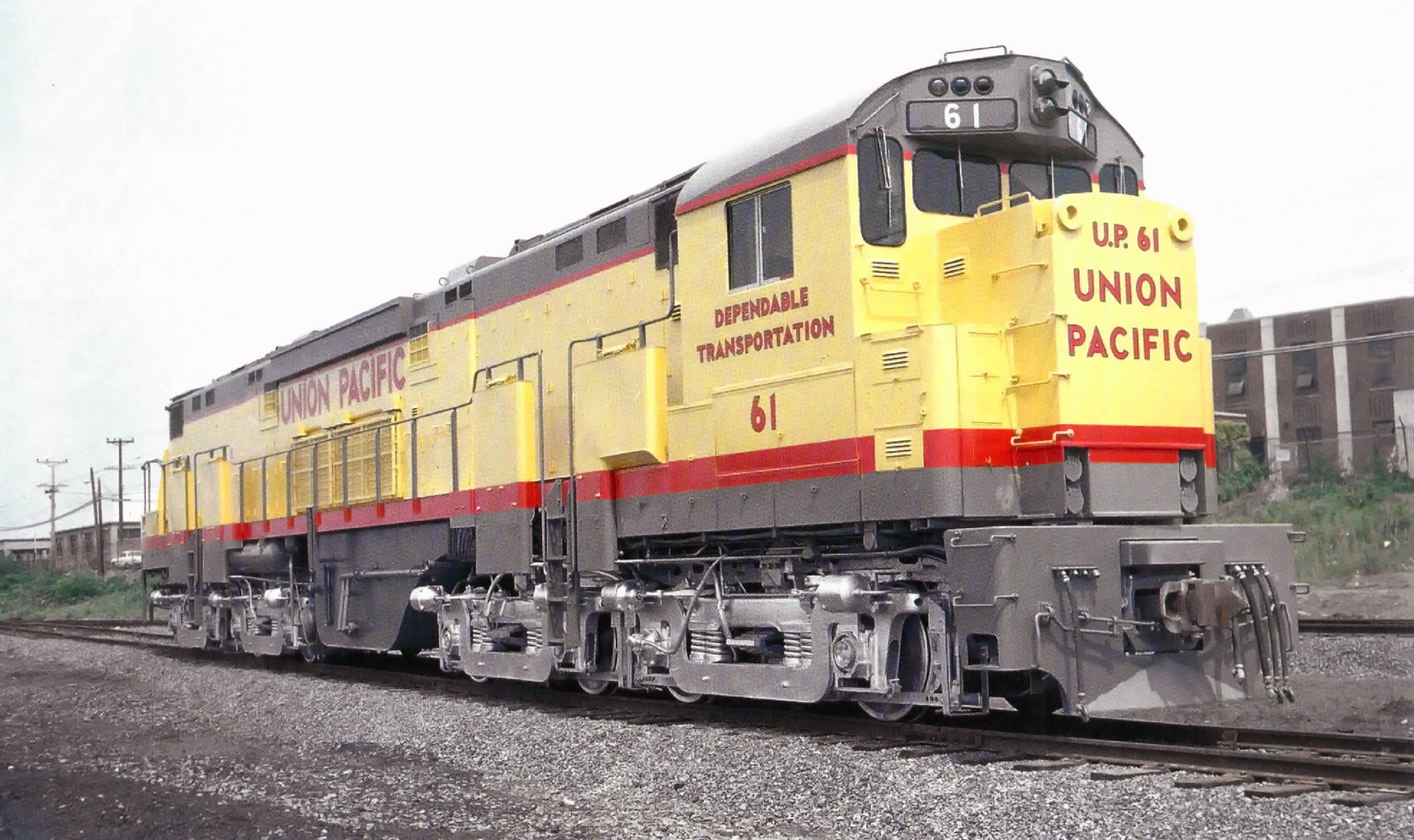 An American Locomotive builder's photo of C855 #61 at the company's plant in Schenectady, New York in June, 1964.
Overview
The idea of high horsepower locomotives wasn't new at Union Pacific. The railroad had been experimenting with such single-unit designs dating back to the famous 4-8-8-4 "Big Boys" of 1941-1944.
They were the brainchild of UP's chief mechanical officer, Otto Jabelmann, wanted to lower maintenance costs by decreasing the number of locomotives needed to power a typical freight train.
The work continued under David Neuhart in 1949 when he replaced Jabelmann as head of the Motive Power Department. His efforts ultimately led to famous designs like the gas turbine, U50, U50C, DD35/A, DDA40X, and the C-855.
Horsepower
Interestingly, the C855 (designated by the builder as the DL-855) was constructed in June of 1964 during the Century line's early years of production. The model was essentially two power plants housed on one frame.
The locomotive employed two of Alco's 251C prime movers that together could produce a stunning (for the time) 5,500 horsepower. The unit rode on four B-B trucks and weighed a grueling 551,000 pounds (275.5 tons).
Obviously, this extreme weight meant that it would be a liability on the track although it also provided for incredible tractive effort that topped out at 109,000 pounds starting and 88,000 pounds continuous (these numbers put the C855 on par with some of the largest steam locomotives ever built, an area Alco was also quite familiar with).
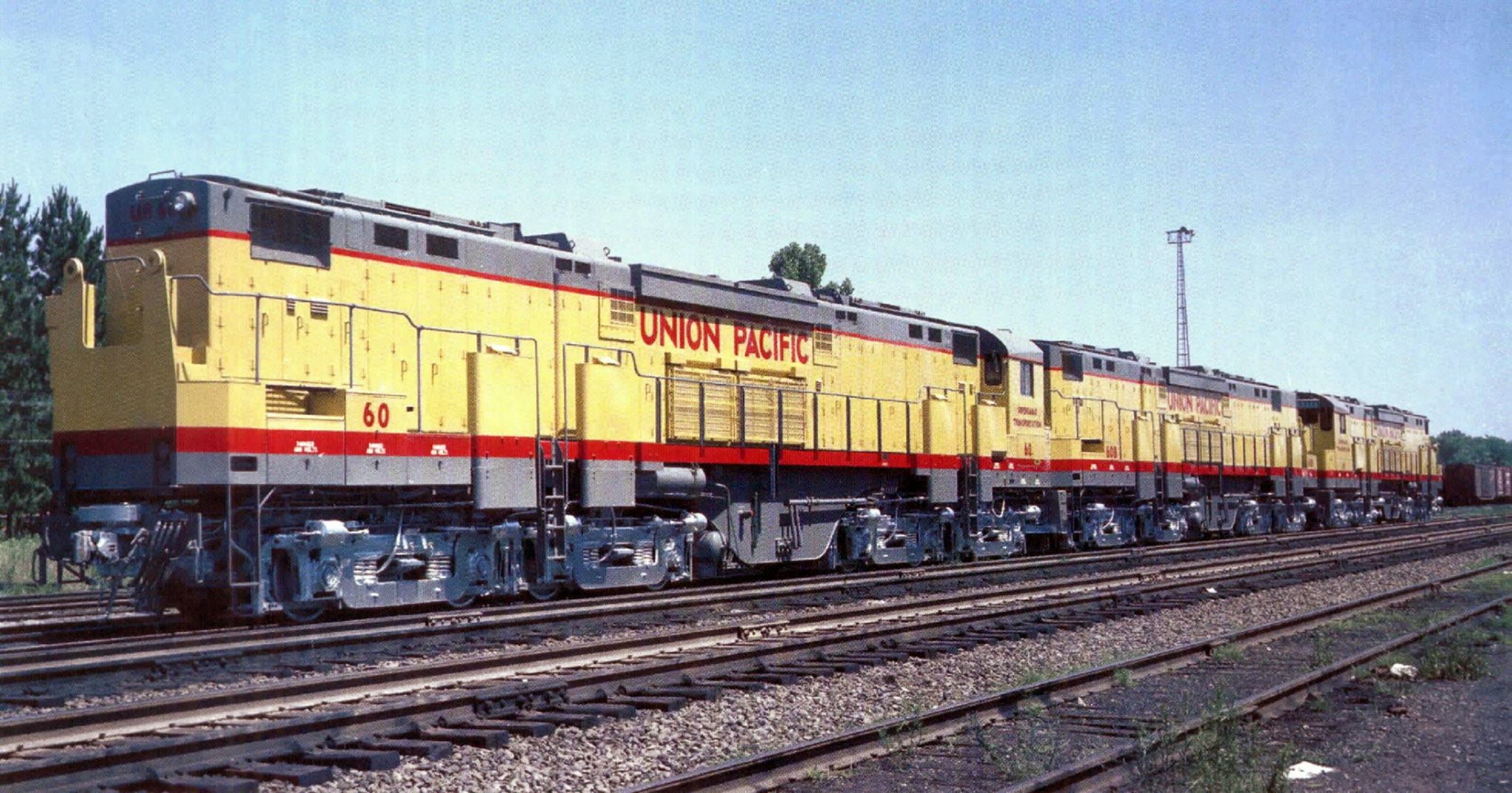 An American Locomotive photo featuring its testbed A-B-A set of C-855's (A unit #60, B unit #60-B, and A unit #61) for Union Pacific in 1964. These beasts could produce 5,500 horsepower, each, utilizing a pair of 16-cylinder, model 251C prime movers. Unfortunately, the design was not successful.
Alco had also developed a model similar to the C855, Southern Pacific's C643H. However, there was a key difference with Espee's locomotive, which used a Voith diesel hydraulic transmission whereas the C855 did not.
UP's version used equipment standard in practically all other Century line locomotives; traction motors (model 752) and main/secondary generators (model GT598 and GY27-5) from General Electric along with air components from Westinghouse.
Of course, anyone who studies Union Pacific's history knows the railroad is famous for going big during the 1950s and 1960s. In the late 1940s UP had GE and Alco build a gas turbine-electric locomotive that itself could produce nearly 5,000 horsepower.
Additionally, during the C855's construction UP contracted GE and EMD to build similar models (EMD unveiled the DD35 and GE the U50, both of which could produce 5,000 horsepower). The C855 was designed to operate as single units or in A-B/A-B-A lash-ups.
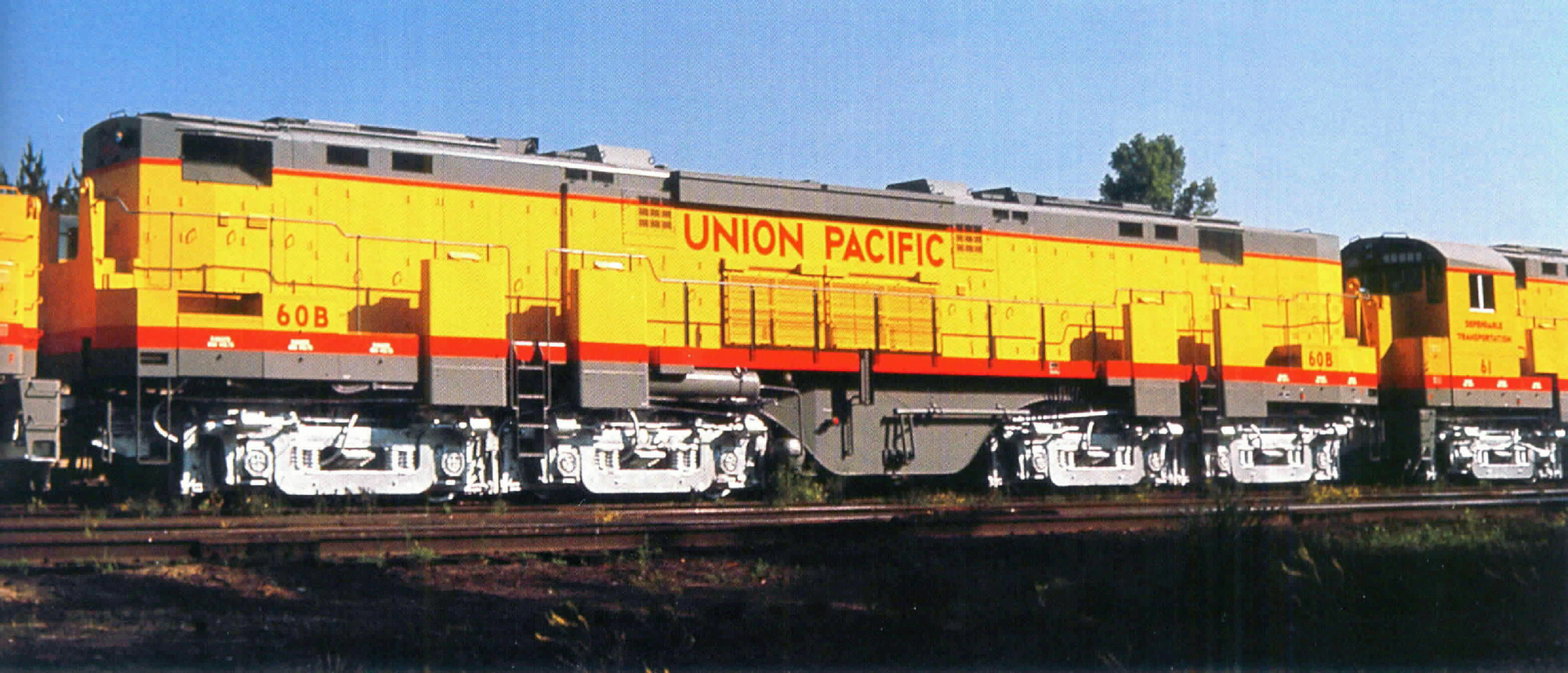
In sequence the locomotives were numbered 60, 60B, and 61 (the cabless "B" unit was designated as the DL-856). In general the carbody had the appearance of the Century line with a short nose and long trailing hood only scaled up to far greater proportions.
From an exterior standpoint it didn't exactly carry a clean look with many bulges and protrusions here and there. The C855 was an incredible 86 feet in length and when all three units were coupled together the set nearly spanned a football field at 258 feet!
The whole point of UP going big with diesel technology was an attempt to reduce its locomotive fleet by using fewer units per train (thus reducing maintenance and general locomotive expenses).
Data Sheet and Specifications
| Entered Production | 6/22/1964 |
| Years Produced | 6/22/1964 |
| Model Specification | DL-855/DL-856A |
| Engine | 251C, V-16 (2) |
| Horsepower | 5,500 (2,750 per engine) |
| RPM | 1,050 |
| Carbody Styling | Alco |
| Length (Between Coupler Pulling Faces) | 83' 11" |
| Weight | 528,000 Lbs. |
| Dynamic Brakes | Yes |
| Trucks | B-B |
| Truck Type | Swing Bolster, Drop-Side Equalizer/AAR Type-B (4) |
| Truck Wheelbase | 9' 4" |
| Wheel Size | 40" |
| Traction Motors | GE 752 (8) |
| Traction Generator | GT598 |
| Gear Ratio | 65:18 |
| Tractive Effort Rating | 88,000 Lbs. at 10 MPH. |
| Top Speed | 75 MPH |
Production Roster
Total Built = 3
| Owner | Road Number(s) | Specification | Construction Number(s) | Completion Date |
|---|---|---|---|---|
| Union Pacific | 60-61 | DL-855 | 84730, 84731 | 6/22/1964 |
| Union Pacific | 60B | DL-856A | 84732 | 6/22/1964 |
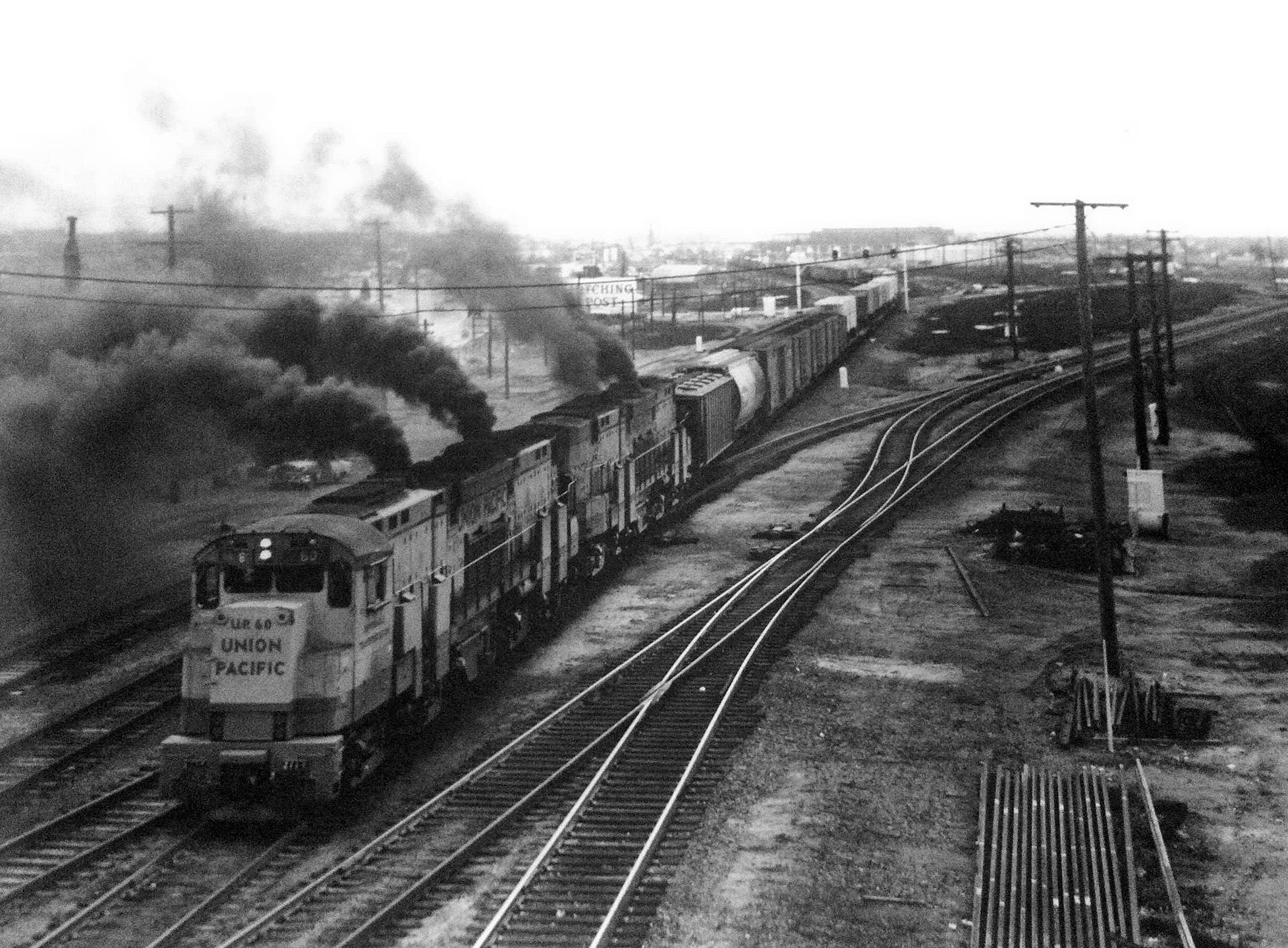 What these must have sounded like in service! With a combined output of 11,000 horsepower (5,500 hp each), Union Pacific C855 #60 and cabless unit #60-B smoke it up as they roar out of Cheyenne, Wyoming with a westbound freight on September 15, 1966. Photo from the Ken Berghorst collection/shared by Brandon Carstensen.
Reception
General Electric's and Alco's high-horsepower designs were plagued with reliability issues, lasting less than a decade in service before being struck from the roster. Among their issues was the use of aluminum wiring, which caught fire, along with general overheating and other problems with the 251Cs.
While both GE's and EMD's models lasted longer in revenue service than did the C855 all three designs had their problems (the C855s were off the roster by 1972).
EMD's version, the DD35/A lasted the longest and proved the most reliable of the three, remaining in service until the early 1980s.
Interestingly, the later DDA40X Centennials turned out to be the most successful of all with the fleet of 47 recording more than two million miles of revenue service, some of which were later rebuilt and operated through the mid-1980s.
Sources
- Foster, Gerald. A Field Guide To Trains. New York: Houghton Mifflin, 1996.
- Kirkland, John F. Diesel Builders, The: Volume Two, American Locomotive Company And Montreal Locomotive Works. Glendale: Interurban Press, 1989.
- Pinkepank, Jerry A. Diesel Spotter's Guide. Milwaukee: Kalmbach Publishing Company, 1967.
- Solomon, Brian. Alco Locomotives. Minneapolis: Voyageur Press, 2009.
Recent Articles


-
Delaware & Hudson Steam Roster (Post 1900)
Jun 03, 26 11:55 AM
 The Delaware & Hudson Railway (D&H), one of America’s oldest railroads, traced its roots to 1823 as a canal and gravity railroad operation hauling anthracite coal from northeastern Pennsylvania. Steam…
 -
Florida 'Whiskey Tasting' Train Rides
Jun 02, 26 12:39 PM
 If you’re dreaming of a whiskey-forward journey by rail in the Sunshine State, here’s what’s available now, what to watch for next, and how to craft a memorable experience of your own.
 -
Kentucky 'Whiskey Tasting' Train Rides
Jun 02, 26 12:29 PM
 Whether you’re a curious sipper planning your first bourbon getaway or a seasoned enthusiast seeking a fresh angle on the Kentucky Bourbon Trail, a train excursion offers a slow, scenic, and flavor-fo…
 -
Chessie System Diesel Roster (All Time)
Jun 02, 26 11:35 AM
 Though Chessie itself owned no equipment—locomotives remained on the books of its subsidiaries with C&O, B&O, or WM reporting marks—the system unified operations across 11,700 route miles, hauling vas…
 -
New York 'Whiskey Tasting' Train Rides
Jun 02, 26 11:09 AM
 For those keen on embarking on such an adventure, the Arcade & Attica offers a unique whiskey tasting train at the end of each summer!
 -
Connecticut 'Wine Tasting' Train Rides
Jun 02, 26 11:04 AM
 If you’re looking for a signature “special occasion” experience, the Essex Steam Train's Wine & Chocolate Dinner Train stands out as a decadent, social, and distinctly memorable take on dinner on…
 -
Massachusetts 'Wine Tasting' Train Rides
Jun 02, 26 10:24 AM
 This article dives into some of the alluring aspects of wine by rail in Massachusetts, currently offered by the Cape Cod Central Railroad.
 -
Buffalo, Rochester & Pittsburgh Steam Roster (Post 1900)
Jun 02, 26 12:32 AM
 The BR&P's steam locomotive roster evolved from modest 19th-century power to some of the heaviest articulated engines in the Northeast, reflecting the railroad’s growing tonnage demands and challengin…
 -
Virginia 'Dinner Train' Rides At Staunton
Jun 01, 26 12:11 PM
 If you’ve ever wished you could pair a classic scenic train ride with a genuinely satisfying meal—served at your table while the countryside rolls by—the Virginia Scenic Railway was built for you.
 -
Oregon 'Dinner Train' Rides At Hood River
Jun 01, 26 12:06 PM
 The Mt. Hood Railroad is the moving part of that postcard—a century-old short line that began as a working railroad.
 -
Maryland 'Wine Tasting' Train Rides
Jun 01, 26 11:58 AM
 This article delves into the enchanting world of wine tasting train experiences in Maryland, providing a detailed exploration of their offerings, history, and allure.
 -
Indiana 'Whiskey Tasting' Train Rides
Jun 01, 26 11:50 AM
 Among IRE’s most talked-about offerings is the Wine & Whiskey Train—an adults-only, evening-style trip that leans into the best parts of classic rail travel: atmosphere, comfort, and a little…
 -
Maryland 'Dinner Train' Rides At Cumberland
Jun 01, 26 11:44 AM
The Western Maryland Scenic Railroad (WMSR) has become one of the Mid-Atlantic’s signature heritage operations—equal parts mountain railroad, living museum, and “special-occasion” night out. -
Massachusetts 'Dinner Train' Rides At Cape Cod
Jun 01, 26 11:43 AM
 The Cape Cod Central Railroad (CCCR) has carved out a special niche by pairing classic New England scenery with old-school hospitality, including some of the best-known dining train experiences in the…
 -
Rhode Island 'Dinner Train' Rides In Portsmouth
Jun 01, 26 11:41 AM
 Despite its small size, Rhode Island is home to one popular dinner train experience where guests can enjoy the breathtaking views of Aquidneck Island.
 -
Maine 'Dinner Train' Rides At Portland
Jun 01, 26 11:38 AM
 While this isn’t generally a “dinner train” railroad in the traditional sense—no multi-course meal served en route—Maine Narrow Gauge does offer several popular ride experiences where food and drink a…
 -
Atlantic Coast Line Diesel Roster (All-Time)
May 31, 26 11:47 AM
 The Atlantic Coast Line was an early pioneer in dieselization, acquiring its first diesel locomotives in 1939 and completing the transition from steam by the mid-1950s.
 -
New Hampshire - Murder Mystery - Dinner Train Rides
May 31, 26 11:27 AM
 The state's murder mystery trains stand out as a captivating blend of theatrical drama, exquisite dining, and scenic rail travel.
 -
New York - Murder Mystery - Dinner Train Rides
May 31, 26 11:25 AM
 New York State, renowned for its vibrant cities and verdant countryside, offers a plethora of activities for locals and tourists alike, including murder mystery train rides!
 -
Pennsylvania 'Murder Mystery' Dinner Train Rides
May 31, 26 11:23 AM
Pennsylvania, steeped in history and industrial heritage, offers a prime setting for a unique blend of dining and drama: the murder mystery dinner train ride. -
New Jersey 'Murder Mystery' Dinner Train Rides
May 31, 26 11:18 AM
There are currently no murder mystery dinner trains available in New Jersey although until 2023 the Cape May Seashore Lines offered this event. Perhaps they will again soon! -
Colorado 'Wine Tasting' Train Rides
May 31, 26 11:14 AM
 To truly savor these local flavors while soaking in the scenic beauty of Colorado, the concept of wine tasting trains has emerged, offering both locals and tourists a luxurious and immersive indulgenc…
 -
Georgia 'Wine Tasting' Train Rides In Cordele
May 31, 26 11:03 AM
 While the railroad offers a range of themed trips throughout the year, one of its most crowd-pleasing special events is the Wine & Cheese Train—a short, scenic round trip designed to feel like a tasti…
 -
Iowa 'Wine Tasting' Train Rides
May 31, 26 10:55 AM
 The state not only boasts a burgeoning wine industry but also offers unique experiences such as wine by rail aboard the Boone & Scenic Valley Railroad.
 -
Arizona 'Wine Tasting' Train Rides
May 31, 26 10:47 AM
 For those who want to experience the charm of Arizona's wine scene while embracing the romance of rail travel, wine tasting train rides offer a memorable journey through the state's picturesque landsc…
 -
Atlantic Coast Line Steam Roster (Post 1900)
May 31, 26 10:43 AM
 The Atlantic Coast Line Railroad (ACL), operating primarily over the relatively flat terrain of the Southeast from Virginia to Florida and Alabama, built a steam roster emphasizing versatile, efficien…
 -
Norfolk & Western 611 Debuts In "America250" Livery
May 30, 26 11:19 PM
 The Virginia Museum of Transportation has announced that Class J No. 611 will receive a temporary special red, white, and blue livery in celebration of America’s 250th Anniversary.
 -
Boston & Maine Diesel Roster (All-Time)
May 30, 26 03:08 PM
 The Boston & Maine Railroad pioneered dieselization in the Northeast, beginning in the 1930s and completing the transition by the mid-1950s.
 -
Boston & Maine Steam Roster (Post 1900)
May 30, 26 02:52 PM
The Boston & Maine Railroad (B&M) operated one of New England’s most varied steam locomotive rosters from the late 19th century until the mid-1950s. -
Ohio 'Whiskey Tasting' Train Rides
May 30, 26 11:57 AM
 LM&M's Bourbon Train stands out as one of the most distinctive ways to enjoy a relaxing evening out in southwest Ohio: a scenic heritage train ride paired with curated bourbon samples and onboard refr…
 -
Washington 'Whiskey Tasting' Train Rides
May 30, 26 11:56 AM
 Climb aboard the Mt. Rainier Scenic Railroad for a whiskey tasting adventure by train!"
 -
Texas 'Murder Mystery' Dinner Train Rides
May 30, 26 11:54 AM
 Here’s a comprehensive look into the world of murder mystery dinner trains in Texas.
 -
Arkansas 'Wine Tasting' Train Rides
May 30, 26 11:51 AM
 This article takes you through the experience of wine tasting train rides in Arkansas, highlighting their offerings, routes, and the delightful blend of history, scenery, and flavor that makes them so…
 -
California 'Wine Tasting' Train Rides
May 30, 26 11:48 AM
 This article explores the charm, routes, and offerings of these unique wine tasting trains that traverse California’s picturesque landscapes.
 -
Wisconsin 'Wine Tasting' Train Rides
May 30, 26 11:44 AM
 Wisconsin might not be the first state that comes to mind when one thinks of wine, but this scenic region is increasingly gaining recognition for its unique offerings in viticulture.
 -
Bessemer & Lake Erie Diesel Roster (All Time)
May 30, 26 11:40 AM
 The Bessemer & Lake Erie Railroad (B&LE) transitioned to diesel power efficiently, completing full dieselization in 1953 thanks to its focused heavy-haul profile.
 -
Bessemer & Lake Erie Steam Roster (Post 1900)
May 30, 26 11:30 AM
 The Bessemer & Lake Erie Railroad (B&LE), the vital iron ore and coal hauler linking Lake Erie docks at Conneaut, Ohio, to Pittsburgh-area steel mills, operated one of the most specialized steam fleet…
 -
Bangor & Aroostook Steam Roster (Post 1900)
May 29, 26 11:48 PM
 The Bangor & Aroostook Railroad (BAR), Maine’s legendary potato and paper hauler stretching deep into the Aroostook County wilderness, relied on a compact yet hardworking steam fleet for much of its i…
 -
Bangor & Aroostook Diesel Roster (All Time)
May 29, 26 11:33 PM
 BAR prioritized Electro-Motive Division (EMD) products for their reliability in harsh northern Maine winters and on light branch lines, resulting in a roster heavy on versatile road switchers.
 -
Western Pacific Timetables (August, 1952)
May 29, 26 10:09 PM
 These timetables capture the Western Pacific in the final golden years of its passenger operations—offering travelers one last chance to enjoy the dramatic scenery of the Feather River Route in comfor…
 -
Maine 'Dinner Train' Rides At Portland
May 29, 26 12:04 PM
While this isn’t generally a “dinner train” railroad in the traditional sense—no multi-course meal served en route—Maine Narrow Gauge does offer several popular ride experiences where food and drink a…






%20for%20Union%20Pacific%20in%201964.%20These%20beasts%20could%20produce%205%2C500%20horsepower%2C%20each%2C%20utilizing%20a%20pair%20of%2016-cylinder%2C%20model%20251C%20prime%20movers.%20Unfortunately%2C%20the%20design%20was%20not%20successful.)

%2C%20Union%20Pacific%20C855%20%2360%20and%20cabless%20unit%20%2360-B%20smoke%20it%20up%20as%20they%20roar%20out%20of%20Cheyenne%2C%20Wyoming%20with%20a%20westbound%20freight%20on%20September%2015%2C%201966.%20Photo%20from%20the%20Ken%20Berghorst%20collection%2Fshared%20by%20Brandon%20Carstensen.)