
Chicago and Eastern Illinois Railroad: Map, Rosters, History
Last revised: August 23, 2024
By: Adam Burns
The Chicago and Eastern Illinois Railroad was a small, Midwestern road situated almost entirely within Illinois; running southward out of the Windy City its main line split at Woodland to reach Evansville and St. Louis.
The railroad once maintained a network of over 1,000 miles and proved a vital connection for the Louisville & Nashville, Floridian passenger services, the movement of coal, and a connection to the Gateway City.
For these reasons, and others, it became a prime target of the much larger trunk lines from the 1870's until disappearing a century later. Poor management under two such owners left it in bankruptcy at various points until a final reorganization during World War II.
When not under another's control the railroad did just fine. By the postwar period a well-maintained and well-managed C&EI showed strong profits, boasting a diversity of traffic that included intermodal by the 1960's.
The company's final chapter was written that decade when the L&N acquired its main line north of Evansville and Missouri Pacific took over the remainder.
Photos
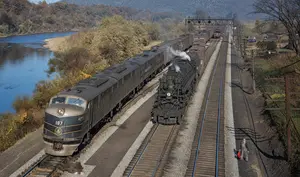
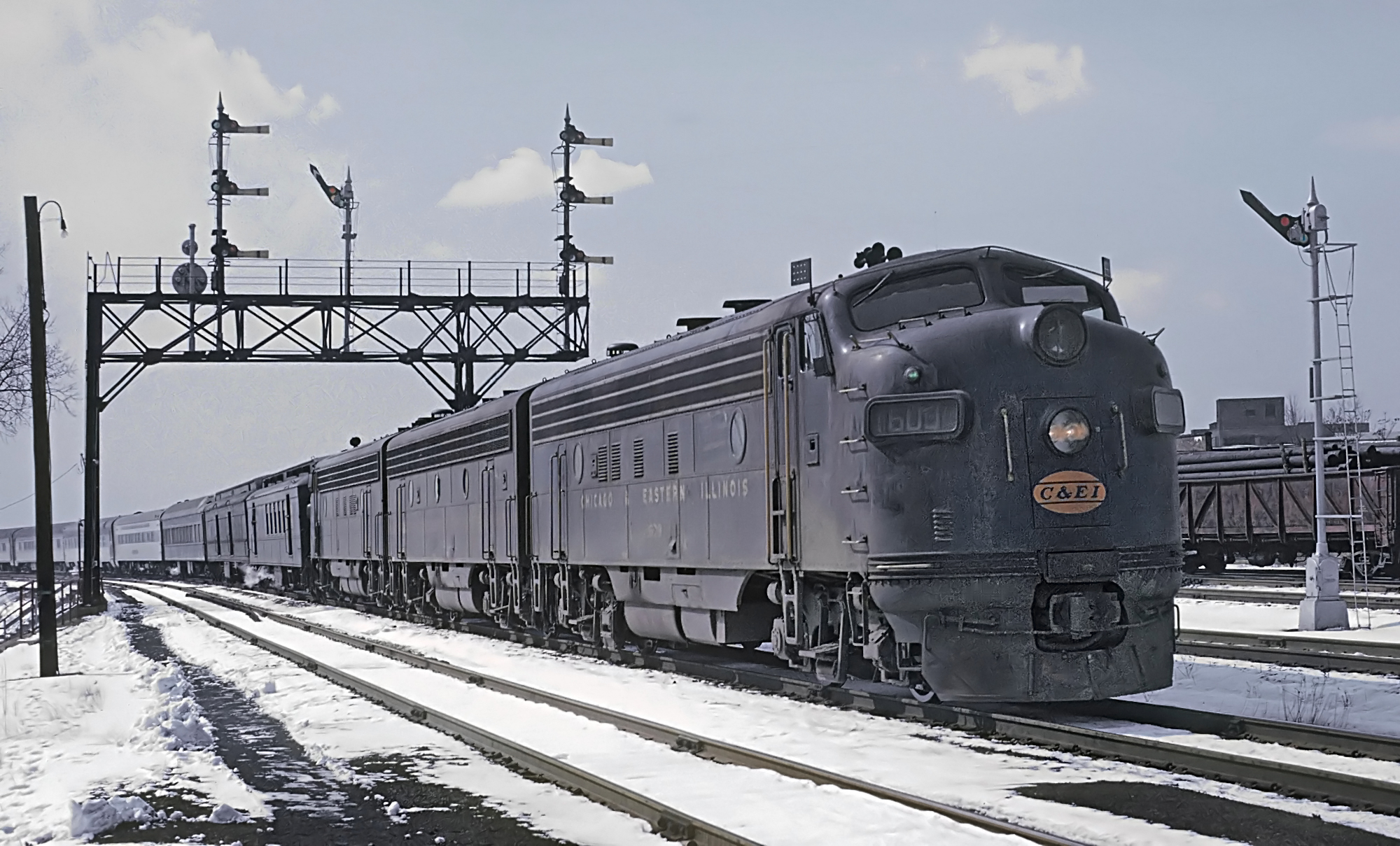 Chicago & Eastern Illinois FP7 #1609 as the combined "Humming Bird"/"Georgian" near the C&WI's 81st Street Tower in Chicago on March 31, 1964. Roger Puta photo.
History
The earliest component of the modern Chicago & Eastern Illinois was the Evansville & Illinois Railroad chartered on January 2, 1849.
According to Willard Anderson's article, "The Century-Old C&EI...," from the August, 1949 issue of Trains Magazine the E&I was formed to connect Evansville, Indiana (located along the north bank of the mighty Ohio River) with Vincennes.
The 53-mile route was completed and ready for service by 1853. The corporate history after this point can become a bit messy or unclear.
According to a small booklet the railroad released in 1957 detailing its corporate heritage, as the E&I was under construction the Wabash Railroad (carrying no connections to the well-known Wabash) was chartered on February 6, 1851 to link Vincennes with Terre Haute.
On November 18, 1852 the Wabash and E&I merged, carrying the latter's name as the Evansville & Illinois. This was short-lived when on March 4, 1853 the railroad was renamed as the Evansville & Crawfordsville.
Then, later that same year service opened to Terre Haute on November 24th. There were hopes of reaching Chicago at this time but the needed funded was never obtained.
Expansion
The southern component saw no additional construction (there was an Evansville belt line, the Evansville & Terre Haute Company incorporated on May 9, 1881, which joined the C&EI in July of 1911).
The northern segment was originally the Chicago, Danville & Vincennes Railroad organized on February 18, 1865 to complete a route from Chicago into the southern Indiana coal fields.
It began operations between Chicago (running via trackage rights over a Pittsburgh, Cincinnati, Chicago & St. Louis subsidiary [PRR] from Lake Street and Western Avenue to Dolton) and Danville in 1871.
In 1875 the road opened its primary engine terminal and maintenance facilities in Danville (Known as the Oaklawn Shops they were closed in 1970 under MP.
During the facility's peak years it featured rip tracks, cars shops, a paint shop, locomotive back shop, and 50-stall roundhouse).
Unfortunately, financial hardships forced the CD&V into bankruptcy and in 1877 it became the Chicago & Nashville Railroad. During August of that year another name change occurred as the Chicago & Eastern Illinois Railroad.
Two years later, in 1879, the C&EI established a direct connection with the Evansville & Crawfordsville (E&C) at Terre Haute when it leased the Evansville, Terre Haute & Chicago (Danville - Otter Creek/Terre Haute), later purchasing the property on December 27, 1899.
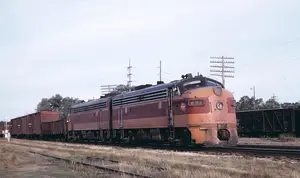
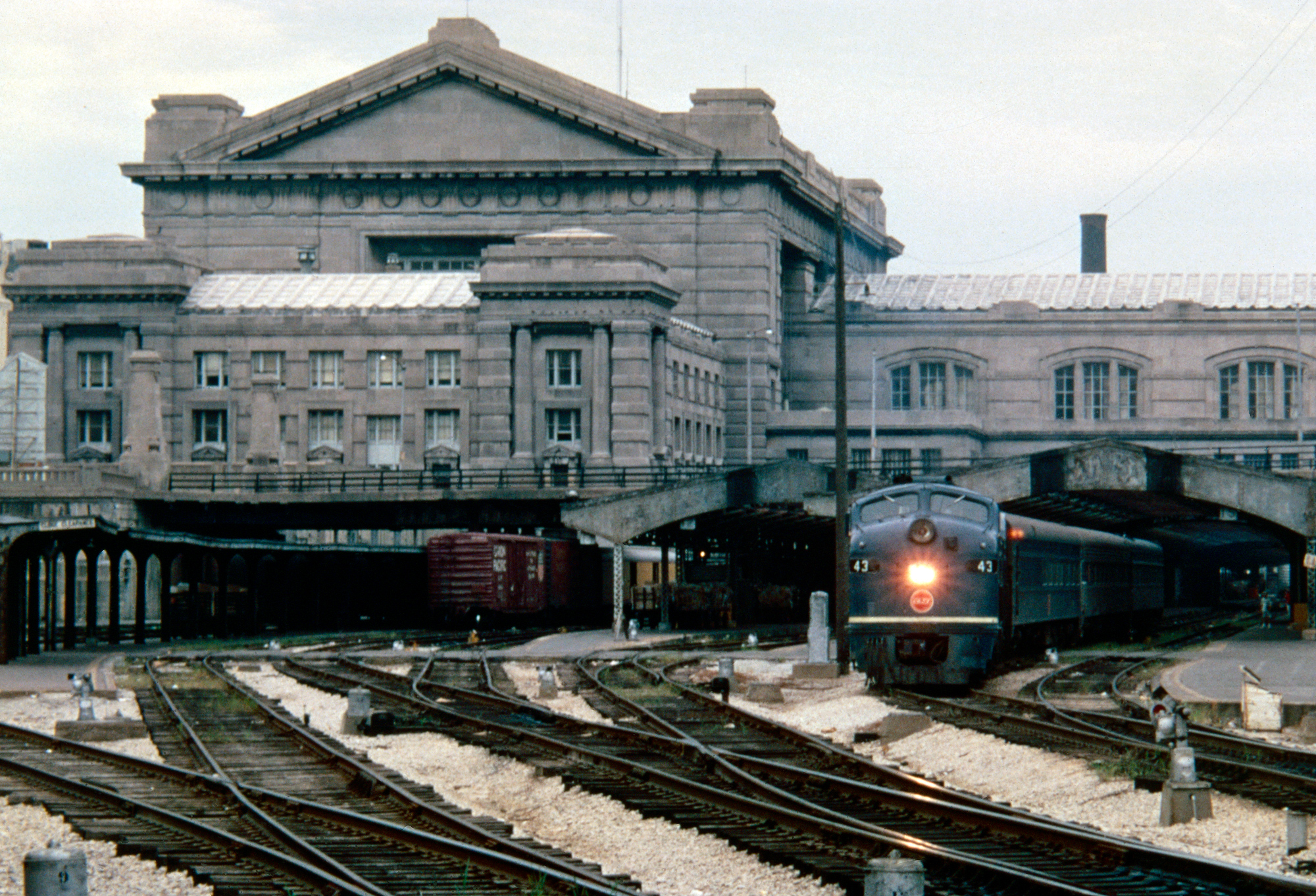 Missouri Pacific E9Am #43 (sporting Chicago & Eastern Illinois logos) departs a perilously empty Kansas City Union Station with train #14, bound for St. Louis, circa 1970. This unnamed consist offered only a grill coach and coaches by this date. The locomotive was originally Boston & Maine E8A #3821. American-Rails.com collection.
In short order the E&C was also added, thus establishing a through route under common ownership from Chicago to Evansville. The western leg to St. Louis and southern leg through Illinois were also built or acquired in stages. They comprised four primary components.
The first was the Danville & Grape Creek Railroad which opened a short segment from Danville to Westville in 1880. During March of 1881 the C&EI took possession of the property and quickly opened an extension to Sidell. Here, it met the Chicago, Danville & St. Louis building towards Tuscola.
At A Glance
Chicago - Evansville, Indiana Fort Branch - Mount Vernon, Illinois Villa Grove, Illinois - Danville, Illinois Woodland, Illinois - St. Louis Findlay, Illinois - Chaffee, Missouri Cypress - Joppa, Illinois Clinton, Illinois - Brazil, Indiana Hoopeston, Illinois - Cissna Park, Illinois | |
The C&EI purchased this road in November of 1887 and then extended it to Shelbyville, Illinois during December of 1891. Five years later it had reached Altamont.
Between February of 1897 and January of 1899 there were two final additions; the Chicago, Paducah & Memphis extended rails from Altamont to Marion while the Eastern Illinois & Missouri was pushing towards Thebes.
After the C&EI takeover it reached the latter city in 1900. Once a bridge opened across the Mississippi River direct interchange was established with the Illinois Central, Missouri Pacific, St. Louis-San Francisco Railway (Frisco), and St. Louis Southwestern Railway (Cotton Belt) which included trackage rights to Chaffee, Missouri. At the same time a short branch from Cypress to Joppa opened.
Logo
The extension to St. Louis was launched in 1903 following Frisco's involvement, which had acquired control a year earlier. This was not the first time a larger road had taken an interest in the railroad.
According to Gary Dolzall's article, "The Case For The C&EI" from the January 1990 issue of Trains Magazine, going back to 1875 the Illinois Central had courted predecessor Chicago, Danville & Vincennes.
Building southwestward from the Chicago main line at Woodland rails connected with the Chaffee/Joppa branch at Villa Grove and was then extended from Findlay to Pana.
As work continued an agreement was reached with the Cleveland, Cincinnati, Chicago & St. Louis (the "Big Four," a New York Central subsidiary) to use its tracks as far as Granite City. From there, additional rights were granted over the Terminal Railroad Association of St. Louis (TRRA) which provided the C&EI direct access into the Gateway City.
At its peak the railroad operated an 1,175 network (including trackage rights); 909 miles were deemed main line while 266 carried secondary status.
The Dolton Junction (Chicago) to Clinton, Indiana section was later double-tracked, protected by automatic train stop and the remainder to Evansville guarded by Centralized Traffic Control (CTC). Direct entry into Chicago, north of Dolton Junction, was via the Chicago & Western Indiana.
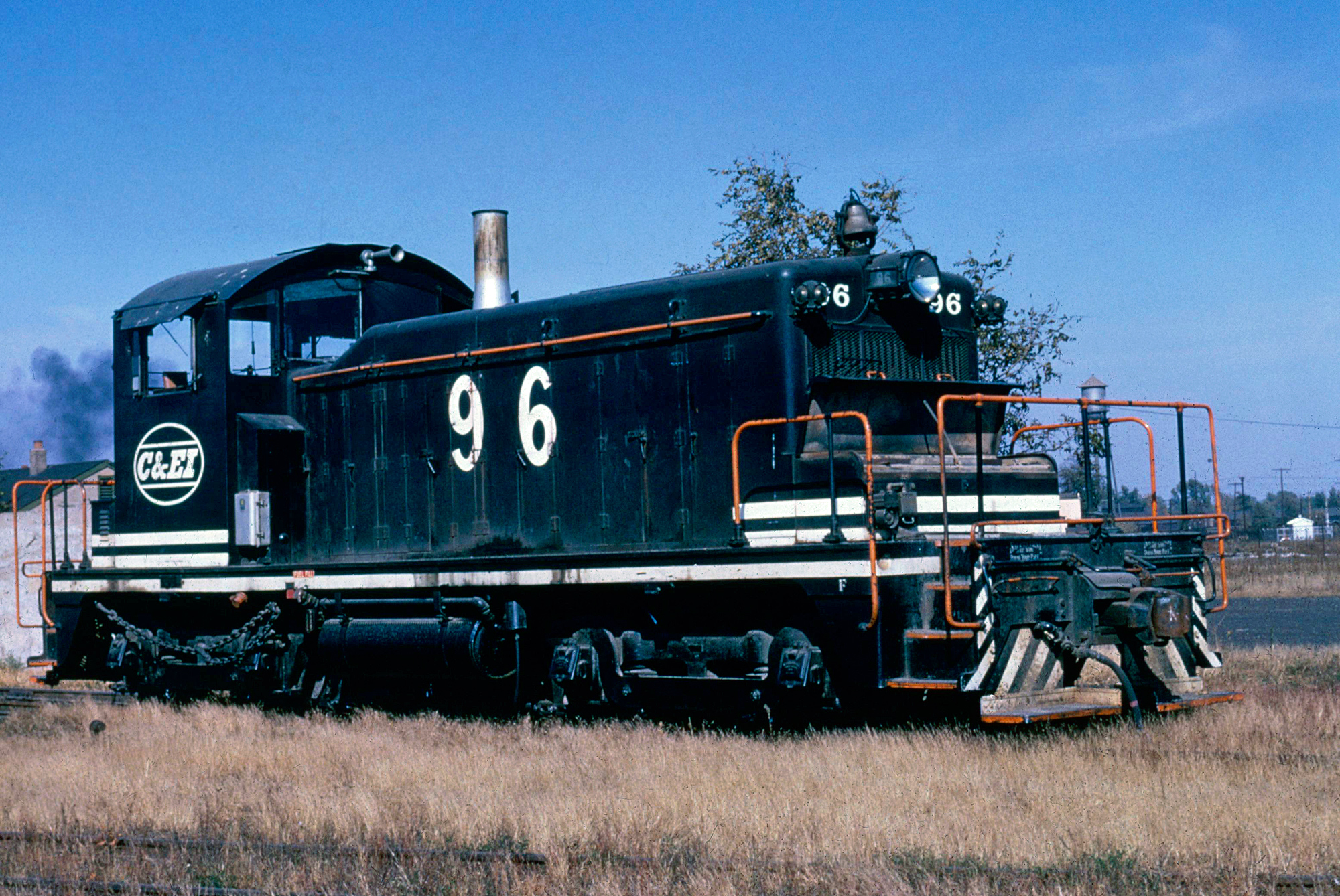 Chicago & Eastern Illinois SW1 #96 is seen here tied down during the 1960s. American-Rails.com collection.
The Frisco's involvement began a tough stretch for the C&EI. The railroad was generally profitable but grand schemes by others sank it into bankruptcy twice. The Frisco, of course, wanted it as a Chicago connection but that carrier's collapse in May of 1913 also brought down the C&EI.
Once reorganized and independent in 1920 the road enjoyed a few years of relative success, in part thanks to coal. The southern Indiana fields at this time generated some 10 million tons annually. However, a 1922 strike greatly hurt the market price from which the coal here never truly recovered.
System Map (1940)
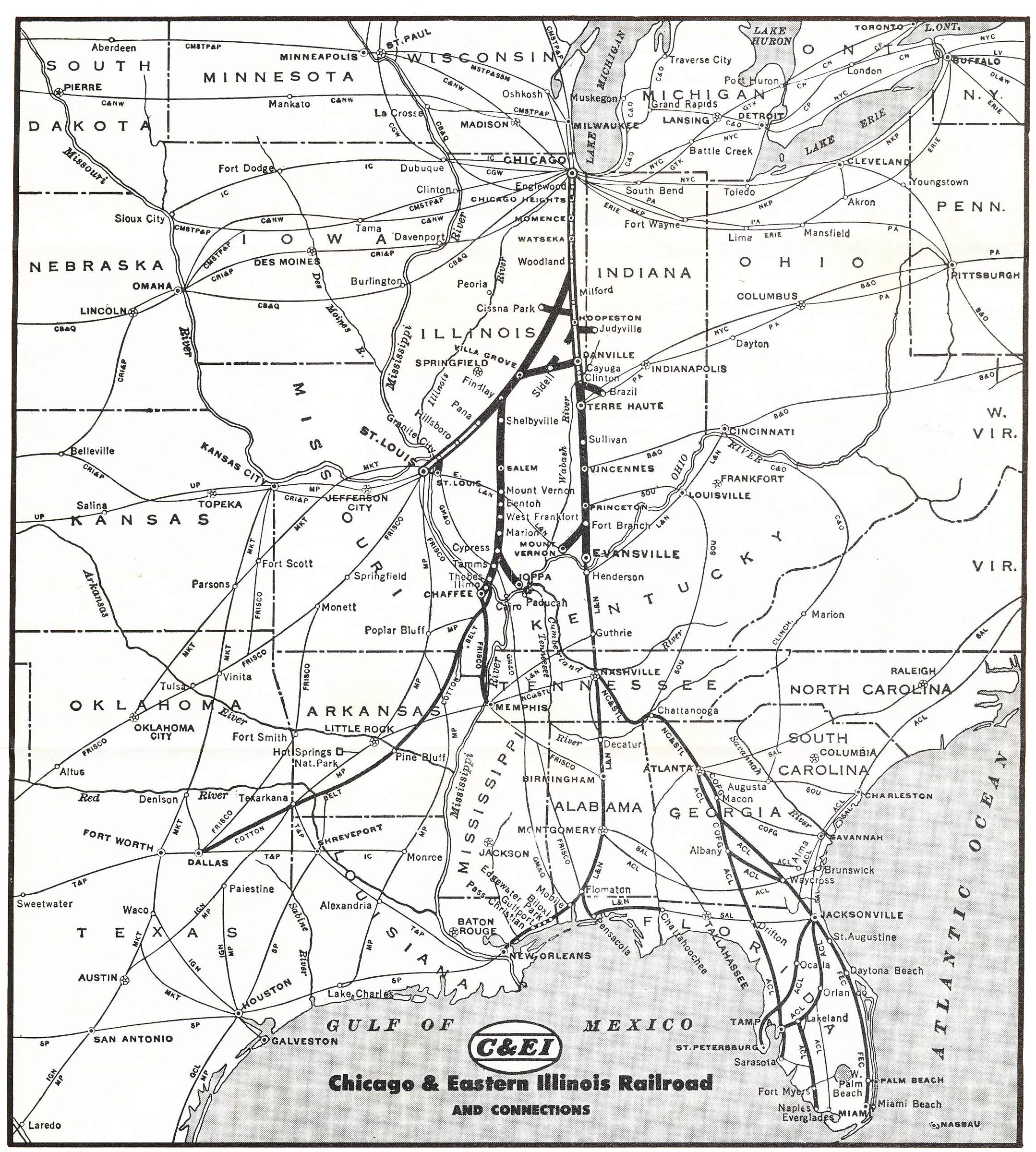
For the C&EI this resulted in tonnage being slashed by two-thirds. After the strike black diamonds remained an important commodity but never exceeded more than one-third of the railroad's annual tonnage.
For instance, Mr. Anderson's article notes that for 1948 its traffic (comprising 10.9 million total tons) was as follows: coal 35.8%, manufacturing 34.3%, agriculture 10%, and the remainder various miscellaneous movements.
In 1928 the C&EI was again acquired when the Van Sweringen's growing railroad empire, through their Chesapeake & Ohio affiliate, took over the property.
 An Electro-Motive photo of new Chicago & Eastern Illinois F3s in February, 1948.
Passenger Trains
The C&EI did operate its own streamliners although is best remembered for the through services to Florida which operated in tandem with the L&N, Florida East Coast, Atlantic Coast Line, Central of Georgia, and Nashville, Chattanooga & St. Louis.
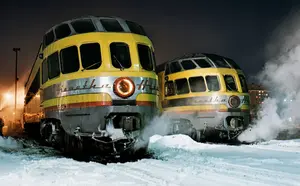
In 1946 it took delivery of two, lightweight trainsets from Pullman for its own streamlined operations; one was a four-car consist named the Meadowlark (mail-baggage/grille car with three coaches) and the other the seven-car Whippoorwill (combine, four coaches, diner, and parlor-lounge-observation).
They were clad in a striking blue livery with gold/orange trim. The railroad's history with streamlining actually began years before either of these trains launched.
In 1940, as part of the Dixie Flagler service hosted by the C&EI/L&N/NC&StL/Atlanta & Birmingham Coast/ACL/FEC the railroad unveiled a modest but striking shroud worn by 4-6-2 #1008 (K-2), a product of its own Oaklawn Shops (a project carried out for a modest $2,300).
The Pacific featured a mostly aluminum/stainless-steel look with black trim and red-pinstripes. Mr. Dolzall notes that a 1941 grade-crossing incident changed the front-end to a bullet-nose appearance and the locomotive lost its shrouding entirely by 1943. The C&EI's passenger business remained strong through World War II as it average more than two-million train miles.
Afterwards, however, that all changed. In 1949 it discontinued service to St. Louis and by 1960 losses were mounting, in part due to the L&N's growing disinterest.
In 1968 the combined Humming Bird/Georgian was discontinued and the last remaining train still running before L&N's takeover was the Chicago-Danville local consisting of just a few cars.
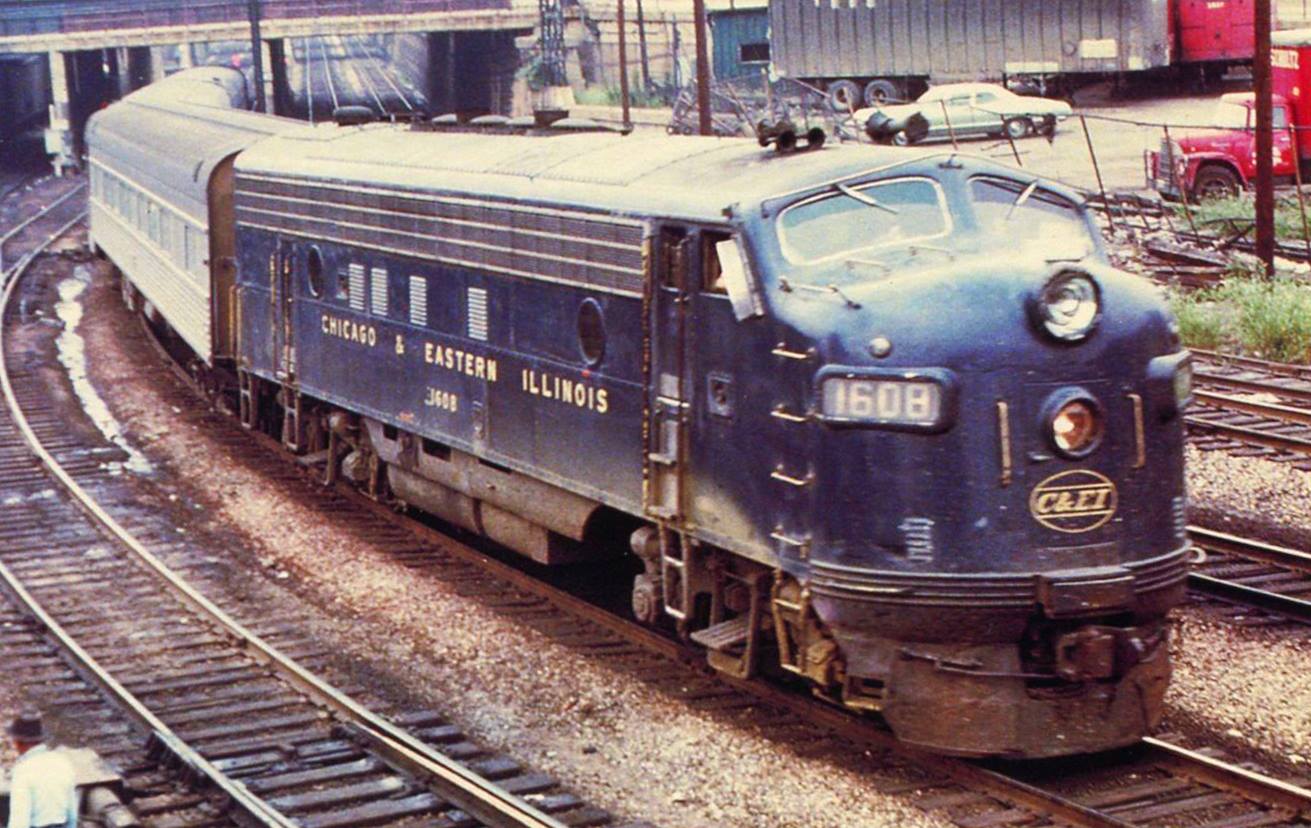 Chicago & Eastern Illinois FP7 #1608 departs Chicago with train #93, the combined southbound "Georgian"/"Hummingbird," circa 1966.
All C&EI trains used Chicago's Dearborn Station
Cardinal: (Chicago - St. Louis)
Century of Progress: (Chicago - St. Louis)
Chicago-Nashville Limited (L&N): (Chicago - Nashville)
Chicago Express (L&N): (Chicago - Birmingham)
Chicago-St. Louis Express: (Chicago - St. Louis)
Chicago-St. Louis Limited: (Chicago - St. Louis)
Chicago-St. Louis Special: (Chicago - St. Louis)
Curfew: (Chicago - St. Louis)
Danville-Chicago Flyer: (Chicago - Danville)
Dearborn: (Chicago - St. Louis)
Dixiana (L&N/NC&StL/A&BC/ACL/FEC): (Chicago - Miami)
Dixie Express (L&N): (Chicago - New Orleans)
Dixie Flagler (L&N/NC&StL/A&BC/ACL/FEC): (Chicago - Atlanta - Miami)
Dixieland (L&N/NC&StL/A&BC/ACL/FEC): (Chicago - Atlanta - Miami)
Dixie Limited (L&N/NC&StL/CoG/ACL): (Chicago - Jacksonville)
Egyptian Zipper: (Danville - Cypress - Joppa)
Evansville-Chicago Express: (Chicago - Evansville)
Georgian (L&N/N&CStL): (Chicago - Atlanta)
LaSalle: (Chicago - St. Louis)
Meadowlark: (Chicago - Cypress)
Nashville-Chicago Limited (L&N): (Chicago - Nashville)
New Dixieland (L&N/NC&StL/ACL/FEC): (Chicago - Miami)
New Orleans Special (L&N): (Chicago - New Orleans)
St. Louis-Chicago Express: (Chicago - St. Louis)
St. Louis-Chicago Limited: (Chicago - St. Louis)
St. Louis-Chicago Special: (Chicago - St. Louis)
Shawnee: (Chicago - Evansville)
Silent Knight: (Chicago - St. Louis)
Spirit of Progress: (Chicago - St. Louis)
Whippoorwill: (Chicago - Evansville)
Zipper: (Chicago - St. Louis)
The above passenger service listing is courtesy of Gary Dolzall's article, "The Case For The C&EI" from the January 1990 issue of Trains Magazine.
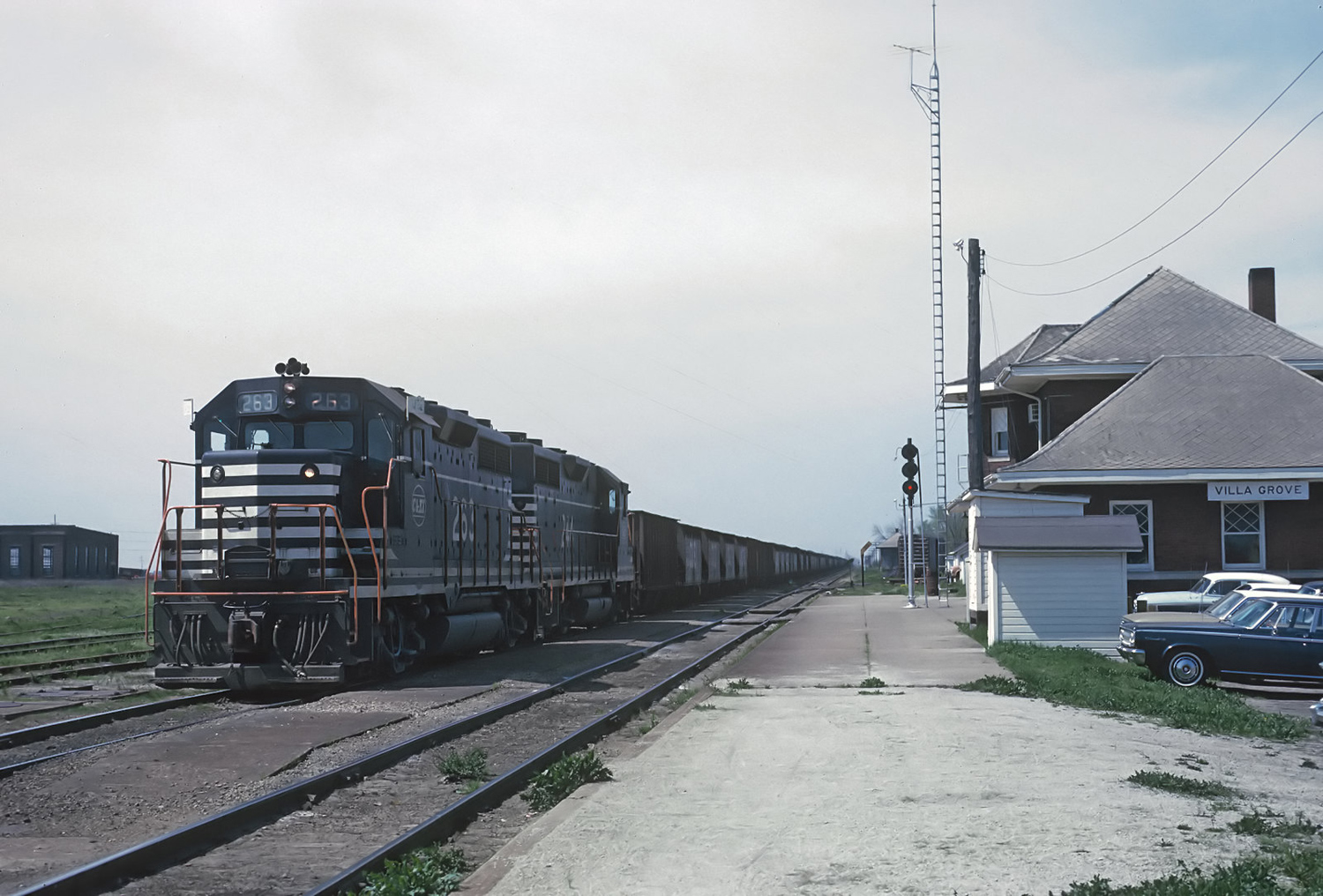 A pair of Chicago & Eastern Illinois GP35's lead a long string of hoppers past the depot at Villa Grove, Illinois on May 7, 1966. Roger Puta photo.
This time the onset of Great Depression brought financial ruin and the company again found itself in bankruptcy by 1933.
It slowly recovered from these lean years, then witnessed record traffic during World War II that saw net profits reach nearly $3 million according to William Gregory and Robert St. Clair's article, "You Can't Keep A Good Railroad Down!" from the October, 1954 issue of Trains Magazine.
On January 17, 1941 it officially emerged from receivership. While wartime traffic helped immensely so did the efforts of receiver John Walker Barriger III (best known for his years leading the Monon) who helped restructure its debt and financing.
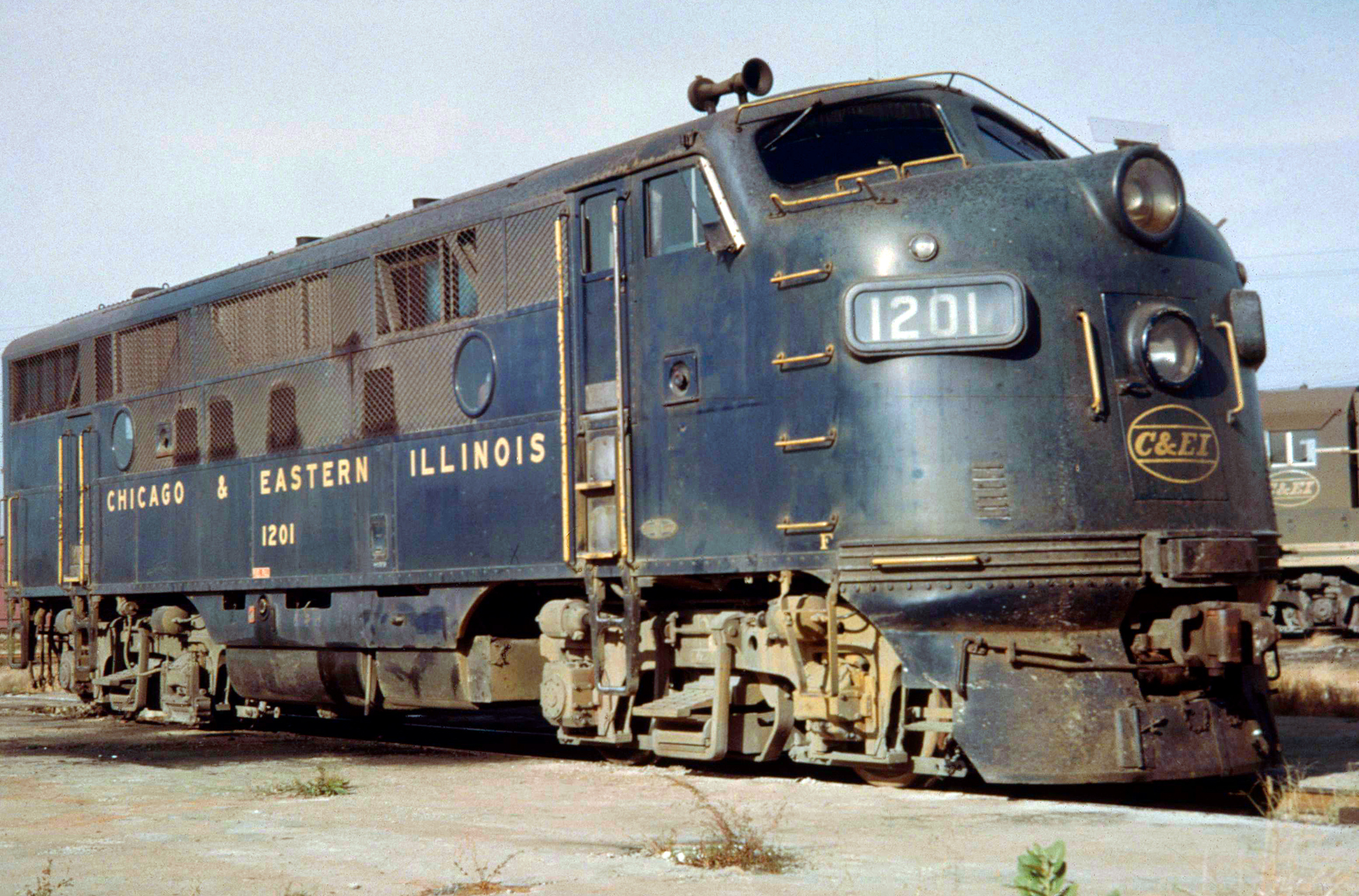 Chicago & Eastern Illinois F3A #1201 lays over between assignments in Mitchell, Illinois on November 3, 1963. American-Rails.com collection.
Into the 1950's the railroad fought sagging coal traffic by looking for other business primarily in the form of agriculture, trailer-on-flatcar/TOFC (the so-called Piggyback Flyers were hotshots which ran overnight from Chicago to the L&N connection), and manufacturing.
These efforts did help turn immediate postwar losses into strong profits although the road's regional status left it vulnerable.
One way in which it improved its postwar slump was through the retirement of steam, quietly carried out on May 5, 1952 when 2-8-2 #1944 finished up switching chores that day. The iron horse was replaced largely with Electro-Motive products as well as a few examples from Baldwin and Alco.
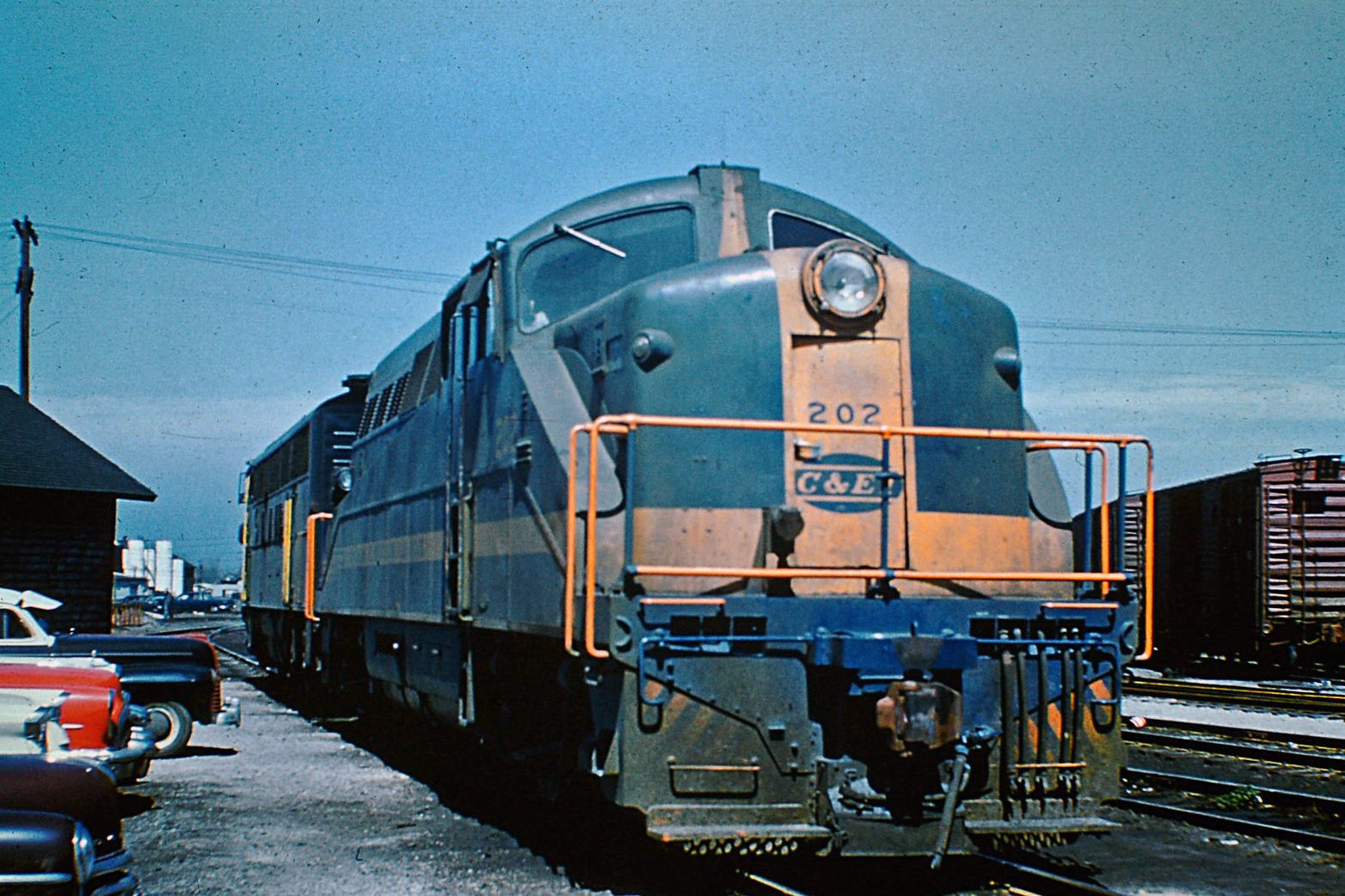 Chicago & Eastern Illinois BL1 #202 and an F3A are seen here in Chicago during September, 1959.
Diesel Roster
American Locomotive Company
| Model Type | Road Number | Date Built | Quantity |
|---|---|---|---|
| HH-660 | 102 | 1938 | 1 |
| S1 | 103-105, 106 (Ex-StL&OF) | 1941-1946 | 4 |
| RS1 | 115-118 | 1945 | 4 |
Baldwin Locomotive Works
| Model Type | Road Number | Date Built | Quantity |
|---|---|---|---|
| VO-660 | 110 | 1942 | 1 |
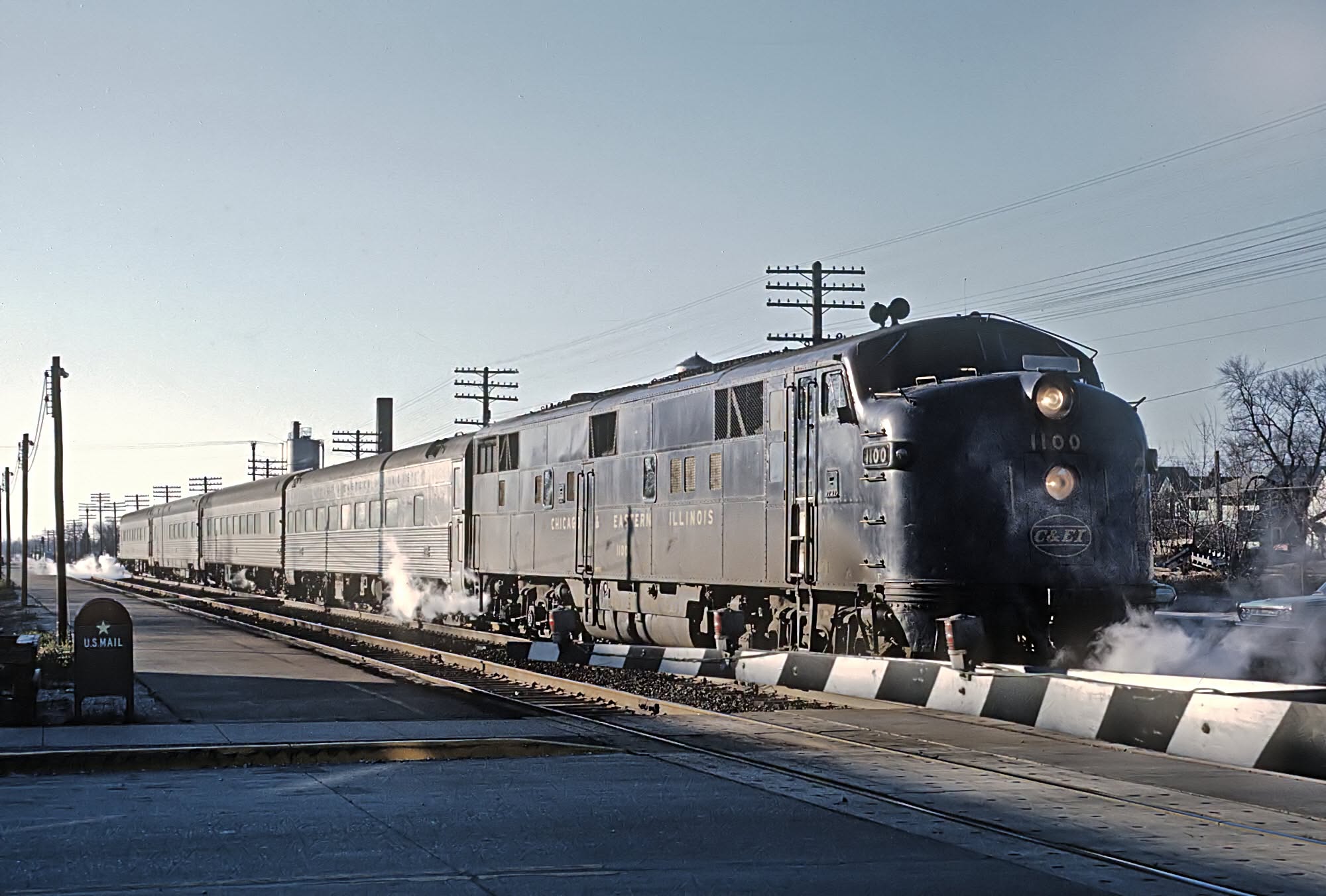 Chicago & Eastern Illinois E7A #1100 hustles the "Danville - Chicago Flyer" through a grade-crossing at Steger, Illinois on November 26, 1965. Roger Puta photo.
Electro-Motive Division
| Model Type | Road Number | Date Built | Quantity |
|---|---|---|---|
| SW1 | 95-99 | 1942 | 5 |
| SW | 100-101 | 1938 | 2 |
| NW2 | 119-124 | 1949 | 6 |
| SW7 | 126-133 | 1950 | 8 |
| BL2 | 200-201 | 1948 | 2 |
| BL1 | 202 | 1948 | 1 |
| GP7 | 203-232 | 1950-1951 | 30 |
| GP9 | 221 (Second), 229 (Second), 233-238 | 1956-1958 | 8 |
| GP30 | 239-241 | 1963 | 3 |
| GP35 | 242-272 | 1964-1965 | 31 |
| E7A | 1100-1102 | 1946 | 3 |
| E9A | 1102 (Second) | 1958 | 1 |
| F3A | 1200-1205, 1400-1409 | 1948-1949 | 16 |
| F3B | 1300-1301, 1500-1504 | 1948 | 7 |
| FP7 | 1600-1609 | 1949 | 10 |
Steam Roster (As Of 1949)
| Class | Road Number(s) | Wheel Arrangement | Builder | Date Built |
|---|---|---|---|---|
| H-6 | 889-959 | 2-8-0 | Baldwin | 1905 |
| K-1 | 1001-1003 | 4-6-2 | Baldwin | 1910 |
| K-2 | 1008-1015 | 4-6-2 | Baldwin | 1911 |
| K-2 | 1016-1017 | 4-6-2 | Alco | 1913 |
| K-3 | 1018-1023 | 4-6-2 | Lima | 1923 |
| K-3 | 1018-1023 | 4-6-2 | Lima | 1923 |
| N-4 | 1900-1924 | 2-8-2 | Alco | 1912 |
| N-2 | 1925-1939 | 2-8-2 | Alco | 1918 |
| N-3 | 1940-1959 | 2-8-2 | Alco | 1922-1923 |
The above steam roster is courtesy of Willard Anderson's article, "The Century-Old C&EI...," from the August, 1949 issue of Trains Magazine.
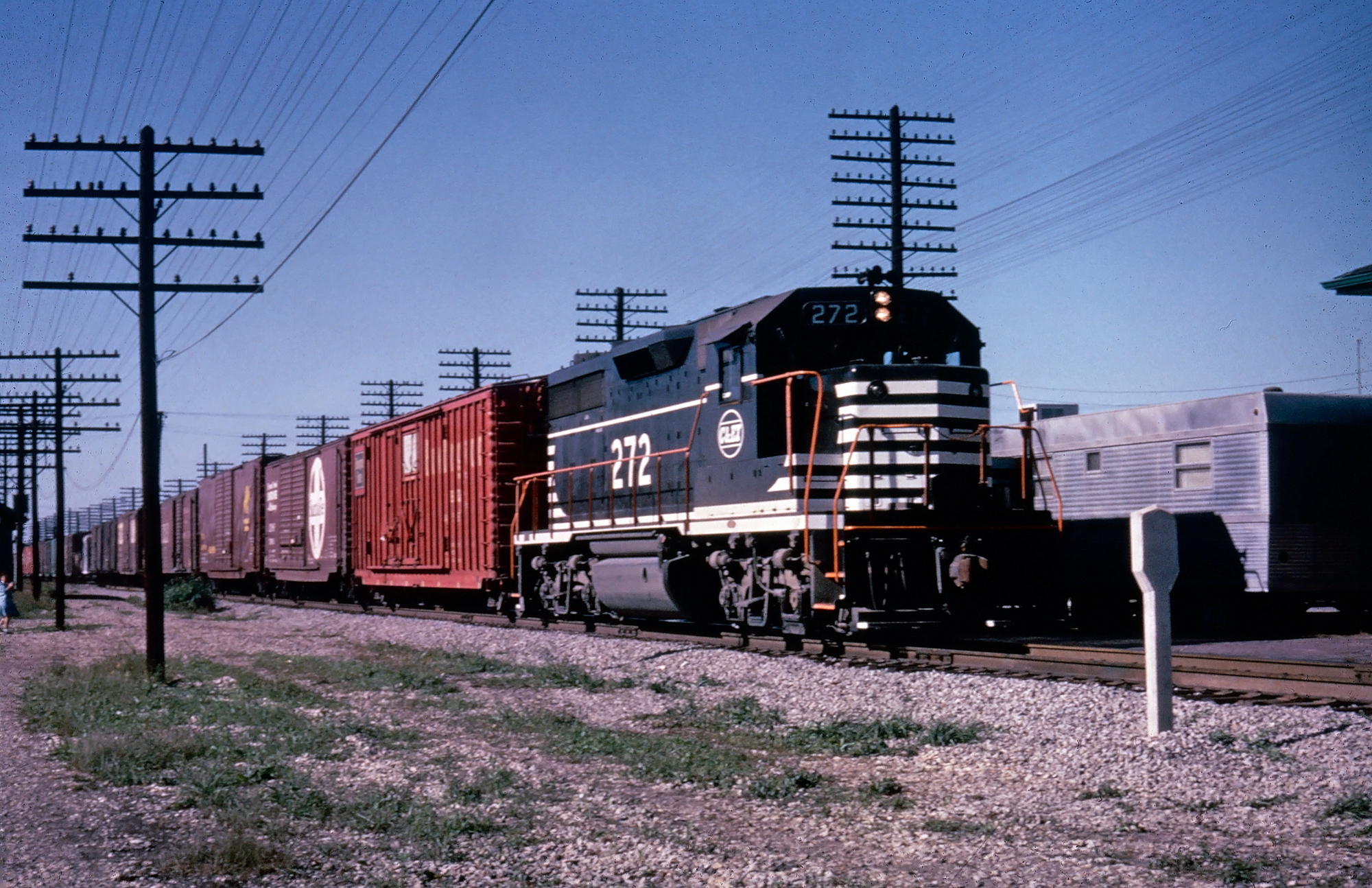 Chicago & Eastern Illinois GP35 #272 leads a northbound freight out of Granite City, Illinois on May 1, 1964. American-Rails.com collection.
Merger and Breakup
The possibility of merger reignited at this time as discussions were carried out with everyone from the Louisville & Nashville, Illinois Central, and Missouri Pacific to the Monon and Chicago Great Western. Things remained unchanged until 1967 when the Missouri Pacific's stock control grew increasingly larger.
This time there would be no return to independence. By 1970 it had majority and formally consolidated the C&EI into its network during 1976.
In 1969 the L&N gained its long-coveted entry into Chicago by picking up the Woodland Junction - Evansville segment (206 miles) then utilized MoPac trackage rights to reach the Windy City.
For such a small road with numerous twists and turns throughout its corporate history the C&EI held an important place within the industry thanks to its Chicago connection.
Today, the MP has since been acquired by the vaunted Union Pacific. However, the principal C&EI lines still play an important part in the UP’s network, including the Evansville segment which is presently utilized by L&N successor CSX Transportation.
Recent Articles


-
Boston and Maine Railroad: "Route Of The Minute Man"
Sep 16, 26 11:30 AM
 Boston & Maine—Andover & Wilmington 1833, NH charter June 27 1835. Eastern, Boston & Lowell, Fitchburg/Hoosac, Concord & Montreal. Section 77 March 12 1970. Guilford June 30 1983. CSX June 1 2…
 -
Smoky Valley Limited Dinner Train (2026)
Sep 16, 26 11:24 AM
 2026 Abilene & Smoky Valley Smoky Valley Limited—two-hour dinner from the 1887 Rock Island Depot. Kansas catering, ~$72–$110. Confirm on asvrr.org.
 -
Canadian National Diesel Locomotives: History, Roster & Photos
Sep 16, 26 11:14 AM
 Canadian National diesel—CLC boxcabs 1929, GMD FP9 and GP9, MLW FPA-4 and RS-18, GMD1, wide-cab SD40-2W, Dash-9s, ES44AC and ET44AC. All-time roster.
 -
Canadian National Steam Locomotives: History, Roster & Photos
Sep 16, 26 10:07 AM
 Canadian National steam—CGR, Canadian Northern, Grand Trunk, GTP. 4-8-4 Confederations, U-1 Mountains, J and K Pacifics. Post-1900 class roster. Last scheduled steam April 25, 1960.
 -
Canadian National Railway: Map, Logo, History, Photos
Sep 16, 26 08:55 AM
 Canadian National—name Dec 20 1918, incorporated June 6 1919, Grand Trunk Jan 20 1923. Crown corporation, IPO Nov 17 1995. IC, Wisconsin Central, BC Rail, EJ&E. Class I, mark CN.
 -
Buffalo, Rochester and Pittsburgh Railway: "Safety and Service"
Sep 16, 26 12:12 AM
 Buffalo, Rochester & Pittsburgh—Rochester & State Line 1869, BR&P March 12 1887. Pennsylvania coal to Buffalo and Rochester. B&O January 1 1932. All-time steam roster, LL 2-6-6-2s, XX…
 -
Buffalo Creek & Gauley Railroad: Map, Roster, Logo, Photos
Sep 15, 26 11:55 PM
 Buffalo Creek & Gauley—Elk River Coal & Lumber, April 1 1904, Dundon–Widen. Last all-steam WV coal road, February 27 1965. All-time steam roster, #4 Baldwin 59472, Majestic and Elk River diesels…
 -
Buffalo and Susquehanna Railroad: Map & History
Sep 15, 26 11:42 PM
 Buffalo & Susquehanna—Goodyear hemlock railroad, Sinnemahoning Valley December 14 1885, 1893 merger, coal to Sagamore, Buffalo extension, bankruptcy May 6 1910, B&O 1932, WAG 1956.
 -
WMSR Allegheny Mountain Dinner Train (2026): Dates & Tickets
Sep 15, 26 11:36 PM
 2026 Western Maryland Scenic Allegheny Mountain Dinner Train—Cumberland, 3 hours, 21+, Saturday 7 p.m. Confirm on wmsr.com.
 -
Boston and Albany Railroad: Map & History
Sep 15, 26 11:28 PM
 Boston & Albany Railroad—Boston & Worcester June 23 1831, Western Railroad across the Berkshires, merger 1867–70. NYC 99-year lease July 1 1900. Berkshires, New England States, CSX and MBTA today.
 -
Grand Bellevue Dinner Train (2026): Portsmouth, Rhode Island
Sep 15, 26 11:14 PM
 2026 Grand Bellevue Rail Dining in Portsmouth, RI—2.5-hour seated dinner on Narragansett Bay. Fall/winter TBA after Aug. 29. Confirm on thegrandbell.com.
 -
The "John Bull": The C&A's First Locomotive (1831)
Sep 15, 26 11:01 PM
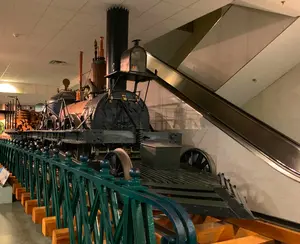
 John Bull locomotive—Stephenson Planet-type 0-4-0, 1831. Dripps assembly, 4-2-0 rebuild, cowcatcher. Specs, Camden & Amboy career, Smithsonian 1884, 1981 steam-up, 1939 replica.
 -
Napa Valley Wine Train Dining (2026): Lunch, Dinner & Vista Dome
Sep 15, 26 10:56 PM
 2026 Napa Valley Wine Train dining—downtown Napa, 36-mile round trip, gourmet lunch and dinner, Vista Dome. Confirm packages on winetrain.com.
 -
My Old Kentucky Dinner Train (2026): Dates, Tickets & What to Expect
Sep 15, 26 10:50 PM
 2026 My Old Kentucky Dinner Train in Bardstown—2.5 hours, 35-mile round trip, four-course dinner from $116. Confirm on kydinnertrain.com.
 -
LaSalle Street Station: One Of Chicago's Great Terminals
Sep 15, 26 10:42 PM
 LaSalle Street Station—Rock Island October 10, 1852. Frost & Granger July 1, 1903. 20th Century Limited, Rockets, Golden State. Headhouse razed 1981. Metra Rock Island District today.
 -
Charlie Russell Chew Choo (2026): Montana Dinner Train from Lewistown
Sep 15, 26 10:39 PM
 2026 Charlie Russell Chew Choo dinner train—Hanover/Lewistown, 4.5 hours, 56-mile round trip, prime rib. Adult $151. Remaining listed dates sold out. Confirm on montanadinnertrain.com.
 -
Central Pacific Railroad: Map, History, Facts, Logo
Sep 15, 26 10:30 PM
 Central Pacific—Judah, Big Four, June 28 1861. Sierra, Chinese labor, Donner Summit Tunnel. Ten-mile day April 28 1869. Promontory May 10. Southern Pacific lease April 1 1885. Dissolved June 30 1959…
 -
Bessemer & Lake Erie Railroad: "The Bessemer Road"
Sep 15, 26 05:20 PM
 Bessemer & Lake Erie—Bear Creek 1865, Carnegie 1897, U.S. Steel 1901. Ore south from Conneaut, coal north. 2-10-4s, Missabe sister road. CN May 10, 2004. Complete corporate history.
 -
Bangor and Aroostook Railroad: "Serving Northern Maine"
Sep 15, 26 05:05 PM
 Bangor & Aroostook—chartered February 13, 1891, first trains January 1, 1894. Potatoes, paper, Searsport, State of Maine reefers. MM&A 2003, Lac-Mégantic 2013, CP 2020, CPKC today. Complete co…
 -
Baltimore & Ohio Chicago Terminal Railroad: Map and History
Sep 15, 26 03:11 PM
 B&OCT—formed January 6, 1910 to buy Chicago Terminal Transfer. Grand Central, Barr Yard, 78 route-miles. Assigned B&O steam. Complete diesel roster. CSX paper subsidiary, mark BOCT.
 -
The "Alphabet Route" (Railroad): Photos and History
Sep 15, 26 02:53 PM
 Alphabet Route—eight railroads, not one company. P&WV to Connellsville February 11, 1931. Alpha Jets Chicago/St. Louis–New York/Boston. NKP, W&LE, P&WV, WM, Reading, CNJ, L&HR, New Hav…
 -
Milwaukee Road Livestock Operations: Cattle, Dakotas & Montana
Sep 15, 26 02:36 PM
 Milwaukee Road livestock traffic—Dakota and Montana cattle, Iowa hogs, Chicago markets, 28-hour law, head-end stock cars. By 1974 mostly Montana. Rick Burn’s Helena speech. Operations history, not the…
 -
Spirit of Jasper Ride & Dine (2026): Season Pause
Sep 15, 26 02:29 PM
 Spirit of Jasper Ride & Dine in Jasper, Indiana—seated meal on board. Operator: not running public trains for 2026. Depot remains open as a rental. Confirm on spiritofjaspertrain.com.
 -
South Carolina Canal & Rail Road Company: Map and History
Sep 15, 26 01:59 PM
 South Carolina Canal & Rail Road—chartered December 19, 1827. Best Friend of Charleston, 136 miles Charleston–Hamburg October 1833, Aiken inclined plane. South Carolina Railroad 1844, Southern 189…
 -
The Practice of Double-Heading: The Steam Era
Sep 15, 26 01:43 PM
 Doubleheading—two locomotives on the point, each with its own steam crew. Not a rear helper, not diesel MU. How it worked, PRR 1877, mountain grades, and what MU ended.
 -
Mohawk and Hudson Railroad: Map, Pictures, Locomotives
Sep 15, 26 01:20 PM
 Mohawk & Hudson Railroad—New York’s first railroad, chartered April 17, 1826. DeWitt Clinton, inclined planes, Albany & Schenectady 1847, first New York Central May 17, 1853. Complete corporat…
 -
Essex Clipper Dinner Train (2026): Dates, Tickets & What to Expect
Sep 15, 26 01:09 PM
 2026 Essex Clipper Dinner Train in Essex, CT—2.5 hours, four-course meal $129.99, 18+. Fall dates through Oct. 25. Confirm on essexsteamtrain.com.
 -
Camden & Amboy Railroad: Map, History, Photos
Sep 15, 26 12:53 PM
 Camden & Amboy Railroad—chartered February 4, 1830. Joint Companies monopoly with the Delaware & Raritan Canal, John Bull, T-rail. United New Jersey 1872, PRR 999-year lease 1871. Complete corpora…
 -
Cafe Lafayette Dinner Train (2026): Dates, Tickets & What to Expect
Sep 15, 26 12:47 PM
2026 Cafe Lafayette Dinner Train in North Woodstock, NH—2 hours, 20 miles, five-course meal from $125. May–October. Confirm on nhdinnertrain.com. -
Christmas Train Ride Locations (2026): A Complete Guide
Sep 15, 26 10:47 AM
 2026 Christmas train rides by state—Santa, North Pole Express, and holiday trains. Not Polar Express. State guides and product pages. Confirm dates on each railroad.
 -
Baltimore & Ohio Railroad: Linking 13 Great States With The Nation
Sep 15, 26 10:22 AM
 Baltimore & Ohio Railroad—first U.S. common carrier, chartered February 28, 1827. Wheeling 1853, Chicago 1874, C&O control 1963, Chessie 1973, into CSX April 30, 1987. Complete corporate history.
 -
Delaware & Hudson Railway: The Bridge Line
Sep 15, 26 09:59 AM
 Delaware & Hudson Railway—Wurts brothers canal 1823, gravity railroad 1829, Stourbridge Lion, Bridge Line to Montreal. Guilford 1984, CP 1991, NS south line 2015, CPKC north.
 -
Delaware & Hudson Diesel Roster (All-Time)
Sep 15, 26 12:17 AM
 All-time Delaware & Hudson diesel roster—Alco S-2s through C-628s and PA-4s, GE U-boats, Baldwin RF-16s, EMD SD45s and GP38-2/GP39-2s. Serials, dates, dispositions.
 -
Granite Railway, Our Country's First Railroad
Sep 14, 26 11:28 PM
 Granite Railway of Quincy, Massachusetts—chartered March 4, 1826, opened October 7, 1826. Gridley Bryant, 5-foot gauge, horses, Bunker Hill Monument stone. First commercial U.S. railroad.
 -
Milwaukee Road Skytop Lounges: History, Specs & Floor Plans
Sep 14, 26 11:09 PM
 Milwaukee Road Skytop observation cars—Brooks Stevens, 1948. Four Rapids parlor-lounges from Milwaukee Shops, six Creek sleeper-lounges from Pullman-Standard. Floor plans, roster, preservation.
 -
West Virginia Christmas Train Rides (2026): A Complete Guide
Sep 14, 26 11:02 PM
2026 West Virginia Christmas trains—Potomac Eagle North Pole Express in Romney and Christmas at Cass. Not Polar Express. Elkins Polar is not listed for 2026. -
Railroads Of Today: Class I Map, PSR & the 2026 Industry
Sep 14, 26 10:30 PM
U.S. freight rail in 2026—six Class I railroads on a nearly 140,000-mile network. PSR as everyday practice, how the STB works, traffic mix, short lines and regionals. -
Railroad History (USA): Timeline, Facts & How the Network Was Built
Sep 14, 26 10:03 PM
 Full U.S. railroad history hub—origins and inventors, Golden Age peak mileage, Civil War and transcontinental, streamliners, ICC regulation, Penn Central and Conrail, Staggers Act, PSR, and today’s Cl…
 -
Railroads In The 2020s: CPKC, East Palestine & the UP–NS Case
Sep 14, 26 09:51 PM
 U.S. railroads 2020–2026—Class I mileage 91,773 in 2020. COVID traffic drop, CPKC April 14 2023, East Palestine Feb. 3 2023, UP–NS $85 billion case still before the STB.
 -
Railroads In The 2010s: PSR, Coal’s Decline & Positive Train Control
Sep 14, 26 03:51 PM
 U.S. railroads 2010–2020—Class I mileage 95,573 to 91,773. Buffett closed BNSF Feb. 12 2010, Harrison at CP June 29 2012 and CSX 2017, PTC deadline Dec. 31 2018.
 -
Virginia Christmas Train Rides (2026): A Complete Guide
Sep 14, 26 03:46 PM
 2026 Virginia Christmas trains—Virginia Scenic Railway Santa Express from Staunton, about 60 minutes. Confirm dates. Not Polar Express.
 -
MARC Train: Maryland Commuter Rail History, Lines & Roster
Sep 14, 26 01:16 PM
 MARC Train history—Maryland Rail Commuter 1984, B&O and PRR corridors, Penn/Camden/Brunswick lines, Silver Spring 1996, all-time locomotive roster.
 -
Railroads In The 2000s: Merger Freeze, Wisconsin Central & Buffett
Sep 13, 26 07:57 AM
 U.S. railroads 2000–2010—Class I mileage 99,250 to 95,573. STB merger freeze March 17 2000, CN–WC Oct. 9 2001, BNSF Railway Jan. 24 2005, Buffett Nov. 3 2009.
 -
Railroads In The 1990s: Mega-Mergers, Conrail’s Split & the STB
Sep 13, 26 12:13 AM
 U.S. railroads 1990–2000—Class I mileage 119,758 to 99,250. BNSF Sept. 22 1995, UP–SP Sept. 11 1996, Conrail split June 1 1999, ICC Termination Dec. 29 1995.
 -
Railroads In The 1980s: Staggers, Mega-Mergers & Conrail’s IPO
Sep 12, 26 11:12 PM
 U.S. railroads 1980–1990—Class I mileage 164,822 to 119,758. Staggers Oct. 14 1980, CSX and Norfolk Southern, UP–Missouri Pacific–Western Pacific, Conrail IPO March 26 1987.
 -
Wabash Class O-1 4-8-4s: History, Roster & Specifications
Sep 12, 26 11:01 PM
 Wabash Class O-1 4-8-4s—Baldwin 1930–31, twenty-five engines 2900–2924. Fast freight, complete roster, specifications. None preserved.
 -
Staggers Rail Act of 1980: Statute, Contract Rates & the ICC
Sep 10, 26 11:23 PM
 Staggers Rail Act, Pub. L. 96-448, signed October 14, 1980. Harley Staggers, S.1946, contract rates, 180% variable-cost test, abandonments, short lines.
 -
Rock Island E8A 652: Bicentennial Independence Paint & History
Sep 10, 26 10:42 PM
 Rock Island E8A 652—EMD March 1952, serial 15199. 20th Century Railroad Club Independence bicentennial scheme, Peoria and Quad Cities Rockets, Midland Railway, Manly Junction Museum.
 -
Vermont Christmas Train Rides (2026): A Complete Guide
Sep 10, 26 10:37 PM
2026 Vermont Christmas trains—Okemo Valley Holiday Express from Chester Depot Dec. 19–20. Polar is Burlington Dec. 5–6 only. -
Railroads In The 1970s: Penn Central, Amtrak & Conrail
Sep 10, 26 10:18 AM
 U.S. railroads 1970–1980—196,479 miles at the decade’s start. Penn Central bankruptcy June 21 1970, Amtrak May 1 1971, 3R/4R Acts, Conrail April 1 1976, Rock Island 1975, Milwaukee 1977.



%20departs%20a%20perilously%20empty%20Kansas%20City%20Union%20Station%20with%20train%20%2314%2C%20bound%20for%20St.%20Louis%2C%20circa%201970.%20%20This%20unnamed%20consist%20offered%20only%20a%20grill%20coach%20and%20coaches%20by%20this%20date.%20%20The%20locomotive%20was%20originally%20Boston%20%26%20Maine%20E8A%20%233821.%20American-Rails.com%20collection.)


