
Rio Grande Railroad: Map, Logo, History, Rosters
Last revised: November 5, 2024
By: Adam Burns
Perhaps no other major American railroad enjoyed such a colorful and captivating history like the Denver & Rio Grande Western. It was the idea of General William J. Palmer, a decorated U.S. Army officer of the Civil War, who envisioned something which had never before been attempted; a corridor piercing the heart of the Rocky Mountains.
It would link Denver with the Mexican border (following its namesake Rio Grande River for much of the way), reach the San Juan mining district, and head west to Salt Lake City.
As a means of reducing costs, Palmer pioneered the 3-foot, narrow-gauge concept. It became a highly popular, it not sustainable, alternative to standard-gauge rights-of-way during the late 19th century.
History
Ultimately, he failed to reach Mexico but is credited with opening the largest and most successful narrow-gauge network in the United States.
In time, 3-footers proved impractical for interchange and as Rio Grande officials would later realize, its gateway through the Rockies was its most valued asset.
After escaping Gould control the D&RGW enjoyed much success, particularly following the World War II era. In 1988, parent company Rio Grande Industries purchased Southern Pacific and retained the more prominent railroad's name.
Photos
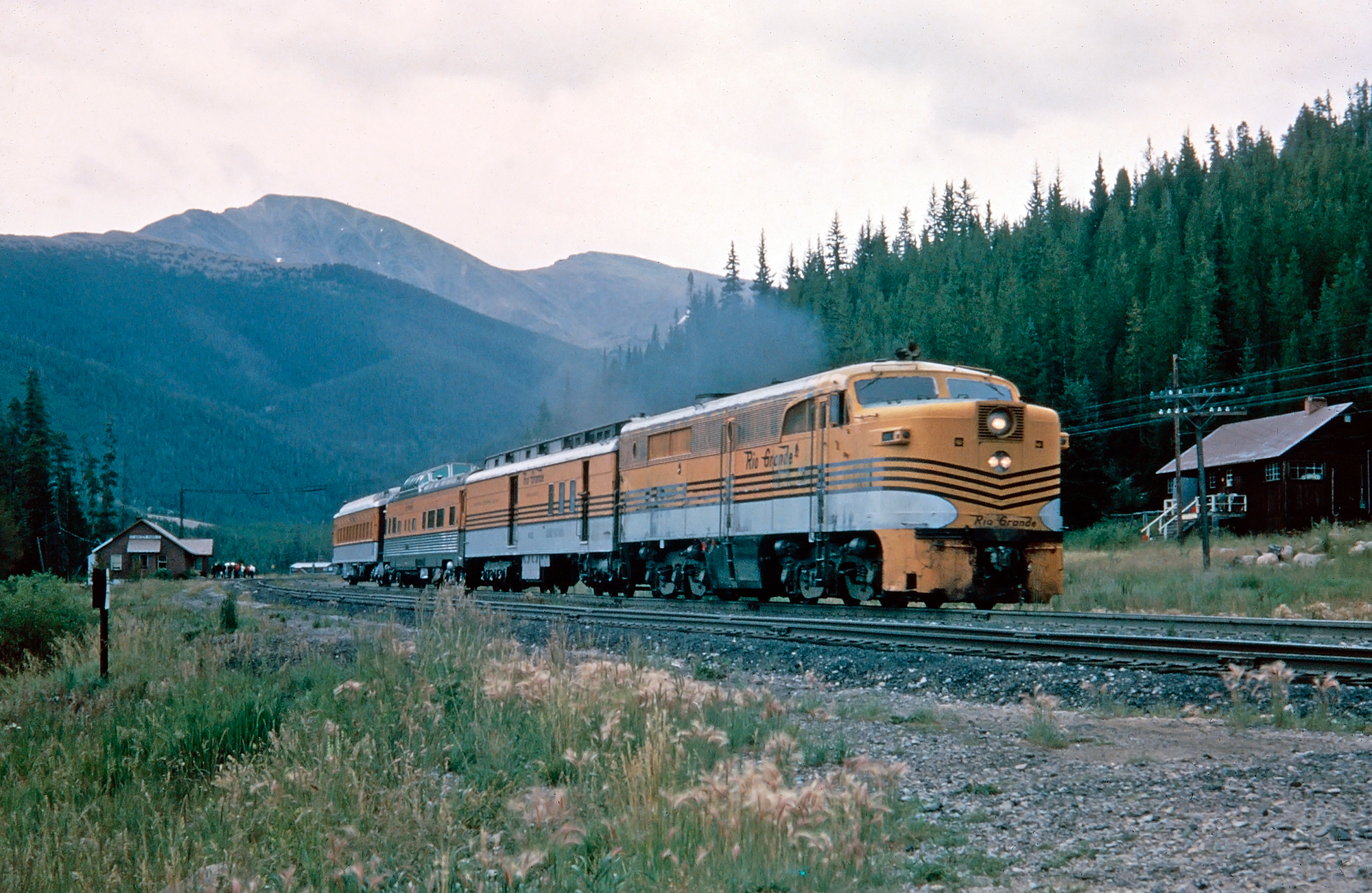 Rio Grande PA-1 #6003 with the westbound "Yampa Valley" at Winter Park, Colorado, circa 1965. American-Rails.com collection.
General William Palmer
As historian Dr. George Hilton notes in his book, "American Narrow Gauge Railroads," despite losing control of New Mexico's Raton Pass, William Palmer did end up creating much of the railroad he had originally visualized.
His interest in the iron horse began early in life when, at the age of 17, he began working for Hempfield Railroad's engineering division.
This system, later acquired by the Baltimore & Ohio, was chartered on May 15, 1850 to link then-Wheeling, Virginia with Greensburg, Pennsylvania. After serving with distinction during the Civil War he hired on with the Kansas Pacific.
According to James Griffin's book, "Rio Grande Railroad," while helping survey this route into Denver, Palmer became convinced Colorado was tailor-made for a railroad; its eastern plains were highly conducive to agricultural development and the Rocky Mountains were rich in precious metals and coal.
Denver & Rio Grande Railway
After the KP's completion in 1870 he left the company, gathered a few business partners from Denver, and chartered the Denver & Rio Grande Railway on October 27th that year Because of the region's rugged topography they decided upon a narrower, 3-foot gauge right-of-way in an effort to reduce costs and avoid clearance issues.
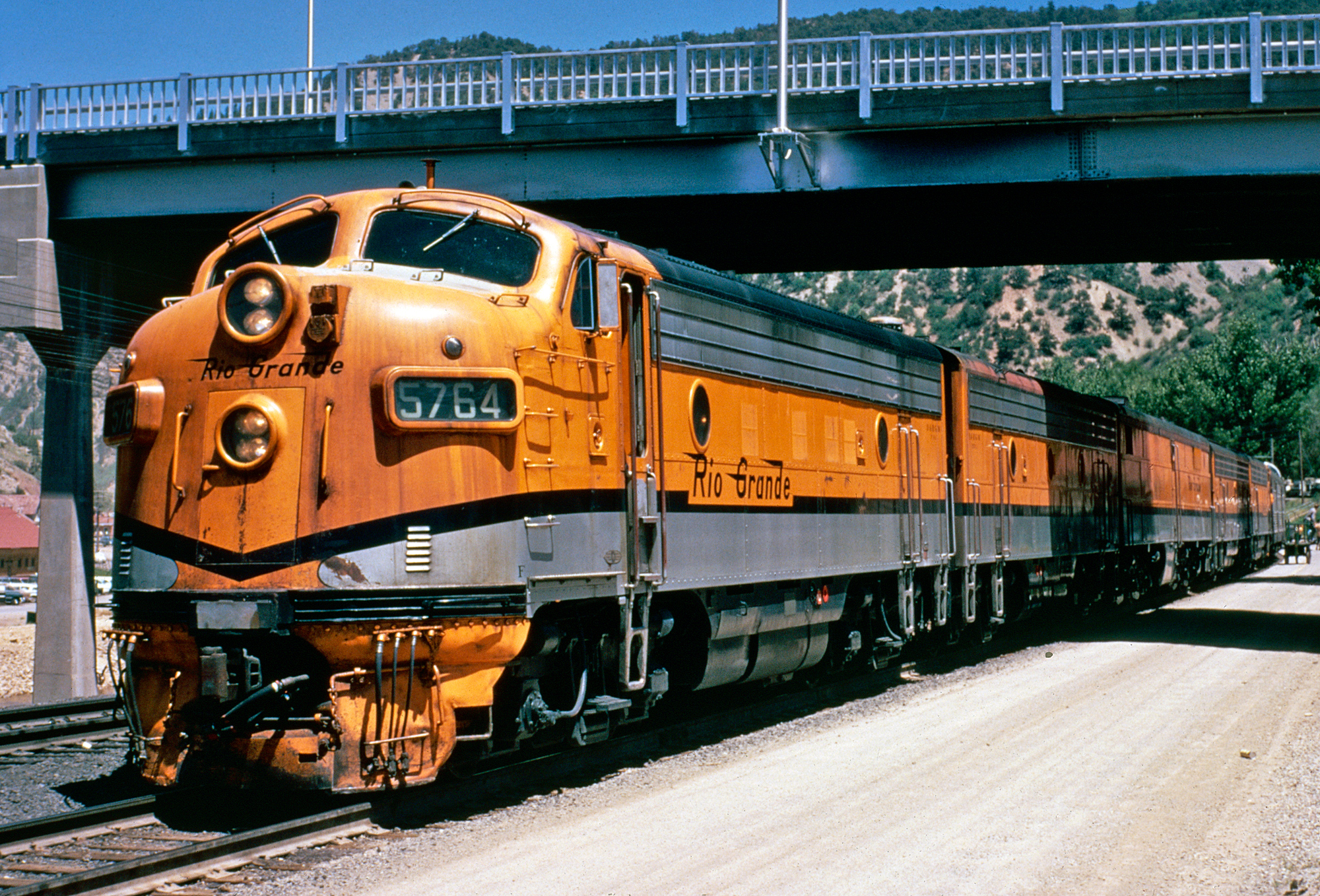 Rio Grande F7A #5764 is stopped in Glenwood Springs, Colorado with train #17, the westbound "Rio Grande Zephyr," during the 1970s. Robert Eastwood, Jr. photo. American-Rails.com collection.
They probably did not realize it then but D&RG's promoters spearheaded America's second-most popular gauge. A rail-width of less than 4 feet, 8 1/2 inches had been pioneered in Britain where Isaac W. Boulton of Ashton-under-Lymre built a locomotive capable of utilizing a 2-foot right-of-way in 1861.
Afterwards, talks of a smaller gauge sprang up across the United States although it was the D&RG to first implement it on a wide scale. The Rio Grande's success led to an entire new industry during the 1880's. Curiously, as quickly as these railroads appeared they vanished just as rapidly.
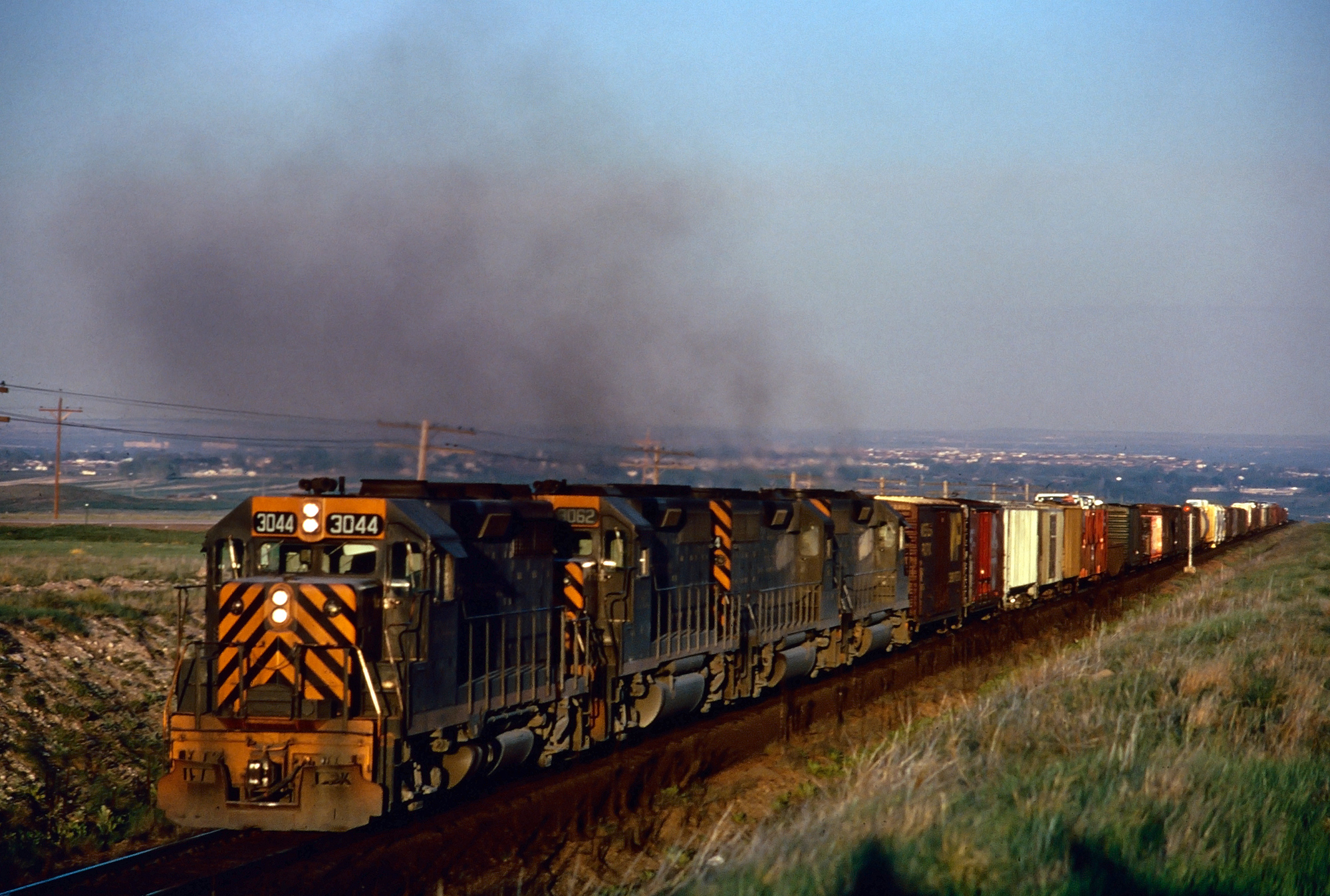 A quartet of Rio Grande Geeps, led by GP35 #3044, make the climb out of Denver with a westbound freight, circa 1967. American-Rails.com collection.
Most were either abandoned or converted by the World War I era. Two years after the Rio Grande's chartering a committee was formed to study the narrow-gauge concept; known as the National Railway-Gauge Railway Convention the conference was held in St. Louis during June 19-20, 1872.
Logo
Among the key points discussed was the belief that a three-foot corridor, operating in mountainous environments, could be constructed for one-fifth the cost of major trunk lines like the Baltimore & Ohio, New York Central, and Illinois Central. In addition, across rolling topography, where many railroads were found, cost savings would be about half that of standard.
Construction
For Palmer, his use of the gauge came purely from an economic and practical standpoint. He sought a three-pronged approach:
- The primary route would link Denver with El Paso, Texas running along the Front Range in an effort to establish through service into Mexico.
- A secondary main line would reach the Central Pacific at Salt Lake City/Ogden.
- Finally branches would infiltrate northwestern New Mexico/southwestern Colorado to serve the San Juan Mountains' booming mining industry. Construction of the main line began out of Denver on July 28, 1871.
It took just months to reach the first target, Colorado Springs, with service officially launched to that point on January 1, 1872. Later that year rails were extended to Pueblo while a branch also opened near Cañon City which served local coal mines.
At A Glance
2,443 Miles (1948) 2,413 (1950) 2,238 (1995) | |
3 Feet (1872-1968) 4 Feet, 8 ½ Inches (1888-1988) | |
Denver - Bond, Colorado - Salt Lake City Denver - Pueblo - Dotsero, Colorado Pueblo - Trinidad, Colorado Walsenburg - Alamosa, Colorado Alamos - Durango, Colorado Salida - Gunnison, Colorado Mears Junction-Alamosa Alamosa - Creede, Colorado Bond - Craig, Colorado Grand Junction - Ouray, Colorado Thistle - Marysvale, Utah Salt Lake City - Ogden | |
Steam: 22 (Narrow-Gauge) Diesel: 257 | |
Freight Cars: 12,610 Passenger Cars: 96 | |
Palmer's hesitation to serve this town directly, citing (but not stating) lack of financing, proved a strategic blunder as upset residents, unaware of the monetary issues, sided with the Santa Fe when it tried to reach the Leadville mining district.
While the Rio Grande is historically remembered for serving Colorado's legendary silver industry, black diamonds proved a much steadier traffic source that served the railroad well throughout its corporate history.
Expansion
Unfortunately, before Palmer could establish a steady flow of business the financial Panic of 1873 hit. The D&RG never entered bankruptcy but construction was delayed until the economy improved.
Work finally resumed in 1876 as crews marched southward, reaching coal mines in the Trinidad/El Moro area (near the New Mexico border) a year later.
At the same time, Palmer pressed his railroad westward from Walsenburg, crossed 9,220-foot Veta Pass, and arrived in Alamosa during July of 1877. As the general sought his next move an unexpected problem arose, the Atchison, Topeka & Santa Fe.
 Classic power- including Southern Pacific, Rio Grande, and Western Pacific F7s - at Roper Yard in Salt Lake City in June, 1970. Rick Burn photo.
Raton Pass
What blossomed into the West's most famous railroad was already a powerful corporation by the 1870's and was feverishly extending towards the Pacific coast. It had arrived in nearby La Junta on February 16, 1876. A year later, William Barstow Strong was elected vice president and general manager.
This iron-willed individual became a constant irritation to Palmer and the two men nearly went to war over slender parcels of ground like the Royal Gorge which could accommodate only a single right-of-way.
Keith Bryant, Jr.'s excellent book, "History Of The Atchison, Topeka & Santa Fe Railway," describes their battles in detail. They not only fought for the gorge, situated west of Cañon City, but also previously-mentioned Raton Pass.
To tap the lucrative San Juan region the Santa Fe had no choice but to enter the Royal Gorge, which offered the only natural passageway for a suitable grade. This stunning canyon, carved over millennia by the Arkansas River, was hardly wide enough for a single rail line let alone two.
Rio Grande crews had already surveyed a route through the area, a fact which did not deter Strong who had the money and commitment to defeat his adversaries. As this was ongoing, he dispatched his second-in-command, Albert Alonzo Robinson, to personally secure Raton, beating Rio Grande's chief engineer, J.A. McMurtrie, to the spot by a mere thirty minutes.
Then, the real fight took place through the gorge. The people of Cañon City were still upset that Palmer had not opened service into their town. They took it upon themselves to correct this wrong and formed their own railroad, the Cañon City & San Juan Railway.
In 1878, backed by Strong, it was completed from an AT&SF connection at Pueblo to Cañon City. Later that same year it was merged into the Pueblo & Arkansas Valley Railroad, a Santa Fe property.
The AT&SF made it twenty miles into the hotly contested gorge, and is credited with constructing the photogenic "Hanging Bridge" over the Arkansas River (which became an often-used location for Rio Grande publicity scenes), before a U.S. Supreme Court order, rendered on April 21, 1879, ended the fighting.
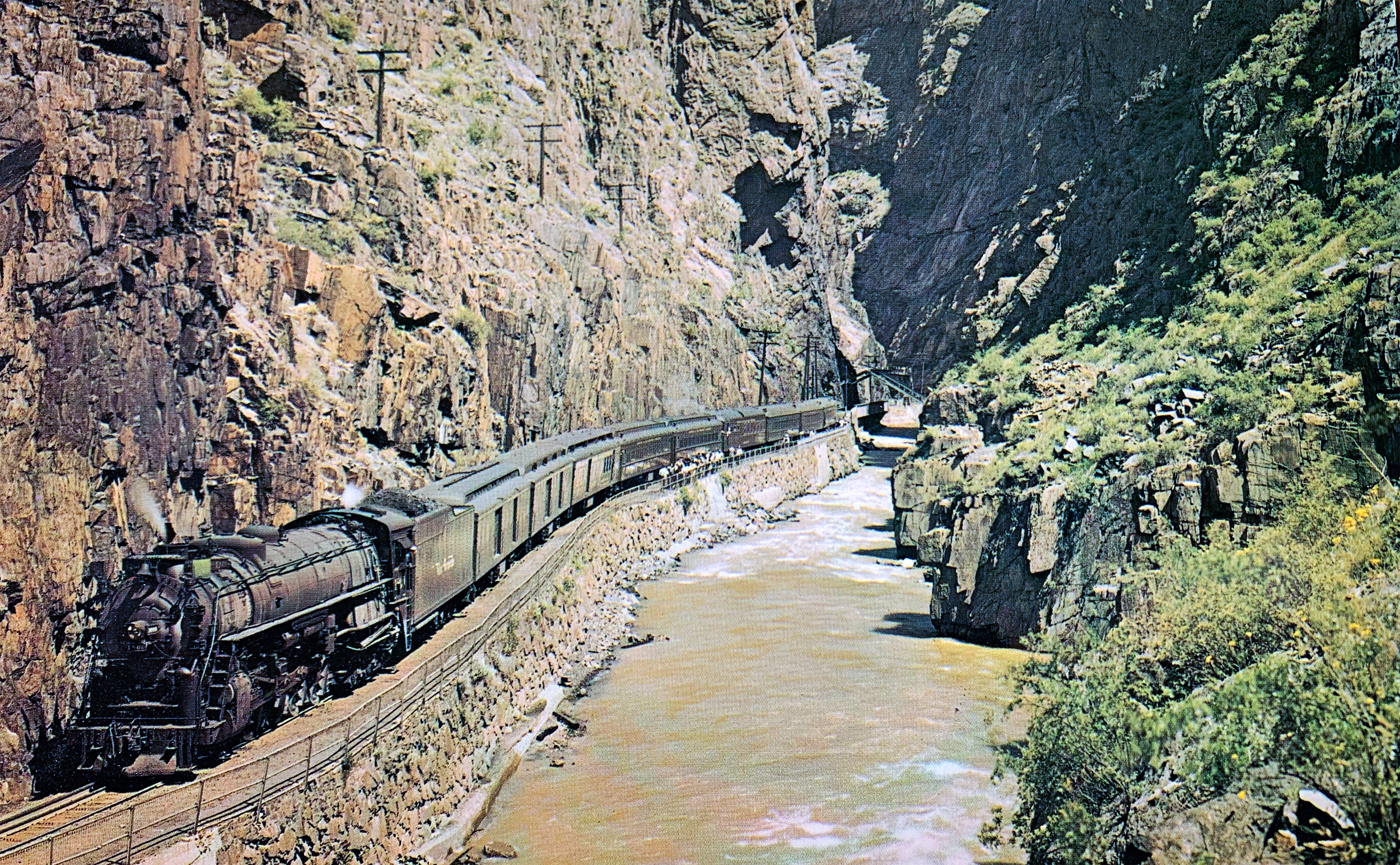 Rio Grande 4-8-4 #1800 (M-68) is stopped with the "Scenic Limited" at the famous Hanging Bridge within Colorado's breathtaking Royal Gorge in the summer of 1945. Otto Roach photo. American-Rails.com collection.
The conflict had nearly resulted in a full-scale war with noted law man, Bat Masterson, employed under the Santa Fe to protect construction gangs. There were armed posse on both sides and Rio Grande forces even built forts in an attempt to ward off their rivals.
The fighting exhausted Palmer's resources, forcing him to briefly lease his railroad to the Santa Fe. The agreement took effect on December 13, 1878 but lasted mere months before being canceled, following a Colorado court order, on April 27, 1879.
The Supreme Court's decision led to the "Treaty of Boston" signed by both parties on March 27, 1880. It ended hostilities and each railroad agreed to stay out of the other's territory (later broken by both). The Rio Grande was also awarded AT&SF's completed work through the gorge, purchased for $1.4 million.
The notorious tycoon, Jay Gould, is also credited for ending the fighting; he had effectively gained control of the D&RG leading up to the treaty and worked as an intermediary in negotiating peace.
With this dispute over, Palmer turned his attention back towards expansion. He remained focused on a southern route as far as Santa Fe, New Mexico, the western terminus of the busy Santa Fe Trail.
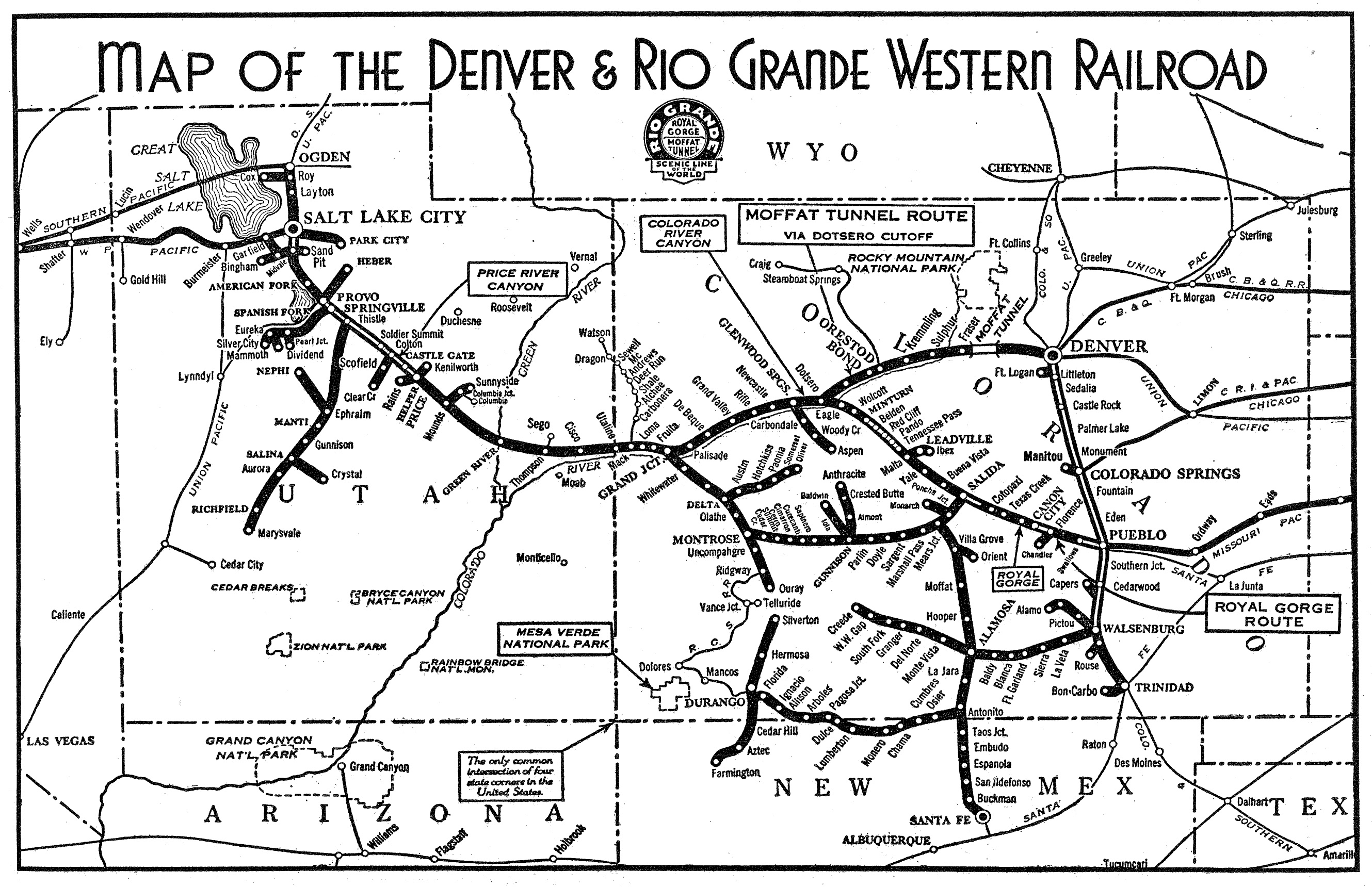
System Map (1940)
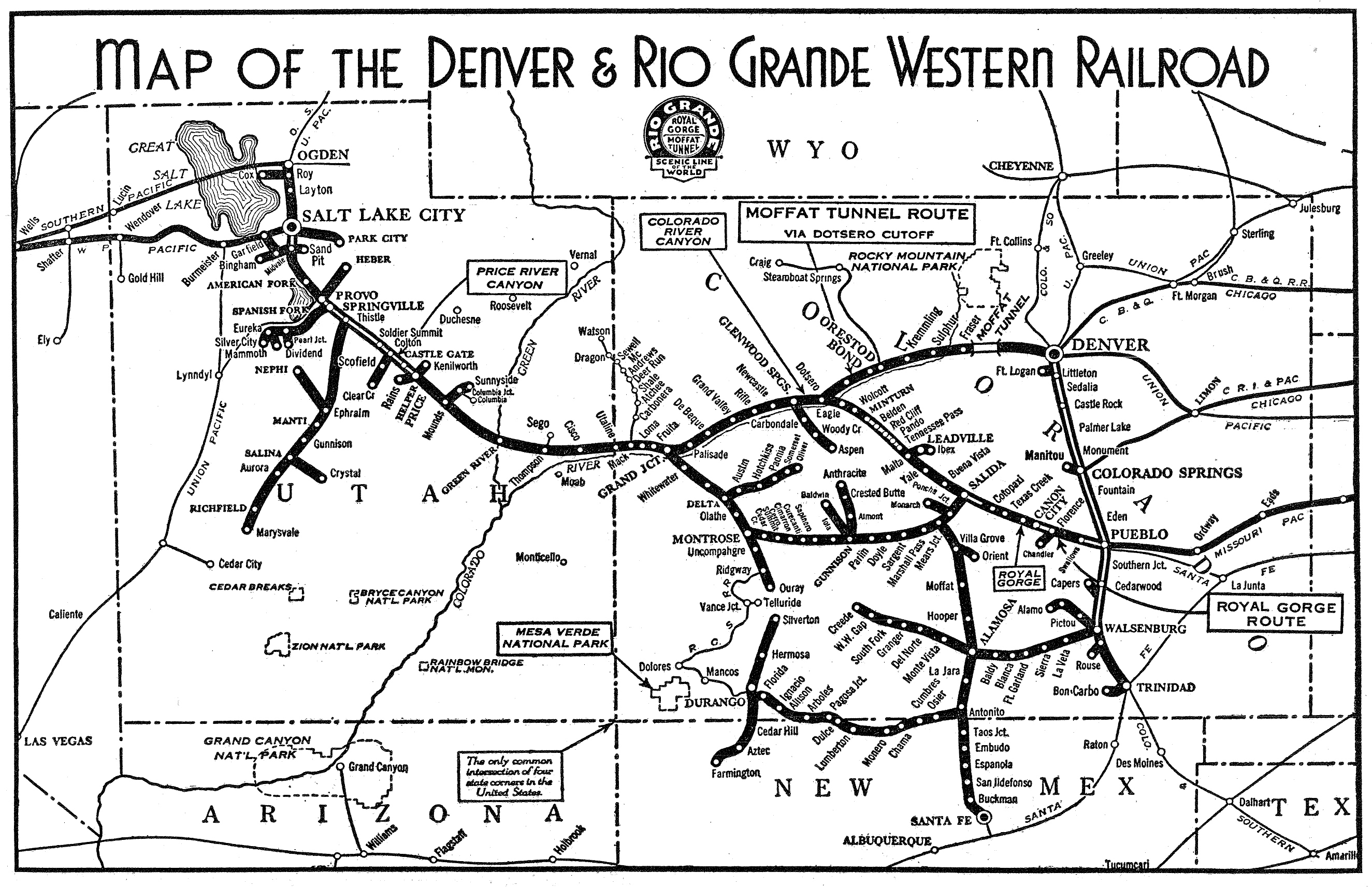
It extended south from Alamosa, reaching Espanola on December 30, 1880. Just over six years later the line was finished into the fabled trading post on January 8, 1887. Unfortunately, the "Chili Line" was never particularly profitable.
It was riddled with curves as sharp as 22 degrees and grades as steep as 4%. Furthermore, the AT&SF already served Santa Fe over a standard-gauge branch that had been in operation since 1880. In later years lumber was the primary commodity before Rio Grande had enough and abandoned the line during 1941.
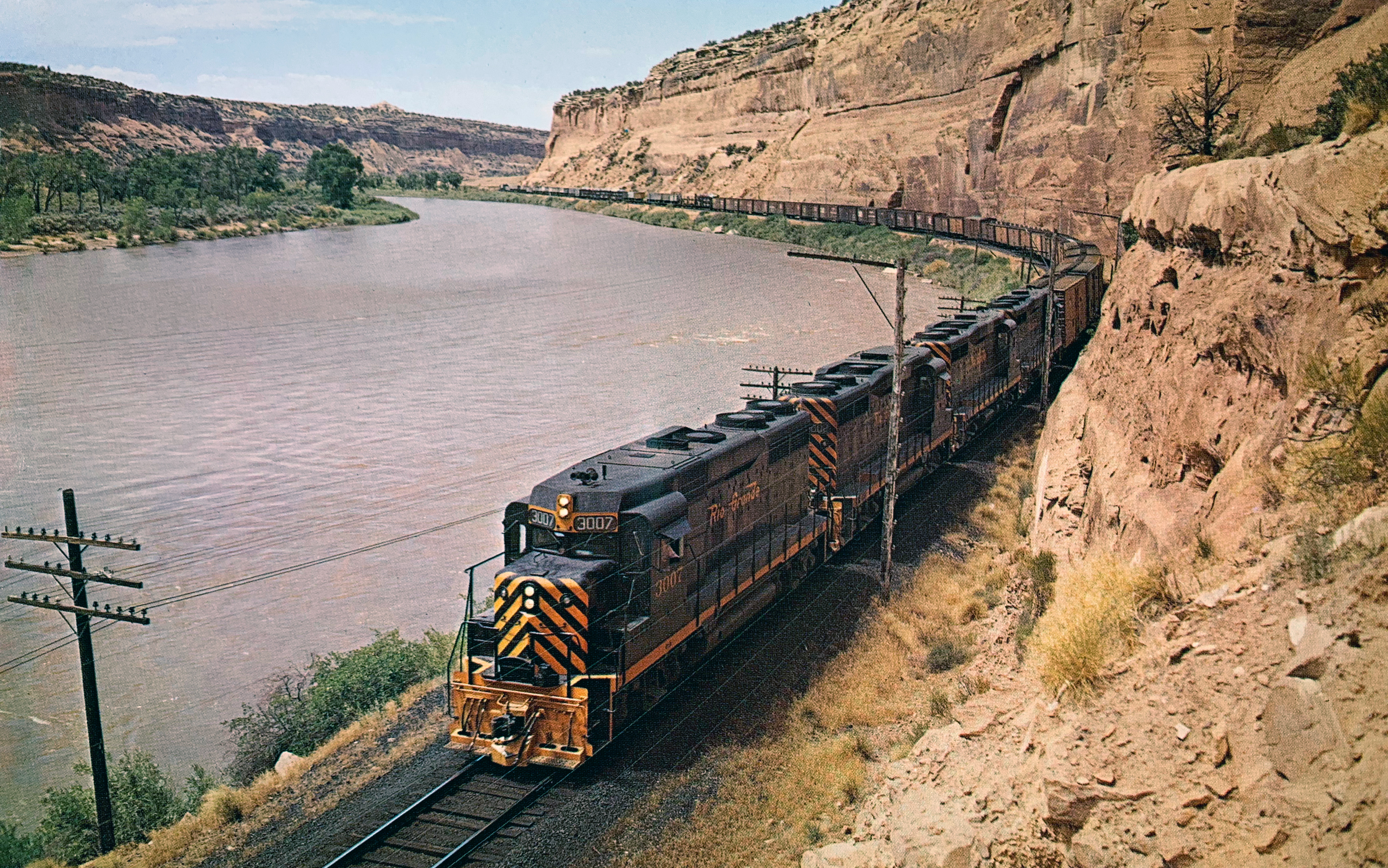 A quartet of new Rio Grande GP30's head east with their train along the Colorado River within Colorado's beautiful Ruby Canyon during the summer of 1962. Ed Roe photo. American-Rails.com collection.
The 1880's were a banner decade for the D&RG as it exploded in size:
- Heading west from Antonito it crossed 10,015-foot Cumbres Pass and arrived in Durango on July 27, 1881.
- Silverton was reached a year later, offering direct service into San Juan mining district.
- Some years later, in 1905, a standard-gauge branch extending southward into Farmington, New Mexico was purchased. When the Rio Grande gave up its intentions of converting everything west of Antonito to standard-gauge, the Farmington Branch was changed to narrow-gauge in 1923.
- West of Alamosa another mining branch opened to Creede in 1891; extending beyond Cañon City and passing through the Royal Gorge, construction gangs reached the very important mining camp of Leadville in 1880.
- This was followed by continuing northward over 10,433-foot Tennessee Pass in 1881 to the small mining community of Red Cliff (when opened, it was highest standard-gauge line in the country).
Interestingly, for the time being management elected not to continue towards Utah from this point but, instead, opted for a more southerly route. The decision was driven primarily by additional coal traffic from mines located near Crested Butte. At Salida, the rail-head was extended westward to Gunninson (1881) before it turned north from Montrose.
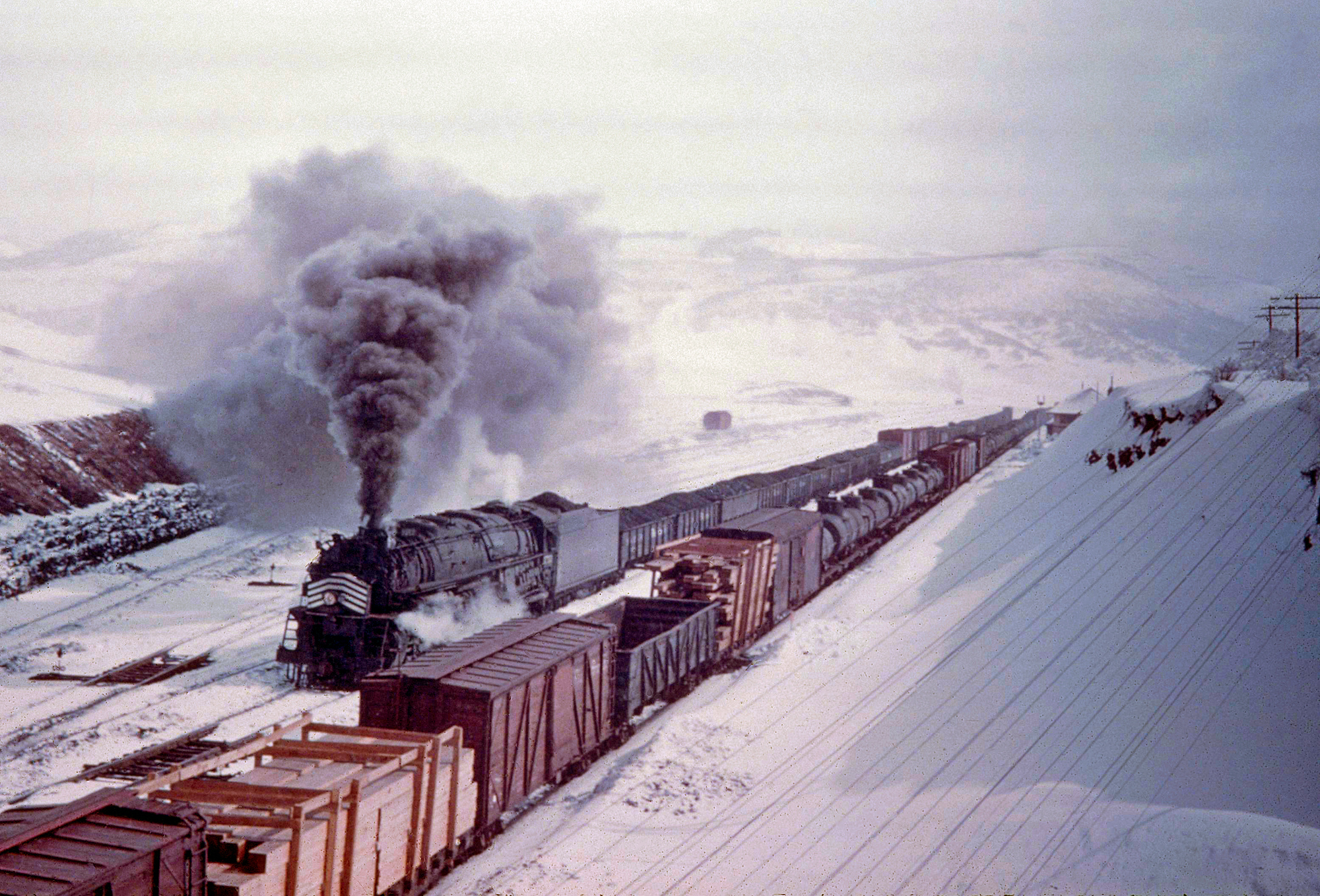 Rio Grande 4-6-6-4 #3712 has crested Utah's Soldier Summit with a westbound freight during the 1950s. Ed Olsen photo. American-Rails.com collection.
This small town, which later became a junction for the Ouray Branch (completed in 1887 to serve silver mines), sat at about the midway point to Grand Junction (reached on November 22, 1882). A month later, on December 19th, the railroad arrived at the state line but could build no further until corporate charters were received to enter Utah.
Denver & Rio Grande Western Railway
As a result, the Denver & Rio Grande Western Railway was organized on July 21, 1881 with rights to build from the state line to Salt Lake City via Green River, Soldier Summit, and Provo.
To aid in this effort, an earlier charter known as the Sevier Valley Railway was acquired along with three other small short lines; the Bingham Canyon & Camp Floyd (BC&CF), Wasatch & Jordan Valley (W&JV), and Utah & Pleasant Valley (U&PV). All were originally built to serve either coal, silver, or copper mines situated south and east of Salt Lake City.
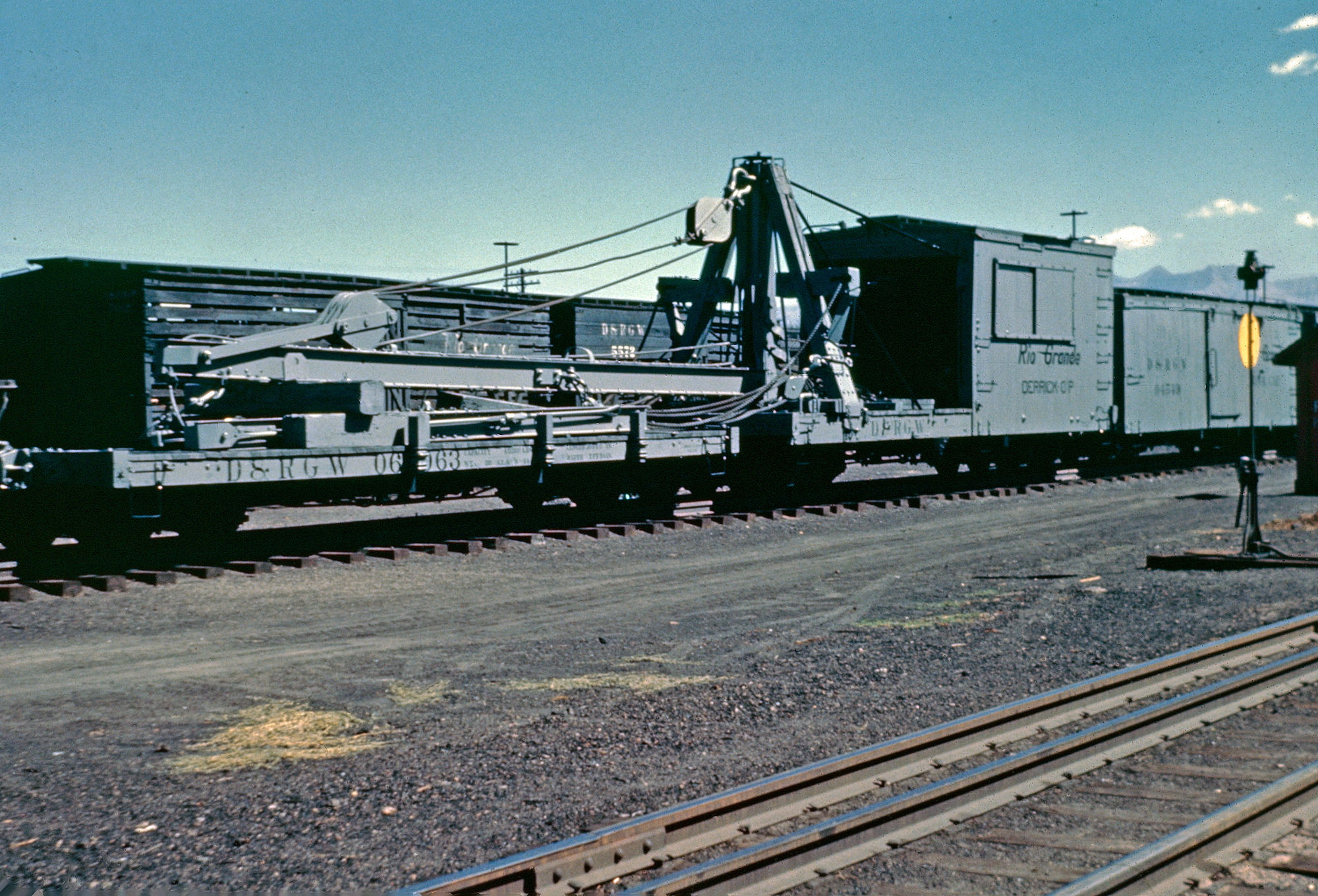 Rio Grande steam derrick "OP" lays over near the depot in Alamosa, Colorado in September, 1944. Author's collection.
The U&PV proved most important; it had opened 55 miles between Springville and Scofield by November of 1879, which was extended further north to Provo in October of 1880.
When the D&RGW finished a disconnected segment between Provo and Salt Lake City it used part of the U&PV over Soldier Summit as part of its main line into Colorado.
Its first task was to improve the original U&PV alignment over the summit before completing the railroad to the state line on December 19, 1882.
Just a few months later, on May 12, 1883, a short branch was finished beyond Salt Lake City to Ogden which established a transcontinental connection with the Central Pacific/Southern Pacific.
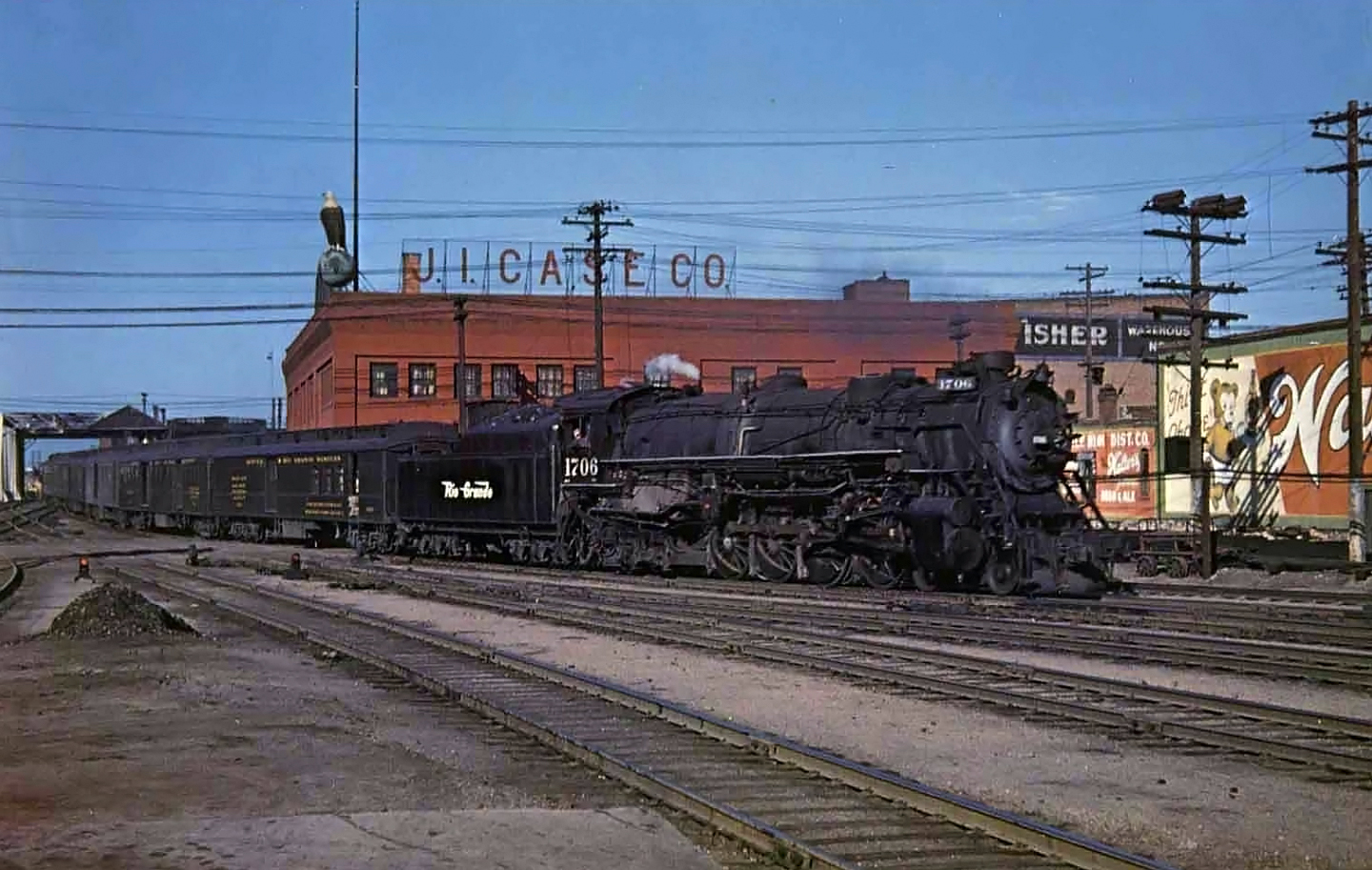 Rio Grande 4-8-4 #1706 (M-64) arrives in Denver with train #16, the "Colorado-New Mexico Express" (Denver - Alamosa), on June 17, 1947. Richard Kindig photo.
It seems the Rio Grande was consistently caught up in one bureaucratic mess after another, a situation that persisted well into the 20th century. Fighting with the Santa Fe had only been over for a few years when strained finances led to Palmer resigning the D&RG's presidency on August 9, 1883.
He moved on to lead subsidiary D&RGW and was replaced by Frederick Lovejoy. The two went to court over philosophical differences regarding the D&RG's perceived neglected state, which led to the railroads' physical connection being severed just inside the Colorado state line.
When the D&RG entered receivership on July 12, 1884, a result of over-exuberant expansion, it elected not to renew its D&RGW lease following its reorganization as the Denver & Rio Grande Railroad on July 14, 1886; the move was made official on July 31st after which time Palmer began improvements on his end.
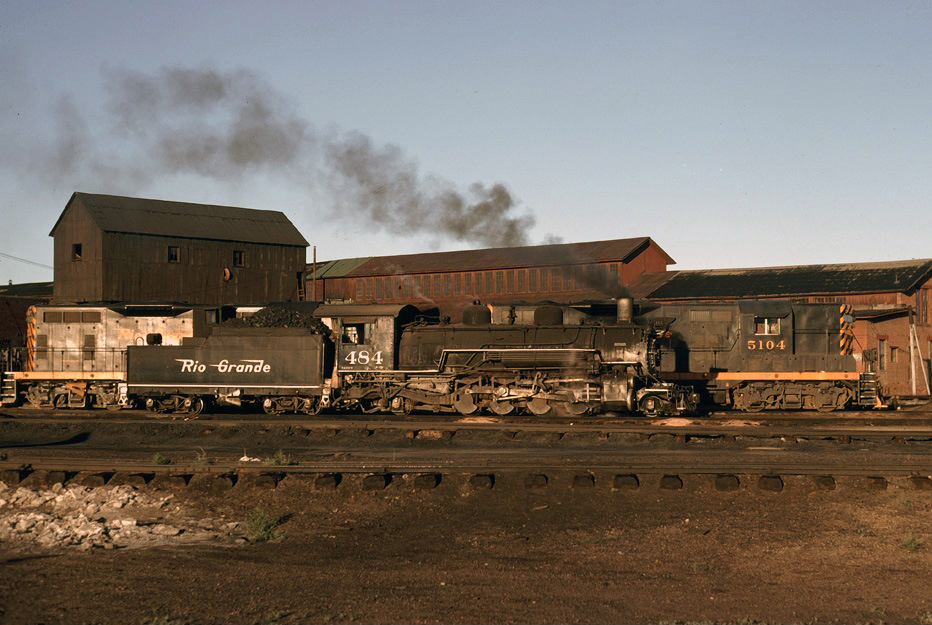 Rio Grande Class K-36 Mikado #484 rests at the yard and roundhouse in Alamosa, Colorado with other power on June 21, 1967. Note how small she seems in comparison to GP7 #5104 on the next track over. Drew Jacksich photo.
Rio Grande Western Railway
He chartered the State Line & Denver Railway for the purpose of purchasing the D&RG from Grand Junction to the Utah state line. He then merged it with the Denver & Rio Grande Western during June of 1889, forming the Rio Grande Western Railway.
Next, the work of converting the entire network to standard-gauge was carried out; the main line from Ogden to Grand Junction was completed on June 11, 1890 with the branches finished the following year.
One final, noteworthy expansion in Utah occurred about a decade later when the Manti Branch was continued down the Sevier River to Marysvale in 1900.
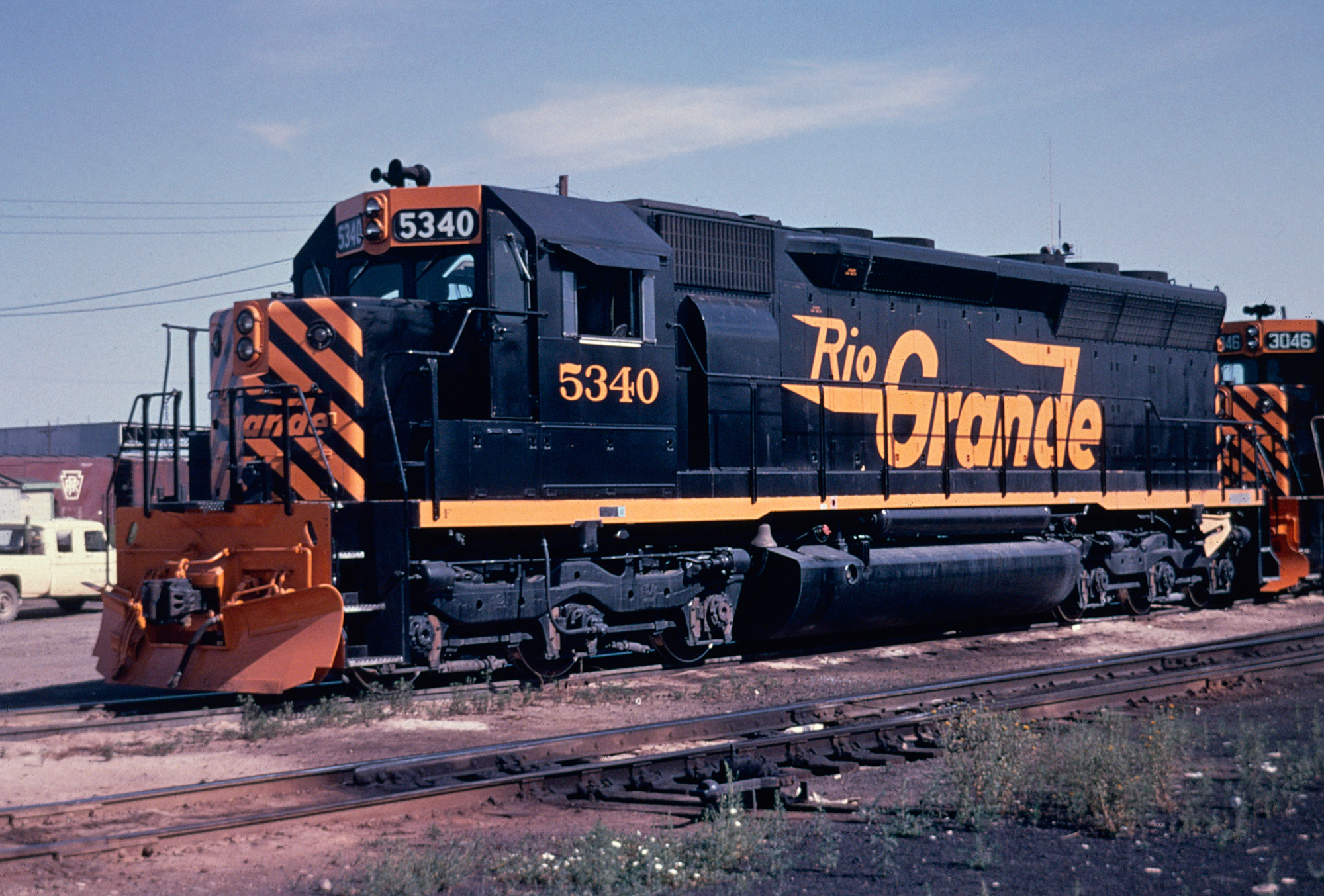 Rio Grande SD45 #5340 and GP35 #3046 in Denver, Colorado; May, 1968. At the time of this photo the big 20 cylinder EMD was just a few months old. Robert Eastwood, Jr. photo. American-Rails.com collection.
During this time the Denver & Rio Grande had also been expanding. Under the leadership of David Moffat, it first built from Red Cliff to Glenwood Springs in an effort to ward off a threat from the standard-gauge Colorado Midland Railway (CM).
The line was completed on October 6, 1887 and a month later, reached to the silver camp of Aspen (November 1st). In 1889 rails were pushed further west to Rifle as officials eyed Grand Junction and the opening of a secondary main line.
At this point the CM and D&RG elected to work together on the project, finishing the connector on November 14, 1890. While Palmer was converting his the D&RGW, his cross-border competitors were doing the name.
The D&RG's narrow-gauge system peaked in 1887 at 1,673 miles. So extensive was its 3-foot network that in 1890 it had only 64 miles of standard-gauge track in operation.
This figure rapidly increased over the following decade as major systems wanted to utilize the D&RG as a through route between Denver and Salt Lake City.
Once officials recognized (particularly after the Sherman Silver Purchase Act was repealed by President Grover Cleveland in 1893) their railroad's potential in this regard, efforts at conversion were hastened; the Denver-Grand Junction section was completed on November 14, 1890 and by 1900 more than 1,000 miles were standard-gauged.
This number continued to increase in the succeeding years. Surprisingly, there remained a few holdouts until well after World War II, most notably within the San Juan district west of Antonito which remained unchanged until the final load of freight left for Alamosa on August 29, 1968. It contained 14 loads of lumber.
Afterwards, much of this trackage was sold to the states of Colorado and New Mexico for a tourist attraction. Today they are operated as the Durango & Silverton Narrow-Gauge and Cumbres & Toltec Scenic.
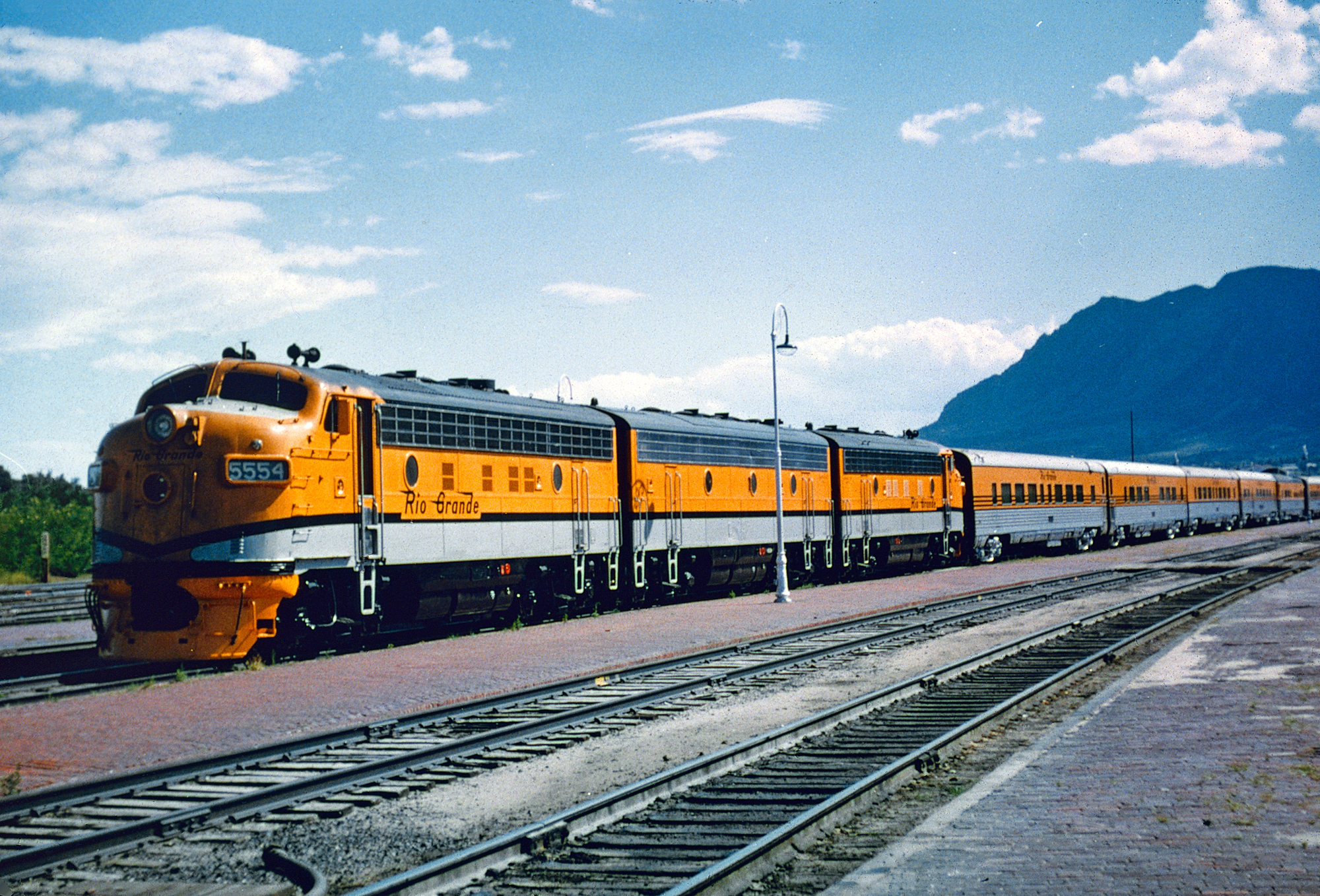 Rio Grande F7A #5554 is ahead of the "Royal Gorge" stopped in Colorado Springs on August 5, 1965. Ed Fulcomer photo. American-Rails.com collection.
Modern Network
In 1896, Gould's empire was handed over to his son, George, who continued his father's transcontinental ambitions. At this time he controlled the Missouri Pacific, Wabash, Western Maryland, Wheeling & Lake Erie, and the Rio Grande. George is credited with reuniting the D&RG and Rio Grande Western under common management by acquiring stock control of the latter in February of 1901.
- To simply his corporate structure, Gould merged the Rio Grand Western into the D&RG in August of 1908. -
However, his decision to use the two in funding the Western Pacific's construction saddled both with heavy debt for decades to come. The company generally struggled under Gould's control; it not only dealt with crushing financial burdens but was also left to its own affairs resulting in deferred maintenance and relatively poor management.
When the financial Panic of 1907 struck, Gould's financing collapsed, and along with it his transcontinental dreams. One by one his properties slipped into bankruptcy, including the Missouri Pacific in 1915 which held some 30% of Rio Grande's stock.
Rio Grande Southern Railroad
Of Colorado's numerous railroads built to serve the legendary San Juan mining district, one of the more noteworthy was the Rio Grande Southern (RGS).
This system was incorporated on November 5, 1889 and promoted by Otto Mears. By that time he had already been involved with various ventures related to the mining industry.
The RGS opened from a connection with the D&RG at Durango to another connection at Ridgway (162 miles) on January 2, 1892.
Its main line was a zigzag affair; from the north at Ridgway it wound its way through Placerville, headed south, then southwest to Dolores, and turned roughly due east back into Durango.
While it was a fascinating operation (making it a popular subject to model), especially its crossing of 10,250-foot Lizard Head Pass, the steep grades and sharp curves made operations extremely difficult. It was a profitable carrier until the Sherman Silver Purchase Act was repealed on June 30, 1893.
This caused tonnage to drop by more than half and it entered receivership on August 2, 1893. D&RG's president, Edward Jeffrey, was made receiver which effectively gave Rio Grande control.
Rio Grande Southern exited receivership on December 1, 1895 and despite the traffic losses did relatively well until the markets crashed in October of 1929.
This led to another bankruptcy on December 11th and an end to Rio Grande's involvement. It failed to escape receivership for more than 20 years as the courts did their best to keep the company solvent.
It survived on government loans and remaining zinc mining until operations ceased entirely on December 17, 1951. The following August and September its network was dismantled.
Then, the United States Railroad Administration took over the industry, made effective at noon on December 28, 1917. The directive was ordered by President Woodrow Wilson in response to fears of national gridlock.
Unfortunately, the government did no better at maintaining fluid operations than the private sector, resulting in rundown equipment and inadequately maintained equipment. This issue, coupled with its crushing debt and complicated corporate structure, led to the D&RG's receivership on January 25, 1918.
The Transportation Act made effective February 28, 1920 returned the industry to private ownership. The Denver & Rio Grande Western Railroad was subsequently organized to acquire the D&RG's assets, taking formal control on August 1, 1921. Financial struggles continued and a second bankruptcy occurred on July 21, 1922.
It was again reorganized on October 29, 1924 but this time carried the same name. As the company's situation remained uncertain it built one of the country's great engineering feats, thanks largely to funding provided through the city of Denver and federal Reconstruction Finance Corporation loans.
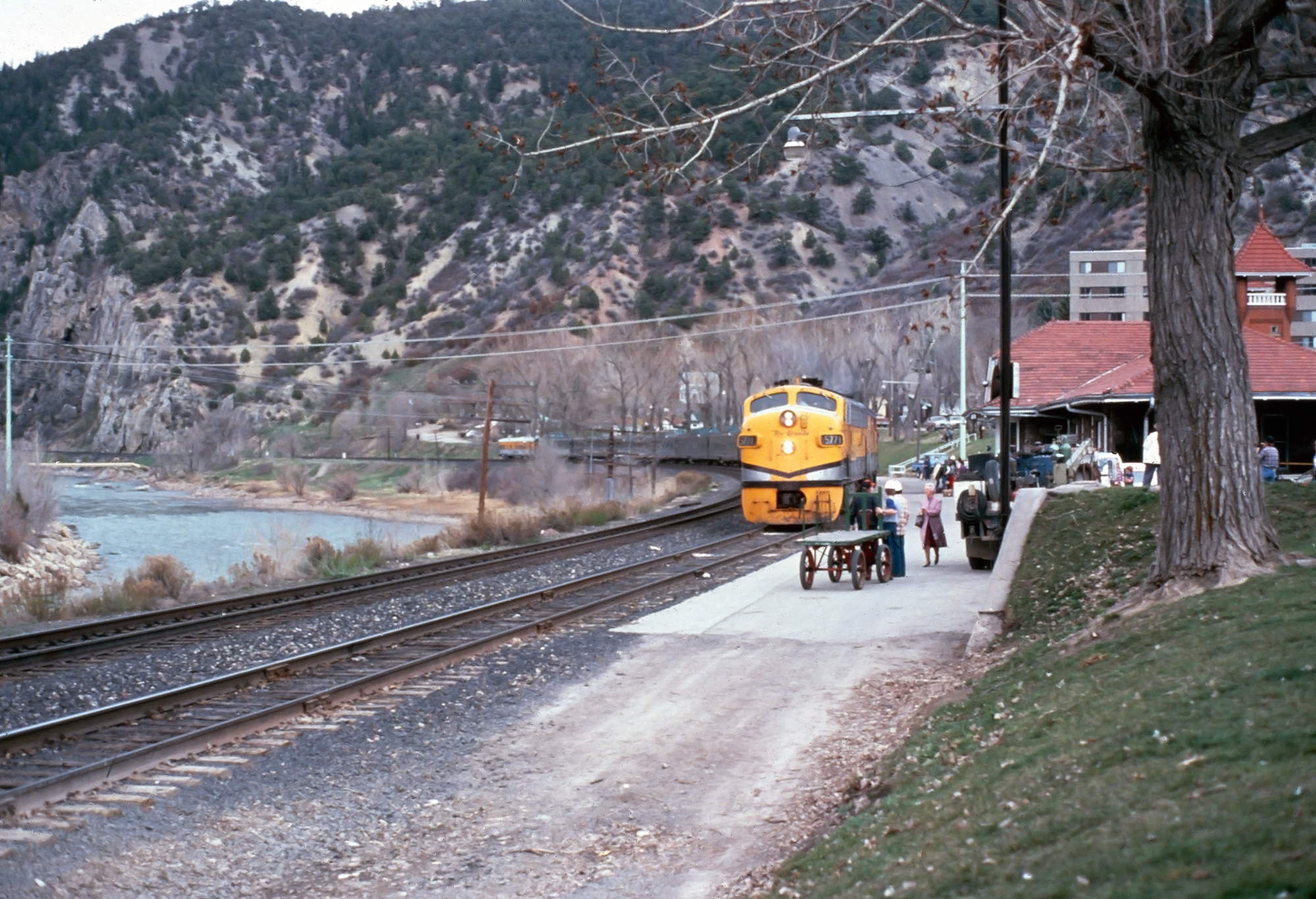 Rio Grande F9A #5771 has arrived at Glenwood Springs, Colorado with the westbound "Rio Grande Zephyr" during the 1970s. The Colorado River is visible at left. American-Rails.com collection.
In 1930, the D&RGW acquired a significant interest in the Denver & Salt Lake Railway (D&SL), a project initially launched by David Moffat in 1902 to build a secondary route from Denver to Salt Lake City. He had run out of money by 1913 having only reached Craig, Colorado.
According to Mike Schafer's took, "Classic American Railroads," part of the D&SL crossed 11,680-foot Rollins Pass. It was situated somewhat northwest of Denver and was only surmounted via a series of tortuous switchbacks, carrying grades as high as 4%.
So difficult was this stretch that 23 miles of railroad were required to connect two points just 8 miles apart. To improve operations the city agreed in 1922 to help fund a new tunnel under James Peak. Following six years of work the $18 million project was completed in 1928 and named for D&SL's founder.
Passenger Trains
California Zephyr: (Chicago - Denver - Salt Lake City - San Francisco)
Colorado Eagle: (St. Louis - Pueblo - Denver)
Exposition Flyer: Operated between Oakland, California and Chicago in conjunction with the Burlington and Western Pacific until 1949 (replaced by the CZ).
Mountaineer: (Denver - Montrose, Colorado)
Panoramic: (Denver - Odgen)
Prospector: (Denver - Salt Lake City)
Rio Grande Zephyr: Replacement for the CZ between 1970 and 1983 it operated between Denver and Ogden.
Royal Gorge: (Denver - Pueblo - Ogden)
San Juan: (Alamosa - Durango, Colorado)
The Ski Train: (Denver - Winter Park)
The Silverton: (Durango - Silverton, Colorado)
The Yampa Valley: (Denver - Craig, Colorado)
Moffat Tunnel was 6.1 miles in length and reduced the trip from hours to a mere 15 minutes. After the Rio Grande gained control it completed a short connector in 1934 known as the Dotsero Cutoff which ran from D&SL at Bond to D&RGW's Tennessee Pass main line at Dotsero.
This essentially completed Rio Grande's modern network which contained 2,569 route miles (including standard, narrow, and third-rail gauge). Alas, with the ongoing depression and lingering monetary troubles another bankruptcy occurred on November 1, 1935.
Diesel Roster
American Locomotive Company
| Model Type | Road Number | Date Built | Quantity |
|---|---|---|---|
| S2 | 101-119 | 9/1941-5/1944 | 19 |
| RS3 | 5200-5204 | 6/1951 | 5 |
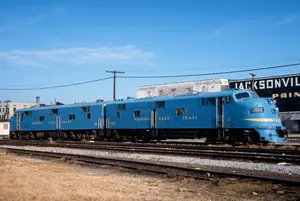
| PA1 | 600A-601A, 600C-601C | 1/1947-4/1947 | 4 |
| PB1 | 600B-601B | 1/1947-2/1947 | 2 |
Baldwin Locomotive Works
| Model Type | Road Number | Date Built | Quantity |
|---|---|---|---|
| VO-660 | 66-74 | 5/31/1941-8/30/1941 | 9 |
Electro-Motive Corporation/Electro-Motive Division
| Model Type | Road Number | Date Built | Quantity |
|---|---|---|---|
| SW1200 | 130-139 | 1965 | 10 |
| FTA | 540A-551A, 540D-551D | 1/1942-10/1944 | 24 |
| FTB | 540B-551B, 540C-551C | 1/1942-10/1944 | 24 |
| F3A | 552A-554A, 552D-554D | 11/1946 | 6 |
| F3B | 552B-554B, 552C-554C | 11/1946 | 6 |
| F7A | 555A-564A, 555D-564D | 2/1949-7/1949 | 20 |
| F7B | 555B-564B, 555C-564C | 2/1949-7/1949 | 20 |
| F7A | 555A-564A, 555D-564D | 2/1949-7/1949 | 20 |
| F7A | 5651, 5654, 5661, 5664, 5671, 5674, 5681, 5684, 5691, 5694, 5701, 5704, 5711, 5714, 5721, 5724, 5731, 5734, 5741, 5744, 5751, 5754, 5761, 5764 | 6/1950-7/1952 | 24 |
| F7B | 5652-5653, 5662-5663, 5672-5673, 5682-5683, 5692-5693, 5702-5703, 5712-5713, 5722-5723, 5732-5733, 5742-5743, 5752-5753, 5762 | 6/1950-7/1952 | 23 |
| GP30 | 3001-3028 | 4/1962-2/1963 | 28 |
| GP35 | 3029-3050 | 5/1964-1/1965 | 22 |
| GP40 | 3051-3093, 3131-3153 | 1/1966-4/1985 | 66 |
| GP40-2 | 3094-3130 | 4/1972-3/1983 | 37 |
| GP60 | 3154-3156 | 5/1990 | 3 |
| GP7 | 5101-5113 | 10/1950-6/1952 | 13 |
| SD7 | 5300-5304 | 5/1953 | 5 |
| SD9 | 5305-5314 | 7/1957 | 10 |
| SD45 | 5315-5340 | 1/1967-3/1968 | 26 |
| SD40T-2 | 5341-5413 | 10/1974-3/1980 | 73 |
| SD50 | 5501-5517 | 8/1984-9/1984 | 17 |
| F9B | 5762-5263, 5772-5773 | 9/1955 | 4 |
| F9A | 5771, 5774 | 9/1955 | 2 |
| GP9 | 5901-5904, 5911-5914, 5921-5924, 5931-5934, 5941-5944, 5951-5954 | 4/1955-6/1956 | 24 |
| NW2 | 7000 | 1/1941 | 1 |
Davenport Locomotive Works
| Model Type | Road Number | Date Built | Quantity |
|---|---|---|---|
| 30-Ton (Narrow-Gauge) | 50 | 1963 | 1 |
Fairbanks-Morse
| Model Type | Road Number | Date Built | Quantity |
|---|---|---|---|
| H-10-44 | 120-123 | 4/1948 | 4 |
| H-15-44 | 150-152 | 1/1948-2/1948 | 3 |
General Electric
| Model Type | Road Number | Date Built | Quantity |
|---|---|---|---|
| 44-Ton | 38-43 | 8/1941-9/1942 | 6 |
Krauss-Maffei
| Model Type | Road Number | Date Built | Quantity |
|---|---|---|---|
| ML-4000 (Cab Unit) | 4001-4003 | 6/1961 | 3 |
Steam Roster (Modern Class Designations)
Standard-Gauge Locomotives
| Road Number(s) | Class | Arrangement | Builder | Date Built/Notes |
|---|---|---|---|---|
| 01 | C-41 | 2-8-0T | Baldwin | 1900 |
| 1 | Y-21 | Class C, 3-Truck Shay | Lima | 8/1924 |
| 2 | Y-25 | Class C, 3-Truck Shay | Lima | 10/1925 |
| 3 | Y-32 | Class C, 3-Truck Shay | Lima | 12/1934 |
| 4-5 | Y-33 | Class C, 3-Truck Shay | Lima | 10/1925, 5/1936 |
| 20-22 | S-23 | 0-6-0 | Alco | 1900 |
| 50-59 | S-33 | 0-6-0 | Baldwin | 1906-1907 |
| 60-62 | S-33 | 0-6-0 | Alco | 1909 |
| 500-501 | T-17 | 4-6-0 | Rome | 1890-1891 |
| 506-538 | T-18 | 4-6-0 | Baldwin | 1887-1891 |
| 520-521, 525-528 | T-19 | 4-6-0 | Baldwin | 1892-1898 |
| 530-533 | T-24 | 4-6-0 | Alco | 1901 |
| 535-541, 545-546 | T-26 | 4-6-0 | Baldwin | 1898 |
| 542-544 | T-26 | 4-6-0 | Denver & Rio Grande | 1897 |
| 575-579 | G-20 | 2-6-0 | Baldwin | 1890-1891 |
| 590-591 | G-28 | 2-6-0 | Baldwin | 1898 |
| 592-597 | G-28 | 2-6-0 | Alco | 1901 |
| 600-626 | C-26 | 2-8-0 | Baldwin | 1889-1892 |
| 630-691 | C-28 | 2-8-0 | Baldwin | 1888-1890 |
| 720-739 | T-28 | 4-6-0 | Brooks | 1899 |
| 750-759 | T-31 | 4-6-0 | Baldwin | 1902 |
| 760-761 | T-31 | 4-6-0 | Brooks | 1908-1909 |
| 762-793 | T-29 | 4-6-0 | Alco/Brooks | 1908-1909 |
| 795-796 | T-33 | 4-6-0 | Alco | 1907 |
| 800-805 | P-44 | 4-6-2 | Baldwin | 1913 |
| 900-903 | C-38 | 2-8-0 | Richmond | 1900 |
| 915-925 | C-39 | 2-8-0 | Baldwin | 1912, 1905 |
| 930-934 | C-40 | 2-8-0 | Baldwin | 1901 |
| 940-944 | C-40 | 2-8-0 | Alco/Richmond | 1901 |
| 950-964 | C-41 | 2-8-0 | Baldwin | 1900 |
| 1000-1029 | C-41 | 2-8-0 | Baldwin | 1902 |
| 970-973 | C-42 | 2-8-0 | Richmond | 1900 |
| 1031-1039 | C-43 | 2-8-0 | Alco | 1910 |
| 1131-1199 | C-48 | 2-8-0 | Alco | 1906-1908 |
| 1200-1213 | K-59 | 2-8-2 | Baldwin | 1912 |
| 1220-1227 | K-63 | 2-8-2 | Lima | 1915 |
| 1228-1229 | K-63 | 2-8-2 | Alco | 1916 |
| 1400-1409 | F-81 | 2-10-2 | Alco | 1916 |
| 1501-1510, 1521-1530 | M-67 | 4-8-2 | Alco | 1922-1923 |
| 1511-1520 | M-78 | 4-8-2 | Alco | 1923 |
| 1700-1713 | M-64 | 4-8-4 | Baldwin | 1929 |
| 1800-1804 | M-68 | 4-8-4 | Baldwin | 1937 |
| 3300-3308 | L-62 | 2-6-6-2 | Alco | 1910 |
| 3350-3351 | L-76 | 2-6-6-2 | Alco | 1916 |
| 3360-3375 | L-77 | 2-6-6-0 | Alco | 1908-1916 |
| 3400-3415 | L-95 | 2-8-8-2 | Alco | 1913 |
| 3500-3509 | L-107 | 2-8-8-2 | Alco | 1923 |
| 3610-3619 | L-132 | 2-8-8-2 | Alco | 1930 |
| 3700-3714 | L-105 | 4-6-6-4 | Baldwin | 1938-1942 |
| 3800-3805 | L-97 | 4-6-6-4 | Alco | 1943 |
Narrow-Gauge Locomotives
| Road Number(s) | Class | Arrangement | Builder | Date Built/Notes |
|---|---|---|---|---|
| 166-177 | T-12 | 4-6-0 | Baldwin | 1883-1884 |
| 200-227 | C-16 | 2-8-0 | Grant | 1881-1882 |
| 228-229, 240-241 | C-16 | 2-8-0 | Baldwin | 1877-1882 |
| 262-263, 265-274 | C-16 | 2-8-0 | Baldwin | 1882 |
| 276, 278, 280-286 | C-16 | 2-8-0 | Baldwin | 1882 |
| 300-306 | C-17 | 2-8-0 | Baldwin | 1887-1895 |
| 315-320 | C-18 | 2-8-0 | Baldwin | 1895-1897 |
| 340-349 | C-19 | 2-8-0 | Baldwin | 1881 |
| 360-361 | C-21 | 2-8-0 | Baldwin | 1900 |
| 375 | C-25 | 2-8-0 | Baldwin | 1903 |
| 450-464 | K-27, "Mudhens" | 2-8-2 | Baldwin | 1903 |
| 470-479 | K-28 | 2-8-2 | Alco | 1923 |
| 480-489 | K-36 | 2-8-2 | Baldwin | 1925 |
| 490-499 | K-37 | 2-8-2 | Denver & Rio Grande Western | 1928-1930 |
Class K-28
Class K-36
Class K-37
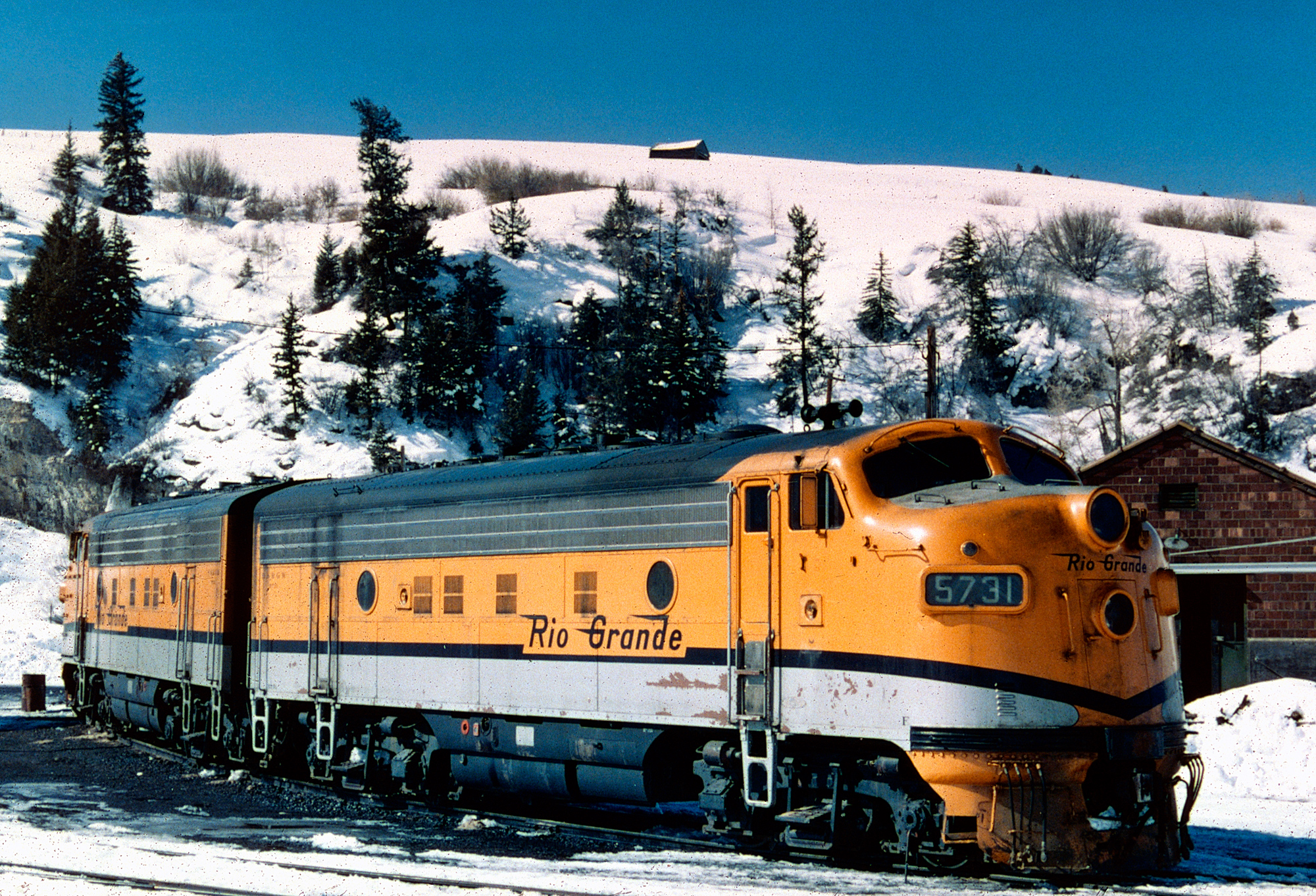 Rio Grande F7A's #5731 and #5721 layover at Minturn, Colorado on March 2, 1968. Ed Fulcomer photo. American-Rails.com collection.
Despite the rugged topography the Rio Grande possessed an impressive operation cutting through the heat of the Rockies.
The road was true to its slogan, "Through The Rockies, Not Around Them" as it boasted three main lines across the region; over Moffat Tunnel, through the Pueblo gateway crossing Tennessee Pass, and the original main line to Grand Junction via Salida/Montrose.
- It nearly opened a fourth route from Antonito to Montrose, via Durango but topography between the rail-heads at Ouray and Silverton [only 23 miles apart] proved too rugged to support a manageable alignment. -
The company financially improved throughout the 1930's, particularly during World War II's traffic blitzkrieg. It was finally reorganized on April 11, 1947 carrying the same as before but permanently separated from the Missouri Pacific and Western Pacific.
Afterwards, it enjoyed several decades of prosperity. In 1949 it launched one the best remembered streamliners of all time, the California Zephyr, in conjunction with the WP and Chicago, Burlington & Quincy.
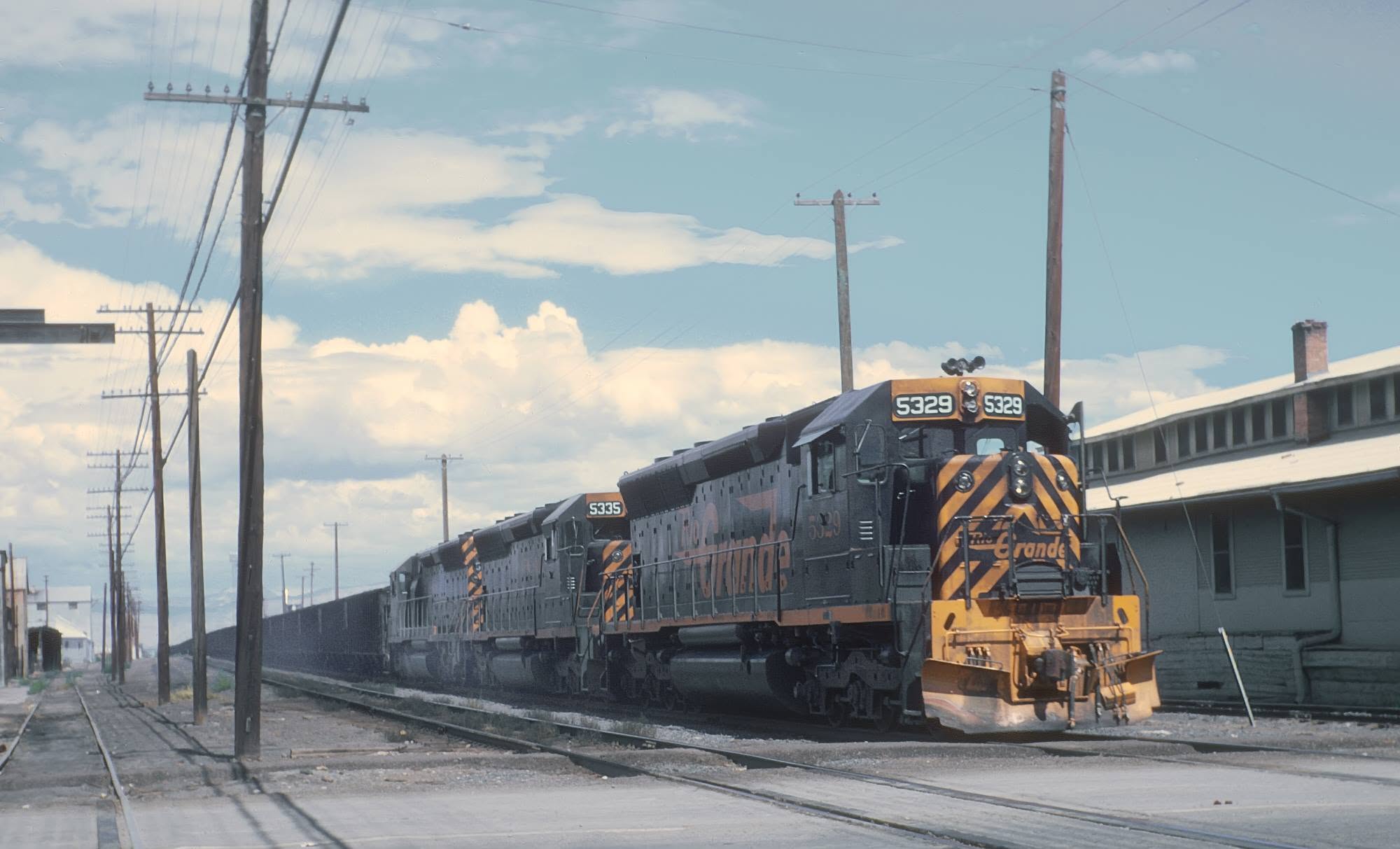 A trio of Rio Grande SD45s, led by #5329, work a freight train westbound through Grand Junction, Colorado circa 1969. Rick Burn photo.
Southern Pacific Purchase
After its cancellation in 1970 the Rio Grande continued to host the service as the Rio Grande Zephyr from Denver to Salt Lake City.
This lasted until 1983 when it finally turned its equipment over to Amtrak. After purchasing an ailing Southern Pacific in 1988, Rio Grande Industries (Rio Grande's parent company) slowly integrated the smaller Denver & Rio Grande Western into the much larger SP.
By the time Union Pacific purchased Southern Pacific in 1996 the D&RGW had largely disappeared. Today, its Denver - Salt Lake City main line remains an important component under Union Pacific while several other segments, like those described, are popular tourist attractions.
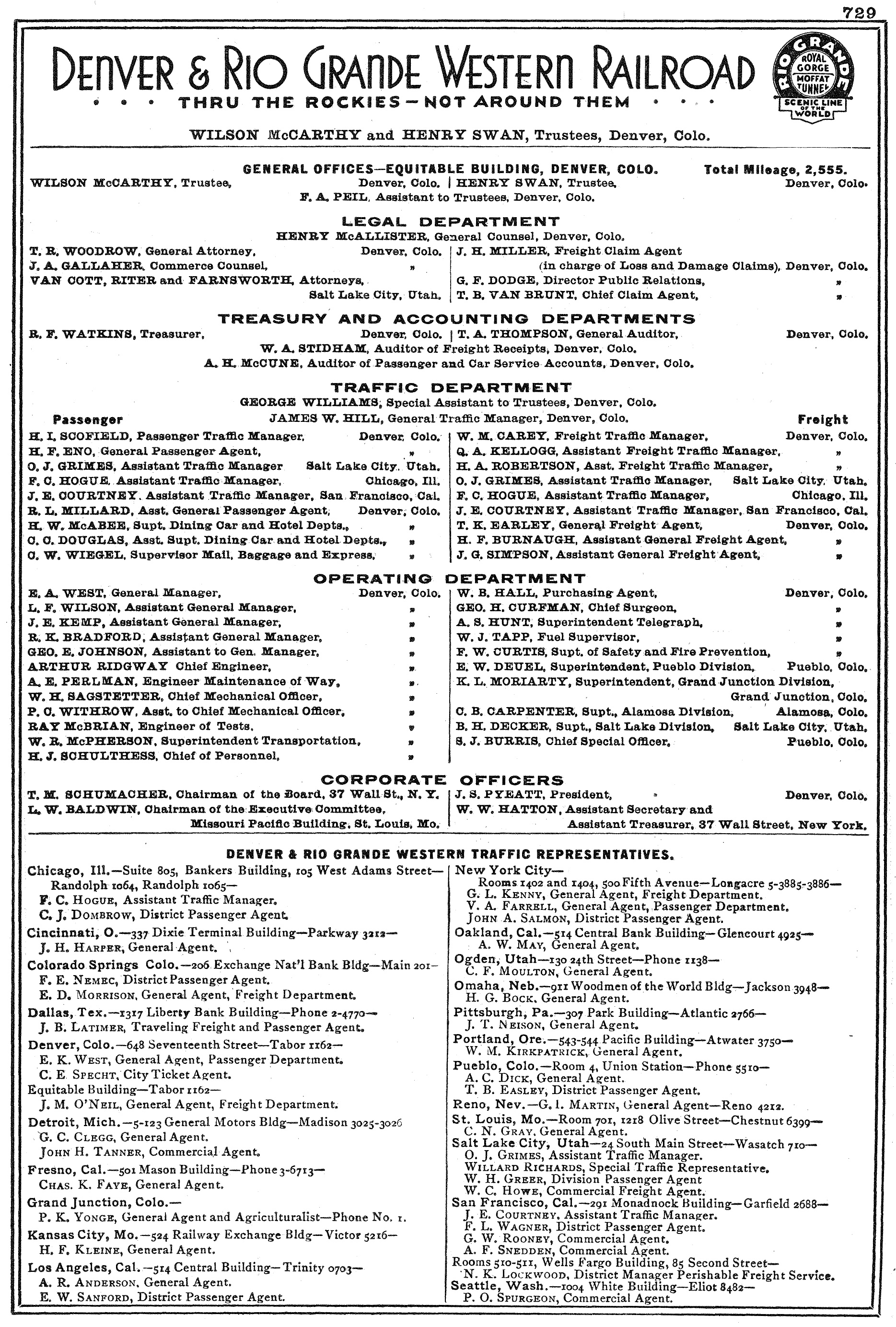
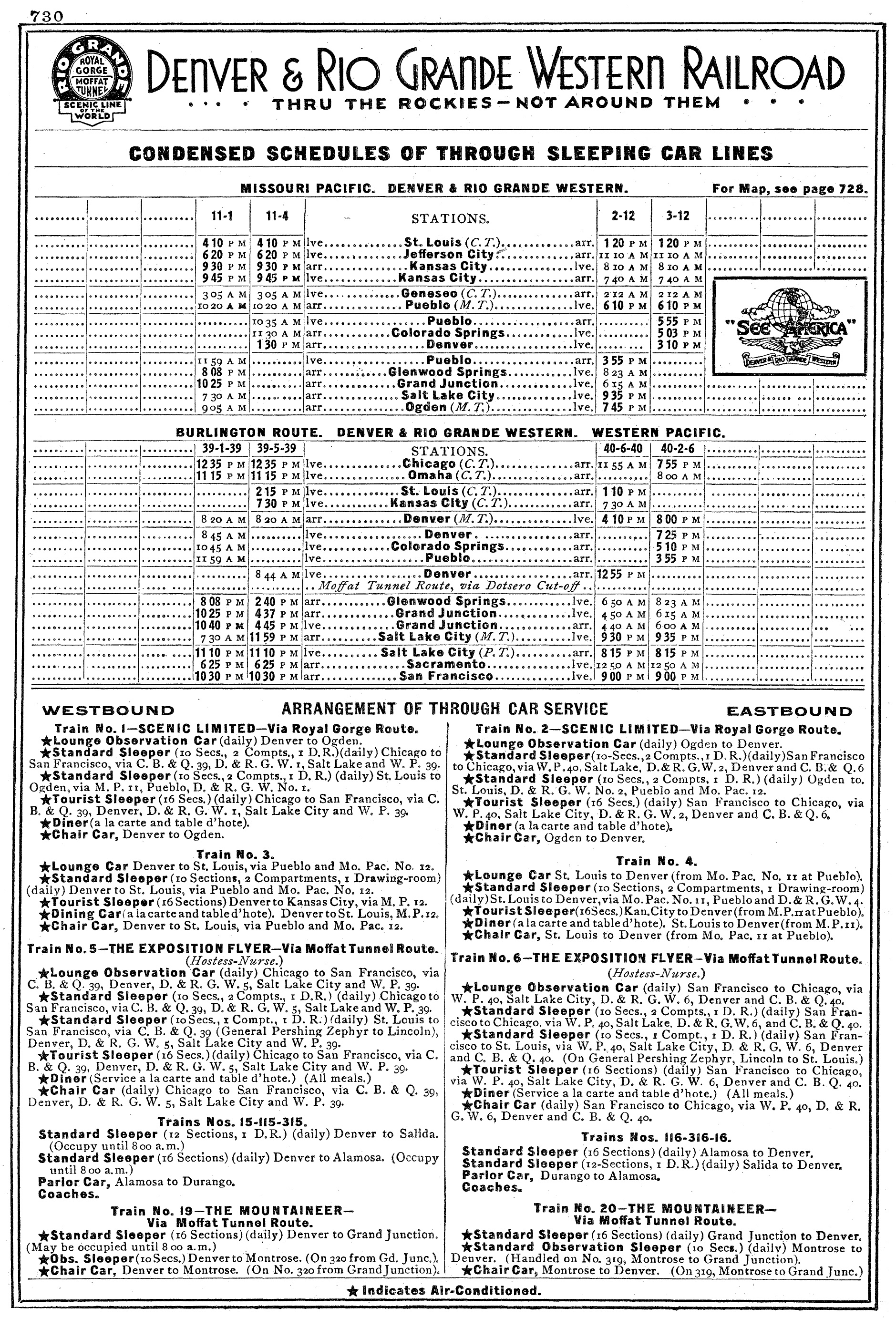
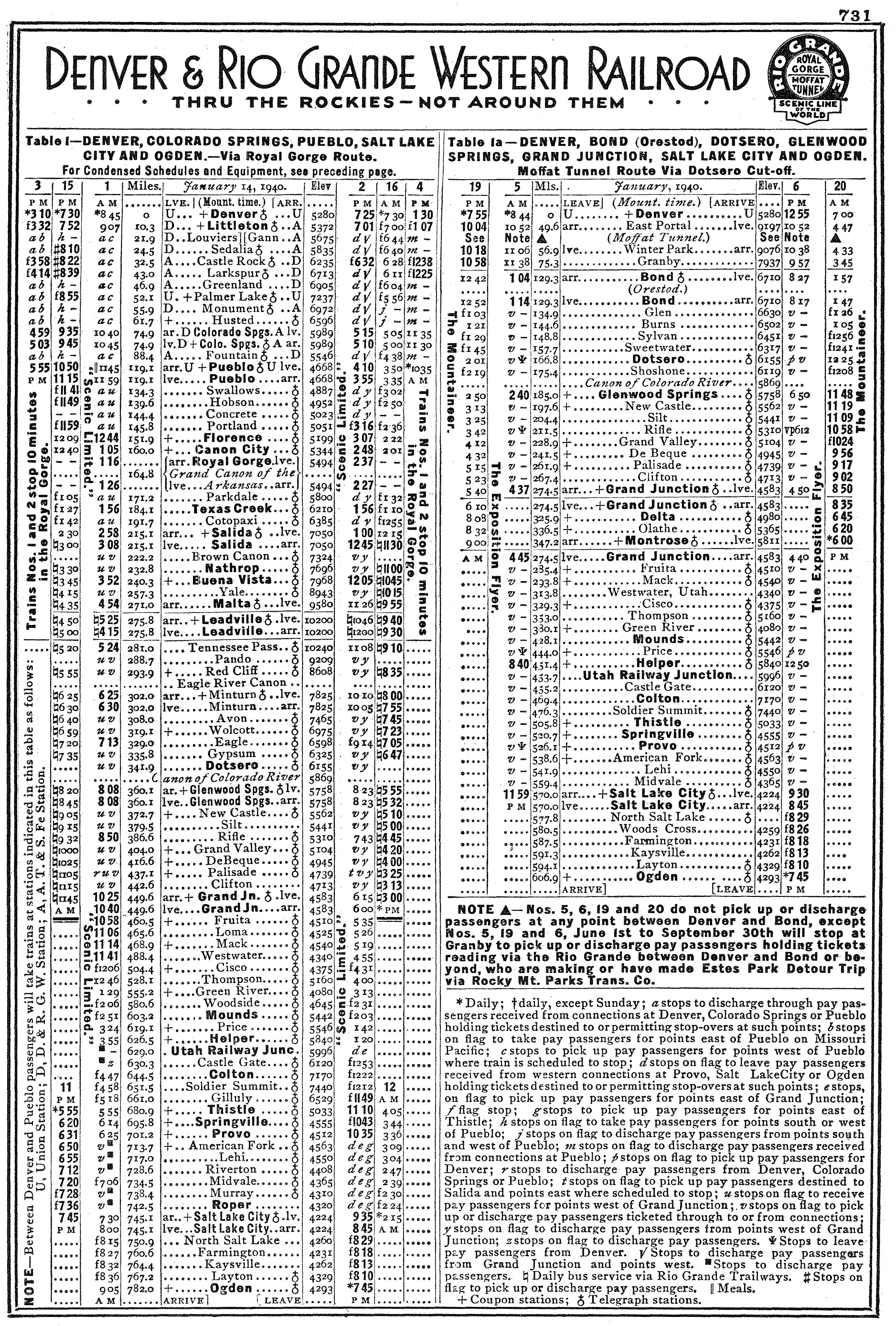
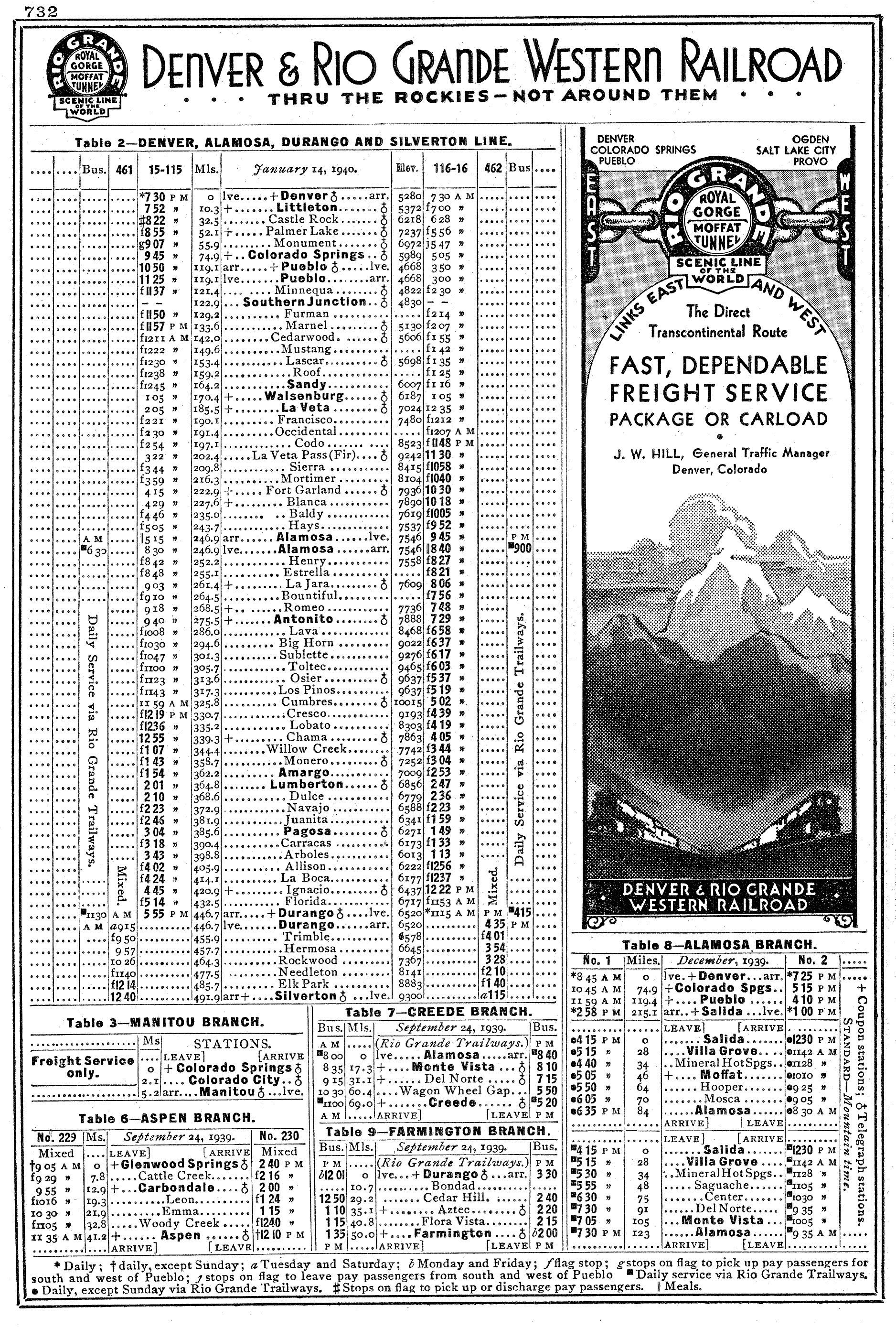
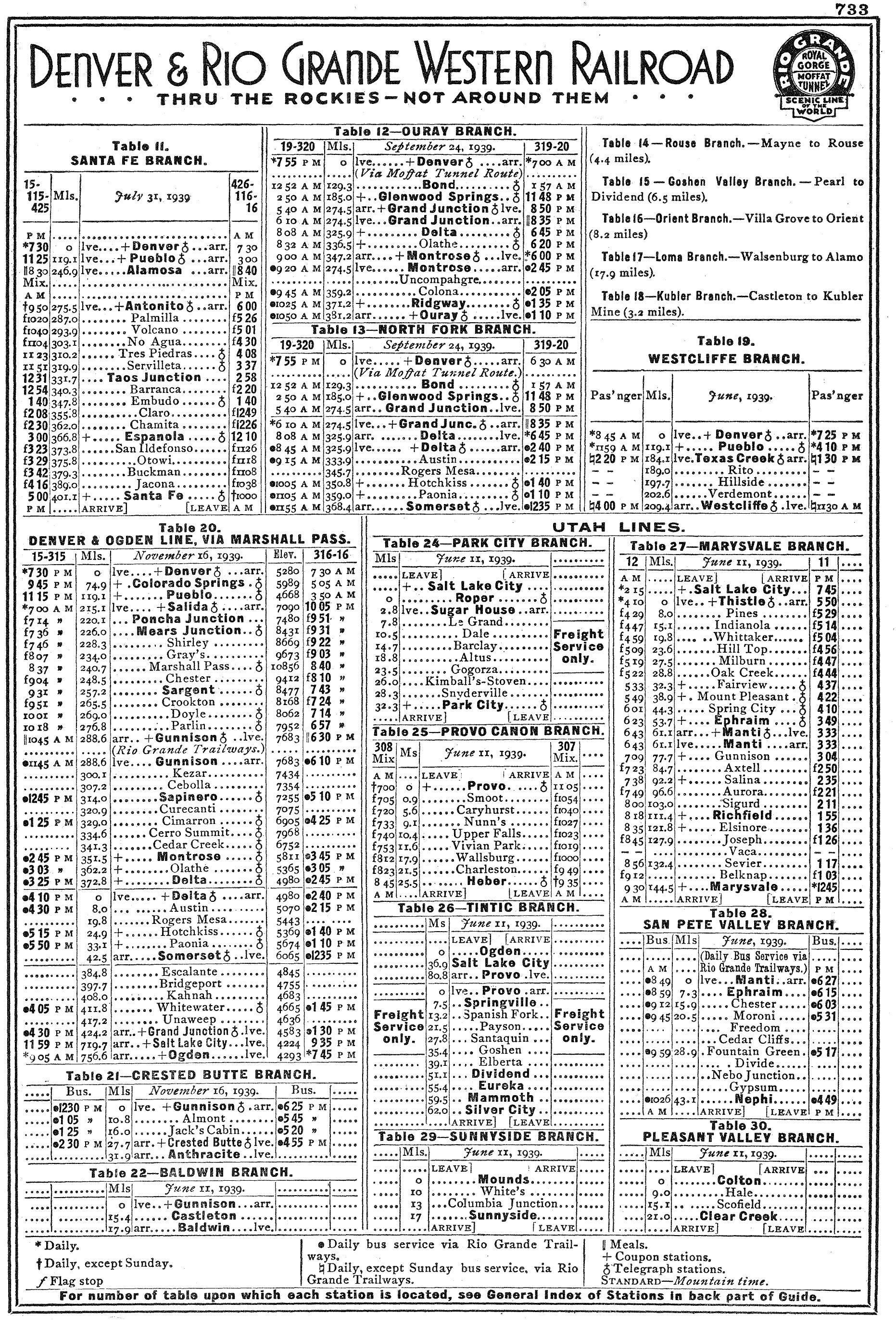
Public Timetables (March, 1940)
Recent Articles


-
Alton Railroad: Map, History, Timetables
Oct 09, 26 10:31 PM
 Alton Railroad, chartered February 27, 1847 as the Alton & Sangamon. Chicago, St. Louis, and Kansas City, the 1937 Official Guide, and the May 31, 1947 merger into the Gulf, Mobile & Ohio.
 -
Mobile & Ohio Steam Roster (Post 1900)
Oct 09, 26 12:26 PM
 Mobile & Ohio steam since 1900. Drury's class grid: 48 six-wheel switchers, 107 Ten-Wheelers, 15 Consolidations, 58 Mikados, and 14 Pacifics. Last revenue steam October 7, 1949.
 -
Mobile & Ohio Railroad: History, Map, Timetable
Oct 09, 26 11:31 AM
 Mobile & Ohio Railroad, chartered in 1848. Columbus on April 22, 1861, the Cairo & St. Louis, the March 1940 Official Guide, and the September 13, 1940 merger into the Gulf, Mobile & Ohio.
 -
Gulf, Mobile & Northern Steam Roster (Post 1900)
Oct 09, 26 10:42 AM
 Gulf, Mobile & Northern steam since 1900. Drury's class grid: Ten-Wheelers, Mikados, Russian Decapods, Pacifics 425 and 426, and three light 4-8-2s. Last revenue steam October 7, 1949.
 -
Gulf, Mobile & Ohio Diesel Roster (All-Time)
Oct 09, 26 10:41 AM
 Gulf, Mobile & Ohio diesel roster, all-time. The 1935 boxcab, DL-107s, 55 FA-1s, F3s and F7s, the Ingalls 4-S, GP30s through GP38-2s, and 21 SD40s. Serials and order numbers.
 -
Gulf, Mobile & Northern Railroad: History, Rebel Route
Oct 09, 26 10:36 AM
 Gulf, Mobile & Northern, from the 1890 Mobile, Jackson & Kansas City to the Rebel and the September 13, 1940 merger into the Gulf, Mobile & Ohio. Steam roster is the companion page.
 -
Gulf, Mobile & Ohio Railroad: Map, Photos, Trains, History
Oct 08, 26 11:48 PM
 Gulf, Mobile & Ohio, chartered in 1938 and merged September 13, 1940. The Mobile & Ohio, the Alton on May 31, 1947, the Rebel Route, and Illinois Central Gulf on August 10, 1972.
 -
New Jersey Railroad Museums (2026): A Complete Guide
Oct 08, 26 11:37 PM
 New Jersey railroad museums—Whippany, Maywood, Pine Creek, Mahwah’s Erie depot, Phillipsburg, and Boonton. Confirm hours on each site.
 -
New Hampshire Railroad Museums (2026): A Complete Guide
Oct 08, 26 11:34 PM
 New Hampshire railroad museums—North Conway, the Flying Yankee, Ashland, Gorham, Raymond, and Sandown. Confirm hours on each site.
 -
Missouri Railroad Museums (2026): A Complete Guide
Oct 08, 26 11:00 PM
 Missouri railroad museums—the National Museum of Transportation, Patee House, Frisco 4524, the Chicago & Alton depot, and Marceline. Confirm hours on each site.
 -
Milwaukee Road X3800: Deer Lodge’s Shop Goat
Oct 08, 26 04:28 PM
 Milwaukee Road X3800, the a home-built shop goat that served the Deer Lodge, MT yard. It was a 220-volt DC switcher, powered through an extension cord that moved electrics into a roundhouse where the…
 -
Key West Extension (Overseas Railroad): History, Construction, Decline
Oct 08, 26 03:59 PM
 Henry Flagler's Overseas Railroad, Miami to Key West, 1905–1935. The Seven Mile Bridge, the 1935 Labor Day Hurricane, and the road that became U.S. 1.
 -
Florida East Coast Steam Roster (Post 1900)
Oct 08, 26 02:34 PM
 Florida East Coast steam since 1897. Seventeen Ten-Wheelers, twenty Atlantics, eighty-seven Pacifics, ninety Mountains, fifteen Mikados, and the switchers.
 -
Florida East Coast Diesel Roster (All-Time)
Oct 08, 26 02:12 PM
 Florida East Coast diesel roster, all-time. E units from 1939, F3s, BL2s, GP7s and GP9s, the GP40-2 orders, 22 SD40-2s, and 24 ES44C4s. Serials and EMD order numbers.
 -
Florida East Coast Railway: Map, History, Rosters
Oct 08, 26 01:46 PM
 Florida East Coast Railway, Henry Flagler's line from Jacksonville to Miami and Key West. Receivership in 1931, the 1963 strike, Grupo México in 2017, and Brightline on the same track.
 -
Minnesota Railroad Museums (2026): A Complete Guide
Oct 08, 26 10:32 AM
Minnesota railroad museums—the Lake Superior Railroad Museum, Two Harbors, Jackson Street, Willmar’s Great Northern 2523, and Currie. Confirm hours on each site. -
Maine Railroad Museums (2026): A Complete Guide
Oct 08, 26 09:24 AM
 Maine railroad museums—Seashore Trolley, the two-foot lines at Portland, Alna, and Phillips, Boothbay, and the Bangor & Aroostook depots. Confirm hours on each site.
 -
Massachusetts Railroad Museums (2026): A Complete Guide
Oct 08, 26 12:08 AM
 Massachusetts railroad museums—Berkshire Scenic at Lenox, Shelburne Falls trolley No. 10, Edaville, Chatham’s 1887 depot, and Lowell. Confirm hours on each site.
 -
Clinchfield Steam Roster (Post 1900)
Oct 07, 26 12:09 PM
 Clinchfield steam since 1900. Fifteen H-4 Consolidations, K-1 Mikados, M-2 and M-3 Mallets, L-class 2-8-8-2s, eighteen Challengers. Class grid after Drury. Last steam April 16, 1954.
 -
Clinchfield Diesel Roster (All-Time)
Oct 07, 26 12:05 PM
 Clinchfield diesel roster, all-time. F3A 800, FP7 200, the F7s, GP7s, 25 SD40s, 18 SD45-2s, seven U36Cs, and the Family Lines hoods. Serials and EMD order numbers.
 -
Clinchfield Railroad: Map, Steam Locomotives, Roster, Logo
Oct 07, 26 12:02 PM
 Clinchfield Railroad, Elkhorn City to Spartanburg. George L. Carter, the Carolina, Clinchfield & Ohio, the 1924 lease, coal, the loops, and CSX. Steam and diesel rosters are companion pages.
 -
Kentucky Railroad Museums (2026): A Complete Guide
Oct 07, 26 11:39 AM
 Kentucky railroad museums—the Kentucky Railway Museum, Bowling Green’s L&N depot, Paducah, Versailles, and Covington. Confirm hours on each site.
 -
Kansas Railroad Museums (2026): A Complete Guide
Oct 07, 26 11:26 AM
 Kansas railroad museums—Santa Fe 3768 at Wichita, Santa Fe 132 in Topeka, the Great Overland Station, and Abilene. Confirm hours on each site.
 -
Cincinnati, New Orleans and Texas Pacific Diesel Roster (All-Time)
Oct 07, 26 10:38 AM
 All-time diesel roster of Southern locomotives lettered for the Cincinnati, New Orleans and Texas Pacific. Serials, order numbers, and builder dates.
 -
Cincinnati, New Orleans and Texas Pacific Railway
Oct 07, 26 10:31 AM
 Cincinnati, New Orleans and Texas Pacific Railway, incorporated September 8, 1881, to lease Cincinnati’s railroad to Chattanooga. Queen and Crescent route, Rathole, and the 2024 sale to Norfolk Southe…
 -
Indiana Railroad Museums (2026): A Complete Guide
Oct 07, 26 12:26 AM
 Indiana railroad museums—Nickel Plate 765, Elkhart’s New York Central collection, French Lick, Linden’s junction depot, and Haley Tower. Confirm hours on each site.
 -
"Triplex" Steam Locomotive: Specs, History, Photos
Oct 06, 26 11:52 PM
 Erie class P-1 Triplex 2-8-8-8-2s. Three Baldwin compounds, 2603–2605, later 5014–5016, built 1914 and 1916. Matt H. Shay, the 1930 class card, and Virginian XA 700.
 -
Illinois Railroad Museums (2026): A Complete Guide
Oct 06, 26 11:47 PM
 Illinois railroad museums—the Illinois Railway Museum, Monticello, the Pioneer Zephyr, Galesburg’s Burlington 3006, and the depots. Confirm hours on each site.
 -
Iowa Railroad Museums (2026): A Complete Guide
Oct 06, 26 11:41 PM
 Iowa railroad museums—the Union Pacific Railroad Museum, RailsWest, Sioux City, Boone, and the National Hobo Museum in Britt. Confirm hours on each site.
 -
Charleston and Western Carolina Diesel Roster (All-Time)
Oct 06, 26 11:29 PM
Charleston and Western Carolina diesel roster. Twenty-one GP7s, two SW7s, two SW9s, and six F7As, all built 1950–1952. Serials, order numbers, and ACL and SCL numbers. -
Charleston and Western Carolina Railway: Map, History, Timetables
Oct 06, 26 11:18 PM
 Charleston and Western Carolina Railway, incorporated September 16, 1896. Port Royal to Spartanburg, with branches to Anderson and Greenville. Merged into the Atlantic Coast Line on December 31, 1959.
 -
Central of Georgia Steam Roster (Post 1900)
Oct 06, 26 04:00 PM
 Central of Georgia steam since 1900. Cooke Consolidations, Harriman Mikados, 32 Mountains, and eight Lima 4-8-4s. Class grid after Drury. Last steam May 1953.
 -
Central of Georgia Diesel Roster (All-Time)
Oct 06, 26 03:44 PM
 Central of Georgia diesel roster. SW1 No. 1 in 1939, E7s and E8s, nine F3As, 39 RS3s, GP7s through SD35s. Serials and order numbers.
 -
Central of Georgia Railway: Map, Logo, History, Rosters
Oct 06, 26 03:42 PM
 Central of Georgia Railway, from the 1833 Savannah charter to Southern control on June 17, 1963. Map, logos, Nancy Hanks II, and links to the steam and diesel rosters.
 -
Georgia Railroad Museums (2026): A Complete Guide
Oct 06, 26 03:33 PM
Georgia railroad museums—Savannah’s Central shops, Duluth, the General at Kennesaw, the Texas in Atlanta, Tifton, Waycross, and Albany. Confirm hours on each site. -
Florida Railroad Museums (2026): A Complete Guide
Oct 06, 26 03:18 PM
 Florida railroad museums—Boca Raton, Winter Garden, Whitehall, the Gold Coast, Parrish, Fort Myers, Milton, and Plant City. Confirm hours on each site.
 -
Connecticut Railroad Museums (2026): A Complete Guide
Oct 06, 26 01:05 PM
 Connecticut railroad museums—the Shore Line Trolley, East Windsor, the Naugatuck Railroad, Danbury Union Station, Willimantic, and the SoNo tower. Confirm hours on each site.
 -
Colorado Railroad Museums (2026): A Complete Guide
Oct 06, 26 12:47 PM
 Colorado railroad museums—Golden, the Forney’s Big Boy 4005, Pueblo’s Santa Fe 2912, and the depots at Castle Rock, Limon, and Ridgway. Confirm hours on each site.
 -
Atlantic Coast Line Steam Roster (Post 1900)
Oct 06, 26 12:44 PM
 Atlantic Coast Line steam since 1900. Copper Head Ten-Wheelers, 235 P-5 Pacifics, Q-1 Santa Fes, twelve R-1 4-8-4s. Class grid after Drury. Last steam June 30, 1955.
 -
Atlantic Coast Line Diesel Roster (All-Time)
Oct 06, 26 11:57 AM
 Atlantic Coast Line diesel roster. HH660 1900 in 1939, E3s for the Champion, FTs and F2s, GP7s 100–279, GP30s, U25Cs, and the 1967 SCL numbers. Serials and orders.
 -
Atlantic Coast Line Railroad: "Standard Railroad of the South"
Oct 06, 26 11:53 AM
 Atlantic Coast Line, the Standard Railroad of the South. April 21, 1900 to July 1, 1967. Plant System, L&N, Clinchfield, the Champion, and the Seaboard Coast Line merger.
 -
California Railroad Museums (2026): A Complete Guide
Oct 06, 26 09:50 AM
California railroad museums—the California State Railroad Museum, Perris, Portola, Railtown 1897, and the depots that still stand. Confirm hours on each site. -
Arizona Railroad Museums (2026): A Complete Guide
Oct 06, 26 09:46 AM
Arizona railroad museums—the Arizona Railway Museum in Chandler, Southern Pacific 1673 at Tucson, and the McCormick-Stillman park in Scottsdale. -
Arkansas Railroad Museums (2026): A Complete Guide
Oct 06, 26 09:07 AM
 Arkansas railroad museums—Cotton Belt 819 at Pine Bluff, the Fort Smith trolley, the Mammoth Spring depot, and the Eureka Springs railway.
 -
Alabama Railroad Museums (2026): A Complete Guide
Oct 06, 26 09:03 AM
Alabama railroad museums—Heart of Dixie at Calera, the North Alabama museum at Chase, Huntsville’s 1860 depot, and Fort Payne. Confirm hours on each site. -
Pennsylvania Railroad Museums (2026): A Complete Guide
Oct 06, 26 12:09 AM
 Pennsylvania railroad museums—Strasburg, Steamtown, the Horseshoe Curve, the East Broad Top, and the depots and towers in between. Confirm hours on each site.
 -
Maryland Railroad Museums (2026): A Complete Guide
Oct 05, 26 11:53 PM
 Maryland railroad museums—the Baltimore roundhouse, Ellicott City station, Bowie, Gaithersburg’s Buffalo Creek & Gauley 14, and the Western Maryland collections.
 -
Ohio Railroad Museums (2026): A Complete Guide
Oct 05, 26 05:51 PM
 Ohio railroad museums—the Age of Steam Roundhouse, Bellevue, Worthington, Conneaut’s Nickel Plate 755, and the Dennison depot. Confirm hours on each site.
 -
Delaware Railroad Museums (2026): A Complete Guide
Oct 05, 26 02:43 PM
 Delaware railroad museums—Wilmington & Western at Greenbank, the Harrington tower and N5 caboose, Felton's 1868 depot, and the Selbyville station museum.
 -
C&O's M-1 Steam Turbine Locomotives: Specs, Roster, History
Oct 05, 26 12:13 PM
 Chesapeake & Ohio Class M-1 steam-turbine-electrics. Three Baldwin-Westinghouse locomotives, 500–502, built 1947–48 for The Chessie. Specs, the 2-C1+2-C1-B arrangement, and a roster. All scrapped…



%20is%20stopped%20with%20the%20%22Scenic%20Limited%22%20at%20the%20famous%20Hanging%20Bridge%20within%20Colorado's%20breathtaking%20Royal%20Gorge%20in%20the%20summer%20of%201945.%20%20Otto%20Roach%20photo.%20%20American-Rails.com%20collection.)


%20arrives%20in%20Denver%20with%20train%20%2316%2C%20the%20%22Colorado-New%20Mexico%20Express%22%20(Denver%20-%20Alamosa)%2C%20on%20June%2017%2C%201947.%20Richard%20Kindig%20photo.)


