Gulf, Mobile & Ohio Railroad: Map, Photos, Trains, History
Last revised: October 9, 2026
By: Adam Burns
The Gulf, Mobile & Ohio was chartered in 1938 to join two southern railroads that had spent decades building toward the same pair of cities, the Gulf, Mobile & Northern and the Mobile & Ohio. The merger was completed on September 13, 1940. A third railroad, the Alton, came in on May 31, 1947, and with it Chicago and Kansas City. In 1948 the finished system covered 2,900 miles. Headquarters stayed in Mobile. The reporting mark was GMO, and the nickname that followed from the initials was Gee-Mo.
It was the Illinois Central's parallel competitor between the Great Lakes and the Gulf, smaller than the Illinois Central and busy on the same spine of the country. The last revenue steam run was October 7, 1949. Amtrak took the intercity passenger trains on May 1, 1971. On August 10, 1972, the Gulf, Mobile & Ohio and the Illinois Central became the Illinois Central Gulf. The two southern predecessors, the steam, and the diesels each have their own pages: the Gulf, Mobile & Northern, the Mobile & Ohio, the post-1900 steam roster, and the all-time diesel roster.

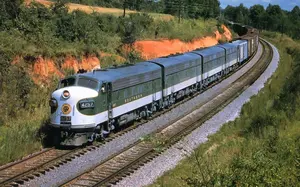
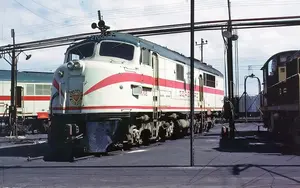
An Electro-Motive photograph of a new Gulf, Mobile & Ohio F3A in May 1947, the month the Alton merger took effect.
On this page: At a glance · The Gulf, Mobile & Northern · The Mobile & Ohio · The Alton · The finished railroad · Diesels · Passenger trains · Illinois Central Gulf · Public timetables, April 1948
At a glance
| Item | Detail |
|---|---|
| Railroad | Gulf, Mobile & Ohio. Mark GMO. Nickname Gee-Mo |
| Headquarters | Mobile, Alabama |
| Chartered | 1938, to merge the Gulf, Mobile & Northern and the Mobile & Ohio |
| Merger | September 13, 1940. The Alton followed on May 31, 1947 |
| States | Illinois, Missouri, Kentucky, Tennessee, Mississippi, Alabama, Louisiana |
| Route miles | 2,900 (1948) |
| Principal lines | Chicago–Springfield–St. Louis–Jackson, Tennessee–Mobile. Springfield–Kansas City. Jackson, Tennessee–Corinth, Mississippi–Mobile. Union–Jackson, Mississippi–New Orleans. Artesia, Mississippi–Montgomery. Memphis–Corinth on the Southern |
| Slogans | The Rebel Route, then The Alton Route |
| 1963 fleet | 246 diesel locomotives, 13,933 freight cars, 135 passenger cars. The all-time diesel roster is 406 road numbers |
| Last steam | October 7, 1949 |
| Into Illinois Central Gulf | August 10, 1972 |
The Gulf, Mobile & Ohio Railroad logo. Author's work.
In final form the railroad was largely end to end. Chicago, St. Louis, Kansas City, and Mobile were the corners, with New Orleans, Memphis, and Montgomery as the other gates. Branches were a short list beside that frame: Bloomington to Murrayville, Mexico to Fulton, Sherman to Peoria, Joliet to Blodgett and Mazonia, and Tuscaloosa to Birmingham. What made the map unusual was the pair of main lines south of Jackson, Tennessee. The Gulf, Mobile & Northern held the western one. The Mobile & Ohio held the eastern one, through Corinth, Mississippi. Both survived into the merged company.
The Gulf, Mobile & Northern
The western predecessor has its own article. Colonel Frank B. Merrill's Mobile, Jackson & Kansas City was organized in 1890 to build from Mobile to Jackson, Tennessee, west of the Mobile & Ohio. The first 49 miles followed the Pascagoula to Merrill, Mississippi. The north end began as a three-foot-gauge line, the Ripley Railroad. Failures, a lease, and a standard-gauging produced the New Orleans, Mobile & Chicago on December 1, 1909, and then, after a 1913 failure, the Gulf, Mobile & Northern on January 1, 1917. Work toward Jackson, Tennessee, began that year. Drury's figure for the finished main line, by 1920, is 408 miles.
The 1920s pushed the railroad past that main line. Preferential traffic agreements with the Chicago, Burlington & Quincy in 1922 came with 145 miles of trackage rights over the Nashville, Chattanooga & St. Louis, Jackson to Paducah. A branch to Dyersburg opened just before the Depression and met the Illinois Central and the Louisville & Nashville at Bells. South of the original railroad the company bought the Meridian & Memphis, acquired the Jackson & Eastern in 1926, finished Union to Jackson, Mississippi, in 1927, and in 1929 took control of the New Orleans Great Northern. New Orleans itself was trackage rights from Slidell over the Southern Railway.
Isaac Burton Tigrett of Jackson, Tennessee, carried the railroad through that growth. After the First World War, at 26, he was interim president. From 1920 he was president, and he led the merged company into 1952. During the 1920s he also brought in the Birmingham & Northwestern and a short line in Tennessee. In 1935 the Gulf, Mobile & Northern put on the Rebel, a semi-articulated trainset from American Car & Foundry, with an Alco power car and styling by Otto Kuhler. It was the first streamliner in the South, and the slogan that stuck was the Rebel Route. The locomotives, 109 entries in Drury's post-1900 class list, are the steam roster. The dates, the narrow-gauge predecessors, and the Rebel's route are on the Gulf, Mobile & Northern page.
The Mobile & Ohio
The eastern predecessor has its own article. Chartered early in 1848, the Mobile & Ohio reached Columbus, Kentucky, on April 22, 1861, and that line became this railroad's eastern road south of Jackson, Tennessee, through Corinth, Mississippi. The Ohio River bridge and Cairo opened in May 1882. St. Louis came by the February 1, 1886 lease of the former three-foot Cairo & St. Louis. In 1898 the road opened from Artesia, Mississippi, through Tuscaloosa to Montgomery. The Southern Railway held it from 1901 for about thirty years. In the March 1940 Official Guide it was in receivership, 1,180.45 miles, and trains 15 and 16 were the Gulf Coast Special. Ike Tigrett's merger with the Gulf, Mobile & Northern was completed on September 13, 1940.
The December 1938 map, Official Guide pages 485 through 487, and the construction of the Cairo & St. Louis are on the Mobile & Ohio page. George Drury's post-1900 class list is the Gulf, Mobile & Northern roster.
The Alton
The way into Chicago was the Alton Railroad. The Baltimore & Ohio bought the bankrupt Chicago & Alton at foreclosure in 1929, and in 1931 the property took the name Alton Railroad. The Baltimore & Ohio had pictured it as a link from Baltimore through to Kansas City. The 1930s ended that plan. The Alton returned to the courts in 1942. The Gulf, Mobile & Ohio merged it on May 31, 1947. The full corporate story, from the Alton & Sangamon onward, is the Alton page.
The short version is a Springfield railroad that grew into a Chicago, St. Louis, and Kansas City line. The Alton & Sangamon was chartered on February 27, 1847. On June 15, 1852, it became the Chicago & Mississippi. Service reached Joliet in 1855, and the Joliet & Chicago, chartered that year, opened in 1856. In 1857 the company was the St. Louis, Alton & Chicago. The Chicago & Alton was formed on February 18, 1861. The Alton & St. Louis, chartered February 4, 1859, put the railroad into East St. Louis by 1865. Kansas City came by lease: the Louisiana & Missouri River in 1870, and the Kansas City, St. Louis & Chicago in 1878.
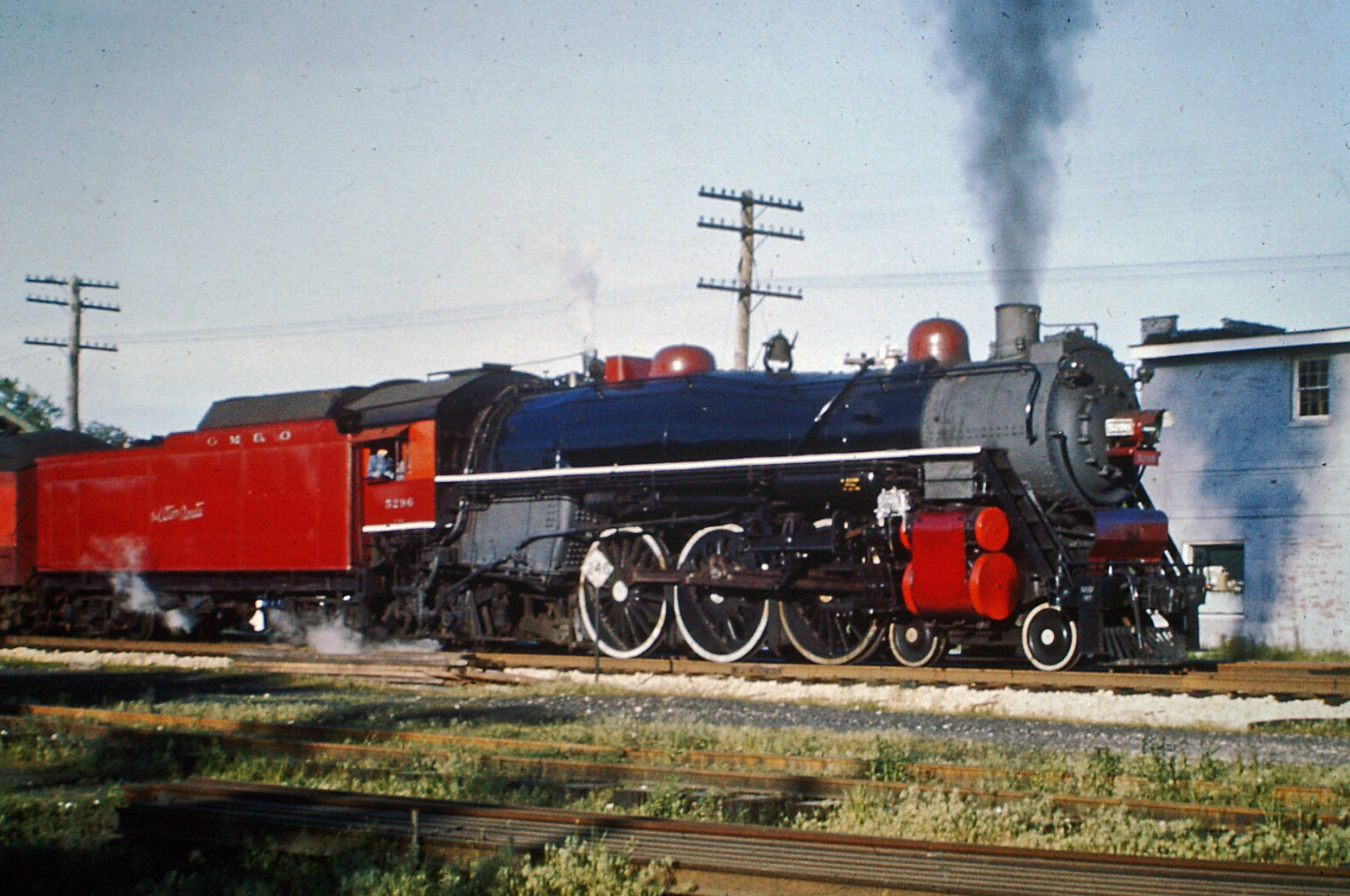
Gulf, Mobile & Ohio 4-6-2 5296, the former Chicago & Alton 656, in red paint on the tender, cab, and cylinders, leaving Brighton, Illinois, with a southbound local in March 1947. Cedric Prusia photo.
In March 1947, with the merger dated May 31, Pacific 5296 was already leaving Brighton lettered for the Gulf, Mobile & Ohio. Alton steam that arrived with the merger is a different roster from the Gulf, Mobile & Northern classes on the steam page. The Chicago & Alton also holds a short list of passenger "firsts," all of them that railroad's and all of them told at more length on the Alton page. The first Pullman sleeper was built in the Bloomington shops. An early steel bridge carried the line over the Missouri River at Glasgow. Reclining-seat cars were an early assignment on its trains. The Delmonico, a Pullman product, went into service on the Chicago & Alton in 1868 and is regarded as the first dining car.
The finished railroad
With the Alton aboard, the slogan became The Alton Route. Chicago–St. Louis streamliners wore two-tone maroon and red with yellow trim. Later freight hoods carried the black-and-white winged herald. The system of 1948, about 2,900 miles, connected Chicago, St. Louis, Kansas City, and Mobile, and it reached New Orleans, Memphis, and Montgomery. The two southern main lines still ran side by side between Mobile and Jackson, Tennessee. Memphis was a Southern Railway trackage-rights turn out of Corinth.
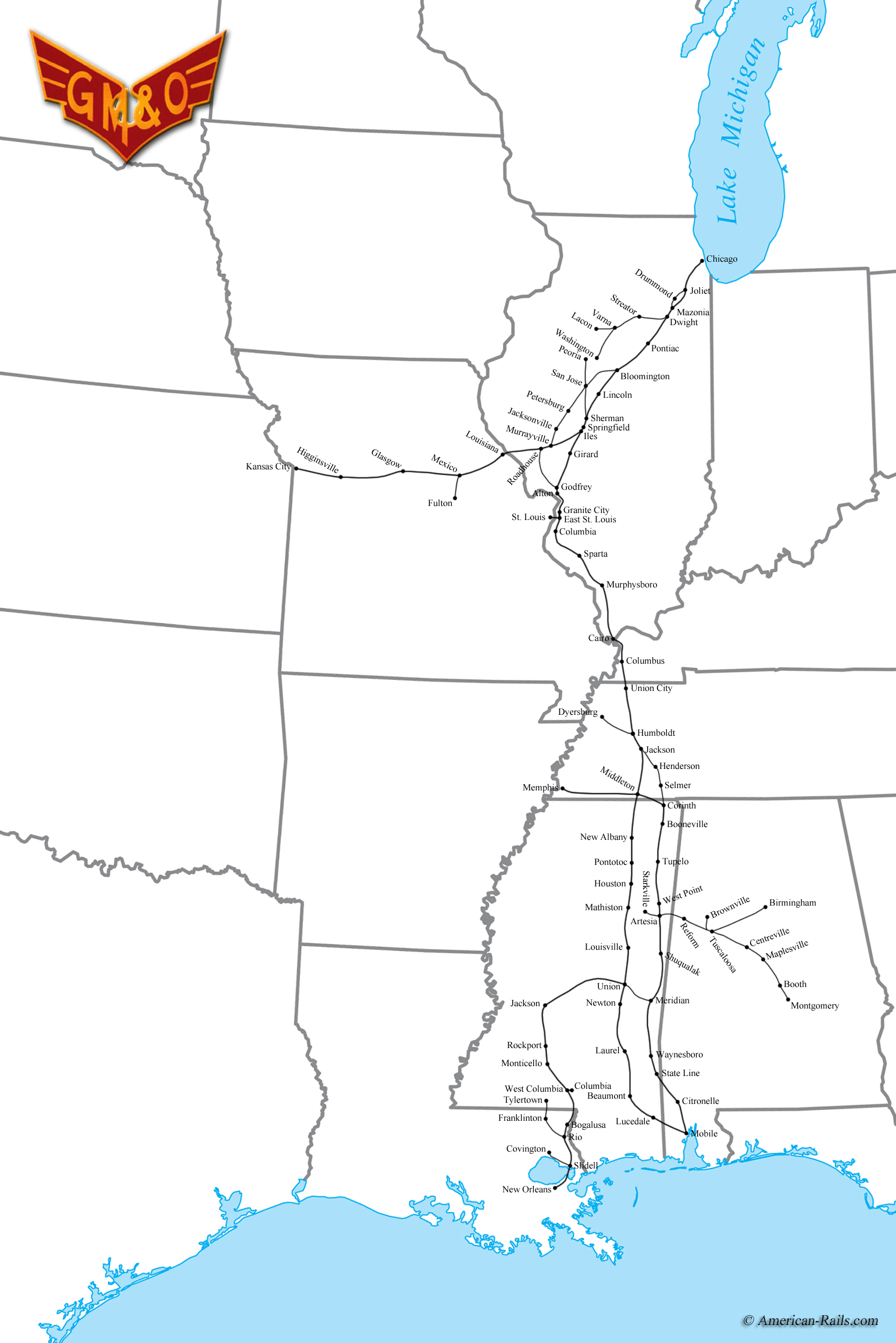
A 1952 system map of the Gulf, Mobile & Ohio. Author's work.
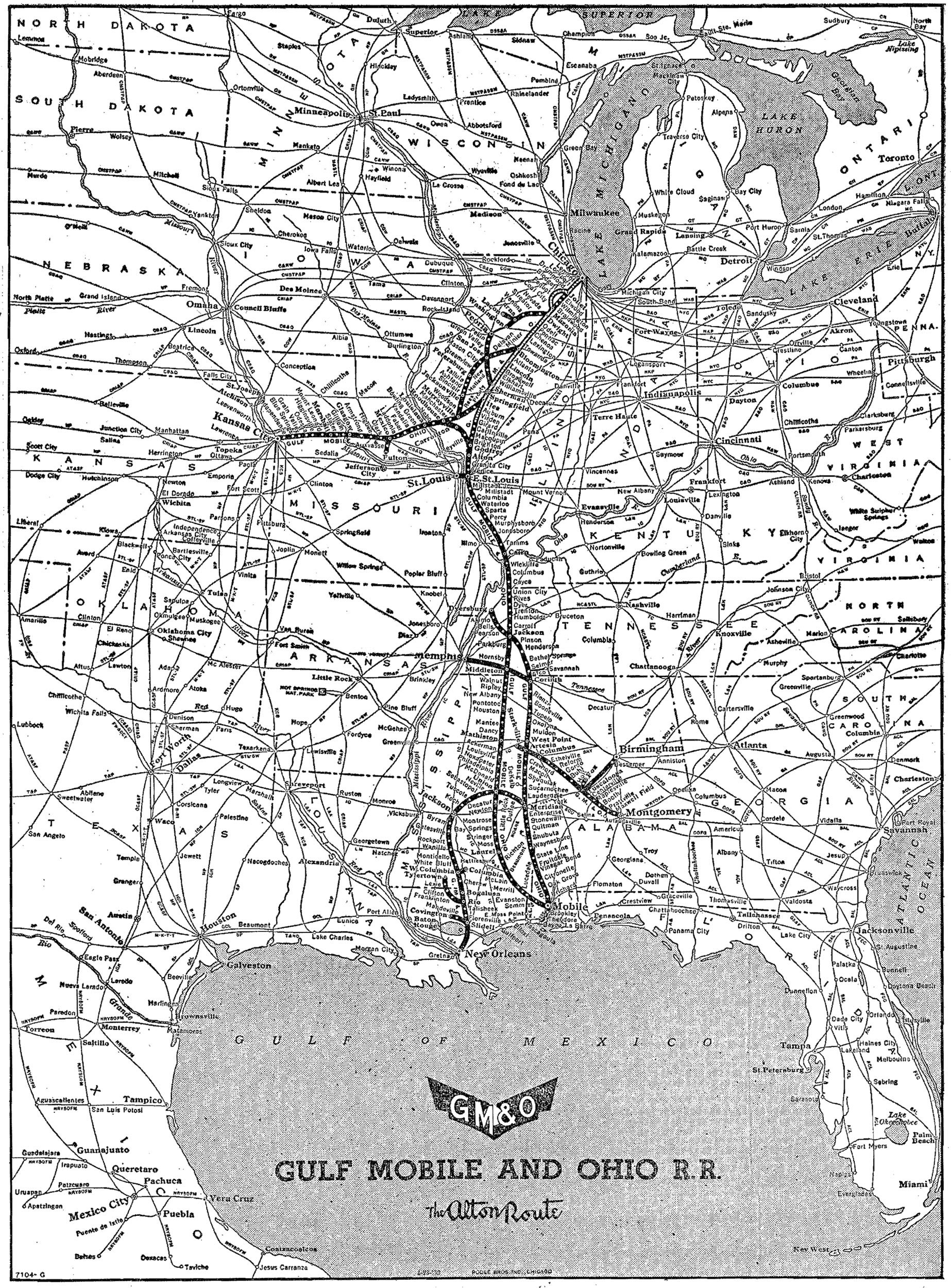
An official 1952 system map of the Gulf, Mobile & Ohio Railroad. Author's collection.
The freight was unit coal, wood products from the Southeast, chemicals off the Gulf Coast, and merchandise between the cities and the interchange points. The large terminals sat at Chicago's Glenn Yard, New Orleans, Montgomery, Kansas City, St. Louis, Meridian, Bloomington, Venice, Illinois, Jackson, and Mobile. On the southern end a local freight still called at the small-town depots the two predecessor main lines had built.
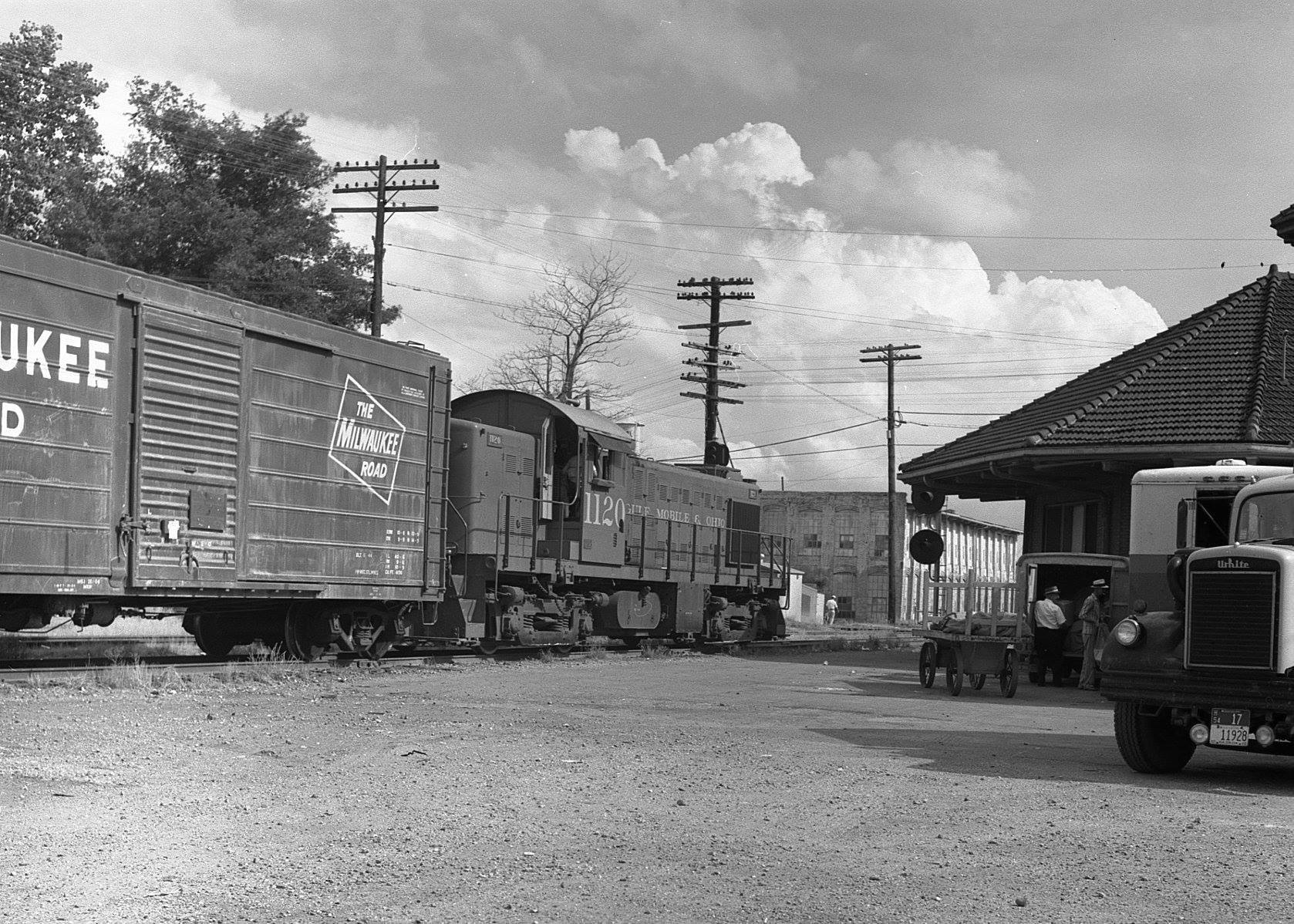
RS1 1120 on local service at the Tupelo, Mississippi, depot in May 1965. Bill McCoy photo. Warren Calloway collection.

A pair of FA-1s, led by 724, with a mixed freight at New Albany, Mississippi, in May 1965. Bill McCoy photo. Warren Calloway collection.
Diesels
The all-time diesel roster counts 406 road numbers, with the builder's serial and the order or specification on each batch. The 1963 figure of 246 locomotives is that year's fleet, counted beside 13,933 freight cars and 135 passenger cars. The freight cab of the 1940s was the Alco FA-1, fifty-five of them in the 700s, often with an FB booster. EMD F3s handled freight and the Chicago suburban trains. The second generation was EMD's: GP30s, GP35s, three kinds of GP38, and twenty-one SD40s plus the SD40 demonstrator. Ingalls Shipbuilding at Pascagoula finished one diesel, No. 1900, and the railroad bought it in June 1946.
The oldest unit was older than the company. Electro-Motive built a boxcab in August 1935 as Baltimore & Ohio 50. It went to the Alton in April 1936 for the Abraham Lincoln and became Gulf, Mobile & Ohio 1200. Retired in 1956, it is at the Museum of Transportation in St. Louis, on the Missouri museum page. The last revenue steam run was October 7, 1949, and the railroad closed out steam that month.

A publicity photograph of new SD40 906 with a new string of covered hoppers loaded with alumina, March 1966.
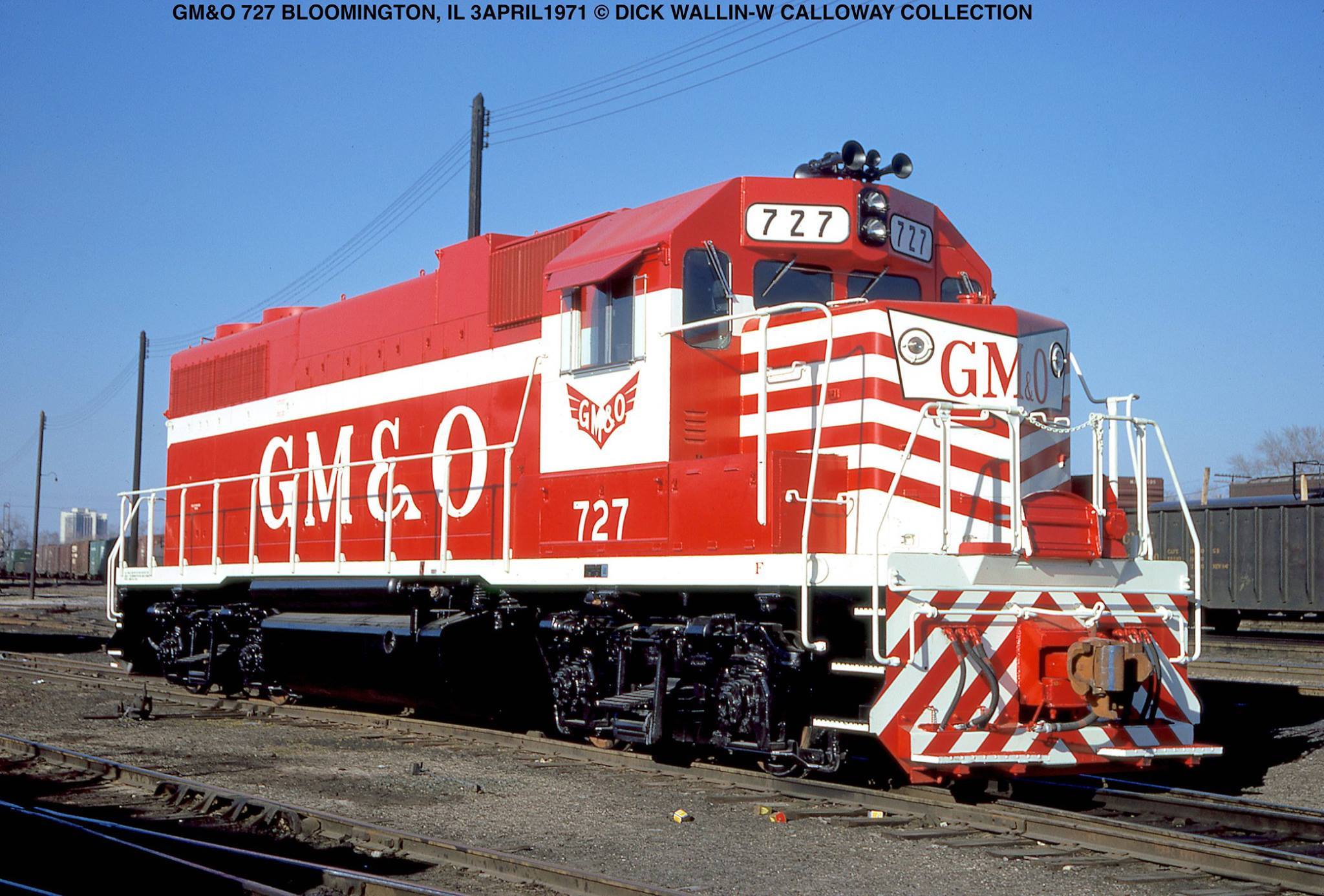
New GP38AC 727 at Bloomington, Illinois, on April 3, 1971. Dick Wallin photo. Warren Calloway collection.

F3s led by 807-B on a northbound freight near Odell, Illinois, on August 15, 1965. Route 66 is at the right. Marty Bernard photo.
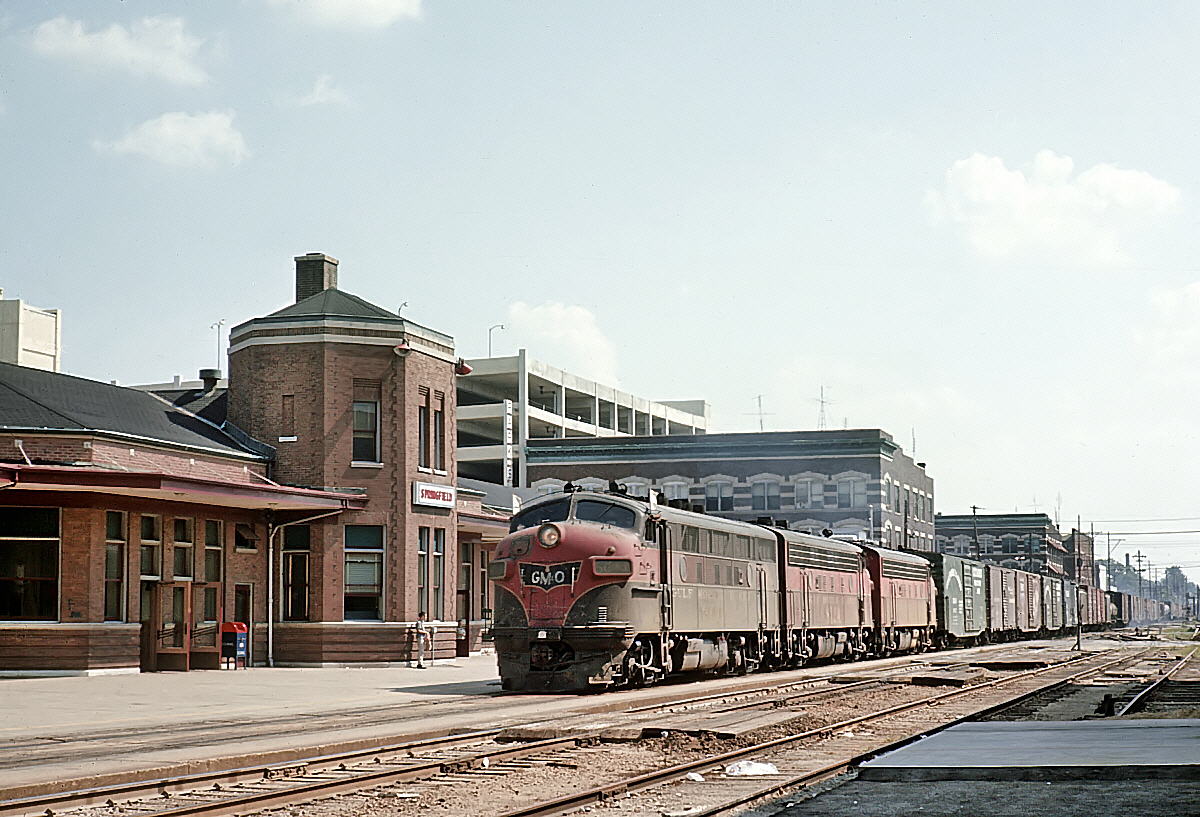
F3A 809A and a pair of F7As lead a freight past the station in Springfield, Illinois, on August 15, 1965. Marty Bernard photo.
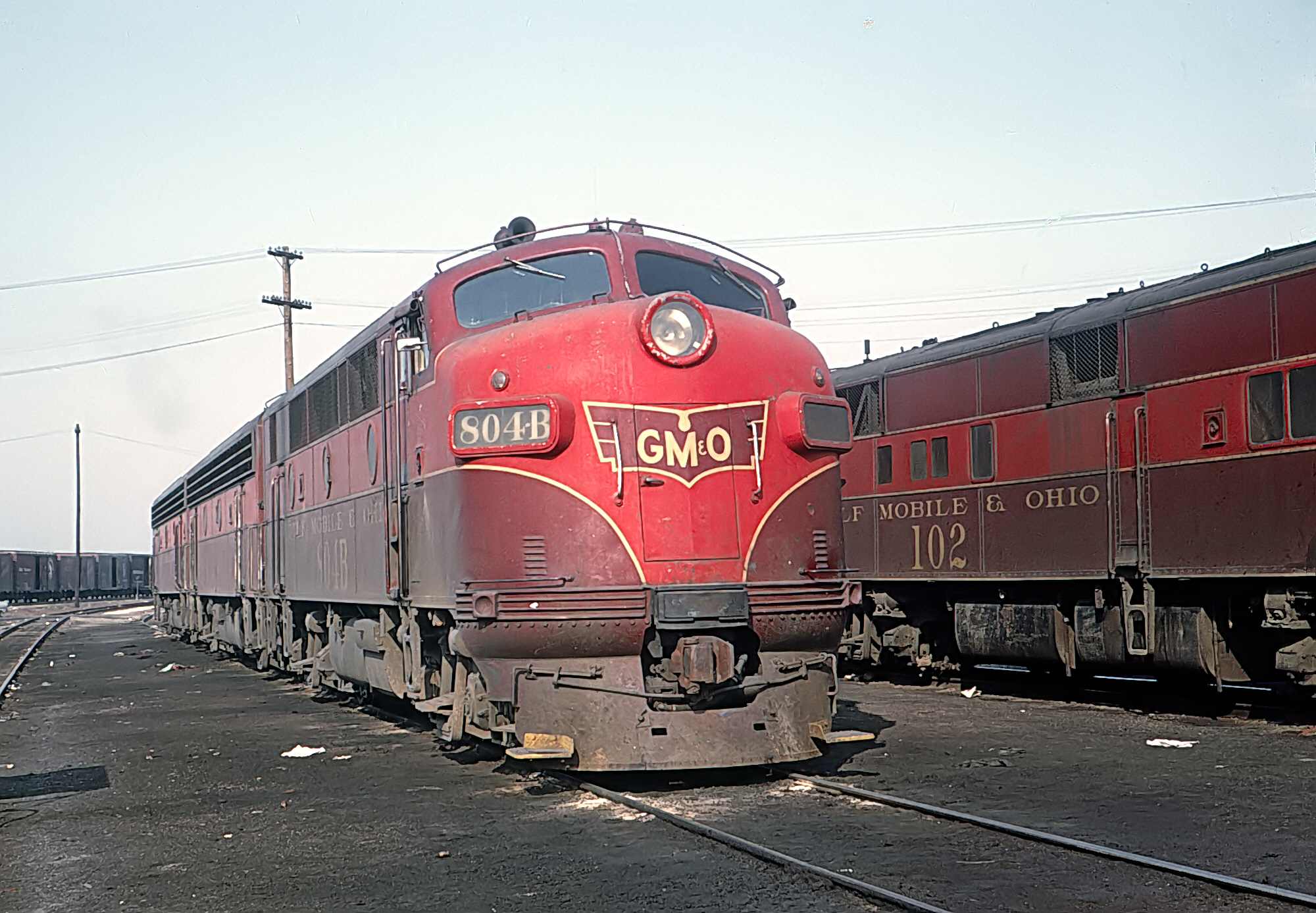
F3A 804B and other power laying over at Glenn Yard, Forest View, Illinois, on April 21, 1965. Marty Bernard photo.
Passenger trains
The famous train was older than the Alton merger. The Rebel was a Gulf, Mobile & Northern train of 1935, Jackson, Tennessee, to New Orleans and Mobile. On the Chicago–St. Louis line the Alton names continued: the Alton Limited, the Abraham Lincoln, the Ann Rutledge, the Midnight Special, the Prairie State Express, and The Mail. The Night Hawk ran St. Louis–Kansas City. The Gulf Coast Rebel ran St. Louis–Mobile and Montgomery. The Ann Rutledge name ran on under Amtrak. Chicago–St. Louis passenger service on the old Alton continues as Amtrak's Lincoln Service.
- Alton Limited — Chicago–St. Louis
- Abraham Lincoln — Chicago–St. Louis
- Ann Rutledge — Chicago–St. Louis
- Gulf Coast Rebel — St. Louis–Mobile and Montgomery
- Midnight Special — Chicago–St. Louis
- Night Hawk — St. Louis–Kansas City
- Prairie State Express — St. Louis–Chicago
- The Mail — Chicago–St. Louis
- The Rebel — Jackson, Tennessee–New Orleans and Mobile
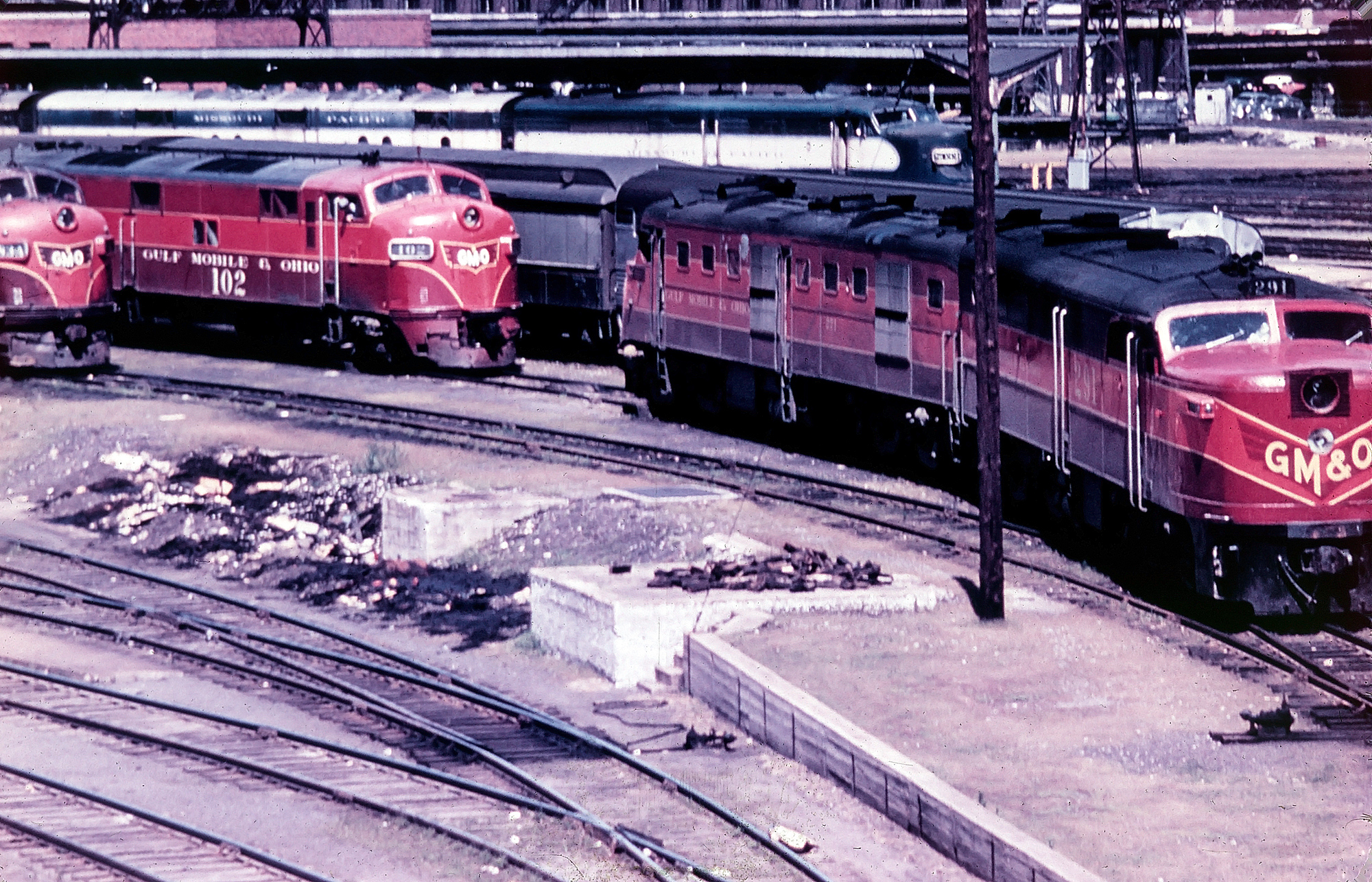
St. Louis Union Station on June 23, 1957, with PA-1 291, DL-109 271, E7A 102, and F3A 883-A. American-Rails.com collection.

Train 19, the southbound Ann Rutledge, Chicago to St. Louis, backing into St. Louis Union Station on June 23, 1957, behind F3A 881-B. American-Rails.com collection.
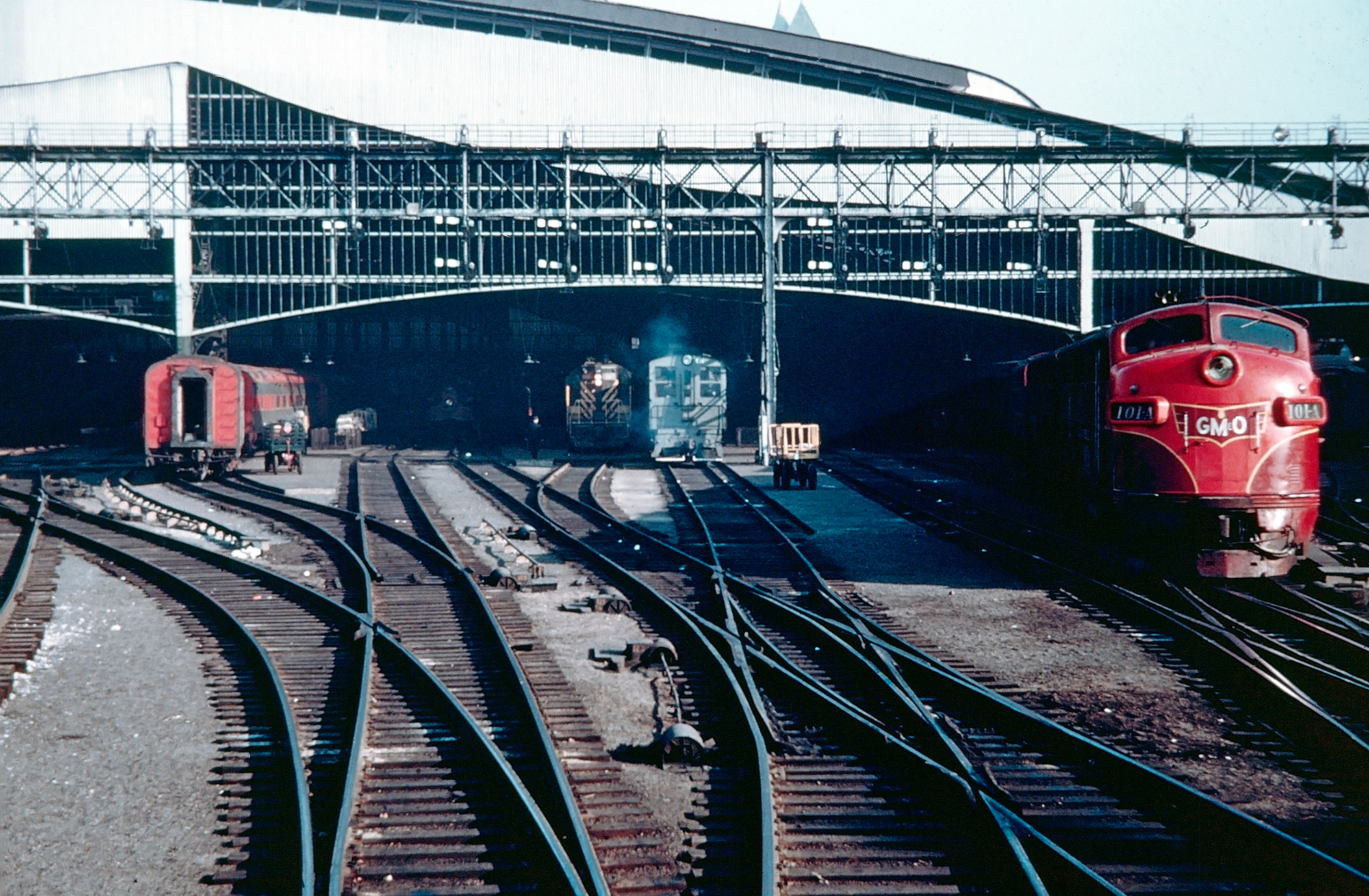
St. Louis Union Station in the 1950s. From right to left: E7A 101-A waits with its train, a Terminal Railroad Association of St. Louis switcher works a few tracks over, a Nickel Plate Road train stands nearby, and an Illinois Central E unit is just visible under the shed. A. C. Kalmbach photo. American-Rails.com collection.
Amtrak took the intercity trains on May 1, 1971. A month earlier the Chicago–Joliet commuter train was still a Gulf, Mobile & Ohio run. Train 17, which crews called the Plug, left Chicago Union Station for Joliet behind F3A 883-A on March 30, 1971. That suburban service outlived the intercity timetable. It later ran as Metra's Heritage Corridor.

F3A 883-A leaves Chicago Union Station with the commuter train to Joliet, train 17, on March 30, 1971. Marty Bernard called this train the Plug. Marty Bernard photo.

RS1 1106 switching at Chicago Union Station on December 26, 1961, with the Pennsylvania Railroad freight depot behind the train. Marty Bernard photo.
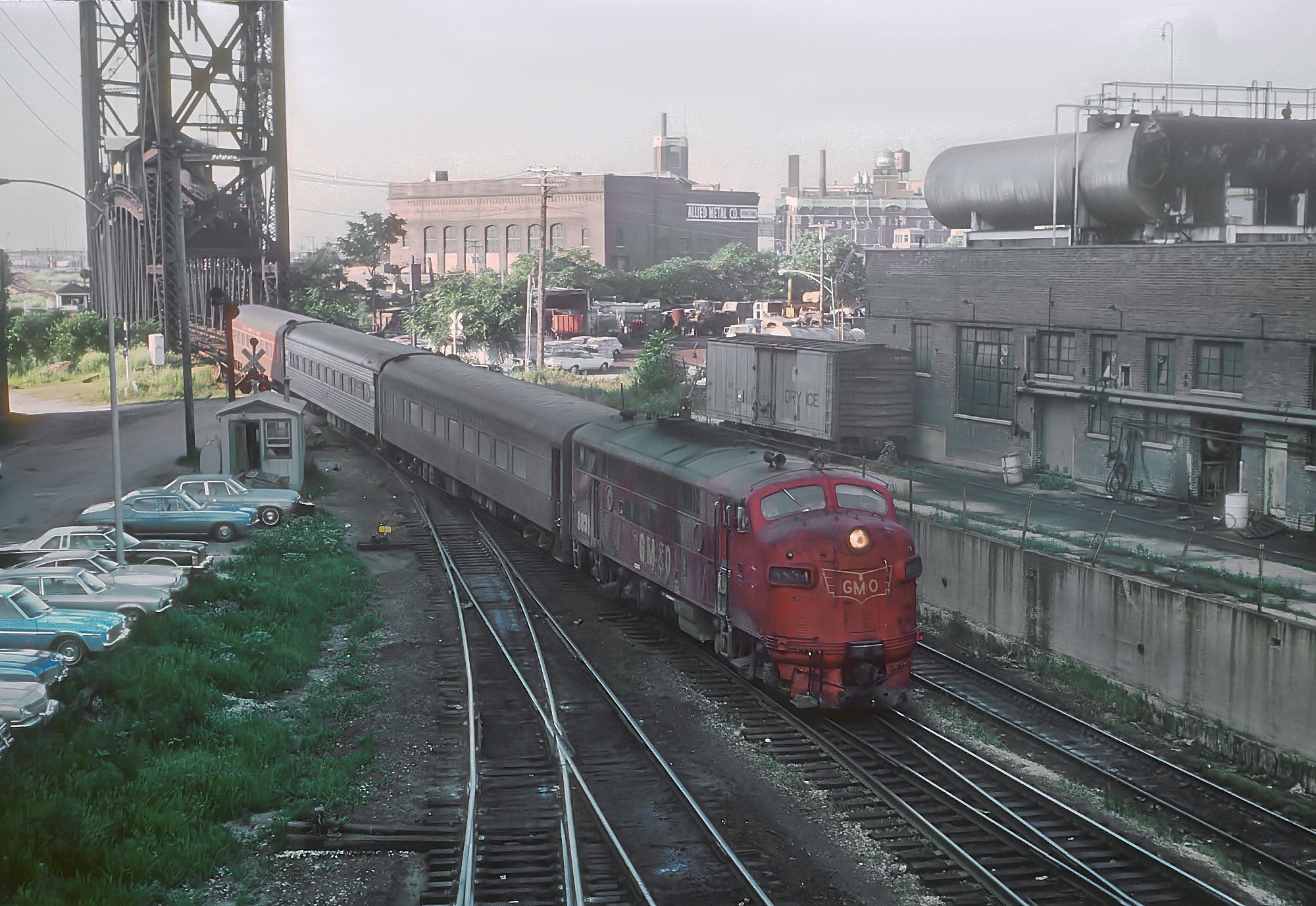
F3A 883A on an inbound commuter train, crossing the South Chicago River and about to duck under the 18th Street Bridge in Chicago, August 1978. The unit is still in Gulf, Mobile & Ohio paint. Rick Burn photo.
Illinois Central Gulf
By the end of the 1960s the two competitors were candidates for one company. Illinois Central Gulf took effect on August 10, 1972, after a three-judge panel in St. Louis dismissed complaints from the Missouri Pacific and the Kansas City Southern. Alan Boyd became president and chief executive. Glen Brock, president of the Gulf, Mobile & Ohio from May 1957, became chairman of the board. William B. Johnson became chairman of the executive committee. The two railroads had paralleled each other from the Great Lakes toward the Gulf, and the argument over that merger has run ever since. Through the 1980s the Illinois Central Gulf sold or abandoned thousands of miles. By the close of the decade it was down to about 2,800 route miles.
On February 29, 1988, Illinois Central Gulf dropped Gulf from the name and was the Illinois Central again. Canadian National bought that company on February 11, 1998. The lines the Illinois Central Gulf had already sold went their own way. The Gulf & Mississippi began service on July 10, 1985, on the former Mobile & Ohio and Gulf, Mobile & Northern track through Mississippi, Tennessee, and Alabama, and in April 1988 it passed to MidSouth's SouthRail. In 1987 the former Alton lines, Chicago to Kansas City by way of Springfield and St. Louis, went to the Chicago, Missouri & Western. That company failed. In 1989 the Southern Pacific took the Chicago–St. Louis line, and in January 1990 the Kansas City line opened as the Gateway Western. Union Pacific, which absorbed the Southern Pacific in 1996, runs the Chicago–St. Louis main line. Kansas City Southern later absorbed the Gateway Western, and that railroad is now part of Canadian Pacific Kansas City.
Public timetables (April, 1948)
A year after the Alton merger, the public timetable of April 1948 is the finished railroad on paper: Chicago, St. Louis, Kansas City, and the Gulf on one system. The ten scans below are that issue, from the author's collection.
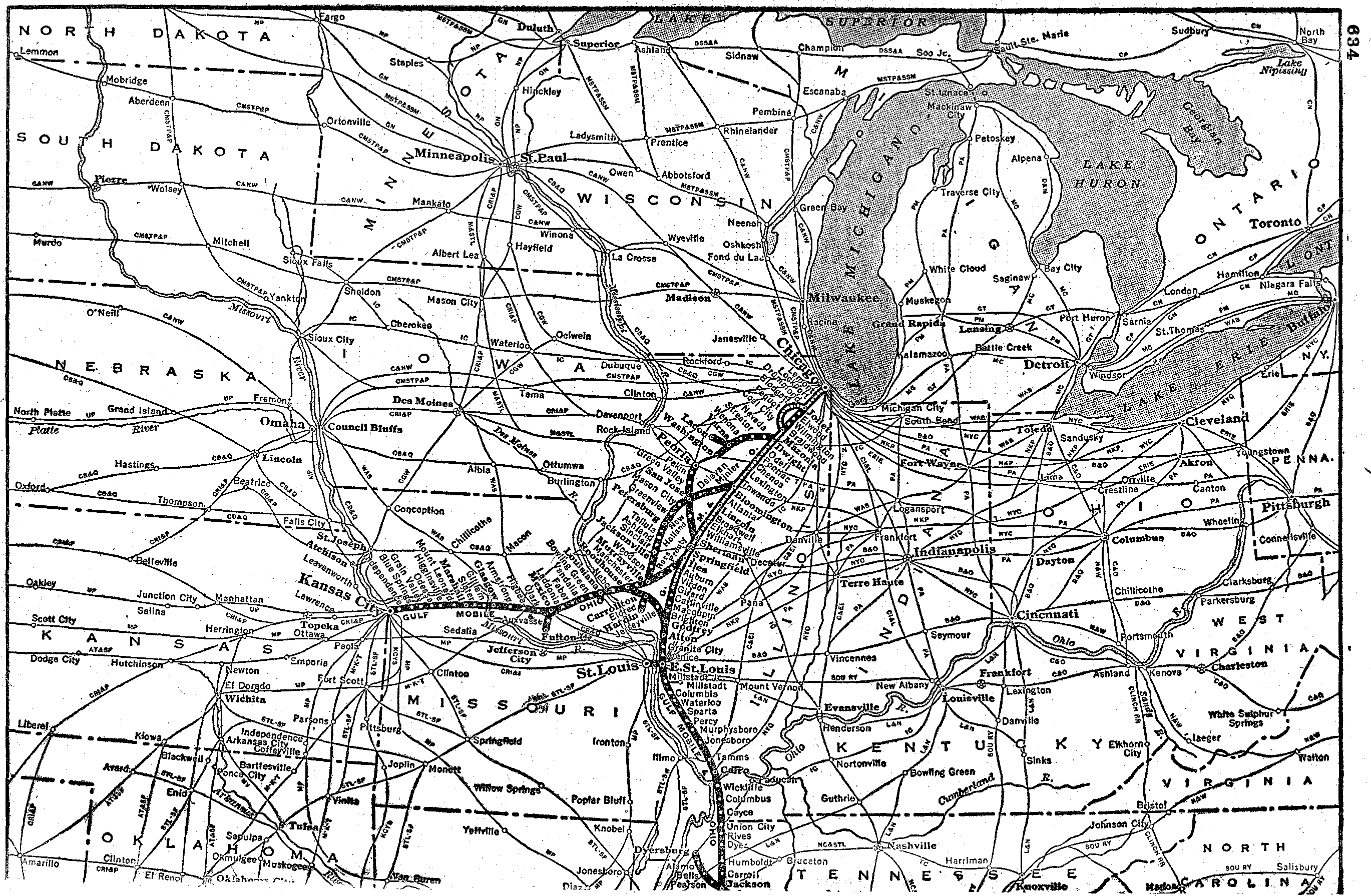
The Gulf, Mobile & Ohio system map, April 1948. Author's collection.
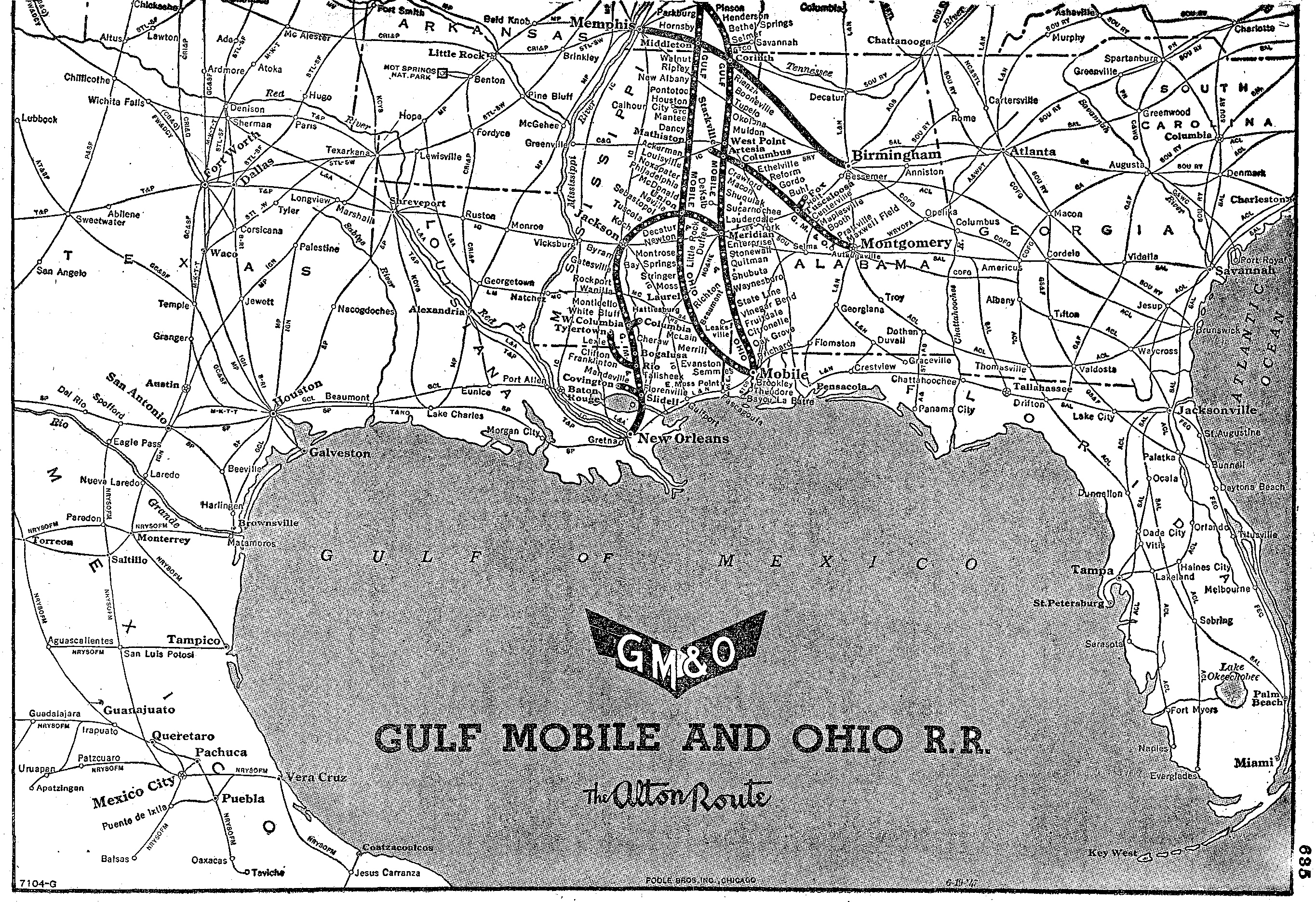
The Gulf, Mobile & Ohio system map, April 1948. Author's collection.
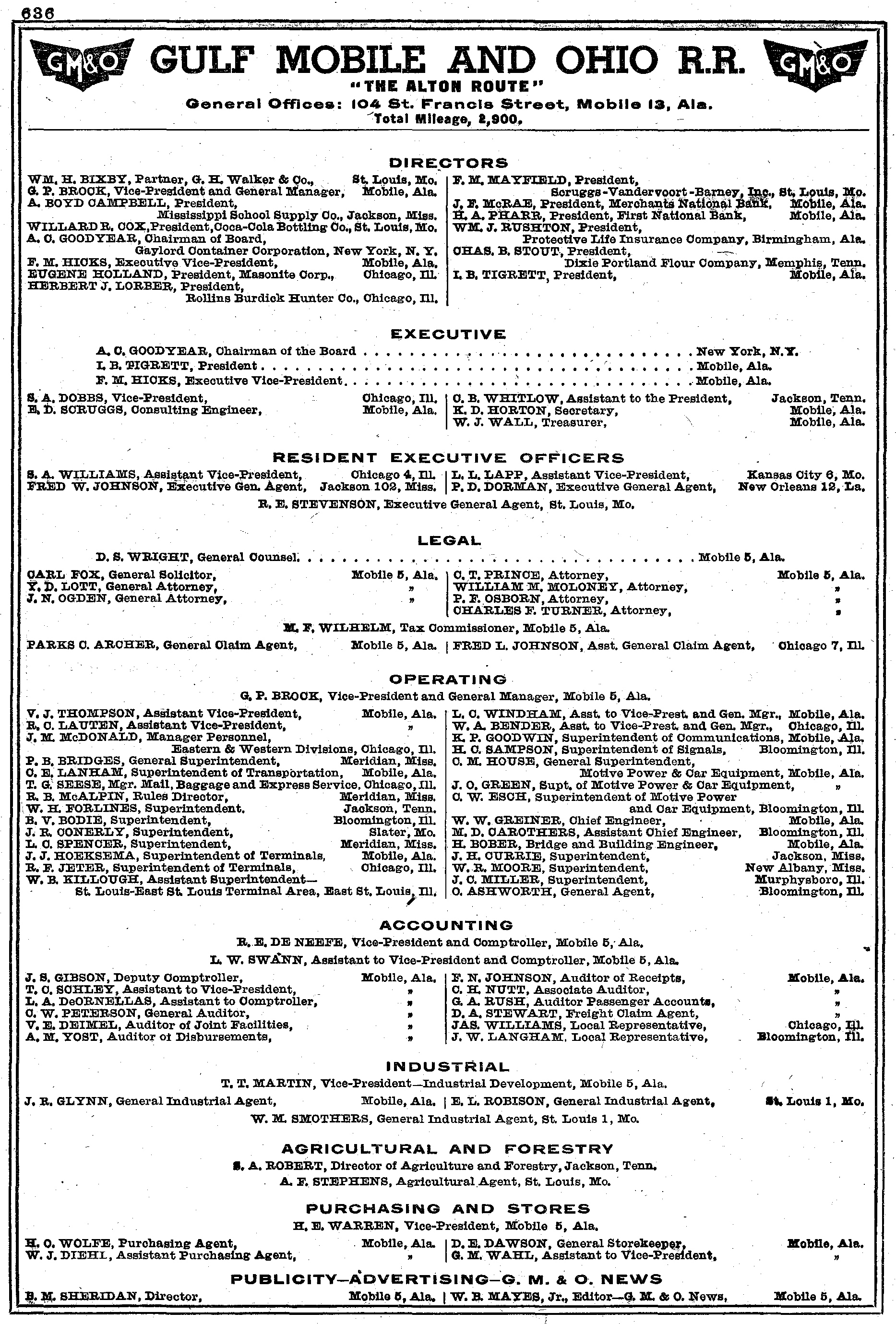
A Gulf, Mobile & Ohio public timetable, April 1948. Author's collection.
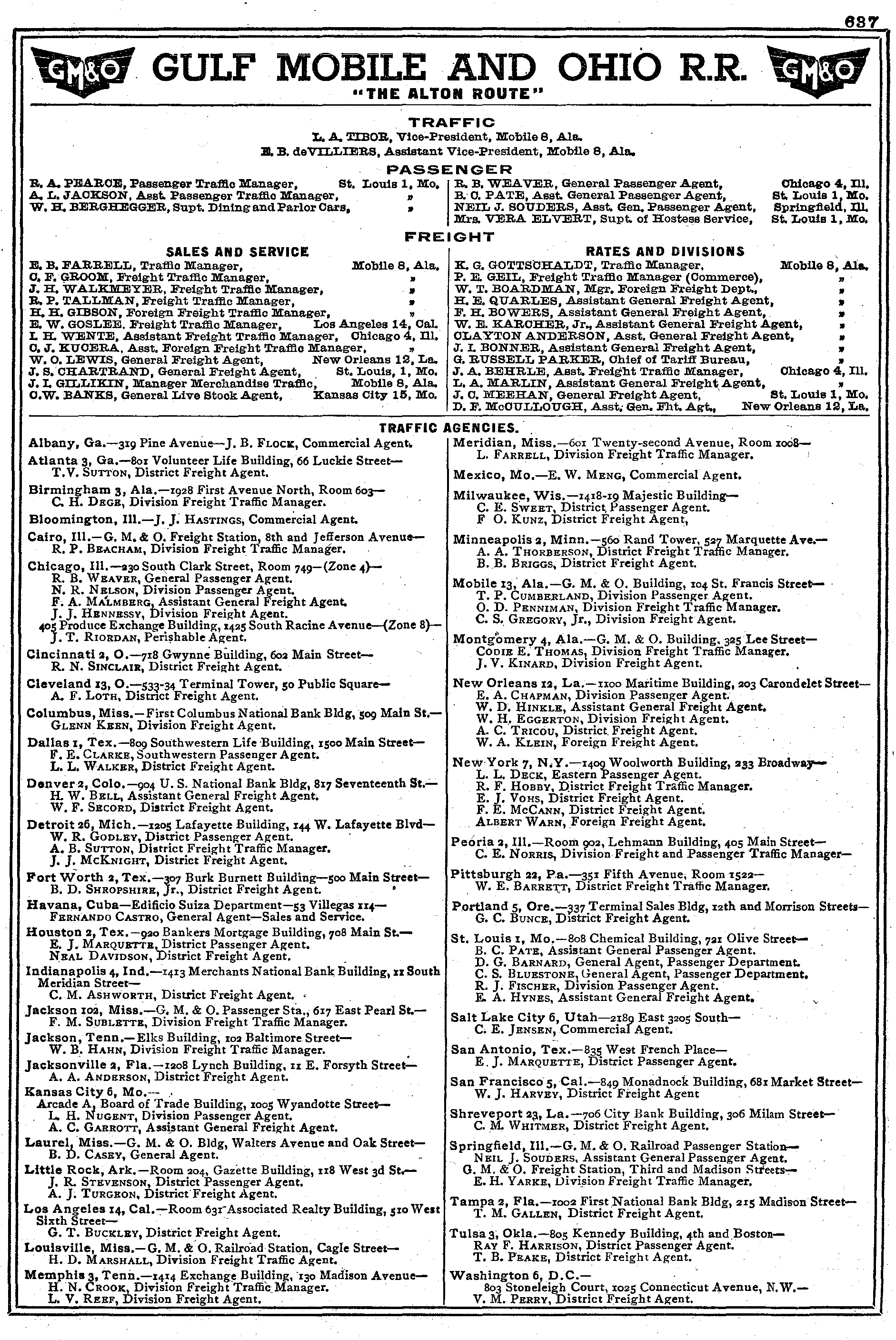
A Gulf, Mobile & Ohio public timetable, April 1948. Author's collection.
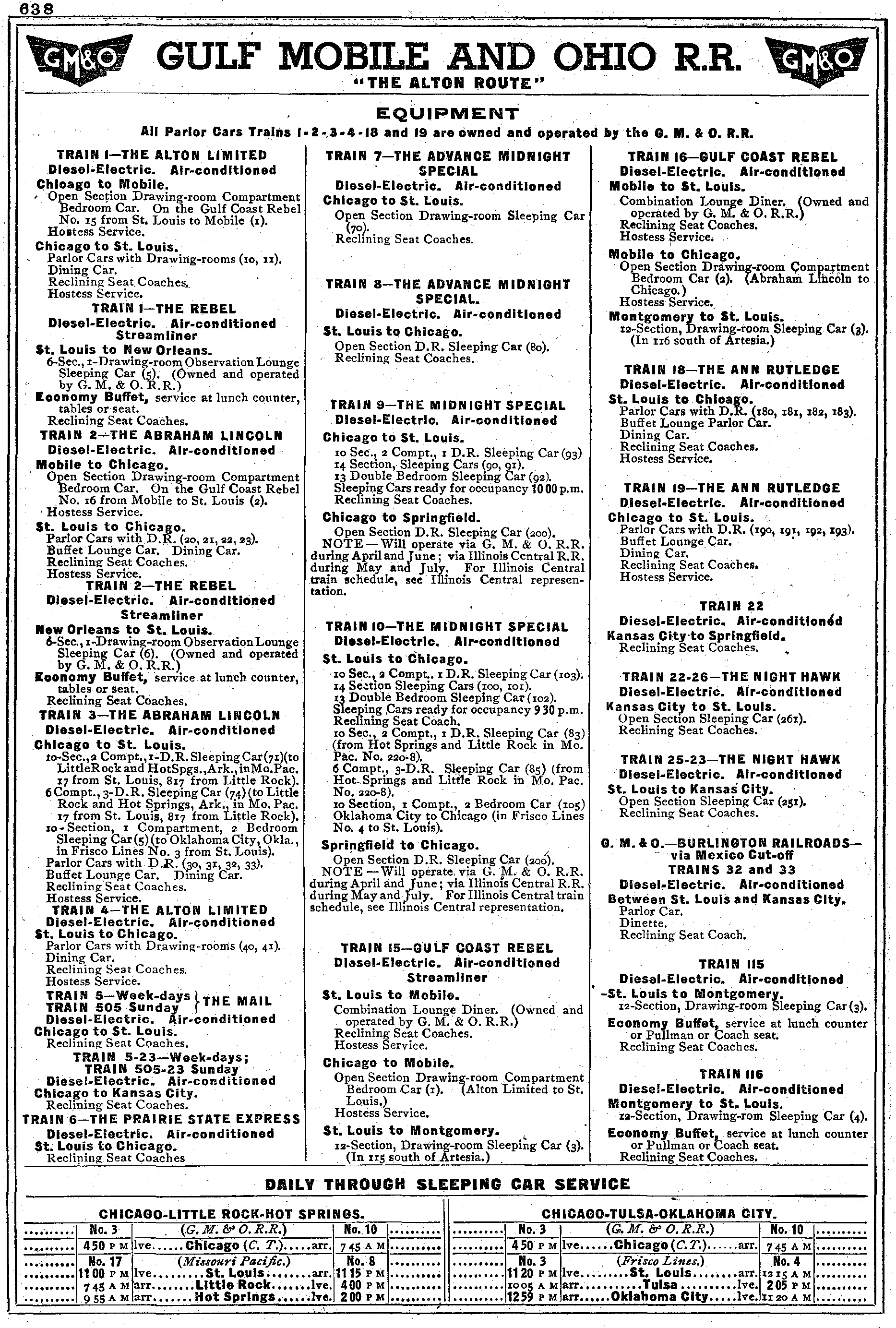
A Gulf, Mobile & Ohio public timetable, April 1948. Author's collection.
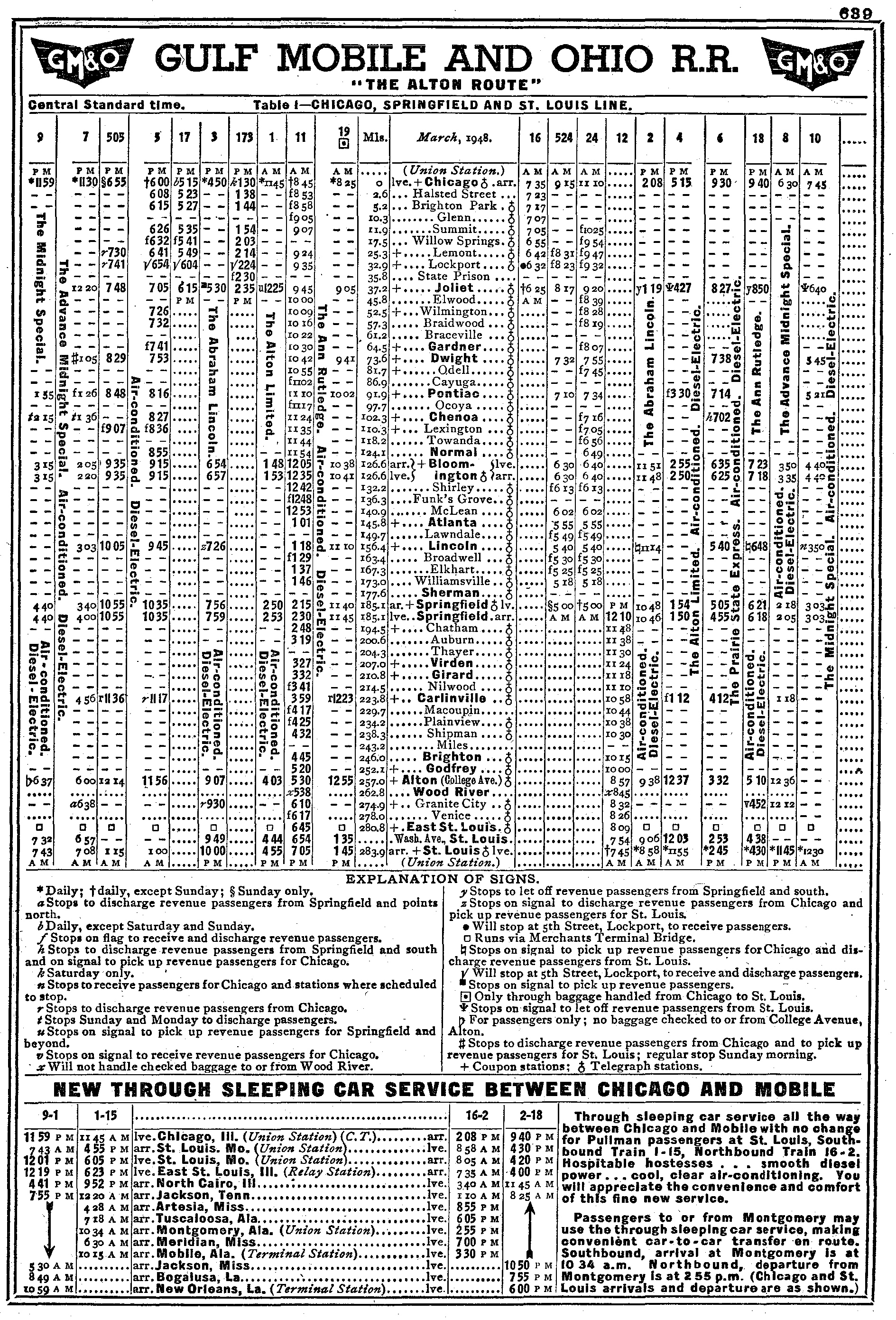
A Gulf, Mobile & Ohio public timetable, April 1948. Author's collection.
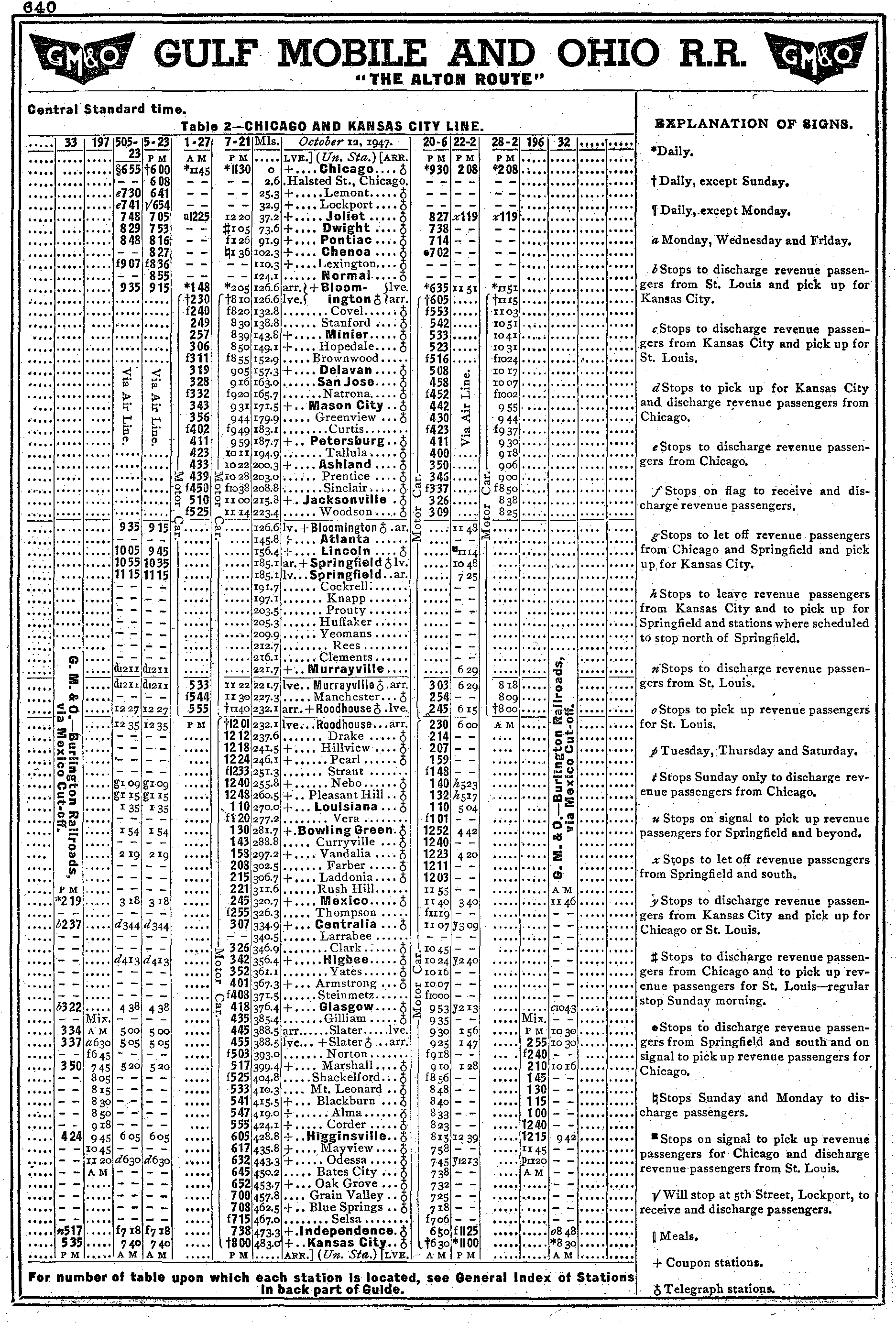
A Gulf, Mobile & Ohio public timetable, April 1948. Author's collection.
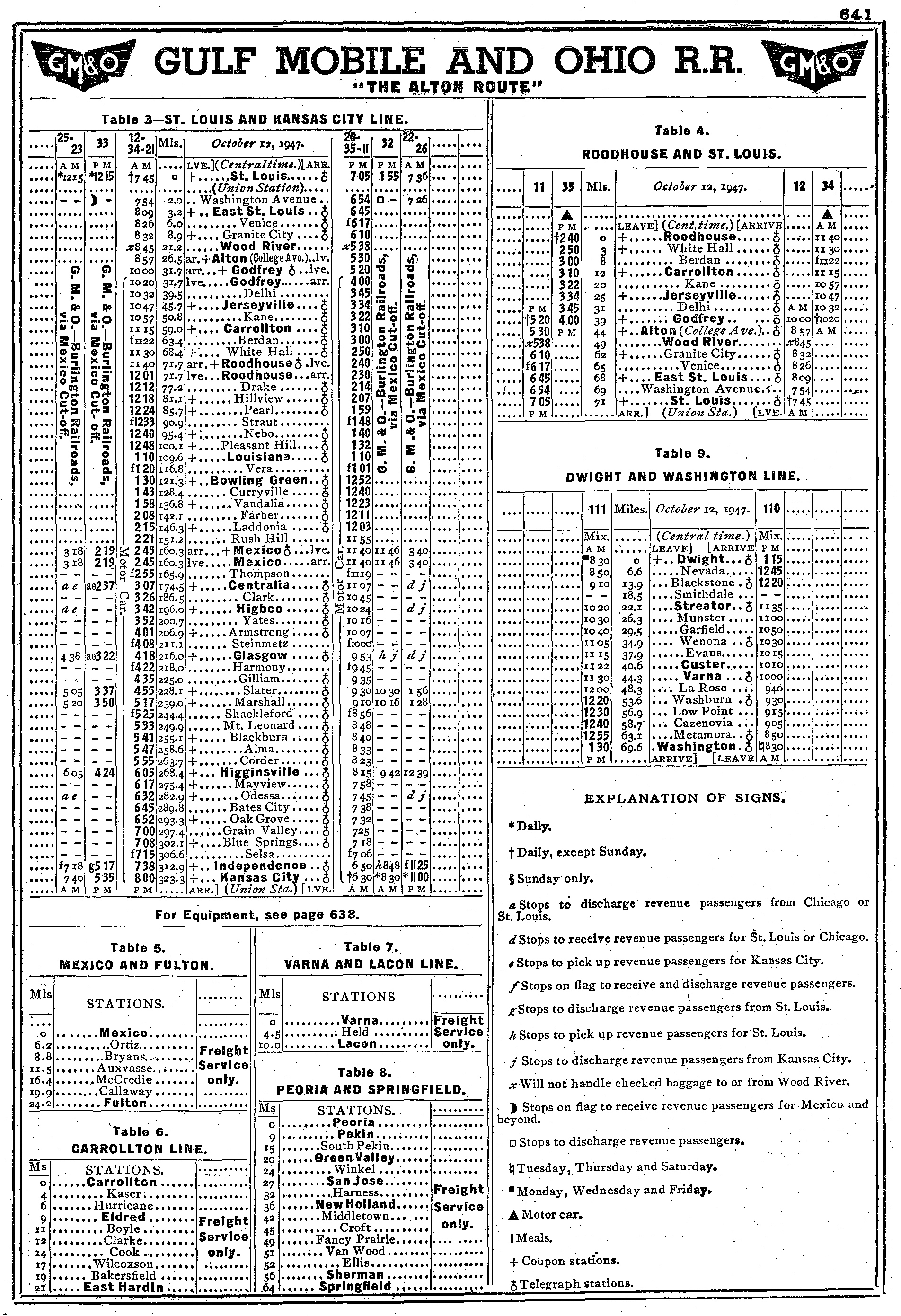
A Gulf, Mobile & Ohio public timetable, April 1948. Author's collection.
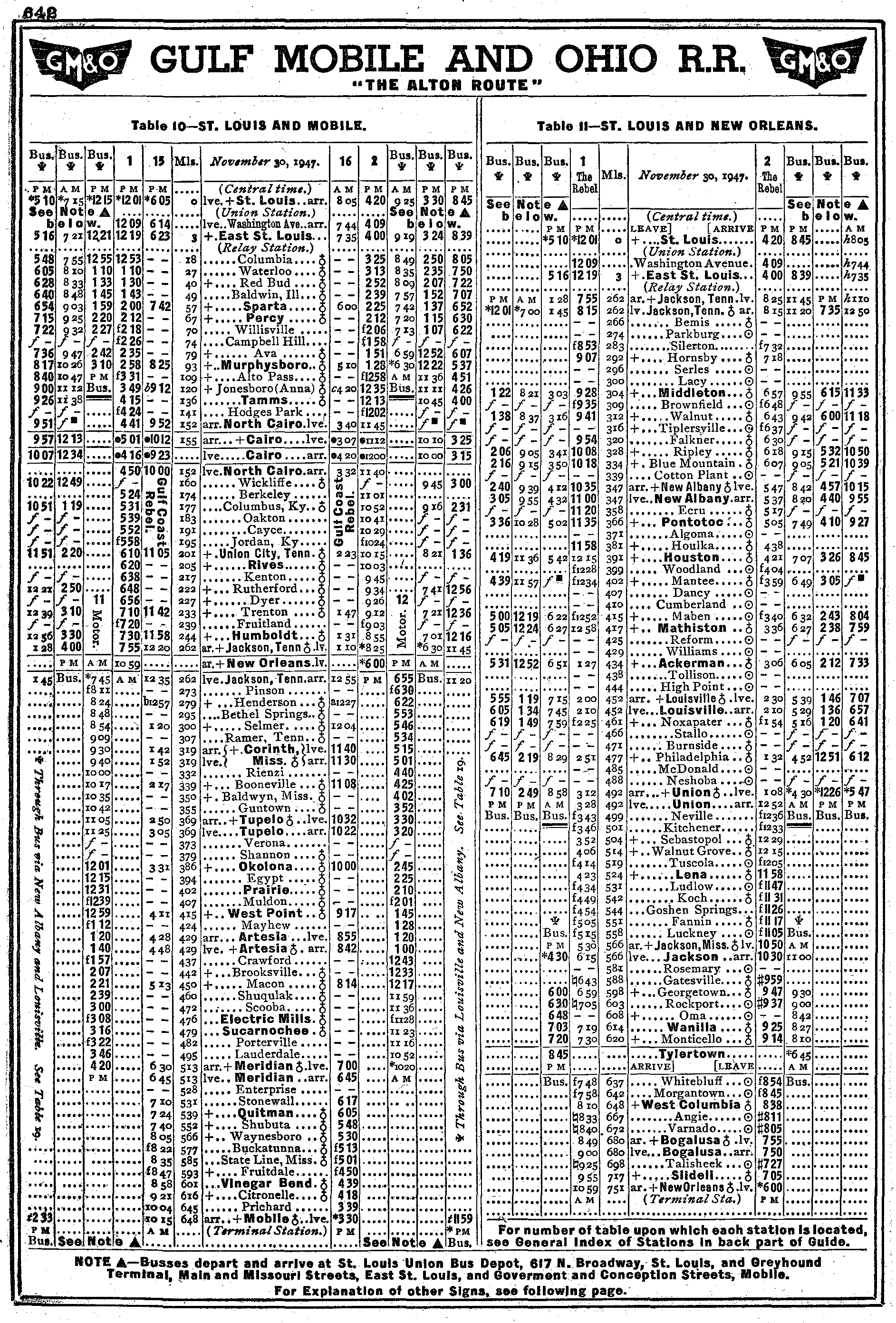
A Gulf, Mobile & Ohio public timetable, April 1948. Author's collection.
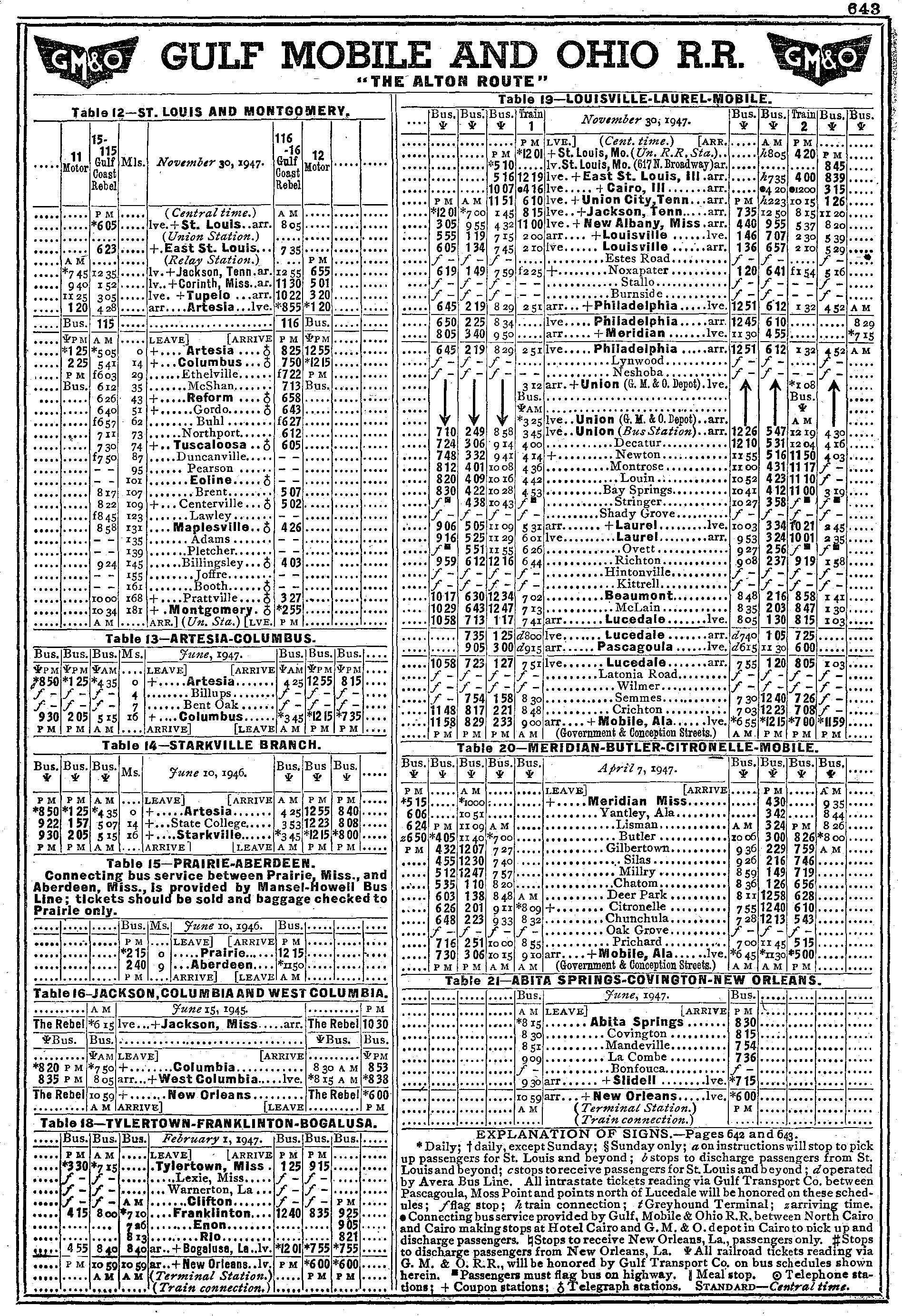
A Gulf, Mobile & Ohio public timetable, April 1948. Author's collection.
Related reading on American-Rails.com
- Mobile & Ohio · Gulf, Mobile & Northern · GM&N steam roster
- GM&O diesel roster · The Rebel · Alton Railroad
- Amtrak · Illinois Central · Southern Railway
- Baltimore & Ohio · Gulf & Mississippi · Gateway Western
Sources
- George H. Drury, Guide to North American Steam Locomotives, revised edition, pp. 186–187. The Gulf, Mobile & Northern's 408-mile main line by 1920, and the last revenue steam run on October 7, 1949
- George W. Hilton, American Narrow Gauge Railroads. The Cairo & St. Louis chapter is told on the Mobile & Ohio page
- Mike Schafer, More Classic American Railroads. The 1938 charter and the September 13, 1940 merger, led by Ike Tigrett
- James H. Lemly, The Gulf, Mobile and Ohio: A Railroad That Had to Expand or Expire (1953)
- Kirk Reynolds and David Oroszi, Baltimore & Ohio Railroad. The 1929 foreclosure purchase of the Chicago & Alton. The Alton Railroad name is 1931, reported in the New York Times of January 24, 1931
- The Official Guide, March 1940, Mobile & Ohio pages 485–487. Receivers C. E. Ervin and T. M. Stevens, 1,180.45 miles, the Gulf Coast Special, and the map dated December 1938. Those pages are reproduced on the Mobile & Ohio article
- New York Times, August 11, 1972. Illinois Central Gulf effective the day before, after a three-judge panel in St. Louis dismissed the Missouri Pacific and Kansas City Southern complaints. Alan Boyd, Glen Brock, and William B. Johnson in the new offices
- The diesel serials and order numbers are on the diesel roster. The 1963 count of 246 locomotives is a one-year fleet figure from the old company summary
Recent Articles


-
Akron, Canton and Youngstown Railroad: Map, History, Rosters
Oct 17, 26 05:49 PM
 Akron, Canton and Youngstown Railroad, Mogadore to Delphos. The rails never reached Canton or Youngstown. Norfolk & Western control on October 16, 1964. Twenty-six diesels and the historical society's…
 -
Georgia Railroad: Map, History, Logo, Rosters
Oct 17, 26 12:59 PM
 Georgia Railroad, the Georgia Railroad and Banking Company, Augusta to Atlanta, with the Athens branch and the Macon Road. Mark GA. The railroad properties were sold on November 4, 1982.
 -
West Point Route (Railroad): Map, History, Logo
Oct 16, 26 11:26 PM
 The West Point Route was a trademarked name comprising the Atlanta & West Point and Western Railway of Alabama, which were controlled by the Georgia Railroad.
 -
Virginian Railway Diesel Roster (All-Time)
Oct 16, 26 11:11 PM
 All-time diesel roster of the Virginian Railway. 40 Fairbanks-Morse H16-44s, 25 H24-66 Train Masters, and one GE 44-tonner. Serials included.
 -
Virginian Railway Steam Roster (Post 1900)
Oct 16, 26 10:55 PM
 Virginian Railway steam locomotives built since 1900. Mikados, 2-8-8-2s, the Triplex, class AE 2-10-10-2s, and the 1945 2-6-6-6s.
 -
Virginian Railway: Map, Rosters, History, Electrification
Oct 16, 26 10:51 PM
 Virginian Railway, Deepwater to Norfolk. Combined in 1907 and completed in 1909. Electrified from Roanoke to Elmore. Absorbed by the Norfolk & Western on December 1, 1959.
 -
Baldwin "Centipede" Locomotives: Specs, Roster, Photos
Oct 16, 26 03:58 PM
 Baldwin DR-12-8-1500/2 Centipede—2-D+D-2, two 608SC engines, 3,000 hp. SAL 4500 from the 1943 test bed. 54 on the serial list, 52 sold. PRR BP60 then BH50. None preserved.
 -
Louisville & Nashville Class M-1 2-8-4s: The Big Emmas
Oct 16, 26 03:52 PM
 Louisville & Nashville class M-1, 42 Big Emma 2-8-4s. Baldwin in 1942 and 1944, Lima in 1949. Coal trains from Neon to DeCoursey. No locomotive survives.
 -
Tennessee, Alabama and Georgia Railway: Map, History, Rosters
Oct 16, 26 03:21 PM
 Tennessee, Alabama and Georgia Railway, Chattanooga to Gadsden. The May 1929 card is 91.7 miles. Southern stock control closed on a January 1, 1971 schedule. Five diesels and Prince's steam list.
 -
Railroad Museums In The USA (2026): State Guides & Collections
Oct 16, 26 02:29 PM
 U.S. railroad museums—what they are vs tourist railroads, preservation history (R&LHS, NRHS, IRM, Steamtown), state guides, and destination collections. Confirm hours on each museum’s site.
 -
Wyoming Railroad Museums (2026): A Complete Guide
Oct 16, 26 02:26 PM
 Wyoming railroad museums—the Cheyenne Depot, Burlington 5633 at Douglas, Big Boy 4004, and the Laramie depot. Confirm hours and which locomotive is on the property.
 -
West Virginia Railroad Museums (2026): A Complete Guide
Oct 16, 26 12:52 PM
 West Virginia railroad museums—Cass Scenic’s geared steam, the Hinton C&O collection, and the Martinsburg B&O roundhouse. Confirm hours and which locomotive is assigned.
 -
Washington Railroad Museums (2026): A Complete Guide
Oct 16, 26 12:46 PM
 Washington railroad museums—Snoqualmie, Elbe, Chehalis, Reardan, and the Northern Pacific depot at Toppenish. Confirm hours and which locomotive is assigned.
 -
Vermont Railroad Museums (2026): A Complete Guide
Oct 16, 26 12:42 PM
 Vermont railroad museums—the Shelburne Museum’s 1890 station, Central Vermont No. 220, and the private car Grand Isle. Confirm hours on the site.
 -
Tennessee Central Railway: Map, Logo, Rosters, History
Oct 16, 26 11:32 AM
 Tennessee Central Railway, Harriman to Hopkinsville. Reorganized January 26, 1922. Last day August 31, 1968. Thirty-one diesels and the railroad's steam roster.
 -
Southern Railway Steam Roster (Post 1900)
Oct 16, 26 09:40 AM
Southern Railway steam locomotives built since 1900. Ps-4 Pacifics, Ts Mountains, USRA Santa Fes, and the subsidiary grids for the CNO&TP, Alabama Great Southern, and New Orleans and Northeastern. -
Southern Railway (USA): Map, Locomotives, Logo, History
Oct 16, 26 09:28 AM
 The Southern Railway, formed July 1, 1894 from the Richmond and Danville and the East Tennessee, Virginia and Georgia. Washington. Norfolk Southern Railway on December 31, 1990.
 -
Seaboard Coast Line Diesel Roster (All-Time)
Oct 15, 26 04:21 PM
 All-time diesel roster of the Seaboard Coast Line. Inherited Coast Line and Seaboard locomotives, then 623 new locomotives in the printed orders, plus 28 acquired from other railroads.
 -
Seaboard Coast Line Railroad: Map, History, Photos
Oct 15, 26 04:17 PM
 The Seaboard Coast Line, formed July 1, 1967 from the Atlantic Coast Line and the Seaboard Air Line. Jacksonville. Family Lines, then the Seaboard System on December 29, 1982.
 -
South Carolina Railroad Museums (2026): A Complete Guide
Oct 15, 26 02:54 PM
 South Carolina railroad museums—Winnsboro’s Rockton & Rion line, Spartanburg’s Hub City depot, Greenwood’s Baldwin No. 19, and the Best Friend replica. Confirm hours on each site.
 -
South Dakota Railroad Museums (2026): A Complete Guide
Oct 15, 26 10:55 AM
 South Dakota railroad museums—the Hill City museum beside the 1880 Train, and Prairie Village at Madison. Confirm hours, and confirm whether Hill City is still open.
 -
Seaboard Air Line Diesel Roster (All-Time)
Oct 15, 26 10:46 AM
 All-time diesel roster of the Seaboard Air Line. 734 locomotives: E4s in 1938, Centipedes, Alco road switchers, and GP40s through February 1967. Serials included.
 -
Seaboard Air Line Steam Roster (Post 1900)
Oct 15, 26 10:39 AM
 Seaboard Air Line steam locomotives built since 1900. Mikados, Russian Decapods, 2-10-2s, and the 2-6-6-4s sold to the Baltimore and Ohio in 1947. Drury's class grid.
 -
Seaboard Air Line Railroad: Map, Rosters, History
Oct 15, 26 10:34 AM
 The Seaboard Air Line, chartered in the Portsmouth and Roanoke of 1832 and formed July 1, 1900. Inland route to Florida. Merged into the Seaboard Coast Line on July 1, 1967.
 -
Utah Railroad Museums (2026): A Complete Guide
Oct 15, 26 12:04 AM
 Utah railroad museums—Ogden Union Station, Golden Spike at Promontory, the Helper mining museum, and the Heber Valley Railroad. Confirm hours on each site.
 -
Escanaba & Lake Superior Diesel Roster (All-Time)
Oct 14, 26 10:44 PM
All-time diesel roster of the Escanaba & Lake Superior. 30 locomotives: Baldwin switchers and RS-12s, two RF16s, three GP38s, three SD40-2s, and the Reserve Mining units. Serials and order numbers. -
Escanaba & Lake Superior Railroad: In Service Since 1898
Oct 14, 26 09:04 PM
 Escanaba & Lake Superior Railroad, chartered November 17, 1898, and still operating from Wells, Michigan. Logging line to Channing, the Milwaukee Road lines, and the diesel roster.
 -
Richmond, Fredericksburg & Potomac Diesel Roster (All-Time)
Oct 14, 26 08:49 PM
 All-time diesel roster of the Richmond, Fredericksburg and Potomac. 107 locomotives: 22 Alco S2s, one SW1, and an Electro-Motive road fleet from E8s to GP40-2s. Serials and order numbers.
 -
Richmond, Fredericksburg & Potomac Steam Roster (Since 1900)
Oct 14, 26 08:46 PM
 Richmond, Fredericksburg and Potomac steam locomotives built since 1900. Pacifics, Mountains, Berkshire-type 2-8-4s, and the named 4-8-4s. Last revenue run December 17, 1954.
 -
Richmond, Fredericksburg and Potomac Railroad: Map, Rosters, Logo
Oct 14, 26 08:36 PM
 The Richmond, Fredericksburg and Potomac, chartered February 25, 1834. A 113-mile Richmond–Washington bridge line. Named 4-8-4s, Potomac Yard, and the CSX sale of October 10, 1991.
 -
North Dakota Railroad Museums (2026): A Complete Guide
Oct 14, 26 08:29 PM
North Dakota railroad museums—Mandan’s state museum, the Railroad Museum of Minot, and Bonanzaville’s Northern Pacific 684. Confirm hours on each site. -
Oklahoma Railroad Museums (2026): A Complete Guide
Oct 14, 26 08:02 PM
Oklahoma railroad museums—the Oklahoma Railway Museum, Enid’s Frisco 1519, Waynoka’s Harvey House, and El Reno’s Rock Island depot. Confirm hours on each site. -
Oneida & Western Railroad: Map, History, Timetable
Oct 14, 26 06:47 PM
Oneida & Western Railroad, a Tennessee short line from Oneida to Jamestown. Chartered in 1912, opened to East Jamestown in 1921, and to Jamestown on December 10, 1930. Last revenue train March 4, 1954… -
Oneida and Western Railroad (Shamrock Coal Company)
Oct 14, 26 03:20 PM
 Shamrock Coal's mint-green coal trains, 1979–1987. Eight EMD SD40-2s, OWTX 9950–9957, order 786246. Two 72-car gondola sets. Louisville & Nashville, then CSX. Sold to BC Rail.
 -
Rhode Island Railroad Museums (2026): A Complete Guide
Oct 14, 26 03:03 PM
 Rhode Island railroad museums—the Friends’ museum in the 1875 Kingston depot, on the old New York, Providence and Boston. Confirm what is on view.
 -
Original Norfolk Southern Diesel Roster (All-Time)
Oct 14, 26 12:40 PM
 All-time diesel roster of the original Norfolk Southern Railway. 59 locomotives: Baldwin switchers and AS-416s, three GE 70-tonners, 17 GP18s, and seven GP38s. Serials and order numbers.
 -
Original Norfolk Southern Railway: Map, Rosters, History
Oct 14, 26 10:09 AM
 The original Norfolk Southern Railway, chartered in 1870 as the Elizabeth City & Norfolk. Norfolk to Charlotte. Merged into the Southern Railway on January 1, 1974. Baldwin diesels and the GP18s and G…
 -
Nebraska Railroad Museums (2026): A Complete Guide
Oct 14, 26 10:00 AM
 Nebraska railroad museums—the Durham Museum, Kenefick Park, Cody Park, and the Golden Spike Tower over Bailey Yard. Confirm hours on each site.
 -
Nevada Railroad Museums (2026): A Complete Guide
Oct 14, 26 09:51 AM
 Nevada railroad museums—Carson City, Boulder City, the Nevada Northern at East Ely, and the Virginia City depot. Confirm hours on each site.
 -
Montana Railroad Museums (2026): A Complete Guide
Oct 14, 26 12:17 AM
 Montana railroad museums—the Livingston depot, Fort Missoula’s Willamette, the Harlowton Milwaukee depot, and the Whitefish station. Confirm hours on each site.
 -
"Jawn Henry" Locomotive: Specs, Diagram, Photos
Oct 14, 26 12:03 AM
 Norfolk & Western No. 2300, class TE-1, the steam turbine-electric Jawn Henry. Baldwin-Lima-Hamilton, Westinghouse, and Babcock & Wilcox, May 1954. Specifications, the road tests, and the Dece…
 -
Atlantic and Danville Railway: Serving Southern VA
Oct 13, 26 04:32 PM
 Atlantic and Danville Railway, chartered in 1882, incorporated September 1883. Three-foot line to Claremont, then Norfolk to Danville. Southern lease from September 1, 1899, to July 1, 1949. Alco RS2s…
 -
Norfolk, Franklin and Danville Railroad: Map, Roster, History
Oct 13, 26 04:26 PM
 Norfolk, Franklin and Danville Railway, chartered October 2, 1962, and operating from November 1, 1962. Norfolk to Danville, 210.8 miles. Two Alco RS36s and four RS11s. Merged into the N&W on December…
 -
Norfolk & Western Diesel Roster (All-Time)
Oct 12, 26 11:59 PM
 Norfolk & Western diesel roster, all-time. 1,464 locomotives built new for the railroad, from the 1955 GP9s and RS-3s through the C36-7s, plus the merger fleets.
 -
Norfolk & Western Steam Roster (Post 1900)
Oct 12, 26 11:52 PM
 Norfolk & Western steam since 1898. The Roanoke grid: 1,266 locomotives, the J, the A, and the Y, and the last road steam on May 7, 1960.
 -
Norfolk & Western Railway: Map, Logo, Rosters, History
Oct 12, 26 11:45 PM
 The Norfolk & Western, from the City Point Railroad of 1838 to Norfolk Southern. Pocahontas coal, Roanoke steam, and the 1964 expansion.
 -
Louisiana Railroad Museums (2026): A Complete Guide
Oct 12, 26 11:24 PM
 Louisiana railroad museums—the DeQuincy depot, the Long Leaf sawmill, Jackson’s model railroad, and Southern Pacific 745. Confirm hours on each site.
 -
Michigan Railroad Museums (2026): A Complete Guide
Oct 12, 26 11:14 PM
 Michigan railroad museums—Pere Marquette 1225 at Owosso, Durand Union Station, The Henry Ford, and the Mount Clemens depot. Confirm hours on each site.
 -
Mississippi Railroad Museums (2026): A Complete Guide
Oct 12, 26 10:52 PM
Mississippi railroad museums—McComb’s rebuilt Illinois Central depot and Illinois Central 2542, and the Casey Jones museum at Water Valley. Confirm hours on each site. -
The "E2b": PRR's Experimental Freight Electrics
Oct 12, 26 10:33 PM
 PRR class E2b: six GE B-B freight electrics, 4939–4944, 2,500 hp, 11 kV AC. Specifications, roster, and the 1964 scrap.