C&O's "George Washington" (Train): Timetable, Route, Consist
Last revised: February 27, 2025
By: Adam Burns
The George Washington joined the C&O's timetable in 1932, marking the bicentennial of George Washington's birth. The railroad spared no expense launching this deluxe, heavyweight train, which featured an array of new and improved accommodations.
The train quickly eclipsed its counterparts - the Sportsman and Fast Flying Virginian - as the railroad's premier first class service. Initially, the C&O had little interest in the streamlined movement.
However, that changed under new president Robert Young, who strongly believed in the concept and passenger service in general. During - and immediately after - World War II he devoted millions to new lightweight equipment from Budd and Pullman-Standard, and also attempted to launch a new steam-turbine powered streamliner, The Chessie.
As Thomas Dixon, Jr. notes in his book, "Chesapeake & Ohio Passenger Service: 1847-1971," Young even boasted his Pullman order was the "largest ever" from an individual builder.
Unfortunately, with waning interest in postwar rail travel, coupled with the steam turbine's issues, a considerable portion of Young's order was ultimately sold off. However, the C&O did go on to acquire 130 new lightweight coaches, sleepers, parlors, lounges, and diners.
While the train's name is but a memory part of the route it followed is still used by Amtrak's Cardinal today between Washington and Chicago.
Photos
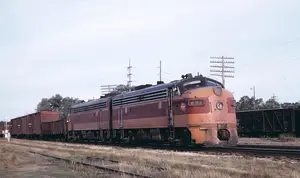
 Chesapeake & Ohio E8A #4002 accelerates train #42, the eastbound "George Washington," away from the station at Lee Hall, Virginia in the summer of 1963. John Stith photo.
History
The C&O's modest passenger fleet is somewhat ironic considering it launched the most beloved and successful PR campaign of any railroad, Chessie the kitten, in 1933.
The mascot was used extensively for marketing purposes and is still widely recognized today. The C&O was even working to launch a streamliner by that name during the 1940s but ultimately gave up on the idea.
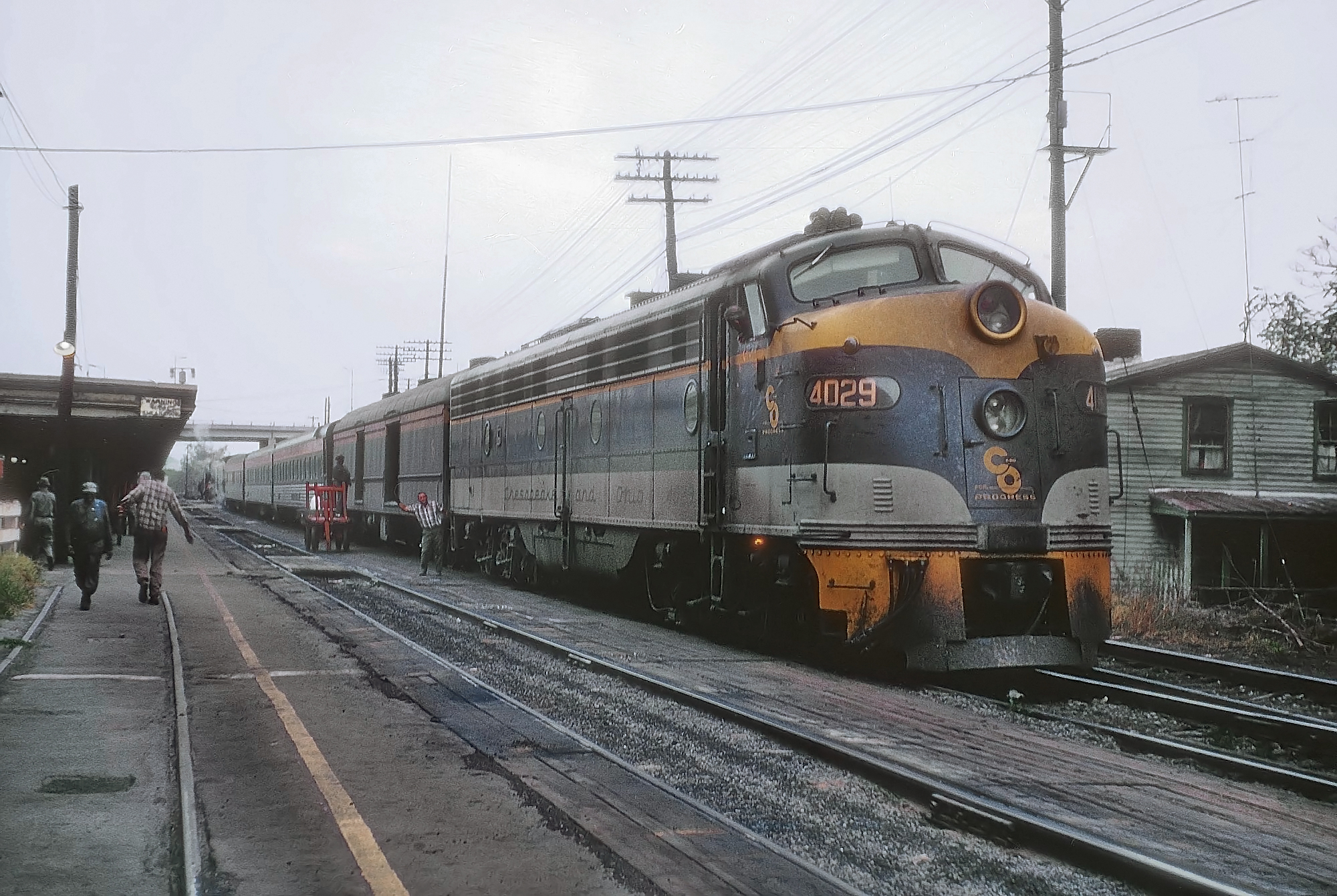 Chesapeake & Ohio E8A #4029 is ahead of train #41, the "George Washington" stopped at Charlottesville, Virginia in October, 1968. Rick Burn photo.
Inauguration
The George Washington was inaugurated on April 30, 1932 in conjunction with the real George Washington’s birth year, which had occurred 200 years earlier (but not on the same day), operating between Newport News and Cincinnati, with through sleepers provided as far as New York City and St. Louis.
Interestingly, as Mike Schafer and Joe Welsh note in their book "Streamliners: History Of A Railroad Icon," the train's original Pullman equipment and diner were named for people, places, and events associated with President Washington.
Timetable and Consist (March, 1933)
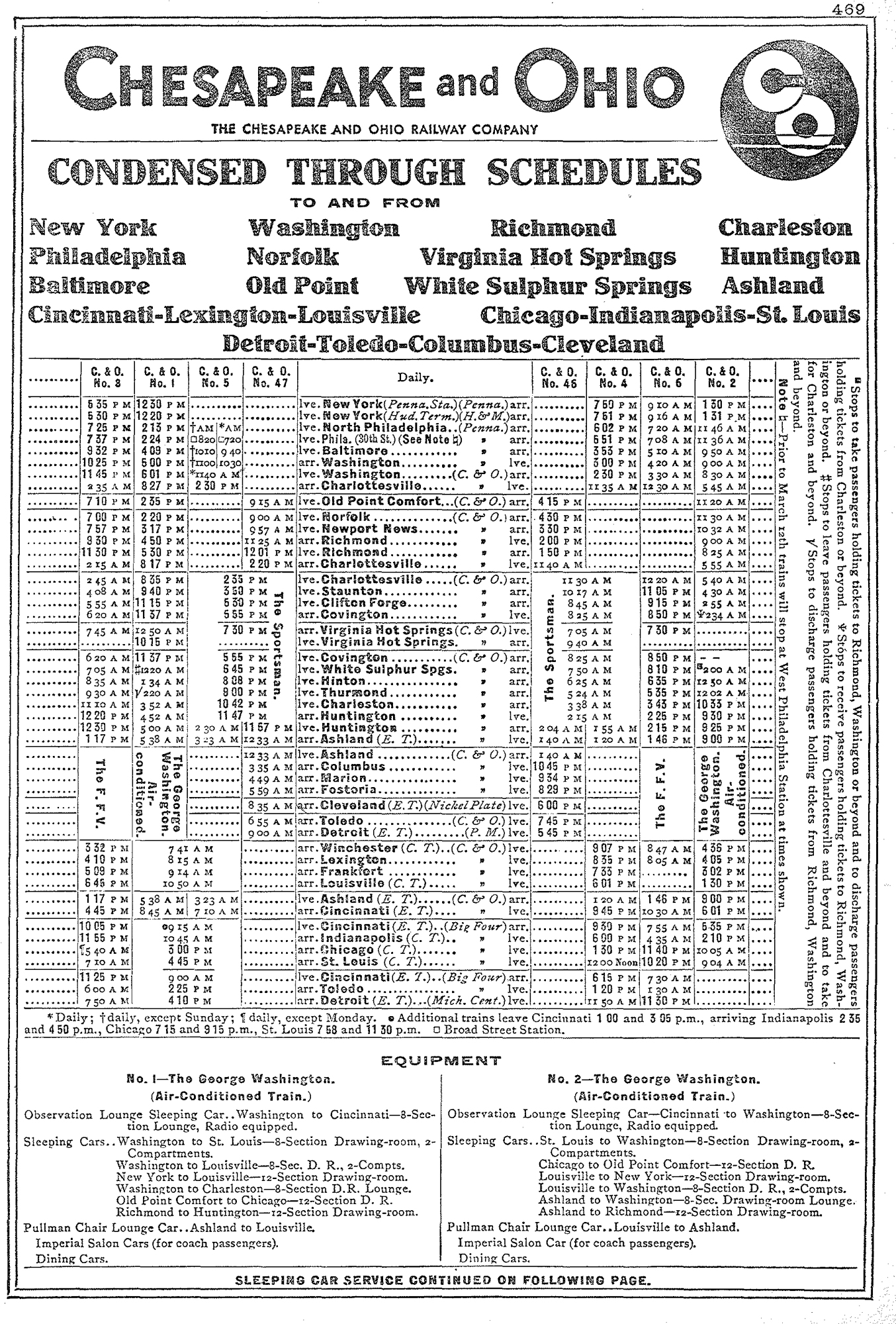
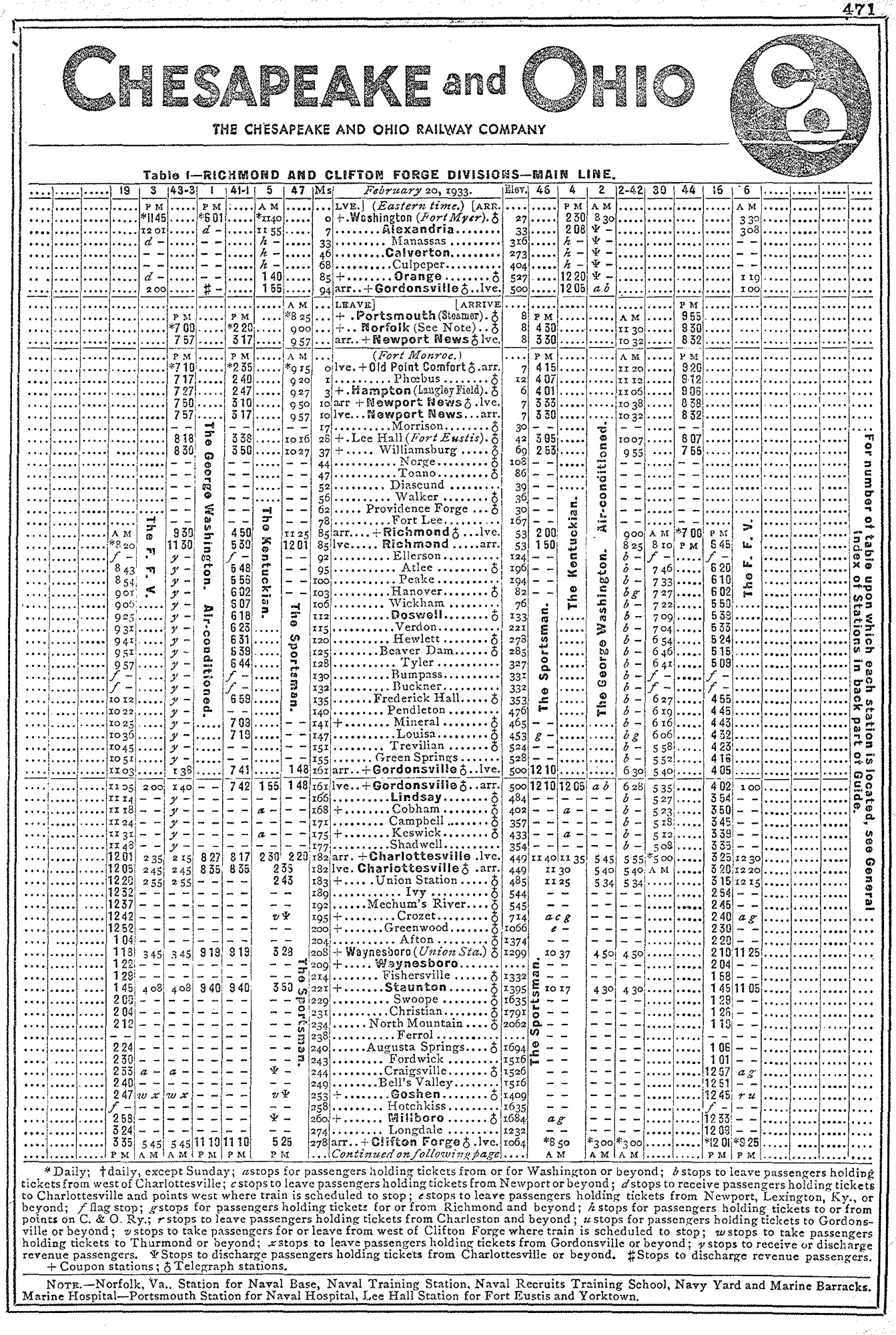
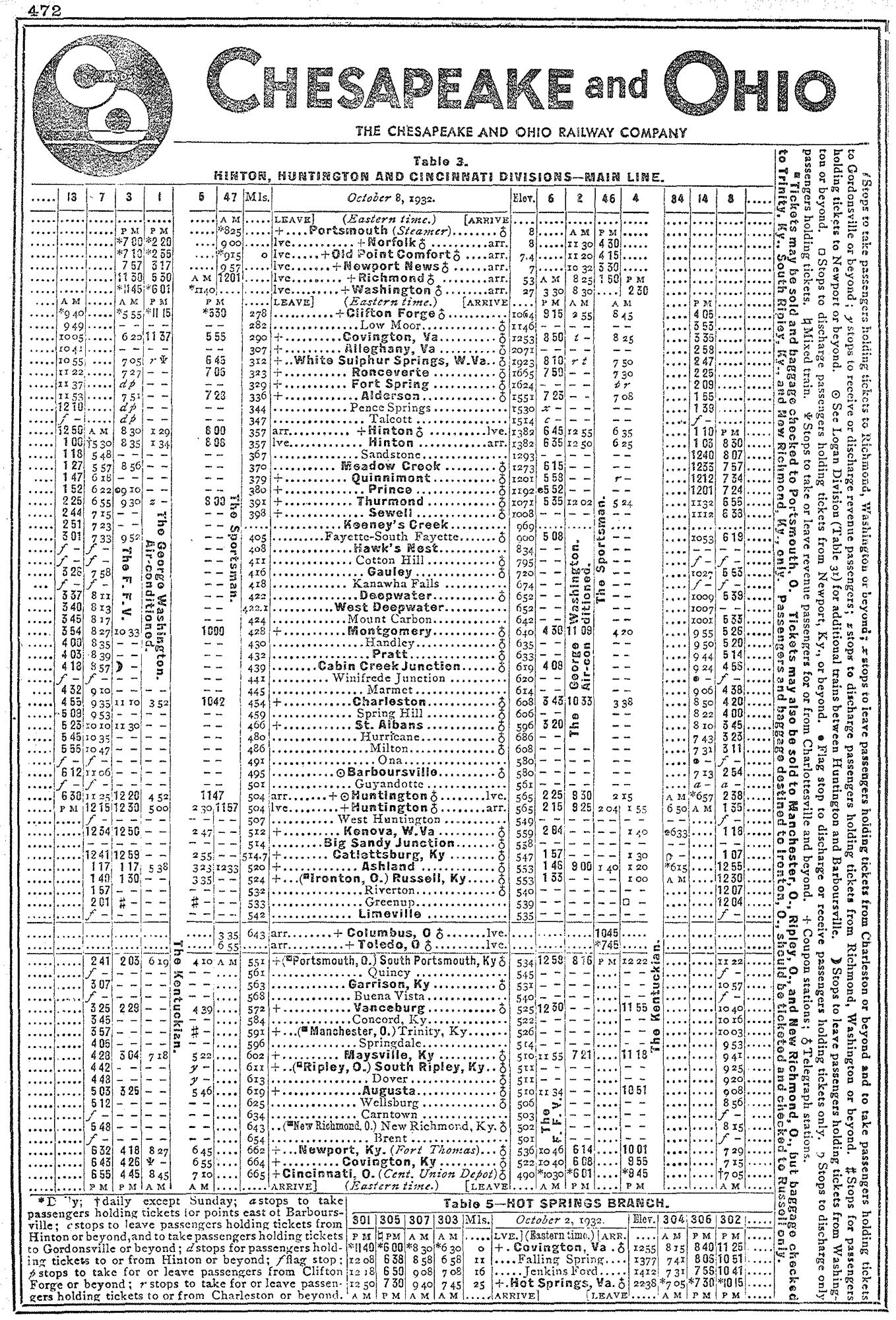
Its interior was adorned in Georgian designs of the Colonial period and featured the very latest in passenger accommodations which included air-conditioning, "Imperial Salon" coaches with 2-and-1 seating, and carpet flooring. The railroad went so far as to boldly proclaim it the "Most Wonderful Train In The World."
Chessie The Kitten
The train itself followed the C&O’s super-scenic main line through the Appalachians and West Virginia's New River Gorge. To promote the train the Chesapeake & Ohio used the now iconic Chessie, the kitten.
Timetable (1952)
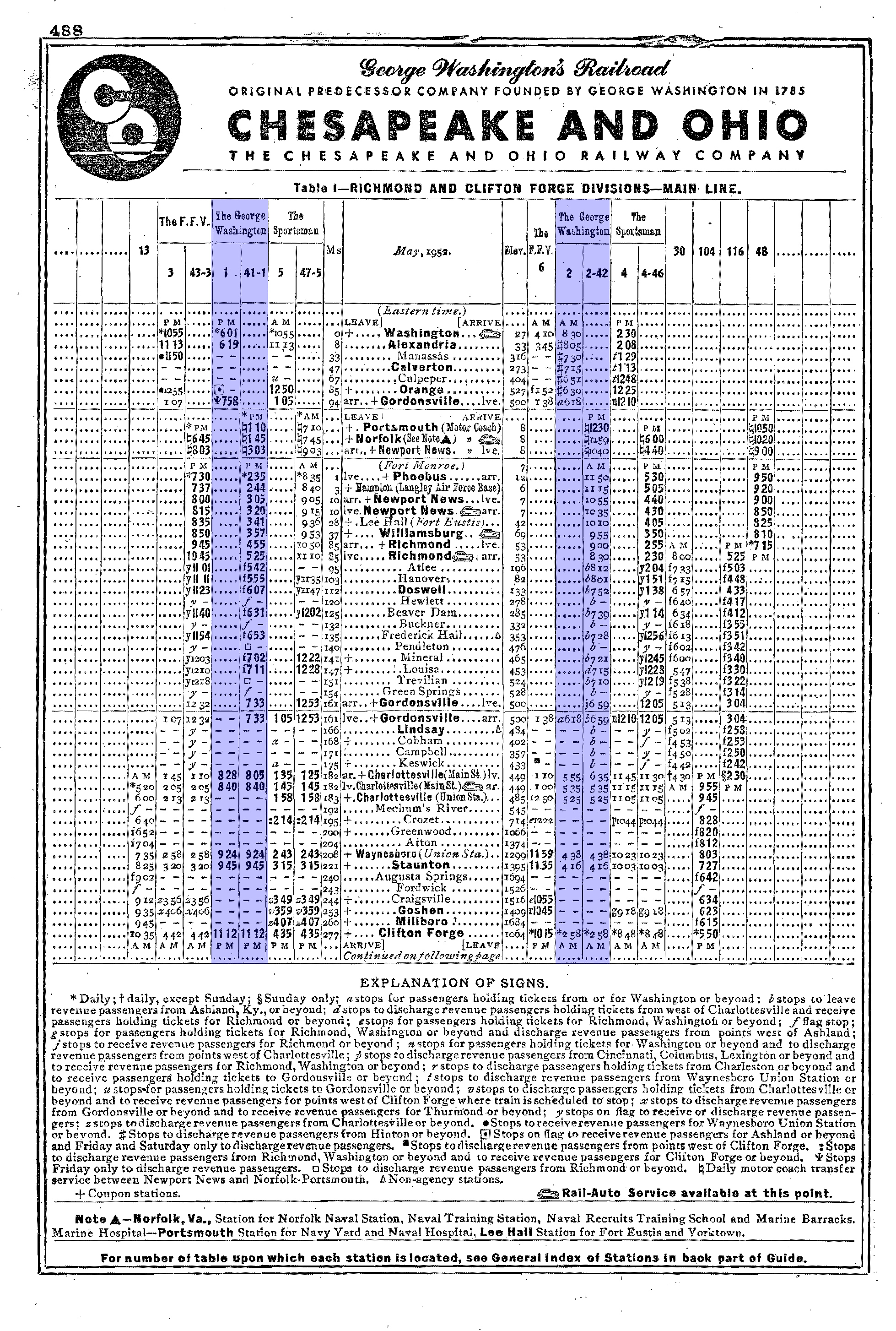
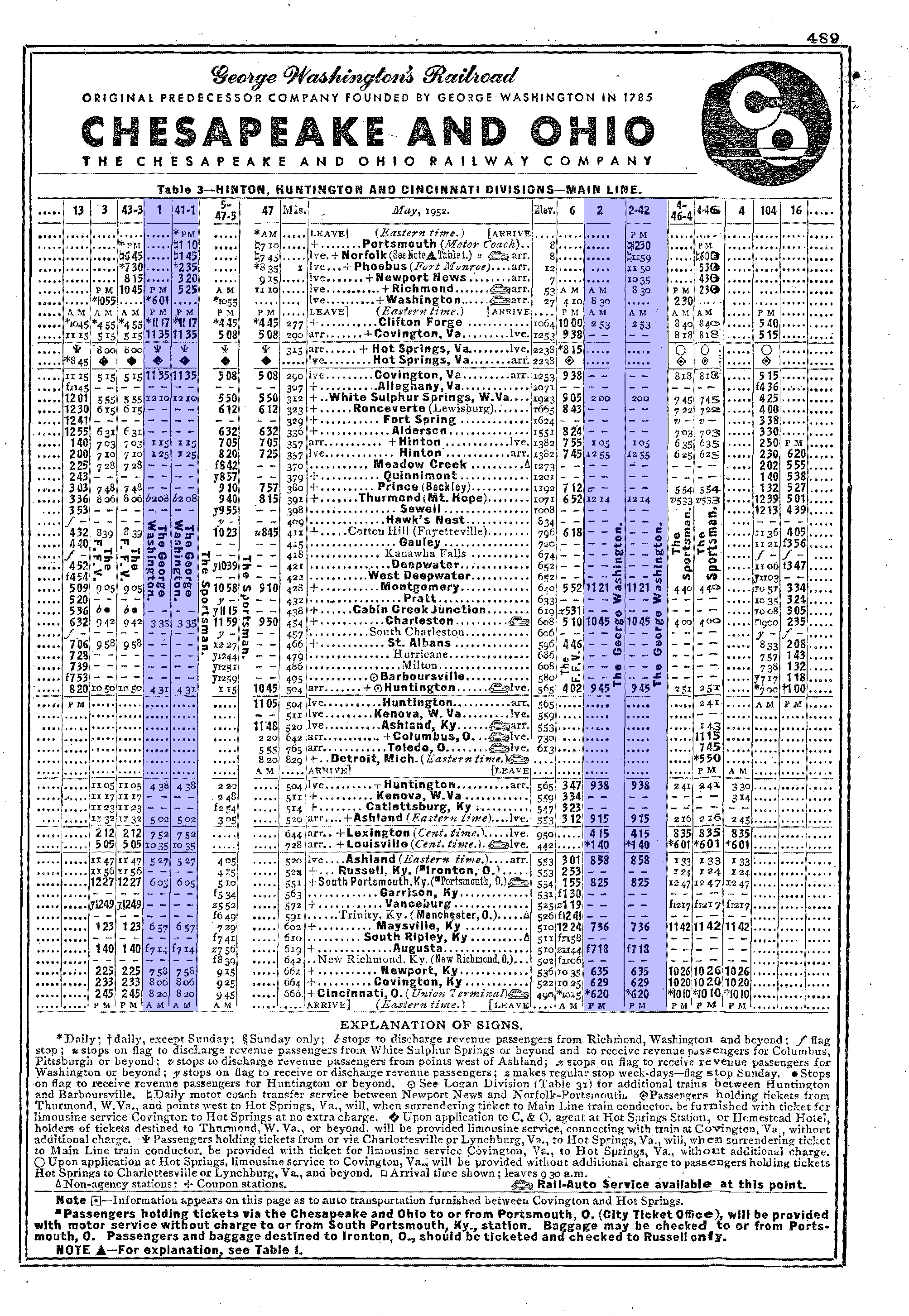
The creator of the sleeping kitten image was artist Guido Grenewald although Chessie is credited to Lionel Probert, an assistant to the C&O president.
Probert, once given permission for the design's use, added "Sleep Like a Kitten"; within just a few years, Chessie had earned nearly legendary status! When the C&O began offering the kitten as a merchandise piece demand was so high it regularly sold out.
The advertising campaign remains one of the most successful of all time and even today the Chesapeake & Ohio Railway Historical Society continues to sell calendars and other memorabilia featuring Chessie.
1933 Advertisement
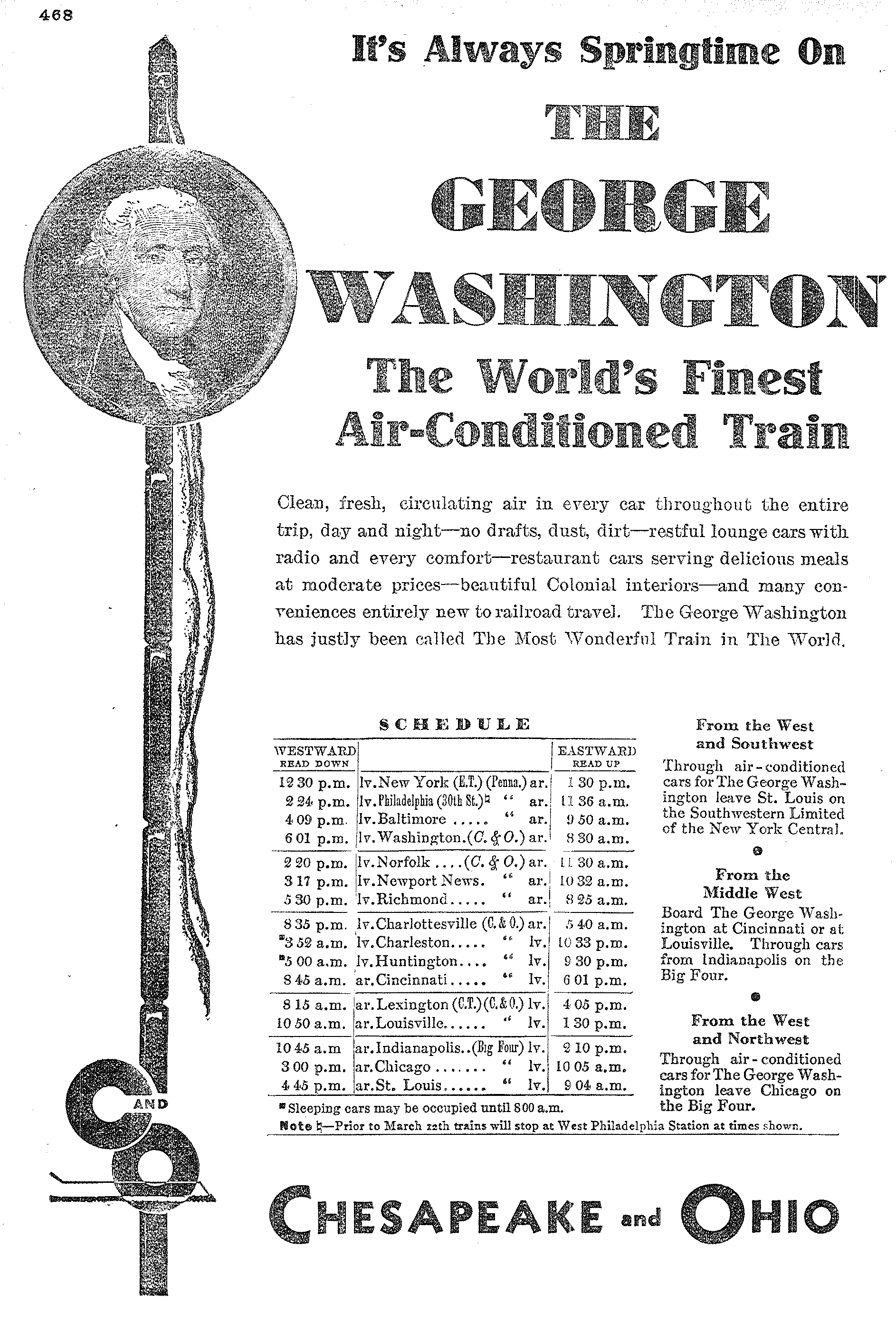
Chessie’s celebrity status did not end with merchandise and an advertising campaign; the kitten became synonymous with the C&O. She earned renewed famed in 1972 when the Chessie System was unveiled, a holding company for the C&O, B&O, and Western Maryland.
The railroad's new paint scheme featured the kitten’s silhouette overlaid in the Chessie System "C." The livery was a mix of vermilion, yellow, and blue.
Timetable (April 30, 1967)
| Time/Leave (Train #1/Chesapeake & Ohio) | Milepost | Location | Time/Arrive (Train #2/Chesapeake & Ohio) |
|---|---|---|---|
| 4:35 PM (Dp) | 0.0 | 8:40 AM (Ar) | |
| 4:52 PM | 8 | 8:05 AM | |
| F 6:14 PM | 85 | F 6:40 AM | |
| F 6:24 PM | 94 | F 6:28 AM | |
| 6:51 PM (Ar) 7:14 PM (Dp) | 115 | 6:05 AM (Dp) 5:35 AM (Ar) | |
| 7:59 PM | 141 | 4:51 AM | |
| 8:23 PM | 154 | 4:30 AM | |
| 9:42 PM | 210 | 3:13 AM | |
| 10:02 PM | 223 | ||
| 10:42 PM | 245 | 2:08 AM | |
| F 11:18 PM | 269 | ||
| 11:54 PM | 290 | 1:06 AM | |
| 12:26 AM | 313 | 12:27 AM | |
| 12:45 AM | 324 | 12:08 AM | |
| 1:41 AM | 361 | 11:16 PM | |
| 2:30 AM | 387 | 10:43 PM | |
| 3:28 AM (Ar), 3:45 AM (Dp) | 437 | 9:40 PM (Dp), 9:27 PM (Ar) | |
| 4:11 AM (Ar), 4:31 AM (Dp) | 453 | 9:04 PM (Dp), 8:49 PM (Ar) | |
| 5:09 AM | 484 | 8:11 PM | |
| F 5:29 AM | 505 | F 7:41 PM | |
| 6:04 AM | 535 | 7:13 PM | |
| 6:23 AM | 552 | F 6:53 PM | |
| 7:09 AM | 594 | 6:15 PM | |
| 7:40 AM (Ar) | 599 | 6:00 PM (Dp) | |
| Time/Leave (Train #1/Baltimore & Ohio) | Milepost | Location | Time/Arrive (Train #2/Baltimore & Ohio) |
| 8:20 AM (Dp) | 599 | 5:15 PM (Ar) | |
| F 8:49 AM | 621 | F 4:40 PM | |
| 9:50 AM | 671 | 3:40 PM | |
| 9:04 AM | 686 | 2:18 PM | |
| 9:51 AM | 725 | 1:34 PM | |
| 10:43 AM | 768 | 12:47 PM | |
| 11:02 AM | 787 | 12:18 PM | |
| 11:16 AM | 797 | 12:05 PM | |
| 11:45 AM | 819 | 11:45 AM | |
| 12:17 PM | 841 | 11:20 AM | |
| 12:45 PM | 866 | 10:54 AM | |
| F 2:00 PM | 934 | 9:45 AM | |
| 2:30 PM | 937 | 9:30 AM |
The stateliness of the original George Washington, along with its spectacular scenery through western Virginia's Blue Ridge, West Virginia's New River George, and portions of Kentucky soon transformed the train's into C&O’s flagship.
Its popularity even surpassed the railroad’s top service of the period, the Fast Flying Virginian. Its popularity also stemmed from the many online resort hotels, most notably the "Greenbrier" in White Sulphur Springs, West Virginia.
Consist (1952)
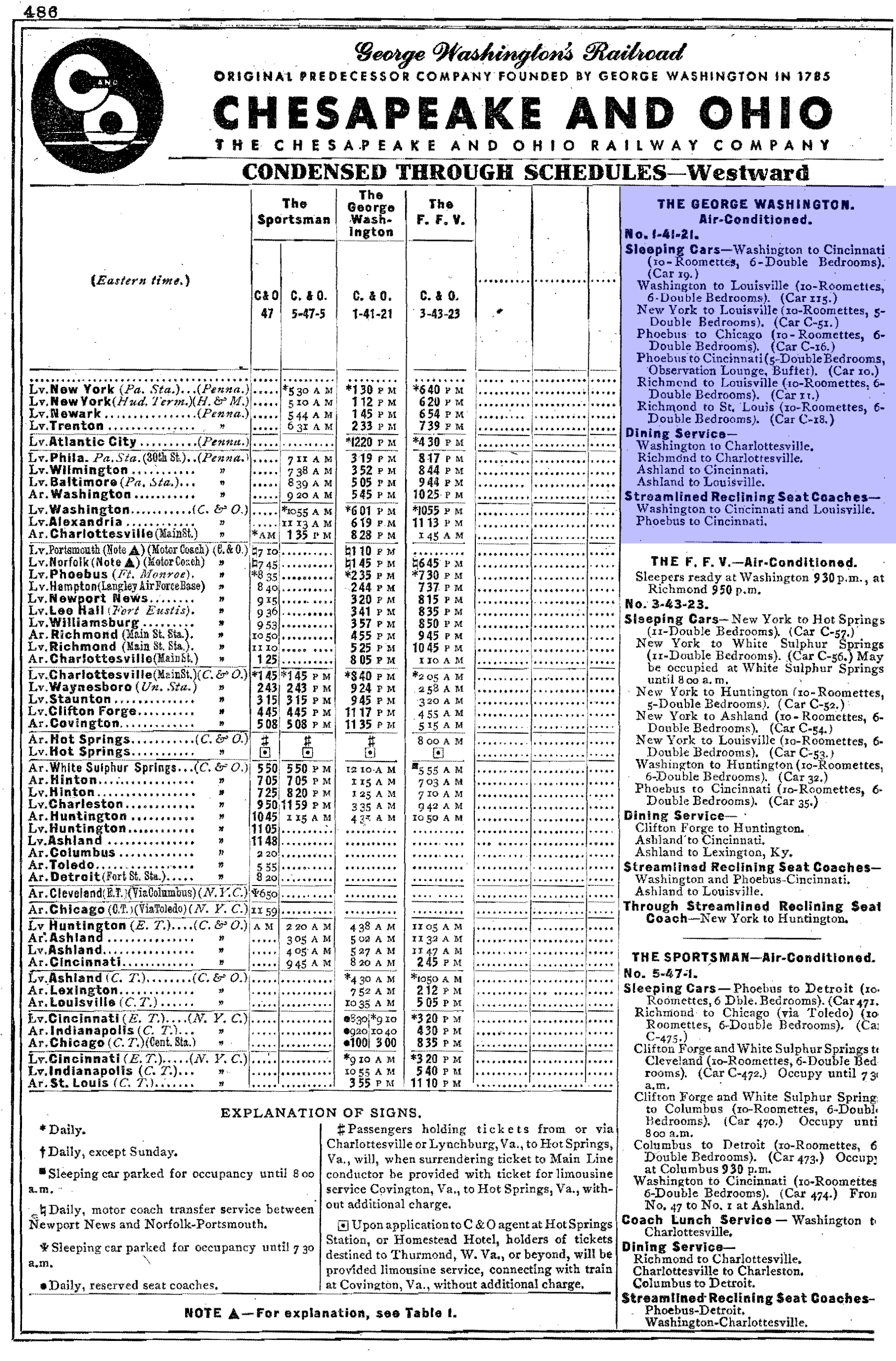
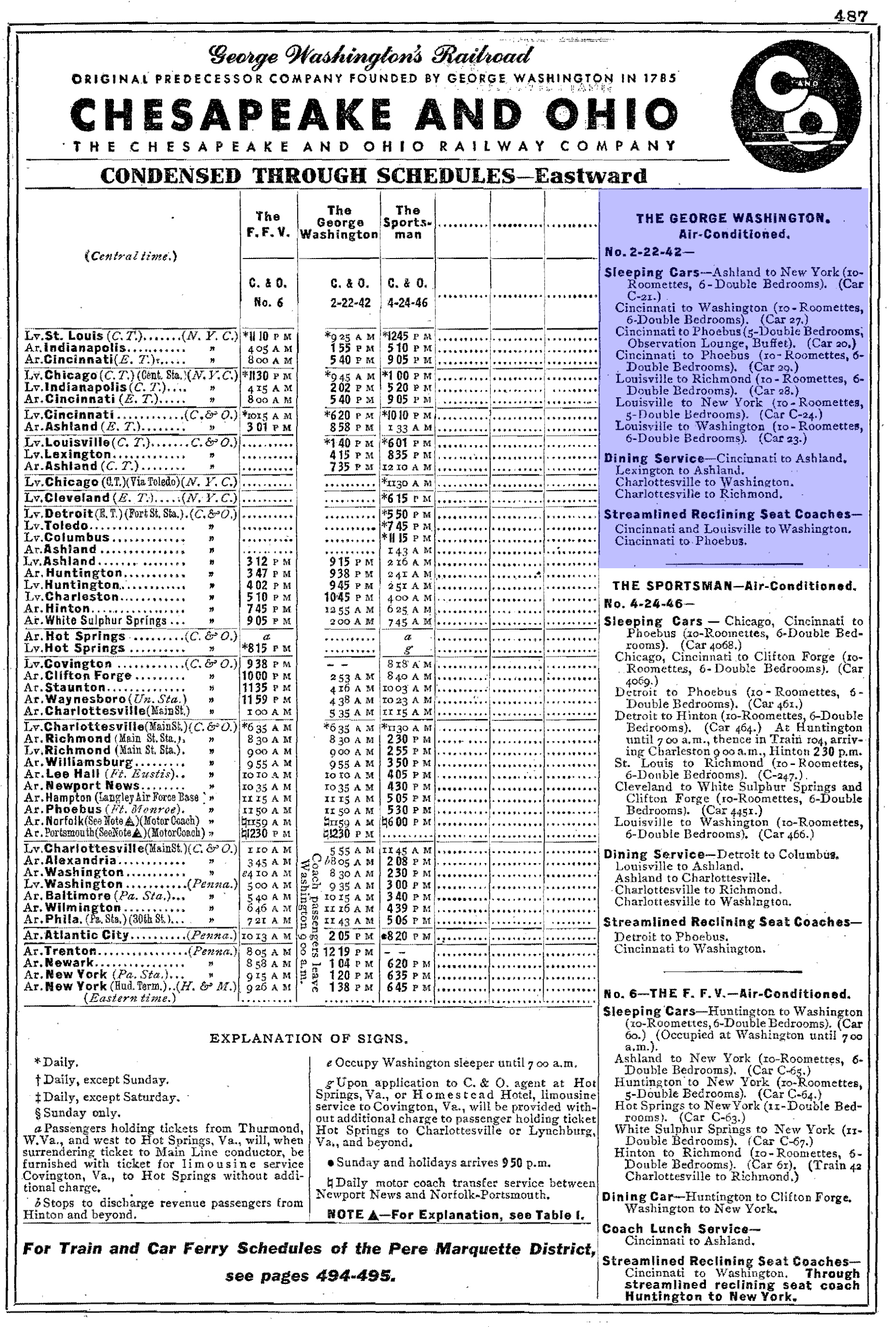
Listed as trains #1 (westbound) and #2 (eastbound) the train could reach New York City, via the Pennsylvania Railroad and
available Pullman/sleeper service, or St. Louis, via the Baltimore &
Ohio.
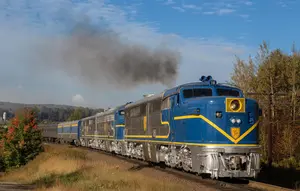
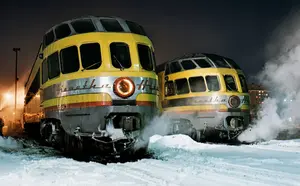
In the early 1950s it was updated with lightweight, streamlined equipment including matching EMD E-series diesels, adorned in a beautiful livery of blue, yellow, and gray.
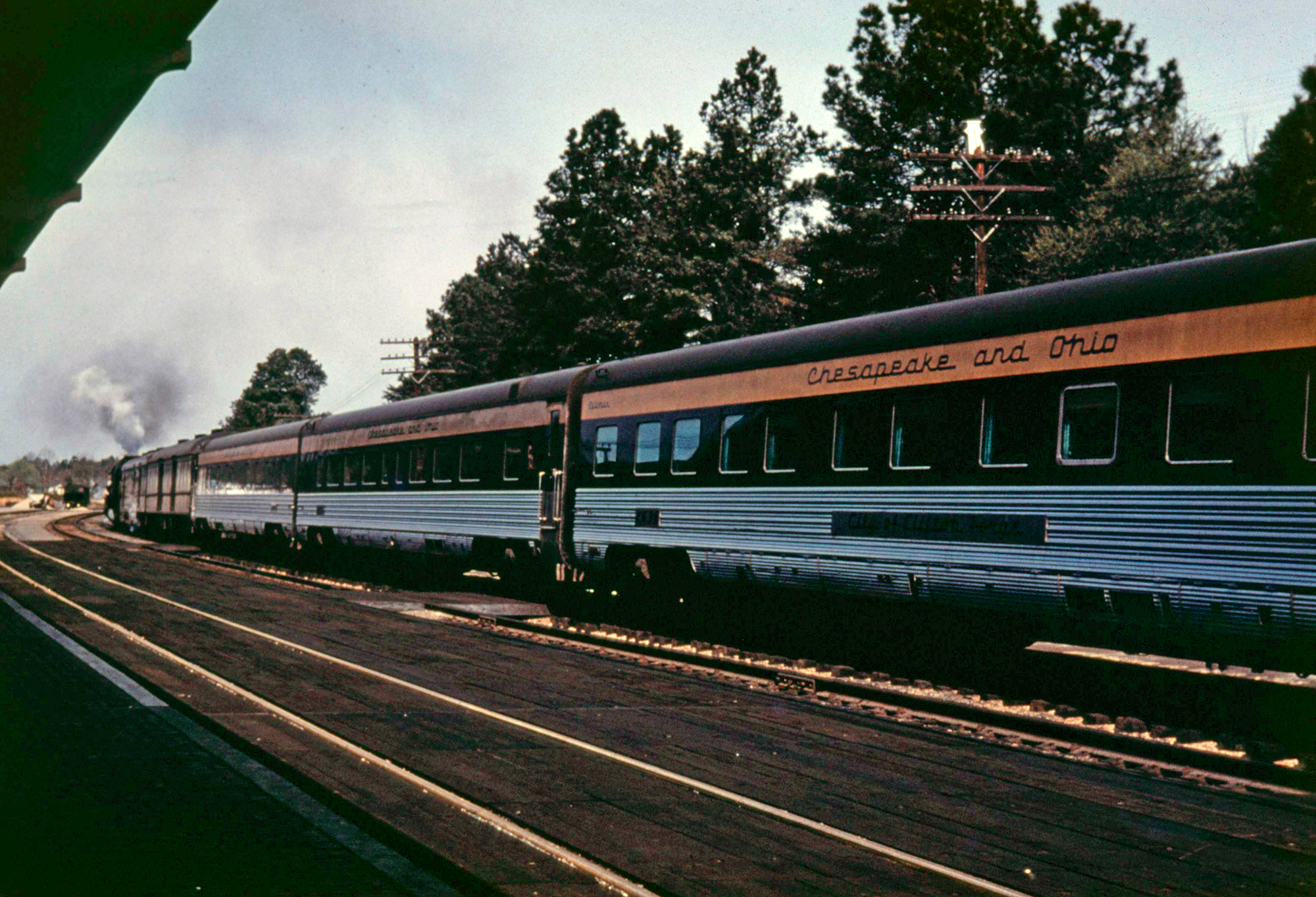 Chesapeake & Ohio's Newport News section of the "George Washington" departs westbound from Williamsburg, Virginia during a summer's morning in the early 1950's. Nearest the photographer is one of C&O's 10 roomette/6 double-bedroom Pullmans, the "City of Clifton Forge." Author's collection.
Final Years
The George Washington's consist included Pullman service sleepers, a slumber-room coach, reclining seat coaches, a diner-lounge, and sometimes a coffee shop car.
According to Mr. Dixon's book, in the summer of 1963 the C&O, having gained control of the Baltimore & Ohio, transferred a slumbercoach, sleeper, and standard coach from the B&O's National Limited (Baltimore/Washington - St. Louis) to George Washington.
This was move was temporary due to the B&O's major daylightling project ongoing along the Parkersburg Branch section (Clarksburg - Parkersburg) of its St. Louis main line at the time. This arrangement, however, was later made permanent in both directions in 1965. The George Washington remained in service lasted until the end, when Amtrak took over most intercity passenger services on May 1, 1971.
Photos
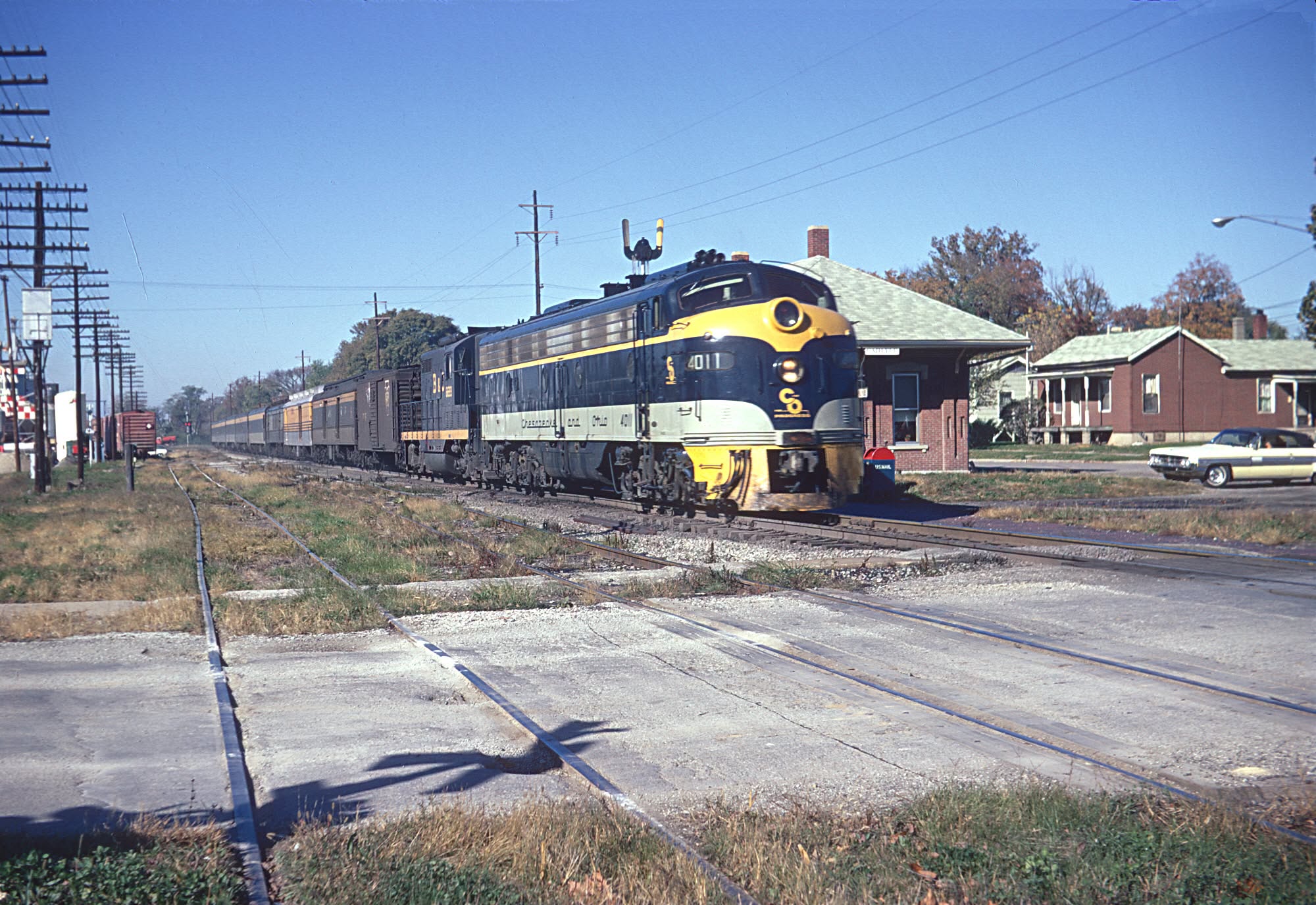 A shined up Chesapeake & Ohio E8A, #4011, and what appears to be a B&O Geep are leading train #2, the "George Washington," at Carlyle, Illinois in October, 1967. Tom Hoffmann photo, Rick Burn collection.
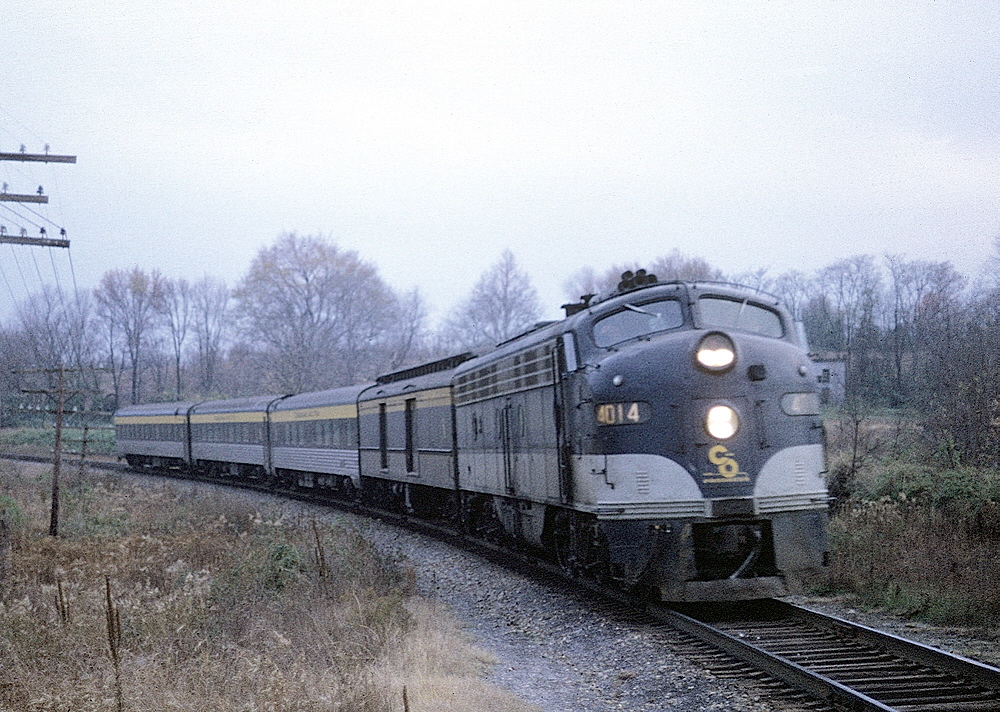 Chesapeake & Ohio E8A #4014 has the Newport News section of the George Washington at Richmond, Virginia on November 16, 1968. Marty Bernard photo.
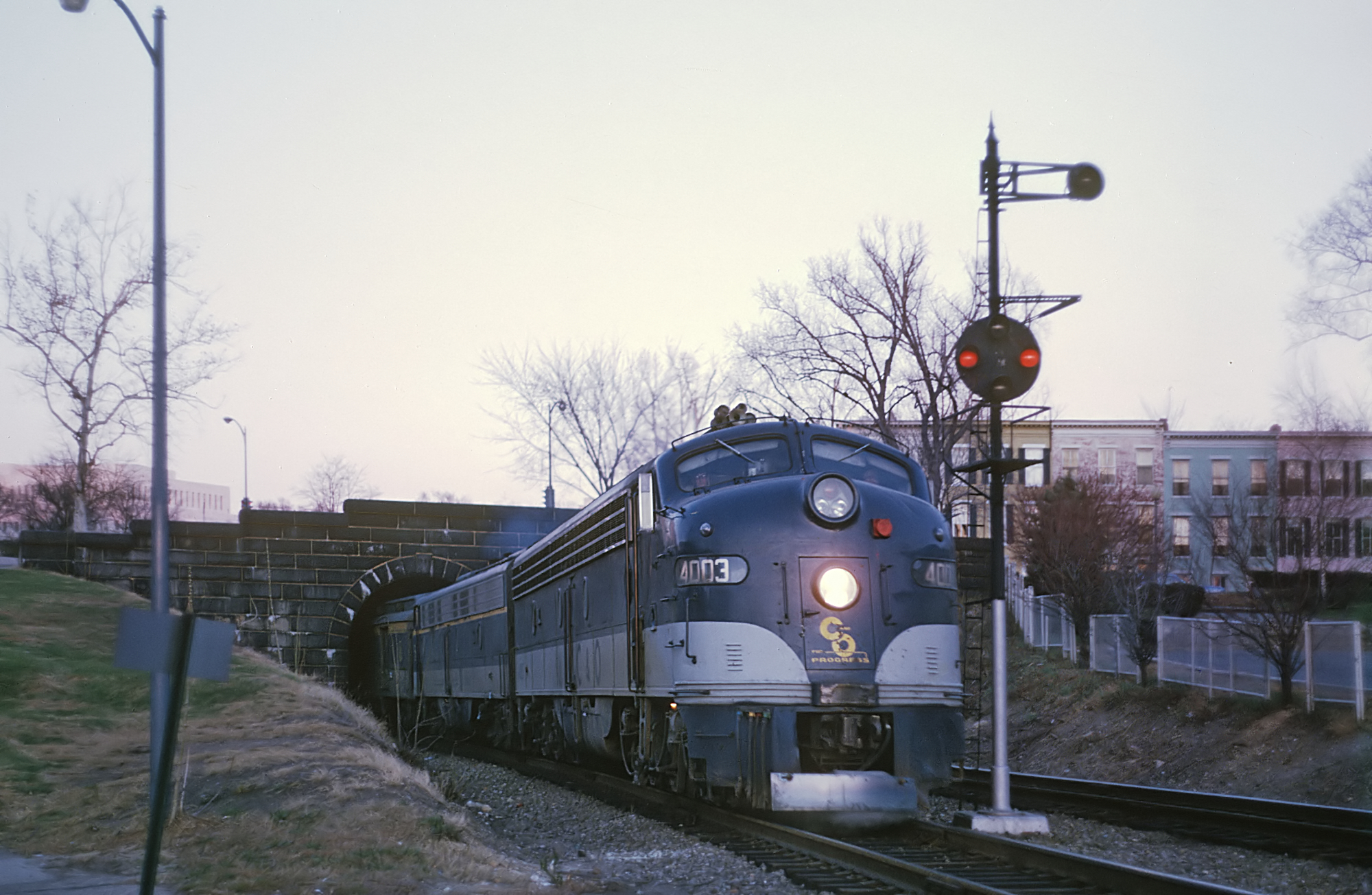 Chesapeake & Ohio E8A #4003 leads train #1, the "George Washington," out of the Union Station Tunnel which runs under First Street in Washington, DC on December 6, 1970. Roger Puta photo.
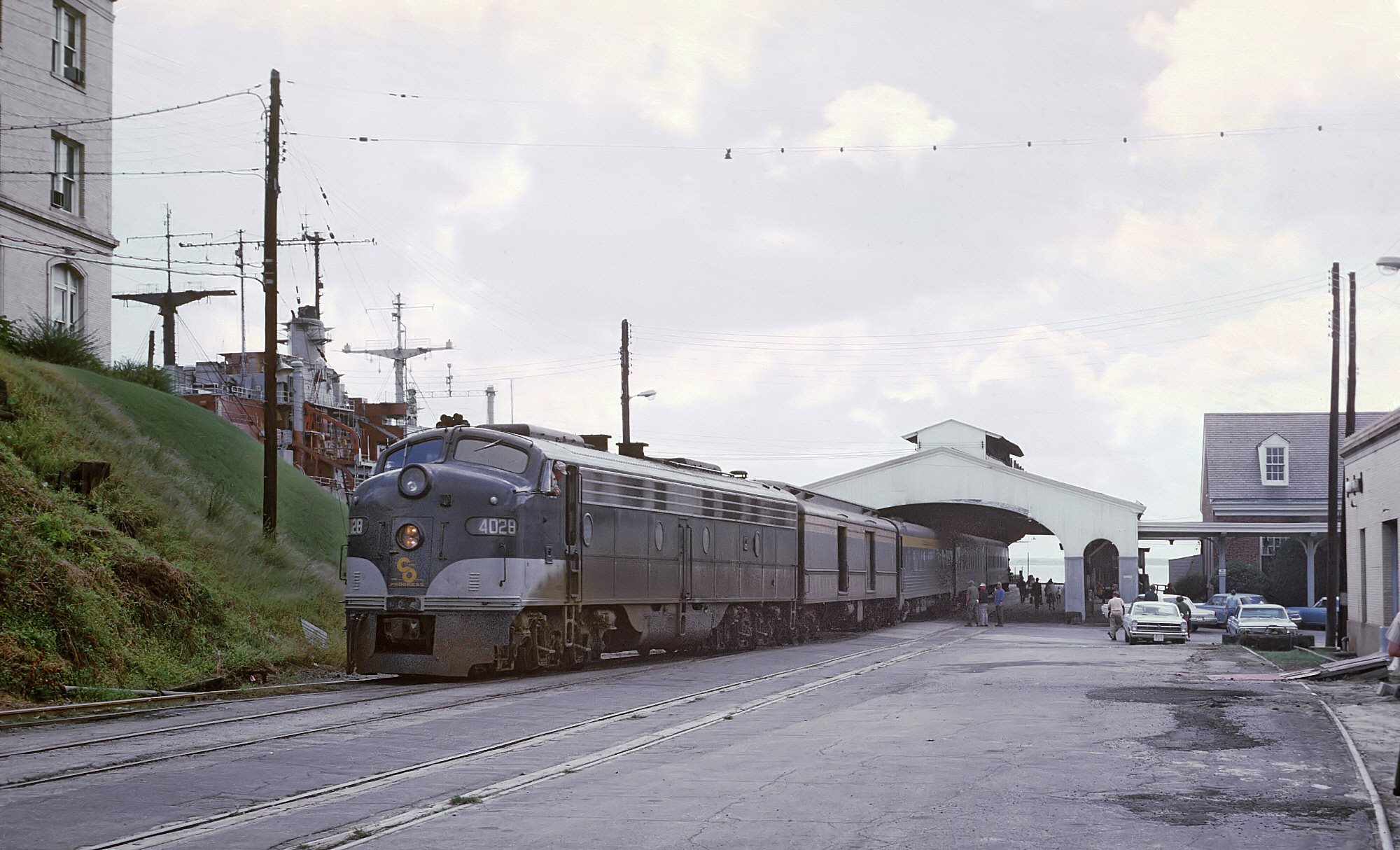 Chesapeake & Ohio E8A #4028 has the Newport News section of the "George Washington" at the ferry slip in Newport News, Virginia on September 21, 1969. Roger Puta photo.
 Baltimore & Ohio E8A #1439 leads train 2, the C&O's "George Washington," over the Accotink Creek Bridge near Springfield, Virginia on November 16, 1969. Roger Puta photo.
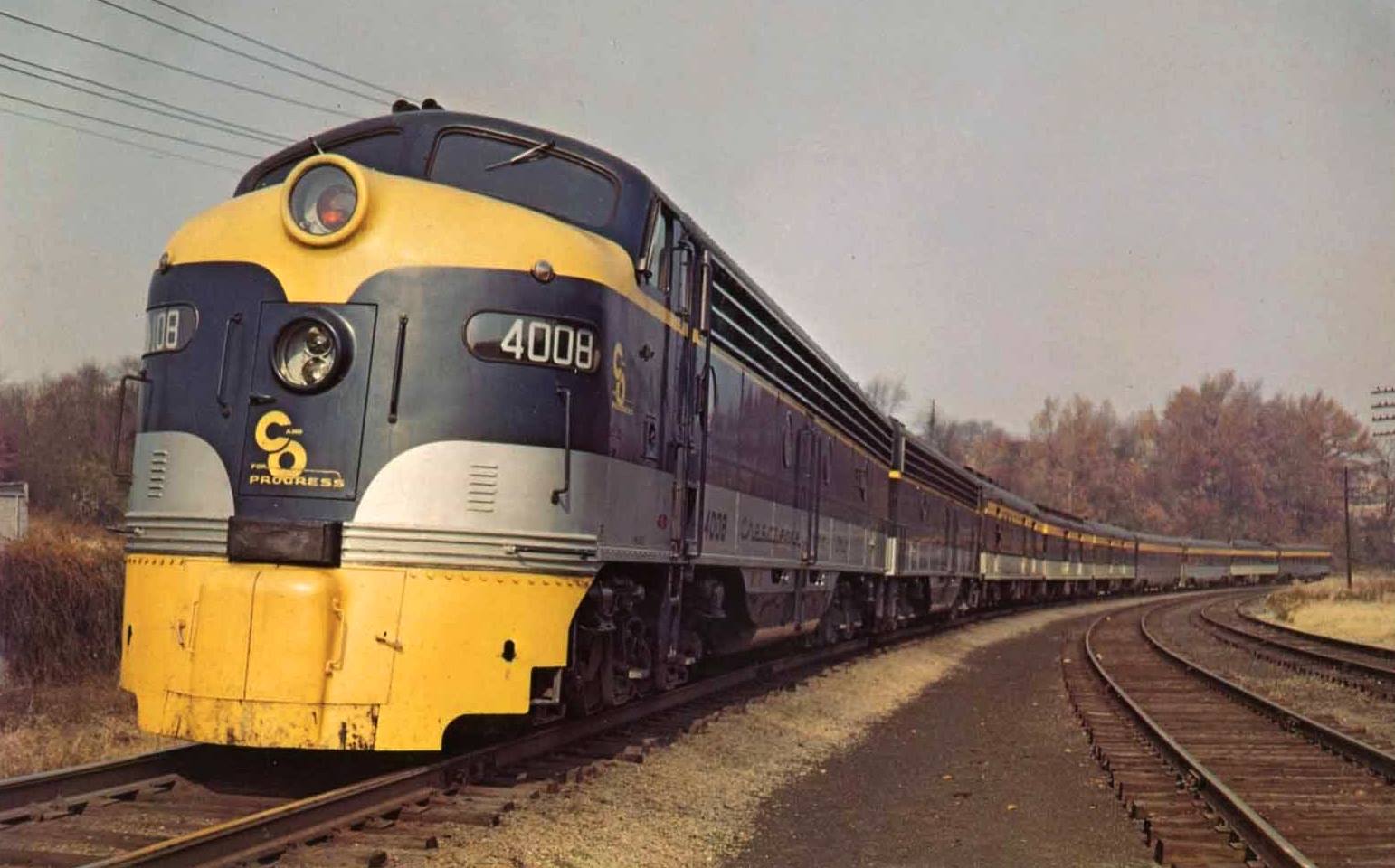 A Chesapeake & Ohio publicity photo of the newly streamlined "George Washington" (Washington/Newport News - Cincinnati/Louisville) seen here during the early 1950s.
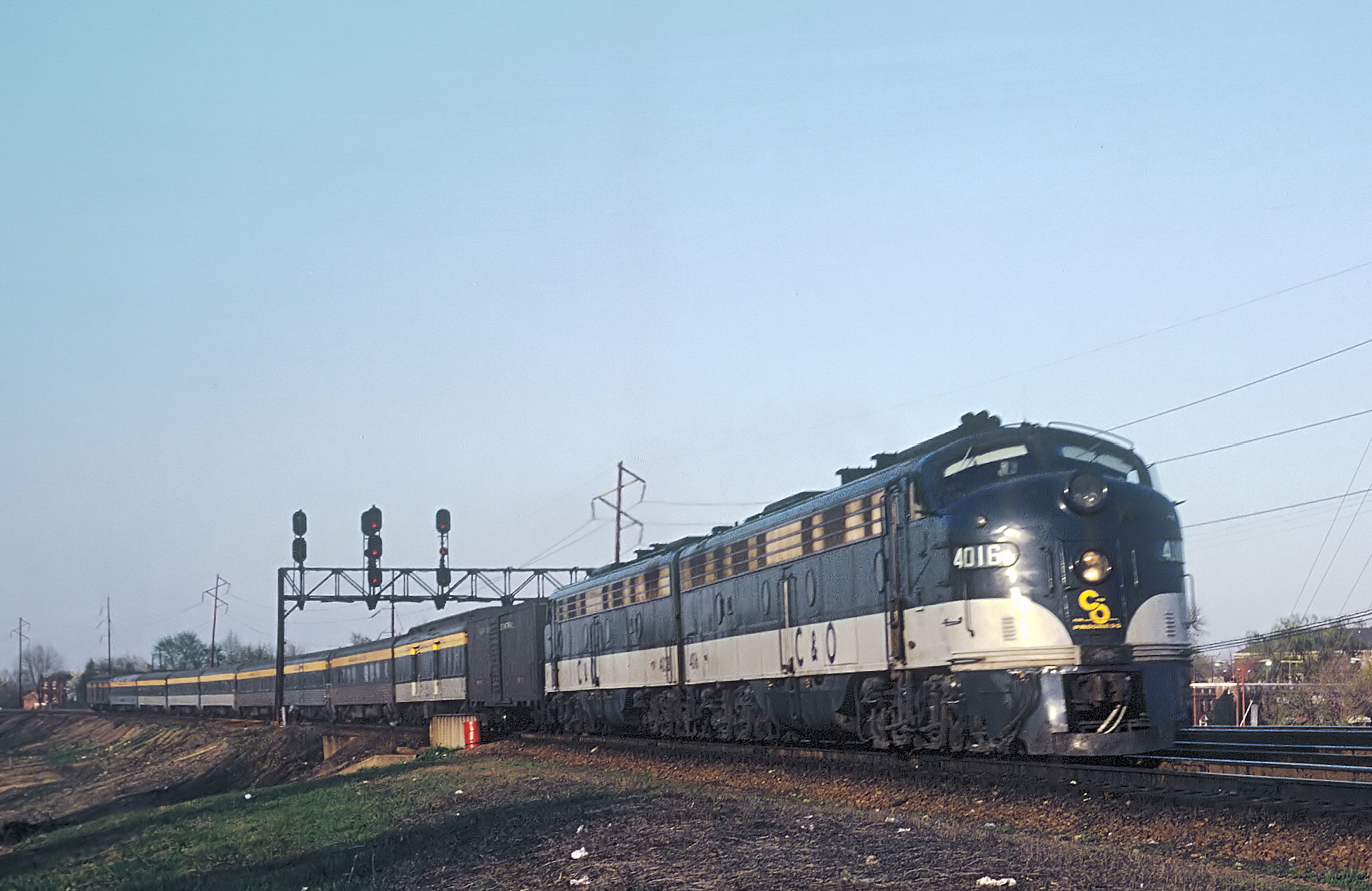 Chesapeake & Ohio E8A #4016 is ahead of train 1, the southbound/eastbound "George Washington," arriving at Alexandria, Virginia on April 12, 1969. Roger Puta photo.
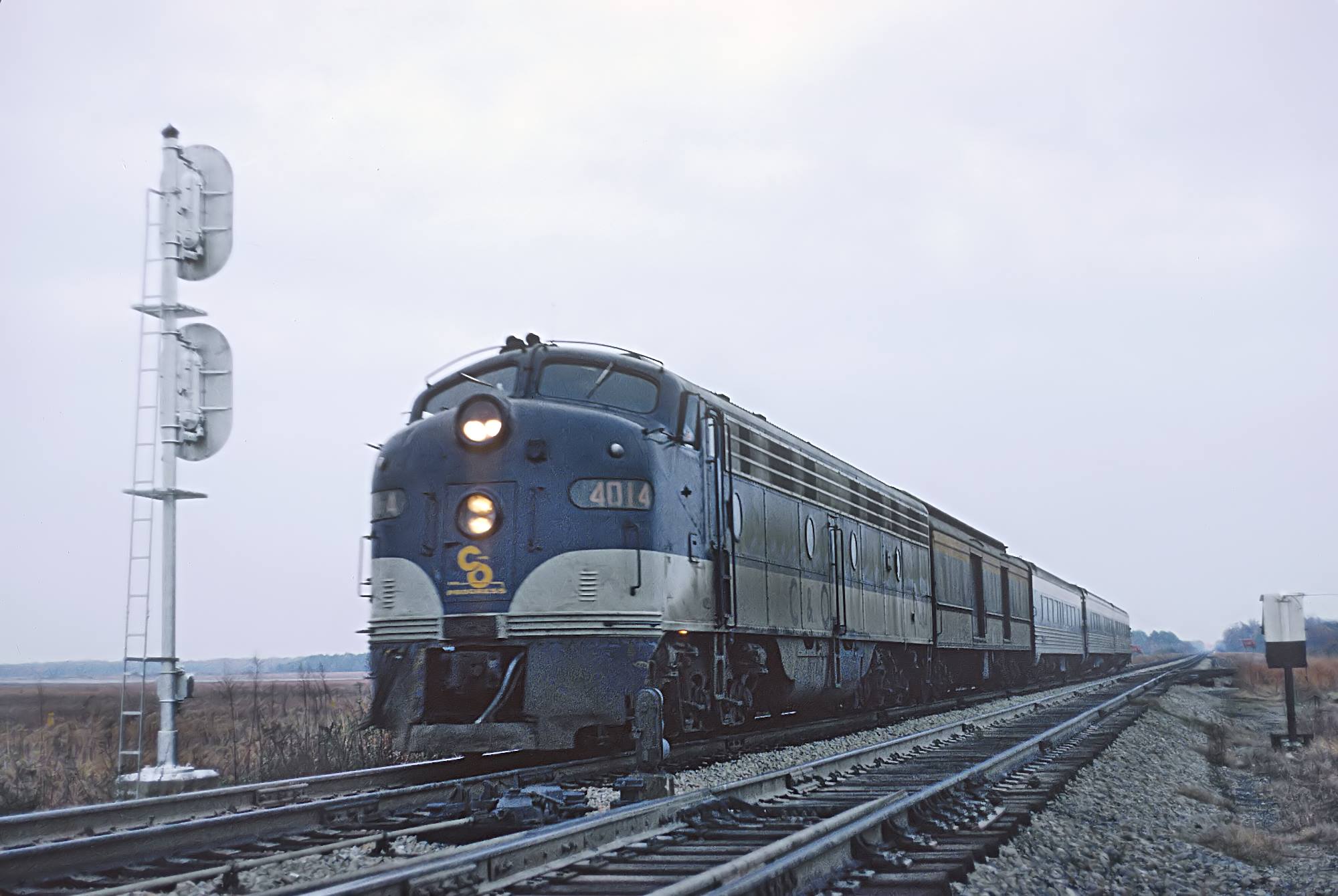 Chesapeake & Ohio E8A #4014 has a very short "George Washington" heading west near Byrd Field at Richmond, Virginia on November 16, 1968. Roger Puta photo.
Sources
- Dixon, Thomas W. Chesapeake And Ohio Railway: A Concise History And Fact Book. Clifton Forge: Chesapeake & Ohio Historical Society, 2012.
- Dixon, Thomas W. Chesapeake & Ohio K-4 Class 2-8-4 Steam Locomotives. Clifton Forge: Chesapeake & Ohio Historical Society, 2013.
- Dixon, Thomas W. Chesapeake & Ohio Passenger Service: 1847-1971. Clifton Forge: Chesapeake & Ohio Historical Society, 2013.
- Schafer, Mike and Welsh, Joe. Streamliners, History of a Railroad Icon. St. Paul: MBI Publishing, 2003.
Recent Articles


-
Boston and Maine Railroad: "Route Of The Minute Man"
Sep 16, 26 11:30 AM
 Boston & Maine—Andover & Wilmington 1833, NH charter June 27 1835. Eastern, Boston & Lowell, Fitchburg/Hoosac, Concord & Montreal. Section 77 March 12 1970. Guilford June 30 1983. CSX June 1 2…
 -
Smoky Valley Limited Dinner Train (2026)
Sep 16, 26 11:24 AM
 2026 Abilene & Smoky Valley Smoky Valley Limited—two-hour dinner from the 1887 Rock Island Depot. Kansas catering, ~$72–$110. Confirm on asvrr.org.
 -
Canadian National Diesel Locomotives: History, Roster & Photos
Sep 16, 26 11:14 AM
 Canadian National diesel—CLC boxcabs 1929, GMD FP9 and GP9, MLW FPA-4 and RS-18, GMD1, wide-cab SD40-2W, Dash-9s, ES44AC and ET44AC. All-time roster.
 -
Canadian National Steam Locomotives: History, Roster & Photos
Sep 16, 26 10:07 AM
 Canadian National steam—CGR, Canadian Northern, Grand Trunk, GTP. 4-8-4 Confederations, U-1 Mountains, J and K Pacifics. Post-1900 class roster. Last scheduled steam April 25, 1960.
 -
Canadian National Railway: Map, Logo, History, Photos
Sep 16, 26 08:55 AM
 Canadian National—name Dec 20 1918, incorporated June 6 1919, Grand Trunk Jan 20 1923. Crown corporation, IPO Nov 17 1995. IC, Wisconsin Central, BC Rail, EJ&E. Class I, mark CN.
 -
Buffalo, Rochester and Pittsburgh Railway: "Safety and Service"
Sep 16, 26 12:12 AM
 Buffalo, Rochester & Pittsburgh—Rochester & State Line 1869, BR&P March 12 1887. Pennsylvania coal to Buffalo and Rochester. B&O January 1 1932. All-time steam roster, LL 2-6-6-2s, XX…
 -
Buffalo Creek & Gauley Railroad: Map, Roster, Logo, Photos
Sep 15, 26 11:55 PM
 Buffalo Creek & Gauley—Elk River Coal & Lumber, April 1 1904, Dundon–Widen. Last all-steam WV coal road, February 27 1965. All-time steam roster, #4 Baldwin 59472, Majestic and Elk River diesels…
 -
Buffalo and Susquehanna Railroad: Map & History
Sep 15, 26 11:42 PM
 Buffalo & Susquehanna—Goodyear hemlock railroad, Sinnemahoning Valley December 14 1885, 1893 merger, coal to Sagamore, Buffalo extension, bankruptcy May 6 1910, B&O 1932, WAG 1956.
 -
WMSR Allegheny Mountain Dinner Train (2026): Dates & Tickets
Sep 15, 26 11:36 PM
 2026 Western Maryland Scenic Allegheny Mountain Dinner Train—Cumberland, 3 hours, 21+, Saturday 7 p.m. Confirm on wmsr.com.
 -
Boston and Albany Railroad: Map & History
Sep 15, 26 11:28 PM
 Boston & Albany Railroad—Boston & Worcester June 23 1831, Western Railroad across the Berkshires, merger 1867–70. NYC 99-year lease July 1 1900. Berkshires, New England States, CSX and MBTA today.
 -
Grand Bellevue Dinner Train (2026): Portsmouth, Rhode Island
Sep 15, 26 11:14 PM
 2026 Grand Bellevue Rail Dining in Portsmouth, RI—2.5-hour seated dinner on Narragansett Bay. Fall/winter TBA after Aug. 29. Confirm on thegrandbell.com.
 -
The "John Bull": The C&A's First Locomotive (1831)
Sep 15, 26 11:01 PM
 John Bull locomotive—Stephenson Planet-type 0-4-0, 1831. Dripps assembly, 4-2-0 rebuild, cowcatcher. Specs, Camden & Amboy career, Smithsonian 1884, 1981 steam-up, 1939 replica.
 -
Napa Valley Wine Train Dining (2026): Lunch, Dinner & Vista Dome
Sep 15, 26 10:56 PM
 2026 Napa Valley Wine Train dining—downtown Napa, 36-mile round trip, gourmet lunch and dinner, Vista Dome. Confirm packages on winetrain.com.
 -
My Old Kentucky Dinner Train (2026): Dates, Tickets & What to Expect
Sep 15, 26 10:50 PM
 2026 My Old Kentucky Dinner Train in Bardstown—2.5 hours, 35-mile round trip, four-course dinner from $116. Confirm on kydinnertrain.com.
 -
LaSalle Street Station: One Of Chicago's Great Terminals
Sep 15, 26 10:42 PM
 LaSalle Street Station—Rock Island October 10, 1852. Frost & Granger July 1, 1903. 20th Century Limited, Rockets, Golden State. Headhouse razed 1981. Metra Rock Island District today.
 -
Charlie Russell Chew Choo (2026): Montana Dinner Train from Lewistown
Sep 15, 26 10:39 PM
 2026 Charlie Russell Chew Choo dinner train—Hanover/Lewistown, 4.5 hours, 56-mile round trip, prime rib. Adult $151. Remaining listed dates sold out. Confirm on montanadinnertrain.com.
 -
Central Pacific Railroad: Map, History, Facts, Logo
Sep 15, 26 10:30 PM
 Central Pacific—Judah, Big Four, June 28 1861. Sierra, Chinese labor, Donner Summit Tunnel. Ten-mile day April 28 1869. Promontory May 10. Southern Pacific lease April 1 1885. Dissolved June 30 1959…
 -
Bessemer & Lake Erie Railroad: "The Bessemer Road"
Sep 15, 26 05:20 PM
 Bessemer & Lake Erie—Bear Creek 1865, Carnegie 1897, U.S. Steel 1901. Ore south from Conneaut, coal north. 2-10-4s, Missabe sister road. CN May 10, 2004. Complete corporate history.
 -
Bangor and Aroostook Railroad: "Serving Northern Maine"
Sep 15, 26 05:05 PM
 Bangor & Aroostook—chartered February 13, 1891, first trains January 1, 1894. Potatoes, paper, Searsport, State of Maine reefers. MM&A 2003, Lac-Mégantic 2013, CP 2020, CPKC today. Complete co…
 -
Baltimore & Ohio Chicago Terminal Railroad: Map and History
Sep 15, 26 03:11 PM
 B&OCT—formed January 6, 1910 to buy Chicago Terminal Transfer. Grand Central, Barr Yard, 78 route-miles. Assigned B&O steam. Complete diesel roster. CSX paper subsidiary, mark BOCT.
 -
The "Alphabet Route" (Railroad): Photos and History
Sep 15, 26 02:53 PM
 Alphabet Route—eight railroads, not one company. P&WV to Connellsville February 11, 1931. Alpha Jets Chicago/St. Louis–New York/Boston. NKP, W&LE, P&WV, WM, Reading, CNJ, L&HR, New Hav…
 -
Milwaukee Road Livestock Operations: Cattle, Dakotas & Montana
Sep 15, 26 02:36 PM
 Milwaukee Road livestock traffic—Dakota and Montana cattle, Iowa hogs, Chicago markets, 28-hour law, head-end stock cars. By 1974 mostly Montana. Rick Burn’s Helena speech. Operations history, not the…
 -
Spirit of Jasper Ride & Dine (2026): Season Pause
Sep 15, 26 02:29 PM
 Spirit of Jasper Ride & Dine in Jasper, Indiana—seated meal on board. Operator: not running public trains for 2026. Depot remains open as a rental. Confirm on spiritofjaspertrain.com.
 -
South Carolina Canal & Rail Road Company: Map and History
Sep 15, 26 01:59 PM
 South Carolina Canal & Rail Road—chartered December 19, 1827. Best Friend of Charleston, 136 miles Charleston–Hamburg October 1833, Aiken inclined plane. South Carolina Railroad 1844, Southern 189…
 -
The Practice of Double-Heading: The Steam Era
Sep 15, 26 01:43 PM
 Doubleheading—two locomotives on the point, each with its own steam crew. Not a rear helper, not diesel MU. How it worked, PRR 1877, mountain grades, and what MU ended.
 -
Mohawk and Hudson Railroad: Map, Pictures, Locomotives
Sep 15, 26 01:20 PM
 Mohawk & Hudson Railroad—New York’s first railroad, chartered April 17, 1826. DeWitt Clinton, inclined planes, Albany & Schenectady 1847, first New York Central May 17, 1853. Complete corporat…
 -
Essex Clipper Dinner Train (2026): Dates, Tickets & What to Expect
Sep 15, 26 01:09 PM
 2026 Essex Clipper Dinner Train in Essex, CT—2.5 hours, four-course meal $129.99, 18+. Fall dates through Oct. 25. Confirm on essexsteamtrain.com.
 -
Camden & Amboy Railroad: Map, History, Photos
Sep 15, 26 12:53 PM
 Camden & Amboy Railroad—chartered February 4, 1830. Joint Companies monopoly with the Delaware & Raritan Canal, John Bull, T-rail. United New Jersey 1872, PRR 999-year lease 1871. Complete corpora…
 -
Cafe Lafayette Dinner Train (2026): Dates, Tickets & What to Expect
Sep 15, 26 12:47 PM
2026 Cafe Lafayette Dinner Train in North Woodstock, NH—2 hours, 20 miles, five-course meal from $125. May–October. Confirm on nhdinnertrain.com. -
Christmas Train Ride Locations (2026): A Complete Guide
Sep 15, 26 10:47 AM
 2026 Christmas train rides by state—Santa, North Pole Express, and holiday trains. Not Polar Express. State guides and product pages. Confirm dates on each railroad.
 -
Baltimore & Ohio Railroad: Linking 13 Great States With The Nation
Sep 15, 26 10:22 AM
 Baltimore & Ohio Railroad—first U.S. common carrier, chartered February 28, 1827. Wheeling 1853, Chicago 1874, C&O control 1963, Chessie 1973, into CSX April 30, 1987. Complete corporate history.
 -
Delaware & Hudson Railway: The Bridge Line
Sep 15, 26 09:59 AM
 Delaware & Hudson Railway—Wurts brothers canal 1823, gravity railroad 1829, Stourbridge Lion, Bridge Line to Montreal. Guilford 1984, CP 1991, NS south line 2015, CPKC north.
 -
Delaware & Hudson Diesel Roster (All-Time)
Sep 15, 26 12:17 AM
 All-time Delaware & Hudson diesel roster—Alco S-2s through C-628s and PA-4s, GE U-boats, Baldwin RF-16s, EMD SD45s and GP38-2/GP39-2s. Serials, dates, dispositions.
 -
Granite Railway, Our Country's First Railroad
Sep 14, 26 11:28 PM
 Granite Railway of Quincy, Massachusetts—chartered March 4, 1826, opened October 7, 1826. Gridley Bryant, 5-foot gauge, horses, Bunker Hill Monument stone. First commercial U.S. railroad.
 -
Milwaukee Road Skytop Lounges: History, Specs & Floor Plans
Sep 14, 26 11:09 PM
 Milwaukee Road Skytop observation cars—Brooks Stevens, 1948. Four Rapids parlor-lounges from Milwaukee Shops, six Creek sleeper-lounges from Pullman-Standard. Floor plans, roster, preservation.
 -
West Virginia Christmas Train Rides (2026): A Complete Guide
Sep 14, 26 11:02 PM
2026 West Virginia Christmas trains—Potomac Eagle North Pole Express in Romney and Christmas at Cass. Not Polar Express. Elkins Polar is not listed for 2026. -
Railroads Of Today: Class I Map, PSR & the 2026 Industry
Sep 14, 26 10:30 PM
U.S. freight rail in 2026—six Class I railroads on a nearly 140,000-mile network. PSR as everyday practice, how the STB works, traffic mix, short lines and regionals. -
Railroad History (USA): Timeline, Facts & How the Network Was Built
Sep 14, 26 10:03 PM
 Full U.S. railroad history hub—origins and inventors, Golden Age peak mileage, Civil War and transcontinental, streamliners, ICC regulation, Penn Central and Conrail, Staggers Act, PSR, and today’s Cl…
 -
Railroads In The 2020s: CPKC, East Palestine & the UP–NS Case
Sep 14, 26 09:51 PM
 U.S. railroads 2020–2026—Class I mileage 91,773 in 2020. COVID traffic drop, CPKC April 14 2023, East Palestine Feb. 3 2023, UP–NS $85 billion case still before the STB.
 -
Railroads In The 2010s: PSR, Coal’s Decline & Positive Train Control
Sep 14, 26 03:51 PM
 U.S. railroads 2010–2020—Class I mileage 95,573 to 91,773. Buffett closed BNSF Feb. 12 2010, Harrison at CP June 29 2012 and CSX 2017, PTC deadline Dec. 31 2018.
 -
Virginia Christmas Train Rides (2026): A Complete Guide
Sep 14, 26 03:46 PM
 2026 Virginia Christmas trains—Virginia Scenic Railway Santa Express from Staunton, about 60 minutes. Confirm dates. Not Polar Express.
 -
MARC Train: Maryland Commuter Rail History, Lines & Roster
Sep 14, 26 01:16 PM
 MARC Train history—Maryland Rail Commuter 1984, B&O and PRR corridors, Penn/Camden/Brunswick lines, Silver Spring 1996, all-time locomotive roster.
 -
Railroads In The 2000s: Merger Freeze, Wisconsin Central & Buffett
Sep 13, 26 07:57 AM
 U.S. railroads 2000–2010—Class I mileage 99,250 to 95,573. STB merger freeze March 17 2000, CN–WC Oct. 9 2001, BNSF Railway Jan. 24 2005, Buffett Nov. 3 2009.
 -
Railroads In The 1990s: Mega-Mergers, Conrail’s Split & the STB
Sep 13, 26 12:13 AM
 U.S. railroads 1990–2000—Class I mileage 119,758 to 99,250. BNSF Sept. 22 1995, UP–SP Sept. 11 1996, Conrail split June 1 1999, ICC Termination Dec. 29 1995.
 -
Railroads In The 1980s: Staggers, Mega-Mergers & Conrail’s IPO
Sep 12, 26 11:12 PM
 U.S. railroads 1980–1990—Class I mileage 164,822 to 119,758. Staggers Oct. 14 1980, CSX and Norfolk Southern, UP–Missouri Pacific–Western Pacific, Conrail IPO March 26 1987.
 -
Wabash Class O-1 4-8-4s: History, Roster & Specifications
Sep 12, 26 11:01 PM
 Wabash Class O-1 4-8-4s—Baldwin 1930–31, twenty-five engines 2900–2924. Fast freight, complete roster, specifications. None preserved.
 -
Staggers Rail Act of 1980: Statute, Contract Rates & the ICC
Sep 10, 26 11:23 PM
 Staggers Rail Act, Pub. L. 96-448, signed October 14, 1980. Harley Staggers, S.1946, contract rates, 180% variable-cost test, abandonments, short lines.
 -
Rock Island E8A 652: Bicentennial Independence Paint & History
Sep 10, 26 10:42 PM
 Rock Island E8A 652—EMD March 1952, serial 15199. 20th Century Railroad Club Independence bicentennial scheme, Peoria and Quad Cities Rockets, Midland Railway, Manly Junction Museum.
 -
Vermont Christmas Train Rides (2026): A Complete Guide
Sep 10, 26 10:37 PM
2026 Vermont Christmas trains—Okemo Valley Holiday Express from Chester Depot Dec. 19–20. Polar is Burlington Dec. 5–6 only. -
Railroads In The 1970s: Penn Central, Amtrak & Conrail
Sep 10, 26 10:18 AM
 U.S. railroads 1970–1980—196,479 miles at the decade’s start. Penn Central bankruptcy June 21 1970, Amtrak May 1 1971, 3R/4R Acts, Conrail April 1 1976, Rock Island 1975, Milwaukee 1977.