
"Silver Meteor" (Train): Route, Consist, Timetable
Last revised: August 25, 2024
By: Adam Burns
During the heyday of streamliners there were many colorful and attractive trains to ride if you were heading south to sunny Florida and the Seaboard Air Line Railroad’s Silver Meteor
was one of those.
While the Seaboard (also known as the SAL) kicked off the streamliner passenger train craze to serve southern destinations other railroads soon followed suit, like rival Atlantic Coast Line Railroad which inaugurated its New York-Miami Champion during late 1939, a few months after the Meteor.
Interestingly, it would be the train's name that would live on under Amtrak as the national passenger carrier discontinued the Champion in the late 1970s.
The ACL and SAL were perhaps the only two railroads in the country to serve markets so highly demanded by passengers.
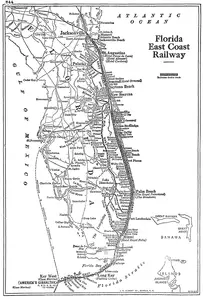
Ever since the late 1800s when Florida became more accessible to the public (by means of Henry Flagler’s Florida East Coast Railway, which was chartered in 1895 to link the entire eastern shoreline of Florida), vacationers and travelers, particularly from the northern states, were enamored with its tropical weather, warm breezes, and beautiful beaches.
Photos
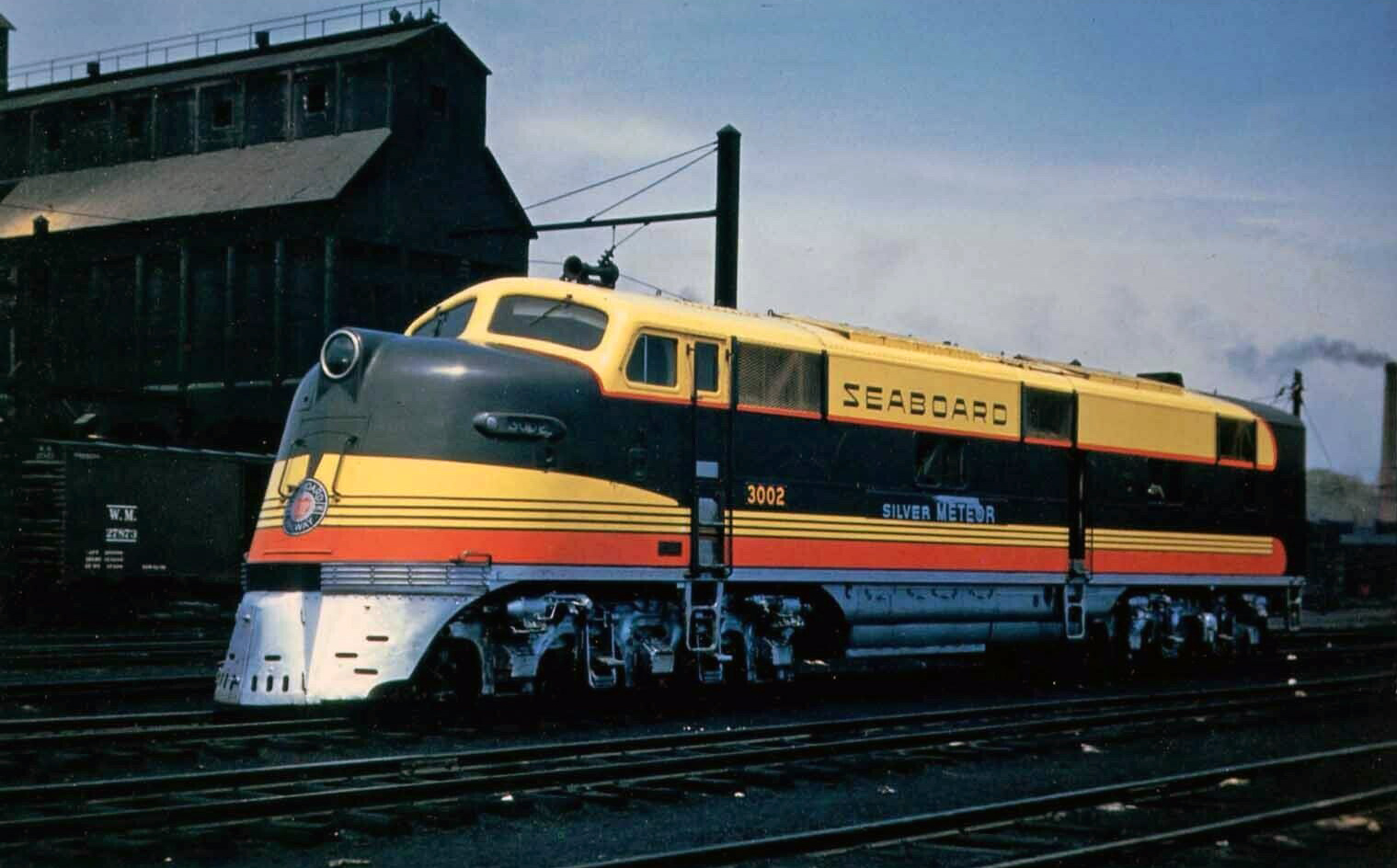 Seaboard Air Line E4A #3002 provides a brilliant splash of color to the Ivy City engine terminal in Washington, D.C. on May 6, 1940 at 12:35 PM as it awaits its next assignment pulling the "Silver Meteor." Leonard W. Rice photo.
History
This tropical climate gave both railroads an unprecedented marketing advantage not found on most other systems. Even as passenger train traffic took serious hits beginning in the 1950s from highways and airlines, across the industry both the Seaboard Air Line and Atlantic Coast Line Railroads continued to earn strong revenue with their Florida-bound trains all of the way up through the 1960s!
Each company had the vacation market cornered and were the only railroads to provide direct service to Florida via the Mid-Atlantic region (as well as Midwestern areas via connections).
A testament to this popularity can be seen in the number of passenger trains both railroads offered to points south.
The Seaboard offered such trains as:
- Cotton Blossom (Washington, D.C. – Atlanta)
- Gulf Wind (Jacksonville – New Orleans)
- New York – Florida Special (New York – Miami/St. Petersburg)
- Orange Blossom Special (New York – Miami)
- Palmland (New York – Tampa/Boca Grande, Florida)
- Silver Meteor (New York – Miami)
- Silver Comet (New York – Birmingham)
- Silver Star (New York – Miami: A train actually introduced to meet the demand of the Silver Meteor’s route!)
- Sunland (Washington, D.C./Portsmouth, Virginia – Miami)
- Suwanee River Special (Cincinnati – Florida)
At A Glance
25 Hours and 45 Minutes (Southbound) 25 Hours and 25 Minutes (Northbound) | |
24 Hours and 30 Minutes (Southbound) 24 Hours and 40 Minutes (Northbound) | |
February 2, 1939 - June 30, 1967 (Seaboard Air Line) July 1, 1967 - April 30, 1971 (Seaboard Coast Line) May 1, 1971 - Present (Amtrak) | |
113/57 (Southbound) 114/58 (Northbound) | |
1388.7 Miles (New York - Miami) | |
Pennsylvania Station (New York) Seaboard Station/2206 Northwest 7th Avenue (Miami) Seaboard Station/420 22nd Street South (St. Petersburg) |
While service to Florida had been brisk for both railroads for decades, it wasn’t until the streamlined, and very colorful, Silver Meteor debuted on February 2, 1939 did southern passenger railroading take on a whole new level of service.
The original version of the Silver Meteor was a lightweight, seven car, all-coach affair (including diner service). However, although it was only all-coach service, it was extremely successful.
Consist (1952/1958)
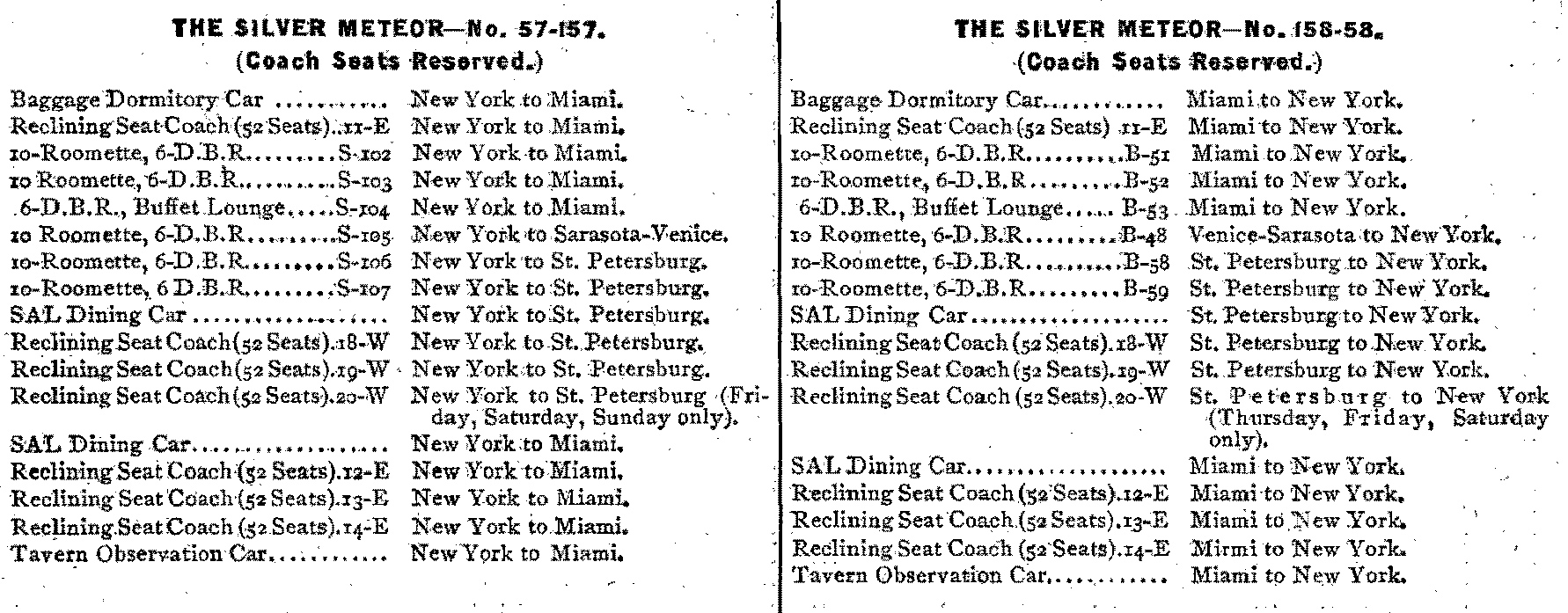
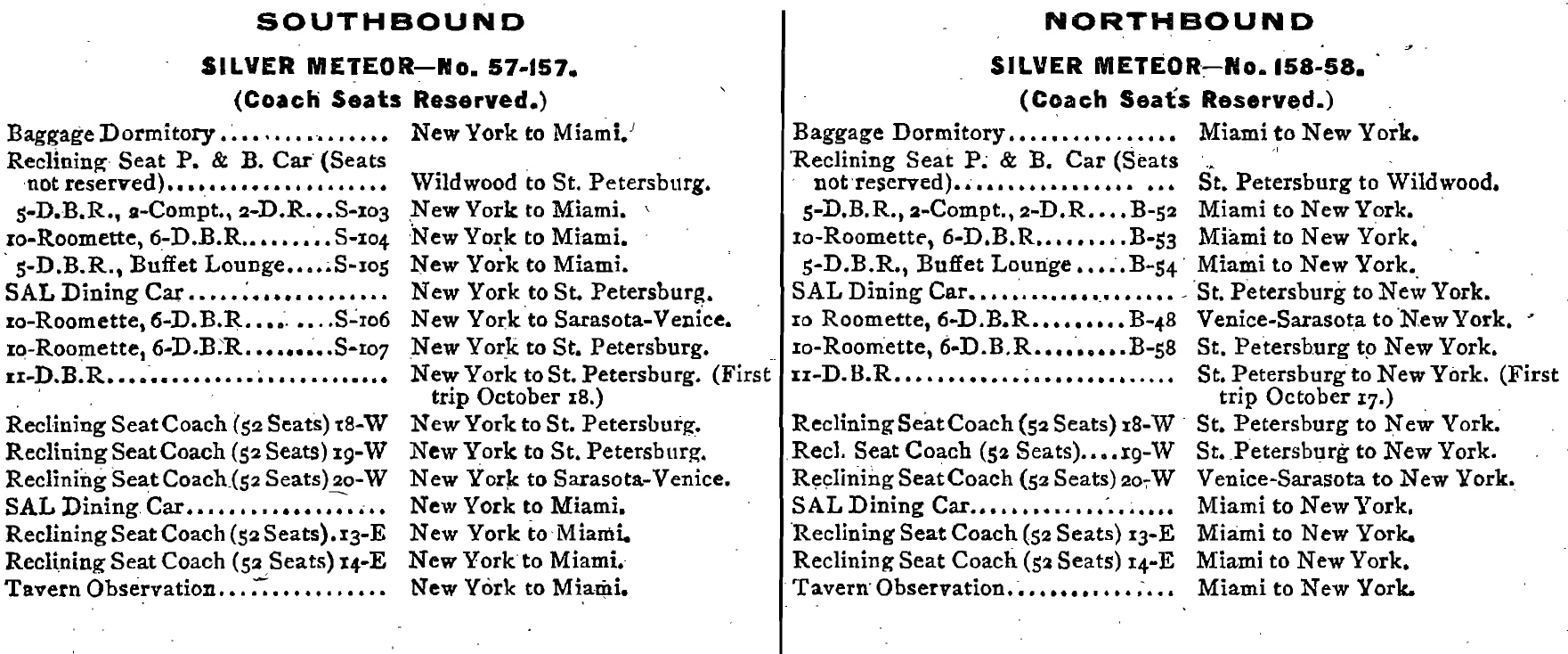
Advertised as an overnight train between New York/Boston and Miami (with through sleeper service available via the Pennsylvania and New Haven railroads) it featured stainless-steel cars (built by the Budd Company) with livery adorning the new EMD E4 diesel locomotives, which was as colorful and bright as Florida itself.
The classic paint scheme featured blends of bright yellow and orange with a center color of very dark green with bright silver featured along the bottom (including the trucks).
The bright livery adorning the Meteor became a signature feature of both the ACL and SAL Florida-bound trains as they exuded bright, cheery themes meant to give passengers a glimpse of the sub-tropical/tropical weather in which they were heading.
The success of the original Meteor meant that the train would not remain an all-coach only affair for long. After World War II it was upgraded with features such as sleepers and lounges (including the 1956 introduction of the “Sun Lounge”, a car with glass ceilings to allow in natural light; clearance restrictions prevented domes to New York City) giving the train much more diversity and options for passengers.
Timetable (1941)
| Read Down Time/Leave (Train #113/PRR) | Milepost | Location | Read Up Time/Arrive (Train #114/PRR) |
|---|---|---|---|
| 2:05 PM (Dp) | 0.0 | 11:15 AM (Ar) | |
| 2:20 PM | 10.0 | 10:58 AM | |
| 3:04 PM | 58.1 | 10:14 AM | |
| 3:32 PM | 85.9 | 9:48 AM | |
| 3:40 PM (Ar) | 9:39 AM (Dp) | ||
| 3:41 PM (Dp) | 9:38 AM (Ar) | ||
| 4:14 PM | 118.1 | F 9:08 AM | |
| 5:14 PM (Ar) | 186.5 | 8:06 AM (Dp) | |
| 5:15 PM (Dp) | 186.5 | 8:05 AM (Ar) | |
| 6:05 PM (Ar) | 226.6 | 7:25 AM (Dp) | |
| Time/Leave (Train #43/RF&P) | Milepost | Location | Time/Arrive (Train #44/RF&P) |
| 6:20 PM (Dp) | 226.6 | 7:05 AM (Ar) | |
| 8:45 PM (Ar) | 343.1 | 4:35 AM (Dp) | |
| Time/Leave (Train #33/SAL) | Milepost | Location | Time/Arrive (Train #34/SAL) |
| 8:45 PM (Dp) | 343.1 | 4:35 AM (Ar) | |
| 9:11 PM | 365.8 | 4:01 AM | |
| F | 596.9 | F | |
| 3:15 AM | 702.8 | 9:55 PM | |
| 5:35 AM (Ar) | 843.7 | 7:30 PM (Dp) | |
| 5:40 AM (Dp) | 843.7 | 7:25 PM (Ar) | |
| 6:41 AM | 911.0 | 6:16 PM | |
| 8:00 AM (Ar) | 982.7 | 5:10 PM (Dp) | |
| 8:05 AM (Dp) | 982.7 | 5:05 PM (Ar) | |
| 8:44 AM | 1026.9 | 4:19 PM | |
| 8:55 AM | 1038.5 | 4:07 PM | |
| 9:33 AM | 1083.8 | 3:30 PM | |
| 10:00 AM (Ar) | 1109.9 | 3:05 PM (Dp) | |
| Time/Leave (Train #43/Miami Section) | Milepost | Location | Time/Arrive (Train #44/Miami Section) |
| 10:10 AM (Dp) | 1109.9 | 2:55 PM (Ar) | |
| 11:05 AM | 1109.9 | 1:44 PM | |
| 11:15 AM | 1184.2 | 1:37 PM | |
| 11:35 AM | 1206.9 | 1:16 PM | |
| 11:45 AM | 1215.9 | 1:06 PM | |
| 1:11 PM | 1318.6 | 11:40 AM | |
| 1:18 PM | 1325.2 | 11:31 AM | |
| 1:29 PM | 1336.2 | 11:20 AM | |
| 1:58 PM | 1361.0 | 10:55 AM | |
| 2:06 PM | 1368.4 | 10:47 AM | |
| 2:35 PM (Ar) | 1388.7 | 10:20 AM (Dp) | |
| Time/Leave (Train #343/St. Petersburg Section) | Milepost | Location | Time/Arrive (Train #344/St. Petersburg Section) |
| 10:15 AM (Dp) | 1109.9 | 2:50 PM (Ar) | |
| 11:00 AM | 1146.5 | 1:58 PM | |
| 11:32 AM | 1171.4 | 1:26 PM | |
| 12:05 PM (Ar) | 1193.4 | 12:55 PM (Dp) | |
| 12:10 PM (Dp) | 1193.4 | 12:50 PM (Ar) | |
| 12:29 PM | 1199.9 | 12:29 PM | |
| F 12:47 PM | 1213.6 | F 12:09 PM | |
| F 12:53 PM | 1218.7 | F 12:03 PM | |
| 1:03 PM | 1226.1 | 11:52 AM | |
| 1:12 PM | 1227.5 | 11:43 AM | |
| 1:15 PM | 1229.4 | 11:41 AM | |
| 1:27 PM | 1236.5 | 11:34 AM | |
| 1:32 PM | 1241.6 | 11:29 AM | |
| 1:50 PM (Ar) | 1247.3 | 11:15 AM (Dp) |
A typical consist during the late 1950s included reclining-seat coaches, a diner, lounge, sleepers, and tavern observation. Listed as Trains #57 (southbound) and #58 (northbound) on Seaboard's timetable, the Silver Meteor would depart Pennsylvania Station at 2:55 pm, powered by PRR GG1s until reaching Washington, D.C. where the train was handed off, about four hours later, to the Richmond, Fredericksburg & Potomac.
The
RF&P carried the train another few hours until reaching Richmond's
Main Street Station before 10 pm. From this point the Seaboard carried
its train the rest of the way to Florida, arriving in Miami by nearly 5
pm the next day (the train also provided connecting service to Tampa,
Venice, and St. Petersburg).
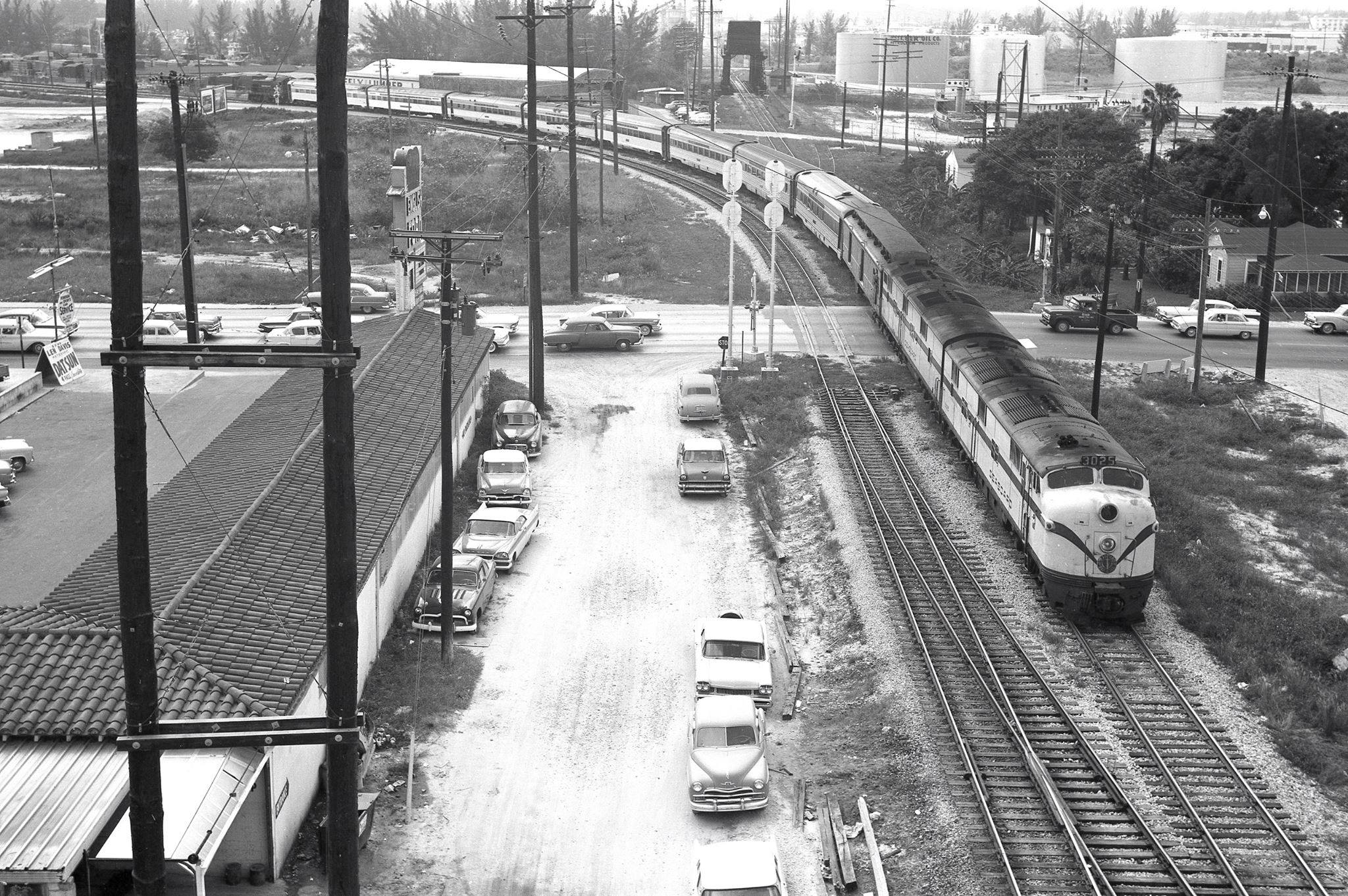 An A-B set of Seaboard Air Line E7's have what may be the "Silver Meteor" (New York - Miami/St. Petersburg/Venice/Fort Meyers) at the Hialeah Market in Miami, Florida during the 1960s. Warren Calloway photo.
Amtrak and Final Years
Much like the Atlantic Coast Line, the Seaboard Air Line Railroad took great pride in its passenger train operations and they remained flawlessly operated with excellent service until the SAL disappeared into the Seaboard Coast Line in 1967.
Under the SCL high quality service was retained (although the train's livery was a much more subdued black with yellow trim) as one could still purchase sleeper service to New York/Boston and the train retained its diner, reclining-seat coaches, and tavern-observation lounge.
As a testament to the SAL’s high quality of
passenger operations and lucrative southern market, Amtrak continues to
operate several of its trains including the Meteor (as well as the Silver Star), and in 1979 elected to discontinue the Atlantic Coast Line's Champion.
Sources
- Goolsby, Larry. Seaboard Air Line Passenger Service, The Streamlined Era. Forest: TLC Publishing, 2011.
- Schafer, Mike. More Classic American Railroads. Osceola: MBI Publishing, 2000.
- Schafer, Mike and Welsh, Joe. Streamliners, History of a Railroad Icon. St. Paul: MBI Publishing, 2003.
- Solomon, Brian. Streamliners: Locomotives And Trains In The Age Of Speed And Style. Minneapolis: Voyageur Press, 2015.
Recent Articles


-
Scenic Dinner Train Rides (2026): A Complete Guide
May 13, 26 01:57 PM
 Dinner trains have become a popular attraction in recent years. Here, you can find dates and locations for these events in 2025.
 -
Railroad Museums In The USA (2026): A Complete Guide
May 13, 26 01:56 PM
 Find out about all of the many railroad museums that operate around the United States, which work to keep alive our nation's history with trains.
 -
Pennsylvania "Father's Day" Train Rides
May 13, 26 12:53 PM
 This state offers a unique way to celebrate Father's Day with unforgettable train rides that combine history, stunning landscapes, and a dash of nostalgia.
 -
New York "Father's Day" Train Rides
May 13, 26 12:52 PM
 If you’re looking to make this day memorable, consider taking a scenic train ride with your dad through the beautiful landscapes of New York State.
 -
Texas Father's Day Train Rides
May 13, 26 12:50 PM
 In Texas, Father's Day can be made unique by combining the nostalgia and charm of train rides with the grandeur of the Texas landscape.
 -
Alabama - Murder Mystery - Dinner Train Rides
May 13, 26 12:49 PM
 There is currently one location in the state offering a murder mystery dinner experience, the Wales West Light Railway!
 -
Pennsylvania - Whiskey Tasting - Train Rides
May 13, 26 12:38 PM
 For whiskey aficionados and history buffs alike, a train ride through the Keystone State offering such spirits provides a unique and memorable experience.
 -
Tennessee 'Wine Tasting' Train Rides
May 13, 26 12:35 PM
 One of the most unique and enjoyable ways to savor the flavors of Tennessee’s vineyards is by train aboard the Tennessee Central Railway Museum.
 -
North Carolina 'Wine Tasting' Train Rides
May 13, 26 12:32 PM
 A noteworthy way to explore North Carolina's beauty is by hopping aboard the Great Smoky Mountains Railroad and sipping fine wine!
 -
Reading & Northern Showcases "America250" Caboose
May 13, 26 12:04 PM
 The Reading & Northern has unveiled repainted PRR N-8 caboose #94850 in "America250" colors. The car made its first run on May 8, 2026.
 -
Chicago & Eastern Illinois Timetables (August, 1952)
May 13, 26 11:50 AM
 Covered here is the Chicago & Eastern Illinois Railroad's complete timetable listing from the August, 1952 edition of the "Official Guide."
 -
Chicago, Aurora and Elgin Timetables (March, 1940)
May 13, 26 12:03 AM
 Featured here is the Roarin' Elgin's single page timetable listing from the March, 1940 issue of the "Official Guide Of The Railways."
 -
Algoma Central Railway Timetables (March, 1940)
May 12, 26 11:51 PM
 Highlighted here is the Algoma Central Railway's single page timetable listing in the March, 1940 edition of the "Official Guide."
 -
Akron, Canton & Youngstown Timetables (March, 1940)
May 12, 26 10:45 PM
 Featured here is the Akron, Canton & Youngstown's brief timetable listing in the "Official Guide" from the March, 1940 edition.
 -
Minnesota 'Dinner Train' Rides At Duluth
May 12, 26 12:47 PM
 One of the best ways to feel the region's history in motion today is aboard the North Shore Scenic Railroad (NSSR), which operates out of Duluth’s historic depot.
 -
Maryland 'Dinner Train' Rides At Walkersville
May 12, 26 12:45 PM
 While WSRR runs a variety of seasonal and special trains, one of its most appealing “date night” offerings is the Valentine’s Dinner Train, a romantic two-hour ride built around classic railroad ambia…
 -
Utah 'Murder Mystery' Dinner Train Rides
May 12, 26 12:43 PM
 This article highlights the murder mystery dinner trains currently avaliable in the state of Utah!
 -
Rhode Island 'Murder Mystery' Dinner Train Rides
May 12, 26 12:41 PM
 Let's dive into the enigmatic world of murder mystery dinner train rides in Rhode Island, where each journey promises excitement, laughter, and a challenge for your inner detective.
 -
Nevada 'Wine Tasting' Train Rides
May 12, 26 12:20 PM
 While it may not be the first place that comes to mind when you think of wine, you can sip this delight by train in Nevada at the Nevada Northern Railway.
 -
New Hampshire "Wine Tasting" Train Rides
May 12, 26 12:18 PM
 This article details New Hampshire's most enchanting wine tasting trains, where every sip is paired with breathtaking views and a touch of adventure.
 -
New Jersey 'Wine Tasting' Train Rides
May 12, 26 12:17 PM
 If you're seeking a unique outing or a memorable way to celebrate a special occasion, wine tasting train rides in New Jersey offer an experience unlike any other.
 -
West Pointe Route Timetables (August, 1952)
May 11, 26 08:23 PM
 Included here is the complete West Point Route timetables, including the Georgia Railroad, from the August, 1952 edition of the "Official Guide."
 -
Virginian Railway Timetables (August, 1952)
May 11, 26 04:27 PM
 Included here is the Virginian Railway's complete system map and brief timetable listing from the August, 1952 edition of the "Official Guide."
 -
RF&P Railroad Timetables (August, 1952)
May 11, 26 02:21 PM
 Featured here is the Richmond, Frederickburg & Potomac's public timetables from the August, 1952 edition of the "Official Guide."
 -
Missouri 'Wine Tasting' Train Rides
May 11, 26 12:20 PM
 The fusion of scenic vistas, historical charm, and exquisite wines is beautifully encapsulated in Missouri's wine tasting train experiences.
 -
Minnesota 'Wine Tasting' Train Rides
May 11, 26 12:19 PM
 This article takes you on a journey through Minnesota's wine tasting trains, offering a unique perspective on this novel adventure.
 -
Alabama - Whiskey Tasting - Train Rides
May 11, 26 12:14 PM
 With a little planning, you can build a memorable whiskey-and-rails getaway in the Heart of Dixie.
 -
Washington 'Murder Mystery' Dinner Train Rides
May 11, 26 12:11 PM
 This article delves into what makes murder mystery dinner train rides in Washington State such a captivating experience.
 -
Nevada 'Murder Mystery' Train Rides
May 11, 26 12:09 PM
 Seamlessly blending the romance of train travel with the allure of a theatrical whodunit, these excursions promise suspense, delight, and an unforgettable journey through Nevada’s heart.
 -
Kentucky 'Murder Mystery' Dinner Train Rides
May 11, 26 12:06 PM
 In the realm of unique travel experiences, Kentucky offers an enchanting twist that entices both locals and tourists alike: murder mystery dinner train rides.
 -
Original Norfolk Southern Timetables (January, 1930)
May 11, 26 10:06 AM
 Featured here is the complete timetable listing of the original Norfolk Southern Railway from the January, 1930 edition of the "Official Guide."
 -
Atlantic and Danville Railway: Serving Southern VA
May 11, 26 09:50 AM
 The Atlantic and Danville Railway (reporting mark AD), often referred to in its early years as the Atlantic & Danville Railroad, stands as a quintessential example of late-19th-century American railro…
 -
Interstate Railroad Timetables (January, 1910)
May 11, 26 09:25 AM
 Featured here is the Interstate Railroad's very brief timetable listing from the January, 1910 edition of the "Official Guide Of The Railways."
 -
Virginia "Whiskey Tasting" Train Rides
May 10, 26 01:01 PM
 Among the Virginia Scenic Railway's most popular specialty excursions is the “Bourbon & BBQ” tasting train, an adults-oriented rail journey that pairs scenic views of the Shenandoah Valley wit…
 -
Tennessee 'Whiskey Tasting' Train Rides
May 10, 26 12:58 PM
 Here’s what to know, who to watch, and how to plan an unforgettable rail-and-whiskey experience in the Volunteer State.
 -
New York 'Dinner Train' Rides In The Adirondacks
May 10, 26 12:51 PM
 Operating over a restored segment of the former New York Central’s Adirondack Division, the Adirondack Railroad has steadily rebuilt both track and public interest in passenger rail across the region.
 -
West Virginia 'Murder Mystery' Dinner Train Rides
May 10, 26 12:45 PM
 For those looking to combine the allure of a train ride with an engaging whodunit, the murder mystery dinner trains offer a uniquely thrilling experience.
 -
Kansas 'Murder Mystery' Dinner Train Rides
May 10, 26 12:26 PM
 Kansas, known for its sprawling wheat fields and rich history, hides a unique gem that promises both intrigue and culinary delight—murder mystery dinner trains.
 -
Florida 'Murder Mystery' Dinner Train Rides
May 10, 26 12:21 PM
 Florida, known for its vibrant culture, dazzling beaches, and thrilling theme parks, also offers a unique blend of mystery and fine dining aboard its murder mystery dinner trains.
 -
Florida East Coast Timetables (January, 1930)
May 09, 26 11:55 PM
 Featured here is the Florida East Coast Railway's listing in the "Official Guide" from January, 1930 when the system still reached Key West.
 -
Clinchfield Railroad Timetables (August, 1952)
May 09, 26 01:28 PM
 Featured here is the Clinchfield's brief listing from the August, 1952 edition of the "Official Guide Of The Railways."
 -
California 'Beer Tasting' Train Rides
May 09, 26 10:58 AM
 While the Niles Canyon Railway is known for family-friendly weekend excursions and seasonal classics, one of its most popular grown-up offerings is Beer on the Rails.
 -
New Jersey 'Beer Tasting' Train Rides
May 09, 26 10:49 AM
 On select dates, the Woodstown Central Railroad pairs its scenery with one of South Jersey’s most enjoyable grown-up itineraries: the Brew to Brew Train.
 -
New Hampshire 'Murder Mystery' Dinner Train Rides
May 09, 26 10:32 AM
 The state's murder mystery trains stand out as a captivating blend of theatrical drama, exquisite dining, and scenic rail travel.
 -
North Carolina 'Dinner Train' Rides At Spencer
May 09, 26 10:26 AM
 Tucked into the Piedmont town of Spencer, the North Carolina Transportation Museum is the kind of place that feels less like a typical museum and more like a living rail yard that never quite stopped…
 -
Tennessee 'Dinner Train' Rides At TVRM
May 09, 26 10:16 AM
 Tucked into East Chattanooga, the Tennessee Valley Railroad Museum (TVRM) is less a “museum you walk through” and more a railroad you step aboard.
 -
Pennsylvania 'Dinner Train' Rides At Boyertown
May 09, 26 10:02 AM
 With beautifully restored vintage equipment, carefully curated menus, and theatrical storytelling woven into each trip, the Colebrookdale Railroad offers far more than a simple meal on rails.
 -
New York 'Murder Mystery' Dinner Train Rides
May 09, 26 09:54 AM
 New York State, renowned for its vibrant cities and verdant countryside, offers a plethora of activities for locals and tourists alike, including murder mystery train rides!
 -
Central of Georgia Timetables (August, 1952)
May 08, 26 11:51 PM
 Featured is the Central of Georgia Railway's complete timetable listing from the August, 1952 edition of the "Official Guide Of The Railways."
 -
Pittsburgh & West Virginia Timetables (September, 1937)
May 08, 26 11:30 PM
 Presented here is the Pittsburgh & West Virginia's public timetables listed in the September, 1937 issue of the "Official Guide."



%20at%20the%20Hialeah%20Market%20in%20Miami%2C%20Florida%20during%20the%201960s.%20%20Warren%20Calloway%20photo.)