Atlantic and Danville Railway: Serving Southern VA
Published: May 11, 2026
By: Adam Burns
The Atlantic and Danville Railway (reporting mark AD), often referred to in its early years as the Atlantic & Danville Railroad, stands as a quintessential example of late-19th-century American railroad entrepreneurship in the post-Reconstruction South. Chartered in 1882 and operational by the 1890s, it carved a vital 203-mile main line across southeastern Virginia from the deepwater ports of the Elizabeth River near Portsmouth and Norfolk to the industrial and tobacco hub of Danville. At its peak, the system encompassed roughly 278 miles, including branches, serving as a critical artery for freight—primarily tobacco, lumber, farm products, and manufactured goods—and passenger travel through the Piedmont and Southside regions.
Unlike many contemporaries absorbed early into larger systems, the A&D maintained a degree of independence for decades, weathering bankruptcy, a 50-year lease to the Southern Railway, and eventual acquisition by the Norfolk & Western. Its story reflects broader themes in Virginia railroad history: the shift from narrow-gauge local haulers to standard-gauge connectors, the economic pull of Hampton Roads ports, and the eventual decline amid trucking competition and mergers. Today, fragments survive as short-line operations, rail trails like the Tobacco Heritage Trail, and historic landmarks, underscoring its enduring legacy in shaping towns and economies along its route.
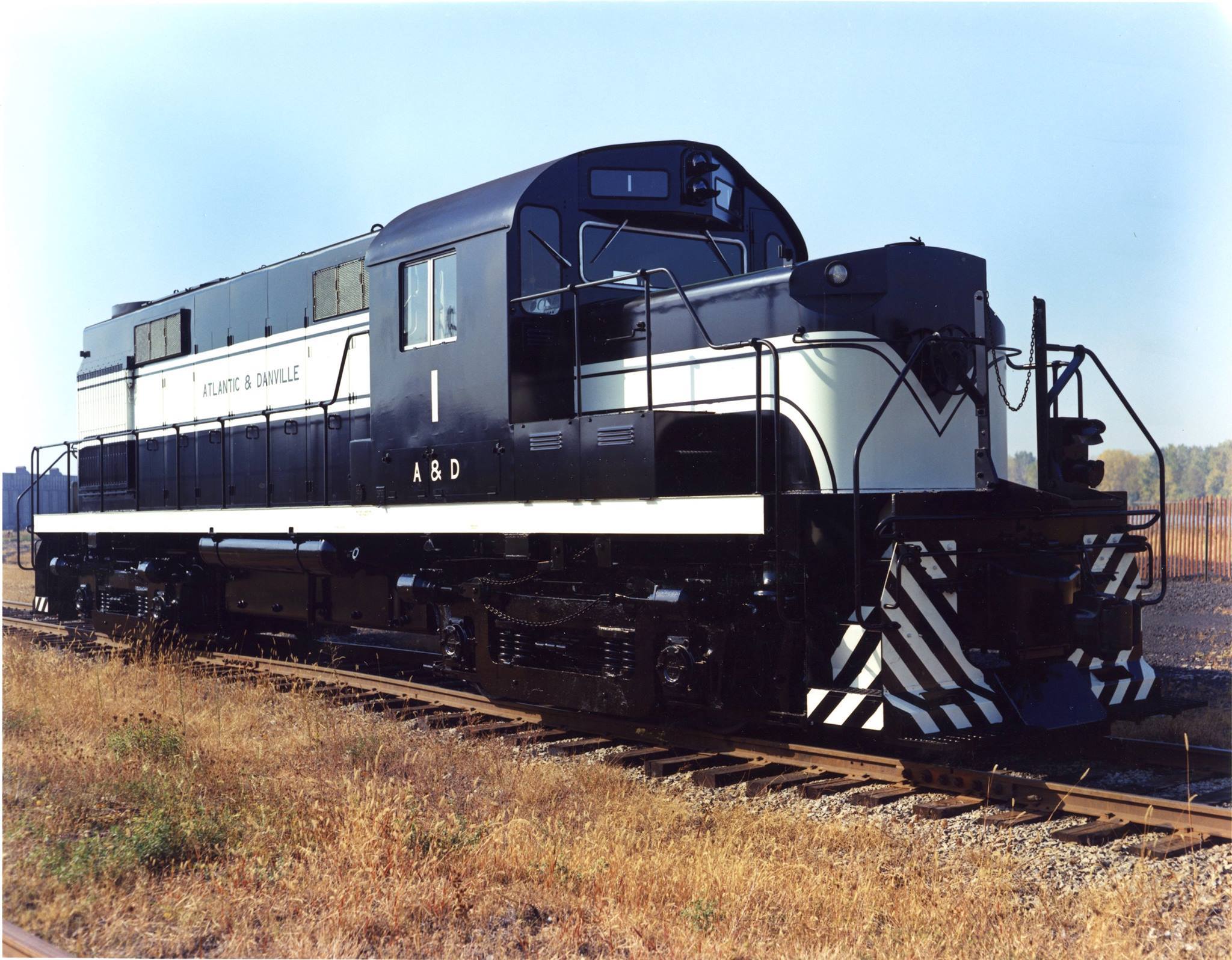 An American Locomotive builder's photo featuring new Atlantic & Danville RS36 #1 at the Schenectady plant in 1962, one of two the road ordered (#2). Warren Calloway collection.
Founding and Early Construction: From Narrow-Gauge Ambition to Standard-Gauge Reality
The railroad’s origins trace to Virginia’s General Assembly charter in 1882, amid a boom in railroad expansion aimed at linking interior resources to coastal ports. At the time, the Norfolk & Western was pushing westward for coal, but the legislature encouraged competition to ensure diverse traffic flows into Norfolk. The A&D’s initial vision was modest yet strategic: a three-foot narrow-gauge line to tap Southeast Virginia’s timberlands.
Construction began in 1885 with a 50-mile narrow-gauge route from Belfield and Hicksford (merged and renamed Emporia in 1887) on the Meherrin River to a new wharf at Claremont on the James River in Surry County. The goal was lumber export, complementing earlier plantation-era strap-iron tracks. A parallel effort by the Surry County Railroad & Lumber Co. (later reorganized) shared trackage initially, but the A&D ultimately dominated Claremont’s facilities after 1886. This phase embodied the era’s speculative optimism—new ports like Claremont and Newport News (by the C&O) sought to rival established Hampton Roads terminals.
The narrow-gauge venture proved unprofitable. Timber traffic alone couldn’t sustain operations, and Claremont’s location up the James River limited ship access compared to deeper Elizabeth River sites. Investors pivoted aggressively. In 1887, they raised capital for standard-gauge track from Emporia to a new deepwater terminal at West Norfolk on the Elizabeth River’s western bank. A car ferry shuttled freight cars across to Norfolk proper, and a short extension reached Portsmouth city limits at the city’s inducement (including stock purchases and promises of passenger service rerouting). By 1888, 78 miles of standard-gauge line linked West Norfolk to Belfield/Emporia.
The westward push to Danville accelerated between 1887 and 1891, adding 133 miles through Brunswick, Mecklenburg, and Halifax counties. Engineers followed a surveyed route from the failed Norfolk & Great Western (1872 charter, no track laid), minimizing grades by hugging the Virginia-North Carolina border (with about 20 miles dipping into North Carolina, requiring dual charters). The full main line—approximately 210 miles from Norfolk/Portsmouth to Danville—opened in 1890, with the company reorganizing as the Atlantic & Danville Railway in 1894 after bankruptcy.
Early challenges included financial strain and competition. The Portsmouth branch to the Seaboard Cotton Press was quickly abandoned post-reorganization, as courts ruled the new entity unbound by prior promises. Yet the line’s completion positioned it perfectly for Piedmont exports: processed tobacco, cotton, and farm goods funneled to international markets via Hampton Roads.
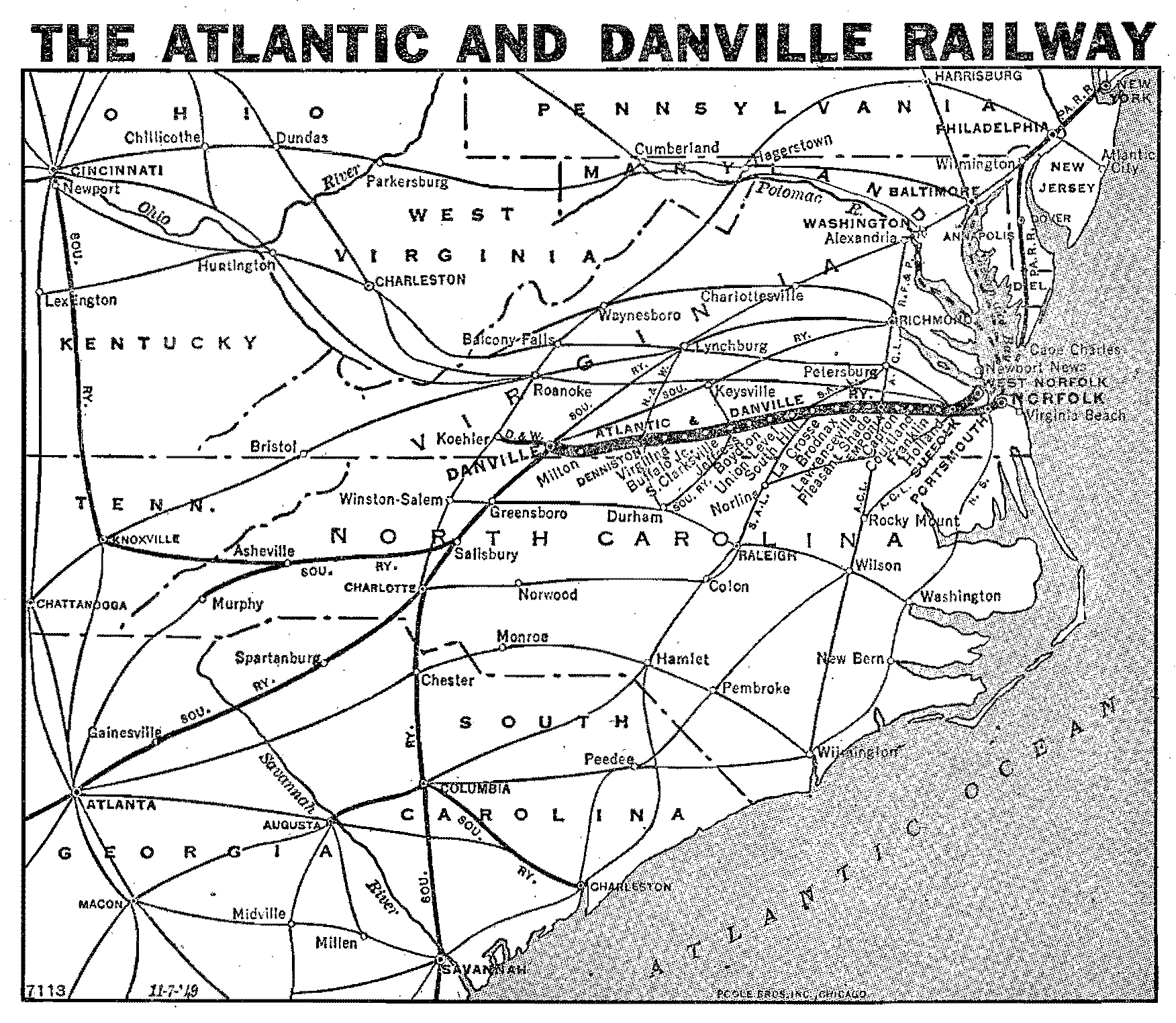 An Atlantic & Danville system map from the August, 1952 edition of the "Official Guide."
Expansion, Town-Building, and the Southern Lease (1890s–1949)
The A&D’s arrival catalyzed regional growth. In Mecklenburg County, it transformed hamlets into thriving centers. South Hill was literally platted by railroad engineers in 1889: a 1.25-mile radius around a central depot on 56 acres. Incorporated in 1901, it boasted warehouses, hotels, and businesses by 1903; by 1913, six passenger and four freight trains daily made it a tobacco, manufacturing, and entertainment hub. Nearby La Crosse (formerly Piney Pond) exploded after the A&D’s 1889 arrival and Seaboard Air Line’s 1900 crossing, handling up to eight daily passenger trains. Other stops like Union Level, Baskerville, Boydton, and Clarksville saw commercial booms tied to brightleaf tobacco and lumber. Lawrenceville became a midpoint repair-shop hub.
By 1896 (under temporary Southern operation as the Richmond & Mecklenburg), the line employed 315 workers. Freight was diverse: outbound coal, lumber, flour, wheat, hay, tobacco, fruits, vegetables, livestock, meats, wool, and leather; inbound petroleum, naval stores, machinery, cement, brick, and consumer goods. Equipment featured Janney couplers and Westinghouse air brakes. Passenger and mail trains complemented freight, with telegraph service by Western Union.
Strategic leasing followed. In 1899, the Southern Railway secured a 50-year lease for direct Norfolk and Danville access, intersecting rivals like the Atlantic Coast Line and Seaboard at key points (Franklin, Emporia, La Crosse). This integrated the A&D into a vast network while preserving its corporate identity. The narrow-gauge Claremont branch lingered for lumber until Southern discontinued it in 1932; the Gray Lumber Company operated it privately until 1938.
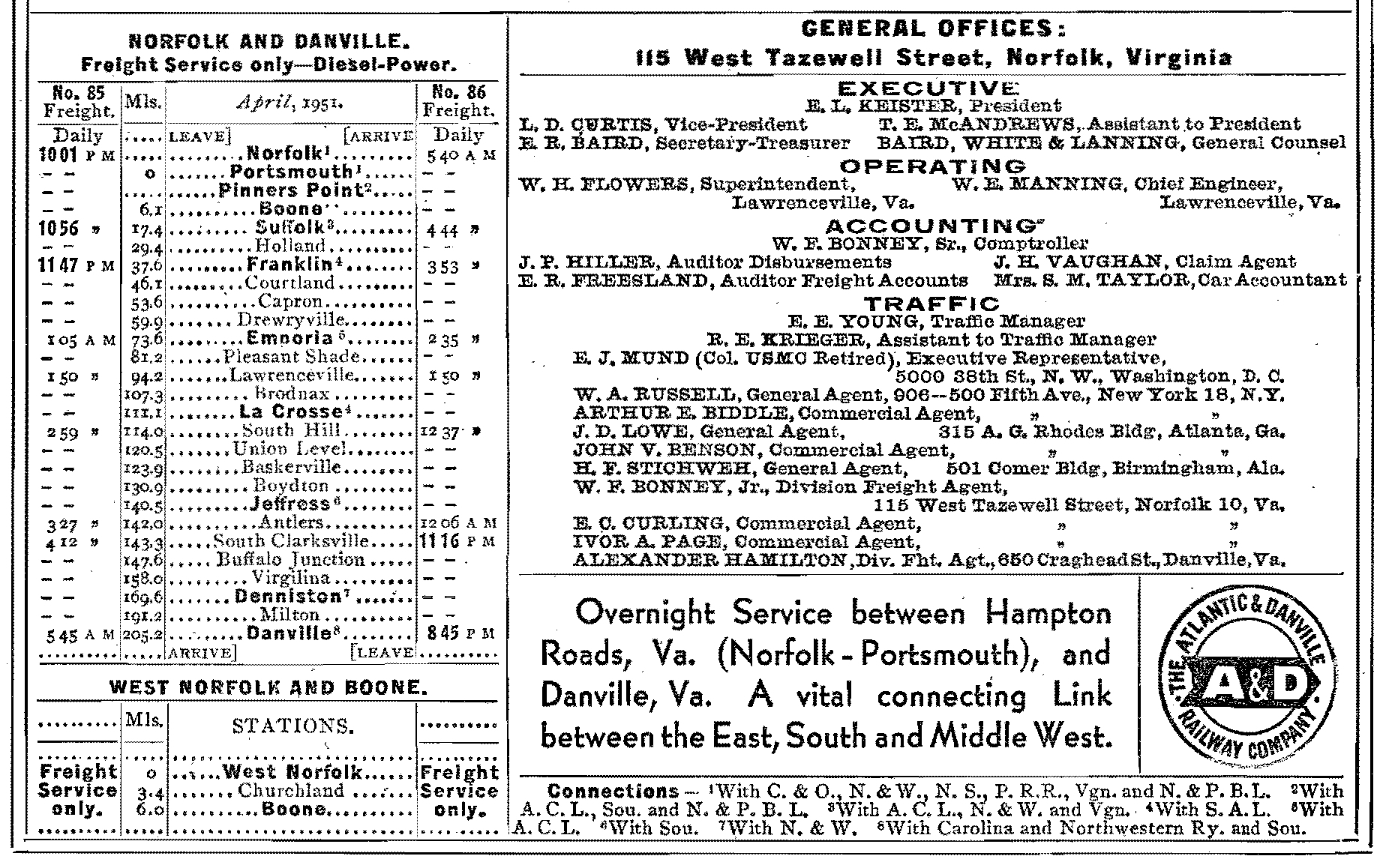
Operations under Southern emphasized reliability. Mainline passenger trains ran overnight: Norfolk departures at 10:01 PM arriving Danville ~5:45 AM, with returns from Danville at 8:45 PM. Stations dotted the route—Suffolk, Holland, Franklin, Courtland, Emporia, Lawrenceville, Brodnax, La Crosse, South Hill, Boydton, Clarksville, and more—serving rural Southside communities. Freight focused on agricultural and industrial flows, bolstering Danville’s textile, paper, and tobacco mills alongside peanut shipments from eastern farms.
Independent Revival, Dieselization, and Challenges (1949–1962)
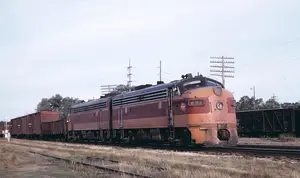
The 50-year lease ended August 1, 1949. Freed from Southern control, the A&D operated independently as a Class I carrier, grossing over $1 million in 1950 despite initial losses. It aggressively modernized, purchasing six Alco RS-2 diesels (101–106) in 1949 and an RS-3 (107) in 1951, painted in striking black with white stripes. Headquarters shifted toward Suffolk.
Freight remained king, but trucking and automobiles eroded margins. Passenger service persisted on a smaller scale amid post-WWII shifts. The company navigated receivership in 1960, reflecting industry-wide pressures: fixed costs, competition, and declining rural traffic. Yet its 228 route miles (including a 17.2-mile West Norfolk–Suffolk branch) retained strategic value for Danville industries and port connections.
Norfolk & Western Acquisition and the Norfolk, Franklin & Danville Era (1962–1982)
In 1962, the Norfolk & Western Railway (N&W) purchased the bankrupt A&D, reorganizing it as the Norfolk, Franklin and Danville Railway (NF&D)—a wholly owned subsidiary. N&W sought Danville’s industrial traffic and port options. The NF&D traded in the Alco RS-2/RS-3 fleet for two new RS-36s (#1–2) and four ex-Nickel Plate Road RS-11s (#201–204, acquired 1965). Locomotives wore simplified dark blue with “NFD” lettering; N&W units were leased as needed.
Operations continued freight-focused on the Norfolk–Danville main line and Suffolk branch, interchanging with multiple Class I roads at Norfolk terminals. Scenic runs traversed rolling hills, farms, and small towns. A 1969 system map highlighted its niche within the N&W network. Major terminals at Danville and Lawrenceville supported manifest freights.
The NF&D endured until the 1982 Norfolk Southern merger, when subsidiaries consolidated. The line was gradually trimmed: the Claremont branch long gone, and western segments became redundant.
Timetables (August, 1952)
Abandonments, Legacy, and Modern Footprints
Post-merger abandonments accelerated. Portions west of Suffolk saw service end; in 2014, Norfolk Southern received approval to abandon 53 miles. Earlier, the narrow-gauge remnants vanished. Yet resilient sections persist: the West Norfolk–Suffolk spur operates today as the Commonwealth Railway (a Genesee & Wyoming short line). In Brodnax, La Crosse, and South Hill, the right-of-way forms the Tobacco Heritage Trail, preserving the corridor for recreation while echoing its tobacco-hauling past.
Surviving infrastructure includes depots at Baskerville and Antlers, commercial buildings in Union Level, and the ca. 1917 La Crosse Hotel. Historic registers recognize stations and related sites in Mecklenburg and beyond, from Lawrenceville to Virgilina. The A&D’s impact endures in planned towns like South Hill and economic lifelines for Southside Virginia.
In total, the Atlantic and Danville Railway exemplified resilient short-line ingenuity. From humble narrow-gauge lumber hauler to leased Southern feeder and N&W subsidiary, it moved millions of tons of freight and thousands of passengers across Virginia’s heartland for nearly a century. Its story—marked by innovation, adaptation, and community ties—remains etched in railbeds, trails, and local lore, a testament to the railroads that built modern Virginia.
Recent Articles


-
Bessemer & Lake Erie Railroad: "The Bessemer Road"
Sep 15, 26 05:20 PM
 Bessemer & Lake Erie—Bear Creek 1865, Carnegie 1897, U.S. Steel 1901. Ore south from Conneaut, coal north. 2-10-4s, Missabe sister road. CN May 10, 2004. Complete corporate history.
 -
Bangor and Aroostook Railroad: "Serving Northern Maine"
Sep 15, 26 05:05 PM
 Bangor & Aroostook—chartered February 13, 1891, first trains January 1, 1894. Potatoes, paper, Searsport, State of Maine reefers. MM&A 2003, Lac-Mégantic 2013, CP 2020, CPKC today. Complete co…
 -
Baltimore & Ohio Chicago Terminal Railroad: Map and History
Sep 15, 26 03:11 PM
 B&OCT—formed January 6, 1910 to buy Chicago Terminal Transfer. Grand Central, Barr Yard, 78 route-miles. Assigned B&O steam. Complete diesel roster. CSX paper subsidiary, mark BOCT.
 -
The "Alphabet Route" (Railroad): Photos and History
Sep 15, 26 02:53 PM
 Alphabet Route—eight railroads, not one company. P&WV to Connellsville February 11, 1931. Alpha Jets Chicago/St. Louis–New York/Boston. NKP, W&LE, P&WV, WM, Reading, CNJ, L&HR, New Hav…
 -
Milwaukee Road Livestock Operations: Cattle, Dakotas & Montana
Sep 15, 26 02:36 PM
 Milwaukee Road livestock traffic—Dakota and Montana cattle, Iowa hogs, Chicago markets, 28-hour law, head-end stock cars. By 1974 mostly Montana. Rick Burn’s Helena speech. Operations history, not the…
 -
Spirit of Jasper Ride & Dine (2026): Season Pause
Sep 15, 26 02:29 PM
 Spirit of Jasper Ride & Dine in Jasper, Indiana—seated meal on board. Operator: not running public trains for 2026. Depot remains open as a rental. Confirm on spiritofjaspertrain.com.
 -
South Carolina Canal & Rail Road Company: Map and History
Sep 15, 26 01:59 PM
 South Carolina Canal & Rail Road—chartered December 19, 1827. Best Friend of Charleston, 136 miles Charleston–Hamburg October 1833, Aiken inclined plane. South Carolina Railroad 1844, Southern 189…
 -
The Practice of Double-Heading: The Steam Era
Sep 15, 26 01:43 PM
 Doubleheading—two locomotives on the point, each with its own steam crew. Not a rear helper, not diesel MU. How it worked, PRR 1877, mountain grades, and what MU ended.
 -
Mohawk and Hudson Railroad: Map, Pictures, Locomotives
Sep 15, 26 01:20 PM
 Mohawk & Hudson Railroad—New York’s first railroad, chartered April 17, 1826. DeWitt Clinton, inclined planes, Albany & Schenectady 1847, first New York Central May 17, 1853. Complete corporat…
 -
Essex Clipper Dinner Train (2026): Dates, Tickets & What to Expect
Sep 15, 26 01:09 PM
 2026 Essex Clipper Dinner Train in Essex, CT—2.5 hours, four-course meal $129.99, 18+. Fall dates through Oct. 25. Confirm on essexsteamtrain.com.
 -
Camden & Amboy Railroad: Map, History, Photos
Sep 15, 26 12:53 PM
 Camden & Amboy Railroad—chartered February 4, 1830. Joint Companies monopoly with the Delaware & Raritan Canal, John Bull, T-rail. United New Jersey 1872, PRR 999-year lease 1871. Complete corpora…
 -
Cafe Lafayette Dinner Train (2026): Dates, Tickets & What to Expect
Sep 15, 26 12:47 PM
2026 Cafe Lafayette Dinner Train in North Woodstock, NH—2 hours, 20 miles, five-course meal from $125. May–October. Confirm on nhdinnertrain.com. -
Christmas Train Ride Locations (2026): A Complete Guide
Sep 15, 26 10:47 AM
 2026 Christmas train rides by state—Santa, North Pole Express, and holiday trains. Not Polar Express. State guides and product pages. Confirm dates on each railroad.
 -
Baltimore & Ohio Railroad: Linking 13 Great States With The Nation
Sep 15, 26 10:22 AM
 Baltimore & Ohio Railroad—first U.S. common carrier, chartered February 28, 1827. Wheeling 1853, Chicago 1874, C&O control 1963, Chessie 1973, into CSX April 30, 1987. Complete corporate history.
 -
Delaware & Hudson Railway: The Bridge Line
Sep 15, 26 09:59 AM
 Delaware & Hudson Railway—Wurts brothers canal 1823, gravity railroad 1829, Stourbridge Lion, Bridge Line to Montreal. Guilford 1984, CP 1991, NS south line 2015, CPKC north.
 -
Delaware & Hudson Diesel Roster (All-Time)
Sep 15, 26 12:17 AM
 All-time Delaware & Hudson diesel roster—Alco S-2s through C-628s and PA-4s, GE U-boats, Baldwin RF-16s, EMD SD45s and GP38-2/GP39-2s. Serials, dates, dispositions.
 -
Granite Railway, Our Country's First Railroad
Sep 14, 26 11:28 PM
 Granite Railway of Quincy, Massachusetts—chartered March 4, 1826, opened October 7, 1826. Gridley Bryant, 5-foot gauge, horses, Bunker Hill Monument stone. First commercial U.S. railroad.
 -
Milwaukee Road Skytop Lounges: History, Specs & Floor Plans
Sep 14, 26 11:09 PM
 Milwaukee Road Skytop observation cars—Brooks Stevens, 1948. Four Rapids parlor-lounges from Milwaukee Shops, six Creek sleeper-lounges from Pullman-Standard. Floor plans, roster, preservation.
 -
West Virginia Christmas Train Rides (2026): A Complete Guide
Sep 14, 26 11:02 PM
2026 West Virginia Christmas trains—Potomac Eagle North Pole Express in Romney and Christmas at Cass. Not Polar Express. Elkins Polar is not listed for 2026. -
Railroads Of Today: Class I Map, PSR & the 2026 Industry
Sep 14, 26 10:30 PM
 U.S. freight rail in 2026—six Class I railroads on a nearly 140,000-mile network. PSR as everyday practice, how the STB works, traffic mix, short lines and regionals.
 -
Railroad History (USA): Timeline, Facts & How the Network Was Built
Sep 14, 26 10:03 PM
 Full U.S. railroad history hub—origins and inventors, Golden Age peak mileage, Civil War and transcontinental, streamliners, ICC regulation, Penn Central and Conrail, Staggers Act, PSR, and today’s Cl…
 -
Railroads In The 2020s: CPKC, East Palestine & the UP–NS Case
Sep 14, 26 09:51 PM
 U.S. railroads 2020–2026—Class I mileage 91,773 in 2020. COVID traffic drop, CPKC April 14 2023, East Palestine Feb. 3 2023, UP–NS $85 billion case still before the STB.
 -
Railroads In The 2010s: PSR, Coal’s Decline & Positive Train Control
Sep 14, 26 03:51 PM
 U.S. railroads 2010–2020—Class I mileage 95,573 to 91,773. Buffett closed BNSF Feb. 12 2010, Harrison at CP June 29 2012 and CSX 2017, PTC deadline Dec. 31 2018.
 -
Virginia Christmas Train Rides (2026): A Complete Guide
Sep 14, 26 03:46 PM
 2026 Virginia Christmas trains—Virginia Scenic Railway Santa Express from Staunton, about 60 minutes. Confirm dates. Not Polar Express.
 -
MARC Train: Maryland Commuter Rail History, Lines & Roster
Sep 14, 26 01:16 PM
 MARC Train history—Maryland Rail Commuter 1984, B&O and PRR corridors, Penn/Camden/Brunswick lines, Silver Spring 1996, all-time locomotive roster.
 -
Railroads In The 2000s: Merger Freeze, Wisconsin Central & Buffett
Sep 13, 26 07:57 AM
 U.S. railroads 2000–2010—Class I mileage 99,250 to 95,573. STB merger freeze March 17 2000, CN–WC Oct. 9 2001, BNSF Railway Jan. 24 2005, Buffett Nov. 3 2009.
 -
Railroads In The 1990s: Mega-Mergers, Conrail’s Split & the STB
Sep 13, 26 12:13 AM
 U.S. railroads 1990–2000—Class I mileage 119,758 to 99,250. BNSF Sept. 22 1995, UP–SP Sept. 11 1996, Conrail split June 1 1999, ICC Termination Dec. 29 1995.
 -
Railroads In The 1980s: Staggers, Mega-Mergers & Conrail’s IPO
Sep 12, 26 11:12 PM
 U.S. railroads 1980–1990—Class I mileage 164,822 to 119,758. Staggers Oct. 14 1980, CSX and Norfolk Southern, UP–Missouri Pacific–Western Pacific, Conrail IPO March 26 1987.
 -
Wabash Class O-1 4-8-4s: History, Roster & Specifications
Sep 12, 26 11:01 PM
 Wabash Class O-1 4-8-4s—Baldwin 1930–31, twenty-five engines 2900–2924. Fast freight, complete roster, specifications. None preserved.
 -
Staggers Rail Act of 1980: Statute, Contract Rates & the ICC
Sep 10, 26 11:23 PM
 Staggers Rail Act, Pub. L. 96-448, signed October 14, 1980. Harley Staggers, S.1946, contract rates, 180% variable-cost test, abandonments, short lines.
 -
Rock Island E8A 652: Bicentennial Independence Paint & History
Sep 10, 26 10:42 PM
 Rock Island E8A 652—EMD March 1952, serial 15199. 20th Century Railroad Club Independence bicentennial scheme, Peoria and Quad Cities Rockets, Midland Railway, Manly Junction Museum.
 -
Vermont Christmas Train Rides (2026): A Complete Guide
Sep 10, 26 10:37 PM
2026 Vermont Christmas trains—Okemo Valley Holiday Express from Chester Depot Dec. 19–20. Polar is Burlington Dec. 5–6 only. -
Railroads In The 1970s: Penn Central, Amtrak & Conrail
Sep 10, 26 10:18 AM
 U.S. railroads 1970–1980—196,479 miles at the decade’s start. Penn Central bankruptcy June 21 1970, Amtrak May 1 1971, 3R/4R Acts, Conrail April 1 1976, Rock Island 1975, Milwaukee 1977.
 -
Railroads In The 1960s: Mergers, Passenger Collapse & Penn Central
Sep 10, 26 10:03 AM
 U.S. railroads 1960–1970—207,334 to 196,479 miles. Erie Lackawanna 1960, C&O–B&O 1963, N&W–Nickel Plate 1964, SCL 1967, Penn Central Feb. 1 1968.
 -
South Carolina Christmas Train Rides (2026): A Complete Guide
Sep 10, 26 08:36 AM
 2026 South Carolina Christmas trains—South Carolina Railroad Museum Santa Train in Winnsboro. Confirm December dates. Not Polar Express. Drop light-festival padding.
 -
Steam Locomotive Feedwater Heaters: Elesco, Coffin & Worthington
Sep 10, 26 08:29 AM
 Steam locomotive feedwater heaters—open Worthington vs closed Elesco and Coffin. How they work, how to identify them on a smokebox, and why not every engine had one.
 -
Oregon Christmas Train Rides (2026): A Complete Guide
Sep 10, 26 08:22 AM
2026 Oregon Christmas trains—Portland Holiday Express, Garibaldi Candy Cane Express, Sumpter Valley Christmas Trains Dec. 11–13. Polar is Mount Hood. -
Lake Shore & Michigan Southern: Map, History, Timetables
Sep 10, 26 08:12 AM
 Lake Shore & Michigan Southern Railway—Erie & Kalamazoo 1833, Michigan Southern to Chicago 1852, LS&MS April 6 1869, Vanderbilt, Ashtabula 1876, NYC merger Dec. 22 1914. 1910 map and Official Guide.
 -
Big Four Route (CCC&StL): Map, History
Sep 10, 26 12:19 AM
Cleveland, Cincinnati, Chicago & St. Louis Railway—Bee Line 1868, Ingalls’s first Big Four 1880, CCC&StL June 30, 1889, NYC lease Feb. 1, 1930. 1910 and 1930 maps, what still runs. -
Railroads In The 1950s: Diesel, the Interstate & Passenger Collapse
Sep 10, 26 12:15 AM
 U.S. railroads 1950–1960—223,779 to 211,459 miles. Interstate June 29, 1956, dieselization, passenger collapse, TOFC, 1957–58 recession, NYO&W 1957, N&W–Virginian 1959.
 -
New Jersey Christmas Train Rides (2026): A Complete Guide
Sep 10, 26 12:06 AM
 2026 New Jersey Christmas trains—Black River & Western Santa Express from Flemington and Pine Creek Christmas trains in Wall Township. Polar is Whippany and Phillipsburg.
 -
New Mexico Christmas Train Rides (2026): A Complete Guide
Sep 09, 26 11:57 PM
 2026 New Mexico Christmas trains—Cumbres & Toltec Santa’s Holiday Express from Chama Dec. 5–6 (and Antonito, Colo., Dec. 12–13). Coach $25/$15. Not Polar Express.
 -
Grand Trunk Railway: Map, History, Timetables
Sep 09, 26 11:47 PM
 Grand Trunk Railway of Canada—charter Nov. 10, 1852, Montreal–Toronto 1856, Portland, Sarnia, Victoria Bridge, St. Clair Tunnel 1891, Great Western 1882, GTPR, CN Jan. 20, 1923. 1893 map and Official…
 -
Troop Trains In World War II: Sleepers, Kitchen Cars & Movements
Sep 09, 26 11:42 PM
 WWII U.S. troop trains—almost 44 million armed-services passengers, Pullman troop sleepers, ACF kitchen cars, hospital trains, monthly movement tables 1942–45. Not the Military Railway Service. ODT an…
 -
Railroads In The 1940s: War Traffic, Last Steam & the Diesel Flood
Sep 09, 26 11:37 PM
 U.S. railroads 1940–1950—233,670 to 223,779 miles. World War II as the decade’s center, last new steam, diesel flood after V-J Day, 1945 car orders, California Zephyr 1949.
 -
Railroads In World War II: ODT, Record Traffic & Private Operation
Sep 09, 26 03:00 PM
 U.S. railroads in World War II—Lend-Lease freight, Pearl Harbor, Office of Defense Transportation, 1944 peak ~740 billion ton-miles, Dec. 1943–Jan. 1944 seizure. Private operation, not a USRA sequel.
 -
Montana Christmas Train Rides (2026): A Complete Guide
Sep 09, 26 02:54 PM
2026 Montana Christmas trains—Charlie Russell Chew Choo North Pole Adventure from Hanover/Lewistown, Nov. 27–Dec. 19, $71, about 1.5 hours. Not Polar Express. -
Railroads In The 1930s: Depression, Streamliners & the FT
Sep 09, 26 09:32 AM
 U.S. railroads 1930–1940—249,052 to 233,670 miles. Section 77, Eastman, Motor Carrier Act, M-10000 and Pioneer Zephyr 1934, EMC FT 1939. Decade frame, not the streamliner encyclopedia.
 -
Sugar Cane Train (Lahaina): LK&P History, Roster & 2026 End
Sep 09, 26 08:19 AM
 Lahaina, Kaanapali & Pacific Sugar Cane Train—3-foot tourist line 1970–2014. Anaka, Myrtle, 2023 and 2025 fires, September 2026 scrapping. Roster, Hahakea trestle, Pioneer Mill corridor.
 -
Massachusetts Christmas Train Rides (2026): A Complete Guide
Sep 09, 26 08:16 AM
 2026 Massachusetts Christmas trains—Shelburne Falls Moonlight Magic Friday Nov. 27; Edaville Festival of Lights in Carver. Polar is Cape Cod Central in Buzzards Bay.