Electric Locomotives (USA): History, Models, Electrification & Preservation
Last revised: August 13, 2026
By: Adam Burns
Electric locomotives define efficiency. No other form of railroad motive power matches their combination of high continuous tractive effort, swift acceleration, and low energy cost at the rail once the wire (or third rail) is already in place. The catch has always been capital: substations, catenary or third rail, clearances, and specialized shops cost so much that U.S. freight railroads rarely electrified except where tunnels, mountain grades, dense suburban traffic, or smoke bans made steam intolerable.
America still pioneered heavy electric railroading. The Baltimore & Ohio energized Baltimore’s Belt Line in 1895; New York Central, New Haven, Pennsylvania, Milwaukee Road, Virginian, Great Northern, and others built systems measured in dozens or hundreds of route-miles. At mid-century you could ride GG1s on the Northeast Corridor, Bi-Polars and Little Joes on the Milwaukee’s Pacific Extension, and rectifier freights on Appalachian coal roads. Dieselization and deferred wire investment later erased most of that network. What remains today is largely passenger and transit electrification—Amtrak’s Northeast Corridor and Keystone corridor, plus agency fleets (Metro-North, LIRR, NJ Transit, SEPTA, Metra Electric, and urban rapid transit)—while classic motors survive mostly as static museum pieces.
This hub covers origins and early U.S. applications, how systems and axle notations work, the great electrified roads, type and manufacturer directories, a roster of preserved classic electrics (pre-1970 main-line and selected industrial survivors), and where the technology sits now.
On this page: At a glance · Origins · Early trendsetters · Systems & characteristics · Great electrified roads · Types & builders · Preserved electrics · Today · Related reading
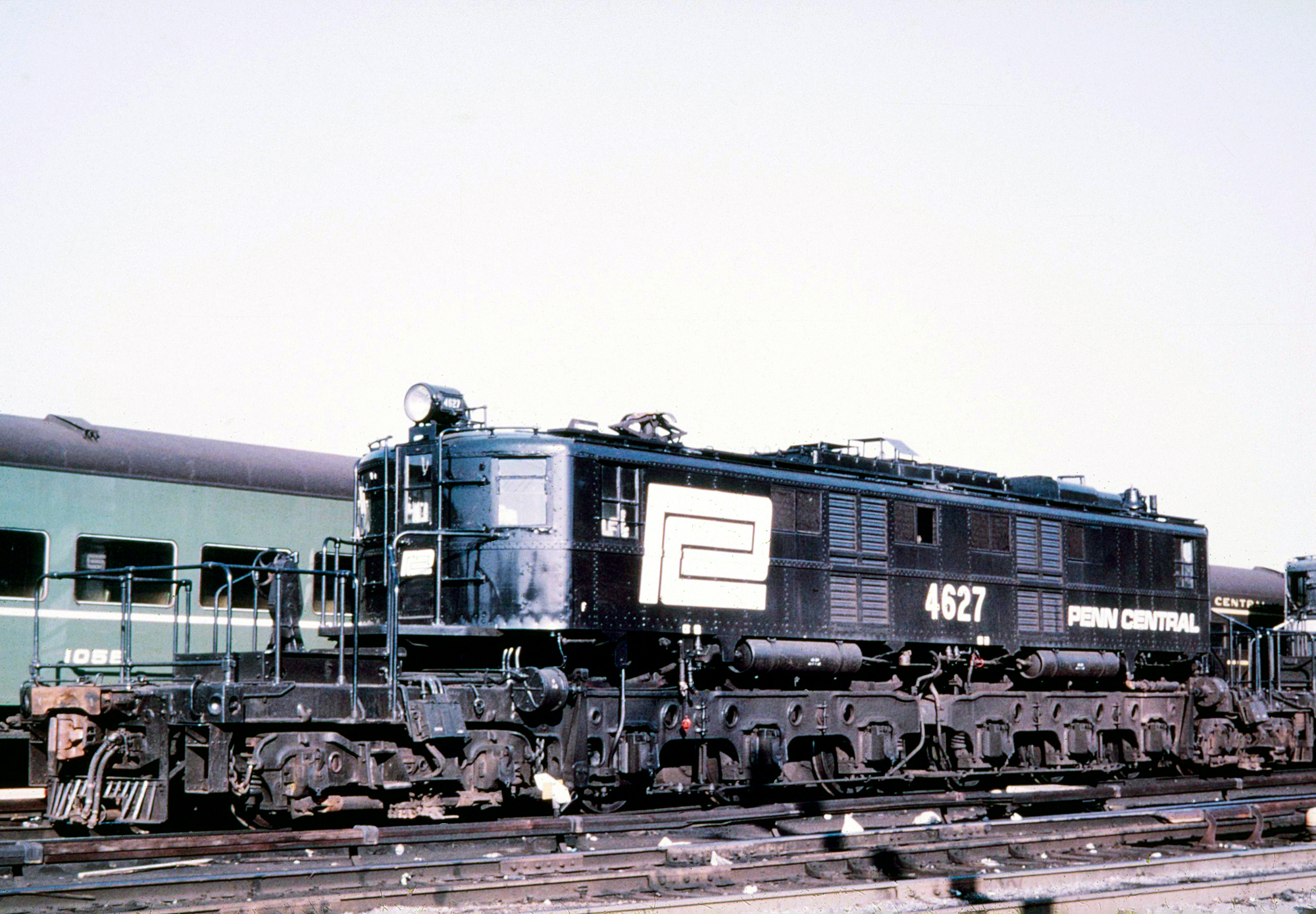
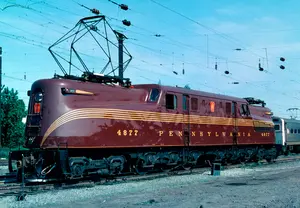
Penn Central P-motor #4627 at White Plains, New York, circa 1970. American-Rails.com collection.
At a Glance
| Topic | Notes |
|---|---|
| Early electric experiments | Thomas Davenport toy train (1835); battery locomotive experiments (Davidson, 1840s); dynamo-era work through the 1860s–70s |
| Siemens demonstration | Werner von Siemens electric railway exhibition, Berlin, 1879 |
| U.S. street railway breakthrough | Frank J. Sprague, Richmond Union Passenger Railway (opened Feb. 2, 1888) |
| First heavy-rail GE locomotive (cited) | ~30-ton two-axle boxcab, 1893 (Brian Solomon, Electric Locomotives) |
| First U.S. main-line Class I application | B&O Baltimore Belt / Howard Street Tunnel electrification, 1895 |
| Most famous American model | Pennsylvania Railroad GG1 |
| Longest classic U.S. freight electrification | Milwaukee Road Pacific Extension electrics—on the order of 650+ route-miles in Montana, Idaho, and Washington at full build-out |
| Power families used in the U.S. | Low-voltage DC (third rail / trolley); moderate-voltage DC (e.g., Milwaukee 3,000 V); high-voltage single-phase AC; three-phase AC (Great Northern Cascade Tunnel era) |
| Classic freight wire today | Essentially gone from Class I freights; remaining heavy electrification is passenger/transit-dominated |
Origins: From Dynamo to Streetcar
While Siemens is often credited with introducing practical electric locomotion at the 1879 Berlin exhibition, the electric motor’s roots run deeper. In The Electric Interurban Railways in America, George Hilton and John Due note that rudimentary electric motors existed by the 1830s; Vermont blacksmith Thomas Davenport exhibited an electrically propelled toy train in Boston and Springfield in 1835. In 1842 Scottish engineer Robert Davidson ran a battery locomotive at about four miles per hour between Edinburgh and Glasgow. Improvements from about 1845 through Pacinotti’s continuous-current dynamo (1860) and independent announcements of self-exciting field magnets (1866–67 by Wheatstone, Varley, Ladd, Siemens, Farmer, and others) set up commercial generators. Zénobe Gramme’s commercially viable generator appeared about 1870; reversibility of motor and generator behavior was demonstrated soon after.
In 1880 Thomas Edison tested an experimental dynamo-powered locomotive on a stretch of track at Menlo Park, New Jersey, but did not market the idea as a railroad product. The modern electric locomotive’s practical path in America grew out of the street railway and interurban boom. Frank J. Sprague—Naval Academy graduate, brief Edison Company engineer, then founder of the Sprague Electric Railway & Motor Company—is widely recognized as the father of electric traction for city railways. His nose-suspended (“wheelbarrow”) axle-hung motor solved mounting problems that had stalled designers. After a 1886 New York Elevated testbed failed to win a contract, Sprague secured work for the Richmond Union Passenger Railway in Virginia. Service opened February 2, 1888 and proved the model. Hilton and Due note that soon afterward some 200 streetcar systems were built or ordered—about half by Sprague himself and roughly 90 percent based on his patents.
The interurban industry largely vanished as a commercial force by World War II, but its electrical hardware, MU control ideas, and operating culture fed main-line electrification. For the traction side of that story, see interurbans and streetcars.
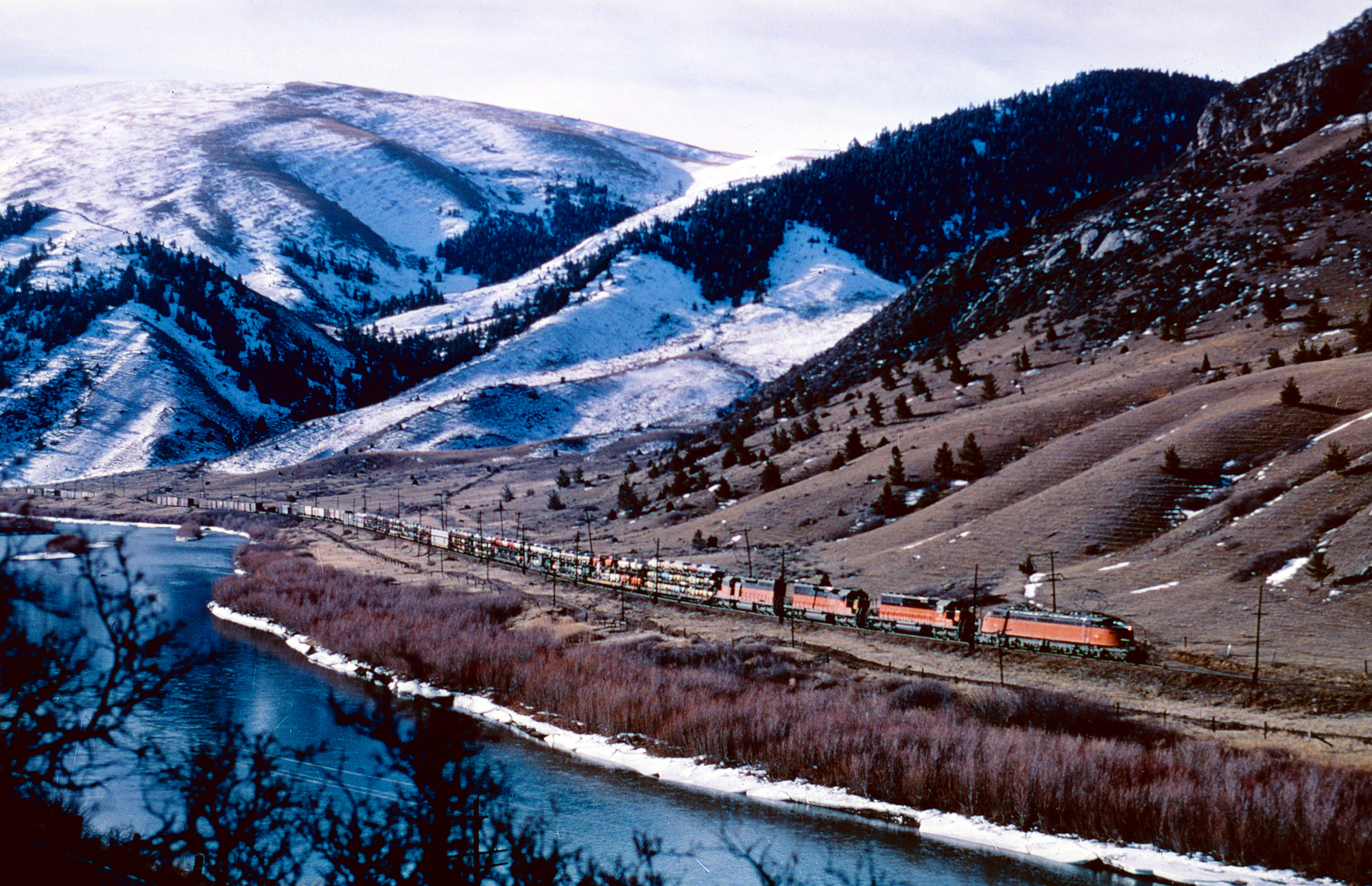
Milwaukee Road “Little Joe” E-77 and SD40-2s #3036, #3035, and #3032 lead a time freight westbound through the Jefferson River Canyon, just east of Jefferson Island, Montana, on March 10, 1973. Larry Zeutschel photo. American-Rails.com collection.
Early Trendsetters: B&O, New York Central, New Haven
Brian Solomon notes the first known use of a true “heavy rail” electric locomotive in the U.S. context as General Electric’s small ~30-ton two-axle machine of 1893, followed a year later by a two-truck design with nose-suspended traction motors. Main-line Class I application arrived in 1895 when the Baltimore & Ohio opened electrified territory on the Baltimore Belt Railroad.
B&O Official List No. 29 (January 1, 1948) described the Belt territory as 7.2 miles from milepost 90.7 at Bay View, Maryland, to milepost 97.9 at Hamburg Street, Baltimore, of which about four miles were electrified. Kirk Reynolds and David Oroszi note the Belt closed a critical gap between B&O’s Washington–Cumberland route and the new line toward New York. Urban smoke and the 1.4-mile Howard Street Tunnel under the city made steam especially unwelcome. General Electric supplied a 600-volt DC system and the first three steeple-cab locomotives (about 360 horsepower on four gearless motors). The Belt opened May 1, 1895, initially with coke-fired steam until electrics arrived June 27; electric operation began July 1. Early overhead catenary gave way by about 1900 to an under-running third-rail system. B&O ordered additional GE power in 1912, 1923, and 1927. Belt electrification lasted into the 1950s before diesels took over.
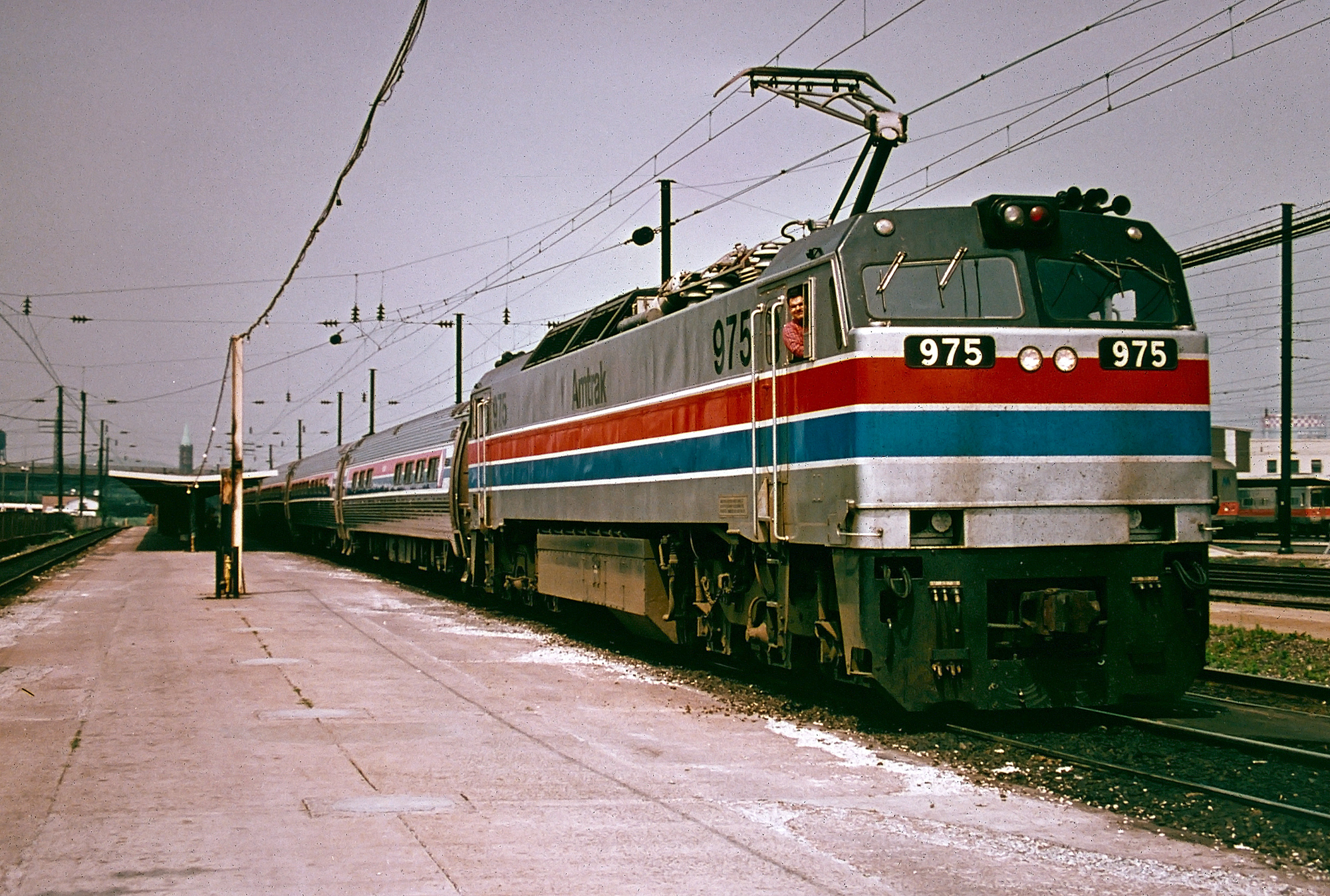
Amtrak E60 #975 awaits departure from New Haven, Connecticut, with train #173, the westbound/southbound Statesman, on the afternoon of June 15, 1976. Carl Sturner photo. American-Rails.com collection.
New York Central watched the B&O closely while planning a new Manhattan terminal. On January 8, 1902, smoke in the Park Avenue Tunnel contributed to a fatal collision when an inbound train overran a stop signal and struck a loaded New Haven suburban consist. Public outcry drove a ban on steam in the city core by July 1, 1908. NYC electrified with a ~660-volt DC under-running third-rail system (pickup shoe under a protected rail). Service opened September 20, 1906 between Grand Central and High Bridge (~7 miles) and grew over the next decades on the Hudson and Harlem lines (and for a time the Putnam Division) to roughly 70 route-miles of electrified territory by about 1931. Classic S- and T-motors became the public face of Grand Central approaches. (Thanks historically noted on related AR pages to helpers such as Joe Klapkowski for electric detail.)
In July 1907 the New York, New Haven & Hartford opened its first main-line AC segment between Woodlawn Junction, New York, and Stamford, Connecticut. The New Haven’s 11,000-volt, 25-cycle single-phase AC system eventually reached New Haven with branches to Danbury and New Canaan. George Westinghouse championed AC against GE’s DC franchise; a 1896 patent pool let each firm sell either technology, but DC’s early simplicity kept AC from spreading overnight. AC’s long-distance transmission advantages and powerful induction motors eventually suited high-speed corridor work—especially once technology allowed AC supply with DC traction motors in many mid-century designs.
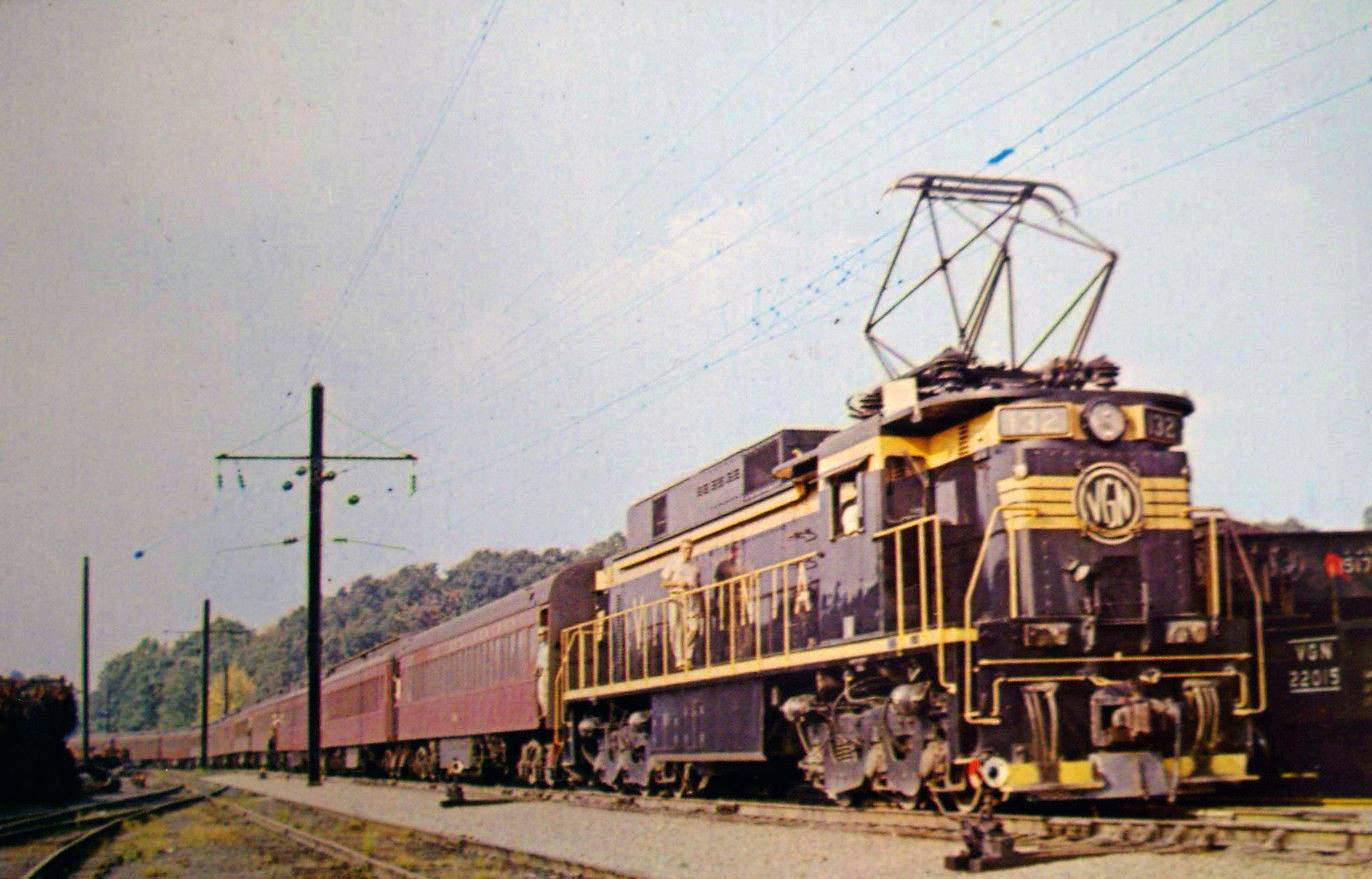
Virginian Railway EL-C #132 has a special National Railway Historical Society fan trip (using Norfolk & Western coaches) at Roanoke, Virginia, circa 1957.
Systems, Axle Notation & Characteristics
American electrification never standardized on one voltage or collection method. Solomon and related literature group U.S. practice roughly as:
- Low-voltage DC — B&O Belt, New York Central third rail, most streetcar/interurban systems
- Moderate-voltage DC — Milwaukee Road’s famous 3,000-volt mountain plant
- High-voltage single-phase AC — New Haven, Pennsylvania, Virginian, Norfolk & Western mountain electrics, and the modern NEC lineage
- Three-phase AC — used by Great Northern on Cascade Tunnel electrification in Washington (a technical outlier in U.S. main-line practice)
Electrics use an axle classification system related in spirit to steam Whyte notation but with different symbols. Letters mark powered axles; numerals mark unpowered axles. Example: New York Central’s early 1-D-1 motors had one unpowered axle at each end and four powered axles in the middle (“D” = four powered). In general, A = one powered axle, B = two, C = three, D = four, and so on. Articulated or multi-unit frames appear with plus signs (for example 2-D+D-2 on South Shore “800s” and related GE designs). Once learned, the code is straightforward and appears throughout builder literature and roster books.
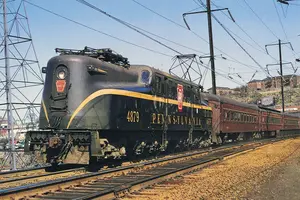
As AC technology matured, very powerful types appeared: PRR’s GG1, New Haven’s EP-5 “Jets,” Virginian’s EL-C rectifiers, and later NEC machines from E60s through AEM-7s to today’s ACS-64s. DC remained preferred where rugged simplicity mattered most—nowhere more visibly than on the Milwaukee Road’s mountain electrics.
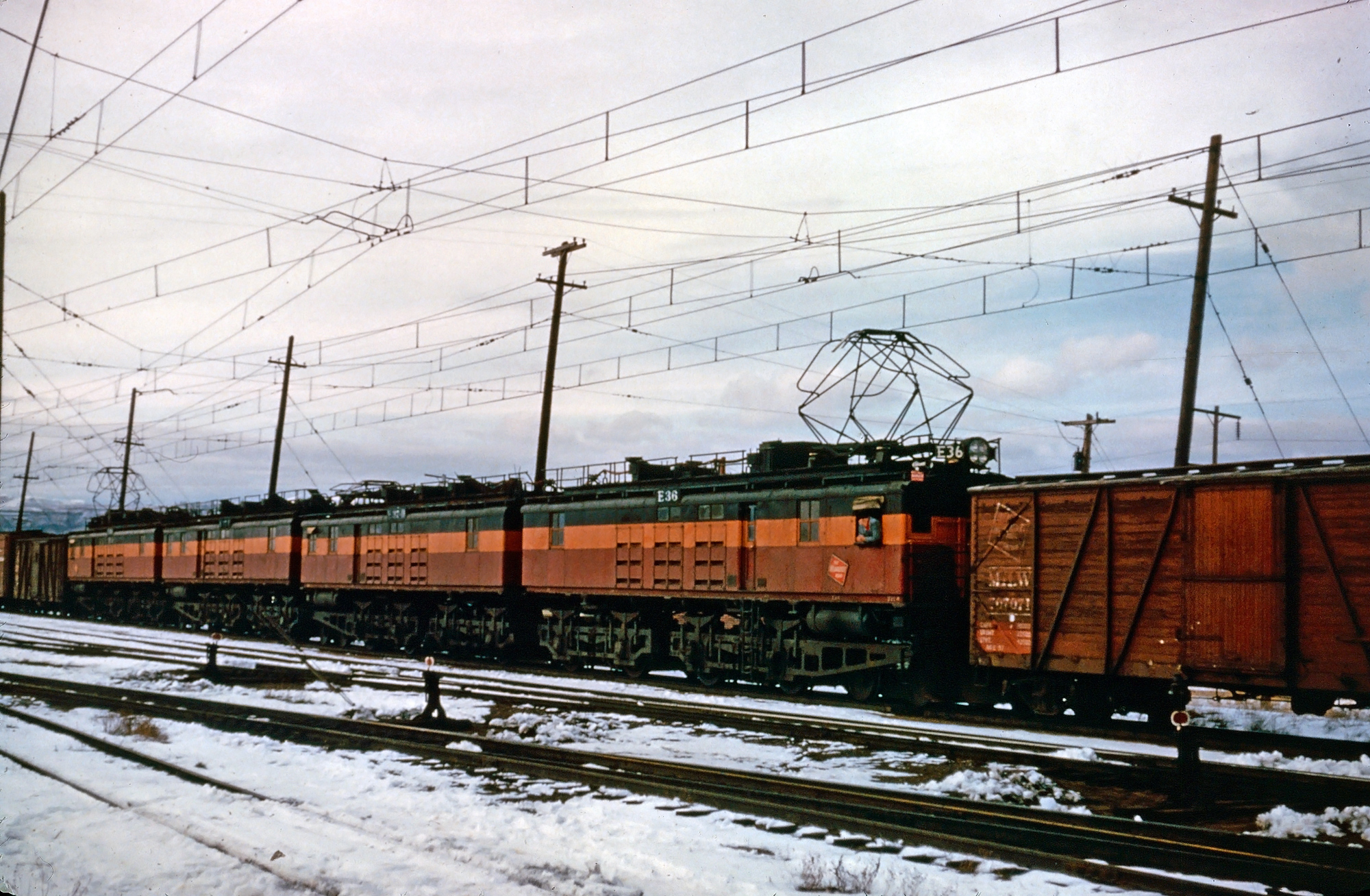
A four-unit Milwaukee Road boxcab set, with E-36 closest to the photographer, works as mid-train helpers at Butte, Montana, on April 28, 1958. American-Rails.com collection.
Great Electrified Roads (Selected)
Beyond B&O, NYC, and New Haven, several systems defined American heavy electrification:
- Pennsylvania Railroad — The largest and most influential AC passenger (and later freight) plant in the East, culminating in the GG1 fleet and the wire that still underpins Amtrak’s Northeast Corridor and Harrisburg line. Related profiles: GG1, E44.
- Milwaukee Road — The longest classic U.S. freight electrification, 3,000 V DC across Montana, Idaho, and Washington (on the order of 650+ route-miles at full extent). Boxcabs, Bi-Polars, and Little Joes moved freights and varnish through the Rockies and Cascades until wire came down in the 1970s. Profiles: Bi-Polars (EP-2), Quills (EP-3), Little Joes.
- Virginian Railway — Mid-1920s 11,000 V AC coal-road electrification from the Roanoke area toward Mullens, West Virginia, powered in part from the road’s own plant at Narrows, Virginia. EL-2B and EL-C rectifier freights were signature power. Profiles: EL-2B, EL-C.
- Other notable plants — Lackawanna suburban electrics; Illinois Central and Reading suburban; Norfolk & Western mountain electrics; Great Northern Cascade Tunnel; industrial and terminal systems that used steeple-cabs by the dozens.
Electrification also left gifts to diesel-electric practice. Sprague’s electro-pneumatic multiple-unit control work on early New York Central power (including the 1-D-1 lineage around 1904) fed the MU systems that let one engineer control a multi-unit diesel consist. Builder alliances—GE with Alco on many DC designs, Westinghouse with Baldwin on AC—carried into the diesel era until market exits and consolidations reshaped the industry.
Types, Models & Manufacturers
American-Rails.com profiles many individual classes. Use these as the catalog; this hub stays the map.
Selected locomotive & train types
- GG1 (Pennsylvania / PC / Amtrak era icon)
- E44 · EP-5 “Jets” · E60 · AEM-7 · ACS-64
- Milwaukee Bi-Polars (EP-2) · Quills (EP-3) · Little Joes (EF/P-4)
- Virginian EL-C · Virginian EL-2B
- R-motors (NYC / South Shore family context)
- Metroliners · Acela Express
- GM10B · GM6C (experimental EMD electrics)
Manufacturers & partners (entry points)
- General Electric · Baldwin (often with Westinghouse on AC) · Electro-Motive / EMD
- Alco (frequent GE mechanical partner on electrics and early diesels)—see broader builder coverage from the diesel hub and locomotives hub
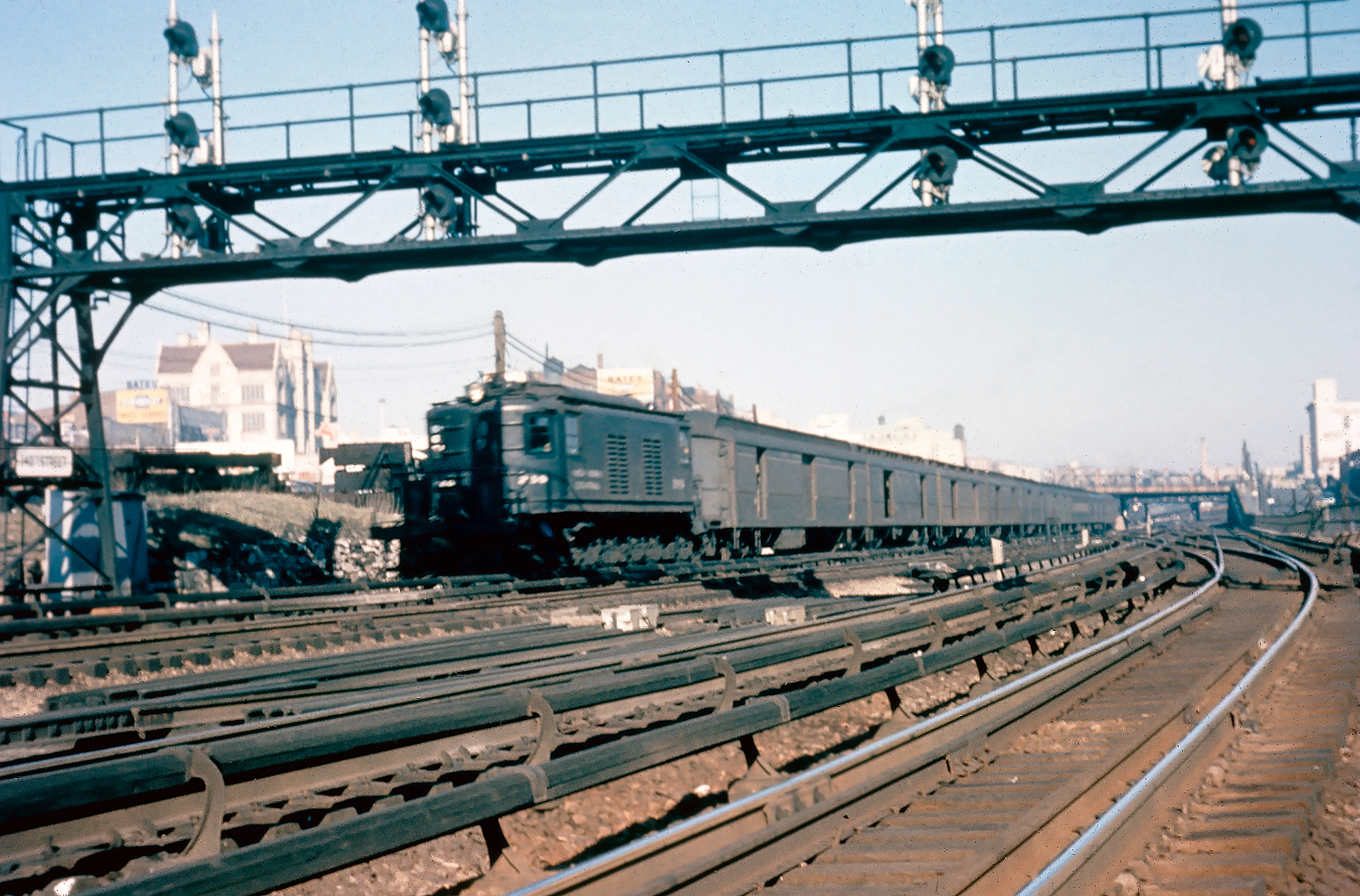
A New York Central T-motor (T-3a) hustles a mail/express train along the intricate web of trackage at 138th Street in the Bronx (New York), circa 1955. Meyer Pearlman photo. American-Rails.com collection.
Preserved Classic Electric Locomotives (U.S.)
Classic main-line electrics form a manageable museum set—far smaller than surviving steam—so the list lives here on the hub rather than on a separate leaf. Scope matches long-standing American-Rails.com practice: locomotives built roughly through the 1960s, emphasizing main-line freight and passenger motors plus a selection of industrial/terminal steeple-cabs already documented on this site. Interurban cars, rapid-transit MUs, and modern NEC fleet units (AEM-7, ACS-64, dual-modes, etc.) are out of scope unless noted on individual profile pages.
Because these machines need overhead wire or third rail, almost none of the famous classics remain operational under their own power. A well-known exception is South Shore “800” class #803, which has operated at the Illinois Railway Museum. GG1 transformers were commonly removed because of PCB-laden insulating oil; survivors are static. Locations and cosmetic condition change—confirm with museums before traveling. This table is a researched snapshot for readers, not a live database.
Main-line and Class I–era survivors (selected roster)
| Railroad / class | Example / notes | Location (typical) |
|---|---|---|
| Chicago South Shore & South Bend 2-D+D-2 “800” | #803 — preserved and operational at IRM | Illinois Railway Museum, Union, IL |
| Illinois Terminal Class B | #1565 — operable at IRM | Illinois Railway Museum |
| Milwaukee Road EF-1 boxcab | #50 (E-50 lineage) — indoor cosmetic restoration | Lake Superior Railroad Museum, Duluth, MN |
| Milwaukee Road EP-2 Bi-Polar | E-2 — last surviving Bi-Polar | Museum of Transportation, St. Louis, MO |
| Milwaukee Road EP-4 Little Joe | #70 — signature Joe survivor | Deer Lodge, MT (static display) |
| New York Central S-1 | #100 — first S-motor; preserved, not always public | Confirm current access with holding museum/collection |
| New York Central S-2 | #115 | Illinois Railway Museum |
| Pennsylvania B1 switcher | At least one cosmetically restored indoors | Railroad Museum of Pennsylvania, Strasburg |
| Pennsylvania DD1 | At least one cosmetically restored indoors | Railroad Museum of Pennsylvania |
| Pennsylvania E44 | At least one cosmetically restored indoors | Railroad Museum of Pennsylvania |
| Pennsylvania GG1 | About 16 preserved (prototype + production). None operational under wire. See GG1 list below and the full GG1 profile. | Multiple museums (PA, MD, NJ, IN, WI, IL, and others) |
| Virginian EL-C / EF-4 / E33 family | #135; #131 | Virginia Museum of Transportation, Roanoke; Railroad Museum of New England / Naugatuck RR, Thomaston, CT |
Pennsylvania GG1 survivors (by original PRR number)
Long-standing American-Rails.com coverage lists surviving GG1s including (original PRR numbers): 4800 (“Old Rivets,” riveted prototype body—Railroad Museum of Pennsylvania), 4859 (Harrisburg Transportation Center; Pennsylvania state electric locomotive designation, 1987), 4876, 4877, 4879, 4882, 4890, 4903, 4909, 4913, 4917, 4918, 4919, 4927, 4933, and 4935. Individual museum homes and paint schemes change; the dedicated GG1 page is the better place for per-unit status notes when that roster is kept current.
Other notable industrial / short-line steeple-cab survivors (selected)
| Identity | Notes | Location (typical) |
|---|---|---|
| Commonwealth Edison #4 | Steeple-cab | Illinois Railway Museum |
| Cornwall Street Railway & Light #14 (B-1) | Steeple-cab | Illinois Railway Museum |
| Iowa Terminal #30 | Steeple-cab | Illinois Railway Museum |
| Hutchinson & Northern #1 | GE steeple-cab, 1921; operational in museum service | Southern California Railway Museum (formerly Orange Empire) |
| TMER&L / Milwaukee Electric #L13, #L10 | Steeple-cabs | Illinois Railway Museum |
| Sacramento Northern #653 | GE steeple-cab, 1928; museum operations | Southern California Railway Museum |
| Sacramento Northern #654 | GE steeple-cab, 1928 | Western Railway Museum |
| Union Pacific E-100 / YVT lineage | Ex-Glendale & Montrose #22 / Yakima Valley Transportation #297 family history | Museum operations (Southern California Railway Museum context on prior AR notes) |
| Wisconsin Electric Power #L4, #L7 | Steeple-cabs | Illinois Railway Museum |
| Yakima Valley Transportation #297 | Baldwin-Westinghouse B+B; YVT colors; operational in museum context | Confirm current museum assignment |
This is not every steeple-cab in North America—industrial electrics are numerous and scattered. It is the set long carried on this page plus the main-line icons readers most often hunt. If a survivor is missing and well documented, use the site contact form; corrections are welcome.
Electric Locomotives Today
Classic freight electrification is effectively extinct on U.S. Class I systems. Capital cost, the success of high-horsepower diesels, and the end of smoke bans as a steam-era problem removed the old justification for hundreds of miles of mountain wire. What thrives is passenger and transit electrification: Amtrak’s Northeast Corridor and electrified Keystone service; commuter fleets under wire or third rail in the New York, Philadelphia, Chicago, and other metros; and light-rail / subway networks nationwide.
Modern corridor motors—E60s and AEM-7s in the Amtrak transition years, then Siemens ACS-64s and various dual-mode and MU fleets—outclass classic GG1s in continuous horsepower and adhesion control, but they are products of a globalized supply chain (Siemens, Alstom, and related builders) rather than a domestic heavy-electric locomotive industry of the GE–Westinghouse–Baldwin era. Dual-mode diesels (third-rail or catenary plus diesel) blur the line for tunnels and terminals without full-route wire.
For how almost all American freight is powered instead, see diesel locomotives. For the three-way power story, return to the locomotive history hub.
Related Reading on American-Rails.com
- Locomotive history hub · Steam locomotives · Diesel locomotives
- GG1 · Little Joes · Bi-Polars · Virginian EL-C
- Interurbans & streetcars · Railroad history · Streamliners
- Amtrak · Commuter rail · Home
Sources
- Hilton, George W., and John F. Due. The Electric Interurban Railways in America
- Solomon, Brian. Electric Locomotives; related NEC and builder studies
- Solomon, Brian, and Mike Schafer. New York Central Railroad (electrification and terminal context)
- Reynolds, Kirk, and David Oroszi. Baltimore & Ohio Railroad (Belt Line / Howard Street context)
- B&O Official List No. 29 (January 1, 1948)—Belt territory mileposts as cited in long-running AR research
- Hain / Sprague secondary literature on Manhattan Elevated and early traction motors
- American-Rails.com class profiles linked above (GG1, Little Joe, Bi-Polar, Virginian rectifiers, E44, E60, AEM-7, ACS-64, etc.)
- Museum and historical-society notes for preserved locations (subject to change)
Recent Articles


-
West Virginia Northern Railroad: Map, Photos, History
Sep 24, 26 11:27 PM
 West Virginia Northern—Kingwood to Tunnelton, 11 miles of Preston County coal. Narrow gauge 1888, standard gauge 1895. Last freight February 19, 1991. Consolidations 8 and 9 survive.
 -
Rutland Railroad: Map, Rosters, History, Logo
Sep 24, 26 01:18 PM
 Rutland Railroad—Follett’s Champlain & Connecticut River, November 1, 1843. Bellows Falls–Burlington December 18, 1849. Green Mountain Gateway. Last train September 25, 1961. Vermont Railway Janua…
 -
Arkansas Dinner Train Rides (2026): A Complete Guide
Sep 24, 26 01:12 PM
 2026 Eureka Springs & North Arkansas Dinner Train—Eurekan dining car, about 2 hours, $53.62 tax included, opens May 9, Tuesday, Wednesday, Friday, and Saturday. Confirm on esnarailway.com.
 -
Arizona Dinner Train Rides (2026): A Complete Guide
Sep 24, 26 01:01 PM
 2026 Arizona has no plated dinner train. Grand Canyon Railway sells snacks in the cars and meals in Williams or at the rim. Verde Canyon includes a charcuterie tray.
 -
Rail News, The Latest
Sep 24, 26 12:36 PM
This page provides a portal to the latest in rail news, from preservation and restortation subjects to other notable topics. -
Cotton Belt 819 Moved Outside at Pine Bluff for Evaluation
Sep 24, 26 12:35 PM
 Cotton Belt 819 left the Pine Bluff shop on September 22, 2026, first time outside in about 30 years. RDG Steam Services is evaluating the engine. No donation link posted.
 -
Reading Steam Locomotives: History, Roster & Photos
Sep 24, 26 12:14 PM
 Reading steam—Wootten fireboxes, Camelback Consolidations, Mallets, K-1 Santa Fes, G-3 Pacifics, T-1 4-8-4s. Post-1900 roster after Drury. Rambles ended October 17, 1964.
 -
Reading Diesel Roster: All-Time
Sep 24, 26 12:10 PM
 Reading diesel roster—AGEIR boxcabs, FTs, FA-1s, RS-3s, Train Masters, GP30s through GP39-2s. Serials and order numbers. Conrail April 1, 1976.
 -
Reading Railroad: Map, Logo, History, Rosters
Sep 24, 26 12:08 PM
 Reading Company—Philadelphia & Reading, 1833. Anthracite, Port Richmond, Reading Terminal. Operating company January 1, 1924. Conrail April 1, 1976.
 -
Nevada Dinner Train Rides (2026): A Complete Guide
Sep 24, 26 12:02 PM
 2026 Nevada Northern Taste of Italy—adults-only gala from East Ely. The September 19 date has run. Confirm any later night on nnry.com.
 -
North Carolina Dinner Train Rides (2026): A Complete Guide
Sep 24, 26 11:24 AM
 2026 North Carolina dinner trains—NCTM Wine & Dine in Spencer sold out February 13–15. GSMR First Class is the plated meal on the Nantahala Gorge excursion. Confirm on the railroad.
 -
Railway Express Agency (REA): Signs, Trucks, Logo & History
Sep 24, 26 09:40 AM
 Railway Express Agency—railroad-owned express company. Incorporated December 7, 1928. Operations March 1, 1929. Red diamond, green trucks. Last regular express November 7, 1975.
 -
Michigan Dinner Train Rides (2026): A Complete Guide
Sep 24, 26 09:28 AM
 2026 Steam Railroading Institute dining in Owosso—select evenings, no public dinner dates posted. Confirm on michigansteamtrain.com.
 -
Pittsburgh and West Virginia Railway: Map, Rosters, History
Sep 24, 26 12:24 AM
 Pittsburgh & West Virginia—the Hi-Line. Wabash-Pittsburgh Terminal 1904. Railway January 29, 1917. Connellsville February 11, 1931. N&W lease October 16, 1964. Wheeling & Lake Erie from May 17, 1990.
 -
Indiana Dinner Train Rides (2026): A Complete Guide
Sep 24, 26 12:13 AM
2026 Spirit of Jasper Ride & Dine is paused. No public trains. Depot at 201 Mill Street stays open as a rental. Confirm on spiritofjaspertrain.com. -
New Jersey Dinner Train Rides (2026): A Complete Guide
Sep 24, 26 12:01 AM
2026 Woodstown Central Dining in Motion—private table of four from $190, about an hour, Salem County. Confirm on woodstowncentral.com. -
Maryland Dinner Train Rides (2026): A Complete Guide
Sep 23, 26 05:19 PM
 2026 Western Maryland Scenic Allegheny Mountain Dinner Train—Cumberland, 3 hours, 21+, Saturday 7 p.m. Confirm on wmsr.com.
 -
Pittsburgh and Lake Erie Railroad: Map, Rosters, Photos
Sep 23, 26 03:28 PM
 Pittsburgh & Lake Erie—the Little Giant. Chartered 1875, Pittsburgh to Youngstown February 10, 1879. New York Central from 1883. Independent May 15, 1979. Last day September 11, 1992.
 -
Kansas Dinner Train Rides (2026): A Complete Guide
Sep 23, 26 01:11 PM
 2026 Abilene & Smoky Valley Smoky Valley Limited—two hours from the Rock Island Depot, about $72–$110, dates into December 31. Confirm on asvrr.org.
 -
The Belpaire Firebox: Simplicity and Greater Power
Sep 23, 26 01:03 PM
 Belpaire firebox—Alfred Belpaire, 1864. Square crown, straight staybolts at right angles. Pennsylvania standard after the 1880s. Great Northern was the other big user.
 -
Pennsylvania Railroad (PRR) Electric Roster: All Classes
Sep 23, 26 12:57 PM
Pennsylvania Railroad electrics—DD1s into Penn Station, P5s, 139 GG1s, B1 switchers, and 66 E44s. Class roster, 1905–1963. No unit-by-unit GG1 list. -
Penn Central Diesel Roster: All-Time
Sep 23, 26 12:46 PM
 Penn Central diesel roster—PRR classes on NYC, PRR, and New Haven power. New orders carry serials. GP38-2s are 7940-8162. Conrail April 1, 1976.
 -
Penn Central Railroad: Map, History, Logo
Sep 23, 26 12:32 PM
 Penn Central—Pennsylvania and New York Central merged February 1, 1968. New Haven January 1, 1969. Section 77 bankruptcy June 21, 1970. Conrail April 1, 1976.
 -
Iowa Dinner Train Rides (2026): A Complete Guide
Sep 23, 26 11:42 AM
 2026 Boone & Scenic Valley Wolf Dinner Train—Saturdays May–October, Union Pacific dining cars, Bass Point Creek High Bridge. Confirm on bsvrr.com.
 -
Pennsylvania-Reading Seashore Lines: Map, Roster, History
Sep 23, 26 12:32 AM
 Pennsylvania-Reading Seashore Lines—Atlantic City Railroad renamed July 15, 1933. Pennsylvania two-thirds, Reading one-third. Camden to Atlantic City, Cape May, and Millville. Conrail April 1, 1976.
 -
Wisconsin Dinner Train Rides (2026): A Complete Guide
Sep 23, 26 12:28 AM
2026 Wisconsin Great Northern dinner train in Trego—$105, Namekagon River, January 8–31 and May 5–December 17. Mid-Continent’s remaining 2026 calendar is snack and scenic. Confirm on the railroad. -
New Hampshire Dinner Train Rides (2026): A Complete Guide
Sep 23, 26 12:21 AM
2026 Cafe Lafayette Dinner Train in North Woodstock—five courses, 2 hours, from $125. Children under 6 not allowed. Confirm on nhdinnertrain.com. -
PRR "GG-1" Locomotives: Roster, Photos, Specs
Sep 23, 26 12:13 AM
 PRR GG1 electric: 139 locomotives, 4800–4938, built 1934–1943. Specs, Loewy shell, Amtrak numbers, and the last revenue trip on October 28, 1983.
 -
Montana Dinner Train Rides (2026): A Complete Guide
Sep 23, 26 12:04 AM
2026 Charlie Russell Chew Choo from Hanover, near Lewistown—4.5 hours, prime rib, adult $151. Remaining listed dates sold out. Confirm on montanadinnertrain.com. -
Kentucky Dinner Train Rides (2026): A Complete Guide
Sep 22, 26 11:52 PM
2026 My Old Kentucky Dinner Train in Bardstown—four courses, 2.5 hours, adult $116. Confirm on kydinnertrain.com. -
Tennessee Dinner Train Rides (2026): A Complete Guide
Sep 22, 26 11:45 PM
2026 TVRM Chattanooga Dinner Train—Grand Junction, select Fri/Sat March 6–October 24, 6 p.m., from $110. Confirm on tvrail.com. -
The Trainphone: PRR's Wireless Radio System
Sep 22, 26 11:17 PM
 Pennsylvania Trainphone—Union Switch & Signal inductive telephone. Bel-Del trial 1941, Frenchtown November 29, 1943. Carriers at 88 kHz and 144 kHz. Out of service April 30, 1967.
 -
Pennsylvania (PRR) Steam Roster: Post 1906
Sep 22, 26 11:13 PM
 ennsylvania steam after 1906—H8, H9, and H10 Consolidations, 574 L1s Mikados, 598 I1s Decapods, 425 K4s Pacifics, 301 M1 Mountains. Drury’s grid. Last steam November 30, 1957.
 -
Pennsylvania Railroad (PRR) Diesel Roster: All-Time List
Sep 22, 26 10:59 PM
 Pennsylvania diesel roster—SW 3908 in June 1937, then Alco, Baldwin, EMD, Fairbanks-Morse, GE, and Lima. Serials and Alco order numbers. Penn Central February 1, 1968.
 -
Pennsylvania Railroad: Map, Logo, History, Rosters
Sep 22, 26 10:02 PM
 Pennsylvania Railroad—chartered April 13, 1846, Harrisburg–Pittsburgh, Horseshoe Curve 1854, Penn Station 1910. Standard Railroad of the World. Penn Central February 1, 1968.
 -
Pennsylvania Dinner Train Rides (2026): A Complete Guide
Sep 22, 26 04:48 PM
 2026 Pennsylvania dinner trains—Colebrookdale Dining Class in Boyertown and Strasburg Dinner on the Rails. Confirm on each railroad.
 -
New York, Ontario & Western Steam Locomotives: History & Roster
Sep 22, 26 04:40 PM
 NYO&W steam—camelback 2-8-0s and 2-6-0s, Class X Bull Moose 2-10-2s, Class Y and Y-2 Mountains. All-time class roster. Steam finished in the summer of 1948. None saved.
 -
New York, Ontario & Western Diesel Roster: All-Time
Sep 22, 26 04:36 PM
 NYO&W diesel—five GE 44-tonners 101-105, eighteen FTs, seven F3s, twenty-one NW2s. Serials and the NW2 order E824. Railroad liquidated March 29 1957.
 -
New York, Ontario & Western Railway: Map, Roster, History
Sep 22, 26 04:26 PM
 New York, Ontario & Western—New York & Oswego Midland chartered January 11 1866, O&W January 21 1880. Scranton coal, West Shore rights. Last train March 29 1957.
 -
Massachusetts Dinner Train Rides (2026): A Complete Guide
Sep 22, 26 04:16 PM
 2026 Cape Cod Dinner Train—Hyannis, Buzzards Bay, and North Falmouth. Four-course, 3–3½ hours, from $99.99. Confirm on capetrain.com.
 -
Colorado Dinner Train Rides (2026): A Complete Guide
Sep 22, 26 03:51 PM
 2026 Royal Gorge Route First Class Dinner and Lunch from Cañon City. About 2 hours, 12+, from $199+. Confirm on royalgorgeroute.com.
 -
New York and Long Branch Railroad: A PRR & CNJ Subsidiary
Sep 22, 26 03:11 PM
 New York & Long Branch—chartered April 8 1868, Perth Amboy–Long Branch July 1 1875, Bay Head Junction 1881. Jersey Central and Pennsylvania trains. Conrail April 1 1976. NJ Transit North Jersey Co…
 -
Monongahela Railway Steam Locomotives: History & Roster
Sep 22, 26 01:34 PM
 Monongahela steam—H-5 Consolidations, USRA light Mikados 170–179, Baldwin L-2s, ex-P&LE L-3s. All-time roster. Last steam May 26, 1954.
 -
Monongahela Railway Diesel Roster: All-Time
Sep 22, 26 01:16 PM
 Monongahela diesel—27 Baldwin S-12s, NYC RF-16 sharks, P&LE GP7s, GP38s 2000–2004, Super 7s 2300–2310. Serials and orders. Last steam May 26, 1954.
 -
Monongahela Railway: Map, Rosters, History
Sep 22, 26 01:14 PM
 Monongahela Railway—incorporated December 31 1900, Railway July 1 1915. Brownsville–Fairmont coal road. Last steam May 26 1954. Conrail May 1 1993.
 -
Virginia Scenic Railway Dining (2026)
Sep 22, 26 01:09 PM
 2026 Virginia Scenic Railway—Blue Ridge Flyer Dining Class from Staunton, about 3 hours, plated meal. Sunday Brunch from Louisa, about $132. Confirm on virginiascenicrailway.com.
 -
Virginia Dinner Train Rides (2026): A Complete Guide
Sep 22, 26 01:03 PM
 2026 Virginia Scenic Railway—Blue Ridge Flyer Dining Class from Staunton, Alleghany Special Dining Class, Sunday Brunch from Louisa. Confirm on virginiascenicrailway.com.
 -
Oregon Dinner Train Rides (2026): A Complete Guide
Sep 22, 26 12:51 PM
 2026 Oregon has no plated dinner train on the calendar. Mount Hood is scenic with snacks. Oregon Coast Scenic’s evening ride is the 21+ Moonlight with sandwiches.
 -
Maine Central Steam Locomotives: History & Roster
Sep 22, 26 12:33 PM
Maine Central steam—Ten-Wheelers, W-class Consolidations, S-class Mikados, C-class Pacifics, Hudsons 701 and 702. Post-1900 roster after Drury. Last steam June 13, 1954. -
Maine Central Diesel Roster: All-Time
Sep 22, 26 12:04 PM
 Maine Central diesel—railcar 901, HH660s, GP7s, E7s, F3s, GP38s, U18Bs, ex-Rock Island U25Bs. All-time roster with serials and orders. Last steam June 13, 1954.