Streamliners (USA): History, Famous Trains & Why They Mattered
Last revised: August 13, 2026
By: Adam Burns
Streamliners were a late answer to a crisis that began after the passenger “Golden Age.” Between the 1880s and World War I, trains ruled interstate travel. The 1920s still looked strong after federal wartime control—then the automobile, the Depression, and rising deficits gutted the business. Railroads answered with something the public had never seen: sleek, fast, colorful trains marketed as modern entertainment as much as transportation. From Union Pacific’s M-10000 and Burlington’s Pioneer Zephyr in 1934 through the great named trains of the 1940s and 1950s, the streamliner era became the most glamorous chapter in American passenger rail.
This hub covers how streamliners were born, why articulated sets gave way to locomotive-hauled consists, design and diesel power, why even the finest trains could not reverse the industry’s passenger losses, what survived into Amtrak and beyond—and a directory of named trains linked to American-Rails.com profiles.
On this page: At a glance · The crisis that created them · M-10000 & Zephyr · Conventional streamliners · Art Deco & design · Steam, diesel & speed · Named-train directory · Why they couldn’t save passenger service · After the streamliners · Related reading
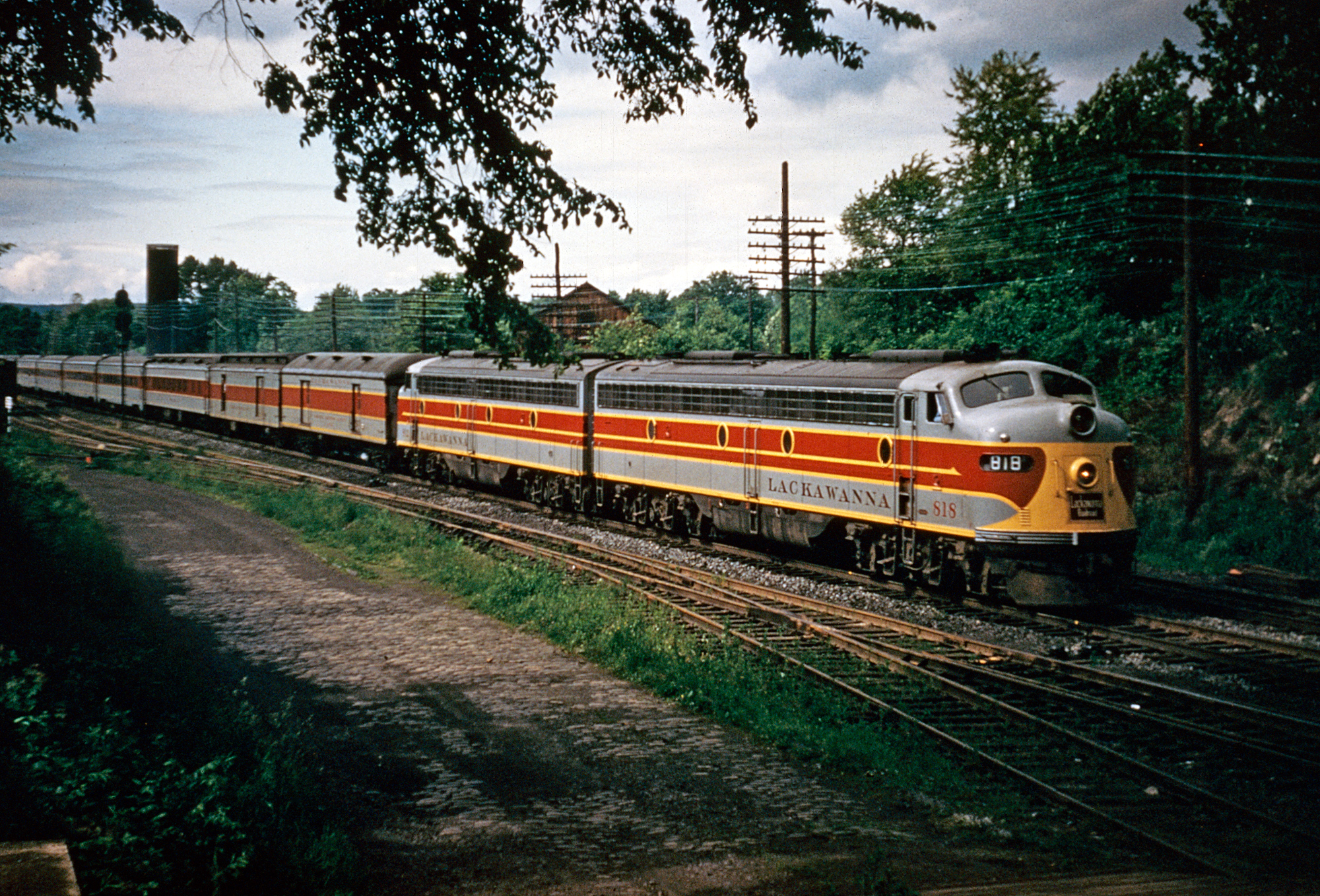
Delaware, Lackawanna & Western E8As led by #818 with the eastbound Phoebe Snow at East Stroudsburg, Pennsylvania, 1950s. American-Rails.com collection.
At a Glance
| Topic | Notes |
|---|---|
| What “streamliner” means | Sleek, lightweight (or restyled) passenger trains of the 1930s–1960s—often diesel-powered, sometimes steam—marketed for speed, style, and modern comfort |
| First American internal-combustion streamliners (1934) | UP M-10000 (Pullman-Standard; distillate engine; Feb. 1934 delivery) and CB&Q Zephyr 9900 / Pioneer Zephyr (Budd; diesel; unveiled April 1934) |
| Zephyr’s famous dash | Denver–Chicago, May 26, 1934: ~1,015 miles in ~13–14 hours (often cited ~78 mph average) |
| Early non-articulated examples (1935) | Milwaukee Road Hiawatha (May 29); B&O Royal Blue streamliner (June 24) |
| Articulated problem | One bad car took the whole fixed trainset out of service; capacity hard to expand |
| Power evolution | Steam speedsters (Milwaukee A and F-7; N&W Js; Daylight GS) + EMC/EMD E-units and other diesels defining the look |
| High water | Late 1930s through early 1950s—nearly every major road fielded at least one flagship |
| End of private era | Amtrak (May 1, 1971) absorbs most remaining intercity passenger trains |
| Legacy | Amtrak names and Superliners; luxury/scenic products (e.g., Rocky Mountaineer); modern corridor brands (e.g., Brightline) still sell speed + style |
The Crisis That Created the Streamliner
Streamliners did not invent passenger luxury—Pullman and the great Limiteds had done that decades earlier. They answered a new problem: annual passenger deficits after 1929 and a public falling in love with cars and, later, planes. John F. Stover notes in The Routledge Historical Atlas of the American Railroads that every year after 1929 the industry posted passenger losses; the Depression deepened the wound. Gregory Schneider, in Rock Island Requiem, records that by 1936 about 70,000 miles of railroad were in receivership—roughly a quarter of the network.
Henry Ford’s mass-produced Model T (1908 onward) had already made personal mobility ordinary. Highways improved. By the early 1930s, drab heavyweight consists looked like yesterday’s product. Union Pacific and the Chicago, Burlington & Quincy bet that a sleek, fast, colorful train could win headlines and tickets. The streamliner was born as marketing and engineering at once.
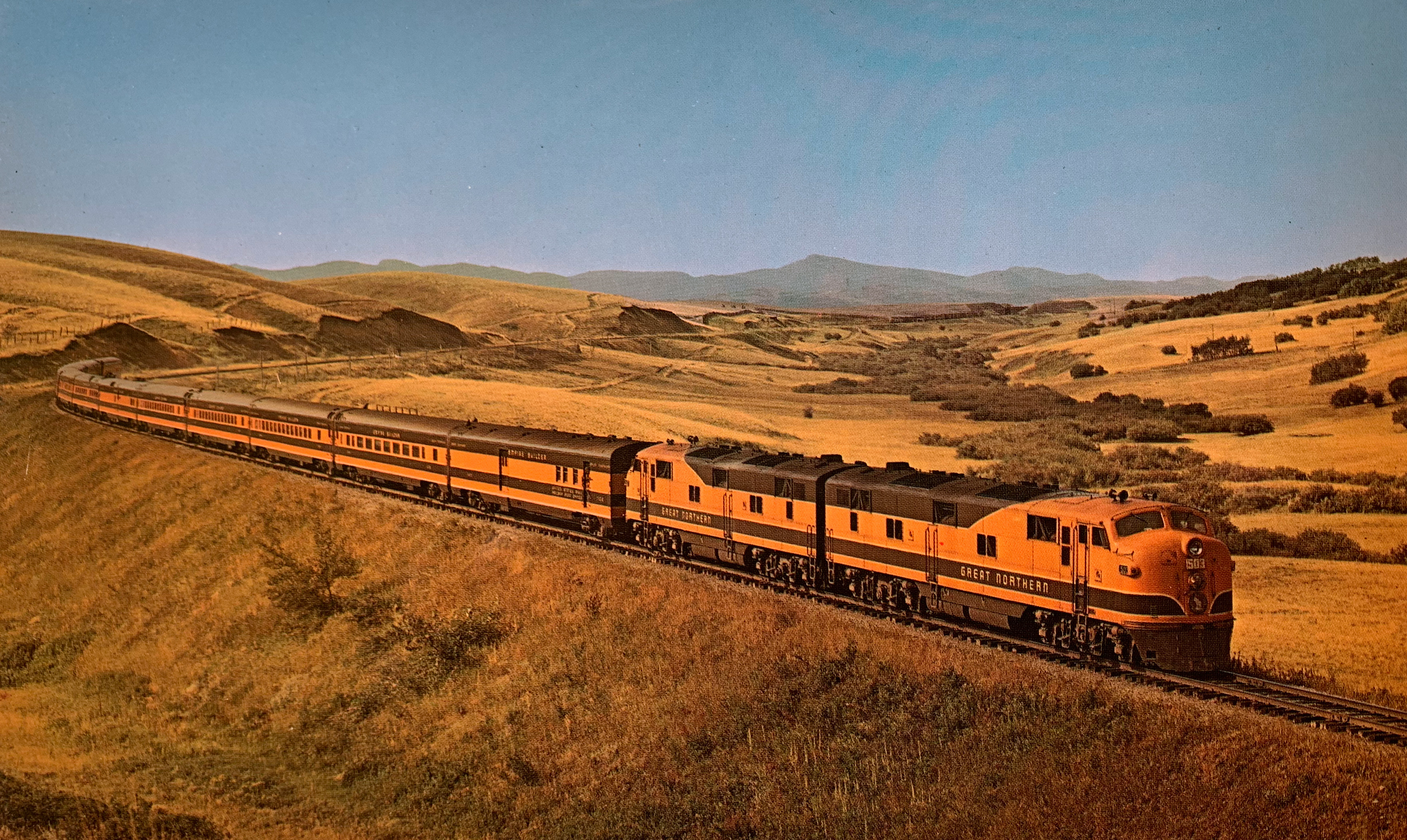
Great Northern publicity view of the Empire Builder just east of Glacier National Park at Spotted Robe (Kilroy), Montana, 1947. Author’s collection.
1934: M-10000 and the Pioneer Zephyr
Union Pacific’s M-10000 arrived February 25, 1934, ordered a year earlier from Pullman-Standard (Mike Schafer and Joe Welsh, Streamliners: History of a Railroad Icon). Nothing about it looked like a standard train: no boxy heavyweight profile, and a bold Canary Yellow and Golden Brown scheme chosen partly for grade-crossing visibility—ancestors of the Armour Yellow family still on UP freights. The articulated three-car set was only about 204 feet long and weighed roughly 124 tons, powered by a ~600 hp Winton distillate engine with claimed capability near 110 mph. Layout: power car/RPO/baggage, 60-seat coach, and buffet-kitchen-observation for 54—about 116 passengers total. It was a publicity triumph; the distillate plant proved less satisfactory in hard service.
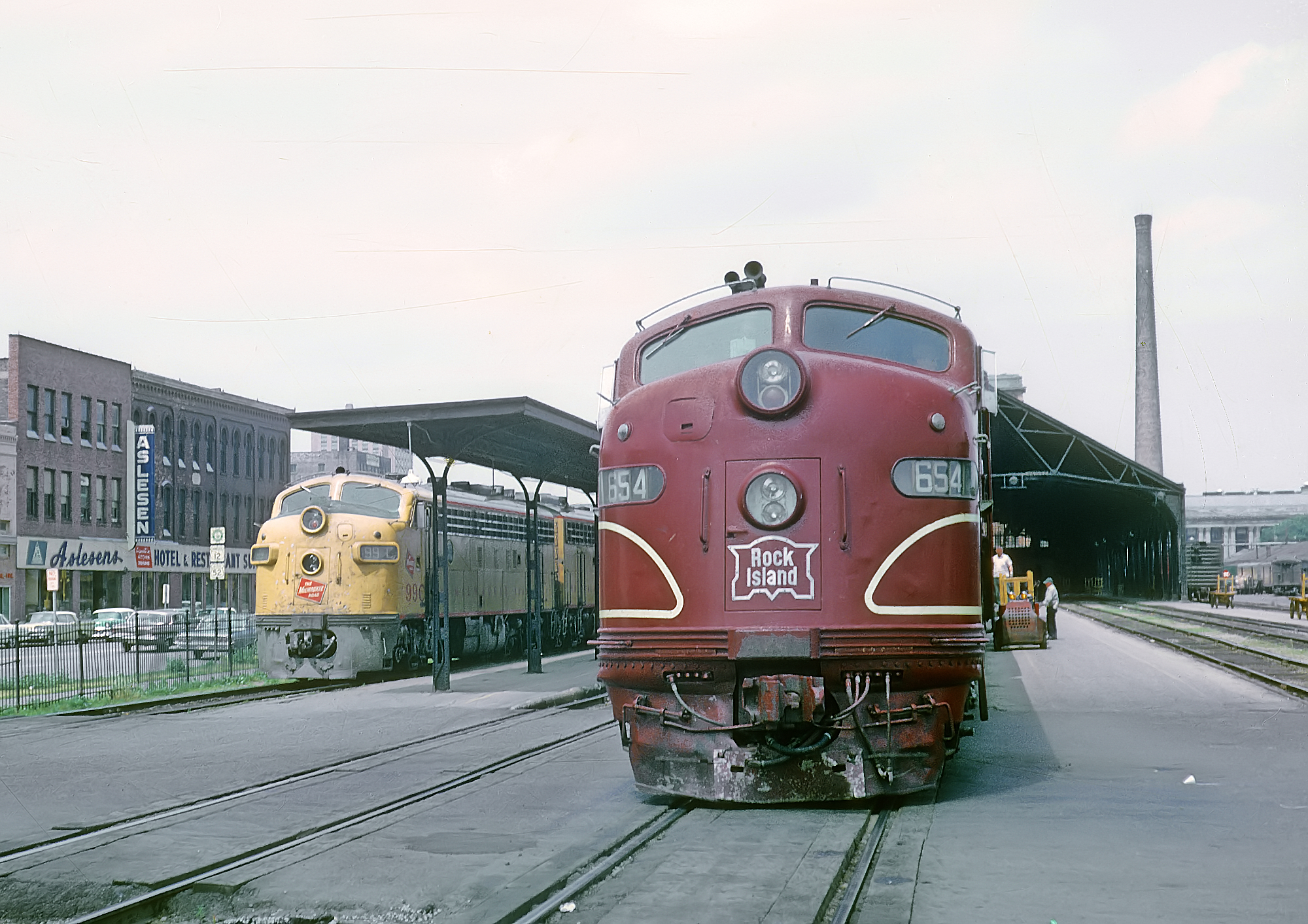
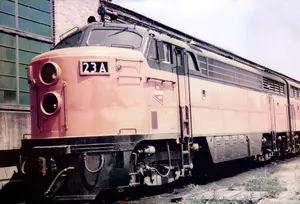
Rock Island E8A #654 is ahead of the Twin Star Rocket while in the background Milwaukee Road FP7 #99C has the Afternoon Hiawatha at Milwaukee Road's station in Minneapolis on June 8, 1964. Marty Bernard photo.
Burlington ordered its set June 17, 1933, from the Budd Company. Unveiled at Philadelphia’s Broad Street Station on April 18, 1934, as Zephyr 9900 (later famous as the Pioneer Zephyr), it used a Winton 8-201-A diesel of about 660 hp and stainless-steel construction. The ~197-foot articulated three-car train seated only about 72 paying passengers but offered a more reliable power plant than UP’s distillate experiment. On May 26, 1934, it left Denver at 5:05 a.m. and reached Chicago that evening after about 1,015 miles in roughly 13–14 hours—an average often cited near 78 mph. The “Silver Streak” story made diesel streamlining a national sensation.
Spin-offs followed quickly: Boston & Maine / Maine Central Flying Yankee (Zephyr-like), New Haven Comet, GM&O Rebel, Illinois Central Green Diamond (M-10000 family). Profiles: M-10000 · Pioneer Zephyr · Flying Yankee · Comet · Rebel · Green Diamond.
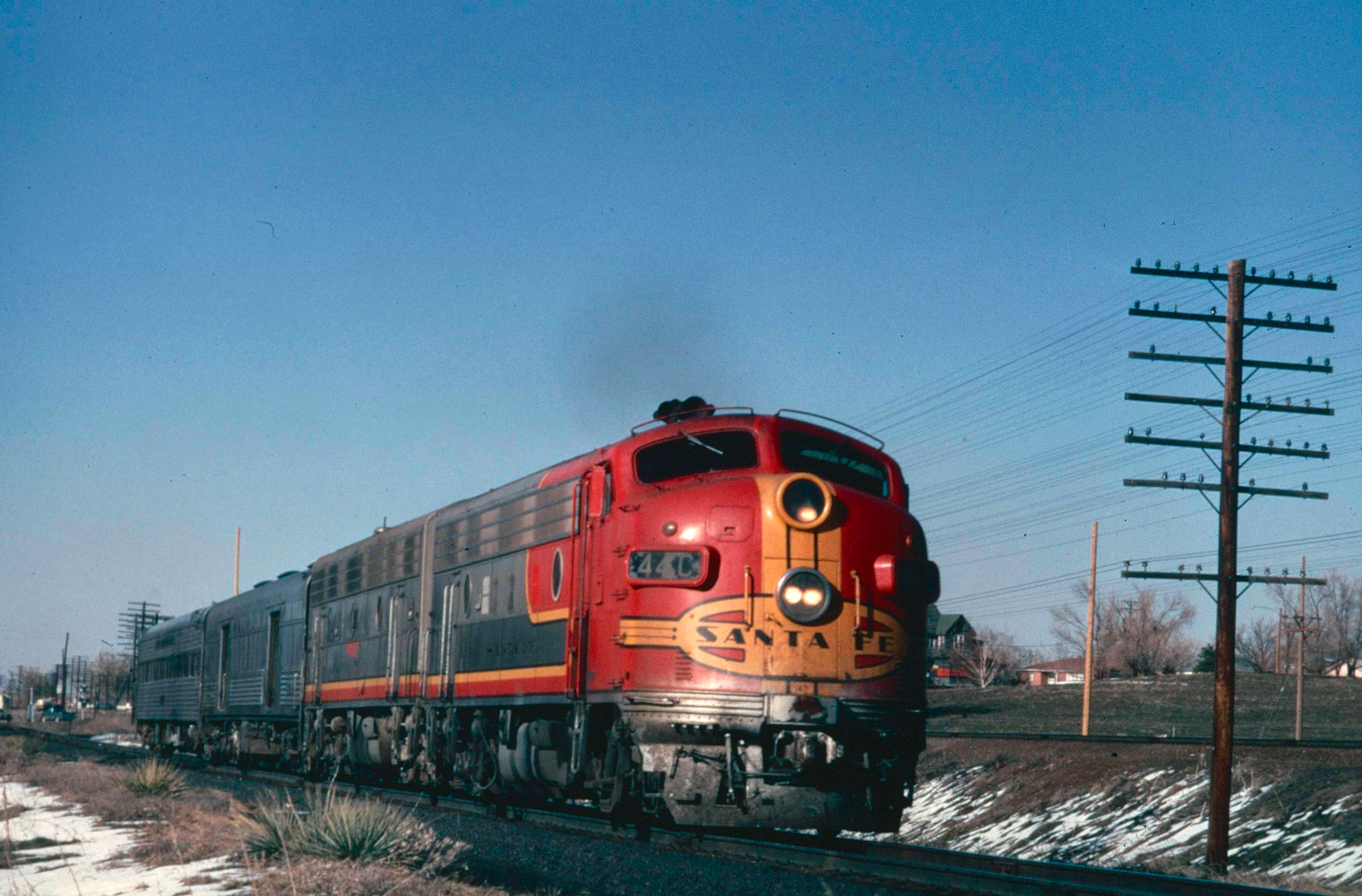
Santa Fe F7A #44-C hustles south through Littleton, Colorado, April 3, 1970—evening Denver–La Junta connection territory for the eastbound Super Chief / El Capitan world. Author’s collection.
From Articulated Sets to Conventional Streamliners
Articulated trainsets had a fatal operational flaw: if one car needed the shop, the entire consist was out of service. As ridership rose, seating limits hurt, and you could not simply add a coach. Railroads needed a conventional train—individual cars behind a locomotive—that still looked and marketed like a streamliner.
In 1935 two early non-articulated answers arrived. Milwaukee Road’s Hiawatha (May 29) and B&O’s restyled Royal Blue (June 24) proved the formula. The Royal Blue name had covered the Washington–New York fleet since the 1890s (Herbert Harwood, Jr., Royal Blue Line); the 1935 streamliner used lightweight ACF aluminum cars, distinctive steam power (4-4-4 Lady Baltimore, 4-6-4 Lord Baltimore), and EMC boxcab diesel #50 related to the later EA family. Interiors stressed wider seats, dining options, buffet-lounge, and observation.
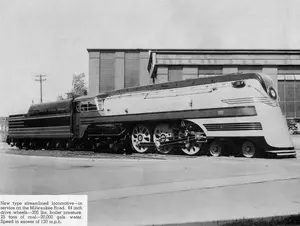
The Hiawatha was about speed. Alco Class A 4-4-2s were built to cruise near 100 mph with reserve toward 120. Jim Scribbins (The Hiawatha Story) describes May 15, 1935, trials with engine No. 2: after warming up, timing crews recorded 100+ mph running, peaking at about 112.5 mph, with a glass of water in the diner holding every drop. Class F-7 4-6-4s later matched that performance. Much of the original Hiawatha equipment was home-built in Milwaukee shops; Tip-Top-Tap and parlor-observation luxury matched the exterior glamour.
By the late 1930s nearly every major road wanted a flagship. Designers packed themes into short deadlines—John Harbeson once estimated he designed more than thirty trains for Budd and never had more than three weeks for any one of them (Bob Johnston, Joe Welsh, and Mike Schafer, The Art of the Streamliner).
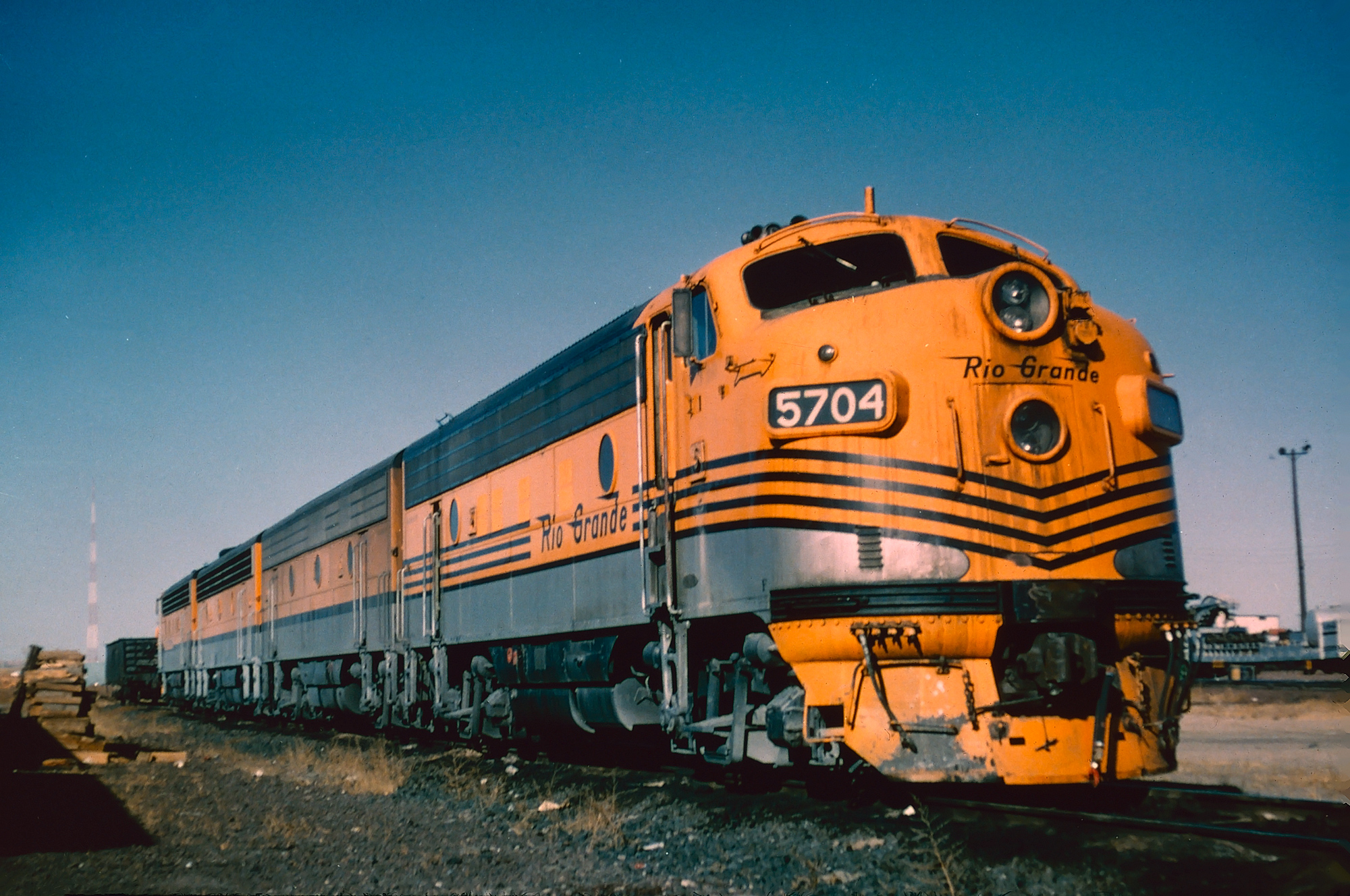
Rio Grande F units with F7A #5704 closest to the camera, Denver, November 8, 1964. Ed Fulcomer photo. American-Rails.com collection.
Art Deco on Rails: The Streamliner as Design Icon
Streamliners were industrial design as much as transportation. Horizontal fluting, sloped noses, skirting, and stainless or bold paint made trains photograph like consumer products of the machine age. Interiors borrowed from hotels and ocean liners: coordinated fabrics, murals, lounges, and observation ends that sold the journey itself.
That visual language spilled into toys, posters, world’s fair exhibits, and city architecture. For a generation, the streamliner was the image of American progress—even as more families bought cars. The irony is sharp: the most beautiful passenger trains arrived just as the structural economics of private passenger service were already failing.
Steam Speed, Diesel Style
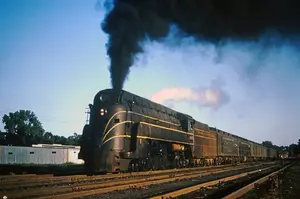
Not every streamliner was diesel. Milwaukee Atlantics and Hudsons, Southern Pacific Daylight GS-class 4-8-4s, Norfolk & Western’s bullet-nosed J class, and other steam stars proved high-speed steam could wear streamlining too. Diesels, especially EMC/EMD E-units and later F units on secondary and mail-heavy runs, became the face of the brand for most of the public: matched sets, clean noses, and multi-unit flexibility.
Related locomotive context: Diesel locomotives · Steam locomotives · N&W J Class · PRR passenger trains.
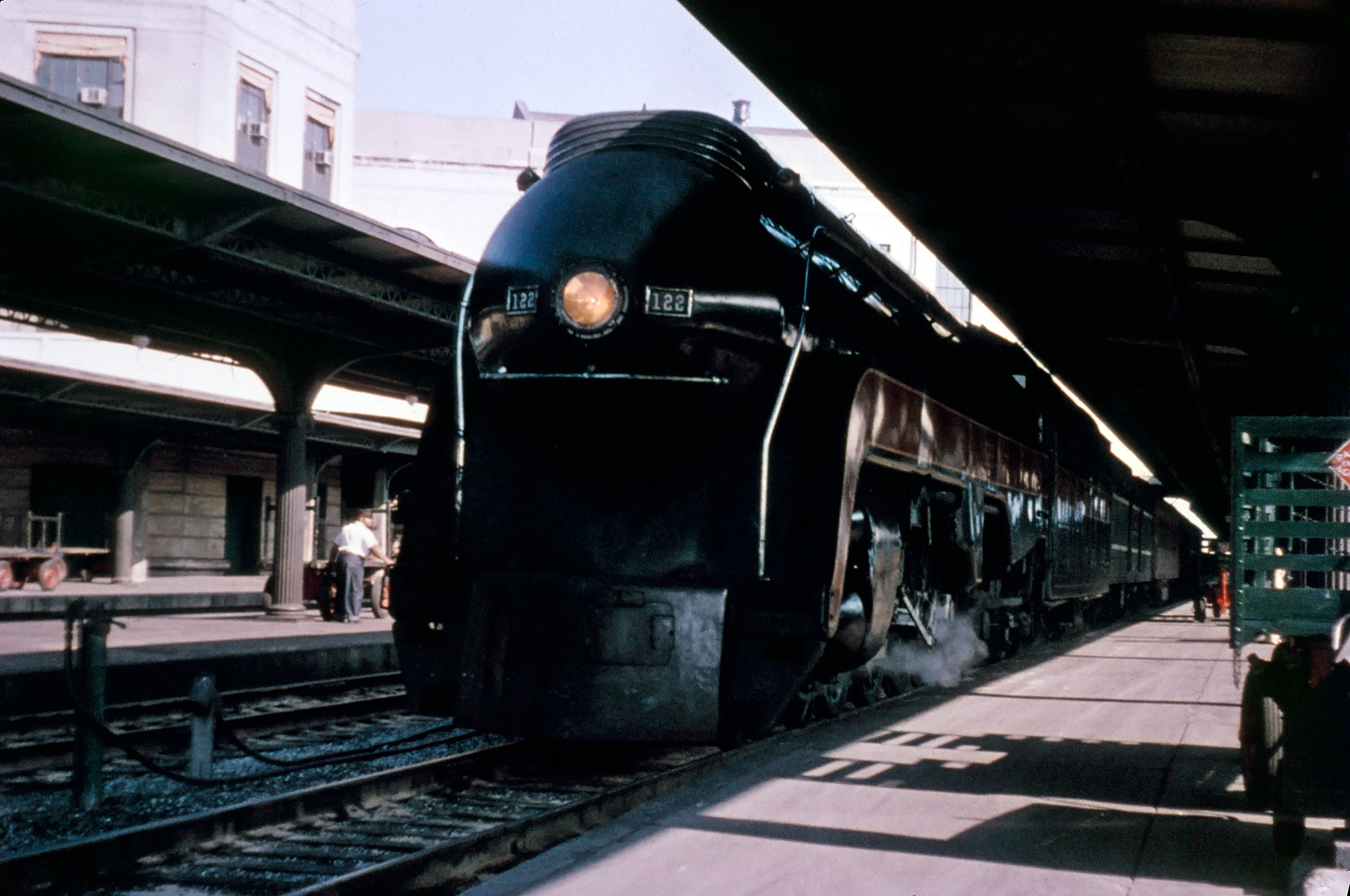
Norfolk & Western 4-8-2 #122, with streamlining echoing the more famous Js, at Richmond’s Broad Street Station, circa 1955. American-Rails.com collection.
Named Streamliners & Flagships (Directory)
Jump into detailed American-Rails.com profiles. Not every train was a stainless-steel diesel set—some were steam-powered speedsters, lightweight rebuilds, or postwar flagships that still belong in the streamliner story.
Marquee names: UP M-10000 · Pioneer Zephyr (9900) · Hiawatha · Super Chief · California Zephyr · Broadway Limited · 20th Century Limited · Empire Builder · Daylights · Capitol Limited
Atlantic Coast Line
Baltimore & Ohio
Boston & Maine
Chesapeake & Ohio
Chicago & Eastern Illinois
Chicago & North Western
Chicago, Burlington & Quincy
Florida East Coast
Great Northern
Gulf, Mobile & Ohio
Illinois Central
Kansas City Southern
Delaware, Lackawanna & Western
Lehigh Valley
Louisville & Nashville
Milwaukee Road
Maine Central
Missouri-Kansas-Texas (Katy)
Missouri Pacific
Nashville, Chattanooga & St. Louis
New York Central
New York, New Haven & Hartford
Nickel Plate Road
Norfolk & Western
Northern Pacific
Pennsylvania
- The "Fleet Of Modernism"
- Congressional Service
- Liberty Limited
- Senator
- South Wind
- Spirit Of St. Louis
Reading
Denver & Rio Grande Western
Rock Island
Frisco
Santa Fe
Seaboard Air Line
Southern Pacific
Southern Railway
Union Pacific
- M-10000
- Challenger
- City of Los Angeles
- City of Portland
- City of San Francisco
- City of Denver
- City of St. Louis
- City of Salina
Wabash
Related & Non-Streamliner Specials
- GM Aerotrain (if profiled) · experimental lightweight concepts of the 1950s
- GM Aerotrain and other 1950s lightweight experiments belong in the late streamliner conversation even when they were not classic named flagships.
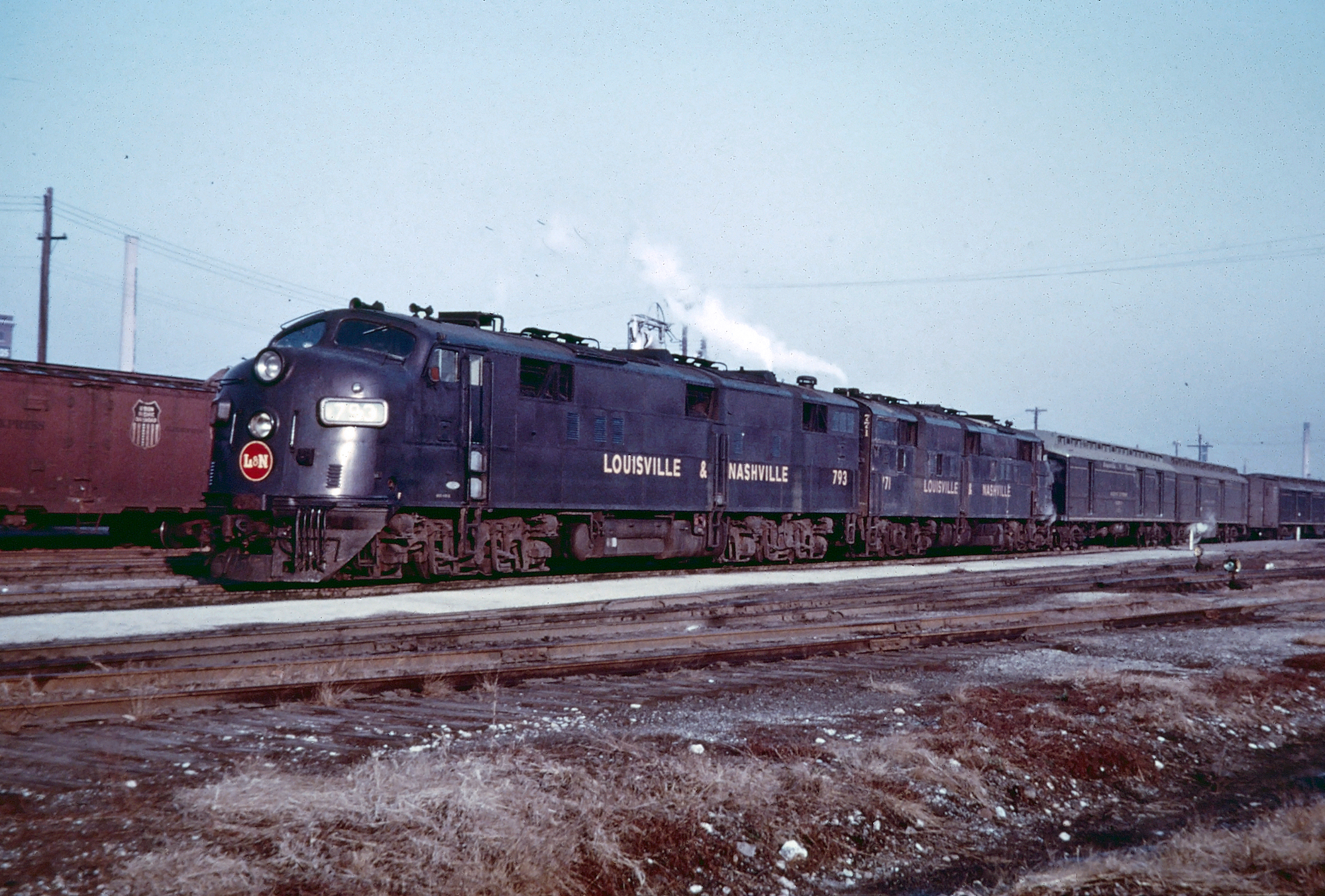
Louisville & Nashville Azalean at Louisville, Kentucky, December 1963. American-Rails.com collection.
Why the Streamliners Could Not Save the Passenger Train
Streamliners bought time, headlines, and pride. They did not fix the business. Automobiles and highways improved every year. Airlines took the long-distance market after World War II. Mail contracts and coach traffic eroded. Fixed costs—crew, stations, terminals, switching, maintenance of specialized lightweight fleets—stayed high even as seats emptied midweek.
Articulated sets were inflexible; locomotive-hauled streamliners were more practical but still expensive. Dramatic styling cost money to build and sometimes to modify. By the 1960s even flagships suffered. New York Central cancelled the prestigious 20th Century Limited before the 1968 Penn Central merger. Santa Fe and Union Pacific held standards longer than most, but they could not carry the industry alone. Car builders left the traditional passenger market; Pullman’s classic era ended in the late 1960s. On May 1, 1971, Amtrak relieved most private railroads of intercity passenger obligation. The streamliner’s failure was not primarily aesthetic or mechanical—it was the failure of the larger economic and regulatory system in which private passenger trains had to operate.
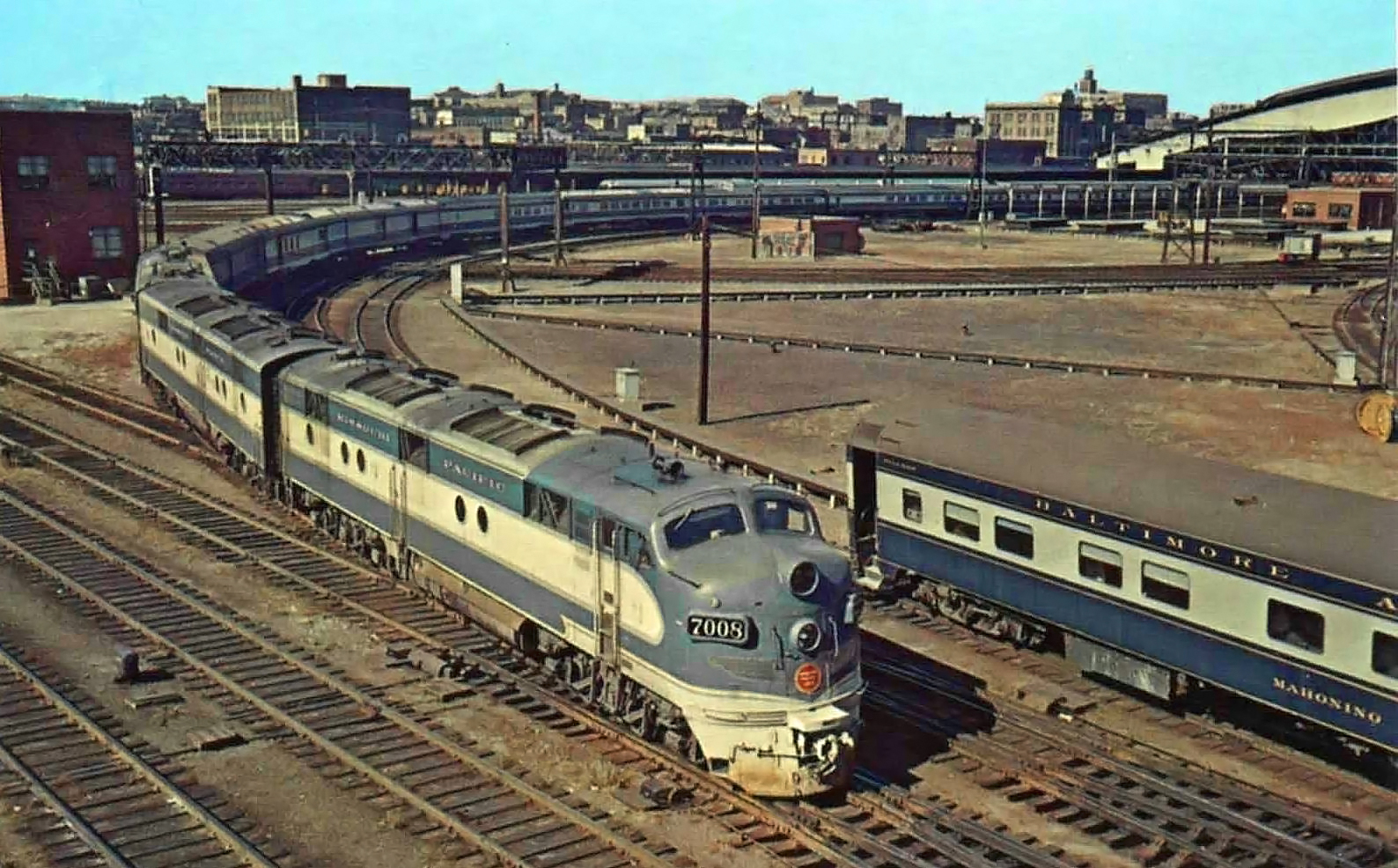
Missouri Pacific Colorado Eagle backs into St. Louis Union Station after its eastbound run, October 1957. Donald Smith photo.
The Streamliner Ideal After the Streamliners
In a corporate sense the classic era ended with Amtrak. The idea did not. Speed, distinctive styling, amenities, and premium marketing still shape passenger rail. Amtrak inherited equipment and glamour; Superliners and later fleets kept dining, lounges, and sleepers as a long-distance package. Corridor equipment and Acela-type products push aerodynamic language into higher-speed service where infrastructure allows.
Outside Amtrak, leisure brands sell scenery and hospitality in ways a 1950s California Zephyr passenger would recognize. Modern private or quasi-private corridor services (such as Brightline) market frequent, polished travel closer to the streamliner philosophy than to a subway. What changed is the role: original streamliners tried to win back mass-market riders from cars and planes; today’s heirs are often niche, leisure, or premium products. The 1930s experiment did not reverse passenger decline—but the aspiration that a train can be fast, stylish, and desirable still defines how passenger rail presents itself nearly a century later.
A Passenger Memory (1964): Rick Burn
"In June, 1964, I spent an extra $12 more than the $49.95 one-way coach fare from Madison, WI to San Diego for my Third-Class Midshipman Training in Navy ROTC. The $49.95 fare (Today would be $522) one way in Coach. Two other guys and I spent $61.95. We took the "Indirect Route" over 2 1/2 weeks. Milwaukee Road to Chicago, overnight at my parents’ home in Elmhurst, IL, Illinois Central "Green Diamond" to St. Louis, Missouri Pacific "Texas Eagle" to San Antonio, Missouri Pacific "Aztec Eagle" to Laredo, TX, NdM "Aztec Eagle to Mexico City, NdM train 7 to Ciudad Juarez, a 30 minute cab ride from getting off train 7, 8 miles in the cab, cleared US Customs, and talked our way on the combined "Golden State- Sunset Limited" to Los Angeles and then an ATSF train to San Diego. We spent a week in Mexico City. We went coach in the United States and lower berths in Mexico. A couple of comments. First, the cab trip shows how much better border crossings were in 1964. Second, train 7 took 41 hours from Mexico City to Ciaded Juarez, but in 1966, it was speeded up to 26 hours, and the best part was the lower berths for sleeping and the ex-New York Central Observation Cars for viewing and having a drink during the day. All three of us are still in touch today and remember this as the great adventure. During the trip, our parents (we were age 19 at the time) knew our general plan, but had no way to reach us. I cannot believe what "helicopter" parents of today would do."
Related Reading on American-Rails.com
- Railroad history · Fallen flags · Passenger train guide
- Diesel locomotives · Steam locomotives · Passenger car types
- Amtrak · PRR passenger trains · American Orient Express
- Marquee profiles: Super Chief · California Zephyr · Hiawatha · 20th Century Limited · Broadway Limited
- Home
Sources
- Schafer, Mike, and Joe Welsh. Streamliners: History of a Railroad Icon
- Johnston, Bob; Welsh, Joe; and Schafer, Mike. The Art of the Streamliner
- Scribbins, Jim. The Hiawatha Story (May 1935 speed trials)
- Harwood, Herbert H., Jr. Royal Blue Line
- Stover, John F. The Routledge Historical Atlas of the American Railroads (passenger deficits after 1929)
- Schneider, Gregory L. Rock Island Requiem (1930s receivership scale)
- Builder and railroad literature on M-10000, Pioneer Zephyr Denver–Chicago run (May 26, 1934), and early articulated sets
- American-Rails.com individual named-train profiles linked in the directory
Streamliners hub revised August 2026 while retaining core research on the passenger crisis, M-10000 and Zephyr 9900, articulated limits, Royal Blue and Hiawatha, diesel and steam power, and the path to Amtrak.
Recent Articles


-
Milwaukee Road Diesel Roster: (All Time)
Oct 26, 26 01:44 PM
 All-time diesel roster of the Milwaukee Road. 1,208 locomotives, each frame once. Alco, Baldwin, Davenport, EMD, Fairbanks-Morse, General Electric, and Whitcomb, with builder numbers.
 -
Milwaukee Road Steam Roster (All-Time): Post-1900
Oct 26, 26 01:38 PM
 Milwaukee Road steam locomotives built since 1900. Prairies, Mikados, the N-class articulateds, the S-class 4-8-4s, and the Hiawatha Atlantics and Hudsons. Quantity column 1,974. Unique frames 1,951.
 -
Milwaukee Road: Map, Electrification, Logo, History
Oct 26, 26 01:20 PM
 The Milwaukee Road, from the Milwaukee & Mississippi of 1850 to the Pacific Coast Extension, the Hiawathas, and the Soo Line sale. Why Lines West should have stayed.
 -
Lake Superior & Ishpeming Railroad: Map, Roster, History
Oct 25, 26 11:38 PM
 Lake Superior & Ishpeming Railroad, reporting mark LSI, from the Marquette Range to the Presque Isle ore dock. The 1954 steam list and the diesels the railroad owned.
 -
Kansas City Southern Steam Roster (Built Since 1900)
Oct 25, 26 09:09 PM
 Steam locomotives of the Kansas City Southern built since 1900, with the Louisiana & Arkansas and the Texas company.
 -
Kansas City Southern Diesel Roster (Built New)
Oct 25, 26 11:46 AM
All-time diesel roster of the Kansas City Southern. E units, F units, Geeps, SD40s through SD70ACes, Fairbanks-Morse, Baldwin, Alco, and General Electric, with serials and order numbers. -
Kansas City Southern Railway: Map, Photos, History
Oct 25, 26 12:24 AM
 The Kansas City Southern, from Arthur Stilwell's Gulf line to Canadian Pacific Kansas City on April 14, 2023. Steam and diesel rosters, the Southern Belle, and the Louisiana & Arkansas.
 -
Indiana Harbor Belt Diesel Roster (All-Time)
Oct 25, 26 12:17 AM
 All-time diesel roster of the Indiana Harbor Belt. 202 locomotive frames, each counted once. NW2s, SW7s, SW1500s, road switchers, and gensets. Slugs and boosters are outside the count.
 -
Indiana Harbor Belt Steam Roster (Built Since 1900)
Oct 25, 26 12:13 AM
 Steam locomotives of the Indiana Harbor Belt built since 1900. 182 engines, each counted once. 0-6-0s, 2-6-0s, 0-8-0s, and 2-8-2s. The three U-4a switchers are three-cylinder Brooks engines of 1927.
 -
Indiana Harbor Belt Railroad: Map, Rosters, History
Oct 25, 26 12:00 AM
 Indiana Harbor Belt, the inner belt across the Calumet, from the East Chicago Belt of May 16, 1896. Renamed June 29, 1907. Still operating, headquarters Hammond. Steam roster is the companion, 182 loc…
 -
NYC's "P Motor" Electric Locomotives
Oct 24, 26 11:43 PM
 New York Central P motors: 22 Alco-GE 2-C+C-2 electrics, Cleveland Union Terminal 1050–1071, class P-1a. 3,030 hp one-hour on 3,000-volt DC catenary, then 660-volt third rail as P-2a and P-2b.
 -
Illinois Terminal Car Roster
Oct 24, 26 11:40 PM
 Illinois Terminal cars. Mainline motors, the 1948 streamliners, sleepers, Alton and Valley Division cars, express motors, and the line cars rebuilt from pull cars.
 -
Illinois Terminal Diesel Roster
Oct 24, 26 09:31 PM
 All-time Illinois Terminal diesels, 62 frames. Alco S-2s and RS-1s, EMD switchers, GP7s, SD39s, GP38-2s, and the two GP20s. Serial numbers from the 1989 roster.
 -
Illinois Terminal Electric Locomotives
Oct 24, 26 08:22 PM
 Illinois Terminal electric locomotives, 57 frames. Class A through Class D, the Decatur-built motors, and the battery locomotives. Class D is the same five Class C frames, rebuilt.
 -
Illinois Terminal Steam Roster
Oct 24, 26 07:37 PM
 Illinois Terminal steam locomotives, 36 frames. Baldwin Moguls, three Class 30 Mikados, Florida East Coast 0-8-0s, and 2-6-0 No. 21, the last fire on June 30, 1950.
 -
Illinois Terminal Railroad: Map, Roster, Photos, History
Oct 24, 26 07:32 PM
Illinois Terminal, McKinley's Illinois Traction System, from the Danville coal towns to St. Louis. The McKinley Bridge, the sleeping cars, the 1937 break with the power company, the 1948 streamliners… -
Southern Railway Diesel Roster (All-Time)
Oct 23, 26 11:00 PM
 All-time diesel roster of the Southern Railway. 2,505 locomotives in the system number series, from the 1939 demonstrator FT to GP50s and B30-7A1s. Serials included.
 -
Illinois Central Diesel Roster (All-Time)
Oct 23, 26 04:06 PM
 Illinois Central and Illinois Central Gulf diesel locomotives, each frame once. The quantity column is 886. Serials and order numbers from Electro-Motive's builder lists. Paducah rebuilds and Gulf, Mo…
 -
Illinois Central Gulf Diesel Roster
Oct 23, 26 04:02 PM
 Illinois Central Gulf operating numbers from August 10, 1972, to February 29, 1988. New frames stay on the Illinois Central diesel roster. Gulf, Mobile and Ohio frames stay on that roster. No Gulf fle…
 -
Illinois Central Railroad: Map, Logo, History
Oct 23, 26 03:50 PM
Illinois Central, the Main Line of Mid-America, from the 1850 land grant to Canadian National control on July 1, 1999. Charter lines, Cairo bridge, Paducah, and the Illinois Central Gulf. Steam quanti… -
Grand Trunk Western Diesel Roster (All-Time)
Oct 23, 26 12:53 PM
 Grand Trunk Western diesel locomotives, each frame once. The quantity column is 377. Serials are filled for the Detroit, Toledo and Ironton and Detroit and Toledo Shore Line engines the railroad kept…
 -
Grand Trunk Western Steam Roster
Oct 23, 26 12:14 PM
 Grand Trunk Western steam locomotives in service about 1937 to 1942, from Richard Leonard's class list. Drury has no chapter. The quantity column is the counted Grand Trunk Western rows. Two mixed Gra…
 -
Grand Trunk Western Railroad: Map, Roster, History
Oct 23, 26 12:09 PM
 Grand Trunk Western, reporting mark GTW, Canadian National's railroad between Port Huron and Chicago. Trade name adopted in 1923. Steam class list quantity 232. Diesel quantity column 377. Identity in…
 -
Green Bay and Western Railroad: Map, Rosters, History
Oct 22, 26 11:18 PM
 Green Bay & Western, the Green Bay Route, reporting mark GBW. From Kewaunee to Winona. Mailer's steam and diesel rosters, and the August 1993 sale to Fox Valley & Western.
 -
Chicago & North Western Class E-4: Streamlined 4-6-4 Hudsons
Oct 22, 26 10:28 PM
 C&NW Class E-4, nine streamlined 4-6-4s, 4001–4009, Alco 1938. 84-inch drivers, 25-by-29 cylinders, 300 psi. Conventional Chicago–Omaha trains. Oil in 1947–48. Retired 1953–1956.
 -
Gateway Western Railway: Map, Roster, History
Oct 22, 26 02:43 PM
 Gateway Western Railway, reporting mark GWWR. Class II from Kansas City to East St. Louis. Kansas City Southern control May 5, 1997. The 1992 diesel fleet, with serials and order numbers.