Railroad Jobs (2026): Careers, Pay, Hiring & What to Expect
Last revised: August 12, 2026
By: Adam Burns
Railroad employment remains one of the most searched topics on American-Rails.com—and one of the easiest to get wrong if you rely on outdated salary folklore or assume every carrier hires the same way. This page is a 2026-oriented overview of how U.S. rail careers actually work: who employs people, how hiring usually starts, what pay figures mean, and what life on the property is like before seniority softens the schedule.
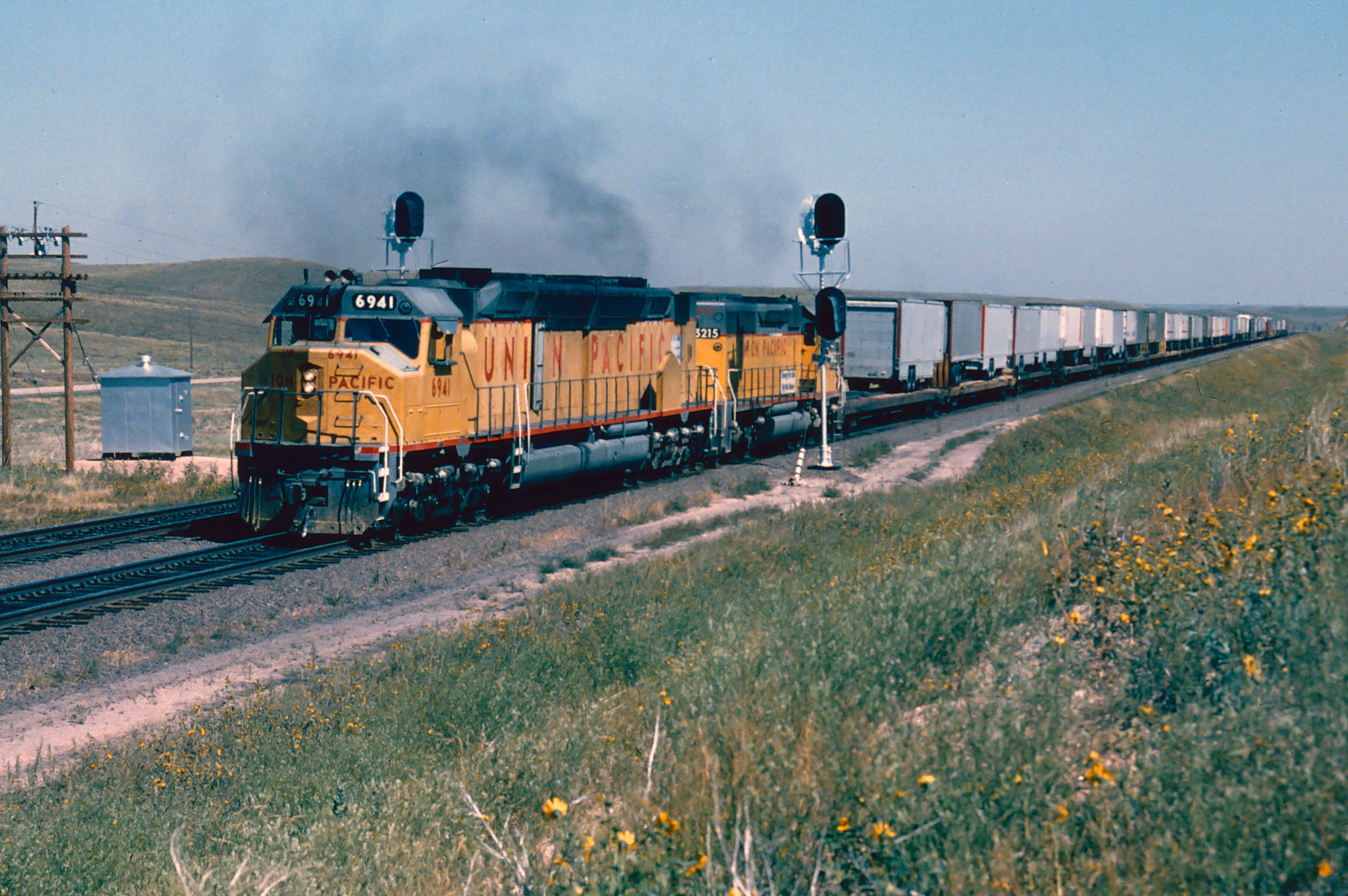
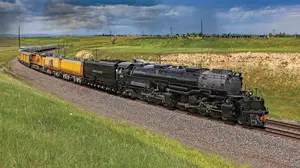
Union Pacific DDA40X “Centennial” #6941 and SD40-2 #3215 hustle trailers westbound up Sherman Hill just west of Borie, Wyoming at Milepost 521.4 signals during the summer of 1984. Mike Bledsoe photo. American-Rails.com collection.
Important disclaimer: American-Rails.com is a history and information site. It is not a railroad, not affiliated with any railroad or rail contractor, and has no job openings of its own. For applications, schedules, and requirements, use each employer’s official careers page or a major job board. The author has never worked for a railroad; this guide synthesizes public industry, government, and historical sources for job seekers and curious readers.
At a Glance (2025–2026)
| Topic | Current picture |
|---|---|
| Direct freight-rail employment (AAR) | About 153,000 workers industry-wide; total economic impact far larger (AAR cites on the order of 749,000 supported jobs) |
| Class I share of employees (AAR) | Roughly 87% of freight-rail employees work for the six Class I systems |
| Class I pay + benefits package (AAR) | Average annual package often cited from about $135,000 to almost $190,000 (wages plus benefits; not base wage alone) |
| BLS median wage, “railroad workers” (May 2024) | About $75,680 per year overall; locomotive engineers ~$77,400; conductors/yardmasters ~$74,080 |
| BLS outlook (2024–34) | About 1% employment growth (slower than average), but roughly 6,600 openings per year largely from retirements and turnover |
| Typical crew today (freight) | Usually engineer + conductor on the head end; caboose / flagman / fireman roles largely historic on Class I freights |
| Common entry points | Conductor / train-service trainee, track laborer / MOW, mechanical, signals & communications, clerical, management trainee |
| Where to apply | Railroad careers sites, Indeed/LinkedIn, short-line company pages, Amtrak and commuter agencies, rail contractors |
AAR and BLS measure different things (industry headcount and total compensation messaging vs. occupational wage medians). Treat both as useful; do not mix them into one invented “starting salary.” Figures compiled August 12, 2026 from public AAR and BLS materials—always re-check primary sources before a formal application or wage claim.
How to Find a Railroad Job in 2026
There is no single national “railroad employment office.” Hiring is employer-by-employer, and openings rise and fall with traffic, attrition, and capital projects. Practical paths:
- Class I freight careers portals — BNSF, Union Pacific, CSX, Norfolk Southern, Canadian National (U.S. operations), and CPKC post craft, mechanical, engineering, IT, and management roles when they are recruiting.
- Regionals and short lines — Hundreds of Class II/III freights (AAR order-of-magnitude: ~615) hire locally; schedules can be more predictable, pay often lower than big Class I packages. Start with the company website or state short-line association listings.
- Passenger & commuter — Amtrak careers, plus metropolitan transit and commuter railroads (Metra, NJ Transit, Metro-North, Caltrain, etc.) hire engineers, conductors, mechanical, stations, and police under their own rules.
- Contractors & suppliers — Track construction firms, signal contractors, car/locomotive shops, and industrial switching companies employ many people who never wear a Class I hard hat.
- General job boards — Indeed, LinkedIn, and government USAJOBS (for some public-sector rail roles) still surface postings; always finish the process on the employer’s official site.
Expect background checks, drug and alcohol testing (including random testing after hire), medical/vision/hearing standards for many craft jobs, and—for locomotive engineers and many conductors—Federal Railroad Administration (FRA) certification administered through the employing railroad.
Major freight & Amtrak career starting points
- BNSF Railway careers
- Union Pacific careers
- CSX Transportation (careers section on company site)
- Norfolk Southern — Work at NS
- Canadian National careers
- CPKC careers
- Amtrak careers
Industry context: Class I railroads · Regionals · Short lines.
Pay: What the Numbers Actually Mean
Older versions of this page quoted field starting pay in the high $30,000s (track) and $50,000s (train crew). Those figures were always rough and are no longer a reliable map of Class I economics in the mid-2020s. Two public frames matter more today:
- AAR total compensation messaging — The average Class I employee’s annual pay and benefit package is commonly described in the $135,000–$190,000 range (average often near the mid–high $100,000s depending on year and publication). That total includes health care, paid time off, and retirement-related value—not take-home base alone.
- BLS occupational wage medians (May 2024) — Across BLS “railroad workers” occupations, median pay was about $75,680. Locomotive engineers ~$77,400; conductors and yardmasters ~$74,080; brake/signal/switch and related ~$65,480; rail yard engineers/hostlers ~$58,030. The top tenth of railroad workers earned more than about $100,130.
Overtime, craft, location, passenger vs. freight, and seniority swing real earnings widely. A conductor on a busy Class I extra board can out-earn a short-line engineer in a quiet terminal; a signal maintainer with overtime can out-earn a junior trainmaster. For planning, use posted job ranges on the employer site plus BLS area.
Reading for perspective (historical as much as vocational): Brian Solomon’s Working on the Railroad remains a solid illustrated introduction to craft life and industry culture.
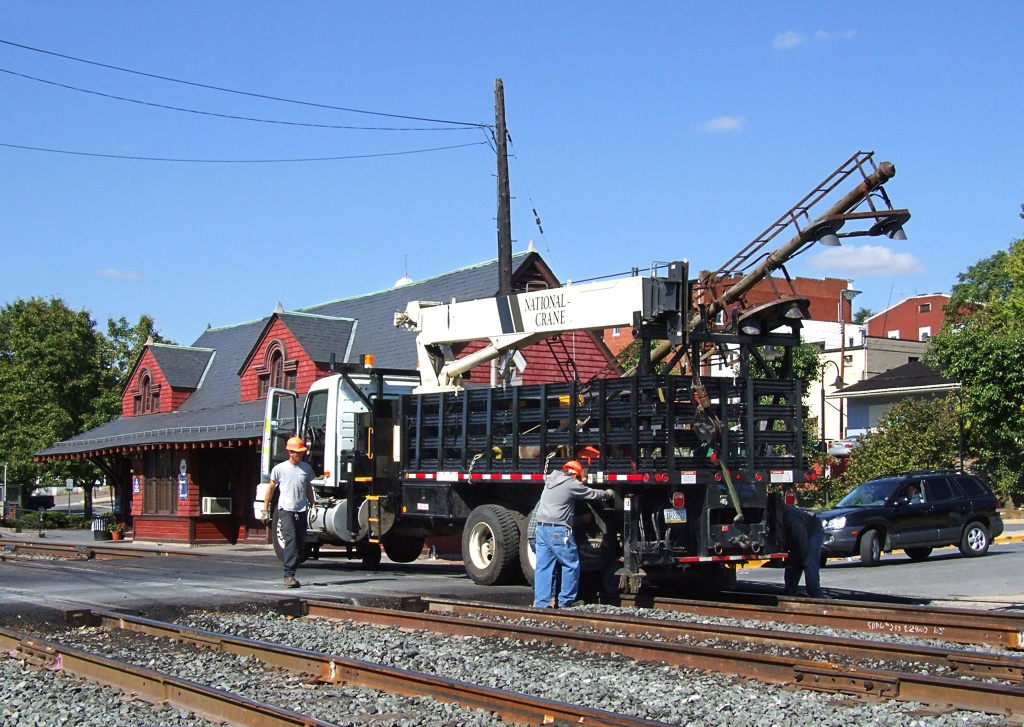
Three CSX signal maintainers are about to clear their hi-rail from the main line at Brunswick, Maryland after taking down a venerable B&O CPL on October 13, 2007. Rob Kitchen photo.
What the Work Is Like
Modern locomotives often have climate control and electronic displays, and heavy track work is highly mechanized. The job is still not a conventional 9-to-5 for most new craft hires:
- 24/7 railroad — Freight and many passenger services run nights, weekends, and holidays. Federal hours-of-service rules set rest floors; they do not create a bank-teller schedule.
- Extra board & call windows — Junior train-service employees often work from a call list with limited ability to refuse trips. Predictable yard or local jobs usually come with seniority.
- Time away from home — Over-the-road freights can mean lodging at away terminals. Short passenger turns and some locals are more home-based.
- Seniority is everything — Days off, preferred jobs, and vacation bids are governed by union agreements and roster standing. Waiting years (sometimes more than a decade) for a “good” job is common on large properties.
- Safety culture & rules — Operating and safety rules are thick; violations can end a career. Random drug/alcohol testing is part of regulated service.
Many railroaders describe multi-generation pride in the craft—grandfathers on the PRR, Santa Fe, or B&O; grandchildren on BNSF or CSX. The romance is real for some; the lifestyle costs are real for everyone who has not yet bid a daylight yard job.
Shorter Class II/III freights sometimes trade lower pay for fewer nights away and a tighter geographic footprint. That trade-off is personal; read the job posting carefully.
Career Paths & Related American-Rails Pages
Field and operations roles get the most public attention, but railroads also hire mechanical, engineering, IT, finance, sales, police, and corporate staff. Craft-focused overviews on this site:
| Role | Notes | AR page |
|---|---|---|
| Locomotive engineer | Operates trains; FRA certification; often promoted from conductor service | Engineer |
| Conductor | Crew boss for train movements, paperwork, switching, passengers on passenger service | Conductor |
| Brakeman / trainman | Historic title; duties largely folded into conductor/utility roles on modern freights | Brakeman |
| Fireman | Steam-era head-end helper; largely obsolete as a freight craft | Fireman |
| Flagman | Historic rear-end protection role; largely obsolete after end-of-train devices | Flagman |
| Signal maintainer | Signals, crossings, PTC-related field work; skilled craft | Signal maintainer |
| Roadmaster | Supervises track territory / MOW forces | Roadmaster |
| Track laborer / MOW | Entry field work on production gangs and section forces | Tie gang / laborer |
| Dispatcher | Authorizes train movements from centralized offices | Dispatcher |
| Trainmaster | Field / terminal supervision of train operations | Trainmaster |
| Yardmaster | Directs yard switching and car classification | Yardmaster |
Also see: Gandy dancer (historic track labor slang) · Rail maintenance · Rail infrastructure.
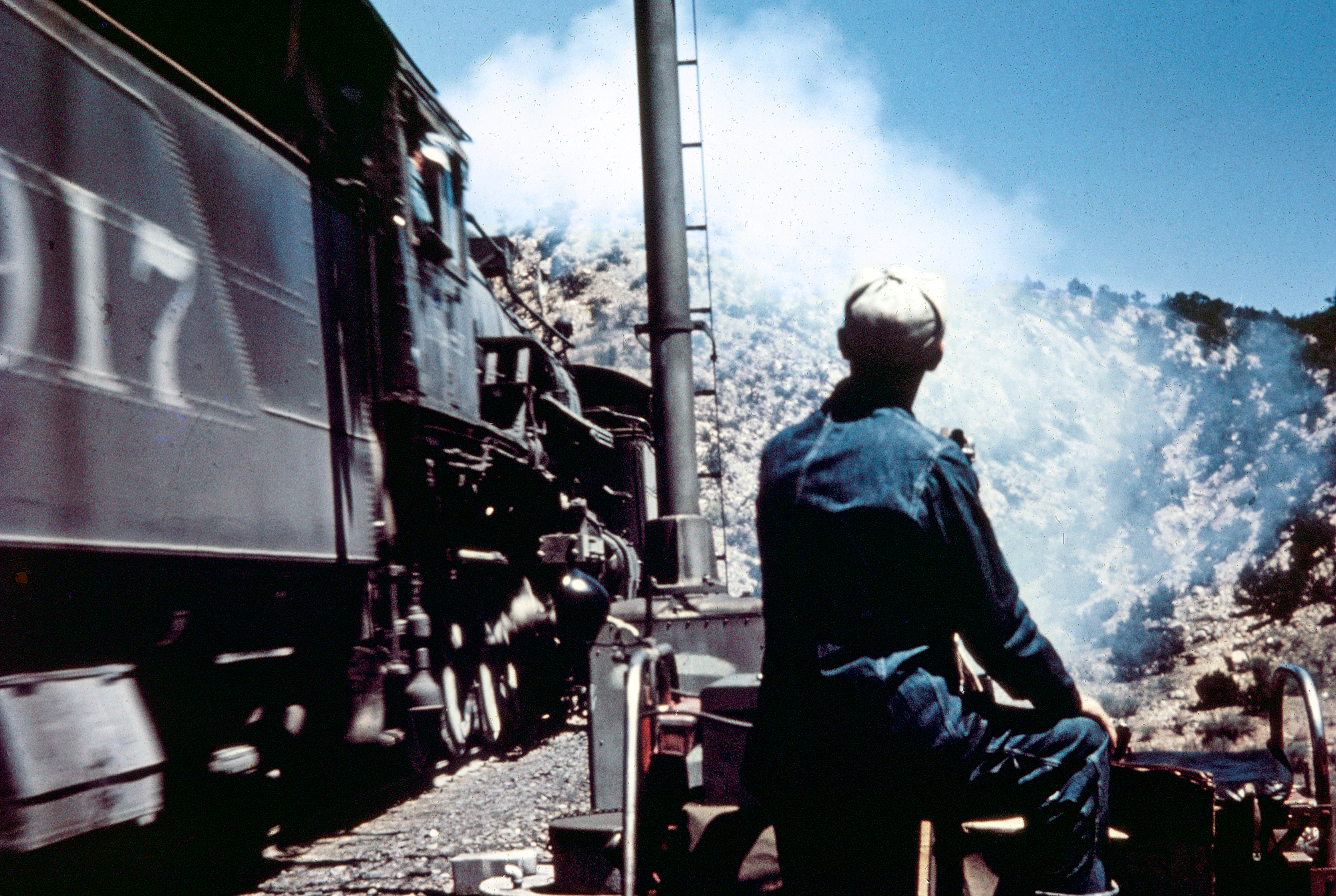
A Santa Fe track inspector watches as a pair of steam locomotives work a passenger train over New Mexico’s Glorieta Pass, circa 1950. Ed Olsen photo. American-Rails.com collection.
How the Railroad Workforce Changed
U.S. railroading once employed armies. John F. Stover’s atlas work and other standard histories place national employment near 1.7 million around World War I’s mileage peak (~254,000 route miles in 1916). Brian Solomon and others note employment still near 2 million into the early 1920s. Today’s freight industry headcount is roughly an order of magnitude smaller—not because freight vanished, but because technology and consolidation removed thousands of intermediate jobs.
Key structural shifts:
- Dieselization — Ended coaling towers, water tanks, and most steam roundhouse forces; reduced mechanical headcount per horsepower.
- Crew consist reductions — From five-person freights (engineer, fireman, head brakeman, conductor, rear flagman) toward today’s typical two-person head-end crew after FRED/EOT devices and the caboose’s exit.
- Centralized dispatching & CTC — Closed towers, many depots, and the classic paper train-order culture (still practiced in pockets into the 1980s).
- Mechanized maintenance-of-way — Tampers, undercutters, spike drivers, and production gangs replaced gandy-dancer armies for most planned work.
- Computers & remote diagnostics — Fewer clerks, agents, and local supervisory layers; more concentration in network operations centers.
The interurban boom before World War I briefly added thousands of motorman, shop, and line jobs; highway competition erased most of that network by mid-century. Passenger employment migrated to Amtrak (1971) and public commuter authorities rather than private freight companies.
For deeper history: Railroad history · Fallen flags · Interurbans & streetcars.
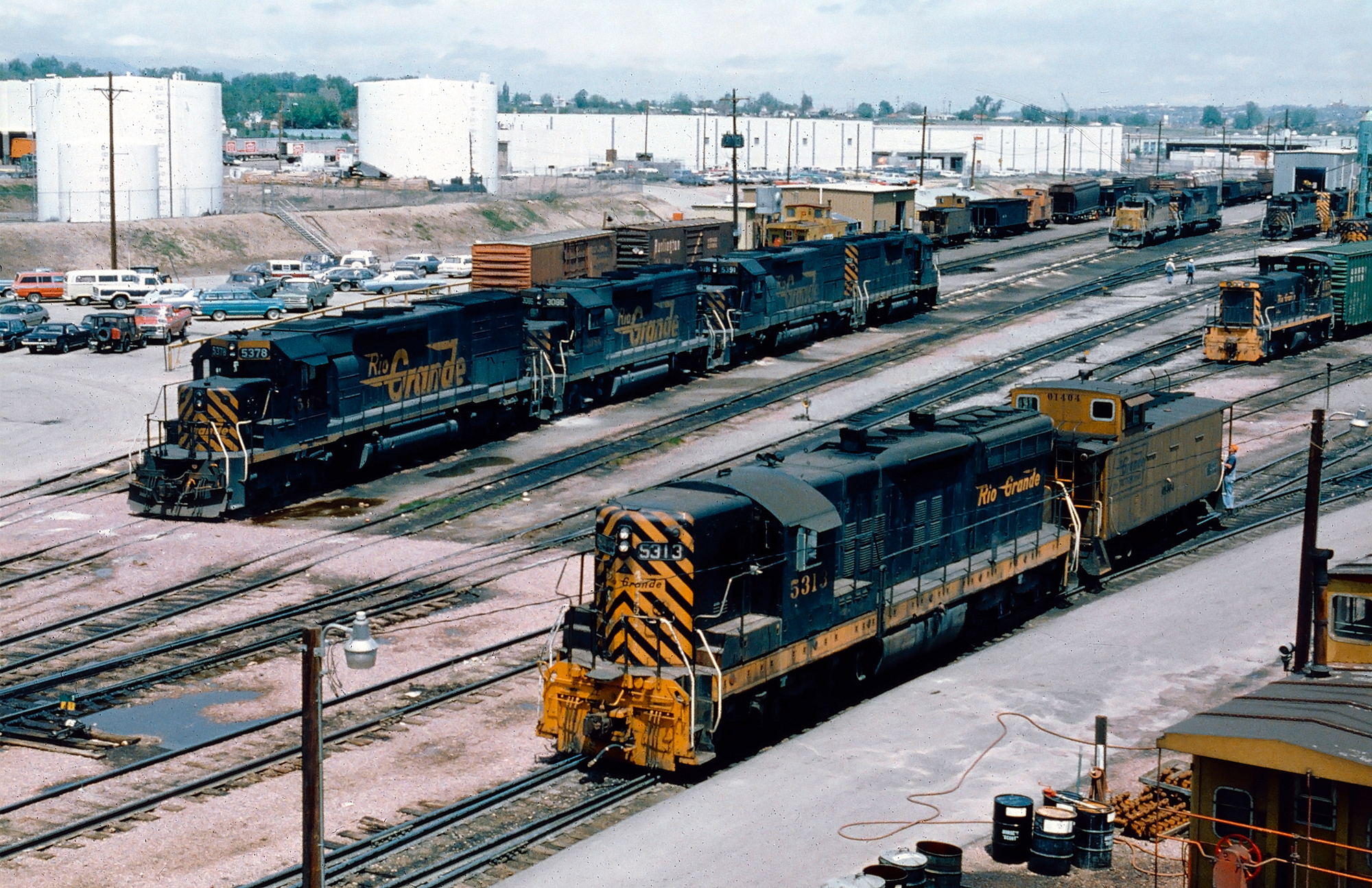
Rio Grande’s North Yard in Denver, Colorado, in 1983—a classic terminal landscape of the late private-passenger / early mega-merger era. Mike Bledsoe photo. American-Rails.com collection.
Safety: From Deadly Craft to Regulated Industry
Nineteenth-century railroading was extraordinarily dangerous. Automatic air brakes (Westinghouse) and knuckle couplers (Janney) existed decades before federal law forced universal use; the Railway Safety Appliance Act of 1893 was a watershed. Link-and-pin coupling and hand-braked freights killed and maimed thousands annually. Labor uprisings such as the Great Railroad Strike of 1877 and the Pullman Strike of 1894 reflected brutal wage cuts and weak worker power as much as ideology.
Modern freight rail posts some of the better industrial safety trends in heavy transportation (AAR regularly highlights multi-decade declines in accident and employee casualty rates, including strong 2025 Class I results). That does not make the property risk-free: moving equipment, electrical hazards, and highway-rail grade crossings remain unforgiving. New hires learn rules first because the margin for improvisation is small.
Railroad Retirement
Most U.S. railroad employees are covered by the Railroad Retirement system (administered by the U.S. Railroad Retirement Board), a federal program separate from Social Security that rail workers and employers fund. Career railroaders with long service often receive substantially higher retirement income than average Social Security benefits—one reason multi-decade careers remain attractive even when schedules are hard. Confirm eligibility and benefit rules with the Railroad Retirement Board and your employer; do not rely on informal estimates.
Practical Tips Before You Apply
- Be honest about lifestyle — If nights and call windows are non-starters, target passenger locals, clerical, shop day shifts, or non-operating crafts—not over-the-road freight.
- Read the posting — CDL, welding tickets, electrical licenses, or prior craft experience can be required or preferred.
- Geography matters — Hiring hubs follow terminals, shops, and corridors. Willingness to relocate multiplies options.
- Unions — Most Class I craft jobs are represented (SMART-TD, BLET, BMWED, BRS, and others depending on craft). Agreements govern bids, discipline, and pay tables.
- Scams — Legitimate railroads do not ask you to pay for a job or wire money for “training slots.” Apply through official domains.
- Military veterans — AAR notes roughly one in six rail employees are veterans; many carriers run veteran hiring initiatives.
Related Reading on American-Rails.com
- Class I railroads · Regionals · Short lines
- Railroad history · Fallen flags
- Diesel locomotives · Steam locomotives
- Amtrak · Commuter rail
- Glossary
Sources
- Association of American Railroads, Freight Rail Facts & Figures and railroad jobs issue pages (employment ~153,000; Class I pay/benefit package ranges; tenure and veterans statistics)
- U.S. Bureau of Labor Statistics, Occupational Outlook Handbook, “Railroad Workers” (May 2024 wages; 2024–34 outlook)
- Federal Railroad Administration — engineer and conductor certification framework
- U.S. Railroad Retirement Board — Railroad Retirement system overview
- Stover, John F. The Routledge Historical Atlas of the American Railroads
- Solomon, Brian. Working on the Railroad (and related craft/history titles)
- Hilton, George W., and John F. Due. The Electric Interurban Railways in America (interurban employment context)
- Class I and Amtrak official careers pages (hiring process and current openings)
Guide rewritten August 2026 to replace outdated salary ranges and generic advice with current public AAR/BLS framing, practical hiring paths, and clearer separation between American-Rails.com content and actual railroad employers.
Recent Articles


-
Scenic Train Rides (USA 2026): State Guide to Tourist Railroads
Oct 04, 26 12:17 AM
 Scenic and tourist train rides in all 50 states for 2026. Colorado narrow gauge, Pennsylvania steam, Alaska’s White Pass, and the states with no full-size ride this month. Confirm on the railroad.
 -
Wyoming Scenic Train Rides (2026): A Complete Guide
Oct 03, 26 12:07 AM
 Wyoming has no full-size tourist railroad on the calendar in October 2026. Cheyenne Depot Museum and Douglas Railroad Museum are static. Union Pacific 4014’s posted public trip is a November run to De…
 -
Washington Scenic Train Rides (2026): A Complete Guide
Oct 02, 26 11:53 PM
 Washington tourist trains in 2026—Mount Rainier Scenic at Elbe, the Northwest Railway Museum, and Chehalis-Centralia. Lake Whatcom has no 2026 date on its ticket page.
 -
Wisconsin Scenic Train Rides (2026): A Complete Guide
Oct 02, 26 11:48 PM
 Wisconsin tourist trains in 2026—Wisconsin Great Northern, Osceola & St. Croix Valley, Mid-Continent, East Troy, and the National Railroad Museum.
 -
Pennsylvania Railroad Class Q2 4-4-6-4: Specs, Roster, History
Oct 02, 26 11:28 PM
 Pennsylvania Railroad Class Q2 4-4-6-4 duplexes. Twenty-six engines, 6131 and 6175–6199, Altoona 1944–45. Form 109-J specs, the 7,987 hp test of 6175, and a roster. All scrapped.
 -
Utah Scenic Train Rides (2026): A Complete Guide
Oct 02, 26 11:18 PM
 Utah tourist trains in 2026—Heber Valley Railroad from Heber City. Golden Spike at Promontory is a locomotive demonstration, not a line-haul ride.
 -
South Dakota Scenic Train Rides (2026): A Complete Guide
Oct 02, 26 11:06 PM
 South Dakota’s 2026 scenic train is the Black Hills Central 1880 Train, Hill City to Keystone. Steam is the summer assignment. Confirm the engine.
 -
Oregon Scenic Train Rides (2026): A Complete Guide
Oct 02, 26 11:04 PM
 Oregon tourist trains in 2026—Oregon Coast Scenic from Rockaway Beach, Mount Hood at Hood River, Eagle Cap from Elgin, and the Oregon Rail Heritage Center in Portland.
 -
Oklahoma Scenic Train Rides (2026): A Complete Guide
Oct 02, 26 10:36 PM
 Oklahoma has no full-size scenic railroad on an October 2026 calendar. Oklahoma Railway Museum Halloween and Polar trains, the El Reno trolley, and the Heartland Flyer.
 -
North Dakota Scenic Train Rides (2026): A Complete Guide
Oct 02, 26 01:14 PM
North Dakota has no tourist railroad on a 2026 calendar. Ride Amtrak’s daily Empire Builder. The Fort Lincoln Trolley in Mandan is not a current ticket. -
Nebraska Scenic Train Rides (2026): A Complete Guide
Oct 02, 26 10:11 AM
 Nebraska has no full-size scenic railroad in 2026. The Omaha Zoo Railroad runs weekends through October 4. Ride Amtrak’s California Zephyr across the state.
 -
Missouri Scenic Train Rides (2026): A Complete Guide
Oct 02, 26 09:56 AM
 Missouri tourist trains in 2026—Branson Scenic Railway and the St. Louis, Iron Mountain & Southern at Jackson. Belton has no 2026 schedule posted.
 -
Minnesota Scenic Train Rides (2026): A Complete Guide
Oct 02, 26 09:52 AM
 Minnesota tourist trains in 2026—North Shore Scenic Railroad in Duluth, the Duluth River Train, and the Como-Harriet streetcar.
 -
Kansas Scenic Train Rides (2026): A Complete Guide
Oct 02, 26 09:32 AM
 Kansas tourist trains in 2026—the Abilene & Smoky Valley Railroad. Santa Fe 3415 is in overhaul. Midland Railway at Baldwin City is closed.
 -
Iowa Scenic Train Rides (2026): A Complete Guide
Oct 02, 26 08:41 AM
 Iowa tourist trains in 2026—Boone & Scenic Valley across the Bass Point Creek High Bridge, and Midwest Central’s December North Pole trains
 -
Indiana Scenic Train Rides (2026): A Complete Guide
Oct 02, 26 08:35 AM
 Indiana tourist trains in 2026—French Lick Scenic Railway, Nickel Plate Express, Hoosier Valley, and Hesston. Whitewater Valley is suspended.
 -
Illinois Scenic Train Rides (2026): A Complete Guide
Oct 02, 26 12:28 AM
 Illinois tourist trains in 2026—Illinois Railway Museum, Monticello Railway Museum, Fox River Trolley, and Silver Creek & Stephenson.
 -
Texas Scenic Train Rides (2026): A Complete Guide
Oct 02, 26 12:14 AM
 Texas tourist trains in 2026—Texas State Railroad, Grapevine Vintage Railroad, Austin Steam Train's Hill Country Flyer, and the Galveston Railroad Museum.
 -
Tennessee Scenic Train Rides (2026): A Complete Guide
Oct 02, 26 12:03 AM
Tennessee tourist trains in 2026—Tennessee Valley Railroad Museum, Dollywood Express, Three Rivers Rambler Christmas trains, and the Tennessee Central Railway Museum. -
South Carolina Scenic Train Rides (2026): A Complete Guide
Oct 01, 26 11:52 PM
 South Carolina's tourist train is the South Carolina Railroad Museum in Winnsboro—Blue Granite Express, pumpkin trains, and Santa trains on the old Rockton & Rion.
 -
Mississippi Scenic Train Rides (2026): A Complete Guide
Oct 01, 26 11:38 PM
 Mississippi has no regular tourist railroad in 2026. Ride Amtrak through the state, or book the excursion lines in Alabama, Tennessee, Louisiana, or Arkansas.
 -
Louisiana Scenic Train Rides (2026): A Complete Guide
Oct 01, 26 02:52 PM
 Louisiana has no regular full-size tourist railroad in 2026. New Orleans Polar Express returns December 11–31. Museums at Long Leaf, DeQuincy, and Jackson.
 -
Kentucky Scenic Train Rides (2026): A Complete Guide
Oct 01, 26 02:45 PM
 Kentucky tourist trains in 2026—Big South Fork Scenic Railway, Bluegrass Scenic Railroad, Kentucky Railway Museum, and My Old Kentucky Dinner Train.
 -
Georgia Scenic Train Rides (2026): A Complete Guide
Oct 01, 26 02:27 PM
 Georgia tourist trains in 2026—Blue Ridge Scenic Railway, SAM Shortline, Azalea Sprinter, Savannah shop rides, and what to confirm at Stone Mountain.
 -
Arkansas Scenic Train Rides (2026): A Complete Guide
Oct 01, 26 01:02 PM
 Arkansas tourist trains in 2026—Arkansas & Missouri through the Boston Mountains, and the Eureka Springs & North Arkansas dinner and excursion trains.
 -
Alabama Scenic Train Rides (2026): A Complete Guide
Oct 01, 26 12:59 PM
Alabama tourist trains in 2026—Heart of Dixie Railroad Museum at Calera, North Alabama Railroad Museum at Chase, and the Wales West Light Railway at Silverhill. -
The Circus Train: How Such Attractions Reached Distant Cities
Oct 01, 26 12:22 PM
 How circuses moved by rail: Coup's 1872 flats, the Ringling train's sections and car counts, the 1918 Hammond wreck, and the last show on May 21, 2017.
 -
West Virginia Halloween Train Rides (2026)
Oct 01, 26 12:19 PM
 2026 West Virginia Halloween train. Cass Scenic Halloween Train, October 30 and 31, steam, 5:00 p.m. from Cass Depot. Adult $75. About two hours to Whittaker. Family ride.
 -
Wisconsin Halloween Train Rides (2026)
Oct 01, 26 12:11 PM
2026 Wisconsin Halloween trains. Mid-Continent Pumpkin Special October 24–25, adult $24, pumpkins extra. Halloween Flyer October 24 at 4:30 p.m., adult $30. Osceola Pumpkin Express boards in Osceola… -
Utah Halloween Train Rides (2026)
Oct 01, 26 12:00 PM
 2026 Utah Halloween trains at Heber Valley Railroad. Pumpkin Train, about 40 minutes, with a cookie and a pumpkin. Halloween Express, about 90 minutes to Grim Hollow, Monday, Thursday, and Friday even…
 -
Texas Halloween Train Rides (2026)
Oct 01, 26 11:28 AM
 2026 Texas Halloween train. Texas State Railroad Spooky Special, adult-only, October 24. Boards Palestine at 5:00 p.m. About five hours to Rusk and back. Dinner on the grounds. Not steam. No fare on t…
 -
Tennessee Halloween Train Rides (2026)
Oct 01, 26 12:15 AM
 2026 Tennessee Halloween trains. Tennessee Valley Railroad Museum Rails, Wizards & Spells, selected days September 18 through October 25, from $35, about 2.5 hours. Spells & Potions tea from $60. The…
 -
Frisco's "Firefly" (Train): Consist, Route, Timetable
Sep 30, 26 11:37 PM
 Frisco Firefly—daylight streamliner, Kansas City to Tulsa and Oklahoma City. Trains 117 and 118. Pacifics 1018, 1026, and 1031. Last run May 22, 1960.
 -
South Carolina Halloween Train Rides (2026)
Sep 30, 26 11:29 PM
 2026 South Carolina Halloween train. South Carolina Railroad Museum Pumpkin Patch Express, the two Saturdays before Halloween. About three miles to the Greenbriar pavilion. Pumpkin for children 12 and…
 -
Oregon Halloween Train Rides (2026)
Sep 30, 26 08:10 PM
2026 Oregon Halloween train. Sumpter Valley Railroad Halloween Express at the Sumpter Depot, calendar window October 31 at 11:00 a.m. through November 1 at 12:30 p.m. Fare and the individual clocks ar… -
Oklahoma Halloween Train Rides (2026)
Sep 30, 26 03:45 PM
2026 Oklahoma Halloween train. Oklahoma Railway Museum, October 30 and 31, from Oakwood Station in Oklahoma City. Adults $15, children 3–12 $8. A candy bag with the ride. -
McCloud River Railroad: Serving The Timber Industry (1897-2009)
Sep 30, 26 03:37 PM
 McCloud River Railroad—Mount Shasta City to McCloud, Hambone, and Burney. Opened August 1, 1897. Alco No. 25 and EMD SD38s. Dinner train through January 2010. Railbikes in 2026; a dinner train is stil…
 -
Nevada Halloween Train Rides (2026)
Sep 30, 26 03:30 PM
2026 Nevada Halloween trains in Ely. Nevada Northern Pumpkin Patch Caper and Haunted Ghost Train. Adult tickets start at $45. Dates are on the railroad’s ticket calendar. Boulder City stays off until… -
Missouri Halloween Train Rides (2026)
Sep 30, 26 11:12 AM
 2026 Missouri Halloween trains. St. Louis Iron Mountain & Southern Pumpkin Patch Train on October 3, 4, 10, and 11, and Halloween Express on October 31 at 1:00 p.m. Jackson depot. No fare on the sched…
 -
Minnesota Halloween Train Rides (2026)
Sep 30, 26 11:06 AM
 2026 Minnesota Halloween trains. North Shore Scenic Great Pumpkin Train in Duluth, October 15–18. Everyone gets a pumpkin. Terror Train is October 30, an adult costume party, about three hours. Fares…
 -
Maryland Halloween Train Rides (2026)
Sep 30, 26 10:42 AM
 2026 Maryland Halloween trains. Western Maryland Scenic Pumpkin Patch Limited, October 17, 18, 24, and 25, $14. Colesville Trolleyween October 24, 25, and 31.
 -
West Side Lumber Company Railroad: Roster, History, Lines
Sep 30, 26 09:45 AM
 West Side Lumber at Tuolumne, California. Three-foot Shay and Heisler logging railroad. Lima shop numbers, builder specs, and where the engines are in 2026.
 -
Kansas Halloween Train Rides (2026)
Sep 30, 26 09:41 AM
 2026 Kansas Halloween train. Abilene & Smoky Valley Pumpkin Harvest Express, October 17 through 31. About one hour. Shop prices $35.56 to $41.02. Everyone picks a pumpkin.
 -
Iowa Halloween Train Rides (2026)
Sep 29, 26 11:58 PM
2026 Iowa Halloween train. Boone & Scenic Valley Pumpkin Express, October 10, 10:00 a.m. from 225 10th Street. About 1 hour 15 minutes. Children pick a pumpkin. -
Arizona Halloween Train Rides (2026)
Sep 29, 26 11:43 PM
 2026 Arizona Halloween train. Grand Canyon Railway Pumpkin Patch Train from Williams, $39 with a pumpkin included. Select October dates on the ticket calendar. Haunted train cars are optional.
 -
Nevada Northern Halloween Trains (2026)
Sep 29, 26 06:18 PM
Nevada Northern 2026 Halloween trains in Ely. Pumpkin Patch Caper to Keystone Gulch and the Haunted Ghost Train. Adult tickets start at $45. Dates are on the railroad’s calendar. Confirm on nnry.com. -
Grand Canyon Railway Pumpkin Patch Train (2026)
Sep 29, 26 02:42 PM
Grand Canyon Railway Pumpkin Patch Train—select October 2026 dates from Williams, $39 with a pumpkin included. Haunted train cars are optional. Days are on the ticket calendar. Confirm on thetrain.com… -
Cass Scenic Railroad Halloween Trains (2026)
Sep 29, 26 02:37 PM
 Cass Scenic Halloween Trains—October 30 and 31, 2026, steam, 5:00 p.m. from Cass Depot. About two hours to Whittaker. Adult $75. Candy for every child. Confirm on mountainrailwv.com.
 -
Halloween Train Rides (2026): Pumpkin Patch, Haunted & Spooky Trips
Sep 29, 26 11:26 AM
 2026 Halloween train rides in nine checked states. Conway Scenic Halloween Express October 24–25. Strasburg’s three fall tickets. Great Smoky Mountains Railroad’s October trains are the gorge and rive…
 -
Maine Halloween Train Rides (2026)
Sep 29, 26 11:08 AM
 2026 Maine Halloween trains. Seashore Pumpkin Patch Trolley through October 18, adult $17. Happy Trolleyween October 23–25 at $15. WW&F Pumpkin Pickin’ October 3, 12, 17, and 24. Downeast’s booking it…