New Haven Comet (1935): Goodyear-Zeppelin Streamliner, Specs & Schedule
Last revised: August 27, 2026
By: Adam Burns
The New Haven did not invent the American streamliner. Union Pacific’s aluminum M-10000 and Burlington’s stainless Pioneer Zephyr were already in the papers when the New York, New Haven & Hartford ordered its own three-car set. What the New Haven built was different in the way that mattered on a short, crowded Shore Line: a double-ended diesel train that did not need a wye or a turntable at South Station. Goodyear-Zeppelin Corporation of Akron—airship people, not carbuilders—delivered one 207-foot aluminum tube in 1935. The railroad named it the Comet. The advertised trick was 44 miles in 44 minutes between Boston and Providence.
It was the only railroad train Goodyear-Zeppelin ever sold. Public Works Administration money paid the $250,000 price. Revenue service began June 5, 1935. The New Haven itself went into Section 77 bankruptcy that October. The little train outlasted the airship partnership, the war rush that overcrowded its 160 seats, and a spell on Boston suburban locals. Nothing of it was saved. The New Haven scrapped the set in 1951.
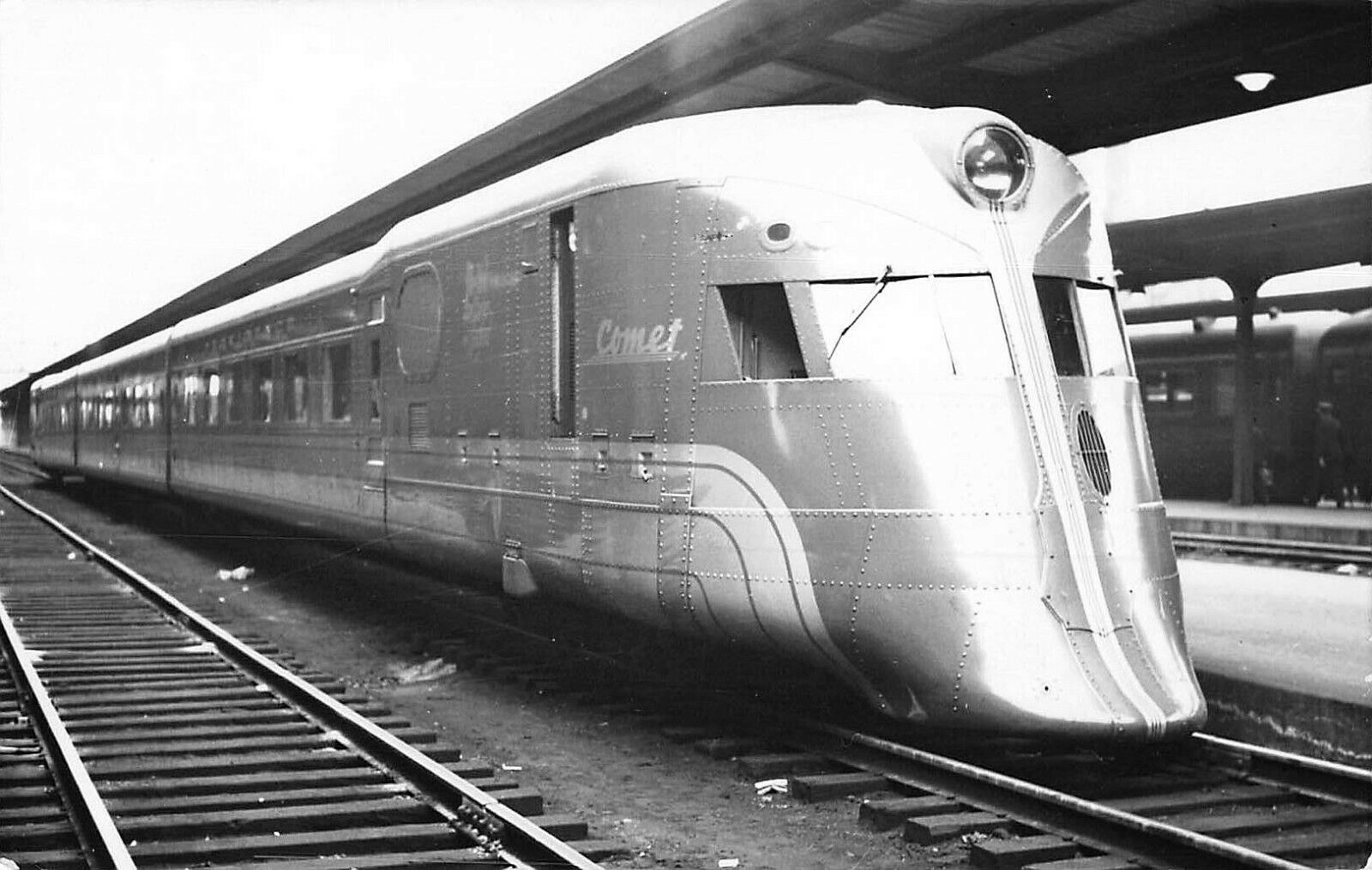
New Haven Comet in a 1970s postcard reproduction of a period photograph. The original card did not give location or date. American-Rails.com collection.
On this page: At a glance · Why Akron built a train · Design · Consist · Specifications · Tests and the 44-in-44 · War, locals, scrap
At a Glance
| Item | Detail |
|---|---|
| Railroad | New York, New Haven & Hartford |
| Name | Comet |
| Builder | Goodyear-Zeppelin Corporation, Akron, Ohio (only railroad trainset the firm sold) |
| Partners in the carbody | Aluminum Company of America (alloy sheet and castings); Westinghouse (diesels and electrical equipment) |
| Cost / funding | $250,000, advanced by the Railroad Division of the Public Works Administration (part of a larger 1934 PWA equipment loan to the New Haven) |
| Bid / construction | Bid accepted early 1934; completed spring 1935 |
| Public test | April 29, 1935, New Haven–Boston: 156.8 miles in 143 minutes, peak 110.5 mph near Kingston, R.I. |
| Revenue service | June 5, 1935 |
| Carded assignment | Boston (South Station)–Providence, advertised 44 miles in 44 minutes; five weekday round trips at the start |
| Withdrawn / scrapped | 1951. Nothing preserved |
Why an airship company built a train
Goodyear-Zeppelin Corporation was a 1924 joint venture: Goodyear two-thirds, Luftschiffbau Zeppelin one-third. Karl Arnstein, Zeppelin’s chief engineer, became vice-president of engineering in Akron. The firm’s reputation rested on rigid airships for the U.S. Navy—Akron and Macon—and on aluminum, wind tunnels, and riveted light structure. USS Akron went into the Atlantic on April 4, 1933. Rigid-airship work stalled. Goodyear-Zeppelin still had the Airdock, the alloy shop, and the Daniel Guggenheim Airship Institute next door. A lightweight passenger train was a way to keep those skills employed.
The New Haven, hemorrhaging passengers to buses and the automobile, wanted something as photogenic as the Zephyr that would actually fit South Station. A double-ended set could shuttle Boston–Providence all day without turning. The PWA’s Railroad Division put up $250,000. Models went through wind tunnels at Columbia and at the Guggenheim institute in Akron. Alcoa supplied the aluminum. Westinghouse supplied the diesels. The train left Ohio in April 1935. USS Macon had crashed off California that February, while the cars were still in the shop. Goodyear-Zeppelin did not vanish in 1941; the airship joint venture was reorganized as Goodyear Aircraft Corporation on December 5, 1939 to build airplane parts. The Comet remained its only railroad product.
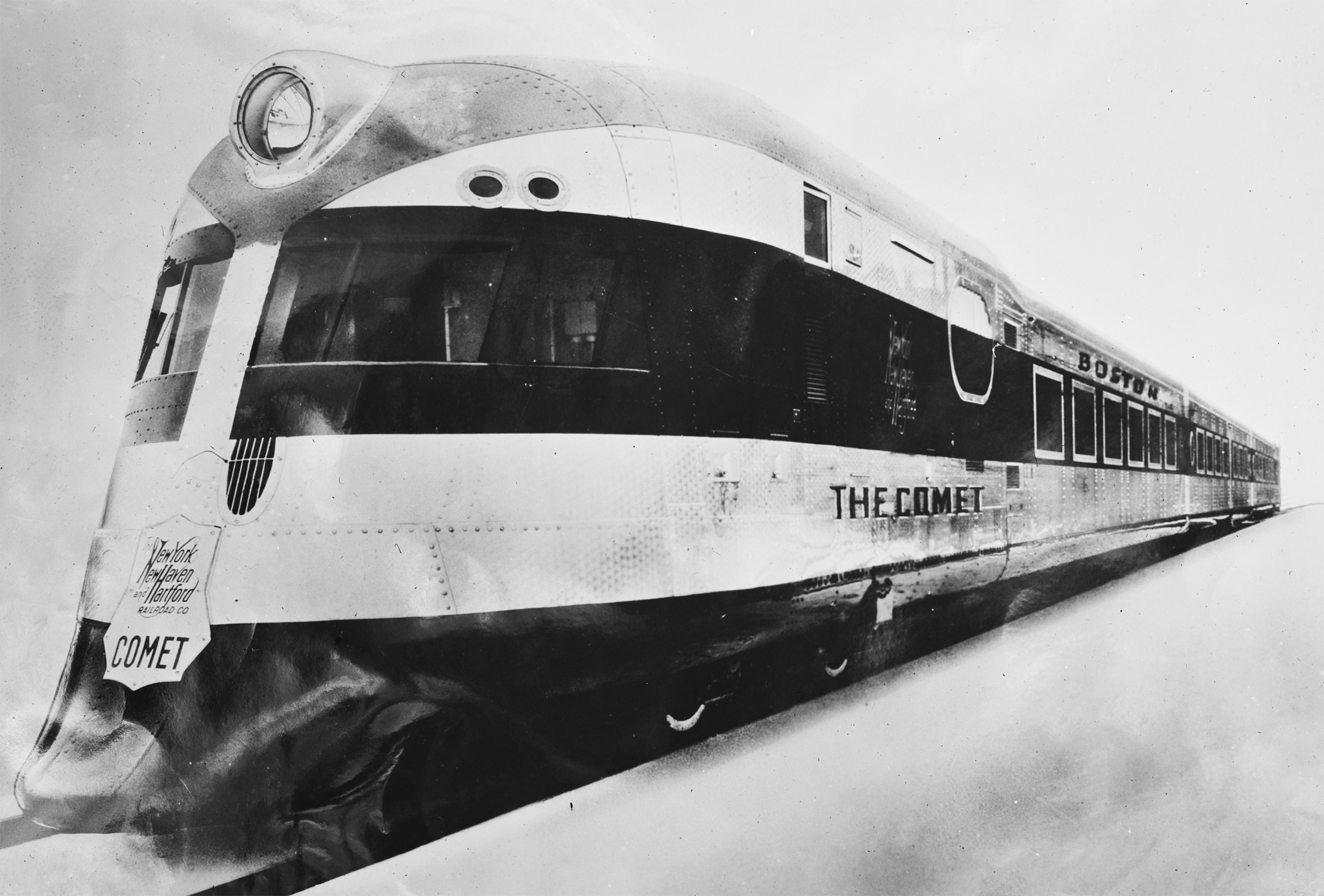
Harris & Ewing Inc. publicity photograph of the Comet, circa 1935. Library of Congress / American-Rails.com collection.
Tube, shovel noses, two cabs
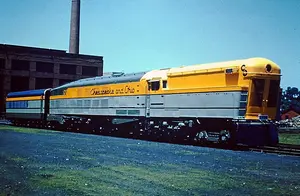
The Comet is a three-car articulated train on four trucks (UIC B′2′2′B′). Adjacent cars share Jacobs bogies. You cannot cut a coach in or out for a Saturday football crowd. The trade is weight, a low floor, and a ride that behaves as one vehicle. Power cars at both ends have shovel noses and cabs. The engineer worked the leading end; there was no balloon track required at Providence or at South Station.
The carbody is aluminum alloy, built more like an airship gondola than a truss-sill heavyweight. Period descriptions stress a tubular structure, flush windows and plug doors, a curved roof and belly, and running gear that put the underside about 10 inches above the rail. Floor height was about 2 feet 8¼ inches. Center of gravity sat roughly 20 inches lower than a conventional coach. Width was 9 feet 10 inches; body height about 10 feet 11 inches, with the engine rooms four inches taller (11 feet 3 inches). Overall length between ends: 207 feet.
The paint was not a simple “blue, silver, and white.” The skin was machined aluminum in a whorled pattern, with bright blue enamel at window height, dark blue at the trucks, a gray roof, and a clear varnish so the metal would not tarnish. Interior: tans, brown, rust mohair walk-over seats, indirect lighting, mechanical air-conditioning, steam heat. All coach. No parlor, no diner, no RPO. This was a 44-minute dayliner.
Each power car carried a Westinghouse six-cylinder, four-cycle, solid-injection diesel—Beardmore-derived Model 160, cylinders 9 by 12 inches, 400 bhp at 900 rpm. Each engine drove a main generator and an auxiliary. Traction motors geared the driving axles. Combined rating: 800 horsepower. Designed top speed in railroad publicity was 95–100 mph; the April 29 test hit 110.5 mph.
Consist (the whole train)
New Haven numbered the three cars 9200–9202. They stayed coupled for life.
| Number | Length | Role | Seats |
|---|---|---|---|
| 9200 | 74 ft 2 in | Power / cab car (one shovel nose) | 48 coach |
| 9201 | 58 ft 8 in | Trailer coach (smoking and non-smoking sections) | 64 (28 smoking + 36 non-smoking) |
| 9202 | 74 ft 2 in | Power / cab car (the other shovel nose) | 48 coach |
Revenue seats: 160. Plug doors, three per side. That capacity was the train’s commercial limit. Extra cars were not an option without rebuilding the articulation.
Specifications
| Specification | Value |
|---|---|
| Builder | Goodyear-Zeppelin Corporation, Akron, Ohio |
| Year | 1935 |
| Type | Three-car articulated diesel-electric streamliner, double-ended |
| Carbody | Aluminum alloy (Alcoa) |
| Train length | 207 ft 0 in |
| Power-car length | 74 ft 2 in each |
| Trailer length | 58 ft 8 in |
| Width | 9 ft 10 in |
| Height | ~10 ft 11 in body; 11 ft 3 in over engine rooms |
| Weight | 126 short tons (252,000 lb)—lighter than a heavyweight train of similar capacity; heavier than Zephyr 9900 (~104 tons) |
| Trucks / wheel arrangement | Four trucks; UIC B′2′2′B′ |
| Wheel diameter | 36 in powered; 30 in unpowered |
| Prime movers | Two Westinghouse / Beardmore inline-6 Model 160 diesels, 400 hp each at 900 rpm (800 hp combined) |
| Transmission | Diesel-electric; traction motors on driving axles |
| Maximum speed (carded / test) | 95 mph service publicity / 110.5 mph April 29, 1935 |
| Seats | 160, all coach |
| Heat / cooling | Steam generators; mechanical air-conditioning |
| Doors | Plug type, three per side |
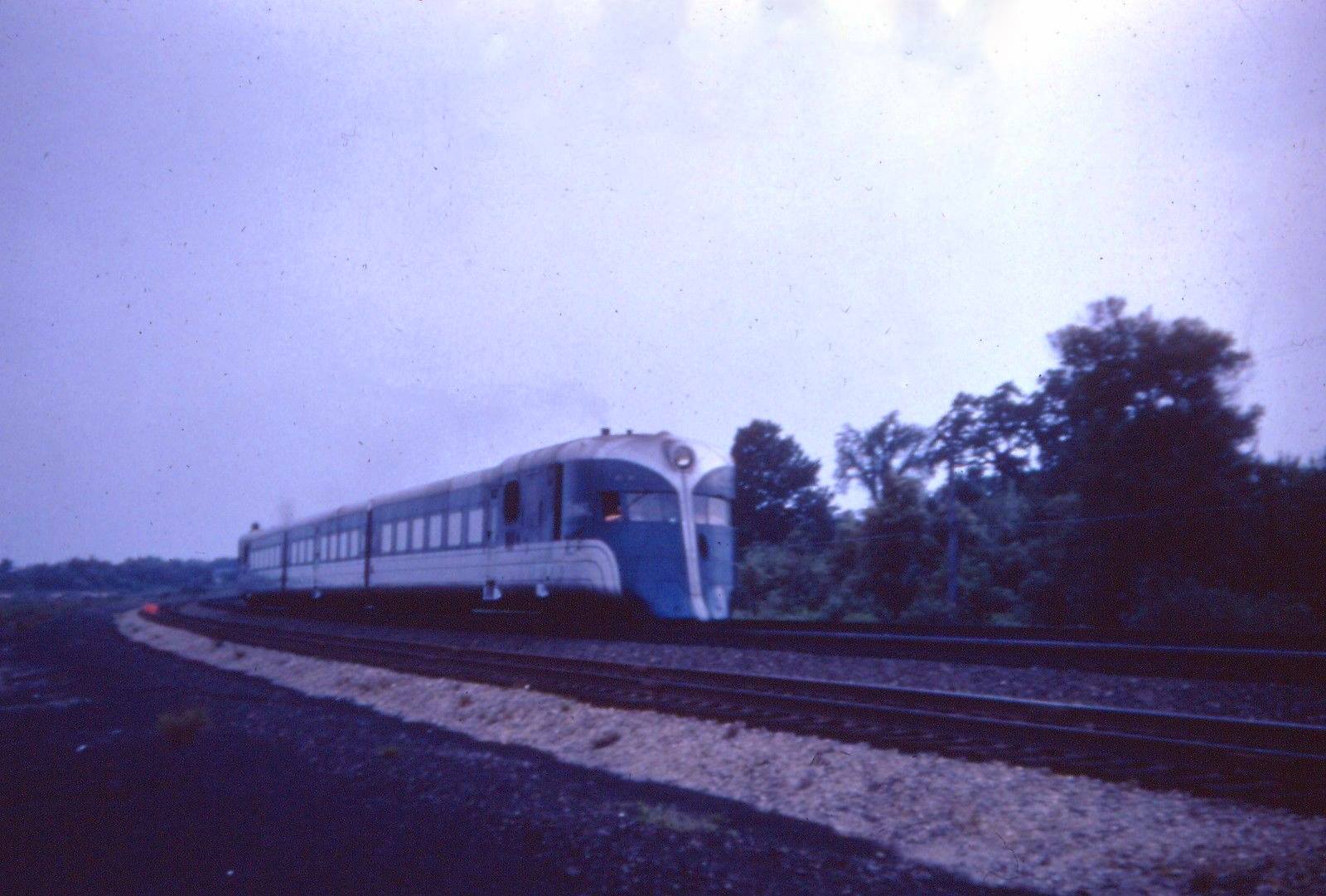
The Comet in service, circa 1940s. Double-ended, three cars, still the only Goodyear-Zeppelin trainset. American-Rails.com collection.
April 29, 1935, then 44 miles in 44 minutes
On April 29, 1935, with president Howard S. Palmer and about 125 guests aboard and engineer Thomas E. Lyons at the throttle, the Comet ran New Haven to Boston: 156.8 miles in 143 minutes, average 65.8 mph, a timed mile at 110.5 mph near Kingston, Rhode Island. That was 55 minutes faster than the steam Yankee Clipper on the same railroad. The Providence–Boston piece, 44 miles, was made in 32.35 minutes—nine minutes inside the schedule the railroad intended to card.
May was a tour. New Haven ran the train around Massachusetts, Rhode Island, Connecticut, and into New York so people could walk through it; contemporary accounts put visitors in the hundreds of thousands. Regular service started June 5, 1935: Boston South Station and Providence, five weekday round trips, later with Back Bay and Pawtucket/Central Falls as intermediates, sold as “44 miles in 44 minutes.” Distance in timetables is 43.8–44 miles depending on the stops counted. Average speed on the card was a little over 60 mph including station work; south of Sharon the train was timed near 95 mph.
The New Haven promoted it regionally. Burlington and Union Pacific had already taken the national magazines. This was a New England shuttle, and the railroad was about to file for bankruptcy. Section 77 petition: October 23, 1935. The Comet was already earning its keep. Under court protection the company still dieselized switchers, bought lightweight coaches, and, later, streamlined steam and electrics. The three-car Akron set stayed unique. No second Comet was ordered. Articulation made a fleet expansion expensive, and the treasury was in the courtroom.
1939 timetable
The image below is the live-page 1939 public timetable for the Boston–Providence Comet service. Read the minutes on the card, not a later summary.
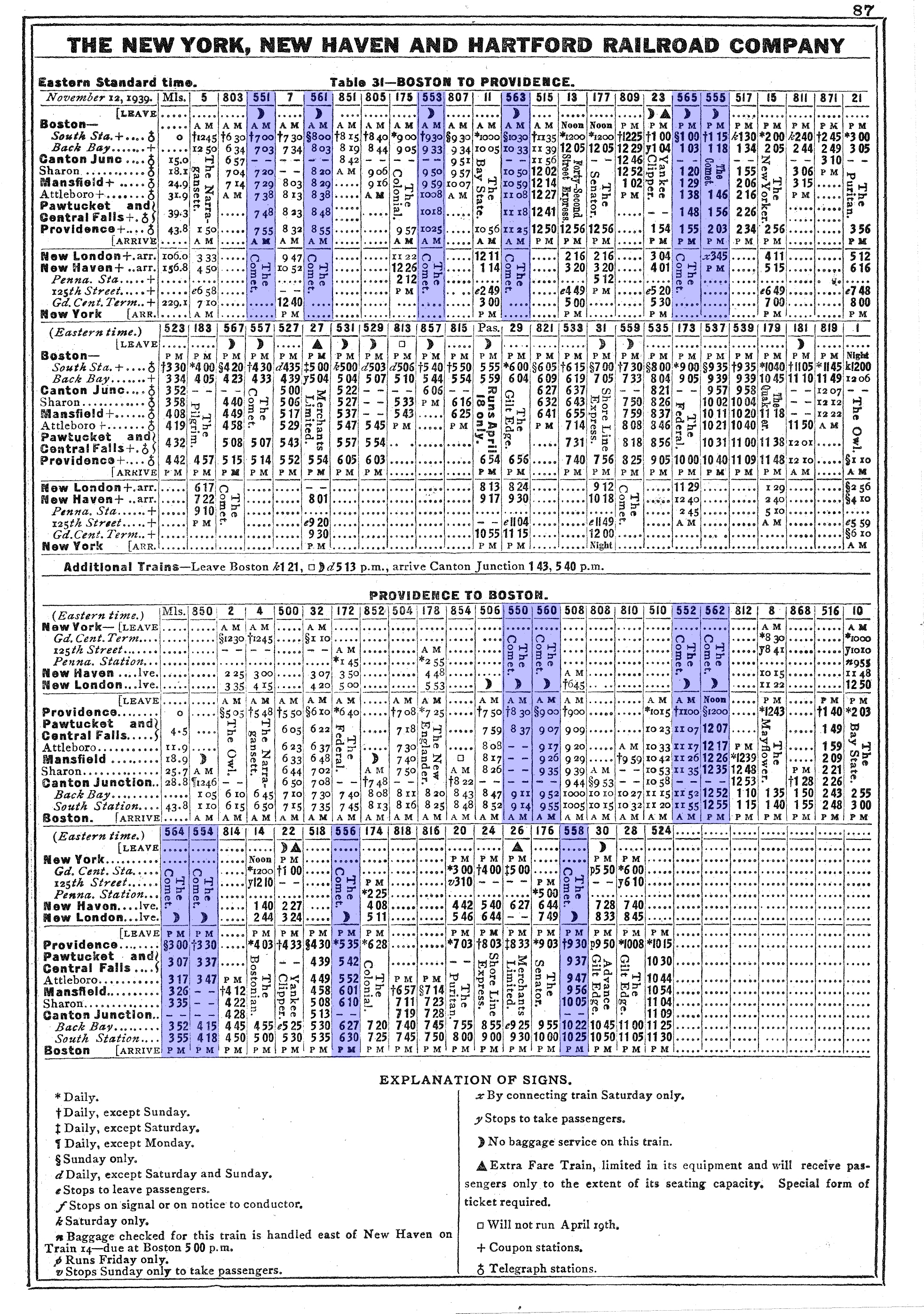
New Haven public timetable, 1939, for Comet service. American-Rails.com collection.
War traffic, suburban locals, 1951 scrap
One hundred sixty seats filled on a popular 44-minute schedule were a victory in 1935 and a bottleneck by 1943. Wartime Boston–Providence traffic needed more cars than an articulated three-car set could grow. The New Haven moved the Comet onto local and suburban runs around Boston, where a fixed 160-seat tube was less useful and less glamorous. Weekend excursions had already used it off the shuttle. After 1943 it was a leftover high-speed local, not New England’s showpiece.
The New Haven left bankruptcy in 1947 with a modernized passenger fleet of more conventional lightweight cars. The Comet was sixteen years old, still unique, still unable to take a fourth car. In September 1951 the railroad pulled it. Preservation of 1930s rail cars was not yet a habit amd the set was scrapped.
Related Reading on American-Rails.com
- New Haven Railroad
- Pioneer Zephyr 9900
- Union Pacific M-10000
- Flying Yankee
- The Rebel
- Green Diamond
- Streamliners
Sources
- New York Times, April 30, 1935 (“Streamliner Hits 110-Mile Top Speed”—April 29 test, 110.5 mph, 32.35 minutes Providence–Boston, $250,000 PWA, Goodyear-Zeppelin / Alcoa / Westinghouse)
- Railway Age, April 27, 1935 (builder description; seating and construction)
- “The American Comet,” Railway Wonders of the World (207 ft, two 400 hp Westinghouse six-cylinder diesels, 9×12 in, 900 rpm, 160 seats, 43.8 miles in 44 minutes)
- Living New Deal, Comet Train, Boston (PWA $250,000 within a larger New Haven equipment loan; Alcoa and Westinghouse as suppliers)
- UConn Archives / New Haven Railroad Records; Shoreliner (NHRHTA), Steve Link, “Introducing the Comet” and “Constructing the Comet”
- Goodyear Aerospace / Goodyear-Zeppelin corporate history (1924 joint venture; Goodyear Aircraft, December 5, 1939)
Recent Articles


-
Connecticut Railroad Museums (2026): A Complete Guide
Oct 06, 26 01:05 PM
 Connecticut railroad museums—the Shore Line Trolley, East Windsor, the Naugatuck Railroad, Danbury Union Station, Willimantic, and the SoNo tower. Confirm hours on each site.
 -
Colorado Railroad Museums (2026): A Complete Guide
Oct 06, 26 12:47 PM
 Colorado railroad museums—Golden, the Forney’s Big Boy 4005, Pueblo’s Santa Fe 2912, and the depots at Castle Rock, Limon, and Ridgway. Confirm hours on each site.
 -
Atlantic Coast Line Steam Roster (Post 1900)
Oct 06, 26 12:44 PM
 Atlantic Coast Line steam since 1900. Copper Head Ten-Wheelers, 235 P-5 Pacifics, Q-1 Santa Fes, twelve R-1 4-8-4s. Class grid after Drury. Last steam June 30, 1955.
 -
Atlantic Coast Line Diesel Roster (All-Time)
Oct 06, 26 11:57 AM
 Atlantic Coast Line diesel roster. HH660 1900 in 1939, E3s for the Champion, FTs and F2s, GP7s 100–279, GP30s, U25Cs, and the 1967 SCL numbers. Serials and orders.
 -
Atlantic Coast Line Railroad: "Standard Railroad of the South"
Oct 06, 26 11:53 AM
 Atlantic Coast Line, the Standard Railroad of the South. April 21, 1900 to July 1, 1967. Plant System, L&N, Clinchfield, the Champion, and the Seaboard Coast Line merger.
 -
California Railroad Museums (2026): A Complete Guide
Oct 06, 26 09:50 AM
 California railroad museums—the California State Railroad Museum, Perris, Portola, Railtown 1897, and the depots that still stand. Confirm hours on each site.
 -
Arizona Railroad Museums (2026): A Complete Guide
Oct 06, 26 09:46 AM
Arizona railroad museums—the Arizona Railway Museum in Chandler, Southern Pacific 1673 at Tucson, and the McCormick-Stillman park in Scottsdale. -
Arkansas Railroad Museums (2026): A Complete Guide
Oct 06, 26 09:07 AM
 Arkansas railroad museums—Cotton Belt 819 at Pine Bluff, the Fort Smith trolley, the Mammoth Spring depot, and the Eureka Springs railway.
 -
Alabama Railroad Museums (2026): A Complete Guide
Oct 06, 26 09:03 AM
 Alabama railroad museums—Heart of Dixie at Calera, the North Alabama museum at Chase, Huntsville’s 1860 depot, and Fort Payne. Confirm hours on each site.
 -
Pennsylvania Railroad Museums (2026): A Complete Guide
Oct 06, 26 12:09 AM
 Pennsylvania railroad museums—Strasburg, Steamtown, the Horseshoe Curve, the East Broad Top, and the depots and towers in between. Confirm hours on each site.
 -
Maryland Railroad Museums (2026): A Complete Guide
Oct 05, 26 11:53 PM
 Maryland railroad museums—the Baltimore roundhouse, Ellicott City station, Bowie, Gaithersburg’s Buffalo Creek & Gauley 14, and the Western Maryland collections.
 -
Ohio Railroad Museums (2026): A Complete Guide
Oct 05, 26 05:51 PM
 Ohio railroad museums—the Age of Steam Roundhouse, Bellevue, Worthington, Conneaut’s Nickel Plate 755, and the Dennison depot. Confirm hours on each site.
 -
Delaware Railroad Museums (2026): A Complete Guide
Oct 05, 26 02:43 PM
 Delaware railroad museums—Wilmington & Western at Greenbank, the Harrington tower and N5 caboose, Felton's 1868 depot, and the Selbyville station museum.
 -
C&O's M-1 Steam Turbine Locomotives: Specs, Roster, History
Oct 05, 26 12:13 PM
 Chesapeake & Ohio Class M-1 steam-turbine-electrics. Three Baldwin-Westinghouse locomotives, 500–502, built 1947–48 for The Chessie. Specs, the 2-C1+2-C1-B arrangement, and a roster. All scrapped…
 -
N&W 2-6-6-2 Locomotives (Class Z): Specs, Roster, History
Oct 05, 26 11:44 AM
 Norfolk & Western Class Z 2-6-6-2s. One hundred ninety compound Mallets, 1300–1489, from Richmond, Baldwin, and Schenectady, 1912–1918. Diagram specs, the Z-1b rebuilds, Z-2 1399, and a roster. No…
 -
Scenic Train Rides (USA 2026): State Guide to Tourist Railroads
Oct 04, 26 12:17 AM
 Scenic and tourist train rides in all 50 states for 2026. Colorado narrow gauge, Pennsylvania steam, Alaska’s White Pass, and the states with no full-size ride this month. Confirm on the railroad.
 -
Wyoming Scenic Train Rides (2026): A Complete Guide
Oct 03, 26 12:07 AM
 Wyoming has no full-size tourist railroad on the calendar in October 2026. Cheyenne Depot Museum and Douglas Railroad Museum are static. Union Pacific 4014’s posted public trip is a November run to De…
 -
Washington Scenic Train Rides (2026): A Complete Guide
Oct 02, 26 11:53 PM
 Washington tourist trains in 2026—Mount Rainier Scenic at Elbe, the Northwest Railway Museum, and Chehalis-Centralia. Lake Whatcom has no 2026 date on its ticket page.
 -
Wisconsin Scenic Train Rides (2026): A Complete Guide
Oct 02, 26 11:48 PM
 Wisconsin tourist trains in 2026—Wisconsin Great Northern, Osceola & St. Croix Valley, Mid-Continent, East Troy, and the National Railroad Museum.
 -
Pennsylvania Railroad Class Q2 4-4-6-4: Specs, Roster, History
Oct 02, 26 11:28 PM
 Pennsylvania Railroad Class Q2 4-4-6-4 duplexes. Twenty-six engines, 6131 and 6175–6199, Altoona 1944–45. Form 109-J specs, the 7,987 hp test of 6175, and a roster. All scrapped.
 -
Utah Scenic Train Rides (2026): A Complete Guide
Oct 02, 26 11:18 PM
 Utah tourist trains in 2026—Heber Valley Railroad from Heber City. Golden Spike at Promontory is a locomotive demonstration, not a line-haul ride.
 -
South Dakota Scenic Train Rides (2026): A Complete Guide
Oct 02, 26 11:06 PM
 South Dakota’s 2026 scenic train is the Black Hills Central 1880 Train, Hill City to Keystone. Steam is the summer assignment. Confirm the engine.
 -
Oregon Scenic Train Rides (2026): A Complete Guide
Oct 02, 26 11:04 PM
 Oregon tourist trains in 2026—Oregon Coast Scenic from Rockaway Beach, Mount Hood at Hood River, Eagle Cap from Elgin, and the Oregon Rail Heritage Center in Portland.
 -
Oklahoma Scenic Train Rides (2026): A Complete Guide
Oct 02, 26 10:36 PM
Oklahoma has no full-size scenic railroad on an October 2026 calendar. Oklahoma Railway Museum Halloween and Polar trains, the El Reno trolley, and the Heartland Flyer. -
North Dakota Scenic Train Rides (2026): A Complete Guide
Oct 02, 26 01:14 PM
North Dakota has no tourist railroad on a 2026 calendar. Ride Amtrak’s daily Empire Builder. The Fort Lincoln Trolley in Mandan is not a current ticket. -
Nebraska Scenic Train Rides (2026): A Complete Guide
Oct 02, 26 10:11 AM
 Nebraska has no full-size scenic railroad in 2026. The Omaha Zoo Railroad runs weekends through October 4. Ride Amtrak’s California Zephyr across the state.
 -
Missouri Scenic Train Rides (2026): A Complete Guide
Oct 02, 26 09:56 AM
 Missouri tourist trains in 2026—Branson Scenic Railway and the St. Louis, Iron Mountain & Southern at Jackson. Belton has no 2026 schedule posted.
 -
Minnesota Scenic Train Rides (2026): A Complete Guide
Oct 02, 26 09:52 AM
 Minnesota tourist trains in 2026—North Shore Scenic Railroad in Duluth, the Duluth River Train, and the Como-Harriet streetcar.
 -
Kansas Scenic Train Rides (2026): A Complete Guide
Oct 02, 26 09:32 AM
 Kansas tourist trains in 2026—the Abilene & Smoky Valley Railroad. Santa Fe 3415 is in overhaul. Midland Railway at Baldwin City is closed.
 -
Iowa Scenic Train Rides (2026): A Complete Guide
Oct 02, 26 08:41 AM
 Iowa tourist trains in 2026—Boone & Scenic Valley across the Bass Point Creek High Bridge, and Midwest Central’s December North Pole trains
 -
Indiana Scenic Train Rides (2026): A Complete Guide
Oct 02, 26 08:35 AM
 Indiana tourist trains in 2026—French Lick Scenic Railway, Nickel Plate Express, Hoosier Valley, and Hesston. Whitewater Valley is suspended.
 -
Illinois Scenic Train Rides (2026): A Complete Guide
Oct 02, 26 12:28 AM
 Illinois tourist trains in 2026—Illinois Railway Museum, Monticello Railway Museum, Fox River Trolley, and Silver Creek & Stephenson.
 -
Texas Scenic Train Rides (2026): A Complete Guide
Oct 02, 26 12:14 AM
 Texas tourist trains in 2026—Texas State Railroad, Grapevine Vintage Railroad, Austin Steam Train's Hill Country Flyer, and the Galveston Railroad Museum.
 -
Tennessee Scenic Train Rides (2026): A Complete Guide
Oct 02, 26 12:03 AM
Tennessee tourist trains in 2026—Tennessee Valley Railroad Museum, Dollywood Express, Three Rivers Rambler Christmas trains, and the Tennessee Central Railway Museum. -
South Carolina Scenic Train Rides (2026): A Complete Guide
Oct 01, 26 11:52 PM
 South Carolina's tourist train is the South Carolina Railroad Museum in Winnsboro—Blue Granite Express, pumpkin trains, and Santa trains on the old Rockton & Rion.
 -
Mississippi Scenic Train Rides (2026): A Complete Guide
Oct 01, 26 11:38 PM
 Mississippi has no regular tourist railroad in 2026. Ride Amtrak through the state, or book the excursion lines in Alabama, Tennessee, Louisiana, or Arkansas.
 -
Louisiana Scenic Train Rides (2026): A Complete Guide
Oct 01, 26 02:52 PM
 Louisiana has no regular full-size tourist railroad in 2026. New Orleans Polar Express returns December 11–31. Museums at Long Leaf, DeQuincy, and Jackson.
 -
Kentucky Scenic Train Rides (2026): A Complete Guide
Oct 01, 26 02:45 PM
 Kentucky tourist trains in 2026—Big South Fork Scenic Railway, Bluegrass Scenic Railroad, Kentucky Railway Museum, and My Old Kentucky Dinner Train.
 -
Georgia Scenic Train Rides (2026): A Complete Guide
Oct 01, 26 02:27 PM
Georgia tourist trains in 2026—Blue Ridge Scenic Railway, SAM Shortline, Azalea Sprinter, Savannah shop rides, and what to confirm at Stone Mountain. -
Arkansas Scenic Train Rides (2026): A Complete Guide
Oct 01, 26 01:02 PM
 Arkansas tourist trains in 2026—Arkansas & Missouri through the Boston Mountains, and the Eureka Springs & North Arkansas dinner and excursion trains.
 -
Alabama Scenic Train Rides (2026): A Complete Guide
Oct 01, 26 12:59 PM
Alabama tourist trains in 2026—Heart of Dixie Railroad Museum at Calera, North Alabama Railroad Museum at Chase, and the Wales West Light Railway at Silverhill. -
The Circus Train: How Such Attractions Reached Distant Cities
Oct 01, 26 12:22 PM
 How circuses moved by rail: Coup's 1872 flats, the Ringling train's sections and car counts, the 1918 Hammond wreck, and the last show on May 21, 2017.
 -
West Virginia Halloween Train Rides (2026)
Oct 01, 26 12:19 PM
 2026 West Virginia Halloween train. Cass Scenic Halloween Train, October 30 and 31, steam, 5:00 p.m. from Cass Depot. Adult $75. About two hours to Whittaker. Family ride.
 -
Wisconsin Halloween Train Rides (2026)
Oct 01, 26 12:11 PM
2026 Wisconsin Halloween trains. Mid-Continent Pumpkin Special October 24–25, adult $24, pumpkins extra. Halloween Flyer October 24 at 4:30 p.m., adult $30. Osceola Pumpkin Express boards in Osceola… -
Utah Halloween Train Rides (2026)
Oct 01, 26 12:00 PM
 2026 Utah Halloween trains at Heber Valley Railroad. Pumpkin Train, about 40 minutes, with a cookie and a pumpkin. Halloween Express, about 90 minutes to Grim Hollow, Monday, Thursday, and Friday even…
 -
Texas Halloween Train Rides (2026)
Oct 01, 26 11:28 AM
 2026 Texas Halloween train. Texas State Railroad Spooky Special, adult-only, October 24. Boards Palestine at 5:00 p.m. About five hours to Rusk and back. Dinner on the grounds. Not steam. No fare on t…
 -
Tennessee Halloween Train Rides (2026)
Oct 01, 26 12:15 AM
 2026 Tennessee Halloween trains. Tennessee Valley Railroad Museum Rails, Wizards & Spells, selected days September 18 through October 25, from $35, about 2.5 hours. Spells & Potions tea from $60. The…
 -
Frisco's "Firefly" (Train): Consist, Route, Timetable
Sep 30, 26 11:37 PM
 Frisco Firefly—daylight streamliner, Kansas City to Tulsa and Oklahoma City. Trains 117 and 118. Pacifics 1018, 1026, and 1031. Last run May 22, 1960.
 -
South Carolina Halloween Train Rides (2026)
Sep 30, 26 11:29 PM
 2026 South Carolina Halloween train. South Carolina Railroad Museum Pumpkin Patch Express, the two Saturdays before Halloween. About three miles to the Greenbriar pavilion. Pumpkin for children 12 and…
 -
Oregon Halloween Train Rides (2026)
Sep 30, 26 08:10 PM
2026 Oregon Halloween train. Sumpter Valley Railroad Halloween Express at the Sumpter Depot, calendar window October 31 at 11:00 a.m. through November 1 at 12:30 p.m. Fare and the individual clocks ar…