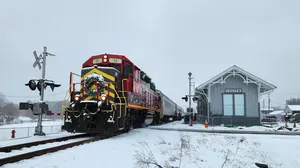
Electro-Motive Diesel: Locomotives, History, Photos
Last revised: February 22, 2025
By: Adam Burns
Electro-Motive Diesel, formerly a division of Progress Rail (owned by Caterpillar), has a history dating back
to the early 20th century.
EMD originally began as the Electro-Motive Corporation, a privately owned company being based out of Cleveland, Ohio that built inexpensive motorcars beginning in 1922.
With the purchase of the company in 1930 by General Motors, and more resources at its disposal the company began developing the precursor of the modern-day diesel-electric road unit (cabs and road-switchers), the streamlined trainset, which consisted of a powered car permanently attached to a few coaches (usually two or three cars).
The most famous of these streamlined trainsets was the Burlington Zephyrs, a beautiful streamlined stainless steel creation (originally powered by Winton engines, which would also become a subsidiary of GM) that was extremely lightweight and fast.
The original trainset, the Zephyr 9900, made headlines in 1934 when it completed a non-stop journey from Denver to Chicago in a little over 13 hours.
Electro-Motive continues to produce locomotives today but in name only; the company is now a division of Progress Rail, a Caterpillar company.
 In 1947, General Motors commissioned Pullman to create four domes for a publicity train called the "Train Of Tomorrow" to highlight post-war rail travel advancements. The train toured the country and was later acquired by Union Pacific. Of the original cars, only the "Moon Glow" lounge survives today; the rest were scrapped in the 1960s, and the associated locomotive was traded in 1963.
History
However, before this development and new technology was introduced, EMC had already become part of General Motors, having been purchased by the company in 1930 and branded GM's Electro-Motive Division, a name it would hold for 75 years.
Because the power cars with these trainsets were permanently attached to the coaches EMD sought to design a locomotive free of this articulated setup but designed in such a manner that a railroad could still attach it to any passenger train and obtain the same, smooth streamlined look.
This it did with the unveiling of the EA model in 1937, the first in a long line of passenger diesel locomotive designs that would come to be known as the E series.
Not surprisingly, soon after the EA unveiling the company decided to take things a step further and develop the first true diesel road unit, capable of pulling long freights in main line service.
 Recently delivered Colorado & Southern (Burlington) SD40s, #884 and #885, look sharp in their Chinese Red livery at Rice Yard in Denver, Colorado during April of 1968. American-Rails.com collection.
In 1939 it introduced the FT model (perhaps the key difference between the E and F series was that Fs rode on B-B trucks whereas Es rode on C-Cs and carried a noticeably longer carbody), the first in EMD’s F series and one of the most success diesel-electric designs of all time.
The F series would go on to define American railroading for years and you can still see it in regular use today, over 60 years after it first debuted!
At A Glance
General Motors Diesel, Ltd. (1950 – 1969) General Motors Diesel Division, Ltd. (1969 – 2005) Electro-Motive Diesel (2005 - June 23, 2012) | |
Plant #2: Chicago's South Side (1946 - 1989) Plant #3: Cleveland, Ohio (1948 - 1954) | |
Supplier Steel Schenectady, Inc. (Glenville, New York Bombardier-Concarril (Sahagún, Mexico) Conrail's Juanita Shops (Altoona, Pennsylvania) Alstom Transport (Hornell, New York) Alstom Transport (Pointe St. Charles Shops/Montreal, Quebec) Canadian Pacific's Ogden Shops (Calgary, Alberta) ITS Rail Services (Welland, Ontario) VMV/ITS Rail Services (Paducah, Kentucky) CEECO (Tacoma, Washington) Mid-America Car (Kansas City) | |
* Soon after renamed as the Electro-Motive Company.
** Renamed as the Electro-Motive Corporation. GM also acquired the Winton Engine Company on June 20, 1930. It was subsequently renamed as the Winton Engine Corporation.
*** The final locomotive produced at La Grange rolled off the shop floor in December, 1992; Metra F40PHM-2 #214.
**** As separate corporate entity. The EMD name is still used by Progress Rail for marketing purposes.
The FT (which stood for Freight, Twenty-seven hundred horsepower) was a superb locomotive and although its 2,700 horsepower came from an A-B setup of a cab (A) and booster (B) units rated at 1,350 horsepower each.
It was quickly loved by many for the efficiencies it held over steam such as its ruggedness and ease of maintenance.
The FT was a serious locomotive and although its 2,700 horsepower came from an A-B setup of cab (A) and booster (B) units rated at 1,350 horsepower each it would become embraced by the rail industry for the efficiencies it held over steam power as well as being rugged and easy to maintain.
 Santa Fe SD39u #1559 at San Bernardino, California; October 22, 1985. American-Rails.com collection.
Following the success of its cab units, EMD realized that there was a market to be made in the road-switchers, which at the time was mostly dominated by Alco with its RS series.
Its first attempt at this type of locomotive, which gave the train crews both excellent vision all around the locomotive for switching and local service as well as enough horsepower to be used in main line operations, was the BL2.
Although unsuccessful from a sales standpoint the BL2 was really a mere stepping-stone for its next model, the GP series (meaning General Purpose).
The BL2 was certainly unmistakable with its longer nose and recessed carbody, which allowed the cab to be much more “open” and train crews could see behind the locomotive as well as to the front.
 Union Pacific SD60M #6286 and SD60 #6021 lead covered autoracks eastbound over Norfolk Southern at Swanton, Ohio in January, 1996. American-Rails.com collection.
Built only between 1948 and 1949, the model came in the standard GP configuration of four-axles and it carried 1,500 horsepower. A total of 59 BL2s were built, naturally making them very rare today!
The first of the GP series was the four-axle, GP7, which began production in 1949. Still commonly found today on several regionals and short lines the GP7 is the classic image of the road switcher with its high, short hood and cab set off to one end leaving for a long hood trailing.
The model was most commonly built with the high hood but some requested a lowered version in the later standard cab design, which included front windshields (GP7s would also be rebuilt with shortened hoods).
 Missouri-Kansas-Texas ("Katy") GP7 #123 was seen here at the road's shops in Parsons, Kansas, circa 1968. American-Rails.com collection.
Through 1954 the model sold an astounding 2,600+ units and is widely credited with completing main line dieselization, relegating most remaining steam locomotives to branch line, yard and short line work.
Following the GP7 was the GP9, which saw an increase of 250 horsepower from 1,500 to 1,750. The model also blew away the GP7's staggering sales numbers, selling more than 6,000 units.
Aside from the model's increased horsepower perhaps it's biggest improvement over the GP7 was the addition of dynamic brakes.
By the 1950s EMD was the unquestionable leader of diesel locomotive manufacturing, making up the vast majority of all diesel sales during that time.
The company originally introduced a six-axle model of its popular GP series a few years after the GP7, in 1952. Known as the SD7 ("SD" stood for Special Duty), high-hooded models were standard through the following SD9 and SD18 but these three types never sold nearly as well as their four-axled brethren.
However, that would change with the second-generation power as EMD's SD24 and subsequent models far outsold their four-axle counterparts.
This was especially true when the company debuted its SD40 series. Along with its "Dash 2" sister the SD40 series have become icons, even in their own time!
So successful was the series that one can spot them virtually any place on practically any given train (Class Is included), even today, over 20 years after the last SD40-2 rolled off of the assembly line!
The SD40 series began production in 1966 with the SD40, which was built through 1972 and ended production in 1986 when the last SD40-2 rolled off of the assembly line.
By the time production ended an astronomical 5,200+ units had been built! Most of these were SD40-2s as just under 4,000 were produced during its fourteen years of production while the SD40 chipped in another 1,200+.
 Electro-Motive's test train, consisting of F9A #462, SDP40F #169, and an SD50 demonstrator are southbound on the Burlington Northern just south of Trinidad, Colorado in 1985. Mike Bledsoe photo. American-Rails.com collection.
When the series debuted it was just what railroads were after. Looking for a more powerful, reliable and gritty locomotive that could be counted on to work properly in almost any type of weather conditions the SD40 and SD40-2 were it.
Rated at 3,000 hp, equipped with EMD’s standard cab design, and a C-C layout (meaning they had six axles) the units carried their builder’s 16-cylinder 645E3 diesel engine and high-traction truck.
Extremely reliable the prime mover was loved by maintenance and shop crews and even many engineers have said the locomotive itself is a joy to operate as it experiences very little problems when in service.
This reliability, ruggedness, and ease of maintenance have been so fantastic with the SD40 series that the units continue to not only remain in common use on Class Is but also the big carriers have liked them so well that many are rebuilding the locomotives to keep them in active service for years to come!
 Burlington Northern Santa Fe SD70MAC #9996 is tied down in Oregon, Ohio on the Norfolk Southern in the winter of 1999. American-Rails.com collection.
However, following the SD40 series EMD's tight grip as the number one manufacturer began to loosen.
General Electric, which had entered the market in the 1950s with its Universal series, following its breakup with Alco (before this the two companies had worked together building diesels), had slowly been gaining market share.
When EMD introduced its trouble-prone SD50 in 1980 it was already receiving increased competition from GE, who had already put Alco out of business more than a decade earlier, and the SD50 fallout only made things worse.
By the mid-1980s GE had taken over the number one spot and has retained it ever since. However, EMD found its footing again with its SD70 and SD80 models.
The SD70ACe became the builder's primary road-switcher model for domestic customers in 2004/2005 as a low-emissions, high-horsepower main line locomotive.
 One of the Katy's recently delivered GP40's, #213, at the railroad's terminal in Parsons, Kansas; December, 1969. American-Rails.com collection.
It sold well for a decade, meeting EPA's Tier II and Tier III standards. One of EMD's biggest changes occurred when the company was spun-off by General Motors in April, 2005. Afterwards the company, renamed as Electro-Motive Diesel, Inc., remained independent for a few years, owned by Greenbriar Equity Group LLC, Berkshire Partners LLC, and a few other investment firms.
It was then acquired by Caterpillar in 2010. Perhaps its biggest selling feature was the HTCR Radial trucks, which steer into curves instead of simply following the track. They greatly reduce wear to both locomotive and rail.
As the EPA increased its regulations on ever-cleaner diesel emissions it seemed the SD70ACe and its 710 prime mover were safe as the engine met later Tier III standards.
However, when Tier IV standards went into effect on January 1, 2015 Caterpillar/Progress Rail was unable to make the prime mover compliant and it appears there is no way to do so according to Bill Badurksi, a former EMD employee in his article "Closing A Chapter In History," from the January, 2015 issue of Trains Magazine.
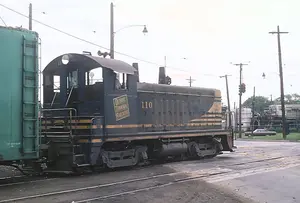
 Rio Grande SW1200 #130 carries out switching chores in Denver, Colorado circa 1975. Robert Eastwood, Jr. photo. American-Rails.com collection.
During October of 2015, Progress Rail finally unveiled a competitor to General Electric which met Tier IV standards. Known as the SD70ACe-T4 this locomotive was presented to the public during the Railway Interchange tradeshow at BNSF’s Northtown Yard in Minneapolis, Minnesota.
It features a completely new engine, the 1010 model that can produce 4,400 horsepower via 12-cylinders (four-stroke). This new prime mover replaced all of the earlier EMD designs dating back to the General Electric, which included the 567, 645 and 710 series.
The new model is currently undergoing testing and it is hoped will finally offer serious competition to GE's dominance in the market over the last several decades.
In a surprising move, during the late summer of 2016 Progress Rail announced its intentions to permanently dissolve the Electro-Motive name as a business entity.

Progress Rail Locomotive Inc.
It was announced that as of September 1, 2016 the Electro-Motive Diesel name would be removed from Progress Rail's corporate holdings according to a Trains Newswire article dated August 31, 2016. Officially, the company noted the following changes would be carried out:
- Electro-Motive Diesel, Inc. became Progress Rail Locomotive Inc.
- Electro-Motive Canada Company became Progress Rail Locomotive Canada Co.
- Electro-Motive Diesel International Corporation became Progress Rail Locomotive International Corporation.
The formal removal of the EMD corporate name means that after nearly a century of building rail cars and locomotives the legendary builder will cease to exist as a business entity.
During its time in the business, EMD nearly single-handedly ceased the reign of steam, unveiled countless classics, conceived dozens of famous liveries, and saved the industry millions annually in direct and indirect maintenance costs.
It will continue to exist only as a branding name for Progress Rail's new locomotive models.
Sources
- Marre, Louis A. and Pinkepank, Jerry A. Contemporary Diesel Spotter's Guide, The: A Comprehensive Reference Manual To Locomotives Since 1972. Milwaukee: Kalmbach Publishing Company, 1989.
- Marre, Louis A. Diesel Locomotives: The First 50 Years, A Guide To Diesels Built Before 1972. Milwaukee: Kalmbach Publishing Company, 1995.
- McDonnell, Greg. Locomotives: The Modern Diesel & Electric Reference, 2nd Edition. Buffalo: Boston Mills Press/Firefly Books, 2015.
- Pinkepank, Jerry A. Diesel Spotter's Guide. Milwaukee: Kalmbach Publishing Company, 1967.Pinkepank, Jerry A. and Marre, Louis A.
- Diesel Spotter's Guide Update: Including Electrics And Lightweight-Train Power Cars. Milwaukee: Kalmbach Publishing Company, 1979.
- Schafer, Mike. Vintage Diesel Locomotives. Osceola: MBI Publishing, 1998.
- Solomon, Brian. EMD Locomotives. Minneapolis: MBI Publishing Company, 2006.
- Solomon, Brian. Electro-Motive E-Units and F-Units: The Illustrated History of North America's Favorite Locomotives. Minneapolis: Voyageur Press, 2011.
- Solomon, Brian. GE and EMD Locomotives: The Illustrated History. Minneapolis: Voyageur Press, 2014.
Recent Articles


-
J. Edgar Thomson: Net Worth, Pennsylvania Railroad, Biography
Nov 20, 26 12:25 AM
 J. Edgar Thomson was born in Springfield, Delaware County, Pennsylvania, on February 10, 1808. He died in Philadelphia on May 27, 1874. No opened inventory states a total.
-
Thomas A. Scott: Net Worth, Railroads, Biography
Nov 20, 26 12:06 AM
 Thomas A. Scott was born at Loudon, Pennsylvania, on December 28. The year is 1823 in one biography and 1824 on the funeral plate. He died near Darby on May 21, 1881. No opened inventory states a tota…
-
Henry Villard: Net Worth, Railroads, Biography
Nov 19, 26 11:41 PM
 Henry Villard was born Ferdinand Heinrich Gustav Hilgard at Speyer on April 10, 1835, and died early on November 12, 1900, at Thorwood Park, near Dobbs Ferry. He was 65. A court recital put the person…
-
J.P. Morgan: Net Worth, Railroads, Biography
Nov 19, 26 07:03 PM
 John Pierpont Morgan was born in Hartford on April 17, 1837, and died in Rome on March 31, 1913, at 12:05 p.m. Rome time. He was 75. A 1916 New York appraisal put the gross estate at $78,149,024, excl…
-
Daniel Willard: Net Worth, Baltimore and Ohio, Biography
Nov 19, 26 06:51 PM
 Daniel Willard was born on January 28, 1861, and died on July 6, 1942. He was 81. He was president of the Baltimore and Ohio from January 15, 1910 until 1941. No opened record states a fortune. Time p…
-
Cyrus K. Holliday: Net Worth, Santa Fe, Biography
Nov 19, 26 06:03 PM
 Cyrus Kurtz Holliday was born April 3, 1826, and died in Topeka on March 29, 1900. He was 73. He founded Topeka, wrote the Atchison and Topeka charter, and was the railroad's first president. He l…
-
N&W 2-6-6-4 Locomotives (Class A): Specs, Roster, History
Nov 19, 26 05:39 PM
 Norfolk & Western Class A. Forty-three simple 2-6-6-4s, 1200 to 1242, built at Roanoke from 1936 to 1950 for time freight and used on passenger trains when assigned. Diagram specs, the 114,000-pou…
-
Jay Cooke: Net Worth, Civil War, Biography
Nov 19, 26 05:05 PM
 Jay Cooke was born at Sandusky on August 10, 1821, and died the night of February 16, 1905, at Ogontz. He was 83. Jay Cooke and Company opened January 1, 1861, and suspended September 18, 1873. He sol…
-
Daniel Drew: Net Worth, Erie Railroad, Biography
Nov 19, 26 04:44 PM
 Daniel Drew was born at Carmel on July 29, 1797, and died the night of September 18, 1879, age 82. He was Erie treasurer, not president. The settlement of July 2, 1868, put him out of that office.
-
James Fisk Jr.: Net Worth, Robber Baron, Biography
Nov 19, 26 02:47 PM
 James Fisk Jr. was born on April 1, 1835, and died the morning of January 7, 1872, at the Grand Central Hotel. He was 36. Edward S. Stokes shot him the afternoon before. He was an Erie director from O…
-
Chehalis-Centralia Polar Express Seats Are Sold Out
Nov 19, 26 02:43 PM
Chehalis-Centralia marks its Polar Express departures sold out. Diesel No. 6 is pulling while steam No. 15 is repaired. The business-car page still prints $260, $390, and $520. -
Cumbres & Toltec Lists Santa's Holiday Express
Nov 19, 26 02:38 PM
 Cumbres & Toltec lists Santa's Holiday Express for December 5-6 in Chama and December 12-13 in Antonito. Coach is $25. The Chama trip will not run to Dalton.
-
Florida Railroad Museum Lists the North Pole Express
Nov 19, 26 02:28 PM
 The Florida Railroad Museum lists the North Pole Express from November 27 through December 22, 2026. The trip is 3.75 hours. The museum will be closed November 21 and 22.
-
George Jay Gould: Net Worth, Railroads, Biography
Nov 19, 26 02:18 PM
 George Jay Gould was born in New York on February 6, 1864, and died on May 16, 1923, at his villa in France. The company pages date his father's portfolio to 1896. The Panic of 1907 broke the tran…
-
Jay Gould: Net Worth, Railroads, Biography
Nov 19, 26 01:43 PM
 Jason Gould, called Jay, was born at Roxbury on May 27, 1836, and died the morning of December 2, 1892. Erie president from October 1868 until 1872. From 1879 the Missouri Pacific was the center of th…
-
Mark Hopkins Jr.: Net Worth, Railroads, Biography
Nov 19, 26 11:53 AM
 Mark Hopkins Jr., born at Henderson on September 1, 1813, died at Fort Yuma on the night of March 29, 1878. Treasurer of the Central Pacific from June 28, 1861, until he died in that office. The 1881…
-
Leland Stanford: Net Worth, Railroads, Biography
Nov 19, 26 12:36 AM
 Amasa Leland Stanford, Watervliet 1824 to the Palo Alto house in June 1893, president of the Central Pacific and, until February 28, 1890, of the Southern Pacific. The 1893 inventory was about 17 mill…
-
Charles Crocker (Railroads): Robber Baron, Net Worth, Biography
Nov 19, 26 12:23 AM
 Charles Crocker, Troy 1822 to August 14, 1888, built the Central Pacific and drove the Siskiyou spike. He did not die president of the Southern Pacific. The opened biographies state no estate total.
-
Edward H. Harriman (Railroad): Facts, Robber Baron, Biography
Nov 19, 26 12:18 AM
 Edward Henry Harriman, February 25, 1848, to September 9, 1909, president of the Union Pacific from 1904 until he died in that office. The Courier-Journal put the known estate on the public record at…
-
Collis P. Huntington: Net Worth, Railroads, Biography
Nov 18, 26 11:26 PM
 Collis Potter Huntington, 1821 to 1900, vice president of the Central Pacific and president of the Southern Pacific from February 28, 1890, until he died in that office. The will stated no total. The…
-
Detroit Terminal Railroad: History, Roster
Nov 18, 26 10:47 PM
 The Detroit Terminal Railroad was a Detroit and Highland Park belt line, incorporated December 8, 1905. The November 1944 Guide listing gives 17.994 miles of first main track.
-
James J. Hill: Net Worth, Railroads, Robber Baron, Facts
Nov 18, 26 09:19 PM
 James J. Hill, 1838 to 1916, built the Great Northern from the St. Paul and Pacific to Puget Sound and left the chair in 1912. The fortune was estimated at $63 million. He left no will.
-
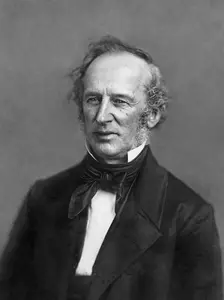
Cornelius Vanderbilt: Biography, Facts, Net Worth
Nov 18, 26 05:21 PM
 Cornelius Vanderbilt, 1794 to 1877, assembled the New York Central and Hudson River from the Harlem, the Hudson River Railroad, and the original New York Central, and died in office. The estate was ab…
-
Pacific Great Eastern Railway: All-Time Diesel Roster
Nov 18, 26 12:24 PM
 All-time diesel roster of the Pacific Great Eastern, the British Columbia Railway, and BC Rail. Classes, road numbers, and builder data from Paul Crozier Smith, Canadian Rail no. 547 (2012).
-
Pacific Great Eastern Railway: Map, History, Roster
Nov 18, 26 10:22 AM
 The Pacific Great Eastern, incorporated February 27, 1912, became the British Columbia Railway Company on March 30, 1972. On the October 26, 1969 Official Guide, 861.9 miles were under operation. Cana…
-
Northern Alberta Railways: Map, History, Timetables
Nov 17, 26 11:52 PM
 Northern Alberta Railways, reporting mark NAR, was incorporated June 14, 1929, and owned jointly by Canadian National and Canadian Pacific. On the October 27, 1968 freight timetable, Dawson Creek is 4…
-
Yakima Valley Transportation: History, Timetable, Photos
Nov 17, 26 10:51 PM
 Yakima Valley Transportation opened Christmas Day, 1907. Union Pacific bought it June 9, 1909. Last city car February 1, 1947. Last freight November 18, 1985. Line car A and steeplecab 298 stayed in Y…
-
"20th Century Limited" (Train): Map, Consist, Schedule, Interior
Nov 17, 26 05:03 PM
 The 20th Century Limited was the flagship passenger train of the NYC, operating until 1967 (just prior to the Penn Central merger).
-
Western Pacific Diesel Roster (All-Time)
Nov 17, 26 04:52 PM
 Western Pacific all-time diesel roster. Why the switchers, covered wagons, road switchers, and General Electric units were bought, where they worked, and what Union Pacific inherited on December 22, 1…
-
Western Pacific Steam Roster (Built Since 1900)
Nov 17, 26 04:49 PM
 Western Pacific steam locomotives built since 1900. Drury quantity column 201. Thirteen rows. Mikado 329 made the last regular steam run in June 1953.
-
Western Maryland Scenic Lists Polar Express Fares
Nov 17, 26 03:30 PM
 Western Maryland Scenic lists Polar Express tickets from November 21 through December 24, 2026. Coach is $40, plus a $5 heritage fee. Excursions are diesel while No. 1309 is inspected.
-
Western Pacific Railroad: Map, History, Logo, Rosters
Nov 17, 26 11:12 AM
 The Western Pacific, organized in San Francisco on March 3, 1903, the Feather River Route to Salt Lake City, and the Union Pacific acquisition completed on December 22, 1982.
-
Spokane, Portland & Seattle Diesel Roster (All-Time)
Nov 17, 26 10:53 AM
Spokane, Portland and Seattle all-time diesel roster. Why the Alcos, Baldwins, and Electro-Motive units were bought, where they worked, and which numbers Burlington Northern inherited. -
Spokane, Portland & Seattle Steam Roster (Built Since 1900)
Nov 17, 26 10:46 AM
 Spokane, Portland and Seattle steam locomotives built since 1900. Drury quantity column 121. Rebuilds counted once, 115 frames. Last steam run was June 23, 1956.
-
Spokane, Portland & Seattle Railway: Map, History, Photos
Nov 17, 26 10:10 AM
 The Spokane, Portland and Seattle, organized August 22, 1905 as the Portland and Seattle, the north-bank line to Portland, and the Burlington Northern merger at 12:01 a.m. on March 2, 1970.
-
Pacific Electric Railway: Car Roster
Nov 16, 26 12:15 AM
 Pacific Electric cars by order: the St. Louis 800s and 950s, Jewett Tens, Standard Steel 1100s, Pressed Steel and Pullman 1200s, and the city-car number catalog.
-
Pacific Electric Railway: Locomotive Roster
Nov 16, 26 12:02 AM
 Pacific Electric box motors, Baldwin-Westinghouse electrics, company-built locomotives, and the General Electric diesels numbered 1650-1654 in 1947.
-
Pacific Electric Railway: Map, Logo, History, Photos
Nov 15, 26 11:38 PM
 The Pacific Electric Red Cars of Los Angeles, Henry Huntington, the Great Merger of September 1, 1911, and the last Long Beach train on the morning of April 9, 1961.
-
Spokane International Railroad: Map, History, Photos
Nov 15, 26 06:54 AM
 The Spokane International, chartered January 1, 1905, from Spokane to Eastport, Idaho, its steam locomotives and Alco RS-1s, and Union Pacific control on October 6, 1958.
-
Northwestern Pacific Railroad: History, Map, Timetable
Nov 15, 26 12:38 AM
 The Northwestern Pacific, incorporated January 8, 1907, by the Southern Pacific and the Santa Fe, the Willits to Shively line, general traffic on July 1, 1915, and the later operators north of San Fra…
-
Northern Pacific Diesel Roster (All-Time)
Nov 14, 26 09:17 PM
 Northern Pacific all-time diesel roster. Alco, Baldwin, Electro-Motive, and General Electric serials, orders, and build dates.
-
Northern Pacific Steam Roster (Built Since 1900)
Nov 14, 26 07:44 PM
Northern Pacific steam locomotives built since 1900. Last steam run was January 17, 1958. -
Northern Pacific Railway: Map, Logo, History, Rosters
Nov 14, 26 12:15 AM
 The Northern Pacific, chartered July 2, 1864, from Jay Cooke and the panic of 1873 to the last spike at Gold Creek in 1883, Stampede Tunnel in 1888, and Burlington Northern at 12:01 a.m. on March 2, 1…
-
The Pacific Extension (Milwaukee Road): Map, Abandonment, History
Nov 13, 26 11:52 PM
 The Milwaukee Road Pacific Extension, from Mobridge to Tacoma. A shorter northern transcontinental, the mountain electrification, and the decision to take the line up.
-
Colorado Railroad Museum Lists Polar Express Fares
Nov 13, 26 11:44 PM
The Colorado Railroad Museum lists 2026 Polar Express train tickets through December 23. Standard seats are $80 and $100. First Class is sold by the table. Shows are at 5, 6:30, and 8 p.m. -
Essex Steam Train Lists the North Pole Express
Nov 13, 26 11:24 PM
 The Essex Steam Train lists North Pole Express dates from November 20 through December 23, 2026. Coach is $60 or $70. The railroad says questions about this train are not taken by phone.
-
Tennessee Valley Lists the North Pole Limited
Nov 13, 26 11:17 PM
The Tennessee Valley Railroad Museum lists the North Pole Limited on select dates from November 13 through December 23, 2026. Traditional tickets are $38 and $45. The page does not print a clock grid. -
Great Northern Diesel Roster (All-Time)
Nov 13, 26 10:59 PM
 Great Northern all-time diesel roster. Alco, Baldwin, Electro-Motive, and General Electric serials, orders, and build dates. Cascade electrics stay on the company page.
-
Alco "DH-643" Locomotives: Specs, Roster, Data Sheet
Nov 13, 26 10:39 PM
 Alco DH-643: 4,300 hp diesel-hydraulic C-C road switcher. Three built for the Southern Pacific in September 1964. Specs, drive, and the production roster.
-
Virginia Scenic Lists the 2026 Santa Express
Nov 13, 26 10:26 PM
 Virginia Scenic Railway lists the Santa Express from November 28 through December 23, 2026. The ride is about 60 minutes. The page says it is not a scenic excursion. Coach is $50.