
Chesapeake and Ohio Railway: Map, Logo, History
Last revised: November 9, 2024
By: Adam Burns
The Chesapeake and Ohio Railway was one of several Appalachian coal
haulers and is perhaps best remembered for its marketing sensation, Chessie the sleeping kitten, as well as its buyout of the Baltimore
& Ohio during the early 1960s.
An icon even outside the rail industry, many people today still recognize the kitten and its association with railroading in some way. The C&O's earliest history traces back the early 19th century when Virginia was first building railroads.
It gained its current name in the 1870s upon which time it grew into a coal-hauling juggernaut similar to the nearby Norfolk & Western.
In addition to excellent management throughout much of the 20th century, the company earned substantial profits even during the industry's turbulent years of the 1960s and '70s.
It thrived on West Virginia and Kentucky coal and was a gateway between Chicago and the ports of Virginia. Today, much of the remaining C&O network is operated by CSX Transportation.
Photos
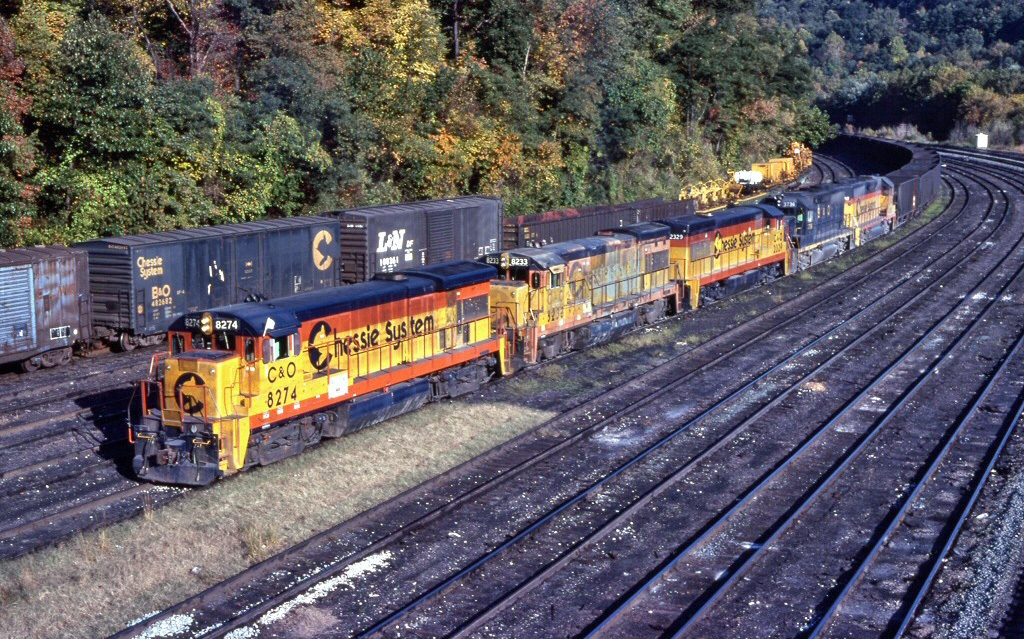 Chessie System/C&O B30-7 #8274 leads empties westbound through the yard at Clifton Forge, Virginia in October, 1983. Rob Kitchen photo.
History
While the Chesapeake and Ohio Railway of the 20th century was a highly profitable and successful operation it took many years before reaching that plateau.
The road's ancestry can be traced all of the way back to the James River Company, a canal operation which opened in 1790 between Richmond and Westham, Virginia. It later became the James River & Kanawha Canal. Unfortunately, by the time of its renaming canal transportation was fast being replaced by the much more efficient railroad.
The C&O's earliest such predecessor was the Louisa Railroad, incorporated on February 18, 1836 by the Virginia General Assembly to open a 22-mile route from Frederick's Hall to Taylorsville (today, known as Doswell) where a connection was established with the north-to-south Richmond, Fredericksburg & Potomac Railroad.
From the start, the system had a relatively strong financial backing and wasted no time completing its charter, opening in December of 1837.
At A Glance
2,730.29 (1930) 5,343 (1950) |
|
Chicago - Cincinnati, Ohio - Ashland, Kentucky - Staunton, Virginia - Newport News, Virginia Gordonsville, Virginia - Washington, D.C.Clifton Forge - Richmond, VirginiaAshland - Louisville, KentuckyAshland, Kentucky - Columbus, Ohio - Toledo, OhioColumbus - Pomeroy, OhioCatlettsburg, Kentucky - Elkhorn City, KentuckyRonceverte - Durbin/Bartow, West Virginia (Greenbrier Branch)Chicago - Grand Rapids, Michigan - Detroit - St. Thomas, Ontario - Buffalo/Niagara Falls, New York (ex-Pere Marquette)Grand Rapids - Petoskey/Bay View, MichiganErieau, Ontario - Ludington, MichiganLudington - Milwaukee/Manitowoc/Kewaunee, Wisconsin (car ferry service)Toledo - Bay City, MichiganPort Huron - Bay City - Elmdale, MichiganHolland - Muskegon - Hart, Michigan | |
Freight Cars: 92,992 Passenger Cars: 324 | |
The Virginia Commonwealth of the early 19th century was a forward-thinking state and a big proponent of railroads, realizing their potential in opening trade and economic opportunities not only within its own borders but also beyond.
Its Piedmont region could support diverse types of agriculture, which persists through today, and the Louisa was utilized by farmers to ship their products to market. In 1850 the company was renamed the Virginia Central as its promoters eyed expansion across the state and even further west.
Logo
According to Thomas Dixon, Jr.'s, "Chesapeake & Ohio Railway: A Concise History And Fact Book," the road's ultimate goal was to reach the Shenandoah Valley and what is today the state of West Virginia (then Western Virginia).
It also saw the potential in a direct link to Richmond, despite protestations from the RF&P, which now viewed the VC as a rival. The RF&P's efforts were in vain as the VC reached the state capital the same year it acquired its new name.
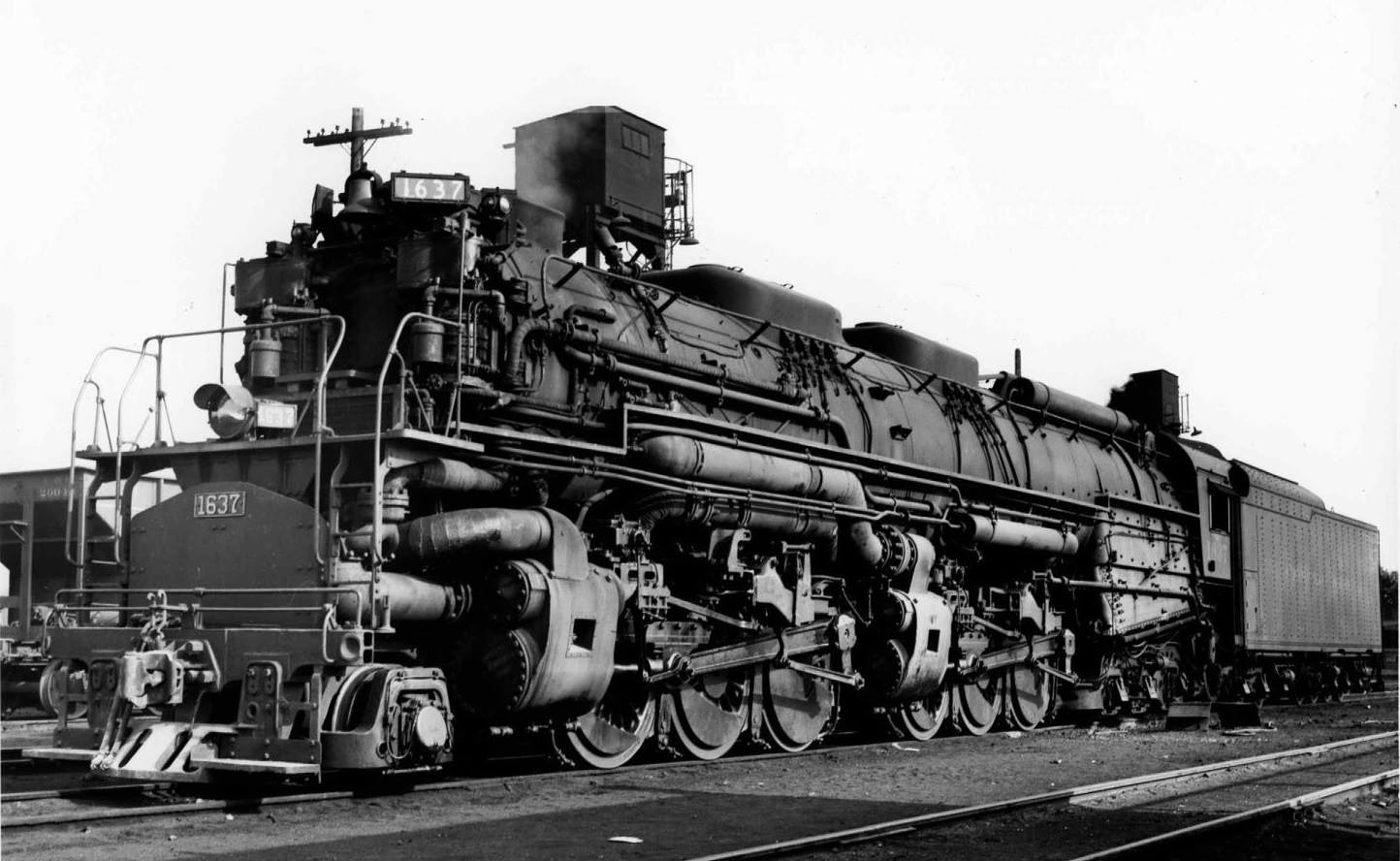 Chesapeake & Ohio 2-6-6-6 (H-8) "Allegheny" #1637 at Richmond, Virginia circa 1956.
In 1857 the VC had expanded as far westward as Jackson's River Station near present-day Clifton Forge via Gordonsville, Charlottesville, and Staunton offering it a network of around 192 miles.
Even before the Louisa Railroad had been renamed the state stepped in to assist its future westward extension by chartering the Blue Ridge Railroad in 1849 to tackle the Blue Ridge Mountains.
This line's most impressive engineering feature was the Blue Ridge Tunnel (also known as the Crozet Tunnel) designed by engineer Claudius Crozet. It was located at Rockfish Gap and spanned 4,237 feet, opening for service in 1858.
The bore became an Historic Civil Engineering Landmark and remained in use until 1942 when the C&O opened a new tunnel to replace the original.
The Blue Ridge Railroad was leased by the VC in 1858 as it looked to finally reach Covington. Unfortunately, the Civil War broke out in 1861 and further construction ceased.
The Virginia Central was a vital asset for the Confederacy during the conflict but was heavily damaged by both sides. After hostilities ended in May of 1865 crews needed until July 23rd to get the road back in service.
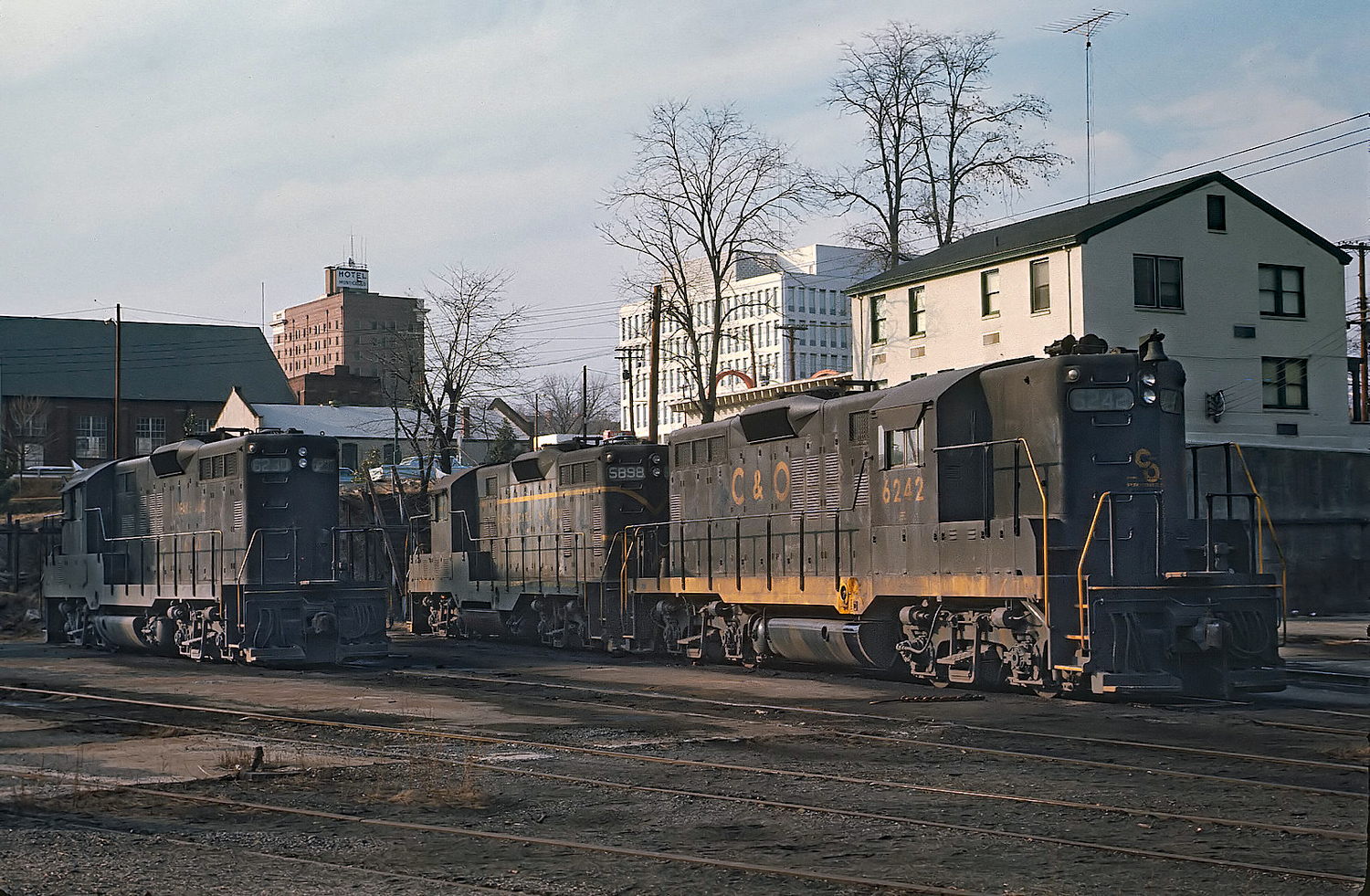 In this classic scene, a trio of Chesapeake & Ohio GP9's await their next assignments at Charlottesville, Virginia on the evening of March 8, 1969. Roger Puta photo.
On July 1, 1867 the VC finally reached Covington although the war's devastation meant funds were exhausted to continue further construction.
Its only other growth during this time was acquiring the assets of the Covington & Ohio, which had partially completed a route to the Ohio River along a stage-coach line originally surveyed by the James River & Kanawha Canal.
In 1868 the Virginia Central was renamed as the Chesapeake & Ohio Railroad Company to further clarify its intentions of reaching the Ohio River and Chesapeake Bay.
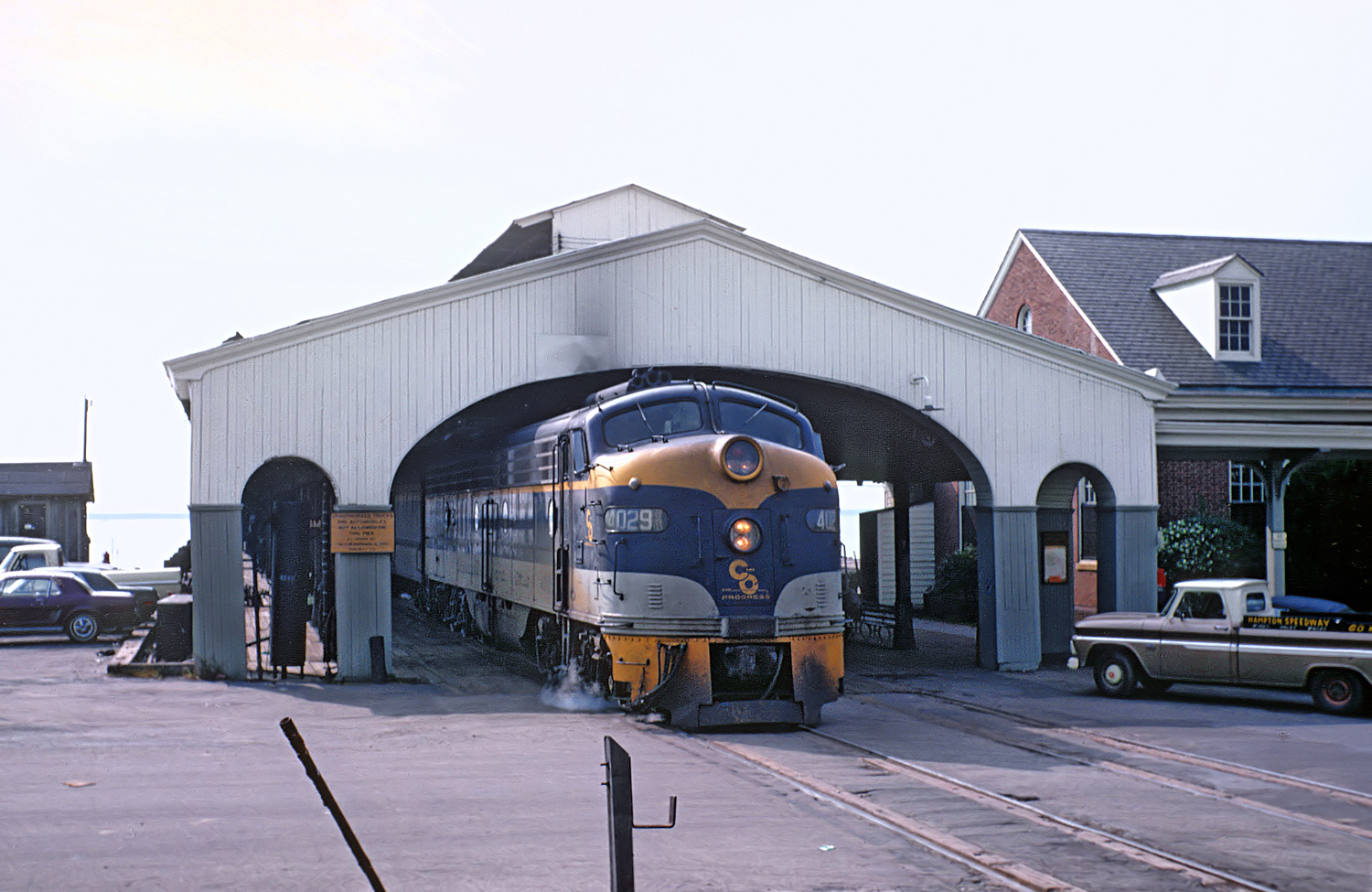 With Chesapeake & Ohio E8A #4029 as power, the westbound "George Washington" awaits departure from the ferry terminal in Newport News, Virginia during October of 1968. Roger Puta photo.
Enter Collis Huntington, who is best remembered for his work in building the western leg of the Transcontinental Railroad. In 1869, just after this project was completed, Huntington pumped new life into the C&O by funding its push towards the west.
The railroad followed the Covington & Ohio's routing, reaching Ronceverte along the banks of the Greenbrier River before turning north from Hinton. This town lay within the beautiful New River Gorge and rails snaked their way along the waterway until reaching Gauley Bridge where it became the Kanawha River.
 Chesapeake & Ohio GP7 #5773 works Reed City Lumber in Reed City, Michigan in August, 1962. Rick Burn photo.
Why, "George Washington's Railroad?"
It is interesting the Chesapeake & Ohio chose to carry a slogan, "George Washington's Railroad" when our nation's first president had no direct ties to the company and died more than three-decades before its first predecessor was ever chartered.
It all began with the James River Company, envisioned by Washington in 1785 as an efficient transportation artery to connect eastern and western Virginia at the Ohio River.
He planned the canal system himself, using the James River across much of the state's eastern and central regions before picking up others, such as the Kanawha and New Rivers, to reach the Ohio.
It opened its first seven miles between Richmond and Westham, Virginia in 1790. It was built no further during Washington's life but did see a bit of commercial traffic until its acquisition by the state in 1820.
In 1835 it was reincorporated as the James River & Kanawha Canal Company, reaching Buchanan by 1851. This proved the extent of its network due to increasing competition from the railroad.
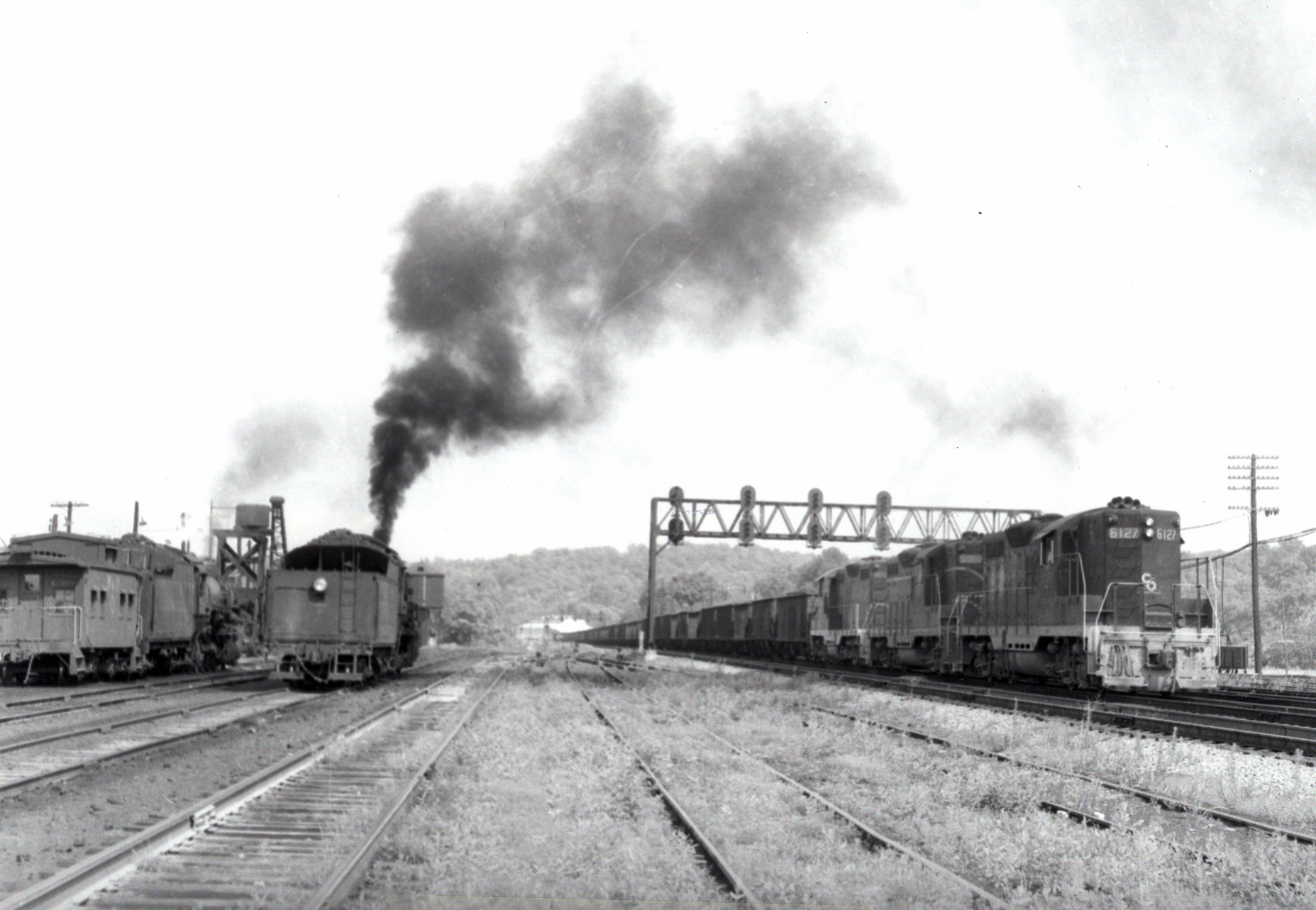 Before the Chesapeake & Ohio and Baltimore & Ohio merged the two interchanged at Kenova, West Virginia near Huntington where the former's main line met the latter's Ohio River Branch. Here, B&O steamers can be seen to the left while C&O GP9's hustle a coal drag in a scene that probably dates to the 1950s. Author's collection.
In 1878 the right-of-way was sold to the new Richmond & Alleghany Railroad, which began construction in 1880 along the canal's old towpath.
According to Laura Armitage's article, "Richmond & Alleghany Railroad," it completed a 230.31-mile route between the Chesapeake & Ohio at Richmond to Clifton Forge in 1881, as well as a 19.38-mile branch to Lexington via Balcony Falls.
The company fell into receivership in 1883 and emerged on May 20, 1889 as the Richmond & Alleghany Railway, upon which time it was acquired by the C&O (the company purchased it outright on January 20, 1890).
The Chessie had been eyeing a more direct line across the state and got it in the R&A's low-grade route, making it ideal to handle heavy tonnage such as coal.
In addition, the route's canal history and ties to Washington allowed the C&O, albeit somewhat indirectly, to claim a heritage to our nation's first president. Today, the corridor remains heavily used by CSX Transportation.
The route continued its way into Charleston, the future capital of West Virginia, before turning away near St. Albans and terminating at the Ohio River near the mouth of the Big Sandy River. The latter location became the town of Huntington, named for the tycoon, himself.
It would eventually become the location of the railroad's major locomotive maintenance and repair shops. The C&O was officially completed at Hawk's Nest, West Virginia along the New River Gorge on January 29, 1873.
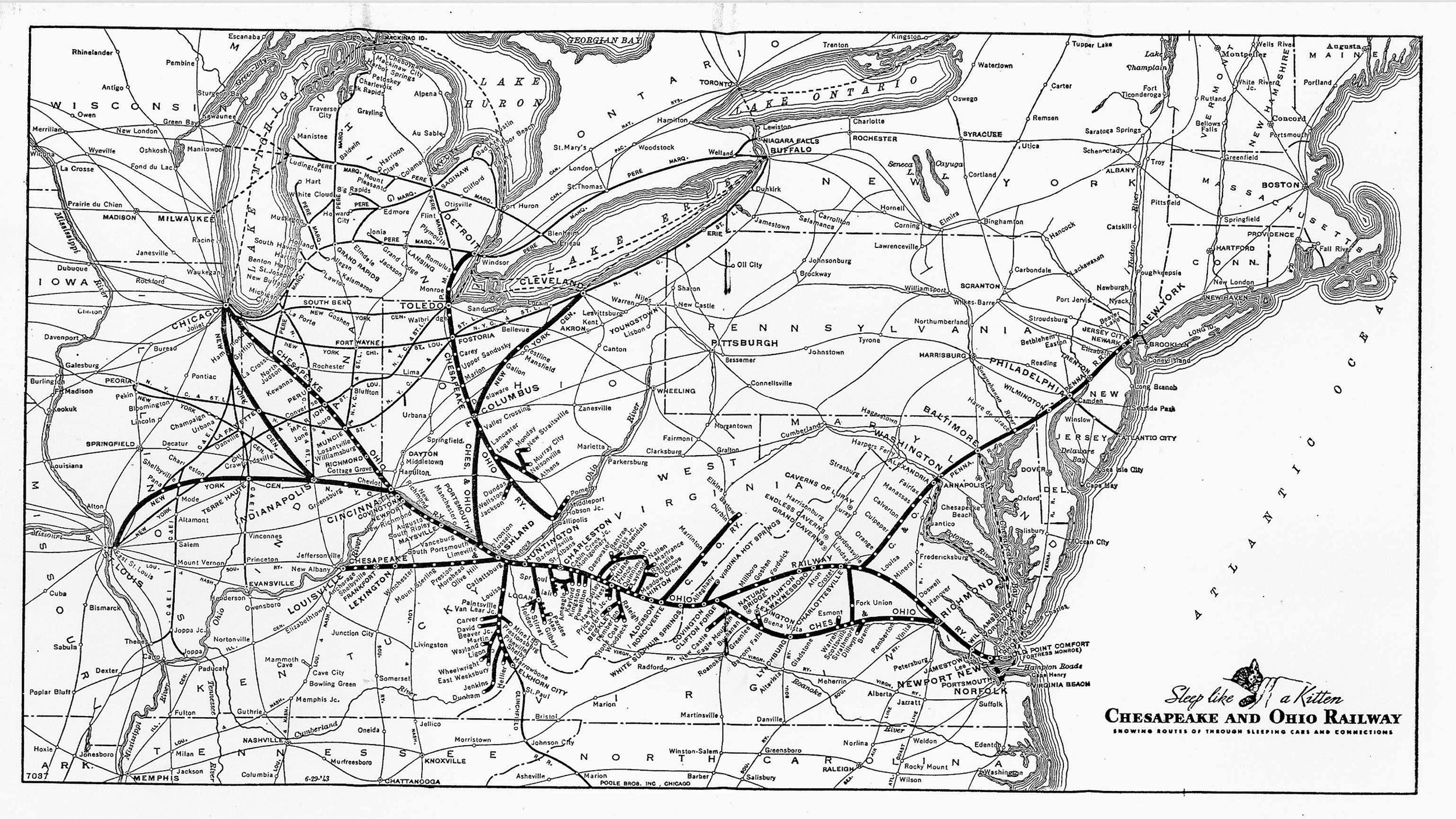
System Map (1946)
Unfortunately, that year coincided with a severe recession as a result of a financial panic and the C&O struggled to remain solvent. Huntington had intended to use the railroad as a means of piecing together a true transcontinental railroad but the economic downturn was too great and the C&O fell into receivership in 1878.
It was soon reorganized as the Chesapeake & Ohio Railway, setting the stage for what became a highly profitable system. During June of 1879, Huntington formed the Newport News & Mississippi Valley to complete a through route from Ashland to Lexington, Kentucky.
The NN&MV ran from the C&O at Mount Savage (about 25 miles southwest of Ashland) to a connection with the Elizabethtown, Lexington & Big Sandy Railroad at Mt. Sterling. The EL&BS continued on into Lexington and was acquired by Huntington.
Through service between Ashland and Lexington commenced during December of 1881 while trackage rights over the Louisville & Nashville enabled the C&O to reach Louisville. That same year the C&O pushed rails eastward into Newport News, finally providing it an east coast port.
Huntington had managed to maintain control of the railroad, even after its bankruptcy, until 1888 when, according to Mike Schafer's, "More Classic American Railroads," he lost out to Cornelius Vanderbilt (of New York Central fame) and J.P. Morgan.
A new ownership was for the best; while Huntington had funded the C&O's continued expansion he had spent little on upgrading the company to modern standards. A new management team did just that and by the turn of the 20th century it was poised to be a very successful enterprise.
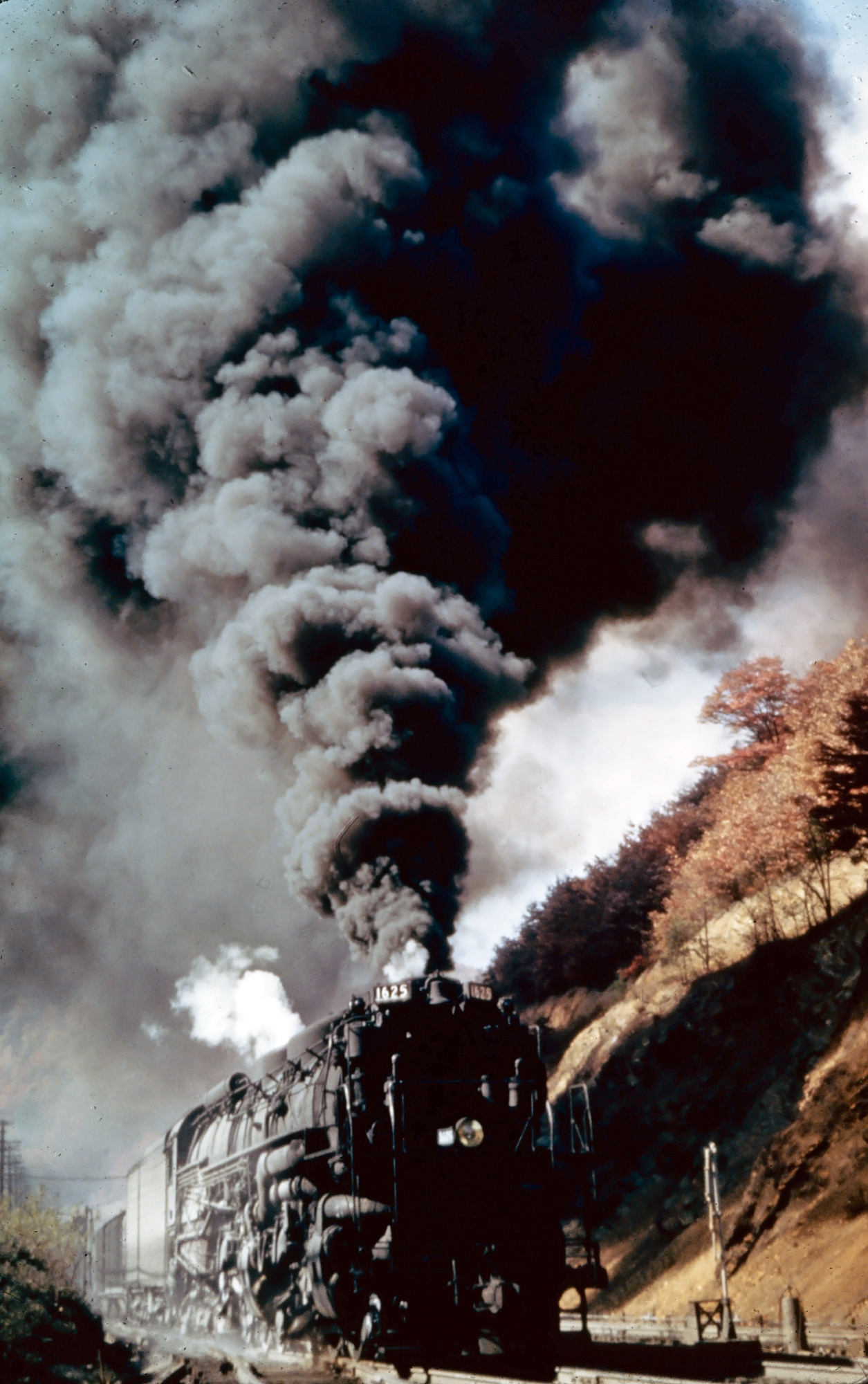 Chesapeake & Ohio 2-6-6-6 #1625 (H-8) charges out of the tunnels at Allegheny, Virginia with an eastbound coal drag on October 19, 1951. Bill Price photo. American-Rails.com collection.
In the meantime, it spent the rest of the century continuing to grow with a near-limitless cash flow. On December 25, 1888 the C&O opened service to Cincinnati, Ohio following the southern bank of the Ohio River via Ashland, Augusta, and Covington, Kentucky.
It blossomed into a major coal carrier at this time, adding branches across southern West Virginia and eastern Kentucky (here, an important connection was also made with the Clinchfield Railroad at Elkhorn City) to tap new mines, a process that continued through 1920. The road spent heavily to improve bridges, update tunnels, and position itself to handle the increased traffic demands for years to come.
It constructed shop and/or yard complexes in Charlottesville, Gladstone, and Clifton Forge, Virginia; Handley, West Virginia; and Russell, Kentucky. In 1891 the C&O obtained trackage rights over the Virginia Midland Railroad between Orange and Washington, D.C. which provided a key connection to the nation's capital.
The VMRR would soon become a subsidiary of the new Southern Railway system. Much of the C&O's growth during the 20th century through acquisition and not new construction.
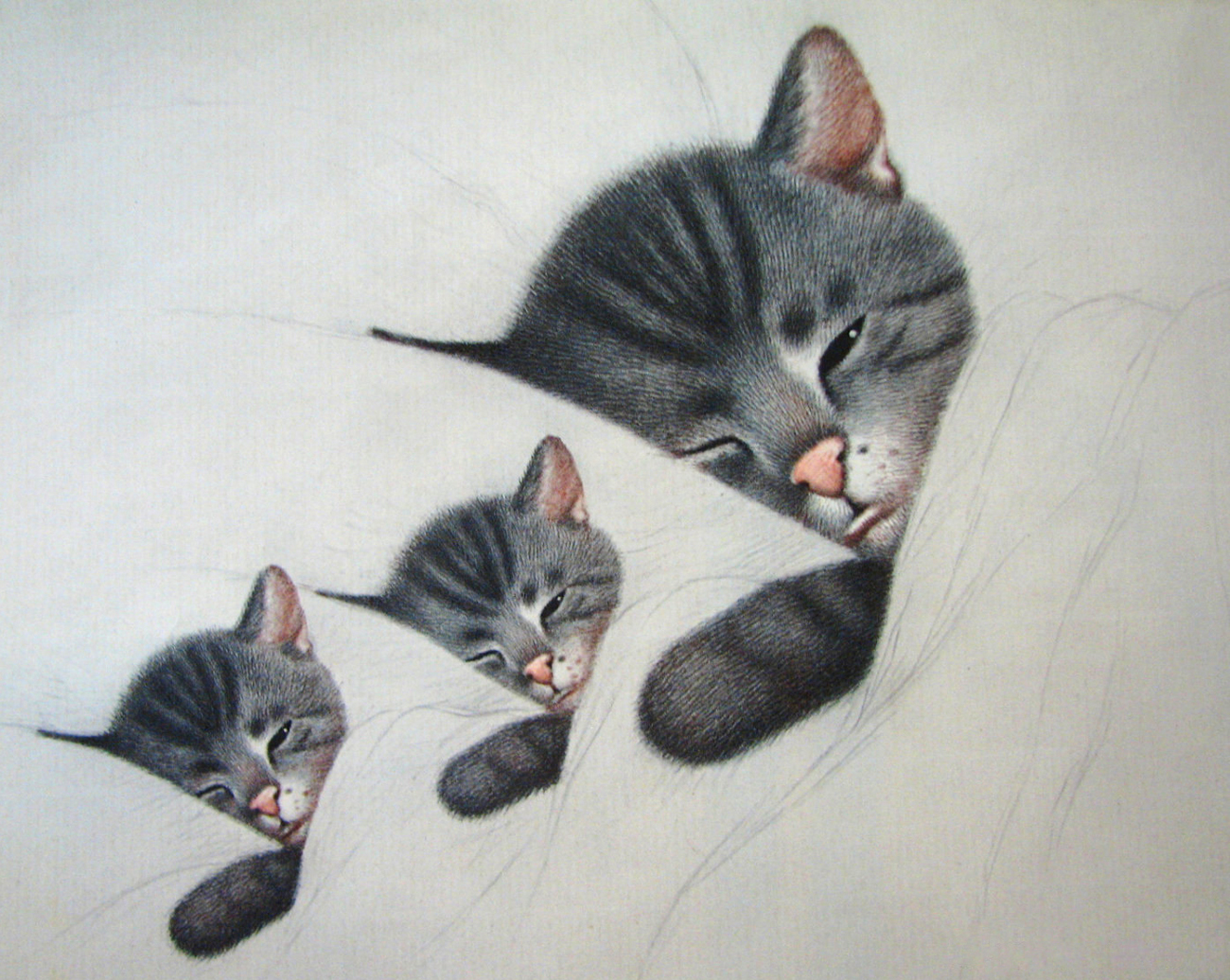
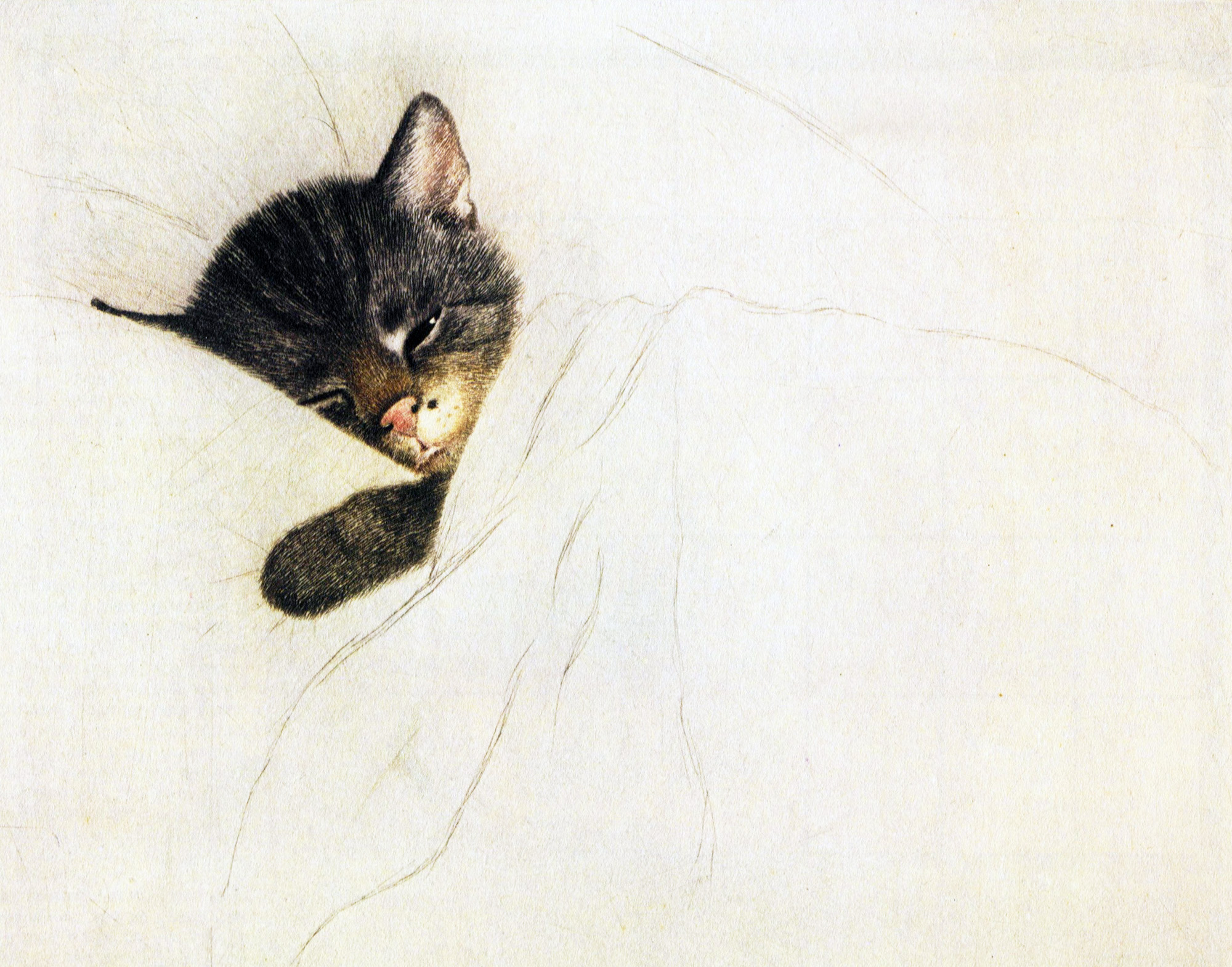
Chessie, The Famous Kitten
The creator of the sleeping kitten image was an artist by the name of Guido Grenewald who had created the cute feline to promote animal kindness.
In 1933, Lionel Probert, who headed the C&O's public relations and marketing department, saw Grenewald's piece and was instantly drawn to its potential. At the time, Probert was looking for a way to showcase the railroad's new air-conditioned sleeping cars while also revitalizing sagging patronage.
He purchased Grenewald's rendering for $5, came up with the name Chessie (named after the railroad), and added the slogan, "Sleep Like A Kitten And Wake Up Fresh As A Daisy In Air-Conditioned Comfort."
The first advertisement appeared in Fortune Magazine's September, 1933 issue and was an instant success. By 1934, Chessie, had appeared in more than 40,000 pieces of media, from newspapers to calendars.
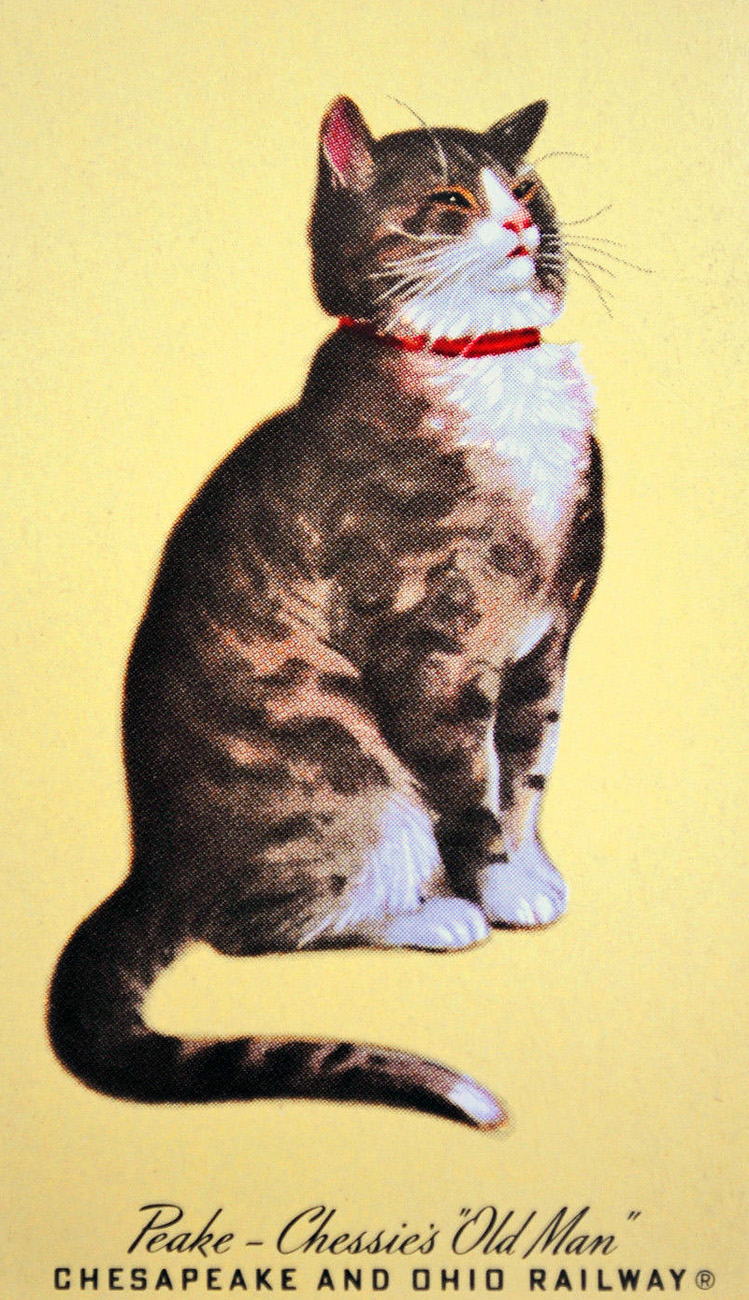
The company's passenger traffic soared and the advertising campaign remains one of the most successful of all time; even today the Chesapeake & Ohio Railway Historical Society continues to sell calendars and other memorabilia featuring Chessie (when the kitten debuted demand was so high that the C&O could not keep merchandise in stock).
The kitten's success resulted in two additional mascots joining it, named Nip and Tuck, as well as a father cat named Peake. The three additional felines continued to appear in advertisements through 1948.
Of course, Chessie’s celebrity status did not end with merchandise and advertising, the kitten became synonymous with the C&O; her celebrity was reignited in the early 1970s when the Chessie System, a holding company for the C&O, B&O, and Western Maryland, overlaid the kitten’s silhouette in the Chessie System "C" adorning the railroads new vermilion, yellow, and blue livery.
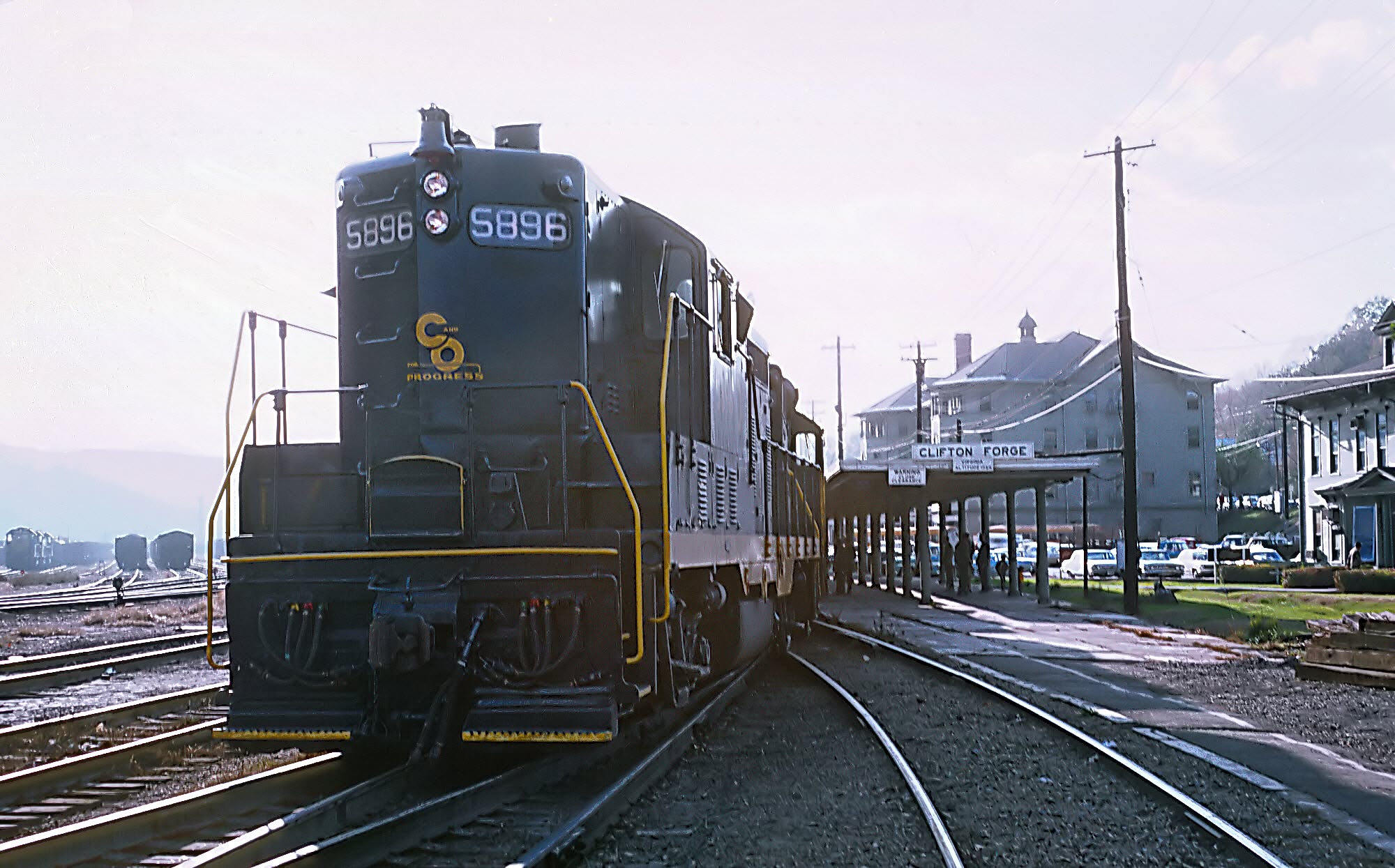 A shined up Chesapeake & Ohio GP7, #5896, has the Old Dominion Chapter of the NRHS "Autumn Leaf Special" fantrip at Clifton Forge, Virginia on October 26, 1969. Roger Puta photo.
The C&O eyed a connection to Chicago as traffic surged and found it in the Chicago Cincinnati & Louisville Railroad. The CC&L had entered receivership in 1908 and was acquired by the C&O on June 23.
This road, covering 284.5 miles between Cincinnati and Hammond, Indiana, gave Chessie direct access into the Windy City thanks to friendly trackage rights with other lines.
The CC&L, which became the Chesapeake & Ohio Railway of Indiana, ran via Richmond, Muncie, and Peru cutting diagonally across the state. It allowed coal and the C&O's other diverse freight to flow both east and west while reaching the most important gateway in the country in the process.
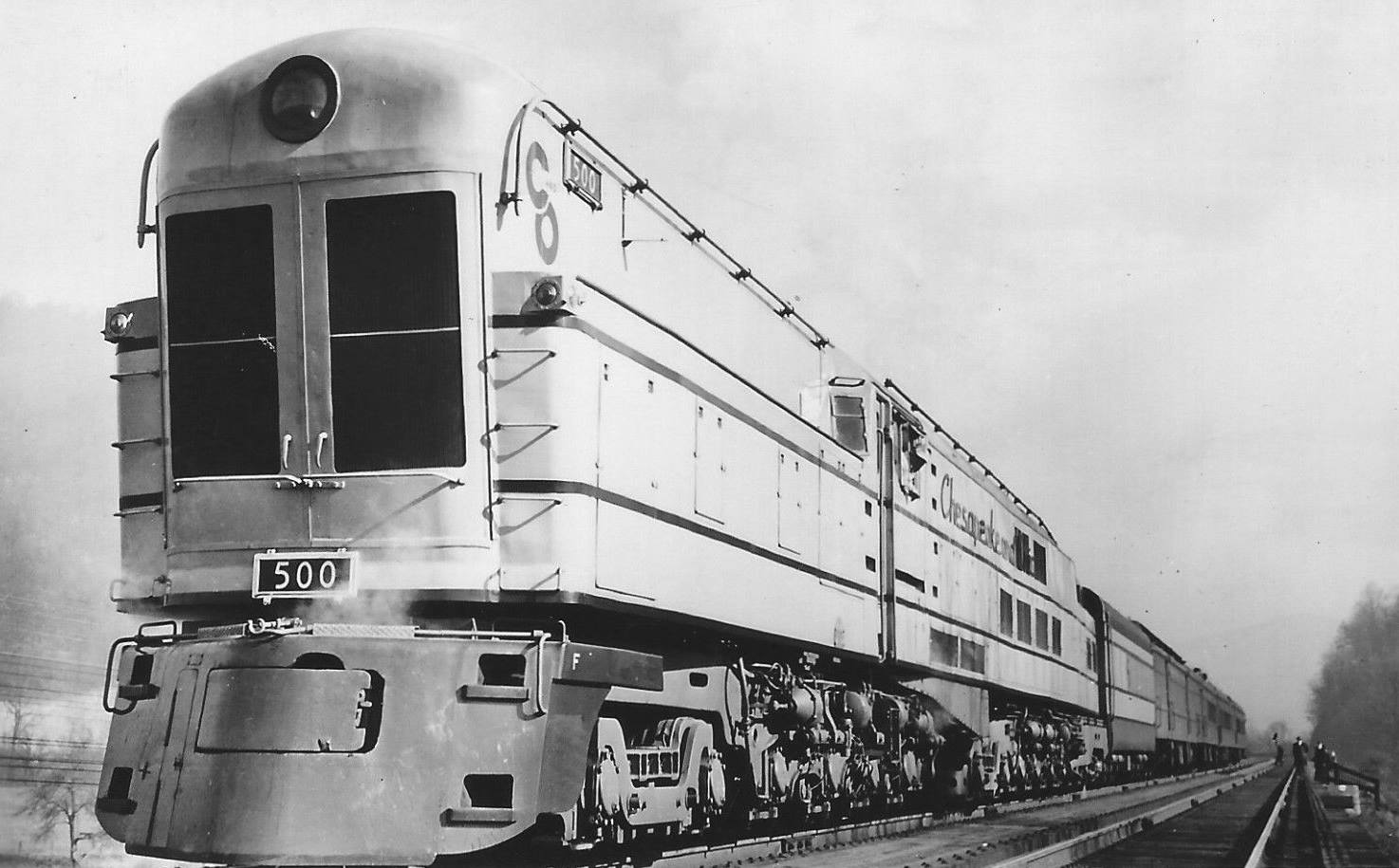 Chesapeake & Ohio steam turbine #500 (M-1) during its trials in 1947. The locomotive was meant to power the streamliner "Chessie," ultimately never launched, in an attempt to prove that advancements in steam technology could still compete against the diesel. It was just over 140 feet in length with a top speed of 100 mph. Unfortunately, Baldwin, Westinghouse, and C&O engineers could never work out the numerous troubleshooting issues and gave up on the design.
Looking beyond Chicago the company's leadership worked its way further into the Midwest; also in 1910 it acquired the Hocking Valley Railway, which stretched from Toledo to Athens, Jackson, Gallipolis, and Pomeroy, Ohio via Columbus.
At first the C&O required trackage rights over the Norfolk & Western to reach this disconnected subsidiary via Limeville, Kentucky and Valley Crossing, Ohio.
However, by 1927 it had completed its own connection and now had a through route across the Buckeye State (the railroad formally merged the HV into its network in 1930).
Passenger Trains
Fast Flying Virginian/F.F.V.: (Washington/Newport News - Cincinnati/Louisville)
George Washington: (Washington/Newport News - Cincinnati/Louisville)
The Chessie (Never Launched): (Washington - Cincinnati)
Pere Marquette: (Detroit-Grand Rapids, Chicago-Grand Rapids/Muskegon, and Detroit-Saginaw)
Resort Special: Originally served Chicago and Petoskey but later connected Washington with White Sulphur Springs, West Virginia.
Sportsman: (Washington/Newport News - Cincinnati/Detroit)
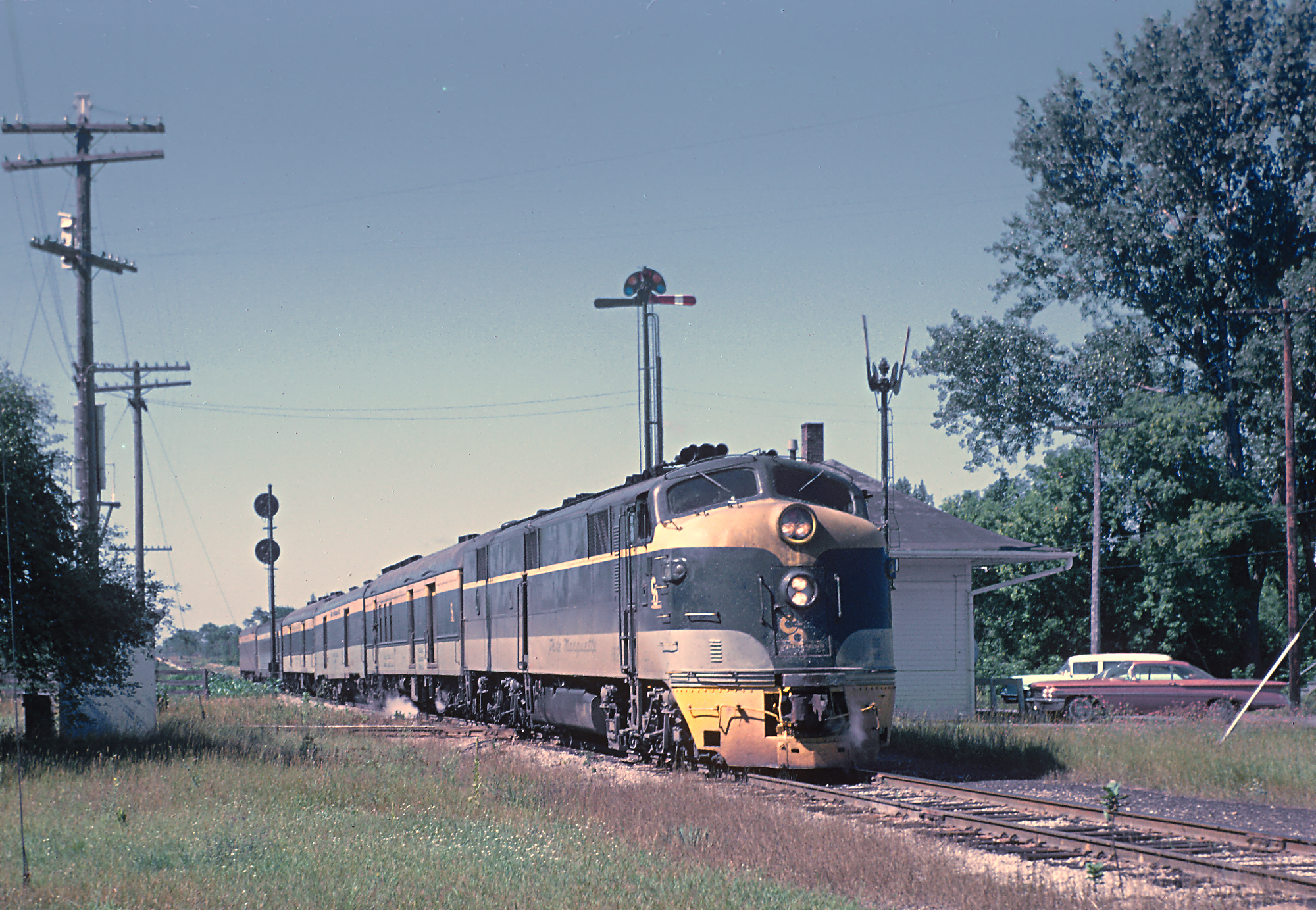 Chesapeake & Ohio’s Train #25 is northbound at Thompsonville, Michigan in August, 1962. The author of this photo, Rick Burn, notes he, and his brother, Don, were riding the train from Baldwin, Michigan to Traverse City. The rear of the locomotive was sitting on the diamond where the C&O crossed the Ann Arbor Railroad mainline from Toledo, Ohio to Frankfort, Michigan. The train had heavy head-end business and also carried a former Pere Marquette combine. In addition, on this day it also carried the tri-weekly Chicago to Traverse City sleeper. On this trip, this particular car was named “Traverse City.”
During the mid-1920s the C&O was acquired by the Van Sweringen brothers of Cleveland, Ohio who expanded its reach into Michigan and as far east as Buffalo, via Ontario, Canada, thanks to control of the Pere Marquette. It also maintained authority over the Nickel Plate Road for many years.
Following the Great Depression Chessie's success only increased: sustained by strong coal earnings it weathered the 1930s rather easily, a decade which saw the birth of Chessie, a marketing sensation.
Throughout the rest of the C&O’s life it would earn healthy profits and in the early 1960s won a bidding war with the New York Central for control of its much larger northern neighbor, the Baltimore & Ohio.
The merger was approved by the Interstate Commerce Commission on December 31, 1962. However, rather than merge the B&O out of existence the railroad chose to gradually combine the two, slowly merging departments and other management areas.
This was done for several reasons but two of the most important was to placate the extremely loyal B&O employees (which would not take outright control and dissolution easily) and retain the its tax exempt status within the State of Maryland.
Chessie System
In 1972 came the largest change for the three railroads (including the B&O-controlled Western Maryland) when a new holding company was created, the Chessie System. Its new livery with the Chess-"C" was an instant hit and remains one of the most colorful, popular, and dynamic liveries ever applied to a locomotive.
The new Chessie System would become quite a juggernaut, earning substantial profits throughout the 1970s, one of only a handful to do so during a darkest days of the industry's history.
The Chessie System, however, would last a mere eight years as an independent company; in 1980 the Chessie roads and those of the Family Lines/Seaboard Coast Line Industries (which was a holding company for a number of southeastern railroads including the Seaboard Coast Line and Louisville & Nashville) formed CSX Corporation on November 1st.
Diesel Roster
Steam Roster
Class F (4-6-2)
Class J (4-8-2)
Class J3a/b (4-8-4)
Class K "Kanawhas" (2-8-4)
Class T-1 (2-10-4)
CSX Transportation
The creation of CSX entered the C&O into its last of many long and storied chapters; eventually a new subsidiary known as CSX Transportation was formed to operate the company's railroad assets.
According to Trains Magazine, the Western Maryland was the first to disappear, merged into the B&O on May 1, 1983. The B&O survived until April 30, 1987 when it disappeared into the C&O. Finally, the C&O was formally dissolved as a corporate entity on August 31, 1987.
Today, large segments of the old C&O remain in use, including its main line from Newport News to Cincinnati as well as segments into northern Ohio via Columbus and Toledo.
Unfortunately, most of its route to Chicago has been abandoned in favor of the B&O's line and the segment to Lexington is no longer part of its network. In addition, most of ex-Pere Marquette trackage has either been sold or abandoned.
The
Chesapeake & Ohio Railway will always be remembered for the excellent
railroad it operated throughout much of the 20th century and Chessie the
kitten remains beloved by millions, decades since the railroad has
disappeared.
Photos
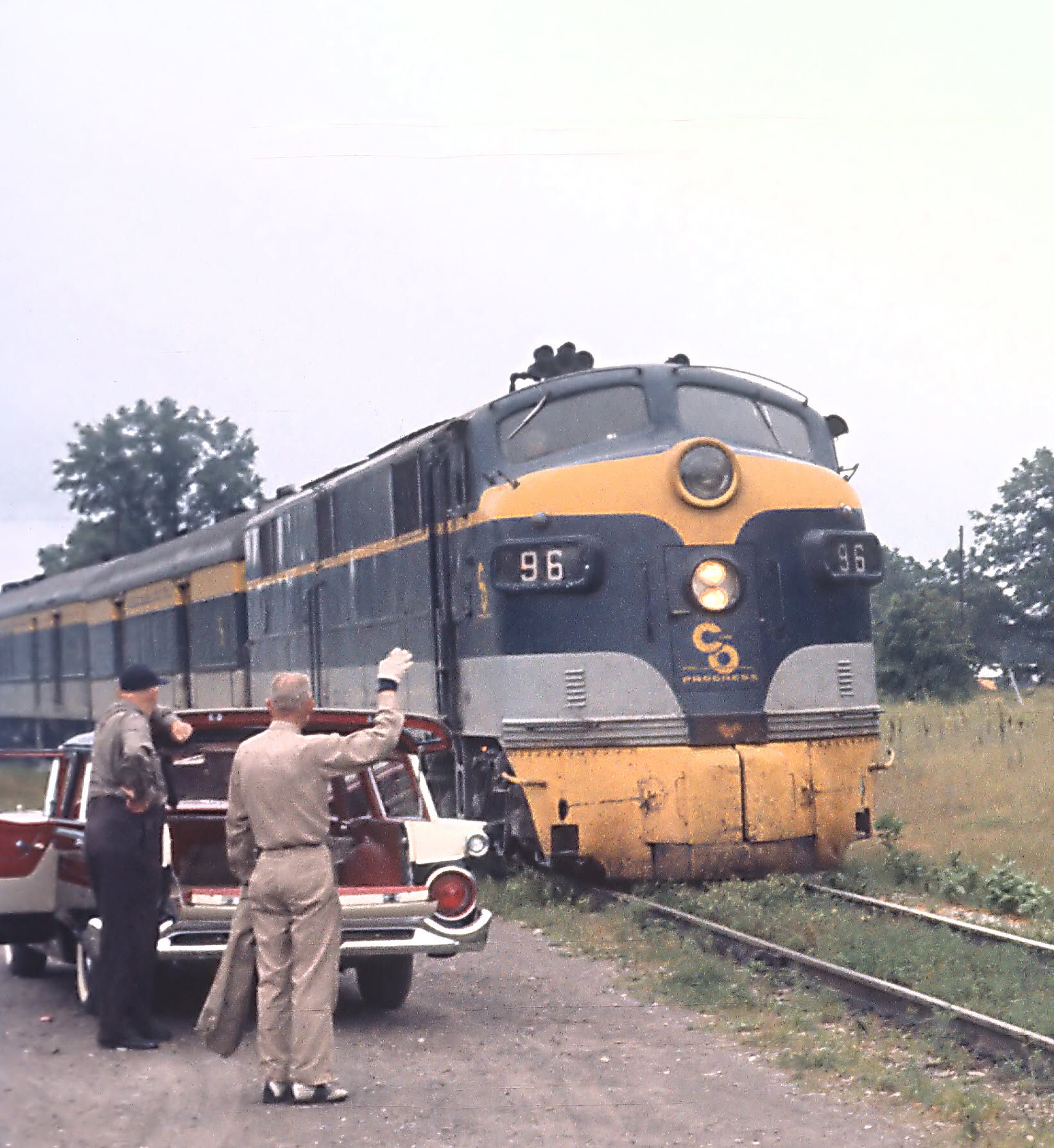 Chesapeake & Ohio E7A #96 is ahead of train 25, the Grand Rapids-Petoskey service on the former Pere Marquette - as the train receives a friendly wave from a bystander at Baldwin, Michigan in July, 1960. Rick Burn photo.
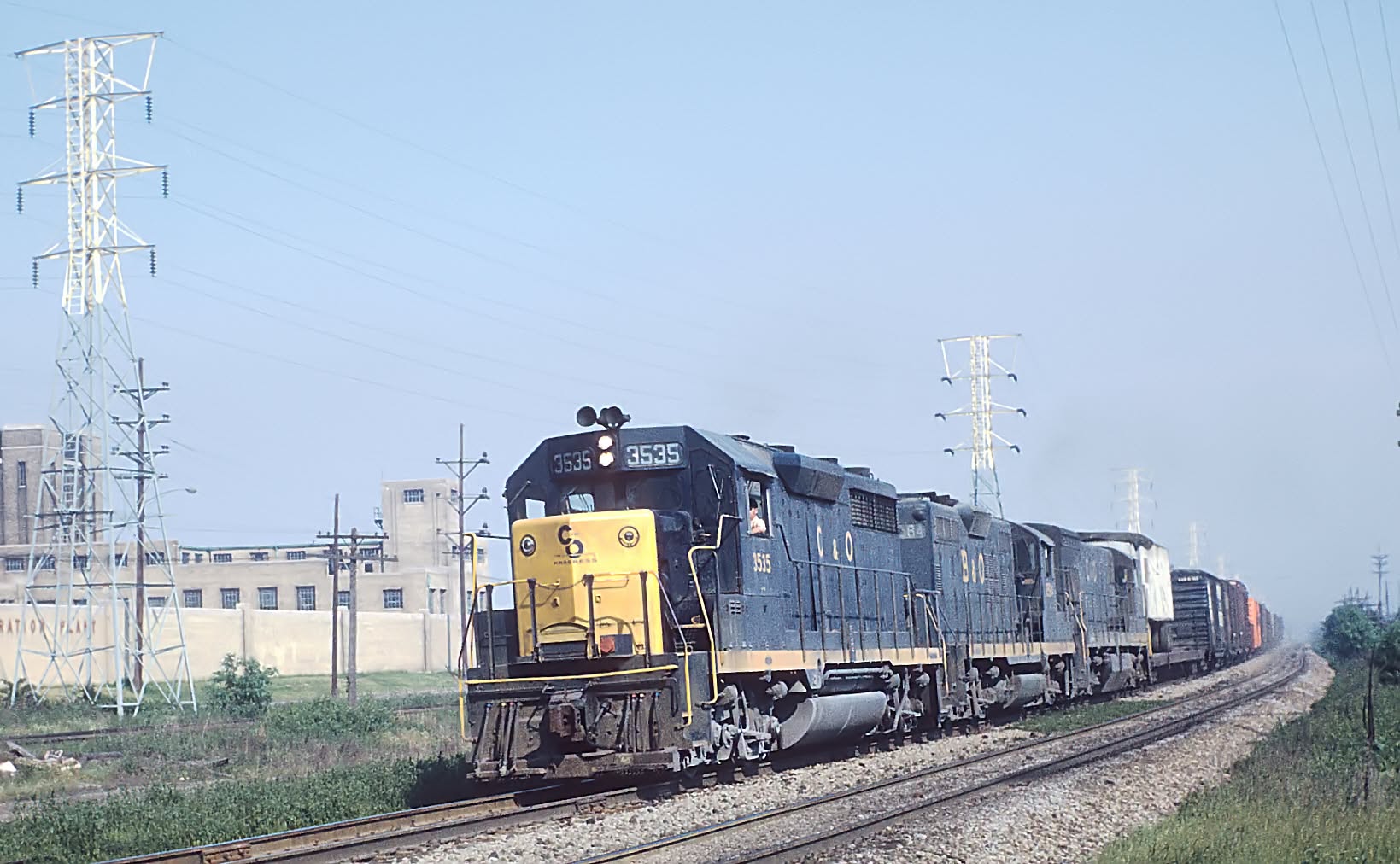 Chesapeake & Ohio GP35 #3535 leads this westbound freight past the Hammond Water Filtration Plant (Hammond Water Works Department) on the joint C&O of Indiana/Erie trackage that ran through Hammond, Indiana toward State Line interlocking in July, 1972. Rick Burn photo.
 Chesapeake & Ohio E8A #4003 lays over at the small engine terminal in Charlottesville, Virginia on March 8, 1969. Roger Puta photo.
 Chesapeake & Ohio GP30 #3008, GP35 #3568, and another GP30 are at the east end of Rockwell Yard on the Belt Railroad of Chicago at the Southwest Highway Crossing in Chicago; January, 1965. Roger Puta photo.
Recent Articles


-
Bessemer & Lake Erie Railroad: "The Bessemer Road"
Sep 15, 26 05:20 PM
 Bessemer & Lake Erie—Bear Creek 1865, Carnegie 1897, U.S. Steel 1901. Ore south from Conneaut, coal north. 2-10-4s, Missabe sister road. CN May 10, 2004. Complete corporate history.
 -
Bangor and Aroostook Railroad: "Serving Northern Maine"
Sep 15, 26 05:05 PM
 Bangor & Aroostook—chartered February 13, 1891, first trains January 1, 1894. Potatoes, paper, Searsport, State of Maine reefers. MM&A 2003, Lac-Mégantic 2013, CP 2020, CPKC today. Complete co…
 -
Baltimore & Ohio Chicago Terminal Railroad: Map and History
Sep 15, 26 03:11 PM
 B&OCT—formed January 6, 1910 to buy Chicago Terminal Transfer. Grand Central, Barr Yard, 78 route-miles. Assigned B&O steam. Complete diesel roster. CSX paper subsidiary, mark BOCT.
 -
The "Alphabet Route" (Railroad): Photos and History
Sep 15, 26 02:53 PM
 Alphabet Route—eight railroads, not one company. P&WV to Connellsville February 11, 1931. Alpha Jets Chicago/St. Louis–New York/Boston. NKP, W&LE, P&WV, WM, Reading, CNJ, L&HR, New Hav…
 -
Milwaukee Road Livestock Operations: Cattle, Dakotas & Montana
Sep 15, 26 02:36 PM
 Milwaukee Road livestock traffic—Dakota and Montana cattle, Iowa hogs, Chicago markets, 28-hour law, head-end stock cars. By 1974 mostly Montana. Rick Burn’s Helena speech. Operations history, not the…
 -
Spirit of Jasper Ride & Dine (2026): Season Pause
Sep 15, 26 02:29 PM
 Spirit of Jasper Ride & Dine in Jasper, Indiana—seated meal on board. Operator: not running public trains for 2026. Depot remains open as a rental. Confirm on spiritofjaspertrain.com.
 -
South Carolina Canal & Rail Road Company: Map and History
Sep 15, 26 01:59 PM
 South Carolina Canal & Rail Road—chartered December 19, 1827. Best Friend of Charleston, 136 miles Charleston–Hamburg October 1833, Aiken inclined plane. South Carolina Railroad 1844, Southern 189…
 -
The Practice of Double-Heading: The Steam Era
Sep 15, 26 01:43 PM
 Doubleheading—two locomotives on the point, each with its own steam crew. Not a rear helper, not diesel MU. How it worked, PRR 1877, mountain grades, and what MU ended.
 -
Mohawk and Hudson Railroad: Map, Pictures, Locomotives
Sep 15, 26 01:20 PM
 Mohawk & Hudson Railroad—New York’s first railroad, chartered April 17, 1826. DeWitt Clinton, inclined planes, Albany & Schenectady 1847, first New York Central May 17, 1853. Complete corporat…
 -
Essex Clipper Dinner Train (2026): Dates, Tickets & What to Expect
Sep 15, 26 01:09 PM
 2026 Essex Clipper Dinner Train in Essex, CT—2.5 hours, four-course meal $129.99, 18+. Fall dates through Oct. 25. Confirm on essexsteamtrain.com.
 -
Camden & Amboy Railroad: Map, History, Photos
Sep 15, 26 12:53 PM
 Camden & Amboy Railroad—chartered February 4, 1830. Joint Companies monopoly with the Delaware & Raritan Canal, John Bull, T-rail. United New Jersey 1872, PRR 999-year lease 1871. Complete corpora…
 -
Cafe Lafayette Dinner Train (2026): Dates, Tickets & What to Expect
Sep 15, 26 12:47 PM
2026 Cafe Lafayette Dinner Train in North Woodstock, NH—2 hours, 20 miles, five-course meal from $125. May–October. Confirm on nhdinnertrain.com. -
Christmas Train Ride Locations (2026): A Complete Guide
Sep 15, 26 10:47 AM
 2026 Christmas train rides by state—Santa, North Pole Express, and holiday trains. Not Polar Express. State guides and product pages. Confirm dates on each railroad.
 -
Baltimore & Ohio Railroad: Linking 13 Great States With The Nation
Sep 15, 26 10:22 AM
 Baltimore & Ohio Railroad—first U.S. common carrier, chartered February 28, 1827. Wheeling 1853, Chicago 1874, C&O control 1963, Chessie 1973, into CSX April 30, 1987. Complete corporate history.
 -
Delaware & Hudson Railway: The Bridge Line
Sep 15, 26 09:59 AM
 Delaware & Hudson Railway—Wurts brothers canal 1823, gravity railroad 1829, Stourbridge Lion, Bridge Line to Montreal. Guilford 1984, CP 1991, NS south line 2015, CPKC north.
 -
Delaware & Hudson Diesel Roster (All-Time)
Sep 15, 26 12:17 AM
 All-time Delaware & Hudson diesel roster—Alco S-2s through C-628s and PA-4s, GE U-boats, Baldwin RF-16s, EMD SD45s and GP38-2/GP39-2s. Serials, dates, dispositions.
 -
Granite Railway, Our Country's First Railroad
Sep 14, 26 11:28 PM
 Granite Railway of Quincy, Massachusetts—chartered March 4, 1826, opened October 7, 1826. Gridley Bryant, 5-foot gauge, horses, Bunker Hill Monument stone. First commercial U.S. railroad.
 -
Milwaukee Road Skytop Lounges: History, Specs & Floor Plans
Sep 14, 26 11:09 PM
 Milwaukee Road Skytop observation cars—Brooks Stevens, 1948. Four Rapids parlor-lounges from Milwaukee Shops, six Creek sleeper-lounges from Pullman-Standard. Floor plans, roster, preservation.
 -
West Virginia Christmas Train Rides (2026): A Complete Guide
Sep 14, 26 11:02 PM
2026 West Virginia Christmas trains—Potomac Eagle North Pole Express in Romney and Christmas at Cass. Not Polar Express. Elkins Polar is not listed for 2026. -
Railroads Of Today: Class I Map, PSR & the 2026 Industry
Sep 14, 26 10:30 PM
 U.S. freight rail in 2026—six Class I railroads on a nearly 140,000-mile network. PSR as everyday practice, how the STB works, traffic mix, short lines and regionals.
 -
Railroad History (USA): Timeline, Facts & How the Network Was Built
Sep 14, 26 10:03 PM
 Full U.S. railroad history hub—origins and inventors, Golden Age peak mileage, Civil War and transcontinental, streamliners, ICC regulation, Penn Central and Conrail, Staggers Act, PSR, and today’s Cl…
 -
Railroads In The 2020s: CPKC, East Palestine & the UP–NS Case
Sep 14, 26 09:51 PM
 U.S. railroads 2020–2026—Class I mileage 91,773 in 2020. COVID traffic drop, CPKC April 14 2023, East Palestine Feb. 3 2023, UP–NS $85 billion case still before the STB.
 -
Railroads In The 2010s: PSR, Coal’s Decline & Positive Train Control
Sep 14, 26 03:51 PM
 U.S. railroads 2010–2020—Class I mileage 95,573 to 91,773. Buffett closed BNSF Feb. 12 2010, Harrison at CP June 29 2012 and CSX 2017, PTC deadline Dec. 31 2018.
 -
Virginia Christmas Train Rides (2026): A Complete Guide
Sep 14, 26 03:46 PM
 2026 Virginia Christmas trains—Virginia Scenic Railway Santa Express from Staunton, about 60 minutes. Confirm dates. Not Polar Express.
 -
MARC Train: Maryland Commuter Rail History, Lines & Roster
Sep 14, 26 01:16 PM
 MARC Train history—Maryland Rail Commuter 1984, B&O and PRR corridors, Penn/Camden/Brunswick lines, Silver Spring 1996, all-time locomotive roster.
 -
Railroads In The 2000s: Merger Freeze, Wisconsin Central & Buffett
Sep 13, 26 07:57 AM
 U.S. railroads 2000–2010—Class I mileage 99,250 to 95,573. STB merger freeze March 17 2000, CN–WC Oct. 9 2001, BNSF Railway Jan. 24 2005, Buffett Nov. 3 2009.
 -
Railroads In The 1990s: Mega-Mergers, Conrail’s Split & the STB
Sep 13, 26 12:13 AM
 U.S. railroads 1990–2000—Class I mileage 119,758 to 99,250. BNSF Sept. 22 1995, UP–SP Sept. 11 1996, Conrail split June 1 1999, ICC Termination Dec. 29 1995.
 -
Railroads In The 1980s: Staggers, Mega-Mergers & Conrail’s IPO
Sep 12, 26 11:12 PM
 U.S. railroads 1980–1990—Class I mileage 164,822 to 119,758. Staggers Oct. 14 1980, CSX and Norfolk Southern, UP–Missouri Pacific–Western Pacific, Conrail IPO March 26 1987.
 -
Wabash Class O-1 4-8-4s: History, Roster & Specifications
Sep 12, 26 11:01 PM
 Wabash Class O-1 4-8-4s—Baldwin 1930–31, twenty-five engines 2900–2924. Fast freight, complete roster, specifications. None preserved.
 -
Staggers Rail Act of 1980: Statute, Contract Rates & the ICC
Sep 10, 26 11:23 PM
 Staggers Rail Act, Pub. L. 96-448, signed October 14, 1980. Harley Staggers, S.1946, contract rates, 180% variable-cost test, abandonments, short lines.
 -
Rock Island E8A 652: Bicentennial Independence Paint & History
Sep 10, 26 10:42 PM
 Rock Island E8A 652—EMD March 1952, serial 15199. 20th Century Railroad Club Independence bicentennial scheme, Peoria and Quad Cities Rockets, Midland Railway, Manly Junction Museum.
 -
Vermont Christmas Train Rides (2026): A Complete Guide
Sep 10, 26 10:37 PM
2026 Vermont Christmas trains—Okemo Valley Holiday Express from Chester Depot Dec. 19–20. Polar is Burlington Dec. 5–6 only. -
Railroads In The 1970s: Penn Central, Amtrak & Conrail
Sep 10, 26 10:18 AM
 U.S. railroads 1970–1980—196,479 miles at the decade’s start. Penn Central bankruptcy June 21 1970, Amtrak May 1 1971, 3R/4R Acts, Conrail April 1 1976, Rock Island 1975, Milwaukee 1977.
 -
Railroads In The 1960s: Mergers, Passenger Collapse & Penn Central
Sep 10, 26 10:03 AM
 U.S. railroads 1960–1970—207,334 to 196,479 miles. Erie Lackawanna 1960, C&O–B&O 1963, N&W–Nickel Plate 1964, SCL 1967, Penn Central Feb. 1 1968.
 -
South Carolina Christmas Train Rides (2026): A Complete Guide
Sep 10, 26 08:36 AM
 2026 South Carolina Christmas trains—South Carolina Railroad Museum Santa Train in Winnsboro. Confirm December dates. Not Polar Express. Drop light-festival padding.
 -
Steam Locomotive Feedwater Heaters: Elesco, Coffin & Worthington
Sep 10, 26 08:29 AM
 Steam locomotive feedwater heaters—open Worthington vs closed Elesco and Coffin. How they work, how to identify them on a smokebox, and why not every engine had one.
 -
Oregon Christmas Train Rides (2026): A Complete Guide
Sep 10, 26 08:22 AM
2026 Oregon Christmas trains—Portland Holiday Express, Garibaldi Candy Cane Express, Sumpter Valley Christmas Trains Dec. 11–13. Polar is Mount Hood. -
Lake Shore & Michigan Southern: Map, History, Timetables
Sep 10, 26 08:12 AM
 Lake Shore & Michigan Southern Railway—Erie & Kalamazoo 1833, Michigan Southern to Chicago 1852, LS&MS April 6 1869, Vanderbilt, Ashtabula 1876, NYC merger Dec. 22 1914. 1910 map and Official Guide.
 -
Big Four Route (CCC&StL): Map, History
Sep 10, 26 12:19 AM
Cleveland, Cincinnati, Chicago & St. Louis Railway—Bee Line 1868, Ingalls’s first Big Four 1880, CCC&StL June 30, 1889, NYC lease Feb. 1, 1930. 1910 and 1930 maps, what still runs. -
Railroads In The 1950s: Diesel, the Interstate & Passenger Collapse
Sep 10, 26 12:15 AM
 U.S. railroads 1950–1960—223,779 to 211,459 miles. Interstate June 29, 1956, dieselization, passenger collapse, TOFC, 1957–58 recession, NYO&W 1957, N&W–Virginian 1959.
 -
New Jersey Christmas Train Rides (2026): A Complete Guide
Sep 10, 26 12:06 AM
 2026 New Jersey Christmas trains—Black River & Western Santa Express from Flemington and Pine Creek Christmas trains in Wall Township. Polar is Whippany and Phillipsburg.
 -
New Mexico Christmas Train Rides (2026): A Complete Guide
Sep 09, 26 11:57 PM
 2026 New Mexico Christmas trains—Cumbres & Toltec Santa’s Holiday Express from Chama Dec. 5–6 (and Antonito, Colo., Dec. 12–13). Coach $25/$15. Not Polar Express.
 -
Grand Trunk Railway: Map, History, Timetables
Sep 09, 26 11:47 PM
 Grand Trunk Railway of Canada—charter Nov. 10, 1852, Montreal–Toronto 1856, Portland, Sarnia, Victoria Bridge, St. Clair Tunnel 1891, Great Western 1882, GTPR, CN Jan. 20, 1923. 1893 map and Official…
 -
Troop Trains In World War II: Sleepers, Kitchen Cars & Movements
Sep 09, 26 11:42 PM
 WWII U.S. troop trains—almost 44 million armed-services passengers, Pullman troop sleepers, ACF kitchen cars, hospital trains, monthly movement tables 1942–45. Not the Military Railway Service. ODT an…
 -
Railroads In The 1940s: War Traffic, Last Steam & the Diesel Flood
Sep 09, 26 11:37 PM
 U.S. railroads 1940–1950—233,670 to 223,779 miles. World War II as the decade’s center, last new steam, diesel flood after V-J Day, 1945 car orders, California Zephyr 1949.
 -
Railroads In World War II: ODT, Record Traffic & Private Operation
Sep 09, 26 03:00 PM
 U.S. railroads in World War II—Lend-Lease freight, Pearl Harbor, Office of Defense Transportation, 1944 peak ~740 billion ton-miles, Dec. 1943–Jan. 1944 seizure. Private operation, not a USRA sequel.
 -
Montana Christmas Train Rides (2026): A Complete Guide
Sep 09, 26 02:54 PM
2026 Montana Christmas trains—Charlie Russell Chew Choo North Pole Adventure from Hanover/Lewistown, Nov. 27–Dec. 19, $71, about 1.5 hours. Not Polar Express. -
Railroads In The 1930s: Depression, Streamliners & the FT
Sep 09, 26 09:32 AM
 U.S. railroads 1930–1940—249,052 to 233,670 miles. Section 77, Eastman, Motor Carrier Act, M-10000 and Pioneer Zephyr 1934, EMC FT 1939. Decade frame, not the streamliner encyclopedia.
 -
Sugar Cane Train (Lahaina): LK&P History, Roster & 2026 End
Sep 09, 26 08:19 AM
 Lahaina, Kaanapali & Pacific Sugar Cane Train—3-foot tourist line 1970–2014. Anaka, Myrtle, 2023 and 2025 fires, September 2026 scrapping. Roster, Hahakea trestle, Pioneer Mill corridor.
 -
Massachusetts Christmas Train Rides (2026): A Complete Guide
Sep 09, 26 08:16 AM
 2026 Massachusetts Christmas trains—Shelburne Falls Moonlight Magic Friday Nov. 27; Edaville Festival of Lights in Carver. Polar is Cape Cod Central in Buzzards Bay.



%20charges%20out%20of%20the%20tunnels%20at%20Allegheny%2C%20Virginia%20with%20an%20eastbound%20coal%20drag%20on%20October%2019%2C%201951.%20Bill%20Price%20photo.%20American-Rails.com%20collection.)


%20during%20its%20trials%20in%201947.%20The%20locomotive%20was%20meant%20to%20power%20the%20streamliner%20%22Chessie%2C%22%20ultimately%20never%20launched%2C%20in%20an%20attempt%20to%20prove%20that%20advancements%20in%20steam%20technology%20could%20still%20compete%20against%20the%20diesel.%20It%20was%20just%20over%20140%20feet%20in%20length%20with%20a%20top%20speed%20of%20100%20mph.%20Unfortunately%2C%20Baldwin%2C%20Westinghouse%2C%20and%20C%26O%20engineers%20could%20never%20work%20out%20the%20numerous%20troubleshooting%20issues%20and%20gave%20up%20on%20the%20design.)
