C&O 4-6-2 Locomotives: Specs, Roster, Photos
Published: April 9, 2025
By: Adam Burns
Arguably C&O's most famous steam class was its fleet of 4-6-2s. These Pacifics, ranging from the F-15 of 1902 to the powerful F-19 of the mid-1920s, were the mainstay of passenger assignments across its system.
The heavy Pacifics are often touted as the best ever built and remained in service until the C&O retired steam power during the 1950s. Alas, none were prerserved.
However, one example of the railroad's Class L-1 4-6-4s does survive, #490, which was rebuilt from a Class F-19. Today, the locomotive is showcased indoors (after a long-display outside on the parking lot) at the Baltimore & Ohio Railroad Museum in Baltimore, Maryland.

Development
The following is only a brief synopsis of the C&O's Pacifics. If you are interested in studying these locomotives in much greater detail two resources are strongly suggested.
First and foremost is the authoritative title on the railroad's motive power fleet during much of the 20th century, "C&O Power: Steam And Diesel Locomotives Of The Chesapeake And Ohio Railway, 1900-1965" by authors Philip Shuster, Eugene Huddleston, and Alvin Staufer.
The other is "Chesapeake & Ohio Heavy Pacific Locomotives" by noted C&O historian Karen Parker who has penned a number of publications over the years thoroughly covering the company.
This book not only offers a fine collection of written information and photos but also features charts, diagrams, and specific aspects of the various Pacific classes.
The C&O's involvement with the 4-6-2 wheel arrangement began in 1902 when it took delivery of its first examples, classed F-15. Parker notes in her book the Pacifics, products of the American Locomotive Company's Richmond Works, arrived only a few weeks after the Missouri Pacific's first examples making the C&O's the second-ever to enter service.
They were assigned to passenger trains along the railroad's more rugged territory, the Allegheny (Hinton, West Virginia - Clifton Forge, Virginia) and Mountain (Clifton Forge - Charlottesville, Virginia) Subdivisions.
Specifications
Proving quite adept at this task with drivers of 72 inches and tractive efforts ranging around 32,000 pounds the railroad was quite impressed; it eventually rostered a fleet of 27 examples by 1911, all of which were products of Alco.
However, it wasn't long before the C&O was in need of larger, more powerful designs as car sizes and weight increased. After testing out the first examples of a 4-8-2 "Mountain" the railroad returned for more Pacifics in 1913, this time from the Baldwin Locomotive Works.
These 4-6-2s, classed as F-16's, also featured 72-inch drivers but were significantly heavier than the F-15's, offering tractive efforts of nearly 44,000 pounds. It seems that between 1910 and 1920 the C&O was constantly struggling to find designs powerful and efficient enough to meet needed demands.
Only a year after the F-16's entered service an even heavier class arrived in 1914; the F-17's. For this batch the C&O returned to Alco; far heavier than any previous Pacific the railroad operated the F-17's weighed 312,065 pounds, offered tractive efforts of 46,500 pounds, and provided greater steaming capacity.
In all the F-17's totaled six units, #470-475, and proved good, reliable engines which could handle the stiff grades and heavier cars with an ability to maintain 25 mph on inclines of 1.51%.
However, with drivers of only 69 inches the F-17's couldn't offer the same speeds of earlier Pacifics. Parker points out their arrival allowed the C&O to transfer fifteen older F-15's for other assignments.
The F-17's were later rebuilt by shop forces in 1934 into F-17a's with such improvements as 74-inch drivers for higher speeds, greater steaming capacity, slightly more tractive effort, roller bearings, increased boiler pressure (200 psi), and a general cleaner exterior appearance.
It was not until the mid-1920s that additional 4-6-2s entered service when the F-18's arrived in 1923 from Alco. These six examples, originally numbered 188-193 (later changed to 480-485 in January of 1925), arrived between June 26th and July 7th that year.
F-15
1902
1906
1911
F-16
F-17
F-17a
Rebuilt from the F-17's in 1934.
F-18
F-18a
Rebuilt in 1931.
F-19
The new power was quite similar to the earlier F-17's but weighed a bit more (321,000 pounds) with tractive efforts of 49,000 pounds, 69-inch drivers (intended for the western grades), and a boiler pressure of 195 psi as opposed to 185 psi.
From an outward appearance it was tough to differentiate between the two classes although astute observers would note that the F-17's utilized Alligator crossheads while the F-18's featured Laird crossheads.
During the F-18's 1931, in which they were reclassed as F-18a's, the locomotives received similar upgrades as the F-17's with 74-inch drivers, a boiler pressure increase to 200 psi, Baker Valve Gear, smaller cab, new Duplex stoker, increase in weight (334,420 pounds), and the now-classic "Flying Pumps" situated on the smokebox giving the locomotive's a "beefier" appearance.
And then there was the most famous class of all, the fabled F-19's. Once again the C&O stuck with Alco, receiving these latest heavy Pacifics, #490-494, between February 22nd and February 26th, 1926.
The locomotives weighed 331,500 pounds (the heaviest the C&O ever operated until the F-18's were rebuilt), featured tractive efforts of 46,900 pounds, and 74-inch drivers.
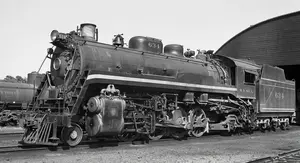
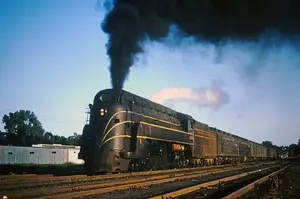
As a late-era design they were also equipped with some of the latest technologies such as Elesco feedwater heaters and roller bearings. Their exterior appearance evoked clean lines and an almost streamlined-like appearance with a rounded tender that nearly sat flush with the cab roof-line.
They also looked powerful sporting the longest wheelbase of any C&O Pacific (more than 36 1/2 feet) and the "Flying Pumps" (air pumps) situated on the smokebox.
This look became a common identifying feature of C&O steam locomotives. With 74-inch drivers the F-19's were intended for low-grade, high-speed service and they excelled at this quite well.
Operation
Over the years the C&O rebuilt or overhauled most of their Pacifics, some to a greater degree than others, which has only been briefly covered here. Thanks to these efforts the railroad never retired any of its 4-6-2s until steam left the roster between 1951 and 1955.
As for the F-19's, they were rebuilt between 1947 and 1948 into the Class L-1 streamlined Hudsons, meant for service on the new Chessie (Washington - Cincinnati). This train was ultimately mothballed before ever entering service but the L-1's nonetheless found a variety of assignments to remain on the roster until 1955.
 Chesapeake & Ohio 4-6-4 #490 (L-1) at Huntington, West Virginia on April 17, 1971. These streamlined Hudsons (five in all) were rebuilt from F-19 Pacific's during the late 1940s for service on the never-launched "Chessie." John Corns photo.
And finally, there was the class of Pacifics often forgotten, the F-20's. These locomotives were not actually C&O designs; with passenger traffic still up following World War II the railroad felt it needed additional power to meet demand and so purchased four examples from the Richmond, Fredericksburg & Potomac.
These locomotives were 1927 products of Baldwin weighing 342,600 pounds with 48,250 pounds of tractive effort and 75-inch drivers. On the RF&P they were numbered 325-328, which was changed to 486-489 under the C&O and re-classed as F-20's.
They were certainly capable machines but as Parker points out, externally looked nothing like a C&O Pacific with a high-mounted headlight, no "flying pumps," and a traditional, square tender among other differences. They usually found assignments between Ashland and Louisville, Kentucky remaining in service until 1951.
Recent Articles


-
Missouri-Kansas-Texas Railroad (Katy): Map, History, Rosters
Oct 27, 26 11:02 PM
 History of the Missouri-Kansas-Texas, the Katy. The race into Indian Territory, Gould, the 1923 railroad, the Texas Special, and the 1988 sale. Steam and diesel rosters are linked.
-
Soo Line Diesel Roster (All-Time)
Oct 27, 26 10:55 PM
 All-time diesel roster of the Soo Line and the Wisconsin Central. 786 locomotives, each frame once. Cab units, Geeps, the Milwaukee Road engines, and the SD60s. The South Shore's 24 stay on that page.
-
Soo Line Steam Roster (Built Since 1900)
Oct 27, 26 10:49 PM
 Soo Line and Wisconsin Central steam locomotives built since 1900. Consolidations, Mikados, Pacifics, 21 Mountains, and four Lima 4-8-4s.
-
Soo Line Railroad: Map, Logo, History, Rosters
Oct 27, 26 10:24 PM
 The Soo Line, from the flour millers' railroad around Chicago to the Sault, the Wisconsin Central, and the Milwaukee Road. Steam quantity 422. Diesels 786. Canadian Pacific took full control in 1990.
-
Minneapolis, Northfield and Southern Railway: Map, History, Rosters
Oct 27, 26 10:32 AM
 The Minneapolis, Northfield & Southern, the Dan Patch Line that became a Twin Cities belt. Steam, gas-electric mules, motor cars, and the 22 diesels, through the Soo Line.
-
Minneapolis & St. Louis Diesel Roster (All-Time)
Oct 27, 26 10:27 AM
 All-time diesel roster of the Minneapolis & St. Louis. 97 locomotives, each frame once. Switchers from 1938, 35 RS-1s, the FT and F-unit cabs, two SD7s, and 23 GP9s. Builder numbers included.
-
Minneapolis & St. Louis Steam Roster (Post 1900)
Oct 27, 26 10:25 AM
 Minneapolis & St. Louis steam locomotives built since 1900. Moguls, Consolidations, 35 Mikados, and five Pacifics.
-
Minneapolis and St Louis Railway: "The Peoria Gateway"
Oct 27, 26 09:52 AM
 The Minneapolis & St. Louis, the Tootin' Louie, from the 1870 charter to the Peoria Gateway and the Chicago & North Western sale on November 1, 1960.
-
Alco "PA" Locomotives: Restoration, Specs, Engine, Rosters
Oct 27, 26 12:12 AM
 Alco's PA passenger cab, 297 locomotives built from 1946 to 1953. The 244 engine, the production roster, the Delaware & Hudson PA-4s, and Nickel Plate Road 190.
-
Milwaukee Road Diesel Roster: (All Time)
Oct 26, 26 01:44 PM
 All-time diesel roster of the Milwaukee Road. 1,208 locomotives, each frame once. Alco, Baldwin, Davenport, EMD, Fairbanks-Morse, General Electric, and Whitcomb, with builder numbers.
-
Milwaukee Road Steam Roster (All-Time): Post-1900
Oct 26, 26 01:38 PM
 Milwaukee Road steam locomotives built since 1900. Prairies, Mikados, the N-class articulateds, the S-class 4-8-4s, and the Hiawatha Atlantics and Hudsons. Quantity column 1,974. Unique frames 1,951.
-
Milwaukee Road: Map, Electrification, Logo, History
Oct 26, 26 01:20 PM
 The Milwaukee Road, from the Milwaukee & Mississippi of 1850 to the Pacific Coast Extension, the Hiawathas, and the Soo Line sale. Why Lines West should have stayed.
-
Lake Superior & Ishpeming Railroad: Map, Roster, History
Oct 25, 26 11:38 PM
 Lake Superior & Ishpeming Railroad, reporting mark LSI, from the Marquette Range to the Presque Isle ore dock. The 1954 steam list and the diesels the railroad owned.
-
Kansas City Southern Steam Roster (Built Since 1900)
Oct 25, 26 09:09 PM
 Steam locomotives of the Kansas City Southern built since 1900, with the Louisiana & Arkansas and the Texas company.
-
Kansas City Southern Diesel Roster (Built New)
Oct 25, 26 11:46 AM
All-time diesel roster of the Kansas City Southern. E units, F units, Geeps, SD40s through SD70ACes, Fairbanks-Morse, Baldwin, Alco, and General Electric, with serials and order numbers. -
Kansas City Southern Railway: Map, Photos, History
Oct 25, 26 12:24 AM
 The Kansas City Southern, from Arthur Stilwell's Gulf line to Canadian Pacific Kansas City on April 14, 2023. Steam and diesel rosters, the Southern Belle, and the Louisiana & Arkansas.
-
Indiana Harbor Belt Diesel Roster (All-Time)
Oct 25, 26 12:17 AM
 All-time diesel roster of the Indiana Harbor Belt. 202 locomotive frames, each counted once. NW2s, SW7s, SW1500s, road switchers, and gensets. Slugs and boosters are outside the count.
-
Indiana Harbor Belt Steam Roster (Built Since 1900)
Oct 25, 26 12:13 AM
 Steam locomotives of the Indiana Harbor Belt built since 1900. 182 engines, each counted once. 0-6-0s, 2-6-0s, 0-8-0s, and 2-8-2s. The three U-4a switchers are three-cylinder Brooks engines of 1927.
-
Indiana Harbor Belt Railroad: Map, Rosters, History
Oct 25, 26 12:00 AM
 Indiana Harbor Belt, the inner belt across the Calumet, from the East Chicago Belt of May 16, 1896. Renamed June 29, 1907. Still operating, headquarters Hammond. Steam roster is the companion, 182 loc…
-
NYC's "P Motor" Electric Locomotives
Oct 24, 26 11:43 PM
 New York Central P motors: 22 Alco-GE 2-C+C-2 electrics, Cleveland Union Terminal 1050–1071, class P-1a. 3,030 hp one-hour on 3,000-volt DC catenary, then 660-volt third rail as P-2a and P-2b.
-
Illinois Terminal Car Roster
Oct 24, 26 11:40 PM
 Illinois Terminal cars. Mainline motors, the 1948 streamliners, sleepers, Alton and Valley Division cars, express motors, and the line cars rebuilt from pull cars.
-
Illinois Terminal Diesel Roster
Oct 24, 26 09:31 PM
 All-time Illinois Terminal diesels, 62 frames. Alco S-2s and RS-1s, EMD switchers, GP7s, SD39s, GP38-2s, and the two GP20s. Serial numbers from the 1989 roster.
-
Illinois Terminal Electric Locomotives
Oct 24, 26 08:22 PM
 Illinois Terminal electric locomotives, 57 frames. Class A through Class D, the Decatur-built motors, and the battery locomotives. Class D is the same five Class C frames, rebuilt.
-
Illinois Terminal Steam Roster
Oct 24, 26 07:37 PM
 Illinois Terminal steam locomotives, 36 frames. Baldwin Moguls, three Class 30 Mikados, Florida East Coast 0-8-0s, and 2-6-0 No. 21, the last fire on June 30, 1950.
-
Illinois Terminal Railroad: Map, Roster, Photos, History
Oct 24, 26 07:32 PM
Illinois Terminal, McKinley's Illinois Traction System, from the Danville coal towns to St. Louis. The McKinley Bridge, the sleeping cars, the 1937 break with the power company, the 1948 streamliners… -
Southern Railway Diesel Roster (All-Time)
Oct 23, 26 11:00 PM
 All-time diesel roster of the Southern Railway. 2,505 locomotives in the system number series, from the 1939 demonstrator FT to GP50s and B30-7A1s. Serials included.
-
Illinois Central Diesel Roster (All-Time)
Oct 23, 26 04:06 PM
Illinois Central and Illinois Central Gulf diesel locomotives, each frame once. The quantity column is 886. Serials and order numbers from Electro-Motive's builder lists. Paducah rebuilds and Gulf, Mo… -
Illinois Central Gulf Diesel Roster
Oct 23, 26 04:02 PM
 Illinois Central Gulf operating numbers from August 10, 1972, to February 29, 1988. New frames stay on the Illinois Central diesel roster. Gulf, Mobile and Ohio frames stay on that roster. No Gulf fle…
-
Illinois Central Railroad: Map, Logo, History
Oct 23, 26 03:50 PM
Illinois Central, the Main Line of Mid-America, from the 1850 land grant to Canadian National control on July 1, 1999. Charter lines, Cairo bridge, Paducah, and the Illinois Central Gulf. Steam quanti… -
Grand Trunk Western Diesel Roster (All-Time)
Oct 23, 26 12:53 PM
 Grand Trunk Western diesel locomotives, each frame once. The quantity column is 377. Serials are filled for the Detroit, Toledo and Ironton and Detroit and Toledo Shore Line engines the railroad kept…
-
Grand Trunk Western Steam Roster
Oct 23, 26 12:14 PM
 Grand Trunk Western steam locomotives in service about 1937 to 1942, from Richard Leonard's class list. Drury has no chapter. The quantity column is the counted Grand Trunk Western rows. Two mixed Gra…
-
Grand Trunk Western Railroad: Map, Roster, History
Oct 23, 26 12:09 PM
 Grand Trunk Western, reporting mark GTW, Canadian National's railroad between Port Huron and Chicago. Trade name adopted in 1923. Steam class list quantity 232. Diesel quantity column 377. Identity in…
-
Green Bay and Western Railroad: Map, Rosters, History
Oct 22, 26 11:18 PM
 Green Bay & Western, the Green Bay Route, reporting mark GBW. From Kewaunee to Winona. Mailer's steam and diesel rosters, and the August 1993 sale to Fox Valley & Western.
-
Chicago & North Western Class E-4: Streamlined 4-6-4 Hudsons
Oct 22, 26 10:28 PM
 C&NW Class E-4, nine streamlined 4-6-4s, 4001–4009, Alco 1938. 84-inch drivers, 25-by-29 cylinders, 300 psi. Conventional Chicago–Omaha trains. Oil in 1947–48. Retired 1953–1956.
-
Gateway Western Railway: Map, Roster, History
Oct 22, 26 02:43 PM
 Gateway Western Railway, reporting mark GWWR. Class II from Kansas City to East St. Louis. Kansas City Southern control May 5, 1997. The 1992 diesel fleet, with serials and order numbers.