
"City of Los Angeles" (Train): Route, Schedule, Timetable
Last revised: February 24, 2025
By: Adam Burns
The City of Los Angeles was just one train in Union Pacific’s premier fleet. The railroad hosted an entire array of plush City trains including the City of Portland, City of Denver, City of Salina (the original M-10000), City of St. Louis, City of San Francisco, and City of Las Vegas.
The City of L.A. was one of the West's most popular streamliners, even though it required two different railroads to complete the Chicago-Los Angeles run. The train was one of the first to enter service following UP's successful M-10000 streamliner and featured incredible on-board accommodations.
As one of the only original Class I's still in operation today, Union Pacific works very hard to maintain, recognize, and honor the company's rich history. They operate historic steam locomotives (including "Big Boy" 4-8-8-4 #4014), maintain a company museum, and still sport the railroad's original Armour Yellow livery.
Today, the City fleet can still be witnessed, in a sense, via UP's official business train The consist not only includes the classic City fleet livery but is also led by original E9s.
Photos
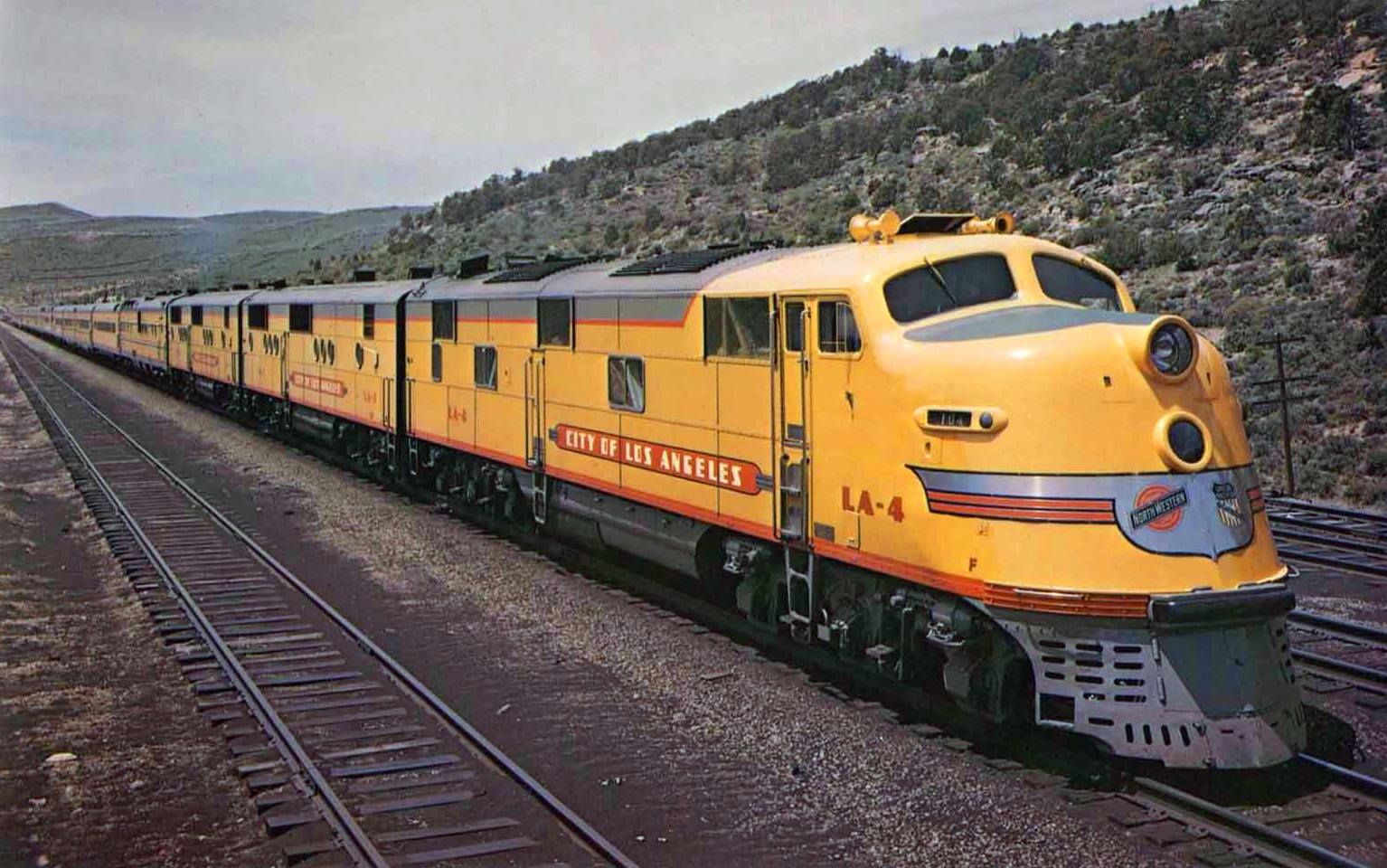 A Union Pacific publicity photo featuring the eastbound "City of Los Angeles" at Aspen, Wyoming in 1941. In the lead is E6A "LA-4" with E2B's "LA-2" and "LA-3" trailing.
History
Union Pacific’s City fleet is credited as the first lightweight streamliner to enter service in the U.S. In 1934 the City of Salina - originally named the M-10000 - debuted as a three-car lightweight trainset.
The railroad was so impressed with the train, and the public response, it purchased seven more sets to serve the far reaches of network throughout the west. As a result, the City fleet was born to serve Denver, San Francisco, Los Angeles, Portland, and later St. Louis.
At A Glance
40 Hours, 45 Minutes (Westbound) 40 Hours, 30 Minutes (Eastbound) |
|
103 (Westbound) 104 (Eastbound) | |
Union Passenger Terminal (Los Angeles) North Western Terminal/Union Station (Chicago) |
The City of Los Angeles entered service on May 15, 1936, originally as the semi-articulated M-10002. In the early 1940s, it was upgraded following a large order of new lightweight, streamlined equipment from Pullman-Standard and American Car & Foundry.
This particular order included some 145 cars, enough to also handle Chicago & North Western's leg of the trip between Omaha-Chicago. From this time, until UP finally discontinued its fleet following the start of Amtrak, the railroad spared no expense in ensuring its trains offered the very best in accommodations.
Timetable (1952)
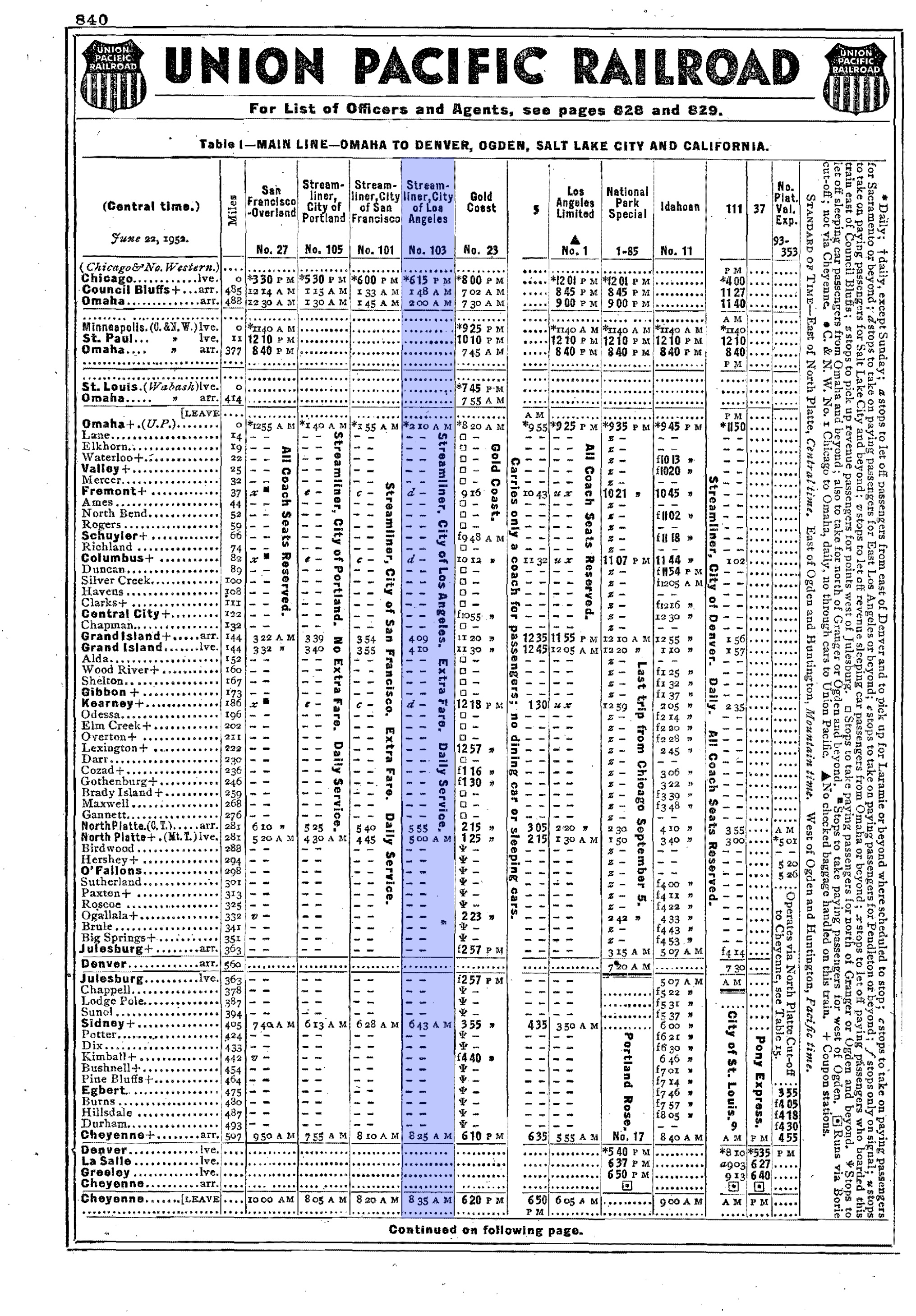
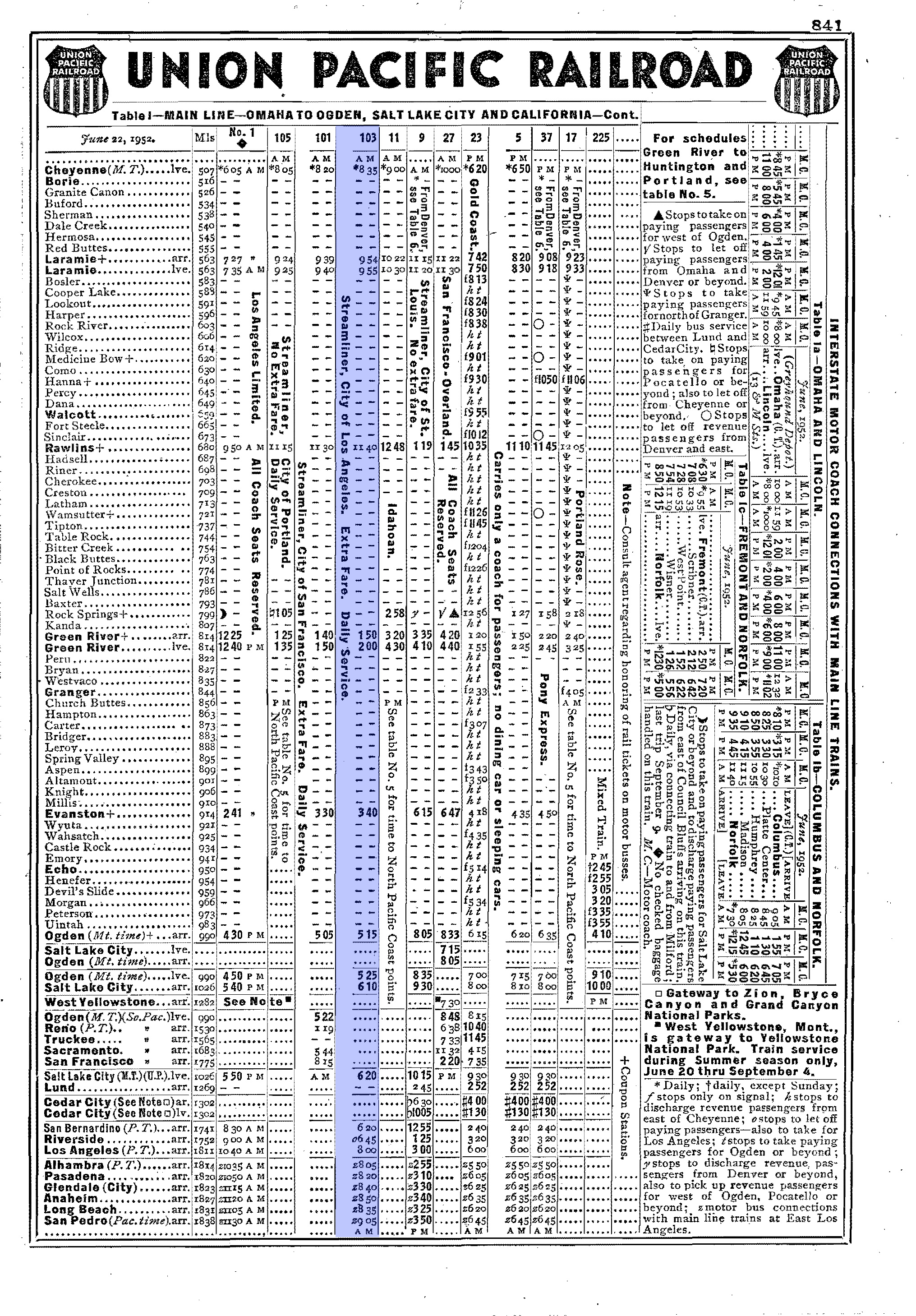
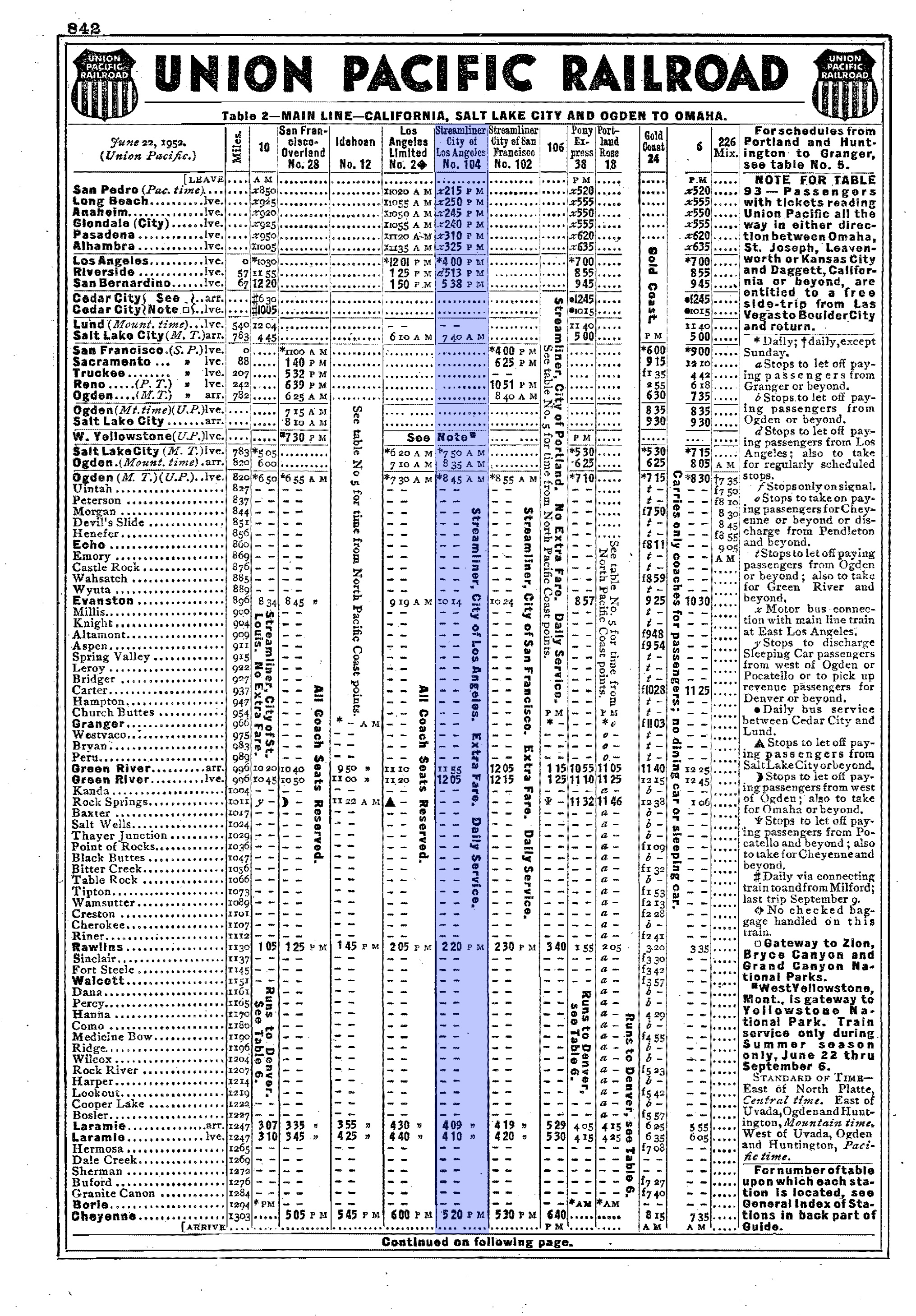
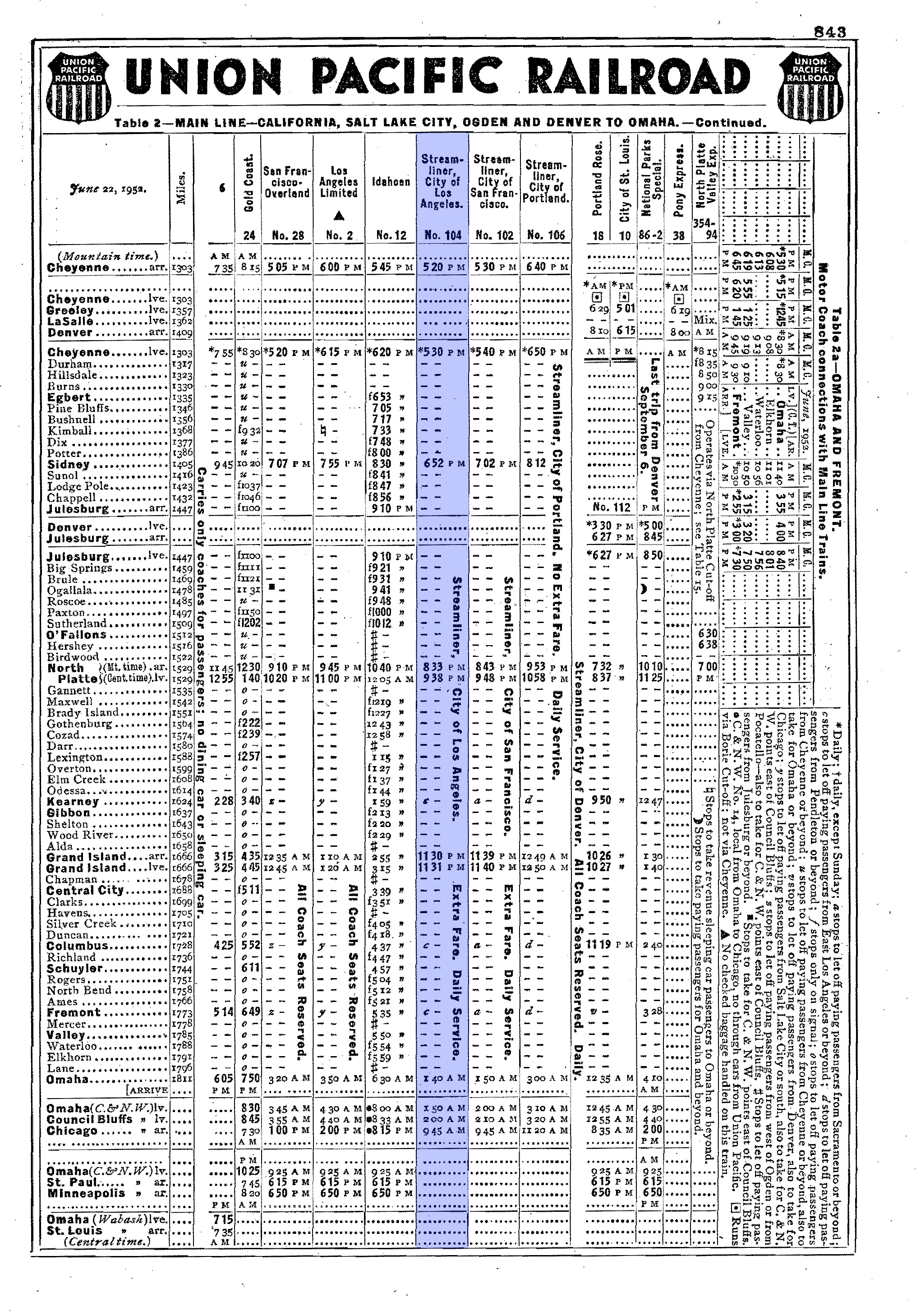
The streamliner craze was just underway when America entered World War II following Japan's bombing of Pearl Harbor on December 7, 1941. In early 1942 the War Production Board placed severe restrictions on not only railroads but also the entire private sector regarding new equipment purchases.
As a result, most wishing to field their own streamliners were forced to wait. However, UP was one of the lucky few that had already placed orders beforehand and as a result was one of the few to showcase new streamlined equipment during the war.
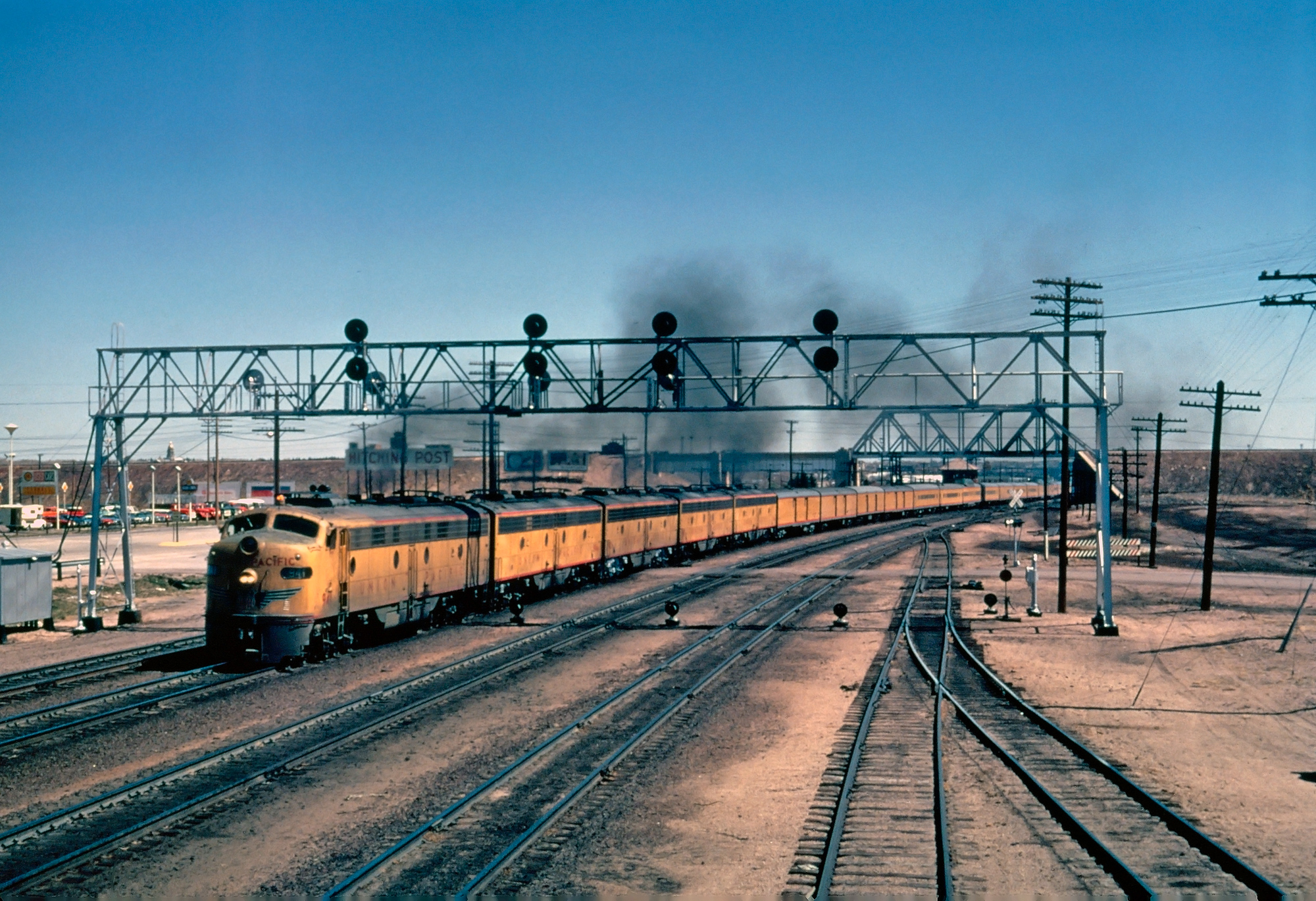 Union Pacific E8A #941 leads the combined "City Of Los Angeles"/"City Of San Francisco" westbound out of Cheyenne, Wyoming, circa 1968. This unit was later sold to the Rock Island (#661) in June, 1969. American-Rails.com collection.
When the City of L.A. launched it originally featured streamlined diesels manufactured from Electro-Motive. These bulbous nose locomotives were part of the manufacturer's early E2 line and the specific carbody design was interestingly never repeated on future models.
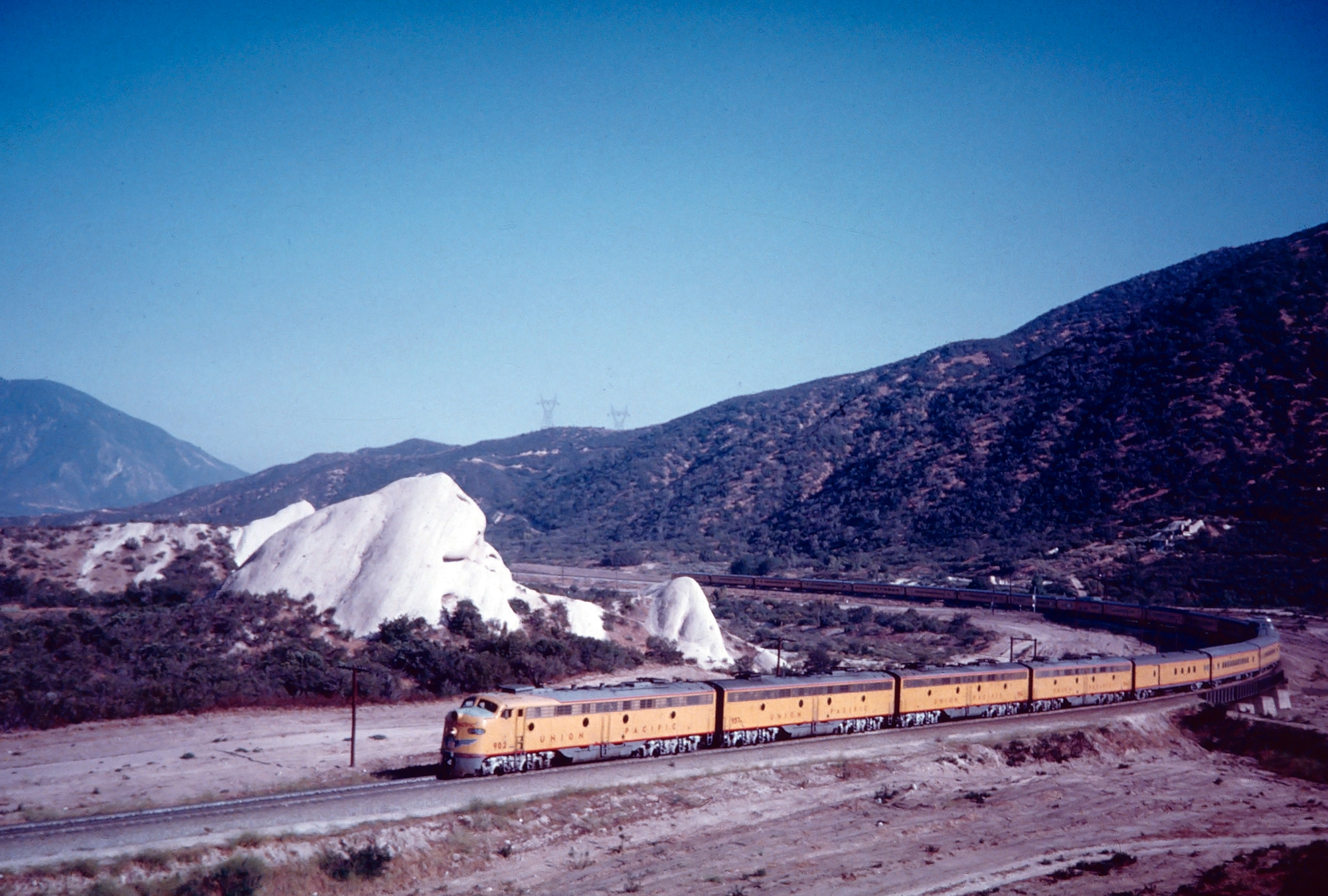 Union Pacific E9A #902 and a trio of "B" units climb Cajon Pass near Alray, California with the eastbound "City of Los Angeles" during the late 1950s. American-Rails.com collection.
The railroad purchased six in total with three used for the City of L.A. - E2A #LA-1 and E2Bs #LA2-LA3. The remaining three were assigened to the City of San Francisco. Just prior to the start of World War II both the City of L.A. and City of S.F. were upgraded with Electro-Motive's latest E6 models.
These particular models were the builder's first stand alone passenger locomotives. They featured the classic slant nose and sold 117 examples before the war halted production. Electro-Motive likely would have sold even more had the global conflict not taken place.
Timetable (June, 1938)
| Read Down Time/Leave (Train #103/Chicago & North Western) | Milepost | Location | Read Up Time/Arrive (Train #104/Chicago & North Western) |
|---|---|---|---|
| 6:15 PM (Dp) | 0.0 | 12:15 PM (Ar) | |
| 8:22 PM | 138 | 10:00 AM | |
| 9:38 PM | 219 | 8:43 AM | |
| 11:31 PM | 340 | 6:50 AM | |
| 1:51 AM (Ar) | 487 | 4:30 AM (Dp) | |
| Time/Leave (Train #103/Union Pacific) | Milepost | Location | Time/Arrive (Train #104/Union Pacific) |
| 2:00 AM (Dp) | 487 | 4:20 AM (Ar) | |
| 4:01 AM | 632 | 2:15 AM | |
| 5:55 AM (Ar) | 769 | 12:29 AM (Dp) | |
| 4:56 AM (Dp) | 769 | 11:28 AM (Ar) | |
| 6:40 AM | 893 | 9:44 PM | |
| 8:25 AM (Ar) | 995 | 8:18 PM (Dp) | |
| 8:35 AM (Dp) | 995 | 8:08 PM (Ar) | |
| 10:00 AM | 1051 | 6:48 PM | |
| 11:47 AM | 1168 | 4:48 PM | |
| 1:57 PM (Ar) | 1302 | 2:35 PM (Dp) | |
| 1:58 PM (Dp) | 1302 | 2:34 PM (Ar) | |
| 3:45 PM | 1402 | 12:53 PM | |
| 5:20 PM (Ar) | 1478 | 11:20 AM (Dp) | |
| 5:30 PM (Dp) | 1478 | 11:07 AM (Ar) | |
| 6:05 PM (Ar) | 1514 | 10:29 AM (Dp) | |
| 6:10 PM (Dp) | 1514 | 10:24 AM (Ar) | |
| 11:23 PM (Ar) | 1839 | 5:04 AM (Dp) | |
| 10:23 PM (Dp) | 1839 | 4:04 AM (Ar) | |
| 1:01 AM (Ar) | 1964 | 1:22 AM (Dp) | |
| 1:06 AM (Dp) | 1964 | 1:17 AM (Ar) | |
| 6:16 AM (Ar) | 2230 | 8:08 PM (Dp) | |
| 6:17 AM (Dp) | 2230 | 8:05 PM (Ar) | |
| 7:37 AM | 2292 | 6:50 PM | |
| 8:00 AM (Ar) | 2298 | 6:30 PM (Dp) |
The original City of L.A. consist featured 14 cars that included such accommodations as a club-dormitory, sleepers, coaches, an observation-lounge, and the train's marquee piece - an articulated diner-coffee shop (the diner section could seat 64). The City of L.A. was also the first streamliner to feature Pullman's new round-end observation, adding to the train's sleek look.
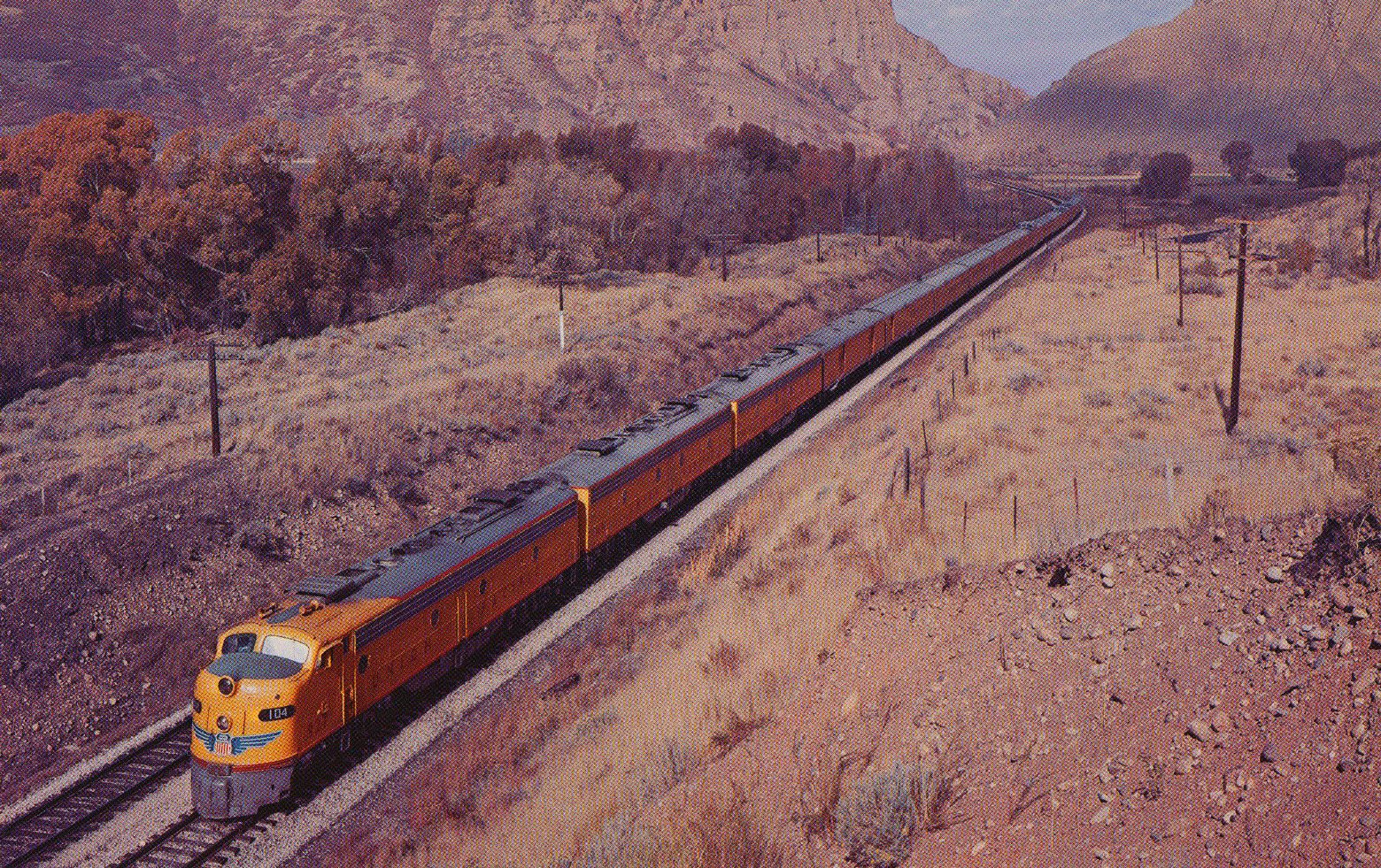 A Union Pacific publicity photo featuring train #104, the eastbound domeliner "City of Los Angeles" (Los Angeles - Chicago), near Henefer, Utah circa 1955. In the lead is E8A #927 while E9B's #969-B and #961-B trail.
While the train boasted a route connecting Los Angeles with the nation’s rail hub in Chicago it needed help in reaching the Windy City. While UP handled the train west of Omaha, its longtime partner Chicago & North Western carried the train - and the entire City fleet - into Chicago.
After UP felt C&NW's service was slipping it began partnering with the Milwaukee after October 30, 1955. This partnership would last until the start of Amtrak although in truth the C&NW as quite happy to discontinue handling the money-losing affair.
The two railroads continued to partner in handling the much more lucrative freight traffic between and by 1980 the Milwaukee Road would largely abandon its Iowa Division into Omaha/Council Bluffs.
Consist (1952)
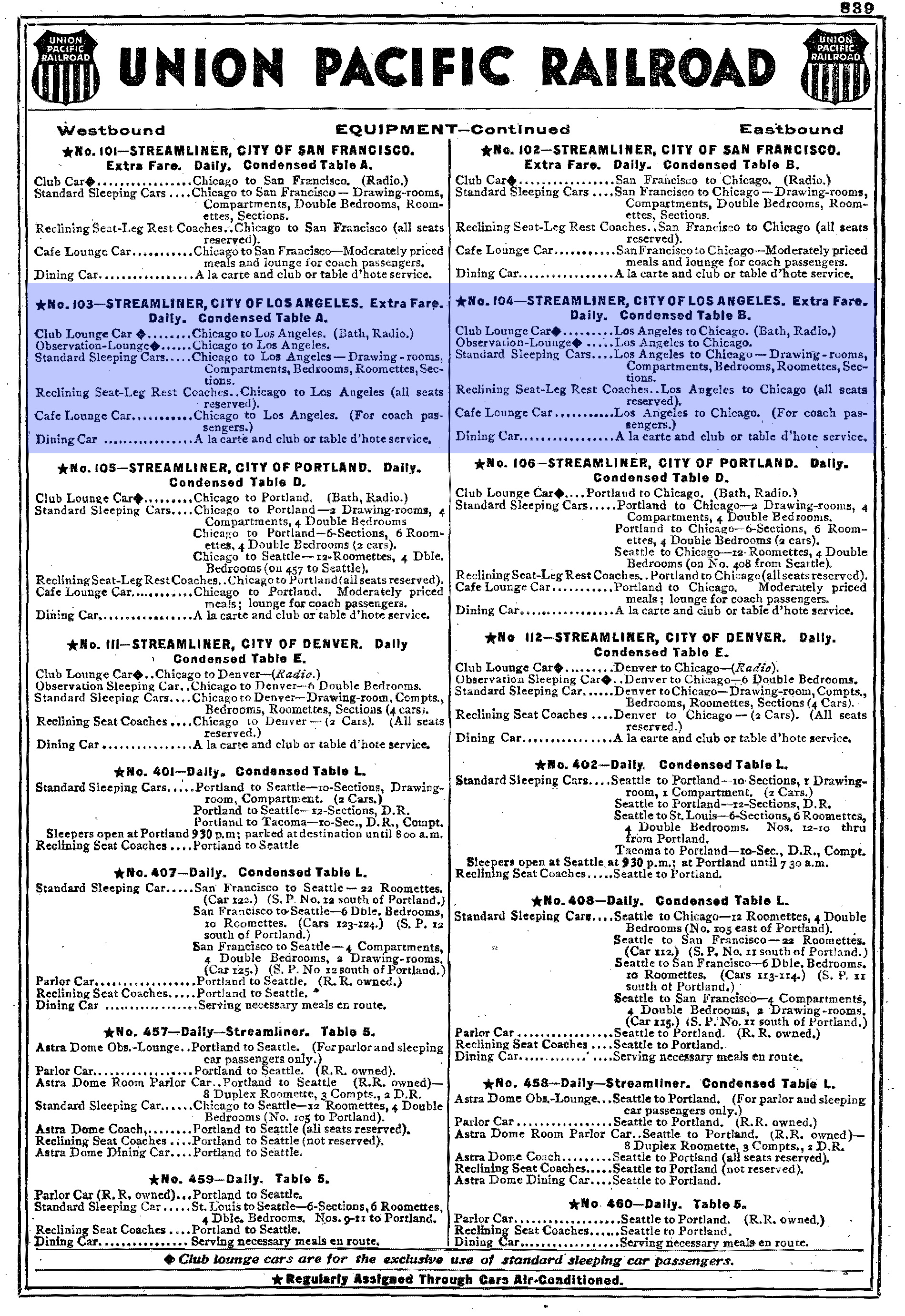
To keep the City of Los Angeles' livery consistent during both the Milwaukee Road's and C&NW's tenures, the equipment featured a matching Armour Yellow and Harbor Mist Grey livery, including locomotives.
Union Pacific continued upgrading its trains throughout the late 1950s, a time when most of the industry had either stopped purchasing new equipment or even began cutting back services.
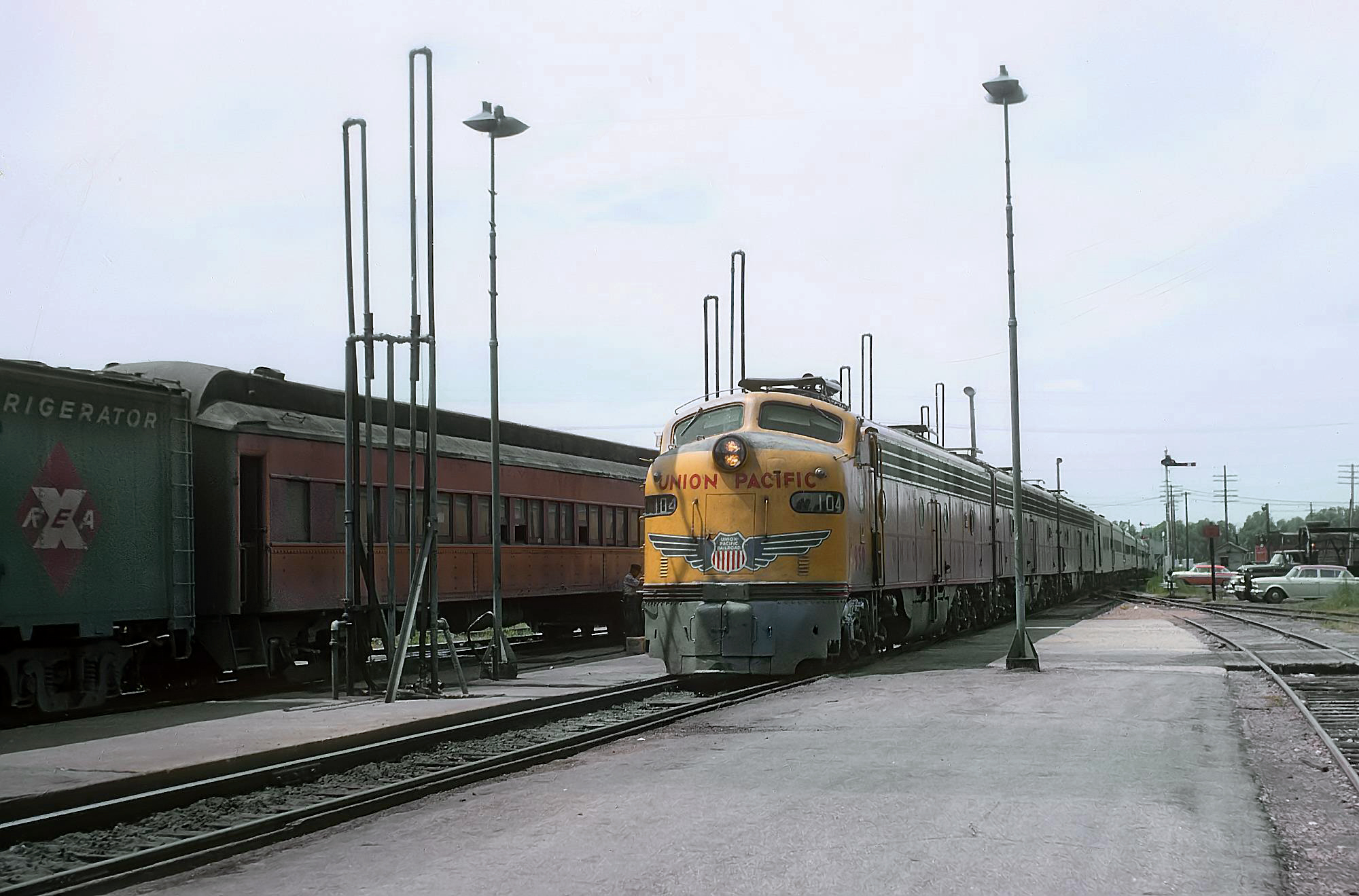 Milwaukee Road's train 104, the "City of Los Angeles," with Union Pacific power ios stopped at Savanna, Illinois in August, 1963. Rick Burn photo.
Between 1954-1958 the railroad acquired 40 new Astra Domes from American Car & Foundry and Pullman-Standard. They came in a variety of configurations - including the only diner domes ever built - and were a big hit with the public.
Between the onboard accommodations and services offered - such as shower-baths and barber shops - it is no wonder that so many famous Hollywood celebrities chose City trains for their travels. Union Pacific was one of just a handful of railroads which continued to enjoy strong ridership throughout the 1950s.
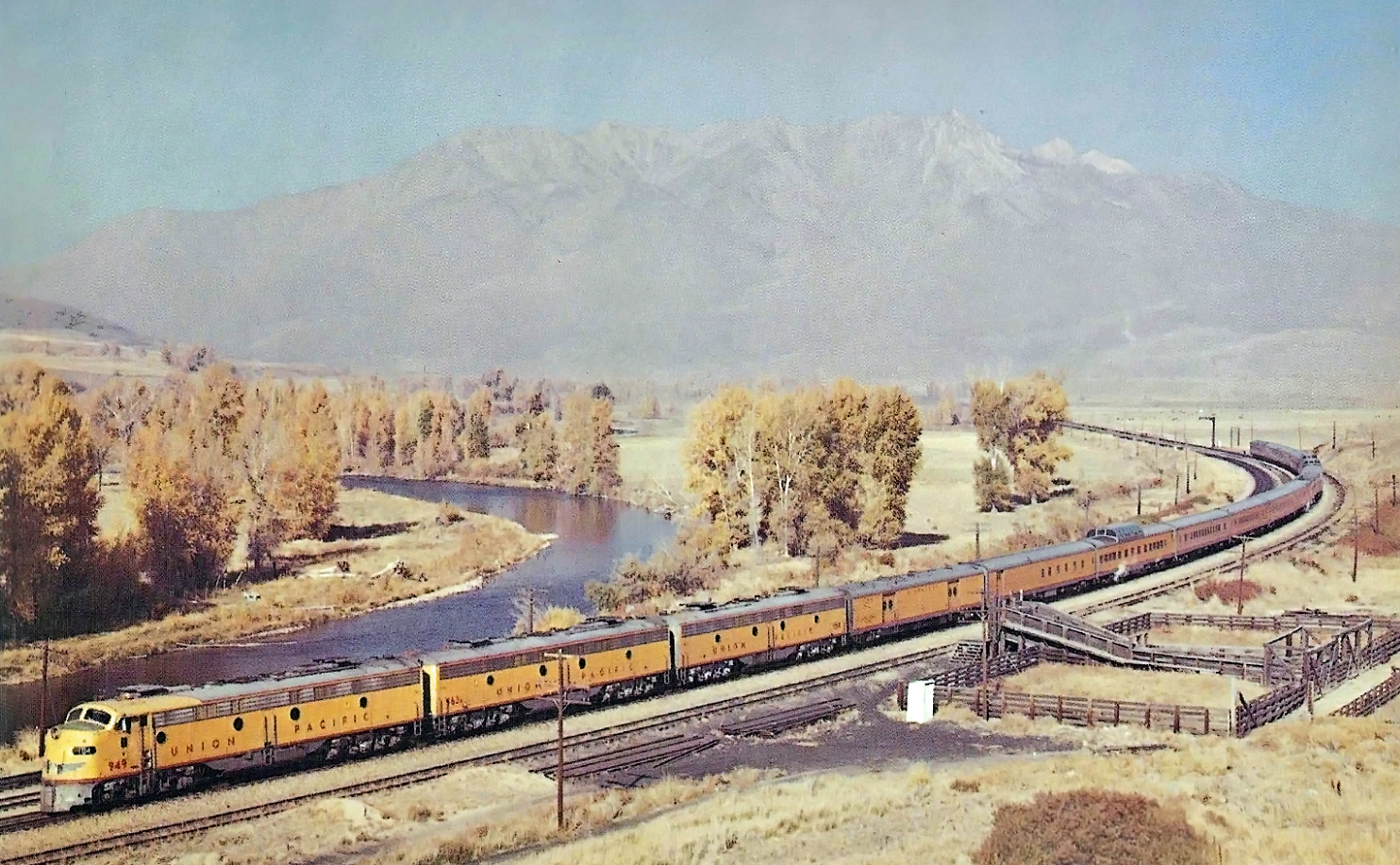 A Union Pacific publicity photo featuring the "City of Los Angeles" heading eastward away from Ogden, Utah along the Weber River in 1959.
Timetable (1956)
(The below City Of Los Angeles timetable is dated effective June of 1956. Note that by this date UP had switched to the Milwaukee Road as its Chicago connection.)
| Read Down Time/Leave (Train #103/Milwaukee Road) | Milepost | Location | Read Up Time/Arrive (Train #104/Milwaukee Road) |
|---|---|---|---|
| 6:45 PM (Dp) | 0.0 | 11:00 AM (Ar) | |
| 8:53 PM (Ar) | 138 | 8:32 AM (Dp) | |
| 8:59 PM (Dp) | 138 | 8:25 AM (Ar) | |
| 10:25 PM | 227 | 7:04 AM | |
| 12:20 AM (Ar) | 362 | 4:56 AM (Dp) | |
| 12:25 AM (Dp) | 362 | 4:51 AM (Ar) | |
| 3:00 AM (Ar) | 487 | 2:45 AM (Dp) | |
| Time/Leave (Train #103/Union Pacific) | Milepost | Location | Time/Arrive (Train #104/Union Pacific) |
| 3:10 AM (Dp) | 487 | 2:30 AM (Ar) | |
| 5:09 AM (Ar) | 632 | 12:20 AM (Dp) | |
| 5:10 AM (Dp) | 632 | 12:19 AM (Ar) | |
| 6:55 AM (Ar) | 769 | 10:28 PM (Dp) | |
| 6:00 AM (Dp) | 769 | 9:23 PM (Ar) | |
| 7:43 AM (Ar) | 893 | 7:42 PM (Dp) | |
| 7:44 AM (Dp) | 893 | 7:41 PM (Ar) | |
| 9:30 AM (Ar) | 995 | 6:20 PM (Dp) | |
| 9:40 AM (Dp) | 995 | 6:10 PM (Ar) | |
| 11:00 AM (Ar) | 1051 | 4:50 PM (Dp) | |
| 11:01 AM (Dp) | 1051 | 4:49 PM (Ar) | |
| 12:55 PM (Ar) | 1168 | 2:55 PM (Dp) | |
| 12:56 PM (Dp) | 1168 | 2:54 PM (Ar) | |
| 3:15 PM (Ar) | 1302 | 12:35 PM (Dp) | |
| 3:25 PM (Dp) | 1302 | 12:25 PM (Ar) | |
| 5:06 PM | 1402 | 10:44 AM | |
| 6:45 PM (Ar) | 1478 | 9:10 AM (Dp) | |
| 6:55 PM (Dp) | 1478 | 9:00 AM (Ar) | |
| 7:40 PM (Ar) | 1514 | 8:15 AM (Dp) | |
| 7:50 PM (Dp) | 1514 | 8:05 AM (Ar) | |
| 10:51 PM (Ar) | 1721 | 4:58 AM (Dp) | |
| 10:54 PM (Dp) | 1721 | 4:55 AM (Ar) | |
| 2:30 AM (Ar) | 1964 | 11:20 AM (Dp) | |
| 2:40 AM (Dp) | 1964 | 11:10 AM (Ar) | |
| 7:45 AM (Ar) | 2230 | 6:08 PM (Dp) | |
| 7:50 AM (Dp) | 2230 | 6:03 PM (Ar) | |
| 8:10 AM | 2240 | 5:43 PM | |
| 9:10 AM | 2292 | 4:50 PM | |
| 9:30 AM (Ar) | 2298 | 4:30 PM (Dp) |
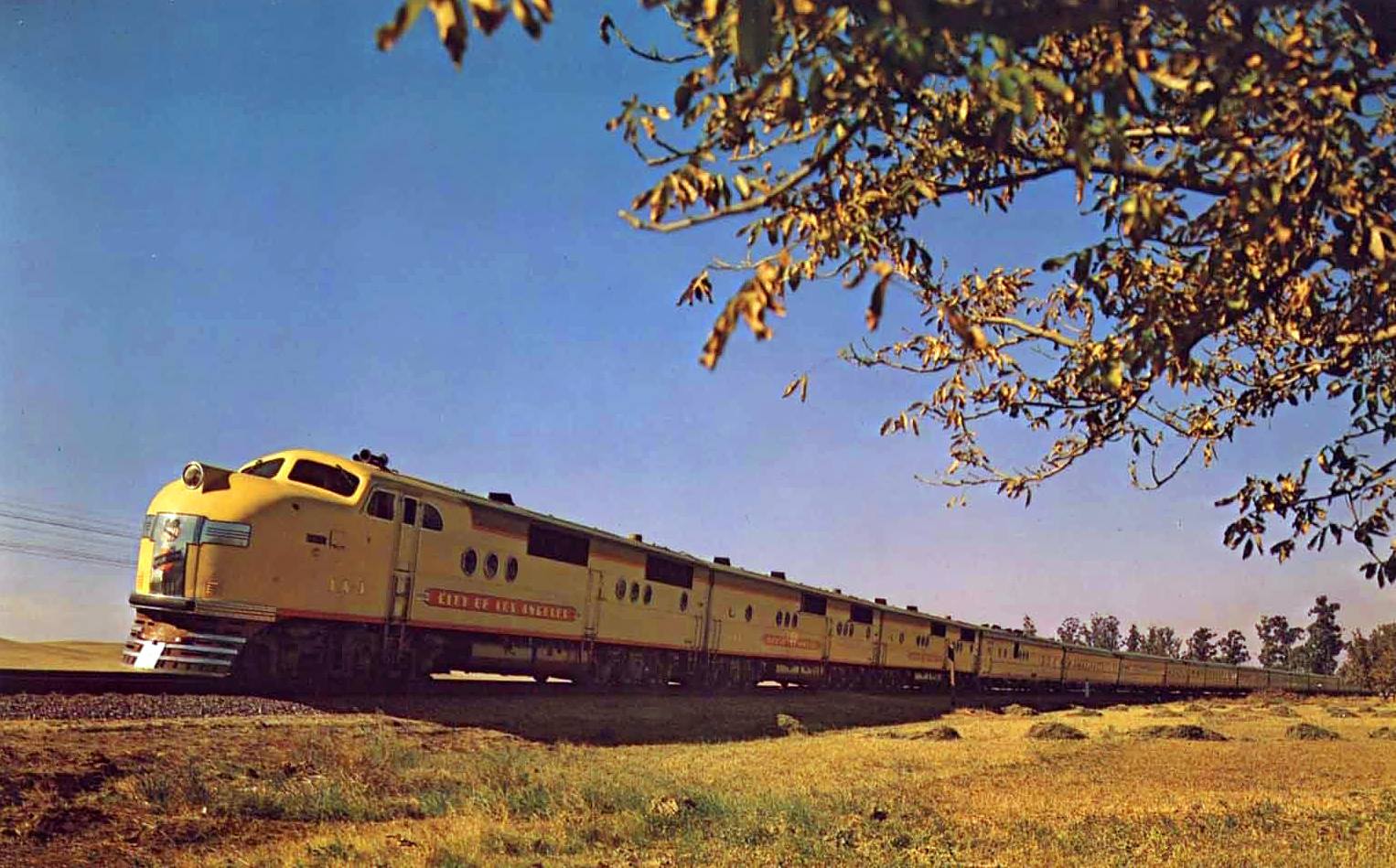 A Union Pacific publicity photo featuring the "City Of Los Angeles," led by E2A "LA-1" with E2B's "LA-2" and "LA-3" trailing, posed somewhere in California circa 1939.
Final Years
Ridership was so high at this time the railroad still operated two westbounds (Trains #103 and #107) and eastbounds (Trains #104 and #108) daily. The train at this time typically could make the run in about 40 hours carrying an average train speed of nearly 57 mph.
There was also through sleeper service available on both the Pennsylvania and New York Central railroads to New York City via Chicago. Through the end, the City of Los Angeles continued to maintain an all matching consist.
By the late 1960s the City of L.A. was down to just an eastbound and westbound run - at which time most of its counterparts had been combined into one massive train east of Cheyenne. Union Pacific's services remained high until the end when trains made their final run on April 30/May 1, 1971.
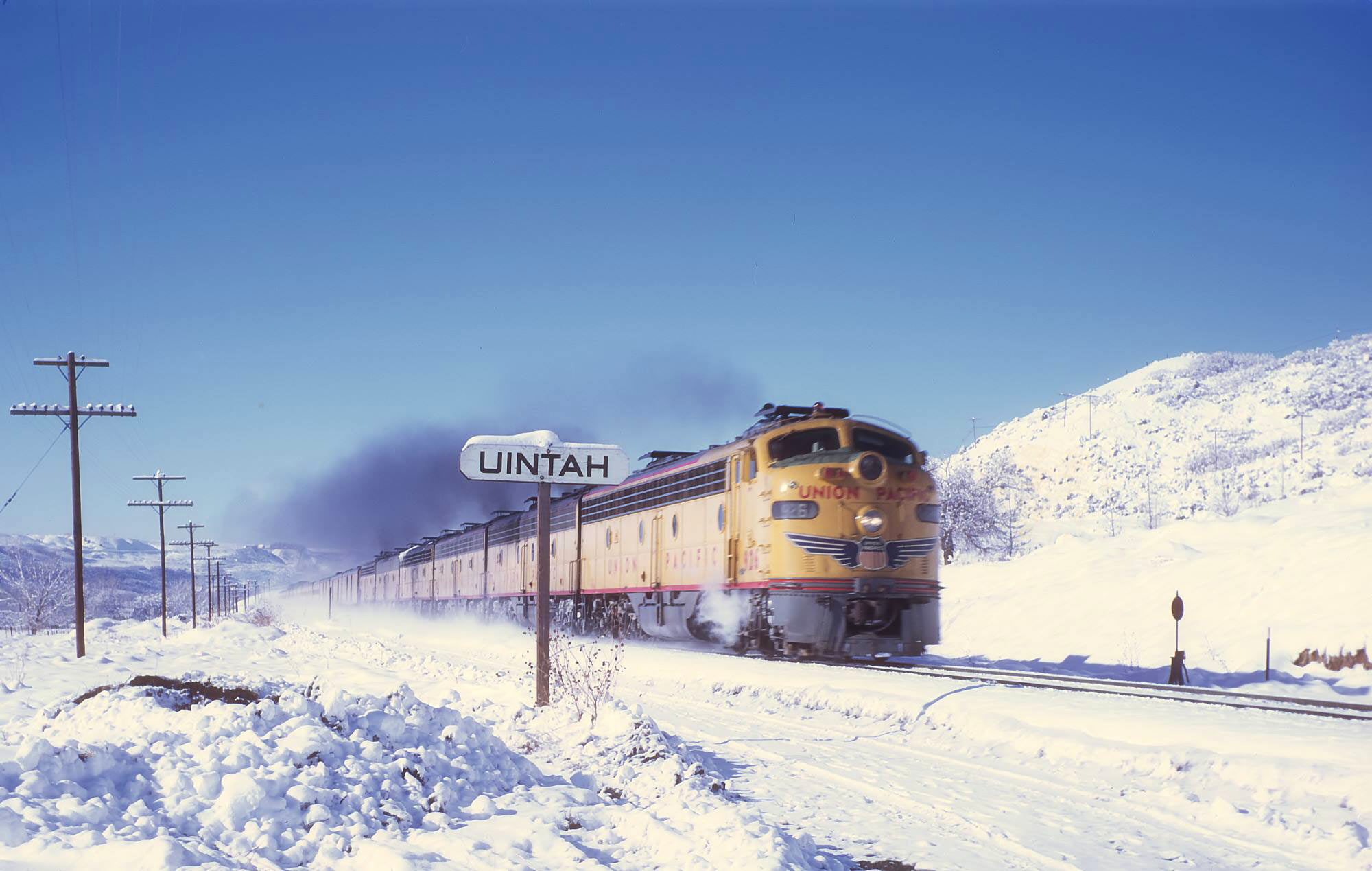 Union Pacific E9A #926 has train #114, the "City of Los Angeles," at Uintah, Utah; January, 1971. Rick Burn photo.
Sources
- Burns, A.J. and Dawson, Leslie. Official Guide Of The Railways And Steam Navigation Lines Of The United States, Porto Rico, Canada, Mexico, and Cuba, The. Volume 85. Issue 3. Pages 839-843. New York: National Railway Publication Company, 1952.
- Johnston, Bob and Welsh, Joe. Art Of The Streamliner, The. New York: Andover Junction Publications, 2001.
- Schafer, Mike and Welsh, Joe. Streamliners, History of a Railroad Icon. St. Paul: MBI Publishing, 2003.
- Solomon, Brian. Streamliners: Locomotives And Trains In The Age Of Speed And Style. Minneapolis: Voyageur Press, 2015.
- Welsh, Joe and Holland, Kevin. Union Pacific Railroad. Minneapolis: Voyageur Press, 2009.
Recent Articles


-
Tennessee's - Wine Tasting - Train Rides
Jan 26, 26 12:44 AM
 One of the most unique and enjoyable ways to savor the flavors of Tennessee’s vineyards is by train aboard the Tennessee Central Railway Museum.
 -
Texas's Thomas The Train Rides
Jan 25, 26 01:41 PM
 In the heart of Texas, where everything is said to be bigger and bolder, lies an event that captures the imagination of children and families alike - A Day Out With Thomas.
 -
New York's Thomas The Train Rides
Jan 25, 26 01:37 PM
 These events, part of a national tour, are crafted for young Thomas fans and their families to enjoy an immersive experience filled with adventure, nostalgia, and sheer joy.
 -
Connecticut's Dinner Train Rides In Essex!
Jan 25, 26 01:34 PM
 Connecticut's rail heritage can be traced back to the industry's earliest days and a few organizations preserve this rich history by offering train rides. The Essex Steam Train also hosts dinner-theme…
 -
Minnesota's Dinner Train Rides In Duluth!
Jan 25, 26 01:25 PM
 One of the best ways to feel the region's history in motion today is aboard the North Shore Scenic Railroad (NSSR), which operates out of Duluth’s historic depot.
 -
North Carolina's - Wine Tasting - Train Rides
Jan 25, 26 01:18 PM
 A noteworthy way to explore North Carolina's beauty is by hopping aboard the Great Smoky Mountains Railroad and sipping fine wine!
 -
Nevada's - Wine Tasting - Train Rides
Jan 25, 26 01:13 PM
 While it may not be the first place that comes to mind when you think of wine, you can sip this delight by train in Nevada at the Nevada Northern Railway.
 -
New Hampshire's - Wine Tasting - Train Rides
Jan 25, 26 01:02 PM
 This article details New Hampshire's most enchanting wine tasting trains, where every sip is paired with breathtaking views and a touch of adventure.
 -
Front Range Passenger Rail [Fort Collins-Pueblo, CO]
Jan 25, 26 12:59 PM
 Front Range Passenger Rail is a proposed project to link Fort Collins to Pueblo, Colorado by rail via Denver and Boulder. It hopes to be operational by the early 2030s.
 -
Indiana "Valentine's" Train Rides
Jan 24, 26 12:53 PM
 If you’ve ever wished you could step into a time when passenger trains were a Saturday-night treat and a whistle echoing across farm fields meant “adventure,” the Nickel Plate Express delivers that fe…
 -
Ohio "Valentine's" Train Rides!
Jan 24, 26 12:46 PM
 The Hocking Valley Scenic Railway offers one of the region’s most atmospheric ways to experience the Hocking Hills area: from the rhythmic click of jointed rail to the glow of vintage coaches rolling…
 -
Arkansas "Dinner Train" Rides On The A&M!
Jan 24, 26 12:40 PM
 If you want a railroad experience that feels equal parts “working short line” and “time machine,” the Arkansas & Missouri Railroad delivers in a way few modern operations can.
 -
North Carolina's Dinner Train Rides At NCTM!
Jan 24, 26 12:34 PM
 Tucked into the Piedmont town of Spencer, the North Carolina Transportation Museum is the kind of place that feels less like a typical museum and more like a living rail yard that never quite stopped…
 -
Colorado's Thomas The Train Rides
Jan 24, 26 12:30 PM
One of the most picturesque locations to see the beloved Thomas the Tank Engine is Colorado at the Colorado Railroad Museum in Golden. -
Iowa's Thomas The Train Rides
Jan 24, 26 12:26 PM
This article explores the magical journey of spending a day with Thomas and what families can expect from this unforgettable experience in Iowa. -
New Jersey's - Wine Tasting - Train Rides
Jan 24, 26 12:21 PM
 If you're seeking a unique outing or a memorable way to celebrate a special occasion, wine tasting train rides in New Jersey offer an experience unlike any other.
 -
Missouri's - Wine Tasting - Train Rides
Jan 24, 26 12:19 PM
 The fusion of scenic vistas, historical charm, and exquisite wines is beautifully encapsulated in Missouri's wine tasting train experiences.
 -
Minnesota's - Wine Tasting - Train Rides
Jan 24, 26 12:17 PM
 This article takes you on a journey through Minnesota's wine tasting trains, offering a unique perspective on this novel adventure.
 -
Massachusetts's - Wine Tasting - Train Rides
Jan 24, 26 12:17 PM
 This article dives into some of the alluring aspects of wine by rail in Massachusetts, currently offered by the Cape Cod Central Railroad.
 -
Kentucky ~ Murder Mystery ~ Dinner Train Rides
Jan 24, 26 12:13 PM
 In the realm of unique travel experiences, Kentucky offers an enchanting twist that entices both locals and tourists alike: murder mystery dinner train rides.
 -
Utah ~ Murder Mystery ~ Dinner Train Rides
Jan 24, 26 12:12 PM
 This article highlights the murder mystery dinner trains currently avaliable in the state of Utah!
 -
North Carolina Scenic Train Rides At The GSMR!
Jan 23, 26 11:47 AM
 The Great Smoky Mountains Railroad (GSMR) has become one of the flagship heritage rail experiences in the Southeast.
 -
Ohio Scenic Train Rides In Nelsonville!
Jan 23, 26 11:42 AM
 The Hocking Valley Scenic Railway (HVSR) offers something rare in today’s world: the chance to experience a working slice of 19th- and 20th-century railroading on an historic right-of-way.
 -
Tennessee "Dinner Train Rides" At The TVRM!
Jan 23, 26 10:59 AM
 Tucked into East Chattanooga, the Tennessee Valley Railroad Museum (TVRM) is less a “museum you walk through” and more a railroad you step aboard.
 -
California "Dinner Train Rides" In Sacramento!
Jan 23, 26 10:36 AM
 Just minutes from downtown Sacramento, the River Fox Train has carved out a niche that’s equal parts scenic railroad, social outing, and “pick-your-own-adventure” evening on the rails.
 -
New Jersey Valentine's Train Rides
Jan 23, 26 10:35 AM
 Today, the Cape May Seashore Lines (CMSL) operates as a short line railroad in Cape May and Atlantic counties, offering both freight and excursion options, including for Valentine's Day!
 -
Wisconsin Valentine's Train Rides
Jan 23, 26 10:27 AM
 The Wisconsin Great Northern Railroad offers one of the Midwest’s most immersive “classic train travel” experiences—complete with restored vintage cars, onboard dining, and a route that feels purpose…
 -
Alabama ~ Murder Mystery ~ Dinner Train Rides
Jan 23, 26 10:26 AM
 There is currently one location in the state offering a murder mystery dinner experience, the Wales West Light Railway!
 -
Rhode Island ~ Murder Mystery ~ Dinner Train Rides
Jan 23, 26 10:17 AM
 Let's dive into the enigmatic world of murder mystery dinner train rides in Rhode Island, where each journey promises excitement, laughter, and a challenge for your inner detective.
 -
Nevada ~ Murder Mystery ~ Dinner Train Rides
Jan 22, 26 10:23 AM
 Seamlessly blending the romance of train travel with the allure of a theatrical whodunit, these excursions promise suspense, delight, and an unforgettable journey through Nevada’s heart.
 -
West Virginia ~ Murder Mystery ~ Dinner Train Rides
Jan 22, 26 10:20 AM
 For those looking to combine the allure of a train ride with an engaging whodunit, the murder mystery dinner trains offer a uniquely thrilling experience.
 -
North Carolina's Thomas The Train Rides
Jan 22, 26 10:17 AM
North Carolina is one of the few states home to two different Thomas the Tank Engine events. Learn more about them here! -
Washington's Thomas The Train Rides
Jan 22, 26 10:14 AM
This article will take you on a detailed journey through A Day Out With Thomas events held in Washington, offering insights into what makes this experience extraordinary for families and railroad enth… -
Kentucky "Valentine's" Train Rides
Jan 22, 26 10:12 AM
 If you’re looking for a date night that feels a little more cinematic than the usual reservation-and-a-movie routine, Bardstown’s My Old Kentucky Dinner Train delivers the kind of evening you remember…
 -
North Carolina "Valentine's" Train Rides
Jan 22, 26 10:09 AM
 While GSMR is widely known for warm-weather gorge trips and its hugely popular holiday trains, it also offers one of the most charming winter date-night ideas in the Smokies: a Valentine’s Day dinner…
 -
Pennsylvania "Valentine's" Train Rides
Jan 22, 26 10:01 AM
 Tucked amid the rolling farmland of Lancaster County, Pennsylvania, the Strasburg Rail Road stands as one of the most celebrated and successful heritage railroads in North America.
 -
Tennessee "Valentine's" Train Rides
Jan 22, 26 09:59 AM
 If you’re looking for a Valentine’s date night that feels different—equal parts elegant dinner and living-history railroading—the Tennessee Valley Railroad Museum offers just that.
 -
Kansas ~ Murder Mystery ~ Dinner Train Rides
Jan 21, 26 01:40 PM
 Kansas, known for its sprawling wheat fields and rich history, hides a unique gem that promises both intrigue and culinary delight—murder mystery dinner trains.
 -
Florida ~ Murder Mystery ~ Dinner Train Rides
Jan 21, 26 01:05 PM
 Florida, known for its vibrant culture, dazzling beaches, and thrilling theme parks, also offers a unique blend of mystery and fine dining aboard its murder mystery dinner trains.
 -
New Hampshire ~ Murder Mystery ~ Dinner Train Rides
Jan 21, 26 12:07 PM
 The state's murder mystery trains stand out as a captivating blend of theatrical drama, exquisite dining, and scenic rail travel.
 -
New Jersey Dinner Train Rides In Woodstown
Jan 21, 26 11:20 AM
 For visitors who love experiences (not just attractions), Woodstown Central’s dinner-and-dining style trains have become a signature offering—especially for couples’ nights out, small friend groups, a…
 -
Montana's Dinner Train Rides Near Lewistown!
Jan 21, 26 10:40 AM
 The Charlie Russell Chew Choo turns an ordinary rail trip into an evening event: scenery, storytelling, live entertainment, and a hearty dinner served as the train rumbles across trestles and into a t…
 -
Kansas Valentine's Train Rides
Jan 21, 26 10:09 AM
 While the railroad’s regular-season excursions are a big draw, the A&SV also shines with its calendar of themed trains—none more romantic than its Valentine’s Day special.
 -
Alabama Valentine's Train Rides
Jan 21, 26 09:39 AM
 The Heart of Dixie Railroad Museum (HoDRM) is the kind of place where history isn’t parked behind ropes—it moves. This includes Valentine's Day weekend, where the museum hosts a wine pairing special.
 -
Wisconsin's Dinner Train Rides In North Freedom!
Jan 20, 26 01:55 PM
 Featured here is a practical guide to Mid-Continent’s dining train concept—what the experience is like, the kinds of menus the museum has offered, and what to expect when you book.
 -
New York's Dinner Train Rides In The Adirondacks!
Jan 20, 26 12:41 PM
 Operating over a restored segment of the former New York Central’s Adirondack Division, the Adirondack Railroad has steadily rebuilt both track and public interest in passenger rail across the region.
 -
Pennsylvania "Dinner Train" Rides In Boyertown!
Jan 20, 26 12:04 PM
 With beautifully restored vintage equipment, carefully curated menus, and theatrical storytelling woven into each trip, the Colebrookdale Railroad offers far more than a simple meal on rails.
 -
New York ~ Murder Mystery ~ Dinner Train Rides
Jan 20, 26 12:03 PM
 New York State, renowned for its vibrant cities and verdant countryside, offers a plethora of activities for locals and tourists alike, including murder mystery train rides!
 -
Pennsylvania ~ Murder Mystery ~ Dinner Train Rides
Jan 20, 26 11:48 AM
Pennsylvania, steeped in history and industrial heritage, offers a prime setting for a unique blend of dining and drama: the murder mystery dinner train ride. -
Florida Valentine's Train Rides
Jan 20, 26 11:46 AM
 For couples looking for something different this Valentine’s Day, the museum’s signature romantic event is back: the Valentine Limited, returning February 14, 2026—a festive evening built around a tra…









%20in%20June%2C%201969.%20%20American-Rails.com%20collection.)

%2C%20near%20Henefer%2C%20Utah%20circa%201955.%20In%20the%20lead%20is%20E8A%20%23927%20while%20E9B's%20%23969-B%20and%20%23961-B%20trail.)

