
Class 1 Railroads (USA): Revenue, Statistics, Overview
Last revised: February 27, 2025
By: Adam Burns
The history of the Class 1 railroad traces back to our country's first common-carrier, the Baltimore & Ohio. During the next century more than 140 such systems came to serve this great country.
After World War II a series of mergers, bankruptcies, and takeovers reduced the number to the current seven.
These enormous operations are spread throughout North America and include Canadian National, Canadian Pacific Kansas City, CSX Transportation, Norfolk Southern, Union Pacific, and BNSF Railway.
There was a major shakeup in the North American rail map following CP's announcement on March 21, 2021 that it would acquire KCS. The new railroad became known as Canadian Pacific-Kansas City.
Interestingly, rival Canadian National had soon made a counterproposal of $33.6 billion to acquire KCS. It appeared CN would be the winning bidder before Surface Transportation Board unanimously rejected the proposal on August 31, 2021, paving the way once more for the CP-KCS union.
As the industry leaders these six Class 1's contain the most trackage, largest annual operating revenue, greatest number of employees, and newest locomotives.
With annual earnings in the billions Class 1's are always at the forefront of technology and innovation. The long-held dream since the early 20th century has been the creation of a true, transcontinental railroad. To date this hope remains elusive.
However, the chances are high that one day two gigantic railroads linking the Pacific and Atlantic Oceans will eventually become a reality.
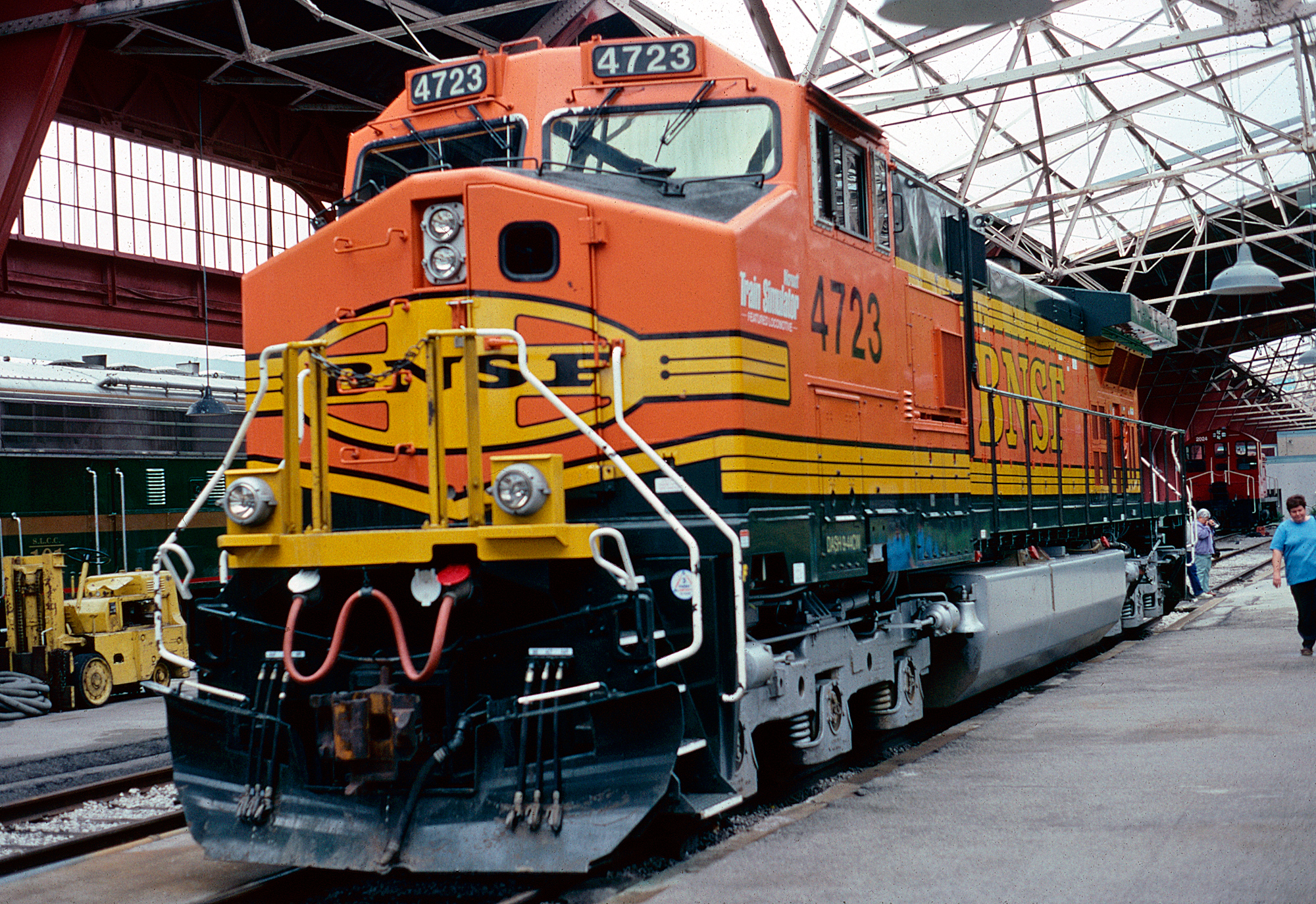 Burlington Northern Santa Fe C44-9W #4723, the official Microsoft Train Simulator locomotive, is seen here on display at St. Louis Union Station in May, 2001. American-Rails.com collection.
Definition and Revenue
While the monetary figure designating a Class 1 has changed over time its principal meaning has remained the same; it is the largest railroad, in terms of annual operating revenue, based in either the United State or Canada.
During the industry's classic era, predating the 1970's, such a carrier could have been only a few hundred miles in length as long as it met the minimum operating revenue.
Small names then like the Detroit & Mackinac, Lehigh & Hudson River, Green Bay & Western, and Spokane International all earned sufficient revenue to wear the designation of Class 1.
Today, this has vastly changed as no railroad smaller than Canadian Pacific-Kansas City's 20,000 route miles holds such a title.
As of 2021, the Association of American Railroads (AAR) defines a Class 1 as having operating revenues of, or exceeding, $900 million annually (previously the figure had been $505 million).
At A Glance
The association also notes, "...[Class 1's] contain 69% of the industry’s mileage, 90% of its employees, and 94% of its freight revenue.
They operate in 44 states and the District of Columbia and concentrate largely on long-haul, high-density intercity traffic."
(The latter point is a stark change from years ago when railroads sought local and less-than-carload, or LCL, business.)
History
In 1939 a premier U.S. railroad was defined as having annual operating revenues of at least $1 million. However, this figure has been updated several times over the years to meet inflation and other market factors.
For instance, in 1956 it was revised to $3 million, $5 million in 1965, $10 million in 1976, $50 million in 1978, $250 million in 1993, $319.3 million in 2005, $475.5 million in 2014, and $505 million in 2019.
As railroads felt the pinch of federal regulation and competition they turned to merger as a way of reducing costs.
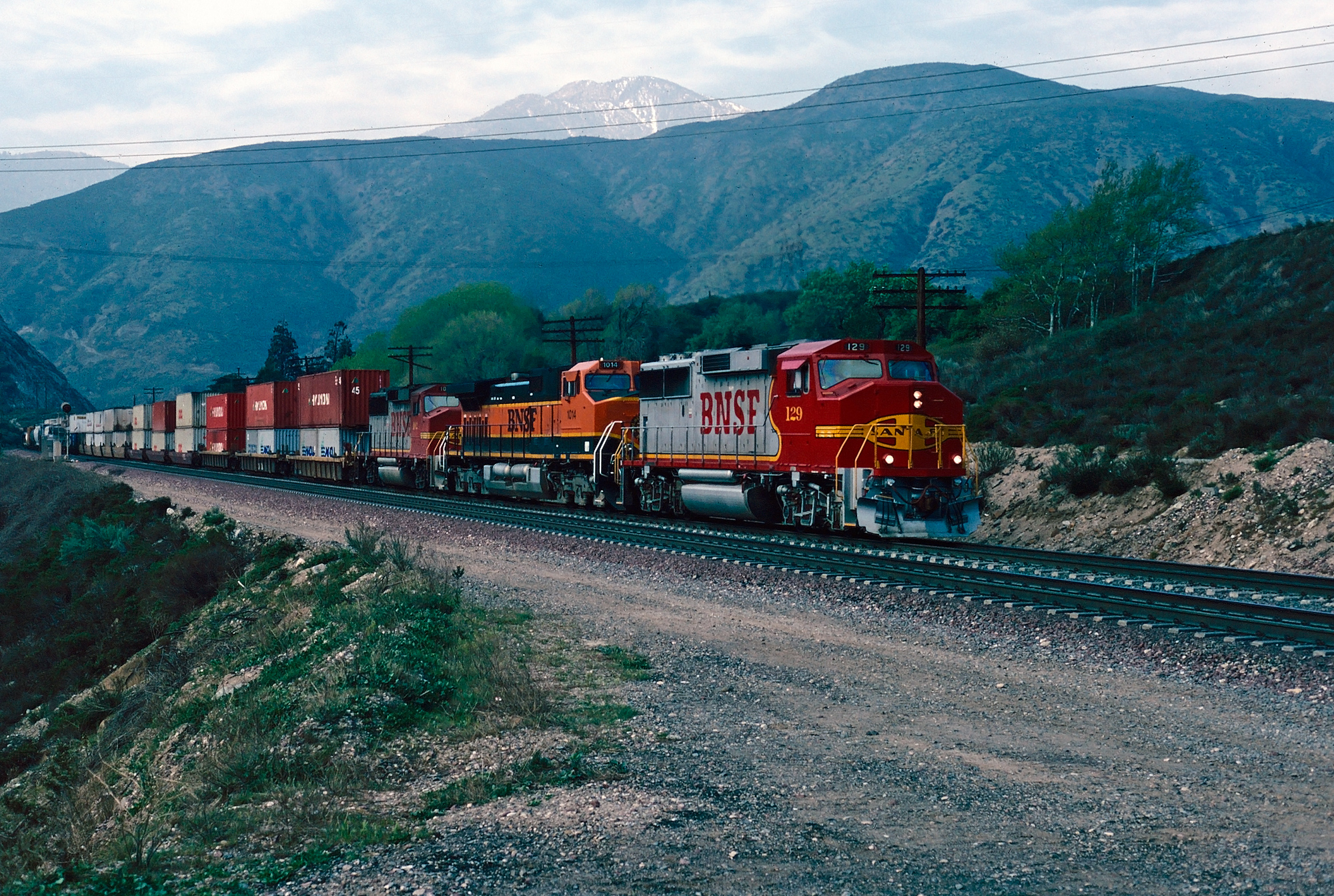 It's the early Burlington Northern Santa Fe era as a pair of former Santa Fe GP60M's, led by #129, along with BNSF C44-9W (#1014), work an eastbound up the west side of Cajon Pass at Blue Cut, California in June, 1997. American-Rails.com collection.
These consolidations eventually resulted in today's seven conglomerates. In addition, mileage was abandoned when deemed superfluous, shrinking from 1916's peak figure of 254,037 to 138,000 today. Of the current mileage Class 1's own about 95,000, or 68%.
Much of the rest (32%) has been spun off to short lines or regionals, many formed in the post-Staggers Act era (1980). In all, there are more 560 railroads currently in operation across the country including Class 1's, regionals (Class 2's), and short lines (Class 3's).
Could There Ever Be A New Class 1?
In today's modern age it is unlikely a new Class 1 will ever appear although the idea is not entirely impossible. For instance, during the 1990's a growing Wisconsin Central came close to achieving this threshold.
It was formed in January of 1987 when Soo Line sold 2,300 miles of track stretching from northern Illinois, into the Upper Peninsula of Michigan, and across Wisconsin.
By the 1990's it had transformed this derelict trackage into a profitable enterprise eclipsing $100 million annually. Perhaps weary of its growing influence, Canadian National purchased the carrier in 2001.
If a similar situation were to occur today, another prominent regional would be the obvious candidate. The most likely way for this to occur, of course, would be some type of continued growth through new acquisition.
During the industry's formative era it was relatively easy to acquire property for new route construction. The difficulty lay in gaining the necessary funding for actual grading and materials.
Unfortunately, the thought of doing this today is nearly unheard of due to the extensive regulatory process, environmental laws, and public opposition ("NIMBY," Not-In-My-Backyard). A good example is the Tongue River Railroad of southern Montana.
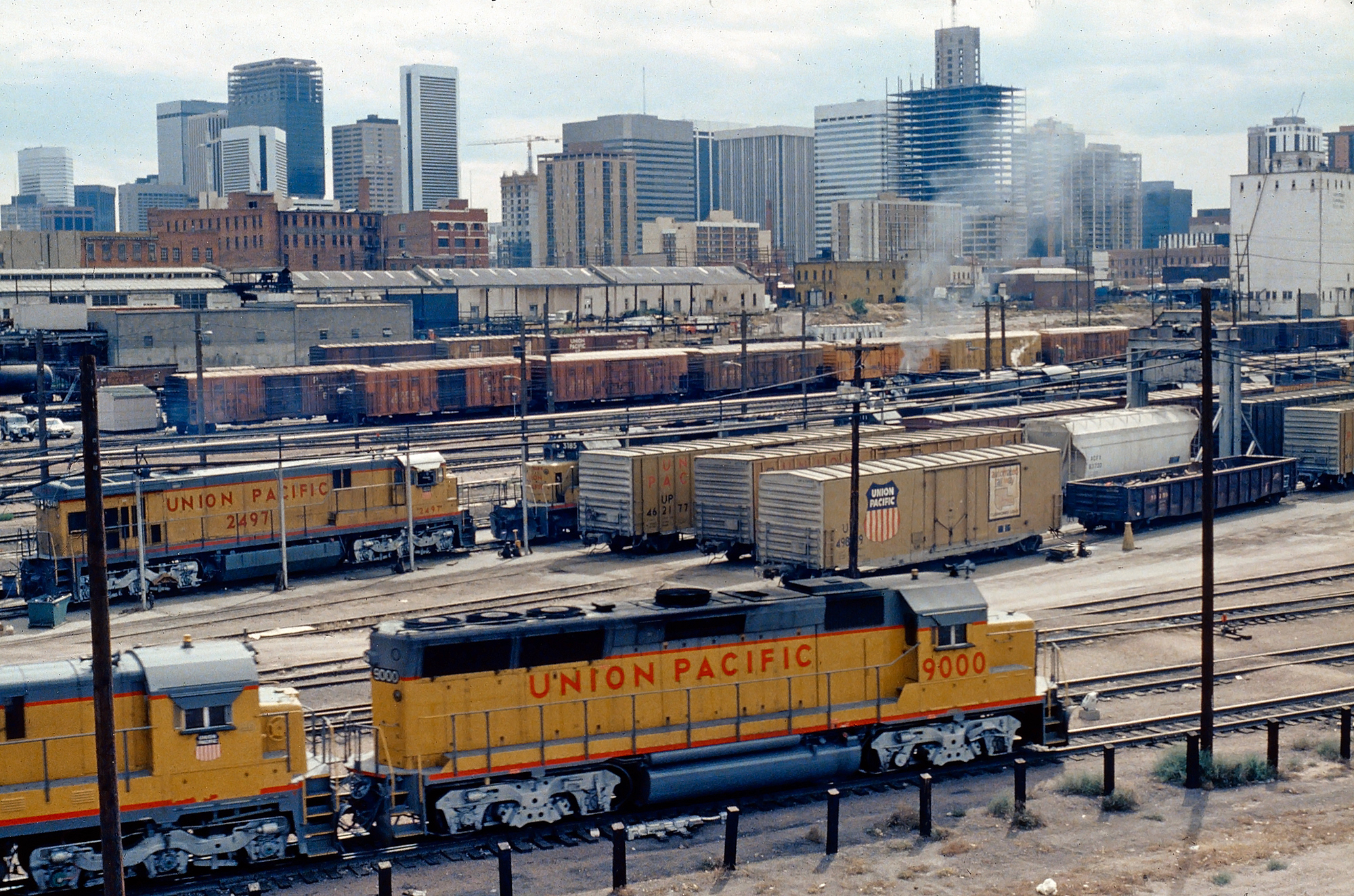 Union Pacific power, including GP40X #9000, along with C30-7 #2497 and SD40-2 #3185, layover at Rio Grande's Burnham Shops in downtown Denver, Colorado, in the summer of 1982. Barely visible in the background is Union Pacific 4-8-4 #8444, which was hosting excursions from Denver to Sterling. Mike Bledsoe photo. American-Rails.com collection.
The first proposal for this new 80-mile route was launched in 1981; projected to serve a surface coal mine at Ashland it would reach Miles City and link with the then-Burlington Northern (now BNSF Railway).
After numerous battles with environmental groups and land owners, all the while completing several environmental studies, the Surface Transportation Board (STB) finally rejected the idea in April of 2016.
The other possibility would be to revive a long-abandoned corridor. This idea has been carried out in a few cases since the 1990's but only along short stretches.
The thought of seeing a major rebuild, such as the Milwaukee Road's Pacific Coast Extension (central Montana to Seattle), the Erie Railroad's/Erie Lackawanna's Chicago main line (Ohio to Chicago), or Baltimore & Ohio's St. Louis main line (central West Virginia - southern Ohio) appears unlikely for the same reasons previously mentioned.
While these lines were direct, high-quality corridors that saw extensive use, even up until their abandonment (the closing of all three remains a hot-button issue), the idea of reactivation is remote.
But, there are many miles of preserved rights-of-way all across the country, railbanked for the express purpose of possible future use.
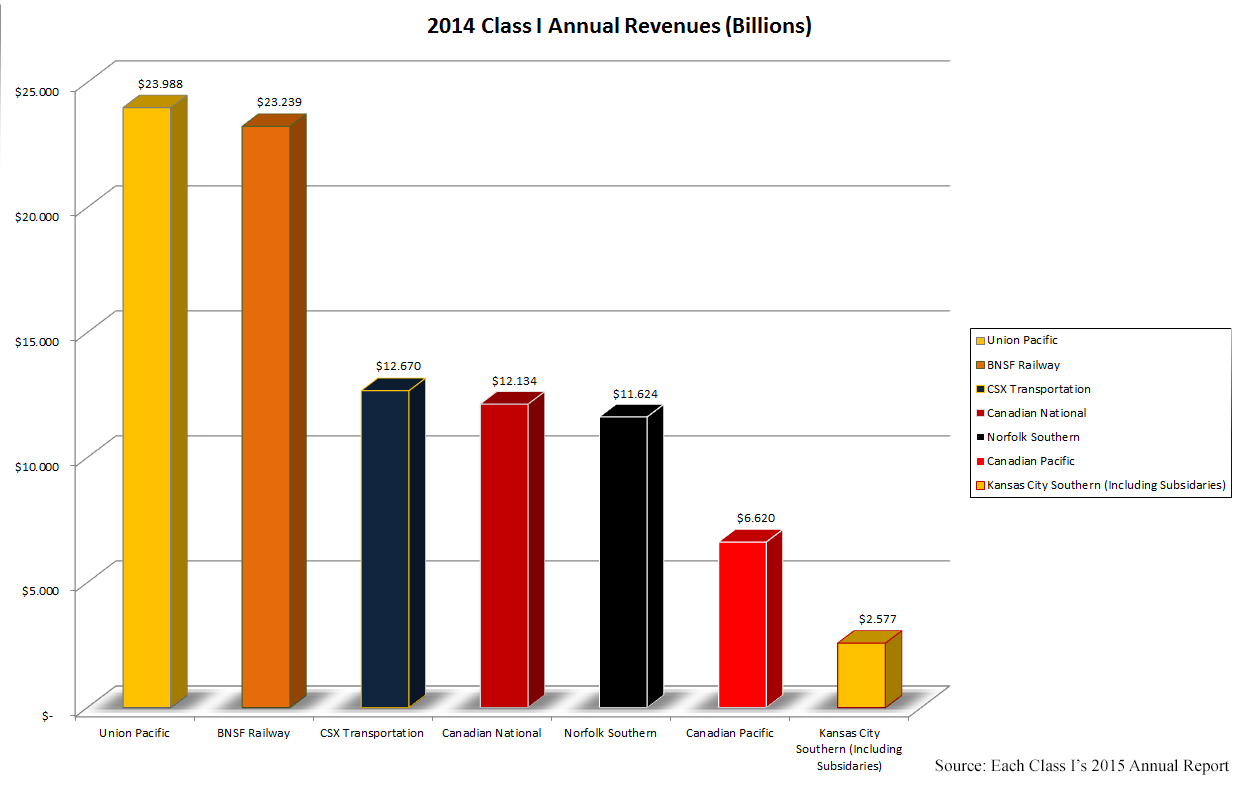
The below tables highlight each railroad (including Canadian National) regarding their 2020 operating revenue (the latest figures available). Leading the pack is Union Pacific and BNSF Railway; the former an American institution.
For generations UP has carried strong profits and keen management, traits which enabled the Omaha-based road to fluidly navigate the turbulent 1970's. BNSF Railway was a 1995 merger of Burlington Northern and the Atchison, Topeka & Santa Fe, two of the West's largest systems.
The Santa Fe was especially noteworthy, known worldwide for its legendary Chiefs and the only pre-merger railroad to boast its own transcontinental main line from Chicago to Los Angeles.
The BN came into existence on March 2, 1970 through the Burlington, Great Northern, Northern Pacific, and Spokane, Portland & Seattle. BNSF is the only Class 1 privately owned, purchased by Warren Buffett in late 2009. Also of note is the Kansas City Southern.
Its heritage can be traced back to 1887 where it eventually grew into a modest network linking Kansas City with the Gulf Coast. Beginning in the 1990's a series of takeovers pushed its network from Mexico to Chicago (via trackage rights).
Statistics
Note that in the below graphs, Canadian National has overtaken CSX as the third highest-grossing Class 1. This can be partially blamed on shifting traffic patterns and the loss of coal tonnage while CSX's leadership has also come into question.
For more statistical data please click here. As you can see from the previous link, the Association of American Railroads' website provides a great wealth of the information for research purposes.
If you are interested in digging deeper into railroad statistics, another fine resource is the Bureau of Transportation Statistics' website.
Annual Reports
Revenues (Since 2014)
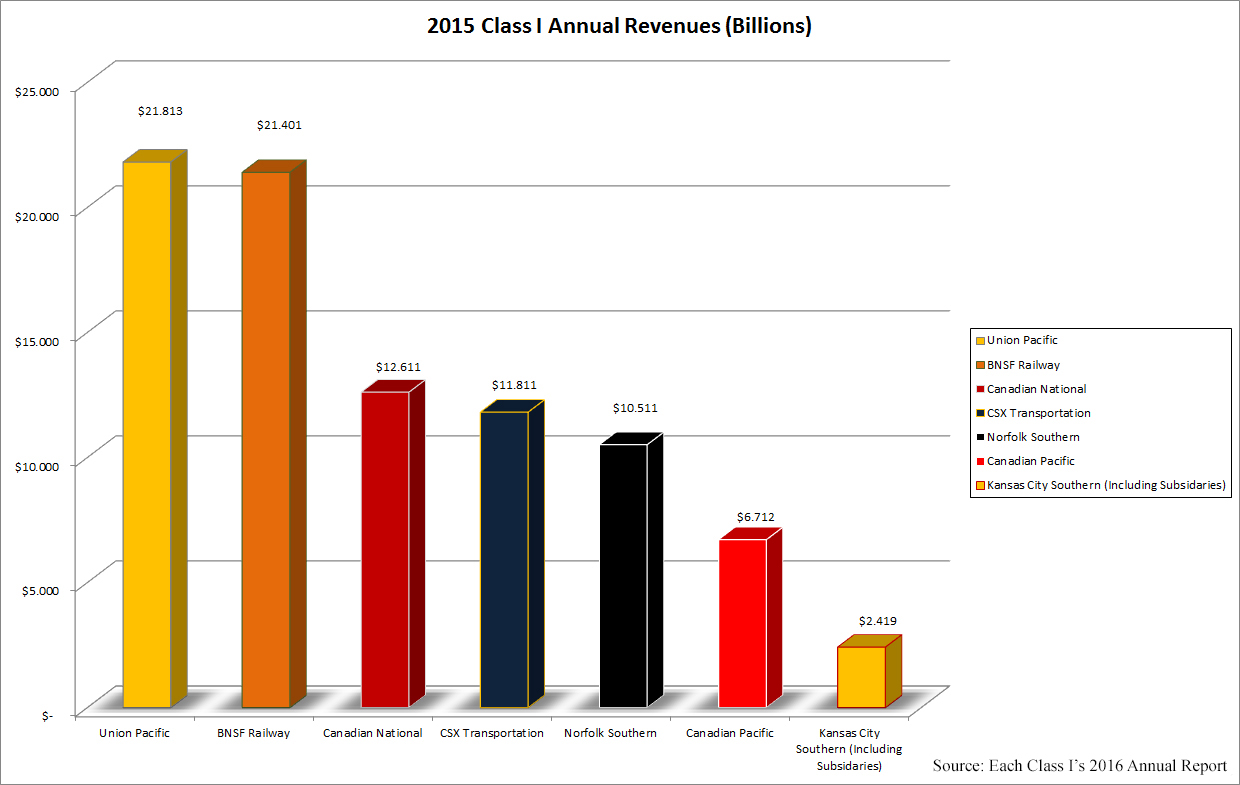
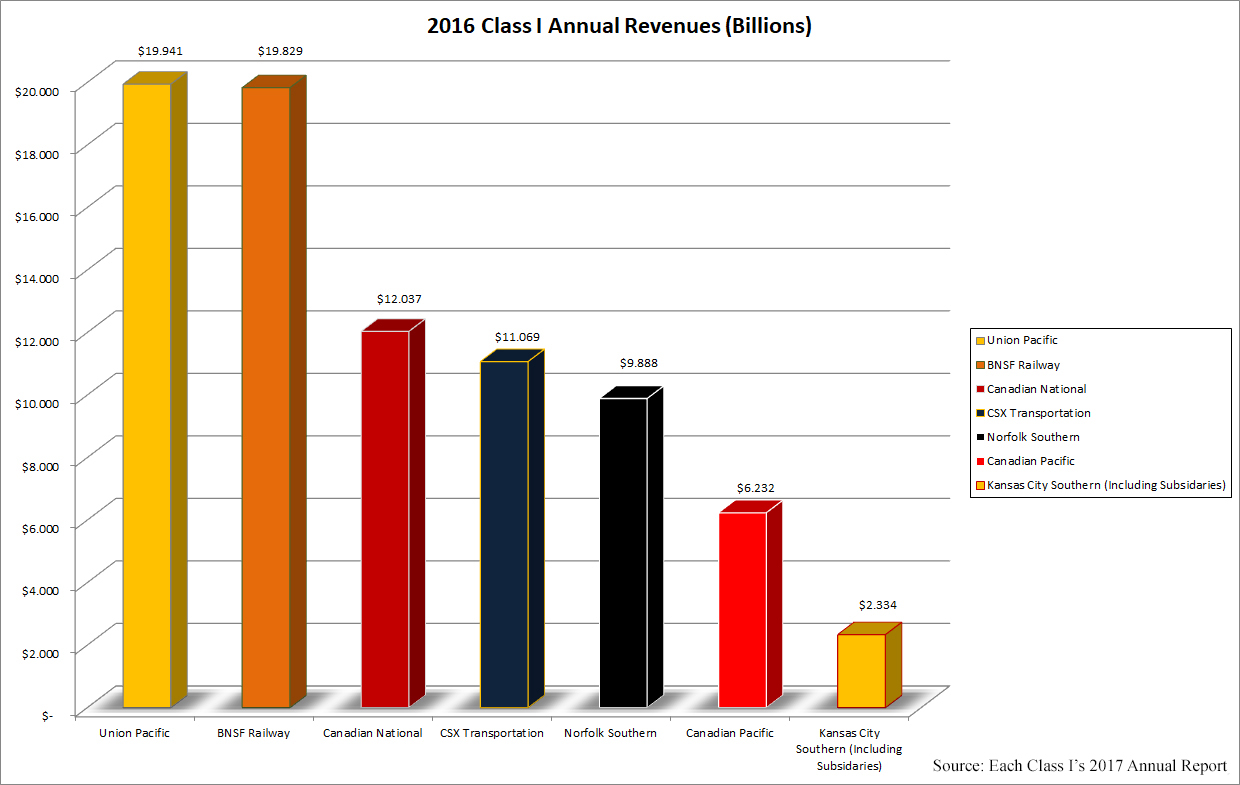
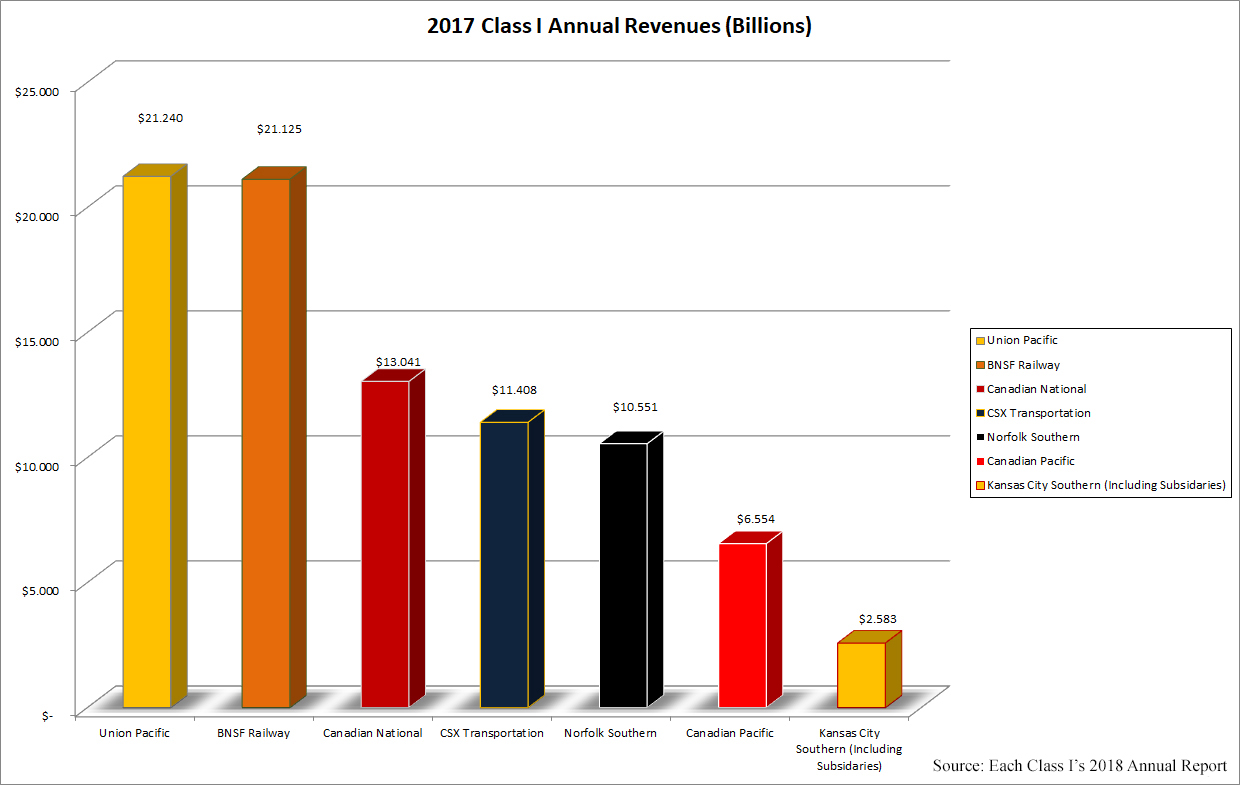
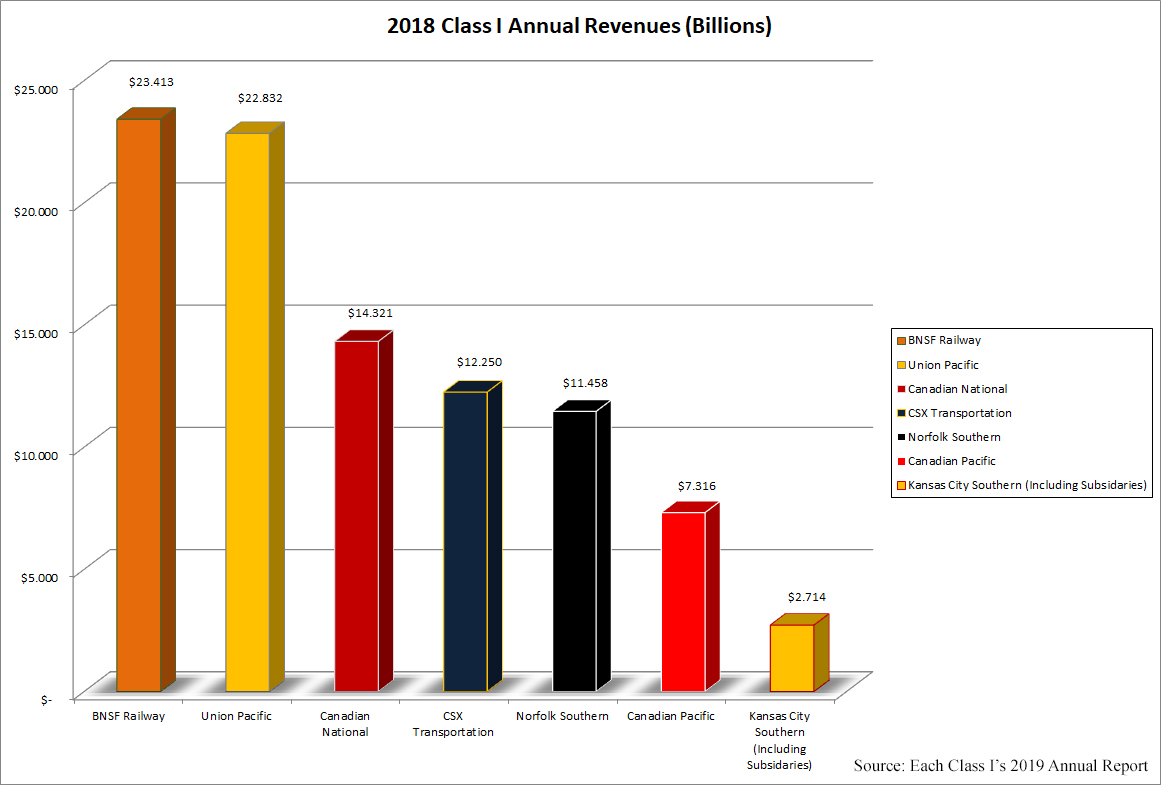
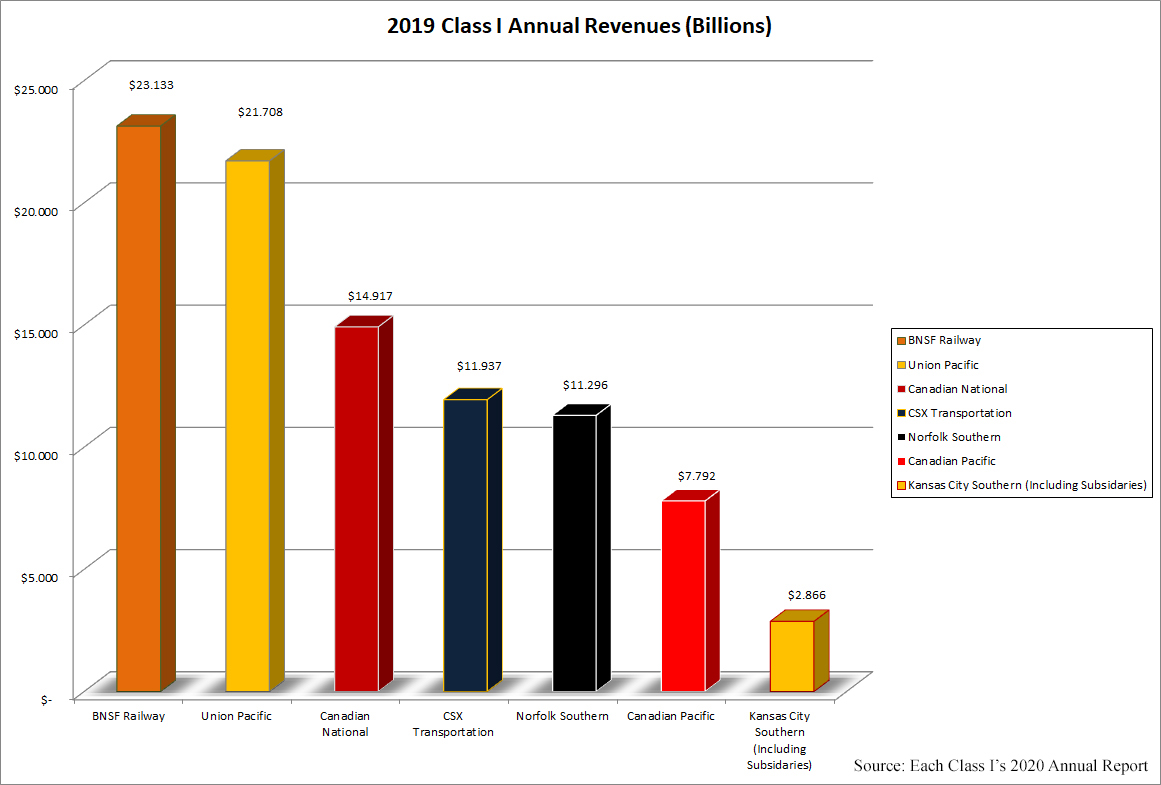
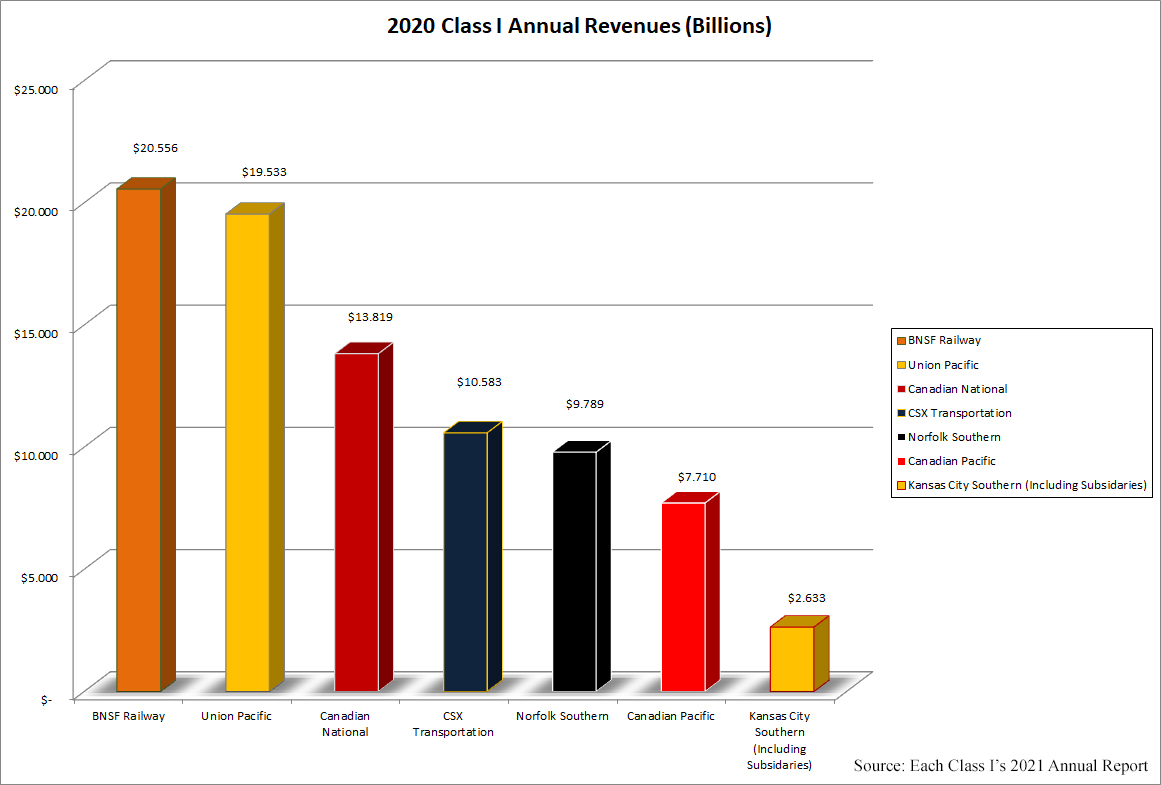
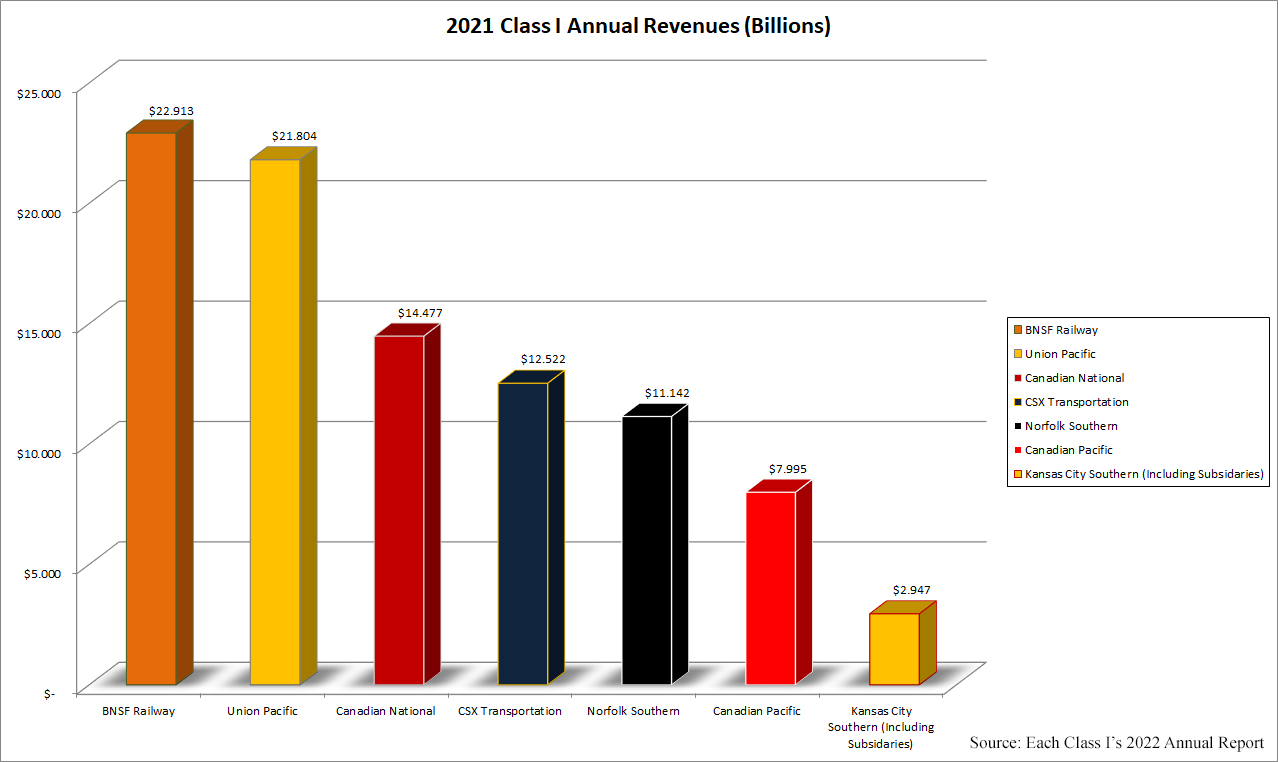
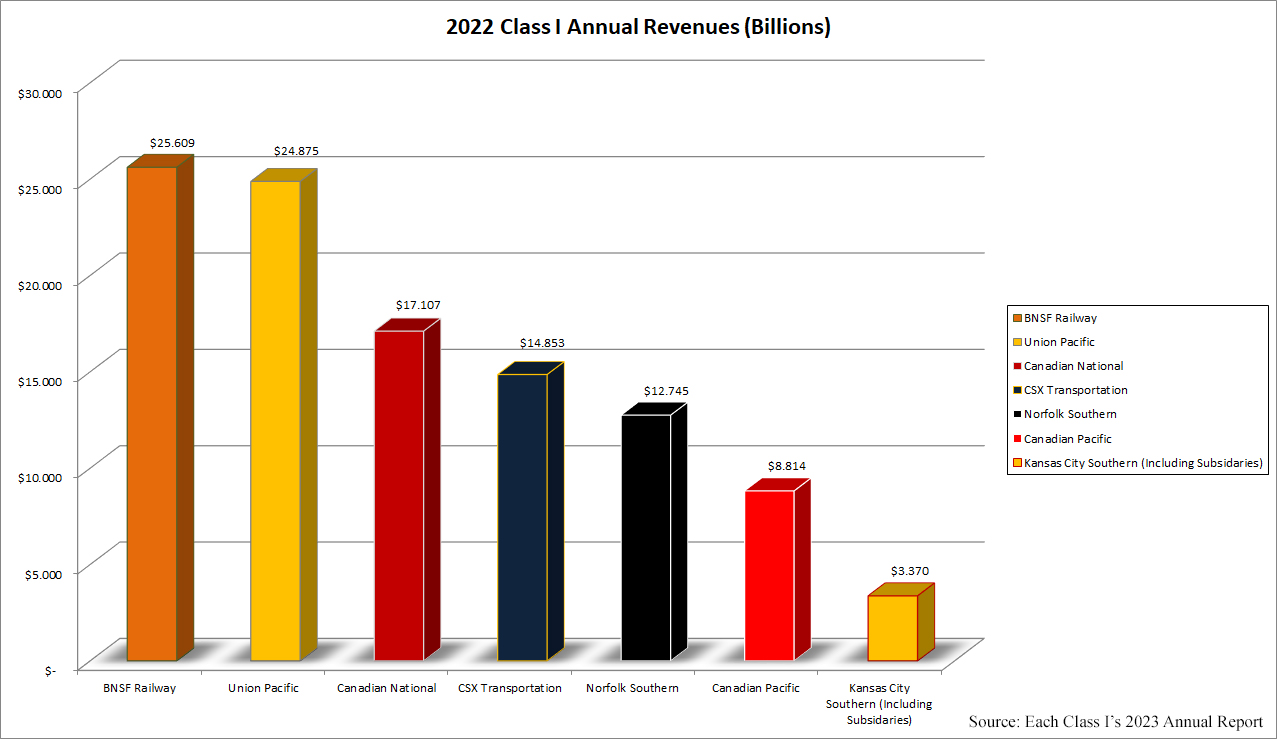
One of the industry's most interesting recent developments occurred in the fall of 2015 when Canadian Pacific openly announced plans to seek a merger with Norfolk Southern. CP had already sought a similar union with CSX, which flatly rejected the idea.
The Canadian road, through then-CEO, E. Hunter Harrison, sent a letter to NS in November, 2015 hoping for a friendly response.
But after some time, and careful deliberation, NS also turned down the proposal. CP continued to pursue the endeavor by sending additional requests, each also rejected.
Despite talk of a potential hostile takeover CP quietly dropped the idea. Had the marriage taken place it would almost certainly have caused a domino effect of other mergers, resulting in two gigantic, coast-to-coast railroads.
Current Railroads
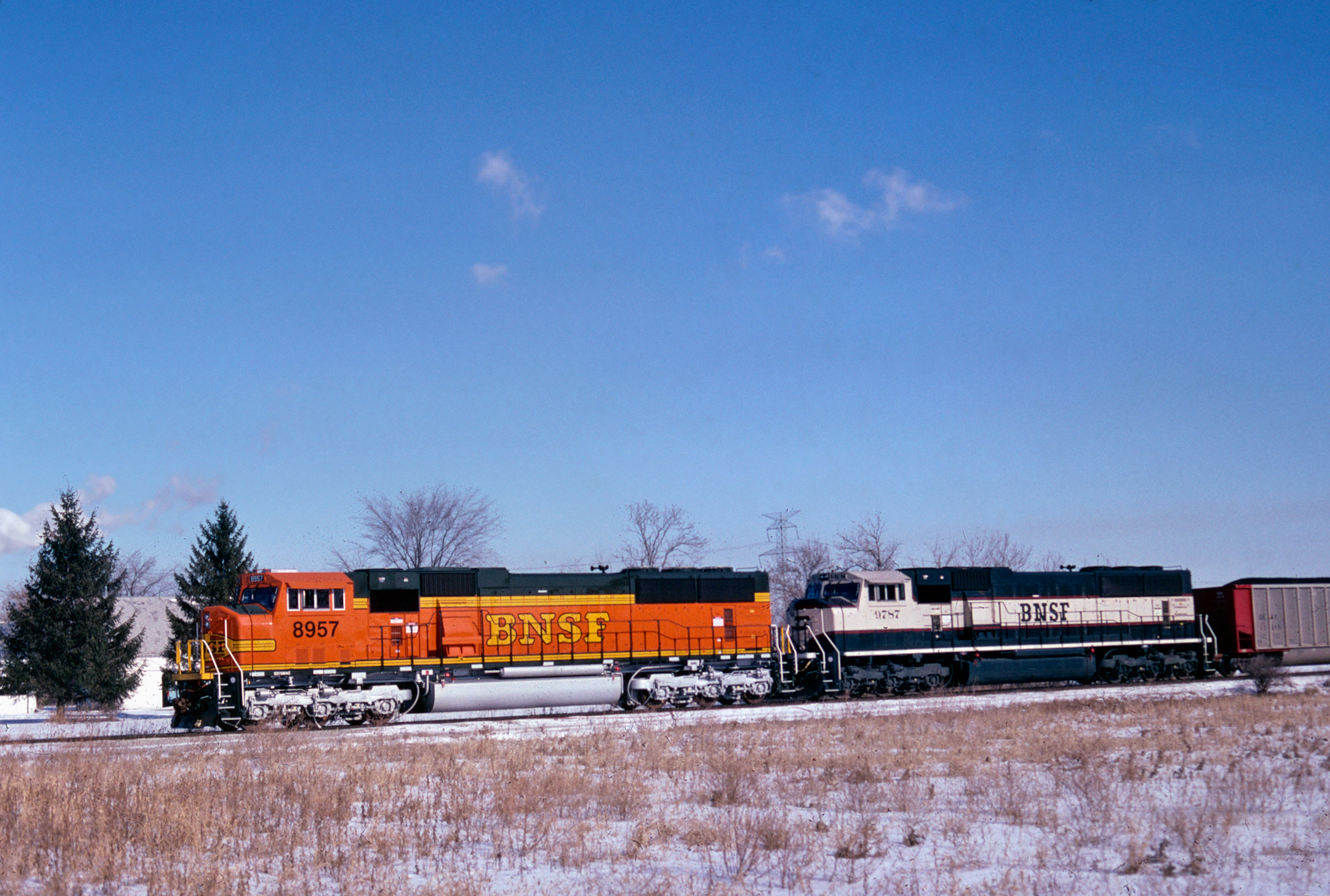 Burlington Northern Santa Fe SD70MAC #8957, wearing the "Heritage II" livery, and SD70MAC #9787, sporting the "Executive" scheme, have a cut of loaded coal hoppers at Oregon, Ohio on the Norfolk Southern in March, 2002. American-Rails.com collection.
In the end, it was not a particularly savvy proposal fraught with numerous issues, the least of which was U.S/Canadian regulatory complications.
Many experts considered the marriage a bad business decision for this reason and others. During the entire process CP had drawn little support, from within the industry and among shippers.
Interestingly, as mentioned at the top of this article, CP has continued to look for a merger partner and appears it will acquire Kansas City Southern to form the Canadian Pacific-Kansas City Railroad. The merger is expected to be finalized within the next 18-24 months
Recent Articles


-
West Pointe Route Timetables (August, 1952)
May 11, 26 08:23 PM
 Included here is the complete West Point Route timetables, including the Georgia Railroad, from the August, 1952 edition of the "Official Guide."
 -
Virginian Railway Timetables (August, 1952)
May 11, 26 04:27 PM
 Included here is the Virginian Railway's complete system map and brief timetable listing from the August, 1952 edition of the "Official Guide."
 -
RF&P Railroad Timetables (August, 1952)
May 11, 26 02:21 PM
 Featured here is the Richmond, Frederickburg & Potomac's public timetables from the August, 1952 edition of the "Official Guide."
 -
Missouri 'Wine Tasting' Train Rides
May 11, 26 12:20 PM
 The fusion of scenic vistas, historical charm, and exquisite wines is beautifully encapsulated in Missouri's wine tasting train experiences.
 -
Minnesota 'Wine Tasting' Train Rides
May 11, 26 12:19 PM
 This article takes you on a journey through Minnesota's wine tasting trains, offering a unique perspective on this novel adventure.
 -
Alabama - Whiskey Tasting - Train Rides
May 11, 26 12:14 PM
 With a little planning, you can build a memorable whiskey-and-rails getaway in the Heart of Dixie.
 -
Washington 'Murder Mystery' Dinner Train Rides
May 11, 26 12:11 PM
 This article delves into what makes murder mystery dinner train rides in Washington State such a captivating experience.
 -
Nevada 'Murder Mystery' Train Rides
May 11, 26 12:09 PM
 Seamlessly blending the romance of train travel with the allure of a theatrical whodunit, these excursions promise suspense, delight, and an unforgettable journey through Nevada’s heart.
 -
Kentucky 'Murder Mystery' Dinner Train Rides
May 11, 26 12:06 PM
 In the realm of unique travel experiences, Kentucky offers an enchanting twist that entices both locals and tourists alike: murder mystery dinner train rides.
 -
Original Norfolk Southern Timetables (January, 1930)
May 11, 26 10:06 AM
 Featured here is the complete timetable listing of the original Norfolk Southern Railway from the January, 1930 edition of the "Official Guide."
 -
Atlantic and Danville Railway: Serving Southern VA
May 11, 26 09:50 AM
 The Atlantic and Danville Railway (reporting mark AD), often referred to in its early years as the Atlantic & Danville Railroad, stands as a quintessential example of late-19th-century American railro…
 -
Interstate Railroad Timetables (January, 1910)
May 11, 26 09:25 AM
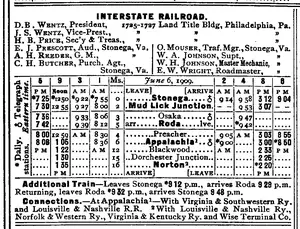
 Featured here is the Interstate Railroad's very brief timetable listing from the January, 1910 edition of the "Official Guide Of The Railways."
 -
Virginia "Whiskey Tasting" Train Rides
May 10, 26 01:01 PM
 Among the Virginia Scenic Railway's most popular specialty excursions is the “Bourbon & BBQ” tasting train, an adults-oriented rail journey that pairs scenic views of the Shenandoah Valley wit…
 -
Tennessee 'Whiskey Tasting' Train Rides
May 10, 26 12:58 PM
 Here’s what to know, who to watch, and how to plan an unforgettable rail-and-whiskey experience in the Volunteer State.
 -
New York 'Dinner Train' Rides In The Adirondacks
May 10, 26 12:51 PM
 Operating over a restored segment of the former New York Central’s Adirondack Division, the Adirondack Railroad has steadily rebuilt both track and public interest in passenger rail across the region.
 -
West Virginia 'Murder Mystery' Dinner Train Rides
May 10, 26 12:45 PM
 For those looking to combine the allure of a train ride with an engaging whodunit, the murder mystery dinner trains offer a uniquely thrilling experience.
 -
Kansas 'Murder Mystery' Dinner Train Rides
May 10, 26 12:26 PM
 Kansas, known for its sprawling wheat fields and rich history, hides a unique gem that promises both intrigue and culinary delight—murder mystery dinner trains.
 -
Florida 'Murder Mystery' Dinner Train Rides
May 10, 26 12:21 PM
 Florida, known for its vibrant culture, dazzling beaches, and thrilling theme parks, also offers a unique blend of mystery and fine dining aboard its murder mystery dinner trains.
 -
Florida East Coast Timetables (January, 1930)
May 09, 26 11:55 PM
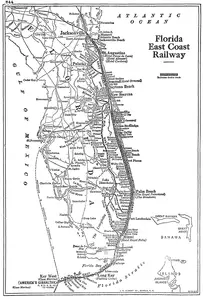
 Featured here is the Florida East Coast Railway's listing in the "Official Guide" from January, 1930 when the system still reached Key West.
 -
Clinchfield Railroad Timetables (August, 1952)
May 09, 26 01:28 PM
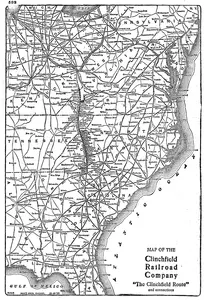
 Featured here is the Clinchfield's brief listing from the August, 1952 edition of the "Official Guide Of The Railways."
 -
California 'Beer Tasting' Train Rides
May 09, 26 10:58 AM
 While the Niles Canyon Railway is known for family-friendly weekend excursions and seasonal classics, one of its most popular grown-up offerings is Beer on the Rails.
 -
New Jersey 'Beer Tasting' Train Rides
May 09, 26 10:49 AM
 On select dates, the Woodstown Central Railroad pairs its scenery with one of South Jersey’s most enjoyable grown-up itineraries: the Brew to Brew Train.
 -
New Hampshire 'Murder Mystery' Dinner Train Rides
May 09, 26 10:32 AM
 The state's murder mystery trains stand out as a captivating blend of theatrical drama, exquisite dining, and scenic rail travel.
 -
North Carolina 'Dinner Train' Rides At Spencer
May 09, 26 10:26 AM
 Tucked into the Piedmont town of Spencer, the North Carolina Transportation Museum is the kind of place that feels less like a typical museum and more like a living rail yard that never quite stopped…
 -
Tennessee 'Dinner Train' Rides At TVRM
May 09, 26 10:16 AM
 Tucked into East Chattanooga, the Tennessee Valley Railroad Museum (TVRM) is less a “museum you walk through” and more a railroad you step aboard.
 -
Pennsylvania 'Dinner Train' Rides At Boyertown
May 09, 26 10:02 AM
 With beautifully restored vintage equipment, carefully curated menus, and theatrical storytelling woven into each trip, the Colebrookdale Railroad offers far more than a simple meal on rails.
 -
New York 'Murder Mystery' Dinner Train Rides
May 09, 26 09:54 AM
 New York State, renowned for its vibrant cities and verdant countryside, offers a plethora of activities for locals and tourists alike, including murder mystery train rides!
 -
Central of Georgia Timetables (August, 1952)
May 08, 26 11:51 PM
 Featured is the Central of Georgia Railway's complete timetable listing from the August, 1952 edition of the "Official Guide Of The Railways."
 -
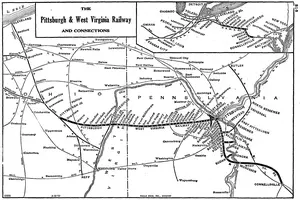
Pittsburgh & West Virginia Timetables (September, 1937)
May 08, 26 11:30 PM
 Presented here is the Pittsburgh & West Virginia's public timetables listed in the September, 1937 issue of the "Official Guide."
 -
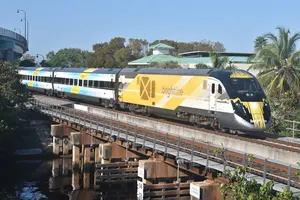
Brightline Florida Faces Debt Crisis and Future Uncertainty
May 08, 26 02:50 PM
 Florida’s pioneering private high-speed passenger rail service, Brightline, is confronting a severe liquidity crunch that has triggered auditor warnings of “substantial doubt” about its ability to con…
 -
Reading & Northern Launches Its Own Coffee Brand
May 08, 26 02:28 PM
 The Reading & Northern Railroad is thrilled to announce the launch of its very own coffee brand, Iron Horse Coffee Company. It will soon be served on all scenic train rides and in the café car located…
 -
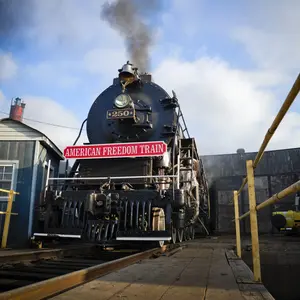
Reading 4-8-4 2100 To Be Under Steam This June
May 08, 26 02:11 PM
 fter more than a decade of intensive restoration by the American Steam Railroad Preservation Association (ASR), the legendary Reading Company 4-8-4 Northern-type steam locomotive No. 2100 will make it…
 -
Pennsylvania Murder Mystery Dinner Train Rides (2026)
May 08, 26 01:52 PM
 Pennsylvania, steeped in history and industrial heritage, offers a prime setting for a unique blend of dining and drama: the murder mystery dinner train ride.
 -
Minnesota Beer Tasting Train Rides (2026)
May 08, 26 01:43 PM
 Among the North Shore Scenic Railroad's special events, one consistently rises to the top for adults looking for a lively night out: the Beer Tasting Train.


%2C%20work%20an%20eastbound%20up%20the%20west%20side%20of%20Cajon%20Pass%20at%20Blue%20Cut%2C%20California%20in%20June%2C%201997.%20American-Rails.com%20collection.)


